EP0736835A2 - Procédé et appareil pour lire un marquage à code à matrice de points sur un article - Google Patents
Procédé et appareil pour lire un marquage à code à matrice de points sur un article Download PDFInfo
- Publication number
- EP0736835A2 EP0736835A2 EP96301265A EP96301265A EP0736835A2 EP 0736835 A2 EP0736835 A2 EP 0736835A2 EP 96301265 A EP96301265 A EP 96301265A EP 96301265 A EP96301265 A EP 96301265A EP 0736835 A2 EP0736835 A2 EP 0736835A2
- Authority
- EP
- European Patent Office
- Prior art keywords
- dots
- dot matrix
- dot
- code
- matrix code
- Prior art date
- Legal status (The legal status is an assumption and is not a legal conclusion. Google has not performed a legal analysis and makes no representation as to the accuracy of the status listed.)
- Granted
Links
Images

Classifications
-
- G—PHYSICS
- G06—COMPUTING OR CALCULATING; COUNTING
- G06K—GRAPHICAL DATA READING; PRESENTATION OF DATA; RECORD CARRIERS; HANDLING RECORD CARRIERS
- G06K7/00—Methods or arrangements for sensing record carriers, e.g. for reading patterns
- G06K7/10—Methods or arrangements for sensing record carriers, e.g. for reading patterns by electromagnetic radiation, e.g. optical sensing; by corpuscular radiation
- G06K7/14—Methods or arrangements for sensing record carriers, e.g. for reading patterns by electromagnetic radiation, e.g. optical sensing; by corpuscular radiation using light without selection of wavelength, e.g. sensing reflected white light
- G06K7/1404—Methods for optical code recognition
- G06K7/146—Methods for optical code recognition the method including quality enhancement steps
- G06K7/1491—Methods for optical code recognition the method including quality enhancement steps the method including a reconstruction step, e.g. stitching two pieces of bar code together to derive the full bar code
-
- G—PHYSICS
- G06—COMPUTING OR CALCULATING; COUNTING
- G06K—GRAPHICAL DATA READING; PRESENTATION OF DATA; RECORD CARRIERS; HANDLING RECORD CARRIERS
- G06K7/00—Methods or arrangements for sensing record carriers, e.g. for reading patterns
- G06K7/10—Methods or arrangements for sensing record carriers, e.g. for reading patterns by electromagnetic radiation, e.g. optical sensing; by corpuscular radiation
- G06K7/14—Methods or arrangements for sensing record carriers, e.g. for reading patterns by electromagnetic radiation, e.g. optical sensing; by corpuscular radiation using light without selection of wavelength, e.g. sensing reflected white light
Definitions
- the invention relates to a process and apparatus for reading a dot matrix code marking on an article.
- the dot matrix code marking comprises a plurality of rows and columns on which dots comprising the code marking are located.
- the reader produces an output which is converted into a digital form by a processor.
- a further processor is provided to determine the orientation and position of the dot matrix code from the digitised image.
- the further processor works by calculating the outer borders of the dot matrix code from the individual dots in the digitised image. This means that the edge of the dot matrix code has to have a reasonable number of dots along it and each dot must be accurately located.
- the present invention seeks to provide a process and apparatus for reading a dot matrix code marking on an article even when the marking has been obscured or damaged in some way.
- the present invention provides a process for automatically reading a dot matrix code marking on an article even when the marking has been partly obscured or damaged, comprising:
- the invention provides a process for reading a dot matrix code marking on an article, the dot matrix code marking having a plurality of rows and columns in which dots comprising the code marking are located, the process comprising the steps of:
- the predetermined criteria in step f) may be that if more than a predetermined maximum number of possible dots are mapped, the mask is adjusted by generating a further mask of dot appearance, the further mask comprising a reproduction of that dot in the image of the dot matrix code which correlates most closely to the initial mask.
- the predetermined criteria in step e) may be that if less than a predetermined minimum number of possible dots are mapped, the threshold is adjusted by decreasing the threshold by a predetermined amount, provided that the threshold is not decreased below a predetermined minimum value.
- the threshold is decreased below the predetermined minimum value, a further mask of dot appearance is generated, the further mask comprising a reproduction of that dot in the image of the dot matrix code which correlates most closely to the initial mask.
- the process ensures that a further mask can only be generated once. Therefore, if the threshold decreases to less than the predetermined minimum for a second time, or if there is a second occasion when there are more than a predetermined maximum number of dots with a correlation above the threshold, a signal is outputted signifying a failure to read the dot matrix code.
- the grid in step h) may be generated over the possible dots by continuously adjusting the relative positions of the cells with respect to the dots to ensure that the dots are contained within the cell boundaries forming the generated grid.
- Decoding of the pattern of possible dots may be accomplished by comparing the datum grid with the generated grid and outputting a valid code signal if a minimum number of cells containing dots in the generated grid correspond to cells in the datum grid.
- the dots of the dot matrix code may conveniently comprise indentations in a surface of the article.
- the dot matrix code is preferably illuminated by a strong light source shining obliquely onto the surface.
- a suitable strong light source is provided by at least one, preferably several, bright light emitting diodes.
- the initial mask preferably represents the appearance of an obliquely illuminated clean dot in a dot matrix code.
- the captured image is a video image captured by a video camera and a video frame store.
- the video camera is a CCD camera.
- Correlation may be performed by scanning of the captured video image line by line and pixel by pixel. Alternatively, to speed up scanning rates, selected of the pixels and/or lines of the captured video image may be omitted from the scanning process.
- the present invention also provides apparatus capable of performing the above process.
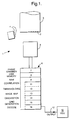
- an apparatus 1 for reading a dot matrix code marking 2 on an article 3 comprises bright LED's for illuminating the dot matrix code 2 on the article 3 and a video camera 5, for example a CCD camera, for viewing the illuminated dot matrix code 2.
- the LED's 4 are arranged to direct light at a low angle of incidence to the surface of the article 3 to increase the contrast of the dots in the dot matrix code 2.
- the camera 5 produces a video output signal corresponding to an image of the dot matrix code 2.
- the output signal is supplied to a computer 6, for example a personal computer, which has a frame grabber card 7 to grab and store the image of the dot matrix code 2.
- a predefined initial default mask of expected dot appearance is stored in memory 8 of the computer 6, e.g. On a hard disk.
- This mask corresponding to an image of sideiit, clean dots, is loaded from disk into RAM 9 of the PC. However, it will be modified during subsequent stages of the process, as explained later.
- the dot appearance will be different, for example the dots may be filled with dirt.
- the system If insufficient correlation between the dots and the initial mask is found, the system generates a further mask. To do so, it selects the dot in the captured image having the best correlation with the initial mask, reduces the expected correlation between image and mask by a certain amount, e.g., 20%, so as to Include further dots which fit with the reduced correlation, and generates the further mask, consisting of dots which reproduce the selected dot in the captured image.
- a certain amount e.g. 20%
- the correlation process above is a two dimensional correlation carried out by correlation software 11.
- Two dimensional correlation is a well known mathematical process and can be readily coded for incorporation in image processing software such as is used for the present invention.
- the correlation software 11 scans the image pixel by pixel and line by line. If a faster reading is required, the correlation can be carried out using a selectable "skip" function so that, e.g., the correlation software 11 only scans every other pixel and every other line. Full scanning gives slightly better definition and fewer errors in decoding, but the system is still able to correctly read dot matrix codes even with incomplete scanning.
- a VDU 10 can be used to display the image at any of the stages of image processing, if desired. However, in a system for production line use, this would not be necessary, since the output 17 of the system can be merely a switching signal to give an aural and/or visual indication that the dot matrix code 2 viewed by camera 5 has or has not been successfully decoded.
- Figure 2a is a representation of a VDU image showing the results of the above initial correlation step, the image showing the dots of the code 2 as bright spots S, with scattered points P of noise.
- some of the spots S may be defects or foreign matter on the surface of the article being examined, rather than part of the dot matrix code 2, having been misidentified by the initial correlation process.
- Correlation software 11 works in conjunction with thresholding software 12, which sets a predetermined initial threshold for the correlation process so that only dots on the image having a correlation above the threshold are selected as being acceptably correlated to the mask.
- thresholding software 12 sets a predetermined initial threshold for the correlation process so that only dots on the image having a correlation above the threshold are selected as being acceptably correlated to the mask.
- the threshold is dropped by, say, 4 on the scale of correlation and the correlation process is repeated. If the number of dots selected is sufficient for decoding, but no code can be derived, then the threshold is dropped by a smaller amount, say 2, before the correlation process is repeated. If the number of dots selected is greater than a predetermined number, say 100, this is taken to be indicative that a new mask is required to set stricter correlation standards. Consequently, a new mask is generated, consisting of dots which reproduce that dot in the captured image having the best correlation to the initial mask.
- an image map 13 exists in RAM, corresponding to those dots which have a correlation above the threshold. If the image map 13 is displayed on VDU 10, an image like Fig. 2b can be generated.
- orientation software 14 described in more detail in our prior patent application GB9405337.8.
- a histogram of the inter-dot spacings is formed and the column and row spacings of the dots are extracted.
- the image is then checked to ensure if it requires reorientation. Reorientation may be necessary because there was no way of knowing (assuming the spacings between the dots in the rows and in the columns are identical) whether the row of dots selected above because it had the shortest inter-dot spacings, represented a row or a column in the actual dot matrix code. In this example we are considering a 6 x 15 matrix, so in effect the image is checked to see if there are 15 dots along from left to right and if not the image is rotated through a right angle to obtain a final read orientation.
- the actual process by which the reorientation in the previous sentence is achieved comprises summing the squares of the inter-dot spacings for all dots lying on lines running parallel to the above-mentioned normal axis. This may be designated the x-direction. Similarly, the squares of the inter-dot spacings are summed for all dots lying on lines running at right angles to the normal axis. This may be designated the y-direction. If the sum of the squares of the inter-dot spacings in the x direction are greater than the sum of the squares of the inter-dot spacings in the y direction, then the image is in the correct orientation. Otherwise, the image must be rotated through a right angle sc that it can be accurately decoded.
- grid generation software 15 constructs a so-called "set grid" over the dots in the image map resulting from the above process.
- the set grid to comprise a 20x20 set of cells. Firstly, the centre of the group of dots in the image is found from the average dot position. The closest dot to the centre is found and a cell is placed around it ( Figure 2c). The set grid is then produced by spreading out from the centre cell first vertically for 10 cells up and down and then horizontally 10 cells left and right, with the grid being adjusted for the dot positions on the image (shown for a smaller grid in Figure 2d).
- Decoding software 16 calls up a datum grid from disk 8. This is positioned and moved over the set grid column by column and row by row until at least 20 cells of the set grid that contain dots are covered by the datum grid. Any dots outside the datum grid are then ignored and decoding of the dot matrix code is attempted by translating the pattern of dots thus captured in the datum grid into a numerical code and comparing it with a list of allowable codes held on disk 8. Decoding is attempted in two orientations of the mapped image of the dots, first at the actual orientation and secondly at 180° to the actual orientation, in case the image is upside-down.
- the dot matrix code includes error correction bits and cyclic redundancy checks and the decoding software 16 uses these to construct the dot matrix code from the dots found in the datum grid. If a valid code is found, an output signal 17 to this effect is generated and the value of the valid code may be output to VDU 10, which may also display the number of errors found in the datum grid that have been corrected for, as a measure of the quality of the initial image of the dot matrix code. However, if no valid code is found, the thresholding software 12 reduces the threshold by, say, 2 and the process is repeated.
- a 6 x 15 matrix is used for the dot matrix code 2.
- This has 10 groups of 9 dots, 8 of the groups providing the code and 2 providing cyclic redundancy checks.
- Each 9 dot group consists of 5 data bits and 4 error correcting bits. The error correction allows correction for one missing dot in any group and the code arrangement used allows the corners to be lost without losing 2 dots from any one code group.
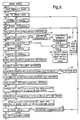
- Figure 3 shows a flow chart illustrating the steps of an exemplary process according to the invention.
- the article 3 is positioned in front of the camera 5 and the computer 6 carries out the steps of the process as follows:
- the matrix code contains error correction bits and cyclic redundancy checks which allow a missing dot from any portion of the code to be corrected for and the code is distributed throughout the matrix so that parts of the matrix may be damaged without losing the code.
Landscapes
- Engineering & Computer Science (AREA)
- Physics & Mathematics (AREA)
- Toxicology (AREA)
- Health & Medical Sciences (AREA)
- Electromagnetism (AREA)
- General Health & Medical Sciences (AREA)
- Artificial Intelligence (AREA)
- Computer Vision & Pattern Recognition (AREA)
- General Physics & Mathematics (AREA)
- Theoretical Computer Science (AREA)
- Quality & Reliability (AREA)
- Image Processing (AREA)
- Image Analysis (AREA)
Applications Claiming Priority (2)
| Application Number | Priority Date | Filing Date | Title |
|---|---|---|---|
| GB9507098 | 1995-04-06 | ||
| GBGB9507098.3A GB9507098D0 (en) | 1995-04-06 | 1995-04-06 | Process and apparatus for reading a dot matrix code marking of an article |
Publications (3)
| Publication Number | Publication Date |
|---|---|
| EP0736835A2 true EP0736835A2 (fr) | 1996-10-09 |
| EP0736835A3 EP0736835A3 (fr) | 2000-05-10 |
| EP0736835B1 EP0736835B1 (fr) | 2003-08-20 |
Family
ID=10772604
Family Applications (1)
| Application Number | Title | Priority Date | Filing Date |
|---|---|---|---|
| EP96301265A Expired - Lifetime EP0736835B1 (fr) | 1995-04-06 | 1996-02-26 | Procédé pour lire un marquage à code à matrice de points sur un article |
Country Status (4)
| Country | Link |
|---|---|
| US (1) | US5892846A (fr) |
| EP (1) | EP0736835B1 (fr) |
| DE (1) | DE69629514T2 (fr) |
| GB (1) | GB9507098D0 (fr) |
Cited By (2)
| Publication number | Priority date | Publication date | Assignee | Title |
|---|---|---|---|---|
| EP0836149A3 (fr) * | 1996-10-10 | 2002-01-02 | Xerox Corporation | Méthode et appareil pour lire des trames de points |
| EP3855342A1 (fr) * | 2020-01-27 | 2021-07-28 | Sick Ag | Lecture de codes optiques |
Families Citing this family (8)
| Publication number | Priority date | Publication date | Assignee | Title |
|---|---|---|---|---|
| EP1548635B1 (fr) | 2002-09-26 | 2009-06-24 | Kenji Yoshida | Procede entree/sortie de reproduction d'information a systeme de points et dispositif de reproduction d'information |
| US8316068B2 (en) | 2004-06-04 | 2012-11-20 | Telefonaktiebolaget Lm Ericsson (Publ) | Memory compression |
| WO2006117869A1 (fr) | 2005-04-28 | 2006-11-09 | Kenji Yoshida | Méthode d’entrée/sortie d’informations utilisant un motif de points |
| JP3771252B1 (ja) | 2005-07-01 | 2006-04-26 | 健治 吉田 | ドットパターン |
| JP4019114B1 (ja) | 2006-09-04 | 2007-12-12 | 株式会社I・Pソリューションズ | 情報出力装置 |
| AU2007254595B2 (en) * | 2007-12-20 | 2011-04-07 | Canon Kabushiki Kaisha | Constellation detection |
| US7874496B2 (en) * | 2008-01-04 | 2011-01-25 | Microsoft Corporation | Optically readable tag |
| DE102010014937B4 (de) | 2010-04-14 | 2013-10-17 | Ioss Intelligente Optische Sensoren & Systeme Gmbh | Verfahren zum Lesen eines Codes auf einem Substrat durch Zusammensetzen von Code-Fragmenten unter Verwendung eines bildgebenden Codelesers |
Family Cites Families (11)
| Publication number | Priority date | Publication date | Assignee | Title |
|---|---|---|---|---|
| US4408342A (en) * | 1981-04-16 | 1983-10-04 | Ncr Corporation | Method for recognizing a machine encoded character |
| US4809342A (en) * | 1984-11-27 | 1989-02-28 | Kappner Helmut A | Process and arrangements for the indentification marking and recognition of objects |
| GB2201808B (en) * | 1987-02-25 | 1990-12-05 | Rolls Royce Plc | Identification in manufacture |
| DE3852153T2 (de) * | 1987-07-11 | 1995-05-11 | Hirokazu Yoshida | Verfahren zum Lesen von Blättern mit Identifikationscode. |
| FR2622992B1 (fr) * | 1987-11-06 | 1990-02-09 | Thomson Semiconducteurs | Procede de lecture de codes a barres |
| US4939354A (en) * | 1988-05-05 | 1990-07-03 | Datacode International, Inc. | Dynamically variable machine readable binary code and method for reading and producing thereof |
| US5128528A (en) * | 1990-10-15 | 1992-07-07 | Dittler Brothers, Inc. | Matrix encoding devices and methods |
| US5202552A (en) * | 1991-04-22 | 1993-04-13 | Macmillan Bloedel Limited | Data with perimeter identification tag |
| US5357095A (en) * | 1992-07-16 | 1994-10-18 | Schiapparelli Biosystems, Inc. | Reagent bottle identification and reagent monitoring system for a chemical analyzer |
| JPH0683964A (ja) * | 1992-08-31 | 1994-03-25 | Takayama:Kk | 画像照合方法 |
| GB2290137B (en) * | 1994-03-18 | 1998-03-11 | Rolls Royce Plc | A method and apparatus for identifying the orientation of a dot matrix code marking of an article |
-
1995
- 1995-04-06 GB GBGB9507098.3A patent/GB9507098D0/en active Pending
-
1996
- 1996-02-26 DE DE69629514T patent/DE69629514T2/de not_active Expired - Lifetime
- 1996-02-26 EP EP96301265A patent/EP0736835B1/fr not_active Expired - Lifetime
- 1996-02-28 US US08/608,574 patent/US5892846A/en not_active Expired - Lifetime
Cited By (3)
| Publication number | Priority date | Publication date | Assignee | Title |
|---|---|---|---|---|
| EP0836149A3 (fr) * | 1996-10-10 | 2002-01-02 | Xerox Corporation | Méthode et appareil pour lire des trames de points |
| EP3855342A1 (fr) * | 2020-01-27 | 2021-07-28 | Sick Ag | Lecture de codes optiques |
| US11250228B2 (en) | 2020-01-27 | 2022-02-15 | Sick Ag | Reading of optical codes |
Also Published As
| Publication number | Publication date |
|---|---|
| US5892846A (en) | 1999-04-06 |
| DE69629514D1 (de) | 2003-09-25 |
| EP0736835B1 (fr) | 2003-08-20 |
| GB9507098D0 (en) | 1995-05-31 |
| EP0736835A3 (fr) | 2000-05-10 |
| DE69629514T2 (de) | 2004-02-26 |
Similar Documents
| Publication | Publication Date | Title |
|---|---|---|
| US7107506B2 (en) | Method of detecting two-dimensional codes | |
| JP4557433B2 (ja) | 郵便番号読取り用の撮像エンジンおよび技術 | |
| US5814801A (en) | Maxicode data extraction using spatial domain features exclusive of fourier type domain transfer processing | |
| EP0669593B1 (fr) | Procédé de reconnaissance de code bidimensionnel | |
| CN1043545C (zh) | 条形码读取装置 | |
| JP2547187B2 (ja) | 三次元表面形状を表現するためのデータ形成装置 | |
| US6364209B1 (en) | Data reading apparatus | |
| EP0999519B1 (fr) | Procédé de correction de distorsion survenant lors de la lecture d'un code optique | |
| KR20120023646A (ko) | 2차원 심볼 코드 및 이 심볼 코드를 판독하는 방법 | |
| EP0491555A1 (fr) | Procédé et appareil pour l'inspection d'objets transparents | |
| EP1416421B1 (fr) | Système et procédé pour la détection de codes à barres | |
| JP2000501209A (ja) | サブ−ピクセルデータフォームリーダー | |
| EP0736835B1 (fr) | Procédé pour lire un marquage à code à matrice de points sur un article | |
| EP0523152A4 (en) | Real time three dimensional sensing system | |
| US6839450B2 (en) | Detecting halftone modulations embedded in an image | |
| JPS61190675A (ja) | グレイスケ−ルにおける画素フイ−ルドにより表現される画像を2値スケ−ルにおける画素フイ−ルドに変換する方法および装置 | |
| JPH0157394B2 (fr) | ||
| US7278585B2 (en) | Redundant two-dimensional code and a decoding method | |
| US4691367A (en) | Method and apparatus for omnidirectional reading of data bases | |
| EP0382293A1 (fr) | Méthode et appareil pour convertir la résolution d'une image représentée par un motif de pixels bivalents | |
| US7487916B2 (en) | Imaging-based bar code reader with enhanced decoding capability | |
| AU773496B2 (en) | Method and device for synchronisation in the encoding and decoding of data that are printed in data tapes | |
| EP0825548B1 (fr) | Lecteur laser de code à barre pour une barre combustible dans un réacteur nucléaire à eau bouillante | |
| JPH08510584A (ja) | 物品のドットマトリックス符号標識の方位を識別するための方法及び装置 | |
| JP2002131031A (ja) | 三次元形状計測方法および三次元形状計測装置 |
Legal Events
| Date | Code | Title | Description |
|---|---|---|---|
| PUAI | Public reference made under article 153(3) epc to a published international application that has entered the european phase |
Free format text: ORIGINAL CODE: 0009012 |
|
| AK | Designated contracting states |
Kind code of ref document: A2 Designated state(s): DE FR GB |
|
| PUAL | Search report despatched |
Free format text: ORIGINAL CODE: 0009013 |
|
| AK | Designated contracting states |
Kind code of ref document: A3 Designated state(s): DE FR GB |
|
| RIC1 | Information provided on ipc code assigned before grant |
Free format text: 7G 06K 7/14 A, 7G 06K 7/10 B |
|
| 17P | Request for examination filed |
Effective date: 20000408 |
|
| 17Q | First examination report despatched |
Effective date: 20001106 |
|
| GRAH | Despatch of communication of intention to grant a patent |
Free format text: ORIGINAL CODE: EPIDOS IGRA |
|
| RTI1 | Title (correction) |
Free format text: PROCESS FOR READING A DOT MATRIX CODE MARKING ON AN ARTICLE |
|
| GRAS | Grant fee paid |
Free format text: ORIGINAL CODE: EPIDOSNIGR3 |
|
| GRAA | (expected) grant |
Free format text: ORIGINAL CODE: 0009210 |
|
| AK | Designated contracting states |
Designated state(s): DE FR GB |
|
| REG | Reference to a national code |
Ref country code: GB Ref legal event code: FG4D |
|
| REF | Corresponds to: |
Ref document number: 69629514 Country of ref document: DE Date of ref document: 20030925 Kind code of ref document: P |
|
| ET | Fr: translation filed | ||
| PLBE | No opposition filed within time limit |
Free format text: ORIGINAL CODE: 0009261 |
|
| STAA | Information on the status of an ep patent application or granted ep patent |
Free format text: STATUS: NO OPPOSITION FILED WITHIN TIME LIMIT |
|
| 26N | No opposition filed |
Effective date: 20040524 |
|
| REG | Reference to a national code |
Ref country code: FR Ref legal event code: PLFP Year of fee payment: 20 |
|
| PGFP | Annual fee paid to national office [announced via postgrant information from national office to epo] |
Ref country code: DE Payment date: 20150226 Year of fee payment: 20 |
|
| PGFP | Annual fee paid to national office [announced via postgrant information from national office to epo] |
Ref country code: FR Payment date: 20150217 Year of fee payment: 20 Ref country code: GB Payment date: 20150226 Year of fee payment: 20 |
|
| REG | Reference to a national code |
Ref country code: DE Ref legal event code: R071 Ref document number: 69629514 Country of ref document: DE |
|
| REG | Reference to a national code |
Ref country code: GB Ref legal event code: PE20 Expiry date: 20160225 |
|
| PG25 | Lapsed in a contracting state [announced via postgrant information from national office to epo] |
Ref country code: GB Free format text: LAPSE BECAUSE OF EXPIRATION OF PROTECTION Effective date: 20160225 |