EP0736878B2 - Procédé pour atténuer la propagation des criques - Google Patents
Procédé pour atténuer la propagation des criques Download PDFInfo
- Publication number
- EP0736878B2 EP0736878B2 EP96302020A EP96302020A EP0736878B2 EP 0736878 B2 EP0736878 B2 EP 0736878B2 EP 96302020 A EP96302020 A EP 96302020A EP 96302020 A EP96302020 A EP 96302020A EP 0736878 B2 EP0736878 B2 EP 0736878B2
- Authority
- EP
- European Patent Office
- Prior art keywords
- noble metal
- palladium
- water
- reactor
- radiation
- Prior art date
- Legal status (The legal status is an assumption and is not a legal conclusion. Google has not performed a legal analysis and makes no representation as to the accuracy of the status listed.)
- Expired - Lifetime
Links
- 238000000034 method Methods 0.000 title claims description 32
- 230000000116 mitigating effect Effects 0.000 title claims description 9
- KDLHZDBZIXYQEI-UHFFFAOYSA-N Palladium Chemical compound [Pd] KDLHZDBZIXYQEI-UHFFFAOYSA-N 0.000 claims description 111
- XLYOFNOQVPJJNP-UHFFFAOYSA-N water Substances O XLYOFNOQVPJJNP-UHFFFAOYSA-N 0.000 claims description 59
- 229910052763 palladium Inorganic materials 0.000 claims description 53
- 229910000510 noble metal Inorganic materials 0.000 claims description 50
- 230000005855 radiation Effects 0.000 claims description 49
- 238000005260 corrosion Methods 0.000 claims description 22
- 230000007797 corrosion Effects 0.000 claims description 22
- 229910052751 metal Inorganic materials 0.000 claims description 22
- 239000002184 metal Substances 0.000 claims description 22
- 150000002736 metal compounds Chemical class 0.000 claims description 16
- 239000002826 coolant Substances 0.000 claims description 12
- 229910001220 stainless steel Inorganic materials 0.000 claims description 12
- 150000001875 compounds Chemical class 0.000 claims description 11
- 238000000354 decomposition reaction Methods 0.000 claims description 11
- 239000010935 stainless steel Substances 0.000 claims description 11
- 229910045601 alloy Inorganic materials 0.000 claims description 10
- 239000000956 alloy Substances 0.000 claims description 10
- 238000005336 cracking Methods 0.000 claims description 10
- JKDRQYIYVJVOPF-FDGPNNRMSA-L palladium(ii) acetylacetonate Chemical compound [Pd+2].C\C([O-])=C\C(C)=O.C\C([O-])=C\C(C)=O JKDRQYIYVJVOPF-FDGPNNRMSA-L 0.000 claims description 10
- PXHVJJICTQNCMI-UHFFFAOYSA-N Nickel Chemical compound [Ni] PXHVJJICTQNCMI-UHFFFAOYSA-N 0.000 claims description 9
- 229910052759 nickel Inorganic materials 0.000 claims description 5
- 150000002902 organometallic compounds Chemical class 0.000 claims description 2
- 239000010963 304 stainless steel Substances 0.000 description 18
- 229910000589 SAE 304 stainless steel Inorganic materials 0.000 description 18
- UFHFLCQGNIYNRP-UHFFFAOYSA-N Hydrogen Chemical compound [H][H] UFHFLCQGNIYNRP-UHFFFAOYSA-N 0.000 description 16
- 229910052739 hydrogen Inorganic materials 0.000 description 16
- 239000001257 hydrogen Substances 0.000 description 16
- 239000000243 solution Substances 0.000 description 15
- 239000000463 material Substances 0.000 description 14
- 230000001590 oxidative effect Effects 0.000 description 12
- 230000004044 response Effects 0.000 description 11
- BASFCYQUMIYNBI-UHFFFAOYSA-N platinum Chemical compound [Pt] BASFCYQUMIYNBI-UHFFFAOYSA-N 0.000 description 10
- QVGXLLKOCUKJST-UHFFFAOYSA-N atomic oxygen Chemical compound [O] QVGXLLKOCUKJST-UHFFFAOYSA-N 0.000 description 7
- 229910052760 oxygen Inorganic materials 0.000 description 7
- 239000001301 oxygen Substances 0.000 description 7
- 238000012360 testing method Methods 0.000 description 7
- 230000008901 benefit Effects 0.000 description 6
- 238000009835 boiling Methods 0.000 description 6
- 230000008569 process Effects 0.000 description 6
- LFQSCWFLJHTTHZ-UHFFFAOYSA-N Ethanol Chemical compound CCO LFQSCWFLJHTTHZ-UHFFFAOYSA-N 0.000 description 5
- MHAJPDPJQMAIIY-UHFFFAOYSA-N Hydrogen peroxide Chemical compound OO MHAJPDPJQMAIIY-UHFFFAOYSA-N 0.000 description 5
- 230000000694 effects Effects 0.000 description 5
- XEEYBQQBJWHFJM-UHFFFAOYSA-N iron Substances [Fe] XEEYBQQBJWHFJM-UHFFFAOYSA-N 0.000 description 5
- 229910052697 platinum Inorganic materials 0.000 description 5
- 238000013459 approach Methods 0.000 description 4
- 230000005670 electromagnetic radiation Effects 0.000 description 4
- 238000002474 experimental method Methods 0.000 description 4
- 150000002739 metals Chemical class 0.000 description 4
- 238000000151 deposition Methods 0.000 description 3
- 230000008021 deposition Effects 0.000 description 3
- 238000011065 in-situ storage Methods 0.000 description 3
- 238000002347 injection Methods 0.000 description 3
- 239000007924 injection Substances 0.000 description 3
- 239000000203 mixture Substances 0.000 description 3
- 230000006798 recombination Effects 0.000 description 3
- 238000005215 recombination Methods 0.000 description 3
- 238000005979 thermal decomposition reaction Methods 0.000 description 3
- 238000011282 treatment Methods 0.000 description 3
- 238000003466 welding Methods 0.000 description 3
- 230000004913 activation Effects 0.000 description 2
- 238000007792 addition Methods 0.000 description 2
- 238000005275 alloying Methods 0.000 description 2
- 230000003197 catalytic effect Effects 0.000 description 2
- 238000000576 coating method Methods 0.000 description 2
- 239000008367 deionised water Substances 0.000 description 2
- 229910021641 deionized water Inorganic materials 0.000 description 2
- 239000002019 doping agent Substances 0.000 description 2
- 238000006056 electrooxidation reaction Methods 0.000 description 2
- 230000007613 environmental effect Effects 0.000 description 2
- 235000019441 ethanol Nutrition 0.000 description 2
- 238000011066 ex-situ storage Methods 0.000 description 2
- 239000000446 fuel Substances 0.000 description 2
- 230000020169 heat generation Effects 0.000 description 2
- 238000010348 incorporation Methods 0.000 description 2
- 150000002500 ions Chemical class 0.000 description 2
- 229910052742 iron Inorganic materials 0.000 description 2
- 239000003758 nuclear fuel Substances 0.000 description 2
- 239000000725 suspension Substances 0.000 description 2
- 239000012498 ultrapure water Substances 0.000 description 2
- 229910000851 Alloy steel Inorganic materials 0.000 description 1
- 229910000975 Carbon steel Inorganic materials 0.000 description 1
- VYZAMTAEIAYCRO-UHFFFAOYSA-N Chromium Chemical group [Cr] VYZAMTAEIAYCRO-UHFFFAOYSA-N 0.000 description 1
- KJTLSVCANCCWHF-UHFFFAOYSA-N Ruthenium Chemical compound [Ru] KJTLSVCANCCWHF-UHFFFAOYSA-N 0.000 description 1
- QCWXUUIWCKQGHC-UHFFFAOYSA-N Zirconium Chemical compound [Zr] QCWXUUIWCKQGHC-UHFFFAOYSA-N 0.000 description 1
- OGGGKVODAVGXNR-UHFFFAOYSA-N [Rh].[Os] Chemical compound [Rh].[Os] OGGGKVODAVGXNR-UHFFFAOYSA-N 0.000 description 1
- 230000009471 action Effects 0.000 description 1
- 238000004458 analytical method Methods 0.000 description 1
- 239000007864 aqueous solution Substances 0.000 description 1
- 239000010962 carbon steel Substances 0.000 description 1
- 238000006243 chemical reaction Methods 0.000 description 1
- 229910052804 chromium Inorganic materials 0.000 description 1
- 239000011651 chromium Substances 0.000 description 1
- UOUJSJZBMCDAEU-UHFFFAOYSA-N chromium(3+);oxygen(2-) Chemical class [O-2].[O-2].[O-2].[Cr+3].[Cr+3] UOUJSJZBMCDAEU-UHFFFAOYSA-N 0.000 description 1
- 238000004140 cleaning Methods 0.000 description 1
- 239000011248 coating agent Substances 0.000 description 1
- 229910017052 cobalt Inorganic materials 0.000 description 1
- 239000010941 cobalt Substances 0.000 description 1
- GUTLYIVDDKVIGB-UHFFFAOYSA-N cobalt atom Chemical compound [Co] GUTLYIVDDKVIGB-UHFFFAOYSA-N 0.000 description 1
- 230000002301 combined effect Effects 0.000 description 1
- 238000010276 construction Methods 0.000 description 1
- 239000000498 cooling water Substances 0.000 description 1
- 238000005520 cutting process Methods 0.000 description 1
- 230000003247 decreasing effect Effects 0.000 description 1
- 230000001419 dependent effect Effects 0.000 description 1
- 239000010432 diamond Substances 0.000 description 1
- 238000007865 diluting Methods 0.000 description 1
- 230000003292 diminished effect Effects 0.000 description 1
- 238000007772 electroless plating Methods 0.000 description 1
- 238000009713 electroplating Methods 0.000 description 1
- 230000003628 erosive effect Effects 0.000 description 1
- 230000004907 flux Effects 0.000 description 1
- 238000010438 heat treatment Methods 0.000 description 1
- 238000007654 immersion Methods 0.000 description 1
- 229910001055 inconels 600 Inorganic materials 0.000 description 1
- 230000000977 initiatory effect Effects 0.000 description 1
- 150000002484 inorganic compounds Chemical class 0.000 description 1
- 229910010272 inorganic material Inorganic materials 0.000 description 1
- 238000011835 investigation Methods 0.000 description 1
- 230000005865 ionizing radiation Effects 0.000 description 1
- 229910052741 iridium Inorganic materials 0.000 description 1
- GKOZUEZYRPOHIO-UHFFFAOYSA-N iridium atom Chemical compound [Ir] GKOZUEZYRPOHIO-UHFFFAOYSA-N 0.000 description 1
- 238000011068 loading method Methods 0.000 description 1
- 238000003754 machining Methods 0.000 description 1
- 229910052748 manganese Inorganic materials 0.000 description 1
- 238000004519 manufacturing process Methods 0.000 description 1
- 238000001465 metallisation Methods 0.000 description 1
- 238000012986 modification Methods 0.000 description 1
- 230000004048 modification Effects 0.000 description 1
- 150000002894 organic compounds Chemical class 0.000 description 1
- -1 palladium ions Chemical class 0.000 description 1
- 238000007750 plasma spraying Methods 0.000 description 1
- 238000010248 power generation Methods 0.000 description 1
- 238000002360 preparation method Methods 0.000 description 1
- 230000000644 propagated effect Effects 0.000 description 1
- 230000002285 radioactive effect Effects 0.000 description 1
- 238000003608 radiolysis reaction Methods 0.000 description 1
- 230000003134 recirculating effect Effects 0.000 description 1
- 238000010992 reflux Methods 0.000 description 1
- 238000011160 research Methods 0.000 description 1
- 229910052707 ruthenium Inorganic materials 0.000 description 1
- 238000004626 scanning electron microscopy Methods 0.000 description 1
- 238000000926 separation method Methods 0.000 description 1
- 238000004901 spalling Methods 0.000 description 1
- 230000003068 static effect Effects 0.000 description 1
- 239000011550 stock solution Substances 0.000 description 1
- 238000005482 strain hardening Methods 0.000 description 1
- 239000000126 substance Substances 0.000 description 1
- 230000008719 thickening Effects 0.000 description 1
- 238000009827 uniform distribution Methods 0.000 description 1
- 238000011144 upstream manufacturing Methods 0.000 description 1
- 229910052726 zirconium Inorganic materials 0.000 description 1
Images

Classifications
-
- C—CHEMISTRY; METALLURGY
- C23—COATING METALLIC MATERIAL; COATING MATERIAL WITH METALLIC MATERIAL; CHEMICAL SURFACE TREATMENT; DIFFUSION TREATMENT OF METALLIC MATERIAL; COATING BY VACUUM EVAPORATION, BY SPUTTERING, BY ION IMPLANTATION OR BY CHEMICAL VAPOUR DEPOSITION, IN GENERAL; INHIBITING CORROSION OF METALLIC MATERIAL OR INCRUSTATION IN GENERAL
- C23F—NON-MECHANICAL REMOVAL OF METALLIC MATERIAL FROM SURFACE; INHIBITING CORROSION OF METALLIC MATERIAL OR INCRUSTATION IN GENERAL; MULTI-STEP PROCESSES FOR SURFACE TREATMENT OF METALLIC MATERIAL INVOLVING AT LEAST ONE PROCESS PROVIDED FOR IN CLASS C23 AND AT LEAST ONE PROCESS COVERED BY SUBCLASS C21D OR C22F OR CLASS C25
- C23F11/00—Inhibiting corrosion of metallic material by applying inhibitors to the surface in danger of corrosion or adding them to the corrosive agent
- C23F11/02—Inhibiting corrosion of metallic material by applying inhibitors to the surface in danger of corrosion or adding them to the corrosive agent in air or gases by adding vapour phase inhibitors
-
- G—PHYSICS
- G21—NUCLEAR PHYSICS; NUCLEAR ENGINEERING
- G21C—NUCLEAR REACTORS
- G21C17/00—Monitoring; Testing ; Maintaining
- G21C17/02—Devices or arrangements for monitoring coolant or moderator
- G21C17/022—Devices or arrangements for monitoring coolant or moderator for monitoring liquid coolants or moderators
- G21C17/0225—Chemical surface treatment, e.g. corrosion
-
- B—PERFORMING OPERATIONS; TRANSPORTING
- B01—PHYSICAL OR CHEMICAL PROCESSES OR APPARATUS IN GENERAL
- B01J—CHEMICAL OR PHYSICAL PROCESSES, e.g. CATALYSIS OR COLLOID CHEMISTRY; THEIR RELEVANT APPARATUS
- B01J37/00—Processes, in general, for preparing catalysts; Processes, in general, for activation of catalysts
- B01J37/02—Impregnation, coating or precipitation
- B01J37/03—Precipitation; Co-precipitation
- B01J37/031—Precipitation
-
- C—CHEMISTRY; METALLURGY
- C23—COATING METALLIC MATERIAL; COATING MATERIAL WITH METALLIC MATERIAL; CHEMICAL SURFACE TREATMENT; DIFFUSION TREATMENT OF METALLIC MATERIAL; COATING BY VACUUM EVAPORATION, BY SPUTTERING, BY ION IMPLANTATION OR BY CHEMICAL VAPOUR DEPOSITION, IN GENERAL; INHIBITING CORROSION OF METALLIC MATERIAL OR INCRUSTATION IN GENERAL
- C23F—NON-MECHANICAL REMOVAL OF METALLIC MATERIAL FROM SURFACE; INHIBITING CORROSION OF METALLIC MATERIAL OR INCRUSTATION IN GENERAL; MULTI-STEP PROCESSES FOR SURFACE TREATMENT OF METALLIC MATERIAL INVOLVING AT LEAST ONE PROCESS PROVIDED FOR IN CLASS C23 AND AT LEAST ONE PROCESS COVERED BY SUBCLASS C21D OR C22F OR CLASS C25
- C23F11/00—Inhibiting corrosion of metallic material by applying inhibitors to the surface in danger of corrosion or adding them to the corrosive agent
- C23F11/08—Inhibiting corrosion of metallic material by applying inhibitors to the surface in danger of corrosion or adding them to the corrosive agent in other liquids
-
- C—CHEMISTRY; METALLURGY
- C23—COATING METALLIC MATERIAL; COATING MATERIAL WITH METALLIC MATERIAL; CHEMICAL SURFACE TREATMENT; DIFFUSION TREATMENT OF METALLIC MATERIAL; COATING BY VACUUM EVAPORATION, BY SPUTTERING, BY ION IMPLANTATION OR BY CHEMICAL VAPOUR DEPOSITION, IN GENERAL; INHIBITING CORROSION OF METALLIC MATERIAL OR INCRUSTATION IN GENERAL
- C23F—NON-MECHANICAL REMOVAL OF METALLIC MATERIAL FROM SURFACE; INHIBITING CORROSION OF METALLIC MATERIAL OR INCRUSTATION IN GENERAL; MULTI-STEP PROCESSES FOR SURFACE TREATMENT OF METALLIC MATERIAL INVOLVING AT LEAST ONE PROCESS PROVIDED FOR IN CLASS C23 AND AT LEAST ONE PROCESS COVERED BY SUBCLASS C21D OR C22F OR CLASS C25
- C23F11/00—Inhibiting corrosion of metallic material by applying inhibitors to the surface in danger of corrosion or adding them to the corrosive agent
- C23F11/08—Inhibiting corrosion of metallic material by applying inhibitors to the surface in danger of corrosion or adding them to the corrosive agent in other liquids
- C23F11/18—Inhibiting corrosion of metallic material by applying inhibitors to the surface in danger of corrosion or adding them to the corrosive agent in other liquids using inorganic inhibitors
-
- G—PHYSICS
- G01—MEASURING; TESTING
- G01N—INVESTIGATING OR ANALYSING MATERIALS BY DETERMINING THEIR CHEMICAL OR PHYSICAL PROPERTIES
- G01N17/00—Investigating resistance of materials to the weather, to corrosion, or to light
- G01N17/02—Electrochemical measuring systems for weathering, corrosion or corrosion-protection measurement
-
- G—PHYSICS
- G21—NUCLEAR PHYSICS; NUCLEAR ENGINEERING
- G21C—NUCLEAR REACTORS
- G21C17/00—Monitoring; Testing ; Maintaining
- G21C17/02—Devices or arrangements for monitoring coolant or moderator
-
- G—PHYSICS
- G21—NUCLEAR PHYSICS; NUCLEAR ENGINEERING
- G21C—NUCLEAR REACTORS
- G21C17/00—Monitoring; Testing ; Maintaining
- G21C17/02—Devices or arrangements for monitoring coolant or moderator
- G21C17/022—Devices or arrangements for monitoring coolant or moderator for monitoring liquid coolants or moderators
-
- G—PHYSICS
- G21—NUCLEAR PHYSICS; NUCLEAR ENGINEERING
- G21C—NUCLEAR REACTORS
- G21C19/00—Arrangements for treating, for handling, or for facilitating the handling of, fuel or other materials which are used within the reactor, e.g. within its pressure vessel
- G21C19/28—Arrangements for introducing fluent material into the reactor core; Arrangements for removing fluent material from the reactor core
-
- G—PHYSICS
- G21—NUCLEAR PHYSICS; NUCLEAR ENGINEERING
- G21C—NUCLEAR REACTORS
- G21C19/00—Arrangements for treating, for handling, or for facilitating the handling of, fuel or other materials which are used within the reactor, e.g. within its pressure vessel
- G21C19/28—Arrangements for introducing fluent material into the reactor core; Arrangements for removing fluent material from the reactor core
- G21C19/30—Arrangements for introducing fluent material into the reactor core; Arrangements for removing fluent material from the reactor core with continuous purification of circulating fluent material, e.g. by extraction of fission products deterioration or corrosion products, impurities, e.g. by cold traps
-
- G—PHYSICS
- G21—NUCLEAR PHYSICS; NUCLEAR ENGINEERING
- G21C—NUCLEAR REACTORS
- G21C19/00—Arrangements for treating, for handling, or for facilitating the handling of, fuel or other materials which are used within the reactor, e.g. within its pressure vessel
- G21C19/28—Arrangements for introducing fluent material into the reactor core; Arrangements for removing fluent material from the reactor core
- G21C19/30—Arrangements for introducing fluent material into the reactor core; Arrangements for removing fluent material from the reactor core with continuous purification of circulating fluent material, e.g. by extraction of fission products deterioration or corrosion products, impurities, e.g. by cold traps
- G21C19/307—Arrangements for introducing fluent material into the reactor core; Arrangements for removing fluent material from the reactor core with continuous purification of circulating fluent material, e.g. by extraction of fission products deterioration or corrosion products, impurities, e.g. by cold traps specially adapted for liquids
-
- G—PHYSICS
- G21—NUCLEAR PHYSICS; NUCLEAR ENGINEERING
- G21C—NUCLEAR REACTORS
- G21C3/00—Reactor fuel elements and their assemblies; Selection of substances for use as reactor fuel elements
- G21C3/02—Fuel elements
- G21C3/04—Constructional details
- G21C3/06—Casings; Jackets
- G21C3/07—Casings; Jackets characterised by their material, e.g. alloys
-
- Y—GENERAL TAGGING OF NEW TECHNOLOGICAL DEVELOPMENTS; GENERAL TAGGING OF CROSS-SECTIONAL TECHNOLOGIES SPANNING OVER SEVERAL SECTIONS OF THE IPC; TECHNICAL SUBJECTS COVERED BY FORMER USPC CROSS-REFERENCE ART COLLECTIONS [XRACs] AND DIGESTS
- Y02—TECHNOLOGIES OR APPLICATIONS FOR MITIGATION OR ADAPTATION AGAINST CLIMATE CHANGE
- Y02E—REDUCTION OF GREENHOUSE GAS [GHG] EMISSIONS, RELATED TO ENERGY GENERATION, TRANSMISSION OR DISTRIBUTION
- Y02E30/00—Energy generation of nuclear origin
- Y02E30/30—Nuclear fission reactors
Definitions
- high-temperature water means water having a temperature of about 150°C or greater or steam.
- High-temperature water can be found in a variety of known apparatus, such as water deaerators, nuclear reactors, and steam-driven power plants.
- a reactor pressure vessel contains the reactor coolant, i.e. water, which removes heat from the nuclear core.
- Respective piping circuits carry the heated water or steam to the steam generators or turbines and carry circulated water or feedwater back to the vessel.
- Operating pressures and temperatures for the reactor pressure vessel are about 7 MPa and 288°C for a boiling water reactor (BWR), and about 15 MPa and 320°C for a pressurized water reactor (PWR).
- BWR boiling water reactor
- PWR pressurized water reactor
- Some of the materials exposed to high-temperature water include carbon steel, alloy steel, stainless steel, and nickel-based, cobalt-based and zirconium-based alloys.
- corrosion occurs on the materials exposed to the high-temperature water.
- problems e.g., stress corrosion cracking, crevice corrosion, erosion corrosion, sticking of pressure relief valves and buildup of the gamma radiation-emitting Co-60 isotope.
- SCC Stress corrosion cracking
- reactor components such as structural members, piping, fasteners, and welds
- SCC refers to cracking propagated by static or dynamic tensile stressing in combination with corrosion at the crack tip.
- the reactor components are subject to a variety of stresses associated with, e.g., differences in thermal expansion, the operating pressure needed for the containment of the reactor cooling water, and other sources such as residual stress from welding, cold working and other asymmetric metal treatments.
- water chemistry, welding, crevice geometry, heat treatment, and radiation can increase the susceptibility of metal in a component to SCC.
- SCC occurs at higher rates when oxygen is present in the reactor water in concentrations of about 1 to 5 ppb or greater.
- SCC is further increased in a high radiation flux where oxidizing species, such as oxygen, hydrogen peroxide, and short-lived radicals, are produced from radiolytic decomposition of the reactor water.
- oxidizing species such as oxygen, hydrogen peroxide, and short-lived radicals
- ECP electrochemical corrosion potential
- Electrochemical corrosion is caused by a flow of electrons from anodic to cathodic areas on metallic surfaces.
- the ECP is a measure of the kinetic tendency for corrosion phenomena to occur, and is a fundamental parameter in determining rates of, e.g., SCC, corrosion fatigue, corrosion film thickening, and general corrosion.
- the radiolysis of the primary water coolant in the reactor core causes the net decomposition of a small fraction of the water to the chemical products H 2 , H 2 O 2 , O 2 and oxidizing and reducing radicals.
- H 2 , H 2 O 2 , O 2 oxidizing and reducing radicals.
- equilibrium concentrations of O 2 , H 2 O 2 , and H 2 are established in both the water which is recirculated and the steam going to the turbine. This concentration of O 2 , H 2 O 2 , and H 2 is oxidizing and results in conditions that can promote intergranular stress corrosion cracking (IGSCC) of susceptible materials of construction.
- IGSCC intergranular stress corrosion cracking
- HWC hydrogen water chemistry
- the injected hydrogen reduces the level of oxidizing species in the water, such as dissolved oxygen, and as a result lowers the ECP of metals in the water.
- factors such as variations in water flow rates and the time or intensity of exposure to neutron or gamma radiation result in the production of oxidizing species at different levels in different reactors.
- varying amounts of hydrogen have been required to reduce the level of oxidizing species sufficiently to maintain the ECP below a critical potential required for protection from IGSCC in high-temperature water.
- critical potential means a corrosion potential at or below a range of values of about -230 to -300 mV based on the standard hydrogen electrode (SHE) scale.
- IGSCC proceeds at an accelerated rate in systems in which the ECP is above the critical potential, and at a substantially lower or zero rate in systems in which the ECP is below the critical potential.
- Water containing oxidizing species such as oxygen increases the ECP of metals exposed to the water above the critical potential, whereas water with little or no oxidizing species present results in an ECP below the critical potential.
- IGSCC of Type 304 stainless steel (containing 18-20% Cr, 8-10.5% Ni, 2% Mn, remainder Fe) used in BWRs can be mitigated by reducing the ECP of the stainless steel to values below -230 mV(SHE).
- An effective method of achieving this objective is to use HWC.
- high hydrogen additions e.g., of about 200 ppb or greater, that may be required to reduce the ECP below the critical potential, can result in a higher radiation level in the steam-driven turbine section from incorporation of the short-lived N-16 species in the steam.
- the amount of hydrogen addition required to provide mitigation of IGSCC of pressure vessel internal components results in an increase in the main steam line radiation monitor by a factor of five to eight. This increase in main steam line radiation can cause high, even unacceptable, environmental dose rates that can require expensive investments in shielding and radiation exposure control.
- recent investigations have focused on using minimum levels of hydrogen to achieve the benefits of HWC with minimum increase in the main steam radiation dose rates.
- An effective approach to achieve this goal is to either coat or alloy the alloy surface with palladium or other noble metal.
- Palladium doping has been shown to be effective in mitigating the crack growth rate in Type 304 stainless steel, Alloy 182 and Alloy 600.
- the techniques used to date for palladium coating include electroplating, electroless plating, hyper-velocity oxy-fuel, plasma deposition and related high-vacuum techniques.
- Palladium alloying has been carried out using standard alloy preparation techniques. These approaches are ex-situ techniques in that they cannot be practiced while the reactor is in operation.
- noble metal coatings such as those applied by plasma spraying and by hyper-velocity oxy-fuel must be applied to all surfaces that require protection, i.e., they afford no protection to adjacent uncoated regions.
- the most critical requirement for IGSCC protection of Type 304 stainless steel is to lower its ECP to values below the protection potential, i.e., -230 mV (SHE).
- SHE protection potential
- the manner in which this potential is achieved is immaterial, e.g., by alloying, doping or by any other method. It has been demonstrated that it is sufficient to dope the oxide film by the appropriate material (e.g., Pd) to achieve a state of lower ECP in the presence of low levels of hydrogen. It was shown in later work that a thickness of 200-300 ⁇ of the doping element (Pd) is sufficient to impart this benefit of lower potential. This is not surprising because the ECP is an interfacial property, and hence modifying the interface by a process such as doping would alter its ECP.
- the critical requirement is that the dopant remain on the surface over a long period of time to gain the maximum benefit from the doping action.
- One method as shown in EP-A-0671486 of in-situ application of a noble metal onto stainless steel or other metal surfaces inside a boiling water reactor is by injecting a decomposable noble metal compound into the high-temperature (i.e., 550°F) water that is in contact with the metal surface during reactor operation.
- a decomposable noble metal compound into the high-temperature (i.e., 550°F) water that is in contact with the metal surface during reactor operation.
- the oxide film on the metal surfaces becomes doped with noble metal.
- the amount of noble metal dopant can be made high enough to provide, sufficient catalytic activity for H2 and 02 recombination to reduce the ECP of the metal surfaces to required protection values.
- EP-A-0671486 is a part of the prior art under Article 54(3) EPC.
- a method for mitigating stress corrosion cracking in a metal component in a water-cooled nuclear reactor comprising the step of injecting a solution of a compound containing a noble metal into the coolant water when nuclear heat is not being generated said water having a temperature in the range 204-232°C said noble metal compound having the property of de composing under reactor radiation conditions to release atoms of said noble metal.
- a method for mitigating stress corrosion cracking in a metal component in a water-cooled nuclear reactor comprising the step of injecting a solution of a compound containing a noble metal into the coolant water when said coolant water has temperature in the range 204-232°C, said noble metal compound having the property of decomposing under reactor radiation and thermal conditions to release atoms of said noble metal.
- the present invention is an alternative method for the application of palladium or other noble metal onto stainless steel or other metal surfaces inside a boiling water reactor.
- the method comprises the step of injecting a solution of a compound containing a noble metal into the coolant water while the reactor is shutdown or during heatup with only recirculation pump heat, i.e., without nuclear heat generation.
- solution refers to both solutions and suspensions of a noble metal compound.
- the reactor coolant water reaches temperatures as low as 49°C (120°F), in contrast to the water temperature of 288°C (550°F) during normal operation.
- pump heat can bring the water temperature up to 204 - 232°C (400-450°F).
- the rate of thermal decomposition of the injected noble metal compound is reduced.
- decomposition of the noble metal compound is also induced by radiation produced inside the reactor.
- the noble metal compound can be decomposed by the gamma radiation emanating from the nuclear fuel core of the reactor.
- Decomposition can also be precipitated by radiation from radioactive isotopes in the material of the reactor component to be protected by noble metal doping.
- the noble metal compound decomposes under reactor thermal and radiation conditions to release atoms of the noble metal which incorporate in or deposit on the oxide film formed on the stainless steel and other alloy components.
- the term "atoms" also includes ions of the noble metal.
- the preferred compound for use in noble metal doping is palladium acetylacetonate.
- the concentration of palladium in the reactor water is preferably in the range of 5 to 100 ppb.
- the palladium acetylacetonate decomposes and deposits palladium on the crudded (heavily oxidized) stainless steel and other alloy surfaces immersed in the water.
- the palladium is incorporated into the oxide film or crud via a process wherein palladium ions/atoms apparently replace iron, nickel and/or chromium atoms in the oxide film or crud, resulting in palladium doping.
- palladium may be deposited within or on the surface of the oxide film or crud in the form of a finely divided metal.
- the oxide film is believed to include mixed nickel, iron and chromium oxides.
- the passive oxide films on the surfaces of structural materials can be doped or coated with palladium or other noble metal using either in situ or ex situ techniques.
- the structural material is immersed in a solution or suspension of a compound containing the noble metal.
- Decomposition of the noble metal compound in the solution is then induced by exposing the immersed material to electromagnetic radiation, e.g., ultraviolet or gamma radiation.
- electromagnetic radiation e.g., ultraviolet or gamma radiation.
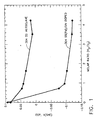
- FIG. 1 is a plot showing the ECP response as a function of the molar ratio of hydrogen to oxygen for a Pd-doped Type 304 stainless steel specimen wherein palladium doping was induced by exposure to ultraviolet radiation at a temperature of 26°C (78°F) ( ⁇ ) and for a Type 304 stainless steel autoclave which had no palladium doping (•).
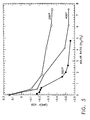
- FIG. 2 is a plot showing the ECP response as a function of the molar ratio of hydrogen to oxygen for an in-reactor crud-deposited Type 304 stainless steel specimen which had an inherent radiation level of 50-60 mRad/hr and was subsequently doped with palladium in 100 ppb Pd at 93°C (200°F) for 24 hr (0) and for a pure platinum specimen ( ⁇ ) for comparison.
- FIG. 3 is a plot showing the ECP response as a function of the molar ratio of hydrogen to oxygen for three Pd-doped Type 304 stainless steel specimens doped with palladium at three different temperatures: (0) 93°C (200°F); ( ⁇ ) 204° C (400°F); and (•) 288°C (550°F).
- the present invention is an in situ technique to coat or dope the oxide film or crud formed on metal surfaces of reactor components with noble metal while the reactor is shutdown or during heatup with recirculation pump heat only, i.e., without nuclear heat generation.
- the noble metal is brought into contact with the oxide layer by injecting a noble metal-containing compound into the coolant water during an outage or during pump heatup.
- the noble metal compound is injected at a point upstream of the feedwater inlet.
- the preferred embodiment of the present invention involves radiation-induced palladium doping of reactor components performed at ambient temperature or heatup temperatures lower than the operating temperature of 288°F (550°F).
- the radiation-induced doping causes deposition/doping of the reactor component surfaces with palladium in an amount that provides catalytic activity for H2 and 02 recombination sufficient to reduce the ECP of stainless steel and other alloy surfaces to required levels for protection against intergranular stress corrosion cracking.
- the mixture so prepared had a palladium content of 15 mg/liter (15 ppm) as palladium.
- This stock solution was diluted to obtain a 100 ppb Pd solution.
- a UV lamp was also immersed in the same solution so that the distance of separation between the UV lamp and the CERT specimen was approximately 1 cm.
- the temperature of the solution was 26°C (78°F).
- the lamp was moved to the other side, exposing that side to another 10 min of UV radiation to obtain a uniform doping of the CERT specimen with palladium.
- the specimen was washed well with deionized water and then tested at 288°C (550° F) for its ECP response as a function of the molar ratio of H 2 /O 2 in the high-purity water environment being tested.
- the present invention is not limited to UV radiation. Any form of electromagnetic radiation, including visible light or higher-energy radiation such as gamma radiation, is expected to provide doping. The extent of doping, however, is expected to depend on the energy of the ionizing radiation and the exposure time. Higher-energy radiation assists in doping the surface with palladium faster and more effectively. For example, experiments have proven that gamma radiation is effective in causing palladium doping of surfaces. The results of experiments involving gamma-assisted palladium doping are shown in FIG. 2.
- one curve shows the ECP response of pure platinum and the other curve shows the ECP response of a Type 304 stainless steel specimen (Type 304 stainless steel/crud/palladium) that had been in a reactor for 10 years.
- the Type 304 stainless steel specimen was believed to have a truly representative oxide layer (or crud) of thickness 1-2 ⁇ m on its surface because of its lengthy immersion in reactor water. After being removed from the reactor, the crudded Type 304 stainless steel. specimen was palladium doped (100 ppb Pd at 93° C (200° F) for 24 hr) in a hot cell facility.
- the purpose of this gamma-assisted palladium doping test was to determine the effects of gamma radiation (inherent on the specimen due to activation) and moderately high temperature (93° C (200° F)) on the palladium doping process, which may be used to coat or dope reactor internals with palladium or other noble metal. Another objective of the test was to determine the effectiveness of palladium doping on a crud-deposited surface. The test involved the following steps.
- Step I a specimen was cut from surveillance basket material (Type 304 stainless steel) which had been in the mid-core region of a boiling water reactor for 10 years in the expectation that the material would have a representative crud layer on its surface.
- the presence of crud was confirmed by analysis as well as by measuring the thickness (1-2 ⁇ m) using scanning electron microscopy. Therefore, machining was done so as to minimize any crud spalling.
- the specimen was cut so that a minimum number of cutting edges were generated. The specimen dimensions were approximately 1 cm x 2 cm.
- Step II a stainless steel wire was spot-welded to the specimen. The amount of cleaning required for the spot welding process was minimized.
- This specimen was then immersed in a 100 ml aqueous solution of palladium acetylacetonate (100 ppb as palladium) containing 0. 01% ethyl alcohol. The solution was stirred and heated to 93° C (200° F) in a flask fitted with a reflux condenser over a period of about one day. After the test, the specimen was removed from the flask, washed and set aside for the ECP test in Step III.
- Step III the specimen from Step II was installed inside an autoclave attached to a recirculating flow system containing high-purity water.
- An ECP test of the specimen was performed at 288° C (550° F) at H 2 /O 2 molar ratios ranging from 0.5 to about 5. The total test time was one week.
- FIG. 3 shows the influence of palladium doping temperature on the ECP response in the absence of radiation.
- Type 304 stainless steel specimens were doped with palladium at temperatures of 93° C (200° F), 204° C (400° F) and 288°C (550°F) at different H 2 /O 2 molar ratios ranging from 0 to about 7.5.
- the doping done at 93° C (200° F) without any radiation influence showed that the lowest ECP reached at a H 2 /O 2 molar ratio of 7 was approximately -0.330 V(SHE).
- the data in FIG. 3 show that, in the absence of electromagnetic radiation, palladium doping is more effective when performed at higher temperatures.
- the radiation in aid of noble metal doping was inherent, i.e., was emitted by radioisotopes (due to activation as a result of reactor exposure) contained in the material of the specimen.
- the crudded Type 304 stainless steel (reactor exposed) specimen had an inherent radiation dose of 50 to 60 mRad/hr, because of its exposure to reactor water over a period of 10 years. It follows that the rate at which palladium acetylacetonate decomposes inside a boiling water reactor will be increased dramatically due to the effect of gamma radiation emitted by the nuclear fuel core. The contribution to the decomposition rate made by electromagnetic radiation will allow palladium doping of equal effect to be achieved at relatively lower doping temperatures.
- a significant advantage of gamma-induced doping is that when thermal doping is practiced in nuclear reactor applications, gamma radiation would inherently be present even if the reactor is in an outage, thereby providing an additional benefit of radiation-induced palladium doping of surfaces. Thus, when thermal doping of palladium is practiced in nuclear reactors, the doping will be due to a combined effect of both thermally induced as well as radiation-induced effects.
- the noble metals which can be applied using this technique include palladium, platinum, ruthenium, rhodium osmium, iridium, and mixtures thereof.
- the noble metal can be injected in the form of an organic or organometallic compound to reduce the potential of reactor components made of stainless steel or other alloys even in the absence of hydrogen injection.
- the noble metal can be injected in form of an inorganic compound in conjunction with hydrogen injection to reduce the ECP at the surface of reactor components.
Landscapes
- Engineering & Computer Science (AREA)
- Physics & Mathematics (AREA)
- Chemical & Material Sciences (AREA)
- Plasma & Fusion (AREA)
- General Engineering & Computer Science (AREA)
- High Energy & Nuclear Physics (AREA)
- Materials Engineering (AREA)
- Metallurgy (AREA)
- Organic Chemistry (AREA)
- Mechanical Engineering (AREA)
- Life Sciences & Earth Sciences (AREA)
- Ecology (AREA)
- General Health & Medical Sciences (AREA)
- Biodiversity & Conservation Biology (AREA)
- Chemical Kinetics & Catalysis (AREA)
- Environmental & Geological Engineering (AREA)
- Environmental Sciences (AREA)
- Health & Medical Sciences (AREA)
- Analytical Chemistry (AREA)
- Biochemistry (AREA)
- Inorganic Chemistry (AREA)
- General Physics & Mathematics (AREA)
- Immunology (AREA)
- Pathology (AREA)
- Preventing Corrosion Or Incrustation Of Metals (AREA)
- Catalysts (AREA)
- Other Surface Treatments For Metallic Materials (AREA)
- Physical Water Treatments (AREA)
Claims (6)
- Procédé pour diminuer la fissuration par corrosion sous tension d' un élément métallique d' un réacteur nucléaire refroidi à 1' eau, qui comprend 1' étape consistant à injecter une solution d' un dérivé d' un métal noble dans 1' eau de refroidissement lorsqu' il n' y a pas production de chaleur d' origine nucléaire, auquel cas l'eau couvre une variation de température de 204 - 232 ° C, ledit dérivé de métal noble ayant la propriété de se décomposer dans les conditions de rayonnement du réacteur pour libérer des atomes dudit métal noble.
- Procédé selon la revendication 1, dans lequel 1' exposition dudit dérivé de métal noble à des rayons gamma provoque sa décomposition.
- Procédé selon la revendication 1 ou 2, dans lequel ledit métal noble est le palladium et ledit dérivé est un dérivé organométallique du palladium.
- Procédé selon 1' une quelconque des revendications 1 à 3, dans lequel ledit élément métallique est en acier inoxydable ou en alliage à base de nickel.
- Procédé pour diminuer la fissuration par corrosion sous tension d' un élément métallique d' un réacteur nucléaire refroidi à 1' eau, qui comprend 1' étape consistant à injecter dans 1' eau de refroidissement une solution d' un dérivé d' un métal noble lorsque ladite eau de refroidissement avec une température dans le secteur de 204 - 232 ° C, ledit dérivé de métal noble ayant la propriété de se décomposer dans les conditions de rayonnement et de température du réacteur pour libérer des atomes dudit métal noble.
- Procédé selon la revendication 5, dans lequel ledit métal noble est le palladium, ledit dérivé de métal noble est 1' acétylacétonate de palladium et ledit élément métallique est en acier inoxydable.
Applications Claiming Priority (2)
| Application Number | Priority Date | Filing Date | Title |
|---|---|---|---|
| US416656 | 1989-10-03 | ||
| US08/416,656 US5602888A (en) | 1993-10-29 | 1995-04-05 | Radiation-induced palladium doping of metals to protect against stress corrosion cracking |
Publications (3)
| Publication Number | Publication Date |
|---|---|
| EP0736878A1 EP0736878A1 (fr) | 1996-10-09 |
| EP0736878B1 EP0736878B1 (fr) | 1999-12-29 |
| EP0736878B2 true EP0736878B2 (fr) | 2002-12-04 |
Family
ID=23650797
Family Applications (1)
| Application Number | Title | Priority Date | Filing Date |
|---|---|---|---|
| EP96302020A Expired - Lifetime EP0736878B2 (fr) | 1995-04-05 | 1996-03-25 | Procédé pour atténuer la propagation des criques |
Country Status (6)
| Country | Link |
|---|---|
| US (1) | US5602888A (fr) |
| EP (1) | EP0736878B2 (fr) |
| JP (1) | JP3002129B2 (fr) |
| KR (1) | KR100264467B1 (fr) |
| DE (2) | DE736878T1 (fr) |
| ES (1) | ES2142024T5 (fr) |
Families Citing this family (23)
| Publication number | Priority date | Publication date | Assignee | Title |
|---|---|---|---|---|
| US5602888A (en) † | 1993-10-29 | 1997-02-11 | General Electric Company | Radiation-induced palladium doping of metals to protect against stress corrosion cracking |
| US5793830A (en) * | 1995-07-03 | 1998-08-11 | General Electric Company | Metal alloy coating for mitigation of stress corrosion cracking of metal components in high-temperature water |
| JP3931560B2 (ja) * | 1997-10-01 | 2007-06-20 | 株式会社日立製作所 | 原子力プラント及びその水質制御方法 |
| EP1036218B1 (fr) * | 1997-11-28 | 2006-06-21 | General Electric Company | Technique fondee sur la temperature permettant de regler la dose de metal appliquee sur des surfaces d'oxyde metallique pour reduire la corrosion et les fissurations par corrosion sous contrainte |
| US6714618B1 (en) * | 1997-11-28 | 2004-03-30 | General Electric Company | Temperature-based method for controlling the amount of metal applied to metal oxide surfaces to reduce corrosion and stress corrosion cracking |
| JP4043647B2 (ja) * | 1999-06-23 | 2008-02-06 | 株式会社東芝 | 原子炉構造材及び原子炉構造材の腐食低減方法 |
| US6681153B1 (en) | 2000-08-02 | 2004-01-20 | General Electric Company | Automated, interactive data collection, data transmittal and data assessment method |
| DE10123690A1 (de) * | 2001-05-15 | 2002-12-05 | Framatome Anp Gmbh | Verfahren zum Schutz der Bauteile des Primärsystems eines Siedewasserreaktors insbesondere vor Spannungsrisskorrosion |
| US6793883B2 (en) | 2001-07-05 | 2004-09-21 | General Electric Company | Application of catalytic nanoparticles to high temperature water systems to reduce stress corrosion cracking |
| US6891912B1 (en) * | 2002-06-26 | 2005-05-10 | Pinnacle West Capital Corporation | Fuel assemblies in a reactor core and method of designing and arranging same |
| US20040190671A1 (en) * | 2003-03-26 | 2004-09-30 | Wivagg Adrian P. | Jet pump assembly repair method |
| TWI277102B (en) * | 2003-06-13 | 2007-03-21 | Toshiba Corp | Method of reducing corrosion of nuclear reactor structural material |
| JP4634709B2 (ja) * | 2003-12-26 | 2011-02-16 | 株式会社東芝 | 原子炉構造材の腐食低減方法 |
| US6724854B1 (en) | 2003-06-16 | 2004-04-20 | General Electric Company | Process to mitigate stress corrosion cracking of structural materials in high temperature water |
| US20040258192A1 (en) * | 2003-06-16 | 2004-12-23 | General Electric Company | Mitigation of steam turbine stress corrosion cracking |
| US20060203952A1 (en) * | 2005-03-14 | 2006-09-14 | General Electric Company | Methods of reducing hydrogen absorption in zirconium alloys of nuclear fuel assemblies |
| US7430902B2 (en) * | 2006-06-16 | 2008-10-07 | General Electric Company | Method of monitoring deposition of a noble metal in a nuclear reactor and deposition monitor therefor |
| US20100246745A1 (en) * | 2006-12-29 | 2010-09-30 | Samson Hettiarachchi | Methods for operating and methods for reducing post-shutdown radiation levels of nuclear reactors |
| JP5743395B2 (ja) | 2009-11-16 | 2015-07-01 | 株式会社東芝 | 冷却水系の腐食防止構造および腐食防止方法 |
| JP6034149B2 (ja) * | 2012-08-03 | 2016-11-30 | 日立Geニュークリア・エナジー株式会社 | 原子力プラントの構成部材への貴金属付着方法 |
| JP6049384B2 (ja) * | 2012-10-03 | 2016-12-21 | 株式会社東芝 | 光触媒注入方法および光触媒注入システム |
| JP2014101240A (ja) * | 2012-11-19 | 2014-06-05 | Hitachi-Ge Nuclear Energy Ltd | 白金酸化物コロイド溶液並びにその製造方法及び製造装置 |
| EP3494090B1 (fr) | 2016-08-04 | 2021-08-18 | Dominion Engineering, Inc. | Suppression du dépôt de radionucléides sur des composants de centrale nucléaire |
Citations (2)
| Publication number | Priority date | Publication date | Assignee | Title |
|---|---|---|---|---|
| US5602888A (en) † | 1993-10-29 | 1997-02-11 | General Electric Company | Radiation-induced palladium doping of metals to protect against stress corrosion cracking |
| US8209572B2 (en) † | 2003-02-13 | 2012-06-26 | Mentor Graphics Corporation | Testing embedded memories in an integrated circuit |
Family Cites Families (20)
| Publication number | Priority date | Publication date | Assignee | Title |
|---|---|---|---|---|
| US3023085A (en) * | 1960-03-30 | 1962-02-27 | John P Mcbride | Method of combining hydrogen and oxygen |
| US3907852A (en) * | 1972-06-23 | 1975-09-23 | Exxon Research Engineering Co | Silylhydrocarbyl phosphines and related compounds |
| DE2509251C3 (de) * | 1975-03-04 | 1978-07-13 | Hoechst Ag, 6000 Frankfurt | Verfahren zur Herstellung eines Palladiumkatalysators |
| US4111830A (en) * | 1976-09-29 | 1978-09-05 | Bannister Ramon A | Method of inhibiting corrosion |
| GB2042931A (en) * | 1979-01-16 | 1980-10-01 | Pearson D C | Coating and Etching Substrates |
| JPS5916983A (ja) * | 1982-07-16 | 1984-01-28 | Katayama Chem Works Co Ltd | 金属防食剤 |
| CH666965A5 (de) * | 1983-08-30 | 1988-08-31 | Cerberus Ag | Verfahren zur herstellung von materialien fuer gassensoren. |
| JP2608550B2 (ja) * | 1986-10-17 | 1997-05-07 | 株式会社 片山化学工業研究所 | 軟水ボイラの防食処理方法 |
| GB8901738D0 (en) * | 1989-01-26 | 1989-03-15 | Atomic Energy Authority Uk | Recombination catalyst |
| US5130081A (en) * | 1990-04-02 | 1992-07-14 | General Electric Company | Operation life of on-life boiling water reactors |
| US5130080A (en) * | 1990-04-02 | 1992-07-14 | General Electric Company | Method of providing extended life expectancy for components of boiling water reactors |
| US5100693A (en) * | 1990-06-05 | 1992-03-31 | The Research Foundation Of State University Of New York | Photolytic deposition of metal from solution onto a substrate |
| DE4040734A1 (de) * | 1990-06-21 | 1992-01-02 | Siemens Ag | Verfahren und einrichtung zur oxidation von wasserstoff |
| AU660027B2 (en) * | 1991-04-12 | 1995-06-08 | Gulf Coast Performance Chemical, Inc. | Method and composition for inhibiting general and pitting corrosion in cooling tower water |
| US5135709A (en) * | 1991-05-13 | 1992-08-04 | General Electric Company | Method for reducing corrosion of components exposed to high-temperature water |
| US5164152A (en) * | 1991-08-02 | 1992-11-17 | General Electric Company | Method for reducing flow assisted corrosion of carbon steel components |
| US5245642A (en) * | 1991-10-31 | 1993-09-14 | General Electric Company | Method of controlling co-60 radiation contamination of structure surfaces of cooling water circuits of nuclear reactors |
| US5600691A (en) * | 1993-10-29 | 1997-02-04 | General Electric Company | Noble metal doping or coating of crack interior for stress corrosion cracking protection of metals |
| US5448605A (en) * | 1993-10-29 | 1995-09-05 | General Electric Company | Palladium acetylacetonate solution and related method of manufacture |
| TW241314B (en) * | 1993-10-29 | 1995-02-21 | Gen Electric | In-situ palladium doping or coating of stainless steel surfaces |
-
1995
- 1995-04-05 US US08/416,656 patent/US5602888A/en not_active Expired - Fee Related
-
1996
- 1996-03-25 EP EP96302020A patent/EP0736878B2/fr not_active Expired - Lifetime
- 1996-03-25 DE DE0736878T patent/DE736878T1/de active Pending
- 1996-03-25 DE DE69605837T patent/DE69605837T3/de not_active Expired - Lifetime
- 1996-03-25 ES ES96302020T patent/ES2142024T5/es not_active Expired - Lifetime
- 1996-04-04 KR KR1019960010233A patent/KR100264467B1/ko not_active Expired - Lifetime
- 1996-04-04 JP JP8082159A patent/JP3002129B2/ja not_active Expired - Lifetime
Patent Citations (2)
| Publication number | Priority date | Publication date | Assignee | Title |
|---|---|---|---|---|
| US5602888A (en) † | 1993-10-29 | 1997-02-11 | General Electric Company | Radiation-induced palladium doping of metals to protect against stress corrosion cracking |
| US8209572B2 (en) † | 2003-02-13 | 2012-06-26 | Mentor Graphics Corporation | Testing embedded memories in an integrated circuit |
Non-Patent Citations (4)
| Title |
|---|
| Internet-Copy from the Homepage of the NACE (http://www.nac.org/naceframes/papers/cc95p ap.htm) † |
| Materials research Society Proc., Vol.282, Kowalczyk S.P. et al.: " Characterization of palladium acetylacetonate as a CVD precursor of Pd metallization", pages 353-358 (1993) † |
| NACE-International Annual Conference and Corrosion Show, Paper 413, Corrosion 95, March 1995, S. Hettiarchchi et al.: "A novel approach for noble metal deposition on surfaces for IGSCC mitigation of boiling water reactor internals" Orlando, Florida, USA † |
| Römpps Chemie-Lexikon, 8th Edition 1985, pages 2971-2973 † |
Also Published As
| Publication number | Publication date |
|---|---|
| JPH0915382A (ja) | 1997-01-17 |
| JP3002129B2 (ja) | 2000-01-24 |
| DE69605837D1 (de) | 2000-02-03 |
| KR100264467B1 (ko) | 2000-08-16 |
| ES2142024T5 (es) | 2003-06-16 |
| DE69605837T2 (de) | 2000-07-06 |
| DE736878T1 (de) | 1997-04-10 |
| US5602888A (en) | 1997-02-11 |
| EP0736878B1 (fr) | 1999-12-29 |
| EP0736878A1 (fr) | 1996-10-09 |
| DE69605837T3 (de) | 2003-09-18 |
| ES2142024T3 (es) | 2000-04-01 |
| KR960037868A (ko) | 1996-11-19 |
Similar Documents
| Publication | Publication Date | Title |
|---|---|---|
| EP0736878B2 (fr) | Procédé pour atténuer la propagation des criques | |
| US5904991A (en) | In-situ palladium doping or coating of stainless steel surfaces | |
| US5768330A (en) | Co-deposition of palladium during oxide film growth in high-temperature water to mitigate stress corrosion cracking | |
| US5774516A (en) | Modification of oxide film electrical conductivity to maintain low corrosion potential in high-temperature water | |
| US5805653A (en) | Noble metal doping or coating of crack interior for stress corrosion cracking protection of metals | |
| US5448605A (en) | Palladium acetylacetonate solution and related method of manufacture | |
| US5600692A (en) | Method for improving tenacity and loading of palladium on palladium-doped metal surfaces | |
| US6697449B2 (en) | Temperature-based method for controlling the amount of metal applied to metal oxide surfaces to reduce corrosion and stress corrosion cracking | |
| EP0651397B1 (fr) | Dopage ou revêtement sur place de surfaces en acier inox avec palladium | |
| US20020118787A1 (en) | Noble metal catalysis for mitigation of corrosion, erosion and stress corrosion cracking in pressurized water reactor and related high temperature water environments | |
| US20020101953A1 (en) | Application of noble metals to internal surfaces of operating boiling water reactors in the presence of zinc in reactor water | |
| KR100380127B1 (ko) | 고온수내의낮은부식전위를유지하기위한산화막전기전도도의조절 | |
| EP1036218B1 (fr) | Technique fondee sur la temperature permettant de regler la dose de metal appliquee sur des surfaces d'oxyde metallique pour reduire la corrosion et les fissurations par corrosion sous contrainte | |
| CA2333072A1 (fr) | Application de metaux nobles sur les surfaces internes de reacteurs a eau bouillante en conditions de marche, en presence de zinc dans l'eau de reacteur | |
| MXPA00005257A (en) | Temperature based method for controlling the amount of metal applied to metal oxide surfaces to reduce corrosion and stress corrosion cracking |
Legal Events
| Date | Code | Title | Description |
|---|---|---|---|
| PUAI | Public reference made under article 153(3) epc to a published international application that has entered the european phase |
Free format text: ORIGINAL CODE: 0009012 |
|
| AK | Designated contracting states |
Kind code of ref document: A1 Designated state(s): CH DE ES FR GB LI SE |
|
| DET | De: translation of patent claims | ||
| 17P | Request for examination filed |
Effective date: 19970623 |
|
| 17Q | First examination report despatched |
Effective date: 19980605 |
|
| GRAG | Despatch of communication of intention to grant |
Free format text: ORIGINAL CODE: EPIDOS AGRA |
|
| GRAG | Despatch of communication of intention to grant |
Free format text: ORIGINAL CODE: EPIDOS AGRA |
|
| GRAH | Despatch of communication of intention to grant a patent |
Free format text: ORIGINAL CODE: EPIDOS IGRA |
|
| GRAH | Despatch of communication of intention to grant a patent |
Free format text: ORIGINAL CODE: EPIDOS IGRA |
|
| GRAA | (expected) grant |
Free format text: ORIGINAL CODE: 0009210 |
|
| AK | Designated contracting states |
Kind code of ref document: B1 Designated state(s): CH DE ES FR GB LI SE |
|
| REG | Reference to a national code |
Ref country code: CH Ref legal event code: EP |
|
| REG | Reference to a national code |
Ref country code: CH Ref legal event code: NV Representative=s name: RITSCHER & SEIFERT |
|
| REF | Corresponds to: |
Ref document number: 69605837 Country of ref document: DE Date of ref document: 20000203 |
|
| REG | Reference to a national code |
Ref country code: ES Ref legal event code: FG2A Ref document number: 2142024 Country of ref document: ES Kind code of ref document: T3 |
|
| ET | Fr: translation filed | ||
| PLBQ | Unpublished change to opponent data |
Free format text: ORIGINAL CODE: EPIDOS OPPO |
|
| PLBI | Opposition filed |
Free format text: ORIGINAL CODE: 0009260 |
|
| PLAV | Examination of admissibility of opposition |
Free format text: ORIGINAL CODE: EPIDOS OPEX |
|
| PLAV | Examination of admissibility of opposition |
Free format text: ORIGINAL CODE: EPIDOS OPEX |
|
| PLAB | Opposition data, opponent's data or that of the opponent's representative modified |
Free format text: ORIGINAL CODE: 0009299OPPO |
|
| PLBF | Reply of patent proprietor to notice(s) of opposition |
Free format text: ORIGINAL CODE: EPIDOS OBSO |
|
| 26 | Opposition filed |
Opponent name: SIEMENS NUCLEAR POWER GMBH Effective date: 20000914 |
|
| R26 | Opposition filed (corrected) |
Opponent name: SIEMENS NUCLEAR POWER GMBH Effective date: 20000914 |
|
| PLBF | Reply of patent proprietor to notice(s) of opposition |
Free format text: ORIGINAL CODE: EPIDOS OBSO |
|
| PLBF | Reply of patent proprietor to notice(s) of opposition |
Free format text: ORIGINAL CODE: EPIDOS OBSO |
|
| PLBQ | Unpublished change to opponent data |
Free format text: ORIGINAL CODE: EPIDOS OPPO |
|
| PLAB | Opposition data, opponent's data or that of the opponent's representative modified |
Free format text: ORIGINAL CODE: 0009299OPPO |
|
| R26 | Opposition filed (corrected) |
Opponent name: FRAMATOME ANP GMBH Effective date: 20000914 |
|
| REG | Reference to a national code |
Ref country code: GB Ref legal event code: IF02 |
|
| PLAW | Interlocutory decision in opposition |
Free format text: ORIGINAL CODE: EPIDOS IDOP |
|
| PLAW | Interlocutory decision in opposition |
Free format text: ORIGINAL CODE: EPIDOS IDOP |
|
| PUAH | Patent maintained in amended form |
Free format text: ORIGINAL CODE: 0009272 |
|
| STAA | Information on the status of an ep patent application or granted ep patent |
Free format text: STATUS: PATENT MAINTAINED AS AMENDED |
|
| 27A | Patent maintained in amended form |
Effective date: 20021204 |
|
| AK | Designated contracting states |
Kind code of ref document: B2 Designated state(s): CH DE ES FR GB LI SE |
|
| REG | Reference to a national code |
Ref country code: CH Ref legal event code: AEN Free format text: AUFRECHTERHALTUNG DES PATENTES IN GEAENDERTER FORM |
|
| REG | Reference to a national code |
Ref country code: ES Ref legal event code: DC2A Date of ref document: 20030218 Kind code of ref document: T5 |
|
| ET3 | Fr: translation filed ** decision concerning opposition | ||
| REG | Reference to a national code |
Ref country code: CH Ref legal event code: PCAR Free format text: NEW ADDRESS: PESTALOZZISTRASSE 2 POSTFACH 1416, 8201 SCHAFFHAUSEN (CH) |
|
| REG | Reference to a national code |
Ref country code: FR Ref legal event code: PLFP Year of fee payment: 20 |
|
| PGFP | Annual fee paid to national office [announced via postgrant information from national office to epo] |
Ref country code: DE Payment date: 20150327 Year of fee payment: 20 Ref country code: ES Payment date: 20150326 Year of fee payment: 20 Ref country code: CH Payment date: 20150327 Year of fee payment: 20 |
|
| PGFP | Annual fee paid to national office [announced via postgrant information from national office to epo] |
Ref country code: SE Payment date: 20150327 Year of fee payment: 20 Ref country code: FR Payment date: 20150317 Year of fee payment: 20 Ref country code: GB Payment date: 20150327 Year of fee payment: 20 |
|
| REG | Reference to a national code |
Ref country code: DE Ref legal event code: R071 Ref document number: 69605837 Country of ref document: DE |
|
| REG | Reference to a national code |
Ref country code: CH Ref legal event code: PL |
|
| REG | Reference to a national code |
Ref country code: GB Ref legal event code: PE20 Expiry date: 20160324 |
|
| PG25 | Lapsed in a contracting state [announced via postgrant information from national office to epo] |
Ref country code: GB Free format text: LAPSE BECAUSE OF EXPIRATION OF PROTECTION Effective date: 20160324 |
|
| REG | Reference to a national code |
Ref country code: SE Ref legal event code: EUG |
|
| REG | Reference to a national code |
Ref country code: ES Ref legal event code: FD2A Effective date: 20160701 |
|
| PG25 | Lapsed in a contracting state [announced via postgrant information from national office to epo] |
Ref country code: ES Free format text: LAPSE BECAUSE OF EXPIRATION OF PROTECTION Effective date: 20160326 |