EP0739125A2 - Verbesserungen an einem Aufzeichnungs- und Drucksystem und Verfahren dazu - Google Patents
Verbesserungen an einem Aufzeichnungs- und Drucksystem und Verfahren dazu Download PDFInfo
- Publication number
- EP0739125A2 EP0739125A2 EP96106193A EP96106193A EP0739125A2 EP 0739125 A2 EP0739125 A2 EP 0739125A2 EP 96106193 A EP96106193 A EP 96106193A EP 96106193 A EP96106193 A EP 96106193A EP 0739125 A2 EP0739125 A2 EP 0739125A2
- Authority
- EP
- European Patent Office
- Prior art keywords
- pixels
- illuminated
- light
- rows
- light modulator
- Prior art date
- Legal status (The legal status is an assumption and is not a legal conclusion. Google has not performed a legal analysis and makes no representation as to the accuracy of the status listed.)
- Withdrawn
Links
Images


Classifications
-
- G—PHYSICS
- G03—PHOTOGRAPHY; CINEMATOGRAPHY; ANALOGOUS TECHNIQUES USING WAVES OTHER THAN OPTICAL WAVES; ELECTROGRAPHY; HOLOGRAPHY
- G03G—ELECTROGRAPHY; ELECTROPHOTOGRAPHY; MAGNETOGRAPHY
- G03G15/00—Apparatus for electrographic processes using a charge pattern
- G03G15/04—Apparatus for electrographic processes using a charge pattern for exposing, i.e. imagewise exposure by optically projecting the original image on a photoconductive recording material
-
- H—ELECTRICITY
- H04—ELECTRIC COMMUNICATION TECHNIQUE
- H04N—PICTORIAL COMMUNICATION, e.g. TELEVISION
- H04N1/00—Scanning, transmission or reproduction of documents or the like, e.g. facsimile transmission; Details thereof
- H04N1/04—Scanning arrangements, i.e. arrangements for the displacement of active reading or reproducing elements relative to the original or reproducing medium, or vice versa
- H04N1/19—Scanning arrangements, i.e. arrangements for the displacement of active reading or reproducing elements relative to the original or reproducing medium, or vice versa using multi-element arrays
- H04N1/191—Scanning arrangements, i.e. arrangements for the displacement of active reading or reproducing elements relative to the original or reproducing medium, or vice versa using multi-element arrays the array comprising a one-dimensional [1D] array
- H04N1/1911—Simultaneously or substantially simultaneously scanning picture elements on more than one main scanning line, e.g. scanning in swaths
- H04N1/1916—Simultaneously or substantially simultaneously scanning picture elements on more than one main scanning line, e.g. scanning in swaths using an array of elements displaced from one another in the main scan direction, e.g. a diagonally arranged array
-
- B—PERFORMING OPERATIONS; TRANSPORTING
- B41—PRINTING; LINING MACHINES; TYPEWRITERS; STAMPS
- B41J—TYPEWRITERS; SELECTIVE PRINTING MECHANISMS, i.e. MECHANISMS PRINTING OTHERWISE THAN FROM A FORME; CORRECTION OF TYPOGRAPHICAL ERRORS
- B41J2/00—Typewriters or selective printing mechanisms characterised by the printing or marking process for which they are designed
- B41J2/435—Typewriters or selective printing mechanisms characterised by the printing or marking process for which they are designed characterised by selective application of radiation to a printing material or impression-transfer material
- B41J2/465—Typewriters or selective printing mechanisms characterised by the printing or marking process for which they are designed characterised by selective application of radiation to a printing material or impression-transfer material using masks, e.g. light-switching masks
-
- G—PHYSICS
- G02—OPTICS
- G02B—OPTICAL ELEMENTS, SYSTEMS OR APPARATUS
- G02B26/00—Optical devices or arrangements for the control of light using movable or deformable optical elements
- G02B26/08—Optical devices or arrangements for the control of light using movable or deformable optical elements for controlling the direction of light
- G02B26/0816—Optical devices or arrangements for the control of light using movable or deformable optical elements for controlling the direction of light by means of one or more reflecting elements
- G02B26/0833—Optical devices or arrangements for the control of light using movable or deformable optical elements for controlling the direction of light by means of one or more reflecting elements the reflecting element being a micromechanical device, e.g. a MEMS mirror, DMD
-
- H—ELECTRICITY
- H04—ELECTRIC COMMUNICATION TECHNIQUE
- H04N—PICTORIAL COMMUNICATION, e.g. TELEVISION
- H04N1/00—Scanning, transmission or reproduction of documents or the like, e.g. facsimile transmission; Details thereof
- H04N1/04—Scanning arrangements, i.e. arrangements for the displacement of active reading or reproducing elements relative to the original or reproducing medium, or vice versa
- H04N1/19—Scanning arrangements, i.e. arrangements for the displacement of active reading or reproducing elements relative to the original or reproducing medium, or vice versa using multi-element arrays
- H04N1/195—Scanning arrangements, i.e. arrangements for the displacement of active reading or reproducing elements relative to the original or reproducing medium, or vice versa using multi-element arrays the array comprising a two-dimensional [2D] array
- H04N1/19505—Scanning picture elements spaced apart from one another in at least one direction
-
- H—ELECTRICITY
- H04—ELECTRIC COMMUNICATION TECHNIQUE
- H04N—PICTORIAL COMMUNICATION, e.g. TELEVISION
- H04N1/00—Scanning, transmission or reproduction of documents or the like, e.g. facsimile transmission; Details thereof
- H04N1/04—Scanning arrangements, i.e. arrangements for the displacement of active reading or reproducing elements relative to the original or reproducing medium, or vice versa
- H04N1/19—Scanning arrangements, i.e. arrangements for the displacement of active reading or reproducing elements relative to the original or reproducing medium, or vice versa using multi-element arrays
- H04N1/195—Scanning arrangements, i.e. arrangements for the displacement of active reading or reproducing elements relative to the original or reproducing medium, or vice versa using multi-element arrays the array comprising a two-dimensional [2D] array
- H04N1/19505—Scanning picture elements spaced apart from one another in at least one direction
- H04N1/1951—Scanning picture elements spaced apart from one another in at least one direction in one direction
-
- H—ELECTRICITY
- H04—ELECTRIC COMMUNICATION TECHNIQUE
- H04N—PICTORIAL COMMUNICATION, e.g. TELEVISION
- H04N1/00—Scanning, transmission or reproduction of documents or the like, e.g. facsimile transmission; Details thereof
- H04N1/04—Scanning arrangements, i.e. arrangements for the displacement of active reading or reproducing elements relative to the original or reproducing medium, or vice versa
- H04N1/19—Scanning arrangements, i.e. arrangements for the displacement of active reading or reproducing elements relative to the original or reproducing medium, or vice versa using multi-element arrays
- H04N1/195—Scanning arrangements, i.e. arrangements for the displacement of active reading or reproducing elements relative to the original or reproducing medium, or vice versa using multi-element arrays the array comprising a two-dimensional [2D] array
- H04N1/19505—Scanning picture elements spaced apart from one another in at least one direction
- H04N1/19521—Arrangements for moving the elements of the array relative to the scanned image or vice versa
- H04N1/19526—Optical means
- H04N1/19547—Apertures
Definitions
- This invention generally relates to display and printer systems and specifically to a printing system which uses a staggered array spatial light modulator.
- electrophotography has become one of the most widely used systems and the dry toner process, has become the most popular for creating copies and prints of documents in a host of environments.
- the basics of electrophotography are well know to those skilled in the art.
- the fundamental elements of a electrophotographic printer or copier using the dry toner process include a photo sensitive medium, typically an organic photoreceptor (OPC), which is charged electrostatically to a predetermined voltage and polarity.
- OPC organic photoreceptor
- this image is passed by a source of developer materials which consists of electrostatically charged toner particles held to ferromagnetic carrier beads.
- the carriers are used to facilitate the transport of the materials into contact with the above mentioned latent image through the action of magnetic fields and rotating magnets within sleeved cylinders, typically called developer rollers.
- developer rollers Through a designed interplay of electrostatic charges, the toner particles that are typically in the 10 micron diameter range, are separated from the carrier beads, typically 50 micron diameter particles, and retained in-place on the appropriate portions of the latent image resident on the OPC surface.
- the magnetic forces associated with the developer rollers carry the depleted ferromagnetic carrier beads back to the position where they are re-mixed with additional toner for development of subsequent images.
- the toner materials are normally plastics with flow promoting agents, charge control agents, and color pigments which melt at a predetermined temperature.
- the OPC surface then carries a developed latent image after exiting the proximity of the developing roller.
- the photoreceptor surface carrying the developed image is brought into contact with an image receptor, which in most common applications of electrophotography is a sheet of paper, but may be an intermediate material suitable for the build-up of multiple pigmented images as required for color printing.
- Electrostatic charging systems are typically used to transfer the toner from the OPC to the image receptor.
- the final image bearing member is ultimately paper or an other material, it can be successively operated on by multiple photoreceptors, a single photoreceptor, or an image bearing intermediate member to build up the full color image. It exits the printing process through a station referred to as the fuser, where the appropriate heat and/or pressure is applied to the image receptor and thereby fixes the image permanently.
- a movable mirror device such as the Digital Micromirror Device (also referred to as Deformable Mirror Device or simply a DMD) manufactured by Texas Instruments, Inc.
- the movable mirror device is composed of many small mirrors called micromirrors which rotate about a fixed axis.
- the movable mirror device is illuminated with a beam of light.
- the rotation of the micromirror causes the light illuminating the micromirror to be deflected under the control of the rotation.
- each micromirror of a movable mirror device can be selectively rotated thereby patterning light reflected from the array.
- Specific details of movable mirror devices are provided in US Patent No. 5,061,049 and 5,083,857, each of which is incorporated herein by reference.
- a long and narrow movable mirror device When using a movable mirror device in print applications, a long and narrow movable mirror device will typically be used. As an example, a movable mirror device array with about 100 rows and 7,000 columns may be utilized. To produce a device of this size, the chip may typically be 5.0 inches long.
- a system for independently illuminating a plurality of areas on an object, such as a printer drum, is disclosed herein.
- the system includes a light source, such as a single light emitting diode (LED) or a plurality of LEDs.
- a spatial light modulator which may be a movable mirror device, such as the Digital Micromirror Device (DMD) manufactured by Texas Instruments, Inc., receives light from the light source and reflects selected portions of the light.
- the mirror device is illuminated in a scanning mode, i. e., each row of mirror elements is illuminated individually and sequentially by scanning a beam of light over all of the micromirrors.
- the mirror device is illuminated in a staring mode, i.e., all the mirror elements of the entire array are illuminated simultaneously.
- the light from the spatial light modulator is imaged onto the object to be illuminated which is partitioned into rows of pixels (picture elements).
- the object is illuminated in such a way that each pixel is, over time, illuminated by light from a corresponding column of micromirrors.
- An advantage of the invention is that it reduces the number of columns of micromirrors required by the movable mirror device. This reduction may be important in printing applications where the number of columns is very high resulting in physically large integrated circuit chips which are difficult to illuminate.
- the reduction in the size of the chip will reduce the cost to manufacture the chip as well as the cost of the optical subsystem to illuminate the chip thereby reducing the cost of the system which the chip subsequently is installed.
- a first embodiment of the staggered array printing system 10 is of the scan mode variety and is depicted in Figure 1A.
- a light source 12 such as a light laser diode, illuminates a spatial light modulator 14.
- the spatial light modulator 14 may comprise a movable mirror device such as the Digital Micromirror Device (DMD) manufactured by Texas Instruments and described in US Patents 5,061,049 and 5,083,857, incorporated herein by reference.
- DMD Digital Micromirror Device
- the light from the light source 12 is scanned over the movable mirror device by means of light scanning optics 13.
- the light illuminating the movable mirror device from the light source 12 forms a long and narrow beam on the movable mirror device.
- the length of the beam is equal to the length of the movable mirror device array and the width of the beam is equal to the width of the illuminated portion of micromirrors.
- each row of micromirrors of the movable mirror device array is sequentially illuminated.
- the beam is scanned rapidly enough that all of the mirror elements are illuminated during a time interval short enough that the illuminated object, such as a printer drum 26, turns only a small fraction of a pixel.
- Modulated light is reflected from the spatial light modulator 14 into projection lens 24 which images the light onto the drum 26.
- the lens 24 may be an anamorphic lens if it is desired to have a printing beam which is not the same shape as the micromirror.
- the rotating drum 26 may then transfer toner to a sheet of paper 27.
- the light scanning optics 13 comprises a first lens 18, a scanner 20, and a third lens 22.
- the scanner 20 scans the light beam down the array within the spatial light modulator 14 in the vertical direction successively illuminating the movable mirror device mirror elements in each row.
- FIG 1C depicts a staring mode embodiment of the staggered array printing system 10.
- the light source 12 such as a light emitting diode (LED) illuminates the spatial light modulator 14.
- the spatial light modulator 14 may comprise a movable mirror device such as the Digital Micromirror Device (DMD) manufactured by Texas Instruments and described in US Patents 5,061,049 and 5,083,857.
- DMD Digital Micromirror Device
- the light from the light source 12 is directed toward the movable mirror device by means of light directing optics 16.
- the light beam illuminates all of the micromirrors of the moving mirror device simultaneously.
- Modulated light is reflected from the spatial light modulator 14 into the projection lens 24 which images the light onto the drum 26.
- the light source 12 is pulsed (rapidly turned on and then off) at a period equal to that required by the drum 26 to rotate through one pixel.
- the light pulse will preferably have a 10% duty cycle so that a sharp image of the mirror element is formed on the drum 26 (i.e., the mirror element image is not "smeared" by the rotation of the drum).
- the lens 24 may be an anamorphic lens if it is desired to have a printing beam which is not the same shape as the micromirror.
- the rotating drum 26 may then transfer toner to the sheet of paper 27.
- the light source 12 is a linear array of LED emitters and the light directing optics 16 is a toroidal lens which magnifies the LED emitters so that the image of each emitter fills the DMD.
- the spatial light modulator 14 preferably comprises a movable mirror device such as the Digital Micromirror Device (DMD) manufactured by Texas Instruments, Inc.
- DMD Digital Micromirror Device
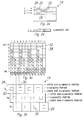
- This movable mirror device 14 is configured in a plurality of rows and columns as illustrated in Figure 2A.
- Each of the rows comprises a plurality of mirror elements (sometimes called micromirrors) 28.
- each row of mirror elements 28 is displaced in the horizontal direction by 1/3 of a mirror dimension.
- Each of the three rows will illuminate 1/3 of the object to be illuminated, e.g., the drum 26 as shown in Figures 1A-D. While illustrated herein with three rows each shifted a 1/3 of a mirror dimension, it should be noted that any number of rows larger than one may be used. In general, if n-rows are used each mirror will be displaced in the horizontal direction by 1/nth of a mirror dimension.
- each mirror element 28 is illuminated.
- the area of each mirror element 28 illuminated is a square whose dimension on each edge is 1/3 of the length of the movable mirror device mirror element 28.
- the dimension of the illuminated portion is different.
- the first row will print the pixels labeled 1 in Figure 2B
- the second row will print the pixels labeled 2 in Figure 2B
- the third row will print the pixels labeled 3 in Figure 2B. Since three rows of movable mirror device 14 are used to print a single line, the movable mirror device 14 can be built with only 1/3 of the total columns. This decrease in the number of columns provides a significant manufacturability advantage over the prior art.
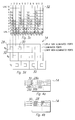
- Figure 3B illustrates a simple movable mirror device array 14 which includes 3 rows (labeled R A , R B and R C ) by 4 columns of mirror elements 28.
- Figure 3A represents the object 32 to be illuminated where each of the boxes 38 is one pixel. In printing applications, this object 32 may be a rotating printer drum (e.g., element 26 in Figure 1A) which will transfer toner to a sheet of paper (element 27 in Figure 1A).
- the first row R A of movable mirror device 14 will print the pixels under the columns labeled C A (i.e., columns 1, 4, 7, etc.) in Figure 3A, while the second row R B will print the pixels under the columns labeled C B and the third row R C will print the pixels under the columns labeled C C .
- the resulting line of imagery corresponds to that illustrated in Figure 2B.
- the first, fourth, seventh, etc. (columns C A ) of line 1 of object 32 will be selectively illuminated by light from the illuminated portions 30 of the first row R A of mirror elements 28.
- the areas on object 32 which may be illuminated are labeled t 1 .
- the box will have shifted down such that line 2 of the object is illuminated by light from the first row R A of mirror elements 28.
- the first, fourth, seventh, etc. columns C A of line 3 of the object can be illuminated by the light reflected from mirror elements 28 in the first row R 1 of movable mirror device 14.
- the first and second lines are not illuminated since they are now aligned with the upper non-illuminated portion of the second row R B and the lower non-illuminated portion of the first row R A of mirror elements 28, respectively.
- both line 1 and line 4 are simultaneously printed as illustrated by the pixels labeled t 4 in Figure 3A.
- the first, fourth, seventh, etc. (columns C A ) of line 4 are illuminated by light reflected from mirror elements 28 from the first row R A of movable mirror device 14.
- line 1 is now aligned with light from the second row R B of mirror elements 28.
- the second, fifth, eight, etc. (columns C B ) of this line can be illuminated.
- the second and third lines are not illuminated since they are now aligned with the upper non-illuminated portion of the second row R B and the lower non-illuminated portion of the first row R A of mirror elements 28, respectively.
- the first line is aligned with the third row R C of mirror elements 28 so that portions of three lines (e.g., lines 1, 4, and 7 at time t 7 ) are being simultaneously illuminated. This shifting will continue until each of the lines of object 32 have been selectively illuminated.
- FIGS 3C and 3D can be utilized to demonstrate a scanned system as illustrated in Figure 1A or 1B.
- each row R A , R B , or R C is illuminated at a different time by a beam which is as long as the movable mirror device and whose height is equal to that of the illuminated portion of the mirror element on the movable mirror device. Accordingly, at time t 1 line 1 is illuminated.
- time t 2 and t 3 no part of object 32 is illuminated since no part is aligned with the array 14.
- line 1 of the object 32 is aligned with the second row R B of spatial light modulator 14. This sequence will continue until each pixel 38 is imaged.
- the light illuminates the apertures for only one third of the time that the beam is scanned over the movable mirror device.
- This inefficiency is made up for because the light source can be turned on only when the scanner is pointed to the aperture over each mirror element 28. Hence, the light source can be turned on only when the scanner is pointed to the aperture over the mirror element.
- one third of the light transmitted will reach the movable mirror device (as illustrated by the fact that the illuminated portion 30 extends one third of each mirror element).
- Figures 4A and 4B illustrate two alternate embodiments of movable mirror device 14 arrays. These embodiments are similar to those previously discussed with respect to Figures 2A (and 3B and 3D).
- the mirror elements 28 are disposed in aligned columns.
- the illuminated portions 30 are staggered such that the illuminated portion 30A in row 1 of Figure 4A is aligned to the left edge of mirror element 28A while the illuminated portion 30B is centered in mirror element 28B and illuminated area 30C is aligned to the right edge of mirror element 28C.
- the same results as illustrated by Figures 3A and 3B (or 3C and 3D) may be achieved. It is also noted that the illuminated portions 30 do not need to be centered in the staggered array ( Figure 2A).
- Figure 4B has been included to illustrate the fact that the illuminated portions 30 are not required to be square.
- the illuminated portions comprise rectangular areas 30 on each mirror element 28.
- the resulting pixel elements which will be printed will be rectangular in this case. While square pixel elements are typically preferred, it is noted that other shaped elements such as rectangles, circles, triangles and other polygons may also be used. Of course, if isomorphic optics are used, the rectangular portion of the mirror element can be used to create a square image.
- the controlled illumination can be obtained by object plane or image plane illumination as depicted in Figures 5, 6, 7A and 7B.
- image plane illumination a mask 34 (shown in Figure 6 as well) containing apertures is illuminated by illumination source 12 and imaged by a lens 36 onto the movable mirror device 14 as shown in Figure 5.
- the apertures 38 may comprise square apertures as well as other shaped apertures.
- the mask 34 in object plane illumination the mask 34 is placed very close to the movable mirror device 14. Effectively, the movable mirror device 14 is in the object plane of the mask 34. Object plane illumination may typically be preferred since there is no intervening lens 34 to introduce distortions. Also, the resulting system is smaller. The smaller structure is easier to make rigid. As illustrated in Figure 7B, the mask 34 should be close to the movable mirror device 14 so that the beam falling on the movable mirror device mirror element 28 ( Figure 2A) is about the same size as the mask 34 aperture 38 ( Figure 6). Calculations indicate that a distance of less than about 10 microns, for example about 3 to 6 microns, should suffice. If the beam defracts so much that the entire mirror element 28 is illuminated, a large fraction of the light reflected back from the mirror 28 will not exit the aperture 38 and pass through the remainder of the optics.
- the movable mirror device 14 is imaged onto the drum 26 as illustrated in Figures 1A-D. Since the drum is rotating, the exposure should be short in time so the charge generated on the drum is not "smeared” resulting in the loss of image in the direction of motion of the drum.
- the short exposure can be obtained by driving the light source with a pulsed waveform. Typical waveforms have a pulsed duration of 33 microseconds with a 10% duty cycle. A 10% duty cycle is maybe inefficient in terms of light output since the source is off 90% of the time.
- a efficient approach is to leave the light source 12 on continuously and scan the beam over the mask 34 at such a speed that the aperture is illuminated for only a short time, for example 33 microseconds.
- the light source 12 can be operated at a 33% duty cycle without loss and efficiency.
- the source can be pulsed as described so long as the scanned beam illuminates only a single row of mirrors at a given instant.
- the use of coherent illumination of the movable mirror device has resulted in spurious and offensive diffraction patterns from the movable mirror device hinges and mirror elements.
- the location of the mask 34 controls the portion if the movable mirror device 14 which is illuminated.
- the mask can be positioned so that only the desired portion 30 of the mirror element 28 is illuminated.
- the concept of a mask offers an alternative means of manufacturing movable mirror device's.
- the movable mirror device 14 need not be designed so that the mirror element 28 is of optical quality throughout all portions of the mirror element. This design tolerance is possible since the portions of the mirror element 28 which are not of optical quality can be covered with the mask 34.
- the mask 34 also allows the size of the mirror elements 28 to be effectively changed without actually changing the physical dimension of the elements.
- a standard movable mirror device 14 can be built with a single mirror size and effective size of the mirror set by the size of the mask aperture 38.
- FIG 8A An alternate embodiment spatial light modulator array 14 is illustrated in Figure 8A.
- a smaller mirror element 28 is included.
- the smaller mirror element 28 covers only a portion of the area of the larger mirror elements 28 (as in Figure 2A).
- the mirror element 28 has a length and width which is one half of the full coverage mirrors (as in Figure 2A). Accordingly, two rows R A and R B are utilized to image each line of text. A representation of the text line is illustrated in Figure 8B.
- the micromirrors 28 shown in Figure 8A are shaded and cross-hatched. This pattern is repeated along the movable mirror device in the process dimension.
- the micromirrors 28 may be on about 17 micron centers and may be about 8 microns on the side.
- the pixels may be square and, for example, about 42 microns on the side.
- the shaded micromirrors 28 (in Figure 8A) expose the shaded pixels (in Figure 8B) and the cross-hatch micromirrors 28 expose the cross-hatch pixels.
- the array 14 is 2.4 inches long and 2.18 mm high and may be magnified by a factor of 5 on the drum. This version has 600 dpi (dots per inch) performance.
- the array is 4.8 inches by 2.18 mm and is magnified by a factor of 2.5 to the movable mirror device. This embodiment has 1200 dpi performance.
- the spatial light modulator array 14 can be used in either a scanned system ( Figure 1B) or a staring system ( Figure 1A).
- the mirror elements 28 are diamond shaped.
- diamond shaped mirror elements 28 include any mirror elements which are rotated such that non-parallel edges of adjacent mirror elements are next to each other.
- the mirror elements 28 are square but other shapes may also be utilized.
- the mirror elements 28 may be 11.3 microns long on the side and spaced on 17 micron centers.
- This architecture if used directly, will produce pixels as shown in Figure 9B. Note that the imaged pixels are non-contiguous. The non-exposed region is not the shape of the micromirrors and cannot be exposed by them for contiguous coverage as was possible with the systems of Figures 1A-D.
- the discontinuities of coverage can be eliminated.
- the first row R A of mirror elements will image the pixels labeled C A in Figure 9C.
- the object 32 will then shift (e.g. the drum 26 will rotate) and the second row R B of mirror elements will image the pixels labeled C B .
- the scanned mode will continue alternating between the first row R A until the entire page has been written to.
- Figure 10A Another embodiment architecture for the movable mirror device 14 is shown in Figure 10A.
- the upper portion of Figure 10A shows a first sub-array 14a of three rows of micromirrors 28 which are shaded.
- these micromirrors 28 may be on about 17 micron centers and diamond shaped with sides which may be about 11.3 microns.
- a second and identical sub-array 14b is shown below sub-array 14a.
- this sub-array 14b may be displaced by 8.5 microns in the vertical (or process) direction and displaced by 8.5 microns in the horizontal (or cross-process) direction. That sub-array pattern may be repeated in the process direction providing as many micromirrors as needed.
- Figure 10A shows three micromirror rows per sub-array 14a and 14b. However, there could be more. The limit is determined by the registration requirements of the micromirror images in successive exposures. While specific dimensions are provided as examples, it is noted that any appropriate size micromirror may be used.
- Figure 10B depicts the pixels written on the drum 26 ( Figure 1B) by a movable mirror device 14 of this configuration.
- One set of cross-hatched pixels 38a are written by the upper subarray 14a and another set of cross-hatched pixels 38b are written by the lower sub-array 14b. Note that contiguous coverage of pixels is obtained on the object 32 by this architecture.
- Each row in subarrays 14a and 14b can be utilized to image a separate line, or alternatively, each row can be used to image the same line a number of times. Multiple imaging may be desired if enough light energy cannot be transmitted to the object to be illuminated in a single illumination period. It is further noted that the multiple imaging rows can also be utilized in any of the other embodiments described herein (e.g., the embodiment of Figures 2A, 3A or 3B, 4A, 4B, or 8A).
- the movable mirror device array of Figure 10A may be utilized in a number of ways.
- a movable mirror device which is 4.8 inches by 1.08 mm may be magnified by a factor of 2.5.
- the resulting performance is 900 dpi in the 45 degree direction of the copy and is 600 dpi in the process dimension.
- a movable mirror device 14 of this architecture may be 3.4 in long and 1.08 mm high.
- the movable mirror device 14 is magnified by a factor of 3.4 and has 600 dpi performance is the 45 degree direction.
- Figure 11 shows an alternative approach to using isomorphic optics.
- the movable mirror device 814 has twice as many elements in the horizontal or cross-production cross-process direction as the movable mirror device 14 in Figure 1A. Also the magnification is reduced by a factor of two to maintain the same page width as in Figure 1A. The resulting four phases are illustrated in Figure 12.
- Each pixel 40 has four non-overlapping phases labeled 1, 2, 3, and 4 in Figure 12. (The pixel 40 is equivalent to each pixel 38 in the array illustrated in Figure 3A.) Since each pixel 40 is so small, the human eye cannot differentiate the four phases but can only add them together. Therefore, if a really dark pixel is desired, each of the subphases 1, 2, 3, and 4 will be printed to. On the other hand, as a less dark pixel is desired, only some of the subphases 1, 2, 3, or 4 will be illuminated.
- FIGs 13 and 14 illustrate two light sources 12 which may be utilized with the present invention.
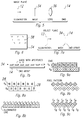
- Most proposed LEDs for the printer applications consist of widely spaced discrete LED emitting areas as shown in Figure 13. This light source may also be used with the embodiments described with respect to the present invention.
- FIG 14 illustrates an LED array which may be used with the present invention.
- An LED array is a high power LED which permits several improvements in the printing system.
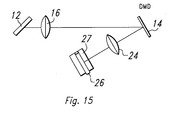
- the LED array has emitting areas placed as close to each other as feasible and forms, to the extent possible, a continuum of emitting areas as depicted in Figure 14. Since the shape of the movable mirror device array of 14 is a long and narrow rectangle, the LED is also long and narrow so that a relatively simple isometric imaging system can be used to relay the light to the movable mirror device 14 as illustrated in Figure 15.
- the additional power provided by the "super LED” can be invested in several ways to lower the cost and size of the system.
- the f-number of lens 24 in Figure 15 can be increased since more light is available by reducing their diameter.
- the f-number can be increased so long as the resolution of lens 24 is sufficient to produce a sharp enough pixel on the drum. The result will be a greater depth of field in the plane of the drum 26 allowing the drum 26 to wobble more during its rotation and generally loosening the tolerances to which it must be position.
- the additional power provided by the LED array could also allow lower transmission lens elements 16 and 24 to be used and still maintain adequate exposure.
- Current designs require up to 30 or more exposures by movable mirror device elements to achieve maximum density on the copy.
- a more powerful LED would allow a maximum exposure with fewer movable mirror device elements reducing the cost of the movable mirror device.
- the LED array also permits the use of the mask approach to controlling the illumination on the movable mirror device for the staggered array concept as discussed previously.
- the biggest objection to the mask is the loss of energy caused by the presence of the mask 34.
- the opaque area of the mask 34 can cause a loss of 90% or more of the light from the LED 12. However, the increased light from the LED array could offset this loss.
- the width of the movable mirror device 14 array could be reduced by a factor of three. If the same F # is maintained to preserve the exposure energy, the diameter and focal lengths of the lenses 16 and 24 of Figure 15 can be reduced by a roughly factor of three. Such reduction would reduce the cost and volume of the optics. The width of the movable mirror device 14 would also be reduced by a factor of three resulting in the substantially smaller movable mirror device 14 although the number of mirrored elements would remain unchanged.
- the width of the staggered movable mirror device array could be doubled with the attendant doubling the number of mirror elements.
- the movable mirror device array would now be two-thirds the original size rather than one-third the size.
- the writing algorithm depicted in Figure 12 could now be used providing a rectangular writing spot with an isomorphic optical system.
Landscapes
- Engineering & Computer Science (AREA)
- Multimedia (AREA)
- Signal Processing (AREA)
- Physics & Mathematics (AREA)
- General Physics & Mathematics (AREA)
- Optics & Photonics (AREA)
- Printers Or Recording Devices Using Electromagnetic And Radiation Means (AREA)
- Mechanical Light Control Or Optical Switches (AREA)
- Facsimile Heads (AREA)
- Mounting And Adjusting Of Optical Elements (AREA)
Applications Claiming Priority (2)
| Application Number | Priority Date | Filing Date | Title |
|---|---|---|---|
| US424917 | 1995-04-19 | ||
| US08/424,917 US5754217A (en) | 1995-04-19 | 1995-04-19 | Printing system and method using a staggered array spatial light modulator having masked mirror elements |
Publications (2)
| Publication Number | Publication Date |
|---|---|
| EP0739125A2 true EP0739125A2 (de) | 1996-10-23 |
| EP0739125A3 EP0739125A3 (de) | 1999-03-10 |
Family
ID=23684425
Family Applications (1)
| Application Number | Title | Priority Date | Filing Date |
|---|---|---|---|
| EP96106193A Withdrawn EP0739125A3 (de) | 1995-04-19 | 1996-04-19 | Verbesserungen an einem Aufzeichnungs- und Drucksystem und Verfahren dazu |
Country Status (7)
| Country | Link |
|---|---|
| US (1) | US5754217A (de) |
| EP (1) | EP0739125A3 (de) |
| JP (1) | JPH08318641A (de) |
| KR (1) | KR960038518A (de) |
| CN (1) | CN1140844A (de) |
| CA (1) | CA2174156A1 (de) |
| TW (1) | TW293116B (de) |
Cited By (5)
| Publication number | Priority date | Publication date | Assignee | Title |
|---|---|---|---|---|
| EP0931667A3 (de) * | 1998-01-23 | 2000-01-12 | Seiko Instruments Inc. | Optischer Druckerschreibkopf, Drucker, und Druckanordnung |
| EP0873006A3 (de) * | 1997-04-18 | 2000-02-02 | MIVATEC Hard- und Software GmbH | Fotoplott-Verfahren und Anordnung zur Aufzeichnung eines computergespeicherten Rasterbildes auf einen ebenen lichtempfindlichen Aufzeichnungsträger |
| EP0957384A3 (de) * | 1998-05-13 | 2000-10-04 | Ricoh Microelectronics Co., Ltd. | Optische Abbildungsvorrichtung und -Verfahren und Ausrichtungsvorrichtung für Lithographie |
| EP1155865A3 (de) * | 2000-05-18 | 2002-03-06 | Fuji Photo Film Co., Ltd. | Gerät und Verfahren zur Bildaufzeichnung |
| EP0971530A3 (de) * | 1998-07-10 | 2002-05-29 | MIVATEC Hard- und Software GmbH | Fotoplott-Verfahren zur hochenergetischen Aufzeichnung eines computergespeicherten Rasterbildes auf einen lichtempfindlichen Aufzeichnungsträger |
Families Citing this family (46)
| Publication number | Priority date | Publication date | Assignee | Title |
|---|---|---|---|---|
| US6467345B1 (en) | 1993-10-18 | 2002-10-22 | Xros, Inc. | Method of operating micromachined members coupled for relative rotation |
| US6044705A (en) * | 1993-10-18 | 2000-04-04 | Xros, Inc. | Micromachined members coupled for relative rotation by torsion bars |
| US6969635B2 (en) * | 2000-12-07 | 2005-11-29 | Reflectivity, Inc. | Methods for depositing, releasing and packaging micro-electromechanical devices on wafer substrates |
| SE9800665D0 (sv) * | 1998-03-02 | 1998-03-02 | Micronic Laser Systems Ab | Improved method for projection printing using a micromirror SLM |
| US6215547B1 (en) | 1998-11-19 | 2001-04-10 | Eastman Kodak Company | Reflective liquid crystal modulator based printing system |
| JP2001154609A (ja) * | 1999-12-01 | 2001-06-08 | Kawasaki Steel Corp | 表示素子 |
| US6330018B1 (en) | 1999-12-22 | 2001-12-11 | Eastman Kodak Company | Method and apparatus for printing high resolution images using reflective LCD modulators |
| JP2001188354A (ja) * | 1999-12-28 | 2001-07-10 | Asahi Kasei Corp | 感光性樹脂凸版の製造方法、及びその製造装置 |
| US6760057B2 (en) * | 2000-05-08 | 2004-07-06 | Fuji Photo Film Co., Ltd. | Optical recording method, apparatus, system and medium using high-power laser light |
| US6396530B1 (en) | 2000-06-12 | 2002-05-28 | Eastman Kodak Company | Method for improving exposure resolution using multiple exposures |
| US6407766B1 (en) | 2000-07-18 | 2002-06-18 | Eastman Kodak Company | Method and apparatus for printing to a photosensitive media using multiple spatial light modulators |
| US7300162B2 (en) * | 2000-08-30 | 2007-11-27 | Texas Instruments Incorporated | Projection display |
| US6614462B1 (en) * | 2000-10-19 | 2003-09-02 | Eastman Kodak Company | Method and apparatus for printing high resolution images using reflective LCD modulators |
| US7116862B1 (en) | 2000-12-22 | 2006-10-03 | Cheetah Omni, Llc | Apparatus and method for providing gain equalization |
| US6643049B2 (en) * | 2001-02-01 | 2003-11-04 | Kodak Polychrome Graphics Llc | Compact imaging head and high speed multi-head laser imaging assembly and method |
| US7339714B1 (en) | 2001-02-02 | 2008-03-04 | Cheetah Omni, Llc | Variable blazed grating based signal processing |
| US7145704B1 (en) | 2003-11-25 | 2006-12-05 | Cheetah Omni, Llc | Optical logic gate based optical router |
| JP5144863B2 (ja) * | 2001-06-29 | 2013-02-13 | 株式会社オーク製作所 | 多重露光描画方法及び多重露光描画装置 |
| US7023606B2 (en) * | 2001-08-03 | 2006-04-04 | Reflectivity, Inc | Micromirror array for projection TV |
| KR100486707B1 (ko) * | 2001-10-09 | 2005-05-03 | 삼성전자주식회사 | 가동 미러 장치 및 이를 채용한 프로젝터 |
| JP2004046146A (ja) * | 2002-05-23 | 2004-02-12 | Fuji Photo Film Co Ltd | 露光ヘッド |
| US6980572B2 (en) * | 2002-05-28 | 2005-12-27 | The Regents Of The University Of California | Wavelength selectable light source |
| US7042622B2 (en) * | 2003-10-30 | 2006-05-09 | Reflectivity, Inc | Micromirror and post arrangements on substrates |
| US7397517B2 (en) * | 2003-05-30 | 2008-07-08 | Kazuhiro Ohara | Display system and signal processing using diamond-shaped DMDs |
| US7701519B2 (en) * | 2003-06-19 | 2010-04-20 | Texas Instruments Incorporated | Display system and signal processing using diamond-shaped DMDs |
| US7131762B2 (en) * | 2003-07-25 | 2006-11-07 | Texas Instruments Incorporated | Color rendering of illumination light in display systems |
| US7212359B2 (en) * | 2003-07-25 | 2007-05-01 | Texas Instruments Incorporated | Color rendering of illumination light in display systems |
| US6888521B1 (en) * | 2003-10-30 | 2005-05-03 | Reflectivity, Inc | Integrated driver for use in display systems having micromirrors |
| US7180573B2 (en) * | 2004-10-15 | 2007-02-20 | Asml Holding N.V. | System and method to block unwanted light reflecting from a pattern generating portion from reaching an object |
| KR20080101517A (ko) * | 2007-05-18 | 2008-11-21 | 삼성전자주식회사 | 화상형성장치 및 방법 |
| US7929660B2 (en) * | 2008-07-18 | 2011-04-19 | Xcounter Ab | Support structure for mammography |
| US8872875B2 (en) | 2011-08-24 | 2014-10-28 | Palo Alto Research Center Incorporated | Single-pass imaging system with anamorphic optical system |
| US8472104B2 (en) | 2011-08-24 | 2013-06-25 | Palo Alto Research Center Incorporated | Single-pass imaging system using spatial light modulator anamorphic projection optics |
| US9030515B2 (en) | 2011-08-24 | 2015-05-12 | Palo Alto Research Center Incorporated | Single-pass imaging method using spatial light modulator and anamorphic projection optics |
| US8670172B2 (en) | 2011-08-24 | 2014-03-11 | Palo Alto Research Center Incorporated | Variable length imaging method using electronically registered and stitched single-pass imaging |
| US8767270B2 (en) | 2011-08-24 | 2014-07-01 | Palo Alto Research Center Incorporated | Single-pass imaging apparatus with image data scrolling for improved resolution contrast and exposure extent |
| US8477403B2 (en) | 2011-08-24 | 2013-07-02 | Palo Alto Research Center Incorporated | Variable length imaging apparatus using electronically registered and stitched single-pass imaging systems |
| US8502853B2 (en) | 2011-08-24 | 2013-08-06 | Palo Alto Research Center Incorporated | Single-pass imaging method with image data scrolling for improved resolution contrast and exposure extent |
| US8520045B2 (en) | 2011-08-24 | 2013-08-27 | Palo Alto Research Center Incorporated | Single-pass imaging system with spatial light modulator and catadioptric anamorphic optical system |
| US9630424B2 (en) | 2011-08-24 | 2017-04-25 | Palo Alto Research Center Incorporated | VCSEL-based variable image optical line generator |
| US8405913B2 (en) * | 2011-08-24 | 2013-03-26 | Palo Alto Research Center Incorporated | Anamorphic projection optical system |
| US8390917B1 (en) | 2011-08-24 | 2013-03-05 | Palo Alto Research Center Incorporated | Multiple line single-pass imaging using spatial light modulator and anamorphic projection optics |
| US8791972B2 (en) | 2012-02-13 | 2014-07-29 | Xerox Corporation | Reflex-type digital offset printing system with serially arranged single-pass, single-color imaging systems |
| US9354379B2 (en) | 2014-09-29 | 2016-05-31 | Palo Alto Research Center Incorporated | Light guide based optical system for laser line generator |
| CN104407339B (zh) * | 2014-11-21 | 2017-01-04 | 中国人民解放军海军工程大学 | 一种激光引偏干扰环境态势图生成系统 |
| EP4169356B1 (de) * | 2020-06-19 | 2023-12-06 | Signify Holding B.V. | Steuerung einer pixelierten beleuchtungsvorrichtung basierend auf einer relativen position einer weiteren lichtquelle |
Family Cites Families (18)
| Publication number | Priority date | Publication date | Assignee | Title |
|---|---|---|---|---|
| FR2274992A1 (fr) * | 1974-06-14 | 1976-01-09 | Thomson Csf | Convertisseur electro-optique et systeme optique d'enregistrement comportant un tel convertisseur |
| DE2631850C2 (de) * | 1976-07-15 | 1984-11-22 | Agfa-Gevaert Ag, 5090 Leverkusen | Verfahren sowie Vorrichtung zum zeilenweisen Belichten punktförmiger Flächenelemente eines lichtempfindlichen Aufzeichnungsträgers |
| DE3118389A1 (de) * | 1981-05-09 | 1983-01-27 | Philips Patentverwaltung Gmbh, 2000 Hamburg | Lichtschaltmaske fuer einen optischen drucker |
| US5061049A (en) * | 1984-08-31 | 1991-10-29 | Texas Instruments Incorporated | Spatial light modulator and method |
| US4596992A (en) * | 1984-08-31 | 1986-06-24 | Texas Instruments Incorporated | Linear spatial light modulator and printer |
| JPS6235323A (ja) * | 1985-08-09 | 1987-02-16 | Canon Inc | 光走査光学系 |
| US5101236A (en) * | 1989-12-21 | 1992-03-31 | Texas Instruments Incorporated | Light energy control system and method of operation |
| US5299042A (en) * | 1990-05-30 | 1994-03-29 | Victor Company Of Japan, Ltd. | Light-to-light conversion method, display unit using the same, and light-to-light conversion element incorporated therein |
| US5142405A (en) * | 1990-06-29 | 1992-08-25 | Texas Instruments Incorporated | Bistable dmd addressing circuit and method |
| US5083857A (en) * | 1990-06-29 | 1992-01-28 | Texas Instruments Incorporated | Multi-level deformable mirror device |
| US5172161A (en) * | 1990-12-31 | 1992-12-15 | Texas Instruments Incorporated | Unibody printing system and process |
| US5155778A (en) * | 1991-06-28 | 1992-10-13 | Texas Instruments Incorporated | Optical switch using spatial light modulators |
| US5430524A (en) * | 1992-07-22 | 1995-07-04 | Texas Instruments Incorporated | Unibody printing and copying system and process |
| US5510824A (en) * | 1993-07-26 | 1996-04-23 | Texas Instruments, Inc. | Spatial light modulator array |
| US5459492A (en) * | 1993-08-30 | 1995-10-17 | Texas Instruments Incorporated | Method and apparatus for printing stroke and contone data together |
| US5414553A (en) * | 1993-11-29 | 1995-05-09 | Xerox Corporation | Electroabsorptive asymmetrical fabry-perot modulator array for line printers |
| US5490009A (en) * | 1994-10-31 | 1996-02-06 | Texas Instruments Incorporated | Enhanced resolution for digital micro-mirror displays |
| JPH08186781A (ja) * | 1994-12-26 | 1996-07-16 | Texas Instr Inc <Ti> | プロジエクタ装置 |
-
1995
- 1995-04-19 US US08/424,917 patent/US5754217A/en not_active Expired - Fee Related
-
1996
- 1996-04-15 CA CA002174156A patent/CA2174156A1/en not_active Abandoned
- 1996-04-19 KR KR1019960011935A patent/KR960038518A/ko not_active Abandoned
- 1996-04-19 CN CN96106144A patent/CN1140844A/zh active Pending
- 1996-04-19 EP EP96106193A patent/EP0739125A3/de not_active Withdrawn
- 1996-04-19 JP JP9877996A patent/JPH08318641A/ja active Pending
- 1996-04-23 TW TW085104796A patent/TW293116B/zh active
Cited By (9)
| Publication number | Priority date | Publication date | Assignee | Title |
|---|---|---|---|---|
| EP0873006A3 (de) * | 1997-04-18 | 2000-02-02 | MIVATEC Hard- und Software GmbH | Fotoplott-Verfahren und Anordnung zur Aufzeichnung eines computergespeicherten Rasterbildes auf einen ebenen lichtempfindlichen Aufzeichnungsträger |
| US6178006B1 (en) | 1997-04-18 | 2001-01-23 | Mivatec Hard-Und Software Gmbh | Photoplotting method and an arrangement for plotting a computer-stored raster image on a plane, photosensitive record carrier |
| EP0931667A3 (de) * | 1998-01-23 | 2000-01-12 | Seiko Instruments Inc. | Optischer Druckerschreibkopf, Drucker, und Druckanordnung |
| EP0957384A3 (de) * | 1998-05-13 | 2000-10-04 | Ricoh Microelectronics Co., Ltd. | Optische Abbildungsvorrichtung und -Verfahren und Ausrichtungsvorrichtung für Lithographie |
| US6288830B1 (en) | 1998-05-13 | 2001-09-11 | Ricoh Microelectronics Company, Ltd. | Optical image forming method and device, image forming apparatus and aligner for lithography |
| EP0971530A3 (de) * | 1998-07-10 | 2002-05-29 | MIVATEC Hard- und Software GmbH | Fotoplott-Verfahren zur hochenergetischen Aufzeichnung eines computergespeicherten Rasterbildes auf einen lichtempfindlichen Aufzeichnungsträger |
| US6504567B1 (en) | 1998-07-10 | 2003-01-07 | Mivatec Hard-Und Software Gmbh | Photoplotting process and apparatus for high-energy plotting of a computer-stored raster image on a photosensitive record carrier |
| EP1155865A3 (de) * | 2000-05-18 | 2002-03-06 | Fuji Photo Film Co., Ltd. | Gerät und Verfahren zur Bildaufzeichnung |
| US6529261B2 (en) * | 2000-05-18 | 2003-03-04 | Fuji Photo Film Co., Ltd. | Apparatus for and method of recording image |
Also Published As
| Publication number | Publication date |
|---|---|
| JPH08318641A (ja) | 1996-12-03 |
| EP0739125A3 (de) | 1999-03-10 |
| KR960038518A (ko) | 1996-11-21 |
| TW293116B (de) | 1996-12-11 |
| CN1140844A (zh) | 1997-01-22 |
| US5754217A (en) | 1998-05-19 |
| CA2174156A1 (en) | 1996-10-20 |
Similar Documents
| Publication | Publication Date | Title |
|---|---|---|
| US5754217A (en) | Printing system and method using a staggered array spatial light modulator having masked mirror elements | |
| US5453778A (en) | Method and apparatus for spatial modulation in the cross-process direction | |
| US6288830B1 (en) | Optical image forming method and device, image forming apparatus and aligner for lithography | |
| EP0620676B1 (de) | Prozess für einen digitalen Mikrospiegeldrucker | |
| US8928720B2 (en) | Apparatus and method of scanning light using an array of light sources | |
| US4450458A (en) | Multi-function reproduction apparatus | |
| US7545399B2 (en) | Line head and image forming apparatus using the same | |
| EP0469912A2 (de) | Zwei-Farben elektronisches Drucksystem mit einzelnem Durchgang | |
| GB2042746A (en) | Multiple Variable Light Source Photographic Printer | |
| EP0427506B1 (de) | Elektronisches Farbdrucksystem | |
| EP0997841A2 (de) | Digitaler Druck hoher Auflösung mittels räumlicher Lichtmodulation | |
| US4928118A (en) | Enhanced resolution electrophotographic-type imaging station | |
| JP2728446B2 (ja) | 電子写真記録装置 | |
| EP0658857B1 (de) | Bildaufzeichnungsgerät | |
| US5168283A (en) | Method and apparatus for charged area development printing with high and low resolution image bars | |
| JP2003320706A (ja) | 細線走査記録方式 | |
| JP3705337B2 (ja) | 細線走査記録方法 | |
| JP3401686B2 (ja) | 画像形成装置 | |
| EP1684129B1 (de) | Abbildungsvorrichtung und Abbildungsverfahren | |
| JP2000025265A (ja) | Ledヘッド及びそれを備えたプリンタ | |
| JPH0638515B2 (ja) | 電子写真記録装置 | |
| JP2001162861A (ja) | 画像記録装置 | |
| JP2001180040A (ja) | 画像記録装置 | |
| JPH11277803A (ja) | 電子写真プリント装置 | |
| JPH0442176A (ja) | 電子写真プリンタ |
Legal Events
| Date | Code | Title | Description |
|---|---|---|---|
| PUAI | Public reference made under article 153(3) epc to a published international application that has entered the european phase |
Free format text: ORIGINAL CODE: 0009012 |
|
| AK | Designated contracting states |
Kind code of ref document: A2 Designated state(s): DE FR GB IT NL |
|
| PUAL | Search report despatched |
Free format text: ORIGINAL CODE: 0009013 |
|
| AK | Designated contracting states |
Kind code of ref document: A3 Designated state(s): DE FR GB IT NL |
|
| 17P | Request for examination filed |
Effective date: 19990909 |
|
| STAA | Information on the status of an ep patent application or granted ep patent |
Free format text: STATUS: THE APPLICATION IS DEEMED TO BE WITHDRAWN |
|
| 18D | Application deemed to be withdrawn |
Effective date: 20031031 |