EP0741182A2 - Immuno- und Enzymassays mittels zweiter Oberschwingung und Summenfrequenz-Erzeugung auf einer Oberfläche - Google Patents
Immuno- und Enzymassays mittels zweiter Oberschwingung und Summenfrequenz-Erzeugung auf einer Oberfläche Download PDFInfo
- Publication number
- EP0741182A2 EP0741182A2 EP96106232A EP96106232A EP0741182A2 EP 0741182 A2 EP0741182 A2 EP 0741182A2 EP 96106232 A EP96106232 A EP 96106232A EP 96106232 A EP96106232 A EP 96106232A EP 0741182 A2 EP0741182 A2 EP 0741182A2
- Authority
- EP
- European Patent Office
- Prior art keywords
- radicals
- radical
- rest
- bis
- diesel fuel
- Prior art date
- Legal status (The legal status is an assumption and is not a legal conclusion. Google has not performed a legal analysis and makes no representation as to the accuracy of the status listed.)
- Granted
Links
Classifications
-
- C—CHEMISTRY; METALLURGY
- C08—ORGANIC MACROMOLECULAR COMPOUNDS; THEIR PREPARATION OR CHEMICAL WORKING-UP; COMPOSITIONS BASED THEREON
- C08G—MACROMOLECULAR COMPOUNDS OBTAINED OTHERWISE THAN BY REACTIONS ONLY INVOLVING UNSATURATED CARBON-TO-CARBON BONDS
- C08G77/00—Macromolecular compounds obtained by reactions forming a linkage containing silicon with or without sulfur, nitrogen, oxygen or carbon in the main chain of the macromolecule
- C08G77/42—Block-or graft-polymers containing polysiloxane sequences
- C08G77/46—Block-or graft-polymers containing polysiloxane sequences containing polyether sequences
-
- B—PERFORMING OPERATIONS; TRANSPORTING
- B01—PHYSICAL OR CHEMICAL PROCESSES OR APPARATUS IN GENERAL
- B01D—SEPARATION
- B01D19/00—Degasification of liquids
- B01D19/02—Foam dispersion or prevention
- B01D19/04—Foam dispersion or prevention by addition of chemical substances
- B01D19/0404—Foam dispersion or prevention by addition of chemical substances characterised by the nature of the chemical substance
- B01D19/0409—Foam dispersion or prevention by addition of chemical substances characterised by the nature of the chemical substance compounds containing Si-atoms
-
- C—CHEMISTRY; METALLURGY
- C10—PETROLEUM, GAS OR COKE INDUSTRIES; TECHNICAL GASES CONTAINING CARBON MONOXIDE; FUELS; LUBRICANTS; PEAT
- C10L—FUELS NOT OTHERWISE PROVIDED FOR; NATURAL GAS; SYNTHETIC NATURAL GAS OBTAINED BY PROCESSES NOT COVERED BY SUBCLASSES C10G OR C10K; LIQUIFIED PETROLEUM GAS; USE OF ADDITIVES TO FUELS OR FIRES; FIRE-LIGHTERS
- C10L1/00—Liquid carbonaceous fuels
- C10L1/10—Liquid carbonaceous fuels containing additives
- C10L1/14—Organic compounds
- C10L1/28—Organic compounds containing silicon
- C10L1/285—Organic compounds containing silicon macromolecular compounds
Definitions
- hydrocarbon mixtures used as diesel fuel have the unpleasant property of developing foam in connection with air when they are filled into storage tanks, such as storage tanks and fuel tanks of motor vehicles. This leads to a delay in the filling process and inadequate filling of the containers. It is therefore common to add defoamers to diesel fuel. These defoamers should be effective in the lowest possible concentration and must not form harmful residues when the diesel fuel is burned in the engine or have a negative effect on the combustion of the fuel. Correspondingly effective defoamers are described in the patent literature.
- the use concentration of the antifoam is 1 to 100, preferably 5 to 50 ppm, based on diesel fuel.
- siloxanyl-alkenediyl-bis- ⁇ -hydroxy-polyoxyalkylenes themselves and their preparation are described in DD-PS 255 737.
- organopolysiloxanes for defoaming diesel fuel.
- DE-PS 43 43 235 describes a process for defoaming diesel fuel, organofunctionally modified polysiloxanes of the general formula in which the radicals R 1 are alkyl or aryl radicals, the radicals R 2 are selected from several of the following classes of compounds: butene derivatives, alkanol derivatives, polyethers and alkyl radicals.
- organopolysiloxanes described in DE-OS 40 32 006, US Pat. No. 5,334,227 and DE-PS 43 43 235 lead to a reduced silicon loading of the diesel fuels (0.4 to 1 ppm), but cannot be carried out in any additive package without adaptation the solvent composition can be used. Since the defoamers for diesel fuel are incorporated almost without exception into fuel additive packages and are not added directly to the diesel fuel, this is a serious technical disadvantage of these organopolysiloxanes. Additive pacts are added to the raw diesel oil to improve its properties.
- Additive packages are mixtures of different additives, such as. B. Combustion behavior improving agents, smoke reducing agents, harmful exhaust gas reducing agents, inhibitors to reduce corrosion in the engine and its parts, surfactants, lubricants and the like.
- Such additive packages are e.g. B. in JP-OS 05 132 682, GB-OS 2 248 068 and in the journal Mineralöltechnik, 37 (4), 20 pp. described.
- the additives in the additive package are dissolved in an organic solvent to form a concentrate that is added to the raw diesel fuel. Antifoams with polar groups can often not be incorporated evenly into these additive packages or separated during storage.
- the present invention is therefore concerned with the technical problem of finding anti-foaming agents with improved compatibility with the additive packages commonly used.
- this combination of properties can be found in a selected organofunctionally modified polysiloxane.
- the value of b and the value of a are to be understood as average values in the polymer molecule, since the polysiloxanes to be used according to the invention are in the form of - as a rule - equilibrated mixtures.
- the R 1 radicals are alkyl radicals having 1 to 4 carbon atoms, such as methyl, ethyl, propyl or butyl radicals, or aryl radicals, the phenyl radicals being preferred.
- the methyl radicals are preferred for production and price reasons, so that at least 80% of the radicals R 1 must be methyl radicals. Polysiloxanes in which all of the radicals R 1 are methyl are particularly preferred.
- organofunctionally modified polysiloxanes which have organofunctional radicals R 2 .
- These radicals R 2 are selected from two main groups, namely from the radicals R 2A and R 2B .
- These two radicals R 2A and R 2B differ in their polar character: the radicals R 2A are more polar than the simultaneously existing radicals R 2B .
- the ratio of the polar residues R 2A to the less polar residues R 2B can vary within wide limits. It has proven useful to set a ratio of 10: 1 to 1: 3. A ratio of 6: 1 to 2: 1 is particularly preferred.
- R 2 radicals it is not necessary for all of the R 2 radicals to be selected from the radicals R 2A and R 2B . Some of these residues can also have the meaning of the residues R 1 , ie some of the residues R 2 can also have the meaning of alkyl radicals with 1 to 4 carbon atoms or of aryl radicals. In this case too, the residues should preferably be methyl residues.
- radical (a) which is a phenol derivative
- the radical R 3 is a divalent radical which is composed of one or more of the following groups: hydrocarbon radicals which are optionally substituted, aromatic radicals which are optionally substituted, and Polyoxyalkylene residues.
- An alkylene radical having 2 to 6 carbon atoms is preferred.
- the radical R 4 is a monovalent radical which is the same or different and is selected from the groups: hydrogen radical, alkyl radical, alkyloxy radical, hydroxy radical. Hydrogen residues, methyl residues and methoxy residues are preferred.
- the index z is a number from 0 to 4.
- residues (a) can in the molecule of the polysiloxane by addition of allyl or vinyl derivatives to SiH groups of the polysiloxane in the presence of a hydrosilylation catalyst, e.g. B. according to the method of US Pat. No. 5,334,227.
- a hydrosilylation catalyst e.g. B. according to the method of US Pat. No. 5,334,227.
- corresponding allyl derivatives are allylphenol and eugenol (4-allyl, 2-methoxyphenol).
- R 5 is a hydrogen or alkyl radical, in particular a lower alkyl radical with 1 to 4 carbon atoms.
- the hydrogen residue is preferred.
- the index c is a number from 1 to 20, preferably 1.
- the indices d and e are, independently of one another, numbers from 0 to 50.
- Preferred is a radical (b) in which R 5 is a hydrogen radical, the index c is 1 and the indices d and e are each independently 0 to 10. These indices are average numbers since it is known that when alkylene oxides, such as ethylene oxide and propylene oxide, are added to alcohols, a mixture of compounds of different chain lengths is obtained.
- radicals (b) can be introduced into the molecule of the polysiloxane by adding alkenediyl-bis- ⁇ -hydroxy-polyoxyalkylenes to SiH groups of the polysiloxane in the presence of a hydrosilylation catalyst in accordance with the process of DD-PS 255 737.
- R 6 is a hydrogen or a monovalent organic radical.
- the index f is a number from 3 to 20, with the numerical value of 6 being preferred.
- residues (c) can be introduced by means of a hydrosilylation reaction as described above by adding alkenols or their derivatives to SiH groups of the organopolysiloxane.
- alkenols or their derivatives examples include hexenol and the alkyl ether of hexenol.
- R 7 is a hydrogen or a monovalent organic radical.
- R 7 is preferably a hydrogen or methyl radical.
- the index g is a number from 3 to 6, the index h a number from 1 to 50 and the index i a number from 0 to 20, the number ratio h: i> 5: 2.
- the index g preferably has a value of 3, the index h a value of 8 to 30 and the index i a value of 0 to 12.
- residues (d) can also be introduced by means of a hydrosilylation reaction as described above by adding alkenol polyethers or their derivatives to SiH groups of the organopolysiloxane.
- the residue (e) can be compared with the residue (b) (within the possibilities of the residue R 2A ) and differs from this in that the terminal hydroxyl groups are blocked.
- the end blocking group R 9 is one Alkyl, acyl or trialkylsilyl group.
- the methyl, acetyl or trimethylsilyl radical is preferred. This modification significantly improves the compatibility of the antifoam in the additive package.
- the radical R 5 and the radical R 8 , the indices c, d and e correspond to the indices k, m and n. The same applies to the preferred meanings.
- the index o has a numerical value of 5 to 30, preferably 11 to 17. These are long-chain alkyl radicals. These residues significantly improve the compatibility of the siloxane to be used according to the invention in the additive package, but also in the diesel fuel.
- the residue (g) can be compared with the residue (d) (within the possibilities of the residue R 2A ) and differs from it by the number of different oxyalkylene units: the index h is a number from 0 to 35, the index i is a number Number from 1 to 50, the ratio of the indices h: i ⁇ 5: 2. H preferably has a numerical value from 0 to 17 and i has a numerical value from 6 to 26. g is a number from 3 to 6, preferably 3.
- residues (g) can also be introduced by means of a hydrosilylation reaction as described above by adding alkenol polyethers or their derivatives to SiH groups of the organopolysiloxane.
- the organofunctionally modified polysiloxanes to be used according to the invention can be added directly to the diesel fuel, an addition of 0.5 to 50 ppm, based on diesel fuel, being sufficient for effective defoaming.
- the addition is preferably 2 to 20 ppm. Due to this low addition quantity, a lower absolute Si content results in the diesel fuel.
- the reactants are placed in a 1000 ml reaction flask equipped with a stirrer, dropping funnel, thermometer and reflux condenser together with 100 g of toluene.
- the catalyst (20 ppm hexachloroplatinic acid H 2 PtCl 6 , suspended in a little toluene) is added with stirring and then heated to 120.degree. At this temperature, the SiH-functionalized polydimethylsiloxane (see table) is added dropwise within about 30 minutes in such a way that, despite the onset of an exothermic reaction, a temperature of 130 ° C. is not exceeded. After the addition is complete, stirring is continued at a maximum of 130 ° C. The Sales are checked every hour using the SiH value. The average reaction time is about 4 hours, the conversion should be at least 99% of the theoretical value.
- the solvent and volatile by-products are removed by subsequent distillation in an oil pump vacuum at 130 ° C. After cooling, there is a filtration in which the catalyst residues are separated off.
- the siloxanes to be used according to the invention are dissolved in an additive package of the prior art and a certain amount of this mixture is stirred into 500 g of additive-free diesel fuel.
- the mixing ratio of the siloxane to the additive package and the amount of this additive added to the fuel are selected so that the desired siloxane concentration and at the same time a concentration of the additive package of 500 ppm in the diesel fuel are achieved.
- the concentration of the compounds according to the invention in diesel fuel is varied between 2 and 20 ppm. For each product, the approximate critical concentration is determined, below which a significant drop in effectiveness occurs for the first time.
- the foam disintegration of the diesel fuel mixed with additive and defoamer is tested in a pressure apparatus.
- This apparatus essentially consists of a 1 liter pressure vessel that can be pressurized with a constant compressed air pressure and a 250 ml measuring cylinder.
- An outlet connection of the pressure vessel which is provided with a solenoid valve, is centered above the measuring cylinder and dips into it only a few centimeters.
- 100 ml of the diesel fuel to be tested is poured into the pressure vessel, pressurized with a compressed air pressure of 0.4 bar and discharged into the measuring cylinder over a period of 3.9 seconds using the solenoid valve.
- the volume difference which results from the maximum foam level and the level of the foam-free liquid in the measuring cylinder, is given in ml and referred to as the foam volume.
- the time that elapses between reaching the maximum foam level and tearing the foam layer over the liquid to form a foam ring is measured in seconds and is referred to as the foam disintegration time. Three measurements are carried out for each defoamer and the average foam height and disintegration time are determined.
- the following table summarizes the measurement results of the foam disintegration test and the compatibility test.
- the stated use concentrations are the critical use concentration for each defoamer, and falling below this leads to a significant deterioration in the defoaming behavior.
- the silicon content of the diesel fuel with defoamer is calculated from the use concentration of the defoamer and its theoretical silicon content, which is determined using the average structural formula.
- the compilation shows that the organofunctionally modified polysiloxanes E1 to E7 to be used according to the invention are very suitable for defoaming diesel fuel. In contrast to the comparison products, they have excellent compatibility with the fuel additive packages. The use of additional solvents can thus be avoided and the risk that the defoamer, for. B. under unfavorable weather conditions, reduce storage during storage from the additive package.
Landscapes
- Chemical & Material Sciences (AREA)
- Chemical Kinetics & Catalysis (AREA)
- Organic Chemistry (AREA)
- Oil, Petroleum & Natural Gas (AREA)
- Health & Medical Sciences (AREA)
- Engineering & Computer Science (AREA)
- Polymers & Plastics (AREA)
- General Chemical & Material Sciences (AREA)
- Medicinal Chemistry (AREA)
- Toxicology (AREA)
- Dispersion Chemistry (AREA)
- Silicon Polymers (AREA)
- Addition Polymer Or Copolymer, Post-Treatments, Or Chemical Modifications (AREA)
Abstract
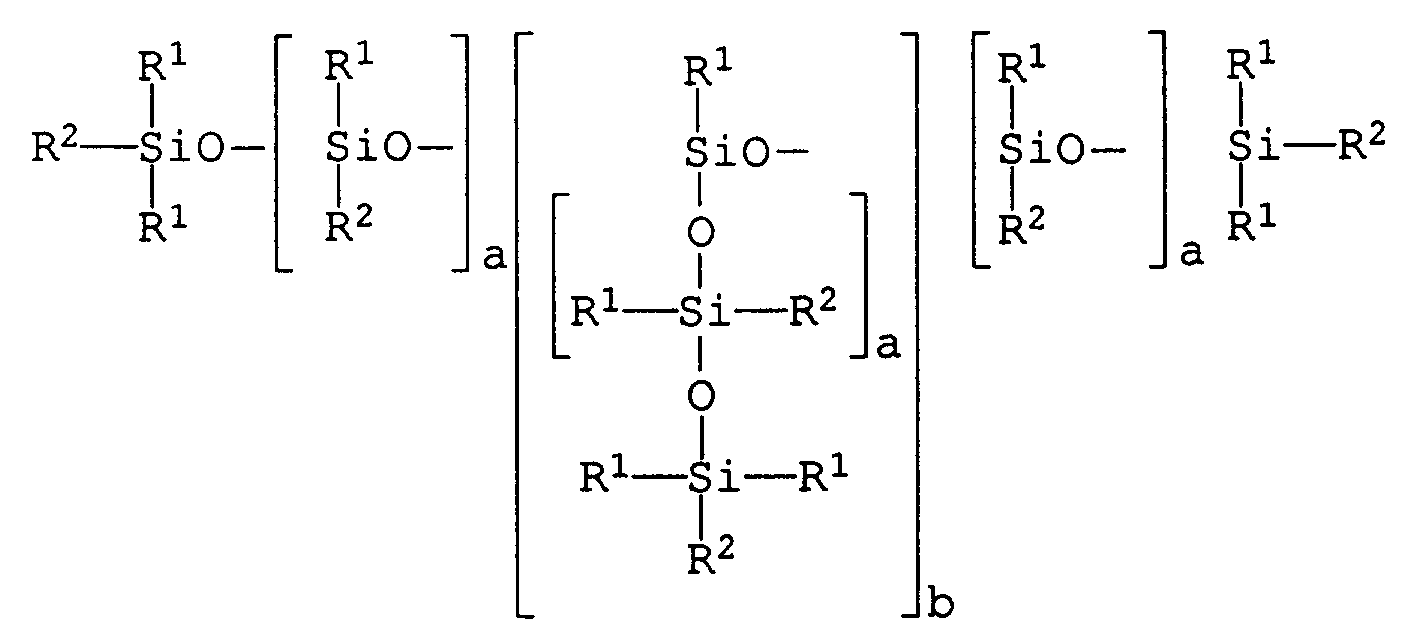
- R1
- vorzugsweise Methylreste sind,
- R2
- im Molekül gleich oder verschieden sind, wobei
- 30 bis 90 %
- die Bedeutung des Restes R1 haben und
- 70 bis 10 %
- aus einem Gemisch von näher definierten Resten R2A und R2B bestehen, die sich durch ihre Polarität unterscheiden,
Description
- Die als Dieselkraftstoff verwendeten Kohlenwasserstoffgemische haben die unangenehme Eigenschaft, beim Abfüllen in Vorratsbehälter, wie Lagertanks und Kraftstoffbehälter von Motorfahrzeugen, in Verbindung mit Luft Schaum zu entwickeln. Dies führt zur Verzögerung des Abfüllvorgangs und zu unzureichender Befüllung der Behälter. Es ist deshalb üblich, dem Dieselkraftstoff Entschäumer zuzusetzen. Diese Entschäumer sollen in möglichst geringer Konzentration wirksam sein und dürfen bei der Verbrennung des Dieselkraftstoffes im Motor keine schädlichen Rückstände bilden oder die Verbrennung des Kraftstoffes negativ beeinflussen. Entsprechend wirksame Entschäumer sind in der Patentliteratur beschrieben.
- So betrifft die GB-PS 2 173 510 ein Verfahren zum Entschäumen von Dieselkraftstoff oder Jet Fuel, wobei dem Kraftstoff ein Antischaummittel zugesetzt wird, welches im wesentlichen aus einem Organopolysiloxan der allgemeinen Formel
R3SiO(R2SiO)x(RR'SiO)ySiR3
besteht, wobei
das Verhältnis x : y im Bereich 1 : 1 bis 9 : 1 liegt, jede Gruppe R eine einwertige Kohlenwasserstoffgruppe ist und mindestens 80 % der Gruppen R Methylgruppen sind,
jede Gruppe R' eine substituierte Gruppe der allgemeinen Formel Q(OA)nOZ ist, in welcher - Q
- eine an einem Si-Atom gebundene zweiwertige Gruppe ist,
- A
- eine Alkylengruppe ist und mindestens 80 % dieser Gruppen Ethylengruppen sind,
- Z
- ein Wasserstoffrest oder eine Gruppe OCR'' ist, in der R'' eine einwertige Gruppe ist,
- n
- einen Wert von 5 bis 25 hat, und
- das
- Copolymer ein durchschnittliches Molekulargewicht der Art hat, daß die OA-Gruppen 25 bis 65 Gew.-% des errechneten Molekulargewichtes des Copolymeren betragen, wobei
- das
- Copolymere in einem organischen Lösungsmittel gelöst sein kann.
- Die Einsatzkonzentration des Antischaummittels liegt bei 1 bis 100, vorzugsweise 5 bis 50 ppm, bezogen auf Dieselkraftstoff.
- Die DE-OS 40 32 006 lehrt ein Verfahren zum Entschäumen und/oder Entgasen organischer Systeme durch Zugabe eines ein Organopolysiloxan enthaltenden Antischaummittels zum organischen System, welches aus Dieselöl oder Rohöl oder Crackprodukten hiervon gebildet sein kann. Als Organopolysiloxan wird ein Polymer verwendet, welches aus Siloxaneinheiten der allgemeinen Formel

- R
- ein einwertiger Kohlenwasserstoffrest mit 1 bis 18 Kohlenstoffatom(en) je Rest bedeutet,
- A
- ein Rest der allgemeinen Formel

- R1
- einen Rest der Formel -CR3H- bedeutet, R3 = Wasserstoff- oder einwertiger organischer Rest,
- R2
- einen Rest der Formel -CR4H-CH3 oder -(CH2)3-bedeutet, R4 = Wasserstoff- oder einwertiger organischer Rest,
- v, w
- jeweils 0 oder ganze Zahl, wobei v+w durchschnittlich 0 bis 16 ist,
- x, y
- 0 oder 1, wobei x+y 1 oder 2 ist,
- Die verwendeten Siloxanyl-alkendiyl-bis-ω-hydroxy-polyoxy-alkylene selbst und ihre Herstellung sind in der DD-PS 255 737 beschrieben.
- Die US-PS 5 334 227 beschreibt die Verwendung von Organopolysiloxanen zur Entschäumung von Dieselkraftstoff. Als Organopolysiloxane werden Verbindungen der allgemeinen Formel


- In der DE-PS 43 43 235 wird ein Verfahren zur Entschäumung von Dieselkraftstoff beschrieben, wobei organofunktionell modifizierte Polysiloxane der allgemeinen Formel

die Reste R1 Alkyl- oder Arylreste sind,
die Reste R2 aus mehreren der nachfolgenden Verbindungsklassen ausgewählt sind: Butenderivate, Alkanolderivate, Polyether und Alkylreste, verwendet werden. - Den beschriebenen und weiteren aus dem Stand der Technik bekannten Antischaummitteln für Dieselkraftstoffe sind verschiedene Nachteile zu eigen. So führt z. B. die Verwendung der in GB-PS 2 173 510 beschriebenen Polysiloxan-Polyoxyalkylen-Copolymeren aufgrund der erforderlichen, relativ hohen Einsatzkonzentration und dem Siliciumgehalt, der typischerweise zwischen 10 und 15 Gew.-% beträgt, zu einer hohen Siliciumbeladung der Dieselkraftstoffe (2 bis 4 ppm).
- Die in DE-OS 40 32 006, US-PS 5 334 227 und DE-PS 43 43 235 beschriebenen Organopolysiloxane führen zwar zu einer reduzierten Siliciumbeladung der Dieselkraftstoffe (0,4 bis 1 ppm), können jedoch nicht in jedem Additivpaket ohne eine Anpassung der Lösungsmittelkomposition eingesetzt werden. Da die Entschäumer für Dieselkraftstoff fast ausnahmslos in Kraftstoffadditivpakete eingearbeitet werden, und nicht direkt dem Dieselkraftstoff zugesetzt werden, ist dies ein schwerwiegender technischer Nachteil dieser Organopolysiloxane. Additivpakte werden dem rohen Dieselöl zu seiner Eigenschaftsverbesserung zugesetzt.
- Unter Additivpaketen versteht man Mischungen verschiedener Zusatzstoffe, wie z. B. Mittel zur Verbesserung des Verbrennungsverhaltens, Mittel zur Verminderung der Rauchbildung, Mittel zur Verringerung der Bildung schädlicher Abgase, Inhibitoren zur Verringerung der Korrosion im Motor und seinen Teilen, grenzflächenaktive Substanzen, Schmiermittel und dergleichen. Derartige Additivpakete sind z. B. in der JP-OS 05 132 682, der GB-OS 2 248 068 und in der Zeitschrift Mineralöltechnik, 37(4), 20 pp. beschrieben. Die Zusätze des Additivpaketes sind dabei in einem organischen Lösungsmittel zu einem Stammkonzentrat gelöst, das dem rohen Dieselkraftstoff zugesetzt wird. Antischaummittel mit polaren Gruppen lassen sich in diese Additivpakete häufig nicht gleichmäßig einarbeiten oder separieren bei der Lagerung.
- Die vorliegende Erfindung befaßt sich deshalb mit dem technischen Problem, Antischaummittel mit verbesserter Verträglichkeit mit den üblicherweise verwendeten Additivpaketen aufzufinden.
- Diese Eigenschaftskombination ist erfindungsgemäß bei einem ausgewählten organofunktionell modifizierten Polysiloxan zu finden.
- Gegenstand vorliegender Erfindung ist deshalb die Verwendung von organofunktionell modifizierten Polysiloxanen der allgemeinen Formel I

- R1
- Alkylreste mit 1 bis 4 Kohlenstoffatomen oder Arylreste sind, jedoch mindestens 80 % der Reste R1 Methylreste sind,
- R2
- im Molekül gleich oder verschieden sind, von denen
- 30 bis 90 %
- die Bedeutung des Restes R1 haben und
- 70 bis 10 %
- aus einem Gemisch von Resten R2A und R2B bestehen, wobei die Reste R2A polarer als die Reste R2B sind, und wobei die Reste R2A aus folgenden Resten ausgewählt sind:
- (a) ein Phenolderivat mit der allgemeinen Formel:
-R3-(C6H4-zR4 z)-OH
wobei- R3
- ein zweiwertiger Rest, der aus einer oder mehreren der folgenden Gruppen zusammengesetzt ist: Kohlenwasserstoffreste, die gegebenenfalls substituiert sind,
Aromatenreste, die gegebenenfalls substituiert sind,
Polyoxyalkylenreste, und - R4
- ein einwertiger Rest, der gleich oder verschieden ist und aus den Gruppen:
Wasserstoffrest, Alkylrest, Alkyloxyrest, Hydroxyrest, ausgewählt ist, und - z
- eine Zahl von 0 bis 4 ist, oder
- (b) der Rest
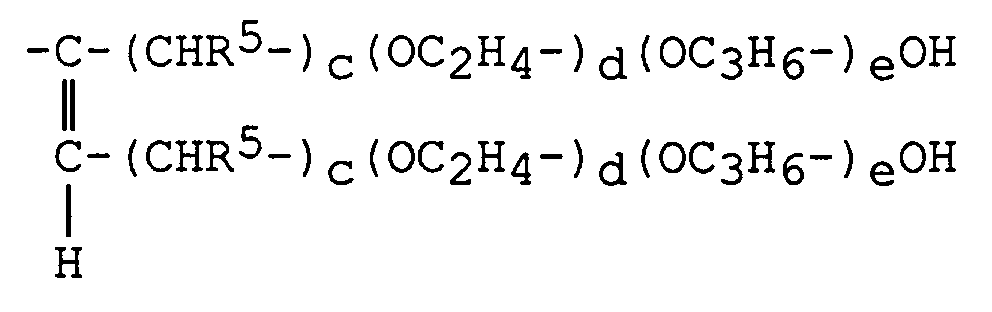
- R5
- ein Wasserstoff- oder Alkylrest,
- c
- eine Zahl von 1 bis 20,
- d
- eine Zahl von 0 bis 50,
- e
- eine Zahl von 0 bis 50 ist oder
- (c) der Rest -(CH2-)fOR6,
wobei- R6
- ein Wasserstoff- oder ein einwertiger organischer Rest,
- f
- eine Zahl von 3 bis 20 ist oder
- (d) der Rest -(CH2-)g(OC2H4-)h(OC3H6-)iOR7 wobei
- R7
- ein Wasserstoff- oder ein einwertiger organischer Rest,
- g
- eine Zahl von 3 bis 6,
- h
- eine Zahl von 1 bis 50,
- i
- eine Zahl von 0 bis 20 ist und
das Verhältnis h : i > 5 : 2 ist, und
die Reste R2B aus folgenden Resten ausgewählt sind:
- (e) der Rest

- R8
- ein Wasserstoff- oder Alkylrest,
- R9
- ein Alkyl-, Acyl- oder Trialkylsilylrest,
- k
- eine Zahl von 1 bis 20,
- m
- eine Zahl von 0 bis 50,
- n
- eine Zahl von 0 bis 50 ist oder
- (f) der Rest -(CH2-)oCH3,
wobei- o
- eine Zahl von 5 bis 30 ist, oder
- (g) der Rest -(CH2-)g(OC2H4-)h(OC3H6-)iOR7 wobei
- R7
- ein Wasserstoff- oder ein einwertiger organischer Rest,
- g
- eine Zahl von 3 bis 6,
- h
- eine Zahl von 0 bis 35,
- i
- eine Zahl von 1 bis 50 ist und
das Verhältnis h : i < 5 : 2 ist,
- a
- eine Zahl von 1 bis 400,
- b
- eine Zahl von 0 bis 10 ist,
- Das Siloxangerüst kann geradkettig (b = 0) oder aber verzweigt sein (> 0 bis 10). Der Wert von b wie auch der Wert von a sind als durchschnittliche Werte im Polymermolekül zu verstehen, da die erfindungsgemäß zu verwendenden Polysiloxane in Form von - im Regelfall - äquilibrierten Gemischen vorliegen.
- Die Reste R1 sind Alkylreste mit 1 bis 4 Kohlenstoffatomen, wie Methyl-, Ethyl-, Propyl- oder Butylreste, oder Arylreste, wobei die Phenylreste bevorzugt sind. Herstellungs- und preisbedingt sind die Methylreste bevorzugt, so daß mindestens 80 % der Reste R1 Methylreste sein müssen. Besonders bevorzugt sind solche Polysiloxane, bei denen alle Reste R1 Methylreste sind.
- Das Wesen der vorliegenden Erfindung besteht insbesondere darin, daß organofunktionell modifizierte Polysiloxane verwendet werden, welche organofunktionelle Reste R2 aufweisen. Diese Reste R2 sind aus zwei Hauptgruppen ausgewählt, nämlich aus den Resten R2A und R2B. Diese beiden Reste R2A und R2B unterscheiden sich in ihrem polaren Charakter: Die Reste R2A sind polarer als die gleichzeitig vorhandenen Reste R2B. Durch diese Wahl der Reste R2A und R2B gelingt es, die Verträglichkeit der erfindungsgemäß zu verwendenden Polysiloxane der Formel I mit dem Dieselkraftstoff zu optimieren und gleichzeitig bei optimaler Verträglichkeit optimale entschäumende Wirkung zu erreichen.
- Das Verhältnis der polaren Reste R2A zu den weniger polaren Resten R2B kann in weiten Grenzen schwanken. Es hat sich bewährt, ein Verhältnis von 10 : 1 bis 1 : 3 einzustellen. Besonders bevorzugt ist ein Verhältnis von 6 : 1 bis 2 : 1.
- Es müssen jedoch nicht alle Reste R2 aus den Resten R2A und R2B ausgewählt sein. Ein Teil dieser Reste kann auch die Bedeutung der Reste R1 haben, d. h. ein Teil der Reste R2 kann auch die Bedeutung von Alkylresten mit 1 bis 4 Kohlenstoffatomen oder von Arylresten haben. Auch in diesem Falle sollen die Reste vorzugsweise Methylreste sein.
- R2 kann somit im Molekül gleich oder verschieden sein und ist wie folgt zu definieren:
- 30 bis 90 %
- aller Reste R2 können die Bedeutung des Restes R1 haben, jedoch müssen
- 70 bis 10 %
- der Reste R2 aus einem Gemisch von Resten R2A und R2B bestehen.
- Im folgenden sollen zunächst die möglichen polaren Reste R2A näher beschrieben werden. Hier stehen die folgenden Reste zur Auswahl:
- Der Rest (a): -R3-(C6H4-zR4 z)-OH
- Im Rest (a), bei dem es sich um ein Phenolderivat handelt, ist der Rest R3 ein zweiwertiger Rest, der aus einer oder mehreren der folgenden Gruppen zusammengesetzt ist: Kohlenwasserstoffreste, die gegebenenfalls substituiert sind, Aromatenreste, die gegebenenfalls substituiert sind, und Polyoxyalkylenreste. Bevorzugt ist ein Alkylenrest mit 2 bis 6 Kohlenstoffatomen. Der Rest R4 ist ein einwertiger Rest, der gleich oder verschieden ist und aus den Gruppen: Wasserstoffrest, Alkylrest, Alkyloxyrest, Hydroxyrest, ausgewählt ist. Bevorzugt sind Wasserstoffreste, Methylreste und Methoxyreste. Der Index z ist eine Zahl von 0 bis 4.
- Diese Reste (a) können in das Molekül des Polysiloxans durch Addition von Allyl- oder Vinylderivaten an SiH-Gruppen des Polysiloxans in Anwesenheit eines Hydrosilylierungskatalysators, z. B. entsprechend dem Verfahren der US-PS 5 334 227, eingeführt werden. Beispiele für entsprechende Allylderivate sind Allylphenol und Eugenol (4-Allyl, 2-Methoxyphenol).
- Der Rest (b):
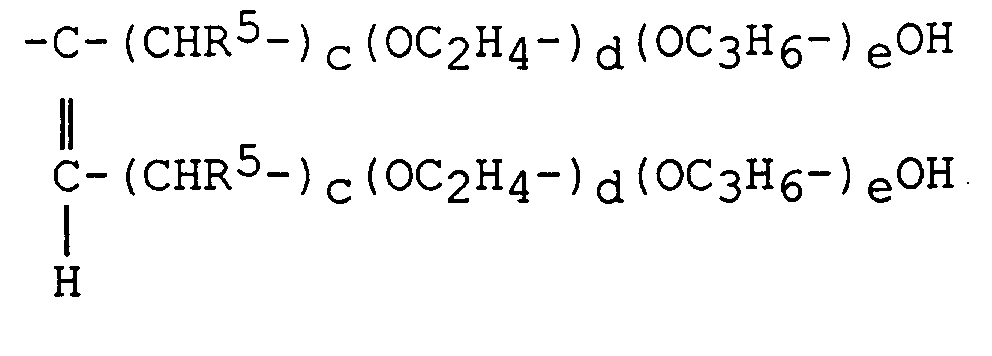
- Im Rest (b) ist R5 ein Wasserstoff- oder Alkylrest, insbesondere ein niederer Alkylrest mit 1 bis 4 Kohlenstoffatomen. Bevorzugt ist der Wasserstoffrest. Der Index c ist eine Zahl von 1 bis 20, vorzugsweise 1. Die Indices d und e sind unabhängig voneinander Zahlen von 0 bis 50. Bevorzugt ist ein Rest (b), bei dem R5 ein Wasserstoffrest ist, der Index c gleich 1 und die Indices d und e unabhängig voneinander jeweils 0 bis 10 sind. Bei diesen Indices handelt es sich um durchschnittliche Zahlen, da es bekannt ist, daß bei der Anlagerung von Alkylenoxiden, wie Ethylenoxid und Propylenoxid, an Alkohole ein Gemisch von Verbindungen unterschiedlicher Kettenlänge erhalten wird.
- Diese Reste (b) können in das Molekül des Polysiloxans durch Addition von Alkendiyl-bis-ω-hydroxy-polyoxyalkylenen an SiH-Gruppen des Polysiloxans in Anwesenheit eines Hydrosilylierungskatalysators entsprechend dem Verfahren der DD-PS 255 737 eingeführt werden.
- Der Rest (c): -(CH2-)fOR6
- Im Rest (c) ist R6 ein Wasserstoff- oder ein einwertiger organischer Rest. Als einwertige organische Reste kommen die üblichen endblockierenden Gruppen, insbesondere niedere Alkylreste mit 1 bis 4 C-Atomen, in Frage. Der Index f ist eine Zahl von 3 bis 20, wobei der Zahlenwert von 6 bevorzugt ist.
- Diese Reste (c) können mittels einer wie oben bereits beschriebenen Hydrosilylierungsreaktion durch Addition von Alkenolen oder ihrer Derivate an SiH-Gruppen des Organopolysiloxans eingeführt werden. Beispiele für ein solches Alkenol und dessen endblockiertes Derivat sind Hexenol bzw. der Alkylether des Hexenols.
- Der Rest (d): -(CH2-)g(OC2H4-)h(OC3H6-)iOR7
- Im Rest (d) ist R7 ein Wasserstoff- oder ein einwertiger organischer Rest. Vorzugsweise ist R7 ein Wasserstoff- oder Methylrest. Der Index g ist eine Zahl von 3 bis 6, der Index h eine Zahl von 1 bis 50 und der Index i eine Zahl von 0 bis 20, wobei das Zahlenverhältnis h : i > 5 : 2 ist. Vorzugsweise hat der Index g einen Wert von 3, der Index h einen Wert von 8 bis 30 und der Index i einen Wert von 0 bis 12.
- Auch die Reste (d) können mittels einer wie oben bereits beschriebenen Hydrosilylierungsreaktion durch Addition von Alkenolpolyethern oder ihrer Derivate an SiH-Gruppen des Organopolysiloxans eingeführt werden.
- Es folgt nun die Beschreibung der Reste R2B, deren Polarität geringer als die der Reste R2A ist. Hier stehen die folgenden Reste zur Auswahl:
- Der Rest (e):

- Der Rest (e) kann mit dem Rest (b) (innerhalb der Möglichkeiten des Restes R2A) verglichen werden und unterscheidet sich von diesem durch die Blockierung der endständigen Hydroxylgruppen. Die endblockierende Gruppe R9 ist eine Alkyl-, Acyl- oder Trialkylsilylgruppe. Bevorzugt ist der Methyl-, Acetyl- oder Trimethylsilylrest. Durch diese Modifizierung wird die Verträglichkeit des Antischaummittels im Additivpaket wesentlich verbessert. Bezüglich ihrer Definition entsprechen sich der Rest R5 und der Rest R8, die Indices c, d und e den Indices k, m und n. Gleiches gilt für die bevorzugten Bedeutungen.
- Der Rest (f): -(CH2-)oCH3
- In dem Rest (f) hat der Index o einen Zahlenwert von 5 bis 30, vorzugsweise 11 bis 17. Es handelt sich hier also um langkettige Alkylreste. Diese Reste verbessern die Verträglichkeit des erfindungsgemäß zu verwendenden Siloxans im Additivpaket, aber auch im Dieselkraftstoff wesentlich.
- Diese Reste können durch hydrosilylierende Addition von α-Olefinen an SiH-Gruppen des Organopolysiloxans erhalten werden.
- Der Rest (g): -(CH2-)g(OC2H4-)h(OC3H6-)iOR7
- Der Rest (g) kann mit dem Rest (d) (innerhalb der Möglichkeiten des Restes R2A) verglichen werden und unterscheidet sich von diesem durch die Anzahl der verschiedenen Oxyalkyleneinheiten: Der Index h ist eine Zahl von 0 bis 35, der Index i eine Zahl von 1 bis 50, wobei das Verhältnis der Indices h : i < 5 : 2 ist. Vorzugsweise hat h einen Zahlenwert von 0 bis 17 und i einen Zahlenwert von 6 bis 26. g ist eine Zahl von 3 bis 6, vorzugsweise 3.
- Auch die Reste (g) können mittels einer wie oben bereits beschriebenen Hydrosilylierungsreaktion durch Addition von Alkenolpolyethern oder ihrer Derivate an SiH-Gruppen des Organopolysiloxans eingeführt werden.
- Die erfindungsgemäß zu verwendenden organofunktionell modifizierten Polysiloxane können dem Dieselkraftstoff direkt zugesetzt werden, wobei ein Zusatz von 0,5 bis 50 ppm, bezogen auf Dieselkraftstoff, für eine wirksame Entschäumung ausreicht. Bevorzugt beträgt der Zusatz 2 bis 20 ppm. Durch diese niedrige Zusatzmenge bedingt resultiert ein niedriger absoluter Si-Gehalt im Dieselkraftstoff.
- Es ist jedoch auch möglich und stellt das in der Praxis bevorzugte Verfahren dar, das erfindungsgemäß zu verwendende Polysiloxan dem sogenannten Additivpaket, welches eingangs beschrieben worden ist, zuzusetzen.
- In den folgenden Beispielen wird zunächst die Herstellung von erfindungsgemäß zu verwendenden organofunktionell modifizierten Organopolysiloxanen der Formel I gezeigt. Die in diesen Beispielen hergestellten Produkte werden mit E1 bis E7 bezeichnet.
- Die Reaktanden (siehe Tabelle) werden in einem 1000-ml-Reaktionskolben, ausgestattet mit Rührer, Tropftrichter, Thermometer und Rückflußkühler, zusammen mit 100 g Toluol vorgelegt.
- Unter Rühren wird der Katalysator (20 ppm Hexachloroplatinsäure H2PtCl6, in etwas Toluol suspendiert) zugegeben und anschließend auf 120 °C aufgeheizt. Bei dieser Temperatur wird das SiH-funktionalisierte Polydimethylsiloxan (siehe Tabelle) innerhalb von ca. 30 Minuten derart zugetropft, daß trotz einsetzender exothermer Reaktion eine Temperatur von 130 °C nicht überschritten wird. Nach beendeter Zugabe wird bei maximal 130 °C weitergerührt. Die Umsatzkontrolle erfolgt stündlich mittels SiH-Wert. Die durchschnittliche Reaktionsdauer beträgt ca. 4 Stunden, wobei der Umsatz mindestens 99 % des theoretischen Wertes betragen soll.
- Durch nachfolgende Destillation im Ölpumpenvakuum bei 130 °C werden das Lösungsmittel sowie flüchtige Nebenprodukte entfernt. Nach dem Abkühlen erfolgt eine Filtration, bei der die Katalysatorreste abgetrennt werden.


- In einem 1000-ml-Reaktionskolben, ausgestattet mit Rührer, Tropftrichter, Thermometer und Rückflußkühler, werden 37,4 g (0,2 Mol) ethoxyliertes 2-Butin-1,4-diol vorgelegt. Unter Rühren werden 20,4 g (0,2 Mol) Essigsäureanhydrid zugetropft. Die Acetylierungsreaktion ist exotherm. Das Reaktionsgemisch wird nach dem Zutropfen auf 120 °C aufgeheizt. Wenn die Temperatur erreicht ist, wird die entstandene Essigsäure im Ölpumpenvakuum abdestilliert. Anschließend werden 273,0 g (0,195 Mol) 4-Allylphenol, 58,3 g (0,26 Mol) Hexadecen und 23,1 mg (20 ppm) Hexachloroplatinsäure H2PtCl6, in etwas Toluol suspendiert, zugegeben und wieder auf 120 °C geheizt. Bei dieser Temperatur werden 217,0 g (0,133 Mol) des SiH-funktionalisierten Polydimethylsiloxans (u = 21; v = 7,5) innerhalb von ca. 30 Minuten derart zugetropft, daß trotz einsetzender exothermer Reaktion eine Temperatur von 130 °C nicht überschritten wird. Nach beendeter Zugabe wird bei maximal 130 °C weitergerührt. Die Umsatzkontrolle erfolgt stündlich mittels SiH-Wert. Die durchschnittliche Reaktionsdauer beträgt ca. 4 Stunden, wobei der Umsatz mindestens 99 % des theoretischen Wertes betragen soll.
- Durch nachfolgende Destillation im Ölpumpenvakuum bei 130 °C werden das Lösungsmittel sowie flüchtige Nebenprodukte entfernt. Nach dem Abkühlen erfolgt eine Filtration, bei der die Katalysatorreste abgetrennt werden.
-
E1:
R* = -(CH2)3(OC2H4-)13(OC3H6-)13OH
R** =
R*** =
E2: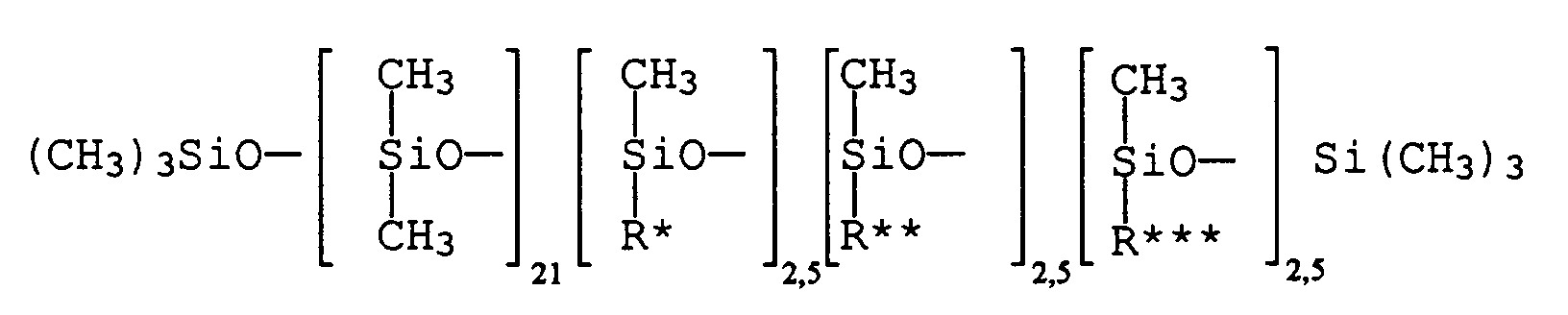
R* = -(CH2-)3(OC2H4-)1(OC3H6-)9OH
R** =
R*** =
E3:
R* = -(CH2-)3(OC2H4-)1(OC3H6-)9OH
R** =
R*** =
E4:
R* = -(CH2-)3(OC2H4-)2(OC3H6-)6OH
R** =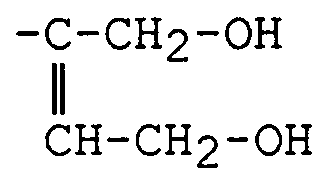
R*** =
E5:
R* = -(CH2-)3(OC3H6-)6OH
R** = -(CH2)15CH3
R*** =
E6:
R* = -(CH2-)3(OC2H4-)13(OC3H6-)13OH
R** =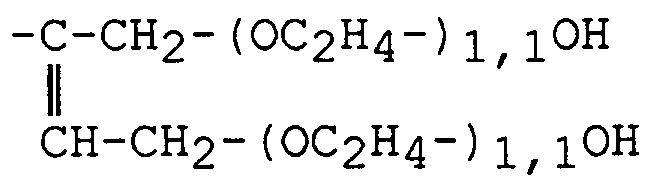
R*** =
E7:
R* =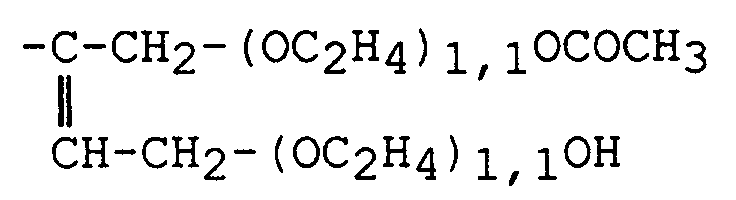
R** = -(CH2)15CH3
R*** =
- Die anwendungstechnischen Vergleichsversuche werden mit Produkten des Standes der Technik und den Verbindungen E1 bis E7 durchgeführt. Als Vergleichssubstanzen dienen der Entschäumer A (entsprechend GB-PS 2 173 510) und der Entschäumer B (entsprechend US-PS 5 334 227):
-
(CH3)3SiO((CH3)2SiO)13(RY(CH3)SiO)3Si(CH3)3 RY = -(CH2-)3(OC2H4-)14OH
-
(CH3)3SiO((CH3)2SiO)80(RY(CH3)SiO)10(RZ(CH3)SiO)5Si(CH3)3 RY = -(CH2-)3(OC2H4-)8OH
RZ =
- Zur Prüfung des Entschäumungsvermögens der erfindungsgemäß zu verwendenden Siloxane werden diese in einem Additivpaket des Standes der Technik gelöst und eine bestimmte Menge dieser Mischung in 500 g additivfreien Dieselkraftstoff eingerührt. Das Mischungsverhältnis des Siloxans zum Additivpaket und die zum Kraftstoff gegebene Menge von diesem Additiv werden so gewählt, daß die gewünschte Siloxankonzentration und gleichzeitig eine Konzentration des Additivpaketes von 500 ppm im Dieselkraftstoff erzielt werden. Die Konzentration der erfindungsgemäßen Verbindungen im Dieselkraftstoff wird zwischen 2 und 20 ppm variiert. Es wird für jedes Produkt die ungefähre kritische Konzentration bestimmt, bei deren Unterschreitung erstmals ein deutlicher Wirkungsabfall eintritt.
- Der Schaumzerfall des mit Additiv und Entschäumer versetzten Dieselkraftstoffes wird in einer Druckapparatur getestet. Diese Apparatur besteht im wesentlichen aus einem 1-Liter-Druckgefäß, das mit einem konstanten Preßluftdruck beaufschlagt werden kann und einem 250-ml-Meßzylinder. Ein mit einem Magnetventil versehener Auslaßstutzen des Druckgefäßes befindet sich dabei zentriert über dem Meßzylinder und taucht in diesen nur wenige Zentimeter ein. Es werden bei jedem Test 100 ml des zu prüfenden Dieselkraftstoffs in das Druckgefäß eingefüllt, mit einem Preßluftdruck von 0,4 bar beaufschlagt und mit Hilfe des Magnetventils über einen Zeitraum von 3,9 Sekunden in den Meßzylinder abgelassen. Die Volumendifferenz, die sich aus dem maximalen Schaumpegel und dem Pegel der schaumfreien Flüssigkeit im Meßzylinder ergibt, wird in ml angegeben und als Schaumvolumen bezeichnet. Die Zeit, die zwischen dem Erreichen des maximalen Schaumpegels und dem Aufreißen der Schaumschicht über der Flüssigkeit zu einem Schaumkranz verstreicht, wird in Sekunden gemessen und als Schaumzerfallszeit bezeichnet. Es werden für jeden Entschäumer drei Messungen durchgeführt und der Mittelwert von Schaumhöhe und -zerfallszeit bestimmt.
- Zur Untersuchung der Verträglichkeit mit Entschäumern werden drei verschiedene, dem Stand der Technik entsprechende Additivpakete verwendet. Es wird jeweils 1 g des erfindungsgemäß zu verwendenden Siloxans zu 19 g eines Additivpaketes gegeben und gerührt. Der Entschäumer wird als mit dem Additivpaket verträglich bezeichnet, wenn innerhalb von einer Woche bei -10 °C keine Trübung oder Ausbildung einer zweiten Phase im Additivpaket festzustellen ist. Das Ergebnis der Verträglichkeitsprüfung wird als positiv bewertet und mit einem "+" gekennzeichnet, wenn der untersuchte Entschäumer mit allen drei getesteten Additivpaketen verträglich ist, sonst als negativ und mit "-" gekennzeichnet.
- Die folgende Tabelle stellt die Meßergebnisse des Schaumzerfallstests und der Verträglichkeitsprüfung zusammen. Die angegebenen Einsatzkonzentrationen sind, wie oben beschrieben, die für jeden Entschäumer kritische Einsatzkonzentration, deren Unterschreitung zu einer deutlichen Verschlechterung des Entschäumungsverhaltens führt. Der Siliciumgehalt des mit Entschäumer versetzten Dieselkraftstoffs wird aus der Einsatzkonzentration des Entschäumers und dessen theoretischem Siliciumgehalt, der anhand der durchschnittlichen Strukturformel bestimmt wird, berechnet.
Entschäumer Einsatzkonzentration (ppm) Schaumvolumen (ml) Zerfallszeit (s) Verträglichkeit Si-Gehalt im Dieselkraftstoff (ppm Si) Blindwert 110 27 A 15 60 2 - 2,25 B 5 49 2 - 1,18 E1 5 47 2 + 0,70 E2 5 49 1 + 0,88 E3 5 36 0 + 0,95 E4 5 48 2 + 1,20 E5 5 47 2 + 1,28 E6 5 42 2 + 0,75 E7 5 49 2 + 1,20 - Die Zusammenstellung zeigt, daß die erfindungsgemäß zu verwendenden organofunktionell modifizierten Polysiloxane E1 bis E7 sehr gut zur Entschäumung von Dieselkraftstoff geeignet sind. Im Gegensatz zu den Vergleichsprodukten weisen sie eine vorzügliche Verträglichkeit mit den Kraftstoff-Additivpaketen auf. Der Einsatz von zusätzlichen Lösungsmitteln läßt sich damit vermeiden und die Gefahr, daß der Entschäumer, z. B. unter ungünstigen Witterungsbedingungen, bei der Lagerung sich aus dem Additivpaket ausscheidet, verringern.
b = 0, 1 oder 2 und
c = 1 oder 2, wobei die Summe b+c nicht größer als 3 ist.
Claims (1)
- Verwendung von organofunktionell modifizierten Polysiloxanen der allgemeinen Formel I
 R1 Alkylreste mit 1 bis 4 Kohlenstoffatomen oder Arylreste sind, jedoch mindestens 80 % der Reste R1 Methylreste sind,R2 im Molekül gleich oder verschieden sind, von denen30 bis 90 % die Bedeutung des Restes R1 haben und70 bis 10 % aus einem Gemisch von Resten R2A und R2B bestehen, wobei die Reste R2A polarer als die Reste R2B sind, und wobei die Reste R2A aus folgenden Resten ausgewählt sind:(a) ein Phenolderivat mit der allgemeinen Formel:
-R3-(C6H4-zR4 z)-OH
wobeiR3 ein zweiwertiger Rest, der aus einer oder mehreren der folgenden Gruppen zusammengesetzt ist: Kohlenwasserstoffreste, die gegebenenfalls substituiert sind, Aromatenreste, die gegebenenfalls substituiert sind, Polyoxyalkylenreste, undR4 ein einwertiger Rest, der gleich oder verschieden ist und aus den Gruppen: Wasserstoffrest, Alkylrest, Alkyloxyrest, Hydroxyrest, ausgewählt ist, undz eine Zahl von 0 bis 4 ist, oder(b) der Rest R5 ein Wasserstoff- oder Alkylrest,c eine Zahl von 1 bis 20,d eine Zahl von 0 bis 50,e eine Zahl von 0 bis 50 ist oder(c) der Rest -(CH2-)fOR6,
wobeiR6 ein Wasserstoff- oder ein einwertiger organischer Rest,f eine Zahl von 3 bis 20 ist oder(d) der Rest -(CH2-)g(OC2H4-)h(OC3H6-)iOR7
wobeiR7 ein Wasserstoff- oder ein einwertiger organischer Rest,g eine Zahl von 3 bis 6,h eine Zahl von 1 bis 50,i eine Zahl von 0 bis 20 ist und
das Verhältnis h : i > 5 : 2 ist, und die Reste R2B aus folgenden Resten ausgewählt sind:(e) der Rest R8 ein Wasserstoff- oder Alkylrest,R9 ein Alkyl-, Acyl- oder Trialkylsilylrest,k eine Zahl von 1 bis 20,m eine Zahl von 0 bis 50,n eine Zahl von 0 bis 50 ist oder(f) der Rest -(CH2-)oCH3,
wobeio eine Zahl von 5 bis 30 ist, oder(g) der Rest -(CH2-)g(OC2H4-)h(OC3H6-)iOR7 wobeiR7 ein Wasserstoff- oder ein einwertiger organischer Rest,g eine Zahl von 3 bis 6,h eine Zahl von 0 bis 35,i eine Zahl von 1 bis 50 ist undwobei mindestens 10 % der Reste R2A gleich dem Rest (a) sind und mindestens 10 % der Reste R2A oder R2B aus den Resten (b), (c), (e) oder (f) ausgewählt sind,
das Verhältnis h : i < 5 : 2 ist,a eine Zahl von 1 bis 400,b eine Zahl von 0 bis 10 ist,zur Entschäumung von Dieselkraftstoff in Mengen von 0,5 bis 50 ppm, bezogen auf Dieselkraftstoff.
Applications Claiming Priority (2)
| Application Number | Priority Date | Filing Date | Title |
|---|---|---|---|
| DE19516360A DE19516360C1 (de) | 1995-05-04 | 1995-05-04 | Verwendung von organofunktionell modifizierten Polysiloxanen zum Entschäumen von Dieselkraftstoff |
| DE19516360 | 1995-05-04 |
Publications (3)
| Publication Number | Publication Date |
|---|---|
| EP0741182A2 true EP0741182A2 (de) | 1996-11-06 |
| EP0741182A3 EP0741182A3 (de) | 1997-02-05 |
| EP0741182B1 EP0741182B1 (de) | 2001-07-25 |
Family
ID=7761062
Family Applications (1)
| Application Number | Title | Priority Date | Filing Date |
|---|---|---|---|
| EP96106232A Expired - Lifetime EP0741182B1 (de) | 1995-05-04 | 1996-04-20 | Verwendung von organofunktionell modifizierten Polysiloxanen zum Entschäumen von Dieselkraftstoff |
Country Status (3)
| Country | Link |
|---|---|
| EP (1) | EP0741182B1 (de) |
| DE (2) | DE19516360C1 (de) |
| NO (1) | NO313243B1 (de) |
Cited By (4)
| Publication number | Priority date | Publication date | Assignee | Title |
|---|---|---|---|---|
| JPH1180359A (ja) * | 1997-09-12 | 1999-03-26 | Toray Dow Corning Silicone Co Ltd | 表面改質剤 |
| US6001140A (en) * | 1996-04-04 | 1999-12-14 | Witco Corporation | Diesel fuel and lubricating oil antifoams and methods of use |
| US6093222A (en) * | 1996-04-04 | 2000-07-25 | Ck Witco Corporation | Diesel fuel antifoam composition |
| US11377611B2 (en) | 2019-01-10 | 2022-07-05 | Evonik Operations Gmbh | Organomodified polysiloxanes and their use for defoaming fuels |
Families Citing this family (4)
| Publication number | Priority date | Publication date | Assignee | Title |
|---|---|---|---|---|
| DE19726653A1 (de) * | 1997-06-24 | 1999-01-07 | Goldschmidt Ag Th | Organofunktionell modifizierte Polysiloxane |
| DE10232115A1 (de) | 2002-07-16 | 2004-02-05 | Goldschmidt Ag | Organopolysiloxane zur Entschäumung wässriger Systeme |
| US20070125716A1 (en) * | 2005-12-07 | 2007-06-07 | Ian Procter | Process for separating mixtures |
| DE102007031287A1 (de) | 2007-07-05 | 2009-01-08 | Evonik Goldschmidt Gmbh | Organofunktionell modifizierte Polysiloxane und ihre Verwendung zur Entschäumung von flüssigen Kraftstoffen mit Biokraftstoffbeimischungen |
Family Cites Families (9)
| Publication number | Priority date | Publication date | Assignee | Title |
|---|---|---|---|---|
| NL79306C (de) * | 1950-06-13 | |||
| DE3508292C1 (de) * | 1985-03-08 | 1986-06-19 | Th. Goldschmidt Ag, 4300 Essen | Verfahren zur Herstellung von Polyurethanweichschaeumen |
| GB8508254D0 (en) * | 1985-03-29 | 1985-05-09 | Dow Corning Ltd | Foam control |
| US4996277A (en) * | 1988-02-08 | 1991-02-26 | Bradshaw Jerald S | Novel oligoethylene oxide-containing alkenes, alkoxysilanes, and polysiloxanes |
| GB8925667D0 (en) * | 1989-11-14 | 1990-01-04 | Bp Chem Int Ltd | Process for making flexible polyurethane foam |
| GB2248068A (en) * | 1990-09-21 | 1992-03-25 | Exxon Chemical Patents Inc | Oil compositions and novel additives |
| DE4032006A1 (de) * | 1990-10-09 | 1992-04-16 | Wacker Chemie Gmbh | Verfahren zum entschaeumen und/oder entgasen von organischen systemen |
| JP3102934B2 (ja) * | 1991-11-13 | 2000-10-23 | 日石三菱株式会社 | 添加剤組成物およびその使用方法並びにディーゼル燃料 |
| DE4343235C1 (de) * | 1993-12-17 | 1994-12-22 | Goldschmidt Ag Th | Verwendung von organofunktionell modifizierten Polysiloxanen zum Entschäumen von Dieselkraftstoff |
-
1995
- 1995-05-04 DE DE19516360A patent/DE19516360C1/de not_active Expired - Fee Related
-
1996
- 1996-02-26 NO NO19960774A patent/NO313243B1/no not_active IP Right Cessation
- 1996-04-20 DE DE59607343T patent/DE59607343D1/de not_active Expired - Fee Related
- 1996-04-20 EP EP96106232A patent/EP0741182B1/de not_active Expired - Lifetime
Cited By (7)
| Publication number | Priority date | Publication date | Assignee | Title |
|---|---|---|---|---|
| US6001140A (en) * | 1996-04-04 | 1999-12-14 | Witco Corporation | Diesel fuel and lubricating oil antifoams and methods of use |
| US6093222A (en) * | 1996-04-04 | 2000-07-25 | Ck Witco Corporation | Diesel fuel antifoam composition |
| US6221815B1 (en) | 1996-04-04 | 2001-04-24 | Crompton Corporation | Diesel fuel and lubricating oil antiforms and methods of use |
| JPH1180359A (ja) * | 1997-09-12 | 1999-03-26 | Toray Dow Corning Silicone Co Ltd | 表面改質剤 |
| EP1683851A1 (de) | 1998-12-15 | 2006-07-26 | General Electric Company | Dieselbrennstoff-Antischaum-Zusammensetzung |
| EP2223989A1 (de) | 1998-12-15 | 2010-09-01 | General Electric Company | Dieselbrennstoffantischaumzusammensetzung |
| US11377611B2 (en) | 2019-01-10 | 2022-07-05 | Evonik Operations Gmbh | Organomodified polysiloxanes and their use for defoaming fuels |
Also Published As
| Publication number | Publication date |
|---|---|
| EP0741182A3 (de) | 1997-02-05 |
| NO960774L (no) | 1996-11-05 |
| DE59607343D1 (de) | 2001-08-30 |
| NO960774D0 (no) | 1996-02-26 |
| NO313243B1 (no) | 2002-09-02 |
| EP0741182B1 (de) | 2001-07-25 |
| DE19516360C1 (de) | 1996-05-15 |
Similar Documents
| Publication | Publication Date | Title |
|---|---|---|
| EP0662334B1 (de) | Verwendung von organofunktionell modifizierten Polysiloxanen zum Entschäumen von Dieselkraftstoff | |
| DE69730417T2 (de) | Dieseltreibstoff mit antischaummittel und verwendungsmethoden | |
| EP2011813B1 (de) | Organofunktionell modifizierte Polysiloxane und ihre Verwendung zur Entschäumung von flüssigen Kraftstoffen mit Biokraftstoffbeimischungen | |
| DE69417693T2 (de) | Leistungsfähige dieselkraftstoffsentschäumer von geringen silikon gehalt | |
| DE10232115A1 (de) | Organopolysiloxane zur Entschäumung wässriger Systeme | |
| EP0867460B1 (de) | Polysiloxan-Polyoxyalkylen-Blockcopolymere | |
| DE102012202523A1 (de) | Verwendung von selbstvernetzten Siloxanen zum Entschäumen von flüssigen Kohlenwasserstoffen | |
| EP1010748B1 (de) | Dieselbrennstoffantischaumzusammensetzung | |
| DE3610414A1 (de) | Verfahren zur bekaempfung der schaumbildung bei einem fluessigen kohlenwasserstoffkraftstoff | |
| EP0985698A1 (de) | Lineare Polyether-Polysiloxan-Copolymere, deren Herstellung und Verwendung | |
| EP3858893A1 (de) | Verfahren zur herstellung hochreiner hydrosilylierungsprodukte | |
| DE1595248A1 (de) | Verfahren zur Herstellung von Siloxan-Polyoxyalkylen-Copolymeren | |
| EP0741182B1 (de) | Verwendung von organofunktionell modifizierten Polysiloxanen zum Entschäumen von Dieselkraftstoff | |
| EP0553137A1 (de) | Verfahren zum entschäumen und/oder entgasen von organischen systemen. | |
| EP0499051B1 (de) | Organopolysiloxane mit an einer gemeinsamen Spacergruppe gebundenen Polyether- und Ester-Gruppen | |
| EP0658361B1 (de) | Entschäumeremulsion auf der Basis organofunktionell modifizierter Polysiloxane | |
| DE1792046B2 (de) | Salbengrundlage sowie hautschutzund hautpflegemittel | |
| EP0849352B1 (de) | Verwendung von Silicon-Polyether-Copolymeren zum Entschäumen von Dieselkraftstoff | |
| EP4112674A1 (de) | Verfahren zur herstellung hochreiner hydrosilylierungsprodukte | |
| EP0887367A2 (de) | Organofunktionell modifizierte Polysiloxane | |
| EP3908644B1 (de) | Organomodifizierte polysiloxane und ihre verwendung zur entschäumung von kraftstoffen | |
| EP0100036B1 (de) | Organosiliciummodifizierte Polydiene, Verfahren zu ihrer Herstellung und ihre Verwendung als Dismulgatoren für Erdöl | |
| DE3614412C2 (de) | ||
| EP0579999A2 (de) | Entschäumungsmittel auf der Basis organofunktionell modifizierter Organopolysiloxane | |
| DE10351803A1 (de) | Verfahren zur Herstellung von mit Phosphonsäureester modifizierten Organosiloxanen |
Legal Events
| Date | Code | Title | Description |
|---|---|---|---|
| PUAI | Public reference made under article 153(3) epc to a published international application that has entered the european phase |
Free format text: ORIGINAL CODE: 0009012 |
|
| 17P | Request for examination filed |
Effective date: 19960426 |
|
| AK | Designated contracting states |
Kind code of ref document: A2 Designated state(s): BE DE FR GB IT NL |
|
| PUAL | Search report despatched |
Free format text: ORIGINAL CODE: 0009013 |
|
| AK | Designated contracting states |
Kind code of ref document: A3 Designated state(s): BE DE FR GB IT NL |
|
| 17Q | First examination report despatched |
Effective date: 19990126 |
|
| RAP1 | Party data changed (applicant data changed or rights of an application transferred) |
Owner name: GOLDSCHMIDT AG |
|
| GRAG | Despatch of communication of intention to grant |
Free format text: ORIGINAL CODE: EPIDOS AGRA |
|
| GRAG | Despatch of communication of intention to grant |
Free format text: ORIGINAL CODE: EPIDOS AGRA |
|
| GRAG | Despatch of communication of intention to grant |
Free format text: ORIGINAL CODE: EPIDOS AGRA |
|
| GRAH | Despatch of communication of intention to grant a patent |
Free format text: ORIGINAL CODE: EPIDOS IGRA |
|
| RIN1 | Information on inventor provided before grant (corrected) |
Inventor name: SPIEGLER, ROLAND, DR. Inventor name: LERSCH, PETER, DR. Inventor name: KUGEL, KERSTIN Inventor name: KEUP, MICHAEL, DR. Inventor name: BUSCH, STEFAN |
|
| GRAG | Despatch of communication of intention to grant |
Free format text: ORIGINAL CODE: EPIDOS AGRA |
|
| GRAH | Despatch of communication of intention to grant a patent |
Free format text: ORIGINAL CODE: EPIDOS IGRA |
|
| GRAA | (expected) grant |
Free format text: ORIGINAL CODE: 0009210 |
|
| AK | Designated contracting states |
Kind code of ref document: B1 Designated state(s): BE DE FR GB IT NL |
|
| REF | Corresponds to: |
Ref document number: 59607343 Country of ref document: DE Date of ref document: 20010830 |
|
| GBT | Gb: translation of ep patent filed (gb section 77(6)(a)/1977) |
Effective date: 20011012 |
|
| ET | Fr: translation filed | ||
| REG | Reference to a national code |
Ref country code: GB Ref legal event code: IF02 |
|
| PLBE | No opposition filed within time limit |
Free format text: ORIGINAL CODE: 0009261 |
|
| STAA | Information on the status of an ep patent application or granted ep patent |
Free format text: STATUS: NO OPPOSITION FILED WITHIN TIME LIMIT |
|
| 26N | No opposition filed | ||
| PGFP | Annual fee paid to national office [announced via postgrant information from national office to epo] |
Ref country code: NL Payment date: 20040331 Year of fee payment: 9 Ref country code: GB Payment date: 20040331 Year of fee payment: 9 |
|
| PGFP | Annual fee paid to national office [announced via postgrant information from national office to epo] |
Ref country code: DE Payment date: 20040408 Year of fee payment: 9 |
|
| PGFP | Annual fee paid to national office [announced via postgrant information from national office to epo] |
Ref country code: FR Payment date: 20040415 Year of fee payment: 9 |
|
| PGFP | Annual fee paid to national office [announced via postgrant information from national office to epo] |
Ref country code: BE Payment date: 20040527 Year of fee payment: 9 |
|
| PG25 | Lapsed in a contracting state [announced via postgrant information from national office to epo] |
Ref country code: IT Free format text: LAPSE BECAUSE OF NON-PAYMENT OF DUE FEES;WARNING: LAPSES OF ITALIAN PATENTS WITH EFFECTIVE DATE BEFORE 2007 MAY HAVE OCCURRED AT ANY TIME BEFORE 2007. THE CORRECT EFFECTIVE DATE MAY BE DIFFERENT FROM THE ONE RECORDED. Effective date: 20050420 Ref country code: GB Free format text: LAPSE BECAUSE OF NON-PAYMENT OF DUE FEES Effective date: 20050420 |
|
| PG25 | Lapsed in a contracting state [announced via postgrant information from national office to epo] |
Ref country code: BE Free format text: LAPSE BECAUSE OF NON-PAYMENT OF DUE FEES Effective date: 20050430 |
|
| BERE | Be: lapsed |
Owner name: *GOLDSCHMIDT G.M.B.H. Effective date: 20050430 |
|
| PG25 | Lapsed in a contracting state [announced via postgrant information from national office to epo] |
Ref country code: NL Free format text: LAPSE BECAUSE OF NON-PAYMENT OF DUE FEES Effective date: 20051101 Ref country code: DE Free format text: LAPSE BECAUSE OF NON-PAYMENT OF DUE FEES Effective date: 20051101 |
|
| REG | Reference to a national code |
Ref country code: FR Ref legal event code: CJ Ref country code: FR Ref legal event code: CD |
|
| GBPC | Gb: european patent ceased through non-payment of renewal fee |
Effective date: 20050420 |
|
| PG25 | Lapsed in a contracting state [announced via postgrant information from national office to epo] |
Ref country code: FR Free format text: LAPSE BECAUSE OF NON-PAYMENT OF DUE FEES Effective date: 20051230 |
|
| NLV4 | Nl: lapsed or anulled due to non-payment of the annual fee |
Effective date: 20051101 |
|
| REG | Reference to a national code |
Ref country code: FR Ref legal event code: ST Effective date: 20051230 |
|
| BERE | Be: lapsed |
Owner name: *GOLDSCHMIDT G.M.B.H. Effective date: 20050430 |