EP0742181A1 - Keramik auf der Basis von durch Kupfer substituiertem Lithiumzirconat zur Erzeugung von Tritium - Google Patents
Keramik auf der Basis von durch Kupfer substituiertem Lithiumzirconat zur Erzeugung von Tritium Download PDFInfo
- Publication number
- EP0742181A1 EP0742181A1 EP96400987A EP96400987A EP0742181A1 EP 0742181 A1 EP0742181 A1 EP 0742181A1 EP 96400987 A EP96400987 A EP 96400987A EP 96400987 A EP96400987 A EP 96400987A EP 0742181 A1 EP0742181 A1 EP 0742181A1
- Authority
- EP
- European Patent Office
- Prior art keywords
- ceramic
- tritium
- copper
- lithium
- lithium zirconate
- Prior art date
- Legal status (The legal status is an assumption and is not a legal conclusion. Google has not performed a legal analysis and makes no representation as to the accuracy of the status listed.)
- Withdrawn
Links
- YZCKVEUIGOORGS-NJFSPNSNSA-N Tritium Chemical compound [3H] YZCKVEUIGOORGS-NJFSPNSNSA-N 0.000 title abstract description 24
- 229910052722 tritium Inorganic materials 0.000 title abstract description 24
- 239000000919 ceramic Substances 0.000 title description 17
- 238000004519 manufacturing process Methods 0.000 title description 3
- -1 Copper-substituted lithium Chemical class 0.000 title 1
- 229910010293 ceramic material Inorganic materials 0.000 claims abstract description 23
- 239000000463 material Substances 0.000 claims abstract description 20
- 238000010586 diagram Methods 0.000 claims abstract description 12
- 230000004927 fusion Effects 0.000 claims abstract description 6
- WHXSMMKQMYFTQS-UHFFFAOYSA-N Lithium Chemical compound [Li] WHXSMMKQMYFTQS-UHFFFAOYSA-N 0.000 claims description 32
- 229910052744 lithium Inorganic materials 0.000 claims description 32
- 239000010949 copper Substances 0.000 claims description 21
- 239000000203 mixture Substances 0.000 claims description 16
- 239000006104 solid solution Substances 0.000 claims description 13
- 229910052802 copper Inorganic materials 0.000 claims description 12
- RYGMFSIKBFXOCR-UHFFFAOYSA-N Copper Chemical group [Cu] RYGMFSIKBFXOCR-UHFFFAOYSA-N 0.000 claims description 10
- 239000007787 solid Substances 0.000 abstract description 2
- 229910007822 Li2ZrO3 Inorganic materials 0.000 abstract 1
- 239000000843 powder Substances 0.000 description 15
- MCMNRKCIXSYSNV-UHFFFAOYSA-N Zirconium dioxide Chemical compound O=[Zr]=O MCMNRKCIXSYSNV-UHFFFAOYSA-N 0.000 description 12
- 238000006467 substitution reaction Methods 0.000 description 12
- 238000000034 method Methods 0.000 description 7
- LFQSCWFLJHTTHZ-UHFFFAOYSA-N Ethanol Chemical compound CCO LFQSCWFLJHTTHZ-UHFFFAOYSA-N 0.000 description 6
- 229910018068 Li 2 O Inorganic materials 0.000 description 5
- 239000012159 carrier gas Substances 0.000 description 5
- 238000010411 cooking Methods 0.000 description 5
- XTVVROIMIGLXTD-UHFFFAOYSA-N copper(II) nitrate Chemical compound [Cu+2].[O-][N+]([O-])=O.[O-][N+]([O-])=O XTVVROIMIGLXTD-UHFFFAOYSA-N 0.000 description 5
- 238000000605 extraction Methods 0.000 description 5
- 230000007246 mechanism Effects 0.000 description 5
- 230000000052 comparative effect Effects 0.000 description 4
- 238000005470 impregnation Methods 0.000 description 4
- XGZVUEUWXADBQD-UHFFFAOYSA-L lithium carbonate Chemical compound [Li+].[Li+].[O-]C([O-])=O XGZVUEUWXADBQD-UHFFFAOYSA-L 0.000 description 4
- 239000010453 quartz Substances 0.000 description 4
- VYPSYNLAJGMNEJ-UHFFFAOYSA-N silicon dioxide Inorganic materials O=[Si]=O VYPSYNLAJGMNEJ-UHFFFAOYSA-N 0.000 description 4
- 239000000243 solution Substances 0.000 description 4
- 238000012360 testing method Methods 0.000 description 4
- 238000006243 chemical reaction Methods 0.000 description 3
- 238000007906 compression Methods 0.000 description 3
- 230000006835 compression Effects 0.000 description 3
- 150000001879 copper Chemical class 0.000 description 3
- 238000001035 drying Methods 0.000 description 3
- 230000004907 flux Effects 0.000 description 3
- 239000007789 gas Substances 0.000 description 3
- 229910052734 helium Inorganic materials 0.000 description 3
- 239000001307 helium Substances 0.000 description 3
- SWQJXJOGLNCZEY-UHFFFAOYSA-N helium atom Chemical compound [He] SWQJXJOGLNCZEY-UHFFFAOYSA-N 0.000 description 3
- 229910052808 lithium carbonate Inorganic materials 0.000 description 3
- 238000005259 measurement Methods 0.000 description 3
- 238000002360 preparation method Methods 0.000 description 3
- 230000005855 radiation Effects 0.000 description 3
- 238000007873 sieving Methods 0.000 description 3
- 238000005245 sintering Methods 0.000 description 3
- XAGFODPZIPBFFR-UHFFFAOYSA-N aluminium Chemical compound [Al] XAGFODPZIPBFFR-UHFFFAOYSA-N 0.000 description 2
- 229910052782 aluminium Inorganic materials 0.000 description 2
- 239000011324 bead Substances 0.000 description 2
- 125000002091 cationic group Chemical group 0.000 description 2
- 238000006073 displacement reaction Methods 0.000 description 2
- 238000011068 loading method Methods 0.000 description 2
- 230000004048 modification Effects 0.000 description 2
- 238000012986 modification Methods 0.000 description 2
- 230000008569 process Effects 0.000 description 2
- 230000009467 reduction Effects 0.000 description 2
- 230000000087 stabilizing effect Effects 0.000 description 2
- 238000003756 stirring Methods 0.000 description 2
- 101100422770 Caenorhabditis elegans sup-1 gene Proteins 0.000 description 1
- UFHFLCQGNIYNRP-UHFFFAOYSA-N Hydrogen Chemical compound [H][H] UFHFLCQGNIYNRP-UHFFFAOYSA-N 0.000 description 1
- XLYOFNOQVPJJNP-PWCQTSIFSA-N Tritiated water Chemical compound [3H]O[3H] XLYOFNOQVPJJNP-PWCQTSIFSA-N 0.000 description 1
- HCHKCACWOHOZIP-UHFFFAOYSA-N Zinc Chemical compound [Zn] HCHKCACWOHOZIP-UHFFFAOYSA-N 0.000 description 1
- 230000015572 biosynthetic process Effects 0.000 description 1
- 150000001768 cations Chemical class 0.000 description 1
- 238000002485 combustion reaction Methods 0.000 description 1
- 150000001875 compounds Chemical class 0.000 description 1
- 238000009833 condensation Methods 0.000 description 1
- 230000005494 condensation Effects 0.000 description 1
- 238000007796 conventional method Methods 0.000 description 1
- 230000000593 degrading effect Effects 0.000 description 1
- 239000012153 distilled water Substances 0.000 description 1
- 230000000694 effects Effects 0.000 description 1
- 238000002474 experimental method Methods 0.000 description 1
- 230000002349 favourable effect Effects 0.000 description 1
- 238000010304 firing Methods 0.000 description 1
- 238000009472 formulation Methods 0.000 description 1
- 229910052735 hafnium Inorganic materials 0.000 description 1
- VBJZVLUMGGDVMO-UHFFFAOYSA-N hafnium atom Chemical compound [Hf] VBJZVLUMGGDVMO-UHFFFAOYSA-N 0.000 description 1
- 238000010438 heat treatment Methods 0.000 description 1
- 229910052739 hydrogen Inorganic materials 0.000 description 1
- 239000001257 hydrogen Substances 0.000 description 1
- 230000006872 improvement Effects 0.000 description 1
- 238000011065 in-situ storage Methods 0.000 description 1
- 238000003780 insertion Methods 0.000 description 1
- 230000037431 insertion Effects 0.000 description 1
- 238000009434 installation Methods 0.000 description 1
- YQNQTEBHHUSESQ-UHFFFAOYSA-N lithium aluminate Chemical compound [Li+].[O-][Al]=O YQNQTEBHHUSESQ-UHFFFAOYSA-N 0.000 description 1
- 230000007774 longterm Effects 0.000 description 1
- 238000003754 machining Methods 0.000 description 1
- 238000010907 mechanical stirring Methods 0.000 description 1
- RVTZCBVAJQQJTK-UHFFFAOYSA-N oxygen(2-);zirconium(4+) Chemical compound [O-2].[O-2].[Zr+4] RVTZCBVAJQQJTK-UHFFFAOYSA-N 0.000 description 1
- 238000011084 recovery Methods 0.000 description 1
- 238000007493 shaping process Methods 0.000 description 1
- 239000007858 starting material Substances 0.000 description 1
- 238000003786 synthesis reaction Methods 0.000 description 1
- 230000009466 transformation Effects 0.000 description 1
- 230000007704 transition Effects 0.000 description 1
- XLYOFNOQVPJJNP-UHFFFAOYSA-N water Chemical compound O XLYOFNOQVPJJNP-UHFFFAOYSA-N 0.000 description 1
- 239000011701 zinc Substances 0.000 description 1
- 229910052725 zinc Inorganic materials 0.000 description 1
- 229910001928 zirconium oxide Inorganic materials 0.000 description 1
Images

Classifications
-
- G—PHYSICS
- G21—NUCLEAR PHYSICS; NUCLEAR ENGINEERING
- G21B—FUSION REACTORS
- G21B1/00—Thermonuclear fusion reactors
- G21B1/11—Details
- G21B1/13—First wall; Blanket; Divertor
-
- C—CHEMISTRY; METALLURGY
- C01—INORGANIC CHEMISTRY
- C01G—COMPOUNDS CONTAINING METALS NOT COVERED BY SUBCLASSES C01D OR C01F
- C01G25/00—Compounds of zirconium
-
- C—CHEMISTRY; METALLURGY
- C01—INORGANIC CHEMISTRY
- C01G—COMPOUNDS CONTAINING METALS NOT COVERED BY SUBCLASSES C01D OR C01F
- C01G25/00—Compounds of zirconium
- C01G25/006—Compounds containing zirconium, with or without oxygen or hydrogen, and containing two or more other elements
-
- C—CHEMISTRY; METALLURGY
- C04—CEMENTS; CONCRETE; ARTIFICIAL STONE; CERAMICS; REFRACTORIES
- C04B—LIME, MAGNESIA; SLAG; CEMENTS; COMPOSITIONS THEREOF, e.g. MORTARS, CONCRETE OR LIKE BUILDING MATERIALS; ARTIFICIAL STONE; CERAMICS; REFRACTORIES; TREATMENT OF NATURAL STONE
- C04B35/00—Shaped ceramic products characterised by their composition; Ceramics compositions; Processing powders of inorganic compounds preparatory to the manufacturing of ceramic products
- C04B35/01—Shaped ceramic products characterised by their composition; Ceramics compositions; Processing powders of inorganic compounds preparatory to the manufacturing of ceramic products based on oxide ceramics
- C04B35/48—Shaped ceramic products characterised by their composition; Ceramics compositions; Processing powders of inorganic compounds preparatory to the manufacturing of ceramic products based on oxide ceramics based on zirconium or hafnium oxides, zirconates, zircon or hafnates
- C04B35/486—Fine ceramics
-
- C—CHEMISTRY; METALLURGY
- C01—INORGANIC CHEMISTRY
- C01P—INDEXING SCHEME RELATING TO STRUCTURAL AND PHYSICAL ASPECTS OF SOLID INORGANIC COMPOUNDS
- C01P2004/00—Particle morphology
- C01P2004/60—Particles characterised by their size
- C01P2004/61—Micrometer sized, i.e. from 1-100 micrometer
-
- Y—GENERAL TAGGING OF NEW TECHNOLOGICAL DEVELOPMENTS; GENERAL TAGGING OF CROSS-SECTIONAL TECHNOLOGIES SPANNING OVER SEVERAL SECTIONS OF THE IPC; TECHNICAL SUBJECTS COVERED BY FORMER USPC CROSS-REFERENCE ART COLLECTIONS [XRACs] AND DIGESTS
- Y02—TECHNOLOGIES OR APPLICATIONS FOR MITIGATION OR ADAPTATION AGAINST CLIMATE CHANGE
- Y02E—REDUCTION OF GREENHOUSE GAS [GHG] EMISSIONS, RELATED TO ENERGY GENERATION, TRANSMISSION OR DISTRIBUTION
- Y02E30/00—Energy generation of nuclear origin
- Y02E30/10—Nuclear fusion reactors
Definitions
- the present invention relates to ceramic materials based on lithium zirconate, usable in particular as tritigenic material in all devices producing tritium, in particular for the covering of controlled nuclear fusion reactors.
- Stoichiometric lithium zirconate is in particular one of the best materials which can be used to form the cover of fusion reactors. It has mechanical characteristics suitable and a relatively low release temperature of tritium, it is thermally stable and its resistance under neutron radiation up to 8% combustion rate is satisfactory.
- zirconia in the material is likely to weaken the ceramic by degrading the cohesion of the grains which constitute it.
- the present invention specifically relates to new ceramic materials based on lithium zirconate which make it possible to avoid such structural modifications during the consumption of lithium.
- this material consists of lithium zirconate substituted by copper in an amount such that the material is in the form of a solid solution of Li 2 ZrO 3 type .
- FIG. 1 illustrates part of the ternary diagram of the ceramic compositions ZrO 2 , Li 2 0 and CuO, located around the zone which corresponds to the domain of solid solutions of the Li 2 ZrO 3 type .
- FIG. 2 schematically illustrates an installation for testing the properties of a ceramic material according to the invention, with regard to the release of tritium.
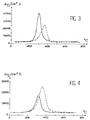
- Figures 3 and 4 are diagrams illustrating the flow of released tritium as a function of temperature in the case of two materials according to the invention.
- line 1 is the middle line which joins the vertex Cu0 (not shown in the drawing) to the opposite side 2 of the ternary diagram, only part of this side being represented, that is the portion which goes from 45% of Li 2 O at 55% Li 2 O.
- line 1 corresponds to the substitution mechanism in which we always have the same Li 2 O / ZrO 2 ratio, which corresponds to the formula Li 2 (1-x / 3) Zr (1-x / 3) Cu x O 3
- substitution mechanism is as follows: 2 3 xLi + + 1 3 xZr 4+ ⁇ xCu 2+
- Line 4 in Figure 1 corresponds to the formula: Li 2 (1-x) Cu x ZrO 3 . either to replace Li 2 O by CuO according to the mechanism: 2xLi + ⁇ xCu 2+ + x ⁇
- the composition of the ceramic material in the entire field of solid solutions represented, but it is preferable to use a material whose composition is located on line 1, because these materials have interesting mechanical and microstructural characteristics. (fine microstructure and mechanical resistance of the same order as that of unsubstituted zirconate).
- the ceramic will then have the formula: Li 2 (1-y i ) ZrCu Y i O 3 where (1-y i ) denotes the content of Li 2 0 at point B.
- the initial composition can therefore be written as a function of y i : Li 2 ZrCu y i O 3 + y i
- the departure of lithium by nuclear reaction can therefore be symbolized by the passage of a ceramic composition to another material of formulation: It is then obvious that the consumption of lithium is done starting from y i Li 2 0.
- y i In order to ensure the structural stability of the ceramic during this whole process, y i must be less than y sup which represents the limit rate of substitution in solid solution of line (4) of the ternary diagram. This relationship then implies that the initial substitution rate is such that: x i ⁇ y sup 1+ 1 3 y sup ⁇ x sup .
- the ceramic materials of the invention can be prepared by conventional methods from zirconium oxide, lithium carbonate and a copper salt such as copper nitrate.
- a lithium zirconate powder Li 2 ZrO 3 is first prepared by the usual methods, then the copper is introduced into this powder by impregnation using an ethanol solution containing a copper salt, for example copper nitrate. The treated powder is then subjected to drying, cooking and sieving before being put into the desired form.
- composition of the ceramic material lies outside this central line 1, it is possible to start with a zirconia powder which is impregnated with a solution of copper nitrate in ethanol and which is then subjected to drying and cooking, then this zirconia powder which contains copper is mixed with lithium carbonate and a zirconate powder is prepared by usual cooking, sieving, shaping and sintering techniques.
- Example 1 Preparation of a ceramic material comprising 8% Cu.
- the zirconia powder has a specific surface of the order of 15 m 2 / g and is sieved to 400 ⁇ m.
- lithium carbonate powder having a specific surface of 1 to 1.5 m 2 / g and is sieved to a dimension of 200 ⁇ m.
- the powders are then mixed by mechanical stirring for approximately 30 minutes, then the powder mixture is brought to 700 ° C. in 3 hours, it is maintained at this temperature for 3 hours, then it is allowed to cool slowly to 100 ° C. .
- sieving at 400 ⁇ m and a new stirring the same cooking cycle at 700 ° C is repeated.
- the powder is then subjected to a new thermal cycle comprising stirring for 30 minutes and baking at 800 ° C for 3 hours, which ensures better integrity of the compact during sintering.
- the lithium zirconate powder thus obtained is then impregnated with an ethanol solution containing 200 9 / l of copper nitrate by bringing it into contact for 30 minutes.
- the impregnated powder is then dried at 120 ° C, then baked at 800 ° C for 3 hours, and sieved to 400 ⁇ m.
- This copper-containing powder is then put in the form of ceramic bars in rubber sheaths with a diameter of 21 mm by compression in an isostatic press under a pressure of 300 MPa. After compression, the sheath is eliminated, then the bars are sintered at a temperature of 925 ° C. for 3 hours.
- the ceramic material thus obtained corresponds to the formula: Li 1.94 Zr 0.97 Cu 0.08 O 3 . and it has a porosity of 22% and an average grain size of 2 ⁇ m.
- Example 2 Preparation of a ceramic material corresponding to the formula: Li 2 ZrCu 0.05 O 3.05 .
- Example 2 The same procedure is followed as in Example 1 to prepare this material using for the impregnation a solution containing 200 g / l of copper nitrates and carrying out the impregnation for 30 minutes.
- the powder obtained corresponds to the formula given above and it has a porosity of 26% and a grain size of 1 ⁇ m.
- Example 2 the same procedure is followed as in Example 1 to prepare a bar of lithium zirconate except that the steps of impregnation, drying and cooking are not carried out before isostatic compression.
- lithium zirconate having a porosity of 27% and a grain size of 1 ⁇ m.
- Each ball is then introduced into quartz tubes and degassed at 650 ° C for 3 hours.
- the helium tubes are then filled under 200 torr (27kPa) and then sealed.
- the sealed tubes are then placed in aluminum containers which can each contain 12 tubes and each container is introduced into a nuclear reactor to subject the beads to irradiation with a neutron flux of 2.5 ⁇ 10 13 neutrons / cm 2 .s. in the center of the container.
- the container contains the twelve tubes, the value of the neutron flux is effectively 2.5.10 13 neutrons / cm 2 .s in the center of the aluminum container but it is halved at these ends, where the irradiation only corresponds to a flux of 1.25.10 13 neutrons / cm 2 .s.
- the tubes are removed from the reactor and allowed to cool for about 6 weeks to remove the intense radiation.
- the tubes are then subjected to a release test for tritium in the device shown in FIG. 2.
- This device comprises a quartz tube 11 connected at one end to a loading device 13 provided with a sealed cover 15, a breaker / tube device (not shown in the drawing) and an inlet for carrier gas 17.
- the tube 11 passes through a first extraction furnace 19 and a second reducing furnace 21 and it is connected at its other end to an ionization chamber 23.
- a tap 14 makes it possible to block the ball in the tube 11 before its entry into the part corresponding to ovens 19 and 21.
- the quartz tube containing the irradiated ball is broken in the loading device 13.
- the tritiated gases are entrained in the circuit by the carrier gas (helium with 0.1% hydrogen or helium alone) introduced in 17, while the ball remains blocked by the ridged tap 14.
- the tritiated gases pass through the zinc reducing furnace 21 brought to a temperature of 370 ° C. where the tritiated water possibly formed during the extraction is reduced to T 2 or HT . This reduction avoids any risk of condensation on the walls of the pipes of the device, which would cause a measurement by default of the quantities of released tritium.
- the mixture consisting of carrier gas and of the species thus formed then passes into the ionization chamber 23 which detects by counting the pairs (He +, e-) the ⁇ emission of tritium. This room allows to monitor the quantity of tritium in the carrier gas at all times.
- the quantity of tritium contained in the quartz tube is therefore determined before the extraction of the tritium contained in the sample ball.
- the ball is released by actuating the tap 14 to position it at 16, and it is introduced into the center of the furnace 19 whose temperature is at 35 ° C. for experiments in linear temperature ramp.
- the extracted gases are then entrained towards the reducing furnace 21 and the ionization chamber 23 as before.
- the ball 16 undergoes a linear rise in temperature, from the temperature of 35 ° C with a heating rate of 1 ° C / min. A measurement is then made of the amount of tritium contained in the carrier gas every minute.
- FIG. 3 illustrates the results obtained in the case of the ceramic material of example 1 and of the ceramic material Li 2 ZrO 3 of comparative example 3.
- the solid line curve represents the results obtained with lithium zirconate doped with 8% copper (ex 1) while the dashed curve represents the result obtained in the case of stoichiometric lithium zirconate (ex 3) .
- These curves illustrate the variations in tritium activity (in Bq / cm 2 .s) as a function of temperature (in ° C).
- FIG. 4 illustrates the results obtained for the ceramic material of example 2 and the stoichiometric lithium zirconate of comparative example 3.
- the curve in solid lines relates to lithium zirconate doped with 5% of Cu in Example 2
- the curve in dashes relates to Li 2 ZrO 3 in Comparative Example 3.
- the ceramic materials of the invention are therefore very advantageous for use as a tritigenic material, in particular in a thermonuclear fusion reactor, since they allow recovery of the tritium at relatively low temperatures.
Landscapes
- Chemical & Material Sciences (AREA)
- Engineering & Computer Science (AREA)
- Organic Chemistry (AREA)
- Inorganic Chemistry (AREA)
- Ceramic Engineering (AREA)
- Physics & Mathematics (AREA)
- General Engineering & Computer Science (AREA)
- High Energy & Nuclear Physics (AREA)
- Composite Materials (AREA)
- Manufacturing & Machinery (AREA)
- Plasma & Fusion (AREA)
- Materials Engineering (AREA)
- Structural Engineering (AREA)
- Compositions Of Oxide Ceramics (AREA)
- Inorganic Compounds Of Heavy Metals (AREA)
Applications Claiming Priority (2)
| Application Number | Priority Date | Filing Date | Title |
|---|---|---|---|
| FR9505582 | 1992-05-11 | ||
| FR9505582A FR2733975B1 (fr) | 1995-05-11 | 1995-05-11 | Ceramique a base de zirconate de lithium substitue par du cuivre, utilisable comme materiau tritigene |
Publications (1)
| Publication Number | Publication Date |
|---|---|
| EP0742181A1 true EP0742181A1 (de) | 1996-11-13 |
Family
ID=9478873
Family Applications (1)
| Application Number | Title | Priority Date | Filing Date |
|---|---|---|---|
| EP96400987A Withdrawn EP0742181A1 (de) | 1995-05-11 | 1996-05-09 | Keramik auf der Basis von durch Kupfer substituiertem Lithiumzirconat zur Erzeugung von Tritium |
Country Status (5)
| Country | Link |
|---|---|
| US (1) | US5834390A (de) |
| EP (1) | EP0742181A1 (de) |
| JP (1) | JPH08310816A (de) |
| CA (1) | CA2176079A1 (de) |
| FR (1) | FR2733975B1 (de) |
Families Citing this family (2)
| Publication number | Priority date | Publication date | Assignee | Title |
|---|---|---|---|---|
| US8114201B2 (en) * | 2008-10-22 | 2012-02-14 | Gore Enterprise Holdings, Inc. | Air pollution control filter elements for filtration systems |
| FR2987161A1 (fr) * | 2012-02-17 | 2013-08-23 | Pierre Marcel Bourgogne | Procede et dispositif pour realiser la fusion nucleaire |
Citations (2)
| Publication number | Priority date | Publication date | Assignee | Title |
|---|---|---|---|---|
| EP0333041A1 (de) * | 1988-03-11 | 1989-09-20 | Tosoh Corporation | Verfahren zur Herstellung von Lithiumzirkonat-Pulver |
| FR2641774A1 (fr) * | 1989-01-16 | 1990-07-20 | Studiecentrum Kernenergi | Procede pour la preparation de zirconate de lithium, et zirconate de lithium et produits intermediaires prepares suivant celui-ci |
-
1995
- 1995-05-11 FR FR9505582A patent/FR2733975B1/fr not_active Expired - Lifetime
-
1996
- 1996-05-08 CA CA002176079A patent/CA2176079A1/en not_active Abandoned
- 1996-05-09 EP EP96400987A patent/EP0742181A1/de not_active Withdrawn
- 1996-05-09 JP JP8114852A patent/JPH08310816A/ja active Pending
-
1997
- 1997-08-15 US US08/911,985 patent/US5834390A/en not_active Expired - Fee Related
Patent Citations (2)
| Publication number | Priority date | Publication date | Assignee | Title |
|---|---|---|---|---|
| EP0333041A1 (de) * | 1988-03-11 | 1989-09-20 | Tosoh Corporation | Verfahren zur Herstellung von Lithiumzirkonat-Pulver |
| FR2641774A1 (fr) * | 1989-01-16 | 1990-07-20 | Studiecentrum Kernenergi | Procede pour la preparation de zirconate de lithium, et zirconate de lithium et produits intermediaires prepares suivant celui-ci |
Non-Patent Citations (1)
| Title |
|---|
| 1. CASTELLANOS, M.CHAVEZ MARTINEZ: "New family of phases, LiMX04", ZEITSCHRIFT FÜR KRISTALLOGRAPHIE, vol. 190, no. 3-4, 1990, pages 161 - 162, XP002011399 * |
Also Published As
| Publication number | Publication date |
|---|---|
| CA2176079A1 (en) | 1997-02-23 |
| FR2733975B1 (fr) | 1997-06-06 |
| US5834390A (en) | 1998-11-10 |
| FR2733975A1 (fr) | 1996-11-15 |
| JPH08310816A (ja) | 1996-11-26 |
Similar Documents
| Publication | Publication Date | Title |
|---|---|---|
| EP2474000B1 (de) | Verfahren zur herstellung von porösem kernbrennstoff auf der basis der weniger häufigen aktiniden | |
| EP0701734B1 (de) | Spaltprodukte zurückhaltender Kernbrennstoff | |
| Hatano et al. | Fabrication of ZrO2 coatings on ferritic steel by wet-chemical methods as a tritium permeation barrier | |
| Moore | Phase relationships in the α+ δ region of the Zr-H system | |
| US9653188B2 (en) | Fabrication method of burnable absorber nuclear fuel pellets and burnable absorber nuclear fuel pellets fabricated by the same | |
| EP3233756A1 (de) | Verfahren zur herstellung eines pellets aus mindestens einem metalloxid | |
| Uetsuka et al. | Embrittlement of Zircaloy-4 due to oxidation in environment of stagnant steam | |
| FR2733975A1 (fr) | Ceramique a base de zirconate de lithium substitue par du cuivre, utilisable comme materiau tritigene | |
| US2835608A (en) | Process of preparing uraniumimpregnated graphite body | |
| US3344081A (en) | Sintered uranium dioxide containing yttrium oxide | |
| FR2601181A1 (fr) | Procede et dispositif pour la decontamination du gaz rejete du cycle de combustible d'un reacteur nucleaire a fusion, gaz rejete contamine par des composants contenant du tritium et/ou du deuterium sous forme combinee chimiquement | |
| Pickman | Internal cladding corrosion effects | |
| Eatherly et al. | Physical properties of graphite materials for special nuclear applications | |
| Marshall | Absorption of gaseous hydrogen by Zircaloy-2 | |
| Vedeneev et al. | Radiogenic helium thermodesorption from titanium tritide | |
| Zhang et al. | The segregation of Fe on the (1010) Zr surface | |
| Wiswall et al. | Removal of tritium from fusion reactor blankets. Annual report, FY 1977 | |
| Iwamoto et al. | The behavior of iodine in adsorption and desorption by graphite | |
| EP1048037B1 (de) | Neutronenabsorbierendes verbundmaterial und herstellungsverfahren dafür | |
| WO1995020551A1 (fr) | Materiau tritigene en ceramique contenant du lithium et son procede de preparation | |
| FR2620438A1 (fr) | Procede de preparation de nitrure d'uranium et/ou de plutonium utilisable comme combustible nucleaire | |
| GB2064201A (en) | Hydrogen Resistant Nuclear Fuel Container | |
| FR2536571A1 (fr) | Procede de fabrication de pastilles de combustible nucleaire contenant un absorbant neutronique temporaire | |
| Stobbs | The Oxidation Mechanism of Pure Uranium in Carbon Dioxide Between 350° and 650° C | |
| JP2547453B2 (ja) | 放射性金属廃棄物の減容処理方法 |
Legal Events
| Date | Code | Title | Description |
|---|---|---|---|
| PUAI | Public reference made under article 153(3) epc to a published international application that has entered the european phase |
Free format text: ORIGINAL CODE: 0009012 |
|
| AK | Designated contracting states |
Kind code of ref document: A1 Designated state(s): DE IT NL |
|
| 17P | Request for examination filed |
Effective date: 19970416 |
|
| 17Q | First examination report despatched |
Effective date: 19980504 |
|
| STAA | Information on the status of an ep patent application or granted ep patent |
Free format text: STATUS: THE APPLICATION IS DEEMED TO BE WITHDRAWN |
|
| 18D | Application deemed to be withdrawn |
Effective date: 19990928 |