EP0742257B1 - Procédé de réticulation et de stabilisation de compositions de propylène hétérophasique - Google Patents
Procédé de réticulation et de stabilisation de compositions de propylène hétérophasique Download PDFInfo
- Publication number
- EP0742257B1 EP0742257B1 EP19960107473 EP96107473A EP0742257B1 EP 0742257 B1 EP0742257 B1 EP 0742257B1 EP 19960107473 EP19960107473 EP 19960107473 EP 96107473 A EP96107473 A EP 96107473A EP 0742257 B1 EP0742257 B1 EP 0742257B1
- Authority
- EP
- European Patent Office
- Prior art keywords
- radical
- cross
- linking
- alkyl
- radicals
- Prior art date
- Legal status (The legal status is an assumption and is not a legal conclusion. Google has not performed a legal analysis and makes no representation as to the accuracy of the status listed.)
- Expired - Lifetime
Links
- 238000004132 cross linking Methods 0.000 title claims description 62
- 239000000203 mixture Substances 0.000 title claims description 53
- -1 polypropylene Polymers 0.000 title claims description 37
- 238000000034 method Methods 0.000 title claims description 26
- 239000004743 Polypropylene Substances 0.000 title claims description 10
- 229920001155 polypropylene Polymers 0.000 title claims description 10
- 230000006641 stabilisation Effects 0.000 title claims description 7
- 238000011105 stabilization Methods 0.000 title claims description 7
- 150000003254 radicals Chemical class 0.000 claims description 29
- 150000001451 organic peroxides Chemical class 0.000 claims description 20
- 150000001875 compounds Chemical class 0.000 claims description 19
- 239000004711 α-olefin Substances 0.000 claims description 18
- 229920000642 polymer Polymers 0.000 claims description 17
- 239000008096 xylene Substances 0.000 claims description 16
- CTQNGGLPUBDAKN-UHFFFAOYSA-N O-Xylene Chemical compound CC1=CC=CC=C1C CTQNGGLPUBDAKN-UHFFFAOYSA-N 0.000 claims description 14
- VGGSQFUCUMXWEO-UHFFFAOYSA-N Ethene Chemical compound C=C VGGSQFUCUMXWEO-UHFFFAOYSA-N 0.000 claims description 13
- 239000005977 Ethylene Substances 0.000 claims description 13
- 229920001577 copolymer Polymers 0.000 claims description 13
- 229910052739 hydrogen Inorganic materials 0.000 claims description 13
- 239000001257 hydrogen Substances 0.000 claims description 13
- 125000004435 hydrogen atom Chemical class [H]* 0.000 claims description 13
- QQONPFPTGQHPMA-UHFFFAOYSA-N propylene Natural products CC=C QQONPFPTGQHPMA-UHFFFAOYSA-N 0.000 claims description 13
- 125000004805 propylene group Chemical group [H]C([H])([H])C([H])([*:1])C([H])([H])[*:2] 0.000 claims description 13
- 239000003381 stabilizer Substances 0.000 claims description 13
- NQRYJNQNLNOLGT-UHFFFAOYSA-N Piperidine Chemical compound C1CCNCC1 NQRYJNQNLNOLGT-UHFFFAOYSA-N 0.000 claims description 12
- 239000004611 light stabiliser Substances 0.000 claims description 9
- 125000006702 (C1-C18) alkyl group Chemical group 0.000 claims description 7
- 150000002148 esters Chemical group 0.000 claims description 7
- 229920000181 Ethylene propylene rubber Polymers 0.000 claims description 6
- 150000003568 thioethers Chemical class 0.000 claims description 6
- XITRBUPOXXBIJN-UHFFFAOYSA-N bis(2,2,6,6-tetramethylpiperidin-4-yl) decanedioate Chemical compound C1C(C)(C)NC(C)(C)CC1OC(=O)CCCCCCCCC(=O)OC1CC(C)(C)NC(C)(C)C1 XITRBUPOXXBIJN-UHFFFAOYSA-N 0.000 claims description 5
- 238000010077 mastication Methods 0.000 claims description 5
- 230000018984 mastication Effects 0.000 claims description 5
- 150000002989 phenols Chemical class 0.000 claims description 5
- 229920000098 polyolefin Polymers 0.000 claims description 5
- RTZKZFJDLAIYFH-UHFFFAOYSA-N Diethyl ether Chemical compound CCOCC RTZKZFJDLAIYFH-UHFFFAOYSA-N 0.000 claims description 4
- 125000003368 amide group Chemical group 0.000 claims description 4
- 150000001412 amines Chemical class 0.000 claims description 4
- 125000000623 heterocyclic group Chemical group 0.000 claims description 4
- 229920001519 homopolymer Polymers 0.000 claims description 4
- AQSJGOWTSHOLKH-UHFFFAOYSA-N phosphite(3-) Chemical class [O-]P([O-])[O-] AQSJGOWTSHOLKH-UHFFFAOYSA-N 0.000 claims description 4
- 229920006395 saturated elastomer Polymers 0.000 claims description 4
- 125000004209 (C1-C8) alkyl group Chemical group 0.000 claims description 3
- 150000001993 dienes Chemical class 0.000 claims description 3
- 125000001841 imino group Chemical group [H]N=* 0.000 claims description 3
- 229910052757 nitrogen Inorganic materials 0.000 claims description 3
- IJGRMHOSHXDMSA-UHFFFAOYSA-N nitrogen Substances N#N IJGRMHOSHXDMSA-UHFFFAOYSA-N 0.000 claims description 3
- QJGQUHMNIGDVPM-UHFFFAOYSA-N nitrogen group Chemical group [N] QJGQUHMNIGDVPM-UHFFFAOYSA-N 0.000 claims description 3
- 125000003386 piperidinyl group Chemical group 0.000 claims description 3
- 125000004178 (C1-C4) alkyl group Chemical group 0.000 claims description 2
- 125000000204 (C2-C4) acyl group Chemical group 0.000 claims description 2
- RKMGAJGJIURJSJ-UHFFFAOYSA-N 2,2,6,6-Tetramethylpiperidine Substances CC1(C)CCCC(C)(C)N1 RKMGAJGJIURJSJ-UHFFFAOYSA-N 0.000 claims description 2
- SLRMQYXOBQWXCR-UHFFFAOYSA-N 2154-56-5 Chemical compound [CH2]C1=CC=CC=C1 SLRMQYXOBQWXCR-UHFFFAOYSA-N 0.000 claims description 2
- 125000001931 aliphatic group Chemical group 0.000 claims description 2
- 125000004183 alkoxy alkyl group Chemical group 0.000 claims description 2
- 125000003710 aryl alkyl group Chemical group 0.000 claims description 2
- 125000003118 aryl group Chemical group 0.000 claims description 2
- RSOILICUEWXSLA-UHFFFAOYSA-N bis(1,2,2,6,6-pentamethylpiperidin-4-yl) decanedioate Chemical compound C1C(C)(C)N(C)C(C)(C)CC1OC(=O)CCCCCCCCC(=O)OC1CC(C)(C)N(C)C(C)(C)C1 RSOILICUEWXSLA-UHFFFAOYSA-N 0.000 claims description 2
- KPUWHANPEXNPJT-UHFFFAOYSA-N disiloxane Chemical compound [SiH3]O[SiH3] KPUWHANPEXNPJT-UHFFFAOYSA-N 0.000 claims description 2
- 229910052760 oxygen Inorganic materials 0.000 claims description 2
- 125000004437 phosphorous atom Chemical group 0.000 claims description 2
- 229920005604 random copolymer Polymers 0.000 claims description 2
- 229910052717 sulfur Inorganic materials 0.000 claims description 2
- 229920002943 EPDM rubber Polymers 0.000 claims 2
- 238000002156 mixing Methods 0.000 description 16
- 239000003921 oil Substances 0.000 description 13
- 239000003963 antioxidant agent Substances 0.000 description 12
- 150000002978 peroxides Chemical class 0.000 description 11
- 238000010521 absorption reaction Methods 0.000 description 8
- 230000000052 comparative effect Effects 0.000 description 8
- 229920006037 cross link polymer Polymers 0.000 description 7
- 238000002360 preparation method Methods 0.000 description 6
- ORECYURYFJYPKY-UHFFFAOYSA-N n,n'-bis(2,2,6,6-tetramethylpiperidin-4-yl)hexane-1,6-diamine;2,4,6-trichloro-1,3,5-triazine;2,4,4-trimethylpentan-2-amine Chemical compound CC(C)(C)CC(C)(C)N.ClC1=NC(Cl)=NC(Cl)=N1.C1C(C)(C)NC(C)(C)CC1NCCCCCCNC1CC(C)(C)NC(C)(C)C1 ORECYURYFJYPKY-UHFFFAOYSA-N 0.000 description 5
- 238000003756 stirring Methods 0.000 description 5
- GWQOYRSARAWVTC-UHFFFAOYSA-N 1,4-bis(2-tert-butylperoxypropan-2-yl)benzene Chemical compound CC(C)(C)OOC(C)(C)C1=CC=C(C(C)(C)OOC(C)(C)C)C=C1 GWQOYRSARAWVTC-UHFFFAOYSA-N 0.000 description 4
- VXNZUUAINFGPBY-UHFFFAOYSA-N 1-Butene Chemical compound CCC=C VXNZUUAINFGPBY-UHFFFAOYSA-N 0.000 description 4
- 241000723420 Celtis Species 0.000 description 4
- 230000006835 compression Effects 0.000 description 4
- 238000007906 compression Methods 0.000 description 4
- 229920001971 elastomer Polymers 0.000 description 4
- UHOVQNZJYSORNB-UHFFFAOYSA-N Benzene Chemical compound C1=CC=CC=C1 UHOVQNZJYSORNB-UHFFFAOYSA-N 0.000 description 3
- LYCAIKOWRPUZTN-UHFFFAOYSA-N Ethylene glycol Chemical compound OCCO LYCAIKOWRPUZTN-UHFFFAOYSA-N 0.000 description 3
- JKIJEFPNVSHHEI-UHFFFAOYSA-N Phenol, 2,4-bis(1,1-dimethylethyl)-, phosphite (3:1) Chemical compound CC(C)(C)C1=CC(C(C)(C)C)=CC=C1OP(OC=1C(=CC(=CC=1)C(C)(C)C)C(C)(C)C)OC1=CC=C(C(C)(C)C)C=C1C(C)(C)C JKIJEFPNVSHHEI-UHFFFAOYSA-N 0.000 description 3
- 230000003078 antioxidant effect Effects 0.000 description 3
- PWWSSIYVTQUJQQ-UHFFFAOYSA-N distearyl thiodipropionate Chemical compound CCCCCCCCCCCCCCCCCCOC(=O)CCSCCC(=O)OCCCCCCCCCCCCCCCCCC PWWSSIYVTQUJQQ-UHFFFAOYSA-N 0.000 description 3
- 239000000806 elastomer Substances 0.000 description 3
- 235000014692 zinc oxide Nutrition 0.000 description 3
- LIKMAJRDDDTEIG-UHFFFAOYSA-N 1-hexene Chemical compound CCCCC=C LIKMAJRDDDTEIG-UHFFFAOYSA-N 0.000 description 2
- KWKAKUADMBZCLK-UHFFFAOYSA-N 1-octene Chemical compound CCCCCCC=C KWKAKUADMBZCLK-UHFFFAOYSA-N 0.000 description 2
- WSSSPWUEQFSQQG-UHFFFAOYSA-N 4-methyl-1-pentene Chemical compound CC(C)CC=C WSSSPWUEQFSQQG-UHFFFAOYSA-N 0.000 description 2
- CSCPPACGZOOCGX-UHFFFAOYSA-N Acetone Chemical compound CC(C)=O CSCPPACGZOOCGX-UHFFFAOYSA-N 0.000 description 2
- KAKZBPTYRLMSJV-UHFFFAOYSA-N Butadiene Chemical compound C=CC=C KAKZBPTYRLMSJV-UHFFFAOYSA-N 0.000 description 2
- 0 CCC(*)(*N*C([C@@](*)C([C@](*)([C@@](B*)(*)C1*)N)*=C)C1(*)O)ON Chemical compound CCC(*)(*N*C([C@@](*)C([C@](*)([C@@](B*)(*)C1*)N)*=C)C1(*)O)ON 0.000 description 2
- 229920000089 Cyclic olefin copolymer Polymers 0.000 description 2
- OWYWGLHRNBIFJP-UHFFFAOYSA-N Ipazine Chemical compound CCN(CC)C1=NC(Cl)=NC(NC(C)C)=N1 OWYWGLHRNBIFJP-UHFFFAOYSA-N 0.000 description 2
- SMWDFEZZVXVKRB-UHFFFAOYSA-N Quinoline Chemical compound N1=CC=CC2=CC=CC=C21 SMWDFEZZVXVKRB-UHFFFAOYSA-N 0.000 description 2
- VYPSYNLAJGMNEJ-UHFFFAOYSA-N Silicium dioxide Chemical compound O=[Si]=O VYPSYNLAJGMNEJ-UHFFFAOYSA-N 0.000 description 2
- HCHKCACWOHOZIP-UHFFFAOYSA-N Zinc Chemical compound [Zn] HCHKCACWOHOZIP-UHFFFAOYSA-N 0.000 description 2
- BGYHLZZASRKEJE-UHFFFAOYSA-N [3-[3-(3,5-ditert-butyl-4-hydroxyphenyl)propanoyloxy]-2,2-bis[3-(3,5-ditert-butyl-4-hydroxyphenyl)propanoyloxymethyl]propyl] 3-(3,5-ditert-butyl-4-hydroxyphenyl)propanoate Chemical compound CC(C)(C)C1=C(O)C(C(C)(C)C)=CC(CCC(=O)OCC(COC(=O)CCC=2C=C(C(O)=C(C=2)C(C)(C)C)C(C)(C)C)(COC(=O)CCC=2C=C(C(O)=C(C=2)C(C)(C)C)C(C)(C)C)COC(=O)CCC=2C=C(C(O)=C(C=2)C(C)(C)C)C(C)(C)C)=C1 BGYHLZZASRKEJE-UHFFFAOYSA-N 0.000 description 2
- 230000015572 biosynthetic process Effects 0.000 description 2
- 239000003054 catalyst Substances 0.000 description 2
- 238000000113 differential scanning calorimetry Methods 0.000 description 2
- YWAKXRMUMFPDSH-UHFFFAOYSA-N pentene Chemical compound CCCC=C YWAKXRMUMFPDSH-UHFFFAOYSA-N 0.000 description 2
- 229920002589 poly(vinylethylene) polymer Polymers 0.000 description 2
- 238000006116 polymerization reaction Methods 0.000 description 2
- 150000003335 secondary amines Chemical class 0.000 description 2
- 230000002195 synergetic effect Effects 0.000 description 2
- 238000003786 synthesis reaction Methods 0.000 description 2
- 239000011701 zinc Substances 0.000 description 2
- 229910052725 zinc Inorganic materials 0.000 description 2
- PRBHEGAFLDMLAL-GQCTYLIASA-N (4e)-hexa-1,4-diene Chemical compound C\C=C\CC=C PRBHEGAFLDMLAL-GQCTYLIASA-N 0.000 description 1
- 125000004400 (C1-C12) alkyl group Chemical group 0.000 description 1
- KOMNUTZXSVSERR-UHFFFAOYSA-N 1,3,5-tris(prop-2-enyl)-1,3,5-triazinane-2,4,6-trione Chemical compound C=CCN1C(=O)N(CC=C)C(=O)N(CC=C)C1=O KOMNUTZXSVSERR-UHFFFAOYSA-N 0.000 description 1
- PRBHEGAFLDMLAL-UHFFFAOYSA-N 1,5-Hexadiene Natural products CC=CCC=C PRBHEGAFLDMLAL-UHFFFAOYSA-N 0.000 description 1
- CARFETJZUQORNQ-UHFFFAOYSA-N 1h-pyrrole-2-thiol Chemical class SC1=CC=CN1 CARFETJZUQORNQ-UHFFFAOYSA-N 0.000 description 1
- BJELTSYBAHKXRW-UHFFFAOYSA-N 2,4,6-triallyloxy-1,3,5-triazine Chemical compound C=CCOC1=NC(OCC=C)=NC(OCC=C)=N1 BJELTSYBAHKXRW-UHFFFAOYSA-N 0.000 description 1
- DMWVYCCGCQPJEA-UHFFFAOYSA-N 2,5-bis(tert-butylperoxy)-2,5-dimethylhexane Chemical compound CC(C)(C)OOC(C)(C)CCC(C)(C)OOC(C)(C)C DMWVYCCGCQPJEA-UHFFFAOYSA-N 0.000 description 1
- XMNIXWIUMCBBBL-UHFFFAOYSA-N 2-(2-phenylpropan-2-ylperoxy)propan-2-ylbenzene Chemical compound C=1C=CC=CC=1C(C)(C)OOC(C)(C)C1=CC=CC=C1 XMNIXWIUMCBBBL-UHFFFAOYSA-N 0.000 description 1
- RIVJYLGQARVCBI-UHFFFAOYSA-N 2-tert-butylperoxy-2-methylpropane;cumene Chemical compound CC(C)C1=CC=CC=C1.CC(C)(C)OOC(C)(C)C RIVJYLGQARVCBI-UHFFFAOYSA-N 0.000 description 1
- WPMYUUITDBHVQZ-UHFFFAOYSA-M 3-(3,5-ditert-butyl-4-hydroxyphenyl)propanoate Chemical compound CC(C)(C)C1=CC(CCC([O-])=O)=CC(C(C)(C)C)=C1O WPMYUUITDBHVQZ-UHFFFAOYSA-M 0.000 description 1
- SWZOQAGVRGQLDV-UHFFFAOYSA-N 4-[2-(4-hydroxy-2,2,6,6-tetramethylpiperidin-1-yl)ethoxy]-4-oxobutanoic acid Chemical compound CC1(C)CC(O)CC(C)(C)N1CCOC(=O)CCC(O)=O SWZOQAGVRGQLDV-UHFFFAOYSA-N 0.000 description 1
- OYPRJOBELJOOCE-UHFFFAOYSA-N Calcium Chemical compound [Ca] OYPRJOBELJOOCE-UHFFFAOYSA-N 0.000 description 1
- 239000004215 Carbon black (E152) Substances 0.000 description 1
- 239000002656 Distearyl thiodipropionate Substances 0.000 description 1
- FYYHWMGAXLPEAU-UHFFFAOYSA-N Magnesium Chemical compound [Mg] FYYHWMGAXLPEAU-UHFFFAOYSA-N 0.000 description 1
- CERQOIWHTDAKMF-UHFFFAOYSA-M Methacrylate Chemical compound CC(=C)C([O-])=O CERQOIWHTDAKMF-UHFFFAOYSA-M 0.000 description 1
- 239000005662 Paraffin oil Substances 0.000 description 1
- 235000021355 Stearic acid Nutrition 0.000 description 1
- UCKMPCXJQFINFW-UHFFFAOYSA-N Sulphide Chemical compound [S-2] UCKMPCXJQFINFW-UHFFFAOYSA-N 0.000 description 1
- HPWKYYZQPCDXNG-UHFFFAOYSA-N [4-(2,4-dimethyl-4-phenylpentan-2-yl)peroxy-2,4-dimethylpentan-2-yl]benzene Chemical compound C=1C=CC=CC=1C(C)(C)CC(C)(C)OOC(C)(C)CC(C)(C)C1=CC=CC=C1 HPWKYYZQPCDXNG-UHFFFAOYSA-N 0.000 description 1
- 150000001252 acrylic acid derivatives Chemical class 0.000 description 1
- 239000000654 additive Substances 0.000 description 1
- 230000002411 adverse Effects 0.000 description 1
- 230000032683 aging Effects 0.000 description 1
- 238000013019 agitation Methods 0.000 description 1
- 150000001336 alkenes Chemical class 0.000 description 1
- 150000001448 anilines Chemical class 0.000 description 1
- 229910052791 calcium Inorganic materials 0.000 description 1
- 239000011575 calcium Substances 0.000 description 1
- 239000006229 carbon black Substances 0.000 description 1
- 230000015556 catabolic process Effects 0.000 description 1
- 238000006243 chemical reaction Methods 0.000 description 1
- 239000003795 chemical substances by application Substances 0.000 description 1
- 239000003431 cross linking reagent Substances 0.000 description 1
- 238000000354 decomposition reaction Methods 0.000 description 1
- 238000006731 degradation reaction Methods 0.000 description 1
- LSXWFXONGKSEMY-UHFFFAOYSA-N di-tert-butyl peroxide Chemical compound CC(C)(C)OOC(C)(C)C LSXWFXONGKSEMY-UHFFFAOYSA-N 0.000 description 1
- 125000000118 dimethyl group Chemical group [H]C([H])([H])* 0.000 description 1
- 230000003292 diminished effect Effects 0.000 description 1
- 239000006185 dispersion Substances 0.000 description 1
- 238000006073 displacement reaction Methods 0.000 description 1
- 235000019305 distearyl thiodipropionate Nutrition 0.000 description 1
- 239000000975 dye Substances 0.000 description 1
- 230000000694 effects Effects 0.000 description 1
- 229920001198 elastomeric copolymer Polymers 0.000 description 1
- 125000004185 ester group Chemical group 0.000 description 1
- HQQADJVZYDDRJT-UHFFFAOYSA-N ethene;prop-1-ene Chemical group C=C.CC=C HQQADJVZYDDRJT-UHFFFAOYSA-N 0.000 description 1
- 238000011156 evaluation Methods 0.000 description 1
- 239000000706 filtrate Substances 0.000 description 1
- PYGSKMBEVAICCR-UHFFFAOYSA-N hexa-1,5-diene Chemical compound C=CCCC=C PYGSKMBEVAICCR-UHFFFAOYSA-N 0.000 description 1
- 239000008240 homogeneous mixture Substances 0.000 description 1
- 238000000265 homogenisation Methods 0.000 description 1
- 229930195733 hydrocarbon Natural products 0.000 description 1
- 150000002430 hydrocarbons Chemical class 0.000 description 1
- 239000011872 intimate mixture Substances 0.000 description 1
- ZFSLODLOARCGLH-UHFFFAOYSA-N isocyanuric acid Chemical compound OC1=NC(O)=NC(O)=N1 ZFSLODLOARCGLH-UHFFFAOYSA-N 0.000 description 1
- 229910052749 magnesium Inorganic materials 0.000 description 1
- 239000011777 magnesium Substances 0.000 description 1
- 235000012245 magnesium oxide Nutrition 0.000 description 1
- AXZKOIWUVFPNLO-UHFFFAOYSA-N magnesium;oxygen(2-) Chemical class [O-2].[Mg+2] AXZKOIWUVFPNLO-UHFFFAOYSA-N 0.000 description 1
- 239000000155 melt Substances 0.000 description 1
- WCYWZMWISLQXQU-UHFFFAOYSA-N methyl Chemical compound [CH3] WCYWZMWISLQXQU-UHFFFAOYSA-N 0.000 description 1
- TVMXDCGIABBOFY-UHFFFAOYSA-N n-Octanol Natural products CCCCCCCC TVMXDCGIABBOFY-UHFFFAOYSA-N 0.000 description 1
- QIQXTHQIDYTFRH-UHFFFAOYSA-N octadecanoic acid Chemical compound CCCCCCCCCCCCCCCCCC(O)=O QIQXTHQIDYTFRH-UHFFFAOYSA-N 0.000 description 1
- OQCDKBAXFALNLD-UHFFFAOYSA-N octadecanoic acid Natural products CCCCCCCC(C)CCCCCCCCC(O)=O OQCDKBAXFALNLD-UHFFFAOYSA-N 0.000 description 1
- 230000003287 optical effect Effects 0.000 description 1
- 239000002245 particle Substances 0.000 description 1
- 239000008188 pellet Substances 0.000 description 1
- 239000002530 phenolic antioxidant Substances 0.000 description 1
- OJMIONKXNSYLSR-UHFFFAOYSA-N phosphorous acid Chemical class OP(O)O OJMIONKXNSYLSR-UHFFFAOYSA-N 0.000 description 1
- 239000000049 pigment Substances 0.000 description 1
- 229920002959 polymer blend Polymers 0.000 description 1
- 229920005629 polypropylene homopolymer Polymers 0.000 description 1
- 238000001556 precipitation Methods 0.000 description 1
- 239000000047 product Substances 0.000 description 1
- 229920001384 propylene homopolymer Polymers 0.000 description 1
- 239000012763 reinforcing filler Substances 0.000 description 1
- 150000003839 salts Chemical class 0.000 description 1
- 239000000377 silicon dioxide Substances 0.000 description 1
- 230000000087 stabilizing effect Effects 0.000 description 1
- 239000008117 stearic acid Substances 0.000 description 1
- 239000000126 substance Substances 0.000 description 1
- 239000000454 talc Substances 0.000 description 1
- 229910052623 talc Inorganic materials 0.000 description 1
- 229920001169 thermoplastic Polymers 0.000 description 1
- 229920002725 thermoplastic elastomer Polymers 0.000 description 1
Classifications
-
- C—CHEMISTRY; METALLURGY
- C08—ORGANIC MACROMOLECULAR COMPOUNDS; THEIR PREPARATION OR CHEMICAL WORKING-UP; COMPOSITIONS BASED THEREON
- C08K—Use of inorganic or non-macromolecular organic substances as compounding ingredients
- C08K5/00—Use of organic ingredients
- C08K5/04—Oxygen-containing compounds
- C08K5/14—Peroxides
-
- C—CHEMISTRY; METALLURGY
- C08—ORGANIC MACROMOLECULAR COMPOUNDS; THEIR PREPARATION OR CHEMICAL WORKING-UP; COMPOSITIONS BASED THEREON
- C08K—Use of inorganic or non-macromolecular organic substances as compounding ingredients
- C08K5/00—Use of organic ingredients
- C08K5/16—Nitrogen-containing compounds
- C08K5/34—Heterocyclic compounds having nitrogen in the ring
- C08K5/3412—Heterocyclic compounds having nitrogen in the ring having one nitrogen atom in the ring
- C08K5/3432—Six-membered rings
- C08K5/3435—Piperidines
Definitions
- the present invention concerns a composition suited to cause a dynamic cross-linking of olefin polymers, and a process of dynamic cross-linking of the polymers based on the use of the above mentioned composition.
- HALS sterically hindered amines
- the Applicant has also found that said stabilizers not only do not hinder the cross-linking action of the peroxides, but also increase the cross-linking effectiveness of the composition used. As a consequence, thanks to the HALS one can obtain higher degrees of cross-linking at equal quantity of organic peroxide used.
- the high degree of cross-linking is shown by a decrease in oil absorption, since the quantity of oil absorbed is an indirect measure of the degree of cross-linking of the polymer, and by the high values of insolubility in xylene.
- composition of the present invention does not adversely affect the stabilization of the cross-linked polymer.
- physical-mechanical properties of the cross-linked polymers are higher than the standards required even after aging.
- HALS as stabilizers in the cross-linking compositions instead of mercaptoazoles/phenylamines or thioethers commonly used in cross-linking systems, improves considerably the organolectic characteristics of the cross-linked polymer, reducing the disagreeable odor exuded by the latter, and eliminating the coloration conferred by the above mentioned antioxidants.
- An other advantage offered by the cross-linking system of the present invention consists of a saving in the use of the organic peroxides and antioxidants employed for the cross-linking, and the stabilization of the polymer.
- object of the present invention is a process for the dynamic cross-linking and stabilization of a heterophasic polypropylene composition which composition does not contain organic sulfides as antioxidants, and comprises at least one organic peroxide and at least one himdered amine light stabilizer (HALS) consisting of an oligomeric compound or a monomeric compound.
- HALS hisdered amine light stabilizer
- the oligomeric compounds are selected from general formulae (I) to (V): where n is an integer from 1 to 100; the R 1 radicals, equal or different, are C 1 -C 4 alkyl or tetramethylpiperidine radicals, or the alkyl radicals form, with the piperidine carbons to which they are bonded, a C 5 -C 9 cycloalkyl radical; the R 2 radicals, equal or different, are hydrogen, or C 1 -C 18 alkyl, C 7 -C 18 aralkyl radicals, or the alkyl radicals form, with the piperidine carbons to which they are bonded, a C 5 -C 10 cycloalkyl radical; the R 3 radicals, equal or different, are hydrogen, or a C 1 -C 18 alkyl, or a C 7 -C 18 arylalkyl radicals; the R 4 radical is hydrogen, or a C 1 -C 8 alkyl, or a benzyl radical;
- Z is a C 1 -C 12 alkyl or C 7 -C 11 aralkyl radical, or a bivalent saturated radical containing at least an ester group, the valences of said radical being bonded to the nitrogen of the piperidine groups.
- L is a bivalent organic radical, preferably a C 1 -C 12 alkylene, a -N(R)- (where R is hydrogen or a C 1 -C 18 alkyl radical), or -O- radical
- T is a bivalent organic radical of the aliphatic, cycloaliphatic, aromatic, or heterocyclic type, containing N or O, S, P atoms in the chain or in the heterocyclic ring
- Z is a C 1 -C 12 alkylene or a bivalent saturated radical containing at least one ester or amide group
- m is a number from 0 to 1
- n, R 1 , R 2 , R 3 , and R 4 are as defined above for formula (I).
- R 1 and R 2 radicals are as defined above for formula (I), preferably are methyl radicals; R' and R'' independently from one another are hydrogen, C 1 -C 8 alkyl, C 1 -C 8 alkoxy radical, preferably are metyl and propyl radicals; and n is an integer from 2 to 15.
- the preferred compound known as Uvasil 299, marketed by Enichem Synthesis has the following formula where n is an iteger from 3 to 9.
- Preferred examples of monomeric compounds suitable for the compositions of the present invention are represented by compounds having general formula (V). where R 1 , R 2 , R 3 , X and Z are as defined above for formula (I).
- n is an integer from 2 to 20;
- R is an -NHR 5 radical [where R 5 is a C 1 -C 10 alkyl radical, preferably -C(CH 3 ) 2 -CH 2 -C(CH 3 ) 3 ] or -N[(CH 2 )-(CH 2 )] 2 O; and where T is a -CH 2 -CH 2 -; and n is an integer from 2 to 20.
- the preferred compounds comprised in general formula (II) have the following formulae (VIII) and (IX): where n is an integer from 2 to 20; and where n is an integer from 2 to 20.
- n is an integer from 2 to 20.
- the preferred compounds comprised in general formula (V) have the following formulae (XI) and (XII): where Z is hydrogen, or a methyl radical; and
- Examples of commercial compounds that are commonly used for the stabilization of polymers that are comprised in the above mentioned general formulas are: poly(N- ⁇ -hydroxymethyl-2,2,6,6-tetramethyl-4-hydroxy-piperidyl succinate) (Tinuvin 622), bis(1,2,2,6,6-pentamethyl-4-piperidyl)sebacate (Tinuvin 765), bis(2,2,6,6-tetramethyl-4-piperidyl)sebacate (Tinuvin 770), poly ⁇ [6-(1,1,3,3-tetramethylbutyl)-imino]-1,3,5-triazine-2,4-diyl][4-(2,2,6,6-tetramethylpiperidyl)-imino]hexamethylene-[4-(2,2,6,6-tetramethylpiperidyl)imino ⁇ (Chimassorb 944), marketed by Ciba Geigy; polymethyl propyl-3-oxy[4-(2,2,6,6-
- the organic peroxides that can be used in the cross-linking composition of the present invention are those commonly used in the cross-linking process. In particular, it is preferable to use peroxides having long half-lifetimes, from 3 to 20 minutes, for example, at the temperature used in the cross-linking process.
- Specific examples of said organic peroxides are: di-tert-butyl peroxide isopropyl benzene, dicumyl peroxide, monocumyl(tert-butyl)peroxide, di(tert-butyl) peroxide, 2,5-dimethyl-2,5-di(tert-butylperoxy)-hexane.
- the organic peroxide/HALS weight ratio generally is from 1:1 to 6:1, preferably from 1.2:1 to 4:1.
- the HALS amount used in the cross-linking preferably is from 0.01 to 3%, more preferably 0.05-1%, by weight with respect to the total weight of the composition that is subjected to cross-linking.
- the quantity of organic peroxide used in the cross-linking is preferably from 0.1 to 8%, more preferably 0.5-5%, by weight with respect to the total weight of the composition that is subjected to cross-linking.
- the cross-linking composition of the present invention contains preferably one or more cross-linking coagent(s).
- Said coagents are selected from those commonly used for this purpose. Examples of preferred coagents are: difurfuraldazine, 1,2-polybutadiene, triallyl cyanurate, triallyl isocyanurate, and derivatives of the methacrylate and acrylate compounds, such as ethylene glycol dimethyl cyanurate.
- the quantity of cross-linking coagents used in the cross-linking depends on the degree of cross-linking that one wants to impart to the final cross-linked composition. Generally speaking, it preferably varies from 0.01 to 8%, more preferably from 0.05 to 3%, by weight with respect to the total weight of the composition that is subjected to cross-linking.
- the organic peroxide/cross-linking coagent weight ratio generally is from 1:0.05 to 1:0.6, preferably from 1:0.1 to 1:0.5.
- the cross-linking composition of the present invention can contain other stabilizers, such as sterically hindered phenols, phosphites, secondary amines, and quinoline.
- stabilizers such as sterically hindered phenols, phosphites, secondary amines, and quinoline.
- the sterically hindered phenols and phosphites are the preferred coadjuvant stabilizers.
- the weight ratio between the HALS and the other stabilizers is approximately from 0.1 to 10, preferably from 1 to 3.
- the cross-linking composition of the present invention is used to cross-link and stabilize, heterophasic polypropylene compositions comprising (by weight):
- the C 4 -C 8 ⁇ -olefins present in the above mentioned copolymers are linear or branched alkenes, and are preferably selected from the following compounds: 1-butene, 1-pentene, 1-hexene, 1-octene, and 4-methyl-1-pentene.
- the 1-butene is the ⁇ -olefin particularly preferred.
- Fraction (A) is present in the heterophasic polypropylene composition preferably in quantities ranging from 10 to 50 parts by weight, and preferably comprises a homopolymer of propylene with an insolubility in xylene at ambient temperature greater than 90% by weight, more preferably from 95 to 98%, or a copolymer containing more than 85% by weight of propylene, more preferably from 90 to 99%.
- Fraction (B) is present in the heterophasic polypropylene composition preferably in quantities ranging from 7 to 15 parts by weight, and has a crystallinity preferably ranging about from 20 to 60%, determined by DSC (Differential Scanning Calorimetry).
- the copolymer comprised in said fraction is preferably selected from the following types of copolymers: ethylene-propylene, containing greater than 55% by weight of ethylene; ethylene-propylene-C 4 -C 8 ⁇ -olefin, containing from 1 to 10% by weight of said ⁇ -olefin, and 55-98% by weight, preferably 80-95%, of ethylene and said ⁇ -olefin; ethylene-C 4 -C 8 ⁇ -olefin, containing 55-98% by weight, preferably 80-95%, of said ⁇ -olefin.
- Fraction (C) is present in the heterophasic polypropylene composition preferably in quantities ranging from 30 to 75 parts by weight, and preferably comprises a copolymer selected from: an ethylene-propylene copolymer containing from 15% to 70% by weight, preferably from 20 to 60%, of ethylene; an ethylene-propylene-C 4 -C 8 ⁇ -olefin copolymer, containing from 1 to 10% by weight of said ⁇ -olefin, preferably from 1 to 5%, where the total quantity of ethylene and ⁇ -olefin is from 20 to less than 40% by weight; an ethylene- ⁇ -olefin copolymer containing from 20 to less than 40% by weight, preferably from 20 to 38%, more preferably from 25 to 38%, of said ⁇ -olefin.
- a copolymer selected from: an ethylene-propylene copolymer containing from 15% to 70% by weight, preferably from 20 to 60%, of ethylene; an ethylene-propylene
- the dienes optionally present in the copolymers of said fraction are present in quantities preferably equal to or less than 10% by weight, and are selected preferably from: 1,3-butadiene, 1,4-hexadiene, 1,5-hexadiene, and 1-ethylidene-5-norbornene.
- the heterophasic compositions are prepared either by mechanically blending components (A), (B), and (C) in the molten state, or using a sequential polymerization process carried out in two or more stages, and using highly specific Ziegler-Natta catalysts.
- heterophasic polypropylene compositions as well as the catalysts and the polymerization processes commonly used for their preparation are described in published European patent applications No. 400,333 and 472,946.
- the cross-linking composition of the present invention is prepared, for example, blending its components until a good dispersion of the latter is obtained.
- the operating conditions used for the preparation of the cross-linking composition are not critical, however, the mixing conditions must be such as not to cause the degradation of the organic peroxide that may optionally be present. It is preferable to operate at ambient temperature.
- the dynamic cross-linking process is carried out according to known techniques.
- the above mentioned elastomeric or thermoplastic polymers, or their mixtures are subjected to mastication and/or mixing in the presence of the cross-linking composition of the present invention, at a temperature that is sufficiently high to melt the polymer mass (generally from 160 to 260°C), after which the mastication or mixing is continued for a time sufficient to cause the cross-linking of the polymer.
- the organic peroxide and the light stabilizer are added separately at consecutive times.
- the mastication, and/or mixing and cross-linking process can be carried out in an internal mixer, or in a Buss single-screw extruder, or a twin-screw extruder with mixing components.
- One can also operate in a number of machines placed in succession, where in the first ones one carries out the intimate mixing and homogenization of the composition, and the cross-linking takes place in the others, always operating in a mixing and masticating mode.
- thermoplastic elastomers In the case of thermoplastic elastomers, the mixing and masticating operation before cross-linking is aimed at obtaining an intimate and homogeneous mixture of the elastomeric copolymer in the melted polymer, with the elastomer being in the form of particles with dimensions of about 1 micron, and preferably from 0.5 to 1 micron.
- the length of the mastication which generally speaking is carried out at temperatures from 160 to 240°C, depends on the type of the cross-linking agent.
- the cross-linking are preferably from 1 to 10 minutes.
- additives that according to the known art are generally added to the cross-linking systems used up to know.
- examples of said substances are hydrocarbon extension oils (such as Celtis 911 oil), zinc and magnesium oxides, stearic acid or its salts (such as zinc, calcium, or magnesium, for example).
- reinforcing fillers such as silica, talc, and carbon black
- pigments and dyes such as titanium dioxide
- thermal and optical stabilizers such as titanium dioxide
- the solution is allowed to cool to 95°C, after which it is poured into a 25°C bath and kept there for 20 minutes without stirring, and 10 more minutes under agitation.
- the solution is then filtered, and acetone is added to a portion of the filtrate in order to secure the precipitation of the dissolved polymer.
- the polymer obtained in this manner is recovered, washed, dried, and weighed in order to determine the percentage of solubles in xylene.
- 35 parts by weight of homopolypropylene, 65 parts of EPR copolymer, and 1 part by weight of a light stabilizer are introduced into an internal Brabender Plasticorder PLD mixer type 651.
- the mixing is carried out at 180°C at a speed of 50 rpm. After 2 minutes from the beginning of the mixing the peroxide is added while continuing to stir. The total mixing time is 10 minutes.
- Table 1 shows the types of light stabilizers used, and the values of the melt index and oil absorption of the polymer mixture treated with the peroxide and the stabilizer.
- a specific quantity of polymer and the proper quantity of the cross-linking composition not containing the peroxide are introduced in an internal Brabender Plasticorder PLD mixer type 651.
- the mixture is carried out at 180°C at a speed of 50 rpm.
- the total mixing time is 10 minutes.
- the cross-linked composition is melted in a press with plates heated to a temperature of 200°C for 10 minutes at atmospheric pressure, initially, and then for an additional 5 minutes at a pressure of about 200 atm.
- the resulting specimens are then cooled to 23°C in a second press at a pressure of 200 atm.
- the final dimensions of the specimens are 120x120x1 mm.
- a number of test pieces are cut from these specimens, and said test pieces are then used to determine the properties indicated in Tables 2 and 3.
- extruder with a screw turning at 279 rpm and having a temperature from 170° to 230°C, are introduced, using metering devices, a mixture of a predetermined quantity of homopolymer, an EPR copolymer in pellet form, and Lithene PH, previously blended in a Bambury mixer, and a mixture of Valtec HL002D in flake form, ZnO, Irganox B225, VP-3, and Peroximon F40, previously blended in a Dry Mixer.
- the Celtis 911 oil is introduced in the above mentioned extruder by a displacement pump. Subsequently, once the mixing and decomposition of the peroxide have started, a mixture of the preselected stabilizers carried on Valtec HL002D is added by a metering device.
- the cross-linked composition is melted in a press with plates heated to a temperature of 200°C, initially, for 10 minutes, at atmospheric pressure, and then for an additional 5 minutes at a pressure of about 200 atm.
- the resulting specimens are then cooled to 23°C in a second press at a pressure of 200 atm.
- the final dimensions of the specimens are 120x120x1 mm.
- a number of test pieces are cut from these specimens, and said test pieces are then used to determine the properties indicated in Table 5.
- Tables from 2 to 5 show, in parts by weight (p/w) or percentage by weight (% w), the quantities of polymers and cross-linking compositions used to prepare the cross-linked polymers, and the properties of the resulting cross-linked polymers.
Landscapes
- Chemical & Material Sciences (AREA)
- Health & Medical Sciences (AREA)
- Chemical Kinetics & Catalysis (AREA)
- Medicinal Chemistry (AREA)
- Polymers & Plastics (AREA)
- Organic Chemistry (AREA)
- Compositions Of Macromolecular Compounds (AREA)
Claims (8)
- Procédé pour la réticulation dynamique et la stabilisation d'une composition de polypropylène hétérophasique comprenant le mélange et/ou la trituration du polymère en présence d'une composition convenable pour la ..réticulation de polymères d'oléfines ne contenant pas de sulfures organiques, et comprenant au moins un peroxyde organique, et au moins un stabilisant vis-à-vis de la lumière de type amine encombrée (HALS) choisi parmi les formules générales suivantes:dans laquelle n est un entier de 2 à 20;

R est un groupe -NHR5 [dans lequel R5 est un groupe alkyle en C1-10, de préférence -C(CH3)2-CH2-C(CH3)3] ou -N[(CH2)-(CH2)]2O;
etdans laquelle T est un groupe -CH2-CH2-; et n est un entier de 2 à 20; dans laquelle n est un entier de 1 à 100;
les groupes R1, identiques ou différents, sont des groupes alkyle en C1-4 ou tétraméthylpipéridine, ou bien les groupes alkyle forment avec les atomes de carbone de la pipéridine auxquels ils sont liés, un groupe cycloalkyle en C5-9; les groupes R2, identiques ou différents, sont un atome d'hydrogène ou des groupes alkyle en C1-18, aralkyle en C7-18, ou bien les groupes alkyle forment avec les atomes de carbone de la pipéridine auxquels ils sont liés, un groupe cycloalkyle en C5-10; les groupes R3, identiques ou différents, sont un atome d'hydrogène ou des groupes alkyle en C1-18, ou aralkyle en C7-18; le groupe R4 est un atome d'hydrogène ou un groupe alkyle en C1-18, ou un groupe benzyle;
L est un groupe organique bivalent, de préférence un groupe alkylène en C1-12, un radical -O-, ou -N(R)- dans lequel R est un atome d'hydrogène ou un groupe alkyle en C1-18;
T est un groupe organique bivalent du type aliphatique, cycloaliphatique, aromatique ou hétérocyclique, contenant des atomes de N ou O, S, P dans la chaíne ou dans le noyau hétérocyclique;
Z est un groupe alkylène en C1-12, ou un groupe saturé bivalent contenant au moins un groupe ester ou amide;
m est un nombre de 0 à 1;dans laquelle n est un entier de 2 à 20; dans laquelle R1 et R2 sont tels que définis plus haut pour la formule (II); R' et R" sont indépendamment l'un de l'autre, un atome d'hydrogène, un groupe alkyle en C1-8, un groupe alcoxy en C1-8; et n est un entier de 2 à 15;
etdans laquelle: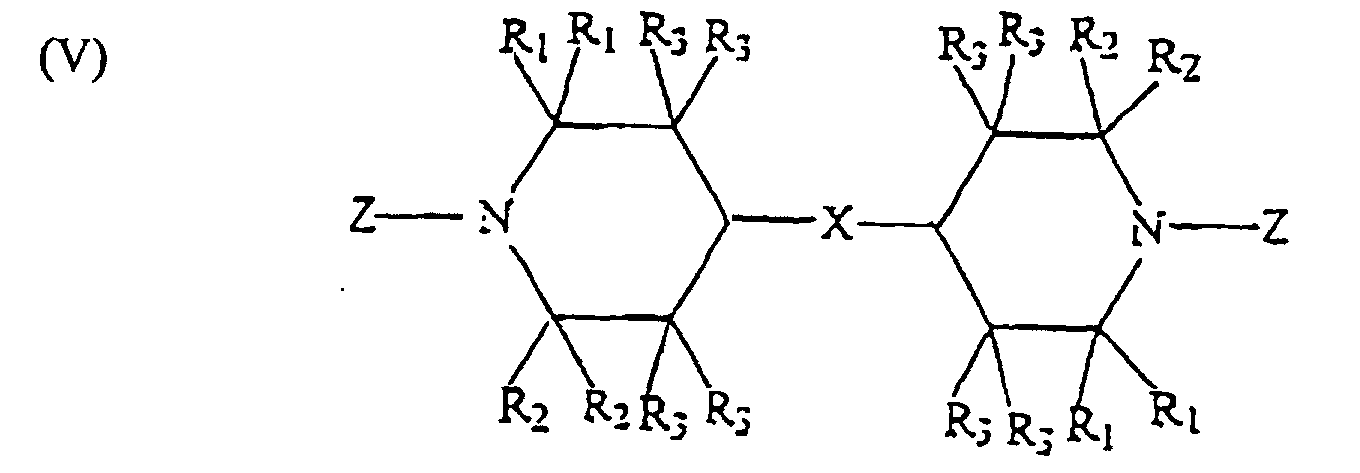 R1, R2 et R3 sont tels que définis plus haut pour la formule (II);X est un groupe organique bivalent, de préférence un groupe alkylène en C1-12, ou un groupe bivalent contenant au moins un groupe ester ou amide, etZ est un atome d'hydrogène, ou un groupe alkyle en C1-18, alkylène en C1-12, aralkyle en C7-18, acyle en C2-4, alcanol en C2-18, alcoxyalkyle en C3-18, oxyle, cyanométhyle, xylène, ou un groupe ayant une valence comprise entre 1 et 4, et contenant de 1 à 4 groupes oxyliques et éventuellement des groupes éther, ester ou éthéroxylique, où les valences dudit groupe sont liées à l'atome d'azote des groupes pipéridine;ladite composition de polypropylène hétérophasique comprenant, en poids:A) de 10 à 60 parties d'un homopolymère de propylène, ou d'un copolymère statistique de propylène avec de l'éthylène et/ou une α-oléfine en C4-8, contenant plus de 80% de propylène, et étant insoluble à plus de 80% dans le xylène à la température ambiante;B) de 0 à 25 parties, de préférence de 1 à 25 parties, d'un copolymère semicristallin essentiellement linéaire d'éthylène contenant du propylène et/ou une α-oléfine en C4-8, insoluble dans le xylène à la température ambiante; etC) de 15 à 87 parties d'un copolymère d'éthylène avec du propylène ou une α-oléfine en C4-8, ou des mélanges de ceux-ci, et éventuellement des quantités mineures de diène, ledit copolymère, contenant de 10 à 80% d'éthylène, étant soluble dans le xylène à la température ambiante.
 - Procédé suivant la revendication 1, dans lequel le rapport du peroxyde organique au stabilisant vis-à-vis de la lumière est compris dans la gamme de 1:1 à 6:1.
- Procédé suivant les revendications 1 ou 2, dans lequel le stabilisant vis-à-vis de la lumière est choisi parmi un poly-(succinate de N-β-hydroxyméthyl-2,2,6,6-tétraméthyl-4-hydroxy-pipéridyle), le sébacate de bis-(1,2,2,6,6-pentaméthyl-4-pipéridyle), le sébacate de bis-(2,2,6,6-tétraméthyl-4-pipéridyle), un poly-{[6-(1,1,3,3-tétraméthylbutyl)-imino]-1,3,5-triazine-2,4-diyl][4-(2,2,6,6-tétraméthylpipéridyl)- imino]-hexaméthylène-[4-(2,2,6,6-tétraméthylpipéridyl)-imino}; un polyméthylpropyl-3-oxy-[4-(2,2,6,6-tétraméthyl)-pipéridinyl]-siloxane; et un poly-[hexaméthylènedi-(4-amino-2,2,6,6-tétraméthyl)-pipéridine].
- Procédé suivant l'une quelconque des revendications précédentes, dans lequel la composition comprend des stabilisants choisis parmi des phosphites et des phénols encombrés stériquement.
- Procédé suivant l'une quelconque des revendications précédentes, dans lequel le peroxyde organique et le stabilisant vis-à-vis de la lumière sont ajoutés séparément et consécutivement.
- Procédé suivant l'une quelconque des revendications précédentes, comprenant l'utilisation d'un co-agent de réticulation.
- Procédé suivant la revendication 6, dans lequel le rapport du peroxyde organique au co-agent de réticulation est compris dans la gamme de 1:0,05 à 1:0,6.
- Procédé suivant l'une quelconque des revendications précédentes effectué sur des mélanges de polypropylène avec des caoutchoucs éthylène-propylène (EPR) ou des caoutchoucs éthylène-propylène-diène (EPDM).
Applications Claiming Priority (4)
| Application Number | Priority Date | Filing Date | Title |
|---|---|---|---|
| ITMI950945A IT1274469B (it) | 1995-05-11 | 1995-05-11 | Composizioni poliolefiniche vulcanizzabili dinamicamente |
| ITMI950945 | 1995-05-11 | ||
| ITMI951026 | 1995-05-19 | ||
| ITMI951026A IT1275437B (it) | 1995-05-19 | 1995-05-19 | Composizione reticolante per polimeri |
Publications (2)
| Publication Number | Publication Date |
|---|---|
| EP0742257A1 EP0742257A1 (fr) | 1996-11-13 |
| EP0742257B1 true EP0742257B1 (fr) | 2004-01-28 |
Family
ID=26331271
Family Applications (1)
| Application Number | Title | Priority Date | Filing Date |
|---|---|---|---|
| EP19960107473 Expired - Lifetime EP0742257B1 (fr) | 1995-05-11 | 1996-05-10 | Procédé de réticulation et de stabilisation de compositions de propylène hétérophasique |
Country Status (2)
| Country | Link |
|---|---|
| EP (1) | EP0742257B1 (fr) |
| DE (1) | DE69631394D1 (fr) |
Families Citing this family (3)
| Publication number | Priority date | Publication date | Assignee | Title |
|---|---|---|---|---|
| TWI247777B (en) | 1998-10-30 | 2006-01-21 | Mitsui Chemicals Inc | Crosslinked olefin elastomer foam |
| US6455616B1 (en) * | 2000-03-07 | 2002-09-24 | Union Carbide Chemicals & Plastics Technology Corporation | Polyethylene crosslinkable composition |
| ATE321095T1 (de) | 2000-05-30 | 2006-04-15 | Ciba Sc Holding Ag | Molekulargewichtsmodifizierung von thermoplastischen polymeren |
Family Cites Families (4)
| Publication number | Priority date | Publication date | Assignee | Title |
|---|---|---|---|---|
| DE3343676A1 (de) * | 1983-12-02 | 1985-06-13 | Dynamit Nobel Ag, 5210 Troisdorf | Verfahren zur herstellung von lichtbestaendigen und witterungsfesten schaumstoffen aus polyolefinen |
| JPS6346246A (ja) * | 1986-04-14 | 1988-02-27 | Sumitomo Chem Co Ltd | エチレン・α−オレフイン共重合系加硫ゴム組成物 |
| JP3350092B2 (ja) * | 1992-04-03 | 2002-11-25 | 旭電化工業株式会社 | 安定化された熱可塑性エラストマー組成物 |
| JPH07252392A (ja) * | 1994-03-17 | 1995-10-03 | Japan Synthetic Rubber Co Ltd | 蒸気架橋用エチレン−プロピレン系共重合ゴム組成物 |
-
1996
- 1996-05-10 DE DE69631394T patent/DE69631394D1/de not_active Expired - Lifetime
- 1996-05-10 EP EP19960107473 patent/EP0742257B1/fr not_active Expired - Lifetime
Also Published As
| Publication number | Publication date |
|---|---|
| EP0742257A1 (fr) | 1996-11-13 |
| DE69631394D1 (de) | 2004-03-04 |
Similar Documents
| Publication | Publication Date | Title |
|---|---|---|
| US5552482A (en) | Thermoplastic elastomers with improved extrusion performance | |
| US5143978A (en) | Dynamically partially crosslinked thermoplastic elastomer containing polybutene-1 | |
| EP0428153B1 (fr) | Elastomère thermoplastique à base de matériau de polymère de propylène et éthylène-propylène caoutchouc reticulé | |
| EP0513699B1 (fr) | Sels de zinc de certains composés thioliques comme antioxydants pour vieillissement à hautes températures d'élastomères thermoplastiques | |
| US4812505A (en) | Tree resistant compositions | |
| AU698706B2 (en) | Dynamically vulcanizable polyolefin compositions | |
| KR101510168B1 (ko) | 올레핀계 탄성 수지 조성물 | |
| US7872075B2 (en) | Peroxide-cured thermoplastic vulcanizates and process for making the same | |
| US6610785B1 (en) | Thermoplastic olefin elastomers and process for their preparation | |
| US20100048823A1 (en) | Process for cross-linking thermoplastic polyolefin elastomer compositions | |
| AU655296B2 (en) | Zinc-salts of certain mercapto compounds and hindered phenols in olefin polymer based thermoplastic elastomers for improved heat aging | |
| EP0742257B1 (fr) | Procédé de réticulation et de stabilisation de compositions de propylène hétérophasique | |
| US5907004A (en) | Thermoplastic elastomer | |
| US6150466A (en) | Process for dynamically crosslinked thermoplastic elastomer containing a metal halide antibloom agent | |
| EP0808341B1 (fr) | Elastomere thermoplastique | |
| ITMI951026A1 (it) | Composizione reticolante per polimeri |
Legal Events
| Date | Code | Title | Description |
|---|---|---|---|
| PUAI | Public reference made under article 153(3) epc to a published international application that has entered the european phase |
Free format text: ORIGINAL CODE: 0009012 |
|
| AK | Designated contracting states |
Kind code of ref document: A1 Designated state(s): DE ES FR GB IT |
|
| 17P | Request for examination filed |
Effective date: 19970424 |
|
| 17Q | First examination report despatched |
Effective date: 19980803 |
|
| RAP1 | Party data changed (applicant data changed or rights of an application transferred) |
Owner name: BASELL TECHNOLOGY COMPANY B.V. Owner name: BASELL NORTH AMERICA INC. |
|
| RTI1 | Title (correction) |
Free format text: PROCESS FOR THE DYNAMIC CROSS-LINKING AND STABILIZATION OF A HETEROPHASIC POLYPROPYLENE COMPOSITION |
|
| GRAH | Despatch of communication of intention to grant a patent |
Free format text: ORIGINAL CODE: EPIDOS IGRA |
|
| RAP1 | Party data changed (applicant data changed or rights of an application transferred) |
Owner name: BASELL POLIOLEFINE ITALIA S.P.A. |
|
| GRAH | Despatch of communication of intention to grant a patent |
Free format text: ORIGINAL CODE: EPIDOS IGRA |
|
| RBV | Designated contracting states (corrected) |
Designated state(s): DE FR IT |
|
| GRAA | (expected) grant |
Free format text: ORIGINAL CODE: 0009210 |
|
| AK | Designated contracting states |
Kind code of ref document: B1 Designated state(s): DE FR IT |
|
| PG25 | Lapsed in a contracting state [announced via postgrant information from national office to epo] |
Ref country code: IT Free format text: LAPSE BECAUSE OF FAILURE TO SUBMIT A TRANSLATION OF THE DESCRIPTION OR TO PAY THE FEE WITHIN THE PRESCRIBED TIME-LIMIT;WARNING: LAPSES OF ITALIAN PATENTS WITH EFFECTIVE DATE BEFORE 2007 MAY HAVE OCCURRED AT ANY TIME BEFORE 2007. THE CORRECT EFFECTIVE DATE MAY BE DIFFERENT FROM THE ONE RECORDED. Effective date: 20040128 Ref country code: FR Free format text: LAPSE BECAUSE OF FAILURE TO SUBMIT A TRANSLATION OF THE DESCRIPTION OR TO PAY THE FEE WITHIN THE PRESCRIBED TIME-LIMIT Effective date: 20040128 |
|
| REF | Corresponds to: |
Ref document number: 69631394 Country of ref document: DE Date of ref document: 20040304 Kind code of ref document: P |
|
| PG25 | Lapsed in a contracting state [announced via postgrant information from national office to epo] |
Ref country code: DE Free format text: LAPSE BECAUSE OF FAILURE TO SUBMIT A TRANSLATION OF THE DESCRIPTION OR TO PAY THE FEE WITHIN THE PRESCRIBED TIME-LIMIT Effective date: 20040429 |
|
| PLBE | No opposition filed within time limit |
Free format text: ORIGINAL CODE: 0009261 |
|
| STAA | Information on the status of an ep patent application or granted ep patent |
Free format text: STATUS: NO OPPOSITION FILED WITHIN TIME LIMIT |
|
| 26N | No opposition filed |
Effective date: 20041029 |
|
| EN | Fr: translation not filed |