EP0742310B1 - Behandlung der Abwässer eines Papierbehandlungverfahrens - Google Patents
Behandlung der Abwässer eines Papierbehandlungverfahrens Download PDFInfo
- Publication number
- EP0742310B1 EP0742310B1 EP19960303157 EP96303157A EP0742310B1 EP 0742310 B1 EP0742310 B1 EP 0742310B1 EP 19960303157 EP19960303157 EP 19960303157 EP 96303157 A EP96303157 A EP 96303157A EP 0742310 B1 EP0742310 B1 EP 0742310B1
- Authority
- EP
- European Patent Office
- Prior art keywords
- suspension
- solids
- water
- carbon particles
- paper
- Prior art date
- Legal status (The legal status is an assumption and is not a legal conclusion. Google has not performed a legal analysis and makes no representation as to the accuracy of the status listed.)
- Expired - Lifetime
Links
- 238000000034 method Methods 0.000 title claims abstract description 39
- 238000011282 treatment Methods 0.000 title claims abstract description 18
- 239000000725 suspension Substances 0.000 claims abstract description 57
- 239000007787 solid Substances 0.000 claims abstract description 32
- 239000010802 sludge Substances 0.000 claims abstract description 29
- XLYOFNOQVPJJNP-UHFFFAOYSA-N water Substances O XLYOFNOQVPJJNP-UHFFFAOYSA-N 0.000 claims abstract description 26
- 239000002245 particle Substances 0.000 claims abstract description 25
- OKTJSMMVPCPJKN-UHFFFAOYSA-N Carbon Chemical compound [C] OKTJSMMVPCPJKN-UHFFFAOYSA-N 0.000 claims abstract description 24
- 229910052799 carbon Inorganic materials 0.000 claims abstract description 24
- 230000003647 oxidation Effects 0.000 claims abstract description 20
- 238000007254 oxidation reaction Methods 0.000 claims abstract description 20
- 239000007900 aqueous suspension Substances 0.000 claims abstract description 13
- 229910010272 inorganic material Inorganic materials 0.000 claims abstract description 13
- 239000011147 inorganic material Substances 0.000 claims abstract description 13
- 239000010893 paper waste Substances 0.000 claims abstract description 13
- 239000011368 organic material Substances 0.000 claims abstract description 10
- QVGXLLKOCUKJST-UHFFFAOYSA-N atomic oxygen Chemical compound [O] QVGXLLKOCUKJST-UHFFFAOYSA-N 0.000 claims abstract description 9
- 229910052760 oxygen Inorganic materials 0.000 claims abstract description 9
- 239000001301 oxygen Substances 0.000 claims abstract description 9
- 239000007789 gas Substances 0.000 claims abstract description 8
- 239000007791 liquid phase Substances 0.000 claims abstract description 6
- 230000000694 effects Effects 0.000 claims abstract description 4
- 239000011236 particulate material Substances 0.000 claims description 12
- 238000000926 separation method Methods 0.000 claims description 11
- 239000000203 mixture Substances 0.000 claims description 9
- 239000002270 dispersing agent Substances 0.000 claims description 8
- 238000000576 coating method Methods 0.000 claims description 4
- 239000000463 material Substances 0.000 description 13
- 239000000047 product Substances 0.000 description 10
- VTYYLEPIZMXCLO-UHFFFAOYSA-L Calcium carbonate Chemical compound [Ca+2].[O-]C([O-])=O VTYYLEPIZMXCLO-UHFFFAOYSA-L 0.000 description 8
- NLYAJNPCOHFWQQ-UHFFFAOYSA-N kaolin Chemical compound O.O.O=[Al]O[Si](=O)O[Si](=O)O[Al]=O NLYAJNPCOHFWQQ-UHFFFAOYSA-N 0.000 description 8
- 239000005995 Aluminium silicate Substances 0.000 description 6
- 235000012211 aluminium silicate Nutrition 0.000 description 6
- 239000000945 filler Substances 0.000 description 5
- 229910052500 inorganic mineral Inorganic materials 0.000 description 5
- 239000011707 mineral Substances 0.000 description 5
- GWEVSGVZZGPLCZ-UHFFFAOYSA-N Titan oxide Chemical compound O=[Ti]=O GWEVSGVZZGPLCZ-UHFFFAOYSA-N 0.000 description 4
- 229910000019 calcium carbonate Inorganic materials 0.000 description 4
- 238000005188 flotation Methods 0.000 description 4
- -1 poly(acrylic acid) Polymers 0.000 description 4
- 239000011343 solid material Substances 0.000 description 4
- QTBSBXVTEAMEQO-UHFFFAOYSA-N Acetic acid Chemical compound CC(O)=O QTBSBXVTEAMEQO-UHFFFAOYSA-N 0.000 description 3
- 235000012970 cakes Nutrition 0.000 description 3
- 150000001768 cations Chemical class 0.000 description 3
- 239000011248 coating agent Substances 0.000 description 3
- 238000002474 experimental method Methods 0.000 description 3
- 239000000454 talc Substances 0.000 description 3
- 229910052623 talc Inorganic materials 0.000 description 3
- 229910021532 Calcite Inorganic materials 0.000 description 2
- OYPRJOBELJOOCE-UHFFFAOYSA-N Calcium Chemical compound [Ca] OYPRJOBELJOOCE-UHFFFAOYSA-N 0.000 description 2
- CURLTUGMZLYLDI-UHFFFAOYSA-N Carbon dioxide Chemical compound O=C=O CURLTUGMZLYLDI-UHFFFAOYSA-N 0.000 description 2
- MYMOFIZGZYHOMD-UHFFFAOYSA-N Dioxygen Chemical compound O=O MYMOFIZGZYHOMD-UHFFFAOYSA-N 0.000 description 2
- 238000002441 X-ray diffraction Methods 0.000 description 2
- 239000011575 calcium Substances 0.000 description 2
- 229910052791 calcium Inorganic materials 0.000 description 2
- OSGAYBCDTDRGGQ-UHFFFAOYSA-L calcium sulfate Chemical compound [Ca+2].[O-]S([O-])(=O)=O OSGAYBCDTDRGGQ-UHFFFAOYSA-L 0.000 description 2
- 229910001882 dioxygen Inorganic materials 0.000 description 2
- 235000021463 dry cake Nutrition 0.000 description 2
- 239000000835 fiber Substances 0.000 description 2
- 238000001914 filtration Methods 0.000 description 2
- 238000000227 grinding Methods 0.000 description 2
- 229910052622 kaolinite Inorganic materials 0.000 description 2
- 239000010445 mica Substances 0.000 description 2
- 229910052618 mica group Inorganic materials 0.000 description 2
- 239000005416 organic matter Substances 0.000 description 2
- 239000000049 pigment Substances 0.000 description 2
- 238000004064 recycling Methods 0.000 description 2
- 239000006228 supernatant Substances 0.000 description 2
- 238000005406 washing Methods 0.000 description 2
- 239000002699 waste material Substances 0.000 description 2
- 239000004606 Fillers/Extenders Substances 0.000 description 1
- 229920001131 Pulp (paper) Polymers 0.000 description 1
- 229920002125 Sokalan® Polymers 0.000 description 1
- 239000002253 acid Substances 0.000 description 1
- 150000007513 acids Chemical class 0.000 description 1
- 239000000654 additive Substances 0.000 description 1
- 230000000996 additive effect Effects 0.000 description 1
- 238000000498 ball milling Methods 0.000 description 1
- 239000011230 binding agent Substances 0.000 description 1
- VSGNNIFQASZAOI-UHFFFAOYSA-L calcium acetate Chemical compound [Ca+2].CC([O-])=O.CC([O-])=O VSGNNIFQASZAOI-UHFFFAOYSA-L 0.000 description 1
- 239000001639 calcium acetate Substances 0.000 description 1
- 229960005147 calcium acetate Drugs 0.000 description 1
- 235000011092 calcium acetate Nutrition 0.000 description 1
- 239000001175 calcium sulphate Substances 0.000 description 1
- 235000011132 calcium sulphate Nutrition 0.000 description 1
- 239000006229 carbon black Substances 0.000 description 1
- 239000001569 carbon dioxide Substances 0.000 description 1
- 229910002092 carbon dioxide Inorganic materials 0.000 description 1
- 239000003575 carbonaceous material Substances 0.000 description 1
- 239000001913 cellulose Substances 0.000 description 1
- 229920002678 cellulose Polymers 0.000 description 1
- 238000005119 centrifugation Methods 0.000 description 1
- 238000002485 combustion reaction Methods 0.000 description 1
- 150000001875 compounds Chemical class 0.000 description 1
- 239000000356 contaminant Substances 0.000 description 1
- 238000010908 decantation Methods 0.000 description 1
- 239000006185 dispersion Substances 0.000 description 1
- 239000010459 dolomite Substances 0.000 description 1
- 229910000514 dolomite Inorganic materials 0.000 description 1
- 238000011049 filling Methods 0.000 description 1
- 239000000706 filtrate Substances 0.000 description 1
- 230000003311 flocculating effect Effects 0.000 description 1
- 238000005189 flocculation Methods 0.000 description 1
- 230000016615 flocculation Effects 0.000 description 1
- 238000009291 froth flotation Methods 0.000 description 1
- 239000011256 inorganic filler Substances 0.000 description 1
- 229910003475 inorganic filler Inorganic materials 0.000 description 1
- 239000001023 inorganic pigment Substances 0.000 description 1
- 229910003480 inorganic solid Inorganic materials 0.000 description 1
- 238000004519 manufacturing process Methods 0.000 description 1
- 239000004579 marble Substances 0.000 description 1
- 239000010899 old newspaper Substances 0.000 description 1
- 150000002894 organic compounds Chemical class 0.000 description 1
- 239000003973 paint Substances 0.000 description 1
- 125000002467 phosphate group Chemical class [H]OP(=O)(O[H])O[*] 0.000 description 1
- 229920001495 poly(sodium acrylate) polymer Polymers 0.000 description 1
- 229920000642 polymer Polymers 0.000 description 1
- 238000004537 pulping Methods 0.000 description 1
- 238000011084 recovery Methods 0.000 description 1
- 150000003839 salts Chemical class 0.000 description 1
- NNMHYFLPFNGQFZ-UHFFFAOYSA-M sodium polyacrylate Chemical compound [Na+].[O-]C(=O)C=C NNMHYFLPFNGQFZ-UHFFFAOYSA-M 0.000 description 1
- 239000007790 solid phase Substances 0.000 description 1
- 239000000126 substance Substances 0.000 description 1
- 239000004408 titanium dioxide Substances 0.000 description 1
- 238000009279 wet oxidation reaction Methods 0.000 description 1
Images
Classifications
-
- D—TEXTILES; PAPER
- D21—PAPER-MAKING; PRODUCTION OF CELLULOSE
- D21C—PRODUCTION OF CELLULOSE BY REMOVING NON-CELLULOSE SUBSTANCES FROM CELLULOSE-CONTAINING MATERIALS; REGENERATION OF PULPING LIQUORS; APPARATUS THEREFOR
- D21C11/00—Regeneration of pulp liquors or effluent waste waters
- D21C11/12—Combustion of pulp liquors
- D21C11/14—Wet combustion ; Treatment of pulp liquors without previous evaporation, by oxidation of the liquors remaining at least partially in the liquid phase, e.g. by application or pressure
-
- C—CHEMISTRY; METALLURGY
- C02—TREATMENT OF WATER, WASTE WATER, SEWAGE, OR SLUDGE
- C02F—TREATMENT OF WATER, WASTE WATER, SEWAGE, OR SLUDGE
- C02F11/00—Treatment of sludge; Devices therefor
- C02F11/06—Treatment of sludge; Devices therefor by oxidation
- C02F11/08—Wet air oxidation
-
- D—TEXTILES; PAPER
- D21—PAPER-MAKING; PRODUCTION OF CELLULOSE
- D21C—PRODUCTION OF CELLULOSE BY REMOVING NON-CELLULOSE SUBSTANCES FROM CELLULOSE-CONTAINING MATERIALS; REGENERATION OF PULPING LIQUORS; APPARATUS THEREFOR
- D21C5/00—Other processes for obtaining cellulose, e.g. cooking cotton linters ; Processes characterised by the choice of cellulose-containing starting materials
- D21C5/02—Working-up waste paper
- D21C5/025—De-inking
-
- Y—GENERAL TAGGING OF NEW TECHNOLOGICAL DEVELOPMENTS; GENERAL TAGGING OF CROSS-SECTIONAL TECHNOLOGIES SPANNING OVER SEVERAL SECTIONS OF THE IPC; TECHNICAL SUBJECTS COVERED BY FORMER USPC CROSS-REFERENCE ART COLLECTIONS [XRACs] AND DIGESTS
- Y02—TECHNOLOGIES OR APPLICATIONS FOR MITIGATION OR ADAPTATION AGAINST CLIMATE CHANGE
- Y02W—CLIMATE CHANGE MITIGATION TECHNOLOGIES RELATED TO WASTEWATER TREATMENT OR WASTE MANAGEMENT
- Y02W30/00—Technologies for solid waste management
- Y02W30/50—Reuse, recycling or recovery technologies
- Y02W30/64—Paper recycling
-
- Y—GENERAL TAGGING OF NEW TECHNOLOGICAL DEVELOPMENTS; GENERAL TAGGING OF CROSS-SECTIONAL TECHNOLOGIES SPANNING OVER SEVERAL SECTIONS OF THE IPC; TECHNICAL SUBJECTS COVERED BY FORMER USPC CROSS-REFERENCE ART COLLECTIONS [XRACs] AND DIGESTS
- Y10—TECHNICAL SUBJECTS COVERED BY FORMER USPC
- Y10S—TECHNICAL SUBJECTS COVERED BY FORMER USPC CROSS-REFERENCE ART COLLECTIONS [XRACs] AND DIGESTS
- Y10S210/00—Liquid purification or separation
- Y10S210/928—Paper mill waste, e.g. white water, black liquor treated
Definitions
- This invention relates to the treatment of waste paper and, more particularly but not exclusively, is concerned with a process for recovering a useful product from an effluent suspension which is derived from a plant for treating waste paper, for example a plant for de-inking printed waste paper.
- waste paper When waste paper is de-inked to make recycled paper or tissue, it is generally found that most of the mineral content of the paper, which had been added in the form of paper fillers or coating pigments during the manufacture of the paper, is detached from the cellulosic fibre content and passes into the reject sludge of the de-inking plant together with the ink residues.
- the sludge is generally a dark grey in colour, and has found to be quite unsuitable for any use without further treatment. It has not hitherto been practicable to separate the mineral material from the other components of the sludge, and the material has not therefore been recycled for use in paper making or paper coating.
- the sludge produced by a de-inking plant also contains various organic materials such as cellulosic fibres and fibre fines, ink residues and binders. Most of these materials are combustible and could be burned to produce energy if a way could be found to separate them from the mineral material.
- GB-1366020 describes a process for the recovery of inorganic paper making filler materials from paper mill waste sludges by a wet air oxidation process.
- the waste sludge is heated with an oxygen-containing gas at a temperature of from 160 to 375°C, preferably from 200 to 320°C when air is used as the oxygen-containing gas, and at a corresponding pressure which will maintain the water content of the sludge in the liquid phase.
- the solid phase is then separated.
- GB1366020 The process described in GB1366020 is applicable to treat a paper making mill effluent sludge which is essentially white and does not contain substantial quantities of material which will seriously affect the whiteness of the treated material and of the particulate material recovered therefrom.
- the effluent from a de-inking plant presents a new problem since, as noted hereinbefore, it will generally contain substantial quantities of dark ink residues, especially carbon black particles, and application of a treatment similar to that described in GB 1366020 produces a grey particulate material which is unsuitable for use in applications such as paper filling.
- a process for treating an aqueous suspension comprising or obtained from an effluent produced by a paper treatment process, the suspension comprising a mixture of organic material and inorganic particulate material
- the process including the step of contacting the aqueous suspension with an oxygen-containing gas at an elevated temperature wherein the water component of the suspension is substantially maintained in the liquid phase whereby substantially complete oxidation of the organic material in the suspension is effected, the process being characterised in that the treated suspension contains a substantial quantity of carbon particles and that the solid content of the aqueous suspension following the oxidation step is subjected to a particle separation step to separate the carbon particles and the inorganic material present in the solid content from one another.
- the treated aqueous suspension may be sludge produced as an effluent by a de-inking plant for the treatment of waste paper. It may alternatively be a suspension which is obtained from such a sludge, eg. by dewatering such a sludge.
- the presence of carbon particles in a sludge produced by a de-inking plant will give the sludge a grey appearance. If the sludge is treated by a wet oxidation process as described in GB 1366020, the solid residue formed after oxidation still has an unacceptable grey appearance. The extent of this problem will depend upon the specific composition of the suspension being treated. The problem is likely to be significant for suspensions wherein the carbon content is at least 0.05% or more of the dry weight of the solids present. In effluent sludge from a de-inking plant the carbon content is likely to be in the range 0.1% to 2% by dry weight of the solids present. The present invention is therefore particularly applicable in treating such sludge.
- the grey appearance can be removed after oxidation in accordance with the present invention by a particle separation process as described hereinbefore to leave an inorganic particulate material which is substantially white and is useful with or without further treatment, eg. by comminution in a known way such as grinding, and with or without further particulate materials, in the various applications in which inorganic white particulate materials are employed, eg. as a filler in paper making or as an additive to compositions for paper coating or as a filler or extender in polymers and paints.
- the recovered white particulate material will in general comprise a mixture of kaolin and calcium carbonate in a proportion determined by the composition of the waste paper treated as well as minor amounts of other material such as calcium sulphate, titanium dioxide and talc employed in paper compositions.
- the step of separating the carbon and inorganic materials may be carried out by a suitable known separation step. Centrifugation is preferred. Alternative suitable separation methods are specified hereinafter.
- the residual solid material formed after the oxidation step in the method according to the present invention is subjected to a washing treatment to remove unwanted multivalent cations such as calcium.
- cations may be formed by oxidation of a small amount of the inorganic material during the oxidation step. They can combine with weak acids present, eg. acetic acid, to form substances such as calcium acetate which have a flocculating effect on the residual solid material.
- the washing treatment may be carried out in a simple way by dewatering the suspension remaining after oxidation followed by re-suspension in clean water.
- the re-suspension is preferably carried out in the presence of a water soluble dispersant, eg. up to 1% by weight total (based on the dry weight of the solid material being resuspended) of one or more of the suitable dispersant compounds specified hereinafter.
- a preferred method for carrying out the process according to the present invention in the treatment of a carbon-containing effluent suspension from a waste paper treatment plant includes the following steps:
- the effluent suspension treated by the process of the present invention will consist wholly, or at least predominantly, of an aqueous sludge obtained from a waste paper de-inking plant.
- step (a) the consistency of the effluent suspension will generally be adjusted so that the aqueous suspension does not contain more than about 20% by weight of dry solids.
- the oxygen-containing gas is advantageously air or oxygen.
- the oxidation step may be performed in any conventional pressure vessel, provided that it is capable of withstanding the pressures required.
- the pressure in the pressure vessel will generally be in the range of from about 3MPa (435psig) to about 15MPa (2176psig).
- the oxidation step can be carried out at a temperature in the range of from 160°C to 375°C. and most preferably is carried out at a temperature in the range of from 200°C to 320°C. At these latter temperatures, it has been found that the residence time in the pressure vessel is conveniently in the range of from 1 to 2 hours.
- step (b) is dewatered, for example by filtration, centrifuging or decantation, to remove water containing dissolved multivalent cations, such as calcium
- the solids component of the suspension Prior to or during the carrying out of step (d) the solids component of the suspension is advantageously subjected to comminution by, for example, ball milling or attrition grinding, to reduce the particle size of the solids.
- the solid component is comminuted in suspension to which a dispersing agent for the solids component is added.
- a suitable dispersing agent is, for example, a water-soluble condensed phosphate salt or a water-soluble salt of poly(acrylic acid) or of poly(methacrylic acid).
- step (e) the separation of the carbon particles from the inorganic material may be effected by centrifuging the suspension under conditions such that the heavier inorganic filler and pigment material is sedimented and a supernatant suspension containing the carbon particles is decanted therefrom.
- the separation is improved by performing at least once the sequence of steps of redispersing the sedimented material in water containing a dispersing agent and centrifuging the resultant suspension.
- the separation may be effected by a froth flotation process or by selective flocculation.
- a sample of an aqueous sludge was obtained from a waste paper de-inking plant.
- the plant operated by subjecting the pulped waste paper to a flotation step, in which a large part of the ink residues were removed in the froth product.
- the underflow product from the flotation step was resuspended in water and the suspension filtered.
- the sludge sample used in this experiment was taken from the filtrate obtained from this filtration step.
- the percentage reflectance of the cake was found to be 64%.
- a further sample of the sludge was evaporated to dryness, and the dry residue was found to contain 67% by weight of combustible organic material, principally cellulose, 19% by weight of calcium carbonate and 14% by weight of other minerals, principally kaolin. 22g of the dried residue was suspended in 400ml of water and the resultant suspension was placed in an autoclave of nominal capacity 1 litre. The autoclave was sealed and charged to 600psig (4.14MPa) with oxygen gas. The autoclave was then heated to 250°C, and maintained at this temperature for one hour. During the time the autoclave was maintained at 250°C the pressure inside was nearly constant at 1600psig (11.03MPa).
- the autoclave was then cooled to room temperature, the pressure released, and the suspension remaining inside was removed.
- the suspension was centrifuged, and the sedimented solids were dried.
- the dried solids were analysed by X-ray diffraction, and were found to contain 60% by weight of crystalline calcite, the remainder being principally kaolinite, with trace amounts of dolomite, rutile, mica and talc.
- the percentage reflectance to light of wavelength 457nm of the dried solids was measured and found to be 76%.
- the dried solids were then dispersed in water containing a sodium polyacrylate dispersing agent to form a suspension containing approximately 5% by weight of solids, and the suspension was spun at 3000rpm in a centrifuge for 10 minutes. The supernatant suspension was found to be considerably darker in colour than the sedimented solids, and was discarded. The steps of suspending the sedimented solids in water containing the dispersing agent, and centrifuging the suspension under the conditions described above, were then repeated two more times. The final sedimented solids were dried, and the percentage reflectance to light of wavelength 457nm of the dried solids was measured and found to be 81%.
- a sample of sludge was obtained from a plant for de-inking waste paper pulp produced by pulping a mixture of old newspapers and magazines.
- the plant operated by subjecting the pulp to flotation, the sample of sludge being taken from the froth product of the flotation process.
- a portion of the sludge was filtered and the cake dried.
- the percentage reflectance of the surface of the dry cake to light of wavelength 457nm was measured by the method described in Example 1 above, and was found to be 20%.
- the dry material contained 17% by weight of calcium carbonate, 42% by weight of kaolin and other pigments and 41% by weight of combustible organic material.
- the dried sludge was mixed with water to form a suspension containing 8% by weight of dry solids, and a portion of the suspension was subjected to an oxidation process similar to that described in Example 1 above, except that the initial pressure of the oxygen gas was 750psig (5.17MPa) and the pressure increased to 1800psig (12.41MPa) when the temperature was raised to 250°C.
- a dried oxidation product was recovered from the autoclave as described in Example 1, and the percentage reflectance to light of 457nm wavelength was measured and found to be 20%.
- the dried product was analysed by X-ray diffraction and was found to contain 30% by weight of calcite, the remainder being predominantly kaolinite with trace amounts of mica, talc and anatase.
- Carbon particles were separated from the mineral materials by a process of repeating the steps of dispersing the solid material in water followed by centrifuging the resultant suspension, as described in Example 1.
- the final dry product was found to have a percentage reflectance to light of wavelength 457nm of 55%.
- Example 2 The experiment of Example 2 was repeated, using a different sample of the same sludge as was used in Example 2.
- the conditions of the experiment were the same as those prevailing in Example 2 except that the temperature of the autoclave was raised to 280°C, and was maintained at that level for 2 hours.
- the dry product recovered from the autoclave was found to have a percentage reflectance to light of wavelength 457nm of 60%. This reflectance was increased to 75% by the process of repeated dispersion in water followed by centrifuging which was described in Example 1.
- water separated from recovered solid particulate material may be either re-cycled for re-use in a process plant e.g. a paper making plant adjacent to the de-inking plant or discharged to an effluent stream.
- the water is preferably treated to render it suitable for onward release either before or after separation from the particulate material.
- the treatment may be one or more known treatments selected according to the target species that need to be removed. Residual organic contaminants, for example, may be removed by a suitable biochemical oxidation, e.g. using a known treatment in a bioreactor.
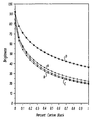
- Figure 1 is a graph of brightness of various inorganic particulate materials (representative of materials used in paper making) against carbon content (percentage by weight) where various amounts of fine carbon having an average particle diameter of about 0.12 ⁇ m have been intimately mixed with each inorganic material investigated.
- the brightness measured in a known way in ISO units, falls rapidly especially at carbon contents of less than 0.5 per cent by weight, as carbon content increases. This illustrates the improvement in brightness which may be expected by carbon separation.
- curves labelled A, B, C and D respectively represent the following inorganic particulate materials:
Landscapes
- Life Sciences & Earth Sciences (AREA)
- Hydrology & Water Resources (AREA)
- Engineering & Computer Science (AREA)
- Environmental & Geological Engineering (AREA)
- Water Supply & Treatment (AREA)
- Chemical & Material Sciences (AREA)
- Organic Chemistry (AREA)
- Paper (AREA)
- Treatment Of Sludge (AREA)
- Processing And Handling Of Plastics And Other Materials For Molding In General (AREA)
- Treatment Of Water By Oxidation Or Reduction (AREA)
- Chemical Treatment Of Metals (AREA)
Claims (9)
- Verfahren zur Behandlung einer wässrigen Suspension, umfassend das oder erhalten aus dem Abwasser eines Papierbehandlungsverfahrens, wobei die Suspension ein Gemisch aus organischem Material und teilchenförmigem anorganischem Material enthält, wobei das Verfahren den Schritt umfasst: Zusammenbringen der Suspension mit einem sauerstoffhaltigen Gas bei erhöhter Temperatur, wobei der Wasserbestandteil der Suspension im Wesentlichen in der flüssigen Phase gehalten wird, wodurch das organische Material in der Suspension im Wesentlichen vollständig oxidiert wird, und das Verfahren dadurch gekennzeichnet ist, dass die behandelte Suspension eine erhebliche Menge an Kohlenstoffpartikel enthält und dass die festen Bestandteile der wässrigen Suspension im Anschluss an den Oxidationsschritt einem Teilchentrennungsschritt unterworfen wird, wobei die im Festanteil vorliegenden Kohlenstoffpartikel und das anorganische Material voneinander getrennt werden.
- Verfahren nach Anspruch 1, wobei der Kohlenstoff in der behandelten Suspension mindestens 0,05 Gew.% des Festanteils der Suspension ausmacht.
- Verfahren nach Anspruch 1 oder 2, wobei die behandelte Suspension ganz oder überwiegend besteht aus dem wässrigen Schlamm einer Anlage zum Deinken von Altpapier.
- Verfahren nach Anspruch 1, 2 oder 3, umfassend die Schritte:(a) Einstellen der Konsistenz der zu behandelnden Suspension, falls notwendig, so dass man eine wässrige Suspension erhält, die mindestens 2 Gew.% Festbestandteile, bezogen auf deren Trockengewicht, enthält;(b) Zusammenbringen der Suspension aus Schritt (a) mit einem sauerstoffhaltigen Gas bei erhöhter Temperatur, unter erhöhtem Druck - ausreichend, um den wässrigen Bestandteil der Suspension in der flüssigen Phase zu halten - und über einen Zeitraum, der genügt, um das organische Material in der Suspension im Wesentlichen vollständig zu oxidieren;(c) Entwässern des Produkts aus Schritt (b);(d) Resuspendieren der entwässerten Festbestandteile aus Schritt (c) in Wasser und(e) Abtrennen aus der in Schritt (d) erzeugten Suspension das Wasser mit den in Suspension befindlichen feinen Kohlenstoffpartikeln, so dass ein anorganisches Material bleibt, das geeignet ist für eine weitere Verwendung in einem Papierherstellungs- oder -beschichtungsprozess.
- Verfahren nach Anspruch 4, wobei in Schritt (a) die Konsistenz der zu behandelnden Suspension so eingestellt wird, dass eine wässrige Suspension vorliegt, die nicht mehr als 20 Gew.% Festbestandteile, bezogen auf deren Trockengewicht, enthält.
- Verfahren nach Anspruch 4 oder 5, wobei Schritt (d) in Gegenwart eines Dispersionsmittels für die vorhandenen Festbestandteile erfolgt.
- Verfahren nach einem der Ansprüche 4 bis 6, wobei vor oder während Schritt (d) die Festbestandteile der Suspension zerkleinert wird.
- Verfahren nach einem der Ansprüche 4 bis 7, wobei in Schritt (e) die Abtrennung der Kohlenstoffpartikel von dem anorganischen Material durch Zentrifugieren der Suspension unter solchen Bedingungen erfolgt, dass das schwerere anorganische Material sedimentiert und eine die Kohlenstoffpartikel enthaltende Suspension dekantiert werden kann.
- Verfahren nach einem der Ansprüche 4 bis 7, wobei der Oxidationsschritt in einem Druckgefäß unter einem Druck von 3 MPa (435 psig) bis 15 MPa (2176 psig) und bei einer Temperatur von 160°C bis 375°C erfolgt.
Applications Claiming Priority (2)
| Application Number | Priority Date | Filing Date | Title |
|---|---|---|---|
| GB9509633 | 1995-05-12 | ||
| GB9509633A GB9509633D0 (en) | 1995-05-12 | 1995-05-12 | Treatment of waste paper |
Publications (2)
| Publication Number | Publication Date |
|---|---|
| EP0742310A1 EP0742310A1 (de) | 1996-11-13 |
| EP0742310B1 true EP0742310B1 (de) | 1998-03-25 |
Family
ID=10774363
Family Applications (1)
| Application Number | Title | Priority Date | Filing Date |
|---|---|---|---|
| EP19960303157 Expired - Lifetime EP0742310B1 (de) | 1995-05-12 | 1996-05-03 | Behandlung der Abwässer eines Papierbehandlungverfahrens |
Country Status (13)
| Country | Link |
|---|---|
| US (1) | US5683590A (de) |
| EP (1) | EP0742310B1 (de) |
| JP (1) | JPH08337983A (de) |
| KR (1) | KR960041517A (de) |
| AT (1) | ATE164402T1 (de) |
| AU (1) | AU692379B2 (de) |
| BR (1) | BR9602220A (de) |
| CA (1) | CA2175935C (de) |
| DE (1) | DE69600197T2 (de) |
| DK (1) | DK0742310T3 (de) |
| GB (1) | GB9509633D0 (de) |
| NO (1) | NO961908L (de) |
| ZA (1) | ZA963684B (de) |
Cited By (1)
| Publication number | Priority date | Publication date | Assignee | Title |
|---|---|---|---|---|
| US7300539B2 (en) | 1996-07-31 | 2007-11-27 | Imerys Minerals Limited | Treatment of solid containing material derived from effluent |
Families Citing this family (9)
| Publication number | Priority date | Publication date | Assignee | Title |
|---|---|---|---|---|
| US6159381A (en) * | 1996-04-11 | 2000-12-12 | Bleakley; Ian Stuart | Waste paper treatment process |
| US20040055715A1 (en) * | 1998-09-04 | 2004-03-25 | Jonathan Phipps | Treatment of solid containing material derived from effluent |
| TW527455B (en) * | 2000-07-17 | 2003-04-11 | Kohei Matsushita | Method for treating a mixture containing organic substances and white inorganic particles, material made thereby and method using the same |
| SE518051C2 (sv) * | 2000-12-14 | 2002-08-20 | Stora Kopparbergs Bergslags Ab | Sätt att återvinna oorganiskt material ur avfärgningsslam |
| WO2003042104A1 (en) | 2001-11-09 | 2003-05-22 | Imerys Pigments, Inc. | High surface area incineration product |
| US20090300982A1 (en) * | 2008-06-05 | 2009-12-10 | Chemical Products Corporation | Calcium carbonate soil amendment and industrial filler derived from carpet backing |
| BR102013016060B1 (pt) * | 2013-06-24 | 2015-06-02 | Ecofill Espec Em Tecnologia De Transf De Resíduos Ltda | Processos seco e úmido de recuperação, beneficiamento e reaproveitamento do resíduo de dregs gerado na indústria de celulose e produtos obtidos através dos mesmos |
| CN112209363A (zh) * | 2019-07-10 | 2021-01-12 | 东北林业大学 | 一种以活性污泥为原料制备碳量子点的方法 |
| DE102021103520A1 (de) * | 2021-02-15 | 2022-08-18 | Koehler Innovation & Technology Gmbh | Füllstoff |
Family Cites Families (9)
| Publication number | Priority date | Publication date | Assignee | Title |
|---|---|---|---|---|
| AU428247B2 (en) * | 1970-05-08 | 1972-09-13 | Wet combustion of waste liquor | |
| US3876497A (en) * | 1971-11-23 | 1975-04-08 | Sterling Drug Inc | Paper mill waste sludge oxidation and product recovery |
| GB1366020A (en) * | 1971-11-23 | 1974-09-04 | Sterling Drug Inc | Treatment of paper mill waste sludges |
| SU567271A1 (ru) * | 1973-02-26 | 1981-03-30 | Украинский Научно-Исследовательский Институт Целлюлозно-Бумажнойпромышленности | Способ очистки сточных вод целлюлозно-бумажной промышленности отОРгАНичЕСКиХ СОЕдиНЕНий |
| FR2612212B1 (fr) * | 1987-03-13 | 1990-06-29 | Centre Tech Ind Papier | Procede et installation pour le recyclage de vieux papiers imprimes |
| US5094716A (en) * | 1990-09-19 | 1992-03-10 | Betz Paperchem, Inc. | Use of anionic surfactant/dispersant blends for the deinking of groundwood newsprint |
| US5200094A (en) * | 1991-12-20 | 1993-04-06 | Lawrence Paper Company | Method of recovery of printing ink wastes using elevated temperature, pressure and shear |
| US5160636A (en) * | 1992-01-17 | 1992-11-03 | Chemical Waste Management, Inc. | Process for the treatment of mixed wastes |
| US5332474A (en) * | 1993-01-19 | 1994-07-26 | Maxham John V | Conversion of pulp and paper mill waste solids to a papermaking filler product |
-
1995
- 1995-05-12 GB GB9509633A patent/GB9509633D0/en active Pending
-
1996
- 1996-05-02 AU AU52001/96A patent/AU692379B2/en not_active Ceased
- 1996-05-03 EP EP19960303157 patent/EP0742310B1/de not_active Expired - Lifetime
- 1996-05-03 DK DK96303157T patent/DK0742310T3/da active
- 1996-05-03 DE DE69600197T patent/DE69600197T2/de not_active Expired - Fee Related
- 1996-05-03 AT AT96303157T patent/ATE164402T1/de not_active IP Right Cessation
- 1996-05-07 CA CA 2175935 patent/CA2175935C/en not_active Expired - Fee Related
- 1996-05-09 ZA ZA9603684A patent/ZA963684B/xx unknown
- 1996-05-10 BR BR9602220A patent/BR9602220A/pt not_active Application Discontinuation
- 1996-05-10 KR KR1019960015333A patent/KR960041517A/ko not_active Abandoned
- 1996-05-10 US US08/644,554 patent/US5683590A/en not_active Expired - Fee Related
- 1996-05-10 NO NO961908A patent/NO961908L/no not_active Application Discontinuation
- 1996-05-13 JP JP11726196A patent/JPH08337983A/ja active Pending
Cited By (1)
| Publication number | Priority date | Publication date | Assignee | Title |
|---|---|---|---|---|
| US7300539B2 (en) | 1996-07-31 | 2007-11-27 | Imerys Minerals Limited | Treatment of solid containing material derived from effluent |
Also Published As
| Publication number | Publication date |
|---|---|
| BR9602220A (pt) | 1998-04-07 |
| NO961908D0 (no) | 1996-05-10 |
| ATE164402T1 (de) | 1998-04-15 |
| DE69600197D1 (de) | 1998-04-30 |
| GB9509633D0 (en) | 1995-07-05 |
| DE69600197T2 (de) | 1998-07-16 |
| CA2175935C (en) | 2000-09-12 |
| DK0742310T3 (da) | 1999-01-11 |
| US5683590A (en) | 1997-11-04 |
| NO961908L (no) | 1996-11-13 |
| EP0742310A1 (de) | 1996-11-13 |
| CA2175935A1 (en) | 1996-11-13 |
| JPH08337983A (ja) | 1996-12-24 |
| ZA963684B (en) | 1997-02-24 |
| KR960041517A (ko) | 1996-12-19 |
| AU692379B2 (en) | 1998-06-04 |
| AU5200196A (en) | 1996-11-21 |
Similar Documents
| Publication | Publication Date | Title |
|---|---|---|
| US5624488A (en) | Ultrahigh brightness calcined clay pigment, manufacture & use thereof | |
| US5846378A (en) | Treatment of solid containing material derived from effluent of wastepaper treating plant | |
| US5830364A (en) | Process for the treatment of waste material suspensions | |
| US3765921A (en) | Production of calcined clay pigment from paper wastes | |
| AU711477B2 (en) | Delaminated kaolin pigments, their preparation and use | |
| US6063237A (en) | Treatment of solid containing material derived from effluent or waste from wastepaper treating process | |
| US6159381A (en) | Waste paper treatment process | |
| US5683590A (en) | Treatment of waste paper | |
| AU689715B2 (en) | Treatment of solid-containing material derived from effluent | |
| BG108226A (bg) | Процес за рециклиране на отпадъци при обработка на хартия | |
| JP2001262002A (ja) | 顔料塗工古紙の脱墨スラッジを原料とする白色顔料の製造方法 | |
| US6830615B2 (en) | High surface area incineration product | |
| US20070025904A1 (en) | Preparation of a composition comprising an alkaline earth metal oxide and a substrate having a reduced amount of grit | |
| US5573658A (en) | Low brightness functional pigment from process by-product | |
| US7300539B2 (en) | Treatment of solid containing material derived from effluent | |
| EP0168492A1 (de) | Verfahren zum behandeln von zeolitherzen zum entfernen von farbigen verunreinigungen und zur verbesserung deren helligkeit, fein zerkleinertes zeolithprodukt und bekleidungen, papier und überzogenes papier welche es enthalten. | |
| JP2002356629A (ja) | 顔料塗工古紙の脱墨スラッジを原料とする白色顔料の製造方法 | |
| CN116867941B (zh) | 填料 | |
| US20040055715A1 (en) | Treatment of solid containing material derived from effluent |
Legal Events
| Date | Code | Title | Description |
|---|---|---|---|
| PUAI | Public reference made under article 153(3) epc to a published international application that has entered the european phase |
Free format text: ORIGINAL CODE: 0009012 |
|
| 17P | Request for examination filed |
Effective date: 19960515 |
|
| AK | Designated contracting states |
Kind code of ref document: A1 Designated state(s): AT BE CH DE DK ES FI FR GB IT LI NL PT SE |
|
| 17Q | First examination report despatched |
Effective date: 19970410 |
|
| GRAG | Despatch of communication of intention to grant |
Free format text: ORIGINAL CODE: EPIDOS AGRA |
|
| GRAG | Despatch of communication of intention to grant |
Free format text: ORIGINAL CODE: EPIDOS AGRA |
|
| GRAH | Despatch of communication of intention to grant a patent |
Free format text: ORIGINAL CODE: EPIDOS IGRA |
|
| GRAH | Despatch of communication of intention to grant a patent |
Free format text: ORIGINAL CODE: EPIDOS IGRA |
|
| GRAA | (expected) grant |
Free format text: ORIGINAL CODE: 0009210 |
|
| AK | Designated contracting states |
Kind code of ref document: B1 Designated state(s): AT BE CH DE DK ES FI FR GB IT LI NL PT SE |
|
| PG25 | Lapsed in a contracting state [announced via postgrant information from national office to epo] |
Ref country code: NL Free format text: LAPSE BECAUSE OF FAILURE TO SUBMIT A TRANSLATION OF THE DESCRIPTION OR TO PAY THE FEE WITHIN THE PRESCRIBED TIME-LIMIT Effective date: 19980325 Ref country code: LI Free format text: LAPSE BECAUSE OF FAILURE TO SUBMIT A TRANSLATION OF THE DESCRIPTION OR TO PAY THE FEE WITHIN THE PRESCRIBED TIME-LIMIT Effective date: 19980325 Ref country code: IT Free format text: LAPSE BECAUSE OF FAILURE TO SUBMIT A TRANSLATION OF THE DESCRIPTION OR TO PAY THE FEE WITHIN THE PRE;WARNING: LAPSES OF ITALIAN PATENTS WITH EFFECTIVE DATE BEFORE 2007 MAY HAVE OCCURRED AT ANY TIME BEFORE 2007. THE CORRECT EFFECTIVE DATE MAY BE DIFFERENT FROM THE ONE RECORDED.SCRIBED TIME-LIMIT Effective date: 19980325 Ref country code: ES Free format text: THE PATENT HAS BEEN ANNULLED BY A DECISION OF A NATIONAL AUTHORITY Effective date: 19980325 Ref country code: CH Free format text: LAPSE BECAUSE OF FAILURE TO SUBMIT A TRANSLATION OF THE DESCRIPTION OR TO PAY THE FEE WITHIN THE PRESCRIBED TIME-LIMIT Effective date: 19980325 Ref country code: BE Free format text: LAPSE BECAUSE OF FAILURE TO SUBMIT A TRANSLATION OF THE DESCRIPTION OR TO PAY THE FEE WITHIN THE PRESCRIBED TIME-LIMIT Effective date: 19980325 Ref country code: AT Free format text: LAPSE BECAUSE OF FAILURE TO SUBMIT A TRANSLATION OF THE DESCRIPTION OR TO PAY THE FEE WITHIN THE PRESCRIBED TIME-LIMIT Effective date: 19980325 |
|
| REF | Corresponds to: |
Ref document number: 164402 Country of ref document: AT Date of ref document: 19980415 Kind code of ref document: T |
|
| REG | Reference to a national code |
Ref country code: CH Ref legal event code: EP |
|
| ET | Fr: translation filed | ||
| REF | Corresponds to: |
Ref document number: 69600197 Country of ref document: DE Date of ref document: 19980430 |
|
| PG25 | Lapsed in a contracting state [announced via postgrant information from national office to epo] |
Ref country code: PT Free format text: LAPSE BECAUSE OF FAILURE TO SUBMIT A TRANSLATION OF THE DESCRIPTION OR TO PAY THE FEE WITHIN THE PRESCRIBED TIME-LIMIT Effective date: 19980625 |
|
| NLV1 | Nl: lapsed or annulled due to failure to fulfill the requirements of art. 29p and 29m of the patents act | ||
| REG | Reference to a national code |
Ref country code: CH Ref legal event code: PL |
|
| REG | Reference to a national code |
Ref country code: DK Ref legal event code: T3 |
|
| PLBE | No opposition filed within time limit |
Free format text: ORIGINAL CODE: 0009261 |
|
| STAA | Information on the status of an ep patent application or granted ep patent |
Free format text: STATUS: NO OPPOSITION FILED WITHIN TIME LIMIT |
|
| 26N | No opposition filed | ||
| REG | Reference to a national code |
Ref country code: GB Ref legal event code: IF02 |
|
| PGFP | Annual fee paid to national office [announced via postgrant information from national office to epo] |
Ref country code: DK Payment date: 20020412 Year of fee payment: 7 |
|
| PGFP | Annual fee paid to national office [announced via postgrant information from national office to epo] |
Ref country code: FI Payment date: 20020415 Year of fee payment: 7 |
|
| PG25 | Lapsed in a contracting state [announced via postgrant information from national office to epo] |
Ref country code: FI Free format text: LAPSE BECAUSE OF NON-PAYMENT OF DUE FEES Effective date: 20030503 |
|
| PG25 | Lapsed in a contracting state [announced via postgrant information from national office to epo] |
Ref country code: DK Free format text: LAPSE BECAUSE OF NON-PAYMENT OF DUE FEES Effective date: 20031201 |
|
| REG | Reference to a national code |
Ref country code: DK Ref legal event code: EBP |
|
| PGFP | Annual fee paid to national office [announced via postgrant information from national office to epo] |
Ref country code: DE Payment date: 20080425 Year of fee payment: 13 |
|
| PGFP | Annual fee paid to national office [announced via postgrant information from national office to epo] |
Ref country code: SE Payment date: 20080421 Year of fee payment: 13 |
|
| PGFP | Annual fee paid to national office [announced via postgrant information from national office to epo] |
Ref country code: FR Payment date: 20080414 Year of fee payment: 13 |
|
| PGFP | Annual fee paid to national office [announced via postgrant information from national office to epo] |
Ref country code: GB Payment date: 20080425 Year of fee payment: 13 |
|
| GBPC | Gb: european patent ceased through non-payment of renewal fee |
Effective date: 20090503 |
|
| REG | Reference to a national code |
Ref country code: FR Ref legal event code: ST Effective date: 20100129 |
|
| PG25 | Lapsed in a contracting state [announced via postgrant information from national office to epo] |
Ref country code: FR Free format text: LAPSE BECAUSE OF NON-PAYMENT OF DUE FEES Effective date: 20090602 |
|
| PG25 | Lapsed in a contracting state [announced via postgrant information from national office to epo] |
Ref country code: GB Free format text: LAPSE BECAUSE OF NON-PAYMENT OF DUE FEES Effective date: 20090503 |
|
| PG25 | Lapsed in a contracting state [announced via postgrant information from national office to epo] |
Ref country code: DE Free format text: LAPSE BECAUSE OF NON-PAYMENT OF DUE FEES Effective date: 20091201 |
|
| PG25 | Lapsed in a contracting state [announced via postgrant information from national office to epo] |
Ref country code: SE Free format text: LAPSE BECAUSE OF NON-PAYMENT OF DUE FEES Effective date: 20090504 |