EP0742709B1 - Wirkstoffkomplex für haarbehandlungsmittel - Google Patents
Wirkstoffkomplex für haarbehandlungsmittel Download PDFInfo
- Publication number
- EP0742709B1 EP0742709B1 EP95907633A EP95907633A EP0742709B1 EP 0742709 B1 EP0742709 B1 EP 0742709B1 EP 95907633 A EP95907633 A EP 95907633A EP 95907633 A EP95907633 A EP 95907633A EP 0742709 B1 EP0742709 B1 EP 0742709B1
- Authority
- EP
- European Patent Office
- Prior art keywords
- hair
- dicarboxylic acid
- water
- hair treatment
- alkyl
- Prior art date
- Legal status (The legal status is an assumption and is not a legal conclusion. Google has not performed a legal analysis and makes no representation as to the accuracy of the status listed.)
- Expired - Lifetime
Links
- 239000004480 active ingredient Substances 0.000 title abstract description 13
- 125000000217 alkyl group Chemical group 0.000 claims abstract description 18
- XLYOFNOQVPJJNP-UHFFFAOYSA-N water Substances O XLYOFNOQVPJJNP-UHFFFAOYSA-N 0.000 claims abstract description 17
- OFOBLEOULBTSOW-UHFFFAOYSA-N Malonic acid Chemical compound OC(=O)CC(O)=O OFOBLEOULBTSOW-UHFFFAOYSA-N 0.000 claims abstract description 15
- 125000004432 carbon atom Chemical group C* 0.000 claims abstract description 15
- 150000003839 salts Chemical class 0.000 claims abstract description 9
- 125000002496 methyl group Chemical group [H]C([H])([H])* 0.000 claims abstract description 8
- 125000000596 cyclohexenyl group Chemical group C1(=CCCCC1)* 0.000 claims abstract description 7
- 125000001495 ethyl group Chemical group [H]C([H])([H])C([H])([H])* 0.000 claims abstract description 7
- 125000003342 alkenyl group Chemical group 0.000 claims abstract description 5
- 150000001735 carboxylic acids Chemical class 0.000 claims abstract description 4
- 239000002253 acid Substances 0.000 claims abstract description 3
- 150000007513 acids Chemical class 0.000 claims abstract description 3
- 125000004435 hydrogen atom Chemical group [H]* 0.000 claims abstract 2
- 239000000203 mixture Substances 0.000 claims description 33
- 150000002191 fatty alcohols Chemical class 0.000 claims description 13
- 235000014113 dietary fatty acids Nutrition 0.000 claims description 11
- 239000000194 fatty acid Substances 0.000 claims description 11
- 229930195729 fatty acid Natural products 0.000 claims description 11
- 150000004665 fatty acids Chemical class 0.000 claims description 11
- 239000000118 hair dye Substances 0.000 claims description 6
- 125000002252 acyl group Chemical group 0.000 claims description 5
- 229920000831 ionic polymer Polymers 0.000 claims description 5
- 239000013543 active substance Substances 0.000 claims description 4
- 239000002736 nonionic surfactant Substances 0.000 claims description 4
- 229920006395 saturated elastomer Polymers 0.000 claims description 4
- SMZOUWXMTYCWNB-UHFFFAOYSA-N 2-(2-methoxy-5-methylphenyl)ethanamine Chemical compound COC1=CC=C(C)C=C1CCN SMZOUWXMTYCWNB-UHFFFAOYSA-N 0.000 claims description 3
- NIXOWILDQLNWCW-UHFFFAOYSA-N 2-Propenoic acid Natural products OC(=O)C=C NIXOWILDQLNWCW-UHFFFAOYSA-N 0.000 claims description 3
- 238000005698 Diels-Alder reaction Methods 0.000 claims description 3
- OYHQOLUKZRVURQ-HZJYTTRNSA-N Linoleic acid Chemical compound CCCCC\C=C/C\C=C/CCCCCCCC(O)=O OYHQOLUKZRVURQ-HZJYTTRNSA-N 0.000 claims description 3
- 229910052783 alkali metal Inorganic materials 0.000 claims description 3
- 150000001340 alkali metals Chemical class 0.000 claims description 3
- 235000020778 linoleic acid Nutrition 0.000 claims description 3
- OYHQOLUKZRVURQ-IXWMQOLASA-N linoleic acid Natural products CCCCC\C=C/C\C=C\CCCCCCCC(O)=O OYHQOLUKZRVURQ-IXWMQOLASA-N 0.000 claims description 3
- 150000003863 ammonium salts Chemical class 0.000 claims description 2
- 125000003178 carboxy group Chemical group [H]OC(*)=O 0.000 claims description 2
- 239000003086 colorant Substances 0.000 claims description 2
- 125000004417 unsaturated alkyl group Chemical group 0.000 claims description 2
- 239000007795 chemical reaction product Substances 0.000 claims 1
- 230000000694 effects Effects 0.000 abstract description 5
- 239000001257 hydrogen Substances 0.000 abstract description 2
- 229910052739 hydrogen Inorganic materials 0.000 abstract description 2
- 125000000896 monocarboxylic acid group Chemical group 0.000 abstract 1
- -1 alkyl phosphates Chemical class 0.000 description 25
- 239000003795 chemical substances by application Substances 0.000 description 25
- 239000003921 oil Substances 0.000 description 19
- PEDCQBHIVMGVHV-UHFFFAOYSA-N Glycerine Chemical compound OCC(O)CO PEDCQBHIVMGVHV-UHFFFAOYSA-N 0.000 description 14
- 230000003766 combability Effects 0.000 description 12
- 150000001991 dicarboxylic acids Chemical class 0.000 description 12
- 239000000047 product Substances 0.000 description 12
- 238000009472 formulation Methods 0.000 description 11
- GLDOVTGHNKAZLK-UHFFFAOYSA-N octadecan-1-ol Chemical compound CCCCCCCCCCCCCCCCCCO GLDOVTGHNKAZLK-UHFFFAOYSA-N 0.000 description 11
- 239000002304 perfume Substances 0.000 description 10
- 239000000975 dye Substances 0.000 description 9
- 239000000126 substance Substances 0.000 description 9
- 150000001875 compounds Chemical class 0.000 description 8
- 239000002453 shampoo Substances 0.000 description 8
- LYCAIKOWRPUZTN-UHFFFAOYSA-N Ethylene glycol Chemical class OCCO LYCAIKOWRPUZTN-UHFFFAOYSA-N 0.000 description 7
- MHAJPDPJQMAIIY-UHFFFAOYSA-N Hydrogen peroxide Chemical compound OO MHAJPDPJQMAIIY-UHFFFAOYSA-N 0.000 description 7
- 239000003925 fat Substances 0.000 description 7
- 235000019197 fats Nutrition 0.000 description 7
- 239000003531 protein hydrolysate Substances 0.000 description 7
- LFQSCWFLJHTTHZ-UHFFFAOYSA-N Ethanol Chemical compound CCO LFQSCWFLJHTTHZ-UHFFFAOYSA-N 0.000 description 6
- IAYPIBMASNFSPL-UHFFFAOYSA-N Ethylene oxide Chemical compound C1CO1 IAYPIBMASNFSPL-UHFFFAOYSA-N 0.000 description 6
- 235000011187 glycerol Nutrition 0.000 description 6
- GHMLBKRAJCXXBS-UHFFFAOYSA-N resorcinol Chemical compound OC1=CC=CC(O)=C1 GHMLBKRAJCXXBS-UHFFFAOYSA-N 0.000 description 6
- 235000000346 sugar Nutrition 0.000 description 6
- CWLKGDAVCFYWJK-UHFFFAOYSA-N 3-aminophenol Chemical class NC1=CC=CC(O)=C1 CWLKGDAVCFYWJK-UHFFFAOYSA-N 0.000 description 5
- WQZGKKKJIJFFOK-GASJEMHNSA-N Glucose Natural products OC[C@H]1OC(O)[C@H](O)[C@@H](O)[C@@H]1O WQZGKKKJIJFFOK-GASJEMHNSA-N 0.000 description 5
- WQZGKKKJIJFFOK-VFUOTHLCSA-N beta-D-glucose Chemical compound OC[C@H]1O[C@@H](O)[C@H](O)[C@@H](O)[C@@H]1O WQZGKKKJIJFFOK-VFUOTHLCSA-N 0.000 description 5
- 238000009826 distribution Methods 0.000 description 5
- 239000008103 glucose Substances 0.000 description 5
- QGZKDVFQNNGYKY-UHFFFAOYSA-N Ammonia Chemical compound N QGZKDVFQNNGYKY-UHFFFAOYSA-N 0.000 description 4
- LCGLNKUTAGEVQW-UHFFFAOYSA-N Dimethyl ether Chemical compound COC LCGLNKUTAGEVQW-UHFFFAOYSA-N 0.000 description 4
- KFZMGEQAYNKOFK-UHFFFAOYSA-N Isopropanol Chemical compound CC(C)O KFZMGEQAYNKOFK-UHFFFAOYSA-N 0.000 description 4
- 229920002472 Starch Polymers 0.000 description 4
- POJWUDADGALRAB-UHFFFAOYSA-N allantoin Chemical compound NC(=O)NC1NC(=O)NC1=O POJWUDADGALRAB-UHFFFAOYSA-N 0.000 description 4
- MTHSVFCYNBDYFN-UHFFFAOYSA-N diethylene glycol Chemical compound OCCOCCO MTHSVFCYNBDYFN-UHFFFAOYSA-N 0.000 description 4
- BXWNKGSJHAJOGX-UHFFFAOYSA-N hexadecan-1-ol Chemical compound CCCCCCCCCCCCCCCCO BXWNKGSJHAJOGX-UHFFFAOYSA-N 0.000 description 4
- 239000000243 solution Substances 0.000 description 4
- 239000008107 starch Substances 0.000 description 4
- 235000019698 starch Nutrition 0.000 description 4
- CWERGRDVMFNCDR-UHFFFAOYSA-N thioglycolic acid Chemical compound OC(=O)CS CWERGRDVMFNCDR-UHFFFAOYSA-N 0.000 description 4
- KCXVZYZYPLLWCC-UHFFFAOYSA-N EDTA Chemical compound OC(=O)CN(CC(O)=O)CCN(CC(O)=O)CC(O)=O KCXVZYZYPLLWCC-UHFFFAOYSA-N 0.000 description 3
- 229910019142 PO4 Inorganic materials 0.000 description 3
- DNIAPMSPPWPWGF-UHFFFAOYSA-N Propylene glycol Chemical compound CC(O)CO DNIAPMSPPWPWGF-UHFFFAOYSA-N 0.000 description 3
- GOOHAUXETOMSMM-UHFFFAOYSA-N Propylene oxide Chemical compound CC1CO1 GOOHAUXETOMSMM-UHFFFAOYSA-N 0.000 description 3
- 108010009736 Protein Hydrolysates Proteins 0.000 description 3
- 239000003945 anionic surfactant Substances 0.000 description 3
- PYMYPHUHKUWMLA-UHFFFAOYSA-N arabinose Natural products OCC(O)C(O)C(O)C=O PYMYPHUHKUWMLA-UHFFFAOYSA-N 0.000 description 3
- SRBFZHDQGSBBOR-UHFFFAOYSA-N beta-D-Pyranose-Lyxose Natural products OC1COC(O)C(O)C1O SRBFZHDQGSBBOR-UHFFFAOYSA-N 0.000 description 3
- 238000004140 cleaning Methods 0.000 description 3
- 239000002537 cosmetic Substances 0.000 description 3
- 239000006071 cream Substances 0.000 description 3
- 150000002148 esters Chemical class 0.000 description 3
- 229930182470 glycoside Natural products 0.000 description 3
- 229940119170 jojoba wax Drugs 0.000 description 3
- 229920001542 oligosaccharide Polymers 0.000 description 3
- 150000002482 oligosaccharides Chemical class 0.000 description 3
- 235000021317 phosphate Nutrition 0.000 description 3
- 229920000642 polymer Polymers 0.000 description 3
- 239000003755 preservative agent Substances 0.000 description 3
- 230000002335 preservative effect Effects 0.000 description 3
- 229920002545 silicone oil Polymers 0.000 description 3
- 239000001993 wax Substances 0.000 description 3
- KJCVRFUGPWSIIH-UHFFFAOYSA-N 1-naphthol Chemical compound C1=CC=C2C(O)=CC=CC2=C1 KJCVRFUGPWSIIH-UHFFFAOYSA-N 0.000 description 2
- FBJAGEQLOUPXHL-UHFFFAOYSA-N 1-sulfanylethanesulfonic acid Chemical compound CC(S)S(O)(=O)=O FBJAGEQLOUPXHL-UHFFFAOYSA-N 0.000 description 2
- JMUKALCRCFJQTI-UHFFFAOYSA-N 2-(7-carboxyheptyl)-5-hexylcyclohex-3-ene-1-carboxylic acid Chemical compound CCCCCCC1CC(C(O)=O)C(CCCCCCCC(O)=O)C=C1 JMUKALCRCFJQTI-UHFFFAOYSA-N 0.000 description 2
- PMNLUUOXGOOLSP-UHFFFAOYSA-N 2-mercaptopropanoic acid Chemical compound CC(S)C(O)=O PMNLUUOXGOOLSP-UHFFFAOYSA-N 0.000 description 2
- 229940018563 3-aminophenol Drugs 0.000 description 2
- PLIKAWJENQZMHA-UHFFFAOYSA-N 4-aminophenol Chemical compound NC1=CC=C(O)C=C1 PLIKAWJENQZMHA-UHFFFAOYSA-N 0.000 description 2
- POJWUDADGALRAB-PVQJCKRUSA-N Allantoin Natural products NC(=O)N[C@@H]1NC(=O)NC1=O POJWUDADGALRAB-PVQJCKRUSA-N 0.000 description 2
- 229920000858 Cyclodextrin Polymers 0.000 description 2
- SNPLKNRPJHDVJA-ZETCQYMHSA-N D-panthenol Chemical compound OCC(C)(C)[C@@H](O)C(=O)NCCCO SNPLKNRPJHDVJA-ZETCQYMHSA-N 0.000 description 2
- SRBFZHDQGSBBOR-IOVATXLUSA-N D-xylopyranose Chemical compound O[C@@H]1COC(O)[C@H](O)[C@H]1O SRBFZHDQGSBBOR-IOVATXLUSA-N 0.000 description 2
- 229930091371 Fructose Natural products 0.000 description 2
- RFSUNEUAIZKAJO-ARQDHWQXSA-N Fructose Chemical compound OC[C@H]1O[C@](O)(CO)[C@@H](O)[C@@H]1O RFSUNEUAIZKAJO-ARQDHWQXSA-N 0.000 description 2
- 239000005715 Fructose Substances 0.000 description 2
- ZRALSGWEFCBTJO-UHFFFAOYSA-N Guanidine Chemical compound NC(N)=N ZRALSGWEFCBTJO-UHFFFAOYSA-N 0.000 description 2
- UFHFLCQGNIYNRP-UHFFFAOYSA-N Hydrogen Chemical compound [H][H] UFHFLCQGNIYNRP-UHFFFAOYSA-N 0.000 description 2
- NBIIXXVUZAFLBC-UHFFFAOYSA-N Phosphoric acid Chemical compound OP(O)(O)=O NBIIXXVUZAFLBC-UHFFFAOYSA-N 0.000 description 2
- CZMRCDWAGMRECN-UGDNZRGBSA-N Sucrose Chemical compound O[C@H]1[C@H](O)[C@@H](CO)O[C@@]1(CO)O[C@@H]1[C@H](O)[C@@H](O)[C@H](O)[C@@H](CO)O1 CZMRCDWAGMRECN-UGDNZRGBSA-N 0.000 description 2
- 229930006000 Sucrose Natural products 0.000 description 2
- XSQUKJJJFZCRTK-UHFFFAOYSA-N Urea Chemical compound NC(N)=O XSQUKJJJFZCRTK-UHFFFAOYSA-N 0.000 description 2
- HCHKCACWOHOZIP-UHFFFAOYSA-N Zinc Chemical compound [Zn] HCHKCACWOHOZIP-UHFFFAOYSA-N 0.000 description 2
- 230000035508 accumulation Effects 0.000 description 2
- 238000009825 accumulation Methods 0.000 description 2
- 229960000458 allantoin Drugs 0.000 description 2
- WQZGKKKJIJFFOK-PHYPRBDBSA-N alpha-D-galactose Chemical compound OC[C@H]1O[C@H](O)[C@H](O)[C@@H](O)[C@H]1O WQZGKKKJIJFFOK-PHYPRBDBSA-N 0.000 description 2
- 229910021529 ammonia Inorganic materials 0.000 description 2
- PYMYPHUHKUWMLA-WDCZJNDASA-N arabinose Chemical compound OC[C@@H](O)[C@@H](O)[C@H](O)C=O PYMYPHUHKUWMLA-WDCZJNDASA-N 0.000 description 2
- 238000004061 bleaching Methods 0.000 description 2
- HOWJQLVNDUGZBI-UHFFFAOYSA-N butane;propane Chemical compound CCC.CCCC HOWJQLVNDUGZBI-UHFFFAOYSA-N 0.000 description 2
- 235000013877 carbamide Nutrition 0.000 description 2
- 239000004359 castor oil Substances 0.000 description 2
- 235000019438 castor oil Nutrition 0.000 description 2
- 239000003054 catalyst Substances 0.000 description 2
- 229920003086 cellulose ether Polymers 0.000 description 2
- 229960000541 cetyl alcohol Drugs 0.000 description 2
- HVYWMOMLDIMFJA-DPAQBDIFSA-N cholesterol Chemical compound C1C=C2C[C@@H](O)CC[C@]2(C)[C@@H]2[C@@H]1[C@@H]1CC[C@H]([C@H](C)CCCC(C)C)[C@@]1(C)CC2 HVYWMOMLDIMFJA-DPAQBDIFSA-N 0.000 description 2
- 235000012000 cholesterol Nutrition 0.000 description 2
- 229920001577 copolymer Polymers 0.000 description 2
- UFULAYFCSOUIOV-UHFFFAOYSA-N cysteamine Chemical compound NCCS UFULAYFCSOUIOV-UHFFFAOYSA-N 0.000 description 2
- 239000000982 direct dye Substances 0.000 description 2
- UKMSUNONTOPOIO-UHFFFAOYSA-N docosanoic acid Chemical compound CCCCCCCCCCCCCCCCCCCCCC(O)=O UKMSUNONTOPOIO-UHFFFAOYSA-N 0.000 description 2
- 235000019441 ethanol Nutrition 0.000 description 2
- RTZKZFJDLAIYFH-UHFFFAOYSA-N ether Substances CCOCC RTZKZFJDLAIYFH-UHFFFAOYSA-N 0.000 description 2
- 239000000834 fixative Substances 0.000 description 2
- 229930182830 galactose Natural products 0.000 description 2
- ZEMPKEQAKRGZGQ-XOQCFJPHSA-N glycerol triricinoleate Natural products CCCCCC[C@@H](O)CC=CCCCCCCCC(=O)OC[C@@H](COC(=O)CCCCCCCC=CC[C@@H](O)CCCCCC)OC(=O)CCCCCCCC=CC[C@H](O)CCCCCC ZEMPKEQAKRGZGQ-XOQCFJPHSA-N 0.000 description 2
- IPCSVZSSVZVIGE-UHFFFAOYSA-N hexadecanoic acid Chemical compound CCCCCCCCCCCCCCCC(O)=O IPCSVZSSVZVIGE-UHFFFAOYSA-N 0.000 description 2
- 239000004816 latex Substances 0.000 description 2
- 229920000126 latex Polymers 0.000 description 2
- 238000004519 manufacturing process Methods 0.000 description 2
- 238000000034 method Methods 0.000 description 2
- SYSQUGFVNFXIIT-UHFFFAOYSA-N n-[4-(1,3-benzoxazol-2-yl)phenyl]-4-nitrobenzenesulfonamide Chemical class C1=CC([N+](=O)[O-])=CC=C1S(=O)(=O)NC1=CC=C(C=2OC3=CC=CC=C3N=2)C=C1 SYSQUGFVNFXIIT-UHFFFAOYSA-N 0.000 description 2
- GOQYKNQRPGWPLP-UHFFFAOYSA-N n-heptadecyl alcohol Natural products CCCCCCCCCCCCCCCCCO GOQYKNQRPGWPLP-UHFFFAOYSA-N 0.000 description 2
- 239000007800 oxidant agent Substances 0.000 description 2
- 230000003647 oxidation Effects 0.000 description 2
- 238000007254 oxidation reaction Methods 0.000 description 2
- 229940101267 panthenol Drugs 0.000 description 2
- 235000020957 pantothenol Nutrition 0.000 description 2
- 239000011619 pantothenol Substances 0.000 description 2
- BTSZTGGZJQFALU-UHFFFAOYSA-N piroctone olamine Chemical compound NCCO.CC(C)(C)CC(C)CC1=CC(C)=CC(=O)N1O BTSZTGGZJQFALU-UHFFFAOYSA-N 0.000 description 2
- 229940081510 piroctone olamine Drugs 0.000 description 2
- 229920005862 polyol Polymers 0.000 description 2
- 229920000036 polyvinylpyrrolidone Polymers 0.000 description 2
- 239000002243 precursor Substances 0.000 description 2
- 238000002360 preparation method Methods 0.000 description 2
- PZRKPUQWIFJRKZ-UHFFFAOYSA-N pyrimidine-2,4,5,6-tetramine Chemical compound NC1=NC(N)=C(N)C(N)=N1 PZRKPUQWIFJRKZ-UHFFFAOYSA-N 0.000 description 2
- WQGWDDDVZFFDIG-UHFFFAOYSA-N pyrogallol Chemical compound OC1=CC=CC(O)=C1O WQGWDDDVZFFDIG-UHFFFAOYSA-N 0.000 description 2
- 150000003856 quaternary ammonium compounds Chemical class 0.000 description 2
- 239000002994 raw material Substances 0.000 description 2
- 229910052708 sodium Inorganic materials 0.000 description 2
- 239000011734 sodium Substances 0.000 description 2
- 239000003381 stabilizer Substances 0.000 description 2
- 239000007858 starting material Substances 0.000 description 2
- 239000005720 sucrose Substances 0.000 description 2
- 150000008163 sugars Chemical class 0.000 description 2
- 238000012360 testing method Methods 0.000 description 2
- HLZKNKRTKFSKGZ-UHFFFAOYSA-N tetradecan-1-ol Chemical compound CCCCCCCCCCCCCCO HLZKNKRTKFSKGZ-UHFFFAOYSA-N 0.000 description 2
- 239000011782 vitamin Substances 0.000 description 2
- 238000005406 washing Methods 0.000 description 2
- MEJYDZQQVZJMPP-ULAWRXDQSA-N (3s,3ar,6r,6ar)-3,6-dimethoxy-2,3,3a,5,6,6a-hexahydrofuro[3,2-b]furan Chemical compound CO[C@H]1CO[C@@H]2[C@H](OC)CO[C@@H]21 MEJYDZQQVZJMPP-ULAWRXDQSA-N 0.000 description 1
- RVGOBWDGAVAVPJ-UHFFFAOYSA-N (4-hydroxyphenyl)azanium;chloride Chemical compound Cl.NC1=CC=C(O)C=C1 RVGOBWDGAVAVPJ-UHFFFAOYSA-N 0.000 description 1
- 150000005207 1,3-dihydroxybenzenes Chemical class 0.000 description 1
- WZCQRUWWHSTZEM-UHFFFAOYSA-N 1,3-phenylenediamine Chemical compound NC1=CC=CC(N)=C1 WZCQRUWWHSTZEM-UHFFFAOYSA-N 0.000 description 1
- FBMQNRKSAWNXBT-UHFFFAOYSA-N 1,4-diaminoanthracene-9,10-dione Chemical compound O=C1C2=CC=CC=C2C(=O)C2=C1C(N)=CC=C2N FBMQNRKSAWNXBT-UHFFFAOYSA-N 0.000 description 1
- NLXFWUZKOOWWFD-UHFFFAOYSA-N 1-(2-hydroxyethylamino)-4-(methylamino)anthracene-9,10-dione Chemical compound O=C1C2=CC=CC=C2C(=O)C2=C1C(NCCO)=CC=C2NC NLXFWUZKOOWWFD-UHFFFAOYSA-N 0.000 description 1
- ICVRBKCRXNVOJC-UHFFFAOYSA-N 1-amino-4-(methylamino)anthracene-9,10-dione Chemical compound O=C1C2=CC=CC=C2C(=O)C2=C1C(N)=CC=C2NC ICVRBKCRXNVOJC-UHFFFAOYSA-N 0.000 description 1
- JOLQKTGDSGKSKJ-UHFFFAOYSA-N 1-ethoxypropan-2-ol Chemical compound CCOCC(C)O JOLQKTGDSGKSKJ-UHFFFAOYSA-N 0.000 description 1
- PZNPLUBHRSSFHT-RRHRGVEJSA-N 1-hexadecanoyl-2-octadecanoyl-sn-glycero-3-phosphocholine Chemical compound CCCCCCCCCCCCCCCCCC(=O)O[C@@H](COP([O-])(=O)OCC[N+](C)(C)C)COC(=O)CCCCCCCCCCCCCCC PZNPLUBHRSSFHT-RRHRGVEJSA-N 0.000 description 1
- KZTWOUOZKZQDMN-UHFFFAOYSA-N 2,5-diaminotoluene sulfate Chemical compound OS(O)(=O)=O.CC1=CC(N)=CC=C1N KZTWOUOZKZQDMN-UHFFFAOYSA-N 0.000 description 1
- KULOFVMDAJSPOK-UHFFFAOYSA-N 2-(2,5-diaminophenoxy)ethanol Chemical compound NC1=CC=C(N)C(OCCO)=C1 KULOFVMDAJSPOK-UHFFFAOYSA-N 0.000 description 1
- KWSVXCAQFTWTEF-UHFFFAOYSA-N 2-(2,5-diaminophenyl)ethanol Chemical compound NC1=CC=C(N)C(CCO)=C1 KWSVXCAQFTWTEF-UHFFFAOYSA-N 0.000 description 1
- LGZSBRSLVPLNTM-UHFFFAOYSA-N 2-(4-amino-2-methyl-5-nitroanilino)ethanol Chemical compound CC1=CC(N)=C([N+]([O-])=O)C=C1NCCO LGZSBRSLVPLNTM-UHFFFAOYSA-N 0.000 description 1
- HZAXFHJVJLSVMW-UHFFFAOYSA-N 2-Aminoethan-1-ol Chemical class NCCO HZAXFHJVJLSVMW-UHFFFAOYSA-N 0.000 description 1
- NZKTVPCPQIEVQT-UHFFFAOYSA-N 2-[4-[(4-aminophenyl)diazenyl]-n-(2-hydroxyethyl)anilino]ethanol Chemical compound C1=CC(N)=CC=C1N=NC1=CC=C(N(CCO)CCO)C=C1 NZKTVPCPQIEVQT-UHFFFAOYSA-N 0.000 description 1
- ISCYHXYLVTWDJT-UHFFFAOYSA-N 2-[4-amino-n-(2-hydroxyethyl)anilino]ethanol Chemical compound NC1=CC=C(N(CCO)CCO)C=C1 ISCYHXYLVTWDJT-UHFFFAOYSA-N 0.000 description 1
- SWZVJOLLQTWFCW-UHFFFAOYSA-N 2-chlorobenzene-1,3-diol Chemical compound OC1=CC=CC(O)=C1Cl SWZVJOLLQTWFCW-UHFFFAOYSA-N 0.000 description 1
- OBCSAIDCZQSFQH-UHFFFAOYSA-N 2-methyl-1,4-phenylenediamine Chemical compound CC1=CC(N)=CC=C1N OBCSAIDCZQSFQH-UHFFFAOYSA-N 0.000 description 1
- ZTMADXFOCUXMJE-UHFFFAOYSA-N 2-methylbenzene-1,3-diol Chemical compound CC1=C(O)C=CC=C1O ZTMADXFOCUXMJE-UHFFFAOYSA-N 0.000 description 1
- SYRZWFBWUASJJI-UHFFFAOYSA-N 3-amino-2,4-dichlorophenol Chemical compound NC1=C(Cl)C=CC(O)=C1Cl SYRZWFBWUASJJI-UHFFFAOYSA-N 0.000 description 1
- XYRDGCCCBJITBH-UHFFFAOYSA-N 3-amino-2-chloro-6-methylphenol Chemical compound CC1=CC=C(N)C(Cl)=C1O XYRDGCCCBJITBH-UHFFFAOYSA-N 0.000 description 1
- ASHGTJPOSUFTGB-UHFFFAOYSA-N 3-methoxyphenol Chemical compound COC1=CC=CC(O)=C1 ASHGTJPOSUFTGB-UHFFFAOYSA-N 0.000 description 1
- VTXBLQLZQLHDIL-UHFFFAOYSA-N 4-(3-hydroxypropylamino)-3-nitrophenol Chemical compound OCCCNC1=CC=C(O)C=C1[N+]([O-])=O VTXBLQLZQLHDIL-UHFFFAOYSA-N 0.000 description 1
- UNBOSJFEZZJZLR-UHFFFAOYSA-N 4-(4-nitrophenylazo)aniline Chemical compound C1=CC(N)=CC=C1N=NC1=CC=C([N+]([O-])=O)C=C1 UNBOSJFEZZJZLR-UHFFFAOYSA-N 0.000 description 1
- JCYPECIVGRXBMO-UHFFFAOYSA-N 4-(dimethylamino)azobenzene Chemical compound C1=CC(N(C)C)=CC=C1N=NC1=CC=CC=C1 JCYPECIVGRXBMO-UHFFFAOYSA-N 0.000 description 1
- XPLTXYDVYDWSSO-UHFFFAOYSA-N 4-(ethylamino)-3-nitrobenzoic acid Chemical compound CCNC1=CC=C(C(O)=O)C=C1[N+]([O-])=O XPLTXYDVYDWSSO-UHFFFAOYSA-N 0.000 description 1
- MWKPYVXITDAZLL-UHFFFAOYSA-N 4-[3-(2,4-diaminophenoxy)propoxy]benzene-1,3-diamine Chemical compound NC1=CC(N)=CC=C1OCCCOC1=CC=C(N)C=C1N MWKPYVXITDAZLL-UHFFFAOYSA-N 0.000 description 1
- XWNSFEAWWGGSKJ-UHFFFAOYSA-N 4-acetyl-4-methylheptanedinitrile Chemical compound N#CCCC(C)(C(=O)C)CCC#N XWNSFEAWWGGSKJ-UHFFFAOYSA-N 0.000 description 1
- XSFKCGABINPZRK-UHFFFAOYSA-N 4-aminopyrazol-3-one Chemical class NC1=CN=NC1=O XSFKCGABINPZRK-UHFFFAOYSA-N 0.000 description 1
- WIGIZIANZCJQQY-UHFFFAOYSA-N 4-ethyl-3-methyl-N-[2-[4-[[[(4-methylcyclohexyl)amino]-oxomethyl]sulfamoyl]phenyl]ethyl]-5-oxo-2H-pyrrole-1-carboxamide Chemical compound O=C1C(CC)=C(C)CN1C(=O)NCCC1=CC=C(S(=O)(=O)NC(=O)NC2CCC(C)CC2)C=C1 WIGIZIANZCJQQY-UHFFFAOYSA-N 0.000 description 1
- QGNGOGOOPUYKMC-UHFFFAOYSA-N 4-hydroxy-6-methylaniline Chemical compound CC1=CC(O)=CC=C1N QGNGOGOOPUYKMC-UHFFFAOYSA-N 0.000 description 1
- DBFYESDCPWWCHN-UHFFFAOYSA-N 5-amino-2-methylphenol Chemical compound CC1=CC=C(N)C=C1O DBFYESDCPWWCHN-UHFFFAOYSA-N 0.000 description 1
- ZVDCYZVYRXZJQF-UHFFFAOYSA-N 6-nitro-1,2,3,4-tetrahydroquinoxaline Chemical compound N1CCNC2=CC([N+](=O)[O-])=CC=C21 ZVDCYZVYRXZJQF-UHFFFAOYSA-N 0.000 description 1
- WHXQRLWIGWYJDJ-UHFFFAOYSA-N 6-nitro-1,2,3,4-tetrahydroquinoxaline;hydrochloride Chemical compound Cl.N1CCNC2=CC([N+](=O)[O-])=CC=C21 WHXQRLWIGWYJDJ-UHFFFAOYSA-N 0.000 description 1
- QGZKDVFQNNGYKY-UHFFFAOYSA-O Ammonium Chemical compound [NH4+] QGZKDVFQNNGYKY-UHFFFAOYSA-O 0.000 description 1
- NLXLAEXVIDQMFP-UHFFFAOYSA-N Ammonium chloride Substances [NH4+].[Cl-] NLXLAEXVIDQMFP-UHFFFAOYSA-N 0.000 description 1
- VHUUQVKOLVNVRT-UHFFFAOYSA-N Ammonium hydroxide Chemical compound [NH4+].[OH-] VHUUQVKOLVNVRT-UHFFFAOYSA-N 0.000 description 1
- 235000021357 Behenic acid Nutrition 0.000 description 1
- KWIUHFFTVRNATP-UHFFFAOYSA-N Betaine Natural products C[N+](C)(C)CC([O-])=O KWIUHFFTVRNATP-UHFFFAOYSA-N 0.000 description 1
- BVKZGUZCCUSVTD-UHFFFAOYSA-M Bicarbonate Chemical compound OC([O-])=O BVKZGUZCCUSVTD-UHFFFAOYSA-M 0.000 description 1
- 239000004604 Blowing Agent Substances 0.000 description 1
- 0 C*C1C=CC(*)C(*)C1* Chemical compound C*C1C=CC(*)C(*)C1* 0.000 description 1
- BVKZGUZCCUSVTD-UHFFFAOYSA-L Carbonate Chemical compound [O-]C([O-])=O BVKZGUZCCUSVTD-UHFFFAOYSA-L 0.000 description 1
- 235000013162 Cocos nucifera Nutrition 0.000 description 1
- 244000060011 Cocos nucifera Species 0.000 description 1
- 102000008186 Collagen Human genes 0.000 description 1
- 108010035532 Collagen Proteins 0.000 description 1
- WQZGKKKJIJFFOK-CBPJZXOFSA-N D-Gulose Chemical compound OC[C@H]1OC(O)[C@H](O)[C@H](O)[C@H]1O WQZGKKKJIJFFOK-CBPJZXOFSA-N 0.000 description 1
- WQZGKKKJIJFFOK-WHZQZERISA-N D-aldose Chemical compound OC[C@H]1OC(O)[C@@H](O)[C@@H](O)[C@H]1O WQZGKKKJIJFFOK-WHZQZERISA-N 0.000 description 1
- WQZGKKKJIJFFOK-IVMDWMLBSA-N D-allopyranose Chemical compound OC[C@H]1OC(O)[C@H](O)[C@H](O)[C@@H]1O WQZGKKKJIJFFOK-IVMDWMLBSA-N 0.000 description 1
- WQZGKKKJIJFFOK-QTVWNMPRSA-N D-mannopyranose Chemical compound OC[C@H]1OC(O)[C@@H](O)[C@@H](O)[C@@H]1O WQZGKKKJIJFFOK-QTVWNMPRSA-N 0.000 description 1
- HMFHBZSHGGEWLO-SOOFDHNKSA-N D-ribofuranose Chemical compound OC[C@H]1OC(O)[C@H](O)[C@@H]1O HMFHBZSHGGEWLO-SOOFDHNKSA-N 0.000 description 1
- 208000001840 Dandruff Diseases 0.000 description 1
- 102000016942 Elastin Human genes 0.000 description 1
- 108010014258 Elastin Proteins 0.000 description 1
- VGGSQFUCUMXWEO-UHFFFAOYSA-N Ethene Chemical compound C=C VGGSQFUCUMXWEO-UHFFFAOYSA-N 0.000 description 1
- 239000005977 Ethylene Substances 0.000 description 1
- PXGOKWXKJXAPGV-UHFFFAOYSA-N Fluorine Chemical compound FF PXGOKWXKJXAPGV-UHFFFAOYSA-N 0.000 description 1
- MIWUTEVJIISHCP-UHFFFAOYSA-N HC Blue No. 2 Chemical compound OCCNC1=CC=C(N(CCO)CCO)C=C1[N+]([O-])=O MIWUTEVJIISHCP-UHFFFAOYSA-N 0.000 description 1
- GZGZVOLBULPDFD-UHFFFAOYSA-N HC Red No. 3 Chemical compound NC1=CC=C(NCCO)C([N+]([O-])=O)=C1 GZGZVOLBULPDFD-UHFFFAOYSA-N 0.000 description 1
- PNENOUKIPPERMY-UHFFFAOYSA-N HC Yellow No. 4 Chemical compound OCCNC1=CC=C([N+]([O-])=O)C=C1OCCO PNENOUKIPPERMY-UHFFFAOYSA-N 0.000 description 1
- 229920000663 Hydroxyethyl cellulose Polymers 0.000 description 1
- DGAQECJNVWCQMB-PUAWFVPOSA-M Ilexoside XXIX Chemical compound C[C@@H]1CC[C@@]2(CC[C@@]3(C(=CC[C@H]4[C@]3(CC[C@@H]5[C@@]4(CC[C@@H](C5(C)C)OS(=O)(=O)[O-])C)C)[C@@H]2[C@]1(C)O)C)C(=O)O[C@H]6[C@@H]([C@H]([C@@H]([C@H](O6)CO)O)O)O.[Na+] DGAQECJNVWCQMB-PUAWFVPOSA-M 0.000 description 1
- 102000011782 Keratins Human genes 0.000 description 1
- 108010076876 Keratins Proteins 0.000 description 1
- CERQOIWHTDAKMF-UHFFFAOYSA-N Methacrylic acid Chemical compound CC(=C)C(O)=O CERQOIWHTDAKMF-UHFFFAOYSA-N 0.000 description 1
- 102000014171 Milk Proteins Human genes 0.000 description 1
- 108010011756 Milk Proteins Proteins 0.000 description 1
- KWIUHFFTVRNATP-UHFFFAOYSA-O N,N,N-trimethylglycinium Chemical compound C[N+](C)(C)CC(O)=O KWIUHFFTVRNATP-UHFFFAOYSA-O 0.000 description 1
- WHNWPMSKXPGLAX-UHFFFAOYSA-N N-Vinyl-2-pyrrolidone Chemical compound C=CN1CCCC1=O WHNWPMSKXPGLAX-UHFFFAOYSA-N 0.000 description 1
- CHJJGSNFBQVOTG-UHFFFAOYSA-N N-methyl-guanidine Natural products CNC(N)=N CHJJGSNFBQVOTG-UHFFFAOYSA-N 0.000 description 1
- JCXJVPUVTGWSNB-UHFFFAOYSA-N Nitrogen dioxide Chemical class O=[N]=O JCXJVPUVTGWSNB-UHFFFAOYSA-N 0.000 description 1
- 239000004435 Oxo alcohol Substances 0.000 description 1
- 235000021314 Palmitic acid Nutrition 0.000 description 1
- 239000005662 Paraffin oil Substances 0.000 description 1
- ZLMJMSJWJFRBEC-UHFFFAOYSA-N Potassium Chemical compound [K] ZLMJMSJWJFRBEC-UHFFFAOYSA-N 0.000 description 1
- 239000004153 Potassium bromate Substances 0.000 description 1
- PYMYPHUHKUWMLA-LMVFSUKVSA-N Ribose Natural products OC[C@@H](O)[C@@H](O)[C@@H](O)C=O PYMYPHUHKUWMLA-LMVFSUKVSA-N 0.000 description 1
- 241000220317 Rosa Species 0.000 description 1
- 108010073771 Soybean Proteins Proteins 0.000 description 1
- 235000021355 Stearic acid Nutrition 0.000 description 1
- 206010044625 Trichorrhexis Diseases 0.000 description 1
- 241000209140 Triticum Species 0.000 description 1
- 235000021307 Triticum Nutrition 0.000 description 1
- HSWXSHNPRUMJKI-UHFFFAOYSA-N [8-[(2-methoxyphenyl)hydrazinylidene]-7-oxonaphthalen-2-yl]-trimethylazanium;chloride Chemical compound [Cl-].COC1=CC=CC=C1N\N=C/1C2=CC([N+](C)(C)C)=CC=C2C=CC\1=O HSWXSHNPRUMJKI-UHFFFAOYSA-N 0.000 description 1
- 239000000443 aerosol Substances 0.000 description 1
- 230000001476 alcoholic effect Effects 0.000 description 1
- 239000003513 alkali Substances 0.000 description 1
- 150000008044 alkali metal hydroxides Chemical class 0.000 description 1
- 229910052784 alkaline earth metal Inorganic materials 0.000 description 1
- 229910001860 alkaline earth metal hydroxide Inorganic materials 0.000 description 1
- 229910000287 alkaline earth metal oxide Inorganic materials 0.000 description 1
- 125000005600 alkyl phosphonate group Chemical group 0.000 description 1
- 150000008051 alkyl sulfates Chemical class 0.000 description 1
- 125000002947 alkylene group Chemical group 0.000 description 1
- HMFHBZSHGGEWLO-UHFFFAOYSA-N alpha-D-Furanose-Ribose Natural products OCC1OC(O)C(O)C1O HMFHBZSHGGEWLO-UHFFFAOYSA-N 0.000 description 1
- SRBFZHDQGSBBOR-STGXQOJASA-N alpha-D-lyxopyranose Chemical compound O[C@@H]1CO[C@H](O)[C@@H](O)[C@H]1O SRBFZHDQGSBBOR-STGXQOJASA-N 0.000 description 1
- 229910000147 aluminium phosphate Inorganic materials 0.000 description 1
- 125000003277 amino group Chemical group 0.000 description 1
- 235000011114 ammonium hydroxide Nutrition 0.000 description 1
- 229940051880 analgesics and antipyretics pyrazolones Drugs 0.000 description 1
- 239000003963 antioxidant agent Substances 0.000 description 1
- 239000007864 aqueous solution Substances 0.000 description 1
- QVGXLLKOCUKJST-UHFFFAOYSA-N atomic oxygen Chemical compound [O] QVGXLLKOCUKJST-UHFFFAOYSA-N 0.000 description 1
- 239000000987 azo dye Substances 0.000 description 1
- 235000013871 bee wax Nutrition 0.000 description 1
- 239000012166 beeswax Substances 0.000 description 1
- 229940116226 behenic acid Drugs 0.000 description 1
- 229960003237 betaine Drugs 0.000 description 1
- 230000015572 biosynthetic process Effects 0.000 description 1
- 239000000337 buffer salt Substances 0.000 description 1
- 239000004202 carbamide Substances 0.000 description 1
- BVKZGUZCCUSVTD-UHFFFAOYSA-N carbonic acid Chemical class OC(O)=O BVKZGUZCCUSVTD-UHFFFAOYSA-N 0.000 description 1
- 150000004649 carbonic acid derivatives Chemical class 0.000 description 1
- 229920006317 cationic polymer Polymers 0.000 description 1
- 239000003093 cationic surfactant Substances 0.000 description 1
- 238000006243 chemical reaction Methods 0.000 description 1
- 239000003638 chemical reducing agent Substances 0.000 description 1
- 150000001841 cholesterols Chemical class 0.000 description 1
- 229940096386 coconut alcohol Drugs 0.000 description 1
- 229920001436 collagen Polymers 0.000 description 1
- 239000008139 complexing agent Substances 0.000 description 1
- 239000007859 condensation product Substances 0.000 description 1
- 230000001143 conditioned effect Effects 0.000 description 1
- 230000008878 coupling Effects 0.000 description 1
- 238000010168 coupling process Methods 0.000 description 1
- 238000005859 coupling reaction Methods 0.000 description 1
- LDHQCZJRKDOVOX-NSCUHMNNSA-N crotonic acid Chemical compound C\C=C\C(O)=O LDHQCZJRKDOVOX-NSCUHMNNSA-N 0.000 description 1
- 125000000113 cyclohexyl group Chemical group [H]C1([H])C([H])([H])C([H])([H])C([H])(*)C([H])([H])C1([H])[H] 0.000 description 1
- 230000001419 dependent effect Effects 0.000 description 1
- 239000003599 detergent Substances 0.000 description 1
- 150000005690 diesters Chemical class 0.000 description 1
- 235000013870 dimethyl polysiloxane Nutrition 0.000 description 1
- SWSQBOPZIKWTGO-UHFFFAOYSA-N dimethylaminoamidine Natural products CN(C)C(N)=N SWSQBOPZIKWTGO-UHFFFAOYSA-N 0.000 description 1
- SMVRDGHCVNAOIN-UHFFFAOYSA-L disodium;1-dodecoxydodecane;sulfate Chemical compound [Na+].[Na+].[O-]S([O-])(=O)=O.CCCCCCCCCCCCOCCCCCCCCCCCC SMVRDGHCVNAOIN-UHFFFAOYSA-L 0.000 description 1
- 239000006185 dispersion Substances 0.000 description 1
- LQZZUXJYWNFBMV-UHFFFAOYSA-N dodecan-1-ol Chemical compound CCCCCCCCCCCCO LQZZUXJYWNFBMV-UHFFFAOYSA-N 0.000 description 1
- 238000001035 drying Methods 0.000 description 1
- 238000004043 dyeing Methods 0.000 description 1
- 239000008344 egg yolk phospholipid Substances 0.000 description 1
- 229920002549 elastin Polymers 0.000 description 1
- 239000000839 emulsion Substances 0.000 description 1
- QUPDWYMUPZLYJZ-UHFFFAOYSA-N ethyl Chemical compound C[CH2] QUPDWYMUPZLYJZ-UHFFFAOYSA-N 0.000 description 1
- 239000007789 gas Substances 0.000 description 1
- 239000000499 gel Substances 0.000 description 1
- 150000002357 guanidines Chemical class 0.000 description 1
- 230000037308 hair color Effects 0.000 description 1
- 239000008266 hair spray Substances 0.000 description 1
- UBHWBODXJBSFLH-UHFFFAOYSA-N hexadecan-1-ol;octadecan-1-ol Chemical compound CCCCCCCCCCCCCCCCO.CCCCCCCCCCCCCCCCCCO UBHWBODXJBSFLH-UHFFFAOYSA-N 0.000 description 1
- 150000004679 hydroxides Chemical class 0.000 description 1
- 125000004356 hydroxy functional group Chemical group O* 0.000 description 1
- 235000019447 hydroxyethyl cellulose Nutrition 0.000 description 1
- 125000002951 idosyl group Chemical class C1([C@@H](O)[C@H](O)[C@@H](O)[C@H](O1)CO)* 0.000 description 1
- 239000002563 ionic surfactant Substances 0.000 description 1
- 239000004611 light stabiliser Substances 0.000 description 1
- 239000007788 liquid Substances 0.000 description 1
- 229940018564 m-phenylenediamine Drugs 0.000 description 1
- 150000004988 m-phenylenediamines Chemical class 0.000 description 1
- 159000000003 magnesium salts Chemical class 0.000 description 1
- VZCYOOQTPOCHFL-UPHRSURJSA-N maleic acid Chemical compound OC(=O)\C=C/C(O)=O VZCYOOQTPOCHFL-UPHRSURJSA-N 0.000 description 1
- 239000011976 maleic acid Substances 0.000 description 1
- 229960003151 mercaptamine Drugs 0.000 description 1
- 235000021239 milk protein Nutrition 0.000 description 1
- 239000002480 mineral oil Substances 0.000 description 1
- 238000002156 mixing Methods 0.000 description 1
- 150000002762 monocarboxylic acid derivatives Chemical class 0.000 description 1
- 150000002763 monocarboxylic acids Chemical class 0.000 description 1
- 150000002772 monosaccharides Chemical class 0.000 description 1
- 239000012170 montan wax Substances 0.000 description 1
- 229940043348 myristyl alcohol Drugs 0.000 description 1
- WQEPLUUGTLDZJY-UHFFFAOYSA-N n-Pentadecanoic acid Natural products CCCCCCCCCCCCCCC(O)=O WQEPLUUGTLDZJY-UHFFFAOYSA-N 0.000 description 1
- ZUVBIBLYOCVYJU-UHFFFAOYSA-N naphthalene-1,7-diol Chemical compound C1=CC=C(O)C2=CC(O)=CC=C21 ZUVBIBLYOCVYJU-UHFFFAOYSA-N 0.000 description 1
- 150000004780 naphthols Chemical class 0.000 description 1
- 150000005181 nitrobenzenes Chemical class 0.000 description 1
- QIQXTHQIDYTFRH-UHFFFAOYSA-N octadecanoic acid Chemical compound CCCCCCCCCCCCCCCCCC(O)=O QIQXTHQIDYTFRH-UHFFFAOYSA-N 0.000 description 1
- OQCDKBAXFALNLD-UHFFFAOYSA-N octadecanoic acid Natural products CCCCCCCC(C)CCCCCCCCC(O)=O OQCDKBAXFALNLD-UHFFFAOYSA-N 0.000 description 1
- 239000003605 opacifier Substances 0.000 description 1
- 239000001301 oxygen Substances 0.000 description 1
- 229910052760 oxygen Inorganic materials 0.000 description 1
- 238000004806 packaging method and process Methods 0.000 description 1
- 230000035515 penetration Effects 0.000 description 1
- NBIIXXVUZAFLBC-UHFFFAOYSA-K phosphate Chemical compound [O-]P([O-])([O-])=O NBIIXXVUZAFLBC-UHFFFAOYSA-K 0.000 description 1
- 239000010452 phosphate Substances 0.000 description 1
- 150000003904 phospholipids Chemical class 0.000 description 1
- 150000003009 phosphonic acids Chemical class 0.000 description 1
- 150000003013 phosphoric acid derivatives Chemical group 0.000 description 1
- QXYMVUZOGFVPGH-UHFFFAOYSA-N picramic acid Chemical compound NC1=CC([N+]([O-])=O)=CC([N+]([O-])=O)=C1O QXYMVUZOGFVPGH-UHFFFAOYSA-N 0.000 description 1
- 239000000419 plant extract Substances 0.000 description 1
- 229920000435 poly(dimethylsiloxane) Polymers 0.000 description 1
- 235000020777 polyunsaturated fatty acids Nutrition 0.000 description 1
- 239000001267 polyvinylpyrrolidone Substances 0.000 description 1
- 235000013855 polyvinylpyrrolidone Nutrition 0.000 description 1
- 229910052700 potassium Inorganic materials 0.000 description 1
- 239000011591 potassium Substances 0.000 description 1
- XAEFZNCEHLXOMS-UHFFFAOYSA-M potassium benzoate Chemical compound [K+].[O-]C(=O)C1=CC=CC=C1 XAEFZNCEHLXOMS-UHFFFAOYSA-M 0.000 description 1
- OCATYIAKPYKMPG-UHFFFAOYSA-M potassium bromate Chemical compound [K+].[O-]Br(=O)=O OCATYIAKPYKMPG-UHFFFAOYSA-M 0.000 description 1
- 235000019396 potassium bromate Nutrition 0.000 description 1
- 229940094037 potassium bromate Drugs 0.000 description 1
- 150000003142 primary aromatic amines Chemical class 0.000 description 1
- 239000003380 propellant Substances 0.000 description 1
- JEXVQSWXXUJEMA-UHFFFAOYSA-N pyrazol-3-one Chemical class O=C1C=CN=N1 JEXVQSWXXUJEMA-UHFFFAOYSA-N 0.000 description 1
- ZZYXNRREDYWPLN-UHFFFAOYSA-N pyridine-2,3-diamine Chemical class NC1=CC=CN=C1N ZZYXNRREDYWPLN-UHFFFAOYSA-N 0.000 description 1
- FGVVTMRZYROCTH-UHFFFAOYSA-N pyridine-2-thiol N-oxide Chemical compound [O-][N+]1=CC=CC=C1S FGVVTMRZYROCTH-UHFFFAOYSA-N 0.000 description 1
- 229960002026 pyrithione Drugs 0.000 description 1
- 229940079877 pyrogallol Drugs 0.000 description 1
- DQAKJEWZWDQURW-UHFFFAOYSA-N pyrrolidonecarboxylic acid Chemical class OC(=O)N1CCCC1=O DQAKJEWZWDQURW-UHFFFAOYSA-N 0.000 description 1
- 150000003242 quaternary ammonium salts Chemical class 0.000 description 1
- 238000007363 ring formation reaction Methods 0.000 description 1
- 150000004671 saturated fatty acids Chemical class 0.000 description 1
- 235000003441 saturated fatty acids Nutrition 0.000 description 1
- HFHDHCJBZVLPGP-UHFFFAOYSA-N schardinger α-dextrin Chemical compound O1C(C(C2O)O)C(CO)OC2OC(C(C2O)O)C(CO)OC2OC(C(C2O)O)C(CO)OC2OC(C(O)C2O)C(CO)OC2OC(C(C2O)O)C(CO)OC2OC2C(O)C(O)C1OC2CO HFHDHCJBZVLPGP-UHFFFAOYSA-N 0.000 description 1
- 239000000344 soap Substances 0.000 description 1
- XUXNAKZDHHEHPC-UHFFFAOYSA-M sodium bromate Chemical compound [Na+].[O-]Br(=O)=O XUXNAKZDHHEHPC-UHFFFAOYSA-M 0.000 description 1
- RYYKJJJTJZKILX-UHFFFAOYSA-M sodium octadecanoate Chemical compound [Na+].CCCCCCCCCCCCCCCCCC([O-])=O RYYKJJJTJZKILX-UHFFFAOYSA-M 0.000 description 1
- 238000005063 solubilization Methods 0.000 description 1
- 230000007928 solubilization Effects 0.000 description 1
- 239000002904 solvent Substances 0.000 description 1
- 229940001941 soy protein Drugs 0.000 description 1
- 239000008347 soybean phospholipid Substances 0.000 description 1
- 239000008117 stearic acid Substances 0.000 description 1
- 229940012831 stearyl alcohol Drugs 0.000 description 1
- 239000013589 supplement Substances 0.000 description 1
- 239000004094 surface-active agent Substances 0.000 description 1
- 230000008961 swelling Effects 0.000 description 1
- 239000003760 tallow Substances 0.000 description 1
- NJRXVEJTAYWCQJ-UHFFFAOYSA-N thiomalic acid Chemical compound OC(=O)CC(S)C(O)=O NJRXVEJTAYWCQJ-UHFFFAOYSA-N 0.000 description 1
- VZCYOOQTPOCHFL-UHFFFAOYSA-N trans-butenedioic acid Natural products OC(=O)C=CC(O)=O VZCYOOQTPOCHFL-UHFFFAOYSA-N 0.000 description 1
- LDHQCZJRKDOVOX-UHFFFAOYSA-N trans-crotonic acid Natural products CC=CC(O)=O LDHQCZJRKDOVOX-UHFFFAOYSA-N 0.000 description 1
- 150000003626 triacylglycerols Chemical class 0.000 description 1
- DWKARHJHPSUOBW-UHFFFAOYSA-N trimethyl-[3-[(2e)-2-(3-methyl-5-oxo-1-phenylpyrazol-4-ylidene)hydrazinyl]phenyl]azanium;chloride Chemical compound [Cl-].CC1=NN(C=2C=CC=CC=2)C(O)=C1N=NC1=CC=CC([N+](C)(C)C)=C1 DWKARHJHPSUOBW-UHFFFAOYSA-N 0.000 description 1
- AAAQKTZKLRYKHR-UHFFFAOYSA-N triphenylmethane Chemical compound C1=CC=CC=C1C(C=1C=CC=CC=1)C1=CC=CC=C1 AAAQKTZKLRYKHR-UHFFFAOYSA-N 0.000 description 1
- 150000004670 unsaturated fatty acids Chemical class 0.000 description 1
- 235000021122 unsaturated fatty acids Nutrition 0.000 description 1
- 150000003672 ureas Chemical class 0.000 description 1
- 235000013311 vegetables Nutrition 0.000 description 1
- 235000013343 vitamin Nutrition 0.000 description 1
- 229940088594 vitamin Drugs 0.000 description 1
- 229930003231 vitamin Natural products 0.000 description 1
- 238000005303 weighing Methods 0.000 description 1
- 150000003751 zinc Chemical class 0.000 description 1
- 229910052725 zinc Inorganic materials 0.000 description 1
- 239000011701 zinc Substances 0.000 description 1
- PICXIOQBANWBIZ-UHFFFAOYSA-N zinc;1-oxidopyridine-2-thione Chemical compound [Zn+2].[O-]N1C=CC=CC1=S.[O-]N1C=CC=CC1=S PICXIOQBANWBIZ-UHFFFAOYSA-N 0.000 description 1
- 239000002888 zwitterionic surfactant Substances 0.000 description 1
Classifications
-
- A—HUMAN NECESSITIES
- A61—MEDICAL OR VETERINARY SCIENCE; HYGIENE
- A61K—PREPARATIONS FOR MEDICAL, DENTAL OR TOILETRY PURPOSES
- A61K8/00—Cosmetics or similar toiletry preparations
- A61K8/18—Cosmetics or similar toiletry preparations characterised by the composition
- A61K8/30—Cosmetics or similar toiletry preparations characterised by the composition containing organic compounds
- A61K8/33—Cosmetics or similar toiletry preparations characterised by the composition containing organic compounds containing oxygen
- A61K8/36—Carboxylic acids; Salts or anhydrides thereof
- A61K8/362—Polycarboxylic acids
-
- A—HUMAN NECESSITIES
- A61—MEDICAL OR VETERINARY SCIENCE; HYGIENE
- A61Q—SPECIFIC USE OF COSMETICS OR SIMILAR TOILETRY PREPARATIONS
- A61Q5/00—Preparations for care of the hair
- A61Q5/12—Preparations containing hair conditioners
Definitions
- the invention relates to the use of a special combination of active ingredients in hair treatment products.
- the cleaning and care of the hair is an important part of human body care. Both cleaning the hair with shampoos as well also the decorative design of the hairstyle, for example by dyeing or Perms are interventions that affect the natural structure and properties affect the hair. So you can follow such Treatment, for example, the wet and dry combability of the hair Hold and the fullness of the hair may be unsatisfactory or the hair unite have increased split ends.
- these preparations contain, for example for cleaning the hair, additional active ingredients that used to be the hair after-treatment agents were reserved. The consumer thus saves one application step; at the same time, the packaging effort is reduced, since a Product is used less.
- the biodegradability of the quaternary ammonium compounds unsatisfactory and limits their lack of compatibility with anionic surfactants the wording options strongly.
- the same disadvantages apply to the cationic polymers.
- undesirable accumulations can occur with polymers occur on the hair.
- alkyl phosphonates and alkyl phosphates are compatible with anionic surfactants, but have only limited nourishing properties.
- Dicarboxylic acids of formula (I) are known in the literature.
- a manufacturing method is, for example, the US patent 3,753,968.
- German patent specification 22 50 055 discloses the Use of these dicarboxylic acids in liquid soap masses. From the German Laid-open application 28 33 291 deodorising agents are known which Contain zinc or magnesium salts of these dicarboxylic acids. Finally are means for washing from German Offenlegungsschrift 35 03 618 and rinsing the hair known in which by adding these dicarboxylic acids a noticeably improved hair cosmetic effect of the contained in the agent water-soluble ionic polymer is included.
- the ones disclosed there Hair detergents can also contain water-insoluble, cosmetic oil and fat components contain, their solubilization by the dicarboxylic acids considerably is improved.
- the carboxylic acids of formula (I) can, for example, by reacting polyunsaturated dicarboxylic acids with unsaturated monocarboxylic acids in the form of a Diels-Alder cyclization. Usually one becomes from a polyunsaturated fatty acid as dicarboxylic acid component going out. Above all, there is the one from natural fats and oils accessible linoleic acid. As a monocarboxylic acid component especially acrylic acid, but also e.g. Methacrylic acid and crotonic acid prefers. Diels-Alder reactions usually produce mixtures of isomers in which one component is in excess. These mixtures of isomers can according to the invention just like the pure compounds be used.
- Preferred dicarboxylic acids of the formula (I) are those in which R 1 is a linear or methyl-branched, saturated alkyl group having 4 to 8 carbon atoms and n is a number from 6 to 10.
- Can be used according to the invention in addition to the preferred dicarboxylic acids according to Formula (I) are also those dicarboxylic acids which differ from the compounds according to formula (I) by 1 to 3 methyl or ethyl substituents on the cyclohexyl ring distinguish or formally from these connections by attachment from one molecule of water to the double formation of the cyclohexene ring be formed.
- the dicarboxylic acid (mixture) which results from the reaction of linoleic acid with acrylic acid has proven to be particularly effective according to the invention. It is a mixture of 5- and 6-carboxy-4-hexyl-2-cyclohexen-1-octanoic acid. Such compounds are commercially available under the names Westvaco Diacid R 1550 and Westvaco Diacid R 1595 (manufacturer: Westvaco).
- dicarboxylic acids themselves, their physiologically tolerable salts can also be used according to the invention.
- examples of such salts are the alkali, alkaline earth, ammonium, mono, di and trimethyl, ethyl and hydroxyethyl ammonium salts and the zinc salt.
- the sodium, potassium and ammonium salts are preferred salts.
- the potassium salt of 5- and 6-carboxy-4-hexyl-2-cyclohexen-1-octanoic acid which is commercially available as an aqueous solution under the name Westvaco Diacid R H-240, has proven to be particularly suitable.
- the second component of the active ingredient combination according to the invention is a water-insoluble fat or oil.
- water-insoluble in the sense of the registration are substances whose solubility in water at 20 ° C 1 is g / l or less. Substances with a solubility of 0.1 g / l and less are preferred.
- Natural fats come as water-insoluble fats and oils and oils, mono-, di- and triglycerides of saturated and unsaturated Fatty acids, ethylene glycol esters of fatty acids, fatty acids, low ethoxylated Fatty acids, fatty alcohols, low ethoxylated fatty alcohols, cholesterol and low ethoxylated cholesterols, but also synthetic products such as silicone oils. As particularly effective have fatty acids, low ethoxylated fatty acids, fatty alcohols and low ethoxylated fatty alcohols. As component (B) can also appropriate mixtures are used.
- components (B) are lauryl alcohol, myristyl alcohol, cetyl alcohol, Stearyl alcohol, mixtures of cetyl / stearyl alcohol, tallow fatty alcohol, coconut fatty alcohol, palmitic acid, stearic acid, jojoba oil, paraffin oil and polydimethylsiloxanes.
- Long chain fatty alcohols such as cetyl alcohol and stearyl alcohol, their mixtures as well as natural fatty alcohol mixtures with a high content of these components are preferred components (B).
- the dicarboxylic acids (A) are in the agents used according to the invention usually in amounts of 0.1 to 10% by weight, based on the agent, contain. In many cases, amounts of 1 to 5% by weight have been found to be special proven advantageous.
- the water-insoluble fats and oils (B) are those used in the invention Agents preferably in amounts of 0.1 to 15 wt .-%, based on the means to contain. Amounts of 3 to 10% by weight are particularly preferred.
- hair treatment agents used all components customary for such agents, with the exception of water-soluble ionic polymers.
- the selection of these other components is essentially determined by Art of the hair treatment agent determined.
- nonionic surfactants One class of such components are the nonionic surfactants represents.
- the addition products of ethylene and / or Propylene oxide to fatty alcohols or derivatives of these addition products can represent both products with a "normal" homolog distribution as well as those with a narrow homolog distribution become.
- Mixtures are called "normal" homolog distribution understood by homologues that one in the implementation of fatty alcohol and alkylene oxide using alkali metals, alkali metal hydroxides or alkali metal alcoholates as catalysts. Narrated homolog distributions are obtained if, for example, hydrotalcites, Alkaline earth metal salts of ether carboxylic acids, alkaline earth metal oxides, hydroxides or alcoholates can be used as catalysts.
- the usage products with narrow homolog distribution may be preferred be.
- Alkyl polyglycosides according to the formula RO- (Z) x , in which R stands for an alkyl radical having 8 to 22 carbon atoms, Z for a mono- or oligosaccharide and x for a number from 1.1 to 5, are particularly preferred nonionic surfactants. These connections are characterized by the following parameters.
- the alkyl radical R contains 8 to 22 carbon atoms and can be both linear be branched as well. Primary linear and 2-position are preferred methyl branched aliphatic radicals.
- Such alkyl radicals are, for example 1-octyl, 1-decyl, 1-lauryl, 1-myristyl, 1-cetyl and 1-stearyl. Especially 1-octyl, 1-decyl, 1-lauryl, 1-myristyl are preferred.
- so-called "Oxo-alcohols" as starting materials predominate compounds with an odd number of carbon atoms in the alkyl chain.
- alkyl glycosides which can be used according to the invention can contain only one contain certain alkyl radical R. Usually these connections but made from natural fats and oils or mineral oils. In this case, the alkyl radicals R are mixtures corresponding to Starting compounds or according to the respective processing of these Connections before.
- Any motto or oligosaccharides can be used as sugar building block Z. become.
- sugars with 5 or 6 carbon atoms as well as the corresponding oligosaccharides.
- Such sugars are for example glucose, fructose, galactose, arabinose, ribose, xylose, Lyxose, allose, old rose, mannose, gulose, idose, talose and sucrose.
- Preferred Sugar building blocks are glucose, fructose, galactose, arabinose and Sucrose; Glucose is particularly preferred.
- alkyl polyglycosides which can be used according to the invention contain on average 1.1 to 5 sugar units. Alkyl glycosides with x values from 1.3 to 2 are prefers. Alkyl glycosides in which x is 1.4 are very particularly preferred is up to 1.6.
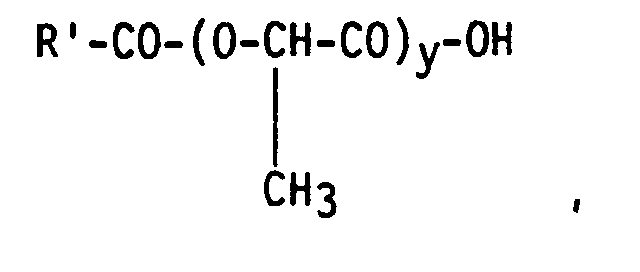
- Hair treatment compositions which have acyl lactylates of the general formula in addition to the active ingredient combination according to the invention have also proven to be particularly advantageous in which R 'represents a linear or branched, saturated or unsaturated alkyl or alkenyl group having 6 to 22 carbon atoms and y is a number from b 1 to 5.
- R represents a, in particular saturated, linear or methyl-branched alkyl group having 12 to 18 carbon atoms and y for a number from 1 to 3, are particularly preferred.
- Such acyl lactylates are commercially available under the trademark Pationic R.
- a sodium isostearoyl lactyl lactylate which is sold under the name Pationic R ISL, is a particularly preferred acyl lactylate.
- agents according to the invention which are additionally non-ionic Polymers of the starch or cyclodextrin type contain, as special proven effective.
- the type of hair treatment agent used according to the invention is subject to no restrictions.
- the agents according to the invention can both on the Hair remain, as well as after a contact time of a few seconds Minutes.
- Examples of used according to the invention Agents are shampoos, conditioners, cures, conditioners, tinting agents, Colorants, permanent waving agents, fixing agents, hair sprays and hair dryer waves.
- agents used according to the invention can be used, for example, as aqueous alcoholic or aqueous-alcoholic solutions, creams, gels or emulsions be formulated.
- the active ingredient combination according to the invention has proven to be particularly advantageous proven in hair coloring and tinting agents.
- Such agents either contain so-called “substantive” dyes and / or precursors for oxidation dyes.
- Usual direct dyes are e.g. B. nitrobenzene derivatives, andrachinone dyes, Triphenylmethane dyes and azo dyes.
- Representatives of this class of dyes used in hair dyes and tints are, for example, those under the international names or trade names HC Yellow 2, HC Yellow 4, methyl yellow, fluor yellow, basic yellow 57, Disperse Orange 3, HC Red 3, HC Red BN, Cardinal Red, Red Y, Red X, Basic Red 76, HC Blue 2, Nitro Blue, Disperse Blue 3, Basis Blue 99, HC Violet 1, Disperse Violet 1, Disperse Violet 4, Disperse Black 9, Basis Brown 16, picramic acid and Rodol 9 R, known compounds.
- Suitable direct dyes are, for example, the compounds 3-nitro-4-ethylaminobenzoic acid, 1,2,3,4-tetrahydro-6-nitroquinoxaline, 2-nitro-4-amino-4'-dimethylaminodiphenylamine-2'-carboxylic acid and 2-nitro-4-aminodiphenylamine-2'-carboxylic acid.
- Hair dyes contain so-called precursors for oxidation dyes Developer and coupler components. Form the Etttwickler components under the influence of oxidizing agents or atmospheric oxygen or under coupling with one or more coupler components actual dyes.
- Primary aromatic amines are usually used as developer components with another free or in the para or ortho position substituted hydroxy or amino group, diaminopyridine derivatives, heterocyclic Hydrazones, 4-aminopyrazolone derivatives and 2,4,5,6-tetraaminopyrimidine and its derivatives used.
- Special representatives are, for example p-toluenediamine, 2,4,5,6-tetraaminopyrimidine, p-aminophenol, N, N-bis- (2-hydroxyethyl) -p-phenylenediamine, 2- (2,5-diaminophenyl) ethanol, 2- (2,5-diaminophenoxy) ethanol, 1-phenyl-3-carboxyamido-4-aminopyrazolone-5 and 4-amino-3-methylphenol.
- coupler components m-phenylenediamine derivatives, naphthols, Resorcinol and resorcinol derivatives, pyrazolones and m-aminophenols are used.
- Suitable coupler substances are, in particular, ⁇ -naphthol, pyrogallol, 1,5-, 2,7- and 1,7-dihydroxynaphthalene, 5-amino-2-methylphenol, m-aminophenol, Resorcinol, resorcinol monomethyl ether, m-phenylenediamine, 1-phenyl3-methyl-pyrazolon-5, 2,4-dichloro-3-aminophenol, 1,3-bis (2,4-diaminophenoxy) propane, 2-chloro-resorcinol, 2-chloro-6-methyl-3-aminophenol and 2-methylresorcinol.
- Dry strands of hair weighing approx. 2 g were once with 32 g bleaching mixture (market product Poly Blond Medium Brightener) bleached for half an hour. After washing out the bleaching mixture the strands of hair were immediately without intermediate drying undergo permanent wave treatment with the market product Poly Lock Normal. The exposure times of the corrugated component and fixing component were 30 or 15 minutes. After rinsing out the fixative were the strands dried and at least two days at ambient conditions conditioned.
- the wet combability of the hair treated with this formulation was determined using very good to good graded.
- the wet combability of the hair treated with this conditioner was found to be very good (grade 1).
- the hairstyle hold was significantly improved.
- Diacid H-240 10.0 Stenol 1618 3.0 Jojoba oil 0.5 Soluble starch 3.0 Perfume oil 0.15 Preservative 0.1 water ad 100
- the wet combability of the hair treated with this conditioner was found to be very good (grade 1).
- the hairstyle hold was significantly improved.
- the hair dye was made with a commercial 6% hydrogen peroxide dispersion (Poly Color Brillance Color-Creme, mixing ratio 1: 1) colored. A light blonde shade resulted. The wet combability of the hair treated with this dye was rated good to satisfactory (Grade 2 to 3).
- Diacid H-240 2.0 Coconut alcohol 1.0 Thioglycolic acid 8.0 Eumulgin R B 2 1.0 Dehyton R K 3.0 Natrosol-250 HR 1.5 urea 3.0 EDTA 0.3 Perfume oil 0.3 water ad 100 A pH of 8.5 was set with an ammonia solution.
- the pH was adjusted to 5 with phosphoric acid.
Landscapes
- Health & Medical Sciences (AREA)
- Life Sciences & Earth Sciences (AREA)
- Veterinary Medicine (AREA)
- Animal Behavior & Ethology (AREA)
- General Health & Medical Sciences (AREA)
- Public Health (AREA)
- Dermatology (AREA)
- Emergency Medicine (AREA)
- Birds (AREA)
- Epidemiology (AREA)
- Cosmetics (AREA)
- Medicines Containing Material From Animals Or Micro-Organisms (AREA)
- Organic Low-Molecular-Weight Compounds And Preparation Thereof (AREA)
Description

und
in Haarbehandlungsmitteln, die, wenn sie frei von Haarfarbstoffen sind, keine wasserlöslichen, ionischen Polymeren enthalten.
- Anlagerungsprodukte von 2 bis 30 Mol Ethylenoxid und/oder 0 bis 5 Mol Propylenoxid an lineare Fettalkohole mit 8 bis 22 C-Atomen, an Fettsäuren mit 12 bis 22 C-Atomen und an Alkylphenole mit 8 bis 15 C-Atomen in der Alkylgruppe,
- C12-C22-Fettsäuremono- und -diester von Anlagerungsprodukten von 1 bis 30 Mol Ethylenoxid an Glycerin,
- C8-C22-Alkylmono- und oligoglycoside und deren ethoxylierte Analoga sowie
- Anlagerungsprodukte von 5 bis 60 Mol Ethylenoxid an Rizinusöl und gehärtetes Rizinusöl.
- im wesentlichen aus C8- und C10-Alkylgruppen,
- im wesentlichen aus C12- und C14-Alkylgruppen,
- im wesentlichen aus C8- bis C16-Alkylgruppen oder
- im wesentlichen aus C12- bis C16-Alkylgruppen besteht.

- anionische Tenside, wie beispielsweise Fettalkylsulfate und -ethersulfate sowie Alkylethercarbonsäuren,
- kationische Tenside, wie beispielsweise quartäre Ammoniumverbindungen, Amidoamine und quaternisierte Ester und Proteinhydrolysate,
- zwitterionische Tenside, wie beispielsweise Betaine,
- ampholytische Tenside,
- nichtionische Polymere wie beispielsweise Polyvinylpyrrolidon, Vinylpyrrolidon/Vinylacetat-Copolymere und Celluloseether,
- Strukturanten wie Glucose und Maleinsäure,
- haarkonditionierende Verbindungen wie Phospholipide, beispielsweise Sojalecithin, Ei-Lecitin und Kephaline, sowie Silikonöle,
- Proteinhydrolysate, insbesondere Elastin-, Kollagen-, Keratin-, Milcheiweiß-, Sojaprotein- und Weizenproteinhydrolysate, deren Kondensationsprodukte mit Fettsäuren sowie quaternisierte Proteinhydrolysate,
- Parfümöle und Dimethylisosorbid,
- Lösungsvermittler, wie Ethanol, Isopropanol, Ethylenglykol, Propylenglykol, Glycerin und Diethylenglykol,
- Farbstoffe,
- Antischuppenwirkstoffe wie Piroctone Olamine und Zink Omadine,
- weitere Substanzen zur Einstellung des pH-Wertes,
- Wirkstoffe wie Panthenol, Allantoin, Pyrrolidoncarbonsäuren und deren Salze, Pflanzenextrakte und Vitamine,
- Lichtschutzmittel,
- Konsistenzgeber wie Zuckerester, Polyolester oder Polyolalkylether,
- Wachse, wie Bienenwachs und Montanwachs,
- Fettsäurealkanolamide,
- Komplexbildner wie EDTA, NTA und Phosphonsäuren,
- Quell- und Penetrationsstoffe wie Glycerin, Propylenglykolmonoethylether, Carbonate, Hydrogencarbonate, Guanidine, Harnstoffe sowie primäre, sekundäre und tertiäre Phosphate,
- Trübungsmittel wie Latex,
- Perlglanzmittel wie Ethylenglykolmono- und -distearat,
- Treibmittel wie Propan-Butan-Gemische, N2O, Dimethylether, CO2 und Luft sowie
- Antioxidantien,
- Reduktionsmittel wie z.B. Thioglykolsäure und deren Derivate, Thiomilchsäure, Cysteamin, Thioäpfelsäure und α-Mercaptoethansulfonsäure,
- Oxidationsmittel wie Wasserstoffperoxid, Kaliumbromat und Natriumbromat.
| Westvaco DiacidR H-240 | 10,0 |
| Jojobaöl | 0,5 |
| StenolR 1618 | 6,0 |
| Parfümöl | 0,15 |
| EuxylRK400 | 0,1 |
| Wasser | ad 100 |
| Westvaco DiacidR H-240 | 10,0 |
| StenolR 1618 | 3,0 |
| PationicR ISL | 5,0 |
| Parfümöl | 0,15 |
| EuxylRK400 | 0,1 |
| Wasser | ad 100 |
| Diacid H-240 | 10,0 |
| Stenol 1618 | 3,0 |
| Jojobaöl | 0,5 |
| Lösliche Stärke | 3,0 |
| Parfümöl | 0,15 |
| Konservierungsmittel | 0,1 |
| Wasser | ad 100 |
| Westvaco DiacidR H-240 | 10,0 |
| StenolR 1618 | 5,0 |
| SilikonölR DC 200 | 2,0 |
| Plantaren 600R | 2,0 |
 |
3,0 |
| NatrosolR 250 HR | 0,5 |
| Parfümöl | q.s |
| Wasser | ad 100 |
| Westvaco DiacidR H-240 | 10,0 |
| TexaponR N 25 | 30,0 |
| PlantarenR 600 | 3,0 |
| AkypoR Soft 45 NV | 7,0 |
| PationicR ISL | 3,0 |
| Stenol 1618 | 3,0 |
| Parfümöl | q.s. |
| Konservierungsmittel | q.s. |
| Wasser | ad 100 |
| Westvaco DiacidR H-240 | 10,0 |
| TexaponR N 25 | 40,0 |
| Stenol 1618 | 1,0 |
| Natriumstearat | 3,0 |
| Behensäure | 1,5 |
| Stärke, löslich | 1,0 |
| Parfümöl | q.s. |
| Konservierungsmittel | q.s. |
| Wasser | ad 100 |
| Erfindung | Vergleich | |
| Texapon N 25 | - | 16,0 |
| Diacid H-240 | 10 | - |
| Stenol 1618 | 5,0 | 6,0 |
| Stärke, löslich | 3,0 | 3,0 |
| 4-Amino-2-nitrodiphenyl<-> | ||
| amin-2'-carbonsäure | 0,1 | 0,1 |
| 6-Nitro-1,2,3,4-tetrahydrochinoxalinhydrochlorid | 0,1 | 0,1 |
| Wasser | ad 100 | ad 100 |
| mit Ammoniak auf | pH 7,51 | pH 7,53 |
| Westvaco DiacidR H-240 | 10,0 |
| PlantarenR 600 | 2,0 |
| HydrenolR D | 5,0 |
| p-Toluylendiaminsulfat | 0,1 |
| p-Aminophenolhydrochlorid | 0,03 |
| Resorcin | 0,04 |
| m-Aminophenol | 0,004 |
| Stabilisierungsmittel, Parfümöl, Puffersalz | q.s. |
| Wasser | ad 100 |
| Mit Ammoniak wurde ein pH-Wert von 9,5 eingestellt. |
| Diacid H-240 | 2,0 |
| Kokosfettalkohol | 1,0 |
| Thioglycolsäure | 8,0 |
| EumulginR B 2 | 1,0 |
| DehytonR K | 3,0 |
| Natrosol-250 HR | 1,5 |
| Harnstoff | 3,0 |
| EDTA | 0,3 |
| Parfümöl | 0,3 |
| Wasser | ad 100 |
| Mit einer Ammoniaklösung wurde ein pH-Wert von 8,5 eingestellt. |
| Diacid H-240 | 4,0 |
| Stenol 1618 | 2,0 |
| Texapon N 25 | 2,0 |
| Wasserstoffperoxid (50%ig) | 5,0 |
| Stabilisator | q.s. |
| Parfümöl | q.s. |
| Wasser | ad 100 |
Claims (10)
- Verwendung einer Wirkstoffkombination, bestehend aus(A) einer Dicarbonsäure der allgemeinen Formel (I),in der R1 steht für eine lineare oder verzweigte Alkyl- oder Alkenylgruppe mit 4 bis 12 Kohlenstoffatomen, n für eine Zahl von 4 bis 12 sowie eine der beiden Gruppen X und Y für eine COOH-Gruppe und die andere für Wasserstoff oder einen Methyl- oder Ethylrest, einer Dicarbonsäure der allgemeinen Formel (I), die zusätzlich noch 1 bis 3 Methyl- oder Ethylsubstituenten am Cyclohexenring trägt, einer Dicarbonsäure, die aus den Carbonsäuren gemäß Formel (I) formal durch Anlagerung eines Moleküls Wasser an die Doppelbindung im Cyclohexenring entsteht, oder einem physiologisch verträglichen Salz einer dieser Säuren

und(B) einem wasserunlöslichen Öl oder Wachs,
in Haarbehandlungsmitteln, die, wem sie frei von Haarfarbstoffen sind, keine wasserlöslichen, ionischen Polymeren sind enthalten. - Verwendung nach Anspruch 1, dadurch gekennzeichnet, daß R1 steht für eine lineare oder methylverzweigte, gesättigte Alkylgruppen mit 4 bis 8 Kohlenstoffatomen und n für eine Zahl von 6 bis 10.
- Verwendung nach Anspruch 1, dadurch gekennzeichnet, daß die Dicarbonsäure gemäß Formel (I) ein Reaktionsprodukt ist, daß durch Diels-Alder-Reaktion aus Littolsäure und Acrylsäure erhältlich ist.
- Verwendung nach einem der Ansprüche 1 bis 3, dadurch gekennzeichnet, daß das physiologisch verträgliche Salz der Dicarbonsäure gemäß Formel (I) ein Alkali- oder Ammoniumsalz ist.
- Verwendung nach einem der Ansprüche 1 bis 4, dadurch gekennzeichnet, daß die Komponente (B) ausgewählt ist aus der Gruppe, die von Fettalkoholen, Fettsäuren, ethoxylierten Fettalkoholen und ethoxylierten Fettsäuren.
- Verwendung nach einem der Ansprüche 1 bis 5, dadurch gekennzeichnet, daß die Komponente (A) in Mengen von 0,1 bis 10 Gew.-%, insbesondere von 1 bis 5 Gew.-%, jeweils bezogen auf das gesamte Haarbehandlungsmittel, enthalten ist.
- Verwendung nach einem der Ansprüche 1 bis 6, dadurch gekennzeichnet, daß die Komponente (B) in Mengen von 0,1 bis 15 Gew.-%, insbesondere von 3 bis 10 Gew.-%, jeweils bezogen auf das gesamte Haarbehandlungsmittel, enthalten ist.
- Verwendung nach einem der Ansprüche 1 bis 7, dadurch gekennzeichnet, daß das Haarbehandlungsmittel weiterhin ein nichtionogenes Tensid, insbesondere ein Alkylpolyglykosid, enthält.
- Verwendung nach einem der Ansprüche 1 bis 8, dadurch gekennzeichnet, daß das Haarbehandlungsmittel weiterhin ein Acyllactylat der allgemeinen Formelin der R' für eine lineare oder verzweigte, gesättigte oder ungesättigte Alkyl- oder Alkenylgruppe mit 6 bis 22 Kohlenstoffatomen steht und y für eine Zahl von 1 bis 5, enthält.
- Verwendung nach einem der Ansprüche 1 bis 9, dadurch gekennzeichnet, daß das Haarbehandlungsmittel ein Haarfärbemittel oder ein Haartönungsmittel ist.
Applications Claiming Priority (3)
| Application Number | Priority Date | Filing Date | Title |
|---|---|---|---|
| DE4403570A DE4403570A1 (de) | 1994-02-05 | 1994-02-05 | Wirkstoffkomplex für Haarbehandlungsmittel |
| DE4403570 | 1994-02-05 | ||
| PCT/EP1995/000334 WO1995020938A1 (de) | 1994-02-05 | 1995-01-27 | Wirkstoffkomplex für haarbehandlungsmittel |
Publications (2)
| Publication Number | Publication Date |
|---|---|
| EP0742709A1 EP0742709A1 (de) | 1996-11-20 |
| EP0742709B1 true EP0742709B1 (de) | 1999-09-22 |
Family
ID=6509538
Family Applications (1)
| Application Number | Title | Priority Date | Filing Date |
|---|---|---|---|
| EP95907633A Expired - Lifetime EP0742709B1 (de) | 1994-02-05 | 1995-01-27 | Wirkstoffkomplex für haarbehandlungsmittel |
Country Status (7)
| Country | Link |
|---|---|
| EP (1) | EP0742709B1 (de) |
| AT (1) | ATE184781T1 (de) |
| DE (2) | DE4403570A1 (de) |
| DK (1) | DK0742709T3 (de) |
| ES (1) | ES2138188T3 (de) |
| GR (1) | GR3031461T3 (de) |
| WO (1) | WO1995020938A1 (de) |
Families Citing this family (1)
| Publication number | Priority date | Publication date | Assignee | Title |
|---|---|---|---|---|
| DE19754053A1 (de) * | 1997-12-05 | 1999-06-10 | Henkel Kgaa | Kosmetische Mittel enthaltend eine spezielle Wirkstoffkombination |
Family Cites Families (4)
| Publication number | Priority date | Publication date | Assignee | Title |
|---|---|---|---|---|
| WO1986000800A1 (en) * | 1984-07-19 | 1986-02-13 | Westvaco Corporation | Vegetable oil adducts as emollients in skin and hair care products |
| DE3500877A1 (de) * | 1985-01-12 | 1986-07-17 | Henkel KGaA, 4000 Düsseldorf | Haarfaerbemittel-zubereitung |
| DE3503618A1 (de) * | 1985-02-02 | 1986-08-07 | Henkel KGaA, 4000 Düsseldorf | Mittel zum waschen oder spuelen der haare |
| JP2526105B2 (ja) * | 1988-09-20 | 1996-08-21 | 花王株式会社 | 洗浄剤組成物 |
-
1994
- 1994-02-05 DE DE4403570A patent/DE4403570A1/de not_active Withdrawn
-
1995
- 1995-01-27 DE DE59506896T patent/DE59506896D1/de not_active Expired - Fee Related
- 1995-01-27 EP EP95907633A patent/EP0742709B1/de not_active Expired - Lifetime
- 1995-01-27 WO PCT/EP1995/000334 patent/WO1995020938A1/de not_active Ceased
- 1995-01-27 AT AT95907633T patent/ATE184781T1/de not_active IP Right Cessation
- 1995-01-27 DK DK95907633T patent/DK0742709T3/da active
- 1995-01-27 ES ES95907633T patent/ES2138188T3/es not_active Expired - Lifetime
-
1999
- 1999-10-07 GR GR990402552T patent/GR3031461T3/el unknown
Also Published As
| Publication number | Publication date |
|---|---|
| DK0742709T3 (da) | 2000-03-27 |
| GR3031461T3 (en) | 2000-01-31 |
| ES2138188T3 (es) | 2000-01-01 |
| EP0742709A1 (de) | 1996-11-20 |
| ATE184781T1 (de) | 1999-10-15 |
| DE4403570A1 (de) | 1995-08-10 |
| DE59506896D1 (de) | 1999-10-28 |
| WO1995020938A1 (de) | 1995-08-10 |
Similar Documents
| Publication | Publication Date | Title |
|---|---|---|
| EP1276451B2 (de) | Verwendung von zuckertensiden und fettsäurepartialglyceriden | |
| EP1037591B1 (de) | Kosmetische mittel enthaltend eine spezielle wirkstoffkombination | |
| EP0971689B2 (de) | Wässrige pflegende haarbehandlungsmittel | |
| DE102015222214A1 (de) | Verbesserte Entfärbung von gefärbten keratinischen Fasern | |
| EP0648103B1 (de) | Haarbehandlungsmittel | |
| EP0662815B1 (de) | Haarbehandlungsmittel | |
| EP1156774B2 (de) | Zubereitungen zur behandlung keratinischer fasern | |
| DE202008016408U1 (de) | Neue Farbstoffvorproduktkombinationen | |
| EP1039875B1 (de) | Haarbehandlungmittel enthaltend biopolymere, panthenol und mono- und/oder disaccharide | |
| DE102016225047A1 (de) | "Verfahren zur Entfärbung von gefärbten keratinischen Fasern" | |
| EP1041954B1 (de) | Haarbehandlungsmittel | |
| EP0914080B1 (de) | Mittel und verfahren zum färben und tönen keratinischer fasern | |
| EP0895468A1 (de) | Festes mittel zur behandlung keratinischer fasern | |
| EP1100443B1 (de) | Haarbehandlungsmittel | |
| EP1021164B1 (de) | Kosmetische mittel | |
| EP0742709A1 (de) | Wirkstoffkomplex für haarbehandlungsmittel | |
| EP0662814B1 (de) | Haarbehandlungsmittel | |
| WO2019057470A1 (de) | Verbesserte entfärbung von gefärbten keratinischen fasern | |
| DE19855080A1 (de) | Pflegende Haut- und Haarbehandlungsmittel | |
| DE19618398A1 (de) | Festes Mittel zur Behandlung keratinischer Fasern | |
| DE19835330A1 (de) | Wirkstoffkomplex für Haarbehandlungsmittel | |
| DE19855079A1 (de) | Pflegende Haut- und Haarbehandlungsmittel |
Legal Events
| Date | Code | Title | Description |
|---|---|---|---|
| PUAI | Public reference made under article 153(3) epc to a published international application that has entered the european phase |
Free format text: ORIGINAL CODE: 0009012 |
|
| 17P | Request for examination filed |
Effective date: 19960729 |
|
| AK | Designated contracting states |
Kind code of ref document: A1 Designated state(s): AT BE CH DE DK ES FR GB GR IE IT LI NL SE |
|
| GRAG | Despatch of communication of intention to grant |
Free format text: ORIGINAL CODE: EPIDOS AGRA |
|
| 17Q | First examination report despatched |
Effective date: 19981013 |
|
| GRAG | Despatch of communication of intention to grant |
Free format text: ORIGINAL CODE: EPIDOS AGRA |
|
| GRAH | Despatch of communication of intention to grant a patent |
Free format text: ORIGINAL CODE: EPIDOS IGRA |
|
| GRAH | Despatch of communication of intention to grant a patent |
Free format text: ORIGINAL CODE: EPIDOS IGRA |
|
| GRAA | (expected) grant |
Free format text: ORIGINAL CODE: 0009210 |
|
| AK | Designated contracting states |
Kind code of ref document: B1 Designated state(s): AT BE CH DE DK ES FR GB GR IE IT LI NL SE |
|
| REF | Corresponds to: |
Ref document number: 184781 Country of ref document: AT Date of ref document: 19991015 Kind code of ref document: T |
|
| REG | Reference to a national code |
Ref country code: CH Ref legal event code: EP |
|
| REF | Corresponds to: |
Ref document number: 59506896 Country of ref document: DE Date of ref document: 19991028 |
|
| ITF | It: translation for a ep patent filed | ||
| ET | Fr: translation filed | ||
| REG | Reference to a national code |
Ref country code: ES Ref legal event code: FG2A Ref document number: 2138188 Country of ref document: ES Kind code of ref document: T3 |
|
| GBT | Gb: translation of ep patent filed (gb section 77(6)(a)/1977) |
Effective date: 19991221 |
|
| REG | Reference to a national code |
Ref country code: DK Ref legal event code: T3 |
|
| PLBE | No opposition filed within time limit |
Free format text: ORIGINAL CODE: 0009261 |
|
| STAA | Information on the status of an ep patent application or granted ep patent |
Free format text: STATUS: NO OPPOSITION FILED WITHIN TIME LIMIT |
|
| 26N | No opposition filed | ||
| REG | Reference to a national code |
Ref country code: GB Ref legal event code: IF02 |
|
| PGFP | Annual fee paid to national office [announced via postgrant information from national office to epo] |
Ref country code: IE Payment date: 20090115 Year of fee payment: 15 Ref country code: ES Payment date: 20090218 Year of fee payment: 15 Ref country code: DK Payment date: 20090113 Year of fee payment: 15 Ref country code: AT Payment date: 20090113 Year of fee payment: 15 |
|
| PGFP | Annual fee paid to national office [announced via postgrant information from national office to epo] |
Ref country code: NL Payment date: 20090104 Year of fee payment: 15 Ref country code: DE Payment date: 20090123 Year of fee payment: 15 |
|
| PGFP | Annual fee paid to national office [announced via postgrant information from national office to epo] |
Ref country code: GR Payment date: 20081215 Year of fee payment: 15 Ref country code: GB Payment date: 20090121 Year of fee payment: 15 Ref country code: CH Payment date: 20090126 Year of fee payment: 15 |
|
| PGFP | Annual fee paid to national office [announced via postgrant information from national office to epo] |
Ref country code: BE Payment date: 20090213 Year of fee payment: 15 |
|
| PGFP | Annual fee paid to national office [announced via postgrant information from national office to epo] |
Ref country code: SE Payment date: 20090108 Year of fee payment: 15 Ref country code: IT Payment date: 20090128 Year of fee payment: 15 |
|
| PGFP | Annual fee paid to national office [announced via postgrant information from national office to epo] |
Ref country code: FR Payment date: 20090113 Year of fee payment: 15 |
|
| BERE | Be: lapsed |
Owner name: *HENKEL K.G.A.A. Effective date: 20100131 |
|
| REG | Reference to a national code |
Ref country code: NL Ref legal event code: V1 Effective date: 20100801 |
|
| REG | Reference to a national code |
Ref country code: CH Ref legal event code: PL |
|
| REG | Reference to a national code |
Ref country code: DK Ref legal event code: EBP |
|
| GBPC | Gb: european patent ceased through non-payment of renewal fee |
Effective date: 20100127 |
|
| EUG | Se: european patent has lapsed | ||
| REG | Reference to a national code |
Ref country code: FR Ref legal event code: ST Effective date: 20100930 |
|
| PG25 | Lapsed in a contracting state [announced via postgrant information from national office to epo] |
Ref country code: NL Free format text: LAPSE BECAUSE OF NON-PAYMENT OF DUE FEES Effective date: 20100801 Ref country code: LI Free format text: LAPSE BECAUSE OF NON-PAYMENT OF DUE FEES Effective date: 20100131 Ref country code: FR Free format text: LAPSE BECAUSE OF NON-PAYMENT OF DUE FEES Effective date: 20100201 Ref country code: CH Free format text: LAPSE BECAUSE OF NON-PAYMENT OF DUE FEES Effective date: 20100131 |
|
| PG25 | Lapsed in a contracting state [announced via postgrant information from national office to epo] |
Ref country code: DE Free format text: LAPSE BECAUSE OF NON-PAYMENT OF DUE FEES Effective date: 20100803 Ref country code: AT Free format text: LAPSE BECAUSE OF NON-PAYMENT OF DUE FEES Effective date: 20100127 |
|
| PG25 | Lapsed in a contracting state [announced via postgrant information from national office to epo] |
Ref country code: GB Free format text: LAPSE BECAUSE OF NON-PAYMENT OF DUE FEES Effective date: 20100127 |
|
| PG25 | Lapsed in a contracting state [announced via postgrant information from national office to epo] |
Ref country code: IE Free format text: LAPSE BECAUSE OF NON-PAYMENT OF DUE FEES Effective date: 20100127 Ref country code: DK Free format text: LAPSE BECAUSE OF NON-PAYMENT OF DUE FEES Effective date: 20100131 |
|
| PG25 | Lapsed in a contracting state [announced via postgrant information from national office to epo] |
Ref country code: BE Free format text: LAPSE BECAUSE OF NON-PAYMENT OF DUE FEES Effective date: 20100131 |
|
| REG | Reference to a national code |
Ref country code: ES Ref legal event code: FD2A Effective date: 20110324 |
|
| PG25 | Lapsed in a contracting state [announced via postgrant information from national office to epo] |
Ref country code: IT Free format text: LAPSE BECAUSE OF NON-PAYMENT OF DUE FEES Effective date: 20100127 |
|
| PG25 | Lapsed in a contracting state [announced via postgrant information from national office to epo] |
Ref country code: ES Free format text: LAPSE BECAUSE OF NON-PAYMENT OF DUE FEES Effective date: 20110310 |
|
| PG25 | Lapsed in a contracting state [announced via postgrant information from national office to epo] |
Ref country code: ES Free format text: LAPSE BECAUSE OF NON-PAYMENT OF DUE FEES Effective date: 20100128 |
|
| PG25 | Lapsed in a contracting state [announced via postgrant information from national office to epo] |
Ref country code: SE Free format text: LAPSE BECAUSE OF NON-PAYMENT OF DUE FEES Effective date: 20100128 |