EP0743018A1 - Ruban de pâte instantané, procédé et dispositif de sa fabrication - Google Patents
Ruban de pâte instantané, procédé et dispositif de sa fabrication Download PDFInfo
- Publication number
- EP0743018A1 EP0743018A1 EP96300458A EP96300458A EP0743018A1 EP 0743018 A1 EP0743018 A1 EP 0743018A1 EP 96300458 A EP96300458 A EP 96300458A EP 96300458 A EP96300458 A EP 96300458A EP 0743018 A1 EP0743018 A1 EP 0743018A1
- Authority
- EP
- European Patent Office
- Prior art keywords
- pyramid
- dough sheet
- strips
- shaped
- dough
- Prior art date
- Legal status (The legal status is an assumption and is not a legal conclusion. Google has not performed a legal analysis and makes no representation as to the accuracy of the status listed.)
- Granted
Links
Images




Classifications
-
- A—HUMAN NECESSITIES
- A23—FOODS OR FOODSTUFFS; TREATMENT THEREOF, NOT COVERED BY OTHER CLASSES
- A23L—FOODS, FOODSTUFFS OR NON-ALCOHOLIC BEVERAGES, NOT OTHERWISE PROVIDED FOR; PREPARATION OR TREATMENT THEREOF
- A23L7/00—Cereal-derived products; Malt products; Preparation or treatment thereof
- A23L7/10—Cereal-derived products
- A23L7/109—Types of pasta, e.g. macaroni or noodles
-
- A—HUMAN NECESSITIES
- A21—BAKING; EDIBLE DOUGHS
- A21C—MACHINES OR EQUIPMENT FOR MAKING OR PROCESSING DOUGHS; HANDLING BAKED ARTICLES MADE FROM DOUGH
- A21C11/00—Other machines for forming the dough into its final shape before cooking or baking
- A21C11/02—Embossing machines
- A21C11/04—Embossing machines with cutting and embossing rollers or drums
-
- A—HUMAN NECESSITIES
- A21—BAKING; EDIBLE DOUGHS
- A21C—MACHINES OR EQUIPMENT FOR MAKING OR PROCESSING DOUGHS; HANDLING BAKED ARTICLES MADE FROM DOUGH
- A21C11/00—Other machines for forming the dough into its final shape before cooking or baking
- A21C11/02—Embossing machines
- A21C11/06—Embossing machines handling regularly pre-shaped sheets of dough
-
- A—HUMAN NECESSITIES
- A21—BAKING; EDIBLE DOUGHS
- A21C—MACHINES OR EQUIPMENT FOR MAKING OR PROCESSING DOUGHS; HANDLING BAKED ARTICLES MADE FROM DOUGH
- A21C11/00—Other machines for forming the dough into its final shape before cooking or baking
- A21C11/22—Apparatus with rollers and cutting discs or blades for shaping noodles
Definitions
- the present invention relates to instant noodle strips and a method and an apparatus of manufacturing instant noodle strips by rolling a dough to form a dough sheet and cutting the dough sheet into noodle strips by a cutting means, and more particularly relates to non-fried instant noodle strips having good reconstituting property and a method and an apparatus of manufacturing such instant noodle strips.
- non-fried noodles could not be easily reconstituted into a tasty edible state and a relatively long preparation time is required as compared with the fried noodles.
- noodles could not be thickened, and therefore fulfilled satisfaction could not be attained.
- noodles could not match with a soup well, so that the consumers get bored with the taste and the chewiness.
- the wedge-shaped ditch is formed by using a specially designed die, so that this method can be applied only to pasta such as spaghetti and macaroni.
- the noodle strips are manufactured by extrusion molding under pressure, so that their microstructure is liable to be dense. Such noodle strips could be hardly applied to the cup noodles in which the dried noodles have to be reconstituted with hot water in about three minutes.
- An object of the present invention is to provide novel and improved instant noodles having improved reconstitution, appearance, chewiness and soup matching.
- an instant noodle strip formed by a usual cutting step comprises one or more rows of pyramid-shaped recesses with four triangle faces formed in at least one of two rolled surfaces situating between cut side surfaces, said recesses being separated from one another by a desired distance.
- each said pyramid-shaped recess is so shaped that a vertical angle of an isosceles triangle formed by a vertical cross section passing through a top of the pyramid-shaped recess in a longitudinal direction of the noodle strip is set to an angle within a range from 45 degrees to 90 degrees.
- a method of manufacturing instant noodle strips comprises the steps of:
- Said forming means may include molding rolls at least one of which has thereon a plurality of pyramid-shaped protrusions with four triangle faces to form said recesses in said strips.
- said molding rolls are arranged side by side with a distance which is smaller than a thickness of the dough sheet, so that the pyramid-shaped recesses can be positively formed with a sufficiently large depth.
- Said pyramid-shaped protrusions onthe molding roll are preferably shaped such that a vertical angle of an isosceles triangle formed by a vertical cross section passing through a top of the pyramid-shaped recess in the longitudinal direction of the noodle strip is set to an angle within a range from 45 degrees to 90 degrees.
- the distance between adjacent pyramid-shaped protrusions viewed in a direction parallel with an axis of the molding roll is set to be equal to a distance between adjacent edges of cutter roll, there is formed a single row of pyramid-shaped recesses in each of strips.
- both rolls have the pyramid-shaped protrusions
- a distance between adjacent pyramid-shaped protrusions viewed in the direction parallel with the axis of the molding roll is set to be a half of the distance between adjacent edge of cutter roll, there are formed two rows of pyramid-shaped recesses in one surface of a strip. Then, there are formed four rows of pyramid-shaped recesses in respective strip.
- the pyramid-shaped protrusions in a surface of one of the pair-wised rolls and the other roll may have a smooth surface, but in this case a great many pyramid-shaped recesses have to be formed.
- a width of a strip is small such as 1 to 1.5 mm, the desired function can be attained by forming a single row of pyramid-shaped recesses.
- a plurality of recess rows may be advantageously formed in parallel with each other.
- a width of a strip it is not always necessary to set a width of a strip to be equal to an integer multiple of a distance between adjacent pyramid-shaped recess rows.
- the pyramid-shaped recesses are formed by one or more molding rolls arranged just before the cutting means for cutting the dough sheet into strips, and thus any desired cutter may be used.
- a strip may have a circular cross section, a rectangular cross section or a rounded-off rectangular cross section.
- the method and apparatus according to the invention can be performed by merely providing the molding rolls between the last rolling roll pair and the cutting section or by replacing the last rolling roll pair by the molding rolls. Therefore, it is not necessary to change largely the ordinary installation for manufacturing the oil-free non-fried instant noodles.
- the pyramid-shaped protrusions may be readily formed on the surface of the molding roll by longitudinal and peripheral v-shaped grooves.
- the protrusion is to be a rectangular pyramid but not necessary to be a square pyramid. However, only a portion of the pyramid-shaped protrusion is projected into the dough sheet, and thus if a difference between a long side and a short side of a bottom of a pyramid-shaped protrusion is large, a distance between adjacent pyramid-shaped recesses viewed in the axial direction of the molding roll or in the longitudinal direction of the strip becomes too large to form the recesses on a larger surface area of the dough sheet. Therefore, a ratio of the long side to the short side of the rectangle bottom of the pyramid-shaped protrusion is preferably set to about 1:1.
- a distance between successive pyramid-shaped recesses viewed in the axial direction of the molding roll is substantially determined by a width of a strip to be formed. For instance, when a single row of recesses is to be formed on a strip having a width of 1 mm, said distance is preferably set to 1 mm.
- a distance between successive recesses viewed in a rotational direction of the molding roll may be determined at will.
- a vertical angle of a recess viewed on a vertical plane passing through a top of the recesses and being in parallel with a longitudinal direction of the noodle strip is small, in other words, if the recess have an acute vertical angle, the object of the present invention could not be attained as the needle roll stated above, so the dough sheet material is liable to stick onto the molding roll and a continuous production becomes impossible.
- said vertical angle is preferably set to an angle within a range from 45 degrees to 90 degrees.
- the instant noodle strip according to the invention there are formed pyramid-shaped recesses, and thus a surface area is increased and a large amount of water can be absorbed into the strip. In this manner, the reconstituting time can be shortened.
- the dough is repeatedly rolled by means of a plural sets of rolls and thus a network microstructure of gluten is rolled in the longitudinal direction of the dough sheet. Even though the noodle strip is reconstituted, it has the microstructure in which is like chewing rubber.
- the network microstructure of gluten is cut by forming the pyramid-shaped recesses in the dough sheet. Therefore, the instant noodle strip has a soft chewiness.
- the outer configuration of the strip is not affected by the presence of pyramid-shaped recesses as compared with the known instant noodle strips formed by the known methods stated above, and therefore the circular or rectangular or rounded-off rectangular cross section of the strip can be substantially maintained. Therefore, the strip according to the invention is felt to be smooth to the tongue. The surface of the strip is felt to be substantially smooth, while the strip can be efficiently reconstituted within a short time and can be well matched with soup.
- Fig. 1 is a schematic view showing an embodiment of an apparatus for manufacturing instant noodle strip according to the invention, in which a pair of molding rolls are provided between the last pair of rolls of a multistage rolling device and a cutting device.
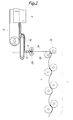
- Fig. 2 is a schematic view illustrating another embodiment of the apparatus for manufacturing instant noodle strip according to the invention, in which the last pair of rolls of the multistage rolling device are formed by molding rolls.
- a dough obtained by kneading wheat flour together with water or water containing additives is supplied to a rolling device 1.
- the rolling device 1 is formed by a known multistage rolling device including plural pairs of rolls. Then, number of stages of the multistage rolling device 1 may be three to five.
- the rolling device 1 By means of the rolling device 1, there is formed a dough sheet 2.
- the dough sheet 2 is supplied from the last pair of rolls 1A and 1B into a pair of molding rolls 3A and 3B.
- On outer surfaces of the molding rolls 3A and 3B there are formed a number of pyramid-shaped protrusions, and therefore corresponding pyramid-shaped recesses are formed in both rolled surfaces of the dough sheet 2.
- the distance between the molding rolls 3A and 3B is controlled by a device not shown, so that the pyramid-shaped recesses may be formed with a suitable depth.
- Fig. 3 shows the operation of the molding rolls 3A and 3B and cutting rolls 4A and 4B
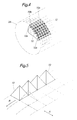
- Fig. 4 shows a part of the molding rolls 3A on an enlarged scale.
- On the molding rolls 3A and 3B there are formed a number of rectangular pyramid-shaped protrusions 10, which are formed by longitudinal v-shaped grooves 10a and peripheral v-shaped grooves 10b.
- the protrusions 10 may be in the form of a polyhedron or a cone, but a rectangle bottom face is preferable for the purpose of easy formation.
- Fig. 5 shows protrusions 10 provided on the surfaces of the molding rolls 3A and 3B.
- a rotational direction of the molding roll is shown by an arrow R and an axial direction of the molding roll is denoted by an arrow A.
- Fig. 6 shows a vertical cross sectional view of a pyramid-shaped protrusion 10 cut along a plane which is parallel with the rotational direction R of the molding roll 3A and 3B, and passes through a vertex V of the pyramid-shaped protrusion.
- the vertical cross section is an isosceles triangle having a vertical angle K.
- said vertical angle K is preferably set to a value within a range from 45 degrees to 90 degrees in order to obtain an improved reconstituting property.
- Fig. 7 illustrates another noodle strip 13 obtained by cutting the dough sheet 2 having the pyramid-recesses 11 formed thereon.
- the noodle strip 13 has a rather wide width and having a rectangular cross section. In each of upper and lower surfaces of the strip, there are formed four rows of pyramid-shaped recesses 11.
- Fig. 8 shows still another noodle strip 14 according to the invention.
- the strip 14 has a circular cross section and two rows of pyramid-shaped recesses 11 are formed at diametrically opposed positions.
- Wheat flour of 100 weight part was mixed with KANSUI of 0.5 weight part, common salt of 1 weight part, food color of gardenia of 0.1 weight part and water of 40 weight part.
- KANSUI is an alkaline additive in solid or aqueous solution form containing one or more salts such as sodium carbonate, potassium carbonate and the like.
- a mixture was kneaded well to form a dough.
- the dough was rolled by the rolling device in a usual manner to produce a dough sheet having a thickness of 1.3 mm.
- the dough sheet was passed through a pair of molding rolls having the pyramid-shaped protrusions formed thereon.
- the vertical angle K of a pyramid-shaped protrusion was set to 45 degrees and a distance between vertices of adjacent protrusions aligned in the axial direction as well as in the rotational direction of the roll was set to 0.75 mm.
- the molding rolls were separated from each other by 0.5 mm. Therefore, in both surfaces of the dough sheet, there were formed a number of pyramid-shaped recesses aligned regularly in a longitudinal direction as well as in a lateral direction such that a distance between vertices of adjacent recesses was 0.75 mm. Then, the dough sheet was cut into strips by means of the cutting rolls having cutting edges of No. 20 (1.5 mm width).
- Each strip had a thickness of 1.4 mm and had four rows of pyramid-shaped recesses, two rows being formed in one of two rolled surfaces between cut surfaces and two rows being formed in the other rolled surfaces.
- the strips were steamed, and then were dried with a hot air of 90 degrees centigrade. In this manner, hot air dried instant noodles containing water of 10 weight % were obtained.
- the dough sheet obtained by the same process as the above mentioned example 1 was cut into strips by means of the No. 20 cutting edges without passing through the molding rolls. In this manner, the noodle strips having a thickness of 1.4 mm were obtained. After steaming, they were dried by hot air to obtain instant noodles containing water by 10 weight %.
- the instant noodles obtained by the example 1 and comparative example 1 were boiled in hot water of 500 ml for three minutes, and then soup was added. Sensory test was conducted for the resulted noodles by five panelists. Result of this test is shown in a Table 1.
- the noodle strips were also tested by means of a rheometer for measuring a cut-off strength. Result of this test is shown in Table 2. Further the instant noodles were immersed in hot water and an amount of water absorbed in the noodles was measured. Result of this test is shown in Table 3.
- Fig. 9 represents a graph obtained by a rheoplotter, which plots data a rheometer generates, on the basis of the data shown in the Table 2.
- Table 1 SENSORY TEST Example 1 Comparative Example 1 Estimation transparent appearance, voluminous, smooth to tongue, soft like as fresh noodle, well matching with soup transparent appearance, but microstructure is like chewing tough rubber, hard core existent and poor matching with soup Table 2
- Example 1 Comparative Example 1 Cut-off Strength 1013 g/cm 2 1275 g/cm 2
- Table 3 WATER ABSORBING TEST noodle weight prior to addition of hot water noodle weight 3 minutes after addition of hot water weight of absorbed hot water
- Example 1 70 g 169 g 99 g Comparative Example 1 70 g 155 g 85 g
- the instant noodle according to the example 1 of the invention has improved reconstitution, gives smooth feeling to the tongue, well matches with soup and don't get bored with customers. Further, the noodle has texture which is not like chewing tough rubber, but gives good chewiness.
- the noodle of the example 1 has a soft chewiness much more than the noodles of the comparative example 1.
- the noodle according to the example 1 has an improved reconstituting property as compared with the noodles of the comparative example 1.
- the noodle of the example 1 is softer than the noodle of the comparative example 1.
- the noodle of the comparative example 1 is tough and a hard core existent even after one minute from an end of the three minutes preparation.
- the dough sheet was treated by molding rolls having pyramid-shaped protrusions having the vertical angle K of 60 degrees.
- the remaining conditions were identical with those of the example 2.
- the dough sheet was passed between molding rolls having pyramid-shaped protrusions having the vertical angle K of 45 degrees.
- the remaining conditions were same as those of the example 2.
- the dough sheet was formed by the same process as the example 2 except for a point that the dough sheet was not passed through the molding rolls. After cutting the dough sheet into noodle strips, they were treated by the same process as the example 2 to obtain instant noodles.
- the dough sheet was formed by the same process as the example 2 except for a point the dough sheet was passed between molding rolls having pyramid-shaped protrusions formed thereon, said protrusion having the vertical angle K of 120 degrees.
- the remaining manufacturing process was entirely same as the example 2.
- the dough sheet was passed between molding rolls having pyramid-shaped protrusions formed thereon, the protrusion having the vertical angle K of 30 degrees. Then, material of the dough sheet stuck on the molding rolls, so that noodle strips could not be formed.
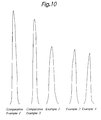
- the instant noodles obtained by the examples 2, 3 and 4 and comparative examples 2 and 3 were boiled in hot water of 500 ml for three minutes, and then soup was added. Sensory test was conducted for the resulted noodles by five panelists. Result of this test is shown in a Table 4. The noodle strips were also tested by means of a rheometer for measuring a cut-off strength. Result of this test is shown in Table 5. Further the instant noodles were immersed in hot water and an amount of water absorbed in the noodles was measured. Result of this test is shown in Table 6. Fig. 10 shows a graph obtained by a rheoplotter on the basis of the data shown in the Table 5.
- the instant noodles according to the examples 2 to 4 of the invention in which the dough sheet was passed through the molding rolls having the pyramid-shaped protrusions having the vertical angle K of 45 degrees to 90 degrees, have improved reconstituting property, give smooth feeling to a tongue, well matche with soup and never bore the consumers with the taste. Further, the noodles have texture which is not like chewing tough rubber, but gives good chewiness.
- test result represented in the Table 6 shows that the instant noodles of the examples 2 to 4 according to the invention can be well reconstituted with hot water as compared with the instant noodles of the comparative examples 2 and 3.
Landscapes
- Life Sciences & Earth Sciences (AREA)
- Engineering & Computer Science (AREA)
- Food Science & Technology (AREA)
- Health & Medical Sciences (AREA)
- Nutrition Science (AREA)
- Chemical & Material Sciences (AREA)
- Polymers & Plastics (AREA)
- Noodles (AREA)
- Manufacturing And Processing Devices For Dough (AREA)
Applications Claiming Priority (3)
| Application Number | Priority Date | Filing Date | Title |
|---|---|---|---|
| JP14244095 | 1995-05-18 | ||
| JP142440/95 | 1995-05-18 | ||
| JP7142440A JP2750671B2 (ja) | 1995-05-18 | 1995-05-18 | 復元性の良い麺線及びその製造方法 |
Publications (2)
| Publication Number | Publication Date |
|---|---|
| EP0743018A1 true EP0743018A1 (fr) | 1996-11-20 |
| EP0743018B1 EP0743018B1 (fr) | 2001-08-01 |
Family
ID=15315369
Family Applications (1)
| Application Number | Title | Priority Date | Filing Date |
|---|---|---|---|
| EP96300458A Expired - Lifetime EP0743018B1 (fr) | 1995-05-18 | 1996-01-24 | Ruban de pâte instantané, procédé et dispositif de sa fabrication |
Country Status (7)
| Country | Link |
|---|---|
| US (1) | US5759608A (fr) |
| EP (1) | EP0743018B1 (fr) |
| JP (1) | JP2750671B2 (fr) |
| KR (1) | KR0175155B1 (fr) |
| CN (1) | CN1074655C (fr) |
| DE (1) | DE69614186T2 (fr) |
| TW (1) | TW284674B (fr) |
Cited By (4)
| Publication number | Priority date | Publication date | Assignee | Title |
|---|---|---|---|---|
| EP1424010A3 (fr) * | 2002-11-20 | 2007-07-11 | Pastificio Rana S.p.A. | Procédé de préparation de pâte alimentaire à haute capacité d'absorption de substances, dispositif de traitement de pâte correspondant et pâte ainsi obtenue |
| WO2011074730A1 (fr) * | 2009-12-16 | 2011-06-23 | 주식회사농심 | Procédé de production de nouilles creuses |
| RU2484648C2 (ru) * | 2009-02-19 | 2013-06-20 | Ниссин Фудз Холдингз Ко., Лтд. | Брикетированная несваренная лапша быстрого приготовления |
| IT202000028763A1 (it) * | 2020-11-27 | 2022-05-27 | Italiana Pastifici S R L | Procedimento di produzione a freddo di pasta alimentare e relativo apparato di produzione |
Families Citing this family (14)
| Publication number | Priority date | Publication date | Assignee | Title |
|---|---|---|---|---|
| US6017573A (en) * | 1997-04-30 | 2000-01-25 | Nestec S.A. | Process for preparing intermediate moisture pasta product |
| US6322840B2 (en) * | 1999-03-16 | 2001-11-27 | Nestec S.A. | Pasta product and manufacture thereof |
| TW200421988A (en) * | 2003-04-21 | 2004-11-01 | Nissin Food Products Ltd | Instant noodles and method for producing instant noodle dishes |
| JP4113858B2 (ja) * | 2004-06-18 | 2008-07-09 | 日清製粉株式会社 | ノンフライ即席麺の製造方法 |
| US8622730B2 (en) * | 2008-12-23 | 2014-01-07 | General Mills, Inc. | Dough forming and cutting apparatus and method |
| US8622729B2 (en) * | 2008-12-23 | 2014-01-07 | General Mills, Inc. | Dough cutting and stamping apparatus and method |
| CN101828672B (zh) * | 2010-05-28 | 2013-02-13 | 杨明德 | 一种软面面条的加工方法及面条加工机 |
| DE102012008649A1 (de) * | 2012-05-03 | 2013-11-07 | Franz Tress | Teigwarenerzeugniseinheit |
| DE102012008648A1 (de) * | 2012-05-03 | 2013-11-07 | Franz Tress | Teigwarenerzeugniseinheit |
| JP5684318B2 (ja) * | 2013-04-17 | 2015-03-11 | サンヨー食品株式会社 | 麺線 |
| US20160095336A1 (en) * | 2014-10-02 | 2016-04-07 | Pastificio Rana S.P.A. | Method for creating a decoration on a layer of dough for making pasta |
| CN106386941B (zh) * | 2016-11-16 | 2018-07-10 | 桐梓县巧媳妇农产品开发有限公司 | 面条加工机 |
| US11013238B2 (en) | 2018-05-24 | 2021-05-25 | General Mills, Inc. | Rotary dough cutter and method of operation |
| CN112956641A (zh) * | 2021-04-13 | 2021-06-15 | 马进龙 | 一种异形兰州拉面面条 |
Citations (3)
| Publication number | Priority date | Publication date | Assignee | Title |
|---|---|---|---|---|
| SU1486136A1 (ru) * | 1987-03-23 | 1989-06-15 | Pk T B Kompleksnoj Ratsionaliz | Устройство для формования мучных изделий с начинкой |
| US5042369A (en) * | 1988-12-27 | 1991-08-27 | Toyo Suisan Kaisha, Ltd. | Apparatus for manufacturing instant noodles |
| US5240731A (en) * | 1992-06-24 | 1993-08-31 | General Mills, Inc. | Apparatus and methods for recouping scrap dough material |
Family Cites Families (5)
| Publication number | Priority date | Publication date | Assignee | Title |
|---|---|---|---|---|
| USD248256S (en) | 1976-06-18 | 1978-06-27 | Pollano Deceased Leo A | Lasagna |
| US4816281A (en) * | 1984-03-06 | 1989-03-28 | Nisshin Flour Milling Co., Ltd. | Extruded elongate pasta |
| US4780329A (en) * | 1986-04-07 | 1988-10-25 | Alterio Joseph C D | Pasta ribbon having aligned slits with rippled edges |
| USD311630S (en) | 1987-02-26 | 1990-10-30 | Francois Scali | Pasta |
| US5047369A (en) * | 1989-05-01 | 1991-09-10 | At&T Bell Laboratories | Fabrication of semiconductor devices using phosphosilicate glasses |
-
1995
- 1995-05-18 JP JP7142440A patent/JP2750671B2/ja not_active Expired - Fee Related
- 1995-07-20 TW TW084107514A patent/TW284674B/zh not_active IP Right Cessation
- 1995-09-11 CN CN95116941A patent/CN1074655C/zh not_active Expired - Fee Related
- 1995-10-24 KR KR1019950036746A patent/KR0175155B1/ko not_active Expired - Fee Related
-
1996
- 1996-01-24 DE DE69614186T patent/DE69614186T2/de not_active Expired - Fee Related
- 1996-01-24 EP EP96300458A patent/EP0743018B1/fr not_active Expired - Lifetime
- 1996-03-13 US US08/615,512 patent/US5759608A/en not_active Expired - Fee Related
Patent Citations (3)
| Publication number | Priority date | Publication date | Assignee | Title |
|---|---|---|---|---|
| SU1486136A1 (ru) * | 1987-03-23 | 1989-06-15 | Pk T B Kompleksnoj Ratsionaliz | Устройство для формования мучных изделий с начинкой |
| US5042369A (en) * | 1988-12-27 | 1991-08-27 | Toyo Suisan Kaisha, Ltd. | Apparatus for manufacturing instant noodles |
| US5240731A (en) * | 1992-06-24 | 1993-08-31 | General Mills, Inc. | Apparatus and methods for recouping scrap dough material |
Non-Patent Citations (2)
| Title |
|---|
| DATABASE WPI Section Ch Week 7230, Derwent World Patents Index; Class D11, AN 72-47969T, XP002012296 * |
| DATABASE WPI Section Ch Week 9011, Derwent World Patents Index; Class D11, AN 90-082425, XP002012295 * |
Cited By (4)
| Publication number | Priority date | Publication date | Assignee | Title |
|---|---|---|---|---|
| EP1424010A3 (fr) * | 2002-11-20 | 2007-07-11 | Pastificio Rana S.p.A. | Procédé de préparation de pâte alimentaire à haute capacité d'absorption de substances, dispositif de traitement de pâte correspondant et pâte ainsi obtenue |
| RU2484648C2 (ru) * | 2009-02-19 | 2013-06-20 | Ниссин Фудз Холдингз Ко., Лтд. | Брикетированная несваренная лапша быстрого приготовления |
| WO2011074730A1 (fr) * | 2009-12-16 | 2011-06-23 | 주식회사농심 | Procédé de production de nouilles creuses |
| IT202000028763A1 (it) * | 2020-11-27 | 2022-05-27 | Italiana Pastifici S R L | Procedimento di produzione a freddo di pasta alimentare e relativo apparato di produzione |
Also Published As
| Publication number | Publication date |
|---|---|
| EP0743018B1 (fr) | 2001-08-01 |
| JPH08308518A (ja) | 1996-11-26 |
| DE69614186T2 (de) | 2001-11-22 |
| JP2750671B2 (ja) | 1998-05-13 |
| DE69614186D1 (de) | 2001-09-06 |
| KR960040161A (ko) | 1996-12-17 |
| CN1074655C (zh) | 2001-11-14 |
| TW284674B (en) | 1996-09-01 |
| KR0175155B1 (ko) | 1999-02-18 |
| CN1135849A (zh) | 1996-11-20 |
| US5759608A (en) | 1998-06-02 |
Similar Documents
| Publication | Publication Date | Title |
|---|---|---|
| EP0743018B1 (fr) | Ruban de pâte instantané, procédé et dispositif de sa fabrication | |
| US4675199A (en) | Production of pasta | |
| US6117466A (en) | Formed chips and method of production thereof | |
| AU723031B2 (en) | Processes for the production of noodles by machines | |
| US4857357A (en) | Soya food product and process | |
| JPS63248366A (ja) | 即席麺類の製造法 | |
| US6203830B1 (en) | Method of producing filled pasta | |
| JP3332979B2 (ja) | 練粉シートの製造装置及び製造方法 | |
| JP2807536B2 (ja) | 溝付き麺類 | |
| JPH07106128B2 (ja) | 溝付き押出成形麺 | |
| JPS63269960A (ja) | 麺類の製造方法 | |
| JP2660038B2 (ja) | 溝付き押出麺類 | |
| US2045228A (en) | Manufacture of bread | |
| JPH11113515A (ja) | 三角麺類または五角麺類の製造装置および製造方法 | |
| JP2997952B2 (ja) | 中華麺の製造方法 | |
| JPH0494658A (ja) | 麺類の製造装置 | |
| JPS60244256A (ja) | 中空スナツク食品およびその製造方法並びに装置 | |
| JPS6327597Y2 (fr) | ||
| EP1815753A1 (fr) | Méthode de préparation d'un produit intermédiaire à base de pommes de terre, céréales, légumes ou dérivés, pour la fabrication de snacks | |
| JPS6170951A (ja) | 手延うどんの製造方法 | |
| JP7177735B2 (ja) | 食塩濃度に斑を有する麺帯 | |
| JP2004129538A (ja) | 溝付き即席麺及びその製造方法 | |
| KR890001480B1 (ko) | 스낵식품의 제조방법 | |
| JPS6027342A (ja) | スナツク食品およびその製造法 | |
| JPS61234759A (ja) | 繊維状練製品の製造法 |
Legal Events
| Date | Code | Title | Description |
|---|---|---|---|
| PUAI | Public reference made under article 153(3) epc to a published international application that has entered the european phase |
Free format text: ORIGINAL CODE: 0009012 |
|
| 17P | Request for examination filed |
Effective date: 19960205 |
|
| AK | Designated contracting states |
Kind code of ref document: A1 Designated state(s): DE FR GB IT |
|
| 17Q | First examination report despatched |
Effective date: 20000210 |
|
| GRAG | Despatch of communication of intention to grant |
Free format text: ORIGINAL CODE: EPIDOS AGRA |
|
| GRAG | Despatch of communication of intention to grant |
Free format text: ORIGINAL CODE: EPIDOS AGRA |
|
| GRAH | Despatch of communication of intention to grant a patent |
Free format text: ORIGINAL CODE: EPIDOS IGRA |
|
| GRAH | Despatch of communication of intention to grant a patent |
Free format text: ORIGINAL CODE: EPIDOS IGRA |
|
| GRAA | (expected) grant |
Free format text: ORIGINAL CODE: 0009210 |
|
| AK | Designated contracting states |
Kind code of ref document: B1 Designated state(s): DE FR GB IT |
|
| REF | Corresponds to: |
Ref document number: 69614186 Country of ref document: DE Date of ref document: 20010906 |
|
| EN | Fr: translation not filed | ||
| REG | Reference to a national code |
Ref country code: GB Ref legal event code: IF02 |
|
| EN | Fr: translation not filed |
Free format text: BO 01/52 PAGES: 283, IL Y A LIEU DE SUPPRIMER: LA MENTION DE LA NON REMISE. LA REMISE EST PUBLIEE DANS LE PRESENT BOPI. |
|
| ET | Fr: translation filed | ||
| PLBE | No opposition filed within time limit |
Free format text: ORIGINAL CODE: 0009261 |
|
| 26N | No opposition filed | ||
| PG25 | Lapsed in a contracting state [announced via postgrant information from national office to epo] |
Ref country code: FR Free format text: LAPSE BECAUSE OF NON-PAYMENT OF DUE FEES Effective date: 20020930 |
|
| REG | Reference to a national code |
Ref country code: FR Ref legal event code: ST |
|
| REG | Reference to a national code |
Ref country code: FR Ref legal event code: RN |
|
| REG | Reference to a national code |
Ref country code: FR Ref legal event code: D3 |
|
| PGFP | Annual fee paid to national office [announced via postgrant information from national office to epo] |
Ref country code: DE Payment date: 20090122 Year of fee payment: 14 |
|
| PGFP | Annual fee paid to national office [announced via postgrant information from national office to epo] |
Ref country code: GB Payment date: 20090122 Year of fee payment: 14 |
|
| PGFP | Annual fee paid to national office [announced via postgrant information from national office to epo] |
Ref country code: IT Payment date: 20090128 Year of fee payment: 14 |
|
| PGFP | Annual fee paid to national office [announced via postgrant information from national office to epo] |
Ref country code: FR Payment date: 20090115 Year of fee payment: 14 |
|
| GBPC | Gb: european patent ceased through non-payment of renewal fee |
Effective date: 20100124 |
|
| REG | Reference to a national code |
Ref country code: FR Ref legal event code: ST Effective date: 20100930 |
|
| PG25 | Lapsed in a contracting state [announced via postgrant information from national office to epo] |
Ref country code: DE Free format text: LAPSE BECAUSE OF NON-PAYMENT OF DUE FEES Effective date: 20100803 |
|
| PG25 | Lapsed in a contracting state [announced via postgrant information from national office to epo] |
Ref country code: GB Free format text: LAPSE BECAUSE OF NON-PAYMENT OF DUE FEES Effective date: 20100124 |
|
| PG25 | Lapsed in a contracting state [announced via postgrant information from national office to epo] |
Ref country code: IT Free format text: LAPSE BECAUSE OF NON-PAYMENT OF DUE FEES Effective date: 20100124 |
|
| PG25 | Lapsed in a contracting state [announced via postgrant information from national office to epo] |
Ref country code: FR Free format text: LAPSE BECAUSE OF NON-PAYMENT OF DUE FEES Effective date: 20100131 |