EP0743257B1 - Barquette pour denrées consommables, notamment alimentaires, et procédé de fabrication de la barquette - Google Patents
Barquette pour denrées consommables, notamment alimentaires, et procédé de fabrication de la barquette Download PDFInfo
- Publication number
- EP0743257B1 EP0743257B1 EP96400961A EP96400961A EP0743257B1 EP 0743257 B1 EP0743257 B1 EP 0743257B1 EP 96400961 A EP96400961 A EP 96400961A EP 96400961 A EP96400961 A EP 96400961A EP 0743257 B1 EP0743257 B1 EP 0743257B1
- Authority
- EP
- European Patent Office
- Prior art keywords
- sheet
- paper
- container
- greaseproof
- layer
- Prior art date
- Legal status (The legal status is an assumption and is not a legal conclusion. Google has not performed a legal analysis and makes no representation as to the accuracy of the status listed.)
- Expired - Lifetime
Links
Images
Classifications
-
- B—PERFORMING OPERATIONS; TRANSPORTING
- B32—LAYERED PRODUCTS
- B32B—LAYERED PRODUCTS, i.e. PRODUCTS BUILT-UP OF STRATA OF FLAT OR NON-FLAT, e.g. CELLULAR OR HONEYCOMB, FORM
- B32B29/00—Layered products comprising a layer of paper or cardboard
- B32B29/002—Layered products comprising a layer of paper or cardboard as the main or only constituent of a layer, which is next to another layer of the same or of a different material
- B32B29/005—Layered products comprising a layer of paper or cardboard as the main or only constituent of a layer, which is next to another layer of the same or of a different material next to another layer of paper or cardboard layer
-
- B—PERFORMING OPERATIONS; TRANSPORTING
- B32—LAYERED PRODUCTS
- B32B—LAYERED PRODUCTS, i.e. PRODUCTS BUILT-UP OF STRATA OF FLAT OR NON-FLAT, e.g. CELLULAR OR HONEYCOMB, FORM
- B32B29/00—Layered products comprising a layer of paper or cardboard
-
- B—PERFORMING OPERATIONS; TRANSPORTING
- B32—LAYERED PRODUCTS
- B32B—LAYERED PRODUCTS, i.e. PRODUCTS BUILT-UP OF STRATA OF FLAT OR NON-FLAT, e.g. CELLULAR OR HONEYCOMB, FORM
- B32B1/00—Layered products having a non-planar shape
-
- B—PERFORMING OPERATIONS; TRANSPORTING
- B32—LAYERED PRODUCTS
- B32B—LAYERED PRODUCTS, i.e. PRODUCTS BUILT-UP OF STRATA OF FLAT OR NON-FLAT, e.g. CELLULAR OR HONEYCOMB, FORM
- B32B7/00—Layered products characterised by the relation between layers; Layered products characterised by the relative orientation of features between layers, or by the relative values of a measurable parameter between layers, i.e. products comprising layers having different physical, chemical or physicochemical properties; Layered products characterised by the interconnection of layers
- B32B7/04—Interconnection of layers
- B32B7/12—Interconnection of layers using interposed adhesives or interposed materials with bonding properties
-
- B—PERFORMING OPERATIONS; TRANSPORTING
- B65—CONVEYING; PACKING; STORING; HANDLING THIN OR FILAMENTARY MATERIAL
- B65D—CONTAINERS FOR STORAGE OR TRANSPORT OF ARTICLES OR MATERIALS, e.g. BAGS, BARRELS, BOTTLES, BOXES, CANS, CARTONS, CRATES, DRUMS, JARS, TANKS, HOPPERS, FORWARDING CONTAINERS; ACCESSORIES, CLOSURES, OR FITTINGS THEREFOR; PACKAGING ELEMENTS; PACKAGES
- B65D5/00—Rigid or semi-rigid containers of polygonal cross-section, e.g. boxes, cartons or trays, formed by folding or erecting one or more blanks made of paper
- B65D5/42—Details of containers or of foldable or erectable container blanks
- B65D5/56—Linings or internal coatings, e.g. pre-formed trays provided with a blow- or thermoformed layer
- B65D5/563—Laminated linings; Coatings
-
- B—PERFORMING OPERATIONS; TRANSPORTING
- B65—CONVEYING; PACKING; STORING; HANDLING THIN OR FILAMENTARY MATERIAL
- B65D—CONTAINERS FOR STORAGE OR TRANSPORT OF ARTICLES OR MATERIALS, e.g. BAGS, BARRELS, BOTTLES, BOXES, CANS, CARTONS, CRATES, DRUMS, JARS, TANKS, HOPPERS, FORWARDING CONTAINERS; ACCESSORIES, CLOSURES, OR FITTINGS THEREFOR; PACKAGING ELEMENTS; PACKAGES
- B65D77/00—Packages formed by enclosing articles or materials in preformed containers, e.g. boxes, cartons, sacks or bags
- B65D77/10—Container closures formed after filling
- B65D77/20—Container closures formed after filling by applying separate lids or covers, i.e. flexible membrane or foil-like covers
- B65D77/2024—Container closures formed after filling by applying separate lids or covers, i.e. flexible membrane or foil-like covers the cover being welded or adhered to the container
-
- D—TEXTILES; PAPER
- D21—PAPER-MAKING; PRODUCTION OF CELLULOSE
- D21H—PULP COMPOSITIONS; PREPARATION THEREOF NOT COVERED BY SUBCLASSES D21C OR D21D; IMPREGNATING OR COATING OF PAPER; TREATMENT OF FINISHED PAPER NOT COVERED BY CLASS B31 OR SUBCLASS D21G; PAPER NOT OTHERWISE PROVIDED FOR
- D21H27/00—Special paper not otherwise provided for, e.g. made by multi-step processes
- D21H27/30—Multi-ply
- D21H27/32—Multi-ply with materials applied between the sheets
-
- D—TEXTILES; PAPER
- D21—PAPER-MAKING; PRODUCTION OF CELLULOSE
- D21H—PULP COMPOSITIONS; PREPARATION THEREOF NOT COVERED BY SUBCLASSES D21C OR D21D; IMPREGNATING OR COATING OF PAPER; TREATMENT OF FINISHED PAPER NOT COVERED BY CLASS B31 OR SUBCLASS D21G; PAPER NOT OTHERWISE PROVIDED FOR
- D21H27/00—Special paper not otherwise provided for, e.g. made by multi-step processes
- D21H27/30—Multi-ply
- D21H27/38—Multi-ply at least one of the sheets having a fibrous composition differing from that of other sheets
-
- B—PERFORMING OPERATIONS; TRANSPORTING
- B32—LAYERED PRODUCTS
- B32B—LAYERED PRODUCTS, i.e. PRODUCTS BUILT-UP OF STRATA OF FLAT OR NON-FLAT, e.g. CELLULAR OR HONEYCOMB, FORM
- B32B2439/00—Containers; Receptacles
- B32B2439/70—Food packaging
-
- D—TEXTILES; PAPER
- D21—PAPER-MAKING; PRODUCTION OF CELLULOSE
- D21H—PULP COMPOSITIONS; PREPARATION THEREOF NOT COVERED BY SUBCLASSES D21C OR D21D; IMPREGNATING OR COATING OF PAPER; TREATMENT OF FINISHED PAPER NOT COVERED BY CLASS B31 OR SUBCLASS D21G; PAPER NOT OTHERWISE PROVIDED FOR
- D21H27/00—Special paper not otherwise provided for, e.g. made by multi-step processes
- D21H27/06—Vegetable or imitation parchment; Glassine paper
-
- D—TEXTILES; PAPER
- D21—PAPER-MAKING; PRODUCTION OF CELLULOSE
- D21H—PULP COMPOSITIONS; PREPARATION THEREOF NOT COVERED BY SUBCLASSES D21C OR D21D; IMPREGNATING OR COATING OF PAPER; TREATMENT OF FINISHED PAPER NOT COVERED BY CLASS B31 OR SUBCLASS D21G; PAPER NOT OTHERWISE PROVIDED FOR
- D21H27/00—Special paper not otherwise provided for, e.g. made by multi-step processes
- D21H27/10—Packing paper
Definitions
- the present invention relates to the field of the paper and cardboard industry, and concerns more specifically a container or receptacle intended for packaging of consumable products such as, for example example, food, cosmetic or industrial (see par example WO-A-93 25 057).
- the invention aims to respond, in the field food, needs and desire developing in consumers to have food packaged, packaged, ready to use and, immediately available without special preparation.
- the invention makes it possible to meet the needs of consumers looking to stock up on food products in unit dose form prepared and packaged, therefore easily taken from the shelves of self-service outlets, these packaged products being specific to a more or less long storage, either at temperature room, either on the shelves of a refrigerator or possibly a freezer.
- the products can thus be taken from the storage site and used either at the room temperature either after reheating in a room or infrared oven, or microwave oven type.
- the packaging currently used and meeting these purposes essentially consist of trays, metal or plastic boxes or containers.
- the materials traditionally used for the realization of rigid trays allow badly the direct passage of the food product through its storage container in a warming enclosure, when, for example, food preparations intended for consumption, either after cooking final, or even after a simple reheating.
- the metallic materials do not lend themselves to passing through a microwave oven, due to their conductivity electric; and trays or storage containers in terms of synthesis, often of a nature thermoplastic, do not resist a rise of temperature compatible with final cooking or with a satisfactory warming of food products.
- Another objective of the invention in addition to overcoming to the pollutant load disadvantages supported by the community, is to respond to the wish of the consumer to have a container suitable for allow possibly prolonged storage, even container which can be, during the preparatory phase and preceding consumption, subject to warming either in a room oven, or in a radiation oven infrared, or still in a microwave oven.
- An object of the present invention to provide ranges of containers or packaging, especially under shape of trays, capable of being occluded while being easily opened during the final phase preceding consumption, these containers being suitable after a conservation phase, to undergo a phase of possible reheating either for cooking final either in order to bring them to temperature appropriate, without decanting, the product thus being likely to pass directly from the enclosure of storage (simple cupboard, fridge or freezer), on the plate or on the consumption table, whether be it the family table or a table collective catering.
- the invention relates to a container to contain and store products consumables such as foodstuffs in particular food and able to undergo a thermal elevation treatment immediately before consumption, as defined by claim 1.
- the glue resistant to the humidity is food compatible and heat resistant.
- the container is provided with a cover consisting of a waterproof sheet flexible sealed on the upper edges of said container and able to be removed by simple peeling.
- a rigid cover fitted is provided.
- the humidification of the baking sheet incorporates a humidity level between 5 and 30% and preferably equal to 12%.
- a complex formed is produced on the one hand, a sheet of greaseproof paper (of preferably real parchment paper) associated, with with a water-resistant glue, a layer of paper or cardboard.
- the whole is subjected to thermoforming by a set of dies and punches of complementary conformation and subject to heating during operation.
- the glue used to ensure the complex formed from the sheet of greaseproof paper and the outer sheet is a single-component adhesive based polyurethane, more especially, for example, a glue known under the trade name SWIFT EC1 2340.
- the invention also relates to a container characterized in that the complex has a third layer associated with the outer layer of paper or cardboard, on the side opposite the paper side greasable, this third outer layer being consisting of a sheet of paper or cardboard, suitable for provide an improvement in aesthetics, greasiness and mechanical strength and allowing to receive informative registrations or commercial on the product contained.
- the third sheet exterior can be of the greaseproof type, made of paper parchment, coated paper, or any type of paper or cardboard.
- edges of the container or tray thus shaped are folded down along a horizontal plane and constituting the surface support to receive a closure lid the interior space of the container, this lid being secured by sealing on said bearing face and being removable by simple manual peeling.
- greaseproof paper of the greaseproof type is provided with a grammage varying from 25 g / m 2 to 150 g / m 2 , and more precisely from 40 to 70 g / m 2 , while the associated outer sheet is a grammage card between 200 and 600 g / m 2 , which may be of the coated type.
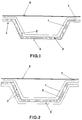
- Figure 1 shows a sectional view of a tray according to the invention, according to a first form of production ;
- Figure 2 shows a variant of production.
- Figures 1 and 2 relate to a form of embodiment of the invention in which the tray is made from a complex associating a layer of parchment paper and a sheet of cardboard.
- the layer formed from parchment paper 1 is laminated with a layer of interstitial glue 2 on the layer of cardboard 3 which will conform the outer face from the tray.
- the sheet of parchment paper is provided with a relatively light grammage and varying from 25 g / m 2 to 150 g / m 2 , and preferably between 40 and 70 g / m 2 , while the cardboard consists of '' a sheet of cardboard with a grammage of approximately 250 g / m 2 .
- the glue is an organic glue allowing to constitute a barrier to water; we will advantageously use the product known as trade name SWIFT EC1 2340, produced by SWIFT ADHESIFS FRANCE.
- the flat sheet thus formed and conforming the complex intended for the production of the container or the tray according to the invention is then shaped in order to define a product receiving space, in particular of the food product.
- Formatting can be done in two ways.
- one conforms according to a determined plane of grooves or grooves representing a desired geometric configuration and these grooves or grooves defining the folding angles faces of the container during its shaping.
- the complex is shaped in a single operation of thermoforming, in which the complex is caught between an intaglio or matrix imprint and an imprint in relief of corresponding conformation or punch.
- Matrix and punch are heated and ensure and stabilize the deformation of the walls which are raised at from the bottom to conform to the desired final tray.
- the assembly and especially the side consisting of parchment paper 1 is subjected to softening by partial impregnation or packaging by passage through a steam box.
- the outer sheet, on which is stuck or laminated the inner sheet of paper of the type greaseproof can itself be made of paper sulfurized. It is possible to combine the two sheets (interior and exterior) of sulfurized without the addition of glue, by fixing and combining the two sheets of sulfurized during the manufacture of the latter. More especially the two sheets of parchment paper are joined by the cellulose gel generated during of the manufacture of sulfurized.
- this can be either monolayer or multilayer, that is to say itself made up of several layers of different papers, contributing to the same goal and presenting greasability properties.
- greaseproof materials and sulfurized can be subjected to any type of treatment to result in a parchment paper of the type siliconized, quiloned or otherwise treated known.
- the container of the invention is not limited to containing or preserving food products, but can also be applied to the field of cosmetology, for creams, shampoos, or products similar, or from industry in general, for glues, paints, mastics, or similar products.
Landscapes
- Engineering & Computer Science (AREA)
- Mechanical Engineering (AREA)
- Wrappers (AREA)
- Cartons (AREA)
- Packages (AREA)
- Containers Having Bodies Formed In One Piece (AREA)
- General Preparation And Processing Of Foods (AREA)
- Paper (AREA)
- Bakery Products And Manufacturing Methods Therefor (AREA)
- Blow-Moulding Or Thermoforming Of Plastics Or The Like (AREA)
- Laminated Bodies (AREA)
- Packging For Living Organisms, Food Or Medicinal Products That Are Sensitive To Environmental Conditiond (AREA)
Description
Claims (12)
- Récipient permettant de contenir et conserver des produits consommables, tels que, par exemple, des denrées alimentaires, caractérisé en ce qu'il est constitué d'un complexe formé d'au moins une feuille de papier (1) conformant la paroi intérieure du récipient, cette feuille de papier étant du type ingraissable constitué de papier sulfurisé et contrecollée sur une feuille extérieure de papier ou carton (3), par une couche interstitielle (2) constituée d'une colle résistant à l'humidité et à la chaleur, et notamment à compatibilité alimentaire, l'ensemble étant mis en forme pour réserver un volume de réception du produit contenu.
- Récipient selon la revendication 1, caractérisé en ce qu'il est pourvu d'un opercule constitué d'une feuille étanche (6) souple, scellée sur les bords supérieurs (4) audit récipient et apte à être retiré par simple pelage.
- Récipient selon l'une des revendications 1 ou 2, caractérisé en ce que la colle utilisée pour assurer le complexe formé de la feuille de papier ingraissable, et la feuille extérieure de papier ou carton, est une colle à base de résine organique.
- Récipient selon la revendication 3, caractérisé en ce que la colle est du type connu sous la dénomination commerciale SWIFT EC 1 2340.
- Récipient selon l'une des revendications 1 à 4, caractérisé en ce que le complexe comporte une troisième couche constituée d'une feuille de papier ingraissable, la couche de papier ou carton étant prise en sandwich entre la couche intérieure et ladite troisième couche.
- Récipient selon l'une des revendications 1 à 5, caractérisé en ce que le papier ingraissable présente un grammage compris entre 25g/m2 et 150g/m2, de préférence entre 40 et 70g/m2, tandis que la feuille extérieure associée est un carton de grammage compris entre 200 et 600g/m2.
- Récipient selon la revendication 1, caractérisé en ce que la feuille extérieure est constituée de papier sulfurisé.
- Récipient selon la revendication 5, caractérisé en ce que la couche intérieure et/ou la troisième couche est/sont du type papier sulfurisé.
- Procédé pour la réalisation d'un récipient en vue de contenir et conserver des produits consommables (denrées alimentaires), caractérisé par les opérations suivantes :a) on réalise par contrecollage un complexe formé d'au moins un papier ingraissable du type sulfurisé et destiné à constituer la face intérieure du récipient, ladite feuille étant associée par complexage au moyen d'une colle résistant à l'eau (2), à une feuille (3) extérieure en matériau fibreux (papier, carton ou analogues);b) on humidifie au moins la face constituée du matériau ingraissable, en vue de rendre ladite feuille malléable;c) on forme des rainures ou cannelures dans ledit complexe selon les lignes futures de repli des faces devant être rabattues;d) on conforme la feuille selon une structure en trois dimensions par repli des faces définies par l'espace entre lesdites rainures ou cannelures en vue de constituer un volume en creux constituant lui-même un espace récepteur des denrées contenues;e) on solidarise par collage les faces venant en contact après ledit repli afin de solidariser et de stabiliser l'ensemble volumique ainsi formé.
- Procédé selon la revendication 9, caractérisé en ce que l'humidification de la feuille de matériau du type ingraissable (1) incorpore un degré d'humidité compris entre 5 et 30% et de préférence égal à 12%.
- Procédé selon l'une des revendications 9 ou 10, caractérisé en ce que l'on réalise un complexe formé d'une part d'une feuille de papier ingraissable (1), associée au moyen d'une colle résistant à l'eau (2) et à la chaleur, à une couche de papier ou carton (3), on humidifie au moins la couche de sulfurisé, puis l'ensemble est soumis à thermoformage par un jeu de matrices et poinçons de conformations complémentaires, les matrices et poinçons étant soumis à chauffage en cours d'opération.
- Procédé selon l'une des revendications 9 à 11, caractérisé en ce que la feuille en matériau ingraissable est constituée de papier sulfurisé.
Priority Applications (1)
| Application Number | Priority Date | Filing Date | Title |
|---|---|---|---|
| EP99106732A EP0943557B1 (fr) | 1995-05-15 | 1996-05-06 | Récipient pour denrées consommables constitué d'une feuille monocouche ou multicouche et procédé de réalisation |
Applications Claiming Priority (2)
| Application Number | Priority Date | Filing Date | Title |
|---|---|---|---|
| FR9505707A FR2734245B1 (fr) | 1995-05-15 | 1995-05-15 | Recipient apte a contenir et conserver des denrees consommables perissables, notamment alimentaires |
| FR9505707 | 1995-05-15 |
Related Child Applications (1)
| Application Number | Title | Priority Date | Filing Date |
|---|---|---|---|
| EP99106732A Division EP0943557B1 (fr) | 1995-05-15 | 1996-05-06 | Récipient pour denrées consommables constitué d'une feuille monocouche ou multicouche et procédé de réalisation |
Publications (2)
| Publication Number | Publication Date |
|---|---|
| EP0743257A1 EP0743257A1 (fr) | 1996-11-20 |
| EP0743257B1 true EP0743257B1 (fr) | 1999-11-03 |
Family
ID=9478970
Family Applications (2)
| Application Number | Title | Priority Date | Filing Date |
|---|---|---|---|
| EP99106732A Expired - Lifetime EP0943557B1 (fr) | 1995-05-15 | 1996-05-06 | Récipient pour denrées consommables constitué d'une feuille monocouche ou multicouche et procédé de réalisation |
| EP96400961A Expired - Lifetime EP0743257B1 (fr) | 1995-05-15 | 1996-05-06 | Barquette pour denrées consommables, notamment alimentaires, et procédé de fabrication de la barquette |
Family Applications Before (1)
| Application Number | Title | Priority Date | Filing Date |
|---|---|---|---|
| EP99106732A Expired - Lifetime EP0943557B1 (fr) | 1995-05-15 | 1996-05-06 | Récipient pour denrées consommables constitué d'une feuille monocouche ou multicouche et procédé de réalisation |
Country Status (7)
| Country | Link |
|---|---|
| EP (2) | EP0943557B1 (fr) |
| AT (2) | ATE232178T1 (fr) |
| DE (2) | DE69626138T2 (fr) |
| DK (2) | DK0943557T3 (fr) |
| ES (2) | ES2188053T3 (fr) |
| FR (1) | FR2734245B1 (fr) |
| PT (1) | PT743257E (fr) |
Families Citing this family (1)
| Publication number | Priority date | Publication date | Assignee | Title |
|---|---|---|---|---|
| GB2590361B (en) * | 2019-12-05 | 2024-06-19 | Coveris Flexibles Uk Ltd | A Carton |
Family Cites Families (6)
| Publication number | Priority date | Publication date | Assignee | Title |
|---|---|---|---|---|
| US3198416A (en) * | 1962-09-10 | 1965-08-03 | Packaging Corp America | Method of preventing wicking and moisture and vapor absorption and penetration in paperboard cartons, and cartons produced by such method |
| US3792809A (en) * | 1971-10-29 | 1974-02-19 | D Schneider | Disposable tray |
| US3756495A (en) * | 1972-03-02 | 1973-09-04 | Robalex Inc | Boilable bakeable package |
| NO901483L (no) * | 1990-04-02 | 1991-10-03 | Polycoat As | Gasstett innpakningsmateriale, fremgangsmaate til fremstilling av dette samt anvendelse av materialet. |
| DE69322269T2 (de) * | 1992-05-27 | 1999-04-22 | Conagra, Inc., Omaha, Nebr. | Lebensmittelbehälter und dergleichen mit durch druck aufgetragenen schichten |
| FR2716869B1 (fr) * | 1994-03-04 | 1996-05-24 | Cmb Flexible | Feuille d'emballage pour produits gras et procédés de fabrication associés. |
-
1995
- 1995-05-15 FR FR9505707A patent/FR2734245B1/fr not_active Expired - Lifetime
-
1996
- 1996-05-06 DE DE69626138T patent/DE69626138T2/de not_active Expired - Lifetime
- 1996-05-06 AT AT99106732T patent/ATE232178T1/de active
- 1996-05-06 DE DE69604965T patent/DE69604965T2/de not_active Expired - Lifetime
- 1996-05-06 DK DK99106732T patent/DK0943557T3/da active
- 1996-05-06 PT PT96400961T patent/PT743257E/pt unknown
- 1996-05-06 ES ES99106732T patent/ES2188053T3/es not_active Expired - Lifetime
- 1996-05-06 EP EP99106732A patent/EP0943557B1/fr not_active Expired - Lifetime
- 1996-05-06 ES ES96400961T patent/ES2140044T3/es not_active Expired - Lifetime
- 1996-05-06 AT AT96400961T patent/ATE186268T1/de active
- 1996-05-06 DK DK96400961T patent/DK0743257T3/da active
- 1996-05-06 EP EP96400961A patent/EP0743257B1/fr not_active Expired - Lifetime
Also Published As
| Publication number | Publication date |
|---|---|
| EP0743257A1 (fr) | 1996-11-20 |
| DE69604965T2 (de) | 2000-06-15 |
| DE69626138D1 (de) | 2003-03-13 |
| EP0943557B1 (fr) | 2003-02-05 |
| FR2734245B1 (fr) | 1997-06-20 |
| DE69604965D1 (de) | 1999-12-09 |
| ES2188053T3 (es) | 2003-06-16 |
| FR2734245A1 (fr) | 1996-11-22 |
| ATE232178T1 (de) | 2003-02-15 |
| EP0943557A1 (fr) | 1999-09-22 |
| ATE186268T1 (de) | 1999-11-15 |
| ES2140044T3 (es) | 2000-02-16 |
| PT743257E (pt) | 2000-04-28 |
| DK0743257T3 (da) | 2000-05-08 |
| DK0943557T3 (da) | 2003-02-24 |
| DE69626138T2 (de) | 2003-11-20 |
Similar Documents
| Publication | Publication Date | Title |
|---|---|---|
| CA1117915A (fr) | Emballage pour produits alimentaires | |
| DE69635223T2 (de) | Verpackungsaufbau mit innenverschluss für microwellenkochen | |
| JP2020537618A (ja) | フラットシートで構成される複合体、複合体を得る方法、パッケージを製造する方法、および品物を包装する方法 | |
| FR2649071A1 (fr) | ||
| MX2010012258A (es) | Empaque para alimentos. | |
| FR2464203A1 (fr) | Recipient profile en pate moulee avec revetement de polyester et procede pour appliquer ce revetement | |
| FR3141685A1 (fr) | Élément d’emballage multicouche, emballage comprenant cet élément et procédé de réalisation de cet élément d’emballage | |
| JP2005519003A (ja) | 変位可能な底、本体又は蓋部分を備えた食品用の容器 | |
| EP0943557B1 (fr) | Récipient pour denrées consommables constitué d'une feuille monocouche ou multicouche et procédé de réalisation | |
| EP2344305A1 (fr) | Procede de realisation d'une boite ou d'un habillage d'emballage tronconique ou tronc-pyramidal, notamment pour produits alimentaires ou horticoles, boite et habillage ainsi obtenus | |
| BE1028605B1 (fr) | Récipient pour produits alimentaires | |
| JP5444871B2 (ja) | 襞付き紙製容器及び襞付き紙製容器の製造方法 | |
| FR2599335A1 (fr) | Boite de presentation a fenetre | |
| US5106670A (en) | Metalized package components and methods of forming the same | |
| JPH03295B2 (fr) | ||
| EP0109878A1 (fr) | Boîte isolante | |
| EP1357055B1 (fr) | Emballage alimentaire comprenant au moins une zone de scellement de moindre résistance | |
| FR2859185A1 (fr) | Barquette absorbante avec ou sans barriere et procede de fabrication | |
| BE1015314A3 (fr) | Conditionnement pour produit alimentaire. | |
| FR2780706A1 (fr) | Papier thermoscellable destine a l'emballage de produits frais et emballage utilisant un tel papier | |
| JP2544244B2 (ja) | 容 器 | |
| FR2607110A1 (fr) | Emballage pour produit perissable et son procede de fabrication | |
| FR2748004A1 (fr) | Nouveau conteneur en un materiau semi-rigide et son procede de fabrication | |
| CN103391882A (zh) | 纸质容器以及纸质容器的制造方法 | |
| EP1751028B1 (fr) | Emballage pour aliments, conserve et procede pour obtenir et utiliser un tel emballage |
Legal Events
| Date | Code | Title | Description |
|---|---|---|---|
| PUAI | Public reference made under article 153(3) epc to a published international application that has entered the european phase |
Free format text: ORIGINAL CODE: 0009012 |
|
| AK | Designated contracting states |
Kind code of ref document: A1 Designated state(s): AT BE CH DE DK ES FI FR GB IE IT LI LU NL PT SE |
|
| 17P | Request for examination filed |
Effective date: 19961017 |
|
| 17Q | First examination report despatched |
Effective date: 19971103 |
|
| RAP1 | Party data changed (applicant data changed or rights of an application transferred) |
Owner name: AHLSTROM INDUSTRIES SA |
|
| GRAG | Despatch of communication of intention to grant |
Free format text: ORIGINAL CODE: EPIDOS AGRA |
|
| GRAG | Despatch of communication of intention to grant |
Free format text: ORIGINAL CODE: EPIDOS AGRA |
|
| GRAG | Despatch of communication of intention to grant |
Free format text: ORIGINAL CODE: EPIDOS AGRA |
|
| GRAH | Despatch of communication of intention to grant a patent |
Free format text: ORIGINAL CODE: EPIDOS IGRA |
|
| GRAH | Despatch of communication of intention to grant a patent |
Free format text: ORIGINAL CODE: EPIDOS IGRA |
|
| GRAA | (expected) grant |
Free format text: ORIGINAL CODE: 0009210 |
|
| AK | Designated contracting states |
Kind code of ref document: B1 Designated state(s): AT BE CH DE DK ES FI FR GB IE IT LI LU NL PT SE |
|
| REF | Corresponds to: |
Ref document number: 186268 Country of ref document: AT Date of ref document: 19991115 Kind code of ref document: T |
|
| REG | Reference to a national code |
Ref country code: CH Ref legal event code: EP |
|
| REF | Corresponds to: |
Ref document number: 69604965 Country of ref document: DE Date of ref document: 19991209 |
|
| REG | Reference to a national code |
Ref country code: CH Ref legal event code: NV Representative=s name: INFOSUISSE |
|
| REG | Reference to a national code |
Ref country code: IE Ref legal event code: FG4D Free format text: FRENCH |
|
| ITF | It: translation for a ep patent filed | ||
| GBT | Gb: translation of ep patent filed (gb section 77(6)(a)/1977) |
Effective date: 20000120 |
|
| REG | Reference to a national code |
Ref country code: ES Ref legal event code: FG2A Ref document number: 2140044 Country of ref document: ES Kind code of ref document: T3 |
|
| REG | Reference to a national code |
Ref country code: PT Ref legal event code: SC4A Free format text: AVAILABILITY OF NATIONAL TRANSLATION Effective date: 20000117 |
|
| REG | Reference to a national code |
Ref country code: DK Ref legal event code: T3 |
|
| PLBE | No opposition filed within time limit |
Free format text: ORIGINAL CODE: 0009261 |
|
| STAA | Information on the status of an ep patent application or granted ep patent |
Free format text: STATUS: NO OPPOSITION FILED WITHIN TIME LIMIT |
|
| 26N | No opposition filed | ||
| REG | Reference to a national code |
Ref country code: GB Ref legal event code: IF02 |
|
| REG | Reference to a national code |
Ref country code: CH Ref legal event code: PCAR Free format text: INFOSUISSE INFORMATION HORLOGERE ET INDUSTRIELLE;18, RUE DU GRENIER;2302 LA CHAUX-DE-FONDS (CH) |
|
| PGFP | Annual fee paid to national office [announced via postgrant information from national office to epo] |
Ref country code: LU Payment date: 20110603 Year of fee payment: 16 |
|
| PGFP | Annual fee paid to national office [announced via postgrant information from national office to epo] |
Ref country code: CH Payment date: 20120523 Year of fee payment: 17 Ref country code: IE Payment date: 20120522 Year of fee payment: 17 Ref country code: NL Payment date: 20120531 Year of fee payment: 17 Ref country code: DK Payment date: 20120521 Year of fee payment: 17 Ref country code: DE Payment date: 20120523 Year of fee payment: 17 |
|
| PGFP | Annual fee paid to national office [announced via postgrant information from national office to epo] |
Ref country code: FI Payment date: 20120511 Year of fee payment: 17 Ref country code: GB Payment date: 20120522 Year of fee payment: 17 Ref country code: SE Payment date: 20120522 Year of fee payment: 17 Ref country code: FR Payment date: 20120601 Year of fee payment: 17 Ref country code: BE Payment date: 20120524 Year of fee payment: 17 |
|
| PGFP | Annual fee paid to national office [announced via postgrant information from national office to epo] |
Ref country code: IT Payment date: 20120528 Year of fee payment: 17 |
|
| PGFP | Annual fee paid to national office [announced via postgrant information from national office to epo] |
Ref country code: ES Payment date: 20120521 Year of fee payment: 17 |
|
| PGFP | Annual fee paid to national office [announced via postgrant information from national office to epo] |
Ref country code: PT Payment date: 20120504 Year of fee payment: 17 |
|
| PGFP | Annual fee paid to national office [announced via postgrant information from national office to epo] |
Ref country code: AT Payment date: 20120511 Year of fee payment: 17 |
|
| REG | Reference to a national code |
Ref country code: PT Ref legal event code: MM4A Free format text: LAPSE DUE TO NON-PAYMENT OF FEES Effective date: 20131106 |
|
| BERE | Be: lapsed |
Owner name: S.A. *AHLSTROM INDUSTRIES Effective date: 20130531 |
|
| REG | Reference to a national code |
Ref country code: NL Ref legal event code: V1 Effective date: 20131201 |
|
| REG | Reference to a national code |
Ref country code: CH Ref legal event code: PL |
|
| REG | Reference to a national code |
Ref country code: SE Ref legal event code: EUG |
|
| REG | Reference to a national code |
Ref country code: AT Ref legal event code: MM01 Ref document number: 186268 Country of ref document: AT Kind code of ref document: T Effective date: 20130531 |
|
| GBPC | Gb: european patent ceased through non-payment of renewal fee |
Effective date: 20130506 |
|
| PG25 | Lapsed in a contracting state [announced via postgrant information from national office to epo] |
Ref country code: CH Free format text: LAPSE BECAUSE OF NON-PAYMENT OF DUE FEES Effective date: 20130531 Ref country code: AT Free format text: LAPSE BECAUSE OF NON-PAYMENT OF DUE FEES Effective date: 20130531 Ref country code: SE Free format text: LAPSE BECAUSE OF NON-PAYMENT OF DUE FEES Effective date: 20130507 Ref country code: DE Free format text: LAPSE BECAUSE OF NON-PAYMENT OF DUE FEES Effective date: 20131203 Ref country code: PT Free format text: LAPSE BECAUSE OF NON-PAYMENT OF DUE FEES Effective date: 20131106 Ref country code: LI Free format text: LAPSE BECAUSE OF NON-PAYMENT OF DUE FEES Effective date: 20130531 |
|
| REG | Reference to a national code |
Ref country code: DK Ref legal event code: EBP Effective date: 20130531 |
|
| REG | Reference to a national code |
Ref country code: IE Ref legal event code: MM4A |
|
| REG | Reference to a national code |
Ref country code: DE Ref legal event code: R119 Ref document number: 69604965 Country of ref document: DE Effective date: 20131203 |
|
| PG25 | Lapsed in a contracting state [announced via postgrant information from national office to epo] |
Ref country code: IT Free format text: LAPSE BECAUSE OF NON-PAYMENT OF DUE FEES Effective date: 20130506 Ref country code: BE Free format text: LAPSE BECAUSE OF NON-PAYMENT OF DUE FEES Effective date: 20130531 Ref country code: FI Free format text: LAPSE BECAUSE OF NON-PAYMENT OF DUE FEES Effective date: 20130506 Ref country code: NL Free format text: LAPSE BECAUSE OF NON-PAYMENT OF DUE FEES Effective date: 20131201 |
|
| REG | Reference to a national code |
Ref country code: FR Ref legal event code: ST Effective date: 20140131 |
|
| PG25 | Lapsed in a contracting state [announced via postgrant information from national office to epo] |
Ref country code: DK Free format text: LAPSE BECAUSE OF NON-PAYMENT OF DUE FEES Effective date: 20130531 Ref country code: IE Free format text: LAPSE BECAUSE OF NON-PAYMENT OF DUE FEES Effective date: 20130506 Ref country code: GB Free format text: LAPSE BECAUSE OF NON-PAYMENT OF DUE FEES Effective date: 20130506 |
|
| PG25 | Lapsed in a contracting state [announced via postgrant information from national office to epo] |
Ref country code: FR Free format text: LAPSE BECAUSE OF NON-PAYMENT OF DUE FEES Effective date: 20130531 |
|
| REG | Reference to a national code |
Ref country code: ES Ref legal event code: FD2A Effective date: 20140610 |
|
| PG25 | Lapsed in a contracting state [announced via postgrant information from national office to epo] |
Ref country code: ES Free format text: LAPSE BECAUSE OF NON-PAYMENT OF DUE FEES Effective date: 20130507 |
|
| PG25 | Lapsed in a contracting state [announced via postgrant information from national office to epo] |
Ref country code: LU Free format text: LAPSE BECAUSE OF NON-PAYMENT OF DUE FEES Effective date: 20130506 |