EP0743538A2 - Gerät zur Fernlokalisierung einer radioaktiven Quelle und spektrometrischer Messungen in einem Beobachtungszone - Google Patents
Gerät zur Fernlokalisierung einer radioaktiven Quelle und spektrometrischer Messungen in einem Beobachtungszone Download PDFInfo
- Publication number
- EP0743538A2 EP0743538A2 EP96401051A EP96401051A EP0743538A2 EP 0743538 A2 EP0743538 A2 EP 0743538A2 EP 96401051 A EP96401051 A EP 96401051A EP 96401051 A EP96401051 A EP 96401051A EP 0743538 A2 EP0743538 A2 EP 0743538A2
- Authority
- EP
- European Patent Office
- Prior art keywords
- detector
- observation area
- image
- detection
- signals
- Prior art date
- Legal status (The legal status is an assumption and is not a legal conclusion. Google has not performed a legal analysis and makes no representation as to the accuracy of the status listed.)
- Withdrawn
Links
- 230000002285 radioactive effect Effects 0.000 title claims description 15
- 238000005259 measurement Methods 0.000 title description 14
- 230000005855 radiation Effects 0.000 claims abstract description 35
- 230000003287 optical effect Effects 0.000 claims abstract description 10
- 238000001514 detection method Methods 0.000 claims description 42
- 239000007787 solid Substances 0.000 claims description 12
- 230000004807 localization Effects 0.000 claims description 11
- 239000013078 crystal Substances 0.000 claims description 7
- 230000005540 biological transmission Effects 0.000 claims description 5
- 238000001730 gamma-ray spectroscopy Methods 0.000 claims description 5
- 239000011159 matrix material Substances 0.000 claims description 5
- 230000004044 response Effects 0.000 claims description 5
- 230000005251 gamma ray Effects 0.000 abstract 2
- 230000001681 protective effect Effects 0.000 abstract 1
- 230000006870 function Effects 0.000 description 10
- 238000004611 spectroscopical analysis Methods 0.000 description 7
- 238000004364 calculation method Methods 0.000 description 5
- 238000001228 spectrum Methods 0.000 description 4
- 230000015572 biosynthetic process Effects 0.000 description 3
- JBRZTFJDHDCESZ-UHFFFAOYSA-N AsGa Chemical compound [As]#[Ga] JBRZTFJDHDCESZ-UHFFFAOYSA-N 0.000 description 2
- 229910045601 alloy Inorganic materials 0.000 description 2
- 239000000956 alloy Substances 0.000 description 2
- 230000000694 effects Effects 0.000 description 2
- 229910052732 germanium Inorganic materials 0.000 description 2
- GNPVGFCGXDBREM-UHFFFAOYSA-N germanium atom Chemical compound [Ge] GNPVGFCGXDBREM-UHFFFAOYSA-N 0.000 description 2
- 230000001678 irradiating effect Effects 0.000 description 2
- 238000001429 visible spectrum Methods 0.000 description 2
- 229910017214 AsGa Inorganic materials 0.000 description 1
- 229910001218 Gallium arsenide Inorganic materials 0.000 description 1
- 230000003321 amplification Effects 0.000 description 1
- 230000000903 blocking effect Effects 0.000 description 1
- 230000005669 field effect Effects 0.000 description 1
- 230000003993 interaction Effects 0.000 description 1
- 239000000463 material Substances 0.000 description 1
- 238000003199 nucleic acid amplification method Methods 0.000 description 1
- 230000010287 polarization Effects 0.000 description 1
- 230000035945 sensitivity Effects 0.000 description 1
- 230000003595 spectral effect Effects 0.000 description 1
- 238000010183 spectrum analysis Methods 0.000 description 1
- WFKWXMTUELFFGS-UHFFFAOYSA-N tungsten Chemical compound [W] WFKWXMTUELFFGS-UHFFFAOYSA-N 0.000 description 1
- 229910052721 tungsten Inorganic materials 0.000 description 1
- 239000010937 tungsten Substances 0.000 description 1
Images


Classifications
-
- G—PHYSICS
- G01—MEASURING; TESTING
- G01T—MEASUREMENT OF NUCLEAR OR X-RADIATION
- G01T1/00—Measuring X-radiation, gamma radiation, corpuscular radiation, or cosmic radiation
- G01T1/29—Measurement performed on radiation beams, e.g. position or section of the beam; Measurement of spatial distribution of radiation
- G01T1/2914—Measurement of spatial distribution of radiation
- G01T1/2921—Static instruments for imaging the distribution of radioactivity in one or two dimensions; Radio-isotope cameras
-
- G—PHYSICS
- G01—MEASURING; TESTING
- G01T—MEASUREMENT OF NUCLEAR OR X-RADIATION
- G01T7/00—Details of radiation-measuring instruments
Definitions
- the present invention relates to a device for remote location of radioactive sources and spectrometric measurement in an observation area.
- a device for remote location of radioactive sources and spectrometric measurement in an observation area makes it possible to identify sources of radiation voluntarily or accidentally present in the observation area, and to draw up a map or an image of the observation area on which these sources appear.
- FR-A-2 706 626 discloses a localization device comprising a camera capable of supplying electrical signals corresponding to an image of an observation area, and a pinhole chamber equipped with detection means of radiation emitted by radioactive sources.
- the pinhole chamber of the device described in document (1) comprises a radiophotoluminescent screen which is sensitive to the radiation emitted by the sources and placed opposite the pinhole behind a collimator. A latent image of the radioactive sources is formed on this screen which is then extracted from the pinhole chamber and placed on a reading device.
- a display system receiving electrical signals from the camera and the reading device superimposes a so-called “visible” image of the measurement area and a so-called “gamma” image.
- the document localization device (1) saves time in producing images of location of sources in relation to devices using a conventional film sensitive to gamma radiation instead of the radiophotoluminescent screen. It allows in particular to avoid the loss of time necessary for the development of this film. However, the device does not prevent deferred image formation.
- the present invention aims to remedy these limitations and therefore relates to a source location device for providing an undelayed image of an observation area.
- An object of the present invention is also to propose a device which is very sensitive to energy information coming from sources, in particular their gamma radiation.
- Another object of the present invention is to propose a device for locating sources which is also capable of performing, simultaneously with the formation of location images, spectrometric measurements of these sources.
- Yet another object of the invention is to propose a localization device capable of making rapid spectrometric measurements by focusing these measurements on parts of the observation area containing the sources.
- the invention relates more precisely to a device for the remote location of radioactive radiation sources in an observation area, comprising at least one optical camera capable of supplying electrical signals corresponding to an image of the area of observation, and at least one pinhole camera equipped with means for detecting the radiation emitted by radioactive sources in the observation area.
- the detection means comprise a gamma radiation detector with position resolution capable of supplying electrical detection signals as a function of a distribution of the radiation in the observation area, and a system for processing the electrical signals of camera and detector to form a location image of radioactive sources.
- optical camera is meant a sensitive camera in a spectrum of wavelengths corresponding substantially to the visible spectrum of light.
- the localization image is understood as a superposition of an image in the visible spectrum and of an image representative of gamma radiation.
- the solid detector which takes the place of the radiophotoluminescent screen of the prior art in the pinhole chamber, is not extracted from this chamber to form an image but directly supplies electrical signals which account for the distribution in the area for measuring the radiation emitted by the sources and therefore the distribution of these sources.
- the solid detector used in the device of the invention may comprise a detection crystal configured in a matrix of detection elements, called pixels.
- An image of the measurement area is formed on the detection crystal by means of a collimator.
- the device may include means for selecting electrical signals from the solid detector corresponding to at least part of the observation area.
- the signal outputs of the detector comprise lines of pixels electrically connected to chains of discrete elements of resistors. These chains are arranged in such a way that they collect the signals according to a formation in rows and columns, corresponding to two axes of spatial coordinates (x and y). The ends of these chains are connected to four charge amplifiers which then supply pulses to a position encoder of a processing unit.
- the selection of the signals can be carried out, for example, by a position discriminator controlled by a logic unit.
- the solid detector is of the position resolution type it is indeed possible to make a selection on the signals as a function of their detection position on the detector, that is to say as a function of the part of the area d observation to which they correspond.
- these can also act directly on each detection element of the solid detector.
- each detection element can include a transistor for transmitting the detection signals of the detection element
- the selection means may include a circuit for controlling the transmission transistors to selectively inhibit or validate the transmission of the detection signals of each detection element as a function of said part from the observation area.
- the signal processing system can comprise a summing device for delivering, in response to the detection signals of the detector, analog signals with an amplitude proportional to an energy absorbed by the solid detector, as well as '' a gamma spectrometry unit to perform a spectral analysis of the energies of the radiations emitted by the sources.
- the gamma spectrometry unit includes, for example, an energy discriminator.
- the processing system may also include a system for controlling means for selecting electrical signals to select one or more so-called spectrometric acquisition zones in the measurement zone.
- the control system includes, for example, a microcomputer.
- the detection device can be mounted on rails for observation of the observation area from different angles.
- the device can also be equipped with two optical cameras and two pinhole cameras of the type described above, angularly offset, to provide "views" of the observation area from different angles. It is thus possible to create a localization image offering a user of the device a feeling of relief.
- Such a stereoscopic vision makes it possible to have three position coordinates of the sources of gamma radiation, which constitutes an appreciable advantage for observation areas containing many materials almost transparent to gamma radiation.
- Stereoscopy of the "visible" image is also an advantage insofar as it offers the user all the comfort necessary for efficient use of localization images.
- the optical camera used in the device can also be equipped with a graduated marking or a laser rangefinder to measure the dimensions or the distance of the objects observed, and in particular of the sources, in the observation zone.
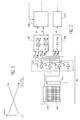
- the device represented in FIG. 1 comprises a pinhole chamber 10, the pinhole 11 of which is directed towards a measurement zone 14 in which there are sources of gamma radiation represented very schematically with the reference 16.
- a camera optical 18, that is to say sensitive to visible light, integral with the chamber 10, receives visible light from the zone 14 by an aiming system comprising a mirror 20.
- the pinhole chamber 10 has a thick wall 22 which constitutes shielding against gamma radiation ( ⁇ ).
- the wall 22 is made for example of an appropriate alloy based on tungsten, such as the alloy known under the name "Denal”.
- a collimator 24 of the chamber 12 makes it possible to form an "image" of the ⁇ radiation on a position resolution detector 26, for example of the GeHP (Germanium High Purity) or AsGa (Gallium Arsenide) type, placed in the chamber 12.
- the expression "image" of ⁇ radiation is understood to mean a distribution of intensities on the detector 26 obtained by the collimator 24 which is of the double cone type, for example.
- Electrical connections 28, 30 respectively connect the camera 18 and the detector 26 to a processing system 32 to which they supply electrical signals from the detector and the camera.
- the processing system comprises a unit 34 for acquiring the electrical signals from the camera 18 to form, in the form of electrical signals, a first observation image of the observation area 14.
- This first image which is an image of light visible from this area is called "visible image”.
- the detection signals from the detector 26 are directed both to a so-called localization line 35 and to a spectrometry line 36 of the processing system 32.
- the location line 35 comprises, in order, a position encoder 37 and a position discriminator 39 which form a means for selecting the signals from the detector 26.
- the position encoder delivers to the position discriminator of voltage pulses, the amplitude of which depends on the measurement position of the radiation on the detector 26.
- the position discriminator 39 includes circuits for selecting the pulses supplied to it by the position encoder 37. The selection is carried out by selectively reversing the polarizations of the electronic elements as a function of the amplitude of the signals which corresponds to the position of the radiation. detected.
- the signals selected by the position discriminator 39 are sent to an analog to digital converter 41.
- the digitized signals from the converter 41 are supplied to a calculation unit 43 capable of forming a digital image called gamma image and performing special processing such as the calculation of isodose curves. Digitized signals are also directed to a logic control unit 45 described below.
- the spectrometry line 36 corresponds to a gamma spectrometry chain of a known type. After summation, filter and amplification means 38 which receive the signals from the detector 26, the line 36 includes an energy discriminator.
- the means 38 deliver, in response to the signals from the detector, pulses whose amplitude is proportional to the energy of the signals.
- the energy discriminator 42 selects the pulses according to their amplitude.
- the signals are then digitized in an analog-digital converter 46 which, like the converter 41, is connected to the logic control unit 45.
- a delay line 48 can be mounted downstream of the converter 46.
- the delay line 48 allows in particular to pulses from the computing unit 43 and the converter 46 to be simultaneously directed to a memory 49.
- the memory 49 makes it possible to store the gamma images from the location line and the spectra from the spectrometry line.
- the logic control unit 45 contains circuits for controlling the discriminators in position 39 and in energy 42.
- the control circuits can be controlled using appropriate software.
- there is a relationship between the detection and spectrometry lines because the signals from the detector 26 are both a function of the position they have on the surface. of detection of the detector and function of the energy of the gamma photons at the origin of the interactions in the crystal of the detector.
- the selection of a particular energy thus corresponds to the selection of a position. It is thus possible to carry out an energy discrimination on the detected radioelements according to the place where they were detected, which amounts to locating the radioelements according to their nature.
- the unit 50 connected to the memory 49 and to the logic unit 45 allows the user to recall from the memory, for example, the spectrum corresponding to a given image.
- the processing system comprises a unit 40 which superimposes the visible images supplied by the acquisition unit 34 and by the calculation unit 43.
- a display device 44 makes it possible to display, as desired, a spectrum supplied by the converter 46 , the gamma image supplied by the calculation unit 43 or else a localization image supplied by the unit 40, the localization image being the superposition of the visible image and the gamma image.
- Figure 2 shows in more detail an embodiment of the detector 26 and the operation of the position encoder 37 and the summing means 38.
- the detector 26 comprises, as shown in FIG. 2, a mosaic of individual detection elements 60 connected respectively to two resistive networks 62 and 64 which correspond respectively to the axes of measurement of abscissa position (x) and ordinate (y).
- the charges created in the detection elements 60 under the effect of radiation are collected in the networks 62 and 64 and then directed to charge preamplifiers 70, 71, 72, 73.
- the terminals of the network 62 are respectively connected to the charge preamplifiers 70 and 71 and the terminals of the resistance network 64 are connected to the charge preamplifiers 72 and 73.
- the preamplifiers deliver to the position encoder 37 and to the summation means 38 voltages designated by X A , X B , Y A and Y B and which correspond respectively to radiation positions detected by the detector 26.
- FIG. 3 indicates by way of example, as a function of the position on the abscissa x on the detector, the voltages X A and X B delivered by the charge preamplifiers.
- the voltages reported on the ordinate in FIG. 3 are expressed in an arbitrary scale. It can be noted that the voltages X A and X B move in the opposite direction as a function of the position x.
- Figure 4 is an alternative embodiment of the device of the invention. We find in this figure a number of elements already existing on the device of Figure 1. We thus identify in Figure 4 a processing system 132 with a unit 134 for acquiring signals from a camera 118, an encoder 136, a digitizing unit 138 of the analog-to-digital converter type, a stacking unit 140, a display device 144, a gamma spectrometry chain 148 with a summator 146, and a control unit which is a microcomputer 150 For all these elements, we can therefore refer to the description above.
- Figure 4 does not show a pinhole camera but illustrates in more detail a position resolution detector 126.
- This detector like the camera 118, are however used in a device and an arrangement similar to those illustrated in the figure 1.
- the detector 126 of FIG. 4 with solid crystal is of the same kind in the same type as the detector 26 described above, that is to say, for example, a germanium detector of high purity; and comprises a matrix of detection elements 160.
- Each detection element 160 is associated with a field effect transistor 162 for transmitting the signals of this element.
- the drains 164 of the transistors 162 are respectively connected to the elements 160 and the sources 165 of the transistors 164 are respectively connected to signal lines 166 to route the signals from each detection element 160 to the processing system 132 via preamplifiers 168.
- Each line of detection elements 160 of the matrix is associated with a line of signals 166 and each signal line is connected to the encoder 136 and to the summator 146, respectively by a preamplifier 168.
- a preamplifier 168 is shown in FIG. 4.
- the signal selection means comprise a logic gate circuit 180 controlled by the microcomputer 150, and connected respectively to the gates 170 of the transistors 160 to inhibit or validate the transmission of the detection signals to line 166.
- transistors 162 By making the transistors 162 corresponding to one or more detection elements conductive or blocking, by applying an appropriate voltage to their grid, it is possible to select regions of the detector which correspond to parts of the observation area.
- the gates of the transistors of the same line are interconnected. It is however possible to envisage an individual control of each transistor.
- the invention it is possible to quickly and with great precision make maps of the irradiating zones by delivering information concerning the location of the sources, their intensity and their emission energy.
- flow measurement associated with knowledge of detection efficiency allows direct measurement of exposure rates and, by an appropriate transfer function, the calculation of the activity of the sources viewed.
- the device can be installed for example on a mobile support in order to access an irradiating observation area.
Landscapes
- Physics & Mathematics (AREA)
- Health & Medical Sciences (AREA)
- Life Sciences & Earth Sciences (AREA)
- General Physics & Mathematics (AREA)
- High Energy & Nuclear Physics (AREA)
- Molecular Biology (AREA)
- Spectroscopy & Molecular Physics (AREA)
- Measurement Of Radiation (AREA)
- Nuclear Medicine (AREA)
Applications Claiming Priority (2)
| Application Number | Priority Date | Filing Date | Title |
|---|---|---|---|
| FR9505979 | 1995-05-19 | ||
| FR9505979A FR2734372B1 (fr) | 1995-05-19 | 1995-05-19 | Dispositif de localisation a distance de sources radioactives et de mesure spectrometrique dans une zone d'observation |
Publications (2)
| Publication Number | Publication Date |
|---|---|
| EP0743538A2 true EP0743538A2 (de) | 1996-11-20 |
| EP0743538A3 EP0743538A3 (de) | 1999-05-06 |
Family
ID=9479177
Family Applications (1)
| Application Number | Title | Priority Date | Filing Date |
|---|---|---|---|
| EP96401051A Withdrawn EP0743538A3 (de) | 1995-05-19 | 1996-05-14 | Gerät zur Fernlokalisierung einer radioaktiven Quelle und spektrometrischer Messungen in einem Beobachtungszone |
Country Status (2)
| Country | Link |
|---|---|
| EP (1) | EP0743538A3 (de) |
| FR (1) | FR2734372B1 (de) |
Cited By (7)
| Publication number | Priority date | Publication date | Assignee | Title |
|---|---|---|---|---|
| WO1998052071A1 (en) * | 1997-05-15 | 1998-11-19 | British Nuclear Fuels Plc | Improvements in and relating to monitoring |
| US7022998B2 (en) | 1997-05-15 | 2006-04-04 | British Nuclear Fuels Plc | Radiation dose rate measurement |
| FR2879304A1 (fr) * | 2004-12-14 | 2006-06-16 | Commissariat Energie Atomique | Dispositif d'imagerie gamma ameliore. |
| US7095030B2 (en) | 2001-11-27 | 2006-08-22 | British Nuclear Fuels Plc | Investigations of radioactivity |
| US7186963B2 (en) | 2001-11-27 | 2007-03-06 | Bnfl (Ip) Ltd. | Environment radiation detector having a visual image capturing device |
| DE102010017543A1 (de) | 2010-06-23 | 2011-12-29 | Surgiceye Gmbh | Vorrichtung und Verfahren zur kombinierten optischen und nuklearen Bilderfassung |
| CN104459372A (zh) * | 2014-11-10 | 2015-03-25 | 中国科学院新疆理化技术研究所 | 基于p-i-n结构的位移损伤剂量探测方法 |
Families Citing this family (1)
| Publication number | Priority date | Publication date | Assignee | Title |
|---|---|---|---|---|
| FR2932573B1 (fr) * | 2008-06-16 | 2014-09-05 | Commissariat Energie Atomique | Dispositif d'imagerie gamma ameliore permettant la localisation precise de sources irradiantes dans l'espace |
Family Cites Families (4)
| Publication number | Priority date | Publication date | Assignee | Title |
|---|---|---|---|---|
| FR2615960B1 (fr) * | 1987-05-27 | 1991-09-06 | Commissariat Energie Atomique | Dispositif de localisation d'un rayonnement nucleaire, et dispositif de formation d'image de rayonnement incluant un tel dispositif de localisation |
| FR2652909B1 (fr) * | 1989-10-11 | 1992-03-27 | Commissariat Energie Atomique | Dispositif de localisation en temps reel de sources de rayonnement. |
| US5216250A (en) * | 1991-11-27 | 1993-06-01 | Lorad Corporation | Digital imaging system using CCD array |
| FR2706626B1 (fr) * | 1993-06-09 | 1995-08-04 | Stmi | Dispositif de localisation à distance de sources de rayonnement. |
-
1995
- 1995-05-19 FR FR9505979A patent/FR2734372B1/fr not_active Expired - Lifetime
-
1996
- 1996-05-14 EP EP96401051A patent/EP0743538A3/de not_active Withdrawn
Cited By (12)
| Publication number | Priority date | Publication date | Assignee | Title |
|---|---|---|---|---|
| WO1998052071A1 (en) * | 1997-05-15 | 1998-11-19 | British Nuclear Fuels Plc | Improvements in and relating to monitoring |
| US7022998B2 (en) | 1997-05-15 | 2006-04-04 | British Nuclear Fuels Plc | Radiation dose rate measurement |
| US7095030B2 (en) | 2001-11-27 | 2006-08-22 | British Nuclear Fuels Plc | Investigations of radioactivity |
| US7186963B2 (en) | 2001-11-27 | 2007-03-06 | Bnfl (Ip) Ltd. | Environment radiation detector having a visual image capturing device |
| FR2879304A1 (fr) * | 2004-12-14 | 2006-06-16 | Commissariat Energie Atomique | Dispositif d'imagerie gamma ameliore. |
| WO2006090035A1 (fr) * | 2004-12-14 | 2006-08-31 | Commissariat à l'Energie Atomique | Dispositif d'imagerie gamma ameliore |
| US7772563B2 (en) | 2004-12-14 | 2010-08-10 | Commissariat A L'energie Atomique | Gamma imagery device |
| RU2399929C2 (ru) * | 2004-12-14 | 2010-09-20 | Коммиссариат А Л'Энержи Атомик | Усовершенствованный прибор для получения гамма-изображений |
| DE102010017543A1 (de) | 2010-06-23 | 2011-12-29 | Surgiceye Gmbh | Vorrichtung und Verfahren zur kombinierten optischen und nuklearen Bilderfassung |
| WO2011161197A1 (de) | 2010-06-23 | 2011-12-29 | Surgiceye Gmbh | Vorrichtung und verfahren zur kombinierten optischen und nuklearen bilderfassung |
| CN104459372A (zh) * | 2014-11-10 | 2015-03-25 | 中国科学院新疆理化技术研究所 | 基于p-i-n结构的位移损伤剂量探测方法 |
| CN104459372B (zh) * | 2014-11-10 | 2017-09-01 | 中国科学院新疆理化技术研究所 | 基于p‑i‑n结构的位移损伤剂量探测方法 |
Also Published As
| Publication number | Publication date |
|---|---|
| EP0743538A3 (de) | 1999-05-06 |
| FR2734372A1 (fr) | 1996-11-22 |
| FR2734372B1 (fr) | 1997-08-01 |
Similar Documents
| Publication | Publication Date | Title |
|---|---|---|
| EP2035861B1 (de) | Einrichtung zum lokalisieren und abbilden von gamma- oder röntgenstrahlungsquellen | |
| EP0425333B1 (de) | Gerät zur Echtzeitlokalisierung der Bestrahlungsquelle | |
| EP1825298B1 (de) | Verbesserte gamma-bilderzeugungsvorrichtung | |
| McLeod et al. | The gravitational lens MG 0414+ 0534: a link between red galaxies and dust | |
| EP0449690A1 (de) | Verfahren zur Messung des Zerfalls von Positronen | |
| EP0311503B1 (de) | Vielfachstrahlungsdetektor, insbesondere zwei Energieniveaus selektionierender Röntgenstrahlungsdetektor | |
| FR2734372A1 (fr) | Dispositif de localisation a distance de sources radioactives et de mesure spectrometrique dans une zone d'observation | |
| EP2145208B1 (de) | Röntgenabbildungsvorrichtung mit einer polychromatischen quelle | |
| EP2859380B1 (de) | Verfahren zur echtzeit-abbildung einer verteilung von photonen an einem ort | |
| FR2629200A1 (fr) | Dispositif de detection pour mesurer l'intensite d'un rayonnement electromagnetique et interferometre incorporant un tel dispositif | |
| EP1111908A1 (de) | Lichtempfindliche ladungsgekoppelte Vorrichtung mit Ladungsakkumulation und Lidar mit einer solchen Vorrichtung | |
| EP0907284A1 (de) | Lichtempfindliche ladungsgekoppelte Vorrichtung mit Ladungsakkumulation und Lidar mit einer solchen Vorrichtung | |
| FR2700859A1 (fr) | Gamma-caméra à compensation de gain. | |
| EP0489644B1 (de) | Gerät zur Bestimmung des Azimuts und der Höhe einer Lichtquelle | |
| EP0762139A2 (de) | Optische Vorrichtung zur Bestimmung der Orientierung eines Festkörpers | |
| FR2859279A1 (fr) | Dispositif et procede de mesure spectroscopique avec un dispositif d'imagerie comprenant une matrice de photodetecteurs | |
| EP0199607A1 (de) | Vielfachdetektoren für Tomoszintigraphie | |
| EP3884656A1 (de) | Vorrichtung und verfahren zur beobachtung einer szene mit einem ziel | |
| Vadawale et al. | Prospects of hard X-ray polarimetry with Astrosat-CZTI | |
| FR2735935A1 (fr) | Dispositif a couplage de charges adapte a l'acquisition rapide d'un signal lumineux et son application dans un lidar | |
| ROSE | Assembling a High-Redshift Galactic Protocluster: An Imaging Study of MRC1138-262 | |
| BE854714A (fr) | Detecteur d'horizon optique | |
| Diner | MISR Level 1B1 Radiance Data (MI1B1_V1) | |
| Mirzoyan et al. | A CCD-Based Atmospheric Imaging Detector for SHE-UHE-EHE Astroparticle Physics | |
| WO2025202035A1 (fr) | Systeme d'imagerie a rayons x de type hartmann |
Legal Events
| Date | Code | Title | Description |
|---|---|---|---|
| PUAI | Public reference made under article 153(3) epc to a published international application that has entered the european phase |
Free format text: ORIGINAL CODE: 0009012 |
|
| AK | Designated contracting states |
Kind code of ref document: A2 Designated state(s): BE DE ES FR GB SE |
|
| PUAL | Search report despatched |
Free format text: ORIGINAL CODE: 0009013 |
|
| AK | Designated contracting states |
Kind code of ref document: A3 Designated state(s): BE DE ES FR GB SE |
|
| 17P | Request for examination filed |
Effective date: 19991022 |
|
| 17Q | First examination report despatched |
Effective date: 20010216 |
|
| STAA | Information on the status of an ep patent application or granted ep patent |
Free format text: STATUS: THE APPLICATION IS DEEMED TO BE WITHDRAWN |
|
| 18D | Application deemed to be withdrawn |
Effective date: 20010627 |