EP0743539A2 - Procédé et agencement des sondes pour la détection électromagnétique des corps métalliques - Google Patents
Procédé et agencement des sondes pour la détection électromagnétique des corps métalliques Download PDFInfo
- Publication number
- EP0743539A2 EP0743539A2 EP96107936A EP96107936A EP0743539A2 EP 0743539 A2 EP0743539 A2 EP 0743539A2 EP 96107936 A EP96107936 A EP 96107936A EP 96107936 A EP96107936 A EP 96107936A EP 0743539 A2 EP0743539 A2 EP 0743539A2
- Authority
- EP
- European Patent Office
- Prior art keywords
- loops
- probe arrangement
- signals
- arrangement according
- loop
- Prior art date
- Legal status (The legal status is an assumption and is not a legal conclusion. Google has not performed a legal analysis and makes no representation as to the accuracy of the status listed.)
- Withdrawn
Links
- 238000000034 method Methods 0.000 title claims abstract description 25
- 238000001514 detection method Methods 0.000 title claims abstract description 6
- 239000000523 sample Substances 0.000 claims abstract description 41
- 230000005540 biological transmission Effects 0.000 claims description 15
- 238000005070 sampling Methods 0.000 claims description 11
- 239000011159 matrix material Substances 0.000 claims description 9
- 238000012545 processing Methods 0.000 claims description 6
- 238000011156 evaluation Methods 0.000 claims description 5
- 238000003860 storage Methods 0.000 claims description 4
- 239000003990 capacitor Substances 0.000 claims description 3
- 238000011161 development Methods 0.000 description 4
- 230000018109 developmental process Effects 0.000 description 4
- 238000005259 measurement Methods 0.000 description 3
- 238000013461 design Methods 0.000 description 2
- 238000010586 diagram Methods 0.000 description 2
- 238000005516 engineering process Methods 0.000 description 2
- 230000035945 sensitivity Effects 0.000 description 2
- 239000002689 soil Substances 0.000 description 2
- 230000006978 adaptation Effects 0.000 description 1
- 230000006698 induction Effects 0.000 description 1
- 238000012432 intermediate storage Methods 0.000 description 1
- 230000004807 localization Effects 0.000 description 1
- 239000002184 metal Substances 0.000 description 1
- 230000035515 penetration Effects 0.000 description 1
- XLYOFNOQVPJJNP-UHFFFAOYSA-N water Substances O XLYOFNOQVPJJNP-UHFFFAOYSA-N 0.000 description 1
Images
Classifications
-
- G—PHYSICS
- G01—MEASURING; TESTING
- G01V—GEOPHYSICS; GRAVITATIONAL MEASUREMENTS; DETECTING MASSES OR OBJECTS; TAGS
- G01V3/00—Electric or magnetic prospecting or detecting; Measuring magnetic field characteristics of the earth, e.g. declination, deviation
- G01V3/12—Electric or magnetic prospecting or detecting; Measuring magnetic field characteristics of the earth, e.g. declination, deviation operating with electromagnetic waves
-
- G—PHYSICS
- G01—MEASURING; TESTING
- G01S—RADIO DIRECTION-FINDING; RADIO NAVIGATION; DETERMINING DISTANCE OR VELOCITY BY USE OF RADIO WAVES; LOCATING OR PRESENCE-DETECTING BY USE OF THE REFLECTION OR RERADIATION OF RADIO WAVES; ANALOGOUS ARRANGEMENTS USING OTHER WAVES
- G01S13/00—Systems using the reflection or reradiation of radio waves, e.g. radar systems; Analogous systems using reflection or reradiation of waves whose nature or wavelength is irrelevant or unspecified
- G01S13/88—Radar or analogous systems specially adapted for specific applications
- G01S13/885—Radar or analogous systems specially adapted for specific applications for ground probing
Definitions
- the invention relates to a method and a probe arrangement for the electromagnetic detection of metallic objects, in which an electromagnetic signal is emitted, which excites the object to be detected to emit a secondary signal, the secondary signal being received with several loops in the form of several loop-specific secondary signals, evaluated object-specifically and is shown.
- DE 42 42 541 A1 discloses a method and a probe arrangement of the type mentioned at the outset.
- four adjacent transmission and reception coils are moved within a carrier device over an area to be examined, whereby a larger area can be scanned.
- the information of each individual coil is queried and sent for further processing.
- the invention has for its object to provide a method and a probe arrangement of the type mentioned, which or which a particularly good Evaluation of the signal information guaranteed and leads to the most accurate possible local detection of the object sought.
- This object is achieved procedurally in accordance with the characterizing features of claim 1 and in terms of arrangement in accordance with the characterizing features of claim 10.
- Advantageous further developments are described in the subclaims.
- an electromagnetic signal is emitted, which excites the object to be detected to emit a secondary signal, which can be specifically linked and evaluated by the reception in a multiplicity of reception loops.
- a plurality of reception loops are arranged in the form of a matrix in the probe arrangement, and these are able to receive the secondary signal emitted by the object to be detected. Due to the different distances and spatial arrangement of the different reception loops to the object, loop-specific secondary signals are measured which differ from one another. These different measured values are then linked or compared with one another in order to obtain exact information about the location and the position of the object to be detected.
- the spatiality and measurement and further processing of the individual received secondary signals make it possible to generate computer-aided shadow images from the search objects. It is particularly preferred to select the received secondary signals to be summed up so that a ground compensation is carried out automatically. To do this, two groups of secondary signals must be selected which, in the absence of an object to be searched for, result in the same sum depending on the soil. The difference between the two groups thus results in "zero” as long as no object changes the received secondary signal and thus produces a result that deviates from "zero". This can be done, for example, by forming the difference between two reception loops arranged directly next to one another.
- the method is preferably carried out using pulse induction technology (PI technology).
- PI technology pulse induction technology
- Frequencies between 10 Hz and 10 kHz can be used.
- the use of bipolar pulses is particularly preferred. However, it is possible also a continuous operation.
- each individual received signal When using individual pulses, it is particularly preferred to first sample each individual received signal using a sampling or multiplex method and to further process the sample values for themselves. This can be done for the samples of each individual received secondary signal in the same way as described above for the entirety of the secondary signals. As a result, a secondary signal is obtained in each receiving channel, which has already been processed and further processed. For example, when the individual sample values are summed up, secondary signals are obtained which each have a sensitivity which is increased by up to 30% compared to the conventional received secondary signal. The further procedure and the linking of the received and processed secondary signals is then continued with the individual values prepared in this way. This development can be carried out both with mono single pulses and preferably with bipolar single pulses.
- the evaluation with digital techniques and microprocessors is also preferred in order to be able to use the variety of measurement and linking options.
- a probe arrangement with a plurality of reception loops arranged in a matrix for carrying out the method.
- a transmit loop is formed around the receive loops arranged in a matrix.
- the receiving loops are preferably arranged in the form of a two-dimensional matrix. In the smallest case, this is a 2 x 2 matrix.
- the receiving coils are preferably queried separately in the x and y directions. At least at certain locations in the loop, object concentrations can be seen. This enables the location of the objects to be assigned to the search route.
- the reception loops can also be subdivided further. Individual reception loops can be combined to form a so-called main loop, wherein the individual reception loops and the main loops as a whole can be queried and their values compared and linked to one another.
- main loop wherein the individual reception loops and the main loops as a whole can be queried and their values compared and linked to one another.
- four main loops are provided, each of which consists of four or eight receive loops.
- the advantage of this arrangement is that the respective size of the reception loops enables adaptation to the search task. If only large objects are searched, it is sufficient if only the values of the main loops are queried. As search objects become smaller, it becomes necessary to query smaller search loops.
- the depth range can also be controlled by selecting and using the respective reception loops.
- the large rotating transmission loop is designed so that it both can send as well as receive.
- This received value can in turn be related to the individual received secondary signals and an additional link with the consequence of an increased accuracy of the measurement can thereby be achieved.
- the diameter of the large transmission loop can be, for example, between 1/2 and 5 m.
- each of the receive loops, each of the main loops and the transmit loop also used as a receive loop is connected to a sample and hold device for sampling and storage of the received secondary signals.
- the sample and hold devices have analog switches and capacitors.
- receive loops of different sizes can be used in a further development of the invention.
- e.g. uses a very large receive loop within a main loop and a few smaller receive loops arranged around it. In this way, a higher sensitivity can be achieved with the larger reception loop, the smaller reception loops then being used for more precise localization.
- the entire probe arrangement is conveniently housed in a mobile, metal-free device in which the loop height to the floor is adjustable.
- the adjustability has the advantage that the influence of heavily disruptive floors can be reduced by a larger measuring distance. Even small metallic parts can be hidden within certain limits. Such a hiding of unwanted small parts can also be done by computer-controlled signal selection.
- a floatable and / or submersible design of the probe arrangement can also be advantageous for use when searching for objects under water.
- the probe arrangement with the associated electronics is arranged in a watertight encapsulated housing. The results are shown on a display that is visible to the user and is controlled by the probe arrangement by radio or cable connection.
- the floating and submersible probe assembly is equipped with floodable tanks that can be used to control buoyancy or depth.
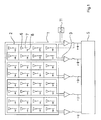
- a transmission loop 1 is shown, which is connected to a transmitter 11.
- the transmitter generates individual pulses which can be radiated largely into the ground via the large rotating transmission loop 1.
- the reception loops 2 arranged in a matrix are shown. Each of the receive loops forms a receive channel for itself. Eight individual reception loops 2 are combined to form a main loop 3, which in turn form a reception channel. Since the transmission loop 1 is also designed as an additional reception channel, there are a total of 37 reception channels, of which 32 on the individual reception loops 2, four on the main loops 3 and 1 Receiving channel on the transmission loop 1 is omitted.
- the main loops 3 are connected to the multiplexer 5, via which the 37 reception channels, that is to say the 37 received secondary signals, are interrogated and fed to a combination of the individual values and further processing.
- the loops are usually designed as coils.
- the processing of the individual measured values, which are recorded and temporarily stored by a data logger during the search, is carried out later by computer-aided further processing.
- the documented search process can be reproduced in any form using suitable software.
- a direct analog display when searching is also possible. So also the indication in which part of the loop there are metal objects.
- the individual reception loops 2 and also the main loops 3 each have a receiver 6 and a sample and hold device with analog switches 7 and capacitors 8 for time and / or amplitude-related sampling and intermediate storage of secondary signals.
Landscapes
- Physics & Mathematics (AREA)
- Engineering & Computer Science (AREA)
- Remote Sensing (AREA)
- Life Sciences & Earth Sciences (AREA)
- Electromagnetism (AREA)
- Environmental & Geological Engineering (AREA)
- Geology (AREA)
- General Life Sciences & Earth Sciences (AREA)
- General Physics & Mathematics (AREA)
- Geophysics (AREA)
- Geophysics And Detection Of Objects (AREA)
Applications Claiming Priority (2)
| Application Number | Priority Date | Filing Date | Title |
|---|---|---|---|
| DE19518342 | 1995-05-18 | ||
| DE19518342A DE19518342A1 (de) | 1995-05-18 | 1995-05-18 | Verfahren und Sondenanordnung zur elektromagnetischen Detektion von metallischen Objekten |
Publications (2)
| Publication Number | Publication Date |
|---|---|
| EP0743539A2 true EP0743539A2 (fr) | 1996-11-20 |
| EP0743539A3 EP0743539A3 (fr) | 1999-06-16 |
Family
ID=7762299
Family Applications (1)
| Application Number | Title | Priority Date | Filing Date |
|---|---|---|---|
| EP96107936A Withdrawn EP0743539A3 (fr) | 1995-05-18 | 1996-05-17 | Procédé et agencement des sondes pour la détection électromagnétique des corps métalliques |
Country Status (4)
| Country | Link |
|---|---|
| US (1) | US5770944A (fr) |
| EP (1) | EP0743539A3 (fr) |
| CA (1) | CA2177320A1 (fr) |
| DE (1) | DE19518342A1 (fr) |
Cited By (2)
| Publication number | Priority date | Publication date | Assignee | Title |
|---|---|---|---|---|
| EP1347311A2 (fr) | 2002-03-23 | 2003-09-24 | Lorenz Roatzsch | Procédé de détection d'objets, particulièrement d'objets métalliques |
| DE10213115A1 (de) * | 2002-03-23 | 2003-10-16 | Lorenz Roatzsch | Verfahren zum Aussortieren von Metallobjekten bzw. eine Sortieranlage, ein Detektor sowie eine Schaltungsanordnung hierfür |
Families Citing this family (9)
| Publication number | Priority date | Publication date | Assignee | Title |
|---|---|---|---|---|
| US6600320B2 (en) * | 1996-03-25 | 2003-07-29 | The Johns Hopkins University | Apparatus with movable receiver coil array for locating a buried metallic object |
| US6064209A (en) * | 1998-05-18 | 2000-05-16 | Xtech Explosive Decontamination, Inc. | Apparatus and process for clearance of unexploded ordinance |
| DE29903856U1 (de) * | 1999-03-03 | 1999-06-10 | Fa. Ing. Klaus Ebinger, 51149 Köln | Sondenanordnung |
| DE10155533C2 (de) * | 2001-11-12 | 2003-12-18 | Andreas Roser | Vorrichtung zum Auffinden von Land- oder Seeminen |
| DE10240293B4 (de) * | 2002-08-31 | 2007-05-24 | Bundesrepublik Deutschland, vertreten durch das Bundesministerium der Verteidigung, dieses vertreten durch den Präsidenten des Bundesamtes für Wehrtechnik und Beschaffung | Minenräumgerät |
| DE102004047188B4 (de) | 2004-09-29 | 2022-10-27 | Robert Bosch Gmbh | Vorrichtung zur Ortung metallischer Objekte |
| US8098070B2 (en) * | 2008-06-05 | 2012-01-17 | Lopez John A | Electromagnetic subterranean imaging instrument |
| KR20150083593A (ko) * | 2014-01-10 | 2015-07-20 | 한국전자통신연구원 | 매설관 위치 검출 장치 및 그 방법 |
| CN111323825B (zh) * | 2020-03-23 | 2022-09-20 | 西安西北有色物化探总队有限公司 | 一种地-坑广域电磁探测方法及装置 |
Family Cites Families (8)
| Publication number | Priority date | Publication date | Assignee | Title |
|---|---|---|---|---|
| GB2041532B (en) * | 1979-01-31 | 1983-05-11 | Plessey Co Ltd | Metal detector |
| JPS5646480A (en) * | 1979-09-25 | 1981-04-27 | Nec Corp | Magnetic sign system |
| DE3421066A1 (de) * | 1984-06-06 | 1986-01-02 | Heimann Gmbh, 6200 Wiesbaden | Personenuntersuchungsgeraet |
| DE3705308A1 (de) * | 1987-02-19 | 1988-09-01 | Foerster Inst Dr Friedrich | Induktives suchgeraet |
| US4818944A (en) * | 1987-05-06 | 1989-04-04 | Schonstedt Instrument Company | Magnetic locating and tracing system and method using dual-antenna transmitter to distinguish between concealed adjacent objects |
| US4912414A (en) * | 1988-10-28 | 1990-03-27 | Lesky Edward S | Induction-type metal detector with increased scanning area capability |
| DE4242541C2 (de) * | 1992-12-16 | 1996-03-28 | Tzn Forschung & Entwicklung | Vorrichtung zum Orten von unterhalb der Erdoberfläche befindlicher Munition |
| DE4326030A1 (de) * | 1993-08-03 | 1995-02-09 | Klaus Ebinger | Verfahren zur elektromagnetischen Detektion von Objekten |
-
1995
- 1995-05-18 DE DE19518342A patent/DE19518342A1/de not_active Withdrawn
-
1996
- 1996-05-14 US US08/645,792 patent/US5770944A/en not_active Expired - Fee Related
- 1996-05-17 EP EP96107936A patent/EP0743539A3/fr not_active Withdrawn
- 1996-05-17 CA CA002177320A patent/CA2177320A1/fr not_active Abandoned
Cited By (3)
| Publication number | Priority date | Publication date | Assignee | Title |
|---|---|---|---|---|
| EP1347311A2 (fr) | 2002-03-23 | 2003-09-24 | Lorenz Roatzsch | Procédé de détection d'objets, particulièrement d'objets métalliques |
| DE10213115A1 (de) * | 2002-03-23 | 2003-10-16 | Lorenz Roatzsch | Verfahren zum Aussortieren von Metallobjekten bzw. eine Sortieranlage, ein Detektor sowie eine Schaltungsanordnung hierfür |
| EP1347311A3 (fr) * | 2002-03-23 | 2005-08-03 | Lorenz Roatzsch | Procédé de détection d'objets, particulièrement d'objets métalliques |
Also Published As
| Publication number | Publication date |
|---|---|
| EP0743539A3 (fr) | 1999-06-16 |
| CA2177320A1 (fr) | 1996-11-19 |
| US5770944A (en) | 1998-06-23 |
| DE19518342A1 (de) | 1996-11-21 |
Similar Documents
| Publication | Publication Date | Title |
|---|---|---|
| DE4242541C2 (de) | Vorrichtung zum Orten von unterhalb der Erdoberfläche befindlicher Munition | |
| EP0271670B1 (fr) | Procédé pour la détection de la corrosion ou similaire | |
| DE69917030T2 (de) | Metalldetektor | |
| DE69617926T2 (de) | Lokalisieren von objekten | |
| DE69826079T2 (de) | Lokalisator von elektrisch leitenden objekten | |
| DE60020784T2 (de) | Eichung am Messort einer Sonargruppenantenne | |
| DE3808172C2 (fr) | ||
| DE60031000T2 (de) | Bodendurchdringendes Radarsystem und Verfahren zur Erkennung eines Objektes auf oder unter einer Bodenfläche | |
| DE2500698C3 (de) | Automatischer Peiler | |
| DE4344509B4 (de) | Verfahren zur Messung der akustischen Rückstreueigenschaft von Gewässerböden | |
| EP0743539A2 (fr) | Procédé et agencement des sondes pour la détection électromagnétique des corps métalliques | |
| DE2614680A1 (de) | Verfahren und vorrichtung zur messung des vektors einer minimalen trefferablage | |
| DE69512751T2 (de) | Verfahren und Vorrichtung zum Erkennen von Objekten, welche in einem Gebiet verteilt sind | |
| DE3335421A1 (de) | Verfahren zur signalauswertung von ultraschall-echosignalen, wie sie bei verwendung eines ultraschall-sensors an einem roboterarm auftreten | |
| DE19506339C2 (de) | Verfahren und Schaltungsvorrichtung zur elektromagnetischen Detektion von Objekten | |
| DE10018031A1 (de) | Einrichtung und Verfahren zur digitalen Erfassung, Verfolgung und Kartierung unterirdischer oberflächennaher Rohrleitungen und Rohrleitungsnetze | |
| DE69517822T2 (de) | Bestimmung der elektrischen leitfähigkeit einer erdschicht | |
| DE2440742C3 (de) | Einrichtung zur Ausschaltung von Stör- und Festzeichen | |
| EP0780705B1 (fr) | Procédé de recherche et agencement des sondes pour localiser des objets souterrains | |
| DE29522359U1 (de) | Sondenanordnung zur elektromagnetischen Detektion von metallischen Objekten | |
| DE2845164C2 (de) | Ziel-Ortungs- und Entfernungs- Meßsystem | |
| DE4206570C2 (de) | Ultraschall-Geschwindigkeitsmesser | |
| EP2653895B1 (fr) | Procédé de détection d'objets | |
| DE2626671C2 (de) | Mehrkanalpeilanordnung | |
| DE3874756T2 (de) | Geraet und verfahren zur elektrischen untergrunduntersuchung. |
Legal Events
| Date | Code | Title | Description |
|---|---|---|---|
| PUAI | Public reference made under article 153(3) epc to a published international application that has entered the european phase |
Free format text: ORIGINAL CODE: 0009012 |
|
| AK | Designated contracting states |
Kind code of ref document: A2 Designated state(s): AT CH DE ES FI FR GB IT LI SE |
|
| PUAL | Search report despatched |
Free format text: ORIGINAL CODE: 0009013 |
|
| AK | Designated contracting states |
Kind code of ref document: A3 Designated state(s): AT CH DE ES FI FR GB IT LI SE |
|
| RIC1 | Information provided on ipc code assigned before grant |
Free format text: 6G 01V 3/10 A |
|
| 17P | Request for examination filed |
Effective date: 19990820 |
|
| 17Q | First examination report despatched |
Effective date: 20000721 |
|
| STAA | Information on the status of an ep patent application or granted ep patent |
Free format text: STATUS: THE APPLICATION HAS BEEN WITHDRAWN |
|
| 18W | Application withdrawn |
Withdrawal date: 20000912 |