EP0744812A2 - Hartlöten von Kupferendringen und Kupferstäben in Rotoren von Induktionsmotoren mittels Induktionserwärmung - Google Patents
Hartlöten von Kupferendringen und Kupferstäben in Rotoren von Induktionsmotoren mittels Induktionserwärmung Download PDFInfo
- Publication number
- EP0744812A2 EP0744812A2 EP96201188A EP96201188A EP0744812A2 EP 0744812 A2 EP0744812 A2 EP 0744812A2 EP 96201188 A EP96201188 A EP 96201188A EP 96201188 A EP96201188 A EP 96201188A EP 0744812 A2 EP0744812 A2 EP 0744812A2
- Authority
- EP
- European Patent Office
- Prior art keywords
- copper
- bars
- laminations
- slots
- end ring
- Prior art date
- Legal status (The legal status is an assumption and is not a legal conclusion. Google has not performed a legal analysis and makes no representation as to the accuracy of the status listed.)
- Withdrawn
Links
- RYGMFSIKBFXOCR-UHFFFAOYSA-N Copper Chemical compound [Cu] RYGMFSIKBFXOCR-UHFFFAOYSA-N 0.000 title claims abstract description 50
- 229910052802 copper Inorganic materials 0.000 title claims abstract description 50
- 239000010949 copper Substances 0.000 title claims abstract description 50
- 230000006698 induction Effects 0.000 title claims abstract description 38
- 238000005219 brazing Methods 0.000 title abstract description 25
- 238000010438 heat treatment Methods 0.000 title abstract description 13
- 238000003475 lamination Methods 0.000 claims abstract description 71
- 238000004519 manufacturing process Methods 0.000 claims description 11
- 230000004907 flux Effects 0.000 claims description 7
- 239000004020 conductor Substances 0.000 claims description 4
- 230000000717 retained effect Effects 0.000 claims description 4
- 238000003754 machining Methods 0.000 abstract description 4
- 238000000034 method Methods 0.000 description 18
- 239000000463 material Substances 0.000 description 9
- 238000005304 joining Methods 0.000 description 5
- 229910000679 solder Inorganic materials 0.000 description 3
- 229910000976 Electrical steel Inorganic materials 0.000 description 2
- 229910000831 Steel Inorganic materials 0.000 description 2
- 238000013021 overheating Methods 0.000 description 2
- 239000010959 steel Substances 0.000 description 2
- 239000002966 varnish Substances 0.000 description 2
- 239000002918 waste heat Substances 0.000 description 2
- 241000555745 Sciuridae Species 0.000 description 1
- 230000004323 axial length Effects 0.000 description 1
- 230000000694 effects Effects 0.000 description 1
- 230000005294 ferromagnetic effect Effects 0.000 description 1
- 230000014759 maintenance of location Effects 0.000 description 1
- 238000005507 spraying Methods 0.000 description 1
- 230000009466 transformation Effects 0.000 description 1
Images




Classifications
-
- H—ELECTRICITY
- H02—GENERATION; CONVERSION OR DISTRIBUTION OF ELECTRIC POWER
- H02K—DYNAMO-ELECTRIC MACHINES
- H02K15/00—Processes or apparatus specially adapted for manufacturing, assembling, maintaining or repairing of dynamo-electric machines
- H02K15/02—Processes or apparatus specially adapted for manufacturing, assembling, maintaining or repairing of dynamo-electric machines of stator or rotor bodies
- H02K15/021—Magnetic cores
- H02K15/023—Cage rotors
-
- H—ELECTRICITY
- H02—GENERATION; CONVERSION OR DISTRIBUTION OF ELECTRIC POWER
- H02K—DYNAMO-ELECTRIC MACHINES
- H02K17/00—Asynchronous induction motors; Asynchronous induction generators
- H02K17/02—Asynchronous induction motors
- H02K17/16—Asynchronous induction motors having rotors with internally short-circuited windings, e.g. cage rotors
- H02K17/20—Asynchronous induction motors having rotors with internally short-circuited windings, e.g. cage rotors having deep-bar rotors
Definitions
- the technical field of this invention is the manufacture of induction motor rotors having copper end rings and copper bars.
- Induction motor rotors are often manufactured with a plurality of straight, electrically conducting bars equally spaced from and extending parallel to the rotor axis around the rotor core assembly. At each axial end, these bars are joined to an electrically conducting end ring to form a "squirrel cage" rotor. During manufacture of the rotor, the bars must be physically and electrically joined to the end rings so as to provide both physical strength and a low resistance electrical current path. Even a small resistance can produce a significant voltage drop with the large currents produced in such a rotor. Copper is a favored material for such bars and rings, due to its low resistance and reasonable cost.
- the joining of copper bars and end rings for induction motor rotors is known to be accomplished by a brazing process in which the parts to be joined are fluxed and flame heated to the braze temperature, at which the braze material is applied to the joint area. Flame heating may take from 5 to 15 minutes per rotor end; and it is hard to obtain even heating of the copper even with the use of multiple flame devices.
- a preformed piece of solder material is inserted into the joint area, with the parts separately fluxed or the flux included in the solder material.
- the parts are then heated in a furnace to the braze temperature, at which the braze material flows into the joint area. This process provides more even heating but may take from 0.5 to 2 hours to reach the proper temperature.
- the rotor laminations are subjected to temperatures of 650 to 760 degrees C for extended periods of time. This can lead to core losses in the lamination steel, which produces motor inefficiency.
- These types of heating methods can also limit the type of brazing material used, since some brazing material will only melt above the Curie Temperature of the lamination steel.
- the object of this invention is to provide a method of joining the ends of copper bars to copper end rings in the manufacture of induction motor rotors which is fast and produces a minimal negative effect on the remainder of the rotor.
- This object is realized by induction brazing the ends of the copper bars to the copper end rings.
- the end rings are clamped tightly on each axial end of the core assembly with the rotor bars retained in the core slots and extending through the end ring slots.
- an induction coil is placed coaxially around the copper end ring and relative axial rotation is provided between the end ring and the induction coil while a high frequency alternating current is generated in the induction coil to braze the copper bars to the copper end rings by electromagnetically induced heat.
- Induction heating provides heat more efficiently to the region to be brazed with less waste heat to the remainder of the assembly than with prior art heating methods using flame or ovens. This produces time savings for reduced costs in the manufacturing process and reduces the possibility of reduced motor efficiency due to overheating of the core.
- a method for brazing copper end rings and bars in an induction motor rotor by induction heating in accordance with the present invention is characterised by the features specified in Claim 1.
- an induction motor rotor 10 is built on a steel shaft 12 having an interior splined portion 14.
- a ferromagnetic core 15 comprises a plurality of core laminations 16, which are axially stacked and spline fitted to interior splined portion 14 of shaft 12 in the normal manner.
- FIG. 6 shows a typical core lamination 16, which is annular in shape with spline teeth 18 at its inner diameter (43 mm)to fit corresponding splines of shaft 12 and a plurality (68, for example) of equally spaced, radially aligned slots 20 opening to outer diameter 19 (126 mm).
- FIG. 7 shows a close-up of a slot 20, which is partially closed at its radially outer end by circumferential extensions 22 of the lamination material for rotor bar retention.
- Slot 20 measures 1.4 mm wide at its radially inner end, which is 15 mm from the outer diameter, and 2.6 mm wide adjacent extensions 22; the latter measuring 0.5 mm radially and leaving an opening of 0.8 mm.
- FIG. 4 shows an end ring lamination 30 in perspective view.
- End ring lamination 30 is 2.3 mm in width and annular in shape, with an unsplined inner diameter (52 mm) and a plurality of radially aligned slots 34 opening to its outer diameter 36 (125 mm).
- a similar end ring 37 comprising end ring laminations 35 is shown in FIG. 1 at the opposite axial end of core 15.
- Slots 34 of end ring lamination 30, as well as similar slots of end ring laminations 35, are equal in number, aligned with, and of essentially the shape and size as core laminations 16, but without the circumferential extensions of core lamination 16, so that they measure only 14 mm in from the 125 mm outer diameter of the lamination.
- a plurality of rotor bars 40 extend axially through the slots of core 15 and end rings 32 and 37.
- Bars 40 are slightly trapezoidal in cross section, with a slight increase in width in the radial direction to fit the cross section of slots 20 of FIG. 7 and slots 34 of FIG. 5.
- Bars 40 are uniform in cross section along their axial length and are physically and electrically joined to each of end rings 32 and 37 by brazing or a similar process to form a shorted turn rotor conductor structure locked onto core 15 of rotor 10.
- a containment cup 42 covers the axial end of rotor 10 which comprises end ring 32; and a similar containment cup 44 covers the opposite axial end of rotor 10, which comprises end ring 37.
- the structure of rotor 10 is the same as that of the prior art except for laminations 30 of end ring 32 and laminations 35 of end ring 37.
- These laminations enable the end rings to be formed by the stamping of laminations from sheet copper, orienting and stacking the laminations, and joining the laminations to bars 40 by brazing or a similar process. Although a small amount of machining may be done to smooth the end rings for a precise fit of the containment cups 42 and 44, the major machining required for end rings of the prior art is eliminated for significant time and cost savings in manufacture. Additional cost savings result from the reduction in scrap produced.
- the laminated structure of the end rings does not introduce significant resistance into the rotor current paths; and tests show equivalent performance by motors having rotors made according to this invention.
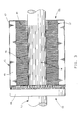
- Brazing arbor 50 shown in FIG. 1, includes a containment ring 51 at one end which is just large enough in diameter to retain the core laminations. Although shown as a separate part threaded onto arbor 50, containment ring 51 may be an integral part of the arbor. A washer 53 and lam containment ring 54 at the other end are also just large enough in diameter to retain the core laminations, which are tightly retained in a stack when lam containment ring 54 is threaded on arbor 50. Copper rotor bars 40 are then inserted in the slots of the stacked core so that they project from each axial end.
- End ring laminations 30 and 35 are stamped from sheet copper on a punch press, and a predetermined number (e.g. 8 or 9) are assembled at each end of the core laminations by inserting axially onto the projecting ends of rotor bars 40.
- the end ring laminations have a larger inner diameter than the outer diameter of containment ring 51, washer 52 and lam containment ring 54, which axially retain the core laminations, so they can be pushed past these tool pieces against the core laminations.
- End ring containment caps 56 and 57 are then threaded onto the ends of the arbor to hold the end ring laminations tightly in place.
- the core and end ring laminations which are held tightly together on brazing arbor 50 to prevent undesirable expansion during the brazing process, form a lamination assembly 58 with rotor bars 40 inserted.
- Lamination assembly 58 is next placed in a rotation fixture. With all laminations aligned and held tightly together, the rotor bars 40 are then pushed axially partly out of the assembly, at least by the axial width of an end ring, so that they project outward from the other end of the assembly by an equal amount.
- the end ring laminations and rotor bars are now ready for fluxing, as shown in FIG. 1.
- a solder dam material 59 is applied around the circumference of end ring containment caps 56 and 57 where they abut the outermost end ring laminations in order to prevent flux from migrating under these caps during the brazing process.
- a high temperature flux is applied to the projecting rotor bars at one axial end and the exposed slots of the end ring laminations at the other axial end of rotor 10, such as by spraying from a squeeze bottle 58, while rotating rotor 10 on the fixture.
- Rotor bars 40 are then pushed back into lamination assembly 58 so that their ends are flush with the outermost one of end ring laminations 30 and 35 at each end; and the flux is thus distributed across the surfaces between the ends of bars 40 and end ring laminations 30 and 35.
- Additional flux is then applied as required to the outer surfaces of the region to be brazed, such as the edges of end ring laminations 30 and 35 and the surface where rotor bars 40 intersect end ring laminations 30 and 35.
- an induction coil 60 which may, for example be the output element of an Elva Minac (R) electrical induction heating unit, is placed around and coaxial with the copper end ring laminations 30 at one axial end of the lamination stack.
- the unit supplies induction coil 60 with alternating current at a high frequency of 12 KHz; and this current induces currents in the copper end ring laminations 30 and 35 and the ends of copper bars 40 within the coil.
- the heat produced by these induced currents raises the temperature of the region to be brazed to the brazing temperature to join the copper end ring laminations and rotor bars 40 together physically, to form a strong physical conductor structure on the rotor core, and electrically, to create low resistance current paths between bars 40 through end ring laminations 30 and 35.
- the unit described is capable of being programmed for two consecutive periods so that a higher power may be provided for a first period to raise the temperature to the brazing temperature and the power may be then automatically reduced to hold the brazing temperature for an additional period.
- the lamination assembly is rotated at 5-10 RPM within induction coil 60 to distribute the heat evenly throughout the brazing region.
- Induction heating by coil 60 as described provides heat more efficiently to the region to be brazed with less waste heat to the remainder of the assembly than with prior art heating methods using flame or ovens. This produces time savings for reduced costs in the manufacturing process and reduces the possibility of reduced motor efficiency due to overheating of the core.
- the brazing process at one end of the rotor is completed, the process is repeated at the other end.
- the result of the previous processes is the transformation of lamination assembly 58 into a core and conductor subassembly 65 of an induction motor rotor.
- the various containment pieces are removed, and subassembly 65 is removed from the brazing arbor. It is installed in a fixture, and the rotor shaft 12 is installed.
- some machining of the copper end rings is performed.
- the assembly is rotated on a lathe and copper is removed to meet the required runout of copper end rings 32 and 37 for the fit of containment cups 42 and 44.
- Containment cups 42 and 44 are then heated by an induction or other heating unit and installed over copper end rings 32 and 37, the cups shrinking to a tight fit as they cool.
- the rotor core is varnish impregnated and buffed to remove excess varnish from the surface, with the result being rotor 10 of FIG. 3.
Landscapes
- Engineering & Computer Science (AREA)
- Power Engineering (AREA)
- Manufacturing & Machinery (AREA)
- Induction Machinery (AREA)
- Manufacture Of Motors, Generators (AREA)
Applications Claiming Priority (2)
| Application Number | Priority Date | Filing Date | Title |
|---|---|---|---|
| US451918 | 1982-12-27 | ||
| US45191895A | 1995-05-26 | 1995-05-26 |
Publications (2)
| Publication Number | Publication Date |
|---|---|
| EP0744812A2 true EP0744812A2 (de) | 1996-11-27 |
| EP0744812A3 EP0744812A3 (de) | 1999-03-17 |
Family
ID=23794253
Family Applications (1)
| Application Number | Title | Priority Date | Filing Date |
|---|---|---|---|
| EP96201188A Withdrawn EP0744812A3 (de) | 1995-05-26 | 1996-04-29 | Hartlöten von Kupferendringen und Kupferstäben in Rotoren von Induktionsmotoren mittels Induktionserwärmung |
Country Status (2)
| Country | Link |
|---|---|
| EP (1) | EP0744812A3 (de) |
| MX (1) | MX9601776A (de) |
Cited By (6)
| Publication number | Priority date | Publication date | Assignee | Title |
|---|---|---|---|---|
| CN102672358A (zh) * | 2011-03-11 | 2012-09-19 | 通用汽车环球科技运作有限责任公司 | 用于感应电动机的焊接设备和焊接感应电动机的方法 |
| US20130043760A1 (en) * | 2011-08-15 | 2013-02-21 | GM Global Technology Operations LLC | Rotor for electric motor and brazing process |
| CN103692051A (zh) * | 2013-12-17 | 2014-04-02 | 山东华力电机集团股份有限公司 | 一种铜条转子电机焊接工装 |
| CN105345230A (zh) * | 2015-11-18 | 2016-02-24 | 哈尔滨电气动力装备有限公司 | 屏蔽电机转子连接环钎缝补焊的氩弧钎焊方法 |
| US20240333114A1 (en) * | 2023-03-27 | 2024-10-03 | Hyundai Motor Company | Rotor for an induction motor and a method of manufacturing the same |
| GB2642028A (en) * | 2024-06-17 | 2025-12-31 | Jaguar Land Rover Ltd | A rotor cage for an induction motor |
Family Cites Families (3)
| Publication number | Priority date | Publication date | Assignee | Title |
|---|---|---|---|---|
| US2286008A (en) * | 1940-08-02 | 1942-06-09 | Gen Electric | Magnetic core for electrical devices and method of making the same |
| US3705971A (en) * | 1970-08-13 | 1972-12-12 | Gen Motors Corp | Induction motor fabrication method |
| CH564876A5 (de) * | 1973-11-15 | 1975-07-31 | Bbc Brown Boveri & Cie |
-
1996
- 1996-04-29 EP EP96201188A patent/EP0744812A3/de not_active Withdrawn
- 1996-05-13 MX MX9601776A patent/MX9601776A/es unknown
Cited By (9)
| Publication number | Priority date | Publication date | Assignee | Title |
|---|---|---|---|---|
| CN102672358A (zh) * | 2011-03-11 | 2012-09-19 | 通用汽车环球科技运作有限责任公司 | 用于感应电动机的焊接设备和焊接感应电动机的方法 |
| CN102672358B (zh) * | 2011-03-11 | 2015-06-17 | 通用汽车环球科技运作有限责任公司 | 用于感应电动机的焊接设备 |
| US20130043760A1 (en) * | 2011-08-15 | 2013-02-21 | GM Global Technology Operations LLC | Rotor for electric motor and brazing process |
| US8684257B2 (en) * | 2011-08-15 | 2014-04-01 | GM Global Technology Operations LLC | Rotor for electric motor and brazing process |
| CN103692051A (zh) * | 2013-12-17 | 2014-04-02 | 山东华力电机集团股份有限公司 | 一种铜条转子电机焊接工装 |
| CN103692051B (zh) * | 2013-12-17 | 2015-11-18 | 山东华力电机集团股份有限公司 | 一种铜条转子电机焊接工装 |
| CN105345230A (zh) * | 2015-11-18 | 2016-02-24 | 哈尔滨电气动力装备有限公司 | 屏蔽电机转子连接环钎缝补焊的氩弧钎焊方法 |
| US20240333114A1 (en) * | 2023-03-27 | 2024-10-03 | Hyundai Motor Company | Rotor for an induction motor and a method of manufacturing the same |
| GB2642028A (en) * | 2024-06-17 | 2025-12-31 | Jaguar Land Rover Ltd | A rotor cage for an induction motor |
Also Published As
| Publication number | Publication date |
|---|---|
| MX9601776A (es) | 1997-07-31 |
| EP0744812A3 (de) | 1999-03-17 |
Similar Documents
| Publication | Publication Date | Title |
|---|---|---|
| US8365392B2 (en) | Method of fabricating a rotor assembly for an electric motor | |
| US6088906A (en) | Method of manufacturing squirrel cage rotors | |
| US4064410A (en) | Squirrel cage rotor and method of making same | |
| US5642010A (en) | Rotor construction for alternating current induction motor | |
| EP2804297B1 (de) | Rotorabschlusskappe für Käfigläuferanordnung mit Elektronstrahlen geschweisste Fuge | |
| US8237323B2 (en) | Rotor for an electrical machine comprising an intermediate sleeve interposed between at least one polar wheel and a shaft on which it is mounted | |
| JP2725979B2 (ja) | スロットなし及び歯なし巻線付きステータ及びその製造方法 | |
| JP3675074B2 (ja) | ランデルコア型回転電機 | |
| US6806611B2 (en) | Stator assembly for electrical machines and method of making the same | |
| CN107800255B (zh) | 感应转子和组装感应转子的方法 | |
| EP0744812A2 (de) | Hartlöten von Kupferendringen und Kupferstäben in Rotoren von Induktionsmotoren mittels Induktionserwärmung | |
| EP0086443B1 (de) | Generator vom Typ mit feststehender Felderregerspule und ein Verfahren zu dessen Herstellung | |
| EP3046224A1 (de) | Verfahren zur herstellung der rotoranordnung für einen elektromotor | |
| EP2166643B1 (de) | Verfahren zur herstellung des rotors einer dynamoelektrischen maschine | |
| US10886823B2 (en) | Stator for rotary electric machine, rotary electric machine, and method for manufacturing stator for rotary electric machine | |
| CN111130282B (zh) | 制造定子的方法 | |
| US6118191A (en) | Method for bonding rotors of an electric rotating machine | |
| EP0744813A2 (de) | Rotor eines Induktionsmotors mit laminierten Endringen und seine Herstellung | |
| US10361612B2 (en) | Short-circuiting ring and rotor for an electric machine | |
| US7256364B2 (en) | Method for simultaneous resistance brazing of adjacent conductor joints | |
| US12531452B2 (en) | Manufacturing and assembling stator assemblies | |
| JPH08331813A (ja) | 回転電機の回転子の製造方法 | |
| JPH0556581A (ja) | 回転電機のコアシート | |
| MXPA96001777A (en) | Induction motor rotor with laminated end rings and method for the manufacture of mi | |
| JP2022137412A (ja) | ステーター、ステーターの製造方法、交流回転電機の製造方法、誘導電動機および送風機 |
Legal Events
| Date | Code | Title | Description |
|---|---|---|---|
| PUAI | Public reference made under article 153(3) epc to a published international application that has entered the european phase |
Free format text: ORIGINAL CODE: 0009012 |
|
| AK | Designated contracting states |
Kind code of ref document: A2 Designated state(s): DE FR GB |
|
| PUAL | Search report despatched |
Free format text: ORIGINAL CODE: 0009013 |
|
| RHK1 | Main classification (correction) |
Ipc: H02K 17/16 |
|
| AK | Designated contracting states |
Kind code of ref document: A3 Designated state(s): DE FR GB |
|
| 17P | Request for examination filed |
Effective date: 19990917 |
|
| RAP1 | Party data changed (applicant data changed or rights of an application transferred) |
Owner name: DELPHI TECHNOLOGIES, INC. |
|
| STAA | Information on the status of an ep patent application or granted ep patent |
Free format text: STATUS: THE APPLICATION IS DEEMED TO BE WITHDRAWN |
|
| 18D | Application deemed to be withdrawn |
Effective date: 20011102 |