EP0745623B1 - Polymères greffés élastiques thermoplastiques à propriétés améliorées - Google Patents
Polymères greffés élastiques thermoplastiques à propriétés améliorées Download PDFInfo
- Publication number
- EP0745623B1 EP0745623B1 EP96107835A EP96107835A EP0745623B1 EP 0745623 B1 EP0745623 B1 EP 0745623B1 EP 96107835 A EP96107835 A EP 96107835A EP 96107835 A EP96107835 A EP 96107835A EP 0745623 B1 EP0745623 B1 EP 0745623B1
- Authority
- EP
- European Patent Office
- Prior art keywords
- thermoplastic
- graft polymers
- elastic
- groups
- styrene
- Prior art date
- Legal status (The legal status is an assumption and is not a legal conclusion. Google has not performed a legal analysis and makes no representation as to the accuracy of the status listed.)
- Expired - Lifetime
Links
Classifications
-
- C—CHEMISTRY; METALLURGY
- C08—ORGANIC MACROMOLECULAR COMPOUNDS; THEIR PREPARATION OR CHEMICAL WORKING-UP; COMPOSITIONS BASED THEREON
- C08F—MACROMOLECULAR COMPOUNDS OBTAINED BY REACTIONS ONLY INVOLVING CARBON-TO-CARBON UNSATURATED BONDS
- C08F279/00—Macromolecular compounds obtained by polymerising monomers on to polymers of monomers having two or more carbon-to-carbon double bonds as defined in group C08F36/00
- C08F279/02—Macromolecular compounds obtained by polymerising monomers on to polymers of monomers having two or more carbon-to-carbon double bonds as defined in group C08F36/00 on to polymers of conjugated dienes
-
- C—CHEMISTRY; METALLURGY
- C08—ORGANIC MACROMOLECULAR COMPOUNDS; THEIR PREPARATION OR CHEMICAL WORKING-UP; COMPOSITIONS BASED THEREON
- C08F—MACROMOLECULAR COMPOUNDS OBTAINED BY REACTIONS ONLY INVOLVING CARBON-TO-CARBON UNSATURATED BONDS
- C08F4/00—Polymerisation catalysts
- C08F4/28—Oxygen or compounds releasing free oxygen
- C08F4/32—Organic compounds
- C08F4/34—Per-compounds with one peroxy-radical
-
- C—CHEMISTRY; METALLURGY
- C08—ORGANIC MACROMOLECULAR COMPOUNDS; THEIR PREPARATION OR CHEMICAL WORKING-UP; COMPOSITIONS BASED THEREON
- C08L—COMPOSITIONS OF MACROMOLECULAR COMPOUNDS
- C08L25/00—Compositions of, homopolymers or copolymers of compounds having one or more unsaturated aliphatic radicals, each having only one carbon-to-carbon double bond, and at least one being terminated by an aromatic carbocyclic ring; Compositions of derivatives of such polymers
- C08L25/02—Homopolymers or copolymers of hydrocarbons
- C08L25/04—Homopolymers or copolymers of styrene
- C08L25/08—Copolymers of styrene
- C08L25/12—Copolymers of styrene with unsaturated nitriles
-
- C—CHEMISTRY; METALLURGY
- C08—ORGANIC MACROMOLECULAR COMPOUNDS; THEIR PREPARATION OR CHEMICAL WORKING-UP; COMPOSITIONS BASED THEREON
- C08L—COMPOSITIONS OF MACROMOLECULAR COMPOUNDS
- C08L27/00—Compositions of homopolymers or copolymers of compounds having one or more unsaturated aliphatic radicals, each having only one carbon-to-carbon double bond, and at least one being terminated by a halogen; Compositions of derivatives of such polymers
- C08L27/02—Compositions of homopolymers or copolymers of compounds having one or more unsaturated aliphatic radicals, each having only one carbon-to-carbon double bond, and at least one being terminated by a halogen; Compositions of derivatives of such polymers not modified by chemical after-treatment
- C08L27/12—Compositions of homopolymers or copolymers of compounds having one or more unsaturated aliphatic radicals, each having only one carbon-to-carbon double bond, and at least one being terminated by a halogen; Compositions of derivatives of such polymers not modified by chemical after-treatment containing fluorine atoms
-
- C—CHEMISTRY; METALLURGY
- C08—ORGANIC MACROMOLECULAR COMPOUNDS; THEIR PREPARATION OR CHEMICAL WORKING-UP; COMPOSITIONS BASED THEREON
- C08L—COMPOSITIONS OF MACROMOLECULAR COMPOUNDS
- C08L51/00—Compositions of graft polymers in which the grafted component is obtained by reactions only involving carbon-to-carbon unsaturated bonds; Compositions of derivatives of such polymers
- C08L51/04—Compositions of graft polymers in which the grafted component is obtained by reactions only involving carbon-to-carbon unsaturated bonds; Compositions of derivatives of such polymers grafted on to rubbers
Definitions
- the invention relates to elastic-thermoplastic graft polymers that by emulsion polymerization using a special initiator system are produced and thermoplastic molding compositions based thereon.
- the graft polymerization is usually carried out by alkali or Ammonium salts of peroxodisulfuric acid or by organic peroxides as Radical starter initiated.
- the polymers according to the invention are distinguished by an excellent light color in the non-colored state (raw color) and very high Toughness values of thermoplastic molding compounds based on the ABS type out.
- Suitable rubbers for producing the elastic-thermoplastic graft polymers according to the invention are in principle all rubber-like polymers in emulsion form with a glass transition temperature below 0 ° C.
- diene rubbers ie homopolymers of conjugated dienes with 4 to 8 carbon atoms, such as butadiene, isoprene, chloroprene or their copolymers with up to 60% by weight, preferably up to 30% by weight, of a vinyl monomer, for example acrylonitrile, can be used.
- styrene acrylonitrile, vinyl butyl ether, acrylic acid (ester), methacrylic acid ( ester), vinyl sulfonic acid.
- acrylate rubber homo- or copolymers which contain 0.01 to 8% by weight of divinyl or polyvinyl compounds and / or N-methylolacrylamide or N-methylolmethacrylamide or other compounds which act as crosslinkers, for example divinylbenzene, triallyl cyanurate, are preferably used .
- Polybutadiene rubbers SBR rubbers with up to 30% by weight are preferred.
- latices with average particle diameters d 50 of 0.05 to 2.0 ⁇ m, preferably of 0.08 to 1.0 ⁇ m and particularly preferably of 0.1 to 0.5 ⁇ m are suitable.
- the average particle diameters are determined using an ultracentrifuge (cf. W. Scholtan, H. Lange: Kolloid-Z. UZ Polymer 250, pp. 782-796 (1972). Mixtures of several latices can also be used (cf. DE-OS 1 813 719)
- These rubber latices can be produced by emulsion polymerization, and the necessary reaction conditions, auxiliaries and working techniques are known in principle.
- the so-called seed polymerization technique can also be used in which a finely divided polymer, e.g. a butadiene polymer, produced and then by further sales with butadiene-containing Monomers is polymerized further to larger particles.
- a finely divided polymer e.g. a butadiene polymer
- rubber polymer latices can also be produced by Emulsification of finished rubber polymers in aqueous media (cf. Japanese patent application 55 125 102).
- Examples of compounds of the formula I are styrene, ⁇ -methylstyrene, p-methylstyrene and vinyl toluene.
- Examples of compounds of formula II are Acrylonitrile and methyl methacrylate.
- Other suitable monomers are e.g. Vinyl acetate and N-phenylmaleimide.
- Preferred monomers are mixtures of styrene and acrylonitrile, ⁇ -methylstyrene and acrylonitrile, from styrene, acrylonitrile and methyl methacrylate and Combinations of these monomer mixtures with N-phenylmaleimide.
- Preferred graft polymers according to the invention are those which Graft polymerization of styrene and acrylonitrile in a weight ratio of 90:10 to 50:50, preferably 80:20 to 65:35 (with styrene completely or partially replaced can be by ⁇ -methylsyrrole or methyl methacrylate) in the presence of such amounts of rubber, preferably polybutadiene, can be obtained that Graft polymers with rubber contents of 20 to 80% by weight, preferably 30 to 75% by weight and particularly preferably 35 to 70% by weight result.
- the radical A is preferably a radical of the formula (II).
- the radicals R 2 and R 3 are H, C 1 -C 40 alkyl, C 3 -C 40 cycloalkyl, aryl, aralkyl or halogen, with the restriction that the sum of the carbon atoms of both radicals is greater than 16 or the radicals are part of a C 5 -C 10 aliphatic or C 6 -C 14 aromatic ring system, the rest of the formula (II) containing a maximum of 40 carbon atoms.
- Reducing agents which can be used according to the invention are preferably water-soluble Connections, e.g. Salts of sulfinic acids, salts of sulphurous acid, Sodium dithionite, sodium sulfite, sodium hyposulfite, sodium hydrogen sulfite, Ascorbic acid and its salts, Rongalit C (sodium formaldehyde sulfoxylate), Mono- and dihydroxyacetone, sugar (e.g. glucose), iron (II) salts such as e.g. Iron (II) sulfate, tin (II) salts such as e.g. Tin (II) chloride, titanium (III) salts such as e.g. Titanium (III) sulfate.
- Preferred reducing agents are water-soluble compounds such as. Ascorbic acid (salts) or rongalite.
- the amounts of peroxide (I) and reducing agent to be used according to the invention are freely selectable, in general they are 0.05 to 2 parts by weight of peroxide and 0.05 to 1 part by weight of reducing agent, preferably 0.1 to 1 part by weight Peroxide and 0.1 to 0.8 parts by weight of reducing agent (each based on 100 parts by weight of monomer); the weight ratio of peroxide (I): reducing agent is preferably 10: 1 to 1: 3, particularly preferably 7: 1 to 1: 1.
- Molding compositions can usually be used as molecular weight regulators Connections e.g. Mercaptans or dimeric ⁇ -methylstyrene can be used.
- Emulsifiers anionic, cationic and nonionic emulsifiers are used are used, but preferably no additional emulsifier is used.
- Such temperatures can be selected as reaction temperatures at to which the initiator systems used are sufficient radicals Provide initiation and maintenance of the polymerization reaction.
- This Temperature range is approximately from 30 ° C to 100 ° C, preferably from 50 ° C to 75 ° C.
- thermoplastic molding compositions containing the elastic-thermoplastic graft polymers prepared according to the invention are thermoplastic molding compositions containing the elastic-thermoplastic graft polymers prepared according to the invention.
- the graft polymer is mixed with a Mixed matrix resin.
- Suitable matrix resins are e.g. from copolymers of styrene and Acrylonitrile in a weight ratio of 90:10 to 50:50, the styrene entirely or can be partially replaced by ⁇ -methylstryol or methyl methacrylate and optionally up to 25% by weight, based on the matrix resin further monomer from the series maleic anhydride, maleic or Fumaric acid bisalkyl ester, maleimide, N- (cyclo) -alkylmaleinimide, N- (alkyl) -phenylmaleimide, Can also be used.
- Matrix resins produced by bulk or solution polymerization have been found especially proven.
- the graft polymer can be used to produce the molding compositions can be mixed with the matrix resin in different ways.
- Matrix resin made by emulsion polymerization so the latices mixed and precipitated together or precipitated separately and the resulting solid substances are mixed.
- the matrix resin is produced by solution or bulk polymerization, so the graft polymer must be precipitated separately.
- mixing devices for precipitation products or Granules come, for example, multi-roll mills, mixing extruders or Internal kneader into consideration.
- the proportion of the elastic-thermoplastic graft products according to the invention is 10 to 65% by weight, the proportion of graft polymers being lower, since not all monomers Form graft branches.
- Preferred molding compositions have the following composition: Graft product 30 to 60 parts by weight Matrix resins 70 to 40 parts by weight, the highest toughness is achieved with proportions of 40 to 60 parts by weight of graft product
- the molding compositions of the invention can be used in the manufacture, refurbishment, Further processing and final deformation the necessary or appropriate Additives are added, e.g. Antioxidants, UV stabilizers, Peroxide destroyers, antistatic agents, lubricants, flame retardants, fillers or Reinforcing materials (glass fibers, carbon fibers, etc.) and colorants.
- Additives e.g. Antioxidants, UV stabilizers, Peroxide destroyers, antistatic agents, lubricants, flame retardants, fillers or Reinforcing materials (glass fibers, carbon fibers, etc.) and colorants.
- the final deformation can be done on standard processing units and includes e.g. Injection molding processing, sheet extrusion with optionally subsequent hot forming, cold forming, extrusion of Pipes and profiles or calender processing.
- the graft rubbers produced according to the invention are used in amounts of 1 to 80, preferably 5 to 50% by weight, based on the total molding composition, used.
- Example 1 was repeated, the amounts of reaction product being from Octadecenyl succinic anhydride and tert-butyl hydroperoxide in the template and were doubled in the feed and also the amount of sodium ascorbate was doubled.
- Example 1 was repeated using instead of that described above Reaction product tert-butyl hydroperoxide was used. The latex could could not be worked up since he coagulated in the course of the reaction
- Example 3 was repeated, in addition to parallel to the other feeds 1 part by weight (calculated as solid substance) of the Sodium salt of a resin acid mixture (Dresinate 731, dissolved in alkaline Water) was added.
- Example 1 was repeated, using 0.25 part by weight of K 2 S 2 O 8 (in the form of a 1.64% strength aqueous solution, addition to the initial charge) instead of the reaction product described above and the sodium ascorbate solution. After the reaction had ended, the latex contained a large amount of coagulum (about 4.8% by weight, based on the total solids), but could still be worked up.
- K 2 S 2 O 8 in the form of a 1.64% strength aqueous solution, addition to the initial charge
- Example 6 was repeated, using 0.5 part by weight of K 2 S 2 O 8 (in the form of a 1.64% strength aqueous solution, addition in the receiver) instead of the reaction product described above and the sodium ascorbate solution.
- 1 part by weight (calculated as solid substance) of the sodium salt of a resin acid mixture (Dresinate 731, dissolved in alkaline water) was metered in over the course of 4 hours.
Landscapes
- Chemical & Material Sciences (AREA)
- Health & Medical Sciences (AREA)
- Chemical Kinetics & Catalysis (AREA)
- Medicinal Chemistry (AREA)
- Polymers & Plastics (AREA)
- Organic Chemistry (AREA)
- Engineering & Computer Science (AREA)
- Materials Engineering (AREA)
- Graft Or Block Polymers (AREA)
Claims (9)
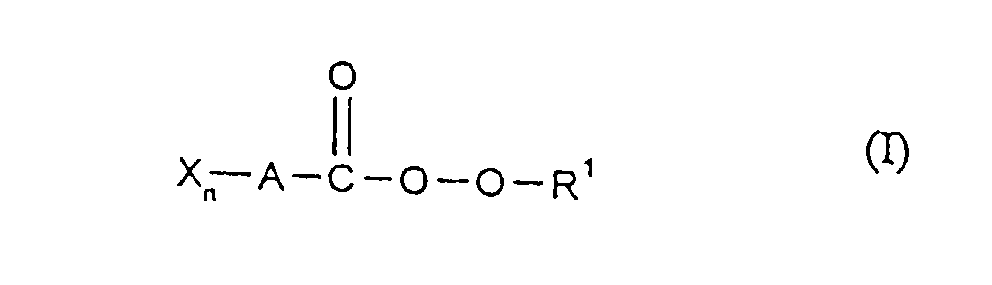
- Polymères greffés élastiques-thermoplastiques préparés par polymérisation radicalaire en émulsion de monomères vinyliques formateurs de résine en présence de caoutchouc présent sous forme de latex, en utilisant une combinaison d'un peroxyde répondant à la formule (I)dans laquelle
- R1
- représente un radical alkyle, un radical cycloalkyle et un radical aryle contenant de 4 à 20 atomes de carbone,
- X
- représente les radicaux -COOH et -SO3H, ainsi que leurs sels de métaux alcalins, de métaux alcalino-terreux ou d'ammonium,
- n
- représente un nombre entier dans le domaine de 1 à 6,
- A
- représente un radical alkylène, un radical cycloalkylène et un radical arylène contenant de 6 à 40 atomes de carbone,
- Polymères greffés élastiques-thermoplastiques selon la revendication 1, constitués par du styrène, de l'α-méthylstyrène, de l'acrylonitrile, du méthacrylate de méthyle, du N-phénylmaléimide, ainsi que par des mélanges de ces derniers, à titre de monomères formateurs de résine.
- Polymères greffés élastiques-thermoplastiques selon la revendication 1, contenant du polybutadiène à titre de caoutchouc.
- Polymères greffés élastiques-thermoplastiques selon la revendication 1, dans lesquels, en ce qui concerne le radical A dans la formule (I), il s'agit de radicaux répondant à la formule (II)dans laquelle les radicaux R2 et R3 représentent un atome d'hydrogène, un groupe alkyle en C1-C40, un groupe cycloalkyle en C3-C40, un groupe aryle, un groupe aralkyle ou un atome d'halogène, avec cette restriction que la somme des atomes de carbone des deux radicaux est supérieure à 16 ou que les radicaux représentent des constituants d'un système à noyau aliphatique en C5-C10 ou à noyau aromatique en C6-C14, le radical répondant à la formule (II) contenant au total 40 atomes de carbone au maximum.

- Polymères greffés élastiques-thermoplastiques selon la revendication 1, dans lesquels, dans la formule (I), A représente un radical alkylène, un radical cycloalkylène et un radical arylène contenant de 10 à 17 atomes de carbone.
- Matières à mouler thermoplastiques contenant des polymères greffés élastiques-thermoplastiques selon la revendication 1 et au moins une résine thermoplastique.
- Matières à mouler thermoplastiques selon la revendication 6, dans lesquelles la résine thermoplastique représente un copolymère de styrène et d'acrylonitrile dans le rapport pondéral de 90:10 à 50:50, le styrène pouvant être remplacé, en tout ou en partie, par de l'α-méthylstyrène ou par du méthacrylate de méthyle.
- Matières à mouler thermoplastiques selon la revendication 6, qui contiennent, à titre de résine thermoplastique, au moins un polycarbonate et/ou une résine de polyester.
- Procédé pour la préparation de polymères greffés élastiques-thermoplastiques par polymérisation radicalaire de monomères vinyliques formateurs de résine en présence d'un latex de caoutchouc, caractérisé en ce qu'on utilise, à titre d'initiateur radicalaire, un peroxyde répondant à la formule (I) en combinaison avec un agent de réduction.
Applications Claiming Priority (2)
| Application Number | Priority Date | Filing Date | Title |
|---|---|---|---|
| DE19519622A DE19519622A1 (de) | 1995-05-29 | 1995-05-29 | Elastisch-thermoplastische Pfropfpolymerisate mit verbesserten Eigenschaften |
| DE19519622 | 1995-05-29 |
Publications (2)
| Publication Number | Publication Date |
|---|---|
| EP0745623A1 EP0745623A1 (fr) | 1996-12-04 |
| EP0745623B1 true EP0745623B1 (fr) | 2000-01-05 |
Family
ID=7763113
Family Applications (1)
| Application Number | Title | Priority Date | Filing Date |
|---|---|---|---|
| EP96107835A Expired - Lifetime EP0745623B1 (fr) | 1995-05-29 | 1996-05-17 | Polymères greffés élastiques thermoplastiques à propriétés améliorées |
Country Status (4)
| Country | Link |
|---|---|
| US (2) | US5668218A (fr) |
| EP (1) | EP0745623B1 (fr) |
| DE (2) | DE19519622A1 (fr) |
| ES (1) | ES2141415T3 (fr) |
Families Citing this family (4)
| Publication number | Priority date | Publication date | Assignee | Title |
|---|---|---|---|---|
| DE19831735A1 (de) | 1998-07-15 | 2000-01-20 | Bayer Ag | Thermoplastische Formmassen auf Basis hochwirksamer Propfkautschukkomponenten |
| DE19831734A1 (de) | 1998-07-15 | 2000-01-20 | Bayer Ag | Thermoplastische Formmassen auf Basis spezieller hocheffektiver Pfropfpolymerkomponenten |
| US7390328B2 (en) * | 2003-12-19 | 2008-06-24 | Abbott Laboratories | Device and method for suturing of internal puncture sites |
| DE102007035462A1 (de) | 2007-07-28 | 2009-01-29 | Lanxess Deutschland Gmbh | Verfahren zur Herstellung von Pfropfkautschuken |
Family Cites Families (9)
| Publication number | Priority date | Publication date | Assignee | Title |
|---|---|---|---|---|
| SU621687A1 (ru) * | 1975-06-03 | 1978-08-30 | Предприятие П/Я В-2913 | Способ получени ударопрочных привитых сополимеров |
| JPS56149406A (en) * | 1980-04-21 | 1981-11-19 | Mitsui Toatsu Chem Inc | Production of styrene polymer |
| JPS5917125B2 (ja) * | 1981-04-01 | 1984-04-19 | 電気化学工業株式会社 | 耐衝撃性スチレン系樹脂の製法 |
| DE3118372A1 (de) * | 1981-05-09 | 1982-11-25 | Bayer Ag, 5090 Leverkusen | Emulgierend wirkende azoinitiatoren und ihre verwendung |
| DE3118373A1 (de) * | 1981-05-09 | 1982-11-25 | Bayer Ag, 5090 Leverkusen | Azoinitiatoren mit emulgatorwirkung und ihre verwendung |
| DE3708913A1 (de) * | 1987-03-19 | 1988-09-29 | Bayer Ag | Verfahren zur herstellung kautschukreicher pfropfpolymerisate |
| US4906689A (en) * | 1988-12-27 | 1990-03-06 | General Electric Company | Low-gloss aromatic carbonate polymer blend |
| DE4215484A1 (de) * | 1992-05-11 | 1993-11-18 | Bayer Ag | Oberflächenaktive Peroxide und ihre Verwendung |
| JPH07108411A (ja) * | 1993-10-08 | 1995-04-25 | Komatsu Ltd | シャーリングマシン |
-
1995
- 1995-05-29 DE DE19519622A patent/DE19519622A1/de not_active Withdrawn
-
1996
- 1996-05-10 US US08/644,133 patent/US5668218A/en not_active Expired - Fee Related
- 1996-05-17 EP EP96107835A patent/EP0745623B1/fr not_active Expired - Lifetime
- 1996-05-17 DE DE59604084T patent/DE59604084D1/de not_active Expired - Fee Related
- 1996-05-17 ES ES96107835T patent/ES2141415T3/es not_active Expired - Lifetime
-
1997
- 1997-04-03 US US08/834,755 patent/US5723540A/en not_active Expired - Fee Related
Also Published As
| Publication number | Publication date |
|---|---|
| EP0745623A1 (fr) | 1996-12-04 |
| US5668218A (en) | 1997-09-16 |
| US5723540A (en) | 1998-03-03 |
| DE19519622A1 (de) | 1996-12-05 |
| DE59604084D1 (de) | 2000-02-10 |
| ES2141415T3 (es) | 2000-03-16 |
Similar Documents
| Publication | Publication Date | Title |
|---|---|---|
| EP1268662B1 (fr) | Compositions polymeres a constance de proprietes amelioree | |
| EP0745624B1 (fr) | Masses à mouler d'ABS à propriétés améliorées | |
| DE19649249A1 (de) | Verbesserte thermoplastische Formmassen vom ABS-Typ | |
| EP1326904B1 (fr) | Procede de preparation de latex caoutchouteux greffes ayant une teneur limitee en monomeres residuels | |
| EP1263879B1 (fr) | Matieres a mouler abs ayant une moulabilite amelioree et une brillance elevee | |
| EP1098918B1 (fr) | Matieres moulables thermodurcissables a base de composants en caoutchouc greffe a haute efficacite | |
| EP1214375B1 (fr) | Matieres de moulage thermoplastiques a base de constituants caoutchoutes greffes determines | |
| EP0253236B1 (fr) | Procédé de préparation d'une masse de moulage thermoplastique | |
| EP1141057A1 (fr) | Matiere moulable abs aux associations de proprietes ameliorees | |
| EP1224237A1 (fr) | Procede visant a minimiser les effets dus au blanchissement par agression par le froid | |
| EP1341844B1 (fr) | Matieres a mouler thermoplastiques | |
| EP0731138A2 (fr) | Masses à mouler thermoplastiques de type ABS | |
| EP1098919B1 (fr) | Matieres moulables thermodurcissables a base de composants polymere greffe a tres haute efficacite | |
| EP0745623A1 (fr) | Polymères greffés élastiques thermoplastiques à propriétés améliorées | |
| EP0680978B1 (fr) | Polymères greffés élastiques thermoplastiques et matières moulées à partir de ceux-ci | |
| EP1268664B1 (fr) | Matieres moulables thermoplastiques a base de composants speciaux de caoutchouc greffe | |
| EP1337569B1 (fr) | Polymeres greffes elasto-thermoplastiques ameliores, destines a la production de matieres a mouler thermoplastiques modifiees par caoutchouc | |
| EP0094525A2 (fr) | Caoutchouc greffé pour la modification de masses à mouler thermoplastiques | |
| EP0531848B1 (fr) | Procédé de préparation de caoutchoucs greffés, avec formation réduite de coagulum | |
| DE102006056523A1 (de) | Verfahren zur Herstellung von Pfropfkautschuken, Pfropfkautschuke und thermoplastische Formmassen auf Basis dieser Pfropfkautschuke | |
| DE19738081A1 (de) | Verfahren zur Herstellung von partikelförmigen Polymerisaten unter Mitverwendung eines stabilen N-Oxyl-Radikals | |
| EP0310853B1 (fr) | Caoutchoucs greffés pour la modification de masses à mouler thermoplastiques | |
| EP0717077A2 (fr) | Masses à mouler d'ABS de morphologie nouvelle | |
| DE3523312A1 (de) | Pfropfkautschuke zur modifizierung thermoplastischer formmassen |
Legal Events
| Date | Code | Title | Description |
|---|---|---|---|
| PUAI | Public reference made under article 153(3) epc to a published international application that has entered the european phase |
Free format text: ORIGINAL CODE: 0009012 |
|
| AK | Designated contracting states |
Kind code of ref document: A1 Designated state(s): BE DE ES FR GB IT NL |
|
| 17P | Request for examination filed |
Effective date: 19970505 |
|
| GRAG | Despatch of communication of intention to grant |
Free format text: ORIGINAL CODE: EPIDOS AGRA |
|
| 17Q | First examination report despatched |
Effective date: 19981214 |
|
| GRAG | Despatch of communication of intention to grant |
Free format text: ORIGINAL CODE: EPIDOS AGRA |
|
| GRAG | Despatch of communication of intention to grant |
Free format text: ORIGINAL CODE: EPIDOS AGRA |
|
| GRAH | Despatch of communication of intention to grant a patent |
Free format text: ORIGINAL CODE: EPIDOS IGRA |
|
| GRAH | Despatch of communication of intention to grant a patent |
Free format text: ORIGINAL CODE: EPIDOS IGRA |
|
| GRAA | (expected) grant |
Free format text: ORIGINAL CODE: 0009210 |
|
| AK | Designated contracting states |
Kind code of ref document: B1 Designated state(s): BE DE ES FR GB IT NL |
|
| REF | Corresponds to: |
Ref document number: 59604084 Country of ref document: DE Date of ref document: 20000210 |
|
| REG | Reference to a national code |
Ref country code: ES Ref legal event code: FG2A Ref document number: 2141415 Country of ref document: ES Kind code of ref document: T3 |
|
| ITF | It: translation for a ep patent filed | ||
| GBT | Gb: translation of ep patent filed (gb section 77(6)(a)/1977) |
Effective date: 20000228 |
|
| ET | Fr: translation filed | ||
| PLBE | No opposition filed within time limit |
Free format text: ORIGINAL CODE: 0009261 |
|
| STAA | Information on the status of an ep patent application or granted ep patent |
Free format text: STATUS: NO OPPOSITION FILED WITHIN TIME LIMIT |
|
| 26N | No opposition filed | ||
| REG | Reference to a national code |
Ref country code: GB Ref legal event code: IF02 |
|
| PGFP | Annual fee paid to national office [announced via postgrant information from national office to epo] |
Ref country code: FR Payment date: 20030513 Year of fee payment: 8 |
|
| PGFP | Annual fee paid to national office [announced via postgrant information from national office to epo] |
Ref country code: NL Payment date: 20030528 Year of fee payment: 8 |
|
| PG25 | Lapsed in a contracting state [announced via postgrant information from national office to epo] |
Ref country code: NL Free format text: LAPSE BECAUSE OF NON-PAYMENT OF DUE FEES Effective date: 20041201 |
|
| PG25 | Lapsed in a contracting state [announced via postgrant information from national office to epo] |
Ref country code: FR Free format text: LAPSE BECAUSE OF NON-PAYMENT OF DUE FEES Effective date: 20050131 |
|
| NLV4 | Nl: lapsed or anulled due to non-payment of the annual fee |
Effective date: 20041201 |
|
| REG | Reference to a national code |
Ref country code: FR Ref legal event code: ST |
|
| REG | Reference to a national code |
Ref country code: GB Ref legal event code: 732E |
|
| PGFP | Annual fee paid to national office [announced via postgrant information from national office to epo] |
Ref country code: IT Payment date: 20060531 Year of fee payment: 11 |
|
| REG | Reference to a national code |
Ref country code: GB Ref legal event code: 732E |
|
| PGFP | Annual fee paid to national office [announced via postgrant information from national office to epo] |
Ref country code: ES Payment date: 20080526 Year of fee payment: 13 |
|
| PGFP | Annual fee paid to national office [announced via postgrant information from national office to epo] |
Ref country code: BE Payment date: 20080624 Year of fee payment: 13 |
|
| PGFP | Annual fee paid to national office [announced via postgrant information from national office to epo] |
Ref country code: DE Payment date: 20080630 Year of fee payment: 13 |
|
| PGFP | Annual fee paid to national office [announced via postgrant information from national office to epo] |
Ref country code: GB Payment date: 20080529 Year of fee payment: 13 |
|
| PG25 | Lapsed in a contracting state [announced via postgrant information from national office to epo] |
Ref country code: IT Free format text: LAPSE BECAUSE OF NON-PAYMENT OF DUE FEES Effective date: 20070517 |
|
| BERE | Be: lapsed |
Owner name: *LANXESS DEUTSCHLAND G.M.B.H. Effective date: 20090531 |
|
| GBPC | Gb: european patent ceased through non-payment of renewal fee |
Effective date: 20090517 |
|
| PG25 | Lapsed in a contracting state [announced via postgrant information from national office to epo] |
Ref country code: GB Free format text: LAPSE BECAUSE OF NON-PAYMENT OF DUE FEES Effective date: 20090517 |
|
| PG25 | Lapsed in a contracting state [announced via postgrant information from national office to epo] |
Ref country code: DE Free format text: LAPSE BECAUSE OF NON-PAYMENT OF DUE FEES Effective date: 20091201 Ref country code: BE Free format text: LAPSE BECAUSE OF NON-PAYMENT OF DUE FEES Effective date: 20090531 |
|
| REG | Reference to a national code |
Ref country code: ES Ref legal event code: FD2A Effective date: 20090518 |
|
| PG25 | Lapsed in a contracting state [announced via postgrant information from national office to epo] |
Ref country code: ES Free format text: LAPSE BECAUSE OF NON-PAYMENT OF DUE FEES Effective date: 20090518 |