EP0746013A2 - Méthode de nettoyage et traitement d'un dispositif micromécanique - Google Patents
Méthode de nettoyage et traitement d'un dispositif micromécanique Download PDFInfo
- Publication number
- EP0746013A2 EP0746013A2 EP96108733A EP96108733A EP0746013A2 EP 0746013 A2 EP0746013 A2 EP 0746013A2 EP 96108733 A EP96108733 A EP 96108733A EP 96108733 A EP96108733 A EP 96108733A EP 0746013 A2 EP0746013 A2 EP 0746013A2
- Authority
- EP
- European Patent Office
- Prior art keywords
- device surface
- cleaning medium
- cleaning
- mirror
- treating
- Prior art date
- Legal status (The legal status is an assumption and is not a legal conclusion. Google has not performed a legal analysis and makes no representation as to the accuracy of the status listed.)
- Withdrawn
Links
Images

Classifications
-
- B—PERFORMING OPERATIONS; TRANSPORTING
- B81—MICROSTRUCTURAL TECHNOLOGY
- B81C—PROCESSES OR APPARATUS SPECIALLY ADAPTED FOR THE MANUFACTURE OR TREATMENT OF MICROSTRUCTURAL DEVICES OR SYSTEMS
- B81C1/00—Manufacture or treatment of devices or systems in or on a substrate
- B81C1/00912—Treatments or methods for avoiding stiction of flexible or moving parts of MEMS
- B81C1/0096—For avoiding stiction when the device is in use, i.e. after manufacture has been completed
-
- B—PERFORMING OPERATIONS; TRANSPORTING
- B08—CLEANING
- B08B—CLEANING IN GENERAL; PREVENTION OF FOULING IN GENERAL
- B08B7/00—Cleaning by methods not provided for in a single other subclass or a single group in this subclass
-
- B—PERFORMING OPERATIONS; TRANSPORTING
- B08—CLEANING
- B08B—CLEANING IN GENERAL; PREVENTION OF FOULING IN GENERAL
- B08B7/00—Cleaning by methods not provided for in a single other subclass or a single group in this subclass
- B08B7/0021—Cleaning by methods not provided for in a single other subclass or a single group in this subclass by liquid gases or supercritical fluids
-
- B—PERFORMING OPERATIONS; TRANSPORTING
- B81—MICROSTRUCTURAL TECHNOLOGY
- B81B—MICROSTRUCTURAL DEVICES OR SYSTEMS, e.g. MICROMECHANICAL DEVICES
- B81B3/00—Devices comprising flexible or deformable elements, e.g. comprising elastic tongues or membranes
- B81B3/0002—Arrangements for avoiding sticking of the flexible or moving parts
- B81B3/0005—Anti-stiction coatings
-
- B—PERFORMING OPERATIONS; TRANSPORTING
- B81—MICROSTRUCTURAL TECHNOLOGY
- B81C—PROCESSES OR APPARATUS SPECIALLY ADAPTED FOR THE MANUFACTURE OR TREATMENT OF MICROSTRUCTURAL DEVICES OR SYSTEMS
- B81C1/00—Manufacture or treatment of devices or systems in or on a substrate
- B81C1/00841—Cleaning during or after manufacture
- B81C1/00857—Cleaning during or after manufacture after manufacture, e.g. back-end of the line process
-
- G—PHYSICS
- G02—OPTICS
- G02B—OPTICAL ELEMENTS, SYSTEMS OR APPARATUS
- G02B26/00—Optical devices or arrangements for the control of light using movable or deformable optical elements
- G02B26/08—Optical devices or arrangements for the control of light using movable or deformable optical elements for controlling the direction of light
- G02B26/0816—Optical devices or arrangements for the control of light using movable or deformable optical elements for controlling the direction of light by means of one or more reflecting elements
- G02B26/0833—Optical devices or arrangements for the control of light using movable or deformable optical elements for controlling the direction of light by means of one or more reflecting elements the reflecting element being a micromechanical device, e.g. a MEMS mirror, DMD
- G02B26/0841—Optical devices or arrangements for the control of light using movable or deformable optical elements for controlling the direction of light by means of one or more reflecting elements the reflecting element being a micromechanical device, e.g. a MEMS mirror, DMD the reflecting element being moved or deformed by electrostatic means
-
- B—PERFORMING OPERATIONS; TRANSPORTING
- B81—MICROSTRUCTURAL TECHNOLOGY
- B81C—PROCESSES OR APPARATUS SPECIALLY ADAPTED FOR THE MANUFACTURE OR TREATMENT OF MICROSTRUCTURAL DEVICES OR SYSTEMS
- B81C2201/00—Manufacture or treatment of microstructural devices or systems
- B81C2201/11—Treatments for avoiding stiction of elastic or moving parts of MEMS
- B81C2201/112—Depositing an anti-stiction or passivation coating, e.g. on the elastic or moving parts
-
- B—PERFORMING OPERATIONS; TRANSPORTING
- B81—MICROSTRUCTURAL TECHNOLOGY
- B81C—PROCESSES OR APPARATUS SPECIALLY ADAPTED FOR THE MANUFACTURE OR TREATMENT OF MICROSTRUCTURAL DEVICES OR SYSTEMS
- B81C2201/00—Manufacture or treatment of microstructural devices or systems
- B81C2201/11—Treatments for avoiding stiction of elastic or moving parts of MEMS
- B81C2201/117—Using supercritical fluid, e.g. carbon dioxide, for removing sacrificial layers
Definitions
- the present invention relates generally to cleaning and treating a semiconductor surface, and more particularly, to a method of cleaning and passivating a micromechanical device including a digital micromirror device (DMD) spatial light modulator (SLM).
- DMD digital micromirror device
- SLM spatial light modulator
- the DMD is an electro/mechanical/optical Spatial Light Modulator (SLM) suitable for use in displays, projectors and hard copy printers.
- SLM Spatial Light Modulator
- the DMD is a monolithic single-chip integrated circuit SLM, comprised of a high density area or linear array of 16 micron square deflectable micromirrors on 17 micron centers. These mirrors are fabricated over address circuitry including an array of SRAM cells and address electrodes which generate electrostatic attraction forces.
- Each mirror forms one pixel of the DMD array and may be monostable, or bistable, that is to say, stable in one of two positions, wherein a source of light directed upon the mirror array will be reflected in one of two directions.
- incident light to that mirror will be reflected to a projector lens and focused on a display screen or a photosensitive element of a printer.
- light directed on the mirror will be deflected to a light absorber.
- Each mirror of the array is individually controlled to either direct incident light into the projector lens, or to the light absorber.
- the projector lens ultimately focuses and magnifies the modulated light from the pixel mirrors onto a display screen and produce an image in the case of a display. If each pixel mirror of the DMD array is in the "on” position, the displayed image will be an array of bright pixels.
- the DMD is revolutionary in that it is truly a digital display device and an integrated circuit solution.
- the evolution and variations of the DMD can be appreciated through a reading of several commonly assigned patents.
- the "first generation" of DMD spatial light modulators implemented a deflectable beam wherein the mirror and the beam were one in the same. That is, an electrostatic force was created between the mirror and the underlying address electrode to induce deflection thereof.
- the deflection of these mirrors can be variable and operate in the analog mode, and may comprise a leaf-spring or cantilevered beam, as disclosed in commonly assigned U.S. Patent 4,662,746 to Hornbeck, entitled “Spatial Light Modulator and Method", U.S.
- Patent 4,710,732 to Hornbeck entitled “Spatial Light Modulator and Method”
- U.S. Patent 4,956,619 to Hornbeck entitled “Spatial Light Modulator”
- U.S. Patent 5,172,262 to Hornbeck entitled “Spatial Light Modulator and Method”.
- a “second generation” of the DMD is embodied in commonly assigned U.S. Patent 5,083,857 entitled “Multi-Level Deformable Mirror Device'', as well as in copending Published European patent application serial number 941202343.
- the mirror is elevated above a yoke, this yoke being suspended over the addressing circuitry by a pair of torsion hinges.
- an electrostatic force is generated between the elevated mirror and an elevated electrode. When rotated, it is the yoke that comes into contact with a landing electrode, whereby the mirror tips never come into contact with any structure.
- the shorter moment arm of the yoke being about 50% of the mirror, allows energy to be more efficiently coupled into the mirror by reset pulses due to the fact that the mirror tip is free to move.
- Applying resonant reset pulses to the mirror to help free the pivoting structure from the landing electrode is disclosed in commonly assigned U.S. Patent 5,096,279, entitled “Spatial Light Modulator and Method'', and U.S. Patent 5,233,456 entitled “Resonant Mirror and Method of Manufacture".
- U.S. Patent 5,096,279 entitled “Spatial Light Modulator and Method''
- U.S. Patent 5,233,456 entitled “Resonant Mirror and Method of Manufacture”.
- some of the address torque generated between the mirror and the elevated address electrode is sacrificed compared to the first generation devices because the yoke slightly diminishes the surface area of the address electrode.
- the deflectable mirror of the DMD or the yoke supporting the elevated mirror, will land upon and engage a landing electrode.
- This movable element is subject to stiction forces, which is commonly known as the tendency of a movable element to stick to the engaged element or pad. This phenomenon is due to many known and unknown physical characteristics and features of the parts, and can include Van der Waals forces, friction, and adhesion.
- One solution minimizing the tendency for a micromechanical device to stick to an engaged element is to passivate the engaged element, as disclosed in commonly assigned U.S. Patent 5,331,454 to Hornbeck, entitled "Low Reset Voltage process for DMD".
- An orientated monolayer is passivated upon the landing electrode of the spatial light modulator element such that when the element (mirror or yoke) is activated and deflects to come in contact with the landing electrode, the orientated monolayer decreases the Van der Waals and stiction forces to reduce the tendency for the element to stick to the electrode.
- PFPE perfluoropolyether
- a supercritical fluid such as carbon dioxide
- Additives may be included to modify the chemical properties, polarity, or solvating power of the fluid.
- O 2 , O 3 , or H 2 O 2 may be used to oxidize the wafer surface or organic contaminants.
- Chemical treatments such as HF etching (wet or anhydrous) are notorious for an electrostatically active wafer surface which attracts particle and chemical contaminants.
- Such oxide removal or cleaning processes are usually followed by further processing to clean and passivate the wafer surface.
- Cleaning with a CO 2 supercritical fluid alleviates the electrostatic problem because the volume of fluid between the wafer and the cleaning chamber metal walls is minimized.
- the system is noted as ideally suited for single wafer, cluster-tool configurations where supercritical fluid cleaning can provide a contaminant free, passivated surface between various processing steps.
- SCF supercritical fluid
- the present invention sets out to achieve an effective method for cleaning and passivating a semiconductor surface, especially a micromechanical device such as those of the DMD type.
- the present invention provides a method of cleaning and treating a device surface comprising, placing said device in an controlled environment, exposing said device surface to a cleaning medium, removing substances liberated from said device surface by said cleaning medium and treating said device surface with a treating medium before said device is removed from said controlled environment such that the introduction of contaminants onto said device surface is substantially eliminated.
- the present invention achieves technical advantages by cleaning a semiconductor surface with a supercritical fluid to remove soluble chemical compounds, maintaining the cleaned part in the cleaned SCF chamber to preserve the surface integrity of the part so crucial to successive subsequent lubrication application, and then passivating the surface.
- the subsequent lubricant passivation treatment of the surface is very effective to reduce stiction over the operational life of the device.
- An ultra-high vacuum technique is utilised whereby surfaces can be rendered clean in the SCF chamber for hours if necessary, until the surface is passivated.
- the surface is passivated after a SCF cleaning process, but before the part is removed from the SCF chamber.
- the invention eliminates the deposition of chemical compounds on the molecular level including organics, which are present even in an ambient clean room environment.
- the present invention is well suited for micromechanical devices which have one element enduring a repeated contact with another element.
- the present invention is also well suited for treating a semiconductor surface, such as a very thin layer of gate oxide having a thickness on the order of a few molecules, such as 30 Angstroms, in preparation for a subsequent process or treatment, and for passivating a hard disk drive.
- a semiconductor surface such as a very thin layer of gate oxide having a thickness on the order of a few molecules, such as 30 Angstroms
- cleaning and maintaining a semiconductor device in a clean SCF chamber after the SCF cleaning process and until the device surface is passivated is encompassed by the present invention.
- the preferred embodiment of the present invention will be set forth in reference to cleaning and passivating the landing electrode of a bistable digital micromirror device (DMD) spatial light modulator, such as that shown in Figure 1.
- DMD digital micromirror device
- the method of the present invention is suitable to clean and passivate other surfaces including, but without limitation to, a semiconductor wafer, or a hard disk of a disk drive.
- a digital micromirror device comprising one pixel is generally shown at 10.
- pixel 10 When used as a spatial light modulator, pixel 10 comprises of one of thousands of such pixels arranged in a linear or area array to modulate incident light and generate an image, as set forth in the several cross referenced commonly assigned patents previously discussed in the section entitled Background of the Invention.
- Pixel 10 is seen to include a beam comprising a mirror 12 supported by a torsion hinge 14 above a silicon substrate 16.
- the beam could comprise a yoke supporting an elevated mirror, as disclosed in commonly assigned co-pending European Patent Application Serial No.96106099.3.
- a pair of support posts 18 support torsion hinges 14 each side of mirror 12, whereby mirror 12 is suspended over a pair of opposing address electrodes 20 and a pair of opposing mirror landing electrodes generally shown at 22.
- Mirror 12 is bistable, that is to say, stable in one of two landing states.
- Mirror 12 is deflected by addressing one of the two address electrodes 20 with a voltage to generate electrostatic attraction forces between mirror 12 and the addressed address electrode 20.
- a bias voltage is applied to mirror 12 to initiate the deflection.
- the generated electrostatic attraction forces pull the mirror 12 downward until the respective landing tip 24 of mirror 12 lands upon and engages the corresponding landing electrode 22.
- incident light (not shown) is modulated by mirror 12 and directed into either a light absorber, or directed into a projection lens of a darkfield optics system to generate a light image.
- Each pixel 10 of the area array (not shown) modulates the respective portion of incident light, whereby the pixel array together generates a light image which is focused by the projector lens to a projector screen, or to an exposure module such as the electrostatic drum of a xerographic printer.
- passivating the surface of the landing electrodes 22 with an oriented monolayer can decrease the Van der Waals forces and reduce the tendency for the mirror to stick to the landing electrode.
- An oriented monolayer disclosed in this patent is powdered Perfluordecanoic Acid (PFDA). Passivating the landing surface of the landing electrode 22 with a monolayer of PFDA helps prevent the buildup of the Van der Waals forces between the moving and non-moving elements by lowering the surface energy of the landing electrode.
- PFDA powdered Perfluordecanoic Acid
- the landing electrode be passivated with a layer of perfluoropolyether (PFPE).
- PFPE perfluoropolyether
- the PFPE has "self-healing" wear-resistant properties, whereby the molecules can migrate to the location where the mirror landing tip engages the landing electrode when the mirror is spaced therefrom.
- the voltage needing to be applied to the mirror to reset the mirror does not need to be significantly increased to free the mirror from the landing electrode.
- damage to the mirror 12, which could include the mirror snapping off its hinges can be avoided by minimizing the reset forces applied to remove the mirror tip from the landing electrode 22.
- the method set for allows the landing electrode 22 of the pixel 10 to be effectively passivated with a lubricating material.
- a lubricating medium on the micromechanical device, sticking between the contacting components of the micromechanical device during operation is significantly reduced, especially over the significant lifetime of the device. Over time, with the components making repetitive contact being up to 10 12 cycles, operation-related sticking is minimized due to the effective passivation of the landing electrode. It is the unique problem of operation-related stiction forces encountered post-processing of the micromechanical device to achieve reliable operation that is being addressed by the teachings of the present invention.
- the method of the present invention comprises essentially three key steps. First, cleaning the device surface with a supercritical fluid (SCF) in a SCF chamber to remove contaminants including soluble chemical compounds, then retaining the cleaned surface in the SCF chamber to preserve the surface integrity of the part so crucial to successful subsequent lubricant application, and finally, passivating the cleaned surface in the SCF chamber with a lubricant, without ever removing the cleaned surface from the SCF chamber. Recognizing the importance of maintaining the cleaned surface in the SCF chamber, without transporting the surface even through a clean room ambient, has been observed in the laboratory to render a subsequently passivated surface effective over an extended period of time, even through extended operation of a device having an element making repetitive contact with the landing electrode.
- SCF supercritical fluid
- the present invention derives technical advantages by preserving the SCF cleaned landing electrode free from contaminants, including specifically, organics and other contaminants. If the cleaned surface is not maintained in the SCF chamber, contamination from organics and inorganics that reside in even a Class-1 clean room can preclude a suitable deposition of a passivation layer. The benefits of maintaining the cleaned surface in the SCF chamber post SCF cleaning, and until the surface is passivated, has realized dramatic results. Micromechanical devices are unique in that they endure repetitive contact over the operational life of the device. The present invention addresses the unique environment and operational requirements of a reliable micromechanical device which requires a suitable passivated surface to be maintained over the operational life of the device.
- micromechanical devices In addition to micromechanical devices, other devices stand to benefit by the method of the present invention as well, including cleaning and passivating a Si surface prior to the growth of a gate oxide on a silicon wafer, or prior to the deposition of subsequent semiconductor materials.
- a hard disk of memory drives also stand to benefit according to the teachings of the present invention, whereby the useful life of the hard disk drive is extended.
- the method of the present invention is set forth as follows.
- the surface to be cleaned and passivated such as the landing electrodes 22 of pixel 10 shown in Figure 1, but could also include a silicon wafer, hard disk etc.
- inlet valve 52 is controlled by and opened by a processor and valve control 54, whereby a supercritical fluid, such as carbon dioxide, is introduced into chamber 50 via passageway 56.
- a supercritical fluid such as carbon dioxide
- Processor 54 opens an outlet valve 58 whereby the SCF fluid and liberated soluble contaminants are purged from chamber 50 via passageway 60.
- the effectiveness of the SCF fluid to clean the exposed surfaces without creating surface tension may be done in many ways, and may be enhanced as well.
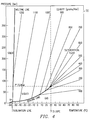
- a pressure-temperature-density chart for carbon dioxide is illustrated, with the region generally shown at 70 illustrating when carbon dioxide is above the critical point (CP).
- CP critical point
- carbon dioxide needs to be maintained in a pressure environment above about 75 bar, above a temperature of about 30° Celsius, and at a density above approximately 200 grams per liter.
- other supercritical fluids could be used as well, however, carbon dioxide has proven to be a predictable, inexpensive supercritical fluid that is well suited for cleaning objects according to the present invention.
- other process controls including electromagnetic energy control 62 and temperature control 64 also make up and comprise the apparatus 66 suited to perform the method of the present invention as just discussed.
- This temperature control 64 is achieved by conductive and radiative heating of the chamber 50 walls.
- the coupling of focused electromagnetic energy 62 onto the device can also be used to provide local temperature changes, and thus SCF density variations, in the immediate vicinity of the device to enhance the cleaning process. This could be accomplished by, for example, the use of a specially designed window affixed to the chamber 50 which permits the passage of electromagnetic radiation.
- the choice of electromagnetic energy could be dictated by the propensity of the contaminant to undergo a chemical reaction, for example by photon absorption, between the CO 2 SCF so as to facilitate the removal of a particular chemical species. For example, fluorocarbon removal would be facilitated by exposure to UV light in the course of the CO 2 SCF process.
- a specific cleaning additive chosen so as to result in a chemical reaction with surface contaminants, such as organics, is dissolved in the CO 2 SCF environment.
- the additive is chosen so as to facilitate the removal of the contaminant through chemical attack which liberates the contaminant from the surface to be swept away in subsequent purging steps.
- step 34 the device 10 just cleaned by the SCF fluid is maintained within the sealed chamber 50 to avoid any contaminants, including organic material on the molecular level, from contaminating the cleaned surfaces of device 10, including the landing electrodes 22 of DMD 10.
- This step is critical to ensure that the passivating step to follow is truly effective. Should device 10 not be maintained within the sealed SCF chamber, such as being transported through the ambient of a class one clean room, the exposed surfaces could be contaminated with molecular level impurities thus degrading the effectiveness of the subsequent passivation step, and reducing device reliability.
- the chamber 50 could be purged with an inert gas, such as Argon, to serve as a transition medium in which the chemical cleanliness of the surface is also preserved.
- step 36 the device 10 is passivated by introducing a passivant into chamber 50 through passageway 56.
- the passivant can include, but is not limited to, PFDA and PFPE, as set forth in the commonly assigned Patent and Patent Application previously referenced, or other suitable passivants.
- the passivated surface alleviates the need to increase the reset voltage that is applied to the mirror 12 to effect a reset operation over the extended operational life of the device.
- device reliability is dramatically improved, as is device yield and performance.
- stiction is somewhat of a phenomenon in the area of physical sciences, performing the method of the present invention is very effective to reduce stiction, and also to reduce the surface energy of the landing electrode to minimize any associated Van der Waals forces that may exist between the landing electrode and the deflectable mirror.
- mirror 12 and hinges 14 are typically of the order of about 500 Angstroms in thickness.
- Mirror 12 and hinges 14 may comprise of various materials, including aluminum, aluminum alloys, titanium tungsten, titanium tungsten nitride, or other materials that are well suited for the device and are compatible with robust semiconductor manufacturing processes.
- the present invention appreciates the effect contaminants, especially organic contaminants, can have on a landing electrode if they exist during the passivation process. Again, it is simply not enough to maintain the device in a clean room during transportation to a separate passivating apparatus if good performance of the device is to be expected over a significant time period. Especially in the case of a micromechanical device which endures repeated mechanical operation, the method of the present invention is crucial to achieve satisfactory operational performance.
- the method of the present invention is well suited for cleaning other surfaces, including the interface between a semiconductor wafer substrate and a gate oxide layer over said semiconductor wafer, which layer may be on the order of only a few nanometers in thickness, such as 3 nm.
- a supercritical fluid such as carbon dioxide
- the gate oxide layer may be on the order of only a few nanometers in thickness, such as 3 nm.
- the method of the present invention achieves technical advantages by cleaning a device, especially those of the micromechanical type, with a supercritical fluid to minimize surface tension which could otherwise damage a micromechanical element. Maintaining the cleaned surface in the SCF chamber until and during the subsequent passivation step avoids contaminants on the molecular level, including organics, from contaminating the cleaned surface. By passivating the surface in the SCF chamber, a high quality passivation layer is achieved which is effective over the extended life of the device to increase device reliability, such as 10 years in the case of a DMD device, and increase device yield and performance.
- the reset voltage required to reset the mirror from a deflected state does not need to be significantly increased over the life of the device to overcome the effects of Van der Waals forces, adhesion and stiction. Thus, it is especially the extended reliable life time of the device that is achieved through the cleaning and passivation process of the present invention.
Landscapes
- Engineering & Computer Science (AREA)
- Microelectronics & Electronic Packaging (AREA)
- Manufacturing & Machinery (AREA)
- Physics & Mathematics (AREA)
- Computer Hardware Design (AREA)
- General Physics & Mathematics (AREA)
- Optics & Photonics (AREA)
- Mechanical Light Control Or Optical Switches (AREA)
- Cleaning Or Drying Semiconductors (AREA)
Applications Claiming Priority (2)
| Application Number | Priority Date | Filing Date | Title |
|---|---|---|---|
| US455466 | 1989-12-22 | ||
| US45546695A | 1995-05-31 | 1995-05-31 |
Publications (2)
| Publication Number | Publication Date |
|---|---|
| EP0746013A2 true EP0746013A2 (fr) | 1996-12-04 |
| EP0746013A3 EP0746013A3 (fr) | 1999-10-27 |
Family
ID=23808919
Family Applications (1)
| Application Number | Title | Priority Date | Filing Date |
|---|---|---|---|
| EP96108733A Withdrawn EP0746013A3 (fr) | 1995-05-31 | 1996-05-31 | Méthode de nettoyage et traitement d'un dispositif micromécanique |
Country Status (3)
| Country | Link |
|---|---|
| US (1) | US6024801A (fr) |
| EP (1) | EP0746013A3 (fr) |
| JP (1) | JPH08330266A (fr) |
Cited By (3)
| Publication number | Priority date | Publication date | Assignee | Title |
|---|---|---|---|---|
| WO2000039915A1 (fr) * | 1998-12-29 | 2000-07-06 | Honeywell Inc. | Configuration jumelee permettant d'augmenter la duree de vie d'organes de commande electrostatiques fonctionnant en mode tactile |
| US6556741B1 (en) | 2000-10-25 | 2003-04-29 | Omm, Inc. | MEMS optical switch with torsional hinge and method of fabrication thereof |
| WO2002048023A3 (fr) * | 2000-10-25 | 2003-08-21 | Omm Inc | Procede permettant d'ameliorer les structures de silicium polycristallin d'un dispositif mems au moyen d'un masquage empechant la gravure anodique de ces structures |
Families Citing this family (114)
| Publication number | Priority date | Publication date | Assignee | Title |
|---|---|---|---|---|
| US6149828A (en) | 1997-05-05 | 2000-11-21 | Micron Technology, Inc. | Supercritical etching compositions and method of using same |
| US6306564B1 (en) | 1997-05-27 | 2001-10-23 | Tokyo Electron Limited | Removal of resist or residue from semiconductors using supercritical carbon dioxide |
| US6500605B1 (en) | 1997-05-27 | 2002-12-31 | Tokyo Electron Limited | Removal of photoresist and residue from substrate using supercritical carbon dioxide process |
| TW539918B (en) | 1997-05-27 | 2003-07-01 | Tokyo Electron Ltd | Removal of photoresist and photoresist residue from semiconductors using supercritical carbon dioxide process |
| US6093256A (en) * | 1997-11-14 | 2000-07-25 | Fort James Corp | Embossing roll cleaning method |
| US6242165B1 (en) | 1998-08-28 | 2001-06-05 | Micron Technology, Inc. | Supercritical compositions for removal of organic material and methods of using same |
| US6204085B1 (en) * | 1998-09-15 | 2001-03-20 | Texas Instruments Incorporated | Reduced deformation of micromechanical devices through thermal stabilization |
| US7064070B2 (en) | 1998-09-28 | 2006-06-20 | Tokyo Electron Limited | Removal of CMP and post-CMP residue from semiconductors using supercritical carbon dioxide process |
| US6277753B1 (en) | 1998-09-28 | 2001-08-21 | Supercritical Systems Inc. | Removal of CMP residue from semiconductors using supercritical carbon dioxide process |
| US6602349B2 (en) | 1999-08-05 | 2003-08-05 | S.C. Fluids, Inc. | Supercritical fluid cleaning process for precision surfaces |
| US7071520B2 (en) * | 2000-08-23 | 2006-07-04 | Reflectivity, Inc | MEMS with flexible portions made of novel materials |
| KR100744888B1 (ko) * | 1999-11-02 | 2007-08-01 | 동경 엘렉트론 주식회사 | 소재를 초임계 처리하기 위한 장치 및 방법 |
| US6748960B1 (en) * | 1999-11-02 | 2004-06-15 | Tokyo Electron Limited | Apparatus for supercritical processing of multiple workpieces |
| US6890853B2 (en) * | 2000-04-25 | 2005-05-10 | Tokyo Electron Limited | Method of depositing metal film and metal deposition cluster tool including supercritical drying/cleaning module |
| TW499548B (en) | 2000-06-02 | 2002-08-21 | Tokyo Electron Ltd | Dual diaphragm pump |
| AU2001290171A1 (en) | 2000-07-26 | 2002-02-05 | Tokyo Electron Limited | High pressure processing chamber for semiconductor substrate |
| US7057246B2 (en) | 2000-08-23 | 2006-06-06 | Reflectivity, Inc | Transition metal dielectric alloy materials for MEMS |
| US6764809B2 (en) | 2000-10-12 | 2004-07-20 | North Carolina State University | CO2-processes photoresists, polymers, and photoactive compounds for microlithography |
| US6664779B2 (en) * | 2000-11-16 | 2003-12-16 | Texas Instruments Incorporated | Package with environmental control material carrier |
| JP2002237481A (ja) * | 2001-02-09 | 2002-08-23 | Kobe Steel Ltd | 微細構造体の洗浄方法 |
| US6641678B2 (en) | 2001-02-15 | 2003-11-04 | Micell Technologies, Inc. | Methods for cleaning microelectronic structures with aqueous carbon dioxide systems |
| US6905555B2 (en) | 2001-02-15 | 2005-06-14 | Micell Technologies, Inc. | Methods for transferring supercritical fluids in microelectronic and other industrial processes |
| US6596093B2 (en) | 2001-02-15 | 2003-07-22 | Micell Technologies, Inc. | Methods for cleaning microelectronic structures with cyclical phase modulation |
| US6602351B2 (en) | 2001-02-15 | 2003-08-05 | Micell Technologies, Inc. | Methods for the control of contaminants following carbon dioxide cleaning of microelectronic structures |
| JP2004527110A (ja) * | 2001-02-15 | 2004-09-02 | マイセル・テクノロジーズ,インコーポレイテッド | マイクロエレクトロニック構造体を洗浄する方法 |
| US6613157B2 (en) | 2001-02-15 | 2003-09-02 | Micell Technologies, Inc. | Methods for removing particles from microelectronic structures |
| US6562146B1 (en) * | 2001-02-15 | 2003-05-13 | Micell Technologies, Inc. | Processes for cleaning and drying microelectronic structures using liquid or supercritical carbon dioxide |
| JP2002352420A (ja) * | 2001-05-22 | 2002-12-06 | Fuji Electric Co Ltd | 磁気記録媒体の製造方法および製造装置 |
| US6958123B2 (en) * | 2001-06-15 | 2005-10-25 | Reflectivity, Inc | Method for removing a sacrificial material with a compressed fluid |
| US7057251B2 (en) * | 2001-07-20 | 2006-06-06 | Reflectivity, Inc | MEMS device made of transition metal-dielectric oxide materials |
| US20030019528A1 (en) * | 2001-07-26 | 2003-01-30 | Ibm Corporation | Check valve for micro electro mechanical structure devices |
| US6706641B2 (en) | 2001-09-13 | 2004-03-16 | Micell Technologies, Inc. | Spray member and method for using the same |
| US6782900B2 (en) | 2001-09-13 | 2004-08-31 | Micell Technologies, Inc. | Methods and apparatus for cleaning and/or treating a substrate using CO2 |
| US6619304B2 (en) | 2001-09-13 | 2003-09-16 | Micell Technologies, Inc. | Pressure chamber assembly including non-mechanical drive means |
| US6666928B2 (en) | 2001-09-13 | 2003-12-23 | Micell Technologies, Inc. | Methods and apparatus for holding a substrate in a pressure chamber |
| US6763840B2 (en) * | 2001-09-14 | 2004-07-20 | Micell Technologies, Inc. | Method and apparatus for cleaning substrates using liquid carbon dioxide |
| US20040040660A1 (en) * | 2001-10-03 | 2004-03-04 | Biberger Maximilian Albert | High pressure processing chamber for multiple semiconductor substrates |
| US6696364B2 (en) * | 2001-10-19 | 2004-02-24 | Stmicroelectronics S.R.L. | Method for manipulating MEMS devices, integrated on a wafer semiconductor and intended to be diced one from the other, and relevant support |
| JP2003133070A (ja) * | 2001-10-30 | 2003-05-09 | Seiko Epson Corp | 積層膜の製造方法、電気光学装置、電気光学装置の製造方法、有機エレクトロルミネッセンス装置の製造方法、及び電子機器 |
| US6737225B2 (en) | 2001-12-28 | 2004-05-18 | Texas Instruments Incorporated | Method of undercutting micro-mechanical device with super-critical carbon dioxide |
| JP2006508521A (ja) | 2002-02-15 | 2006-03-09 | 東京エレクトロン株式会社 | 溶剤浴と超臨界co2を用いたレジストの乾燥 |
| US6924086B1 (en) | 2002-02-15 | 2005-08-02 | Tokyo Electron Limited | Developing photoresist with supercritical fluid and developer |
| CN1296771C (zh) | 2002-03-04 | 2007-01-24 | 东京毅力科创株式会社 | 在晶片处理中低电介质材料的钝化方法 |
| US7387868B2 (en) | 2002-03-04 | 2008-06-17 | Tokyo Electron Limited | Treatment of a dielectric layer using supercritical CO2 |
| US6953654B2 (en) | 2002-03-14 | 2005-10-11 | Tokyo Electron Limited | Process and apparatus for removing a contaminant from a substrate |
| US7169540B2 (en) | 2002-04-12 | 2007-01-30 | Tokyo Electron Limited | Method of treatment of porous dielectric films to reduce damage during cleaning |
| US6764552B1 (en) | 2002-04-18 | 2004-07-20 | Novellus Systems, Inc. | Supercritical solutions for cleaning photoresist and post-etch residue from low-k materials |
| US6846380B2 (en) * | 2002-06-13 | 2005-01-25 | The Boc Group, Inc. | Substrate processing apparatus and related systems and methods |
| US20040011386A1 (en) * | 2002-07-17 | 2004-01-22 | Scp Global Technologies Inc. | Composition and method for removing photoresist and/or resist residue using supercritical fluids |
| US20040050406A1 (en) * | 2002-07-17 | 2004-03-18 | Akshey Sehgal | Compositions and method for removing photoresist and/or resist residue at pressures ranging from ambient to supercritical |
| US6905556B1 (en) | 2002-07-23 | 2005-06-14 | Novellus Systems, Inc. | Method and apparatus for using surfactants in supercritical fluid processing of wafers |
| US20080000505A1 (en) * | 2002-09-24 | 2008-01-03 | Air Products And Chemicals, Inc. | Processing of semiconductor components with dense processing fluids |
| US7267727B2 (en) * | 2002-09-24 | 2007-09-11 | Air Products And Chemicals, Inc. | Processing of semiconductor components with dense processing fluids and ultrasonic energy |
| US20080004194A1 (en) * | 2002-09-24 | 2008-01-03 | Air Products And Chemicals, Inc. | Processing of semiconductor components with dense processing fluids |
| JP2004158534A (ja) * | 2002-11-05 | 2004-06-03 | Kobe Steel Ltd | 微細構造体の洗浄方法 |
| US6997197B2 (en) * | 2002-12-13 | 2006-02-14 | International Business Machines Corporation | Apparatus and method for rapid thermal control of a workpiece in liquid or dense phase fluid |
| US20040112409A1 (en) * | 2002-12-16 | 2004-06-17 | Supercritical Sysems, Inc. | Fluoride in supercritical fluid for photoresist and residue removal |
| US20040154647A1 (en) * | 2003-02-07 | 2004-08-12 | Supercritical Systems, Inc. | Method and apparatus of utilizing a coating for enhanced holding of a semiconductor substrate during high pressure processing |
| US20040168709A1 (en) * | 2003-02-27 | 2004-09-02 | Drumm James M. | Process control, monitoring and end point detection for semiconductor wafers processed with supercritical fluids |
| US20040198066A1 (en) * | 2003-03-21 | 2004-10-07 | Applied Materials, Inc. | Using supercritical fluids and/or dense fluids in semiconductor applications |
| US6806993B1 (en) | 2003-06-04 | 2004-10-19 | Texas Instruments Incorporated | Method for lubricating MEMS components |
| US6951769B2 (en) * | 2003-06-04 | 2005-10-04 | Texas Instruments Incorporated | Method for stripping sacrificial layer in MEMS assembly |
| US20050006310A1 (en) * | 2003-07-10 | 2005-01-13 | Rajat Agrawal | Purification and recovery of fluids in processing applications |
| US7163380B2 (en) | 2003-07-29 | 2007-01-16 | Tokyo Electron Limited | Control of fluid flow in the processing of an object with a fluid |
| US20050029492A1 (en) * | 2003-08-05 | 2005-02-10 | Hoshang Subawalla | Processing of semiconductor substrates with dense fluids comprising acetylenic diols and/or alcohols |
| US7514012B2 (en) * | 2004-01-27 | 2009-04-07 | Texas Instruments Incorporated | Pre-oxidization of deformable elements of microstructures |
| US20050183740A1 (en) * | 2004-02-19 | 2005-08-25 | Fulton John L. | Process and apparatus for removing residues from semiconductor substrates |
| US7741012B1 (en) * | 2004-03-01 | 2010-06-22 | Advanced Micro Devices, Inc. | Method for removal of immersion lithography medium in immersion lithography processes |
| US20050279453A1 (en) * | 2004-06-17 | 2005-12-22 | Uvtech Systems, Inc. | System and methods for surface cleaning |
| US7250374B2 (en) * | 2004-06-30 | 2007-07-31 | Tokyo Electron Limited | System and method for processing a substrate using supercritical carbon dioxide processing |
| US7195676B2 (en) * | 2004-07-13 | 2007-03-27 | Air Products And Chemicals, Inc. | Method for removal of flux and other residue in dense fluid systems |
| DE102004037902A1 (de) * | 2004-08-05 | 2006-03-16 | Robert Bosch Gmbh | Verfahren zur Abscheidung einer Anti-Haftungsschicht |
| US7692839B2 (en) | 2004-09-27 | 2010-04-06 | Qualcomm Mems Technologies, Inc. | System and method of providing MEMS device with anti-stiction coating |
| US7307019B2 (en) * | 2004-09-29 | 2007-12-11 | Tokyo Electron Limited | Method for supercritical carbon dioxide processing of fluoro-carbon films |
| US20060065288A1 (en) * | 2004-09-30 | 2006-03-30 | Darko Babic | Supercritical fluid processing system having a coating on internal members and a method of using |
| US20060081273A1 (en) * | 2004-10-20 | 2006-04-20 | Mcdermott Wayne T | Dense fluid compositions and processes using same for article treatment and residue removal |
| US20060102208A1 (en) * | 2004-11-12 | 2006-05-18 | Tokyo Electron Limited | System for removing a residue from a substrate using supercritical carbon dioxide processing |
| US20060102591A1 (en) * | 2004-11-12 | 2006-05-18 | Tokyo Electron Limited | Method and system for treating a substrate using a supercritical fluid |
| US20060102204A1 (en) * | 2004-11-12 | 2006-05-18 | Tokyo Electron Limited | Method for removing a residue from a substrate using supercritical carbon dioxide processing |
| US7491036B2 (en) * | 2004-11-12 | 2009-02-17 | Tokyo Electron Limited | Method and system for cooling a pump |
| US20060102590A1 (en) * | 2004-11-12 | 2006-05-18 | Tokyo Electron Limited | Method for treating a substrate with a high pressure fluid using a preoxide-based process chemistry |
| US20060130966A1 (en) * | 2004-12-20 | 2006-06-22 | Darko Babic | Method and system for flowing a supercritical fluid in a high pressure processing system |
| US20060135047A1 (en) * | 2004-12-22 | 2006-06-22 | Alexei Sheydayi | Method and apparatus for clamping a substrate in a high pressure processing system |
| US20060134332A1 (en) * | 2004-12-22 | 2006-06-22 | Darko Babic | Precompressed coating of internal members in a supercritical fluid processing system |
| US7140393B2 (en) * | 2004-12-22 | 2006-11-28 | Tokyo Electron Limited | Non-contact shuttle valve for flow diversion in high pressure systems |
| US7434590B2 (en) * | 2004-12-22 | 2008-10-14 | Tokyo Electron Limited | Method and apparatus for clamping a substrate in a high pressure processing system |
| US7435447B2 (en) * | 2005-02-15 | 2008-10-14 | Tokyo Electron Limited | Method and system for determining flow conditions in a high pressure processing system |
| US20060180572A1 (en) * | 2005-02-15 | 2006-08-17 | Tokyo Electron Limited | Removal of post etch residue for a substrate with open metal surfaces |
| US20060180174A1 (en) * | 2005-02-15 | 2006-08-17 | Tokyo Electron Limited | Method and system for treating a substrate with a high pressure fluid using a peroxide-based process chemistry in conjunction with an initiator |
| US7291565B2 (en) * | 2005-02-15 | 2007-11-06 | Tokyo Electron Limited | Method and system for treating a substrate with a high pressure fluid using fluorosilicic acid |
| US7008853B1 (en) * | 2005-02-25 | 2006-03-07 | Infineon Technologies, Ag | Method and system for fabricating free-standing nanostructures |
| US7550075B2 (en) | 2005-03-23 | 2009-06-23 | Tokyo Electron Ltd. | Removal of contaminants from a fluid |
| US20060226117A1 (en) * | 2005-03-29 | 2006-10-12 | Bertram Ronald T | Phase change based heating element system and method |
| US7399708B2 (en) | 2005-03-30 | 2008-07-15 | Tokyo Electron Limited | Method of treating a composite spin-on glass/anti-reflective material prior to cleaning |
| US7442636B2 (en) | 2005-03-30 | 2008-10-28 | Tokyo Electron Limited | Method of inhibiting copper corrosion during supercritical CO2 cleaning |
| US20060255012A1 (en) * | 2005-05-10 | 2006-11-16 | Gunilla Jacobson | Removal of particles from substrate surfaces using supercritical processing |
| US7789971B2 (en) * | 2005-05-13 | 2010-09-07 | Tokyo Electron Limited | Treatment of substrate using functionalizing agent in supercritical carbon dioxide |
| US20060254612A1 (en) * | 2005-05-16 | 2006-11-16 | Micron Technology, Inc. | Polar fluid removal from surfaces using supercritical fluids |
| US7524383B2 (en) * | 2005-05-25 | 2009-04-28 | Tokyo Electron Limited | Method and system for passivating a processing chamber |
| US20070012337A1 (en) * | 2005-07-15 | 2007-01-18 | Tokyo Electron Limited | In-line metrology for supercritical fluid processing |
| US7580174B2 (en) * | 2005-11-23 | 2009-08-25 | Miradia, Inc. | Anti-stiction gas-phase lubricant for micromechanical systems |
| US7471439B2 (en) * | 2005-11-23 | 2008-12-30 | Miradia, Inc. | Process of forming a micromechanical system containing an anti-stiction gas-phase lubricant |
| US7463404B2 (en) * | 2005-11-23 | 2008-12-09 | Miradia, Inc. | Method of using a preferentially deposited lubricant to prevent anti-stiction in micromechanical systems |
| US7616370B2 (en) * | 2005-11-23 | 2009-11-10 | Miradia, Inc. | Preferentially deposited lubricant to prevent anti-stiction in micromechanical systems |
| US7723812B2 (en) * | 2005-11-23 | 2010-05-25 | Miradia, Inc. | Preferentially deposited lubricant to prevent anti-stiction in micromechanical systems |
| US8096665B2 (en) * | 2006-10-11 | 2012-01-17 | Miradia, Inc. | Spatially offset multi-imager-panel architecture for projecting an image |
| US20080296258A1 (en) * | 2007-02-08 | 2008-12-04 | Elliott David J | Plenum reactor system |
| US8134772B2 (en) * | 2007-05-03 | 2012-03-13 | Silicon Quest Kabushiki-Kaisha | Mirror device with an anti-stiction layer |
| US20090040516A1 (en) * | 2007-08-10 | 2009-02-12 | Honeywell International Inc. | Spectroscopic system |
| US8299190B2 (en) * | 2007-12-19 | 2012-10-30 | National University Corporation Shizuoka University | Colored polymer particles, method for producing the same, and toner and developer using the same |
| US8252119B2 (en) * | 2008-08-20 | 2012-08-28 | Micron Technology, Inc. | Microelectronic substrate cleaning systems with polyelectrolyte and associated methods |
| TWI689004B (zh) | 2012-11-26 | 2020-03-21 | 美商應用材料股份有限公司 | 用於高深寬比半導體元件結構具有污染物去除之無黏附乾燥處理 |
| TWI674629B (zh) * | 2017-01-12 | 2019-10-11 | 國立中山大學 | 以超臨界流體處理電子元件之方法 |
| US11101141B2 (en) * | 2017-01-12 | 2021-08-24 | National Sun Yat-Sen University Kz | Method for reducing defects of electronic components by a supercritical fluid |
Family Cites Families (26)
| Publication number | Priority date | Publication date | Assignee | Title |
|---|---|---|---|---|
| US4710732A (en) * | 1984-07-31 | 1987-12-01 | Texas Instruments Incorporated | Spatial light modulator and method |
| US5061049A (en) * | 1984-08-31 | 1991-10-29 | Texas Instruments Incorporated | Spatial light modulator and method |
| US5096279A (en) * | 1984-08-31 | 1992-03-17 | Texas Instruments Incorporated | Spatial light modulator and method |
| US4662746A (en) * | 1985-10-30 | 1987-05-05 | Texas Instruments Incorporated | Spatial light modulator and method |
| US5172262A (en) * | 1985-10-30 | 1992-12-15 | Texas Instruments Incorporated | Spatial light modulator and method |
| JPS6445131A (en) * | 1987-08-14 | 1989-02-17 | Hitachi Ltd | Cleaning and oxidation of semiconductor wafer |
| US4956619A (en) * | 1988-02-19 | 1990-09-11 | Texas Instruments Incorporated | Spatial light modulator |
| US5013366A (en) * | 1988-12-07 | 1991-05-07 | Hughes Aircraft Company | Cleaning process using phase shifting of dense phase gases |
| US5079544A (en) * | 1989-02-27 | 1992-01-07 | Texas Instruments Incorporated | Standard independent digitized video system |
| US5068040A (en) * | 1989-04-03 | 1991-11-26 | Hughes Aircraft Company | Dense phase gas photochemical process for substrate treatment |
| US5105369A (en) * | 1989-12-21 | 1992-04-14 | Texas Instruments Incorporated | Printing system exposure module alignment method and apparatus of manufacture |
| FR2658532B1 (fr) * | 1990-02-20 | 1992-05-15 | Atochem | Application des (perfluoroalkyl)-ethylenes comme agents de nettoyage ou de sechage, et compositions utilisables a cet effet. |
| JP2798093B2 (ja) * | 1990-03-02 | 1998-09-17 | 日本ペイント株式会社 | 潤滑性親水化処理剤及び処理方法 |
| US5083857A (en) * | 1990-06-29 | 1992-01-28 | Texas Instruments Incorporated | Multi-level deformable mirror device |
| EP0615147B1 (fr) * | 1992-01-16 | 1998-08-05 | Texas Instruments Incorporated | Dispositifs micromécanique à miroirs déformables (-DMD-) |
| US5331454A (en) * | 1990-11-13 | 1994-07-19 | Texas Instruments Incorporated | Low reset voltage process for DMD |
| CA2063744C (fr) * | 1991-04-01 | 2002-10-08 | Paul M. Urbanus | Architecture et dispositif de synchronisation de systeme d'affichage a modulation d'impulsions en duree |
| US5233456A (en) * | 1991-12-20 | 1993-08-03 | Texas Instruments Incorporated | Resonant mirror and method of manufacture |
| US5401322A (en) * | 1992-06-30 | 1995-03-28 | Southwest Research Institute | Apparatus and method for cleaning articles utilizing supercritical and near supercritical fluids |
| US5456759A (en) * | 1992-08-10 | 1995-10-10 | Hughes Aircraft Company | Method using megasonic energy in liquefied gases |
| US5403665A (en) * | 1993-06-18 | 1995-04-04 | Regents Of The University Of California | Method of applying a monolayer lubricant to micromachines |
| DE69421465T2 (de) * | 1993-07-30 | 2000-02-10 | Applied Materials, Inc. | Verfahren zur Ablagerung von Silzium-Nitrid auf Siliziumoberflächen |
| DE69523208T2 (de) * | 1994-04-08 | 2002-06-27 | Texas Instruments Inc., Dallas | Verfahren zur Reinigung von Halbleiterscheiben mittels verflüssigter Gase |
| US5814562A (en) * | 1995-08-14 | 1998-09-29 | Lucent Technologies Inc. | Process for semiconductor device fabrication |
| US5869405A (en) * | 1996-01-03 | 1999-02-09 | Micron Technology, Inc. | In situ rapid thermal etch and rapid thermal oxidation |
| US5868856A (en) * | 1996-07-25 | 1999-02-09 | Texas Instruments Incorporated | Method for removing inorganic contamination by chemical derivitization and extraction |
-
1996
- 1996-05-30 JP JP8137130A patent/JPH08330266A/ja active Pending
- 1996-05-31 EP EP96108733A patent/EP0746013A3/fr not_active Withdrawn
- 1996-12-09 US US08/761,579 patent/US6024801A/en not_active Expired - Lifetime
Cited By (4)
| Publication number | Priority date | Publication date | Assignee | Title |
|---|---|---|---|---|
| WO2000039915A1 (fr) * | 1998-12-29 | 2000-07-06 | Honeywell Inc. | Configuration jumelee permettant d'augmenter la duree de vie d'organes de commande electrostatiques fonctionnant en mode tactile |
| US6211580B1 (en) | 1998-12-29 | 2001-04-03 | Honeywell International Inc. | Twin configuration for increased life time in touch mode electrostatic actuators |
| US6556741B1 (en) | 2000-10-25 | 2003-04-29 | Omm, Inc. | MEMS optical switch with torsional hinge and method of fabrication thereof |
| WO2002048023A3 (fr) * | 2000-10-25 | 2003-08-21 | Omm Inc | Procede permettant d'ameliorer les structures de silicium polycristallin d'un dispositif mems au moyen d'un masquage empechant la gravure anodique de ces structures |
Also Published As
| Publication number | Publication date |
|---|---|
| EP0746013A3 (fr) | 1999-10-27 |
| JPH08330266A (ja) | 1996-12-13 |
| US6024801A (en) | 2000-02-15 |
Similar Documents
| Publication | Publication Date | Title |
|---|---|---|
| US6024801A (en) | Method of cleaning and treating a semiconductor device including a micromechanical device | |
| KR100351077B1 (ko) | 미소기계디바이스부품을분리시키는방법 | |
| US5331454A (en) | Low reset voltage process for DMD | |
| US5523878A (en) | Self-assembled monolayer coating for micro-mechanical devices | |
| US7362494B2 (en) | Micromirror devices and methods of making the same | |
| CN100380165C (zh) | 空间光调制器、其制造方法以及投影系统 | |
| KR100459058B1 (ko) | 부분절단후의웨이퍼세정방법 | |
| US7483198B2 (en) | Micromirror device and method for making the same | |
| US7833879B2 (en) | Low temperature hermetic bonding at water level and method of bonding for micro display application | |
| CN101214917A (zh) | 使用牺牲材料制造微器件 | |
| CN101084462A (zh) | 高反差空间光调制器和方法 | |
| JP2008058965A (ja) | 抗スティクション材料を有するマイクロデバイス | |
| US7821010B2 (en) | Low temperature fabrication of conductive micro structures | |
| US7071025B2 (en) | Separating wafers coated with plastic films | |
| CN101213481B (zh) | 微镜阵列装置及其制造方法 | |
| US7411717B2 (en) | Micromirror device | |
| EP0615147B1 (fr) | Dispositifs micromécanique à miroirs déformables (-DMD-) | |
| CN1079311C (zh) | 具有接触元件的微型机械装置及防止接触元件粘着的方法 | |
| US20050148192A1 (en) | Method for removal of pattern resist over patterned metal having an underlying spacer layer | |
| US20120184067A1 (en) | Releasing and post-releasing processes in fabrications for micromirror array devices | |
| KR100303602B1 (ko) | 미소기계장치상에저표면에너지,내마모성박막을제조하기위한방법및전자장치 | |
| KR20040048208A (ko) | 실란계 화합물을 이용한 표면 또는 몸체 미세가공 기술의점착 방지 방법 |
Legal Events
| Date | Code | Title | Description |
|---|---|---|---|
| PUAI | Public reference made under article 153(3) epc to a published international application that has entered the european phase |
Free format text: ORIGINAL CODE: 0009012 |
|
| AK | Designated contracting states |
Kind code of ref document: A2 Designated state(s): DE FR GB IT NL |
|
| PUAL | Search report despatched |
Free format text: ORIGINAL CODE: 0009013 |
|
| AK | Designated contracting states |
Kind code of ref document: A3 Designated state(s): DE FR GB IT NL |
|
| RIC1 | Information provided on ipc code assigned before grant |
Free format text: 6H 01L 21/306 A, 6G 02B 26/08 B, 6B 81B 7/00 B |
|
| 17P | Request for examination filed |
Effective date: 20000410 |
|
| 17Q | First examination report despatched |
Effective date: 20020611 |
|
| STAA | Information on the status of an ep patent application or granted ep patent |
Free format text: STATUS: THE APPLICATION IS DEEMED TO BE WITHDRAWN |
|
| 18D | Application deemed to be withdrawn |
Effective date: 20021022 |