EP0746564B1 - Acides sialiques 4-n-substitues et leurs sialosides - Google Patents
Acides sialiques 4-n-substitues et leurs sialosides Download PDFInfo
- Publication number
- EP0746564B1 EP0746564B1 EP95911100A EP95911100A EP0746564B1 EP 0746564 B1 EP0746564 B1 EP 0746564B1 EP 95911100 A EP95911100 A EP 95911100A EP 95911100 A EP95911100 A EP 95911100A EP 0746564 B1 EP0746564 B1 EP 0746564B1
- Authority
- EP
- European Patent Office
- Prior art keywords
- hydrocarbyl
- substituted
- azido
- alkyl
- carbon atoms
- Prior art date
- Legal status (The legal status is an assumption and is not a legal conclusion. Google has not performed a legal analysis and makes no representation as to the accuracy of the status listed.)
- Expired - Lifetime
Links
- 0 *C(C(C1)O)C([C@@]([C@@](CO)O)O)OC1(*)O Chemical compound *C(C(C1)O)C([C@@]([C@@](CO)O)O)OC1(*)O 0.000 description 5
Images


Classifications
-
- C—CHEMISTRY; METALLURGY
- C07—ORGANIC CHEMISTRY
- C07H—SUGARS; DERIVATIVES THEREOF; NUCLEOSIDES; NUCLEOTIDES; NUCLEIC ACIDS
- C07H13/00—Compounds containing saccharide radicals esterified by carbonic acid or derivatives thereof, or by organic acids, e.g. phosphonic acids
- C07H13/02—Compounds containing saccharide radicals esterified by carbonic acid or derivatives thereof, or by organic acids, e.g. phosphonic acids by carboxylic acids
- C07H13/04—Compounds containing saccharide radicals esterified by carbonic acid or derivatives thereof, or by organic acids, e.g. phosphonic acids by carboxylic acids having the esterifying carboxyl radicals attached to acyclic carbon atoms
-
- A—HUMAN NECESSITIES
- A61—MEDICAL OR VETERINARY SCIENCE; HYGIENE
- A61P—SPECIFIC THERAPEUTIC ACTIVITY OF CHEMICAL COMPOUNDS OR MEDICINAL PREPARATIONS
- A61P31/00—Antiinfectives, i.e. antibiotics, antiseptics, chemotherapeutics
- A61P31/12—Antivirals
-
- A—HUMAN NECESSITIES
- A61—MEDICAL OR VETERINARY SCIENCE; HYGIENE
- A61P—SPECIFIC THERAPEUTIC ACTIVITY OF CHEMICAL COMPOUNDS OR MEDICINAL PREPARATIONS
- A61P31/00—Antiinfectives, i.e. antibiotics, antiseptics, chemotherapeutics
- A61P31/12—Antivirals
- A61P31/14—Antivirals for RNA viruses
- A61P31/16—Antivirals for RNA viruses for influenza or rhinoviruses
-
- A—HUMAN NECESSITIES
- A61—MEDICAL OR VETERINARY SCIENCE; HYGIENE
- A61P—SPECIFIC THERAPEUTIC ACTIVITY OF CHEMICAL COMPOUNDS OR MEDICINAL PREPARATIONS
- A61P43/00—Drugs for specific purposes, not provided for in groups A61P1/00-A61P41/00
-
- C—CHEMISTRY; METALLURGY
- C07—ORGANIC CHEMISTRY
- C07H—SUGARS; DERIVATIVES THEREOF; NUCLEOSIDES; NUCLEOTIDES; NUCLEIC ACIDS
- C07H15/00—Compounds containing hydrocarbon or substituted hydrocarbon radicals directly attached to hetero atoms of saccharide radicals
- C07H15/02—Acyclic radicals, not substituted by cyclic structures
- C07H15/04—Acyclic radicals, not substituted by cyclic structures attached to an oxygen atom of the saccharide radical
-
- C—CHEMISTRY; METALLURGY
- C07—ORGANIC CHEMISTRY
- C07H—SUGARS; DERIVATIVES THEREOF; NUCLEOSIDES; NUCLEOTIDES; NUCLEIC ACIDS
- C07H15/00—Compounds containing hydrocarbon or substituted hydrocarbon radicals directly attached to hetero atoms of saccharide radicals
- C07H15/02—Acyclic radicals, not substituted by cyclic structures
- C07H15/14—Acyclic radicals, not substituted by cyclic structures attached to a sulfur, selenium or tellurium atom of a saccharide radical
Definitions
- Sialic acids are a group of acidic 9 carbon keto-sugars found glycosidically linked to other sugars in glycoproteins and glycolipids which serve as receptor determinants for viruses, toxins, adhesion proteins, antibodies and lectins.
- the design of synthetic sialosides and their analogs is of pharmaceutical interest.
- This invention provides novel azide, amino and acylamino group containing sialosides, a process for their preparation, and a method for their use in inhibiting influenza sialidase activity.
- Sialidases are enzymes present on viral protein coats and bacterial outer membranes. They serve to process the carbohydrate moieties of glycoproteins and glycolipids terminated with sialic acids that are found on host cell surfaces. The processing of these glycoprotein and glycolipid moieties are crucial in the pathogen. replication cycle.
- a specific example of this particular host-pathogen species is the influenza virus and the erythrocyte. Influenza virus binds to the erythrocytes through attachment to cell surface carbohydrates. Specifically, the virus has a membrane envelope with two types of surface glycoproteins, the hemagglutinin and the neuraminidase (sialidase), both of which interact with sialyloligosaccharides on host (erythrocyte) cells.
- Neuraminidase functions to hydrolyze the sialic acid from receptors, and at high pathogen levels in an infected cell this neuraminidase activity aids in elution of the budding virus from the host membrane, thus facilitating replication of the pathogen.
- the 4-amino- and -guanidino-2,3-dehydrosialic acids have recently been shown to be extremely potent inhibitors of the influenza virus neuraminidase and may become useful as an anti viral drug.
- the high binding potencies of these unnatural compounds have been shown to arise from the electrostatic interaction between the 4-amino or guanidino groups of the dehydrosialic acids and the carboxyl residues at the active site of the neuraminidase.
- Such interaction should also be possible in ketosidically linked sialosides that represent the terminal carbohydrate structures of glycoproteins and glycolipids (M. von Itzstein et al., Nature, 418-423 (1993)).
- This invention further provides the 4-azido-2-chlorosialic acids or 4-deoxy-2-chlorosialic acids of the structure II.
- This invention further provides compounds of the structure III where
- This invention further provides compounds of the structure IV where
- This invention further provides a method for inhibiting sialidase activity comprising contacting sialidase with a compound of the formula III where
- This invention further provides compounds of the formula III where
- Figure 1 shows the chemical structures of compounds prepared in the examples.
- Figure 2 shows inhibition to influenza neuraminidase hydrolysis of ⁇ DNeuAc2,6 ⁇ DLacNAc by the 4-amino-sialoside 12 (panel A) and by the 4-amino-thiosialoside 14 (panel B).
- Applicant provides for (1) the first concise synthesis of 4-azido, amino and acetamido-substituted sialyl disaccharides; (2) the discovery that the azido or acetamido groups at the 4-position of sialic acids of O-linked sialosides imparts resistance to the hydrolytic action of the neuraminidase; and (3) the identification of potent 4-amino-sialoside and 4-amino-thiosialoside inhibitors for the influenza neuraminidase.
- the starting materials for the process of the present invention are known compounds.
- methyl 5-acetamido-7,8,9-tri-O-acetyl-2, 6-anhydro-4-azido-3,4,5-trideoxy-D-glycero-D-galacto-non-2-en
- R 1 is methyl
- R 2 is azido
- R 3 is methyl
- R 4 is acetyl
- the synthetic route starts from the known, commercially available, N-acetyl-neuraminic acid (1).
- This synthesis, carried out in experiments 1, 2 and 3, is illustrated in synthetic sequence 1.
- Example 4 The process of the present invention is illustrated in Example 4 for the conversion of a compound of general structure I (specific compound 4, where, in I, R 1 is CH 3 , R 2 is N 3 , R 3 is CH 3 , and R 4 is CH 3 CO) to a compound of general structure II (specific compound 5, where, in II, R 1 is CH 3 , R 2 is N 3 , R 3 is CH 3 , and R 4 is CH 3 CO).
- anhydrous hydrogen chloride is required.
- This may comprise anhydrous hydrogen chloride gas itself, or may involve the in situ dehydration of water-containing hydrochloric acid, for example by molecular sieves.
- the process is carried out under substantially anhydrous conditions under an inert gas atmosphere, e.g., nitrogen or argon.
- an inert gas atmosphere e.g., nitrogen or argon.
- the process is carried out in a solvent, an aprotic organic solvent such as acetonitrile, dimethylformamide, dimethylacetamide, dimethylsulfoxide and halogenated organic solvents such as methylene chloride, chloroform and carbon tetrachloride or an organic carboxylic acid solvent such as acetic acid.
- aprotic organic solvent such as acetonitrile, dimethylformamide, dimethylacetamide, dimethylsulfoxide and halogenated organic solvents such as methylene chloride, chloroform and carbon tetrachloride or an organic carboxylic acid solvent such as acetic acid.
- acetonitrile is preferred.
- the process is generally conducted at 0°C to 25°C for extended periods of time, i.e., from 24 hours to six or more days.
- Lithium chloride is an optional additive to the process reaction media. It serves to increase the concentration of chloride available for the reaction. Its presence is not required.
- Conversion of the compounds II to the novel compounds III and IV is illustrated by Examples 6 to 14. Conversion of compound II to other type III compounds is carried out by methods known in the art. For example, to prepare III when X is CR 9 R 10 , Compound II is allowed to react with an appropriate carbanion. To prepare III when X is NR 11 , compound II is allowed to react with an appropriate amine. The ester function can be hydrolyzed so that R 1 can be converted to H or various salts.
- Compounds that are especially useful in the method for inhibiting sialidase activity are of generic structure III where X is S, R 1 is Na, R 2 is NH 2 , R 3 is CH 3 , R 4 is H, R 5 is CH 3 , one of R 6 and R 6' is OH, the other is H and R 7 and R 7' is H or where X is O, R 1 is Na, R 2 is NH 2 , R 3 is CH 3 , R 4 is H, R 5 is H, one of R 6 and R 6 ' is OH, the other is H and R 7 and R 7' is H. These are prepared in Examples 11 and 13.
- Preferred compounds resistant to neuramidase hydrolysis activity are those of generic structure III where X is S, R 1 is Na, R 2 is H, azido or acetamido, R 3 is CH 3 , R 4 is H, R 5 is CH 3 , one of R 6 and R 6' is OH, the other is H and R 7 is H.
- R 1 is Na
- R 2 is azido
- R 3 is CH 3
- R 4 is H
- R 5 is H or CH 3
- one of R 6 and R 6' is OH
- the other is H and R 7 is H.
- Still other preferred compounds resistant to neuramidase hydrolysis activity are those of generic structure III where X is O, R 1 is Na, R 2 is acetamido, R 3 is CH 3 , R 4 is H, R 5 is H, one of R 6 and R 6' is OH, the other is H and R 7 is H and where X is O, R 1 is Na, R 2 is acetamido, R 3 is CH 3 , R 4 is H, R 5 is CH 3 , R 6 is 2-(trimethylsilyl)ethoxy, R 6' is H, and R 7 is H.
- Figure 1 shows the chemical structures of compounds prepared in the examples.
- the substituent coding is as follows:
- reaction mixture was passed through a Dowex phosphate resin column (200-400 mesh) containing Chelex resin (500 mg) packed on the top.
- the column was eluted with deionized water (30 mL) and the eluant was concentrated to a dry residue, which was dissolved in 100 mM sodium cacodylate buffer (2.5 mL, pH 6.5) containing CMP-NeuAc (50 mg, Sigma Chemical Co.), bovine alkaline phosphatase (6 U), bovine serum albumin (5 mg) and Gal ⁇ 1,4GlcNAc a 2, 6 sialyl transferase (500 mU, E.C.
- Inhibition constants of the inhibitors were determined by incubating (37°C) a solution of A at four different concentrations with the neuraminidase, in the presence or absence of the inhibitors. After the reaction, the reaction mixture was diluted with deionized water and passed through a column of Dowex resin. The column was further eluted with deionized water. Under these conditions, only the free LacNAc elutes. The eluant was diluted with Scintillation fluid (10 mL, Formula 989, NEN, MA) and the radioactivity was measured, and the amount of free LacNAc liberated was determined.
- the hydrogen and carbon chemical shifts in organic solvents are expressed relative to tetramethylsilane (TMS).
- TMS tetramethylsilane
- the hydrogen and carbon atoms are numbered from the reducing end units.
- the hydrogen chemical shift values are expressed relative to the HOD signal (4.75 ppm at 296°K, internal acetone 2.23 ppm), and the carbon chemical shifts are expressed relative to external TMS using the deuterium lock of the spectrometer, which set the chemical shfits of 1,4-dioxane at 66.9 ppm.
- Methyl (5-acetamido-3,5-dideoxy-2,4,7,8,9-penta-O-acetyl- ⁇ -D-glycero-D-galactononulopyranosyl)onate 2 Compound 2 was prepared according to the published methods (Baggett, N; Marsden, B. J. Carbohydr. Res. (1982) 110 , 11-18; Hasegawa, A.; Ohki, H.; Nagahama, T.; Ishida, H.; Kiso, M. Carbohydr. Res.
- N-acetyl-neuraminic acid (1) (15.0 g, Chemica Alta Ltd., Edmonton, Alberta, Canada) and acid resin (15.0 g, AG® 50 W - X2, 100-200 mesh, washed with methanol and acetonitrile, BioRad, Richmond, CA, USA) in anhydrous methanol (350 mL) were stirred at room temperature for 18 h. The resin was then filtered and the filtrate was evaporated to dryness and the residue was dissolved in pyridine (100 mL) and acetic anhydride (50 mL). After 20 h, the reaction mixture was poured over crushed ice and the product was extracted with dichloromethane.
- Methyl 7,8,9-Tri-O-acetyl-2,3-didehydro-2,3,5-trideoxy-4',5'-dihydro-2'-methyloxazolo [5,4-d]-D-glycero-D-talo-2-nonulopyranosidonate 3 Compound 3 was prepared by according to the literature method (Schreiner, E.; Zbiral, E.; Kleineidam, R. G.; Schauer, R. Liebigs Ann. Chem. (1991) 129-134).
- Methyl (5-acetamido-7,8,9-tri-O-acetyl-2, 6-anhydro-4-azido-3,4,5-trideoxy-D-glycero-D-galacto-non-2-en)onate 4 Compound 4 was prepared according to the published procedure (von Itzstein, M.; Jin, B.; Wu, W. Y.; Chandler, M. Carbohydr. Res. (1993) 244 , 181-185). Trimethylsilyl azide (7.65 mL, Aldrich Chemical Co., Milwaukee, WI) was added to a solution of compound 3 (5.7 g) in t-butanol (50 mL) and heated at 80°C for 4 h.
- the reaction mixture was concentrated to dryness and the residue was dissolved in dichloromethane and washed with water and saturated sodium chloride solution. The solvent was then evaporated and the product was purified by chromatography using ethylacetate-hexane-ethanol (10:15:1) as eluant. The yield of the product was 5.0 g. The structure of 4 was confirmed by comparison with the published NMR data (von Itzstein et al.).
- Anhydrous HCl gas Aldrich Chemical Co., Milwaukee, WI
- Methyl 5-acetamido-7,8,9-tri-O-acetyl-4-azido-2-methylthio-3,4,5-trideoxy- ⁇ -D-glycero-D-galactononulopyranosylonate 7 Sodium thiomethoxide (1.13 g, 16.2 mmol, Aldrich Chemical Co., Milwaukee, WI) was added to a solution of compound 5 (1.6 g) in acetonitrile (20 mL) containing molecular sieves (4 ⁇ , 1.0 g) and stirred under dry nitrogen atmosphere for 40 h. The reaction mixture was then concentrated to dryness, the residue suspended in dichloromethane and poured over ice-cold HCl.
- reaction mixture was neutralized with acidic resin, evasternd to dryness, redissolved in water (5 mL) and purified by gel permeation chromatography on Bio gel P-2 to obtain pure methyl (5-acetamido-4-azido-3,4,5-trideoxy-D- glycero -D- galacto -nonulopyranosylonate (2-6)-1,2;3,4-di-O-isopropylidene- ⁇ -D- galacto -pyranose (270 mg). A portion of this (110 mg) was dissolved in 50% aqueous trifluoroacetic acid (10 mL) and kept at ice-bath temperature for 1 h and then at room temperature for 4 h.
- the activity of neuraminidase was measured with a radiolabeled substrate.
- the inhibition constants (Ki) for 12 and 14 were determined by incubating (37°C) a solution of A at four different concentrations (approx. at 0.5, 1, 2 and 4 times the Km of A for the enzyme), with the neuraminidase, in the presence (at three inhibitor concentrations) or absence of the inhibitors, for 20 or 30 min. This was followed by estimating the amount of free LacNac liberated.
- the buffer used in these neuraminidase reactions was 100 mM NaOAc- 5 mM Na 2 HPO 4 (pH 5.5).
- the 4 concentrations of A used in these assays for influenza A neuraminidase for both 12 1nd 14 were 1.0, 2.0, 4.0 and 8.0 mM.
- the inhibitor concentrations were 0.07, 0.14 and 0.28 mM.
- the neuraminidase concentration was 53 ug of influenza A virus in 60 uL of total reaction volume.
- the reaction mixture was diluted with deionized water (1 mL), and passed through a column of Dowex resin (phosphate form, 200-400 mesh, 2 mL of a 1 g/mL suspension of the resin in deionized water). The column was further eluted with deionized water (2 mL). Under these conditions, only the free LacNAc eluted.
- the eluant was diluted with Scintillation fluid (10 mL), Formula 989, NEN, MA) and the radioactivity was measured for 2 or 5 min with a Liquid Scintillation counter. From the Lineweaver-Burk plots for the hydrolysis of A the inhibition constant Ki was calculated according to methods known in the art.
Landscapes
- Chemical & Material Sciences (AREA)
- Health & Medical Sciences (AREA)
- Organic Chemistry (AREA)
- Life Sciences & Earth Sciences (AREA)
- General Health & Medical Sciences (AREA)
- Engineering & Computer Science (AREA)
- Molecular Biology (AREA)
- Biochemistry (AREA)
- Biotechnology (AREA)
- Genetics & Genomics (AREA)
- Crystallography & Structural Chemistry (AREA)
- Virology (AREA)
- Pharmacology & Pharmacy (AREA)
- Animal Behavior & Ethology (AREA)
- Chemical Kinetics & Catalysis (AREA)
- General Chemical & Material Sciences (AREA)
- Medicinal Chemistry (AREA)
- Nuclear Medicine, Radiotherapy & Molecular Imaging (AREA)
- Veterinary Medicine (AREA)
- Public Health (AREA)
- Oncology (AREA)
- Communicable Diseases (AREA)
- Pulmonology (AREA)
- Bioinformatics & Cheminformatics (AREA)
- Saccharide Compounds (AREA)
- Pharmaceuticals Containing Other Organic And Inorganic Compounds (AREA)
- Pyrane Compounds (AREA)
Claims (7)
- Procédé d'hydrochloration des acides 4-azido-2,3-déhydrosialiques ou des acides 4-désoxy-2,3-déhydrosialiques (I) vers les acides 4-azido-2-chlorosialiques ou les acides 4-désoxy-2-chlorosialiques (II) correspondants conformément à l'équationoù
 ledit procédé comprenant la mise en contact sous des conditions réactives de l'acide 4-azido-2,3-déhydrosialique ou de l'acide 4-désoxy-2,3-déhydrosialique avec du chlorure d'hydrogène anhydre en présence d'un solvant polaire aprotique ou d'un solvant organique à base d'acide carboxylique.R1 est un groupement alkyle contenant de 1 à 20 atomes de carbone;R2 est un groupement azido ou un atome d'hydrogène;R3 est un atome H ou un groupement hydrocarbyle ou hydrocarbyle substitué contenant de 1 à 20 atomes de carbone; etR4 est un groupement acyle contenant de 1 à 8 atomes de carbone, ou un groupement alkyle contenant de 1 à 20 atomes de carbone;
 - Procédé de la revendication 1, comprenant en outre l'exécution de la réaction en présence de chlorure de lithium.
- Composés de la structureoù
 R1 est un groupement alkyle contenant de 1 à 20 atomes de carbone;R2 est un groupement azido;R3 est un atome H ou un groupement hydrocarbyle ou hydrocarbyle substitué contenant de 1 à 20 atomes de carbone; etR4 est un groupement acyle contenant de 1 à 8 atomes de carbone, ou un groupement alkyle contenant de 1 à 20 atomes de carbone.
 - Composés de la structureoù
 où R9, R10 et R11 sont indépendamment un atome H ou un groupement hydrocarbyle ou hydrocarbyle substitué contenant de 1 à 20 atomes de carbone.X est un atome d'oxygène, de soufre, CR9R10, ou NR11;R1 est un atome H, un groupement alkyle contenant de 1 à 20 atomes de carbone, un cation mono-, di- ou polyvalent d'un métal alcalin, d'un métal alcalino-terreux ou d'un métal de transition, ou un ion ammonium ou un ion ammonium substitué;R2 est un groupement azido, acylamino, où le groupement acyle contient de 1 à 8 atomes de carbone, un groupement amino, un atome d'hydrogène ou un groupement guanidino;R3 est un atome H ou un groupement hydrocarbyle ou hydrocarbyle substitué contenant de 1 à 20 atomes de carbone;R4 est un atome H, un groupement acyle contenant de 1 à 8 atomes de carbone, ou un groupement alkyle contenant de 1 à 20 atomes de carbone,R5 est un atome H, un groupement hydrocarbyle ou un hydrocarbyle substitué contenant de 1 à 20 atomes de carbone;R6 et R6' consistent en un atome H, un groupement OH, un groupement alkoxy ou alkoxy substitué contenant de 1 à 20 atomes de carbone, un mono-, di- ou oligosaccharide, ou un groupement alkylidène-oxy pris conjointement avec R7', lorsque R7' n'est pas un atome H; sous réserve que l'un parmi R6 et R6' doit être un atome H, mais que R6 et R6' ne peuvent pas tous les deux être un atome H; etR7 et R7' consistent en un atome H, un groupement acyle contenant de 1 à 8 atomes de carbone, ou un groupement alkyle, aryle, ou alkylidène contenant de 1 à 20 atomes de carbone pris conjointement avec un groupement adjacent R6, R6', R7 ou R7';
 - Composés de la structureoù
 R1 est un atome H, un groupement alkyle contenant de 1 à 20 atomes de carbone, un cation mono-, di- ou polyvalent d'un métal alcalin, d'un métal alcalino-terreux ou d'un métal de transition, ou un ion ammonium ou un ion ammonium substitué;R2 est un groupement azido, acylamino, où le groupement acyle contient de 1 à 8 atomes de carbone, un groupement amino ou guanidino;R3 est un atome H ou un groupement hydrocarbyle ou hydrocarbyle substitué contenant de 1 à 20 atomes de carbone;R4 est un atome H, un groupement acyle contenant de 1 à 8 atomes de carbone, ou un groupement alkyle contenant de 1 à 20 atomes de carbone;R8 est un groupement hydrocarbyle ou hydrocarbyle substitué de 1 à 20 atomes de carbone, un groupement acyle contenant de 1 à 8 atomes de carbone;R9, R10 et R11 sont indépendamment un atome H ou un groupement hydrocarbyle ou hydrocarbyle substitué contenant de 1 à 20 atomes de carbone; etX est un atome d'oxygène, de soufre, CR9R10, ou NR11.
 - Procédé d'inhibition de l'activité de la sialidase comprenant la mise en contact de la sialidase avec un composé de la formule IIIoù
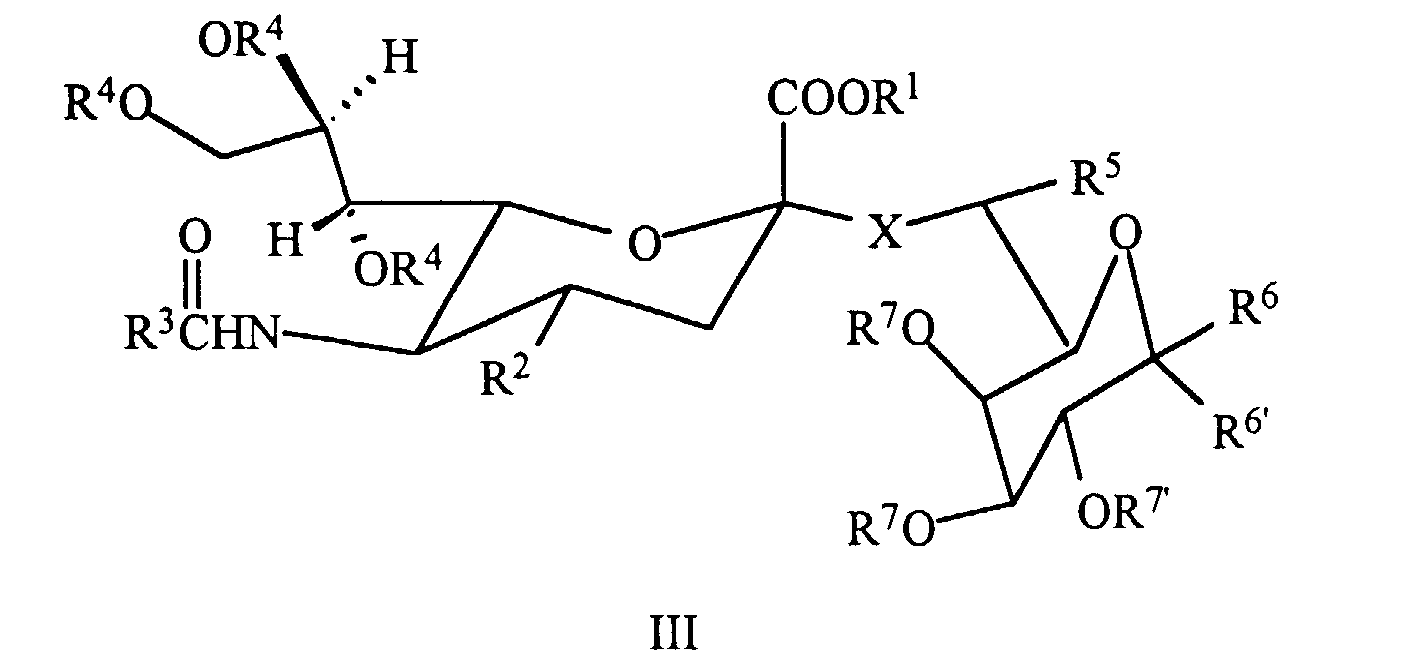 X est un atome d'oxygène, de soufre, CR9R10, ou NR11;R1 est un atome H, un cation mono-, di- ou polyvalent d'un métal alcalin, d'un métal alcalino-terreux ou d'un métal de transition, ou un ion ammonium ou un ion ammonium substitué;R2 est un groupement amino ou guanidino;R3 est un atome H ou un groupement hydrocarbyle ou hydrocarbyle substitué contenant de 1 à 20 atomes de carbone;R4 est un atome H;R5 est un atome H, un groupement hydrocarbyle ou hydrocarbyle substitué contenant de 1 à 20 atomes de carbone;R6 et R6' consistent en un atome H, un groupement OH, un groupement alkoxy ou alkoxy substitué contenant de 1 à 20 atomes de carbone, un mono-, di- ou oligosaccharide, ou un groupement alkylidène-oxy pris conjointement avec R7', lorsque R7' n'est pas un atome H; sous réserve que l'un parmi R6 ou R6' doit être un atome H, mais que R6 et R6' ne peuvent pas tous les deux être un atome H; etR7 et R7' consistent en un atome H ou un alkylidène pris conjointement avec un groupement adjacent R6, R6', R7 ou R7'; où R9, R10 et R11 sont indépendamment un atome H ou un groupement hydrocarbyle ou hydrocarbyle substitué contenant de 1 à 20 atomes de carbone.
 - Composés de la revendication 4 possédant une résistance à la sialidase.
Applications Claiming Priority (3)
| Application Number | Priority Date | Filing Date | Title |
|---|---|---|---|
| US20191794A | 1994-02-25 | 1994-02-25 | |
| US201917 | 1994-02-25 | ||
| PCT/US1995/002329 WO1995023157A1 (fr) | 1994-02-25 | 1995-02-24 | Acides sialiques 4-n-substitues et leurs sialosides |
Publications (2)
| Publication Number | Publication Date |
|---|---|
| EP0746564A1 EP0746564A1 (fr) | 1996-12-11 |
| EP0746564B1 true EP0746564B1 (fr) | 1998-12-02 |
Family
ID=22747826
Family Applications (1)
| Application Number | Title | Priority Date | Filing Date |
|---|---|---|---|
| EP95911100A Expired - Lifetime EP0746564B1 (fr) | 1994-02-25 | 1995-02-24 | Acides sialiques 4-n-substitues et leurs sialosides |
Country Status (6)
| Country | Link |
|---|---|
| US (1) | US5674988A (fr) |
| EP (1) | EP0746564B1 (fr) |
| JP (1) | JPH09509664A (fr) |
| CA (1) | CA2181237A1 (fr) |
| DE (1) | DE69506383T2 (fr) |
| WO (1) | WO1995023157A1 (fr) |
Families Citing this family (32)
| Publication number | Priority date | Publication date | Assignee | Title |
|---|---|---|---|---|
| CA2315262C (fr) * | 1997-12-17 | 2009-11-10 | Biocryst Pharmaceuticals, Inc. | Composes des cyclopentane et cyclopentene convenant comme inhibiteurs de neuraminidase |
| US7960139B2 (en) | 2007-03-23 | 2011-06-14 | Academia Sinica | Alkynyl sugar analogs for the labeling and visualization of glycoconjugates in cells |
| JP5523313B2 (ja) | 2007-07-03 | 2014-06-18 | チルドレンズ ホスピタル アンド リサーチ センター アット オークランド | ポリシアル酸誘導体、製造方法、ならびにがん抗原産生の増強およびターゲティングにおける使用 |
| EP2173759A4 (fr) | 2007-07-03 | 2014-01-29 | Childrens Hosp & Res Ct Oak | Dérivés d'acide oligosialique, procédés de fabrication et utilisations immunologiques |
| CA2692419C (fr) | 2007-07-03 | 2017-12-05 | Children's Hospital & Research Center At Oakland | Inhibiteurs de l'acide polysialique de-n-acetylase et procedes pour leur utilisation |
| JP5986745B2 (ja) | 2008-07-15 | 2016-09-06 | アカデミア シニカAcademia Sinica | Ptfe様のアルミニウム・コート・ガラススライド上のグリカンアレイおよび関連する方法 |
| AU2010273118B2 (en) | 2009-07-15 | 2015-10-29 | The University Of British Columbia | 2,3-fluorinated glycosides as neuraminidase inhibitors and their use as anti-virals |
| US10087236B2 (en) | 2009-12-02 | 2018-10-02 | Academia Sinica | Methods for modifying human antibodies by glycan engineering |
| US11377485B2 (en) | 2009-12-02 | 2022-07-05 | Academia Sinica | Methods for modifying human antibodies by glycan engineering |
| US10338069B2 (en) | 2010-04-12 | 2019-07-02 | Academia Sinica | Glycan arrays for high throughput screening of viruses |
| WO2013106937A1 (fr) | 2012-01-19 | 2013-07-25 | The University Of British Columbia | Composés inhibiteurs de la neuraminidase substitués par le fluor 3' équatorial, compositions et méthodes |
| US10130714B2 (en) | 2012-04-14 | 2018-11-20 | Academia Sinica | Enhanced anti-influenza agents conjugated with anti-inflammatory activity |
| WO2014031498A1 (fr) * | 2012-08-18 | 2014-02-27 | Academia Sinica | Sondes perméables aux cellules pour l'identification et l'imagerie de sialidases |
| WO2014031762A1 (fr) | 2012-08-21 | 2014-02-27 | Academia Sinica | Composés benzocyclo-octyne et leurs utilisations |
| EP3013365B1 (fr) | 2013-06-26 | 2019-06-05 | Academia Sinica | Antigènes rm2 et leur utilisation |
| WO2014210564A1 (fr) | 2013-06-27 | 2014-12-31 | Academia Sinica | Conjugués de glycane et leur utilisation |
| US9782476B2 (en) | 2013-09-06 | 2017-10-10 | Academia Sinica | Human iNKT cell activation using glycolipids with altered glycosyl groups |
| US10150818B2 (en) | 2014-01-16 | 2018-12-11 | Academia Sinica | Compositions and methods for treatment and detection of cancers |
| CA2937123A1 (fr) | 2014-01-16 | 2015-07-23 | Academia Sinica | Compositions et methodes pour traiter et detecter des cancers |
| WO2015148915A1 (fr) | 2014-03-27 | 2015-10-01 | Academia Sinica | Composés de marquage réactifs et leurs utilisations |
| US10118969B2 (en) | 2014-05-27 | 2018-11-06 | Academia Sinica | Compositions and methods relating to universal glycoforms for enhanced antibody efficacy |
| KR20170003720A (ko) | 2014-05-27 | 2017-01-09 | 아카데미아 시니카 | 항-cd20 글리코항체 및 이의 용도 |
| KR102512592B1 (ko) | 2014-05-27 | 2023-03-21 | 아카데미아 시니카 | 항-her2 글리코항체 및 이의 용도 |
| CA2950423A1 (fr) | 2014-05-27 | 2015-12-03 | Academia Sinica | Compositions et procedes concernant des glycoformes universelles pour une efficacite d'anticorps amelioree |
| CN106714829A (zh) | 2014-05-28 | 2017-05-24 | 中央研究院 | 抗TNF‑α醣抗体及其用途 |
| CA2960712A1 (fr) | 2014-09-08 | 2016-03-17 | Academia Sinica | Activation des cellules inkt humaines par des glycolipides |
| US10495645B2 (en) | 2015-01-16 | 2019-12-03 | Academia Sinica | Cancer markers and methods of use thereof |
| US9975965B2 (en) | 2015-01-16 | 2018-05-22 | Academia Sinica | Compositions and methods for treatment and detection of cancers |
| AU2015378564A1 (en) | 2015-01-24 | 2017-07-13 | Academia Sinica | Novel glycan conjugates and methods of use thereof |
| WO2017156192A1 (fr) | 2016-03-08 | 2017-09-14 | Academia Sinica | Procédés de synthèse modulaire de n-glycanes et de puces à n-glycanes |
| EP3500594A4 (fr) | 2016-08-22 | 2020-03-11 | Cho Pharma Inc. | Anticorps, fragments de liaison, et procédés d'utilisation |
| WO2018098342A1 (fr) * | 2016-11-23 | 2018-05-31 | The Regents Of The University Of California | Acides sialiques n-acétylés et sialosides apparentés |
Family Cites Families (5)
| Publication number | Priority date | Publication date | Assignee | Title |
|---|---|---|---|---|
| AU656721B2 (en) * | 1989-12-29 | 1995-02-16 | Symex Corp. | Methods for diagnosting human influenza and 4-position modified chromogenic N-acetylneuraminic acid substrates for use therein |
| CA2050484A1 (fr) * | 1990-02-27 | 1991-08-28 | Satoru Nakabayashi | Derives de glycolipide contenant de l'acide sialique |
| WO1992006691A1 (fr) * | 1990-10-19 | 1992-04-30 | Biota Scientific Management Pty. Ltd. | Composes anti-viraux qui lient le site actif de la neuraminidase de la grippe et presentent une activite in vivo contre l'orthomixovirus et le paramyxovirus |
| JPH04300890A (ja) * | 1991-03-29 | 1992-10-23 | Nisshin Oil Mills Ltd:The | シアル酸部分を変換したガングリオシドgm3類縁体 |
| US5220008A (en) * | 1991-11-22 | 1993-06-15 | E. I. Du Pont De Nemours And Company | Oligosaccharide inhibitors for influenza virus |
-
1995
- 1995-02-24 WO PCT/US1995/002329 patent/WO1995023157A1/fr not_active Ceased
- 1995-02-24 EP EP95911100A patent/EP0746564B1/fr not_active Expired - Lifetime
- 1995-02-24 CA CA002181237A patent/CA2181237A1/fr not_active Abandoned
- 1995-02-24 DE DE69506383T patent/DE69506383T2/de not_active Expired - Fee Related
- 1995-02-24 JP JP7522484A patent/JPH09509664A/ja not_active Ceased
-
1996
- 1996-01-31 US US08/594,422 patent/US5674988A/en not_active Expired - Fee Related
Also Published As
| Publication number | Publication date |
|---|---|
| JPH09509664A (ja) | 1997-09-30 |
| DE69506383T2 (de) | 1999-06-17 |
| DE69506383D1 (de) | 1999-01-14 |
| CA2181237A1 (fr) | 1995-08-31 |
| WO1995023157A1 (fr) | 1995-08-31 |
| US5674988A (en) | 1997-10-07 |
| EP0746564A1 (fr) | 1996-12-11 |
Similar Documents
| Publication | Publication Date | Title |
|---|---|---|
| EP0746564B1 (fr) | Acides sialiques 4-n-substitues et leurs sialosides | |
| US5830871A (en) | Inhibitors of E-, P- and L-selectin binding | |
| US8114970B2 (en) | Synthetic heparin monosaccharides | |
| Ogura et al. | Syntheses of 2-O-glycosyl derivatives of N-acetyl-d-neuraminic acid | |
| Sabesan et al. | Synthesis, enzymic, and NMR studies of novel sialoside probes: unprecedented, selective neuraminidase hydrolysis of and inhibition by C-6-(methyl)-Gal sialosides | |
| HUT70404A (en) | SULFATED BéTA-GLYCOLIPID DERIVATIVES AS CELL ADHESION INHIBITORS AND PHARMACEUTICAL COMPNS. CONTG. THEM | |
| PL176272B1 (pl) | Analogi sialilowe Le jako inhibitory adhezji komórkowej | |
| JPWO2000017216A1 (ja) | カルボキシメチルガラクトース誘導体 | |
| EP0642526B1 (fr) | Preparation d'hydrates de carbone fucosyles par synthese a flucosylation enzymatique de nucleotides de sucres, et regeneration in situ de gdp-fucose | |
| Datta et al. | An improved synthesis of trehalose 6-mono and 6, 6′-dicorynomycolates and related esters | |
| Isecke et al. | Synthesis of 5-N-and 9-N-thioacylated sialic acids | |
| EP0728763B1 (fr) | Analogue de ganglioside gm3 dote d'un residu d'acide sialique fluore en position 9, et intermediaire necessaire | |
| Sabesan et al. | Structural and functional-group tuning in the design of neuraminidase inhibitors | |
| Nikrad et al. | Use of human-milk fucosyltransferase in the chemoenzymic synthesis of analogues of the sialyl Lewis and sialyl Lewis tetrasaccharides modified at the C-2 position of the reducing unit | |
| Fuse et al. | Synthesis and enzymatic susceptibility of a series of novel GM2 analogs | |
| US5489675A (en) | Disaccharide sialidase substrates and inhibitors | |
| Terada et al. | Synthetic Studies on Sialoglycoconjugates 44: Synthesis of KDN-Gangliosides Gm4 and GM3 | |
| US5220008A (en) | Oligosaccharide inhibitors for influenza virus | |
| US20040019198A1 (en) | Method of forming glycosidic bonds from thioglycosides using an N,N-dialkylsulfinamide | |
| Thollas et al. | Synthesis of various sulfoforms of the trisaccharide β-d-Glc p A-(1→ 3)-β-d-Gal p-(1→ 3)-β-d-Gal p-(1→ OMP) as probes for the study of the biosynthesis and sorting of proteoglycans | |
| US5254676A (en) | Oligosaccharide inhibitors for influenza virus | |
| Gandolfi-Donadío et al. | Synthesis of arabinofuranose branched galactofuran tetrasaccharides, constituents of mycobacterial arabinogalactan | |
| Sasaki et al. | Design of N-acetyl-6-sulfo-β-D-glucosaminide-based inhibitors of influenza virus sialidase | |
| Prabhanjan et al. | Regio-and stereo-selective synthesis of ganglioside GM1b and some positional analogs | |
| Hasegawa et al. | Synthetic Studies on Sialoglycoconjugates 36: α-Selective Glycoside Synthesis of N-Acetylneuraminic Acid with the Secondary Hydroxyl Group in D-Glucofyranose, 2-Acetamido-2-deoxy-D-glucopyranose and D-Galactopyranose Derivatives |
Legal Events
| Date | Code | Title | Description |
|---|---|---|---|
| PUAI | Public reference made under article 153(3) epc to a published international application that has entered the european phase |
Free format text: ORIGINAL CODE: 0009012 |
|
| 17P | Request for examination filed |
Effective date: 19960801 |
|
| AK | Designated contracting states |
Kind code of ref document: A1 Designated state(s): DE FR GB IT |
|
| GRAG | Despatch of communication of intention to grant |
Free format text: ORIGINAL CODE: EPIDOS AGRA |
|
| 17Q | First examination report despatched |
Effective date: 19980130 |
|
| GRAG | Despatch of communication of intention to grant |
Free format text: ORIGINAL CODE: EPIDOS AGRA |
|
| GRAH | Despatch of communication of intention to grant a patent |
Free format text: ORIGINAL CODE: EPIDOS IGRA |
|
| GRAH | Despatch of communication of intention to grant a patent |
Free format text: ORIGINAL CODE: EPIDOS IGRA |
|
| GRAA | (expected) grant |
Free format text: ORIGINAL CODE: 0009210 |
|
| AK | Designated contracting states |
Kind code of ref document: B1 Designated state(s): DE FR GB IT |
|
| REF | Corresponds to: |
Ref document number: 69506383 Country of ref document: DE Date of ref document: 19990114 |
|
| ITF | It: translation for a ep patent filed | ||
| ET | Fr: translation filed | ||
| PLBE | No opposition filed within time limit |
Free format text: ORIGINAL CODE: 0009261 |
|
| STAA | Information on the status of an ep patent application or granted ep patent |
Free format text: STATUS: NO OPPOSITION FILED WITHIN TIME LIMIT |
|
| 26N | No opposition filed | ||
| REG | Reference to a national code |
Ref country code: GB Ref legal event code: IF02 |
|
| PGFP | Annual fee paid to national office [announced via postgrant information from national office to epo] |
Ref country code: FR Payment date: 20050208 Year of fee payment: 11 |
|
| PGFP | Annual fee paid to national office [announced via postgrant information from national office to epo] |
Ref country code: DE Payment date: 20050217 Year of fee payment: 11 |
|
| PGFP | Annual fee paid to national office [announced via postgrant information from national office to epo] |
Ref country code: GB Payment date: 20050223 Year of fee payment: 11 |
|
| PG25 | Lapsed in a contracting state [announced via postgrant information from national office to epo] |
Ref country code: IT Free format text: LAPSE BECAUSE OF NON-PAYMENT OF DUE FEES;WARNING: LAPSES OF ITALIAN PATENTS WITH EFFECTIVE DATE BEFORE 2007 MAY HAVE OCCURRED AT ANY TIME BEFORE 2007. THE CORRECT EFFECTIVE DATE MAY BE DIFFERENT FROM THE ONE RECORDED. Effective date: 20050224 |
|
| PG25 | Lapsed in a contracting state [announced via postgrant information from national office to epo] |
Ref country code: GB Free format text: LAPSE BECAUSE OF NON-PAYMENT OF DUE FEES Effective date: 20060224 |
|
| PG25 | Lapsed in a contracting state [announced via postgrant information from national office to epo] |
Ref country code: DE Free format text: LAPSE BECAUSE OF NON-PAYMENT OF DUE FEES Effective date: 20060901 |
|
| GBPC | Gb: european patent ceased through non-payment of renewal fee |
Effective date: 20060224 |
|
| REG | Reference to a national code |
Ref country code: FR Ref legal event code: ST Effective date: 20061031 |
|
| PG25 | Lapsed in a contracting state [announced via postgrant information from national office to epo] |
Ref country code: FR Free format text: LAPSE BECAUSE OF NON-PAYMENT OF DUE FEES Effective date: 20060228 |