EP0747082A2 - Ensemble d'aiguille auto protègeant - Google Patents
Ensemble d'aiguille auto protègeant Download PDFInfo
- Publication number
- EP0747082A2 EP0747082A2 EP96304186A EP96304186A EP0747082A2 EP 0747082 A2 EP0747082 A2 EP 0747082A2 EP 96304186 A EP96304186 A EP 96304186A EP 96304186 A EP96304186 A EP 96304186A EP 0747082 A2 EP0747082 A2 EP 0747082A2
- Authority
- EP
- European Patent Office
- Prior art keywords
- assembly
- cap
- needle
- hub
- catheter
- Prior art date
- Legal status (The legal status is an assumption and is not a legal conclusion. Google has not performed a legal analysis and makes no representation as to the accuracy of the status listed.)
- Withdrawn
Links
Images

Classifications
-
- A—HUMAN NECESSITIES
- A61—MEDICAL OR VETERINARY SCIENCE; HYGIENE
- A61M—DEVICES FOR INTRODUCING MEDIA INTO, OR ONTO, THE BODY; DEVICES FOR TRANSDUCING BODY MEDIA OR FOR TAKING MEDIA FROM THE BODY; DEVICES FOR PRODUCING OR ENDING SLEEP OR STUPOR
- A61M25/00—Catheters; Hollow probes
- A61M25/01—Introducing, guiding, advancing, emplacing or holding catheters
- A61M25/06—Body-piercing guide needles or the like
- A61M25/0612—Devices for protecting the needle; Devices to help insertion of the needle, e.g. wings or holders
- A61M25/0631—Devices for protecting the needle; Devices to help insertion of the needle, e.g. wings or holders having means for fully covering the needle after its withdrawal, e.g. needle being withdrawn inside the handle or a cover being advanced over the needle
-
- A—HUMAN NECESSITIES
- A61—MEDICAL OR VETERINARY SCIENCE; HYGIENE
- A61M—DEVICES FOR INTRODUCING MEDIA INTO, OR ONTO, THE BODY; DEVICES FOR TRANSDUCING BODY MEDIA OR FOR TAKING MEDIA FROM THE BODY; DEVICES FOR PRODUCING OR ENDING SLEEP OR STUPOR
- A61M25/00—Catheters; Hollow probes
- A61M25/01—Introducing, guiding, advancing, emplacing or holding catheters
- A61M25/06—Body-piercing guide needles or the like
- A61M25/0612—Devices for protecting the needle; Devices to help insertion of the needle, e.g. wings or holders
- A61M25/0618—Devices for protecting the needle; Devices to help insertion of the needle, e.g. wings or holders having means for protecting only the distal tip of the needle, e.g. a needle guard
-
- A—HUMAN NECESSITIES
- A61—MEDICAL OR VETERINARY SCIENCE; HYGIENE
- A61M—DEVICES FOR INTRODUCING MEDIA INTO, OR ONTO, THE BODY; DEVICES FOR TRANSDUCING BODY MEDIA OR FOR TAKING MEDIA FROM THE BODY; DEVICES FOR PRODUCING OR ENDING SLEEP OR STUPOR
- A61M5/00—Devices for bringing media into the body in a subcutaneous, intra-vascular or intramuscular way; Accessories therefor, e.g. filling or cleaning devices, arm-rests
- A61M5/178—Syringes
- A61M5/31—Details
- A61M5/32—Needles; Details of needles pertaining to their connection with syringe or hub; Accessories for bringing the needle into, or holding the needle on, the body; Devices for protection of needles
- A61M5/3205—Apparatus for removing or disposing of used needles or syringes, e.g. containers; Means for protection against accidental injuries from used needles
- A61M5/321—Means for protection against accidental injuries by used needles
- A61M5/3243—Means for protection against accidental injuries by used needles being axially-extensible, e.g. protective sleeves coaxially slidable on the syringe barrel
-
- A—HUMAN NECESSITIES
- A61—MEDICAL OR VETERINARY SCIENCE; HYGIENE
- A61M—DEVICES FOR INTRODUCING MEDIA INTO, OR ONTO, THE BODY; DEVICES FOR TRANSDUCING BODY MEDIA OR FOR TAKING MEDIA FROM THE BODY; DEVICES FOR PRODUCING OR ENDING SLEEP OR STUPOR
- A61M5/00—Devices for bringing media into the body in a subcutaneous, intra-vascular or intramuscular way; Accessories therefor, e.g. filling or cleaning devices, arm-rests
- A61M5/178—Syringes
- A61M5/31—Details
- A61M5/32—Needles; Details of needles pertaining to their connection with syringe or hub; Accessories for bringing the needle into, or holding the needle on, the body; Devices for protection of needles
- A61M5/3205—Apparatus for removing or disposing of used needles or syringes, e.g. containers; Means for protection against accidental injuries from used needles
- A61M5/321—Means for protection against accidental injuries by used needles
- A61M5/3243—Means for protection against accidental injuries by used needles being axially-extensible, e.g. protective sleeves coaxially slidable on the syringe barrel
- A61M5/3275—Means for protection against accidental injuries by used needles being axially-extensible, e.g. protective sleeves coaxially slidable on the syringe barrel being connected to the needle hub or syringe by radially deflectable members, e.g. longitudinal slats, cords or bands
Definitions
- the present invention provides an improved self-capping disposable needle assembly for use in combination with a skin puncture apparatus. More specifically, the present invention relates to an improved self-capping disposable needle assembly for use with a skin puncture apparatus such as a catheter assembly which contains a pleated sleeve made from any natural or synthetic fiber material. Moreover, the fiber material employed as the pleated sleeve may be braided, non-woven or woven and it, optionally, may be treated with a suitable agent that provides the fiber with a hydrophobic coating. Such a coating will prevent unwanted fluids such as blood from seeping through the fiber material during use.
- skin puncture apparatus is used herein to denote devices that are employed in the medical profession to pierce the skin of a patient. Such devices include IV catheter assemblies, intrascopic devices, hypodermic syringe assemblies, biopsy needles and sutures.
- puncture resistant containers One way of avoiding accidental contamination and/or injury is to advise health care workers to place disposable needles in puncture resistant containers.
- puncture resistant containers represents a viable solution to the aforementioned problem, it is not a practical way since it presupposes that puncture resistant containers are available in all circumstances wherein contamination could occur.
- a needle assembly which includes a hub for connecting the assembly to a fluid conduit.
- the hub includes a passageway extending therethrough to receive a hollow needle in fluid communication therewith.
- the cap has a neutral position along the needle adjacent to the hub for exposing a length of the needle, and an extended position for capping the distal tip of the needle.
- the needle is disposed within a passageway of a catheter assembly whereby removal of the needle from the passageway of the catheter assembly moves the cap to the extended position, capping the distal tip as the cap is unseated from the catheter assembly.
- U.S. Patent No. 5,312,371 to Dombrowski et al. More specifically, this patent relates to a method for making a self-capping needle and catheter assembly which includes placing a needle hub and cap on a pin, with the pin extending through the passageway thereof. Two sheets of organic polymeric material are placed on the hub and the cap. The sleeve containing this organic polymeric material is then permanently stretched to a predetermined length. The cap, hub and organic polymeric sleeve are, according to this patent, placed on a needle and the cap is moved against the hub, folding the sleeve therebetween for reception of the catheter assembly.
- the sleeves are made of an organic polymeric material which are pleated into bellows using elaborate and costly thermal processes.
- the plastic sleeves employed in the Dombrowski et al. patents have low tensile strength and high elongation. Thus, under some circumstances the sleeve may break resulting in possible contamination and/or injury of the person handling the needle.
- the present invention is directed to an improved pleated sleeve material for use in self-capping needle assemblies which are adapted to receive a skin puncture apparatus connected thereto.
- the pleated sleeve materials employed in the present invention include braided, woven or non-woven fibers such as dacron, silk, cotton, polyester, rayon, wool, linen, satin and the like. Mixtures of these fibers are also contemplated herein. Such fibers have higher tensile strengths and lower elongation values than the pleated sleeves that are fabricated from organic polymeric materials. Because of these properties, the fiber sleeves of the instant invention are stronger than those heretofore known. Moreover, the fiber sleeves of the present invention, which include any natural or synthetic fiber, can be pleated or formed into bellows without the need for elaborate and expensive thermal processes such as those employed in the prior art.
- the term skin puncture apparatus is used herein to denote medical devices that are employed in the health industry to pierce the skin of a patient.
- Illustrative examples of such skin puncture apparatuses that may be employed in the instant invention include, but are not limited to, IV catheter assemblies, intrascopic devices, hypodermic syringe assemblies, biopsy needles, sutures and the like. Of these skin puncture apparatuses, catheters are particularly preferred.
- the fiber material is treated with a suitable agent that forms a pleated sleeve which contains a hydrophobic coating thereon.
- a suitable agent that forms a pleated sleeve which contains a hydrophobic coating thereon.
- Such a coating prevents blood and/or fluids that are inside the sleeve from seeping through the fiber material.
- Specific types of agents that may be employed in the instant invention are fluorocarbon-based materials that have a low energy effect when applied to the natural or synthetic fibers.
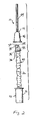
- Figure 1 is a longitudinal cross-sectional view of a needle assembly that may be employed in the present invention.
- Figure 2 is a side view of a catheter being completely removed from the needle assembly.
- the present invention provides an improved pleated sleeve material for use in self-capping disposable needle assemblies that are adapted for use with a skin puncture apparatus.
- a wide variety of needle assemblies and skin puncture apparatuses may be employed in the present invention, reference is made to the accompanying drawings which illustrate one type of needle assembly and catheter assembly that may be employed in the present invention.
- the needle assembly 10 of the instant invention includes a combination of a hypodermic needle assembly 12 and a catheter assembly 14.
- Other skin puncture apparatuses such as intrascopic devices, hypodermic syringe assemblies, biopsy needles and sutures may be used in place of catheter assembly 14.
- the hypodermic needle assembly 12 includes a hub portion 16 having an inner cup shaped surface 18 adapted to be connected to a syringe barrel 20.
- the hub 16 of the hypodermic needle assembly includes a passageway 22 extending therethrough.
- the hub 16 also includes a radially outwardly extending flange 24 which is employed in the present invention to secure hub 16 to syringe barrel 20 with an appropriate type of locking mechanism such as a luer-locking mechanism.
- Needle assembly 10 further includes a hollow metallic needle 26 having a base 28 which is reversibly fitted into passageway 22 of hub 16.
- the hollow needle is in fluid communication with passageway 22 and it includes a distal tip 30 which is a sharp pointed beveled portion adapted for puncturing the skin of a patient.
- a distal tip is well known to those skilled in this art.
- Needle assembly 10 also includes a cap 32 having a neutral position along needle 26 positioned near hub 16 for exposing the length of needle 26 as shown in Figure 1.
- Cap 32 also has an extended position for capping distal tip 30 as shown in Figure 2.
- Cap 32 includes a cap passageway 34 to allow passage of needle 26 therethrough and an inner surface 35 having at least one flange 36 extending therefrom and tapered towards hub 16. The flange 36 forms closed corners 38 defined by inner surface 35.
- flange 36 covers needle tip 30 and prevents the needle tip from re-entering passageway 34.
- the cap 32 contains an outer seating surface not shown in the accompanying drawings for receiving the catheter assembly 14.
- Needle assembly 10 also includes a sleeve 40 for connecting cap 32 to hub 16.
- the sleeve 40 also serves to limit the extent cap 32 can be extended from hub 16.
- Cap 32 may extend from hub 16 to the full length of needle 26 and, when in combination with flange 36, it deflects the needle tip 30 into closed corners 38. The needle tip is thereafter locked under cap 32 when it is relocated to the extended position.
- flange 36 is in combination with sleeve 40, thus providing a sufficient means for locking cap 32 over distal tip 30 of needle 26.
- Sleeve 40 employed in the present invention is in the form of an expandable pleated or bellow-shaped sleeve interconnecting hub 16 and cap 32 for perfecting a seal and closure about the full length of needle 26 when the cap is extended as shown in Figure 2.
- the sleeve is made from any natural or synthetic fiber material. More specifically, the fiber materials that are employed in the present invention as the sleeve material may be braided, woven or non-woven fibers. Specific types of fiber materials that may be employed in the present invention as sleeve 40 include, but are not limited to, silk, cotton, rayon, linen, dacron, wool, satin, nylon, polyester and the like. Mixtures of the fiber materials are also contemplated in the present invention. Of these fibers, polyesters are particularly preferred as the sleeve material.
- sleeve 40 when sleeve 40 is composed of a fiber material it will have a higher tensile strength and lower elongation value compared to plastic materials that are commonly employed in the prior art as the sleeve material. Because of the foregoing properties, the sleeve of the present invention is highly resistant to accidental breakage and it is easier to expand over needle 26.
- Sleeve 40 is made by forming two sheets of fiber material about hub 16 and cap 32, sealing the edges thereof, and fastening it to hub 16 and cap 32.
- the sealing of the edges of the two fiber materials and the fastening to hub 16 and cap 32 are performed using conventional techniques that are well known to those skilled in this particular field.
- the fiber material is coated with an agent which provides sleeve 40 with a hydrophobic coating.
- an agent which provides sleeve 40 with a hydrophobic coating By forming a hydrophobic coating around sleeve 40, fluids inside the sleeve, such as blood, are prevented from seeping through the sleeve material.
- Suitable agents that may be used to provide sleeve 40 with a hydrophobic coating include fluorocarbon-based materials which have a low surface energy effect on the fiber material when applied thereto. Specific examples of such fluorocarbon-based materials include, but are not limited to, fluoromethane, fluoroethane, fluoropropane, fluoroethene, fluoropropene and the like. Mixtures of these fluorocarbon-based materials are also contemplated in the present invention.
- the hydrophobic coating may be provided using conventional coating techniques that are well known to those skilled in the art.
- the hydrophobic coating may be provided to the fiber material by lamination, direct calendaring, direct coating or transfer coating.
- lamination direct calendaring
- direct coating transfer coating
- catheter assembly 14 used in the present invention.
- other skin puncture apparatuses such as intrascopic devices, hypodermic syringe apparatuses, biopsy needles and sutures may be used instead of catheter assembly 14.
- the catheter assembly 14 shown in Figure 2 includes a shaft portion 44 which is disposed about the uncovered length of needle 26 and acts to expose distal tip 30. In this particularly position, distal tip 30 may initiate a puncture through a patient's skin and gain entry to the patient such that shaft portion 44 of the catheter 14 enters the patient.
- the catheter assembly 14 also contains a catheter hub 46 connected to shaft portion 44 and having an inner surface for releasable seating on the cap seating surface 48 whereby removal of needle 26 from shaft 44 moves cap 32 to the extended position, as hub 46 of the catheter assembly is unseated from the seating surface of cap 32.
- Distal tip 30 of needle 26 is concurrently capped as needle 26 is removed from the catheter assembly.
- a person administering the injection such as a nurse or doctor does not have to remove needle assembly 12 from catheter assembly 14, and then separately cap distal tip 30 of needle 26. This greatly reduces the probability of accidental contamination and/or injury. Instead, needle 26 is capped in a single motion. It should be noted that sleeve 40 of the present invention also maintains cap 32 locked against distal tip 30.
- seating surface 48 provides an outer cylindrical or frustoconical surface for cap 32.
- the catheter hub 46 includes an inner complementing surface defining a seat in friction fit over seating surface 48 when cap 32 is in a neutral position. Other reversible methods of seating or connecting the seating surface are also contemplated in the present invention.
- the hub 46 also includes radially outwardly extending annular flange 50 which permits for a luer lock of the catheter.
- catheter assembly 14 is seated over cap 32 and both are disposed adjacent to hub 16. After catherization, the hub portion 16 is moved away from the catheter 14 withdrawing needle 26 from the catheter and extending sleeve 40.
- the hub 16 depending on the particular use may or may not contain a hypodermic syringe assembly 20.
- the present invention provides a more efficient and safer means for catherizing a patient than heretofore known.
- sleeve 40 is made from a braided, woven or non-woven fiber, it has a higher tensile strength and lower elongation value than would a sleeve made of plastic material.
- Such properties result in a needle assembly which is more durable and less likely to break than those disclosed in the prior art.
- the sleeves of the present invention are pleated using conventional processes which are less expensive and not as elaborate as those required for pleating plastic sleeves.
Landscapes
- Health & Medical Sciences (AREA)
- Life Sciences & Earth Sciences (AREA)
- Biophysics (AREA)
- Pulmonology (AREA)
- Engineering & Computer Science (AREA)
- Anesthesiology (AREA)
- Biomedical Technology (AREA)
- Heart & Thoracic Surgery (AREA)
- Hematology (AREA)
- Animal Behavior & Ethology (AREA)
- General Health & Medical Sciences (AREA)
- Public Health (AREA)
- Veterinary Medicine (AREA)
- Infusion, Injection, And Reservoir Apparatuses (AREA)
- Media Introduction/Drainage Providing Device (AREA)
Applications Claiming Priority (2)
| Application Number | Priority Date | Filing Date | Title |
|---|---|---|---|
| US483549 | 1995-06-07 | ||
| US08/483,549 US5685860A (en) | 1995-06-07 | 1995-06-07 | Self-capping needle assembly |
Publications (2)
| Publication Number | Publication Date |
|---|---|
| EP0747082A2 true EP0747082A2 (fr) | 1996-12-11 |
| EP0747082A3 EP0747082A3 (fr) | 1997-02-26 |
Family
ID=23920518
Family Applications (1)
| Application Number | Title | Priority Date | Filing Date |
|---|---|---|---|
| EP96304186A Withdrawn EP0747082A3 (fr) | 1995-06-07 | 1996-06-06 | Ensemble d'aiguille auto protègeant |
Country Status (7)
| Country | Link |
|---|---|
| US (1) | US5685860A (fr) |
| EP (1) | EP0747082A3 (fr) |
| JP (1) | JPH0999071A (fr) |
| BR (1) | BR9602636A (fr) |
| IL (1) | IL118393A0 (fr) |
| TW (1) | TW415243U (fr) |
| ZA (1) | ZA964784B (fr) |
Cited By (8)
| Publication number | Priority date | Publication date | Assignee | Title |
|---|---|---|---|---|
| EP1430921A3 (fr) * | 2002-12-16 | 2004-09-08 | Vaillancourt, Patricia B. | Aiguille de sécurité avec un manchon pouvant s'affaisser |
| US8231582B2 (en) | 2008-12-11 | 2012-07-31 | Bard Access Systems, Inc. | Device for removing a Huber needle from a patient |
| EP2567662A1 (fr) * | 2011-09-07 | 2013-03-13 | VLV associates, Inc. | Ensemble couvercle de protection pour un ensemble d'aiguille |
| US8574197B2 (en) | 2004-02-26 | 2013-11-05 | C. R. Bard, Inc. | Huber needle safety enclosure |
| US8597253B2 (en) | 2007-04-20 | 2013-12-03 | Bard Access Systems | Huber needle with safety sheath |
| US9248234B2 (en) | 2010-09-10 | 2016-02-02 | C. R. Bard, Inc. | Systems for isolation of a needle-based infusion set |
| US10525234B2 (en) | 2010-09-10 | 2020-01-07 | C. R. Bard, Inc. | Antimicrobial/haemostatic interface pad for placement between percutaneously placed medical device and patient skin |
| US10729846B2 (en) | 2010-09-10 | 2020-08-04 | C. R. Bard, Inc. | Self-sealing pad for a needle-based infusion set |
Families Citing this family (48)
| Publication number | Priority date | Publication date | Assignee | Title |
|---|---|---|---|---|
| US5630803A (en) * | 1995-11-06 | 1997-05-20 | Tamaro; Frank A. | Safety cap assembly for needles |
| US6749588B1 (en) * | 1998-04-09 | 2004-06-15 | Becton Dickinson And Company | Catheter and introducer needle assembly with needle shield |
| US6080138A (en) * | 1998-09-23 | 2000-06-27 | Lemke; Christy L. | IV protector |
| US6213978B1 (en) | 1998-10-27 | 2001-04-10 | Cherie A. Voyten | Intravenous catheter insertion apparatus |
| US7232433B1 (en) | 1999-09-22 | 2007-06-19 | Siemens Medical Solutions Usa, Inc. | Medical diagnostic ultrasound catheter with dielectric isolation |
| US6234999B1 (en) | 2000-01-18 | 2001-05-22 | Becton, Dickinson And Company | Compact needle shielding device |
| DE20106697U1 (de) * | 2001-04-18 | 2001-10-31 | B. Braun Melsungen Ag, 34212 Melsungen | Kathetereinführvorrichtung |
| US6527747B2 (en) * | 2001-05-25 | 2003-03-04 | Becton Dickinson And Company | Introducer needle assembly having a tethered needle shield |
| US20030161815A1 (en) * | 2002-02-12 | 2003-08-28 | Intercytex Limited | Cell delivery system |
| DK1563061T3 (da) * | 2002-11-14 | 2012-10-01 | Aderans Res Inst Inc | Dyrkning af hårinducerende celler |
| US7125396B2 (en) | 2002-12-30 | 2006-10-24 | Cardinal Health 303, Inc. | Safety catheter system and method |
| US7530967B2 (en) * | 2004-05-03 | 2009-05-12 | Clearview Patient Safety Technologies, Llc | Porous multiple sample sleeve and blood drawing device for flash detection |
| US8177760B2 (en) | 2004-05-12 | 2012-05-15 | C. R. Bard, Inc. | Valved connector |
| WO2006085331A2 (fr) * | 2005-02-14 | 2006-08-17 | Flexicath Ltd. | Procede et appareil d'insertion d'un catheter |
| WO2007006055A2 (fr) | 2005-07-06 | 2007-01-11 | Vascular Pathways Inc. | Dispositif permettant l'insertion d'un catheter intraveineux et procede d'utilisation |
| JP4994775B2 (ja) | 2006-10-12 | 2012-08-08 | 日本コヴィディエン株式会社 | 針先保護具 |
| US8883190B2 (en) * | 2006-12-01 | 2014-11-11 | Wake Forest University Health Sciences | Urologic devices incorporating collagen inhibitors |
| US8057431B2 (en) | 2006-12-21 | 2011-11-15 | B. Braun Melsungen Ag | Hinged cap for needle device |
| JP5139518B2 (ja) | 2007-05-07 | 2013-02-06 | バスキュラー・パスウェイズ・インコーポレイテッド | 静脈カテーテル挿入装置 |
| US9950139B2 (en) | 2010-05-14 | 2018-04-24 | C. R. Bard, Inc. | Catheter placement device including guidewire and catheter control elements |
| US9872971B2 (en) | 2010-05-14 | 2018-01-23 | C. R. Bard, Inc. | Guidewire extension system for a catheter placement device |
| US11925779B2 (en) | 2010-05-14 | 2024-03-12 | C. R. Bard, Inc. | Catheter insertion device including top-mounted advancement components |
| US8932258B2 (en) | 2010-05-14 | 2015-01-13 | C. R. Bard, Inc. | Catheter placement device and method |
| US10384039B2 (en) | 2010-05-14 | 2019-08-20 | C. R. Bard, Inc. | Catheter insertion device including top-mounted advancement components |
| CN101933830B (zh) * | 2010-09-07 | 2012-04-25 | 吉林大学 | 一种仿生医用穿刺针改良润湿性的处理方法 |
| US8690833B2 (en) | 2011-01-31 | 2014-04-08 | Vascular Pathways, Inc. | Intravenous catheter and insertion device with reduced blood spatter |
| WO2012154277A1 (fr) | 2011-02-25 | 2012-11-15 | C.R. Bard, Inc. | Dispositif d'introduction de composant médical comprenant une aiguille rétractable |
| US8486024B2 (en) | 2011-04-27 | 2013-07-16 | Covidien Lp | Safety IV catheter assemblies |
| USD903101S1 (en) | 2011-05-13 | 2020-11-24 | C. R. Bard, Inc. | Catheter |
| WO2013048768A1 (fr) | 2011-09-26 | 2013-04-04 | Covidien Lp | Ensemble cathéter et aiguille de sécurité intraveineux |
| EP2760520A1 (fr) | 2011-09-26 | 2014-08-06 | Covidien LP | Cathéter à sécurité |
| EP2766074B1 (fr) | 2011-10-14 | 2020-04-08 | Kpr U.S., Llc | Ensemble cathéter intraveineux iv de sécurité |
| MX2013001219A (es) * | 2013-01-30 | 2014-07-30 | Equipos Médicos Vizcarra S A | Cateter intravenoso periferico cerrado con sistema de seguridad civpcss. |
| WO2014119986A1 (fr) * | 2013-01-30 | 2014-08-07 | Equipos Médicos Vizcarra, S.A. | Cathéter intraveineux périphérique possédant un système de sécurité passive de type soufflet civstf |
| CN108607150B (zh) | 2013-01-30 | 2021-01-12 | 血管通路股份有限公司 | 用于静脉穿刺和导管放置的系统和方法 |
| US9125985B2 (en) | 2013-04-01 | 2015-09-08 | iMed Technology, Inc. | Needle with protective cover member |
| WO2016037127A1 (fr) | 2014-09-05 | 2016-03-10 | C.R. Bard, Inc. | Dispositif d'insertion de cathéter comprenant une aiguille rétractable |
| USD903100S1 (en) | 2015-05-01 | 2020-11-24 | C. R. Bard, Inc. | Catheter placement device |
| EP3294380B1 (fr) | 2015-05-15 | 2022-03-23 | C. R. Bard, Inc. | Dispositif d'insertion de cathéter |
| US10493262B2 (en) | 2016-09-12 | 2019-12-03 | C. R. Bard, Inc. | Blood control for a catheter insertion device |
| JP6953541B2 (ja) | 2017-03-01 | 2021-10-27 | シー・アール・バード・インコーポレーテッドC R Bard Incorporated | カテーテル挿入装置 |
| US11389626B2 (en) | 2018-03-07 | 2022-07-19 | Bard Access Systems, Inc. | Guidewire advancement and blood flashback systems for a medical device insertion system |
| USD921884S1 (en) | 2018-07-27 | 2021-06-08 | Bard Access Systems, Inc. | Catheter insertion device |
| USD884160S1 (en) | 2019-02-25 | 2020-05-12 | iMed Technology, Inc. | Huber safety needle |
| JP7721504B2 (ja) | 2019-08-19 | 2025-08-12 | ベクトン・ディキンソン・アンド・カンパニー | 正中線カテーテル配置デバイス |
| EP4025288A1 (fr) | 2019-09-20 | 2022-07-13 | Bard Peripheral Vascular, Inc. | Dispositif de placement de cathéter intraveineux |
| CN110731813B (zh) * | 2019-11-28 | 2024-10-01 | 搏时(北京)医疗科技有限公司 | 一种胸骨穿刺针底座组件以及胸骨穿刺针 |
| US12318557B2 (en) * | 2020-06-16 | 2025-06-03 | Becton, Dickinson And Company | Catheter system to provide needle safety and related methods |
Family Cites Families (7)
| Publication number | Priority date | Publication date | Assignee | Title |
|---|---|---|---|---|
| US3134380A (en) * | 1962-02-08 | 1964-05-26 | Thomas A Armao | Shielded hypodermic needle |
| US4790828A (en) * | 1987-08-07 | 1988-12-13 | Dombrowski Mitchell P | Self-capping needle assembly |
| US5013305A (en) * | 1988-06-29 | 1991-05-07 | Opie Eric A | Needle safety system and method |
| US4978344A (en) * | 1988-08-11 | 1990-12-18 | Dombrowski Mitchell P | Needle and catheter assembly |
| US5368566A (en) * | 1992-04-29 | 1994-11-29 | Cardiovascular Dynamics, Inc. | Delivery and temporary stent catheter having a reinforced perfusion lumen |
| US5312371A (en) * | 1993-07-27 | 1994-05-17 | Dombrowski Mitchell P | Method of making a needle sleeve assembly |
| US5419766A (en) * | 1993-09-28 | 1995-05-30 | Critikon, Inc. | Catheter with stick protection |
-
1995
- 1995-06-07 US US08/483,549 patent/US5685860A/en not_active Expired - Lifetime
-
1996
- 1996-05-22 IL IL11839396A patent/IL118393A0/xx unknown
- 1996-06-05 BR BR9602636A patent/BR9602636A/pt not_active Application Discontinuation
- 1996-06-06 ZA ZA9604784A patent/ZA964784B/xx unknown
- 1996-06-06 EP EP96304186A patent/EP0747082A3/fr not_active Withdrawn
- 1996-06-06 JP JP8165181A patent/JPH0999071A/ja active Pending
- 1996-08-19 TW TW086207437U patent/TW415243U/zh not_active IP Right Cessation
Cited By (19)
| Publication number | Priority date | Publication date | Assignee | Title |
|---|---|---|---|---|
| US8066678B2 (en) | 2001-12-17 | 2011-11-29 | Bard Access Systems, Inc. | Safety needle with collapsible sheath |
| US8728029B2 (en) | 2001-12-17 | 2014-05-20 | Bard Access Systems, Inc. | Safety needle with collapsible sheath |
| EP1430921A3 (fr) * | 2002-12-16 | 2004-09-08 | Vaillancourt, Patricia B. | Aiguille de sécurité avec un manchon pouvant s'affaisser |
| US8852154B2 (en) | 2004-02-26 | 2014-10-07 | C. R. Bard, Inc. | Huber needle safety enclosure |
| US8574197B2 (en) | 2004-02-26 | 2013-11-05 | C. R. Bard, Inc. | Huber needle safety enclosure |
| US8597253B2 (en) | 2007-04-20 | 2013-12-03 | Bard Access Systems | Huber needle with safety sheath |
| US9713673B2 (en) | 2007-04-20 | 2017-07-25 | Bard Access Systems, Inc. | Huber needle with safety sheath |
| US8535273B2 (en) | 2008-12-11 | 2013-09-17 | Bard Access Systems, Inc. | Device for removing a huber needle from a patient |
| US8231582B2 (en) | 2008-12-11 | 2012-07-31 | Bard Access Systems, Inc. | Device for removing a Huber needle from a patient |
| US9662441B2 (en) | 2008-12-11 | 2017-05-30 | Bard Access Systems, Inc. | Device for removing a huber needle from a patient |
| US10806900B2 (en) | 2010-09-10 | 2020-10-20 | C. R. Bard. Inc. | Insertion device with interface pad and methods of making |
| US10143799B2 (en) | 2010-09-10 | 2018-12-04 | C. R. Bard, Inc. | Systems for isolation of a needle-based infusion set |
| US10729846B2 (en) | 2010-09-10 | 2020-08-04 | C. R. Bard, Inc. | Self-sealing pad for a needle-based infusion set |
| US9248234B2 (en) | 2010-09-10 | 2016-02-02 | C. R. Bard, Inc. | Systems for isolation of a needle-based infusion set |
| US10525234B2 (en) | 2010-09-10 | 2020-01-07 | C. R. Bard, Inc. | Antimicrobial/haemostatic interface pad for placement between percutaneously placed medical device and patient skin |
| CN102988086A (zh) * | 2011-09-07 | 2013-03-27 | Vlv联合股份有限公司 | 用于针头组件的保护盖组件 |
| AU2012216621B2 (en) * | 2011-09-07 | 2016-06-23 | Vlv Associates, Inc. | Protective cover assembly for a needle assembly |
| CN102988086B (zh) * | 2011-09-07 | 2016-01-13 | Vlv联合股份有限公司 | 用于针头组件的保护盖组件 |
| EP2567662A1 (fr) * | 2011-09-07 | 2013-03-13 | VLV associates, Inc. | Ensemble couvercle de protection pour un ensemble d'aiguille |
Also Published As
| Publication number | Publication date |
|---|---|
| IL118393A0 (en) | 1996-09-12 |
| ZA964784B (en) | 1997-12-08 |
| BR9602636A (pt) | 1998-04-22 |
| EP0747082A3 (fr) | 1997-02-26 |
| TW415243U (en) | 2000-12-11 |
| JPH0999071A (ja) | 1997-04-15 |
| US5685860A (en) | 1997-11-11 |
Similar Documents
| Publication | Publication Date | Title |
|---|---|---|
| US5685860A (en) | Self-capping needle assembly | |
| US5312371A (en) | Method of making a needle sleeve assembly | |
| RU2172187C2 (ru) | Внутривенный катетер с самоустанавливающимся защитным приспособлением иглы | |
| US4978344A (en) | Needle and catheter assembly | |
| US5743882A (en) | Needle blunting assembly for use with intravascular introducers | |
| DE69730150T2 (de) | Pflastervorrichtung für einen katheter | |
| US5098402A (en) | Retractable hypodermic syringe | |
| US4892523A (en) | Shielded safety syringe | |
| US5312366A (en) | Shielded cannula assembly | |
| US8066678B2 (en) | Safety needle with collapsible sheath | |
| EP1433419B1 (fr) | Aiguille de sécurité avec protecteur pivotable | |
| CA2174828C (fr) | Ecran rigide pour gaine pivotante | |
| US6270480B1 (en) | Catheter apparatus and method | |
| EP2952220B1 (fr) | Cathéter intraveineux périphérique possédant un système de sécurité passive de type soufflet civstf | |
| EP0812601A2 (fr) | Chambre de reflux ventilée radialement et montage de bouchon | |
| EP0799626A1 (fr) | Système d'avancement d'un cathéter et rétraction d'aiguille automatique dans un pas | |
| US20060052748A1 (en) | Single use syringe having safety shield | |
| US20050234408A1 (en) | Safety arteriovenous fistula needle | |
| JP2003510137A (ja) | コンパクトな針点シールド | |
| WO1991016935A1 (fr) | Protection pour aiguille hypodermique | |
| JPH02111376A (ja) | カテーテル組立体 | |
| SE513823C2 (sv) | Spetsskydd för punktionsnålar | |
| US20150352333A1 (en) | Closed peripheral intravenous catheter with safety system cpivcss | |
| US20180296772A1 (en) | Self-anesthetizing hypodermic needle system and method of using same | |
| US20060184135A1 (en) | Shieldable unit dose medical needle assemblies |
Legal Events
| Date | Code | Title | Description |
|---|---|---|---|
| PUAI | Public reference made under article 153(3) epc to a published international application that has entered the european phase |
Free format text: ORIGINAL CODE: 0009012 |
|
| AK | Designated contracting states |
Kind code of ref document: A2 Designated state(s): DE ES FR GB IT SE |
|
| PUAL | Search report despatched |
Free format text: ORIGINAL CODE: 0009013 |
|
| AK | Designated contracting states |
Kind code of ref document: A3 Designated state(s): DE ES FR GB IT SE |
|
| 17P | Request for examination filed |
Effective date: 19970801 |
|
| 17Q | First examination report despatched |
Effective date: 19990512 |
|
| STAA | Information on the status of an ep patent application or granted ep patent |
Free format text: STATUS: THE APPLICATION IS DEEMED TO BE WITHDRAWN |
|
| 18D | Application deemed to be withdrawn |
Effective date: 20000125 |