EP0747276A2 - Automatisches Flugzeugbremssystem mit unscharfer Logik - Google Patents
Automatisches Flugzeugbremssystem mit unscharfer Logik Download PDFInfo
- Publication number
- EP0747276A2 EP0747276A2 EP96201088A EP96201088A EP0747276A2 EP 0747276 A2 EP0747276 A2 EP 0747276A2 EP 96201088 A EP96201088 A EP 96201088A EP 96201088 A EP96201088 A EP 96201088A EP 0747276 A2 EP0747276 A2 EP 0747276A2
- Authority
- EP
- European Patent Office
- Prior art keywords
- error
- slope
- decel
- current
- fuzzy
- Prior art date
- Legal status (The legal status is an assumption and is not a legal conclusion. Google has not performed a legal analysis and makes no representation as to the accuracy of the status listed.)
- Granted
Links
Images




Classifications
-
- B—PERFORMING OPERATIONS; TRANSPORTING
- B60—VEHICLES IN GENERAL
- B60T—VEHICLE BRAKE CONTROL SYSTEMS OR PARTS THEREOF; BRAKE CONTROL SYSTEMS OR PARTS THEREOF, IN GENERAL; ARRANGEMENT OF BRAKING ELEMENTS ON VEHICLES IN GENERAL; PORTABLE DEVICES FOR PREVENTING UNWANTED MOVEMENT OF VEHICLES; VEHICLE MODIFICATIONS TO FACILITATE COOLING OF BRAKES
- B60T8/00—Arrangements for adjusting wheel-braking force to meet varying vehicular or ground-surface conditions, e.g. limiting or varying distribution of braking force
- B60T8/17—Using electrical or electronic regulation means to control braking
- B60T8/1701—Braking or traction control means specially adapted for particular types of vehicles
- B60T8/1703—Braking or traction control means specially adapted for particular types of vehicles for aircrafts
-
- B—PERFORMING OPERATIONS; TRANSPORTING
- B60—VEHICLES IN GENERAL
- B60T—VEHICLE BRAKE CONTROL SYSTEMS OR PARTS THEREOF; BRAKE CONTROL SYSTEMS OR PARTS THEREOF, IN GENERAL; ARRANGEMENT OF BRAKING ELEMENTS ON VEHICLES IN GENERAL; PORTABLE DEVICES FOR PREVENTING UNWANTED MOVEMENT OF VEHICLES; VEHICLE MODIFICATIONS TO FACILITATE COOLING OF BRAKES
- B60T8/00—Arrangements for adjusting wheel-braking force to meet varying vehicular or ground-surface conditions, e.g. limiting or varying distribution of braking force
- B60T8/17—Using electrical or electronic regulation means to control braking
- B60T8/174—Using electrical or electronic regulation means to control braking characterised by using special control logic, e.g. fuzzy logic, neural computing
-
- B—PERFORMING OPERATIONS; TRANSPORTING
- B64—AIRCRAFT; AVIATION; COSMONAUTICS
- B64C—AEROPLANES; HELICOPTERS
- B64C25/00—Alighting gear
- B64C25/32—Alighting gear characterised by elements which contact the ground or similar surface
- B64C25/42—Arrangement or adaptation of brakes
- B64C25/426—Braking devices providing an automatic sequence of braking
Definitions
- the present invention relates to autobrake systems for aircraft, and more particularly to fuzzy logic utilized for improved control of aircraft autobrake systems.
- Fuzzy logic as applied to control systems is exemplified in the patent literature by, e.g., U.S. Patent No. 4,842,342 to Takahashi, et al., which describes a vehicle antiskid system (i.e., a system used to control braking on a single wheel in such a manner that the wheel lockup is prevented) based on fuzzy control.
- a vehicle antiskid system i.e., a system used to control braking on a single wheel in such a manner that the wheel lockup is prevented
- the present control objective is different, viz., automatic application and control to a constant deceleration, as opposed to preventing wheel lockup and optimizing braking force.
- membership functions and rule bases are different.
- the present invention uses fuzzy logic to automatically control the braking of an airplane to a desired setting upon landing or during an RTO rejected takeoff.
- the inputs to the control system are airplane acceleration and airplane pitch.
- the output from the control system is an electric current which is sent to a hydraulic servo valve. This valve meters hydraulic pressure to the brakes.
- the control logic is based on a set of rules which are vague, i.e., fuzzy.
- the rule base is evaluated in parallel each decision cycle. First, a weight is assigned to each rule based on how applicable the rule is at the given point in time. The output is then calculated using these weights by taking the weighted average of all of the rules.
- fuzzy logic is applied to aircraft brakes and that two separate rule bases are actually used, one to provide on-ramp braking, and the other to provide steady-state braking.
- a supervisory mixing module determines how much weight is given to each of the two rule bases.
- FIG. 1 is a graph illustrative of desired aircraft deceleration during autobrake stop.
- FIG. 2 is illustrative of the components of the present fuzzy autobrake algorithm.
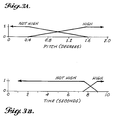
- FIG. 3A is a graph illustrative of the nosedown fuzzy set for pitch angle in
- FIG. 3B is a graph illustrative of nosedown fuzzy set for time in seconds.
- FIGS. 4A, 4B, 4C, 4D, and 4E are on-ramp fuzzy sets for slope error, nosedown, error, time, and decel, respectively.
- FIGS 5A and 5B are steady-state fuzzy sets for decel error and slope, respectively.
- FIGS. 6A and 6B are comparative results on a simulator of prior and fuzzy autobrake systems, respectively, with an autobrake setting of 6.3 ft/sec/sec deceleration without aircraft thrust reverser deployment;
- FIGS. 7A and 7B are comparative results on a simulator of prior and fuzzy autobrake systems, respectively, with an autobrake setting of 8.5 ft/sec/sec deceleration with aircraft thrust reversers deployed.
- the present autobrake system controls the amount of electric current sent to an electronic servo valve, which in turn meters hydraulic pressure to the brakes of the airplane.
- the deceleration rate of the airplane and the pitch angle of the airplane are inputs to the control algorithm.
- the objective is to decelerate the airplane at a constant, pilot-selected deceleration (decel) rate, and to provide a smooth on-ramp to that decel rate (FIG. 1).
- the present fuzzy system yields smoother braking and has been shown by comparison, as hereinafter illustrated, to yield both a smoother on-ramp, and tighter control to the steady-state set point.
- the fuzzy inference engine is a rule-based system of the following form:
- a ij s are fuzzy sets, and the B i s are scalar values.
- a fuzzy set is a set which allows membership values in the [0,1] interval.
- a fuzzy set is defined on a universal set by a membership function which maps all elements of the universal set to the [0,1] interval: ⁇ A ij (x): X ⁇ [0,1].
- the "AND" logical operators in these rules can be replaced with "OR” logical operators.
- the rule base is processed in parallel each time an inference is made. This process occurs in two steps:
- the present Fuzzy Autobrake Algorithm consists of an initial open loop brake fill region (which consists of a current spike) followed by a closed loop algorithm.
- the closed loop algorithm which executes with a 10 ms frame time, can be broken into 6 components (FIG. 2).
- Component 1 Component to Calculate Decision Variables
- This component receives pitch and time as inputs, and calculates the value of "nosedown,” which can take values from 0 to 100. Nosedown represents the degree to which the nose of the airplane should be considered to be down, with 0 representing definitely not down and 100 representing definitely down.
- Nosedown represents the degree to which the nose of the airplane should be considered to be down, with 0 representing definitely not down and 100 representing definitely down.
- the two rules and four fuzzy set values are listed below.
- Component 3 On-ramp Fuzzy Inference Engine (The on-ramp fuzzy sets are shown in FIGS. 4A, 4B, 4C, 4D, and 4E)
- This component receives decel, decel error, slope error, time, and nosedown as inputs, and calculates a value of ⁇ current (in 100,000ths of a mA).
- ⁇ current in 100,000ths of a mA.
- Component 4 Steady State Fuzzy Inference Engine (the steady state fuzzy sets are shown in FIGS. 5A and 5B where:
- This component receives decel error and slope as inputs, and calculates a value of ⁇ current (in 100,00ths of a mA).
- ⁇ current in 100,00ths of a mA.
- Component 5 Supervisory Mixing Component
- This component receives as inputs the ⁇ current from the On-ramp component, the ⁇ current from the Steady State Component, and the decel error, and calculates the ⁇ current by which the current will actually be increased.
- This calculation is a linear transition from On-ramp control to Steady State (S.S.) control as the decel error passes from less than -0.5 fps 2 to 0; i.e.,
- the portion of control given to the S.S. component is held to a minimum of the highest value that it has attained so far. This means that the portion of control given to the S.S. component can never decrease, and that once the decel error reaches zero, all control will be from the S.S. component.
- Component 6 Summing and Limiting Component
- This component receives ⁇ current as an input, and calculates the current.
- the new current is equal to the previous current plus ⁇ current, limited to a minimum and maximum value.
- FIGS. 7A and 7B show a comparison where the autobrake setting is 8.5 ft/sec/sec deceleration with aircraft thrust reversers deployed.
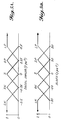
- the aircraft ARINC 629 (Primary Controller) operates in C-Mode, and receives the "Minor Frame Synch” Pulse (MIFS) from external logic; i.e., from the Auxiliary Controller.
- MIFS "Minor Frame Synch" Pulse
- the control of the XPP addresses are accomplished by external logic other than Primary ARINC 629 Controller. The XPP addresses of the Primary are ignored.
- the present control logic is based on a set of rules which are vague, i.e. fuzzy.
- One example rule from the system is "If the Decel Error is Large Negative, and the Slope [Derivative of Decel Error] is Positive Small, then the ⁇ Current is Positive Very Small.”
- "Large Negative,” “Positive Small,” and “Positive Very Small” are defined by mathematical functions.
- the rule base is evaluated in parallel each decision cycle. First, a weight is assigned to each rule based on how applicable the rule is at the given point in time. The output is then calculated using these weights by taking the weighted average of all of the rules.
Landscapes
- Engineering & Computer Science (AREA)
- Mechanical Engineering (AREA)
- Transportation (AREA)
- Aviation & Aerospace Engineering (AREA)
- Physics & Mathematics (AREA)
- Fuzzy Systems (AREA)
- Mathematical Physics (AREA)
- Software Systems (AREA)
- Theoretical Computer Science (AREA)
- Feedback Control In General (AREA)
- Regulating Braking Force (AREA)
Applications Claiming Priority (2)
| Application Number | Priority Date | Filing Date | Title |
|---|---|---|---|
| US08/472,945 US5539642A (en) | 1993-05-21 | 1995-06-06 | Fuzzy logic autobrake system for aircraft |
| US472945 | 1999-12-27 |
Publications (4)
| Publication Number | Publication Date |
|---|---|
| EP0747276A2 true EP0747276A2 (de) | 1996-12-11 |
| EP0747276A3 EP0747276A3 (de) | 1998-07-15 |
| EP0747276B1 EP0747276B1 (de) | 2004-09-29 |
| EP0747276B2 EP0747276B2 (de) | 2009-12-09 |
Family
ID=23877533
Family Applications (1)
| Application Number | Title | Priority Date | Filing Date |
|---|---|---|---|
| EP96201088A Expired - Lifetime EP0747276B2 (de) | 1995-06-06 | 1996-04-23 | Automatisches Flugzeugbremssystem mit Fuzzy-Logik |
Country Status (3)
| Country | Link |
|---|---|
| US (1) | US5539642A (de) |
| EP (1) | EP0747276B2 (de) |
| DE (1) | DE69633484T3 (de) |
Families Citing this family (11)
| Publication number | Priority date | Publication date | Assignee | Title |
|---|---|---|---|---|
| US6088646A (en) * | 1996-10-25 | 2000-07-11 | The Boeing Company | Fuzzy logic antiskid control system for aircraft |
| US5968106A (en) * | 1997-08-05 | 1999-10-19 | The Boeing Company | Aircraft stop-to-position autobrake control system |
| US6510354B1 (en) * | 1999-04-21 | 2003-01-21 | Ching-Fang Lin | Universal robust filtering process |
| US6757569B2 (en) * | 2000-04-19 | 2004-06-29 | American Gnc Corporation | Filtering process for stable and accurate estimation |
| FR2857468B1 (fr) * | 2003-07-08 | 2005-09-30 | Airbus France | Systeme d'aide a la commande de la deceleration d'un aeronef roulant sur le sol |
| US7720579B2 (en) * | 2006-12-20 | 2010-05-18 | The Boeing Company | Method, system, and computer program product for performance monitored aircraft rejected takeoff braking |
| TR201613964A2 (tr) * | 2016-10-05 | 2016-11-21 | Selcuk Karaosmanoglu | Sifir ki̇li̇tlenme fren si̇stemi̇ |
| US10647306B2 (en) | 2018-04-23 | 2020-05-12 | Goodrich Corporation | Measurement of contact maintaining control valve current for a hydraulic actuator |
| FR3093993B1 (fr) * | 2019-03-21 | 2021-02-26 | Safran Aircraft Engines | Procédé de contrôle du freinage des roues d’un avion et contrôleur de freinage de roues associé |
| US11548625B2 (en) | 2019-12-13 | 2023-01-10 | Goodrich Corporation | Aircraft brake system |
| US12025994B2 (en) * | 2020-12-23 | 2024-07-02 | Rockwell Collins, Inc. | Rejected takeoff aircraft system and method |
Family Cites Families (19)
| Publication number | Priority date | Publication date | Assignee | Title |
|---|---|---|---|---|
| US4022513A (en) * | 1972-04-12 | 1977-05-10 | Crane Co., Hydro-Aire Division | Selective deceleration brake control system |
| US3920278A (en) * | 1973-08-30 | 1975-11-18 | Crane Co | Selective deceleration brake control system |
| US4076331A (en) * | 1973-09-06 | 1978-02-28 | The Boeing Company | Aircraft automatic braking system |
| US3926479A (en) * | 1973-11-12 | 1975-12-16 | Boeing Co | Aircraft automatic braking system having auto-brake control logic |
| US3920204A (en) * | 1974-11-11 | 1975-11-18 | Boeing Co | Rejected take-off (RTO) control for automatic braking system |
| US4007970A (en) * | 1975-09-30 | 1977-02-15 | The Boeing Company | Aircraft automatic braking system |
| US4327413A (en) * | 1979-09-12 | 1982-04-27 | Goodyear Aerospace Corporation | Automatic brake control circuit for aircraft |
| DE3231162C2 (de) * | 1982-08-21 | 1984-08-16 | Messerschmitt-Bölkow-Blohm GmbH, 8000 München | Verfahren für das beschleunigte Herbeiführen des Bodenkontaktes von Flugzeugen |
| US4610484A (en) * | 1983-09-23 | 1986-09-09 | The Boeing Company | Deceleration control brake system |
| US4646242A (en) * | 1984-01-27 | 1987-02-24 | The Boeing Company | Aircraft automatic braking system |
| JPH0698903B2 (ja) * | 1986-08-06 | 1994-12-07 | 本田技研工業株式会社 | 車両走行制御装置 |
| JP2681930B2 (ja) * | 1987-06-27 | 1997-11-26 | 株式会社デンソー | サーボ制御装置 |
| JPH01132450A (ja) * | 1987-11-17 | 1989-05-24 | Nissan Motor Co Ltd | アンチスキッドブレーキシステム |
| JP2536182B2 (ja) * | 1988-09-28 | 1996-09-18 | オムロン株式会社 | ファジイ・コントロ―ラ、ファジイ推論装置、ファジイル―ル管理装置、ファジイ・コントロ―ル方法、ファジイ推論方法及びファジイル―ル管理方法 |
| CN2044952U (zh) * | 1988-12-27 | 1989-09-27 | 青岛建筑工程学院 | 汽车气压应急制动装置 |
| US5136510A (en) * | 1990-02-20 | 1992-08-04 | Aircraft Braking Systems Corporation | Aircraft deceleration brake control system |
| JPH03258650A (ja) * | 1990-03-09 | 1991-11-18 | Toyota Motor Corp | 路面摩擦係数検出装置 |
| JP2668751B2 (ja) * | 1991-11-30 | 1997-10-27 | 三菱自動車工業株式会社 | 後輪制動力制御装置 |
| JP2855987B2 (ja) * | 1992-08-26 | 1999-02-10 | 三菱自動車工業株式会社 | アンチスキッドブレーキング方法 |
-
1995
- 1995-06-06 US US08/472,945 patent/US5539642A/en not_active Expired - Lifetime
-
1996
- 1996-04-23 EP EP96201088A patent/EP0747276B2/de not_active Expired - Lifetime
- 1996-04-23 DE DE69633484T patent/DE69633484T3/de not_active Expired - Lifetime
Also Published As
| Publication number | Publication date |
|---|---|
| EP0747276A3 (de) | 1998-07-15 |
| EP0747276B1 (de) | 2004-09-29 |
| DE69633484T2 (de) | 2005-11-17 |
| EP0747276B2 (de) | 2009-12-09 |
| US5539642A (en) | 1996-07-23 |
| DE69633484T3 (de) | 2010-07-15 |
| DE69633484D1 (de) | 2004-11-04 |
Similar Documents
| Publication | Publication Date | Title |
|---|---|---|
| US5583769A (en) | Automatic train operation apparatus incorporating security function with improved reliability | |
| EP0092832B1 (de) | Verfahren und Einrichtung zum Anhalten eines Fahrzeugs an einem bestimmten Ort | |
| EP0830647B1 (de) | Automatisches fehlertolerantes steuerungssystem unter verwendung analytischer redundanz | |
| Elliott | NASA's advanced control law program for the F-8 digital fly-by-wire aircraft | |
| EP0747276A2 (de) | Automatisches Flugzeugbremssystem mit unscharfer Logik | |
| US6085127A (en) | Fault tolerant automatic control system utilizing analytic redundancy | |
| US5571953A (en) | Method and apparatus for the linear real time estimation of an aircraft center of gravity | |
| JP4102166B2 (ja) | ロータトルク予測装置 | |
| JP4108450B2 (ja) | ロータトルク予測装置 | |
| Nair et al. | Aircraft yaw control system using lqr and fuzzy logic controller | |
| Duyar et al. | Fault diagnosis for the space shuttle main engine | |
| US20020055809A1 (en) | Flight control system | |
| US6114976A (en) | Vehicle emergency warning and control system | |
| DE19537694A1 (de) | Verfahren zur Überwachung einer Maschine oder Anlage | |
| EP1429220B2 (de) | Verfahren und Computerprogrammprodukt zur Steuerung von Steuerflächen für ein aerodynamisches Fahrzeug | |
| EP0742141B1 (de) | Methode und Vorrichtung zur Abgabe eines dynamischen Ruder-Steuerbefehls zur Kompensation unsymmetrischen Schubes ohne direkte Schubmessung | |
| Vascak et al. | Performance-based adaptive fuzzy control of aircrafts | |
| US6131449A (en) | Velocity adaptive control test system | |
| Lea | Applications of fuzzy sets to rule-based expert system development | |
| Olson et al. | Model-follower longitudinal control for automated guideway transit vehicles | |
| Berenji et al. | Pitch control of the space shuttle training aircraft | |
| Ewers et al. | Expert supervision of an anti-skid control system of a commercial aircraft | |
| Costea et al. | Automation and optimization of air traffic control systems | |
| Ho et al. | Fuzzy logic in restructurable flight control systems | |
| McLean et al. | A structure load alleviation control system for a large aircraft |
Legal Events
| Date | Code | Title | Description |
|---|---|---|---|
| PUAI | Public reference made under article 153(3) epc to a published international application that has entered the european phase |
Free format text: ORIGINAL CODE: 0009012 |
|
| AK | Designated contracting states |
Kind code of ref document: A2 Designated state(s): DE FR GB |
|
| PUAL | Search report despatched |
Free format text: ORIGINAL CODE: 0009013 |
|
| AK | Designated contracting states |
Kind code of ref document: A3 Designated state(s): DE FR GB |
|
| 17P | Request for examination filed |
Effective date: 19981116 |
|
| 17Q | First examination report despatched |
Effective date: 20020705 |
|
| GRAP | Despatch of communication of intention to grant a patent |
Free format text: ORIGINAL CODE: EPIDOSNIGR1 |
|
| GRAS | Grant fee paid |
Free format text: ORIGINAL CODE: EPIDOSNIGR3 |
|
| GRAA | (expected) grant |
Free format text: ORIGINAL CODE: 0009210 |
|
| AK | Designated contracting states |
Kind code of ref document: B1 Designated state(s): DE FR GB |
|
| REG | Reference to a national code |
Ref country code: GB Ref legal event code: FG4D |
|
| REF | Corresponds to: |
Ref document number: 69633484 Country of ref document: DE Date of ref document: 20041104 Kind code of ref document: P |
|
| PLAQ | Examination of admissibility of opposition: information related to despatch of communication + time limit deleted |
Free format text: ORIGINAL CODE: EPIDOSDOPE2 |
|
| PLBI | Opposition filed |
Free format text: ORIGINAL CODE: 0009260 |
|
| PLBQ | Unpublished change to opponent data |
Free format text: ORIGINAL CODE: EPIDOS OPPO |
|
| PLAX | Notice of opposition and request to file observation + time limit sent |
Free format text: ORIGINAL CODE: EPIDOSNOBS2 |
|
| 26 | Opposition filed |
Opponent name: AIRBUS SAS Effective date: 20050628 |
|
| ET | Fr: translation filed | ||
| PLAF | Information modified related to communication of a notice of opposition and request to file observations + time limit |
Free format text: ORIGINAL CODE: EPIDOSCOBS2 |
|
| PLBB | Reply of patent proprietor to notice(s) of opposition received |
Free format text: ORIGINAL CODE: EPIDOSNOBS3 |
|
| APBM | Appeal reference recorded |
Free format text: ORIGINAL CODE: EPIDOSNREFNO |
|
| APBP | Date of receipt of notice of appeal recorded |
Free format text: ORIGINAL CODE: EPIDOSNNOA2O |
|
| APAH | Appeal reference modified |
Free format text: ORIGINAL CODE: EPIDOSCREFNO |
|
| APBU | Appeal procedure closed |
Free format text: ORIGINAL CODE: EPIDOSNNOA9O |
|
| RIC2 | Information provided on ipc code assigned after grant |
Ipc: B60T 8/17 20060101AFI20090803BHEP |
|
| PUAH | Patent maintained in amended form |
Free format text: ORIGINAL CODE: 0009272 |
|
| STAA | Information on the status of an ep patent application or granted ep patent |
Free format text: STATUS: PATENT MAINTAINED AS AMENDED |
|
| 27A | Patent maintained in amended form |
Effective date: 20091209 |
|
| AK | Designated contracting states |
Kind code of ref document: B2 Designated state(s): DE FR GB |
|
| REG | Reference to a national code |
Ref country code: FR Ref legal event code: PLFP Year of fee payment: 20 |
|
| PGFP | Annual fee paid to national office [announced via postgrant information from national office to epo] |
Ref country code: GB Payment date: 20150427 Year of fee payment: 20 Ref country code: DE Payment date: 20150429 Year of fee payment: 20 |
|
| PGFP | Annual fee paid to national office [announced via postgrant information from national office to epo] |
Ref country code: FR Payment date: 20150417 Year of fee payment: 20 |
|
| REG | Reference to a national code |
Ref country code: DE Ref legal event code: R071 Ref document number: 69633484 Country of ref document: DE |
|
| REG | Reference to a national code |
Ref country code: GB Ref legal event code: PE20 Expiry date: 20160422 |
|
| PG25 | Lapsed in a contracting state [announced via postgrant information from national office to epo] |
Ref country code: GB Free format text: LAPSE BECAUSE OF EXPIRATION OF PROTECTION Effective date: 20160422 |