EP0747334A2 - Hemmung der katalytischen Oxidation eines Kohlenstoff-Kohlenstoff-Verbundwerkstoffes - Google Patents
Hemmung der katalytischen Oxidation eines Kohlenstoff-Kohlenstoff-Verbundwerkstoffes Download PDFInfo
- Publication number
- EP0747334A2 EP0747334A2 EP96108895A EP96108895A EP0747334A2 EP 0747334 A2 EP0747334 A2 EP 0747334A2 EP 96108895 A EP96108895 A EP 96108895A EP 96108895 A EP96108895 A EP 96108895A EP 0747334 A2 EP0747334 A2 EP 0747334A2
- Authority
- EP
- European Patent Office
- Prior art keywords
- carbon
- aluminum
- zinc
- phosphate
- salt
- Prior art date
- Legal status (The legal status is an assumption and is not a legal conclusion. Google has not performed a legal analysis and makes no representation as to the accuracy of the status listed.)
- Granted
Links
Images

Classifications
-
- C—CHEMISTRY; METALLURGY
- C04—CEMENTS; CONCRETE; ARTIFICIAL STONE; CERAMICS; REFRACTORIES
- C04B—LIME, MAGNESIA; SLAG; CEMENTS; COMPOSITIONS THEREOF, e.g. MORTARS, CONCRETE OR LIKE BUILDING MATERIALS; ARTIFICIAL STONE; CERAMICS; REFRACTORIES; TREATMENT OF NATURAL STONE
- C04B41/00—After-treatment of mortars, concrete, artificial stone or ceramics; Treatment of natural stone
- C04B41/009—After-treatment of mortars, concrete, artificial stone or ceramics; Treatment of natural stone characterised by the material treated
-
- C—CHEMISTRY; METALLURGY
- C04—CEMENTS; CONCRETE; ARTIFICIAL STONE; CERAMICS; REFRACTORIES
- C04B—LIME, MAGNESIA; SLAG; CEMENTS; COMPOSITIONS THEREOF, e.g. MORTARS, CONCRETE OR LIKE BUILDING MATERIALS; ARTIFICIAL STONE; CERAMICS; REFRACTORIES; TREATMENT OF NATURAL STONE
- C04B41/00—After-treatment of mortars, concrete, artificial stone or ceramics; Treatment of natural stone
- C04B41/45—Coating or impregnating, e.g. injection in masonry, partial coating of green or fired ceramics, organic coating compositions for adhering together two concrete elements
- C04B41/50—Coating or impregnating, e.g. injection in masonry, partial coating of green or fired ceramics, organic coating compositions for adhering together two concrete elements with inorganic materials
- C04B41/5007—Coating or impregnating, e.g. injection in masonry, partial coating of green or fired ceramics, organic coating compositions for adhering together two concrete elements with inorganic materials with salts or salty compositions, e.g. for salt glazing
- C04B41/5015—Coating or impregnating, e.g. injection in masonry, partial coating of green or fired ceramics, organic coating compositions for adhering together two concrete elements with inorganic materials with salts or salty compositions, e.g. for salt glazing containing phosphorus in the anion, e.g. phosphates
-
- C—CHEMISTRY; METALLURGY
- C04—CEMENTS; CONCRETE; ARTIFICIAL STONE; CERAMICS; REFRACTORIES
- C04B—LIME, MAGNESIA; SLAG; CEMENTS; COMPOSITIONS THEREOF, e.g. MORTARS, CONCRETE OR LIKE BUILDING MATERIALS; ARTIFICIAL STONE; CERAMICS; REFRACTORIES; TREATMENT OF NATURAL STONE
- C04B41/00—After-treatment of mortars, concrete, artificial stone or ceramics; Treatment of natural stone
- C04B41/45—Coating or impregnating, e.g. injection in masonry, partial coating of green or fired ceramics, organic coating compositions for adhering together two concrete elements
- C04B41/52—Multiple coating or impregnating multiple coating or impregnating with the same composition or with compositions only differing in the concentration of the constituents, is classified as single coating or impregnation
-
- C—CHEMISTRY; METALLURGY
- C04—CEMENTS; CONCRETE; ARTIFICIAL STONE; CERAMICS; REFRACTORIES
- C04B—LIME, MAGNESIA; SLAG; CEMENTS; COMPOSITIONS THEREOF, e.g. MORTARS, CONCRETE OR LIKE BUILDING MATERIALS; ARTIFICIAL STONE; CERAMICS; REFRACTORIES; TREATMENT OF NATURAL STONE
- C04B41/00—After-treatment of mortars, concrete, artificial stone or ceramics; Treatment of natural stone
- C04B41/80—After-treatment of mortars, concrete, artificial stone or ceramics; Treatment of natural stone of only ceramics
- C04B41/81—Coating or impregnation
- C04B41/85—Coating or impregnation with inorganic materials
-
- C—CHEMISTRY; METALLURGY
- C04—CEMENTS; CONCRETE; ARTIFICIAL STONE; CERAMICS; REFRACTORIES
- C04B—LIME, MAGNESIA; SLAG; CEMENTS; COMPOSITIONS THEREOF, e.g. MORTARS, CONCRETE OR LIKE BUILDING MATERIALS; ARTIFICIAL STONE; CERAMICS; REFRACTORIES; TREATMENT OF NATURAL STONE
- C04B41/00—After-treatment of mortars, concrete, artificial stone or ceramics; Treatment of natural stone
- C04B41/80—After-treatment of mortars, concrete, artificial stone or ceramics; Treatment of natural stone of only ceramics
- C04B41/81—Coating or impregnation
- C04B41/89—Coating or impregnation for obtaining at least two superposed coatings having different compositions
-
- F—MECHANICAL ENGINEERING; LIGHTING; HEATING; WEAPONS; BLASTING
- F16—ENGINEERING ELEMENTS AND UNITS; GENERAL MEASURES FOR PRODUCING AND MAINTAINING EFFECTIVE FUNCTIONING OF MACHINES OR INSTALLATIONS; THERMAL INSULATION IN GENERAL
- F16D—COUPLINGS FOR TRANSMITTING ROTATION; CLUTCHES; BRAKES
- F16D65/00—Parts or details
- F16D65/02—Braking members; Mounting thereof
- F16D65/12—Discs; Drums for disc brakes
- F16D65/125—Discs; Drums for disc brakes characterised by the material used for the disc body
- F16D65/126—Discs; Drums for disc brakes characterised by the material used for the disc body the material being of low mechanical strength, e.g. carbon, beryllium; Torque transmitting members therefor
-
- F—MECHANICAL ENGINEERING; LIGHTING; HEATING; WEAPONS; BLASTING
- F16—ENGINEERING ELEMENTS AND UNITS; GENERAL MEASURES FOR PRODUCING AND MAINTAINING EFFECTIVE FUNCTIONING OF MACHINES OR INSTALLATIONS; THERMAL INSULATION IN GENERAL
- F16D—COUPLINGS FOR TRANSMITTING ROTATION; CLUTCHES; BRAKES
- F16D65/00—Parts or details
- F16D65/02—Braking members; Mounting thereof
- F16D65/12—Discs; Drums for disc brakes
- F16D65/127—Discs; Drums for disc brakes characterised by properties of the disc surface; Discs lined with friction material
-
- F—MECHANICAL ENGINEERING; LIGHTING; HEATING; WEAPONS; BLASTING
- F16—ENGINEERING ELEMENTS AND UNITS; GENERAL MEASURES FOR PRODUCING AND MAINTAINING EFFECTIVE FUNCTIONING OF MACHINES OR INSTALLATIONS; THERMAL INSULATION IN GENERAL
- F16D—COUPLINGS FOR TRANSMITTING ROTATION; CLUTCHES; BRAKES
- F16D69/00—Friction linings; Attachment thereof; Selection of coacting friction substances or surfaces
- F16D69/02—Composition of linings ; Methods of manufacturing
- F16D69/023—Composite materials containing carbon and carbon fibres or fibres made of carbonizable material
-
- F—MECHANICAL ENGINEERING; LIGHTING; HEATING; WEAPONS; BLASTING
- F16—ENGINEERING ELEMENTS AND UNITS; GENERAL MEASURES FOR PRODUCING AND MAINTAINING EFFECTIVE FUNCTIONING OF MACHINES OR INSTALLATIONS; THERMAL INSULATION IN GENERAL
- F16D—COUPLINGS FOR TRANSMITTING ROTATION; CLUTCHES; BRAKES
- F16D2200/00—Materials; Production methods therefor
- F16D2200/0034—Materials; Production methods therefor non-metallic
- F16D2200/0039—Ceramics
- F16D2200/0047—Ceramic composite, e.g. C/C composite infiltrated with Si or B, or ceramic matrix infiltrated with metal
Definitions
- This invention relates to a method and composition useful in inhibiting catalyzed oxidation of carbon-carbon composites.
- carbon-carbon composites have been coated with barriers to prevent oxidation.
- the barriers include silicon based coatings, such as silicon carbide.
- the coatings however have cracks and porosity. These cracks and porosity are areas which may be subject to the above oxidation problems.
- Some commercial transport brakes have suffered crushing in the lugs or stator slots. The damage has been associated with visible surface oxidation and oxidation enlargement of cracks around fibers or in the carbon-carbon composite coating. The enlargement occurs at depths up to 0.5 inch beneath the exposed surfaces. Potassium or sodium has been identified in the severely oxidized regions. Alkali and alkaline earth elements are well known to catalyze carbon oxidation. Catalyzed oxidation is carbon oxidation that is accelerated by the presence of contaminating materials. These contaminating materials come into contact with the brake from cleaning and de-icing chemicals used on aircraft. Sodium can originate from salt deposits left from seawater or sea spray.
- Woodburn and Lynch (USP 2,685,539) describe several ways of impregnating pores in carbon or graphite with aluminum phosphate. They specified compositions having a molar ratio of Al 2 O 3 :P 2 O 5 between 0.2:1 and 0.8:1. Application methods included brushing, spraying or soaking in solutions, including Al(H 2 PO 4 ) 3 dissolved in aqueous HCl.
- U. S. Patent No. 4,439,491 issued to Wilson, relates to carbon or graphite protected against oxidation by application of a solution comprising mono-ammonium phosphate, zinc orthophosphate, phosphoric acid, boric acid, cupric oxide, and wetting agent in water.
- U. S. Patent No. 4,837,073 issued to McAllister et al., relates to a barrier coating and penetrant providing oxidation protection for carbon-carbon materials.
- the method involves penetrating a barrier coating for carbon-carbon materials with an oxidation inhibitor.
- This invention relates to method of inhibiting catalyzed oxidation of carbon-carbon composites comprising the steps of treating a porous carbon-carbon composite with a catalyzed oxidation inhibiting amount of aqueous compositions, capable of impregnating carbon-carbon composites, comprising (a) phosphoric acid, (b) (i) a metal phosphate or (ii) a combination of a zinc salt and an aluminum salt, and (c) a catalyzed oxidation inhibiting amount of a compatible wetting agent selected from the group consisting of polyols, alkoxylated monohydric alcohols, silicone surfactant and mixtures thereof and heating the treated carbon-carbon composite to a temperature sufficient to form deposits within the pores.
- a compatible wetting agent selected from the group consisting of polyols, alkoxylated monohydric alcohols, silicone surfactant and mixtures thereof and heating the treated carbon-carbon composite to a temperature sufficient to form deposits within the pores.
- the invention also relates to composition
- the term "retention" refers to preventing the migration of the liquid impregnant from the pores of the carbon-carbon deposit to the surface thereof upon heating.
- This invention is particularly useful for aircraft brakes which operate at temperatures up to about 700°C during normal service, or, where a barrier coating is applied, up to about 900°C. It is in the lower temperature range, e.g. above about 400°C to about 600°C, where commercial aircraft brakes operate most of the time, that the effect of catalytic oxidation is most severe in allowing more rapid degradation of a carbon body's strength by oxidation internally from air diffusing into the pores.
- Application of this invention provides a means for significantly extending the service life of carbons by preventing catalyst-accelerated, internal oxidation.
- metal phosphate deposits should be distributed uniformly throughout the pores (e.g. with not more than ⁇ 1 mm separation between deposits) to a depth sufficient to cover the range affected by O 2 diffusing in from exposed surfaces ( ⁇ 1 cm).
- the process described here has provided such deposits when the carbon is heated in service to the range 400°C to 850°C (but below - 1040°C).
- Carbon-carbon composites are generally prepared from carbon preforms.
- Carbon preforms are made of carbon fibers, which may be formed from pre-oxidized acrylonitrile resin. In one embodiment, these fibers can be layered together to form a shape, such as a friction brake. The shape is heated and infiltrated with methane or another pyrolyzable carbon source to form the carbon-carbon composites.
- Carbon-carbon composites and methods of their manufacture are known to those in the art.
- the carbon-carbon composite has a density from about 1.6 to about 1.9 g/cm 3 .
- a particularly useful carbon-carbon composite has a density of about 1.75 g/cm 3 .
- the carbon-carbon composites are impregnated with an aqueous composition
- an aqueous composition comprising (a) phosphoric acid, (b) (i) a metal phosphate or (ii) a combination of a zinc salt and an aluminum salt, and (c) a penetration and retention improving amount of a compatible wetting agent selected from the group consisting of polyols, alkoxylated monohydric alcohols, silicone surfactant and mixtures thereof.
- the aqueous composition is free of hydrochloric acid.
- the aqueous composition contains less than 0.5%, or less than 0.1 % by weight boron.
- the aqueous mixture is free of boron and metal borates.
- the aqueous composition contains less than 0.5%, or less than 0.1% by weight manganese.
- the aqueous mixture is free of manganese.
- the aqueous composition is free of hydrochloric acid.
- the aqueous compositions generally contain from about 40% up to, about 70%, or from about 45% or about 50% up to about 65% by weight water.
- the phosphoric acid (a) is present in an amount from about 50%, or about 55%, or about 60% up to about 75% or to about 70% by weight of combination of (a) and (b).
- the metal phosphate (b) is present in an amount from about 25%, or about 30%, up to about 50%, or to about 45%, or to about 40% by weight of the combination of (a) and (b).
- the aqueous composition includes a metal phosphate.
- Illustrative examples of useful metal phosphates include manganese, zinc and aluminum phosphates.
- the metal phosphate is aluminum phosphate, preferably mono-aluminum phosphate (Al(H 2 PO 4 ) 3 ).
- Al(H 2 PO 4 ) 3 mono-aluminum phosphate
- the molar ratio of aluminum to phosphorus is generally from about 0.2 up to about 0.8 (aluminum) to one (phosphorus).
- phosphoric acid (a) is generally present in an amount from about 5% up to about 35%, or from about 10% up to about 30%, or from about 12% up to about 25 % by weight of the aqueous composition.
- the ratio of the aluminum salt to the zinc salt is generally from about 4 to about 1, preferably, from about 3 to about 1, more preferably two parts of aluminum salt for each part of zinc salt.
- the zinc salt may be any zinc salt capable of forming zinc phosphate upon heating. Examples of zinc salts include zinc halides, such as zinc chloride, zinc nitrate, zinc phosphate and mixtures thereof.
- the zinc salt is Zn 3 (PO 4 ) 2 .2H 2 O.
- the zinc salt may be present in an amount from about 2% up to about 20%, or from about 5% up to about 18%, or from about 8% to about 14% by weight of the aqueous composition.
- the aluminum salt may be any aluminum salt capable of forming aluminum phosphate upon heating.
- aluminum salts include aluminum halides, such as aluminum chloride, aluminum nitrate, aluminum phosphate, and mixtures thereof.
- the aluminum salt is added as a soluble aluminum phosphate, preferably mono-aluminum phosphate (Al(H 2 PO 4 ) 3 ).
- the aluminum salt is generally present in an amount from about 10% up to about 50%, or from about 15% up to about 35%, or from about 20% up to about 30% by weight of the aqueous composition.
- the aqueous compositions of the present invention additionally contain a compatible wetting agent.
- a compatible wetting agent is a material which does not separate from the aqueous composition before the aqueous composition is used.
- the wetting agent is selected from the group consisting of polyols, alkoxylated monohydric alcohols, silicone surfactant and mixtures thereof.
- the wetting agent is present in an amount sufficient to improve the penetration and retention of the metal phosphate and phosphoric acid.
- the wetting agent is typically present in an amount from about 0.3% to about 3%, or from about 0.5% up to about 2%, or from about 0.75% up to about 1.5% by weight of the combination of the (a) and (b).
- the wetting agent is present in an amount from about 0.5% to about 1 % by weight of the combination of (a) and (b).
- the wetting agent is generally present in the aqueous composition in an amount from about 0.1% up to about 2%, or from about 0.3% up to about 1% by weight of the aqueous composition.
- the wetting agent (c) is a polyol
- it generally contains two, three, or four hydroxyl groups, preferably two hydroxyl groups.
- the polyol is alkoxylated.
- the polyol is an acetylenic polyol.
- the acetylenic polyol may be branched. Examples of acetylenic polyols include dimethylhexynol, dimethyloctynediol, and tetramethyldecynediol.
- Acetylenic polyols are available commercially from Air Products & Chemicals, Inc. under the tradename Surfynol.
- An example of a useful acetylenic polyol is Surfynol 104.
- the acetylenic polyol may also be alkoxylated. These materials are generally prepared by treating an acetylenic polyol with an epoxide, such as ethylene oxide, propylene oxide, etc.
- an epoxide such as ethylene oxide, propylene oxide, etc.
- An example of a useful alkoxylated acetylenic polyol is Surfynol 440.
- the wetting agent (c) may also be an alkoxylated monohydric alcohol.
- the alkoxylated monohydric alcohols are generally prepared by reacting a monohydric alcohol with an epoxide, such as those epoxides described above. In one embodiment, the alcohol contains from about 8 to about 24, or from about 10 up to about 18 carbon atoms.
- the alkoxylated monohydric alcohol may be an alkoxylated linear alcohol.
- An example of a useful alkoxylated alcohol is Polytergent SL-62 available commercially from Olin Corporation.
- the wetting agent is a silicone surfactant.
- the silicone surfactants include polysiloxanes such as amino-functional, hydroxy-functional, acetoxy-functional, or alkoxy-functional polysiloxanes.
- Examples of silicone surfactants include polydimethylsiloxane, polydiethylsiloxane, polymethylethylsiloxane, polymethylphenylsiloxane, polydiphenylsiloxane, diphenylsilanediol, block copolymers of a polysiloxane and a polyoxyalkylene, etc.
- silicone surfactants include Abil-B 8800 series of polysiloxane polyether compositions and Abil Wax dialkoxy dimethylpolysiloxanes, polysiloxane polyalkyl copolymers, and polysiloxane polyalkylene copolymers of Goldschmidt Chemical Company; Alkasil NE silicone polyalkoxylate block copolymers of Rhone Paulenc; Dow Corning® silicone glycol copolymers; Hartosaft S5793 amino functional silicone emulsion of Hart Products Co.; and BYK-346 polydimethylsiloxane of BYK Chemie.
- the carbon-carbon composites have a barrier coating.
- the thickness of the barrier coating is generally from about 0.0005 to about 0.005, or from about 0.001 to about 0.003, or from about 0.001 to about 0.002 inches.
- the range and ratio limits may be combined.
- the barrier coating has continuous porosity. The porosity is typically from about 8% to about 13% by volume. Examples of barrier coatings include silicon carbide, titanium carbide, boron carbide, silicon oxycarbide, etc. These coatings may be applied to the carbon-carbon composites by any means known to those in the art. In one embodiment, the barrier coating may be applied by chemical vapor deposition (CVD), painting, or spraying.
- CVD chemical vapor deposition
- the carbon-carbon composites have a silicon carbide based coating prepared by CVD with subsequent heat treatment (or cooling after deposition) that results in microcracks through which an inhibitor solution can penetrate.
- the barrier coating is applied as a commercial paint, such as ZYP Corp. grade SC, which is baked to 650°C or above, either before or after the pores of the carbon are penetrated by the inhibitor solution.
- the wetting agent is applied to the porous carbon-carbon composite without a protective barrier coating. However, it is preferably omitted when the solution is applied to a cracked or porous barrier coating.
- the invention relates to a composition consisting essentially of a phosphate oxidation inhibiting mixture, and a penetration and retention improving amount of a compatible wetting agent selected from the group consisting of polyols, alkoxylated monohydric alcohols, silicone surfactants and mixtures thereof.
- a compatible wetting agent selected from the group consisting of polyols, alkoxylated monohydric alcohols, silicone surfactants and mixtures thereof.
- the phosphate oxidation inhibiting mixtures are those which inhibit catalyzed oxidation of the carbon-carbon composites. These mixtures include metal phosphates and phosphoric acid as described above.
- the wetting agents also are described above.
- the invention also relates to a method of inhibiting catalyzed oxidation of carbon-carbon composites comprising the steps of treating a carbon-carbon composite with a catalyzed oxidation inhibiting amount of an aqueous mixture comprising a metal phosphate, phosphoric acid, and a compatible wetting agent selected from the group consisting of polyols, alkoxylated monohydric alcohols, silicone surfactant and mixtures thereof and heating the treated carbon-carbon composite to a temperature sufficient to remove water.
- the aqueous mixture is applied to regions exposed to oxidation, such as brake stators and lugs.
- the mixture is prepared by blending the components of the mixture.
- the components are mixed ultrasonically or by stirring. Typically the method occurs at atmospheric pressure.
- the aqueous mixture may be applied by any means known to those in the art, including painting, dipping, spraying, etc.
- the treated carbon-carbon composites are then heated to remove water.
- the heating is done in an inert atmosphere, such as a nitrogen atmosphere.
- the treated carbon-carbon composites are generally heated to a temperature from about 350°C, or about 450°C or about 550°C up to about 900°C, or to about 750°C, or to about 650°C. In one embodiment, the treated carbon-carbon composites are heated to about 600°C to about 700°C.
- the aqueous composition consists essentially of (a) phosphoric acid, (b) the combination of a zinc salt and an aluminum salt, and optionally, (c) a compatible wetting agent.
- the invention also relates to a method of inhibiting catalyzed oxidation of carbon-carbon composites comprising the steps of treating a carbon-carbon composite with one or more of the above described aqueous compositions and heating the treated carbon-carbon composite to a temperature sufficient to form deposits in the pores.
- the deposit comprises a dispersion of aluminum phosphate in zinc phosphate-rich matrix.
- the treated carbon-carbon composites are generally heated to a temperature from about 700°C to about 1000°C, from about 750°C to about 900°C, or from about 800°C up to 900°C. The heating step is usually accomplished in one to six hours.
- the aqueous mixture is applied to non-wearing regions exposed to oxidation, such as the back faces of the end plates of a brake stack, the drive areas and inside diameter surfaces of the stators and lugs and outside diameter surfaces of the rotors in the brake stack.
- the mixture is prepared by first blending the phosphoric acid, zinc phosphate and monoaluminum phosphate components of the aqueous composition, heating gently to accomplish complete solution.
- the wetting agent is then added and mixed ultrasonically or by stirring. Typically the method occurs at atmospheric pressure.
- the aqueous mixture may be applied by any means known to those in the art, including painting, dipping, spraying, etc.
- the carbon parts may be given a heat treatment or warmed prior to application of the solution to aid penetration of the solution.
- the treated carbon parts are then baked in a nonoxidizing atmosphere (e.g. N 2 ) in a manner which optimizes the retention of the oxidation inhibitors in the pores.
- a nonoxidizing atmosphere e.g. N 2
- Such retention is improved by heating a load of brake discs to about 200°C and holding for 1 hour before heating to a temperature in the range 650°C to 840°C at a rate which provides temperature uniformity within the load. The maximum temperature is held for a time sufficient to obtain that temperature throughout the load.
- the aluminum phosphate and zinc phosphate typically form a two-phase deposit in the carbon after heating.
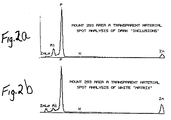
- Fig. 2a and 2b show the energy dispersive x-ray (EDX) spectra of dark and light portion, respectively, of the microstructures in Figs. 1a and 1b.
- An aluminum-rich phosphate (dark by secondary electron emission) is dispersed in a zinc-rich phosphate matrix (brighter secondary electron emission). Since aluminum phosphate has a higher melting point than zinc phosphate, this is evidence that solid particles exist within a fluid matrix at certain temperatures during the oxidation process, thus contributing an increased viscosity to inhibit coalescence of the particles that would degrade the dispersion at higher temperatures.
- Compositions containing this mixture of aluminum and zinc phosphates have superior ability to deactivate a potassium oxidation catalyst after heating to high temperatures.
- An aqueous mixture is prepared by mixing 60 parts of a 50% by weight of an aqueous mixture of mono-aluminum phosphate available from Stauffer Chemical, 20 parts of 85% by weight phosphoric acid aqueous solution, 20 parts of water, and 0.5 parts of polydimethylsiloxane (BYK 346). The aqueous mixture is stirred until the solution is clear. The mixture is painted onto a carbon-carbon composite so that pores near the painted surface are impregnated and the carbon-carbon composite thus treated is heated to 650°C under nitrogen.
- Example 1 The procedure of Example 1 is followed except 1 part of polydimethylsiloxane (BYK 346) is used.
- An aqueous mixture is prepared by mixing 20 parts of 85% solution of phosphoric acid, 48 parts of a 50% solution of monoaluminum phosphate, 12 parts by weight of zinc phosphate dihydtate, and 20 parts water. The aqueous mixture is warmed to about 35 °C while being stirred for 30 minutes.
- An aqueous mixture is prepared as described in Example 3 except 54 parts of the monoaluminum phosphate and 6 parts of the zinc phosphate are used.
- An aqueous mixture is prepared as described in Example 3 except 1 % by weight of an alkoxylated acetylenic polyol (Surfynol 440) is added to the mixture and dispersed by ultrasonic agitation for 30 minutes.
- an alkoxylated acetylenic polyol (Surfynol 440) is added to the mixture and dispersed by ultrasonic agitation for 30 minutes.
- An aqueous mixture is prepared as described in Example 3 wherein an alkoxylated linear alcohol (Polytergent SL-62) is used in place of the alkoxylated tetramethyldecynediol and dispersed by ultrasonic agitation for 30 minutes.
- an alkoxylated linear alcohol Polytergent SL-62
- An aqueous mixture is prepared as described in Example 3 except 0.25 % by weight of the alkoxylated linear alcohol of Example 6 is added to the mixture.
- An aqueous mixture is prepared as described in Example 3 except 0.5% by weight of the alkoxylated linear alcohol of Example 6 is added to the mixture.
- An aqueous mixture is prepared as described in Example 3 except 1 % by weight of a polydimethylsiloxane (BYK-346) is added to the mixture.
- Coupons are cut from brake material, manufactured by densification of a fiber preform by chemical vapor infiltration/deposition of carbon (CVI-C) with an intermediate heat treatment prior to final CVI-C. Typically, 8% to 13% of the volume consists of pores. The porosity is measured by displacement in a liquid, Isopar-M, under vacuum.
- the carbon is further subjected to a final heat treatment at about 2200°C which can improve the resistance to oxidation of the carbon.
- Oxidation tests are conducted by comparing weight loss in a lot of 8 to 20 coupons during isothermal exposures in flowing air at temperatures between about 480°C and 705 °C. The times are shown below in Table 1. The time and temperature profiles simulate aircraft landings. The longer times (except for overnight holds) are broken into two or four increments to allow shifting of coupon locations to compensate for temperature gradients within the furnace.
- Coupons are placed on Al 2 O 3 tube supports and inserted into the preheated furnace. After removal, weights are subtracted from the as-inhibited weight, obtained after heating 5-6 minutes at 593°C in air, and divided by the uninhibited dry carbon weight to compare carbon weight loss after successive "landings". Following an initial oxidation to simulate initial service, contamination is simulated by soaking specimens for about 5 minutes in a contaminating solution containing an oxidation catalyst. In some tests, seawater containing 10.8 mg/ml Na, 1.46 mg/ml Mg, 0.43 mg/ml K and 0.33 mg/ml Ca (all oxidation catalysts) is used.
- coupons are soaked instead in a diluted solution of runway deicer representing contamination on a runway containing a mixture of deicer and melted snow or ice.
- the runway deicer (E36) contains about 51% potassium acetate and is manufactured by Cryotech Deicing Technology. Samples for testing are supplied by Chevron Chemical Company. After contamination, the coupons are first dried and then are heated for 5 minutes at 593 °C; the weight increase ( ⁇ 0.1 % of the carbon weight) is added to the previous weight from which later weights are subtracted to calculate percent carbon lost. Coupons are treated with the aqueous compositions and are exposed to oxidation as described above.
- MZ-1A refers to the aqueous composition of Example 3
- MZ-1 refers to the aqueous composition of Example 6.
- coupons are painted with the aqueous compositions described above.
- the coupons are baked together in an oven heated to 649°C for two hours. They are then preoxidized in cycles equivalent to 600 landings, and are contaminated by soaking for 5 minutes in solutions with increasing amounts of runway deicer E36 added to deionized water.
- the "landings" after contamination are simulated by oxidation in flowing air in a furnace which is cooled from a maximum temperature at the temperatures and for times shown in Table 1.
- Table 2 contains data on the effectiveness of oxidation inhibiting solutions containing a mixture of a zinc salt and an aluminum salt when a preferred wetting agent is added.
- coupons 1-5 demonstrate the reproducibility of the method when 1% of Olin Chemical Poly-Tergent SL-62 is added. Coupon's 6-10 without the wetting agent show a variability in performance resulting from relatively large (millimeter size) regions which are left without phosphate deposits after the bake.
- a barrier coating is required to limit access of oxygen to the carbon at high temperatures, where the rate of carbon oxidation is high whether or not catalysts are present.
- the barrier coating may be applied by a baked SiC paint, SiC deposited by chemical vapor deposition, or a combination of these methods on different portions of the brake discs.
- Coupons are cut from brake material manufactured by densification of a fiber preform by chemical vapor infiltration/deposition of carbon (CVI-C). Some of the coupons are first preoxidized to increase surface porosity by soaking in 85% H 3 PO 4 and then baking to 843°C for 2 hours, thus removing catalytic impurities, and then oxidizing the coupons in air for either 2 or 4 hours in a furnace set at 621°C. The purpose of such preoxidation is to open surface cracks and pores to improve adherence of the barrier coatings. Some of the coupons, with or without preoxidation, are painted with a commercial SiC paint manufactured by ZYP Coatings, Inc., Oak Ridge, Tennessee, and baked at 760°C.
- Oxidation tests are conducted by comparing weight loss in coupons during isothermal exposures to flowing air. The times and temperatures of the tests are shown in Table 3. The time and temperature profiles simulate a sequence of aircraft landings which absorb different amounts of kinetic energy, and are based on measurements of thermocouples inside the rotors and stators of brakes during dynamometer tests in which these different levels of kinetic energy are absorbed.
- the treated coupons are exposed to specific combinations of the above "landings" together with exposure to seawater.
- the treated coupons are initially soaked in Pacific Ocean water for three hours at room temperature and then dried at 320°C to obtain the weight of sea salt added.
- the testing occurs in sequences of successive cooling cycles based on multiples of the above type landing temperature and time profiles. In the sequences S stands for service landing, N stands for normal landings, and L stands for lightweight landings. Below W stands for a fifteen minute soak in sea water. 12 W represents a three hour soak in sea water.
- the following table contains data showing the percentage of change in weight of the original carbon in coupons which have a silicon carbide coating, having a thickness of 1 to 2 mils, and which are treated with an inhibitor composition. The data also show the affect of preoxidation of the coupon as described above.
- Examples 1-11 relate to chemical vapor deposition SiC coatings.
- Examples 12-17 relate to painted SiC coatings.
- the SiC coating of Examples 1-6 was prepared by depositing the SiC on the carbon-carbon deposit for 49 hours at 927°C.
- Examples 7-10 were coated with SiC by CVD under similar conditions in other furnace runs for 50 hours.
- Example 11 had a thinner deposit as a result of only 221 ⁇ 2 hours of CVD.
- Examples 1-3, and 7-14 were baked at 843°C for 2 hours after treatment with the aqueous composition.
- Examples 4-6 and 15-17 were baked at 760°C for 2 hours after treatment with the aqueous composition.
- Table 4 Percent Change In Initial Carbon Weight Preox. & loss Paint SiC CVD Inhibiter and Bake Temp.
- coupons are cut from brake material.
- the coupons are painted with the aqueous composition of Example 2 and baked at either 1200°F or 1150°F for three hours.
- the amount of material added to the brake is given below.
- Carbon loss is measured after treatment of the coated coupons with potassium acetate (5% solution in water) and drying for 45 minutes, followed by exposure for three hours at 1100°F in air.
- the following table contains data for the average of additional material added to the coupons with coating and the average carbon loss.
- Table 5 C-C Inhibitor Average Addition Ave.
- the weight of addition from the aqueous composition, per unit area of surface applied should be such that the inhibitor deposits in a sufficient depth that catalyzed oxidation near the surface is reduced and/or eliminated.
- the depth of penetration should be at least about 3 mm, preferably at least about 4 mm on the painted areas of a brake disk. In one embodiment, the penetration is less than about 8 mm, or less than 7 mm, or less than about 6 mm.
- the weight of liquid applied per unit area painted can be controlled during production to provide the proper degree of protection. Typically, from about 2 to about 10, or from about 4 to about 8 mg/cm 2 of aqueous composition is applied.
Landscapes
- Chemical & Material Sciences (AREA)
- Engineering & Computer Science (AREA)
- Ceramic Engineering (AREA)
- Materials Engineering (AREA)
- General Engineering & Computer Science (AREA)
- Structural Engineering (AREA)
- Organic Chemistry (AREA)
- Mechanical Engineering (AREA)
- Inorganic Chemistry (AREA)
- Composite Materials (AREA)
- Paints Or Removers (AREA)
- Braking Arrangements (AREA)
- Application Of Or Painting With Fluid Materials (AREA)
Applications Claiming Priority (2)
| Application Number | Priority Date | Filing Date | Title |
|---|---|---|---|
| US485543 | 1990-02-27 | ||
| US08/485,543 US5759622A (en) | 1994-03-18 | 1995-06-07 | Method of inhibiting catalyzed oxidation of carbon-carbon composites |
Publications (3)
| Publication Number | Publication Date |
|---|---|
| EP0747334A2 true EP0747334A2 (de) | 1996-12-11 |
| EP0747334A3 EP0747334A3 (de) | 1998-11-18 |
| EP0747334B1 EP0747334B1 (de) | 2002-10-02 |
Family
ID=23928568
Family Applications (1)
| Application Number | Title | Priority Date | Filing Date |
|---|---|---|---|
| EP96108895A Expired - Lifetime EP0747334B1 (de) | 1995-06-07 | 1996-06-04 | Hemmung der katalytischen Oxidation eines Kohlenstoff-Kohlenstoff-Verbundwerkstoffes |
Country Status (3)
| Country | Link |
|---|---|
| US (1) | US5759622A (de) |
| EP (1) | EP0747334B1 (de) |
| DE (1) | DE69624039T2 (de) |
Cited By (2)
| Publication number | Priority date | Publication date | Assignee | Title |
|---|---|---|---|---|
| WO1999023049A1 (en) * | 1997-10-30 | 1999-05-14 | Alliedsignal Inc. | Infiltrated carbon/carbon friction material |
| EP1889822A3 (de) * | 2006-08-18 | 2009-03-04 | Honeywell International Inc. | Zweiteiliger Kohlenstoff-Kohlenstoff-Druckplattenentwurf für Flugzeugbremsen |
Families Citing this family (48)
| Publication number | Priority date | Publication date | Assignee | Title |
|---|---|---|---|---|
| AU5581799A (en) * | 1998-08-31 | 2000-03-21 | Textron Systems Corporation | Process for the production of improved boron coatings onto graphite and article obtained in this process |
| US6913821B2 (en) * | 1999-03-04 | 2005-07-05 | Honeywell International Inc. | Fluidizing oxidation protection systems |
| US6737120B1 (en) | 1999-03-04 | 2004-05-18 | Honeywell International Inc. | Oxidation-protective coatings for carbon-carbon components |
| US7168528B1 (en) | 1999-05-11 | 2007-01-30 | Goodrich Corporation | Three run disk brake stack and method of assembly |
| US6491891B1 (en) | 1999-09-10 | 2002-12-10 | Ut-Battelle, Inc. | Gelcasting polymeric precursors for producing net-shaped graphites |
| US6340075B1 (en) | 1999-11-24 | 2002-01-22 | The B. F. Goodrich Company | Three run disk brake stack and method of assembly |
| US6455159B1 (en) * | 2000-02-18 | 2002-09-24 | Honeywell International Inc. | Oxidation protection for carbon/carbon composites and graphites |
| ES2262664T3 (es) * | 2000-07-18 | 2006-12-01 | Dunlop Aerospace Limited | Conjunto de freno protegido de aeronave. |
| US6668984B2 (en) | 2000-12-06 | 2003-12-30 | Honeywell Advanced Composites Inc. | Oxidation protection for carbon/carbon composite and graphite friction materials |
| US6884467B2 (en) * | 2002-08-20 | 2005-04-26 | Honeywell International Inc. | Method for simultaneously protecting carbon-containing components against catalytic oxidation and high temperature non-catalytic oxidation |
| US7641941B2 (en) * | 2003-04-22 | 2010-01-05 | Goodrich Corporation | Oxidation inhibition of carbon-carbon composites |
| FR2893939B1 (fr) | 2005-11-29 | 2008-02-22 | Snecma Propulsion Solide Sa | Protection contre l'oxydation de materiaux composites contenant du carbone |
| US20070154712A1 (en) * | 2005-12-22 | 2007-07-05 | Mazany Anthony M | Oxidation inhibition of carbon-carbon composites |
| US20080041674A1 (en) * | 2006-08-18 | 2008-02-21 | Honeywell International Inc. | Carbon-carbon stator insert for aircraft brakes |
| US20080220256A1 (en) * | 2007-03-09 | 2008-09-11 | Ues, Inc. | Methods of coating carbon/carbon composite structures |
| US8383197B2 (en) * | 2009-05-28 | 2013-02-26 | Honeywell International Inc. | Titanium carbide or tungsten carbide with combustion synthesis to block porosity in C-C brake discs for antioxidation protection |
| US20110033623A1 (en) * | 2009-08-05 | 2011-02-10 | Honeywell International Inc. | Method of preventing carbon friction material anti oxidation system migration by utilizing carbon vapor deposition |
| JP5528227B2 (ja) * | 2009-10-16 | 2014-06-25 | 曙ブレーキ工業株式会社 | 固体潤滑材、その製造方法および用途 |
| US9388087B2 (en) | 2013-03-14 | 2016-07-12 | Board Of Trustees, Southern Illinois University | Glass ceramics based antioxidants for the oxidation protection of carbon-carbon composites |
| GB2518031B (en) * | 2014-06-13 | 2016-01-06 | Meggitt Aerospace Ltd | A carbon article having an improved primer coating and an improved anti-oxidant coating |
| GB2518032B (en) * | 2014-06-13 | 2016-04-06 | Meggitt Aerospace Ltd | A carbon article having an improved primer coating and an improved anti-oxidant coating |
| US10087101B2 (en) | 2015-03-27 | 2018-10-02 | Goodrich Corporation | Formulations for oxidation protection of composite articles |
| US10131113B2 (en) | 2015-05-13 | 2018-11-20 | Honeywell International Inc. | Multilayered carbon-carbon composite |
| US10302163B2 (en) * | 2015-05-13 | 2019-05-28 | Honeywell International Inc. | Carbon-carbon composite component with antioxidant coating |
| US9944526B2 (en) | 2015-05-13 | 2018-04-17 | Honeywell International Inc. | Carbon fiber preforms |
| US10035305B2 (en) | 2015-06-30 | 2018-07-31 | Honeywell International Inc. | Method of making carbon fiber preforms |
| US10022890B2 (en) | 2015-09-15 | 2018-07-17 | Honeywell International Inc. | In situ carbonization of a resin to form a carbon-carbon composite |
| US10300631B2 (en) | 2015-11-30 | 2019-05-28 | Honeywell International Inc. | Carbon fiber preforms |
| US10465285B2 (en) | 2016-05-31 | 2019-11-05 | Goodrich Corporation | High temperature oxidation protection for composites |
| US10377675B2 (en) | 2016-05-31 | 2019-08-13 | Goodrich Corporation | High temperature oxidation protection for composites |
| US10508206B2 (en) | 2016-06-27 | 2019-12-17 | Goodrich Corporation | High temperature oxidation protection for composites |
| US10767059B2 (en) | 2016-08-11 | 2020-09-08 | Goodrich Corporation | High temperature oxidation protection for composites |
| US10526253B2 (en) | 2016-12-15 | 2020-01-07 | Goodrich Corporation | High temperature oxidation protection for composites |
| US11046619B2 (en) | 2018-08-13 | 2021-06-29 | Goodrich Corporation | High temperature oxidation protection for composites |
| US11634213B2 (en) | 2018-11-14 | 2023-04-25 | Goodrich Corporation | High temperature oxidation protection for composites |
| US12246994B2 (en) | 2019-12-27 | 2025-03-11 | Goodrich Corporation | High temperature oxidation protection for composites |
| CN114804922B (zh) * | 2021-01-21 | 2024-05-14 | 邓茜丹 | 一种气刨碳棒镀铜前处理封孔剂及其制备方法 |
| US12330996B2 (en) | 2021-05-05 | 2025-06-17 | Goodrich Corporation | High temperature oxidation protection for carbon-carbon composites |
| US12065380B2 (en) | 2021-11-16 | 2024-08-20 | Goodrich Corporation | High temperature oxidation protection for carbon-carbon composites |
| US12344564B2 (en) | 2022-01-07 | 2025-07-01 | Goodrich Corporation | Oxidation protection with improved water resistance for composites |
| CN116814311B (zh) | 2022-03-22 | 2025-09-09 | 通用电气公司 | 用于燃料和油系统中焦炭抑制的化学物质、应用和输送方法 |
| CN116816504A (zh) | 2022-03-22 | 2023-09-29 | 通用电气公司 | 调节表面的ζ电位以减少燃料和油系统中的焦炭 |
| US12319622B2 (en) | 2022-05-18 | 2025-06-03 | Goodrich Corporation | Oxidation protection of composites |
| US12565450B2 (en) | 2022-06-17 | 2026-03-03 | Goodrich Corporation | Oxidation protection for carbon-carbon composites |
| US12454988B2 (en) * | 2022-06-21 | 2025-10-28 | Goodrich Corporation | Carbon/carbon composites and methods of making carbon/carbon composites having increased wear life |
| CN115385709B (zh) * | 2022-08-23 | 2023-09-29 | 湖南博云新材料股份有限公司 | 一种碳碳复合材料快速致密的方法 |
| US12583785B2 (en) | 2023-03-20 | 2026-03-24 | Goodrich Corporation | Advanced oxidation protection system with broad temperature range capability |
| US12559634B2 (en) | 2023-03-20 | 2026-02-24 | Goodrich Corporation | Oxidation protective systems and methods of manufacture |
Family Cites Families (26)
| Publication number | Priority date | Publication date | Assignee | Title |
|---|---|---|---|---|
| US2685539A (en) * | 1951-12-21 | 1954-08-03 | Great Lakes Carbon Corp | Refractory carbon and method of producing the same |
| US2685541A (en) * | 1952-03-14 | 1954-08-03 | Great Lakes Carbon Corp | Refractory carbon and method of producing the same |
| US2685540A (en) * | 1952-03-14 | 1954-08-03 | Great Lakes Carbon Corp | Refractory carbon and method of producing the same |
| US2685542A (en) * | 1953-04-07 | 1954-08-03 | Great Lakes Carbon Corp | Refractory carbon and method of producing the same |
| US2867545A (en) * | 1955-07-22 | 1959-01-06 | Siemens Planiawerke Ag | Method of impregnating porous graphite and carbon articles |
| US2906632A (en) * | 1957-09-10 | 1959-09-29 | Union Carbide Corp | Oxidation resistant articles |
| US3029167A (en) * | 1959-07-16 | 1962-04-10 | Borg Warner | Impregnation method and carbonaceous articles impregnated with salts of organo phosphoric acid |
| DE1179851B (de) * | 1960-04-04 | 1964-10-15 | Siemens Planiawerke Ag | Abbrandschutz fuer Kunstkohlekoerper |
| US3206327A (en) * | 1962-08-28 | 1965-09-14 | Gen Electric | Phosphate impregnated graphite and method |
| US3174872A (en) * | 1963-01-08 | 1965-03-23 | Union Carbide Corp | Oxidation resistant carbon refractory articles |
| US3342627A (en) * | 1964-05-05 | 1967-09-19 | Pure Carbon Company Inc | Method for impregnating graphite bodies and the article produced therefrom |
| US3510347A (en) * | 1964-09-02 | 1970-05-05 | Carborundum Co | Oxidation resistant carbon |
| US3351477A (en) * | 1966-01-27 | 1967-11-07 | Union Carbide Corp | Treat solution for rendering carbonaceous articles oxidation resistant |
| US3713882A (en) * | 1971-03-05 | 1973-01-30 | Brunner R De | Method of protecting carbonaceous material from oxidation at high temperature |
| US4332856A (en) * | 1980-09-29 | 1982-06-01 | Great Lakes Carbon Corporation | Carbon or graphite article and method of making by impregnating with a lignin sulfonate complex |
| US4548957A (en) * | 1981-09-25 | 1985-10-22 | Union Oil Company Of California | Densified carbonaceous bodies with improved surface finishes |
| US4617232A (en) * | 1982-04-15 | 1986-10-14 | Kennecott Corporation | Corrosion and wear resistant graphite material |
| US4621017A (en) * | 1982-04-15 | 1986-11-04 | Kennecott Corporation | Corrosion and wear resistant graphite material and method of manufacture |
| US4439491A (en) * | 1982-11-18 | 1984-03-27 | Great Lakes Carbon Corporation | Oxidation retardant for graphite |
| US4454193A (en) * | 1983-02-28 | 1984-06-12 | Union Oil Company Of California | Carbon-metal phosphate ester composite and method of making |
| US4711666A (en) * | 1987-02-02 | 1987-12-08 | Zyp Coatings, Inc. | Oxidation prevention coating for graphite |
| US4837073A (en) * | 1987-03-30 | 1989-06-06 | Allied-Signal Inc. | Barrier coating and penetrant providing oxidation protection for carbon-carbon materials |
| US4865646A (en) * | 1987-12-31 | 1989-09-12 | Egberg David C | Offset fountain solution to replace isopropyl alcohol |
| FR2640619A1 (fr) * | 1988-12-20 | 1990-06-22 | Europ Propulsion | Procede pour la protection anti-oxydation de produits en materiau composite contenant du carbone, et produits obtenus par le procede |
| US5401440A (en) * | 1993-01-13 | 1995-03-28 | The B. F. Goodrich Company | Inhibition of catalyzed oxidation of carbon-carbon composites |
| US6551709B1 (en) * | 1994-03-18 | 2003-04-22 | Goodrich Corporation | Methods of inhibiting catalyzed oxidation of carbon-carbon composites using phosphoric acid, a zinc salt, and an aluminum salt and articles made therefrom |
-
1995
- 1995-06-07 US US08/485,543 patent/US5759622A/en not_active Expired - Lifetime
-
1996
- 1996-06-04 EP EP96108895A patent/EP0747334B1/de not_active Expired - Lifetime
- 1996-06-04 DE DE69624039T patent/DE69624039T2/de not_active Expired - Fee Related
Cited By (3)
| Publication number | Priority date | Publication date | Assignee | Title |
|---|---|---|---|---|
| US5962135A (en) * | 1997-04-09 | 1999-10-05 | Alliedsignal Inc. | Carbon/carbon friction material |
| WO1999023049A1 (en) * | 1997-10-30 | 1999-05-14 | Alliedsignal Inc. | Infiltrated carbon/carbon friction material |
| EP1889822A3 (de) * | 2006-08-18 | 2009-03-04 | Honeywell International Inc. | Zweiteiliger Kohlenstoff-Kohlenstoff-Druckplattenentwurf für Flugzeugbremsen |
Also Published As
| Publication number | Publication date |
|---|---|
| EP0747334B1 (de) | 2002-10-02 |
| DE69624039D1 (de) | 2002-11-07 |
| US5759622A (en) | 1998-06-02 |
| EP0747334A3 (de) | 1998-11-18 |
| DE69624039T2 (de) | 2003-08-14 |
Similar Documents
| Publication | Publication Date | Title |
|---|---|---|
| EP0747334B1 (de) | Hemmung der katalytischen Oxidation eines Kohlenstoff-Kohlenstoff-Verbundwerkstoffes | |
| EP0677499B1 (de) | Hemmung der katalytischen Oxidation eines Kohlenstoff-Kohlenstoff-Verbundwerkstoffs | |
| EP0606851B1 (de) | Hemmung der katalytischen Oxidation eines Kohlenstoff-Kohlenstoff-Verbundwerkstoffs | |
| US7641941B2 (en) | Oxidation inhibition of carbon-carbon composites | |
| EP1255713B1 (de) | Verbesserter oxidationsschutz fur kohlenstoff-kohlenstoff verbundwerkstoffe und graphit | |
| EP1968914B1 (de) | Oxidationsinhibierung von kohlenstoff-kohlenstoff-verbundwerkstoffen | |
| JP4241042B2 (ja) | 炭素/炭素複合または黒鉛摩擦材料の改善された酸化保護 | |
| EP1768939B1 (de) | Antioxidationssystem für kohlenstoff-kohlenstoff-bremsmaterialien mit erhöhter beständigkeit gegen feuchtigkeitsaussetzung | |
| EP2767529B1 (de) | Formulierungen und Verfahren zum Oxidationsschutz von Verbundgegenständen | |
| US6756121B2 (en) | Carbon barrier controlled metal infiltration layer for enhanced oxidation protection | |
| EP3521265B1 (de) | Hochtemperaturoxidationsschutz für verbundstoffe | |
| CA2202768C (en) | Method for the oxidation protection of articles made of a carbon-containing composite material | |
| EP1546065A1 (de) | Hochtemperaturoxidationsinhibitoren für kohlenstoff-kohlenstoff-reibungsmaterialien | |
| KR20060052933A (ko) | 탄소함유 복합재 부품의 항산화 보호 및 이와 같이 보호된부품 |
Legal Events
| Date | Code | Title | Description |
|---|---|---|---|
| PUAI | Public reference made under article 153(3) epc to a published international application that has entered the european phase |
Free format text: ORIGINAL CODE: 0009012 |
|
| AK | Designated contracting states |
Kind code of ref document: A2 Designated state(s): DE FR GB |
|
| PUAL | Search report despatched |
Free format text: ORIGINAL CODE: 0009013 |
|
| AK | Designated contracting states |
Kind code of ref document: A3 Designated state(s): DE FR GB |
|
| 17P | Request for examination filed |
Effective date: 19990212 |
|
| 17Q | First examination report despatched |
Effective date: 20000120 |
|
| GRAG | Despatch of communication of intention to grant |
Free format text: ORIGINAL CODE: EPIDOS AGRA |
|
| GRAG | Despatch of communication of intention to grant |
Free format text: ORIGINAL CODE: EPIDOS AGRA |
|
| GRAH | Despatch of communication of intention to grant a patent |
Free format text: ORIGINAL CODE: EPIDOS IGRA |
|
| GRAH | Despatch of communication of intention to grant a patent |
Free format text: ORIGINAL CODE: EPIDOS IGRA |
|
| GRAA | (expected) grant |
Free format text: ORIGINAL CODE: 0009210 |
|
| RAP1 | Party data changed (applicant data changed or rights of an application transferred) |
Owner name: GOODRICH CORPORATION |
|
| AK | Designated contracting states |
Kind code of ref document: B1 Designated state(s): DE FR GB |
|
| REG | Reference to a national code |
Ref country code: GB Ref legal event code: FG4D |
|
| REF | Corresponds to: |
Ref document number: 69624039 Country of ref document: DE Date of ref document: 20021107 |
|
| ET | Fr: translation filed | ||
| PLBE | No opposition filed within time limit |
Free format text: ORIGINAL CODE: 0009261 |
|
| STAA | Information on the status of an ep patent application or granted ep patent |
Free format text: STATUS: NO OPPOSITION FILED WITHIN TIME LIMIT |
|
| 26N | No opposition filed |
Effective date: 20030703 |
|
| PGFP | Annual fee paid to national office [announced via postgrant information from national office to epo] |
Ref country code: DE Payment date: 20080731 Year of fee payment: 13 |
|
| PG25 | Lapsed in a contracting state [announced via postgrant information from national office to epo] |
Ref country code: DE Free format text: LAPSE BECAUSE OF NON-PAYMENT OF DUE FEES Effective date: 20100101 |
|
| PGFP | Annual fee paid to national office [announced via postgrant information from national office to epo] |
Ref country code: FR Payment date: 20100630 Year of fee payment: 15 |
|
| PGFP | Annual fee paid to national office [announced via postgrant information from national office to epo] |
Ref country code: GB Payment date: 20100625 Year of fee payment: 15 |
|
| GBPC | Gb: european patent ceased through non-payment of renewal fee |
Effective date: 20110604 |
|
| REG | Reference to a national code |
Ref country code: FR Ref legal event code: ST Effective date: 20120229 |
|
| PG25 | Lapsed in a contracting state [announced via postgrant information from national office to epo] |
Ref country code: FR Free format text: LAPSE BECAUSE OF NON-PAYMENT OF DUE FEES Effective date: 20110630 |
|
| PG25 | Lapsed in a contracting state [announced via postgrant information from national office to epo] |
Ref country code: GB Free format text: LAPSE BECAUSE OF NON-PAYMENT OF DUE FEES Effective date: 20110604 |