EP0747695B1 - Pont ionique à écoulement dirigé - Google Patents
Pont ionique à écoulement dirigé Download PDFInfo
- Publication number
- EP0747695B1 EP0747695B1 EP96304125A EP96304125A EP0747695B1 EP 0747695 B1 EP0747695 B1 EP 0747695B1 EP 96304125 A EP96304125 A EP 96304125A EP 96304125 A EP96304125 A EP 96304125A EP 0747695 B1 EP0747695 B1 EP 0747695B1
- Authority
- EP
- European Patent Office
- Prior art keywords
- fibers
- bridge
- apertures
- ion
- sheet
- Prior art date
- Legal status (The legal status is an assumption and is not a legal conclusion. Google has not performed a legal analysis and makes no representation as to the accuracy of the status listed.)
- Expired - Lifetime
Links
- 239000000835 fiber Substances 0.000 claims abstract description 75
- 239000007788 liquid Substances 0.000 claims abstract description 46
- 239000012530 fluid Substances 0.000 claims description 12
- 239000004020 conductor Substances 0.000 claims description 9
- 150000002500 ions Chemical class 0.000 claims description 7
- -1 polypropylene Polymers 0.000 claims description 7
- 229920000728 polyester Polymers 0.000 claims description 5
- 229920000742 Cotton Polymers 0.000 claims description 4
- 239000000203 mixture Substances 0.000 claims description 4
- 239000005871 repellent Substances 0.000 claims description 4
- 239000004743 Polypropylene Substances 0.000 claims description 3
- 238000005342 ion exchange Methods 0.000 claims description 3
- 229920001155 polypropylene Polymers 0.000 claims description 3
- 229920002554 vinyl polymer Polymers 0.000 claims description 3
- QTBSBXVTEAMEQO-UHFFFAOYSA-M Acetate Chemical compound CC([O-])=O QTBSBXVTEAMEQO-UHFFFAOYSA-M 0.000 claims description 2
- 229920000297 Rayon Polymers 0.000 claims description 2
- 229920001296 polysiloxane Polymers 0.000 claims description 2
- 229920001343 polytetrafluoroethylene Polymers 0.000 claims description 2
- 239000002964 rayon Substances 0.000 claims description 2
- 125000000391 vinyl group Chemical group [H]C([*])=C([H])[H] 0.000 claims 2
- 239000000463 material Substances 0.000 description 8
- 239000004033 plastic Substances 0.000 description 6
- 229920003023 plastic Polymers 0.000 description 6
- 238000010276 construction Methods 0.000 description 5
- 238000009791 electrochemical migration reaction Methods 0.000 description 3
- 238000003759 clinical diagnosis Methods 0.000 description 2
- 230000000694 effects Effects 0.000 description 2
- 239000013610 patient sample Substances 0.000 description 2
- 239000007787 solid Substances 0.000 description 2
- 239000000243 solution Substances 0.000 description 2
- 239000012085 test solution Substances 0.000 description 2
- 239000004698 Polyethylene Substances 0.000 description 1
- 239000004793 Polystyrene Substances 0.000 description 1
- 238000010521 absorption reaction Methods 0.000 description 1
- 239000012491 analyte Substances 0.000 description 1
- 239000000969 carrier Substances 0.000 description 1
- 230000001627 detrimental effect Effects 0.000 description 1
- 238000004519 manufacturing process Methods 0.000 description 1
- 239000002985 plastic film Substances 0.000 description 1
- 229920000573 polyethylene Polymers 0.000 description 1
- 229920000642 polymer Polymers 0.000 description 1
- 229920002223 polystyrene Polymers 0.000 description 1
- 230000001737 promoting effect Effects 0.000 description 1
- 239000012088 reference solution Substances 0.000 description 1
- 125000006850 spacer group Chemical group 0.000 description 1
- 230000001629 suppression Effects 0.000 description 1
- 238000009736 wetting Methods 0.000 description 1
Images


Classifications
-
- G—PHYSICS
- G01—MEASURING; TESTING
- G01N—INVESTIGATING OR ANALYSING MATERIALS BY DETERMINING THEIR CHEMICAL OR PHYSICAL PROPERTIES
- G01N27/00—Investigating or analysing materials by the use of electric, electrochemical, or magnetic means
- G01N27/26—Investigating or analysing materials by the use of electric, electrochemical, or magnetic means by investigating electrochemical variables; by using electrolysis or electrophoresis
- G01N27/28—Electrolytic cell components
- G01N27/30—Electrodes, e.g. test electrodes; Half-cells
- G01N27/307—Disposable laminated or multilayered electrodes
Definitions
- This invention relates to an ion-junction bridge, and a potentiometric test element incorporating the same, for clinical diagnosis of an ionic analyte.
- a potentiometric slide test element providing a differential potential between a reference liquid and the patient sample liquid, both of which are aqueous.
- Such an element features two substantially identical ion-selective electrodes held spaced apart in a frame, and an ion-junction bridge connecting them.
- the bridge is apertured so as to provide two liquid access apertures each aligned and in fluid contact with one of the electrodes.
- the bridge is constructed to induce liquid flow away from the entrance aperture toward the other aperture.
- the bridge can be a sheet of fibers, for example, paper; on or embedded within the frame.
- An example of the first is shown in US-A-4,053,381 and an example of the second is shown in US-A-4,273,639.
- an ion-junction bridge for bringing two liquids together to make an ion exchange junction, the bridge comprising a sheet of fibers having two apertures therethrough; whereby the fibers comprise a material which favors aqueous flow in no more than two generally orthogonal directions and suppresses aqueous flow in directions angled away from either of the orthogonal directions, one of the orthogonal directions being generally aligned with the two apertures, so that aqueous liquids deposited in said apertures will flow primarily in the orthogonal direction being aligned with the apertures.
- a potentiometric test element comprising a frame, two substantially identical ion-selective electrodes mounted spaced apart on the frame, and an ion-junction bridge extending between the electrodes, the bridge comprising a sheet of fibers having two liquid access apertures through the sheet, each aperture being disposed above and in fluid contact with one of the electrodes, whereby the fibers comprise a material which favors aqueous flow in no more than two generally orthogonal directions and suppresses aqueous flow in directions angled away from either of the orthogonal directions, one of the orthogonal directions being generally aligned with the two apertures, so that aqueous liquids deposited in said apertures will flow primarily in the orthogonal direction being aligned with the apertures.
- an ion bridge for a test element inherently provides no more than orthogonally-directed flow, one of which is generally aligned with the two apertures, thereby reducing the amount of liquid needed to form the ion-junction needed to do the potentiometric test.
- the invention is described hereinafter in connection with preferred slide test element constructions having a particular arrangement of electrodes, bridge, and a slide frame, and woven fibers of particular materials in the bridge.
- the invention is applicable regardless of the specific arrangement of parts of the slide test element, so long as the ion-junction bridge has two access apertures and at least one predominant aqueous flow direction that is generally aligned with the two apertures.
- "generally aligned" means, along the center line drawn between the centers of the two apertures, plus or minus 20°.
- the invention is also useful whether or not the sheet of fibers of the bridge is woven with only two directions (warp and weft) and regardless of the materials selected to produce a predominant flow in a direction.
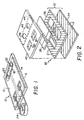
- Figs. 1 and 2 illustrate some typical preferred constructions for slide test elements.
- test element 10 Fig. 1
- two solid electrodes 12 and 14 are mounted on a frame 16, and a capillary bridge 18 is provided for promoting ionic migration between two fluid access holes 20 and 22 at the electrodes.
- the capillary bridge includes a nonporous support layer, a porous layer with ionic access to both electrodes, and a top nonporous cover layer which is preferably non-aqueous-conducting.
- An electrometer 24 is provided to measure the electrical potentials at the interfaces between each solution drop and its associated electrode to provide an indication of ion activity in the test solution.
- an alternative useful construction features a test element 30 which has an electrically insulative mounting frame 32 formed of a base web 34 and a spacer web 36.
- Two solid electrodes 38 and 40 are mounted in the frame and electrically isolated from each other.
- the fluid access holes extend through the cover sheet in the region of, and to provide fluid contact with, electrodes 38 and 40.
- Two electrical access holes 50 and 52 are also formed in the cover sheet.
- the ion-junction bridge comprises a porous sheet of material, such as fibers, which allows flow generally in all directions.
- bridge 44, Fig. 2 is formed from paper such as the Whatman #2 chroma sheet described in the aforesaid US-A-4,273,639. It is this kind of bridge that is improved upon by this invention.
- the ion-junction bridge in either the embodiment of Fig. 1 or Fig. 2 comprises bridge 100 shown in Fig. 3. More specifically, such a bridge comprises a sheet 102 of fibers, preferably a woven sheet in which the fibers extend in two orthogonal directions.
- the machine direction, or warp fibers are those fibers 110 and 110', and the weft direction fibers are fibers 112 extending generally perpendicularly to fibers 110.
- liquid access apertures 46 and 48 extend all the way through sheet 102, to provide fluid contact with an ion-selective electrode located underneath (not shown).
- sheet 102 is embedded in a layer 120 of plastic, such as polystyrene or polyethylene.
- Aperture 46 and 48 each has a side wall 140 which intersects fibers 110' and some of fibers 112. Stated in other words, apertures 46 and 48, when punched out of the bridge, have exposed at wall 140, ends or side portions of fibers 110' and 112. See for example, end 144 in the sidewall of aperture 46 of a fiber 110'. However, to provide mono-directional flow, only the thus-exposed portions of fibers 110' are capable of extensive absorption and carrying of the liquid deposited in the aperture, as will become apparent. (The illustration in Fig. 3 is schematic, because preferably there are more fibers per inch than shown - 20 to 40 per inch, for example. Also, there may be more than one layer.)
- fibers 110 are not active carriers of the liquid as they do not intersect wall 140.
- fibers 110 extend in a direction that is generally aligned with center line 130 extending between center-points C of apertures 46 and 48. That is, the lines along which the warp fibers 110 extend deviate from center-line 130 by an angle of no greater than 20°, and most preferably, no greater than 17° to ensure that liquid flow along fibers 110 intersects both apertures.
- fibers 110,110' comprise an aqueous-conducting material
- fibers 112 comprise a non-aqueous-conducting material.
- aqueous-conducting means, conducting aqueous liquid readily along the length of the fiber. Any suitable materials having these properties can be used.
- Preferred aqueous-conducting materials are selected from the group consisting of cotton, acetate, rayon, and polyester multifilament or hollow core yarn, as well as hollow core yarn made from water-repellant materials such as polyester and polypropylene. The latter hollow core yarn are useful because the hollow core will conduct aqueous liquid through the core, notwithstanding that the shell around the core is water-repellant.
- Preferred non-aqueous-conducting materials are mono- or multifilament yarn selected from the group consisting of polyester, polypropylene, and any aqueous-conducting material coated with a water-repellent composition.
- Preferred water-repellent compositions are selected from the group consisting of wax, poly(tetrafluoroethylene), silicone, and fluourinated vinyl polymers such as "Scotchgard” ® polymer available from 3M Company.
- a highly preferred non-aqueous-conducting material is cotton yarn coated with "Scotchgard” ®, obtainable from 3M Company.
- an aqueous liquid for example, a reference liquid or patient sample
- an aperture 46 or 48 when placed in either aperture 46 or 48, will traverse along primarily fibers 110', and not fibers 112, not even those fibers 112 that intersect a sidewall 140.
- An ion junction then forms somewhere between the two apertures, for example along wavefront 150, created when the two liquids meet along fibers 110'.
- Fig. 4 illustrates the manner in which a mono-directional flow can be expanded to include other, but separate, parts. Parts similar to those previously described bear the same reference numeral to which the suffix "B" is appended.
- a cover sheet 42B has two liquid access apertures 46B, 48B, and an ion bridge 100B comprising a sheet 102B of fibers as described above.
- ISEs being disposed directly underneath sheet 102B (which may be embedded in plastic)
- a new sheet of plastic 200 apertured at 202, 204.
- a second sheet 210 of fibers which comprises aqueous-conducting fibers 110B and non-aqueous-conducting fibers 112B, just as with bridge sheet 100B, except that fibers 110B of sheet 210 run substantially perpendicular to the direction of fibers 110B in sheet 100B.
- sheet 210 should not be embedded in plastic since it needs to adequately wet the apertures in the plastic sheet below it, discussed below.
- the orientation of fibers 110B causes flow of liquid reaching sheet 210 to proceed away from contact points 220 of sheet 210 towards end 222 of sheet 210, that is, orthogonal to the direction of predominant flow in sheet 100B.
- End 222 overlies apertures 310 in the sheet of plastic 300 disposed below.
- It is apertures 310 which in turn conduct liquid flow down to the ISEs 38B, 40B that are mounted below sheet 300.
- apertures 310 are constructed with the properties explained in commonly-owned US-A-4,271,119.
- the length L can be much greater than the width W of these apertures, as described in the '119 patent.
- a filter paper material such as Whatman filter paper, not shown, can be inserted into apertures 310 to aid in wetting the ISEs below.
- fibers 110B of sheet 210 can also deviate from the direction exactly orthogonal to the center line 130B between centers of contact 220, but by no more than 20°.
- a test element can be constructed as in the case of the embodiment of Fig. 4, except that sheets 200 and 210 are omitted, and sheet 100B is modified as follows:
- Fig. 5 illustrates an ion bridge 100C that also acts to provide aqueous liquid flow in a direction generally orthogonal to the centerline direction of line 130C, but suppresses the flow in any direction that is angled more than 20° from said orthogonal directions.
- generally orthogonal means, orthogonal within plus or minus 20°.
- sheet 102C of bridge 100C shown embedded in plastic, has only fibers 110C and 110C' (in actuality, more numerous than those shown), going in both orthogonal directions as both the warp (110C) and the weft (110C') of the sheet.
- the embedded warp fiber 110C is shown in dotted line.
- they both comprise hollow-core fibers with water-repellant (non-aqueous-conducting) shells. They still conduct aqueous liquid, but only if they intersect vertical sidewall 140C of either aperture 46C or 48C, such as at openings 300, Fig. 6.
- fibers 110C and 110C' can be off the centerline 130C, Fig. 5, by an angle ⁇ 1 which can be up to 20°, and the fibers 110C can extend in a direction that departs from the direction 500 that is orthogonal to fibers 110C', whatever direction that is, by an angle ⁇ 2 , which can be up to 20°.
- apertures 400, 404 are formed in sheet 100C, producing sidewalls 410 that intersect the hollow cores of fibers 110C.
- Apertures 400, 404 are preferably substantially the same size and shape as the apertures 310 below them, and aligned with them.
- the bridge will conduct fluid flow in substantially only the two directions that are needed, thus reducing the volume of liquid that would be needed compared to a bridge that flows in all directions.
Landscapes
- Chemical & Material Sciences (AREA)
- Life Sciences & Earth Sciences (AREA)
- Health & Medical Sciences (AREA)
- General Physics & Mathematics (AREA)
- Pathology (AREA)
- Electrochemistry (AREA)
- Physics & Mathematics (AREA)
- Analytical Chemistry (AREA)
- Biochemistry (AREA)
- General Health & Medical Sciences (AREA)
- Molecular Biology (AREA)
- Immunology (AREA)
- Chemical Kinetics & Catalysis (AREA)
- Investigating Or Analysing Biological Materials (AREA)
- Physical Or Chemical Processes And Apparatus (AREA)
- Control Of Motors That Do Not Use Commutators (AREA)
- Saccharide Compounds (AREA)
- Bridges Or Land Bridges (AREA)
- Investigating Or Analyzing Non-Biological Materials By The Use Of Chemical Means (AREA)
- Manufacture Of Macromolecular Shaped Articles (AREA)
- Organic Low-Molecular-Weight Compounds And Preparation Thereof (AREA)
Claims (8)
- Pont à jonction ionique (100) pour amener deux liquides ensemble afin de fabriquer une jonction d'échange ionique, ledit pont comprenant une feuille (102) de fibres ayant deux ouvertures (46, 48) à travers cette dernière ;
caractérisé en ce que la feuille de fibres comprend des fibres s'étendant dans deux sens généralement orthogonaux, l'un d'entre eux est le sens des fils de chaíne et l'autre le sens de la trame, lesdites fibres dans le sens des fils de chaíne (110, 110') comprenant un matériau à conduction aqueuse et lesdites fibres dans le sens de la trame (112) comprenant un matériau qui n'est pas à conduction aqueuse, de telle sorte que la feuille de fibres favorise le flux aqueux dans ledit sens des fils de chaíne et supprime le flux aqueux dans les sens qui sont de biais par rapport audit sens des fils de chaíne, ledit sens des fils de chaínes étant généralement alignés avec lesdites deux ouvertures, pour que les liquides aqueux déposés dans lesdites ouvertures circulent essentiellement dans ledit sens des fils de chaíne entre lesdites ouvertures. - Pont selon la revendication 1, dans lequel lesdites fibres dans le sens des fils de chaíne comprennent des fibres à âme creuse ayant une partie externe qui est hydrophobe, pour que les fibres conduisent le liquide seulement si l'âme de ces dernières est en contact fluidique avec les ouvertures.
- Pont à jonction ionique selon la revendication 1, dans lequel lesdites fibres dans le sens des fils de chaíne sont des fibres de coton, d'acétate, de rayonne ou de polyester.
- Pont à jonction ionique selon la revendication 3, dans lequel lesdites fibres dans le sens des fils de chaíne sont des fibres de polyester ou de polypropylène ou des fibres d'un matériau quelconque à conduction aqueuse recouvert par une composition hydrophobe.
- Pont à jonction ionique selon la revendication 4, dans lequel la composition hydrophobe est de la cire, du poly(tétrafluoroéthylène), de la silicone ou un polymère vinylique fluoré.
- Pont à jonction ionique selon la revendication 5, dans lequel les fibres de sens de la trame comprennent du coton recouvert par un polymère vinylique fluoré.
- Pont à jonction ionique (100c) pour amener deux liquides ensemble afin de fabriquer une jonction d'échange ionique, ledit pont comprenant une feuille (102c) de fibres ayant deux ouvertures (46c, 48v) à travers ces dernières ;
caractérisé en ce que la feuille de fibres comprend une armature de fibres à âme creuse (110c, 110c') ayant une partie externe qui est hydrophobe, pour que les fibres conduisent le liquide seulement si l'âme de ces dernières est en contact fluidique avec les ouvertures, dans laquelle les fibres s'étendent dans deux sens généralement orthogonaux, l'un d'entre eux est le sens des fils de chaíne et l'autre le sens de la trame, de telle sorte que la feuille de fibres favorise le flux aqueux dans lesdits deux sens généralement orthogonaux et supprime le flux aqueux dans les sens qui sont de biais par rapport auxdits deux sens orthogonaux, l'un desdits sens orthogonaux étant généralement aligné avec lesdites deux ouvertures, pour que les liquides aqueux déposés dans lesdites ouvertures circulent essentiellement dans lesdits sens orthogonaux étant alignés avec lesdites ouvertures. - Élément de test potentiométrique comprenant :une structure ;deux électrodes sélectives sensibles identiques montées espacées sur la structure ; et un pont à jonction ionique selon l'une quelconque des revendications 1 à 7 s'étendant entre les électrodes.
Priority Applications (1)
| Application Number | Priority Date | Filing Date | Title |
|---|---|---|---|
| SI9630686T SI0747695T1 (en) | 1995-06-06 | 1996-06-05 | Directional flow ion-junction bridge |
Applications Claiming Priority (2)
| Application Number | Priority Date | Filing Date | Title |
|---|---|---|---|
| US08/466,638 US5540827A (en) | 1995-06-06 | 1995-06-06 | Directional flow ion-junction bridge |
| US466638 | 1995-06-06 |
Publications (3)
| Publication Number | Publication Date |
|---|---|
| EP0747695A2 EP0747695A2 (fr) | 1996-12-11 |
| EP0747695A3 EP0747695A3 (fr) | 1997-10-29 |
| EP0747695B1 true EP0747695B1 (fr) | 2004-05-06 |
Family
ID=23852546
Family Applications (1)
| Application Number | Title | Priority Date | Filing Date |
|---|---|---|---|
| EP96304125A Expired - Lifetime EP0747695B1 (fr) | 1995-06-06 | 1996-06-05 | Pont ionique à écoulement dirigé |
Country Status (8)
| Country | Link |
|---|---|
| US (1) | US5540827A (fr) |
| EP (1) | EP0747695B1 (fr) |
| JP (1) | JP3839523B2 (fr) |
| AT (1) | ATE266197T1 (fr) |
| AU (1) | AU5459996A (fr) |
| CA (1) | CA2176661C (fr) |
| DE (1) | DE69632364T2 (fr) |
| SI (1) | SI0747695T1 (fr) |
Families Citing this family (6)
| Publication number | Priority date | Publication date | Assignee | Title |
|---|---|---|---|---|
| AUPO229696A0 (en) * | 1996-09-13 | 1996-10-10 | Memtec America Corporation | Analytic cell |
| US6193865B1 (en) | 1997-09-11 | 2001-02-27 | Usf Filtration And Separations Group, Inc. | Analytic cell |
| US20050040038A1 (en) * | 2003-04-02 | 2005-02-24 | Larry Berger | Diagnostic electro-chemical reference half cell |
| US20060134387A1 (en) * | 2004-12-20 | 2006-06-22 | William Gottermeier | Multilayer article formed by adhesive ablation |
| US8211078B2 (en) | 2005-02-17 | 2012-07-03 | The Procter And Gamble Company | Sanitary napkins capable of taking complex three-dimensional shape in use |
| US9579238B2 (en) | 2005-02-17 | 2017-02-28 | The Procter & Gamble Company | Sanitary napkins capable of taking complex three-dimensional shape in use |
Citations (1)
| Publication number | Priority date | Publication date | Assignee | Title |
|---|---|---|---|---|
| US4273693A (en) * | 1980-03-19 | 1981-06-16 | Ashland Oil, Inc. | Preparation of furan polymers |
Family Cites Families (6)
| Publication number | Priority date | Publication date | Assignee | Title |
|---|---|---|---|---|
| US4053381A (en) * | 1976-05-19 | 1977-10-11 | Eastman Kodak Company | Device for determining ionic activity of components of liquid drops |
| US4273639A (en) * | 1979-06-20 | 1981-06-16 | Eastman Kodak Company | Capillary bridge in apparatus for determining ionic activity |
| JPS58211648A (ja) * | 1982-06-02 | 1983-12-09 | Fuji Photo Film Co Ltd | イオン活量測定器具 |
| US4556474A (en) * | 1982-10-28 | 1985-12-03 | Eastman Kodak Company | Device for determining ionic analyte activity |
| US5147524A (en) * | 1991-07-25 | 1992-09-15 | Broadley-James Corporation | pH sensor |
| US5346606A (en) * | 1993-08-16 | 1994-09-13 | Elsag International N.V. | Electrochemical sensor |
-
1995
- 1995-06-06 US US08/466,638 patent/US5540827A/en not_active Expired - Lifetime
-
1996
- 1996-05-15 CA CA002176661A patent/CA2176661C/fr not_active Expired - Fee Related
- 1996-05-29 AU AU54599/96A patent/AU5459996A/en not_active Abandoned
- 1996-06-05 AT AT96304125T patent/ATE266197T1/de not_active IP Right Cessation
- 1996-06-05 DE DE69632364T patent/DE69632364T2/de not_active Expired - Fee Related
- 1996-06-05 SI SI9630686T patent/SI0747695T1/xx unknown
- 1996-06-05 EP EP96304125A patent/EP0747695B1/fr not_active Expired - Lifetime
- 1996-06-06 JP JP14459196A patent/JP3839523B2/ja not_active Expired - Fee Related
Patent Citations (1)
| Publication number | Priority date | Publication date | Assignee | Title |
|---|---|---|---|---|
| US4273693A (en) * | 1980-03-19 | 1981-06-16 | Ashland Oil, Inc. | Preparation of furan polymers |
Also Published As
| Publication number | Publication date |
|---|---|
| AU5459996A (en) | 1997-01-02 |
| JPH08334488A (ja) | 1996-12-17 |
| EP0747695A3 (fr) | 1997-10-29 |
| ATE266197T1 (de) | 2004-05-15 |
| CA2176661C (fr) | 2005-10-18 |
| JP3839523B2 (ja) | 2006-11-01 |
| DE69632364D1 (de) | 2004-06-09 |
| EP0747695A2 (fr) | 1996-12-11 |
| US5540827A (en) | 1996-07-30 |
| DE69632364T2 (de) | 2005-06-16 |
| SI0747695T1 (en) | 2004-10-31 |
| CA2176661A1 (fr) | 1996-12-07 |
Similar Documents
| Publication | Publication Date | Title |
|---|---|---|
| US4437970A (en) | Device for determining ionic activity | |
| CA1145398A (fr) | Appareil pour la determination de l'activite ionique d'une solution, a l'aide d'un materiel formant pont capillaire | |
| EP0566717B1 (fr) | Capteur miniaturise pour la determination de concentrations de substances dans des liquides et procede de fabrication dudit capteur | |
| EP0007794A1 (fr) | Dispositif servant à la détermination de l'activité ionique | |
| JPH0445069B2 (fr) | ||
| US5540827A (en) | Directional flow ion-junction bridge | |
| EP0161690A2 (fr) | Paire d'électrodes sélectives aux ions et procédé pour sa fabrication | |
| EP0231033B1 (fr) | Procédé pour mesurer l'activité ionique | |
| GB2106253A (en) | Ionic activity measuring device | |
| DE3687022T2 (de) | Verfahren und vorrichtung zur messung der ionenaktivitaet. | |
| US4871441A (en) | Ion activity measuring device | |
| US4783251A (en) | Ionic activity measuring device | |
| US4872966A (en) | Sheet type electrode for use in the measurement of ion concentrations | |
| EP0010457B1 (fr) | Dispositif pour déterminer l'activité d'une espèce ionique dans un liquide | |
| US5330625A (en) | Round potentiometric slide elements and method of using the same | |
| JPH0476577B2 (fr) | ||
| JPH0476578B2 (fr) | ||
| JPH0528341B2 (fr) | ||
| JPS58201056A (ja) | イオン活量測定器具 | |
| JPS62177446A (ja) | イオン活量測定器具 | |
| JPS58102147A (ja) | イオン活量測定器具 | |
| JPS6293651A (ja) | 液体試料分析器具 | |
| JPH0666759A (ja) | カリウムイオン分析用イオン選択電極 | |
| JPS62239049A (ja) | イオン活量測定方法 | |
| US20030116434A1 (en) | Package of multilayer film electrode web for electrolyte slide |
Legal Events
| Date | Code | Title | Description |
|---|---|---|---|
| PUAI | Public reference made under article 153(3) epc to a published international application that has entered the european phase |
Free format text: ORIGINAL CODE: 0009012 |
|
| AK | Designated contracting states |
Kind code of ref document: A2 Designated state(s): AT BE CH DE DK FR GB GR IT LI MC NL SE |
|
| AX | Request for extension of the european patent |
Free format text: SI PAYMENT 960618 |
|
| PUAL | Search report despatched |
Free format text: ORIGINAL CODE: 0009013 |
|
| AK | Designated contracting states |
Kind code of ref document: A3 Designated state(s): AT BE CH DE DK FR GB GR IT LI MC NL SE |
|
| AX | Request for extension of the european patent |
Free format text: SI PAYMENT 960618 |
|
| 17P | Request for examination filed |
Effective date: 19980403 |
|
| 17Q | First examination report despatched |
Effective date: 20020716 |
|
| GRAP | Despatch of communication of intention to grant a patent |
Free format text: ORIGINAL CODE: EPIDOSNIGR1 |
|
| GRAS | Grant fee paid |
Free format text: ORIGINAL CODE: EPIDOSNIGR3 |
|
| GRAA | (expected) grant |
Free format text: ORIGINAL CODE: 0009210 |
|
| AK | Designated contracting states |
Kind code of ref document: B1 Designated state(s): AT BE CH DE DK FR GB GR IT LI MC NL SE |
|
| AX | Request for extension of the european patent |
Extension state: SI |
|
| PG25 | Lapsed in a contracting state [announced via postgrant information from national office to epo] |
Ref country code: NL Free format text: LAPSE BECAUSE OF FAILURE TO SUBMIT A TRANSLATION OF THE DESCRIPTION OR TO PAY THE FEE WITHIN THE PRESCRIBED TIME-LIMIT Effective date: 20040506 Ref country code: BE Free format text: LAPSE BECAUSE OF FAILURE TO SUBMIT A TRANSLATION OF THE DESCRIPTION OR TO PAY THE FEE WITHIN THE PRESCRIBED TIME-LIMIT Effective date: 20040506 Ref country code: AT Free format text: LAPSE BECAUSE OF FAILURE TO SUBMIT A TRANSLATION OF THE DESCRIPTION OR TO PAY THE FEE WITHIN THE PRESCRIBED TIME-LIMIT Effective date: 20040506 |
|
| REG | Reference to a national code |
Ref country code: GB Ref legal event code: FG4D |
|
| REG | Reference to a national code |
Ref country code: CH Ref legal event code: EP |
|
| REF | Corresponds to: |
Ref document number: 69632364 Country of ref document: DE Date of ref document: 20040609 Kind code of ref document: P |
|
| PG25 | Lapsed in a contracting state [announced via postgrant information from national office to epo] |
Ref country code: MC Free format text: LAPSE BECAUSE OF NON-PAYMENT OF DUE FEES Effective date: 20040630 |
|
| RAP2 | Party data changed (patent owner data changed or rights of a patent transferred) |
Owner name: ORTHO-CLINICAL DIAGNOSTICS, INC. |
|
| PG25 | Lapsed in a contracting state [announced via postgrant information from national office to epo] |
Ref country code: SE Free format text: LAPSE BECAUSE OF FAILURE TO SUBMIT A TRANSLATION OF THE DESCRIPTION OR TO PAY THE FEE WITHIN THE PRESCRIBED TIME-LIMIT Effective date: 20040806 Ref country code: GR Free format text: LAPSE BECAUSE OF FAILURE TO SUBMIT A TRANSLATION OF THE DESCRIPTION OR TO PAY THE FEE WITHIN THE PRESCRIBED TIME-LIMIT Effective date: 20040806 Ref country code: DK Free format text: LAPSE BECAUSE OF FAILURE TO SUBMIT A TRANSLATION OF THE DESCRIPTION OR TO PAY THE FEE WITHIN THE PRESCRIBED TIME-LIMIT Effective date: 20040806 |
|
| REG | Reference to a national code |
Ref country code: CH Ref legal event code: PFA Owner name: ORTHO-CLINICAL DIAGNOSTICS, INC. Free format text: JOHNSON & JOHNSON CLINICAL DIAGNOSTICS, INC.#100 INDIGO CREEK DRIVE#ROCHESTER, NEW YORK 14650-0880 (US) -TRANSFER TO- ORTHO-CLINICAL DIAGNOSTICS, INC.#100 INDIGO CREEK DRIVE#ROCHESTER, NEW YORK 14650-0880 (US) |
|
| NLT2 | Nl: modifications (of names), taken from the european patent patent bulletin |
Owner name: ORTHO-CLINICAL DIAGNOSTICS, INC. |
|
| NLV1 | Nl: lapsed or annulled due to failure to fulfill the requirements of art. 29p and 29m of the patents act | ||
| REG | Reference to a national code |
Ref country code: SI Ref legal event code: IF |
|
| ET | Fr: translation filed | ||
| PLBE | No opposition filed within time limit |
Free format text: ORIGINAL CODE: 0009261 |
|
| STAA | Information on the status of an ep patent application or granted ep patent |
Free format text: STATUS: NO OPPOSITION FILED WITHIN TIME LIMIT |
|
| 26N | No opposition filed |
Effective date: 20050208 |
|
| PGFP | Annual fee paid to national office [announced via postgrant information from national office to epo] |
Ref country code: GB Payment date: 20050601 Year of fee payment: 10 |
|
| PGFP | Annual fee paid to national office [announced via postgrant information from national office to epo] |
Ref country code: FR Payment date: 20050608 Year of fee payment: 10 |
|
| PGFP | Annual fee paid to national office [announced via postgrant information from national office to epo] |
Ref country code: CH Payment date: 20050615 Year of fee payment: 10 |
|
| PG25 | Lapsed in a contracting state [announced via postgrant information from national office to epo] |
Ref country code: GB Free format text: LAPSE BECAUSE OF NON-PAYMENT OF DUE FEES Effective date: 20060605 |
|
| PG25 | Lapsed in a contracting state [announced via postgrant information from national office to epo] |
Ref country code: LI Free format text: LAPSE BECAUSE OF NON-PAYMENT OF DUE FEES Effective date: 20060630 Ref country code: CH Free format text: LAPSE BECAUSE OF NON-PAYMENT OF DUE FEES Effective date: 20060630 |
|
| PGFP | Annual fee paid to national office [announced via postgrant information from national office to epo] |
Ref country code: IT Payment date: 20060630 Year of fee payment: 11 |
|
| PGFP | Annual fee paid to national office [announced via postgrant information from national office to epo] |
Ref country code: DE Payment date: 20070102 Year of fee payment: 11 |
|
| REG | Reference to a national code |
Ref country code: CH Ref legal event code: PL |
|
| GBPC | Gb: european patent ceased through non-payment of renewal fee |
Effective date: 20060605 |
|
| REG | Reference to a national code |
Ref country code: FR Ref legal event code: ST Effective date: 20070228 |
|
| PG25 | Lapsed in a contracting state [announced via postgrant information from national office to epo] |
Ref country code: FR Free format text: LAPSE BECAUSE OF NON-PAYMENT OF DUE FEES Effective date: 20060630 Ref country code: DE Free format text: LAPSE BECAUSE OF NON-PAYMENT OF DUE FEES Effective date: 20080101 |
|
| PG25 | Lapsed in a contracting state [announced via postgrant information from national office to epo] |
Ref country code: IT Free format text: LAPSE BECAUSE OF NON-PAYMENT OF DUE FEES Effective date: 20070605 |
|
| REG | Reference to a national code |
Ref country code: SI Ref legal event code: KO00 Effective date: 20160222 |