EP0747702A2 - Verfahren zum Waschen von immunologischen Testelementen - Google Patents
Verfahren zum Waschen von immunologischen Testelementen Download PDFInfo
- Publication number
- EP0747702A2 EP0747702A2 EP96304126A EP96304126A EP0747702A2 EP 0747702 A2 EP0747702 A2 EP 0747702A2 EP 96304126 A EP96304126 A EP 96304126A EP 96304126 A EP96304126 A EP 96304126A EP 0747702 A2 EP0747702 A2 EP 0747702A2
- Authority
- EP
- European Patent Office
- Prior art keywords
- liquid
- wash
- labeled indicator
- test element
- pool
- Prior art date
- Legal status (The legal status is an assumption and is not a legal conclusion. Google has not performed a legal analysis and makes no representation as to the accuracy of the status listed.)
- Granted
Links
Images




Classifications
-
- G—PHYSICS
- G01—MEASURING; TESTING
- G01N—INVESTIGATING OR ANALYSING MATERIALS BY DETERMINING THEIR CHEMICAL OR PHYSICAL PROPERTIES
- G01N33/00—Investigating or analysing materials by specific methods not covered by groups G01N1/00 - G01N31/00
- G01N33/48—Biological material, e.g. blood, urine; Haemocytometers
- G01N33/50—Chemical analysis of biological material, e.g. blood, urine; Testing involving biospecific ligand binding methods; Immunological testing
- G01N33/53—Immunoassay; Biospecific binding assay; Materials therefor
- G01N33/543—Immunoassay; Biospecific binding assay; Materials therefor with an insoluble carrier for immobilising immunochemicals
- G01N33/54366—Apparatus specially adapted for solid-phase testing
- G01N33/54386—Analytical elements
-
- Y—GENERAL TAGGING OF NEW TECHNOLOGICAL DEVELOPMENTS; GENERAL TAGGING OF CROSS-SECTIONAL TECHNOLOGIES SPANNING OVER SEVERAL SECTIONS OF THE IPC; TECHNICAL SUBJECTS COVERED BY FORMER USPC CROSS-REFERENCE ART COLLECTIONS [XRACs] AND DIGESTS
- Y10—TECHNICAL SUBJECTS COVERED BY FORMER USPC
- Y10S—TECHNICAL SUBJECTS COVERED BY FORMER USPC CROSS-REFERENCE ART COLLECTIONS [XRACs] AND DIGESTS
- Y10S435/00—Chemistry: molecular biology and microbiology
- Y10S435/962—Prevention or removal of interfering materials or reactants or other treatment to enhance results, e.g. determining or preventing nonspecific binding
-
- Y—GENERAL TAGGING OF NEW TECHNOLOGICAL DEVELOPMENTS; GENERAL TAGGING OF CROSS-SECTIONAL TECHNOLOGIES SPANNING OVER SEVERAL SECTIONS OF THE IPC; TECHNICAL SUBJECTS COVERED BY FORMER USPC CROSS-REFERENCE ART COLLECTIONS [XRACs] AND DIGESTS
- Y10—TECHNICAL SUBJECTS COVERED BY FORMER USPC
- Y10S—TECHNICAL SUBJECTS COVERED BY FORMER USPC CROSS-REFERENCE ART COLLECTIONS [XRACs] AND DIGESTS
- Y10S435/00—Chemistry: molecular biology and microbiology
- Y10S435/969—Multiple layering of reactants
-
- Y—GENERAL TAGGING OF NEW TECHNOLOGICAL DEVELOPMENTS; GENERAL TAGGING OF CROSS-SECTIONAL TECHNOLOGIES SPANNING OVER SEVERAL SECTIONS OF THE IPC; TECHNICAL SUBJECTS COVERED BY FORMER USPC CROSS-REFERENCE ART COLLECTIONS [XRACs] AND DIGESTS
- Y10—TECHNICAL SUBJECTS COVERED BY FORMER USPC
- Y10S—TECHNICAL SUBJECTS COVERED BY FORMER USPC CROSS-REFERENCE ART COLLECTIONS [XRACs] AND DIGESTS
- Y10S435/00—Chemistry: molecular biology and microbiology
- Y10S435/97—Test strip or test slide
-
- Y—GENERAL TAGGING OF NEW TECHNOLOGICAL DEVELOPMENTS; GENERAL TAGGING OF CROSS-SECTIONAL TECHNOLOGIES SPANNING OVER SEVERAL SECTIONS OF THE IPC; TECHNICAL SUBJECTS COVERED BY FORMER USPC CROSS-REFERENCE ART COLLECTIONS [XRACs] AND DIGESTS
- Y10—TECHNICAL SUBJECTS COVERED BY FORMER USPC
- Y10S—TECHNICAL SUBJECTS COVERED BY FORMER USPC CROSS-REFERENCE ART COLLECTIONS [XRACs] AND DIGESTS
- Y10S436/00—Chemistry: analytical and immunological testing
- Y10S436/807—Apparatus included in process claim, e.g. physical support structures
- Y10S436/808—Automated or kit
Definitions
- This invention relates to a method of dispensing wash solution onto immunorate slide test elements to achieve improved separation of free labels from bound labels.
- the solution to the above-described problems is to dispense wash in at least two different locations. This can be done by moving the applicator tip, and hence the stream, relative to the test element during wash, so that the "center" of the stream producing the low sweep rate is not confined to one place but also sweeps. As a result, each portion of the test element that is to be washed receives at least part of the time, a faster moving part of the meniscus.
- a method of separating bound labeled indicator from free labeled indicator in a layer of a test element for immunoassay comprising:
- the dispensing stream by its movement laterally across the test element, minimizes the impact of the stream upon the top layer that receives it, preventing a physical washing away of that layer.
- the invention is hereinafter described in connection with certain preferred embodiments, wherein preferred assays are described as being washed with a preferred wash solution, and the method of the wash process is combined with the "ramped" invention described below.
- the invention is useful regardless of the assays being washed and the wash liquid composition that is used, and regardless whether the rate of dispensing of wash is the "ramped" method or not.
- the invention can also be used with a dispense rate that is always greater than the absorption rate, or always less that the absorption rate, of the slide test element.
- the invention is useful with both sandwich-type immunoassays, and competitive types.
- the analyte is capable of binding to the labeled indicator to complete the sandwich, while in the latter case, the analyte is capable of binding to an immobilized antibody in competition with a labeled indicator (the target ligand bearing the label).
- the process of this invention is particularly useful in low level analyte assays, that is, those having levels below 5 X 10 -11 , for example, CKMB.
- the advantages achieved include, lower background rates, reduced biases caused by interfering substances, and improved standard deviations.
- Phenobarbital is a preferred test element for use with this invention, having the following format and composition:
- test element The basic immunoassay process for such a test element is well understood, so that the following summary suffices: A patient sample (for example, serum or urine) is deposited onto the test element, a short incubation follows, a portion of the element so deposited with sample is washed, and further incubation follows. Thereafter, a portion of the washed portion is read several times with a densitometer to determine the rate of color development, and this rate is compared to calibrated results that are predictive of the concentration of the analyte - in this case, phenobarbital.
- a patient sample for example, serum or urine
- a short incubation follows
- a portion of the element so deposited with sample is washed, and further incubation follows. Thereafter, a portion of the washed portion is read several times with a densitometer to determine the rate of color development, and this rate is compared to calibrated results that are predictive of the concentration of the analyte - in this case, phenobarbit
- Fig. 1 illustrates the "ramped" method, where tip 12 is stationary over a slide test element 10 that contains the reagents of the assay preincorporated in “dried” form, and to which a sample has been added already.
- Disposable tip 12 is programmed to dispense drops of wash onto surface 11 of element 10, initially at a rate that is slower than the uptake rate of element 10.
- the height of the tip 12 above the surface 11 is maintained at a distance appropriate to the size of drops desired. For example, a height of 2.54 mm is preferred for 0.5 microliters.
- the first drop D 1 is dispensed and is shown as "falling" onto the element 10. (Separation need not be such as to produce an actual free-falling drop. The separation and free-fall is shown only to aid in visualization.)
- the drop is on the test element, with a portion of the drop diffusing generally downwardly, arrows 14, before diffusing outwardly, with a meniscus still protruding to form a lens L above the surface 11 of element 10.
- arrows 14 for the wash vector are located mostly at the edge of lens L - very little washing occurs inside of the lens or inside of arrows 14 at center point P.
- drops D 1 through D i are preferably of reduced volume (discussed below.)
- point A is useful for the first time, because the volume under point A is properly washed.
- the above described initial rate at less than the fluid uptake rate of the test element provides for a prescribed number of drops "i", which can vary, depending on a number of factors, not the least of which is the drop size.
- a useful example of the number of repeats "i" is 5 such drops.
- the maximum time for the dispensing of wash in separate drop format is about 30 sec. Most preferably, it is much less than that, for example, no more than 18 sec.
- the next phase of the ramped method is that in which the rate of dispense of wash exceeds the current uptake rate of the test element - either by an absolute increase in the dispense rate or by reason of the fact that the uptake rate of the test element has declined due to the increased amounts of fluid already present.
- the instant invention be combined with the "ramped" method discussed above, to apply the wash first at a dispense rate R D that is less than the absorption rate R A of the slide test element, and then to apply it at a rate that exceeds the absorption rate R A .
- the flow characteristics are slightly different, depending on which of these conditions prevails, and whether the dispensing is a "continuous moving wash” or a “discontinuous moving wash” as defined above.
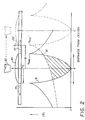
- Figs. 3 A-C illustrate the flow characteristics that result over time, that is, while tip 12 is moving and liquid is continuously dispensed, and while proceeding from the condition R D ⁇ R A to R D > R A . That is, the initial contact of dispensed liquid L, Fig. 3 A, centers at point 0 at time t 0 , on element E, and produces wash velocity vectors, arrows 40, located at the edges of the meniscus spaced apart a distance "m". This leaves unwashed the shaded portion, Fig. 3 B, shown under center point 0. From time t 0 to time t 1 , tip 12 moves, arrow 44, Figs.
- R D is caused to become equal to and then exceed R A . This occurs either by increasing the actual R D rate, and/or by reason of the fact that the liquid already absorbed by element E, by time t 2 , produces a reduced rate of absorption R A ' that is ⁇ R A and ⁇ R D .
- the size of the meniscus m 2 or contact of stream L with element E, edge to edge is larger than m 1 at time t 0 . From time t 3 on to the cessation of stream L, there is a constant "puddle" of wash liquid on element E that grows in the direction of arrow 50.
- tip 12 moves on to subsequent positions adjacent to the right of its position in Fig. 3 D, and at any times t 3 , t 4 , ... t n , only a portion of the wash liquid penetrates down in the direction of arrows 40", Fig. 3 D (mostly at the edges of the menisci).
- the wash can be "discontinuous moving wash” as noted above, where dispensing ceases while tip 12 moves to an adjacent position. Parts similar to those described in the previous embodiment have the same reference numeral with the suffix "A".
- Fig. 4 A at the time t o a drop of wash liquid L A is deposited from tip 12A, arrow 21, centered on point 0 on element E A with a contact meniscus of m 1 .
- tip 12A moves, arrow 44, between depositing, so that at time t 1 , Fig. 4 B, it is centered above point 1 on element E A .
- wash liquid L A starts to be dispensed (shown in phantom), after tip 12A arrives at this location.
- This cessation of flow between time t 0 and t 1 in this embodiment is the primary difference from the previously - described embodiment.
- the liquid L A already on element E A at time t 0 has been absorbed, leaving a shaded column of unwashed volume under point 0, since R D ⁇ R A .
- a second, disconnected drop of liquid has contacted element E A centered at point 2 adjacent to point 1, and some of its maximum velocity wash vectors 40A then act to wash through the shaded region under point 0, as is apparent from Fig. X.
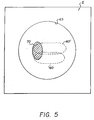
- Fig. 5 illustrates the washed out area that results, as an approximate ellipse 60 or 60'. That is, the ellipse can be anywhere within the open contact circle 65 of element E.
- the free indicator that is an interferent to the read process is located along the edges of the ellipse.
- the ellipse in turn represents the surface area covered by the menisci formed by the moving wash, the menisci overlapping each time contact is made by dispensing from tip 12.
- the process of the invention after washing, comprises reading the bound indicator remaining, in any portion within the ellipse.
- Fig. 5 also shows in the shaded area 70, the area that is washed cleanly if ONLY the "ramped" method described above is used. It is readily apparent that the useful area for reading is greatly enlarged by the instant method, producing the areas of the ellipses 60 or 60', instead of the area 70. This is not to say area 70 is not useful; it is just not as useful.
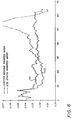
- Fig. 6 further indicates the difference, measured on a phenobarbital test element available under the trademark "Ektachem” from Clinical Diagnostic Systems Inc.
- the trace for the X's , line 110 is that produced by the "ramped” method used alone, with the tip being stationary.
- the trace for the diamonds, line 110' is the trace for the instant invention.
- the readings are rate readings taken across roughly the center of the reaction area of the test element.
- Fig. 7 illustrates a plot of pixel values of rates, following the wash treatment of this invention, and it is through this plot, from left to right, that line 110' was taken.
- the wash solution employed in the experiments, and useful with the invention had the composition: Hydrogen peroxide 0.03% Sodium Phosphate (pH 6.8) 10 mM 4'-Hydroxyacetanilide 5 mM Diethylenetriaminepentaacetic acid 10 mM Hexadecylpyridinium chloride 0.1 %
- the wash producing trace 110' used a speed of movement above the slide test element, left to right that was 0.3 mm/sec., and a variable dispense rate as follows: 0.2 microliters/sec for 10 sec., 0.3 microliters/sec for 8 sec., 0.45 microliters/sec for 8 sec., and 0.5 microliters/sec for 4 sec.
- the same variable dispense rate was used for a pixel plot from which the trace of line 110 was taken, but with the tip fixed in place above the test element.
- line plot 110' has a useful read window of from pixel 9 to pixel 32. But most importantly, line 110' produces a useful read window that goes beyond that of trace 110, that is, from pixel 10 to about 60, instead of "just" pixel 32.
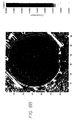
- Figs. 8A and 8B further illustrate by a neutral density photograph, the greater area of test element having a generally uniform read, produced by the instant invention. That is, the small dark area to the left in Fig. 8A is the extent of the washed area using only the "ramped" method noted above. In contrast, the much larger area of uniform concentrations shown in Fig. 8B indicates that the wash of the instant invention provides a larger read window.
- This invention facilitates the use of a dual wash, that is, washing twice the same test element, if such should be desired, regardless of the composition of such dual washes.
- it is conventional in a dual wash to leave out active reagents, such as hydrogen peroxide, in the first wash, but include all desired reagents in the second one.
- This invention by reason of the movement of the stream laterally over the surface area of the slide test element, causes a reduction in the impact of the two successive dispensing streams onto the top layer. That top layer can in extreme cases experience degradation if the wash stream remains static (fixed) as is done with the "ramped" method, AND has to be done twice.
- the invention makes dual washing more feasible than is the case where the wash is a fixed stream.
Landscapes
- Health & Medical Sciences (AREA)
- Immunology (AREA)
- Life Sciences & Earth Sciences (AREA)
- Engineering & Computer Science (AREA)
- Molecular Biology (AREA)
- Biomedical Technology (AREA)
- Chemical & Material Sciences (AREA)
- Hematology (AREA)
- Urology & Nephrology (AREA)
- Food Science & Technology (AREA)
- General Physics & Mathematics (AREA)
- Cell Biology (AREA)
- Biotechnology (AREA)
- Medicinal Chemistry (AREA)
- Physics & Mathematics (AREA)
- Analytical Chemistry (AREA)
- Biochemistry (AREA)
- General Health & Medical Sciences (AREA)
- Microbiology (AREA)
- Pathology (AREA)
- Automatic Analysis And Handling Materials Therefor (AREA)
- Investigating Or Analysing Materials By Optical Means (AREA)
- Medicines Containing Antibodies Or Antigens For Use As Internal Diagnostic Agents (AREA)
- Cleaning Implements For Floors, Carpets, Furniture, Walls, And The Like (AREA)
- Massaging Devices (AREA)
- Detergent Compositions (AREA)
Applications Claiming Priority (2)
| Application Number | Priority Date | Filing Date | Title |
|---|---|---|---|
| US470100 | 1995-06-06 | ||
| US08/470,100 US5641688A (en) | 1995-06-06 | 1995-06-06 | Immunoassay including washing a slide at different locations |
Publications (3)
| Publication Number | Publication Date |
|---|---|
| EP0747702A2 true EP0747702A2 (de) | 1996-12-11 |
| EP0747702A3 EP0747702A3 (de) | 1998-05-06 |
| EP0747702B1 EP0747702B1 (de) | 2003-08-20 |
Family
ID=23866266
Family Applications (1)
| Application Number | Title | Priority Date | Filing Date |
|---|---|---|---|
| EP96304126A Expired - Lifetime EP0747702B1 (de) | 1995-06-06 | 1996-06-05 | Verfahren zum Waschen von immunologischen Testelementen |
Country Status (7)
| Country | Link |
|---|---|
| US (1) | US5641688A (de) |
| EP (1) | EP0747702B1 (de) |
| JP (1) | JP3502222B2 (de) |
| AT (1) | ATE247829T1 (de) |
| AU (1) | AU5459696A (de) |
| CA (1) | CA2176660C (de) |
| DE (1) | DE69629521T2 (de) |
Cited By (1)
| Publication number | Priority date | Publication date | Assignee | Title |
|---|---|---|---|---|
| EP1950564A1 (de) * | 2007-01-10 | 2008-07-30 | Ortho-Clinical Diagnostics, Inc. | Mehrfache Immunochemie-Assays auf einem Element |
Families Citing this family (2)
| Publication number | Priority date | Publication date | Assignee | Title |
|---|---|---|---|---|
| WO2020009962A1 (en) * | 2018-07-02 | 2020-01-09 | Ortho-Clinical Diagnostics, Inc. | Dry slide assay using reduced reading window |
| CN112982252B (zh) * | 2021-02-20 | 2022-09-06 | 深圳一清创新科技有限公司 | 一种沿边清扫方法、装置和清扫车 |
Family Cites Families (9)
| Publication number | Priority date | Publication date | Assignee | Title |
|---|---|---|---|---|
| US4517288A (en) * | 1981-01-23 | 1985-05-14 | American Hospital Supply Corp. | Solid phase system for ligand assay |
| US4670381A (en) * | 1985-07-19 | 1987-06-02 | Eastman Kodak Company | Heterogeneous immunoassay utilizing horizontal separation in an analytical element |
| US5047322A (en) * | 1985-12-19 | 1991-09-10 | Eastman Kodak Company | Use of dry analytical elements to determine analytes |
| GB2186078A (en) * | 1986-01-29 | 1987-08-05 | Iq | Method and apparatus for carrying out biochemical assay |
| US5155024A (en) * | 1986-07-10 | 1992-10-13 | Eastman Kodak Company | Binder composition and analytical element having stabilized peroxidase in layer containing the composition |
| US4857471A (en) * | 1987-07-20 | 1989-08-15 | Eastman Kodak Company | Analyzer with wash station separate from incubator |
| DE4015378A1 (de) * | 1990-05-14 | 1991-11-21 | Boehringer Mannheim Gmbh | Testtraeger fuer die analytische bestimmung eines bestandteils einer probenfluessigkeit |
| US5174960A (en) * | 1990-11-19 | 1992-12-29 | Eastman Kodak Company | Apparatus for shuttling a test element from a discharge path to a wash station |
| JPH06509177A (ja) * | 1992-05-06 | 1994-10-13 | イーストマン コダック カンパニー | イムノアッセイ用改良洗浄方法 |
-
1995
- 1995-06-06 US US08/470,100 patent/US5641688A/en not_active Expired - Lifetime
-
1996
- 1996-05-15 CA CA002176660A patent/CA2176660C/en not_active Expired - Fee Related
- 1996-05-29 AU AU54596/96A patent/AU5459696A/en not_active Abandoned
- 1996-06-05 AT AT96304126T patent/ATE247829T1/de not_active IP Right Cessation
- 1996-06-05 EP EP96304126A patent/EP0747702B1/de not_active Expired - Lifetime
- 1996-06-05 DE DE69629521T patent/DE69629521T2/de not_active Expired - Lifetime
- 1996-06-06 JP JP16694696A patent/JP3502222B2/ja not_active Expired - Fee Related
Cited By (2)
| Publication number | Priority date | Publication date | Assignee | Title |
|---|---|---|---|---|
| EP1950564A1 (de) * | 2007-01-10 | 2008-07-30 | Ortho-Clinical Diagnostics, Inc. | Mehrfache Immunochemie-Assays auf einem Element |
| US7816090B2 (en) | 2007-01-10 | 2010-10-19 | Ortho-Clinical Diagnostics, Inc. | Multiple immunochemistry assays on an element |
Also Published As
| Publication number | Publication date |
|---|---|
| EP0747702B1 (de) | 2003-08-20 |
| DE69629521D1 (de) | 2003-09-25 |
| US5641688A (en) | 1997-06-24 |
| JP3502222B2 (ja) | 2004-03-02 |
| JPH08334510A (ja) | 1996-12-17 |
| AU5459696A (en) | 1996-12-19 |
| ATE247829T1 (de) | 2003-09-15 |
| CA2176660A1 (en) | 1996-12-07 |
| DE69629521T2 (de) | 2004-06-24 |
| EP0747702A3 (de) | 1998-05-06 |
| CA2176660C (en) | 2007-02-20 |
Similar Documents
| Publication | Publication Date | Title |
|---|---|---|
| EP2411806B1 (de) | Verbesserung heterophiler antikörper-immunsensorinterferenz | |
| US5424220A (en) | Analysis element and method for determination of an analyte in a liquid sample | |
| DE69809046T2 (de) | Analytische Testvorrichtung und Verfahren zu ihrer Verwendung | |
| US5569608A (en) | Quantitative detection of analytes on immunochromatographic strips | |
| DE3879048T2 (de) | Geraet fuer die laterale immunochromatographische bestimmung. | |
| DE3856544T2 (de) | Verfahren zur Lagerung labiler Proteine | |
| EP0630475B1 (de) | Trennmittel für rote blutkörperchen bei untersuchungen mit spezifischer bindung | |
| US4487839A (en) | Immunoassay methods employing patterns for the detection of soluble and cell surface antigens | |
| EP0465266B1 (de) | Immunoassay mit komplementärem sichtbaren Signal | |
| EP0643834B1 (de) | Gleichzeitiges testen von arzneimitteln und fingerabdrucktestverfahren | |
| US20040248322A1 (en) | Diagnostic test for analytes in a sample | |
| WO2011063010A1 (en) | Reducing leukocyte interference in non-competitive immunoassays | |
| JP2001513884A (ja) | 自動化イムノアッセイカセット | |
| JP2000321278A (ja) | 改善された免疫クロマトグラフィー分析 | |
| AU2017200412A1 (en) | Reducing leukocyte interference in competitive immunoassays | |
| EP1003038B1 (de) | Immunoassayvorrichtung | |
| EP0268978B1 (de) | Verfahren und Testträger zur Bestimmung eines Analyten | |
| EP0747702A2 (de) | Verfahren zum Waschen von immunologischen Testelementen | |
| US5620860A (en) | Method for washing immunoassay elements | |
| JPS6329246A (ja) | 展開調節域を有する分析要素 | |
| MXPA98007544A (en) | Inmunoens device |
Legal Events
| Date | Code | Title | Description |
|---|---|---|---|
| PUAI | Public reference made under article 153(3) epc to a published international application that has entered the european phase |
Free format text: ORIGINAL CODE: 0009012 |
|
| AK | Designated contracting states |
Kind code of ref document: A2 Designated state(s): AT BE CH DE DK FR GB GR IT LI MC NL SE |
|
| AX | Request for extension of the european patent |
Free format text: SI PAYMENT 960618 |
|
| PUAL | Search report despatched |
Free format text: ORIGINAL CODE: 0009013 |
|
| AK | Designated contracting states |
Kind code of ref document: A3 Designated state(s): AT BE CH DE DK FR GB GR IT LI MC NL SE |
|
| AX | Request for extension of the european patent |
Free format text: SI PAYMENT 960618 |
|
| 17P | Request for examination filed |
Effective date: 19981016 |
|
| 17Q | First examination report despatched |
Effective date: 20000727 |
|
| GRAH | Despatch of communication of intention to grant a patent |
Free format text: ORIGINAL CODE: EPIDOS IGRA |
|
| GRAH | Despatch of communication of intention to grant a patent |
Free format text: ORIGINAL CODE: EPIDOS IGRA |
|
| RAP1 | Party data changed (applicant data changed or rights of an application transferred) |
Owner name: ORTHO-CLINICAL DIAGNOSTICS, INC. |
|
| GRAA | (expected) grant |
Free format text: ORIGINAL CODE: 0009210 |
|
| AK | Designated contracting states |
Designated state(s): AT BE CH DE DK FR GB GR IT LI MC NL SE |
|
| AX | Request for extension of the european patent |
Extension state: SI |
|
| PG25 | Lapsed in a contracting state [announced via postgrant information from national office to epo] |
Ref country code: NL Free format text: LAPSE BECAUSE OF FAILURE TO SUBMIT A TRANSLATION OF THE DESCRIPTION OR TO PAY THE FEE WITHIN THE PRESCRIBED TIME-LIMIT Effective date: 20030820 Ref country code: BE Free format text: LAPSE BECAUSE OF FAILURE TO SUBMIT A TRANSLATION OF THE DESCRIPTION OR TO PAY THE FEE WITHIN THE PRESCRIBED TIME-LIMIT Effective date: 20030820 Ref country code: AT Free format text: LAPSE BECAUSE OF FAILURE TO SUBMIT A TRANSLATION OF THE DESCRIPTION OR TO PAY THE FEE WITHIN THE PRESCRIBED TIME-LIMIT Effective date: 20030820 |
|
| REG | Reference to a national code |
Ref country code: GB Ref legal event code: FG4D |
|
| REG | Reference to a national code |
Ref country code: CH Ref legal event code: EP |
|
| REF | Corresponds to: |
Ref document number: 69629521 Country of ref document: DE Date of ref document: 20030925 Kind code of ref document: P |
|
| PG25 | Lapsed in a contracting state [announced via postgrant information from national office to epo] |
Ref country code: SE Free format text: LAPSE BECAUSE OF FAILURE TO SUBMIT A TRANSLATION OF THE DESCRIPTION OR TO PAY THE FEE WITHIN THE PRESCRIBED TIME-LIMIT Effective date: 20031120 Ref country code: GR Free format text: LAPSE BECAUSE OF FAILURE TO SUBMIT A TRANSLATION OF THE DESCRIPTION OR TO PAY THE FEE WITHIN THE PRESCRIBED TIME-LIMIT Effective date: 20031120 Ref country code: DK Free format text: LAPSE BECAUSE OF FAILURE TO SUBMIT A TRANSLATION OF THE DESCRIPTION OR TO PAY THE FEE WITHIN THE PRESCRIBED TIME-LIMIT Effective date: 20031120 |
|
| REG | Reference to a national code |
Ref country code: CH Ref legal event code: NV Representative=s name: DR. R.C. SALGO EUROPEAN PATENT ATTORNEY |
|
| NLV1 | Nl: lapsed or annulled due to failure to fulfill the requirements of art. 29p and 29m of the patents act | ||
| ET | Fr: translation filed | ||
| PLBE | No opposition filed within time limit |
Free format text: ORIGINAL CODE: 0009261 |
|
| STAA | Information on the status of an ep patent application or granted ep patent |
Free format text: STATUS: NO OPPOSITION FILED WITHIN TIME LIMIT |
|
| PG25 | Lapsed in a contracting state [announced via postgrant information from national office to epo] |
Ref country code: MC Free format text: LAPSE BECAUSE OF NON-PAYMENT OF DUE FEES Effective date: 20040630 |
|
| 26N | No opposition filed |
Effective date: 20040524 |
|
| REG | Reference to a national code |
Ref country code: CH Ref legal event code: PFA Owner name: ORTHO-CLINICAL DIAGNOSTICS, INC. Free format text: ORTHO-CLINICAL DIAGNOSTICS, INC.#100 INDIGO CREEK DRIVE#ROCHESTER, NY 14626-5101 (US) -TRANSFER TO- ORTHO-CLINICAL DIAGNOSTICS, INC.#100 INDIGO CREEK DRIVE#ROCHESTER, NY 14626-5101 (US) |
|
| PGFP | Annual fee paid to national office [announced via postgrant information from national office to epo] |
Ref country code: CH Payment date: 20110614 Year of fee payment: 16 Ref country code: FR Payment date: 20110621 Year of fee payment: 16 |
|
| PGFP | Annual fee paid to national office [announced via postgrant information from national office to epo] |
Ref country code: GB Payment date: 20110601 Year of fee payment: 16 |
|
| PGFP | Annual fee paid to national office [announced via postgrant information from national office to epo] |
Ref country code: DE Payment date: 20110601 Year of fee payment: 16 Ref country code: IT Payment date: 20110615 Year of fee payment: 16 |
|
| REG | Reference to a national code |
Ref country code: CH Ref legal event code: PL |
|
| REG | Reference to a national code |
Ref country code: CH Ref legal event code: PL |
|
| GBPC | Gb: european patent ceased through non-payment of renewal fee |
Effective date: 20120605 |
|
| PG25 | Lapsed in a contracting state [announced via postgrant information from national office to epo] |
Ref country code: IT Free format text: LAPSE BECAUSE OF NON-PAYMENT OF DUE FEES Effective date: 20120605 |
|
| REG | Reference to a national code |
Ref country code: FR Ref legal event code: ST Effective date: 20130228 |
|
| REG | Reference to a national code |
Ref country code: DE Ref legal event code: R119 Ref document number: 69629521 Country of ref document: DE Effective date: 20130101 |
|
| PG25 | Lapsed in a contracting state [announced via postgrant information from national office to epo] |
Ref country code: LI Free format text: LAPSE BECAUSE OF NON-PAYMENT OF DUE FEES Effective date: 20120630 Ref country code: GB Free format text: LAPSE BECAUSE OF NON-PAYMENT OF DUE FEES Effective date: 20120605 Ref country code: DE Free format text: LAPSE BECAUSE OF NON-PAYMENT OF DUE FEES Effective date: 20130101 Ref country code: CH Free format text: LAPSE BECAUSE OF NON-PAYMENT OF DUE FEES Effective date: 20120630 Ref country code: FR Free format text: LAPSE BECAUSE OF NON-PAYMENT OF DUE FEES Effective date: 20120702 |