EP0747828A2 - Système et procédé pour fournir une mémoire partagée efficace dans un système à mémoire virtuelle - Google Patents
Système et procédé pour fournir une mémoire partagée efficace dans un système à mémoire virtuelle Download PDFInfo
- Publication number
- EP0747828A2 EP0747828A2 EP96303732A EP96303732A EP0747828A2 EP 0747828 A2 EP0747828 A2 EP 0747828A2 EP 96303732 A EP96303732 A EP 96303732A EP 96303732 A EP96303732 A EP 96303732A EP 0747828 A2 EP0747828 A2 EP 0747828A2
- Authority
- EP
- European Patent Office
- Prior art keywords
- shared
- memory
- address space
- virtual
- address
- Prior art date
- Legal status (The legal status is an assumption and is not a legal conclusion. Google has not performed a legal analysis and makes no representation as to the accuracy of the status listed.)
- Withdrawn
Links
Images


Classifications
-
- G—PHYSICS
- G06—COMPUTING OR CALCULATING; COUNTING
- G06F—ELECTRIC DIGITAL DATA PROCESSING
- G06F12/00—Accessing, addressing or allocating within memory systems or architectures
- G06F12/02—Addressing or allocation; Relocation
- G06F12/08—Addressing or allocation; Relocation in hierarchically structured memory systems, e.g. virtual memory systems
- G06F12/10—Address translation
- G06F12/109—Address translation for multiple virtual address spaces, e.g. segmentation
-
- G—PHYSICS
- G06—COMPUTING OR CALCULATING; COUNTING
- G06F—ELECTRIC DIGITAL DATA PROCESSING
- G06F2212/00—Indexing scheme relating to accessing, addressing or allocation within memory systems or architectures
- G06F2212/65—Details of virtual memory and virtual address translation
- G06F2212/656—Address space sharing
Definitions
- the present invention relates to data processing systems.
- the invention relates to a system and method of operating a virtual memory system for a computer to provide efficient shared memory.
- the invention provides a method of sharing virtual memory areas by multiple tasks in a computer memory management system, comprising the steps of: attaching a virtual segment ID with an independent task address space for each of a plurality of address spaces shared by more than one task; mapping said virtual segment ID into each of said more than one task.
- Some virtual memory systems provide the feature of a shared memory band that appears at the same address in each address space; in contrast, the system described herein uses the creation of an independent address space that can be attached at any address selectively.
- an address space is like a container for memory objects.
- Many other shared memory schemes only deal with sharing memory objects. Sharing a memory object allows modifications by one task to be seen by multiple tasks. Sharing an address space allows modifications to the address space, such as creating and destroying of memory objects and changes to the attributes of the memory object, such as protection changes, to be seen by multiple tasks by performing the operation only to the shared address space.
- a method of providing efficient shared memory in a virtual memory system takes advantage of the inverted page table architecture of the PowerPC and the IBM Microkernel virtual memory design.
- the shared memory method of the invention solves the problem of the expense (in system resources) of page aliasing.
- An independent address space is created such that it can be "attached" to multiple address spaces. Any change to the shared address space is reflected in all attached address spaces with just one operation to the shared address space. Entities in the shared address space require only one set of system resources. Since the same PowerPC virtual segment ID is used for all attached address spaces, only one set of PowerPC page table entries is needed.
- Another feature of at least a preferred embodiment is attaching shared memory with and without control privileges to provide protection; tasks with privilege can manipulate the address space using the same operations and base addresses as in the non-shared normal address space, and tasks with normal attachment can only reference the memory objects in the overlaid shared address space - memory objects can not be created or destroyed.
- the shared address space can be attached either with or without privilege to add or subtract entries in the shared map.
- control privilege virtual memory operations such as allocation, change of access protection, and deletion are allowed. Without control privilege, only data read and write access is allowed. Operations which manipulate the address space are refused.
- a preferred feature of the invention is associating a PowerPC virtual segment ID with an independent shared address space, then mapping this single segment ID into multiple tasks to "overlap" the task's address space to provide shared access to the memory objects in the shared address space; only one set of kernel and hardware resources are required.
- Another preferred feature is that multiple independent shared address spaces can be created and attached at any address within a task's address space.
- Data processing system 11 includes a system central processing unit or CPU 12 , a system memory 13 , a mass storage controller 14 and a communications link 15 linking the CPU 12 , memory 13 and mass storage controller 15 for interchange of data and commands.
- Communications link 15 may be a system bus or it may represent some type of network.
- FIG 2 is a map of virtual memory and physical memory for the system of Figure 1 .
- the virtual address space 20 is established by the type of microprocessor used in the CPU 12 , such as a i 486, a PowerPC chip, or the like. Note that an i 486, for example, exhibits only one 4-GB virtual address space, with a number of tasks using space within this 4-GB space, whereas a PowerPC operating system sets up a separate 4-GB virtual address space for each task.
- the physical memory 13 is represented by a block 21 , and is much smaller than the virtual address space.
- a page table 22 which is usually stored in memory 13 , translates virtual addresses from space 20 to physical addresses in space 21 .
- a Task-1 running on the CPU 12 may use a block 23 of the virtual address space, and individual virtual page addresses in block 23 are looked up in the page table 22 to find physical addresses.
- Each of the page table entries 24 contains a virtual address field 25 and a corresponding physical address field 26 .
- the page table entry also contains protection information, and an indication of whether the page is in physical memory 13 or in disk storage 15 (in which case the page must be moved to physical memory before being used).
- a Task-2 running on the CPU 12 may use virtual memory block 27 , and references entries 24 in the page table 22 , and some of these entries may be the same as those for Task-1, i.e., the tasks may share physical memory; this is an example of page aliasing, in that a page in physical memory is used in both Task-1 and Task-2, but these locations have different virtual addresses so two page table entries 24 are used.
- Figure 3 is also a map of virtual memory and physical memory, like Figure 2 , illustrating another method of sharing memory for the i 486 type of architecture.
- Task-1 and Task-2 have an overlapping area 30 , and some of the same virtual addresses appear in each task, so the same page table entries 24 are used for shared memory references, thus avoiding the duplication of page table entries.
- a virtual memory location 31 in each task points to a particular entry 24 in the page table 22 , which of course points to the same physical memory location. This is a very useful method, and may be accomplished according to the concepts of the invention, but still places constraints on the user, i.e., that shared address spaces for different tasks must have the same virtual addresses.
- Figure 4 is again a map of virtual memory and physical memory, like Figures 2 and 3 illustrating a method of sharing memory according to the invention.
- Task-1 and Task-2 have a shared memory location 32 or 33 , which by another translator 34 , point to the same entry 24 in the page table 22 , and thus to the same location 35 in physical memory 21 .
- the translator 34 may be of the form shown in Figure 5 .
- Shared memory can be efficiently created on the IBM PowerPC by mapping the same virtual segment ID into multiple address spaces.
- Figure 5 illustrates an efficient data structure organization to manage shared Intel page tables to emulate virtual segment IDs.
- Shared memory areas of 256MB can be created and mapped into an address space on 256MB boundaries, as with PowerPC virtual segment IDs.
- the diagram of Figure 5 shows the data structure organization, i.e., a new data structure that is created by the OS in memory. For each shared memory area in virtual address space 20 , a structure labelled "A" is created. All “A” structures are linked together, i.e., each data structure "A” contains the address of the next structure "A".
- a structure of type "G” is created and linked off its "A” structure; i.e., the structure "A” has within it the address of the first "G” and each "G” has the address of the next "G.”
- Each "G” structure records the 256MB slot that the shared memory was mapped into the task.
- Multiple “G” structures can point into the same task at different 256MB offsets (28-bit addresses) into the virtual address space 20 .
- Each task such as Task-1 or Task-2 has a sixteen-entry array 36 as seen in Figure 6 , with one entry 37 in the array for each 256MB slot in the 32-bit (4-GB) virtual address space 20 .
- An entry 37 points to the "A” structure if a shared memory area has been mapped into the task at that 256MB slot.
- a "G” structure points via path 38 to an offset in a "T” structure which addresses a directory page "D” via a path 39.
- Each task such as Task-1 or Task-2 has its own Intel directory page, and directory pages are labelled "D" in Figure 5 .
- the directory page entries in all directory pages "D" for a shared memory area "A” all point via path 40 to a common shared set of page tables "P,” corresponding to page table 22 of Figure 4 .
- Virtual memory operations that modify the directory page "D" must modify all directory pages "D" which use the shared memory area. For example, adding a new virtual translation which requires a new page table to be allocated. In this case, the 16-entry array 36 of Figure 6 is checked to see if this address is in a shared area. If not, the task's directory page can be modified. If the modification is to a shared area, then the entry in the "T" structure points via path 41 to the "A" structure for this shared area. The directory pages for all tasks in this shared memory's "G" list are modified.
- Each virtual address has associated with it in the segment descriptors and the page table 21 various levels of memory protection in the Intel i 386 or i 486 architecture, and these can be used to allow control of whether each reference to a shared memory area can merely read from the shared locations, or can read and write the shared locations.
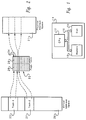
- the shared memory method is illustrated schematically in the diagram of Figure 7 .
- the microkernel operating system for the PowerPC sets up independent virtual address spaces for each task, rather than having tasks share a continuous 4-GB 32-bit address space as in the i 486 type of architecture.
- This diagram of Figure 7 shows three tasks, Task-1, Task-2, and Task-3, and two independent shared address spaces 45 and 46 , called Space-A and Space-B. Also shown are memory objects MO-1, MO-2, MO-3, and MO-4.
- Task-1 This enables Task-1 to add and destroy memory objects in shared address Space-A by manipulating its own address space in the range of addresses where shared address Space-A is attached.
- Task-2 can reference the memory objects contained in shared address Space-A, but cannot add or destroy memory objects in this range of address in its address space.
- Task-1 has the identical access rights to the memory objects contained in shared address Space-A.
- Task-3 can only reference the memory objects in shared address Space-B.
- Page aliasing as illustrated by Task-1 and Task-2 both having access to memory object MO-4 of Figure 7 , requires replicated resources (such as page table entries 24 in page table 22 ) in each task since these resources are not being shared. Unlike allocating a new memory object in the shared address space which will show up everywhere the shared address space is attached in one operation, allocating a new memory object with page aliasing requires an operation to be performed in each address space that it should be seen.
- Task-1 has no access to shared address Space-B of Figure 7 .
- Task-3 has no access to shared memory address Space-A or other memory objects contained in shared address Space-A.
- Task-2 has access to memory objects in both shared address spaces.
- User tasks with a different pervasive personality could be attached to a different shared address space.
- a so-called host_shared_memory_create function creates a virtual address space, where the size is a multiple of the machine-dependent segment size; in an Intel i 386 or i 486 the segment size can be any size up to 4-GB.
- This function specifies the port for the host machine, and also a kernel-assigned port name for the virtual address space, called vm_space_port, and this is used as a token for accessing the virtual address space created and all other calls to this port fail.
- a virtual_shared_memory_attach function provides access to the virtual address space, as by a task; this function maps the virtual address space into a given address range.
- the range can be set to be either inherited by child tasks with an inherit parameter.
- This virtual_shared_memory_attach function specifies a value called target_space which is the port of the virtual memory address space in which the virtual address space is to be mapped, and specifies a value base_addr which is the address where the virtual address space is to be mapped, and this must be a machine-dependent segment boundary.
- a virtual_shared_memory_detach function deallocates a virtual address space mapping from a given virtual address space associated with a task. The range for which the shared memory was mapped can be left reserved on request; otherwise it will be empty.
- This virtual_shared_memory_detach function specifies parameters just as the virtual_shared_memory_attach function (except it doesn't have inherit and control), and also specifies a value called "reserve" which is the reserve indicator, true or false.
Landscapes
- Engineering & Computer Science (AREA)
- Theoretical Computer Science (AREA)
- Physics & Mathematics (AREA)
- General Engineering & Computer Science (AREA)
- General Physics & Mathematics (AREA)
- Memory System Of A Hierarchy Structure (AREA)
- Storage Device Security (AREA)
- Memory System (AREA)
Applications Claiming Priority (2)
| Application Number | Priority Date | Filing Date | Title |
|---|---|---|---|
| US08/472,364 US5875487A (en) | 1995-06-07 | 1995-06-07 | System and method for providing efficient shared memory in a virtual memory system |
| US472364 | 1995-06-07 |
Publications (2)
| Publication Number | Publication Date |
|---|---|
| EP0747828A2 true EP0747828A2 (fr) | 1996-12-11 |
| EP0747828A3 EP0747828A3 (fr) | 1996-12-18 |
Family
ID=23875227
Family Applications (1)
| Application Number | Title | Priority Date | Filing Date |
|---|---|---|---|
| EP96303732A Withdrawn EP0747828A3 (fr) | 1995-06-07 | 1996-05-24 | Système et procédé pour fournir une mémoire partagée efficace dans un système à mémoire virtuelle |
Country Status (3)
| Country | Link |
|---|---|
| US (1) | US5875487A (fr) |
| EP (1) | EP0747828A3 (fr) |
| JP (1) | JPH0916461A (fr) |
Families Citing this family (15)
| Publication number | Priority date | Publication date | Assignee | Title |
|---|---|---|---|---|
| US6349355B1 (en) * | 1997-02-06 | 2002-02-19 | Microsoft Corporation | Sharing executable modules between user and kernel threads |
| US6289432B1 (en) * | 1998-03-25 | 2001-09-11 | International Business Machines Corporation | Sharing segments of storage by enabling the sharing of page tables |
| US6301582B1 (en) * | 1998-03-30 | 2001-10-09 | International Business Machines Corporation | System and method for storage of shared persistent objects |
| US6760743B1 (en) * | 2000-01-04 | 2004-07-06 | International Business Machines Corporation | Instruction memory system for multi-processor environment and disjoint tasks |
| US7058775B2 (en) * | 2001-01-31 | 2006-06-06 | Rto Sortware, Inc | Systems and methods for avoiding base address collisions using alternate components |
| US6950916B2 (en) * | 2001-01-31 | 2005-09-27 | Rto Software, Inc. | Dynamically setting the optimal base addresses of process components |
| US7461228B2 (en) * | 2003-11-21 | 2008-12-02 | Rto Software, Inc. | Systems and methods for avoiding base address collisions |
| US7975117B2 (en) | 2003-03-24 | 2011-07-05 | Microsoft Corporation | Enforcing isolation among plural operating systems |
| US7213125B2 (en) * | 2004-07-31 | 2007-05-01 | Hewlett-Packard Development Company, L.P. | Method for patching virtually aliased pages by a virtual-machine monitor |
| US7698510B2 (en) * | 2005-06-22 | 2010-04-13 | Hewlett-Packard Development Company, L.P. | Systems and methods for identifying and registering a range of virtual memory |
| US20080163185A1 (en) * | 2006-12-29 | 2008-07-03 | Rto Software, Inc. | Delay-load optimizer |
| CN102096687B (zh) * | 2009-12-14 | 2013-08-07 | 阿里巴巴集团控股有限公司 | 一种调度任务的方法和平台 |
| CN107402891B (zh) * | 2012-12-25 | 2020-12-22 | 华为技术有限公司 | 确定共享虚拟内存页面管理模式的方法和相关设备 |
| WO2014106871A1 (fr) * | 2013-01-07 | 2014-07-10 | Hitachi, Ltd. | Système de stockage qui réalise une copie distante asynchrone en utilisant une mémoire cache composée d'une mémoire flash, et procédé de commande de celui-ci |
| US20150058926A1 (en) * | 2013-08-23 | 2015-02-26 | International Business Machines Corporation | Shared Page Access Control Among Cloud Objects In A Distributed Cloud Environment |
Family Cites Families (5)
| Publication number | Priority date | Publication date | Assignee | Title |
|---|---|---|---|---|
| US4742450A (en) * | 1986-01-16 | 1988-05-03 | International Business Machines Corporation | Method to share copy on write segment for mapped files |
| US5230045A (en) * | 1986-11-12 | 1993-07-20 | Xerox Corporation | Multiple address space system including address translator for receiving virtual addresses from bus and providing real addresses on the bus |
| EP0442297B1 (fr) * | 1990-01-24 | 2000-05-24 | Sony Corporation | Processeur à mémoire de microcode réinscriptible |
| GB9205551D0 (en) * | 1992-03-13 | 1992-04-29 | Inmos Ltd | Cache memory |
| US5729710A (en) * | 1994-06-22 | 1998-03-17 | International Business Machines Corporation | Method and apparatus for management of mapped and unmapped regions of memory in a microkernel data processing system |
-
1995
- 1995-06-07 US US08/472,364 patent/US5875487A/en not_active Expired - Fee Related
-
1996
- 1996-05-24 EP EP96303732A patent/EP0747828A3/fr not_active Withdrawn
- 1996-05-28 JP JP8133637A patent/JPH0916461A/ja active Pending
Also Published As
| Publication number | Publication date |
|---|---|
| JPH0916461A (ja) | 1997-01-17 |
| US5875487A (en) | 1999-02-23 |
| EP0747828A3 (fr) | 1996-12-18 |
Similar Documents
| Publication | Publication Date | Title |
|---|---|---|
| EP0238158B1 (fr) | Utilisation partagée de segments du type "copie à l'écriture" dans un système de traitement de données à machines virtuelles possédant une mémoire virtuelle | |
| EP0700000B1 (fr) | Système et procédé de combinaison d'un identificateur d'objet global avec une adresse locale d'objet dans un unique pointeur d'objet | |
| KR920005853B1 (ko) | 페이지 분할형 가상 메모리 데이타 처리 시스템에서의 데이타 전송 방법 | |
| US7085890B2 (en) | Memory mapping to reduce cache conflicts in multiprocessor systems | |
| US5144551A (en) | Computer memory management method utilizing segmentation and protection techniques | |
| US7409487B1 (en) | Virtualization system for computers that use address space indentifiers | |
| US6134601A (en) | Computer resource management system | |
| US5875487A (en) | System and method for providing efficient shared memory in a virtual memory system | |
| CN109359487B (zh) | 一种基于硬件隔离的可扩展安全影子存储及标签管理方法 | |
| EP0476841A2 (fr) | Gestion de stockage dans plusieurs systèmes de fichiers | |
| EP0232960A2 (fr) | Méthode pour accroître automatiquement la taille d'un segment dans un système de traitement de données à mémoire virtuelle segmentée en pages | |
| EP0474395A2 (fr) | Hierarchie de mémoire de données avec un niveau de mémoire partagée | |
| US7149873B2 (en) | Methods and apparatus for a dual address space operating system | |
| EP0747827B1 (fr) | Système et procédé pour une mémoire partagée dans un environnement à plusieurs tâches | |
| US8006055B2 (en) | Fine granularity hierarchiacal memory protection | |
| KR20090122936A (ko) | 가상 머신의 메모리를 관리하기 위한 시스템, 방법 및 프로그램 | |
| EP0169018A2 (fr) | Système de mémoire d'ordinateur | |
| CN118210622B (zh) | 一种内存分配方法及计算设备 | |
| US20040268084A1 (en) | Protected RAM filesystem | |
| KR19990013934A (ko) | 대용량 메모리 할당 방법 및 장치 | |
| EP0403124A2 (fr) | Echange de segments de recouvrement | |
| Aron et al. | The SawMill framework for virtual memory diversity | |
| US6735613B1 (en) | System for processing by sets of resources | |
| US10216529B1 (en) | Method and system for sharing driver pages | |
| KR930003439B1 (ko) | 가상 메모리 관리를 위한 메모리 구조 및 시스템 |
Legal Events
| Date | Code | Title | Description |
|---|---|---|---|
| PUAI | Public reference made under article 153(3) epc to a published international application that has entered the european phase |
Free format text: ORIGINAL CODE: 0009012 |
|
| PUAL | Search report despatched |
Free format text: ORIGINAL CODE: 0009013 |
|
| AK | Designated contracting states |
Kind code of ref document: A2 Designated state(s): DE FR GB |
|
| AK | Designated contracting states |
Kind code of ref document: A3 Designated state(s): DE FR GB |
|
| 17P | Request for examination filed |
Effective date: 19970419 |
|
| 17Q | First examination report despatched |
Effective date: 20000515 |
|
| STAA | Information on the status of an ep patent application or granted ep patent |
Free format text: STATUS: THE APPLICATION HAS BEEN WITHDRAWN |
|
| 18W | Application withdrawn |
Withdrawal date: 20010629 |