EP0747838A1 - Méthode et système pour l'élimination complète de sous-requêtes SQL - Google Patents
Méthode et système pour l'élimination complète de sous-requêtes SQL Download PDFInfo
- Publication number
- EP0747838A1 EP0747838A1 EP96108879A EP96108879A EP0747838A1 EP 0747838 A1 EP0747838 A1 EP 0747838A1 EP 96108879 A EP96108879 A EP 96108879A EP 96108879 A EP96108879 A EP 96108879A EP 0747838 A1 EP0747838 A1 EP 0747838A1
- Authority
- EP
- European Patent Office
- Prior art keywords
- node
- predicate
- dataflow
- subqueries
- sql
- Prior art date
- Legal status (The legal status is an assumption and is not a legal conclusion. Google has not performed a legal analysis and makes no representation as to the accuracy of the status listed.)
- Withdrawn
Links
Images



Classifications
-
- G—PHYSICS
- G06—COMPUTING OR CALCULATING; COUNTING
- G06F—ELECTRIC DIGITAL DATA PROCESSING
- G06F16/00—Information retrieval; Database structures therefor; File system structures therefor
- G06F16/20—Information retrieval; Database structures therefor; File system structures therefor of structured data, e.g. relational data
- G06F16/24—Querying
- G06F16/245—Query processing
- G06F16/2453—Query optimisation
- G06F16/24534—Query rewriting; Transformation
- G06F16/24535—Query rewriting; Transformation of sub-queries or views
-
- Y—GENERAL TAGGING OF NEW TECHNOLOGICAL DEVELOPMENTS; GENERAL TAGGING OF CROSS-SECTIONAL TECHNOLOGIES SPANNING OVER SEVERAL SECTIONS OF THE IPC; TECHNICAL SUBJECTS COVERED BY FORMER USPC CROSS-REFERENCE ART COLLECTIONS [XRACs] AND DIGESTS
- Y10—TECHNICAL SUBJECTS COVERED BY FORMER USPC
- Y10S—TECHNICAL SUBJECTS COVERED BY FORMER USPC CROSS-REFERENCE ART COLLECTIONS [XRACs] AND DIGESTS
- Y10S707/00—Data processing: database and file management or data structures
- Y10S707/99931—Database or file accessing
- Y10S707/99933—Query processing, i.e. searching
-
- Y—GENERAL TAGGING OF NEW TECHNOLOGICAL DEVELOPMENTS; GENERAL TAGGING OF CROSS-SECTIONAL TECHNOLOGIES SPANNING OVER SEVERAL SECTIONS OF THE IPC; TECHNICAL SUBJECTS COVERED BY FORMER USPC CROSS-REFERENCE ART COLLECTIONS [XRACs] AND DIGESTS
- Y10—TECHNICAL SUBJECTS COVERED BY FORMER USPC
- Y10S—TECHNICAL SUBJECTS COVERED BY FORMER USPC CROSS-REFERENCE ART COLLECTIONS [XRACs] AND DIGESTS
- Y10S707/00—Data processing: database and file management or data structures
- Y10S707/99931—Database or file accessing
- Y10S707/99933—Query processing, i.e. searching
- Y10S707/99934—Query formulation, input preparation, or translation
Definitions
- the invention relates to an improved method of implementing a database management system (DBMS) for a relational model database based on the SQL language.
- SQL is a data sublanguage developed in the late 1970's by IBM for access to relational databases that are managed by relational database management systems (RDBMS). SQL has become popular for its ability to be used by widely varying systems and has become the de facto standard for the relational database world.
- a data sublanguage is one that is used in association with another language (the primary programming language or host language) for the specialized purpose of accessing data.
- a relational model database is one having characteristics as expressed by E.F. Codd, "A Relational Model of Data for Large Shared Data Banks", Communications of the ACM , June 1970. Such characteristics include representing data independent of the physical representation of data, independent of the relationships between data, and having implementation considerations related to efficiency.
- a relational database can be distinguished from record-type "network” databases (that typically use pointers to data), hierarchical model databases, object-oriented databases or CODASYL databases.
- DBMS database management system
- DBMS database management system
- DBMS's require that a user define the format of the data very specifically, such as the number of items, data types, and how the items are related to one another.
- a DBMS is used to process a transaction --a atomic unit of work-- meaning it must completely succeed or be aborted. Such transactions are typical in a credit and debit scheme such as a changes to a database of bank accounts, where there is a transferal of money from one account to another.
- the basic unit of data in a relational database is the "relation".
- the relation is analogous to the "table", which is defined in a less rigorous manner than a relation in that a table can have duplicate rows, unlike a pure relational database relation where the tuples (rows) cannot be duplicates.
- Data is stored in a table in SQL in rows.
- a relation (or table in SQL) is made up of one or more attributes (or “columns" in SQL). Each column has associated with it a data type.
- Data types may be bit and character strings (the entire string in SQL is considered as an atomic or fundamental data type), exact numerics, including integers numeric (floating point), decimal, "approximate numerics", date times, including intervals of times, logic and null values (which include TRUE, FALSE and UNKNOWN). SQL supports strong typing data conversions and both static and dynamic execution.
- the most important operation in SQL is the "selection" or identifying of a specific row or rows in a table, which can be accessed through the keyword SELECT. Selection is done by specifying one or more predicates that are used to filter a table to identify the rows for which the predicate is true.
- a predicate is a question asked, with the answer in the form of TRUE, FALSE, or UNKNOWN (if insufficient information is available to determine the question reliably).
- the searching or selection is for a particular row-data.
- Common operations in SQL language are the JOIN, UNION and GROUP BY operations.
- the JOIN operation typically combines information from two tables to create a third "virtual" table (one that does not exist prior to the running of the operation that creates it) that contains information with a common column in both tables but with columns not found in either joined table.
- the JOIN operation is equivalent to the "product" dataflow operator.
- the UNION operation causes no ordering of rows but simply appends rows from one table to another.
- the GROUP BY operation produces one row for all rows in the input table that have a certain column (or columns) in common.
- the query for a video store database " SELECT movie_type, AVG (current_rental_price) FROM movie_titles GROUP BY movie_type” will, when searching a table having columns: “title”, “movie_type”, “current rental price”; give a virtual table with columns “movie_type” and "AVG (current_rental_price)", where different types of movies (e.g., Westerns, Action films, Romances) will be listed with their average rental price listed (SQL has a keyword AVG for computing averages).
- different types of movies e.g., Westerns, Action films, Romances
- SQL when represented by dataflow trees, can be cast into two main classes of operators: “relational operators” and “item operators”. Relational operators are such operators such as projection, selection, join and union, (or, in related SQL keyword analogues, such as by SELECT, GROUP BY, SCAN, etc.) and often indicated in this disclosure by “ ⁇ QRY ⁇ ”. Item operators, or expressional operators, are indicated in this disclosure as “ ⁇ EXPR ⁇ ”, and include such operators as “empty” (a no-op simply used for an expression that does not produce any output value), “constant” (specifies a constant value of some data type), and 'aggregate functions' such as “ any ", " once “, " anyone “, “ any_true “.
- Aggregate functions are expressions used as an argument (predicate) by a relational operator, such as a GROUP BY operator.
- a relational operator such as a GROUP BY operator.
- the "once" aggregate function returns its input, if the group contains more than one element; the "anyone” aggregate function indeterministically returns one value from the group; the "any_true” function returns TRUE if it finds any row that evaluates to TRUE, it returns NULL, if no rows evaluate to TRUE but some evaluate to NULL, and it returns FALSE otherwise.
- SQL also provides for queries within queries.
- a DBMS may have degraded performance if such queries within queries --or "nested queries"-- are present.
- One object of the present invention is to eliminate such nested queries, often termed 'sub-select' elimination.
- the invention describes a component in a relational database system that eliminates "subqueries" from relational database queries by transforming them into semantically equivalent forms.
- Subqueries are queries within queries, and may take up excessive system resources to process.
- the process of rewriting SQL to eliminate subqueries is a process called by many names, such as "sub-select elimination", “unnesting of subqueries”, “subquery elimination” or "subquery transformation”.
- the process described by the present invention transforms all possible forms of subqueries that the SQL92 language (as described in the standard ISO/ANSI SQL92 [ISO92]) into unnested forms.
- the present invention is described for conceptional purposes using the data flow model, where a relational query is represented as a dataflow tree diagram of relational operators, such as projection, selection, join and union.
- relational operators such as projection, selection, join and union.
- subquery elimination as a transformation from one dataflow tree with subquery expressions in it into another, semantically equivalent dataflow tree without subquery expressions in it, it should nonetheless be understood that the SQL language has no provisions in it for reproducing trees in and of itself.
- the method by which the SQL language is represented by dataflow model trees is found in the SQL92 ISO92 standard referenced above and incorporated herein.
- the dataflow model of the present invention contains operators that slightly extend the relational model.
- it contains operators that model a nested execution of a JOIN, allowing one subtree of the JOIN to reference values of the other subtree (known as a 'nested join' or 'nested loop join' in the literature, see, e.g., C.J. Date, "An Introduction to Database Systems", (Addison Wesley, 1990, 5th ed.)).
- the present invention in one embodiment implements the transformation by the construction of transformation rules that eliminate subqueries dependent on the chosen operator and using a nested JOIN operator to represent the result of the transformation.
- the rules themselves are expressed in dataflow tree notation.
- the actual SQL transformation rules are implemented in hardware with Tandem computers running the NonStop (tm) operating kernel, or NSK.
- 'Select' has two different definitions in the literature and herein, one of which is SELECT as a keyword in SQL language, and the other is to describe a filter for queries.
- SELECT as a keyword in SQL language
- 'select' is capitalized, italicized, and/or placed in apostrophes.
- Scalar subselect returns an SQL data type, while quantified subselect returns a logical value.
- Expressional nodes, ⁇ EXPR ⁇ also called “item expressions”, and include such expressions as “empty”, “constant”, aggregate functions such as “once”, “anyone”, “any_true”, and subqueries such as any(QRY, EXPR).
- common expression operators (this set of operators can be extended freely with any other needed operators except those that use ⁇ QRY ⁇ expressions) include such common simple item expressions as:
- Expression operators also include specialized aggregate functions. These functions are used in the normalization rules of the present invention and include:
- Expression operators include subquery item expressions as well.
- Subquery item expressions are used to represent SQL subqueries as the input to the normalization rules, such as:
- a relational query node is a query dataflow tree node that describes a table in terms of an extended relational algebra expression.
- a relational query node may have as a predicate (argument) an expressional node.
- a query parse tree node takes zero or more other queries as input parameters and produces an output table.
- Query objects also utilize expressions in order to drive their control flow and in order to calculate values. Query objects maintain a "current row" of their output result and make that row accessible to expressions contained in them and to other query nodes.
- Query nodes are defined by the following: -- tuple-producing (row-producing) operators (leaf nodes of the tree), such as:
- an important SQL statement is the 'query specification', which starts off with the keyword SELECT.
- a query specification (using SELECT) is allowed to return more than one row.
- the query specification is the most basic operation that deals with tables in SQL, and is used to build virtual tables out of actual tables. Virtual tables are not normally materialized but the columns and rows of virtual tables are computed when necessary.
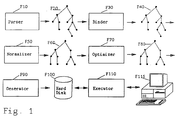
- Figure 1 depicts the components of the DBMS of the present invention.
- Figures 2A, 2B and 2C are schematics depicting the dataflow tree graphic implementation of a one normalization rule for the transformation method of the present invention
- Figures 3A and 3B are schematics depicting the dataflow tree graphic implementation of another normalization rule for the transformation method of the present invention.
- Figures 4A and 4B are schematics depicting the dataflow tree graphic implementation of another normalization rule for the transformation method of the present invention.
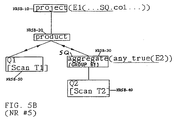
- Figures 5A and 5B are schematics depicting the dataflow tree graphic implementation of another normalization rule for the transformation of the present invention.
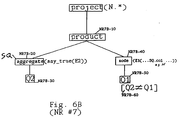
- Figures 6A and 6B are schematics depicting the dataflow tree graphic implementation of another normalization rule of the present invention.
- a SQL expression can be decomposed visually into a upward propagating tree F20 by a parser F10.
- the parser F10 would run under the Tandem Nonstop (tm) operating kernel as part of at least one workstation, such as workstation F115.
- the nodes of the tree can be decomposed into "relational query nodes", indicated in Figures 2-6 by text surrounded in boxes, or as "expression nodes", indicated by text that is not surrounded by boxes.
- a tree such as represented by tree F20 is outputted by the parser.
- a normalizer F50 in Fig. 1, where the normalization rules of the method of practicing the present invention reside.
- the normalizer like the parser, binder, optimizer, generator and executor, would run inside at least one workstation such as workstation F115.
- the normalizer takes tree F40 as input and performs the normalization rules as described herein for subquery elimination and outputs a normalized and syntactically transformed but equivalent tree F60 to a optimizer F70, which optimizes the tree so that it is more efficiently traversed.
- a generator F90 outputs the final tree to a storage medium, such as secondary storage memory hard drive F100.
- An executor F110 then may access the final tree from the secondary storage memory hard drive F100 when needed, as indicated by the double headed reference arrow in Fig. 1.
- the normalization rules of the present invention reside in normalizer F50, a program residing in primary storage memory (RAM) of a preferably Tandem computer running under the Nonstop Operating Kernel, rather than residing in the parser F10, binder F30, optimizer F70, generator F90, hard disk F100 or executor program F110.
- normalizer F50 a program residing in primary storage memory (RAM) of a preferably Tandem computer running under the Nonstop Operating Kernel
- RAM primary storage memory
- the normalization rules of the present invention could be made to reside in any of these other sub-component programs.
- Normalization rule No. 2 (NR3) is a generalized example of rule No. 1 (NR2), with three assumptions: (1) the subquery appears in the "select” predicate, (2) the subquery has a Boolean result (TRUE, FALSE) and (3) the subquery can reference a child node of the "select" predicate.
- the result of an "any" predicate inside an expression can be calculated by a query that returns a single row with a single column of boolean type that has the value of the "any” predicate: any (Q,E) --> aggregate (Q, any_true(E)) .
- Q stands for a relational predicate or operator
- E stands for expressional predicate or operator
- the result of a "one_row” predicate can be calculated by a query that returns a single row or an error: one_row(Q) --> aggregate(Q, once(*)) .
- This normalization rule eliminates a "one_row” expression inside a "select" node, and is best represented graphically as shown below in connection with Figs. 4A, 4B.
- This normalization rule deals with nodes that use an input expression with a subquery, like “scan”, “tuple” and similar nodes. It is best summarized as described below graphically in connection with Figs. 6A and 6B.
- NR1 "select * from t1 where t1.col in (select t2.col from t2)" which means, given a Table t1, with a plurality of rows, each row having a column t1.col with a certain value(s), scan each row in table t1 and evaluate the condition "t1.col in (select t2.col from t2)", which means find if the certain column value in table t1 is found in column t2.col of a row in table t2. In essence, this formulation searches to see if the two tables t1, t2 have a matching value in particular columns.
- parser F10 in Fig. 1 decomposes (or parses) the query into the following tree format, shown in Fig. 2A: "select(scan(t1), any(scan(t2), equal(t1.col, t2.col)"
- Fig. 2A text surrounded by rectangles indicates the presence of a relational expression operator, which deal with sets (multiple arguments or predicates) and inputs and return a single value. Relational operators are also indicated by the term "QRY”.
- text not surrounded by boxes in the figures indicate expressional operators or item expressions, and which have a single argument and return a single value, and are indicated by " ⁇ EXPR ⁇ ".
- a nested subquery can be thought of as a situation where an item expression (single value) has a relational operator as an argument, which creates undesirable complications that this invention seeks to remedy through a series of transformations that will "unnest" such subqueries.
- Fig. 2A is one graphical representation of a nested subquery representation of the expression: "select * from t1 where t1.col in (select t2.col from t2)"
- the tree is an inverted tree where values are passed from lower levels to higher levels, as indicated by the reference arrows 12, 14 in Fig. 2A.
- decomposition nodes 30, 40 and 50 in Fig. 2A with an equivalent expression that is unnested, we use the SQL keyword JOIN operator to create a new column that is the "product", a cartesian product, represented by node 60, "JOIN” or “product” in Fig. 2B, to eliminate the "island” expression "SCAN T1", ref. no. 40 of Fig. 2A.
- the product column works by evaluating the expression in nodes 30, 40 and 50 in Fig. 2A, as expression nodes 80, 90 in Fig. 2B, which is an equivalent decomposition in dataflow tree diagram form.
- the tree shown in Fig. 2B is the same semantically in SQL as the tree shown in Fig. 2B for ex. No. NR1.
- the nodes or leaves of the dataflow tree of Fig. 2B where there are relational expression operators (boxes) are not isolated as "islands" but are contiguous with one another and dependent from one another in the manner shown, as is characteristic of the transformed, unnested subqueries throughout this invention.
- FIG. 2C Another syntactically equivalent dataflow tree diagram expression of the nested subquery of Fig. 2A is shown in Fig. 2C.
- Fig. 2C employs the "semijoin" operator, which is an operator well known to those skilled in the art. See for example the semijoin operator as defined in the normalization rule described in W. Kim, "On Optimizing an SQL-like Nested Query", ACM Transactions on Database Systems 7/3, 1982, pp. 443-469, incorporated by reference herein.
- Normalization Rule No. 2 transforms the select nodes that contain these "any" expressions, using the 'semi-join ' operation.
- SELECT * FROM T WHERE B /(3 *(SELECT MIN(col1) FROM T1))
- the result of any "any" predicate inside an expression can be calculated by a query that returns a single row with a single column of boolean type that has the value of the "any" predicate (where Q stands for a relational predicate or operator and E stands for expressional predicate or operator): any(Q,E) --> aggregate (Q, any_true(E)) . All the rows of the result Q are passed to the "aggregate” operator. The “aggregate” reduces these rows to a single row with the value TRUE, if any rows satisfy the predicate E. A NULL value is returned if no rows of the input query evaluate to TRUE, but some rows evaluate to NULL. In all other cases, FALSE is returned as the result.
- the result of a "one_row” predicate can be calculated by a query that returns a single row or an error: one_row(Q) --> aggregate(Q, once(*)).
- This transformation is similar to the one for the "any” predicate. Instead of returning TRUE and FALSE values, the "aggregate” simply selects the single qualifying row, or, if no rows qualify, a single row with all columns set to NULL. The "once" aggregate function raises an error if Q returns more than one row.
- the 'input' node used in the transformation is a reference to a named value: select (Q1, E1(...any(Q2, E2)%)), as shown graphically in Fig. 3A in dataflow tree form, which is to be transformed into the unnested subquery tree shown in Fig. 3B.
- the graphical dataflow tree of Fig. 3A which has nested subqueries, is semantically equivalent to the tree of Fig. 3B, with QRY nodes NR3B-10 and NR3B-20, the "product” and aggregate function "GROUP BY” nodes, together with the EXPR "any_true”, replacing nested expression NR3-20 in Fig. 3A as shown.
- Fig. 3B refers to the output value of the aggregate query NR3B-20.
- the nodes or leaves of the dataflow tree of Fig. 3B where there are relational expression operators (boxes) are not isolated as "islands” but are contiguous with one another and dependent from one another in the manner shown, as is characteristic of the transformed, unnested subqueries throughout this invention.
- subquery elimination rules may have to be applied repeatedly, since an expression may contain more than one subquery or nested subqueries.
- the above transformation rule does not make any assumptions about the form of an expression that contains a subquery.
- the subquery Q2 can contain "outer references" to the query Q1. In the figures this is represented by double arrows, such as the double arrows 65 between the "QRY" nodes 60, 70 and 60, 100 in Fig. 2B for example.
- the "product" operator is defined such that its right operand can reference values that are generated in its left operand.
- the result of a "one_row” predicate can be calculated by a query that returns a single row or an error: one_row(Q) --> aggregate(Q, once(*)).
- This normalization rule eliminates a "one_row” expression inside a "select" node, and is best represented graphically as shown in connection with Figs. 4A, 4B.
- FIG. 5A Another example where a subquery appears in the projection expression is for "project" nodes, where there is a nested subquery in the project clause.
- an "any" expression appears at predicate ref. no. NR5A-10.
- the expression E1 node NR5B-10 via the product node NR5B-20
- Q1 node NR5B-50
- Q2 node NR5B-40
- Normalization Rule No. 5 (not illustrated) has similar considerations as Normalization Rule No. 2 (NR3).
- Normalization Rule No. 5 "sort” nodes and “aggregate” nodes are considered.
- the child query or queries
- the sort or aggregate operation can then be performed on the newly formed table with the extra column, which will later have to be removed again.
- the expressional operator aggregate function "any_true” the Boolean expressional operator "one_row”.
- Figure 6A shows the nested version of the subquery in datatree form
- Fig. 6B shows the unnested, semantically equivalent version.
- the "node” in Figure 6A can be like one of ("scan", “tuple” ,...) etc.
Landscapes
- Engineering & Computer Science (AREA)
- Theoretical Computer Science (AREA)
- Computational Linguistics (AREA)
- Data Mining & Analysis (AREA)
- Databases & Information Systems (AREA)
- Physics & Mathematics (AREA)
- General Engineering & Computer Science (AREA)
- General Physics & Mathematics (AREA)
- Information Retrieval, Db Structures And Fs Structures Therefor (AREA)
Applications Claiming Priority (2)
| Application Number | Priority Date | Filing Date | Title |
|---|---|---|---|
| US480963 | 1983-03-31 | ||
| US08/480,963 US5724570A (en) | 1995-06-07 | 1995-06-07 | Method and apparatus for a complete SQL subquery elimination process |
Publications (1)
| Publication Number | Publication Date |
|---|---|
| EP0747838A1 true EP0747838A1 (fr) | 1996-12-11 |
Family
ID=23910025
Family Applications (1)
| Application Number | Title | Priority Date | Filing Date |
|---|---|---|---|
| EP96108879A Withdrawn EP0747838A1 (fr) | 1995-06-07 | 1996-06-03 | Méthode et système pour l'élimination complète de sous-requêtes SQL |
Country Status (3)
| Country | Link |
|---|---|
| US (1) | US5724570A (fr) |
| EP (1) | EP0747838A1 (fr) |
| CA (1) | CA2178263A1 (fr) |
Cited By (2)
| Publication number | Priority date | Publication date | Assignee | Title |
|---|---|---|---|---|
| EP1388793A3 (fr) * | 2002-08-09 | 2009-05-20 | Progress Software Corporation | Procédé de transformation des requêtes SQL |
| US7680787B2 (en) * | 2006-04-06 | 2010-03-16 | International Business Machines Corporation | Database query generation method and system |
Families Citing this family (58)
| Publication number | Priority date | Publication date | Assignee | Title |
|---|---|---|---|---|
| US6006214A (en) * | 1996-12-04 | 1999-12-21 | International Business Machines Corporation | Database management system, method, and program for providing query rewrite transformations for nested set elimination in database views |
| US5905982A (en) * | 1997-04-04 | 1999-05-18 | International Business Machines Corporation | Handling null values in SQL queries over object-oriented data |
| US5963932A (en) * | 1997-04-29 | 1999-10-05 | Oracle Corporation | Method and apparatus for transforming queries |
| JP3195275B2 (ja) * | 1997-06-27 | 2001-08-06 | インターナショナル・ビジネス・マシーンズ・コーポレ−ション | データベース・アクセス・システム |
| US5963936A (en) * | 1997-06-30 | 1999-10-05 | International Business Machines Corporation | Query processing system that computes GROUPING SETS, ROLLUP, and CUBE with a reduced number of GROUP BYs in a query graph model |
| US6581052B1 (en) * | 1998-05-14 | 2003-06-17 | Microsoft Corporation | Test generator for database management systems |
| US6138112A (en) * | 1998-05-14 | 2000-10-24 | Microsoft Corporation | Test generator for database management systems |
| US6263345B1 (en) * | 1998-09-28 | 2001-07-17 | Compaq Computers, Corporation | Histogram synthesis modeler for a database query optimizer |
| US6411951B1 (en) | 1998-12-16 | 2002-06-25 | Microsoft Corporation | Evaluating SQL subqueries |
| US6457000B1 (en) * | 1999-07-29 | 2002-09-24 | Oracle Corp. | Method and apparatus for accessing previous rows of data in a table |
| US6339770B1 (en) * | 1999-08-12 | 2002-01-15 | International Business Machines Corporation | Query simplification and optimization involving eliminating grouping column from group by operation corresponds to group by item that is constant |
| US6965888B1 (en) | 1999-09-21 | 2005-11-15 | International Business Machines Corporation | Method, system, program, and data structure for cleaning a database table using a look-up table |
| US7120638B1 (en) | 1999-09-21 | 2006-10-10 | International Business Machines Corporation | Method, system, program, and data structure for cleaning a database table |
| US6920443B1 (en) | 1999-09-21 | 2005-07-19 | International Business Machines, Corporation | Method, system, program, and data structure for transforming database tables |
| US6604095B1 (en) | 1999-09-21 | 2003-08-05 | International Business Machines Corporation | Method, system, program, and data structure for pivoting columns in a database table |
| US6748389B1 (en) | 1999-09-21 | 2004-06-08 | International Business Machines Corporation | Method, system, and program for inverting columns in a database table |
| US6826562B1 (en) * | 1999-11-29 | 2004-11-30 | International Business Machines Corporation | Method of simplifying and optimizing scalar subqueries and derived tables that return exactly or at most one tuple |
| US6694328B1 (en) * | 2000-01-13 | 2004-02-17 | International Business Machines Corporation | Method for creating queries on version objects |
| US6996557B1 (en) * | 2000-02-15 | 2006-02-07 | International Business Machines Corporation | Method of optimizing SQL queries where a predicate matches nullable operands |
| CA2307155A1 (fr) | 2000-04-28 | 2001-10-28 | Ibm Canada Limited-Ibm Canada Limitee | Execution d'interrogations d'une base de donnees permettant le filtrage |
| US6470335B1 (en) | 2000-06-01 | 2002-10-22 | Sas Institute Inc. | System and method for optimizing the structure and display of complex data filters |
| US20020078041A1 (en) * | 2000-10-13 | 2002-06-20 | Wu William Chyi | System and method of translating a universal query language to SQL |
| US6785668B1 (en) | 2000-11-28 | 2004-08-31 | Sas Institute Inc. | System and method for data flow analysis of complex data filters |
| US6915293B2 (en) * | 2001-02-28 | 2005-07-05 | International Business Machines Corporation | Method and system for nested SQL functions for net.data on workstations |
| US8069419B2 (en) * | 2001-04-18 | 2011-11-29 | Sas Institute Inc. | Graphical user interface check-list button control and method |
| US6748378B1 (en) * | 2001-04-20 | 2004-06-08 | Oracle International Corporation | Method for retrieving data from a database |
| US7818297B2 (en) * | 2003-03-31 | 2010-10-19 | Hewlett-Packard Development Company, L.P. | System and method for refreshing a table using epochs |
| US20040193654A1 (en) * | 2003-03-31 | 2004-09-30 | Nitzan Peleg | Logical range logging |
| US7249120B2 (en) * | 2003-06-27 | 2007-07-24 | Microsoft Corporation | Method and apparatus for selecting candidate statistics to estimate the selectivity value of the conditional selectivity expression in optimize queries based on a set of predicates that each reference a set of relational database tables |
| US7085757B2 (en) * | 2003-07-11 | 2006-08-01 | International Business Machines Corporation | Abstract data linking and joining interface |
| US20050060307A1 (en) * | 2003-09-12 | 2005-03-17 | International Business Machines Corporation | System, method, and service for datatype caching, resolving, and escalating an SQL template with references |
| US7426522B2 (en) * | 2003-09-23 | 2008-09-16 | International Business Machines Corporation | Object oriented query path expression to relational outer join translator method, system, article of manufacture, and computer program product |
| US7702627B2 (en) * | 2004-06-22 | 2010-04-20 | Oracle International Corporation | Efficient interaction among cost-based transformations |
| US7814042B2 (en) * | 2004-08-17 | 2010-10-12 | Oracle International Corporation | Selecting candidate queries |
| US7991779B1 (en) | 2005-04-25 | 2011-08-02 | Hewlett Packard Development Company, L.P. | Method and apparatus for populating an index table |
| US7376646B2 (en) * | 2005-06-17 | 2008-05-20 | International Business Machines Corporation | Cost-based subquery correlation and decorrelation |
| US7814091B2 (en) * | 2005-09-27 | 2010-10-12 | Oracle International Corporation | Multi-tiered query processing techniques for minus and intersect operators |
| US20070094233A1 (en) * | 2005-10-24 | 2007-04-26 | Wolfgang Otter | Translating time-independent data using database operations |
| US20070219943A1 (en) * | 2006-03-19 | 2007-09-20 | Mr. Alphonza Draughn | Transforming SQL Queries with Table Subqueries |
| US7584178B2 (en) * | 2006-04-20 | 2009-09-01 | International Business Machines Corporation | Query condition building using predefined query objects |
| US7774189B2 (en) * | 2006-12-01 | 2010-08-10 | International Business Machines Corporation | System and method for simulating data flow using dataflow computing system |
| US8209322B2 (en) * | 2007-08-21 | 2012-06-26 | Oracle International Corporation | Table elimination technique for group-by query optimization |
| US7941460B2 (en) * | 2007-09-05 | 2011-05-10 | International Business Machines Corporation | Compilation model for processing hierarchical data in stream systems |
| US7860863B2 (en) * | 2007-09-05 | 2010-12-28 | International Business Machines Corporation | Optimization model for processing hierarchical data in stream systems |
| US8352461B2 (en) * | 2007-09-12 | 2013-01-08 | Oracle International Corporation | Table elimination optimizations |
| US8359323B2 (en) * | 2008-06-11 | 2013-01-22 | International Business Machines Corporation | Method and system for providing access to adapters |
| US8161380B2 (en) * | 2008-06-26 | 2012-04-17 | International Business Machines Corporation | Pipeline optimization based on polymorphic schema knowledge |
| US7958112B2 (en) * | 2008-08-08 | 2011-06-07 | Oracle International Corporation | Interleaving query transformations for XML indexes |
| US8204903B2 (en) | 2010-02-16 | 2012-06-19 | Microsoft Corporation | Expressing and executing semantic queries within a relational database |
| US9183254B1 (en) * | 2012-05-04 | 2015-11-10 | Paraccel Llc | Optimizing database queries using subquery composition |
| US10430406B2 (en) * | 2012-08-13 | 2019-10-01 | Aria Solutions, Inc. | Enhanced high performance real-time relational database system and methods for using same |
| US10102248B2 (en) * | 2012-10-10 | 2018-10-16 | TmaxData Co., Ltd. | Join type for optimizing database queries |
| US10133776B2 (en) * | 2013-06-20 | 2018-11-20 | Oracle International Corporation | Transforming a query by eliminating a subquery |
| US9870390B2 (en) | 2014-02-18 | 2018-01-16 | Oracle International Corporation | Selecting from OR-expansion states of a query |
| US10585887B2 (en) | 2015-03-30 | 2020-03-10 | Oracle International Corporation | Multi-system query execution plan |
| US10733187B2 (en) * | 2018-02-09 | 2020-08-04 | International Business Machines Corporation | Transforming a scalar subquery |
| CN112732752A (zh) * | 2021-01-29 | 2021-04-30 | 上海达梦数据库有限公司 | 一种查询语句优化方法、装置、设备和存储介质 |
| CN116541409B (zh) * | 2023-03-16 | 2025-08-12 | 北京奥星贝斯科技有限公司 | Sql语句的处理方法及装置、电子设备和存储介质 |
Citations (1)
| Publication number | Priority date | Publication date | Assignee | Title |
|---|---|---|---|---|
| US5367675A (en) * | 1991-12-13 | 1994-11-22 | International Business Machines Corporation | Computer automated system and method for optimizing the processing of a query in a relational database system by merging subqueries with the query |
Family Cites Families (1)
| Publication number | Priority date | Publication date | Assignee | Title |
|---|---|---|---|---|
| US5412804A (en) * | 1992-04-30 | 1995-05-02 | Oracle Corporation | Extending the semantics of the outer join operator for un-nesting queries to a data base |
-
1995
- 1995-06-07 US US08/480,963 patent/US5724570A/en not_active Expired - Lifetime
-
1996
- 1996-06-03 EP EP96108879A patent/EP0747838A1/fr not_active Withdrawn
- 1996-06-05 CA CA002178263A patent/CA2178263A1/fr not_active Abandoned
Patent Citations (1)
| Publication number | Priority date | Publication date | Assignee | Title |
|---|---|---|---|---|
| US5367675A (en) * | 1991-12-13 | 1994-11-22 | International Business Machines Corporation | Computer automated system and method for optimizing the processing of a query in a relational database system by merging subqueries with the query |
Non-Patent Citations (2)
| Title |
|---|
| PIRAHESH H ET AL: "EXTENSIBLE/RULE BASED QUERY REWRITE OPTIMIZATION IN STARBURST", SIGMOD RECORD, vol. 21, no. 2, 1 June 1992 (1992-06-01), pages 39 - 48, XP000413869 * |
| SINGH MUMICK I ET AL: "Implementation of magic-sets in a relational database system", 1994 ACM SIGMOD INTERNATIONAL CONFERENCE ON MANAGEMENT OF DATA, MINNEAPOLIS, MN, USA, 24-27 MAY 1994, vol. 23, no. 2, ISSN 0163-5808, SIGMOD RECORD, JUNE 1994, USA, pages 103 - 114, XP000454453 * |
Cited By (2)
| Publication number | Priority date | Publication date | Assignee | Title |
|---|---|---|---|---|
| EP1388793A3 (fr) * | 2002-08-09 | 2009-05-20 | Progress Software Corporation | Procédé de transformation des requêtes SQL |
| US7680787B2 (en) * | 2006-04-06 | 2010-03-16 | International Business Machines Corporation | Database query generation method and system |
Also Published As
| Publication number | Publication date |
|---|---|
| US5724570A (en) | 1998-03-03 |
| CA2178263A1 (fr) | 1996-12-08 |
Similar Documents
| Publication | Publication Date | Title |
|---|---|---|
| US5724570A (en) | Method and apparatus for a complete SQL subquery elimination process | |
| US6574623B1 (en) | Query transformation and simplification for group by queries with rollup/grouping sets in relational database management systems | |
| US5367675A (en) | Computer automated system and method for optimizing the processing of a query in a relational database system by merging subqueries with the query | |
| US5511186A (en) | System and methods for performing multi-source searches over heterogeneous databases | |
| US6529896B1 (en) | Method of optimizing a query having an existi subquery and a not-exists subquery | |
| US5822750A (en) | Optimization of correlated SQL queries in a relational database management system | |
| AU772754B2 (en) | System and method for rewriting relational database queries | |
| US6847962B1 (en) | Analyzing, optimizing and rewriting queries using matching and compensation between query and automatic summary tables | |
| US6826562B1 (en) | Method of simplifying and optimizing scalar subqueries and derived tables that return exactly or at most one tuple | |
| Cui et al. | Tracing the lineage of view data in a warehousing environment | |
| US5963933A (en) | Efficient implementation of full outer join and anti-join | |
| US5548755A (en) | System for optimizing correlated SQL queries in a relational database using magic decorrelation | |
| US5615361A (en) | Exploitation of uniqueness properties using a 1-tuple condition for the optimization of SQL queries | |
| US7275056B2 (en) | System and method for transforming queries using window aggregation | |
| US6339769B1 (en) | Query optimization by transparently altering properties of relational tables using materialized views | |
| US4769772A (en) | Automated query optimization method using both global and parallel local optimizations for materialization access planning for distributed databases | |
| US6032143A (en) | Evaluation of existential and universal subquery in a relational database management system for increased efficiency | |
| US6560594B2 (en) | Cube indices for relational database management systems | |
| US6339768B1 (en) | Exploitation of subsumption in optimizing scalar subqueries | |
| US5590324A (en) | Optimization of SQL queries using universal quantifiers, set intersection, and max/min aggregation in the presence of nullable columns | |
| US7171399B2 (en) | Method for efficient query execution using dynamic queries in database environments | |
| US7184998B2 (en) | System and methodology for generating bushy trees using a left-deep tree join enumeration algorithm | |
| US6253196B1 (en) | Generalized model for the exploitation of database indexes | |
| Ordonez | Horizontal aggregations for building tabular data sets | |
| Lorie et al. | An access specification language for a relational data base system |
Legal Events
| Date | Code | Title | Description |
|---|---|---|---|
| PUAI | Public reference made under article 153(3) epc to a published international application that has entered the european phase |
Free format text: ORIGINAL CODE: 0009012 |
|
| AK | Designated contracting states |
Kind code of ref document: A1 Designated state(s): DE FR GB IT SE |
|
| 17P | Request for examination filed |
Effective date: 19970423 |
|
| 17Q | First examination report despatched |
Effective date: 20000403 |
|
| STAA | Information on the status of an ep patent application or granted ep patent |
Free format text: STATUS: THE APPLICATION IS DEEMED TO BE WITHDRAWN |
|
| 18D | Application deemed to be withdrawn |
Effective date: 20000815 |