EP0747847A2 - Méthode et appareil pour représenter une connaissance portant sur des entités - Google Patents
Méthode et appareil pour représenter une connaissance portant sur des entités Download PDFInfo
- Publication number
- EP0747847A2 EP0747847A2 EP96108897A EP96108897A EP0747847A2 EP 0747847 A2 EP0747847 A2 EP 0747847A2 EP 96108897 A EP96108897 A EP 96108897A EP 96108897 A EP96108897 A EP 96108897A EP 0747847 A2 EP0747847 A2 EP 0747847A2
- Authority
- EP
- European Patent Office
- Prior art keywords
- entity
- taxonomy
- functional
- defining
- structural
- Prior art date
- Legal status (The legal status is an assumption and is not a legal conclusion. Google has not performed a legal analysis and makes no representation as to the accuracy of the status listed.)
- Withdrawn
Links
Images


Classifications
-
- G—PHYSICS
- G06—COMPUTING OR CALCULATING; COUNTING
- G06F—ELECTRIC DIGITAL DATA PROCESSING
- G06F30/00—Computer-aided design [CAD]
- G06F30/10—Geometric CAD
- G06F30/15—Vehicle, aircraft or watercraft design
-
- G—PHYSICS
- G06—COMPUTING OR CALCULATING; COUNTING
- G06F—ELECTRIC DIGITAL DATA PROCESSING
- G06F2111/00—Details relating to CAD techniques
- G06F2111/04—Constraint-based CAD
Definitions
- the present invention relates to a method and apparatus for representing knowledge about entities. More particularly, the present invention relates to a method and apparatus for representing knowledge about goods and services in connection with buying and selling goods and services via computer.
- PRODIGY, COMPUSERVE, and AMERICA ONLINE each offer subscribers (i.e., potential buyers) the ability to connect to those on-line services via a personal computer (equipped with a modem) and electronically view product descriptions of offerings from a variety of sellers.
- subscribers i.e., potential buyers
- buyer includes both manufacturers and distributors
- buyerers includes both distributors and consumers
- products includes both goods and services.
- the buyer may then electronically order a product from the seller.
- the seller provides the ordered product to the buyer.
- sellers are sometimes buyers and vice versa (e.g., a manufacturer may procure components for a product from one or more suppliers, or, similarly, a distributor may procure products for an integrated offering from one or more manufacturers).
- IBM Electronic Purchasing System is a catalog-based, on-line shopping, multimedia system developed by IBM Corporation.
- the system addresses the entire cycle of a buying decision, including product research, comparison shopping, purchase request, approval tracking, order placement, receipt confirmation, and billing.
- the IBM Electronic Purchasing System automates many of the administrative functions associated with order handling, such as approval and status tracking. As a result, cost is reduced, orders are more frequently correct when first placed, and orders are released to the seller without the need for manual administrative support.
- the IBM Electronic Purchasing System includes three components: Electronic Catalog; Approval and Status Tracking; and Order Manager.
- the Electronic Catalog contains product information. Buyers make purchase requests through the catalog, and product specifications, prices and availability are electronically updated. Buyers can compare product features of similar items while browsing the catalog, build a purchase request, change a request, check status, and cancel a request.
- the Approval and Status Tracking component handles administrative matters related to obtaining proper approval for, and tracking the status of, a particular purchase request
- the Order Manager component monitors the flow of purchase requests, coordinates billing activities, and manages other aspects of the system.
- any on-line system for procuring products the manner in which a product is described on the system ("product description") is critical.
- a seller describes, entices, and “sells” a product to a buyer through the product description.
- a buyer evaluates, assesses, configures, and "buys” a product, in large part, on the basis of the product description.
- the situation is similar to an "off-line" sales transaction between a buyer and a seller through a printed catalog.
- the seller describes product attributes such as price, type, color, features, etc. in words and pictures. The buyer then evaluates the product on the basis of the words and pictures contained in the catalog.
- a seller who self-publishes a printed product catalog has a great deal of flexibility concerning the information content and layout of product descriptions. The situation is very different for a seller whose product descriptions are contained within a printed catalog together with other sellers' product descriptions. For a variety of reasons, it is advantageous for a publisher of a printed catalog containing multiple sellers' products to collect product description information from sellers in a uniform manner. One reason is that it eases the administrative burden of collecting the data. Another reason is that the collected information can then be presented to the buyer in a variety of informative ways. Collection and reconciliation of multiple sellers' product descriptions is a challenge in a printed catalog setting, and an extremely difficult problem with respect to on-line systems for procuring products.
- data means a representation of facts, concepts or instructions in a formalized manner suitable for communication, interpretation, or processing by human or automatic means.
- computer means a device capable of performing the functions of a Turing Machine, including a microcomputer, minicomputer, or mainframe computer. A Turing Machine is a well-known computer science concept and is explained in Encyclopedia of Computer Science, Ed. Anthony Ralston, ISBN 0-88405-321-0 (“Ralston”), which is specifically incorporated herein by reference.
- Memory means one or more devices for storing data for use by a computer, including electronic, magnetic, and electromagnetic memory.
- a functional taxonomy is defined which includes at least one entity and at least one property associated with each entity.
- a structural taxonomy is also defined which includes at least one entity and at least one property associated with each entity, wherein at least one structural taxonomy entity is defined in terms of at least one functional taxonomy entity.
- At least a portion of the functional taxonomy and at least a portion of the structural taxonomy is stored within a memory for access by a computer.
- the invention relies upon an object-centered constraint approach, which uniquely incorporates object-oriented principles together with constraint-satisfaction techniques.
- a key feature of the present invention is the ability to integrate the representation of knowledge about items which exist in fact ("existing items") and items which are capable of existing (“feasible items").
- the invented knowledge representation can be interchanged via networks to facilitate product information reuse in a product information supply chain.
- a manufacturer can interchange its product descriptions with a distributor that then adds their part number and price and interchanges the information with a reseller.
- the reseller adds their part number and price in turn and interchanges the information with a catalog collator. This information is then used in an electronic catalog.
- An advantage of the invented knowledge representation is that multiple sellers may describe their respective products in a uniform manner which can be customized, integrated, interchanged, and reused in various contexts (such as by another seller in connection with its product offering).
- Yet another advantage of the invented knowledge representation is that it simplifies intelligent catalog browsing, product configuration selection, validation and synthesis, product information research, and product manufacture.
- Another advantage of the invented knowledge representation is that is simplifies the maintenance of functional-dependency information.
- Yet another advantage of the invented knowledge representation is that it is well suited for implementation in an object-centered knowledge base management system.
- Another advantage of the invented knowledge representation is that it easily integrates different characteristics of product information such as functions, items, connections, resources (both spatial and electrical), and abstractions created by disparate sources into a more complete product description.
- Another advantage of the invented knowledge representation is the simultaneous representation of complex data and performance of nested operations.
- Yet another advantage of the invented knowledge representation is that it provides a mechanism for a seller to construct the underlying structure of its product descriptions and to customize and maintain that underlying structure.
- Another advantage of the invented knowledge representation is that knowledge thus represented is understandable, maintainable, reusable, and more likely to be correct.
- Still another advantage is that the invented knowledge representation may be specified using a succinct "language" to accomplish the foregoing advantages.
- Another advantage is that the invented knowledge representation can be reworked into other information presentation formats such as paper catalogs and other on-line catalogs such as those found on the Internet.
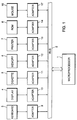
- FIG. 1 is a is a block diagram of a computer system in which the invented knowledge representation method and apparatus may be employed.
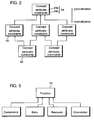
- FIG. 2 is a diagram of a specialization/generalization hierarchical classification system ("taxonomy”) illustrated as an inverted tree having a root node, terminal nodes, and intervening nodes.
- taxonomy a specialization/generalization hierarchical classification system
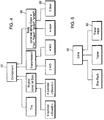
- FIG. 3 is a diagram of an functional taxonomy illustrating a Function concept decomposed into Component, Extra, Resource, and Connection concepts.
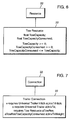
- FIG. 4 is a diagram of a further decomposition of the Component concept of FIG. 3.
- FIG. 5 is a diagram of a further decomposition of the Extra concept of FIG. 3.
- FIG. 6 is a diagram of a further decomposition of the Resource concept of FIG. 3.
- FIG. 7 is a diagram of a further decomposition of the Connection concept of FIG. 3.
- FIG. 8 is a diagram of a structural taxonomy illustrating an Item concept decomposed into various concepts, including a Vehicle concept.
- FIG. 9 is a diagram of a further decomposition of the Vehicle concept of FIG. 8.
- FIG. 10 is a diagram of relationships between Vehicle concepts and particular concepts within the structural taxonomy depicted in FIG. 8.
- FIG. 11 is a diagram of the relationships between Engine concepts and particular concepts within both the functional taxonomy depicted in FIG. 4 and the structural taxonomy depicted in FIG. 8.
- FIG. 12 is a diagram of the relationships between Transmission concepts and particular concepts within both the functional taxonomy depicted in FIG. 4 and the structural taxonomy depicted in FIG. 8.
- FIG. 13 is a diagram of the relationships between Body concepts and particular concepts within both the functional taxonomy depicted in FIG. 4 and the structural taxonomy depicted in FIG. 8.
- FIG. 14 is a diagram of the relationships between Trailer and Trailer-Hitch concepts and particular concepts within both the functional taxonomy depicted in FIG. 5 and the structural taxonomy depicted in FIG. 8.
- FIG. 15 is a diagram of the relationships between Bike Rack concepts and particular concepts within both the functional taxonomy depicted in FIG. 5 and the structural taxonomy depicted in FIG. 8.
- FIG. 16 is a diagram of a taxonomy illustrating a Compatible concept decomposed into Jeep Compatible and Coupe Compatible concepts.
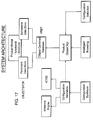
- FIG. 17 is a diagram of the overall system architecture.
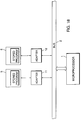
- FIG. 18 is a diagram of a portion of FIG. 1.
- a typical personal computer architecture such as the configuration used in the IBM Personal Computer or the IBM PS/2® computer.
- the present invention may also be used in other digital computer architectures, such as mini-computer and mainframe computer environments, and in local area and wide area computer networks.
- the focal point of the preferred personal computer architecture comprises a microprocessor 1 which may, for example, be an INTEL 8088, 386, 486, or similar microprocessor.
- the microprocessor 1 is connected to a bus 2 which comprises a set of data lines, a set of address lines and a set of control lines.
- a plurality of I/O devices or memory or storage devices 3-8 and 16 are connected to the bus 2 through separate adapters 9-14 and 17, respectively.
- the display 4 may be the IBM Personal Computer Color Display and the adapter 10 may, accordingly, be the IBM Color/Graphics Adapter.
- the other devices 3 and 5-8 and adapters 9 and 11-14 are either included as part of the personal computer or are available as plug-in options from the IBM Corporation.
- RAM 6 and the read-only memory (ROM) 8 and their corresponding adapters 12 and 14 are included as standard equipment in a personal computer, although additional random access memory to supplement memory 6 may be added via a plug-in memory expansion option.
- BIOS basic input/output operating system
- the BIOS controls the fundamental operations of the computer.
- An operating system such as the IBM Personal Computer Series Disk Operating System by Microsoft Corporation (DOS), or the IBM OS/2 operating system software by IBM Corporation, most commonly used with the IBM personal computer family, is loaded into the memory 6 and runs in conjunction with the BIOS stored in ROM 8.
- DOS IBM Personal Computer Series Disk Operating System
- IBM OS/2 operating system software by IBM Corporation, most commonly used with the IBM personal computer family
- the personal computer system could be configured so that parts or all of the BIOS are stored in the memory 6 rather than in the ROM 8 so as to allow modifications to the basic system operations by changes made to the BIOS program, which would then be readily loadable into the random access memory 6.
- programs, data, and knowledge representations stored in memory 6 may be stored in ROM 8.
- An application program such as a word processing program may also be loaded into the memory 6 to provide instructions to the microprocessor 1 to enable a comprehensive set of word processing tasks, including the creation and revision of text documents, to be performed by the personal computer system shown in FIG. 1.
- An application program loaded into the memory 6 is said to run in conjunction with the disk operating system previously loaded into the memory 6.
- an input device such as a mouse 16 and an adapter may, for example, comprise the MICROSOFT MOUSE.
- This mouse is available in either a serial version, which plugs into an Asynchronous Communications Adapter available for the IBM Personal Computer, or in a bus version which includes an adapter card which plugs into an accessory slot in the IBM Personal Computer.
- Mouse 16 is an input device for interacting with the personal computer.
- Other input devices include keyboards, tablets, touch screens, light pens, joysticks, trackballs, and similar devices.
- the present invention relies upon an object-centered constraint approach, which uniquely incorporates object-oriented principles together with constraint-satisfaction techniques.
- Identity refers to the organization of data into identifiable conceptual entities called "concepts”.
- Polymorphism means that an operation may operate differently on different concepts.
- inheritance refers to concepts inheriting attributes and operations based on a hierarchical relationship. Booch discusses additional aspects of object-oriented analysis and design.
- Constraint satisfaction techniques are a method of representing inter- or intra-concept relationships among attributes.
- Intra-concept attribute constraints represent relationships that constrain the values of attributes that are defined either within the same concept or in any of the concept's inherited properties.
- Inter-concept attribute constraints represent relationships that constrain the values of attributes that are defined in disjoint concepts (i.e., the attributes are not common to both concepts).
- the present invention represents knowledge by means of entities, properties (which include attributes and constraints), taxonomies (which include hierarchical relationships) and relations.
- Knowledge representations are manipulated by means of operations such as concept restriction, concept intersection, relation projection, and relation product.
- Concept restriction extracts specified tuples from a specified concept (i.e., restricts the specified concept to just those tuples that satisfy a specified condition).
- Concept intersection builds a concept consisting of all tuples appearing in both of two specified concepts.
- Relation projection extracts specified attributes from a specified relation.
- Relation product builds a relation from two specified relations consisting of all possible combinations of tuples, one from each of the two relations.
- General integrity rules prevent the description of impossible states.
- a key feature of the present invention is the ability to represent knowledge about items which exist in fact ("existing items") and items which are capable of existing (“feasible items”).
- Existing items are represented as unit items or as structural aggregations of concepts and properties within the structural taxonomy. These products are typically only products in that the seller wishes to package a number of components in a particular manner. For example, one seller may only sell computers that have hard disks whereas another seller may sell a computer with no hard disk. Both are items yes one seller's item in not necessarily another seller's item.
- Feasible items are represented with constraints that define the space of feasible, valid concept compositions. For example, a computer may be sold with one hard disk yet have bays that can accommodate more than one hard disk. We may then describe a possible future, feasible item as that same computer with more hard disks or with permutations of hard disks, etc. Until the act of composing the future concept aggregation, the item is just one of a feasible set of possibilities.
- the invented knowledge representation includes a taxonomy 20 of entities 22 and their properties 24.
- "Taxonomy” means classification and, as used herein, refers to a hierarchical classification system (graphically depicted in Figure 2 as an inverted tree having a root node 20a, terminal nodes 20b, and intervening nodes 20c). Generic entities appear higher in the taxonomy than do specific entities and the taxonomy is therefore referred to as a specialization/generalization hierarchy.
- An entity or concept 22 refers to any thing which is to be represented as knowledge.
- Concepts refer to abstractions and are used to generalize characteristics about other concepts.
- Concepts are also used to denote specific entities and atomic entities (e.g., number and string).
- a property 24 Information particular to an entity is referred to as a property 24.
- "property" includes both an attribute 24a and a constraint 24b.
- An attribute is some aspect of an entity and includes both instance attributes and entity attributes. Attributes have values. The value of an instance attribute can be either another abstract or specific concept. The value of a static or variable entity-attribute can be an atomic concept, a set of atomic concepts, or an interval of numeric atomic concepts. If an entity attribute does not change over time, it is called “static”. Conversely, an entity attribute which may vary is called “variable”. The value of an ancillary entity attribute can be another abstract or specific concept, an atomic concept, a set of atomic concepts, or an interval of numeric atomic concepts.
- Static and variable entity-attributes are required to range over the domain of atomic types (i.e., integers, floats, and strings). By default the cardinality of any static or variable entity-attribute is always one. This is because they are in themselves single-valued. A static or variable entity-attribute value can however be assigned to a set of atomic concepts or to an interval of numeric atomic concepts.
- a static entity-attribute must be initialized with a constant value and cannot be modified thereafter.
- size a concept Engine with a static entity-attribute.
- Variable entity-attributes need not be initialized and can be modified even once they have been initialized with a value.
- a variable might be defined that represents the amount of towing capacity for a vehicle that has been consumed as a consequence of a towing a trailer.
- ancillary entity-attributes that provide a means of holding meta-knowledge for a concept.
- An example may be concept documentation (i.e., title). From the three types of entity-attributes only static and variable entity-attributes add semantic information to an entity. Ancillary entity-attributes provide no semantic information to entities.
- Instance-attribute declarations allow concepts to be defined as structures of other entities (e.g., as aggregates of other entities). This is done by defining instance-attributes that relate the entity being defined to other entities. An instance- attribute resembles an instance variable in C++. Instance-attribute declarations allow instances of entities to be declared along with an associated cardinality. An instance-attribute in a concept is required to range over the domain of other concepts in the taxonomy. Within a declaration is a qualifier that captures the semantic role of the instance in the concept. This allows instance-attributes to be differentiated based upon their provision or requisition within the entity. For example a Truck concept may provide an instance of a Trailer-hitch concept.
- the instance-attribute could be arbitrarily named as "aHitch" whose value is then restricted to the Trailer-hitch concept.
- an entity may require another concept.
- Aggregation structures are useful in describing the sub-components that comprise a bundle of items.
- Binary relationships can be used to define links between abstract concepts that are related in an arbitrary, non-taxonomic manner.
- Binary relations are used to specify relationships between two entities. There are two types of relations: abstract relations and Cartesian relations.
- Abstract and Cartesian relations can themselves comprise a specialization taxonomy where one relation serves as a parent to a child relation.
- the Cartesian relation can be used to implicitly specify all possible relationships between all the entities that are specializations of the two entities in the Cartesian relation definition).
- the Cartesian relation can also be used to explicitly specify those entities comprising a particular Cartesian relation.
- a Cartesian relation must always exist as a child of an abstract relation that was previously defined and can never have a child that is another Cartesian relation.
- Constraints include both instance attribute and entity attribute constraints.
- Entity attribute constraints include attribute relations, functional expressions (i.e., mathematical expressions), and logic constraints (i.e., conjunction, disjunction, implication, etc.). Inheritance allows a child concept that is subsumed by one or more parent concept to inherit the parents' properties and relationships.
- Inheritance allows for the grouping of entitles with similar properties as an abstract concept in a hierarchy. Consequently, an entity defined as a child of a more abstract concept inherits its properties. This is called single-inheritance. Multiple-inheritance allows for a child entity to inherit properties from multiple parents.
- the semantics of inheritance are captured in a specialization taxonomy where more general abstract entities are located above more specialized ones.
- Vehicle that can be further specialized as two other concepts: Truck and Car. Both the Truck and the Car are said to inherit from the Vehicle concept.
- the object-centered constraint approach supports both single and multiple inheritance.
- an instance-attribute is defined whose value is restricted to some other entity.
- the Vehicle concept that provides an instance of an Engine concept where the instance-attribute has been named "aEngine”.
- the value restriction for the attribute-instance, "aEngine” is the Engine concept or any of its specializations in the taxonomy.
- the specialization taxonomy any concept that is a child of the Vehicle concept will inherit the aggregation relationship.
- a Truck is a specialization of Vehicle and therefore also provides an instance of Engine.
- This inherited attribute-instance declaration has the similar effect of restricting the "aEngine” instance for a Truck to the Engine concept or any of its specializations.
- a child of that parent can further constrain the inherited instance-attribute. This is done by assigning one or more additional concepts to the instance-attribute's value restriction. This has the effect of further restricting the domain of entities which can satisfy the current value restriction.
- This domain of entities are those entities that are still specializations of the conjoined concepts comprising the instance-attribute value restriction. For example, if the "aEngine" instance-attribute's value restriction is extended to include a Chrysler Engine concept, then the instance-attribute "aEngine” for the Truck concept is restricted to those entities that are specializations of Chrysler engines.
- a language has a syntax and a semantics.
- the syntax of the language is described here. As each construct is presented, the semantics are informally presented.
- the syntax of a language comprises an alphabet, a vocabulary and a set of grammar rules (specified in appendix I, BNF Specification).
- the vocabulary of a language defines the elements of a language (i.e., those sequential combinations of characters of the alphabet that constitute valid elements of a language. For example, each separate work in this sentence is in the english language vocabulary.
- Languages such as PML, recognize certain parts of a language vocabulary as being special constructs in that they can be used as language element delimiters similar to the punctuation found in the english language. If we introduced the keyword "paragraph” into the English language then instead of separating paragraphs by a line we could simply use the keyword “paragraph” to tell us when a paragraph ends and a new one begins.
- These language elements facilitate context-free grammars that are very efficiently read by programs and allow knowledge descriptions to be compressed, by taking out redundant lines and spaces, before transmission over networks.
- the vocabulary of PML comprises the following language elements: denotes start of concept concept declaration const static entity attribute declaration enum enumeration declaration string entity attribute declaration of type string int entity attribute declaration of type integer float entity attribute declaration of type float interval entity attribute declaration of type interval set entity attribute declaration of type set typedef start of a user defined declaration
- the first character of the sequence must be either the underscore character or one of A.z.A.Z. float constant a floating point number e.g. 123.987 integer constant an integer number e.g. 123 character constant a character e.g. c octal constant an octal number e.g. 22 hexidecimal constant a hexidecimal number e.g. ffff string constant sequence of characters between inverted commas e.g. "a string"
- BNF Bocus-Naur Format
- Parsers that validate sentence grammars and generate errors when violations are encountered.
- Punctuation are characters used to make the language more readible. They serve as delimiters in the language similar to punctuation in the English language.
- the structural taxonomy enables the description of entities (such as products) in terms of the functional aspects of the product they implement. This has been accomplished through the clear separation of functional and product specific information are separated. As a result of this separation the taxonomy is divided into two constituent taxonomies. The two constituents representing the functional and product-specific information.
- the functional taxonomy provides for vendor/manufacturer independent product representation.
- the vendor/manufacturer independent nature of the functional taxonomy utilizes a standard nomenclature and functional decomposition.
- the functional taxonomy provides the basis from which to generate the product-specific taxonomy. Products are described in terms of their Function. It provides for vendor/manufacturer independent product representation.
- the Functional aspect of the taxonomy can be further classified into the following: Product Functions, Connectivity Functions, Resource Functions, and Spacial Functions.
- Product Functions describe the hardware and software computer functions. connectivity functions serve to represent the functional dependencies that exist between components. They specify the functional components that are both provided and required for a certain type of connection to exist.
- Resource functions are provide by product functions and represent entities that can be partially consumed by other product functions (i.e., storage space on a hard disk can be consumed by software installed on that hard disk).
- Spatial functions refer to space in a product that is wholly consumed by other products (i.e., a storage bay in a PC is entirely consumed if it is filled with a storage device).
- Ease of maintenance is achieved by clearly separating Functional, Physical, Spatial, Abstract and Product Specific descriptions in addition to its taxonomic structure.
- the taxonomic structure provides modularity and promotes more localized updating and revision.
- the inheritance association feature has the effect of eliminating data redundancies typically found in other data structures (i.e., the relation in the relational model). Elimination of this redundancy significantly reduces the effort involved in the maintenance task.
- the present invention uses connectivity functions to separate functional dependency information from being embedded in the taxonomy. This provided for a greater degree of flexibility (e.g., a customer interested in ordering a single component of a product is not concerned with the functional dependencies that component may have with other components). This separation also facilitates easier functional-dependency maintenance.
- the product specific taxonomy allows vendors/manufacturers to describe their own product components and as well as the contents of bundled systems based on any number of strategies (i.e., marketing, inventory reduction, etc.). This aspect facilitates vendors/manufacturers in the building, customizing, and maintaining of their own product descriptions.
- the description of products in terms of their Product Specific allows vendors/manufacturers to describe their own product components as well as the contents of bundled systems based on any number of strategies (i.e., marketing, inventory reduction, etc.).
- This aspect enables vendors/manufacturers to build, customize, and maintain their own product descriptions.
- the consistency of product representations across vendors/manufacturers is ensured through the intimate connection of the Product Specific description to the Functional description. This connection ensures that the Product Specific description is ultimately functionally defined.
- taxonomic structure in addition to the separation between the functional and product-specific aspects. Separation into two taxonomies provides modularity promoting more localized updating and revision.
- the inheritance of the taxonomic structure has the effect of eliminating data redundancies typically found in other data structures (i.e., the relation in the relational model). Elimination of this redundancy significantly reduces the effort involved in the maintenance task.
- the functional taxonomy has a root node labeled "Function". It is a decomposition of the functions comprising a product where each of the functions corresponds to a concept.
- FIGs. 3 - 4 illustrate a functional taxonomy for a vehicle.
- the vehicle is decomposed into a Component concept, which in turn is decomposed into four other concepts: Tire, Engine, Transmission, and Body.
- the Engine concept is further decomposed into a 6 cylinder concept and 4 cylinder concept.
- the Transmission concept is decomposed into a 2WD concept and a 4WD concept.
- the Body concept is comprised of a 4 door concept and a 2 door concept.
- the decomposition illustrates the inheritance association.
- a 2WD IS-A Transmission 4WD IS-A Transmission
- a Transmission IS-A Function This is specified as follows:
- the concept Engine includes in its definition an attribute definition for size. All attributes are designated with the const qualifier, meaning that the attribute's value is constant and cannot be altered. Following the const qualifier is the attribute type (i.e., int (integer number), float (real number), string (string of characters)). The act of assigning an attribute a value is called initialization. An attribute can be initialized immediately in its declaration or in a concept that inherited the attribute. The language statements below show how the attribute size is defined in the Engine concept and how the attribute is initialized in the 4 cylinder and 6 cylinder concepts with the values of 4 and 6, respectively.
- Attribute values can also be restricted to a range of values specified in a set or an interval. This requires an additional qualifier placed after the const qualifier (i.e., interval or set). Notice that the Body concept has in its definition the attribute color. The color attribute is restricted to range over a set of string values. The attribute is immediately initialized with a set of values as is shown. The corresponding PML is shown below.
- the product-specific taxonomy has a root labeled item.
- FIG. 8 shows the upper portion of a product-specific taxonomy for two types of vehicles.
- Specializations of the Item concept shows the concepts Your part, Your Product, My Part, My Product, Collection, Unit, Virtual Item, Manuf Item, and Line Item. Each of these concepts adds to the description of a product.
- Your Part and My Part allows for existence of two perspectives on items. For example, a vendor or dealer selling a bundle obtained from a manufacturer would consider the bundle both My Product and Your Product. The vendor, however, may or may not sell the contents of a bundle as individual products. Consequently, such an item when not sold by the vendor is labeled Your Part.
- the Collection and Unit concepts allow products to be defined as items that either provide other items or not, respectively.
- Virtual item describes items which are abstractions. They include Line Item for representing product lines and Manuf Item for representing different manufacturers.
- the description of universal product attributes are contained in the Abstraction component. This serves to capture attributes that are commonly used to describe other concepts in the Functional or Product Specific description. Vendors/manufacturers would use abstraction concepts to describe concepts (products) in their part of the product description, the Product Specific description (i.e., a particular vendors/manufacturers product may have a product line abstraction). In a similar manner, the organization responsible for maintaining the Functional description may also use abstractions.
- the shaded portion of FIG. 8 contains those concepts that are dependent on the particular domain being modeled.
- VW and Chrysler concepts are Manuf Items appropriate to the vehicle domain.
- the concepts might be replaced by IBM and Compaq concepts.
- Line Item is specialized into the Cherokee and Scirocco concepts.
- the Vehicle concept contains in its definition declarations for an attribute, a tag, and several aggregation (provides) relationships.
- the attribute weight is designated to range over an interval of real numbers ranging from 1500 to 3500.
- a tag called title is defined to be of type string.
- Cardinality restrictions can be defined in terms of a maximum and a minimum (i.e., atleast and atmost).
- a Vehicle provides exactly one aEngine instance. If no cardinality restriction has been stated the default cardinality restriction of atleast zero and atmost infinity is used.
- the value restriction for the instance.
- aEngine the concept Engine forms the value restriction.
- the engine provides relationship essentially states that every vehicle derived off the vehicle concept must have exactly one instance of engine where that instance must be a chile of the Engine concept.
- the PML associated with the Vehicle concept is as follows:
- the Compatible relation in FIG. 16 represents a relationship between vehicles and bike racks that are compatible with those vehicles. This relation is specialized into a Jeep Compatible relation and a Coupe Compatible relation.
- the instance-attribute constraints in the Jeep Compatible relation shows that roof rack concepts are compatible with Jeep vehicles and the instance-attribute constraints in the Coupe Compatible relation shows bumper racks are compatible with Coupe vehicles. This defines the feasible space of possible bike rack / vehicle combinations.
- the Trailer Connection is a Connection and has three instance attributes stating that a trailer connection exclusively requires a Universal Trailer Hitch, a Universal Trailer and a Tow resource.
- the Trailer Connection concept also has an entity-attribute constraint stating that the Tow Capacity Consumed in the Tow Resource variable entity-attribute in the Tow Resource concept, FIG. 6, must be increased by the weight of the Universal Trailer.
- the Tow Resource concept is-a Resource and contains a number of variable entity-attributes and entity-attribute constraints.
- the Tow Resource has a variable showing the TowCapacity and the amount of that tow capacity that is consumed by some tow entity.
- the concept furthermore, represents the constraints on the row resource with entity-attribute constraints showing that the TowCapacity and the TowCapacityConsumed must be greater than zero, and that the TowCapacityConsumed must be less than or equal to the TowCapacity.
- the model will prevents infeasible aggregates such as a vehicle having two trailers and a vehicle with a trailer that is too heavy for it to pull.
- a stored program 20 implementing the method is advantageously embodied as an article of manufacture by embedding the stored program onto diskette 5, or other portable storage media. Further, the stored program 20 is embodied as a special purpose apparatus by storing the program's executable instructions in memory 6, ROM 8, or a combination of both, for execution by microprocessor 1.
Landscapes
- Engineering & Computer Science (AREA)
- Physics & Mathematics (AREA)
- Geometry (AREA)
- General Physics & Mathematics (AREA)
- Theoretical Computer Science (AREA)
- Mathematical Optimization (AREA)
- Computational Mathematics (AREA)
- Mathematical Analysis (AREA)
- Aviation & Aerospace Engineering (AREA)
- Pure & Applied Mathematics (AREA)
- Computer Hardware Design (AREA)
- Evolutionary Computation (AREA)
- General Engineering & Computer Science (AREA)
- Automation & Control Theory (AREA)
- Machine Translation (AREA)
- Stored Programmes (AREA)
- Information Retrieval, Db Structures And Fs Structures Therefor (AREA)
Applications Claiming Priority (2)
| Application Number | Priority Date | Filing Date | Title |
|---|---|---|---|
| US472414 | 1983-03-04 | ||
| US47241495A | 1995-06-07 | 1995-06-07 |
Publications (2)
| Publication Number | Publication Date |
|---|---|
| EP0747847A2 true EP0747847A2 (fr) | 1996-12-11 |
| EP0747847A3 EP0747847A3 (fr) | 1998-10-14 |
Family
ID=23875414
Family Applications (1)
| Application Number | Title | Priority Date | Filing Date |
|---|---|---|---|
| EP96108897A Withdrawn EP0747847A3 (fr) | 1995-06-07 | 1996-06-04 | Méthode et appareil pour représenter une connaissance portant sur des entités |
Country Status (1)
| Country | Link |
|---|---|
| EP (1) | EP0747847A3 (fr) |
Cited By (4)
| Publication number | Priority date | Publication date | Assignee | Title |
|---|---|---|---|---|
| EP1380970A1 (fr) * | 2002-07-12 | 2004-01-14 | Sap Ag | Agent pour identifier des éléments pendant la conception assistée par ordinateur de combinaison d'éléments |
| WO2004012124A2 (fr) | 2002-07-31 | 2004-02-05 | Trelligence Inc. | Procede et systeme permettant de donner une impulsion a la connaissance fonctionnelle dans un projet technique |
| US8712886B2 (en) | 2001-01-03 | 2014-04-29 | International Business Machines Corporation | Apparatus and method for categorizing services using canonical service descriptions |
| US10318703B2 (en) | 2016-01-19 | 2019-06-11 | Ford Motor Company | Maximally standard automatic completion using a multi-valued decision diagram |
Family Cites Families (1)
| Publication number | Priority date | Publication date | Assignee | Title |
|---|---|---|---|---|
| US5515524A (en) * | 1993-03-29 | 1996-05-07 | Trilogy Development Group | Method and apparatus for configuring systems |
-
1996
- 1996-06-04 EP EP96108897A patent/EP0747847A3/fr not_active Withdrawn
Cited By (8)
| Publication number | Priority date | Publication date | Assignee | Title |
|---|---|---|---|---|
| US8712886B2 (en) | 2001-01-03 | 2014-04-29 | International Business Machines Corporation | Apparatus and method for categorizing services using canonical service descriptions |
| EP1380970A1 (fr) * | 2002-07-12 | 2004-01-14 | Sap Ag | Agent pour identifier des éléments pendant la conception assistée par ordinateur de combinaison d'éléments |
| WO2004012124A2 (fr) | 2002-07-31 | 2004-02-05 | Trelligence Inc. | Procede et systeme permettant de donner une impulsion a la connaissance fonctionnelle dans un projet technique |
| EP1552419A4 (fr) * | 2002-07-31 | 2006-08-09 | Trelligence Inc | Procede et systeme permettant de donner une impulsion a la connaissance fonctionnelle dans un projet technique |
| US10318703B2 (en) | 2016-01-19 | 2019-06-11 | Ford Motor Company | Maximally standard automatic completion using a multi-valued decision diagram |
| US10318701B2 (en) | 2016-01-19 | 2019-06-11 | Ford Motor Company | Resolving configuration conflicts using a multi-valued decision diagram |
| US10318702B2 (en) | 2016-01-19 | 2019-06-11 | Ford Motor Company | Multi-valued decision diagram reversible restriction |
| US10325063B2 (en) | 2016-01-19 | 2019-06-18 | Ford Motor Company | Multi-valued decision diagram feature state determination |
Also Published As
| Publication number | Publication date |
|---|---|
| EP0747847A3 (fr) | 1998-10-14 |
Similar Documents
| Publication | Publication Date | Title |
|---|---|---|
| EP0719432B1 (fr) | Procede et appareil de configuration de systemes | |
| US5675784A (en) | Data structure for a relational database system for collecting component and specification level data related to products | |
| US6002854A (en) | Method and apparatus for configuring systems | |
| Clauß | Generic modeling using UML extensions for variability | |
| Da Silva et al. | From a conceptual framework for agents and objects to a multi-agent system modeling language | |
| US6115547A (en) | Flash configuration cache | |
| US7756772B1 (en) | System and method for automated contract formation | |
| US7043407B2 (en) | Method and apparatus for configuring systems | |
| Engels et al. | Process modeling using UML | |
| Felfernig | Standardized configuration knowledge representations as technological foundation for mass customization | |
| US20150262270A1 (en) | Methods and Systems for Integrating Procurement Systems with Electronic Catalogs | |
| KR19980079627A (ko) | 오더 처리를 위한 객체 지향 기술 프레임워크 | |
| Obrst et al. | Ontologies for corporate web applications | |
| EP2038819A2 (fr) | Rapport de non-concordance de quantité | |
| Obrst et al. | Ontological engineering for B2B e-commerce | |
| EP0747847A2 (fr) | Méthode et appareil pour représenter une connaissance portant sur des entités | |
| Ströbel | Communication design for electronic negotiations on the basis of XML schema | |
| WO2003073213A2 (fr) | Cadre et procedes d'optimisation adaptative d'entreprise (aeo) | |
| Freuder | The role of configuration knowledge in the business process | |
| Grüninger | Applications of PSL to Semantic Web Services. | |
| JPH10149288A (ja) | エンティティに関する知識を表現するための方法及び装置 | |
| Gerbé et al. | Modeling and metamodeling requirements for knowledge management | |
| Eggen | Modular product development | |
| Gustas et al. | A semantically integrated conceptual modelling method for business process reengineering | |
| Evjen et al. | Visual Basic. Net Bible |
Legal Events
| Date | Code | Title | Description |
|---|---|---|---|
| PUAI | Public reference made under article 153(3) epc to a published international application that has entered the european phase |
Free format text: ORIGINAL CODE: 0009012 |
|
| AK | Designated contracting states |
Kind code of ref document: A2 Designated state(s): DE FR GB |
|
| 17P | Request for examination filed |
Effective date: 19970419 |
|
| PUAL | Search report despatched |
Free format text: ORIGINAL CODE: 0009013 |
|
| AK | Designated contracting states |
Kind code of ref document: A3 Designated state(s): DE FR GB |
|
| 17Q | First examination report despatched |
Effective date: 20040315 |
|
| STAA | Information on the status of an ep patent application or granted ep patent |
Free format text: STATUS: THE APPLICATION IS DEEMED TO BE WITHDRAWN |
|
| 18D | Application deemed to be withdrawn |
Effective date: 20040725 |