EP0748109A2 - Rasterungssystem und Farbreproduktionsverfahren beim Offsetdruck - Google Patents
Rasterungssystem und Farbreproduktionsverfahren beim Offsetdruck Download PDFInfo
- Publication number
- EP0748109A2 EP0748109A2 EP96202434A EP96202434A EP0748109A2 EP 0748109 A2 EP0748109 A2 EP 0748109A2 EP 96202434 A EP96202434 A EP 96202434A EP 96202434 A EP96202434 A EP 96202434A EP 0748109 A2 EP0748109 A2 EP 0748109A2
- Authority
- EP
- European Patent Office
- Prior art keywords
- screen
- screens
- screening system
- screening
- moiré
- Prior art date
- Legal status (The legal status is an assumption and is not a legal conclusion. Google has not performed a legal analysis and makes no representation as to the accuracy of the status listed.)
- Granted
Links
- 238000012216 screening Methods 0.000 title claims abstract description 69
- 238000000034 method Methods 0.000 title claims abstract description 31
- 238000007645 offset printing Methods 0.000 title description 2
- 239000013598 vector Substances 0.000 claims description 28
- 238000000926 separation method Methods 0.000 claims description 7
- 238000005070 sampling Methods 0.000 claims description 5
- 230000010076 replication Effects 0.000 claims description 4
- 239000003086 colorant Substances 0.000 claims 1
- 238000007639 printing Methods 0.000 abstract description 10
- 238000010586 diagram Methods 0.000 description 17
- 239000000976 ink Substances 0.000 description 12
- 239000011159 matrix material Substances 0.000 description 10
- 230000003993 interaction Effects 0.000 description 8
- 238000004458 analytical method Methods 0.000 description 6
- VAYOSLLFUXYJDT-RDTXWAMCSA-N Lysergic acid diethylamide Chemical compound C1=CC(C=2[C@H](N(C)C[C@@H](C=2)C(=O)N(CC)CC)C2)=C3C2=CNC3=C1 VAYOSLLFUXYJDT-RDTXWAMCSA-N 0.000 description 5
- 230000000694 effects Effects 0.000 description 4
- 230000008569 process Effects 0.000 description 4
- 238000013459 approach Methods 0.000 description 3
- 238000004364 calculation method Methods 0.000 description 3
- 230000008859 change Effects 0.000 description 3
- 238000004519 manufacturing process Methods 0.000 description 3
- 238000012935 Averaging Methods 0.000 description 2
- 238000009825 accumulation Methods 0.000 description 2
- 238000005516 engineering process Methods 0.000 description 2
- 238000011156 evaluation Methods 0.000 description 2
- 230000007246 mechanism Effects 0.000 description 2
- 230000008901 benefit Effects 0.000 description 1
- 230000003247 decreasing effect Effects 0.000 description 1
- 230000006872 improvement Effects 0.000 description 1
- 239000000463 material Substances 0.000 description 1
- 238000005259 measurement Methods 0.000 description 1
- 238000012986 modification Methods 0.000 description 1
- 230000004048 modification Effects 0.000 description 1
- 230000000737 periodic effect Effects 0.000 description 1
- 230000035945 sensitivity Effects 0.000 description 1
- 239000007787 solid Substances 0.000 description 1
Images







Classifications
-
- H—ELECTRICITY
- H04—ELECTRIC COMMUNICATION TECHNIQUE
- H04N—PICTORIAL COMMUNICATION, e.g. TELEVISION
- H04N1/00—Scanning, transmission or reproduction of documents or the like, e.g. facsimile transmission; Details thereof
- H04N1/46—Colour picture communication systems
- H04N1/52—Circuits or arrangements for halftone screening
-
- G—PHYSICS
- G03—PHOTOGRAPHY; CINEMATOGRAPHY; ANALOGOUS TECHNIQUES USING WAVES OTHER THAN OPTICAL WAVES; ELECTROGRAPHY; HOLOGRAPHY
- G03F—PHOTOMECHANICAL PRODUCTION OF TEXTURED OR PATTERNED SURFACES, e.g. FOR PRINTING, FOR PROCESSING OF SEMICONDUCTOR DEVICES; MATERIALS THEREFOR; ORIGINALS THEREFOR; APPARATUS SPECIALLY ADAPTED THEREFOR
- G03F5/00—Screening processes; Screens therefor
- G03F5/22—Screening processes; Screens therefor combining several screens; Elimination of moiré
-
- H—ELECTRICITY
- H04—ELECTRIC COMMUNICATION TECHNIQUE
- H04N—PICTORIAL COMMUNICATION, e.g. TELEVISION
- H04N1/00—Scanning, transmission or reproduction of documents or the like, e.g. facsimile transmission; Details thereof
- H04N1/40—Picture signal circuits
- H04N1/405—Halftoning, i.e. converting the picture signal of a continuous-tone original into a corresponding signal showing only two levels
- H04N1/4055—Halftoning, i.e. converting the picture signal of a continuous-tone original into a corresponding signal showing only two levels producing a clustered dots or a size modulated halftone pattern
- H04N1/4058—Halftoning, i.e. converting the picture signal of a continuous-tone original into a corresponding signal showing only two levels producing a clustered dots or a size modulated halftone pattern with details for producing a halftone screen at an oblique angle
Definitions
- the present invention relates to screening systems in general and, more particularly, to a second order Moire free screening systems and method.
- Offset printing is a binary process the press can print INK or NO INK an a particular location of the paper. Unlike in the photographic or other "contone" reproduction processes, no controlled modulation of the ink density is possible to obtain the various shades of tone and color.
- the patterns of dots are defined by an angle (measured along the direction of the shortest line that connects two dot centers), a screen ruling (defined by the number of dot centers per measurement unit, measured in the direction of the screen angle), and the shape of the dots as they grow from 0% to 100% (usually controlled by a "spot function").
- angles and rulings of the dot patterns of these four inks are chosen with the following two considerations in mind :
- the yellow ink is usually printed with a screen using the same ruling as the others, and an angle that is 15 degrees offset with respect to one of the other inks.
- a combination of angles that works well is : cyan 75.0 degrees black 45.0 degrees magenta 15.0 degrees yellow 0.0 degrees
- a typical digital film recorder consists of a scanning laser beam exposing a photosensitive material at high resolution.
- the "grid” that defines the resolution at which the laser beam can be modulated ON or OFF has a pitch in the range of 1/2400 of an inch.
- the digital screening algorithms have to turn ON or OFF the "micro dots" on the recorder grid so that they form clusters of microdots that make up the halftone dots, the size of which corresponds to the desired local density level.
- the screen function values are compared : dot-by-dot and line-by-line on the recorder grid with the pixel values of the image to be halftoned. If the screen function value is higher than the pixel value at that location on the recorder grid, the laser beam will be modulated "on", and will create a black microdot on the film. Because of the arrangement of the screen function values, SMALL clusters of halftone dots will occur on the film at light parts of the image, while LARGE clusters of microdots will appear at the dark parts of the original image. In this way, the lightness information of the pixels in the original image is transformed into halftone dots with a corresponding size.
- the arrangement of the screen function values controls exactly how the dots grow from small to large for decreasing lightness levels of the pixels.
- the arrangement also controls the relative position (ruling and angle) of centers of the halftone dots. It turns out that the distinction between most halftoning algorithms can be made in the way that the screen function values are obtained at the time of screening. Some algorithms perform all the mathematical evaluations to obtain the proper screen function value for every element of the recorder grid on the fly; other algorithms do the calculations off line, store the results in a matrix, and just call the prestored values in the appropriate order at the time of the screening itself.
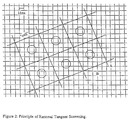
- Figure 2 explains how the most elementary form of "simple rational tangent screening" works.
- the threshold values are precalculated off line for one dot and stored in a square matrix, the size of the matrix determines the size of the dots that it will generate.
- the matrix elements are called in a certain order and used to halftone the contone data. The operation is equivalent to the placement and replication of the matrix elements under the screening angle on the recorder grid.
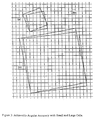
- Figure 3 demonstrates that, especially for small cells (a), the angle of replication cannot be precisely controlled. (The angular accuracy becomes better when the tile is larger).
- U.S. Patent Nos. US-A-3,657,472, US-A-4,084,183, US-A-4,443,060 and US-A-4,537,470 all contain suggestions on how to reduce the problems that occur in printing when combinations of these screens are used.
- Another approach comprises precalculating the screen function values of one period, and storing them in a two dimensional matrix, the size of which is typically 32x32 or 64x64 elements.
- Sampling the screen function period can be done by picking the precalculated matrix element that lies closest to the xy position of the sample point.
- noise is usually added to the xy position coordinates of the samples, and special averaging techniques have to be used. These techniques are described in U.S. Patent US-A-4,449,489, US-A-4,456,924, US-A-4,700,235 and US-A-4,918,622. These special averaging techniques make the implementation of irrational tangent screening algorithms relatively complex and expensive.
- the interactions between two or more rasters correspond to all possible combinations of sum and differences of the original vectors.
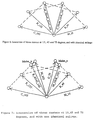
- Figure 7 demonstrates what happens if one of the separations for example the black, is off register.
- the sum of the 15 degree magenta and 135 degree black does not coincide with the 75 degree cyan vector.
- the "second order Moiré” does not have a zero frequency in this case, and a periodical pattern will be created, the angle and period of which correspond to the difference vector.
- the term "Second Order Moire” means the Moiré as a result of the interaction between an original component (for example the "cyan”), and a component that is already the result of an interaction between two other original components (for example magenta and black).
- FIG. 6 only shows the relation between the lengths and angles of the frequency vectors. In addition to these relations, there is also the relative phase of the three rasters. The relative phase of the three rasters will have an effect on the average overlap between the halftone dots, and will determine what kind of rosette is obtained.
- Figure 8 (a) shows a Moiré free combination of three rasters (15, 45 and 75 degrees) in a particular phase relation.
- Figure 8 (b) shows the same set of rasters, but the 45 degree screen is half a period shifted in phase. As can be seen, the "rosette" structure is different in both cases.
- Figure 8 (a) is the preferable one, because it looks less coarse to the eye when seen from a distance, and because it preserves the gradation better in the shadows.
- Figure 9 shows a case of Moiré.
- the relative phase between the sum of the 15 and 75 degree rasters changes continuously, resulting in a shifting rosette.
- the shortest distance of one complete cycle from one kind of a rosette, to another kind and back to the first kind corresponds to the Moiré period, that would be found from the corresponding vector diagram.
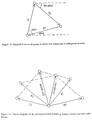
- Figure 6 in that case can be replaced by the simplified diagram in Figure 10, which shows a triangle. If the triangle is "closed”, there will be no second order Moiré, if it is open, the second order Moiré can be calculated from the sum of the three vectors.
- M_x F1*cos(alfa1) + F2*cos(90.0-alfa2) - F3*cos(alfa3)
- M_y F1*sin(alfa1) - F2*sin(90.0-alfa2) - F3*sin(alfa3)
- M_period 1.0/sqrt (M_x*M_x + M_y*M_y);
- the angle of the ideal frequency vector F2' should be 45.0 degrees, and its length should be the distance between the two endpoints of screen1 and screen3.
- Both are irrational numbers with arctangents 15.0 and 75.0 degrees, respectively. In other words, no two integer numbers A and B exist that can make the Moiré period infinitely large.
- the Moiré period in the above example can be calculated and is 1.56 inches. This will be disturbing in most printing situations.
- the Moiré period in this case is 27.07 inches, considerably better than in the pervious case.
- EP 0 342 640 A2 discusses a mechanism for not causing the secondary Moiré pattern in rational tangent screening systems.
- Two screens are defined by the two integer numbers m 0 and n 0 , where m 0 ⁇ n 0 .
- the third screen is at 45°, giving three different screening angles :
- the screening systems corresponding to 15° and 75° are defined in a supercell with pre-angled halftone dots, having a tile size of a 0 (integer) microdots.
- the third screen is oriented at 45° exactly and has a tile size of a 1 (integer) microdots.
- a 0 (n 0 -m 0 ) *a 1 (21) .
- Table I in EP 0 342 640 A2 calculates numbers of screen lines, and thereby discloses screening systems, which obey or do not obey this relation.
- Table I The relevant entries of that table are set out in Table I below, along with a computed value of ( n 0 -m 0 )*a 1 for comparison with a 0 .
- Table I Line # 1 2 3 4 5 6 7 8 9 10 a 1 50 51 40 35 27 26 25 22 20 17 m 0 1 1 1 1 5 5 1 4 1 1 n 0 3 4 3 3 18 17 3 15 3 4 a 0 100 153 80 70 349 314 50 241 40 51 (n 0 -m 0 )*a 1 100 153 80 70 351 312 50 242 40 51
- the screening system for printed reproduction of images comprises three separation screens.
- the separation screens have different screen angles and each screen has rulings. At least two of the screen rulings are different and at least one vector sum of two frequency components of one pair of screens is equal to at least one of the frequency components of the other screen or of a multiple or submultiple of the at least one frequency component.
- Screen angles that are offset by thirty degrees or a multiple thereof and in which the vector lengths of the frequency components are identical are excluded.
- Figure 12 shows the geometry of a cell with multiple preangled dots.
- the angle of the screen that such a tile generates is determined by the ratio of the two integer numbers A and B.
- the period of the screen is proportional to the size of the tile.
- the tile in Figure 12 can be seen as one screen period that, if replicated horizontally and vertically creates a contiguous screen. It is emphasized that the way of creating a rational tangent screen here is fundamentally different from the method described in Figure 4 : In Figure 4, a cell with multiple dots, angled parallel to the cell boundary, is replicated under a rational tangent angle, while in Figure 12, a cell with pre-angled dots is replicated horizontally and vertically. There is a certain symmetry when both techniques are compared.
- This screening system is equivalent to the following screening system :
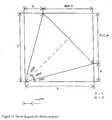
- Figure 13 shows the vector diagram that corresponds to this screening system, with a rectangular frame around it.
- Each of the above screen sets is free from second order Moiré, since the original set (set 1) is free from Moiré, and since all three screens are rotated by exactly the same angle, and since the rulings are all changed by the same constant factor.
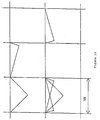
- FIG 15 there is shown an overlay of the 15, 45 and 75 degree screens having the same "tile size". It will be appreciated that the preangled dot geometry of one of the screens corresponds to that shown in Figure 12. Since the three screens use the same tile size, they remain “locked” with respect to each other as shown in Figure 16. Under the "locked” condition, there is ni accumulation of relative position error and, therefore, the rosette remains consistent across the printed page.
Landscapes
- Engineering & Computer Science (AREA)
- Multimedia (AREA)
- Signal Processing (AREA)
- Physics & Mathematics (AREA)
- General Physics & Mathematics (AREA)
- Facsimile Image Signal Circuits (AREA)
- Color Image Communication Systems (AREA)
- Image Processing (AREA)
Applications Claiming Priority (3)
| Application Number | Priority Date | Filing Date | Title |
|---|---|---|---|
| US735644 | 1991-07-25 | ||
| US07/735,644 US5155599A (en) | 1991-07-25 | 1991-07-25 | Screening system and method for color reproduction in offset printing |
| EP92112110A EP0525520B1 (de) | 1991-07-25 | 1992-07-15 | Rasterungs- und Farbreproduktionssystem beim Offsetdruck |
Related Parent Applications (2)
| Application Number | Title | Priority Date | Filing Date |
|---|---|---|---|
| EP92112110A Division EP0525520B1 (de) | 1991-07-25 | 1992-07-15 | Rasterungs- und Farbreproduktionssystem beim Offsetdruck |
| EP92112110.9 Division | 1992-07-15 |
Publications (3)
| Publication Number | Publication Date |
|---|---|
| EP0748109A2 true EP0748109A2 (de) | 1996-12-11 |
| EP0748109A3 EP0748109A3 (de) | 1997-03-19 |
| EP0748109B1 EP0748109B1 (de) | 2001-06-06 |
Family
ID=24956617
Family Applications (2)
| Application Number | Title | Priority Date | Filing Date |
|---|---|---|---|
| EP92112110A Expired - Lifetime EP0525520B1 (de) | 1991-07-25 | 1992-07-15 | Rasterungs- und Farbreproduktionssystem beim Offsetdruck |
| EP96202434A Expired - Lifetime EP0748109B1 (de) | 1991-07-25 | 1992-07-15 | Rasterungssystem und Farbreproduktionsverfahren beim Offsetdruck |
Family Applications Before (1)
| Application Number | Title | Priority Date | Filing Date |
|---|---|---|---|
| EP92112110A Expired - Lifetime EP0525520B1 (de) | 1991-07-25 | 1992-07-15 | Rasterungs- und Farbreproduktionssystem beim Offsetdruck |
Country Status (4)
| Country | Link |
|---|---|
| US (1) | US5155599A (de) |
| EP (2) | EP0525520B1 (de) |
| JP (2) | JP3343140B2 (de) |
| DE (2) | DE69219527T2 (de) |
Cited By (5)
| Publication number | Priority date | Publication date | Assignee | Title |
|---|---|---|---|---|
| WO2000056062A1 (en) * | 1999-03-16 | 2000-09-21 | Megadot Systems Limited | Improvements relating to halftone patterns |
| US6690837B1 (en) | 1998-11-03 | 2004-02-10 | Agfa-Gevaert | Screening method for overlapping sub-images |
| EP1202558A3 (de) * | 2000-10-30 | 2005-01-05 | Xerox Corporation | Verfahren zur moiréfreien Farbhalbtonerzeugung mittels nicht-orthogonaler Gruppenraster |
| EP1686786A1 (de) * | 2005-01-28 | 2006-08-02 | Xerox Corporation | Moiréfreie Farbhalbtonkonfiguration |
| EP2101482A1 (de) * | 2008-03-12 | 2009-09-16 | Dainippon Screen Mfg. Co., Ltd. | Schwellenmatrixerzeugungsverfahren, Rasterbilderzeugungsverfahren und Rasterbilderzeugungsvorrichtung |
Families Citing this family (46)
| Publication number | Priority date | Publication date | Assignee | Title |
|---|---|---|---|---|
| US5477257A (en) * | 1991-11-11 | 1995-12-19 | Matsushita Electric Industrial Co., Ltd. | Image forming method and apparatus using rotated screen with pulse width modulation |
| ATE150245T1 (de) | 1992-05-22 | 1997-03-15 | Agfa Gevaert Nv | Verbessertes verfahren zur frequenzmodulierten halbtonrasterung |
| BE1007264A4 (nl) * | 1993-07-12 | 1995-05-02 | Agfa Gevaert Nv | Rastermethode voor een schrijfsysteem met beperkte densiteitsresolutie. |
| JPH07101032A (ja) * | 1993-09-30 | 1995-04-18 | Sony Corp | レーザ製版装置及び刷版 |
| EP0680193B1 (de) * | 1994-04-27 | 2000-07-12 | Agfa-Gevaert N.V. | Tonabhängige Rosettenstrukturen bei der Mehrschichthalbtonrasterung durch Phasenmodulation |
| DE69527675T2 (de) * | 1994-04-27 | 2003-04-03 | Agfa-Gevaert, Mortsel | Mehrstufige Halbtonrasterung mit gruppierten Punkten und Linien für den elektrografischen Farbdruck |
| US5381247A (en) * | 1994-05-03 | 1995-01-10 | Xerox Corporation | Method for reducing 2-color moire in 4-color printing |
| US5537223A (en) * | 1994-06-02 | 1996-07-16 | Xerox Corporation | Rotating non-rotationally symmetrical halftone dots for encoding embedded data in a hyperacuity printer |
| US5552898A (en) | 1994-07-06 | 1996-09-03 | Agfa-Gevaert | Lossy and lossless compression in raster image processor |
| US5594839A (en) * | 1994-10-17 | 1997-01-14 | Seiko Epson Corporation | Apparatus and method for improving black and color separation in halftoned images by printing black dots in a different screen phase |
| EP0741486B1 (de) * | 1995-05-05 | 2000-08-30 | Agfa-Gevaert N.V. | Moiréfreie Multipegelhalbtonerzeugung für Farbbilder |
| US6532082B1 (en) | 1998-07-16 | 2003-03-11 | Esko-Graphics, N.V. | Halftone printing plates containing microscopic perforations and methods for producing same |
| US6249355B1 (en) | 1998-10-26 | 2001-06-19 | Hewlett-Packard Company | System providing hybrid halftone |
| US6346993B1 (en) * | 1999-02-05 | 2002-02-12 | Xerox Corporation | Tone-variation-resistant phase-shiftable halftone screen system and method of using |
| WO2001058140A1 (en) * | 2000-02-06 | 2001-08-09 | Indigo N.V. | Screening method |
| JP2001219599A (ja) * | 2000-02-10 | 2001-08-14 | Alps Electric Co Ltd | 画像形成方法 |
| US7394570B2 (en) * | 2001-03-07 | 2008-07-01 | Esko-Graphics Imaging Gmbh | Method and apparatus for eliminating seams in screened image data for repetitive printing |
| US6505554B1 (en) | 2001-07-03 | 2003-01-14 | Ralph Rhein | Screen printing process with diminished moire effect |
| US20030081256A1 (en) * | 2001-10-30 | 2003-05-01 | Xerox Corporation | Method of designing halftone screens using non-orthogonal supercells |
| US20030107768A1 (en) * | 2001-12-04 | 2003-06-12 | Crounse Kenneth R. | Halftoning with uniformly dispersed dot growth |
| JP4100157B2 (ja) | 2002-12-09 | 2008-06-11 | 富士ゼロックス株式会社 | 画像形成装置及び方法 |
| JP2005300912A (ja) * | 2004-04-12 | 2005-10-27 | Pfu Ltd | 多色刷網目版の作成方法 |
| US7394572B2 (en) * | 2004-09-23 | 2008-07-01 | Kabushiki Kaisha Toshiba | Method and apparatus for processing of half-tone image |
| US7688473B2 (en) * | 2004-10-26 | 2010-03-30 | Xerox Corporation | Tinted edge enhancement using harmonic halftones for the boundary pixels |
| JP4319182B2 (ja) * | 2005-03-31 | 2009-08-26 | 富士フイルム株式会社 | 画像形成方法、スクリーンセット及び画像形成装置 |
| US20060274338A1 (en) * | 2005-06-07 | 2006-12-07 | Monotype Imaging, Inc. | Method and system for inter-channel clock frequency selection with periodic halftoning |
| US20060279788A1 (en) * | 2005-06-10 | 2006-12-14 | Monotype Imaging, Inc. | Automatic generation of supercell halftoning threshold arrays for high addressability devices |
| DE102005052157A1 (de) * | 2005-11-02 | 2007-05-03 | Man Roland Druckmaschinen Ag | Verfahren und Vorrichtung zur Bebilderung einer löschbaren und wieder verwendbaren Tiefdruckform |
| US20070125468A1 (en) * | 2005-12-05 | 2007-06-07 | Poling David C | Pneumatic tire |
| US7898692B2 (en) * | 2006-11-30 | 2011-03-01 | Xerox Corporation | Rosette printing with up to five colors |
| US7675651B2 (en) * | 2006-11-30 | 2010-03-09 | Xerox Corporation | Moire-free color halftone configuration employing common frequency vectors |
| US7679787B2 (en) * | 2006-11-30 | 2010-03-16 | Xerox Corporation | N-color printing with hexagonal rosettes |
| US8254002B2 (en) * | 2008-02-08 | 2012-08-28 | Kabushiki Kaisha Toshiba | Screen generating apparatus, screen generating method, and image processing apparatus |
| EP2112818B1 (de) * | 2008-04-22 | 2015-06-10 | Heidelberger Druckmaschinen Aktiengesellschaft | Verfahren zur Reduzierung der Flächendeckung einer Druckplatte |
| US8437037B2 (en) * | 2008-05-29 | 2013-05-07 | Xeikon Manufacturing N.V. | Multilevel clustered dot screening method with improved detail and reduced image noise |
| ATE550170T1 (de) | 2008-12-19 | 2012-04-15 | Agfa Graphics Nv | Bildverarbeitungsverfahren für dreidimensionales drucken |
| EP2644362B1 (de) | 2008-12-19 | 2016-06-01 | Agfa Graphics Nv | Verfahren zur Verminderung der Bildqualitätsartefakte beim dreidimensionalen Drucken |
| JP4752920B2 (ja) | 2009-01-22 | 2011-08-17 | ブラザー工業株式会社 | 画像処理装置及び画像処理プログラム |
| US8467103B2 (en) * | 2009-08-12 | 2013-06-18 | Xerox Corporation | Moiré-free color halftoning methods, apparatus and systems |
| US8351085B2 (en) * | 2009-08-12 | 2013-01-08 | Xerox Corporation | Moire-free color halftoning methods, apparatus and systems |
| US8547598B2 (en) * | 2011-04-28 | 2013-10-01 | Xerox Corporation | Polygonal-boundary-based halftone method |
| US9211746B1 (en) | 2014-06-26 | 2015-12-15 | Eastman Kodak Company | Hybrid printer for printing on non-porous media |
| US11142013B2 (en) | 2016-05-27 | 2021-10-12 | Esko Software Bvba | Method for smoother tonal response in flexographic printing |
| US11667115B2 (en) | 2017-10-27 | 2023-06-06 | Agfa Offset Bv | Digital halftoning with spiral dots |
| CN112655190B (zh) | 2018-08-10 | 2022-12-06 | 爱克发胶印有限公司 | 具有表示螺旋的点的数字半色调 |
| ES3036310T3 (en) | 2019-04-30 | 2025-09-17 | Eco3 Bv | Digital halftoning with spiral dots |
Family Cites Families (8)
| Publication number | Priority date | Publication date | Assignee | Title |
|---|---|---|---|---|
| US3742129A (en) * | 1971-07-07 | 1973-06-26 | Harris Intertype Corp | Apparatus and method for generating halftones for image reproduction |
| NL184927C (nl) * | 1978-10-04 | 1989-12-01 | Stork Brabant Bv | Werkwijze voor het vormen van voor reproduktie geschikte gerasterde beelden. |
| ATE25434T1 (de) * | 1981-11-20 | 1987-02-15 | Hell Rudolf Dr Ing Gmbh | Rastersystem fuer den mehrfarbendruck. |
| US4924301A (en) * | 1988-11-08 | 1990-05-08 | Seecolor Corporation | Apparatus and methods for digital halftoning |
| JPH0691620B2 (ja) * | 1988-11-15 | 1994-11-14 | 大日本スクリーン製造株式会社 | カラー画像の網目版画像記録方法 |
| US5040080A (en) * | 1989-06-06 | 1991-08-13 | Scholten Alvin D | Electronic screening |
| WO1991002426A2 (en) * | 1989-08-04 | 1991-02-21 | Intergraph Corporation | Rapid variable angle digital screening |
| DE69025706T2 (de) * | 1989-11-08 | 1996-08-01 | Adobe Systems Inc | Verfahren zur Erzeugung gerasterter Halbtonbilder |
-
1991
- 1991-07-25 US US07/735,644 patent/US5155599A/en not_active Expired - Lifetime
-
1992
- 1992-07-15 DE DE69219527T patent/DE69219527T2/de not_active Expired - Lifetime
- 1992-07-15 EP EP92112110A patent/EP0525520B1/de not_active Expired - Lifetime
- 1992-07-15 EP EP96202434A patent/EP0748109B1/de not_active Expired - Lifetime
- 1992-07-15 DE DE69231866T patent/DE69231866T2/de not_active Expired - Lifetime
- 1992-07-27 JP JP19998792A patent/JP3343140B2/ja not_active Expired - Fee Related
-
2002
- 2002-06-21 JP JP2002181157A patent/JP2003110862A/ja active Pending
Cited By (12)
| Publication number | Priority date | Publication date | Assignee | Title |
|---|---|---|---|---|
| US6690837B1 (en) | 1998-11-03 | 2004-02-10 | Agfa-Gevaert | Screening method for overlapping sub-images |
| US7231096B2 (en) | 1998-11-03 | 2007-06-12 | Agfa-Gevaert N.V. | Screening method for overlapping sub-images |
| WO2000056062A1 (en) * | 1999-03-16 | 2000-09-21 | Megadot Systems Limited | Improvements relating to halftone patterns |
| US7268920B1 (en) * | 1999-03-16 | 2007-09-11 | Megadot Systems Limited | Halftone patterns |
| USRE41604E1 (en) * | 1999-03-16 | 2010-08-31 | Megadot Systems Limited | Halftone patterns |
| EP1202558A3 (de) * | 2000-10-30 | 2005-01-05 | Xerox Corporation | Verfahren zur moiréfreien Farbhalbtonerzeugung mittels nicht-orthogonaler Gruppenraster |
| EP1686786A1 (de) * | 2005-01-28 | 2006-08-02 | Xerox Corporation | Moiréfreie Farbhalbtonkonfiguration |
| US7480076B2 (en) | 2005-01-28 | 2009-01-20 | Xerox Corporation | Moiré-free color halftone configuration |
| US7933044B2 (en) | 2005-01-28 | 2011-04-26 | Xerox Corporation | Moiré-free color halftone configuration |
| EP2101482A1 (de) * | 2008-03-12 | 2009-09-16 | Dainippon Screen Mfg. Co., Ltd. | Schwellenmatrixerzeugungsverfahren, Rasterbilderzeugungsverfahren und Rasterbilderzeugungsvorrichtung |
| US8169666B2 (en) | 2008-03-12 | 2012-05-01 | Dainippon Screen Mfg. Co., Ltd. | Threshold matrix generation method, halftone image generation method, and halftone image generating apparatus |
| EP2469835A1 (de) * | 2008-03-12 | 2012-06-27 | Dainippon Screen Mfg., Co., Ltd. | Verfahren zur Erzeugung einer Schwellenwertmatrix |
Also Published As
| Publication number | Publication date |
|---|---|
| US5155599A (en) | 1992-10-13 |
| EP0525520B1 (de) | 1997-05-07 |
| DE69231866D1 (de) | 2001-07-12 |
| EP0525520A2 (de) | 1993-02-03 |
| JP2003110862A (ja) | 2003-04-11 |
| JP3343140B2 (ja) | 2002-11-11 |
| DE69231866T2 (de) | 2002-03-28 |
| EP0748109B1 (de) | 2001-06-06 |
| DE69219527D1 (de) | 1997-06-12 |
| EP0748109A3 (de) | 1997-03-19 |
| EP0525520A3 (en) | 1993-04-07 |
| JPH05257268A (ja) | 1993-10-08 |
| DE69219527T2 (de) | 1998-01-02 |
Similar Documents
| Publication | Publication Date | Title |
|---|---|---|
| EP0748109B1 (de) | Rasterungssystem und Farbreproduktionsverfahren beim Offsetdruck | |
| EP0204094B2 (de) | Druckverfahren vom Abtastaufzeichnungstyp und dessen Verwirklichungsvorrichtung | |
| KR910007211B1 (ko) | 망목판 화상과 그 기록방법 및 기록장치 | |
| US4499489A (en) | Production of screen printing blocks | |
| EP0442971B1 (de) | Verfahren zur digitalen erzeugung gerasteter halbtöne | |
| US4196451A (en) | Electronic halftone generator | |
| EP0749232B1 (de) | Dither matrix zur Halbtonwiedergabe von Grautonbildern unter Verwendung einer Maskierung mit blauem Rauschen | |
| US5175804A (en) | System and method for color image reproduction from color separations prepared from random fixed size dot placement | |
| US4894726A (en) | Methods and apparatus for eliminating Moire interference using quasiperiodic patterns | |
| EP0409608B1 (de) | Verfahren für Offset- und ähnliche Druckverfahren | |
| EP0405052A2 (de) | Technik zur Erzeugung eines feinkörnigen Zitterbildes mit erhöhten Graupegelzahl | |
| US5202772A (en) | Color halftone screen utilizing preselected halftone dots placed at preselected distance and screen angles from center halftone dots | |
| JP3429300B2 (ja) | 中間調画像生成に用いるためのスクリーン装置 | |
| EP0680195A1 (de) | Mehrstufige Halbtonrasterung mit gruppierten Punkten und Linien für den elektrografischen Farbdruck | |
| EP0254448B1 (de) | Optimale Halbtonfarbmuster für Rasterabtastbilder | |
| EP0493935B1 (de) | Digitales elektronisches System zum Drucken gerasteter Halbtöne | |
| EP0363943B1 (de) | Verfahren zur Produktion von Halbtondaten | |
| EP0342845B1 (de) | Halbtonbilderzeugung | |
| EP0581415A2 (de) | System und Verfahren zur rasterlosen Umsetzung mit grosser Genauigkeit unter Benutzung eines trennbaren Filters | |
| Jones | Evolution of halftoning technology in the United States patent literature | |
| EP0721278B1 (de) | Verfahren zur Herstellung einer Schwellenmatrix sowie Verfahren und Vorrichtung zur Erzeugung eines halbtongerasterten Bildes | |
| US5793500A (en) | Devices and methods for offset and similar printing systems | |
| US6697170B2 (en) | Devices and methods for offset and similar printing systems | |
| JPH0256176A (ja) | 網目スクリーン形成方法 | |
| JPH01223460A (ja) | 印刷版作成方法および装置 |
Legal Events
| Date | Code | Title | Description |
|---|---|---|---|
| PUAI | Public reference made under article 153(3) epc to a published international application that has entered the european phase |
Free format text: ORIGINAL CODE: 0009012 |
|
| AC | Divisional application: reference to earlier application |
Ref document number: 525520 Country of ref document: EP |
|
| AK | Designated contracting states |
Kind code of ref document: A2 Designated state(s): DE FR GB NL |
|
| PUAL | Search report despatched |
Free format text: ORIGINAL CODE: 0009013 |
|
| AK | Designated contracting states |
Kind code of ref document: A3 Designated state(s): DE FR GB NL |
|
| 17P | Request for examination filed |
Effective date: 19970919 |
|
| 17Q | First examination report despatched |
Effective date: 19990303 |
|
| RAP1 | Party data changed (applicant data changed or rights of an application transferred) |
Owner name: AGFA CORPORATION |
|
| RAP1 | Party data changed (applicant data changed or rights of an application transferred) |
Owner name: AGFA CORPORATION |
|
| GRAG | Despatch of communication of intention to grant |
Free format text: ORIGINAL CODE: EPIDOS AGRA |
|
| GRAG | Despatch of communication of intention to grant |
Free format text: ORIGINAL CODE: EPIDOS AGRA |
|
| GRAH | Despatch of communication of intention to grant a patent |
Free format text: ORIGINAL CODE: EPIDOS IGRA |
|
| GRAH | Despatch of communication of intention to grant a patent |
Free format text: ORIGINAL CODE: EPIDOS IGRA |
|
| RAP1 | Party data changed (applicant data changed or rights of an application transferred) |
Owner name: XEIKON NV Owner name: AGFA CORPORATION |
|
| GRAA | (expected) grant |
Free format text: ORIGINAL CODE: 0009210 |
|
| AC | Divisional application: reference to earlier application |
Ref document number: 525520 Country of ref document: EP |
|
| AK | Designated contracting states |
Kind code of ref document: B1 Designated state(s): DE FR GB NL |
|
| REF | Corresponds to: |
Ref document number: 69231866 Country of ref document: DE Date of ref document: 20010712 |
|
| ET | Fr: translation filed | ||
| REG | Reference to a national code |
Ref country code: GB Ref legal event code: IF02 |
|
| PLBE | No opposition filed within time limit |
Free format text: ORIGINAL CODE: 0009261 |
|
| STAA | Information on the status of an ep patent application or granted ep patent |
Free format text: STATUS: NO OPPOSITION FILED WITHIN TIME LIMIT |
|
| 26N | No opposition filed | ||
| PGFP | Annual fee paid to national office [announced via postgrant information from national office to epo] |
Ref country code: NL Payment date: 20100629 Year of fee payment: 19 |
|
| PGFP | Annual fee paid to national office [announced via postgrant information from national office to epo] |
Ref country code: GB Payment date: 20100623 Year of fee payment: 19 Ref country code: FR Payment date: 20100722 Year of fee payment: 19 Ref country code: DE Payment date: 20100623 Year of fee payment: 19 |
|
| REG | Reference to a national code |
Ref country code: NL Ref legal event code: V1 Effective date: 20120201 |
|
| GBPC | Gb: european patent ceased through non-payment of renewal fee |
Effective date: 20110715 |
|
| REG | Reference to a national code |
Ref country code: FR Ref legal event code: ST Effective date: 20120330 |
|
| PG25 | Lapsed in a contracting state [announced via postgrant information from national office to epo] |
Ref country code: FR Free format text: LAPSE BECAUSE OF NON-PAYMENT OF DUE FEES Effective date: 20110801 Ref country code: DE Free format text: LAPSE BECAUSE OF NON-PAYMENT OF DUE FEES Effective date: 20120201 |
|
| REG | Reference to a national code |
Ref country code: DE Ref legal event code: R119 Ref document number: 69231866 Country of ref document: DE Effective date: 20120201 |
|
| PG25 | Lapsed in a contracting state [announced via postgrant information from national office to epo] |
Ref country code: NL Free format text: LAPSE BECAUSE OF NON-PAYMENT OF DUE FEES Effective date: 20120201 |
|
| PG25 | Lapsed in a contracting state [announced via postgrant information from national office to epo] |
Ref country code: GB Free format text: LAPSE BECAUSE OF NON-PAYMENT OF DUE FEES Effective date: 20110715 |