EP0748700A1 - Wärmeempfindliches Aufzeichnungsmaterial - Google Patents
Wärmeempfindliches Aufzeichnungsmaterial Download PDFInfo
- Publication number
- EP0748700A1 EP0748700A1 EP96303803A EP96303803A EP0748700A1 EP 0748700 A1 EP0748700 A1 EP 0748700A1 EP 96303803 A EP96303803 A EP 96303803A EP 96303803 A EP96303803 A EP 96303803A EP 0748700 A1 EP0748700 A1 EP 0748700A1
- Authority
- EP
- European Patent Office
- Prior art keywords
- protective layer
- resin
- thermosensitive coloring
- material according
- layer
- Prior art date
- Legal status (The legal status is an assumption and is not a legal conclusion. Google has not performed a legal analysis and makes no representation as to the accuracy of the status listed.)
- Withdrawn
Links
Images

Classifications
-
- B—PERFORMING OPERATIONS; TRANSPORTING
- B41—PRINTING; LINING MACHINES; TYPEWRITERS; STAMPS
- B41M—PRINTING, DUPLICATING, MARKING, OR COPYING PROCESSES; COLOUR PRINTING
- B41M5/00—Duplicating or marking methods; Sheet materials for use therein
- B41M5/26—Thermography ; Marking by high energetic means, e.g. laser otherwise than by burning, and characterised by the material used
- B41M5/40—Thermography ; Marking by high energetic means, e.g. laser otherwise than by burning, and characterised by the material used characterised by the base backcoat, intermediate, or covering layers, e.g. for thermal transfer dye-donor or dye-receiver sheets; Heat, radiation filtering or absorbing means or layers; combined with other image registration layers or compositions; Special originals for reproduction by thermography
- B41M5/42—Intermediate, backcoat, or covering layers
-
- B—PERFORMING OPERATIONS; TRANSPORTING
- B41—PRINTING; LINING MACHINES; TYPEWRITERS; STAMPS
- B41M—PRINTING, DUPLICATING, MARKING, OR COPYING PROCESSES; COLOUR PRINTING
- B41M5/00—Duplicating or marking methods; Sheet materials for use therein
- B41M5/26—Thermography ; Marking by high energetic means, e.g. laser otherwise than by burning, and characterised by the material used
- B41M5/40—Thermography ; Marking by high energetic means, e.g. laser otherwise than by burning, and characterised by the material used characterised by the base backcoat, intermediate, or covering layers, e.g. for thermal transfer dye-donor or dye-receiver sheets; Heat, radiation filtering or absorbing means or layers; combined with other image registration layers or compositions; Special originals for reproduction by thermography
- B41M5/46—Thermography ; Marking by high energetic means, e.g. laser otherwise than by burning, and characterised by the material used characterised by the base backcoat, intermediate, or covering layers, e.g. for thermal transfer dye-donor or dye-receiver sheets; Heat, radiation filtering or absorbing means or layers; combined with other image registration layers or compositions; Special originals for reproduction by thermography characterised by the light-to-heat converting means; characterised by the heat or radiation filtering or absorbing means or layers
-
- G—PHYSICS
- G09—EDUCATION; CRYPTOGRAPHY; DISPLAY; ADVERTISING; SEALS
- G09F—DISPLAYING; ADVERTISING; SIGNS; LABELS OR NAME-PLATES; SEALS
- G09F3/00—Labels, tag tickets, or similar identification or indication means; Seals; Postage or like stamps
- G09F3/02—Forms or constructions
- G09F3/0291—Labels or tickets undergoing a change under particular conditions, e.g. heat, radiation, passage of time
-
- B—PERFORMING OPERATIONS; TRANSPORTING
- B41—PRINTING; LINING MACHINES; TYPEWRITERS; STAMPS
- B41M—PRINTING, DUPLICATING, MARKING, OR COPYING PROCESSES; COLOUR PRINTING
- B41M5/00—Duplicating or marking methods; Sheet materials for use therein
- B41M5/26—Thermography ; Marking by high energetic means, e.g. laser otherwise than by burning, and characterised by the material used
- B41M5/30—Thermography ; Marking by high energetic means, e.g. laser otherwise than by burning, and characterised by the material used using chemical colour formers
- B41M5/323—Organic colour formers, e.g. leuco dyes
-
- B—PERFORMING OPERATIONS; TRANSPORTING
- B41—PRINTING; LINING MACHINES; TYPEWRITERS; STAMPS
- B41M—PRINTING, DUPLICATING, MARKING, OR COPYING PROCESSES; COLOUR PRINTING
- B41M5/00—Duplicating or marking methods; Sheet materials for use therein
- B41M5/26—Thermography ; Marking by high energetic means, e.g. laser otherwise than by burning, and characterised by the material used
- B41M5/30—Thermography ; Marking by high energetic means, e.g. laser otherwise than by burning, and characterised by the material used using chemical colour formers
- B41M5/323—Organic colour formers, e.g. leuco dyes
- B41M5/327—Organic colour formers, e.g. leuco dyes with a lactone or lactam ring
-
- B—PERFORMING OPERATIONS; TRANSPORTING
- B41—PRINTING; LINING MACHINES; TYPEWRITERS; STAMPS
- B41M—PRINTING, DUPLICATING, MARKING, OR COPYING PROCESSES; COLOUR PRINTING
- B41M5/00—Duplicating or marking methods; Sheet materials for use therein
- B41M5/26—Thermography ; Marking by high energetic means, e.g. laser otherwise than by burning, and characterised by the material used
- B41M5/30—Thermography ; Marking by high energetic means, e.g. laser otherwise than by burning, and characterised by the material used using chemical colour formers
- B41M5/323—Organic colour formers, e.g. leuco dyes
- B41M5/327—Organic colour formers, e.g. leuco dyes with a lactone or lactam ring
- B41M5/3275—Fluoran compounds
-
- B—PERFORMING OPERATIONS; TRANSPORTING
- B41—PRINTING; LINING MACHINES; TYPEWRITERS; STAMPS
- B41M—PRINTING, DUPLICATING, MARKING, OR COPYING PROCESSES; COLOUR PRINTING
- B41M5/00—Duplicating or marking methods; Sheet materials for use therein
- B41M5/26—Thermography ; Marking by high energetic means, e.g. laser otherwise than by burning, and characterised by the material used
- B41M5/30—Thermography ; Marking by high energetic means, e.g. laser otherwise than by burning, and characterised by the material used using chemical colour formers
- B41M5/333—Colour developing components therefor, e.g. acidic compounds
- B41M5/3333—Non-macromolecular compounds
- B41M5/3335—Compounds containing phenolic or carboxylic acid groups or metal salts thereof
-
- B—PERFORMING OPERATIONS; TRANSPORTING
- B41—PRINTING; LINING MACHINES; TYPEWRITERS; STAMPS
- B41M—PRINTING, DUPLICATING, MARKING, OR COPYING PROCESSES; COLOUR PRINTING
- B41M5/00—Duplicating or marking methods; Sheet materials for use therein
- B41M5/26—Thermography ; Marking by high energetic means, e.g. laser otherwise than by burning, and characterised by the material used
- B41M5/30—Thermography ; Marking by high energetic means, e.g. laser otherwise than by burning, and characterised by the material used using chemical colour formers
- B41M5/337—Additives; Binders
- B41M5/3372—Macromolecular compounds
-
- B—PERFORMING OPERATIONS; TRANSPORTING
- B41—PRINTING; LINING MACHINES; TYPEWRITERS; STAMPS
- B41M—PRINTING, DUPLICATING, MARKING, OR COPYING PROCESSES; COLOUR PRINTING
- B41M5/00—Duplicating or marking methods; Sheet materials for use therein
- B41M5/26—Thermography ; Marking by high energetic means, e.g. laser otherwise than by burning, and characterised by the material used
- B41M5/30—Thermography ; Marking by high energetic means, e.g. laser otherwise than by burning, and characterised by the material used using chemical colour formers
- B41M5/337—Additives; Binders
- B41M5/3375—Non-macromolecular compounds
-
- B—PERFORMING OPERATIONS; TRANSPORTING
- B41—PRINTING; LINING MACHINES; TYPEWRITERS; STAMPS
- B41M—PRINTING, DUPLICATING, MARKING, OR COPYING PROCESSES; COLOUR PRINTING
- B41M5/00—Duplicating or marking methods; Sheet materials for use therein
- B41M5/26—Thermography ; Marking by high energetic means, e.g. laser otherwise than by burning, and characterised by the material used
- B41M5/40—Thermography ; Marking by high energetic means, e.g. laser otherwise than by burning, and characterised by the material used characterised by the base backcoat, intermediate, or covering layers, e.g. for thermal transfer dye-donor or dye-receiver sheets; Heat, radiation filtering or absorbing means or layers; combined with other image registration layers or compositions; Special originals for reproduction by thermography
- B41M5/41—Base layers supports or substrates
-
- B—PERFORMING OPERATIONS; TRANSPORTING
- B41—PRINTING; LINING MACHINES; TYPEWRITERS; STAMPS
- B41M—PRINTING, DUPLICATING, MARKING, OR COPYING PROCESSES; COLOUR PRINTING
- B41M5/00—Duplicating or marking methods; Sheet materials for use therein
- B41M5/26—Thermography ; Marking by high energetic means, e.g. laser otherwise than by burning, and characterised by the material used
- B41M5/40—Thermography ; Marking by high energetic means, e.g. laser otherwise than by burning, and characterised by the material used characterised by the base backcoat, intermediate, or covering layers, e.g. for thermal transfer dye-donor or dye-receiver sheets; Heat, radiation filtering or absorbing means or layers; combined with other image registration layers or compositions; Special originals for reproduction by thermography
- B41M5/42—Intermediate, backcoat, or covering layers
- B41M5/426—Intermediate, backcoat, or covering layers characterised by inorganic compounds, e.g. metals, metal salts, metal complexes
-
- B—PERFORMING OPERATIONS; TRANSPORTING
- B41—PRINTING; LINING MACHINES; TYPEWRITERS; STAMPS
- B41M—PRINTING, DUPLICATING, MARKING, OR COPYING PROCESSES; COLOUR PRINTING
- B41M5/00—Duplicating or marking methods; Sheet materials for use therein
- B41M5/26—Thermography ; Marking by high energetic means, e.g. laser otherwise than by burning, and characterised by the material used
- B41M5/40—Thermography ; Marking by high energetic means, e.g. laser otherwise than by burning, and characterised by the material used characterised by the base backcoat, intermediate, or covering layers, e.g. for thermal transfer dye-donor or dye-receiver sheets; Heat, radiation filtering or absorbing means or layers; combined with other image registration layers or compositions; Special originals for reproduction by thermography
- B41M5/42—Intermediate, backcoat, or covering layers
- B41M5/44—Intermediate, backcoat, or covering layers characterised by the macromolecular compounds
-
- B—PERFORMING OPERATIONS; TRANSPORTING
- B41—PRINTING; LINING MACHINES; TYPEWRITERS; STAMPS
- B41M—PRINTING, DUPLICATING, MARKING, OR COPYING PROCESSES; COLOUR PRINTING
- B41M5/00—Duplicating or marking methods; Sheet materials for use therein
- B41M5/26—Thermography ; Marking by high energetic means, e.g. laser otherwise than by burning, and characterised by the material used
- B41M5/40—Thermography ; Marking by high energetic means, e.g. laser otherwise than by burning, and characterised by the material used characterised by the base backcoat, intermediate, or covering layers, e.g. for thermal transfer dye-donor or dye-receiver sheets; Heat, radiation filtering or absorbing means or layers; combined with other image registration layers or compositions; Special originals for reproduction by thermography
- B41M5/42—Intermediate, backcoat, or covering layers
- B41M5/44—Intermediate, backcoat, or covering layers characterised by the macromolecular compounds
- B41M5/443—Silicon-containing polymers, e.g. silicones, siloxanes
-
- B—PERFORMING OPERATIONS; TRANSPORTING
- B41—PRINTING; LINING MACHINES; TYPEWRITERS; STAMPS
- B41M—PRINTING, DUPLICATING, MARKING, OR COPYING PROCESSES; COLOUR PRINTING
- B41M5/00—Duplicating or marking methods; Sheet materials for use therein
- B41M5/26—Thermography ; Marking by high energetic means, e.g. laser otherwise than by burning, and characterised by the material used
- B41M5/40—Thermography ; Marking by high energetic means, e.g. laser otherwise than by burning, and characterised by the material used characterised by the base backcoat, intermediate, or covering layers, e.g. for thermal transfer dye-donor or dye-receiver sheets; Heat, radiation filtering or absorbing means or layers; combined with other image registration layers or compositions; Special originals for reproduction by thermography
- B41M5/42—Intermediate, backcoat, or covering layers
- B41M5/44—Intermediate, backcoat, or covering layers characterised by the macromolecular compounds
- B41M5/446—Fluorine-containing polymers
Definitions
- the present invention relates to a thermosensitive recording material adapted to develop colors by application of heat thereto, thereby forming a desired image.
- thermosensitive recording materials are advantageous and preferred over other types of recording materials for several reasons, including: practicality of use, ease of handling, and a relatively low cost of thermosensitive recording apparatus to be used therewith. Accordingly, thermosensitive recording materials have been widely used as output means for computers, facsimile machines, recorders and the like.
- a typical thermosensitive recording apparatus employs a thermal head, a laser beam or other means for applying heat to a thermosensitive coloring layer of the thermosensitive recording material. The application of heat to the thermosensitive recording material thereby records or forms an image on the recording material.
- the typical thermosensitive recording material contains a color developing component and an acid component.
- the color developing component and acid component react with each other by application of heat thereto, thereby forming an image.
- the product of the reaction may be dissolved by ultraviolet rays, or may be oxidized, for example, due to its exposure to the air. As a result, the image may disappear over time.
- Another problem with such thermosensitive recording materials is that the thermosensitive coloring layer itself may turn yellow due to chronological changes of the acid component.
- thermosensitive coloring layer To avoid the disappearance of the image and the yellowing of the thermosensitive coloring layer, it is proposed to prepare a protective layer and apply it on the thermosensitive coloring layer.
- the protective layer includes an ultraviolet-ray absorbing agent and an ultraviolet-ray reflecting agent. According to this method, ultraviolet rays received from the outside are absorbed or reflected before they reach the thermosensitive coloring layer. That is, the ultraviolet rays are absorbed or reflected as they pass through the inside of the protective layer. Accordingly, the thermosensitive recording material including the protective layer exhibits significantly improved resistance to light.
- thermosensitive coloring layer can also be shielded from the air, and is therefore free from oxidation.
- the protective layer must be formed using a water-soluble resin as a binder, and an aqueous coating liquid containing the ultraviolet-ray absorbing agent and ultraviolet-ray reflecting agent. This is necessary because the thermosensitive coloring layer of the recording material may develop color(s) upon contact with an organic solvent.
- the aqueous protective layer contains a slight amount of alkali metal ions. Further, high energy is applied to the thermal head so as to make up for reduction of the sensitivity of the thermosensitive coloring layer due to provision of the protective layer on the coloring layer.
- the alkali metal ions contained in the protective layer and the high energy applied to the thermal head provide a synergetic effect that causes the thermal head or heating element to electrolyze at its conductive portion. This occurs even though only a slight amount of the alkali metal ions are contained in the protective layer. This effect undesirably increases a possibility of breakdown or corrosion of the thermal head.
- the ultraviolet-ray reflecting agent contained in the protective layer is generally formed of a metal oxide in the form of ultra-fine grains.
- a recording surface of the thermal head is likely to be worn off or broken due to its contact with the extremely hard ultra-fine grains of the metal oxide.
- thermosensitive recording material that has excellent light resistance, and is less likely to suffer from oxidation due to its exposure to the air. It is also an object of the present invention to provide a thermosensitive recording material that retards breakdown or corrosion of a thermal head due to the high energy applied thereto. Furthermore, the present invention provides processes for forming and using such thermosensitive recording materials.
- thermosensitive recording material comprises: a support member; a thermosensitive coloring layer formed on a first surface of the support member, for developing color upon application of heat thereto; a first protective layer formed on the thermosensitive coloring layer and comprising at least one of an ultraviolet-ray absorbing agent and an ultraviolet-ray reflecting agent; and a second protective layer formed on the first protective layer and comprising a water-insoluble resin.
- thermosensitive recording material comprises: a support member; a thermosensitive coloring layer formed on the support member, for developing color upon application of heat thereto; a first protective layer formed on the thermosensitive coloring layer and comprising an ultraviolet-ray reflecting agent; and a second protective layer formed on said first protective layer and comprising a water-insoluble resin, wherein at least one of the first protective layer and the second protective layer contains an ultraviolet-ray absorbing agent.
- thermosensitive coloring layer is covered with the first protective layer, and is thus prevented from being oxidized due to its exposure to the air. Further, ultraviolet rays received by the thermosensitive recording material are absorbed or reflected by the ultraviolet-ray absorbing agent and/or ultraviolet-ray reflecting agent contained in the first protective layer. Accordingly, the light resistance of the thermosensitive coloring layer is significantly enhanced.
- the second protective layer formed of a water-insoluble resin may be formed so as to contain no alkali metal ions or metal oxides.
- the thermal head When this second protective layer is brought into contact with a thermal head, such as during a printing operation, the thermal head is rendered free from breakdown or corrosion that is otherwise caused by such alkali metal ions and metal oxides.
- the durability of the thermal head may be significantly improved.
- the above-indicated water-insoluble resin in embodiments of the present invention preferably comprises silicone resin, preferably alone or in combination with another resin.
- the thermosensitive recording material is prevented from sticking to the thermal head during a printing operation.
- the present thermosensitive recording material may further include an adhesive layer formed on a second surface of the support member remote from the thermosensitive coloring layer. As a covering of an adhesive face of the adhesive layer may be applied a release paper such that the release paper is removable from the adhesive layer. After a desired image is printed on this thermosensitive recording material, the recording material can be attached to a desired position of an object by separating the release paper from the adhesive layer and applying the recording material to the object.
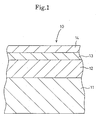
- Fig. 1 is a cross-sectional view of a color thermosensitive recording material 10 constructed according to the present invention.
- the color thermosensitive recording material 10 includes a support member 11, a thermosensitive coloring layer 12, a first protective layer 13, and a second protective layer 14.
- the support member 11 may be any suitable substrate material, and in embodiments may be selected from papers, such as high quality paper, coat paper, glassine paper and the like; plastic films, including those formed of polyester, polystyrene, polyvinyl chloride and its copolymers, polymethacrylate and its copolymers, polyethylene, polypropylene and the like; synthetic paper; and the like.
- the thermosensitive coloring layer 12 includes a leuco dye, a color developer that undergoes thermal reaction with the leuco dye upon application of heat thereto for developing color of the leuco dye, and a coloring accelerator for accelerating the coloring reaction between the leuco dye and the color developer.
- the coloring layer 12 further includes a binder for binding the leuco dye and the color developer.
- the thermosensitive recording layer 12 may further include assistants or additives.
- the leuco dye used in the thermosensitive coloring layer 12 of the present invention may be selected from any of the suitable leuco dyes, including but not limited to:
- the color developer may be selected from any of the various suitable developer compounds.
- the developer is a phenolic compound that can be liquified or vaporized at a temperature equal to or higher than room temperature such that it reacts with the leuco dye as indicated above so as to develop the color of the leuco dye.
- room temperature is meant temperatures ranging from about 15° to 35°C.
- phenolic compounds used for the color developer include, but are not limited to: 4,4'-isopropylidenediphenol (bisphenol A), 4,4'-isopropylidenebis(2-chlorophenol), 4,4'-isopropylidenebis(2-methylphenol), 4,4'-isopropylidenebis(2-tert-butylphenol), 4,4'-sec-butylidenephenol, 4,4'-cyclohexylidenephenol, 4-tert-butylphenol, 4-tert-octylphenol, 4-tert-octylcatechol, 4-phenylphenol (P-phenylphenol), 4-hydroxydiphenoxide, 2,2'-dihydroxydiphenol, ⁇ -naphthol, ⁇ -naphthol, methyl-4-hydroxybenzoate, benzyl-4-hydroxybenzoate, ethyl-4-hydroxybenzoate, propyl-4-hydroxybenzoate, 4-hydroxy-acetophenol, no
- the coloring accelerator used in the present invention may include any of the various suitable coloring accelerators.
- the coloring accelerator is preferably selected from: stearic acid amide, stearic acid methylenebisamide, oleic acid amide, palmitic acid amide, amide of oleic acid derived from sperm oil, amide of fatty acid derived from coconut oil, mixtures thereof, and the like.
- the binder used in forming the thermosensitive recording layer may be selected from any suitable binder material such that the other components of the recording layer may be properly applied.
- the binder may be selected from compounds including, but not limited to, polyvinyl alcohol, starch or its modified forms and derivatives, methylcellulose, hydroxyethyl cellulose, carboxymethyl cellulose, gum arabic, gelatin, casein, polyvinylpyrrolidone, polyacrylamide, polyacrylic salts, styrene/maleic anhydride copolymer, isobutylene/maleic anhydride copolymer, styrene/butadiene copolymer, polyester, polyvinyl acetate, polyacrylic ester, polyurethane, mixtures thereof, and the like.
- thermosensitive coloring layer 12 may optionally further contain various additives and/or assistants.
- the thermosensitive coloring layer 12 may further contain such additional components as waxes, higher fatty acid metal salts, higher fatty acid amides, dispersants, lubricants, defoaming agents, and assistants such as fine powder.
- the first protective layer 13 of the thermosensitive recording material includes at least one of an ultraviolet-ray absorbing agent and an ultraviolet-ray reflecting agent, preferably dispersed in a binder.
- the ultraviolet-ray absorbing agent may be selected from any of the various suitable agents including, but not limited to:
- the ultraviolet-ray reflecting agent may similarly be selected from any of the various suitable materials.
- the ultraviolet-ray reflecting agent is preferably selected from ultra-fine grains of titanium oxide or zirconium oxide, but other materials may be readily used.
- the grain size of the ultra-fine grains is preferably in the range of 0.02 to 0.05 ⁇ m, although smaller or larger sized grains may be used according to specific applications.
- grain size is meant the average particle size or average diameter of the grain particles.
- the ultraviolet-ray reflecting agent is incorporated into the first protective layer rather than the second layer. This is preferred because ultra-fine grains that may be included in the ultraviolet-ray reflecting agent can be very hard, and can cause abrasion of the thermal head, causing it to be worn or broken.
- the first protective layer includes the ultraviolet-ray absorbing agent and that the second protective layer includes the ultraviolet-ray reflecting agent.
- the first protective layer 13 is preferably formed from an aqueous coating liquid so as to avoid undesired coloring of the thermosensitive coloring layer 12.
- the binder used for the first protective layer 13 may, for example, be selected from the binders specified above for the thermosensitive coloring layer 12.
- the binder for the first protective layer 13 may include such compounds as polyvinyl alcohol, starch or its modified forms and derivatives, methylcellulose, hydroxyethyl cellulose, carboxymethyl cellulose, gum arabic, gelatin, casein, polyvinylpyrrolidone, polyacrylamide, polyacrylic salts, styrene/maleic anhydride copolymer, isobutylene/maleic anhydride copolymer, styrene/butadiene copolymer, polyester, polyvinyl acetate, polyacrylic ester, polyurethane, mixtures thereof, and the like.
- the second protective layer 14 is formed on the first protective layer 13.
- the second protective layer 14 is coated on the first protective layer 13 such that a resin that provides the second protective layer 14 is dissolved in an organic solvent.
- an organic solvent is used instead of water to prepare a coating liquid that gives the second protective layer 14.
- the second protective layer 14 can be formed with the coating liquid containing the organic solvent, since the thermosensitive coloring layer 12 is protected by the first protective layer 13. Otherwise, the addition of the organic solvent could induce reaction between the leuco dye and color developer of the thermosensitive coloring layer 12 for color development, as described above.
- the coating liquid for the second protective layer 14 may contain up to 10% or more of an effective component, such as an ultraviolet-ray curing resin.
- the organic solvent-soluble resin used for the second protective layer 14 may include any of the various suitable resins, and may include a single resin or a mixture of two or more resins.
- the resin may include, but is not limited to, polyester resin, alkyd resin, amino resin, epoxy resin, polyurethane resin, acrylic resin, silicone resin, fluorine-containing resin (fluororesin), mixtures thereof, and the like.
- thermosensitive recording material there will now be described one specific example of a thermosensitive recording material according to the present invention.
- parts refers to parts by weight unless otherwise indicated.
- Support member
- a 50 ⁇ m-thickness polyester film was used as the support member 11. The opposite surfaces of this polyester film were treated so as to easily adhere to adjacent layers.
- thermosensitive coating material Preparation of thermosensitive coating material
- thermosensitive coating material Liquid A and Liquid B having the following compositions were prepared.
- Liquid A and Liquid B having the above compositions were prepared, the liquids were dispersed in respective ball mills for 48 hours. Liquids A and B were then blended together and sufficiently stirred to provide a thermosensitive coating material.
- thermosensitive coating material
- thermosensitive coating material prepared as described above in step 2 was applied by gravure roll coating to a surface of the support member 11, such that the amount of the coating when dried was 5g/m 2 . Thereafter, the coating material was dried to form the thermosensitive coloring layer 12.
- a coating material having the following composition was initially prepared to form the first protective layer 13: binder - 45 parts: 15% aqueous solution of polyvinyl alcohol; ultraviolet-ray absorbing agent - 2 parts: 2-(3-t-butyl-5-methyl-2-hydroxyphenyl)-5-chlorobenzotriazole; ultraviolet-ray reflecting agent - 3 parts: ultra-fine grains of titanium oxide (grain size 0.02 ⁇ 0.05 ⁇ m); water - 50 parts.
- the coating material prepared for the first protective layer 13 was applied by gravure roll coating to the thermosensitive coloring layer 12 formed as described above in step 3, such that the amount of the coating when dried was 1g/m 2 . Thereafter, the coating material was dried to form the first protective layer 13.
- a coating material having the following composition was initially prepared to form the second protective layer 14: binder - 90 parts: acrylic modified urethane silicone resin UA-40 (manufactured by Sanyo Chemical Industries Co., Ltd.); toluene - 10 parts.
- the coating material thus prepared for the second protective layer 14 was applied by gravure roll coating to the first protective layer 13 formed as described above in step 5, such that the amount of the coating when dried was 1g/m 2 . Thereafter, the coating material was dried to form the second protective layer 14.
- thermosensitive recording material 10 obtained in the manner as described above was used with a commercially available thermal transfer apparatus (modified facsimile machine available from Brother Industries, Ltd.) for printing an image thereon.
- the resulting image had a sufficiently high density.
- the recording material 10 did not stick to or otherwise affect the thermal transfer apparatus during the printing operation.
- the thermal head of the thermal transfer apparatus was not adversely influenced after conducting a continuous printing operation (the total printing length: 100 Km) on the recording material 10.
- a light resistance test was conducted using an ultraviolet-ray carbon arc orange-color light resistance tester according to JIS B 7751.
- the temperature of a black panel was controlled to be around 30°C, so that changes of color in the printed image on the thermosensitive recording material excluded those caused by heat.
- the light resistance test was carried out with 20 h of light irradiation.
- the reflecting density of a colored portion of the image was at least 1.6 before the light resistance test, and at least 1.6 after the test. Thus, the density of the colored portion was not reduced.
- the reflecting density of an uncolored portion of the image was at least 0.08 before the test, and at least 0.08 after the test. Thus, the density of the uncolored or background portion of the image was also not increased.
- thermosensitive recording material was formed using the same materials and methods as those of the above Example 1, except that the ultraviolet-ray absorbing agent and ultraviolet-ray reflecting agent were not added to the material for the protective layer.
- thermosensitive recording material thus obtained was used with a commercially available thermal transfer apparatus (modified facsimile machine available from Brother Industries, Ltd.) for printing an image thereon.
- the thermal transfer apparatus was the same as used in Example 1 above.
- the resulting image had a sufficiently high density.
- the recording material did not stick to or otherwise affect the thermal transfer apparatus during the printing operation.
- the thermal head of the thermal transfer apparatus was not adversely influenced after conducting a continuous printing operation (the total printing length: 100 Km) on the recording material.
- a light resistance test was conducted similar to Example 1 described above, using an ultraviolet-ray carbon arc orange-color light resistance tester according to JIS B 7751.
- the temperature of a black panel was controlled to around 30°C, so that changes of color in the printed image on the thermosensitive recording material excluded those caused by heat.
- the light resistance test was carried out with 20 h of light irradiation.
- the reflecting density of a colored portion of the image was at least 1.6 before the light resistance test, and at least 1.0 after the test. Thus, the density of the colored portion was considerably reduced.
- the reflecting density of an uncolored portion of the image was at least 0.08 before the test, and at least 0.6 after the test. Thus, the density of the uncolored or background portion of the image was considerably increased.
- thermosensitive recording material was formed using the same materials and methods as those of the above Example 1, except that the second protective layer was not provided.
- thermosensitive recording material thus obtained was used with a commercially available thermal transfer apparatus (modified facsimile machine available from Brother Industries, Ltd.) for printing an image thereon.
- the thermal transfer apparatus was the same as used in Example 1 above.
- the resulting image had a sufficiently high density. Further, the recording material did not stick to or otherwise affect the thermal transfer apparatus during the printing operation. After a continuous printing operation (the total printing length: 100 Km) was conducted on the recording material, however, part of the dot wires of the thermal head suffered from corrosion, and were disconnected.
- a light resistance test was conducted similar to Example 1 described above, using an ultraviolet-ray carbon arc orange-color light resistance tester according to JIS B 7751.
- the temperature of a black panel was controlled to around 30°C, so that changes of color in the printed image on the thermosensitive recording material excluded those caused by heat.
- the light resistance test was carried out with 20 h of light irradiation.
- the reflecting density of a colored portion of the image was at least 1.6 before the light resistance test, and at least 1.5 after the test. Thus, the density of the colored portion hardly changed.
- the reflecting density of an uncolored portion of the image was at least 0.08 before the test, and at least 0.1 after the test. Thus, the density of the uncolored or background portion of the image also hardly changed.
- thermosensitive recording material 10 of an embodiment of the present invention when used with a printer as described later.
- thermosensitive recording material 10 is formed with a large length. As shown in Fig. 2, an adhesive layer 15 is formed on the surface of the support member 11 remote from the thermosensitive coloring layer 12, and a release paper or separate paper 16 is attached to an adhesive face of the adhesive layer 15. In this manner, a printing tape T is formed.
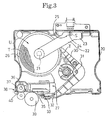
- a tape printer as shown in Fig. 3 includes a printing mechanism adapted to apply heat to the thermosensitive coloring layer 12 of the printing tape T, so that a desired image is formed on the tape T.
- This printing tape T is wound around a tape spool 21 of a tape unit U of the tape printer, as shown in Fig. 3, such that the release paper 16 of the tape T faces outwardly of the spool 21.
- the thermosensitive coloring layer 12 which does not suffer from changes in color, faces inwardly of the spool.
- Tape detecting member 22 is attached at one of its ends to the tape spool 21, such that the detecting member 22 is pivotable about the tape spool 21.
- the other end of tape detecting member 22 is formed with a tape-width defining portion 23 for defining the width of the printing tape T wound around the tape spool 21.
- the tape unit U is rotatably stored in a tape unit storing portion 26.
- the tape unit U is stored in a left, rear part of a tape cassette 20 of the tape printer.
- the tape cassette 20 also incorporates four tape guides 30, 31, 32, 33 mounted on the bottom wall of the tape cassette 20, for guiding the printing tape T that is wound around the tape spool 21 of the tape unit U stored in the tape unit storing portion 26.
- the tape guides 30, 31, 32, 33 guide the printing tape T until the tape T reaches a thermal head guiding member 27. In this arrangement, the printing tape T, which is pulled away from the tape spool 21 of the tape unit U, is smoothly fed to a thermal head 35 of the printer, via the tape guides 30, 31, 32, 33.
- a tape feed roller shaft 36 On the bottom wall of a cassette storing portion of the tape printer that stores the tape cassette 20, there is mounted a tape feed roller shaft 36 adapted to be rotated or driven by a tape feed motor. Between the thermal head guiding member 27 and the left side wall of the tape cassette 20, there is provided a tape feed roller 37 that is engageable with the tape feed roller shaft 36.
- the tape cassette 20 is provided with a tape ejecting portion 38 located in the vicinity of the tape feed roller 37.
- This tape ejecting portion 38 takes the form of a clearance or gap formed between a front end portion of the left side wall of the tape cassette 20, and a guide piece extending from the left side wall of the tape cassette 20.
- the tape printer further includes a platen roller 39 and a tape feed auxiliary roller 40 in the vicinity of the tape ejecting portion 38.
- the platen roller 39 is rotatably installed on the tape printer, such that the roller 39 faces the thermal head 35, and the tape feed auxiliary roller 40 faces the tape feed roller 37.
- the platen roller 39 is brought into abutment on the thermal head 35, and the tape feed auxiliary roller 40 is brought into abutment on the tape feed roller 37.
- the tape feed roller 37 cooperates with the tape feed auxiliary roller 40 to feed the printing tape T pulled away from the tape spool 21 of the tape unit U stored in the tape unit storing portion 26 of the tape cassette 20, such that the tape T is smoothly guided by the tape guides 30, 31, 32, 33.
- the thermal head 35 cooperates with the platen roller 39 abutting on a recessed part of the thermal head guiding member 27, to print characters or other images on the thermosensitive coloring layer of the printing tape T.
- the printing tape T having the characters printed thereon is then ejected out of the tape printer, through the tape ejecting portion 38, due to cooperative rotary movement of the tape feed roller 37 and the tape feed auxiliary roller 40.
- the printing tape T on which the image (e.g., characters and the like) has been printed by the tape printer is cut into a desired length, and the released paper 16 is peeled off, so that the tape T can be attached to a desired place or object. Even when light impinges on the place where the printing tape T is attached, ultraviolet rays are absorbed or reflected by the first protecting layer 13 with which the thermosensitive coloring layer 12 is covered. As a result, the color developed at the coloring layer 12 does not fade away, assuring excellent printing quality.
- the printing tape T does not cause breakdown or corrosion of the thermal head, since the second protective layer 14 of the tape T is formed of a water-insoluble resin. If silicone resin or the like is used as the water-insoluble resin for the second protective layer 14, the printing tape T does not stick to the thermal head of the tape printer during the printing operation, assuring excellent printing quality.
Landscapes
- Physics & Mathematics (AREA)
- Optics & Photonics (AREA)
- General Physics & Mathematics (AREA)
- Engineering & Computer Science (AREA)
- Theoretical Computer Science (AREA)
- Heat Sensitive Colour Forming Recording (AREA)
Applications Claiming Priority (2)
| Application Number | Priority Date | Filing Date | Title |
|---|---|---|---|
| JP7129974A JPH08324112A (ja) | 1995-05-29 | 1995-05-29 | 感熱記録材料 |
| JP129974/95 | 1995-05-29 |
Publications (1)
| Publication Number | Publication Date |
|---|---|
| EP0748700A1 true EP0748700A1 (de) | 1996-12-18 |
Family
ID=15023049
Family Applications (1)
| Application Number | Title | Priority Date | Filing Date |
|---|---|---|---|
| EP96303803A Withdrawn EP0748700A1 (de) | 1995-05-29 | 1996-05-29 | Wärmeempfindliches Aufzeichnungsmaterial |
Country Status (2)
| Country | Link |
|---|---|
| EP (1) | EP0748700A1 (de) |
| JP (1) | JPH08324112A (de) |
Cited By (5)
| Publication number | Priority date | Publication date | Assignee | Title |
|---|---|---|---|---|
| US6413699B1 (en) | 1999-10-11 | 2002-07-02 | Macdermid Graphic Arts, Inc. | UV-absorbing support layers and flexographic printing elements comprising same |
| WO2002074551A1 (en) * | 2001-03-20 | 2002-09-26 | Esselte N.V. | A method and apparatus for producing laminated labels |
| US7316886B2 (en) * | 2004-06-14 | 2008-01-08 | Fujifilm Corporation | Protective film-forming composition for immersion exposure and pattern-forming method using the same |
| EP1970202A1 (de) * | 2007-03-12 | 2008-09-17 | Brother Kogyo Kabushiki Kaisha | Beschriftungskassette, Bandkassette, Banddrucker |
| US20190061375A1 (en) * | 2016-03-29 | 2019-02-28 | Brother Kogyo Kabushiki Kaisha | Printing tape with improved resistance to temperature and water |
Citations (7)
| Publication number | Priority date | Publication date | Assignee | Title |
|---|---|---|---|---|
| GB2171810A (en) * | 1985-02-23 | 1986-09-03 | Ricoh Kk | Thermosensitive recording material |
| EP0339670A2 (de) * | 1988-04-28 | 1989-11-02 | Kanzaki Paper Manufacturing Co., Ltd. | Wärmeempfindliche Aufzeichnungsmaterialien |
| JPH0269285A (ja) * | 1988-09-05 | 1990-03-08 | Oji Paper Co Ltd | 感熱記録材料 |
| EP0431594A1 (de) * | 1989-12-05 | 1991-06-12 | New Oji Paper Co., Ltd. | Wärmeempfindliches Aufzeichnungsmaterial |
| WO1993025393A1 (en) * | 1992-06-10 | 1993-12-23 | Alfred Doi | Ultraviolet protective coatings for heat sensitive record materials |
| US5286703A (en) * | 1990-11-22 | 1994-02-15 | Fuji Photo Film Co., Ltd. | Heat-sensitive recording material |
| EP0593270A2 (de) * | 1992-10-15 | 1994-04-20 | Brother Kogyo Kabushiki Kaisha | Druckband und Druckbandkassette |
-
1995
- 1995-05-29 JP JP7129974A patent/JPH08324112A/ja active Pending
-
1996
- 1996-05-29 EP EP96303803A patent/EP0748700A1/de not_active Withdrawn
Patent Citations (7)
| Publication number | Priority date | Publication date | Assignee | Title |
|---|---|---|---|---|
| GB2171810A (en) * | 1985-02-23 | 1986-09-03 | Ricoh Kk | Thermosensitive recording material |
| EP0339670A2 (de) * | 1988-04-28 | 1989-11-02 | Kanzaki Paper Manufacturing Co., Ltd. | Wärmeempfindliche Aufzeichnungsmaterialien |
| JPH0269285A (ja) * | 1988-09-05 | 1990-03-08 | Oji Paper Co Ltd | 感熱記録材料 |
| EP0431594A1 (de) * | 1989-12-05 | 1991-06-12 | New Oji Paper Co., Ltd. | Wärmeempfindliches Aufzeichnungsmaterial |
| US5286703A (en) * | 1990-11-22 | 1994-02-15 | Fuji Photo Film Co., Ltd. | Heat-sensitive recording material |
| WO1993025393A1 (en) * | 1992-06-10 | 1993-12-23 | Alfred Doi | Ultraviolet protective coatings for heat sensitive record materials |
| EP0593270A2 (de) * | 1992-10-15 | 1994-04-20 | Brother Kogyo Kabushiki Kaisha | Druckband und Druckbandkassette |
Non-Patent Citations (1)
| Title |
|---|
| DATABASE WPI Section Ch Week 9017, Derwent World Patents Index; Class A89, AN 90-126969, XP002010084 * |
Cited By (8)
| Publication number | Priority date | Publication date | Assignee | Title |
|---|---|---|---|---|
| US6413699B1 (en) | 1999-10-11 | 2002-07-02 | Macdermid Graphic Arts, Inc. | UV-absorbing support layers and flexographic printing elements comprising same |
| USRE39835E1 (en) * | 1999-10-11 | 2007-09-11 | Rustom Sam Kanga | UV-absorbing support layers and flexographic printing elements comprising same |
| WO2002074551A1 (en) * | 2001-03-20 | 2002-09-26 | Esselte N.V. | A method and apparatus for producing laminated labels |
| US7021846B2 (en) * | 2001-03-20 | 2006-04-04 | Esselte | Method and apparatus for producing laminated labels |
| US7316886B2 (en) * | 2004-06-14 | 2008-01-08 | Fujifilm Corporation | Protective film-forming composition for immersion exposure and pattern-forming method using the same |
| EP1970202A1 (de) * | 2007-03-12 | 2008-09-17 | Brother Kogyo Kabushiki Kaisha | Beschriftungskassette, Bandkassette, Banddrucker |
| US20190061375A1 (en) * | 2016-03-29 | 2019-02-28 | Brother Kogyo Kabushiki Kaisha | Printing tape with improved resistance to temperature and water |
| US12246544B2 (en) * | 2016-03-29 | 2025-03-11 | Brother Kogyo Kabushiki Kaisha | Printing tape with improved resistance to temperature and water |
Also Published As
| Publication number | Publication date |
|---|---|
| JPH08324112A (ja) | 1996-12-10 |
Similar Documents
| Publication | Publication Date | Title |
|---|---|---|
| EP0344705B1 (de) | Wärmeempfindliches Aufzeichnungsmaterial | |
| US5366952A (en) | Double-surface heat-sensitive record material | |
| EP1211094B1 (de) | Thermisches Aufzeichnungsmaterial | |
| EP1208995B1 (de) | Lichtdurchlässiges wärmeempfindliches Aufzeichnungsmaterial | |
| EP0748700A1 (de) | Wärmeempfindliches Aufzeichnungsmaterial | |
| JP3324173B2 (ja) | 感熱記録材料 | |
| EP0644058B1 (de) | Druckband und Druckbandkassette | |
| EP0992363B1 (de) | Wärmeempfindliches Aufzeichnungsmaterial | |
| EP0593270A2 (de) | Druckband und Druckbandkassette | |
| JPH06262853A (ja) | 感熱記録材料 | |
| US5935899A (en) | Thermosensitive recording material | |
| EP0355012B1 (de) | Wärmeempfindliches Aufzeichnungsmaterial | |
| EP0644063A2 (de) | Druckband und Druckbandkassette | |
| US6417137B1 (en) | Transparent thermosensitive recording material | |
| JP3060446B2 (ja) | 印字用テープ及びその印字用テープを内蔵したテープカセット | |
| JP2984005B2 (ja) | 感熱記録体 | |
| JP2771638B2 (ja) | 感熱記録体 | |
| US4646113A (en) | Heat-sensitive recording sheet | |
| JP2795459B2 (ja) | 感熱記録材料 | |
| JPH06127090A (ja) | 印字用テープ及びその印字用テープを内蔵したテープカセット | |
| JPH06127093A (ja) | 印字用テープ及びその印字用テープを内蔵したテープカセット | |
| JP3158386B2 (ja) | 感熱記録体 | |
| JPH0781194A (ja) | テープ収納カセット | |
| JPH06328820A (ja) | 印字用テープ収納カセット | |
| JPH06143771A (ja) | 印字用テープ及びその印字用テープを内蔵したテープカセット |
Legal Events
| Date | Code | Title | Description |
|---|---|---|---|
| PUAI | Public reference made under article 153(3) epc to a published international application that has entered the european phase |
Free format text: ORIGINAL CODE: 0009012 |
|
| AK | Designated contracting states |
Kind code of ref document: A1 Designated state(s): BE CH DE FR GB LI |
|
| 17P | Request for examination filed |
Effective date: 19970502 |
|
| 17Q | First examination report despatched |
Effective date: 19980612 |
|
| STAA | Information on the status of an ep patent application or granted ep patent |
Free format text: STATUS: THE APPLICATION IS DEEMED TO BE WITHDRAWN |
|
| 18D | Application deemed to be withdrawn |
Effective date: 20040228 |