EP0748827B1 - Spritzpolyharnstoffelastomere - Google Patents
Spritzpolyharnstoffelastomere Download PDFInfo
- Publication number
- EP0748827B1 EP0748827B1 EP95109286A EP95109286A EP0748827B1 EP 0748827 B1 EP0748827 B1 EP 0748827B1 EP 95109286 A EP95109286 A EP 95109286A EP 95109286 A EP95109286 A EP 95109286A EP 0748827 B1 EP0748827 B1 EP 0748827B1
- Authority
- EP
- European Patent Office
- Prior art keywords
- component
- diisocyanate
- spray polyurea
- polyurea elastomer
- amine
- Prior art date
- Legal status (The legal status is an assumption and is not a legal conclusion. Google has not performed a legal analysis and makes no representation as to the accuracy of the status listed.)
- Expired - Lifetime
Links
- 229920001971 elastomer Polymers 0.000 title claims description 71
- 239000000806 elastomer Substances 0.000 title claims description 70
- 239000007921 spray Substances 0.000 title claims description 47
- 229920002396 Polyurea Polymers 0.000 title claims description 43
- 239000000203 mixture Substances 0.000 claims description 50
- 239000012948 isocyanate Substances 0.000 claims description 46
- -1 alkylene carbonate Chemical compound 0.000 claims description 40
- 150000002513 isocyanates Chemical class 0.000 claims description 35
- 229920005862 polyol Polymers 0.000 claims description 31
- 150000003077 polyols Chemical class 0.000 claims description 31
- 229920005989 resin Polymers 0.000 claims description 24
- 239000011347 resin Substances 0.000 claims description 24
- 229920000570 polyether Polymers 0.000 claims description 19
- 125000001931 aliphatic group Chemical group 0.000 claims description 18
- RUOJZAUFBMNUDX-UHFFFAOYSA-N propylene carbonate Chemical compound CC1COC(=O)O1 RUOJZAUFBMNUDX-UHFFFAOYSA-N 0.000 claims description 18
- 239000004721 Polyphenylene oxide Substances 0.000 claims description 14
- 150000001412 amines Chemical class 0.000 claims description 14
- 239000000463 material Substances 0.000 claims description 14
- UFHFLCQGNIYNRP-UHFFFAOYSA-N Hydrogen Chemical compound [H][H] UFHFLCQGNIYNRP-UHFFFAOYSA-N 0.000 claims description 13
- 229910052739 hydrogen Inorganic materials 0.000 claims description 13
- 239000001257 hydrogen Substances 0.000 claims description 13
- 239000004970 Chain extender Substances 0.000 claims description 12
- NIMLQBUJDJZYEJ-UHFFFAOYSA-N isophorone diisocyanate Chemical compound CC1(C)CC(N=C=O)CC(C)(CN=C=O)C1 NIMLQBUJDJZYEJ-UHFFFAOYSA-N 0.000 claims description 6
- 239000005058 Isophorone diisocyanate Substances 0.000 claims description 5
- 125000004432 carbon atom Chemical group C* 0.000 claims description 5
- 125000000217 alkyl group Chemical group 0.000 claims description 4
- 239000008096 xylene Substances 0.000 claims description 4
- ZZXUZKXVROWEIF-UHFFFAOYSA-N 1,2-butylene carbonate Chemical compound CCC1COC(=O)O1 ZZXUZKXVROWEIF-UHFFFAOYSA-N 0.000 claims description 3
- VGHSXKTVMPXHNG-UHFFFAOYSA-N 1,3-diisocyanatobenzene Chemical compound O=C=NC1=CC=CC(N=C=O)=C1 VGHSXKTVMPXHNG-UHFFFAOYSA-N 0.000 claims description 3
- ALQLPWJFHRMHIU-UHFFFAOYSA-N 1,4-diisocyanatobenzene Chemical compound O=C=NC1=CC=C(N=C=O)C=C1 ALQLPWJFHRMHIU-UHFFFAOYSA-N 0.000 claims description 3
- SIZPGZFVROGOIR-UHFFFAOYSA-N 1,4-diisocyanatonaphthalene Chemical compound C1=CC=C2C(N=C=O)=CC=C(N=C=O)C2=C1 SIZPGZFVROGOIR-UHFFFAOYSA-N 0.000 claims description 3
- ICLCCFKUSALICQ-UHFFFAOYSA-N 1-isocyanato-4-(4-isocyanato-3-methylphenyl)-2-methylbenzene Chemical compound C1=C(N=C=O)C(C)=CC(C=2C=C(C)C(N=C=O)=CC=2)=C1 ICLCCFKUSALICQ-UHFFFAOYSA-N 0.000 claims description 3
- QZWKEPYTBWZJJA-UHFFFAOYSA-N 3,3'-Dimethoxybenzidine-4,4'-diisocyanate Chemical compound C1=C(N=C=O)C(OC)=CC(C=2C=C(OC)C(N=C=O)=CC=2)=C1 QZWKEPYTBWZJJA-UHFFFAOYSA-N 0.000 claims description 3
- KMTRUDSVKNLOMY-UHFFFAOYSA-N Ethylene carbonate Chemical compound O=C1OCCO1 KMTRUDSVKNLOMY-UHFFFAOYSA-N 0.000 claims description 3
- OMRDSWJXRLDPBB-UHFFFAOYSA-N N=C=O.N=C=O.C1CCCCC1 Chemical compound N=C=O.N=C=O.C1CCCCC1 OMRDSWJXRLDPBB-UHFFFAOYSA-N 0.000 claims description 3
- 229920000538 Poly[(phenyl isocyanate)-co-formaldehyde] Polymers 0.000 claims description 3
- 150000004984 aromatic diamines Chemical group 0.000 claims description 3
- 230000001588 bifunctional effect Effects 0.000 claims description 3
- IEJIGPNLZYLLBP-UHFFFAOYSA-N dimethyl carbonate Chemical compound COC(=O)OC IEJIGPNLZYLLBP-UHFFFAOYSA-N 0.000 claims description 3
- 239000000178 monomer Substances 0.000 claims description 3
- DVKJHBMWWAPEIU-UHFFFAOYSA-N toluene 2,4-diisocyanate Chemical compound CC1=CC=C(N=C=O)C=C1N=C=O DVKJHBMWWAPEIU-UHFFFAOYSA-N 0.000 claims description 3
- RUELTTOHQODFPA-UHFFFAOYSA-N toluene 2,6-diisocyanate Chemical compound CC1=C(N=C=O)C=CC=C1N=C=O RUELTTOHQODFPA-UHFFFAOYSA-N 0.000 claims description 3
- DTZHXCBUWSTOPO-UHFFFAOYSA-N 1-isocyanato-4-[(4-isocyanato-3-methylphenyl)methyl]-2-methylbenzene Chemical compound C1=C(N=C=O)C(C)=CC(CC=2C=C(C)C(N=C=O)=CC=2)=C1 DTZHXCBUWSTOPO-UHFFFAOYSA-N 0.000 claims description 2
- UPMLOUAZCHDJJD-UHFFFAOYSA-N 4,4'-Diphenylmethane Diisocyanate Chemical compound C1=CC(N=C=O)=CC=C1CC1=CC=C(N=C=O)C=C1 UPMLOUAZCHDJJD-UHFFFAOYSA-N 0.000 claims description 2
- 239000005057 Hexamethylene diisocyanate Substances 0.000 claims description 2
- KIQKWYUGPPFMBV-UHFFFAOYSA-N diisocyanatomethane Chemical compound O=C=NCN=C=O KIQKWYUGPPFMBV-UHFFFAOYSA-N 0.000 claims description 2
- RRAMGCGOFNQTLD-UHFFFAOYSA-N hexamethylene diisocyanate Chemical compound O=C=NCCCCCCN=C=O RRAMGCGOFNQTLD-UHFFFAOYSA-N 0.000 claims description 2
- 229920005906 polyester polyol Polymers 0.000 claims 3
- KXBFLNPZHXDQLV-UHFFFAOYSA-N [cyclohexyl(diisocyanato)methyl]cyclohexane Chemical compound C1CCCCC1C(N=C=O)(N=C=O)C1CCCCC1 KXBFLNPZHXDQLV-UHFFFAOYSA-N 0.000 claims 2
- WTFAGPBUAGFMQX-UHFFFAOYSA-N 1-[2-[2-(2-aminopropoxy)propoxy]propoxy]propan-2-amine Chemical class CC(N)COCC(C)OCC(C)OCC(C)N WTFAGPBUAGFMQX-UHFFFAOYSA-N 0.000 description 46
- 230000000704 physical effect Effects 0.000 description 18
- 125000003118 aryl group Chemical group 0.000 description 12
- 238000009472 formulation Methods 0.000 description 11
- AZYRZNIYJDKRHO-UHFFFAOYSA-N 1,3-bis(2-isocyanatopropan-2-yl)benzene Chemical compound O=C=NC(C)(C)C1=CC=CC(C(C)(C)N=C=O)=C1 AZYRZNIYJDKRHO-UHFFFAOYSA-N 0.000 description 7
- 238000000034 method Methods 0.000 description 7
- 239000000047 product Substances 0.000 description 7
- GWEVSGVZZGPLCZ-UHFFFAOYSA-N Titan oxide Chemical compound O=[Ti]=O GWEVSGVZZGPLCZ-UHFFFAOYSA-N 0.000 description 6
- 125000002887 hydroxy group Chemical group [H]O* 0.000 description 6
- 229920001451 polypropylene glycol Polymers 0.000 description 6
- IAYPIBMASNFSPL-UHFFFAOYSA-N Ethylene oxide Chemical compound C1CO1 IAYPIBMASNFSPL-UHFFFAOYSA-N 0.000 description 5
- 239000005056 polyisocyanate Substances 0.000 description 5
- 229920001228 polyisocyanate Polymers 0.000 description 5
- GOOHAUXETOMSMM-UHFFFAOYSA-N Propylene oxide Chemical compound CC1CO1 GOOHAUXETOMSMM-UHFFFAOYSA-N 0.000 description 4
- 238000000576 coating method Methods 0.000 description 4
- 150000002009 diols Chemical class 0.000 description 4
- 239000010408 film Substances 0.000 description 4
- WYURNTSHIVDZCO-UHFFFAOYSA-N Tetrahydrofuran Chemical compound C1CCOC1 WYURNTSHIVDZCO-UHFFFAOYSA-N 0.000 description 3
- 125000002947 alkylene group Chemical group 0.000 description 3
- 238000005576 amination reaction Methods 0.000 description 3
- 230000000052 comparative effect Effects 0.000 description 3
- 238000011417 postcuring Methods 0.000 description 3
- 230000008569 process Effects 0.000 description 3
- 239000000758 substrate Substances 0.000 description 3
- 239000004408 titanium dioxide Substances 0.000 description 3
- RNLHGQLZWXBQNY-UHFFFAOYSA-N 3-(aminomethyl)-3,5,5-trimethylcyclohexan-1-amine Chemical compound CC1(C)CC(N)CC(C)(CN)C1 RNLHGQLZWXBQNY-UHFFFAOYSA-N 0.000 description 2
- XSTXAVWGXDQKEL-UHFFFAOYSA-N Trichloroethylene Chemical compound ClC=C(Cl)Cl XSTXAVWGXDQKEL-UHFFFAOYSA-N 0.000 description 2
- 150000004649 carbonic acid derivatives Chemical class 0.000 description 2
- 238000006243 chemical reaction Methods 0.000 description 2
- 125000004427 diamine group Chemical group 0.000 description 2
- 239000004872 foam stabilizing agent Substances 0.000 description 2
- 239000003999 initiator Substances 0.000 description 2
- 229910052751 metal Inorganic materials 0.000 description 2
- 239000002184 metal Substances 0.000 description 2
- 229920000728 polyester Polymers 0.000 description 2
- 229920000909 polytetrahydrofuran Polymers 0.000 description 2
- 229920002635 polyurethane Polymers 0.000 description 2
- 239000004814 polyurethane Substances 0.000 description 2
- 230000009257 reactivity Effects 0.000 description 2
- CDMDQYCEEKCBGR-UHFFFAOYSA-N 1,4-diisocyanatocyclohexane Chemical compound O=C=NC1CCC(N=C=O)CC1 CDMDQYCEEKCBGR-UHFFFAOYSA-N 0.000 description 1
- PISLZQACAJMAIO-UHFFFAOYSA-N 2,4-diethyl-6-methylbenzene-1,3-diamine Chemical compound CCC1=CC(C)=C(N)C(CC)=C1N PISLZQACAJMAIO-UHFFFAOYSA-N 0.000 description 1
- FXWSQNPVILUHOJ-UHFFFAOYSA-N 4-(1-aminoethyl)cyclohexan-1-amine Chemical compound CC(N)C1CCC(N)CC1 FXWSQNPVILUHOJ-UHFFFAOYSA-N 0.000 description 1
- DZIHTWJGPDVSGE-UHFFFAOYSA-N 4-[(4-aminocyclohexyl)methyl]cyclohexan-1-amine Chemical compound C1CC(N)CCC1CC1CCC(N)CC1 DZIHTWJGPDVSGE-UHFFFAOYSA-N 0.000 description 1
- 229920000049 Carbon (fiber) Polymers 0.000 description 1
- BVKZGUZCCUSVTD-UHFFFAOYSA-L Carbonate Chemical compound [O-]C([O-])=O BVKZGUZCCUSVTD-UHFFFAOYSA-L 0.000 description 1
- XZMCDFZZKTWFGF-UHFFFAOYSA-N Cyanamide Chemical compound NC#N XZMCDFZZKTWFGF-UHFFFAOYSA-N 0.000 description 1
- VGGSQFUCUMXWEO-UHFFFAOYSA-N Ethene Chemical compound C=C VGGSQFUCUMXWEO-UHFFFAOYSA-N 0.000 description 1
- 239000005977 Ethylene Substances 0.000 description 1
- 229920002121 Hydroxyl-terminated polybutadiene Polymers 0.000 description 1
- BLRPTPMANUNPDV-UHFFFAOYSA-N Silane Chemical compound [SiH4] BLRPTPMANUNPDV-UHFFFAOYSA-N 0.000 description 1
- FDLQZKYLHJJBHD-UHFFFAOYSA-N [3-(aminomethyl)phenyl]methanamine Chemical compound NCC1=CC=CC(CN)=C1 FDLQZKYLHJJBHD-UHFFFAOYSA-N 0.000 description 1
- 125000003277 amino group Chemical group 0.000 description 1
- 230000003466 anti-cipated effect Effects 0.000 description 1
- 230000004888 barrier function Effects 0.000 description 1
- 239000004917 carbon fiber Substances 0.000 description 1
- 239000003054 catalyst Substances 0.000 description 1
- 239000007795 chemical reaction product Substances 0.000 description 1
- 239000003795 chemical substances by application Substances 0.000 description 1
- 239000011248 coating agent Substances 0.000 description 1
- 239000002131 composite material Substances 0.000 description 1
- 150000001875 compounds Chemical class 0.000 description 1
- VKIRRGRTJUUZHS-UHFFFAOYSA-N cyclohexane-1,4-diamine Chemical compound NC1CCC(N)CC1 VKIRRGRTJUUZHS-UHFFFAOYSA-N 0.000 description 1
- 150000004985 diamines Chemical class 0.000 description 1
- 125000005442 diisocyanate group Chemical group 0.000 description 1
- 239000003085 diluting agent Substances 0.000 description 1
- KPUWHANPEXNPJT-UHFFFAOYSA-N disiloxane Chemical class [SiH3]O[SiH3] KPUWHANPEXNPJT-UHFFFAOYSA-N 0.000 description 1
- 239000003995 emulsifying agent Substances 0.000 description 1
- 125000001495 ethyl group Chemical group [H]C([H])([H])C([H])([H])* 0.000 description 1
- 239000003365 glass fiber Substances 0.000 description 1
- 239000008240 homogeneous mixture Substances 0.000 description 1
- 125000004435 hydrogen atom Chemical group [H]* 0.000 description 1
- 239000004615 ingredient Substances 0.000 description 1
- 238000002347 injection Methods 0.000 description 1
- 239000007924 injection Substances 0.000 description 1
- 239000007788 liquid Substances 0.000 description 1
- 239000012528 membrane Substances 0.000 description 1
- RTWNYYOXLSILQN-UHFFFAOYSA-N methanediamine Chemical compound NCN RTWNYYOXLSILQN-UHFFFAOYSA-N 0.000 description 1
- 239000002557 mineral fiber Substances 0.000 description 1
- 238000012986 modification Methods 0.000 description 1
- 230000004048 modification Effects 0.000 description 1
- 150000005677 organic carbonates Chemical class 0.000 description 1
- 125000005702 oxyalkylene group Chemical group 0.000 description 1
- 239000003973 paint Substances 0.000 description 1
- 239000000049 pigment Substances 0.000 description 1
- 239000011253 protective coating Substances 0.000 description 1
- 239000012779 reinforcing material Substances 0.000 description 1
- 239000005060 rubber Substances 0.000 description 1
- 229910000077 silane Inorganic materials 0.000 description 1
- 229920002545 silicone oil Polymers 0.000 description 1
- 239000000126 substance Substances 0.000 description 1
- 239000010409 thin film Substances 0.000 description 1
- 150000004072 triols Chemical class 0.000 description 1
Classifications
-
- C—CHEMISTRY; METALLURGY
- C08—ORGANIC MACROMOLECULAR COMPOUNDS; THEIR PREPARATION OR CHEMICAL WORKING-UP; COMPOSITIONS BASED THEREON
- C08K—Use of inorganic or non-macromolecular organic substances as compounding ingredients
- C08K5/00—Use of organic ingredients
- C08K5/04—Oxygen-containing compounds
- C08K5/10—Esters; Ether-esters
- C08K5/109—Esters; Ether-esters of carbonic acid, e.g. R-O-C(=O)-O-R
-
- C—CHEMISTRY; METALLURGY
- C08—ORGANIC MACROMOLECULAR COMPOUNDS; THEIR PREPARATION OR CHEMICAL WORKING-UP; COMPOSITIONS BASED THEREON
- C08G—MACROMOLECULAR COMPOUNDS OBTAINED OTHERWISE THAN BY REACTIONS ONLY INVOLVING UNSATURATED CARBON-TO-CARBON BONDS
- C08G18/00—Polymeric products of isocyanates or isothiocyanates
- C08G18/06—Polymeric products of isocyanates or isothiocyanates with compounds having active hydrogen
- C08G18/08—Processes
- C08G18/10—Prepolymer processes involving reaction of isocyanates or isothiocyanates with compounds having active hydrogen in a first reaction step
-
- C—CHEMISTRY; METALLURGY
- C08—ORGANIC MACROMOLECULAR COMPOUNDS; THEIR PREPARATION OR CHEMICAL WORKING-UP; COMPOSITIONS BASED THEREON
- C08G—MACROMOLECULAR COMPOUNDS OBTAINED OTHERWISE THAN BY REACTIONS ONLY INVOLVING UNSATURATED CARBON-TO-CARBON BONDS
- C08G18/00—Polymeric products of isocyanates or isothiocyanates
- C08G18/06—Polymeric products of isocyanates or isothiocyanates with compounds having active hydrogen
- C08G18/28—Polymeric products of isocyanates or isothiocyanates with compounds having active hydrogen characterised by the compounds used containing active hydrogen
- C08G18/40—High-molecular-weight compounds
- C08G18/48—Polyethers
- C08G18/50—Polyethers having heteroatoms other than oxygen
- C08G18/5021—Polyethers having heteroatoms other than oxygen having nitrogen
- C08G18/5024—Polyethers having heteroatoms other than oxygen having nitrogen containing primary and/or secondary amino groups
-
- C—CHEMISTRY; METALLURGY
- C08—ORGANIC MACROMOLECULAR COMPOUNDS; THEIR PREPARATION OR CHEMICAL WORKING-UP; COMPOSITIONS BASED THEREON
- C08K—Use of inorganic or non-macromolecular organic substances as compounding ingredients
- C08K5/00—Use of organic ingredients
- C08K5/04—Oxygen-containing compounds
- C08K5/15—Heterocyclic compounds having oxygen in the ring
- C08K5/156—Heterocyclic compounds having oxygen in the ring having two oxygen atoms in the ring
- C08K5/1565—Five-membered rings
-
- C—CHEMISTRY; METALLURGY
- C08—ORGANIC MACROMOLECULAR COMPOUNDS; THEIR PREPARATION OR CHEMICAL WORKING-UP; COMPOSITIONS BASED THEREON
- C08G—MACROMOLECULAR COMPOUNDS OBTAINED OTHERWISE THAN BY REACTIONS ONLY INVOLVING UNSATURATED CARBON-TO-CARBON BONDS
- C08G2150/00—Compositions for coatings
- C08G2150/50—Compositions for coatings applied by spraying at least two streams of reaction components
Definitions
- the invention relates to aliphatic and aromatic spray polyurea elastomers and processes for making the same, and, in one aspect, more particularly to methods for making aliphatic and aromatic spray polyurea elastomers containing organic carbonates.
- Spray elastomer systems are commonly recognized as coating materials, with aliphatic and aromatic spray polyurea elastomer systems being particularly useful when employed in this capacity.
- This two-component technology is based on an isocyanate quasi-prepolymer and an amine coreactant, often an amine resin blend.
- the isocyanate quasi-prepolymer is higher in viscosity than the amine resin blend. This difference in viscosity, coupled with the fast reaction characteristics of these systems, can lead to processing problems in thin film applications.
- the chain extender may include cis -1,4-diaminocyclohexane, isophoronediamine, m -xylenediamine, 4,4'-methylenedicyclohexylamine, methanediamine, 1,4-diaminoethylcyclohexane and substituted derivatives thereof.
- EP-A-0 529 791 discusses quasi-prepolymers of aliphatic diisocyanates and polyoxyalkylene mixtures useful for making polyurea elastomers.
- EP-A-0 350 644 relates to a reaction injection molded elastomer, wherein polyurea RIM systems having improved flow properties with cyclic alkylene carbonates have been used.
- a particular object of the invention is to provide an aliphatic and/or aromatic spray polyurea elastomer with the above characteristics and which has good physical properties including good surface characteristics.
- a spray polyurea elastomer having an (A) component which includes a quasi-prepolymer of an isocyanate and an active hydrogen-containing material; together with an alkylene carbonate.
- the (A) component is reacted with the (B) component which has at least one amine-terminated polyoxyalkylene polyol.
- the (B) component is an amine resin blend.
- the aliphatic and/or aromatic spray polyurea elastomer system of the present invention generally includes two components, an (A) component and a (B) component.
- the (A) component may include an aliphatic isocyanate.
- the aliphatic isocyanates employed in component (A) are those known to one skilled in the art. Thus, for instance, the aliphatic isocyanates are of the type described in U.S. Pat. No.
- 4,748,192 are typically aliphatic diisocyanates, and more particularly are the trimerized or the biuretic form of an aliphatic diisocyanate, such as, hexamethylene diisocyanate, or the bifunctional monomer of the tetraalkyl xylene diisocyanate, such as the tetramethyl xylene diisocyanate. Cyclohexane diisocyanate is also to be considered a preferred aliphatic isocyanate. Other useful aliphatic polyisocyanates are described in U.S. Pat. No. 4,705,814.
- aliphatic diisocyanates for example, alkylene diisocyanates with 4 to 12 carbon atoms in the alkylene radical, such as 1,12-dodecane diisocyanate and 1,4-tetramethylene diisocyanate.
- cycloaliphatic diisocyanates such as 1,3- and 1,4-cyclohexane diisocyanate as well as any desired mixture of these isomers, 1-isocyanato-3,3,5-trimethyl-5-isocyanatomethylcyclohexane (isophorone diisocyanate); 4,4'-, 2,2'- and 2,4'-dicyclohexylmethane diisocyanate as well as the corresponding isomer mixtures, and the like.
- Aromatic isocyanates may also be employed. Suitable aromatic polyisocyanates include, but are not necessarily limited to, m -phenylene diisocyanate; p -phenylene diisocyanate; polymethylene polyphenylisocyanate; 2,4-toluene diisocyanate; 2,6-toluene diisocyanate; dianisidine diisocyanate; bitolylene diisocyanate; naphthalene-1,4-diisocyanate; diphenylene-4,4'-diisocyanate; and the like.
- Aliphatic/aromatic diisocyanates such as xylylene-1,3-diisocyanate; bis (4-isocyanatophenyl)methane; bis (3-methyl-4-isocyanatophenyl)methane; and 4,4'-diphenylpropane diisocyanate.
- the aforestated isocyanates can be used alone or in combination.
- the isocyanate will be at least partially reacted with an active hydrogen-containing material.
- the alkylene carbonates of this invention may be added to an (A) component having only a un-prereacted isocyanate therein, that is, not at least partially reacted with an active hydrogen-containing material to form a quasi-prepolymer. In such a case, the carbonates would work as a reactive diluent. However, it is anticipated that the alkylene carbonates will find a greater utility in the situation where the (A) component contains a quasi-prepolymer of a relatively high viscosity which may be lowered by the alkylene carbonate.
- the active hydrogen-containing materials may include, but are not necessarily limited to polyols or high molecular weight polyoxyalkyleneamines, also described herein as amine-terminated polyethers, or a combination thereof.
- the polyols include, but are not necessarily limited to, polyether polyols, polyester diols, triols, tetrols, etc., having an equivalent weight of at least 500, and preferably at least 1,000 up to 3,000. Those polyether polyols based on trihydric initiators of 4,000 molecular weight and above are especially preferred.
- the polyethers may be prepared from ethylene oxide, propylene oxide, butylene oxide or mixtures of propylene oxide, butylene oxide and/or ethylene oxide.
- Other high molecular weight polyols which may be useful in this invention are polyesters of hydroxyl-terminated rubbers, e.g., hydroxyl-terminated polybutadiene. Hydroxyl-terminated quasi-prepolymers of polyols and isocyanates are also useful in this invention.
- amine-terminated polyether polyols including primary and secondary amine-terminated polyether polyols of greater than 1,500 average molecular weight having from 2 to 6 functionality, preferably from 2 to 3, and an amine equivalent weight of from 750 to 4,000. Mixtures of amine-terminated polyethers may be used. In a preferred embodiment, the amine-terminated polyethers have an average molecular weight of at least 2,500. These materials may be made by various methods known in the art.
- the amine-terminated polyether resins useful in this invention are polyether resins made from an appropriate initiator to which lower alkylene oxides, such as ethylene oxide, propylene oxide, butylene oxide or mixtures thereof, are added with the resulting hydroxyl-terminated polyol then being aminated. When two or more oxides are used, they may be present as random mixtures or as blocks of one or the other polyether.
- the terminal hydroxyl groups in the polyol be essentially all secondary hydroxyl groups for ease of amination. Normally, the amination step does not completely replace all of the hydroxyl groups. However, the majority of hydroxyl groups are replaced by amine groups.
- the amine-terminated polyether resins useful in this invention have greater than 50 percent of their active hydrogens in the form of amine hydrogens. If ethylene oxide is used, it is desirable to cap the hydroxyl-terminated polyol with a small amount of higher alkylene oxide to ensure that the terminal hydroxyl groups are essentially all secondary hydroxyl groups.
- the polyols so prepared are then reductively aminated by known techniques, for example, as described in U.S. Pat. No. 3,654,370.
- a single high molecular weight amine-terminated polyol may be used.
- mixtures of high molecular weight amine-terminated polyols such as mixtures of di- and trifunctional materials and/or different molecular weight or different chemical composition materials, may be used.
- high molecular weight amine-terminated polyethers or simply polyether amines are included within the scope of my invention and may be used alone or in combination with the aforestated polyols.
- the term "high molecular weight” is intended to include polyether amines having a molecular weight of at least 2000.
- Particularly preferred are the JEFFAMINE® series of polyether amines available from Huntsman Corporation; they include JEFFAMINE D-2000, JEFFAMINE D-4000, JEFFAMINE T-3000 and JEFFAMINE T-5000.
- the (A) component of the present spray polyurea elastomer systems include an organic alkylene carbonate.
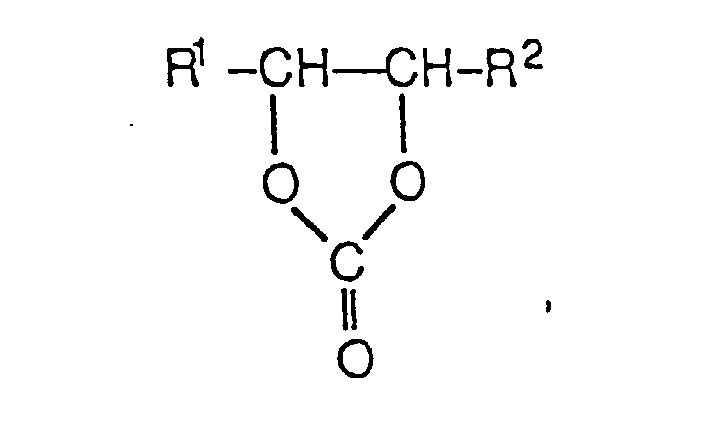
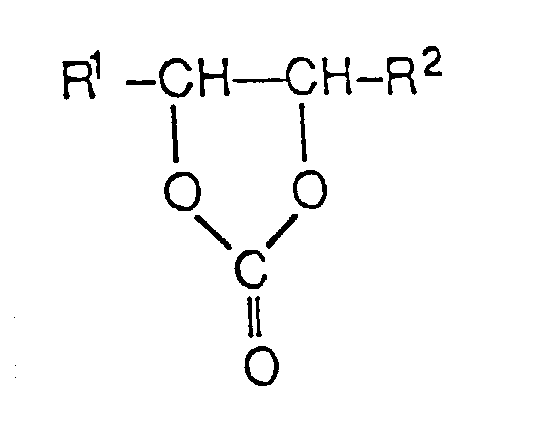
- the alkylene carbonate may have the structure (I): where R 1 and R 2 are independently hydrogen or lower alkyl of 1 to 4 carbon atoms.
- the alkylene carbonates are preferably chosen from the group of ethylene carbonate, propylene carbonate, butylene carbonate and dimethyl carbonate.
- the proportion of alkylene carbonate in (A) component ranges from 1 to 20 percent, preferably from 5 to 15 percent and most preferably from 5 to 10 percent. These percentages are based on 100 volume parts in the (A) component.
- the use of the alkylene carbonates reduces the viscosity of the (A) component, allows slower effective reactivities in spray polyurea elastomer systems, improved properties and surface characteristics (flowability) and possibly improved adhesion to the surfaces on which the elastomer is sprayed.
- the polyurea elastomers of the invention can be used as protective coatings, in "paint" applications, membranes, barrier coatings, road marking coatings, decorative coatings, automotive instrument panel applications, and the like.
- the polyurea elastomer systems may also include chain extenders in the formulation, preferably within the (B) component.
- Suitable chain extenders include those aliphatic and cycloaliphatic diamine chain extenders mentioned in U.S. Pat. No. 5,162,388 and patent application Serial No. 08/117,962. Aromatic diamine chain extenders may also be useful.
- foam stabilizers also known as silicone oils or emulsifiers.
- the foam stabilizers may be an organic silane or siloxane.
- compounds may be used having the formula: RSi[O-(R 2 SiO) n -(oxyalkylene) m R] 3 wherein R is an alkyl group containing from 1 to 4 carbon atoms; n is an integer of from 4 to 8; m is an integer of from 20 to 40; and the oxyalkylene groups are derived from propylene oxide and ethylene oxide. See, for example, U.S. Pat. No. 3,194,773.
- Pigments, for example titanium dioxide may be incorporated in the elastomer system, preferably in the (B) component, to impart color properties to the elastomer.
- Reinforcing materials if desired, useful in the practice of the invention are known to those skilled in the art. For example, chopped or milled glass fibers, chopped or milled carbon fibers and/or other mineral fibers are useful.
- Post curing of the elastomer of the invention is optional. Post curing will improve some elastomeric properties, such as heat sag. Employment of post curing depends on the desired properties of the end product.
- the (A) component and (B) component of the present spray polyurea elastomer system are combined or mixed under high pressure; most preferably, they are impingement mixed directly in the high pressure spray equipment.
- a first and second pressurized stream of components (A) and (B), respectively, are delivered from two separate chambers of the proportioner and are impacted or impinged upon each other at high velocity to effectuate an intimate mixing of the two components and, thus, the formulation of the elastomer system, which is then coated onto the desired substrate via the spray gun.
- the volumetric ratio of the (A) component to the (B) component is generally from 30 to 70 percent to 70 to 30 percent.
- component (A) and component (B) are employed in a 1:1 volumetric ratio.
- the (A) and (B) components react to form the present elastomer system without the aid of a catalyst.
- a GUSMER® VR-H-3000 Proportioning unit (plural component) was used, fitted with a GUSMER GX-7-400 spray gun.
- the equipment was set so as to process each example at an isocyanate to resin blend volume ratio of 1.00.
- Spray processing pressures were maintained at 10 500 kPa (1500 psi) to 17 500 kPa (2500 psi) on both the isocyanate and resin blend components.
- This spray polyurea application used a system with the A-Component, a quasi-prepolymer of m-TMXDI®, 54.5 parts; and JEFFAMINE® D-2000, 36.4 parts.
- A-Component a quasi-prepolymer of m-TMXDI®, 54.5 parts; and JEFFAMINE® D-2000, 36.4 parts.
- TEXACAR® PC propylene carbonate
- the isocyanate component was reacted with a B-component (amine resin blend), a blend of JEFFAMINE T-5000, 24.9 parts; JEFFAMINE D-2000, 24.9 parts; JEFFAMINE T-403, 18.7 parts; JEFFAMINE D-230, 27.4 parts; and TiPure® R-900 (titanium dioxide), 4.1 parts.
- B-component amine resin blend
- JEFFAMINE D-230, 27.4 parts TiPure® R-900 (titanium dioxide), 4.1 parts.
- TiPure® R-900 titanium dioxide
- These components were mixed at a volume ratio of 1.00 (1.00 weight ratio) with high pressure, high temperature impingement mix spray equipment.
- the resulting aliphatic polyurea elastomer had an effective gel time of 2.0 seconds with a tack free time
- This Example used a system with the same A-Component (isocyanate quasi-prepolymer component) as mentioned in Example I.
- the B-component used was a blend of JEFFAMINE T-5000, 22.8 parts; JEFFAMINE D-2000, 22.8 parts; JEFFAMINE T-403, 17.1 parts; JEFFAMINE D-230, 27.4 parts; and TiPure® R-900, 9.9 parts. These components were mixed at a volume ratio of 1.00 (1.00 weight ratio) using the same spray equipment in Example I.
- the resulting aliphatic polyurea elastomer had an effective gel time of 2.0 seconds with a tack free time of approximately 10 seconds.
- Formulation and elastomer physical properties are detailed in Table I. This system was easily applied to a metal substrate with a uniform elastomer film thickness of 0,127 mm (5 mils (0.005 inches)).
- this Example used a system with an A-Component (isocyanate quasi-prepolymer component) of composition: a quasi-prepolymer of m-TMXDI, 55 parts; and JEFFAMINE D-2000, 45 parts, with no alkylene carbonate.
- the B-component used was a blend of JEFFAMINE T-5000, 19.25 parts; JEFFAMINE D-2000, 28.87 parts; JEFFAMINE T-403, 22.86 parts; JEFFAMINE D-230, 22.86 parts; and TiPure R-900, 6.16 parts. These components were mixed at a volume ratio of 1.00 (1.00 weight ratio) using the same spray equipment in Examples I and II.
- the resulting aliphatic polyurea elastomer had an effective gel time of 1.5 seconds with a tack free time of less than 5 seconds.
- Formulation and elastomer physical properties are described in Table I.
- the minimum uniform film thickness obtainable was 0,635 mm (25 mils (0.025 inches)).
- this Example used a system with the same A-Component (isocyanate quasi-prepolymer component) as described in Example III.
- the B-component used was a blend of JEFFAMINE T-5000, 27.0 parts; JEFFAMINE D-2000, 27.0 parts; JEFFAMINE T-403, 17.6 parts; and JEFFAMINE D-230, 28.4 parts. These components were mixed at a volume ratio of 1.00 (1.00 weight ratio) using the same spray equipment in Examples I, II, and III. Reactivity of this system was similar to that of Example III.
- Formulation and elastomer physical properties are mentioned in Table I.
- the minimum uniform film thickness obtainable was 0,635 mm (25 mils (0.025 inches)).
- This Example used an isocyanate component, (A) component, of a blend of AIRTHANE® XACP-722, 45.45 parts; AIRTHANE XACP-504, 45.45 parts; and TEXACAR PC, 9.1 parts.
- This resulting isocyanate component had a viscosity of 1000 to 1300 cps, as compared to well over 20,000 cps without the TEXACAR PC, making it processable.
- the (B) component used was a blend of JEFFAMINE T-5000, 35.1 parts; JEFFAMINE D-2000, 52.6 parts, VESTAMIN IPD, 7.2 parts; and TiPure R-900, 5.1 parts.
- Example VIII Isocyanate quasi-prepolymer AIRTHANE XACP-722 45.45 AIRTHANE XACP-504 45.45 TEXACAR PC 9.1 NCO, % 6.4 Resin blends JEFFAMINE T-5000 35.1 JEFFAMINE D-2000 52.6 VESTAMIN IPD 7.2 TiPure R-900 5.1 Processing INDEX 1.05 Iso/Resin vol. ratio 1.00 Effective gel time, sec. 3.0 Tack free, sec. >1 hr.
- GLOSSARY AIRTHANE® XAPC-504 Isocyanate prepolymer of isophorone diisocyanate and a PTMEG polyol, with an equivalent weight of 504 and a functionality of 2.6, viscosity >40,000 cps.
- a product of Air Products AIRTHANE® XAPC-722 Isocyanate prepolymer of isophorone diisocyanate and a PTMEG polyol, with an equivalent weight of 722 and a functionality of 2.0, viscosity >10,000 cps.
- ETHACURE® 100 A diethyltoluenediamine product of Ethyl Corp.
- JEFFAMINE® D-230 An amine-terminated polyoxypropylene diol of 230 molecular weight available from Huntsman Corporation, used as a chain extender.
- JEFFAMINE® D-2000 An amine-terminated polyoxypropylene diol of 2000 molecular weight available from Huntsman Corporation.
- JEFFAMINE® D-4000 An amine-terminated polyoxypropylene diol of 4000 molecular weight available from Huntsman Corporation.
- JEFFAMINE® T-403 An amine-terminated polyoxypropylene triol of 400 molecular weight available from Huntsman Corporation.
- JEFFAMINE® T-5000 An amine-terminated polyoxypropylene triol of 5000 molecular weight available from Huntsman Corporation.
- MONDUR® ML A liquid uretonimine-modified methylenediisocyanate product of Miles, Inc. m-TMXDI® m-Tetramethylxylene diisocyanate from Cytec Industries (American Cyanamid).
- RUBINATE® X 9009 An aromatic polyisocyanate quasi-prepolymer made by ICI Polyurethanes.
- RUBINATE® X 9015 An aromatic polyisocyanate quasi-prepolymer made by ICI Polyurethanes.
- TEXACAR® EC-50 A proprietary blend of ethylene and propylene carbonate from Huntsman Corporation.
- TEXACAR® PC Propylene carbonate from Huntsman Corporation.
- TEXOX® PPG-2000 A polypropylene glycol product having a molecular weight of 2000 of Huntsman Corporation.
- VESTAMIN® IPD Isophorone diamine from Huls America, used as a chain extender.
- XTA-110 Experimental cycloaliphatic diamine of 194 molecular weight from Huntsman Corporation, used as a chain extender.
Landscapes
- Chemical & Material Sciences (AREA)
- Health & Medical Sciences (AREA)
- Chemical Kinetics & Catalysis (AREA)
- Medicinal Chemistry (AREA)
- Polymers & Plastics (AREA)
- Organic Chemistry (AREA)
- Polyurethanes Or Polyureas (AREA)
Claims (20)
- Spritzpolyharnstoffelastomer, hergestellt aus:einer (A)-Komponente, die ein Quasipräpolymer auseinem Isocyanat undeinem aktiven Wasserstoff enthaltenden Material umfaßt; zusammen mit einem Alkylencarbonat; undeiner (B)-Komponente, die wenigstens ein Aminharz umfaßt.
- Spritzpolyharnstoffelastomer nach Anspruch 1, dadurch gekennzeichnet, daß das Aminharz in der (B)-Komponente ein Polyoxyalkylenpolyol mit Aminendgruppen ist.
- Spritzpolyharnstoffelastomer nach Anspruch 1, dadurch gekennzeichnet, daß die (B)-Komponente außerdem eine Aminharzmischung mit wenigstens zwei Polyoxyalkylenpolyolen mit Aminendgruppen umfaßt.
- Spritzpolyharnstoffelastomer nach Anspruch 1, dadurch gekennzeichnet, daß das Alkylencarbonat in der (A)-Komponente die Formel hatin der R1 und R2 unabhängig Wasserstoff oder Niederalkylgruppen mit 1 bis 4 Kohlenstoffatomen sind.
- Spritzpolyharnstoffelastomer nach Anspruch 1, dadurch gekennzeichnet, daß das Alkylencarbonat in der (A)-Komponente ausgewählt ist aus der Gruppe, die aus Ethylencarbonat, Propylencarbonat, Butylencarbonat, Dimethylcarbonat und Mischungen derselben besteht.
- Spritzpolyharnstoffelastomer nach Anspruch 1, dadurch gekennzeichnet, daß der Anteil von Alkylencarbonat in der (A)-Komponente im Bereich von 1 bis 20 % der (A)-Komponente liegt.
- Spritzpolyharnstoffelastomer nach Anspruch 1, dadurch gekennzeichnet, daß der Anteil an Alkylencarbonat in der (A)-Komponente im Bereich von 5 bis 15 % der (A)-Komponente liegt.
- Spritzpolyharnstoffelastomer nach Anspruch 1, dadurch gekennzeichnet, daß das Isocyanat ausgewählt ist aus der Gruppe von Isocyananten, die ausund Mischungen derselben besteht.aliphatischen Isocyanaten, ausgewählt aus der Gruppe, die aus
Methylendiisocyanat, einem bifunktionellen Monomer von Tetraalkylxyloldiisocyanat, Cyclohexandiisocyanat, 1,12-Dodecandiisocyanat, 1,4-Tetramethylendiisocyanat, Isophorondiisocyanat und Dicyclohexylmethandiisocyanat besteht;aromatischen Isocyanaten, ausgewählt aus der Gruppe, die aus
m-Phenylendiisocyanat, p-Phenylendiisocyanat, Polymethylenpolyphenylisocyanat, 2,4-Toluoldiisocyanat, 2,6-Toluoldiisocyanat, Dianisidindiisocyanat, Bitolylendiisocyanat, Naphthalin-1,4-diisocyanat und Diphenylen-4,4'-diisocyanat besteht; undaliphatisch/aromatischen Diisocyanaten, ausgewählt aus der Gruppe, die aus
Xylylen-1,3-diisocyanat, Bis(4-isocyanatophenyl)methan, Bis(3-methyl-4-isocyanatophenyl)methan und 4,4'-Diphenylpropandiisocyanat besteht, - Spritzpolyharnstoffelastomer nach Anspruch 1, dadurch gekennzeichnet, daß das aktiven Wasserstoff enthaltende Material ausgewählt ist aus der Gruppe, die aus einem Polyol, einem Polyoxyalkylenamin oder einer Kombination derselben besteht.
- Spritzpolyharnstoffelastomer nach Anspruch 9, dadurch gekennzeichnet, daß das aktiven Wasserstoff enthaltende Material in der (A)-Komponente und das Polyoxyalkylenpolyol mit Aminendgruppen in der (B)-Komponente Polyetherpolyole oder Polyesterpolyole mit einem Äquivalentgewicht von wenigstens 500 umfassen.
- Spritzpolyharnstoffelastomer nach Anspruch 1, dadurch gekennzeichnet, daß die (B)-Komponente zusätzlich einen aliphatischen, cycloaliphatischen oder aromatischen Diamin-Kettenverlängerer umfaßt.
- Spritzpolyharnstoffelastomer nach Anspruch 1, dadurch gekennzeichnet, daß das Alkylencarbonat die Formel besitzt:in der R1 und R2 unabhängig Wasserstoff oder Niederalkylgruppen mit 1 bis 4 Kohlenstoffatomen sind,
wobei der Anteil von Alkylencarbonat in der (A)-Komponente im Bereich von 10 bis 20 % der (A)-Komponente liegt. - Spritzpolyharnstoffelastomer nach Anspruch 12, dadurch gekennzeichnet, daß die (B)-Komponente außerdem eine Aminharzmischung mit wenigstens zwei Polyoxyalkylenpolyolen mit Aminendgruppen umfaßt.
- Spritzpolyharnstoffelastomer nach Anspruch 12, dadurch gekennzeichnet, daß der Anteil an Alkylencarbonat in der (A)-Komponente im Bereich von 5 bis 15 % der (A)-Komponente liegt.
- Spritzpolyharnstoffelastomer nach Anspruch 12, dadurch gekennzeichnet, daß das Isocyanat ausgewählt ist aus der Gruppe von Isocyanaten, die ausund Mischungen derselben besteht.aliphatischen Isocyanaten, ausgewählt aus der Gruppe, die aus
Hexamethylendiisocyanat, einem bifunktionellen Monomer von Tetraalkylxyloldiisocyanat, Cyclohexandiisocyanat, 1,12-Dodecandiisocyanat, 1,4-Tetramethylendiisocyanat, Isophorondiisocyanat und Dicyclohexylmethandiisocyanat besteht,aromatischen Isocyanaten, ausgewählt aus der Gruppe, die aus
m-Phenylendiisocyanat, p-Phenylendiisocyanat, Polymethylenpolyphenylisocyanat, 2,4-Toluoldiisocyanat, 2,6-Toluoldiisocyanat, Dianisidindiisocyanat, Bitolylendiisocyanat, Naphthalin-1,4-diisocyanat und 4,4'-Diphenylpropandiisocyanat besteht, - Spritzpolyharnstoffelastomer nach Anspruch 15, dadurch gekennzeichnet, daß das aktiven Wasserstoff enthaltende Material ausgewählt ist aus der Gruppe, die aus einem Polyol, einem Polyoxyalkylenamin oder einer Kombination derselben besteht.
- Spritzpolyharnstoffelastomer nach Anspruch 15, dadurch gekennzeichnet, daß das aktiven Wasserstoff enthaltende Material in der (A)-Komponente und das Polyoxyalkylenpolyol mit Aminendgruppen in der (B)-Komponente Polyetherpolyole oder Polyesterpolyole mit einem Äquivalentgewicht von wenigstens 500 umfassen.
- Spritzpolyharnstoffelastomer nach Anspruch 17, dadurch gekennzeichnet, daß die (B)-Komponente zusätzlich einen aliphatischen, cycloaliphatischen oder aromatischen Diamin-Kettenverlängerer umfaßt.
- Spritzpolyharnstoffelastomer nach Anspruch 1, dadurch gekennzeichnet, daß das Alkylencarbonat ausgewählt ist aus der Gruppe, die aus Ethylencarbonat, Propylencarbonat, Butylencarbonat, Dimethylcarbonat und Mischungen derselben besteht, wobei der Anteil an Alkylencarbonat in der (A)-Komponente im Bereich von 1 bis 20 % der (A)-Komponente liegt, und daß die (B)-Komponente eine Aminharzmischung mit wenigstens zwei Polyoxyalkylenpolyolen mit Aminendgruppen umfaßt, wobei das volumetrische Verhältnis der (A)-Komponente zur (B)-Komponente von 30 bis 70 % der (A)-Komponente zu 70 bis 30 % der (B)-Komponente beträgt.
- Spritzpolyharnstoffelastomer nach Anspruch 19, dadurch gekennzeichnet, daß das aktiven Wasserstoff enthaltende Material in der (A)-Komponente und das Polyoxyalkylenpolyol mit Aminendgruppen in der (B)-Komponente Polyetherpolyole oder Polyesterpolyole mit einem Äquivalengewicht von wenigstens 500 umfassen.
Priority Applications (4)
| Application Number | Priority Date | Filing Date | Title |
|---|---|---|---|
| US08/252,031 US5442034A (en) | 1994-06-01 | 1994-06-01 | Spray polyurea elastomers containing organic carbonates to improve processing characteristics |
| CA002149618A CA2149618C (en) | 1994-06-01 | 1995-05-17 | Spray polyurea elastomers containing organic carbonates to improve processing characteristics |
| EP95109286A EP0748827B1 (de) | 1994-06-01 | 1995-06-16 | Spritzpolyharnstoffelastomere |
| DE1995615650 DE69515650T2 (de) | 1995-06-16 | 1995-06-16 | Spritzpolyharnstoffelastomere |
Applications Claiming Priority (2)
| Application Number | Priority Date | Filing Date | Title |
|---|---|---|---|
| US08/252,031 US5442034A (en) | 1994-06-01 | 1994-06-01 | Spray polyurea elastomers containing organic carbonates to improve processing characteristics |
| EP95109286A EP0748827B1 (de) | 1994-06-01 | 1995-06-16 | Spritzpolyharnstoffelastomere |
Publications (2)
| Publication Number | Publication Date |
|---|---|
| EP0748827A1 EP0748827A1 (de) | 1996-12-18 |
| EP0748827B1 true EP0748827B1 (de) | 2000-03-15 |
Family
ID=26138671
Family Applications (1)
| Application Number | Title | Priority Date | Filing Date |
|---|---|---|---|
| EP95109286A Expired - Lifetime EP0748827B1 (de) | 1994-06-01 | 1995-06-16 | Spritzpolyharnstoffelastomere |
Country Status (3)
| Country | Link |
|---|---|
| US (1) | US5442034A (de) |
| EP (1) | EP0748827B1 (de) |
| CA (1) | CA2149618C (de) |
Families Citing this family (50)
| Publication number | Priority date | Publication date | Assignee | Title |
|---|---|---|---|---|
| US5700846A (en) * | 1994-06-15 | 1997-12-23 | Huntsman Petrochemical Corporation | Polyurea foam made from a partially aminated polyether polyamine |
| US5731397A (en) * | 1996-04-16 | 1998-03-24 | Huntman Petrochemical Corporation | Polyurea spray railcar lining systems |
| US6399736B1 (en) * | 1997-03-11 | 2002-06-04 | Huntsman Petrochemical Corporation | Method of preparing spray elastomer systems |
| US6013755A (en) * | 1997-03-11 | 2000-01-11 | Huntsman Petrochemical Corporation | Method of preparing an aliphatic polyurea spray elastomer system |
| US5962618A (en) * | 1997-04-16 | 1999-10-05 | Huntsman Petrochemical Corporation | Polyurea spray railcar lining systems |
| US5759695A (en) * | 1997-06-05 | 1998-06-02 | Huntsman Petrochemical Corporation | Polyurea elastomer systems with improved adhesion to substrates |
| USRE40088E1 (en) | 1997-06-13 | 2008-02-19 | 3M Innovative Properties Company | Liquid pavement marking compositions |
| ATE320458T1 (de) | 1997-06-13 | 2006-04-15 | Minnesota Mining & Mfg | Flüssige fahrbahnmarkierungszusammensetzungen |
| KR100246009B1 (ko) * | 1997-12-26 | 2000-04-01 | 이은택 | 알킬올아민이 함유된 스프레이 폴리우레아 엘라스토머 |
| EP1246704A4 (de) * | 1998-06-18 | 2004-09-15 | Mackinac Investors Llc | Verfahren zum dämpfen von geräuschen, vibration und schärfe eines substrats und zusammensetzung dafür |
| US6437059B1 (en) | 1999-02-11 | 2002-08-20 | Reichhold, Inc. | Composition of epoxy, urethane polyacrylate and polyamine |
| US6369189B1 (en) | 1999-12-07 | 2002-04-09 | Reichhold, Inc. | Hindered amine adducts for polyurea systems |
| US6635737B1 (en) | 2000-05-26 | 2003-10-21 | Williamette Valley Company | Polymers derived from low unsaturation polyamines |
| US6525108B2 (en) | 2000-06-02 | 2003-02-25 | Milliken & Company | Scorch inhibiting compositions for polyurethane foams |
| US6607591B1 (en) | 2000-06-02 | 2003-08-19 | Milliken & Company | Low-viscosity nonaqueous liquid pigment dispersions and methods of utilizing such compositions |
| US6395797B2 (en) | 2000-06-02 | 2002-05-28 | Milliken & Company | Reduction of color degradation of triphenylmethane polymeric colorants within polyurethane foams |
| US6294590B1 (en) | 2000-06-02 | 2001-09-25 | Milliken & Company | Reduction of color degradation of triphenylmethane polymeric colorants within polyurethane foams |
| US6605126B1 (en) * | 2000-06-02 | 2003-08-12 | Milliken & Co. | Low-viscosity polymeric colorants exhibiting high color strength characteristics |
| US6541532B1 (en) | 2000-06-02 | 2003-04-01 | Milliken & Company | Scorch inhibiting compositions for polyurethane foams |
| US20030013835A1 (en) * | 2001-04-25 | 2003-01-16 | Anastasios Zahariadis | 100% polyurea elastomeric system, process for producing and use thereof |
| US7097734B2 (en) | 2001-05-16 | 2006-08-29 | Hill David A | System and method for forming wood products |
| US7001948B2 (en) * | 2001-05-16 | 2006-02-21 | American Polymer Corporation | Polyurea coating compositions |
| CA2449369C (en) * | 2001-06-15 | 2011-08-23 | Huntsman Petrochemical Corporation | Synergistic amine chain-extenders in polyurea spray elastomers |
| US7378483B2 (en) * | 2002-08-27 | 2008-05-27 | Acushnet Company | Compositions for golf equipment |
| US20070270240A1 (en) * | 2002-09-09 | 2007-11-22 | Reactamine Technology, Llc | Pure polyurea and method for making same |
| US7427424B2 (en) * | 2003-08-07 | 2008-09-23 | Hill David A | Systems and methods of bonding materials |
| US20070173348A1 (en) * | 2004-06-02 | 2007-07-26 | Acushnet Company | Compositions for Golf Equipment |
| US7342056B2 (en) * | 2004-06-17 | 2008-03-11 | 3M Innovative Properties Company | Pavement marking comprising modified isocyanate |
| US20060068198A1 (en) * | 2004-09-02 | 2006-03-30 | Bratys Dan M | Composite films and process for making the same |
| US7387819B2 (en) * | 2005-01-10 | 2008-06-17 | Ppg Industries Ohio, Inc. | Method and apparatus for repairing bed-liner coatings |
| JP2009500483A (ja) * | 2005-07-07 | 2009-01-08 | ハンツマン・インターナショナル・エルエルシー | スプレー用ポリウレアシステム、およびその製造法と使用 |
| US7753616B2 (en) * | 2006-12-21 | 2010-07-13 | Greer Robert F | System, method and composition for adhering preformed thermoplastic traffic control signage to pavement |
| US20080173728A1 (en) * | 2007-01-22 | 2008-07-24 | Patrick Ilfrey | High-solids, reactive components spray application systems |
| US20080176040A1 (en) * | 2007-01-22 | 2008-07-24 | Patrick Ilfrey | Dwelling exterior thermal protection |
| US8313809B2 (en) * | 2007-12-11 | 2012-11-20 | Patrick Ilfrey | Same-day coatings and processes |
| US8168299B1 (en) | 2008-03-05 | 2012-05-01 | Dct Holdings, Llc | Polymeric coating and lining system |
| CN101544818A (zh) * | 2008-03-26 | 2009-09-30 | 拜耳材料科技贸易(上海)有限公司 | 异氰酸酯封端预聚体及其制备方法和用途 |
| KR101541188B1 (ko) * | 2008-11-06 | 2015-08-03 | 삼성전자주식회사 | 폴리우레탄 발포체 조성물 및 이를 사용하여 제조된 폴리우레탄 발포체 |
| US20110132782A1 (en) | 2009-12-07 | 2011-06-09 | Patrick Ilfrey | Article and method for reactive mixtures |
| EP2365011A1 (de) * | 2010-03-02 | 2011-09-14 | Sika Technology AG | Aminogruppen - terminierter Schlagzähigkeitsmodifikator und dessen Verwendungen in Epoxidharzzusammensetzungen |
| CA2798828A1 (en) | 2010-05-12 | 2011-11-17 | 3M Innovative Properties Company | Method of reinforcing irregular structures |
| US8691929B2 (en) * | 2010-11-18 | 2014-04-08 | Ppg Industries Ohio, Inc. | Curable compositions that form a polyurea demonstrating elongation properties over a large temperature range |
| US9487662B1 (en) * | 2014-01-21 | 2016-11-08 | Nanotech Industries, Inc. | Radiation-curable biobased flooring compositions with nonreactive additives |
| DE102015108232A1 (de) | 2015-05-26 | 2016-12-01 | Franken Systems Gmbh | Verfahren zur feuchtigkeitsbeständigen Grundierung von mineralischen Untergründen |
| DE102015110841A1 (de) | 2015-07-06 | 2017-01-12 | Franken Systems Gmbh | Verwendung eines Reaktivsystems zur Bauwerksabdichtung und eine Bauwerksabdichtung |
| US11822117B2 (en) * | 2019-10-08 | 2023-11-21 | Corning Incorporated | Primary coating compositions with improved microbending performance |
| EP4077458B1 (de) * | 2019-12-19 | 2026-02-11 | Sika Technology AG | Polyharnstoffbeschichtungssysteme zur bauwerksabdichtung |
| CN111363120A (zh) * | 2020-04-24 | 2020-07-03 | 长沙盾甲新材料科技有限公司 | 含有反应性阻燃物的高强度喷涂聚氨酯材料及制备方法 |
| GB2604129A (en) * | 2021-02-25 | 2022-08-31 | John Foster Richard | Compositions for forming polyureas, methods of forming polyureas and kits for forming polyureas |
| CN115806652A (zh) * | 2022-12-14 | 2023-03-17 | 合肥安利聚氨酯新材料有限公司 | 一种低碳环保型聚氨酯树脂及其制备方法 |
Family Cites Families (21)
| Publication number | Priority date | Publication date | Assignee | Title |
|---|---|---|---|---|
| BE584820A (de) | 1957-09-25 | |||
| US4154716A (en) * | 1972-04-24 | 1979-05-15 | The Dow Chemical Company | Fluid rapid-setting urethane compositions |
| US4000105A (en) * | 1973-01-29 | 1976-12-28 | The Dow Chemical Company | Solid, rapid-setting, rigid polyurethanes |
| US3883466A (en) * | 1973-05-07 | 1975-05-13 | Dow Chemical Co | Rapid setting polyurethanes from diols and polyisocyanates prepared in the presence of an organic carbonate |
| US4530941A (en) * | 1983-01-26 | 1985-07-23 | The Dow Chemical Company | Reaction injection molded polyurethanes employing high molecular weight polyols |
| US4748192A (en) * | 1986-03-24 | 1988-05-31 | Urylon Development, Inc. | Aliphatic polyurethane sprayable coating compositions and method of preparation |
| US4709002A (en) * | 1986-06-05 | 1987-11-24 | Atlantic Richfield Company | Method for the preparation of rigid non-cellular reaction injection molded thermoset polyisocyanurate compositions |
| US4705814A (en) | 1986-11-06 | 1987-11-10 | Texaco Inc. | Reaction product of polyoxyalkylene polyamine and an aliphatic isocyanate |
| US4731427A (en) * | 1987-04-01 | 1988-03-15 | Arco Chemical Company | Method for the preparation of rigid reaction injection molded thermoset polyurethane modified polyisocyanurate compositions |
| US5028635A (en) * | 1988-06-28 | 1991-07-02 | Mobay Corporation | Polyurea-cyclic carbonate RIM systems having improved flow properties |
| EP0350644A1 (de) * | 1988-06-28 | 1990-01-17 | Miles Inc. | Fliesseigenschaften aufweisende Polyharnstoff-Systeme für das Reaktionsspritzguss-Verfahren |
| DE3825320A1 (de) * | 1988-07-26 | 1990-02-01 | Bayer Ag | Verfahren zur herstellung von presswerkstoffen |
| GB8822790D0 (en) * | 1988-09-28 | 1988-11-02 | Ici Plc | Novel polyisocyanate composition |
| US4883854A (en) * | 1988-09-30 | 1989-11-28 | Medtronic, Inc. | Hydroxyl functional monomers |
| US5171818A (en) * | 1990-03-23 | 1992-12-15 | Bruce Wilson | Sprayable aliphatic polyurea-polyurethane coating compositions and methods |
| US5082917A (en) * | 1990-05-29 | 1992-01-21 | Texaco Chemical Co. | Piperazine derivatives as chain extenders in polyurea elastomer systems and method making same |
| US5162388A (en) * | 1991-06-04 | 1992-11-10 | Texaco Chemical Company | Aliphatic polyurea elastomers |
| CA2057335A1 (en) * | 1991-08-26 | 1993-02-27 | Dudley J. Ii Primeaux | Quasi-prepolymers of aliphatic diisocyanates and polyoxyalkylene polyamine mixtures useful for making polyurea elastomers |
| US5218005A (en) * | 1991-10-16 | 1993-06-08 | Texaco Chemical Company | Polyurea elastomers made using polyamine/carbonyl adducts as chain extenders |
| US5175231A (en) * | 1992-04-17 | 1992-12-29 | Fiber-Cote Corporation | Urethane oligomers and polyurethanes |
| FR3098292B1 (fr) | 2019-07-04 | 2021-07-23 | Cta Int | Munition télescopée comprenant un obus |
-
1994
- 1994-06-01 US US08/252,031 patent/US5442034A/en not_active Expired - Lifetime
-
1995
- 1995-05-17 CA CA002149618A patent/CA2149618C/en not_active Expired - Fee Related
- 1995-06-16 EP EP95109286A patent/EP0748827B1/de not_active Expired - Lifetime
Also Published As
| Publication number | Publication date |
|---|---|
| US5442034A (en) | 1995-08-15 |
| CA2149618A1 (en) | 1995-12-02 |
| CA2149618C (en) | 2008-11-25 |
| EP0748827A1 (de) | 1996-12-18 |
Similar Documents
| Publication | Publication Date | Title |
|---|---|---|
| US5442034A (en) | Spray polyurea elastomers containing organic carbonates to improve processing characteristics | |
| US5480955A (en) | Aliphatic spray polyurea elastomers | |
| US5162388A (en) | Aliphatic polyurea elastomers | |
| US6013755A (en) | Method of preparing an aliphatic polyurea spray elastomer system | |
| US5317076A (en) | Polyurea elastomer with reduced moisture vapor transmission | |
| EP0688802B1 (de) | Herstellung von spritzbaren aliphatischen Polyharnstoffelastomeren | |
| EP0986593B1 (de) | Polyharnstoff-elastomersysteme mit verbesserter haftung auf substraten | |
| US5124426A (en) | Sprayable polyurea elastomer made from reaction of isocyanate compound with amine terminated polyether and di(methylthio)toluene diamine and diethyltoluene diamine chain extenders | |
| US6797798B2 (en) | Spray polyurea coating systems | |
| US6797789B2 (en) | Phenolic/polyurea coating co-polymer compositions and process | |
| US5013813A (en) | Polyurea elastomer with rapid dry time | |
| US20070066786A1 (en) | Methods of preparing and using polyurea elastomers | |
| US20080097068A1 (en) | Isocyanate-Terminated Prepolymer Composition and a Polyurethane or Polyurea Elastomer Produced Therefrom | |
| EP0420426A2 (de) | Spritzbares und giessbares Polyharnstoffelastomer | |
| US6635737B1 (en) | Polymers derived from low unsaturation polyamines | |
| DE69515650T2 (de) | Spritzpolyharnstoffelastomere | |
| KR100246009B1 (ko) | 알킬올아민이 함유된 스프레이 폴리우레아 엘라스토머 | |
| CA2034205C (en) | Spray polyurea elastomers with improved abrasion resistance |
Legal Events
| Date | Code | Title | Description |
|---|---|---|---|
| PUAI | Public reference made under article 153(3) epc to a published international application that has entered the european phase |
Free format text: ORIGINAL CODE: 0009012 |
|
| AK | Designated contracting states |
Kind code of ref document: A1 Designated state(s): DE FR GB |
|
| 17P | Request for examination filed |
Effective date: 19970521 |
|
| 17Q | First examination report despatched |
Effective date: 19990127 |
|
| GRAG | Despatch of communication of intention to grant |
Free format text: ORIGINAL CODE: EPIDOS AGRA |
|
| GRAG | Despatch of communication of intention to grant |
Free format text: ORIGINAL CODE: EPIDOS AGRA |
|
| GRAH | Despatch of communication of intention to grant a patent |
Free format text: ORIGINAL CODE: EPIDOS IGRA |
|
| GRAH | Despatch of communication of intention to grant a patent |
Free format text: ORIGINAL CODE: EPIDOS IGRA |
|
| GRAA | (expected) grant |
Free format text: ORIGINAL CODE: 0009210 |
|
| AK | Designated contracting states |
Kind code of ref document: B1 Designated state(s): DE FR GB |
|
| ET | Fr: translation filed | ||
| REF | Corresponds to: |
Ref document number: 69515650 Country of ref document: DE Date of ref document: 20000420 |
|
| PLBE | No opposition filed within time limit |
Free format text: ORIGINAL CODE: 0009261 |
|
| STAA | Information on the status of an ep patent application or granted ep patent |
Free format text: STATUS: NO OPPOSITION FILED WITHIN TIME LIMIT |
|
| 26N | No opposition filed | ||
| REG | Reference to a national code |
Ref country code: GB Ref legal event code: IF02 |
|
| PGFP | Annual fee paid to national office [announced via postgrant information from national office to epo] |
Ref country code: DE Payment date: 20080630 Year of fee payment: 14 |
|
| PGFP | Annual fee paid to national office [announced via postgrant information from national office to epo] |
Ref country code: GB Payment date: 20080506 Year of fee payment: 14 |
|
| GBPC | Gb: european patent ceased through non-payment of renewal fee |
Effective date: 20090616 |
|
| REG | Reference to a national code |
Ref country code: FR Ref legal event code: ST Effective date: 20100226 |
|
| PG25 | Lapsed in a contracting state [announced via postgrant information from national office to epo] |
Ref country code: FR Free format text: LAPSE BECAUSE OF NON-PAYMENT OF DUE FEES Effective date: 20090630 |
|
| PGFP | Annual fee paid to national office [announced via postgrant information from national office to epo] |
Ref country code: FR Payment date: 20080424 Year of fee payment: 14 |
|
| PG25 | Lapsed in a contracting state [announced via postgrant information from national office to epo] |
Ref country code: GB Free format text: LAPSE BECAUSE OF NON-PAYMENT OF DUE FEES Effective date: 20090616 |
|
| PG25 | Lapsed in a contracting state [announced via postgrant information from national office to epo] |
Ref country code: DE Free format text: LAPSE BECAUSE OF NON-PAYMENT OF DUE FEES Effective date: 20100101 |