EP0749407B1 - Abtrennung und entfernung von verunreinigungen aus tetrafluorethanen durch extraktivdestillation - Google Patents
Abtrennung und entfernung von verunreinigungen aus tetrafluorethanen durch extraktivdestillation Download PDFInfo
- Publication number
- EP0749407B1 EP0749407B1 EP95912858A EP95912858A EP0749407B1 EP 0749407 B1 EP0749407 B1 EP 0749407B1 EP 95912858 A EP95912858 A EP 95912858A EP 95912858 A EP95912858 A EP 95912858A EP 0749407 B1 EP0749407 B1 EP 0749407B1
- Authority
- EP
- European Patent Office
- Prior art keywords
- hfc
- mixture
- tetrafluoroethane
- cfc
- mole
- Prior art date
- Legal status (The legal status is an assumption and is not a legal conclusion. Google has not performed a legal analysis and makes no representation as to the accuracy of the status listed.)
- Expired - Lifetime
Links
- 238000000895 extractive distillation Methods 0.000 title claims abstract description 52
- 239000012535 impurity Substances 0.000 title claims abstract description 46
- LVGUZGTVOIAKKC-UHFFFAOYSA-N 1,1,1,2-tetrafluoroethane Chemical compound FCC(F)(F)F LVGUZGTVOIAKKC-UHFFFAOYSA-N 0.000 claims abstract description 209
- WXGNWUVNYMJENI-UHFFFAOYSA-N 1,1,2,2-tetrafluoroethane Chemical compound FC(F)C(F)F WXGNWUVNYMJENI-UHFFFAOYSA-N 0.000 claims abstract description 193
- OKKJLVBELUTLKV-UHFFFAOYSA-N Methanol Chemical compound OC OKKJLVBELUTLKV-UHFFFAOYSA-N 0.000 claims abstract description 153
- 239000003795 chemical substances by application Substances 0.000 claims abstract description 62
- NBVXSUQYWXRMNV-UHFFFAOYSA-N fluoromethane Chemical compound FC NBVXSUQYWXRMNV-UHFFFAOYSA-N 0.000 claims abstract description 26
- LFQSCWFLJHTTHZ-UHFFFAOYSA-N Ethanol Chemical compound CCO LFQSCWFLJHTTHZ-UHFFFAOYSA-N 0.000 claims abstract description 24
- LRHPLDYGYMQRHN-UHFFFAOYSA-N N-Butanol Chemical compound CCCCO LRHPLDYGYMQRHN-UHFFFAOYSA-N 0.000 claims abstract description 6
- BDERNNFJNOPAEC-UHFFFAOYSA-N propan-1-ol Chemical compound CCCO BDERNNFJNOPAEC-UHFFFAOYSA-N 0.000 claims abstract description 5
- 239000000203 mixture Substances 0.000 claims description 218
- 238000000034 method Methods 0.000 claims description 62
- RFCAUADVODFSLZ-UHFFFAOYSA-N 1-Chloro-1,1,2,2,2-pentafluoroethane Chemical compound FC(F)(F)C(F)(F)Cl RFCAUADVODFSLZ-UHFFFAOYSA-N 0.000 claims description 58
- 235000019406 chloropentafluoroethane Nutrition 0.000 claims description 58
- PXBRQCKWGAHEHS-UHFFFAOYSA-N dichlorodifluoromethane Chemical compound FC(F)(Cl)Cl PXBRQCKWGAHEHS-UHFFFAOYSA-N 0.000 claims description 39
- 235000019404 dichlorodifluoromethane Nutrition 0.000 claims description 39
- NPNPZTNLOVBDOC-UHFFFAOYSA-N 1,1-difluoroethane Chemical compound CC(F)F NPNPZTNLOVBDOC-UHFFFAOYSA-N 0.000 claims description 28
- 238000009835 boiling Methods 0.000 claims description 28
- JQZFYIGAYWLRCC-UHFFFAOYSA-N 1-chloro-1,1,2,2-tetrafluoroethane Chemical compound FC(F)C(F)(F)Cl JQZFYIGAYWLRCC-UHFFFAOYSA-N 0.000 claims description 27
- HTHNTJCVPNKCPZ-UHFFFAOYSA-N 2-chloro-1,1-difluoroethene Chemical group FC(F)=CCl HTHNTJCVPNKCPZ-UHFFFAOYSA-N 0.000 claims description 27
- XWCDCDSDNJVCLO-UHFFFAOYSA-N Chlorofluoromethane Chemical compound FCCl XWCDCDSDNJVCLO-UHFFFAOYSA-N 0.000 claims description 16
- 150000001875 compounds Chemical class 0.000 claims description 12
- VOPWNXZWBYDODV-UHFFFAOYSA-N Chlorodifluoromethane Chemical compound FC(F)Cl VOPWNXZWBYDODV-UHFFFAOYSA-N 0.000 claims description 4
- 239000004340 Chloropentafluoroethane Substances 0.000 claims description 4
- 239000004338 Dichlorodifluoromethane Substances 0.000 claims description 3
- XLYOFNOQVPJJNP-UHFFFAOYSA-N water Substances O XLYOFNOQVPJJNP-UHFFFAOYSA-N 0.000 claims description 3
- 125000004122 cyclic group Chemical group 0.000 claims 1
- 150000001923 cyclic compounds Chemical class 0.000 abstract description 2
- 238000004821 distillation Methods 0.000 description 51
- 238000010992 reflux Methods 0.000 description 37
- 230000000052 comparative effect Effects 0.000 description 36
- 238000011084 recovery Methods 0.000 description 29
- 239000007788 liquid Substances 0.000 description 25
- 150000008282 halocarbons Chemical class 0.000 description 11
- 230000000694 effects Effects 0.000 description 10
- 238000003809 water extraction Methods 0.000 description 10
- 230000015572 biosynthetic process Effects 0.000 description 8
- 229910052799 carbon Inorganic materials 0.000 description 8
- 238000005259 measurement Methods 0.000 description 8
- 238000010533 azeotropic distillation Methods 0.000 description 7
- 238000000605 extraction Methods 0.000 description 6
- 238000000926 separation method Methods 0.000 description 6
- 239000000126 substance Substances 0.000 description 6
- 238000013461 design Methods 0.000 description 4
- 239000007789 gas Substances 0.000 description 4
- 238000001704 evaporation Methods 0.000 description 3
- 230000008020 evaporation Effects 0.000 description 3
- 239000012530 fluid Substances 0.000 description 3
- 125000002887 hydroxy group Chemical group [H]O* 0.000 description 3
- 238000004519 manufacturing process Methods 0.000 description 3
- BAMUEXIPKSRTBS-UHFFFAOYSA-N 1,1-dichloro-1,2,2,2-tetrafluoroethane Chemical compound FC(F)(F)C(F)(Cl)Cl BAMUEXIPKSRTBS-UHFFFAOYSA-N 0.000 description 2
- OKTJSMMVPCPJKN-UHFFFAOYSA-N Carbon Chemical compound [C] OKTJSMMVPCPJKN-UHFFFAOYSA-N 0.000 description 2
- 150000001298 alcohols Chemical class 0.000 description 2
- 238000013459 approach Methods 0.000 description 2
- 238000007796 conventional method Methods 0.000 description 2
- 239000000463 material Substances 0.000 description 2
- 239000012071 phase Substances 0.000 description 2
- 238000011027 product recovery Methods 0.000 description 2
- 238000000746 purification Methods 0.000 description 2
- 238000012546 transfer Methods 0.000 description 2
- 230000032258 transport Effects 0.000 description 2
- BOSAWIQFTJIYIS-UHFFFAOYSA-N 1,1,1-trichloro-2,2,2-trifluoroethane Chemical compound FC(F)(F)C(Cl)(Cl)Cl BOSAWIQFTJIYIS-UHFFFAOYSA-N 0.000 description 1
- UJPMYEOUBPIPHQ-UHFFFAOYSA-N 1,1,1-trifluoroethane Chemical class CC(F)(F)F UJPMYEOUBPIPHQ-UHFFFAOYSA-N 0.000 description 1
- DDMOUSALMHHKOS-UHFFFAOYSA-N 1,2-dichloro-1,1,2,2-tetrafluoroethane Chemical compound FC(F)(Cl)C(F)(F)Cl DDMOUSALMHHKOS-UHFFFAOYSA-N 0.000 description 1
- AHFMSNDOYCFEPH-UHFFFAOYSA-N 1,2-difluoroethane Chemical compound FCCF AHFMSNDOYCFEPH-UHFFFAOYSA-N 0.000 description 1
- BOUGCJDAQLKBQH-UHFFFAOYSA-N 1-chloro-1,2,2,2-tetrafluoroethane Chemical class FC(Cl)C(F)(F)F BOUGCJDAQLKBQH-UHFFFAOYSA-N 0.000 description 1
- 239000004604 Blowing Agent Substances 0.000 description 1
- ZAMOUSCENKQFHK-UHFFFAOYSA-N Chlorine atom Chemical compound [Cl] ZAMOUSCENKQFHK-UHFFFAOYSA-N 0.000 description 1
- 239000003082 abrasive agent Substances 0.000 description 1
- -1 and its isomer Chemical compound 0.000 description 1
- 238000004364 calculation method Methods 0.000 description 1
- 238000003889 chemical engineering Methods 0.000 description 1
- 238000006243 chemical reaction Methods 0.000 description 1
- 239000000460 chlorine Substances 0.000 description 1
- 229910052801 chlorine Inorganic materials 0.000 description 1
- KYKAJFCTULSVSH-UHFFFAOYSA-N chloro(fluoro)methane Chemical compound F[C]Cl KYKAJFCTULSVSH-UHFFFAOYSA-N 0.000 description 1
- 239000012459 cleaning agent Substances 0.000 description 1
- 238000005094 computer simulation Methods 0.000 description 1
- 238000009833 condensation Methods 0.000 description 1
- 230000005494 condensation Effects 0.000 description 1
- 239000000470 constituent Substances 0.000 description 1
- 238000001944 continuous distillation Methods 0.000 description 1
- 239000002274 desiccant Substances 0.000 description 1
- 238000010586 diagram Methods 0.000 description 1
- 238000006073 displacement reaction Methods 0.000 description 1
- 238000007327 hydrogenolysis reaction Methods 0.000 description 1
- 230000003993 interaction Effects 0.000 description 1
- 238000006317 isomerization reaction Methods 0.000 description 1
- 239000007791 liquid phase Substances 0.000 description 1
- 239000002075 main ingredient Substances 0.000 description 1
- 238000002156 mixing Methods 0.000 description 1
- 238000006116 polymerization reaction Methods 0.000 description 1
- 239000003380 propellant Substances 0.000 description 1
- 239000003507 refrigerant Substances 0.000 description 1
- 230000001105 regulatory effect Effects 0.000 description 1
- 239000007787 solid Substances 0.000 description 1
- 239000007858 starting material Substances 0.000 description 1
- 230000000153 supplemental effect Effects 0.000 description 1
Images




Classifications
-
- C—CHEMISTRY; METALLURGY
- C07—ORGANIC CHEMISTRY
- C07C—ACYCLIC OR CARBOCYCLIC COMPOUNDS
- C07C19/00—Acyclic saturated compounds containing halogen atoms
- C07C19/08—Acyclic saturated compounds containing halogen atoms containing fluorine
- C07C19/10—Acyclic saturated compounds containing halogen atoms containing fluorine and chlorine
- C07C19/12—Acyclic saturated compounds containing halogen atoms containing fluorine and chlorine having two carbon atoms
-
- C—CHEMISTRY; METALLURGY
- C07—ORGANIC CHEMISTRY
- C07C—ACYCLIC OR CARBOCYCLIC COMPOUNDS
- C07C17/00—Preparation of halogenated hydrocarbons
- C07C17/38—Separation; Purification; Stabilisation; Use of additives
- C07C17/383—Separation; Purification; Stabilisation; Use of additives by distillation
- C07C17/386—Separation; Purification; Stabilisation; Use of additives by distillation with auxiliary compounds
Definitions
- the instant invention relates to the field of removing impurities from tetrafluoroethanes by using an extractive distillation process that employs alcohols.
- fluorocarbons such as 1,1,1,2 tetrafluoroethane (CF 3 CH 2 F), also known as hydrofluorocarbon 134a (HFC-134a), and its isomer, 1,1,2,2 tetrafluoroethane (CF 2 HCF 2 H or HFC-134).
- fluorocarbons are useful as refrigerants, blowing agents, cleaning agents, aerosol propellants, heat transfer media, fire extinguishing agents, power cycle working fluids, polymerization media, particulate removal fluids, carrier fluids, buffing abrasive agents, displacement drying agents, among many other applications.
- Hydrogenolysis can be employed for manufacturing tetrafluoroethane products, i.e., HFC-134a and HFC-134.
- HFC-134a and HFC-134 tetrafluoroethane products
- a process for manufacturing HFC-134a and HFC-134 by hydrodehalogenating CFC-114 and/or CFC-114a is disclosed in Great Britain Patent No. 1,578,933, U.S. Patent No. 4,996,379, and Journal of Chromagraphic Science, Vol. 30, Pages 280 through 284 (1992) by D. G. Ghering et al.; the disclosure of which is hereby incorporated by reference.
- the product mixture typically contains both 134a and 134 isomers.
- the product may also contain a variety of other non-tetrafluoroethane isomer co-products, such as chlorotetrafluoro-ethanes, dichlorotetrafluoroethanes, trifluoroethanes, difluoroethanes, a variety of single carbon halogenated products, two carbon unsaturated halogenated products, among other impurities.
- chlorotetrafluoro-ethanes dichlorotetrafluoroethanes, trifluoroethanes, difluoroethanes, a variety of single carbon halogenated products, two carbon unsaturated halogenated products, among other impurities.
- the presence of even relatively small amounts of the other isomer or impurities in either tetrafluoroethane product is undesirable in many applications of these products, e.g., more than about 50 ppm of compounds such as HCFC-31 and HCFC-1112 can be harmful
- Chlorofluorocarbon impurities such as CFC-12 are considered environmentally harmful and are being regulated out of the marketplace. While certain impurities in the tetrafluoroethane product can be readily removed by conventional distillation, small amounts of certain other close-boiling impurities are difficult, if not impossible, to remove by using conventional methods.
- HFC-134 and HFC-134a are very difficult to separate from each other by using conventional distillation because of their close atmospheric boiling points: -26.5 degrees C for HFC-134a and -19.7 degrees C for HFC-134.
- the relative volatility of HFC-134a to HFC-134, when approaching 100% pure HFC-134a, is about 1.20 at 0 degrees C, which makes for an extremely difficult separation that requires large and expensive distillation columns.
- 1,1,2,2 tetrafluoroethane HFC-134
- HFC-134a 1,1,2,2 tetrafluoroethane
- an extractive agent comprising or consisting essentially of an alcohol such as at least one of methanol, butanol, ethanol, propanol, isomers and cyclic compounds thereof, among others.
- an alcohol such as at least one of methanol, butanol, ethanol, propanol, isomers and cyclic compounds thereof, among others.
- -OH hydroxyl
- Such hydroxyl containing compounds would necessitate usage of relatively expensive apparatus and process conditions, e.g., thereby increasing energy costs.
- fluorocarbon impurities such as at least one of chlorofluoromethane (HCFC-31), chlorodifluoromethane (HCFC-22), 2-chloro-1,1-difluoroethylene (HCFC-1122), 1-chloro-1,1,2,2-tetrafluoroethane (HCFC-124a), chloropentafluoroethane (CFC-115), dichlorodifluoromethane (CFC-12), 1,1-difluoroethane (HFC-152a), among many other compounds, can be removed from the tetrafluoroethanes concomitantly and/or in a separate operation by using the inventive process.
- chlorofluoromethane HCFC-31
- chlorodifluoromethane HCFC-22
- 2-chloro-1,1-difluoroethylene HCFC-1122
- 1-chloro-1,1,2,2-tetrafluoroethane HCFC-124a
- inventive process can separate two isomers of the same chemical compound, i.e., which by definition have an identical chemical composition and differ only in atomic arrangement, because an effective extractive distillation agent must in some way interact differently with the two compounds. It was heretofore unknown that an alcohol or a hydroxyl containing extractive agent would interact differently with two chemical isomers such that these two isomers can be separated by using extractive distillation. It was also surprising and unexpected that the alcohol containing extractive agent can permit the simultaneous removal other fluorocarbon impurities from the isomers.
- FIG. 1 is a schematic diagram of an extractive distillation system that can be used for practicing an aspect of the inventive process.
- FIG. 2 is a graphical representation of an azeotropic and azeotrope-like compositions consisting essentially of CFC-115 and HFC-134 at a temperature of about 11.2°C.
- FIG. 3 is a graphical representation of an azeotropic and azeotrope-like compositions consisting essentially of HFC-134 and HCFC-124a at a temperature of about -0.2°C.
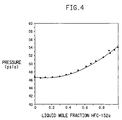
- FIG. 4 is a graphical representation of an azeotropic and azeotrope-like compositions consisting essentially of HFC-152a and HFC-134 at a temperature of about 10°C.
- FIG. 5 is a graphical representation of an azeotropic and azeoptrope-like compositions consisting essentially of CFC-12 and HFC-134a at a temperature of about 0°C.
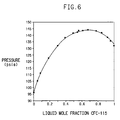
- FIG. 6 is a graphical representation of an azeotropic and azeotrope-like compositions consisting essentially of CFC-115 and HFC-134a at a temperature of about 25°C.
- FIG. 7 is a graphical representation of an azeotropic and azeotrope-like compositions consisting essentially of HFC-134a and HCFC-1122 at a temperature of about 35°C.
- HFC-134a and HFC-134 which are the primary constituents of a first mixture, in their separated and pure states have boiling points, respectively, of about -26.5 and about -19.7°C.
- the relative volatility at around 0°C was found to be about 1.2 as 100% 134a and about 1.3 as 100% 134 was approached.
- substantially free it is meant that the desired tetrafluoroethane isomer product contains less than about 1.0 wt% of the undesired isomer or other impurity, normally less than about .05 wt%, and in some cases less than about 10 ppm by weight.
- PTx Method To determine the relative volatility of HFC-134 and HFC-134a the so-called PTx Method was used. In this procedure, the total absolute pressure in a cell of known volume is measured at a constant temperature for various known binary compositions. Use of the PTx Method is described in greater detail in "Phase Equilibrium in Process Design", Wiley-Interscience Publisher, 1970, written by Harold R. Null, on pages 124 to 126; the entire disclosure of which is hereby incorporated by reference.
- NRTL Non-Random, Two-Liquid
- the NRTL equation can sufficiently predict whether or not HFC-134 and HFC-134a mixtures and/or the following other mixtures behave in an ideal manner, and can sufficiently predict the relative volatilities of the components in such mixtures.
- the "Mole Fraction” column refers to the quantity of HFC-134 that is in the liquid and vapor portions of the HFC-134a/HFC-134 mixture within the PTx Cell.
- the "Mole Fraction” column refers to the quantity of HFC-134a that is in the liquid and vapor portions of the HFC-134a/methanol mixture within the PTx Cell.
- the "Mole Fraction” column refers to the quantity of HFC-134 that is in the liquid and vapor portions of the HFC-134/methanol mixture within the PTx Cell.
- Tables 2 and 3 show that methanol can be readily separated from HFC-134a and HFC-134. More importantly, Tables 2 and 3 show that as the amount of methanol in the HFC-134a or HFC-134 increases, or the mole fraction of HFC-134a or HFC-134 approaches zero, the relative volatility of HFC-134a versus methanol and the relative volatility of HFC-134 versus methanol begins to differ dramatically. Comparing Table 2 versus Table 3, at a liquid mole fraction of about 0.94 of HFC-134a and 0.93 of HFC-134, the relative volatilities of HFC-134a and HFC-134 versus methanol are essentially the same: 5.7 or 6.0.
- Extractive distillation is intended to refer to a process wherein the relative volatility only of the components in the mixture to be separated is being used for separation, whereas “extractive distillation” depends upon the ability of certain extractive agents to amplify or increase the relative volatility of the compounds to be separated.
- Extractive distillation is typically performed by operating a continuous distillation column, which comprises a multi-stage distillation column, with a minimum of two feed points, e.g. introducing the extractive agent at a first feed point which is located above the second feed point that is used for introducing the mixture to be separated, a reboiler, an overhead condenser for returning reflux to the column, among other commercially available apparatus.
- HFC-134a and HFC-134 Given the close relative volatilities of HFC-134a and HFC-134, it was a surprising and an unexpected result that they can be purified by extractive distillation using certain readily available and low cost fluorine-free compounds. It was also surprising that this same procedure and equipment can simultaneously or separately be used for removing other fluorocarbon impurities from HFC-134a and/or HFC-134.
- the purified HFC-134a and/or HFC-134 can be substantially free of its isomer.
- the substantially free tetrafluoroethane is also typically substantially pure.
- substantially pure or purified it is meant that the recovered tetrafluoroethane is at least about 99 % pure tetrafluoroethane on a weight percent basis.
- an extractive agent e.g. methanol
- the first mixture requiring separation e.g., comprising HFC-134 and HFC-134a
- the liquid extractive agent passes downwardly through trays which are located in the center of the column and contacts the first mixture thereby forming a second mixture.
- HFC-134a is relatively more volatile than HFC-134, thereby allowing HFC-134a substantially free of HFC-134 to exit the top of the column.
- the HFC-134a which is exiting the top of the column, can be condensed by using conventional reflux condensers.
- this condensed stream can be returned to the top of the column as reflux, and the remainder recovered as a useful product, e.g., substantially pure HFC-134a.
- the HFC-134a can be transported to a second extractive distillation column and/or a second conventional distillation column for further purification.
- the recovered HFC-134a can be transported to a second extractive distillation column for removing fluorocarbon impurities.
- HFC-134, extractive agent and other fluorocarbon impurities comprise a third mixture that exits from the bottom of the column which can in turn then be passed to a stripper or conventional distillation column for separation by using conventional distillation or other known methods. If desired, the extractive agent may then be recycled to the extractive distillation column.
- the HFC-134 is separated from the extractive agent and recovered as a useful product, e.g., the extractive agent can be removed from the HFC-134 by using conventional distillation.
- the recovered HFC-134 can also be transported to a second or third conventional and/or extractive distillation column for removing fluorocarbon impurities, thereby obtaining substantially pure HFC-134.
- the extractive agent can be removed by any other expedient method such as water extraction.
- a mixture of HFC-134a or HFC-134 and alcohol is passed through water whereby the alcohol is preferentially withdrawn from the mixture.
- HFC-134 can be removed from a mixture containing relatively large quantities of HFC-134a, or vice versa, thereby producing the desired tetrafluoroethane which is substantially free of its isomer.
- the ratio of the material exiting the top of the extractive distillation column, which is then condensed and in turn returned to the column, to the amount of material that is removed as product is commonly referred to as the reflux ratio.
- the reflux ratio will define the physical characteristics of the extractive distillation column. In general, an increase in the reflux ratio will in turn cause an increase in the purity of the recovered HFC-134a, e.g., the quantity of extractant in the recovered HFC-134a can be reduced if not eliminated.
- the specific conditions that can be used for practicing the invention depend upon a number of interrelated design parameters such as the diameter of the column, selected feed points, the number of separation stages in the column, among other parameters.
- the operating pressure of the distillation system may range from about 15 to 350 psia, normally about 50 to 300 psia.
- an increase in the extractant feed rate relative to the mixture to be separated, or an increase in the reflux ratio will result in an increase in the purity of the overhead product produced.
- the temperature and heat transfer area of the overhead condenser is normally sufficient to substantially fully condense the overhead product, or is optionally sufficient to achieve the desired reflux ratio by partial condensation.
- the temperature that is employed at a given step in the inventive process is a function of the pressure and the design characteristics of the distillation column, e.g., the ratio of extractive agent to the first mixture. Typically, the temperature will range from about -25 to about 200°C based upon an operating pressure of about 200 psia.
- the quantity of fluorocarbon impurities in the first mixture can be reduced by using conventional distillation. While conventional distillation processes are incapable of producing HFC-134a or HFC-134 that is substantially free of its isomer, conventional distillation can be used for reducing the initial quantity of other fluorocarbon impurities. For example, conventional distillation can be used for removing relatively large or bulk quantities of impurities, for example, trichlorotrifluoroethane (CFC-113) from the first mixture which in turn is processed in accordance with the inventive process for separating HFC-134a and HFC-134.
- CFC-113 trichlorotrifluoroethane
- the effective amount of the extractive agent can vary widely. In general, however, using an increased amount of extractive agent will enhance the purity of the recovered tetrafluoroethane.
- the ratio of extractive agent to tetrafluoroethane ranges from about 2.0 to about 10:1 on a weight basis; however, higher ratios can be employed as needed.
- Fig. 1 schematically illustrates a system which can be used for performing one aspect of the inventive distillation process.
- a first mixture comprising HFC-134a with HFC-134, HCFC-31 and HCFC-1122 as impurities is supplied via conduit 1 to extraction column 2 .
- At least one liquid extractive agent is supplied via conduit 3 to the extraction column 2 , and introduced into column 3 at a location above the mixture 1 .
- a second mixture comprising the extractive agent(s), HFC-134, HCFC-31, HCFC-1122, among other fluorocarbon impurities, is removed from the bottom of column 2 and transported to steam-heated reboiler 4 .
- the reboiler 4 is attached to the extractive column 2 .
- the second mixture is supplied via conduit 5 to a feed tank 6 .
- Supplemental liquid extractive agent is also supplied to feed tank 6 via conduit 7 thereby forming a third mixture or extractive agent recycle.
- a pump 8 transports the third mixture to a stripping mixture column 9 .
- Stripping column 9 separates the extractive agents from non-extractive agents. Extractive agent is removed from column 9 and supplied to a second steam heated reboiler 10
- the reboiler 10 is attached to column 9 .
- Pump 11 transports the extractive agent from the reboiler 10 through a cold water chiller 12 , and then to chiller 13 . If necessary, excess quantities of extractive agent can be purged prior to reaching chiller 12 .
- chiller 13 is operated at a temperature of about -25°C. After exiting chiller 13 , the extraction agent is supplied via conduit 3 into extraction column 2 .
- HFC-134 exits from the top of stripping column 9 as an off gas, and is introduced into condenser 14 , which is typically operated at a temperature of about -25°C. While under reflux conditions, pump 15 returns a portion of the HFC-134 to the stripping column 9 . The remaining portion of the HFC-134 can be removed from the system via conduit 16 .
- the off gas is also removed from extraction column 2 .
- the off gas can be HFC-134a that is substantially free of HFC-134 and other fluorocarbon impurities.
- the HFC-134a product is transported via conduit 17 to condenser 18 .
- Condenser 18 is typically operated at a temperature of about -25°C. While under reflux conditions, pump 19 returns a portion of the HFC-134a product to extraction column 2 .
- the HFC-134a product can be removed from the system via conduit 20.
- a second aspect of the inventive process can be practiced by transporting the product from conduit 16 and/or 20 , as shown in Fig. 1, to a third column.
- the third column can be either conventional or extractive distillation column depending upon the composition of the product.
- the first mixture in conduit 1 may comprise HFC-134a and one or more impurities selected from HFC-134, HCFC-31, HCFC-1122, CFC-12, and CFC-115.
- the product in conduit 20 comprises HFC-134a, CFC-12 and CFC-115.
- the second mixture, which has exited extractive distillation column 2 , in conduit 5 comprises HFC-134, extractive agent, HCFC-31 and HCFC-1122.
- the product in conduit 16 comprises HFC-134, HCFC-31, and HCFC-1122.
- the products in conduits 16 and/or 20 may be transported to a third column for removal of either additional or remaining halocarbon impurities.
- a system is operated in substantially the same manner as the system in Figure 1 with the exception that the first mixture in conduit 1 comprises HFC-134 and one or more impurities selected from HFC-134a, HFC-152a, CFC-115, and CFC-12.
- the desired product exits the bottom of extractive distillation column 2 as a mixture of HFC-134/methanol.
- the mixture of HFC-134/methanol is transported via conduit 5 to distillation column 9 for separating HFC-134 and methanol.
- the product stream in conduit 16 and/or 20 is transported to a third conventional or extractive distillation column for removal of either additional or remaining halocarbon impurities.
- compositions may be used to purify HFC-134a and/or HFC-134.
- the azeotropic or azeotrope-like compositions that can be formed include one or more of the following mixtures: 1,1,1,2 tetrafluoroethane (HFC-134a) and dichlorodifluoromethane (CFC-12); 1,1,1,2 tetrafluoroethane (HFC-134a) and chloropentafluoroethane (CFC-115); 1,1,1,2 tetrafluoroethane (HFC-134a) and chloro-1,1-difluoroethylene (HCFC-1122) ; chloropentafluoro-ethane (CFC-115) and 1,1,2,2 tetrafluoroethane (HFC-134); 1,1,2,2 tetrafluoroethane
- azeotrope or "azeotropic” composition is meant a constant boiling liquid admixture of two or more substances that behaves as a single substance.
- azeotropic composition or mixture One way to characterize an azeotropic composition or mixture is that the vapor produced by partial evaporation or distillation of the liquid has the same composition as the liquid from which it was evaporated or distilled, e.g., the admixture distills/refluxes without compositional change.
- Constant boiling compositions are characterized as azeotropic because they exhibit either a maximum or minimum boiling point, as compared with that of the non-azeotropic mixtures of the same components.
- An azeotropic composition can also be characterized as the maximum or minimum vapor pressure for a mixture at a given temperature when plotted as a function of mole fraction.
- azeotrope-like composition is meant a constant boiling, or substantially constant boiling, liquid admixture of two or more substances that behaves as a single substance.
- One way to characterize an azeotrope-like composition is that the vapor produced by partial evaporation or distillation of the liquid has substantially the same composition as the liquid from which it was evaporated or distilled, e.g., the admixture distills/refluxes without substantial compositional change.
- An azeotrope-like composition can also be characterized by the area, which is shown by plotting vapor pressure at given temperature as a function of mole fraction, that is adjacent to the maximum or minimum vapor pressure.
- a composition is azeotrope-like, if, after about 50 weight percent of the composition is removed such as by evaporation or boiling off, the change between the original composition and the composition remaining is less than about 6% and normally less than about 3% relative to the original composition.
- effective amount is intended to refer to the amount of each component of the inventive compositions which, when combined, results in the formation of an azeotropic or azeotrope-like composition.
- This definition includes the amounts of each component, which amounts may vary depending on the pressure applied to the composition so long as the azeotropic or azeotrope-like compositions continue to exist at the different pressures, but with possible different boiling points.
- Effective amount also includes the amounts, such as may be expressed in weight percentages, of each component of the compositions of the instant invention which form azeotropic or azeotrope-like compositions at temperatures or pressures other than as described herein.
- azeotropic or azeotrope-like compositions consisting essentially of effective amounts of at least one of HFC-134a and/or HFC-134 and at least one fluorinated molecule such that after about 50 weight percent of an original composition is evaporated or boiled off to produce a remaining composition, the change between the original composition and the remaining composition is typically no more than about 6% and normally no more than about 3% or less relative to the original composition.
- the azeotrope or azeotrope-like compositions of the present invention may be formed by operating a conventional distillation apparatus, when practicing the inventive extractive distillation method, and by combining effective amounts of the components by any convenient method including mixing, combining, among others.
- a preferred method is to weigh the desired component amounts, and thereafter combine them in an appropriate container.
- HFC-134a and HFC-134 can be purified by using the above-identified azeotropic and azeotrope-like compositions in a process that comprises using these azeotropic and azeotrope-like compositions in a conventional distillation method.
- the conventional distillation column is operated at a temperature and pressure which causes these azeotropes to form.
- the composition will be collected, respectively, in the bottoms or as an overhead product.
- an azeotropic or azeotrope-like composition consisting essentially of, for example, HFC-134a/HCFC-1122 or HFC-134a/CFC-12 is collected as an overhead product whereas a composition consisting essentially of HFC-152a/HFC-134 is collected in the bottoms of the conventional distillation column.
- the azeotropic or azeotrope-like composition can be collected and condensed.
- the recovered azeotropic or azeotrope-like composition contains a tetrafluoroethane and a fluorinated halocarbon impurity.
- the recovered composition can be used as the first mixture or feed stream that is processed in accordance with the inventive process described above, e.g., the azeotropic distillation can be used for removing bulk quantities of a fluorocarbon impurity wherein the azeotrope is in turn separated by using extractive distillation.
- the azeotropic distillation can be used for removing bulk quantities of a fluorocarbon impurity wherein the azeotrope is in turn separated by using extractive distillation.
- each stage is based upon a 100 % operational or performance efficiency. Differing column designs and operating conditions are employed in the extractive distillation than in the Comparative Example in order to maximize the performance of each distillation method.
- Each Comparative Example shows a conventional distillation and is followed immediately by an Example which shows using the extractive distillation of the invention being applied to the same starting composition. In all examples, the column condenser is counted as stage no. 1.
- an extractive distillation column with 67 stages is used for purifying a 2000 Lb/hr feed stream containing 50% by weight of HFC-134 and 50% HFC-134a.
- the feed is introduced on stage 50 and the methanol extractant on stage 15, both at a temperature of -5 degrees C, with the column condenser pressure at 34.7 psia and the column base pressure 3 psi higher.
- the distillate temperature is -5.1 degrees C, and the bottom column temperature varies from 82 to 87 degrees C depending of the extractant flow.
- the HFC-134a product will leave in the overhead (distillate) stream from the column.
- the HFC-134 product exits in the bottoms stream with methanol.
- Conditions are set so as to meet a composition of 10 parts per million (ppm) of HFC-134 in the HFC-134a overhead product, and the extractant feed rate is varied to show the effect on bottom product purity.
- Extract. Flow Lb/br Reflux Flow Lb/hr HFC-134a in Overhd Lb/hr HFC-134 in Overhd ppm HFC-134 in Bottom Lb/hr HFC-134a in Bottom ppm HFC-134a Recovery % 20000 9000 1000 10 1000 26 100 25000 9000 1000 10 1000 20 100 30000 9000 1000 10 1000 16 100 35000 9000 1000 10 1000 13 100
- Table 5 shows that by using methanol as an extractive distillation agent, both the overhead and bottom products are substantially pure, i.e., the products contain 10 to 13 ppm impurities, and the recovery of each is about 100%.
- the overhead stream contains less than 0.01 ppm of methanol that, if desired, can be removed by water extraction.
- the impurity level is by comparison 100 ppm in the overhead and 6.6 % (66,000 ppm) in the bottom.
- Table 6 illustrates that conventional distillation is ineffective for separating these compounds. The recovery effeciency is limited because an azeotrope is formed between HFC-152a and HFC-134. However, this Example illustrates how the concentration of HFC-152a can be reduced from a first mixture comprising HFC-152a and HFC-134 by using azeotropic distillation.
- extractive distillation is performed in an extractive distillation column with 57 stages for purifying the same feed stream as in Comparative Example 2.
- the feed is introduced on stage 40 and the methanol extractant on stage 15, both at a temperature of -5 degrees C, with the column condenser pressure at 34.7 psia and the column base pressure 3 psi higher.
- the distillate temperature is -3.1 degrees C, and the bottom column temperature varies from 82 to 86 degrees C depending on the extractant flow rate.
- the HFC-134 product will leave in the bottoms stream from the column along with the methanol extractant.
- Conditions are set so as to meet a composition of 10 parts per million (ppm) of HFC-152a in the HFC-134 bottoms product.
- Extract. Flow Lb/hr Reflux Flow Lb/hr HFC-152a in Overhd Lb/hr HFC-134 in Overhd ppm HFC-152a in Bottom ppm HFC-134 in Bottom Lb/hr HFC-134 Recovery % 20000 1000 5.0 608 10 1000 100 25000 1000 5.0 26 10 1000 100 30000 1000 5.0 10 10 1000 100
- both the overhead and bottom products are substantially pure.
- the overhead also contains less than 0.01 ppm methanol that can be removed, if desired, by water extraction.
- extractive distillation is performed in a column with 57 stages for purifying the same feed stream as in Comparative Example 3.
- the feed and methanol extractant are fed at the same conditions as Example 2.
- the distillate temperature is 1.7 degrees C, and the bottom column temperature varies from 88 to 90 degrees C depending on the extractant flow rate.
- the HFC-134 product will leave in the overhead stream from the column.
- Conditions are set so as to meet a composition of 10 parts per million (ppm) of HCFC-124a in the HFC-134 distillate product, and the extractant feed rate is varied to show the effect on bottoms composition.
- Extract Flow Lb/hr Reflux Flow Lb/hr HCFC-124a in Overhd ppm HFC-134 in Overhd Lb/hr HCFC-124a in Bottom Lb/hr HFC-134 in Bottom Lb/hr HFC-134 Recovery % 5000 1000 11 919 5.0 81 92 7500 1000 10 1000 5.0 0.3 100 10000 1000 10 1000 5.0 0.07 100
- methanol as an extractive agent at a 7500 Lb/hr flowrate or higher
- a composition of substantially pure HFC-134 is obtained overhead with approximately 100% recovery.
- the overhead also contains a relatively small amount of methanol, e.g., varying from 0.9 to 1.3 ppm, that can be removed, if desired, by water extraction.
- Table 10 shows that a portion of the HFC-134 forms an overhead azeotrope, and that the purity of the overhead CFC-115 is relatively low.
- the HFC-134 recovery efficiency is limited because an azeotrope is formed between HFC-134 and CFC-115.
- this Example illustrates how the concentration of CFC-115 can be reduced from a first mixture comprising HFC-134 and CFC-115 by using azeotropic distillation.
- extractive distillation is performed in the column and feed conditions described in Example 2 for purifying the same feed stream as in Comparative Example 4.
- the distillate temperature is -18 degrees C
- the bottom column temperature varies from 23 to 49 degrees C depending of the extractant flow rate.
- the HFC-134 product will leave in the bottoms stream from the column along with the extractant.
- Conditions are set so as to meet a composition of 10 parts per million (ppm) of CFC-115 in the HFC-134 bottoms product, and the extractant feed rate is varied to show the effect on overhead composition.
- Extract Flow Lb/hr Reflux Flow Lb/hr CFC-115 in Overhd Lb/hr HFC-134 in Overhd ppm CFC-115 in Bottom ppm HFC-134 in Bottom Lb/hr HFC-134 Recovery % 1000 1000 5.0 ⁇ 0.01 10 1000 100 2000 1000 5.0 ⁇ 0.01 10 1000 100 3000 1000 5.0 ⁇ 0.01 10 1000 100
- Table 12 shows that a portion of the HFC-134 forms an overhead azeotrope, and that the purity of the overhead CFC-12 is relatively low.
- extractive distillation is performed in the column and feed conditions described in Example 2 for purifying the same feed stream as described in Comparative Example 5.
- the feed is introduced on stage 40 and the methanol extractant on stage 15.
- the distillate temperature varies from -6.0 to -7.5 degrees C, and the bottom column temperature varies from 23 to 62 degrees C depending of the extractant flow rate.
- the HFC-134 product will leave in the bottoms stream from the column along with the extractant.
- Conditions are set so as to meet a composition of 1 part per million (ppm) of CFC-12 in the HFC-134 bottoms product, and the extractant feed rate is varied to show the effect on overhead composition.
- Extract. Flow Lb/hr Reflux Flow Lb/hr CFC-12 in Overhd Lb/hr HFC-134 in Overhd ppm CFC-12 in Bottom ppm HFC-134 in Bottom Lb/hr HFC-134 Recovery % 1000 1000 5.0 >10000 45 999 99.9 2000 1000 5.0 ⁇ 0.01 1 1000 100.0 3000 1000 5.0 ⁇ 0.01 1 1000 100.0 4000 1000 5.0 ⁇ 0.01 1 1000 100.0 5000 1000 5.0 ⁇ 0.01 1 1000 100.0
- CFC-12 and HFC-134 can be substantially completely separated. While the overhead also contains a relatively small amount of methanol, e.g., varying from 0.01 to 0.04 ppm, such an amount can be removed, if desired, by water extraction.
- HFC-134a can be recovered in the overhead, the recovery rate and purity are relatively low.
- the HFC-134a recovery efficiency is limited because an azeotrope is formed between HFC-134a and CFC-12.
- this Example illustrates how the concentration of CFC-12 can be reduced from a first mixture comprising HFC-134a and CFC-12 by using azeotropic distillation.
- extractive distillation is performed in a column with 57 stages for purifying the same feed stream as described in Comparative Example 6.
- the feed and methanol extractant are introduced at the same conditions and locations as described in Example 2.
- the distillate temperature varies from -12 to -7.5 degrees C, and the bottom column temperature varies from 48 to 77 degrees C depending on the extractant flow rate.
- the HFC-134a product will leave in the bottoms stream from the column along with the extractant.
- Conditions are set so as to meet a composition of 10 parts per million (ppm) of CFC-12 in the HFC-134 bottoms product, and the extractant feed rate is varied to show the effect on overhead composition.
- CFC-12 and HFC-134a are substantially completely separated. While the overhead also contains a relatively small amount of methanol, e.g., varying from 0.34 to 0.97 ppm, such an amount can be removed, if desired, by water extraction.
- the recovery of HFC-134a as an overhead product was 50%.
- the recovery of HFC-134a can be increased to about 92 % by using a relatively high reflux ratio, e.g., 50 to 1.
- extractive distillation is performed in the column and feed conditions described in Example 2 for purifying the same feed stream as in Comparative Example 7.
- the feed is introduced on stage 40 and the methanol extractant on stage 15.
- the distillate temperature is -5.1 degrees C, and the bottom column temperature is 90 degrees C.
- the HFC-134a product will leave in the overhead stream from the column.
- Conditions are set so as to meet a composition of 10 parts per million (ppm) of HCFC-31 in the HFC-134a overhead product.
- Extract. Flow Lb/hr Reflux Flow Lb/hr HCFC-31 in Overhd ppm HFC-134a in Overhd Lb/hr HCFC-31 in Bottom Lb/hr HFC-134a in Bottom Lb/hr HFC-134a Recovery % 2000 1000 10 1000 5.0 ⁇ 0.01 100
- both the overhead and bottoms are recovered as substantially pure products.
- the overhead also contains 0.6 ppm methanol that can be removed, if desired, by water extraction.
- Table 18 shows that a portion of the HFC-134a forms an overhead azeotrope, and that the purity of the overhead CFC-115 is relatively low.
- the recovery efficiency of the HFC-134a is limited because an azeotrope is formed between HFC-134a and CFC-115.
- this Example illustrates how the concentration of CFC-115 can be reduced from a first mixture comprising HFC-134a and CFC-115 by using azeotropic distillation.
- extractive distillation is performed in the column and feed conditions described in Example 4 for purifying the same feed stream as in Comparative Example 8.
- the feed is introduced on stage 40 and the methanol extractant on stage 15.
- the distillate temperature is -18 degrees C, and the bottom column temperature varies from 10 to 32 degrees C depending of the extractant flow rate.
- the HFC-134a product will leave in the bottoms stream from the column along with the extractant.
- Conditions are set so as to meet a composition of 10 parts per million (ppm) of CFC-115 in the HFC-134a bottoms product, and the extractant feed rate is varied to show the effect on overhead composition.
- Extract. Flow Lb/hr Reflux Flow Lb/hr CFC-115 in Overhd Lb/hr HFC-134a in Overhd ppm CFC-115 in Bottom ppm HFC-134a in Bottom Lb/hr HFC-134a Recovery % 1000 1000 5.0 ⁇ 0.01 10 1000 100 2000 1000 5.0 ⁇ 0.01 10 1000 100 3000 1000 5.0 ⁇ 0.01 10 1000 100
- Table 19 shows that by using methanol as extractive agent, HFC-134a can be recovered that is substantially free of CFC-115, and the CFC-115 can be recovered as being substantially free of HFC-134a. While the overhead also contains a relatively small amount methanol, e.g., varying from 1.5 to 1.8 ppm, is amount can be removed, if desired, by water extraction.
- the recovery efficiency of the HFC-134a is limited because an azeotrope is formed between HFC-134a and CFC-115.
- this Example illustrates how the concentration of CFC-115 can be reduced from a first mixture comprising HFC-134a and CFC-115 by using azeotropic distillation.
- extractive distillation is performed in a column with 57 stages for purifying the same feed stream as described in Comparative Example 9.
- the feed is introduced on stage 40 and the methanol extractant on stage 15, both at a temperature of -5 degrees C, with the column condenser pressure at 34.7 psia and the column base pressure 3 psi higher.
- the distillate temperature is -5.1 degrees C, and the bottom column temperature varies from 88 to 91 degrees C depending on the extractant flowrate.
- the HFC-134a product will leave in the overhead stream from the column. Conditions are set so as to meet a composition of 100 parts per million (ppm) of HCFC-1122 in the HFC-134a overhead product.
- Extract. Flow Lb/hr Reflux Flow Lb/hr HCFC-1122 in Overhd ppm HFC-134a in Overhd Lb/hr HCFC-1122 in Bottom Lb/hr HFC-134a in Bottom Lb/hr HFC-134a Recovery % 10000 2000 110 907 4.9 93 90.7 15000 2000 100 990 4.9 10 99.0 20000 2000 100 996 4.9 4 99.6 25000 2000 100 998 4.9 2 99.8
- the product recovery is increased to as high as 99.8%.
- the overhead also contains up to 0.03 ppm methanol which can be removed, if desired, by water extraction.
- an extractive agent can be employed for separating HFC-134a and HFC-134 from each other and numerous fluorocarbon impurities.
- one or more extractive agents can be used in combination.
- the inventive process may be maximized to obtain HFC-134a that has the desired purity while minimizing the extractive agent cost.
- a series of one or more chemically related or distinct extractive agents can be employed for maximizing the effectiveness of the inventive process.
- This Example demonstrates the existence of azeotropic and azeotrope-like compositions between the binary pair mixtures consisting essentially of CFC-115 and HFC-134; HFC-134 and HCFC-124a; HFC-152a and HFC-134; CFC-12 and HFC-134a; CFC-115 and HFC-134a; HFC-134a and HCFC-1122;.
- PTx Method To determine the relative volatility of each binary pair, the so-called PTx Method was used. In this procedure, for each binary pair, the total absolute pressure in a PTx cell of known volume was measured at a constant temperature for various known binary compositions. These measurements were then reduced to equilibrium vapor and liquid compositions in the cell using the NRTL equation. Samples of selected vapor and liquid sets were obtained and analyzed to verify their respective compositions.
- Figs. 2 through 7 The vapor pressure measured versus the composition in the PTx cell for the CFC-115/HFC-134; HFC-134/HCFC-124a; HFC-152/HFC-134; CFC-12/HFC-134a; CFC-115/HFC-134a; and HFC-134a/HCFC-112 systems are shown in Figs. 2 through 7, respectively.
- the experimental data points are shown in each Figure as solid points on each Figure and the curve is drawn by using computer modeling.
- Figure 2 illustrates graphically the formation of an azeotropic and azeotrope-like composition consisting essentially of CFC-115 and HFC-134 at 11.2°C, as indicated by a mixture of about 72.4 mole % CFC-115 and 27.6 mole % HFC-134 having the highest pressure over the range of compositions at this temperature.
- an azeotropic or azeotrope-like composition of about 93 mole % CFC-115 and 7 mole % HFC-134 is formed at -50°C and 8.8 psia and an azeotropic or azeotrope-like composition of about 65.9 mole % CFC-115 and about 34.1 mole % HFC-134 is formed at 55°C and 326 psia.
- the present invention provides an azeotropic or azeotrope-like composition consisting essentially of from about 65 to about 93 mole % CFC-115 and from about 35 to 7 mole % HFC-134, said composition having a boiling point of from about -50 at 8.8 psia to about 55°C at 326 psia.
- Figure 3 illustrates graphically the formation of an azeotropic and azeotrope-like composition consisting essentially of HFC-134 and HCFC-124a at -0.2°C, as indicated by a mixture of about 96.9 mole % HFC-134 and 3.1 mole % HCFC-124a having the highest pressure over the range of compositions at this temperature.
- an azeotropic or azeotrope-like composition of about 99.9 mole % HFC-134 and 0.1 mole % HCFC-124a is formed at -20°C and 14.4 psia
- an azeotropic or azeotrope-like composition of about 91.9 mole % HFC-134 and 8.1 mole % HCFC-124a is formed at 60°C and 199 psia.
- the present invention provides an azeotropic or azeotrope-like composition consisting essentially of from about 91 to about 99.9 mole % HFC-134 and from about 9 to 0.1 mole % HCFC-124a, said composition having a boiling point of from about -20°C at 14.4 psia to about 60°C at 199 psia.
- Figure 4 illustrates graphically the formation of an azeotropic and azeotrope-like composition consisting essentially of HFC-152a and HFC-134 at 10°C, as indicated by a mixture of about 93.7mole % HFC-134 and 6.3 mole % HFC-152a having the lowest pressure over the range of compositions at this temperature.
- an azeotropic or azeotrope-like composition of about 99.9 mole % HFC-134 and 0.1 mole % HFC-152a is formed at -25°C and 11.5 psia and an azeotropic or azeotrope-like composition of about 83.1 mole % HFC-134 and 16.9 mole % HFC-152a is formed at 50 °C and 153 psia.
- the present invention provides an azeotropic or azeotrope-like composition consisting essentially of from about 83.1 to about 99.9 mole % HFC-134 and from about 16.9 to about 0.1 mole % HFC-152a, said composition having a boiling point of from about -25°C at 11.5 psia to about 50°C at 153 psia.
- Figure 5 illustrates graphically the formation of an azeotropic and azeotrope-like composition consisting essentially of CFC-12 and HFC-134a at 0°C, as indicated by a mixture of about 58.3 mole % CFC-12 and 41.7mole % HFC-134a having the highest pressure over the range of compositions at this temperature.
- an azeotropic or azeotrope-like composition of about 62.8 mole % CFC-12 and 37.2 mole % HFC-134a is formed at -50°C and 6.8 psia and an azeotropic or azeotrope-like composition of about 46.9 mole % CFC-12 and about 53.1 mole % HFC-134a is formed at 50 °C and 235 psia.
- the present invention provides an azeotropic or azeotrope-like composition consisting essentially of from about 46.9 to about 62.8 mole % CFC-12 and from about 53.1 to about 37.2 mole % HFC-134a, said composition having a boiling point of from about -50°C at 6.8 psia to about 50°C at 235 psia.
- Figure 6 illustrates graphically the formation of an azeotropic and azeotrope-like composition consisting essentially of CFC-115 and HFC-134a at 25°C, as indicated by a mixture of about 67.9 mole % CFC-115 and 32.1 mole % HFC-134a having the highest pressure over the range of compositions at this temperature.
- an azeotropic or azeotrope-like composition of about 80.5 mole % CFC-115 and 19.5 mole % HFC-134a is formed at -50°C and 9.4 psia and an azeotropic or azeotrope-like composition of about 63.1 mole % CFC-115 and about 36.9 mole % HFC-134a is formed at 60°C and 330 psia.
- the present invention provides an azeotropic or azeotrope-like composition consisting essentially of from about 63.1 to about 80.5 mole % CFC-115 and from about 36.9 to about 19.5 mole % HFC-134a, said composition having a boiling point of from about -50°C at 9.4 psia to about 60°C at 330 psia.
- Figure 7 illustrates graphically the formation of an azeotropic and azeotrope-like composition consisting essentially of HFC-134a and HCFC-1122 at 35°C, as indicated by a mixture of about 15.6 mole % HCFC-1122 and 84.4 mole % HFC-134a having the highest pressure over the range of compositions at this temperature.
- an azeotropic or azeotrope-like composition of about 39.3 mole % HCFC-1122 and 60.7 mole % HFC-134a is formed at -50°C and 5.0 psia and an azeotropic or azeotrope-like composition of about 16.1 mole % HCFC-1122 and about 83.9 mole % HFC-134a is formed at 40°C and 149 psia.
- the present invention provides an azeotropic or azeotrope-like composition consisting essentially of from about 16.1 to about 39.3 mole % HCFC-1122 and from about 83.9 to about 60.7 mole % HFC-134a, said composition having a boiling point of from about -50°C at 5.0 psia to about 40°C at 149 psia.
Landscapes
- Chemical & Material Sciences (AREA)
- Organic Chemistry (AREA)
- Organic Low-Molecular-Weight Compounds And Preparation Thereof (AREA)
Claims (22)
- Ein Verfahren zum Reinigen von Tetrafluorethan-Isomeren in einer ersten Mischung, die 1,1,2,2-Tetrafluorethan, 1,1,1,2-Tetrafluorethan und Fluorkohlenstoff-Verunreinigungen enthält, wobei das Verfahren die Schritte beinhaltet:Zugeben von wenigstens einem Extraktionsmittel, das wenigstens einen Alkohol enthält, zu der ersten Mischung, um eine zweite Mischung zu bilden;Trennen von wenigstens einer Flurokohlenstoff-Verunreinigung von den Tetrafluorethan-Isomeren in der zweiten Mischung durch extraktives Destillieren der zweiten Mischung in einer Extraktions-Destillationszone;dabei optional Bilden einer dritten Mischung, die das Extraktionsmittel und Fluorkohlenstoff-Verunreinigungen enthält und Trennen des Extraktionsmittels von der dritten Mischung, und;Rückgewinnen bzw. Gewinnen von wenigstens einem Tetrafluorethan-Isomer.
- Ein Verfahren zum Trennen von Tetrafluorethan-Isomeren in einer ersten Mischung, die 1,1,2,2-Tetrafluorethan, 1,1,1,2-Tetrafluorethan und Fluorkohlenstoff-Verunreinigungen enthält, wobei das Verfahren die Schritte beinhaltet:Zugeben von wenigstens einem Extraktionsmittel, das wenigstens einen Alkohol enthält, zu der ersten Mischung, um eine zweite Mischung zu bilden;Trennen von 1,1,1,2-Tetrafluorethan von dem 1,1,2,2-Tetrafluorethan in der zweiten Mischung durch extraktives Destillieren der zweiten Mischung in einer Extraktions-Destillationszone und dabei Rückgewinnen bzw. Gewinnen von 1,1,2,2-Tetrafluorethan und Bilden einer dritten Mischung, die das Extraktionsmittel, 1,1,1,2-Tetrafluorethan und Fluorkohlenstoff-Verunreinigungen enthält; undoptional Trennen des 1,1,2,2-Tetrafluorethans von der dritten Mischung.
- Ein Verfahren zum Gewinnen bzw. Machen von gereinigten Tetrafluorethan-Isomeren aus einer ersten Mischung, die 1,1,2,2-Tetrafluorethan, 1,1,1,2-Tetrafluorethan und Fluorkohlenstoff-Verunreinigungen enthält, wobei das Verfahren die Schritte beinhaltet:Zugeben von wenigstens einem Extraktionsmittel, das wenigstens einen Alkohol enthält, zu der ersten Mischung, um eine zweite Mischung zu bilden;Trennen von im wesentlichen nur einem der Isomere von dem anderen Isomer und den Fluorkohlenstoff-Verunreinigungen in der zweiten Mischung durch extraktives Destillieren der zweiten Mischung in einer Extraktions-Destillationszone und dabei Rückgewinnen bzw. Gewinnen eines getrennten Isomers, das im wesentlichen rein und im wesentlichen frei ist von dem anderen Isomer, und;optional Bilden einer dritten Mischung, die das Extraktionsmittel, Fluorkohlenstoff-Verunreinigungen und ein Isomer in dem Bodenstrom enthält.
- Ein Verfahren zum Trennen von Tetrafluorethan-Isomeren in einer ersten Mischung, die 1,1,2,2-Tetrafluorethan, 1,1,1,2-Tetrafluorethan und Fluorkohlenstoff-Verunreinigungen enthält, wobei das Verfahren die Schritte beinhaltet:Zugeben von wenigstens einem Extraktionsmittel, das wenigstens einen Alkohol enthält, zu der ersten Mischung, um eine zweite Mischung zu bilden;Trennen von 1,1,1,2-Tetrafluorethan von dem 1,1,2,2-Tetrafluorethan in der zweiten Mischung durch extraktives Destillieren der zweiten Mischung in einer Extraktions-Destillationszone, dabei Bilden einer dritten Mischung, die das Extraktionsmittel, 1,1,2,2,-Tetrafluorethan im wesentlichen frei von 1,1,1,2-Tetrafluorethan und Fluorkohlenstoff-Verunreinigungen enthält; und,optional Trennen des 1,1,2,2-Tetrafluorethans von der dritten Mischung.
- Das Verfahren nach den Ansprüchen 1, 2, 3 oder 4, worin das Extraktionsmittel wenigstens einen Alkohol enthält, der aus der Gruppe ausgewählt ist, die aus Methanol, Ethanol, Propanol, Butanol und zyklischen und isomeren Verbindungen davon besteht.
- Das Verfahren nach Anspruch 1, 2, 3 oder 4, worin das rückgewonnene bzw. gewonnene Tetrafluorethan-Isomer destilliert wird, um im wesentlichen reines Tetrafluorethan zu ergeben bzw. zu erhalten.
- Das Verfahren nach Anspruch 1, 2, 3 oder 4, worin das rückgewonnene bzw. gewonnene Tetrafluorethan-Isomer mit Wasser extrahiert wird, um das Extraktionsmittel zu entfernen, um im wesentlichen reines Tetrafluorethan zu ergeben bzw. zu erhalten.
- Das Verfahren nach den Ansprüchen 1, 2, 3 oder 4, worin die Fluorkohlenstoff-Verunreinigungen wenigstens ein Element aus der Gruppe enthalten, die aus Chlorfluormethan (HCFC-31), Chlordifluormethan (HCFC-22), 2-Chlor-1,1-difluorethylen (HCFC-1122), 1-Chlor-1,1,2,2-Tetrafluorethan (HCFC-124a), Chlorpentafluorethan (CFC-115), Dichlordifluormethan (CFC-12), und 1,1-Difluorethan (HFC-152a) besteht.
- Das Verfahren nach Anspruch 3 oder 4 ferner beinhaltend: Bilden einer dritten Mischung, die das Extraktionsmittel, Fluorkohlenstoff-Verunreinigungen und ein Isomer in dem Bodenstrom enthält und Trennen des Isomers von der dritten Mischung, worin das abgetrennte Isomer im wesentlichen frei ist von dem anderen Isomer.
- Das Verfahren nach Anspruch 2, worin das rückgewonnene bzw. gewonnene 1,1,1,2-Tetrafluorethan im wesentlichen frei ist von 1,1,2,2-Tetrafluorethan.
- Das Verfahren nach Anspruch 3, worin das rückgewonnene bzw. gewonnene Isomer im wesentlichen rein und im wesentlichen frei von dem anderen Isomer ist.
- Das Verfahren nach Anspruch 1, 2, 3 oder 4, worin das Verhältnis von Extraktionsmittel zu Tetrafluorethanen in der zweiten Mischung von 2 bis 10:1 beträgt.
- Das Verfahren nach Anspruch 1, 2, 3 oder 4, worin das extraktive Destillieren bei einer Temperatur von -25 bis 200°C durchgeführt wird.
- Das Verfahren nach Anspruch 1, 2, 3 oder 4, worin das extraktive Destillieren bei einem Druck von 15 bis 350 psia durchgeführt wird.
- Eine azeotrope oder azeotropähnliche Zusammensetzung, bestehend im wesentlichen aus 65 bis 93 Mol% CFC-115 und 35 bis 7 Mol% HFC-134, wobei die Zusammensetzung einen Siedepunkt von -50 bei 8.8 psia bis 55°C bei 326 psia hat.
- Eine azeotrope oder azeotropähnliche Zusammensetzung, bestehend im wesentlichen aus 91 bis 99,9 Mol% HFC-134 und von 9 bis 0,1 Mol% HCFC-124a, wobei die Zusammensetzung einen Siedepunkt von 20°C bei 14,4 psia bis 60°C bei 199 psia hat.
- Eine azeotrope oder azeotropähnliche Zusammensetzung, bestehend im wesentlichen aus 83,1 bis 99,9 Mol% HFC-134 und von 16,9 bis 0,1 Mol% HFC-152a, wobei die Zusammensetzung einen Siedepunkt von -25°C bei 11,5 psia bis 50°C bei 153 psia hat.
- Eine azeotrope oder azeotropähnliche Zusammensetzung, bestehend im wesentlichen aus 46,9 bis 62,8 Mol% CFC-12 und von 53,1 bis 37,2 Mol% HFC-134a, wobei die Zusammensetzung einen Siedepunkt von -50°C bei 6,8 psia bis 50°C bei 235 psia hat.
- Eine azeotrope oder azeotropähnliche Zusammensetzung, bestehend im wesentlichen aus 63,1 bis 80,5 Mol% CFC-115 und von 36,9 bis 19,5 Mol% HFC-134a, wobei die Zusammensetzung einen Siedepunkt von -50°C bei 9,4 psia bis 60°C bei 330 psia hat.
- Eine azeotrope oder azeotropähnliche Zusammensetzung, bestehend im wesentlichen aus 16,1 bis 39,3 Mol% HCFC-1122 und von 83,9 bis 60,7 Mol% HFC-134a, wobei die Zusammensetzung einen Siedepunkt von -50°C bei 5,0 psia bis 40°C bei 149 psia hat.
- Eine azeotrope oder azeotropähnliche Zusammensetzung, bestehend im wesentlichen aus HFC-134 und einer wirksamen Menge eines Elements, das ausgewählt ist aus der Gruppe, die aus CFC-115, HCFC-124a und HFC-152a besteht.
- Eine azeotrope oder azeotropähnliche Zusammensetzung, bestehend im wesentlichen aus HFC-134a und einer wirksamen Menge eines Elements, das ausgewählt ist aus der Gruppe, die aus CFC-12, CFC-115 und HCFC-1122 besteht.
Applications Claiming Priority (3)
| Application Number | Priority Date | Filing Date | Title |
|---|---|---|---|
| US212439 | 1994-03-11 | ||
| US08/212,439 US5470442A (en) | 1994-03-11 | 1994-03-11 | Separating and removing impurities from tetrafluoroethanes by using extractive distillation |
| PCT/US1995/003013 WO1995024370A1 (en) | 1994-03-11 | 1995-03-13 | Separating and removing impurities from tetrafluoroethanes by using extractive distillation |
Publications (2)
| Publication Number | Publication Date |
|---|---|
| EP0749407A1 EP0749407A1 (de) | 1996-12-27 |
| EP0749407B1 true EP0749407B1 (de) | 1999-12-15 |
Family
ID=22791019
Family Applications (1)
| Application Number | Title | Priority Date | Filing Date |
|---|---|---|---|
| EP95912858A Expired - Lifetime EP0749407B1 (de) | 1994-03-11 | 1995-03-13 | Abtrennung und entfernung von verunreinigungen aus tetrafluorethanen durch extraktivdestillation |
Country Status (11)
| Country | Link |
|---|---|
| US (1) | US5470442A (de) |
| EP (1) | EP0749407B1 (de) |
| JP (1) | JPH09510214A (de) |
| KR (1) | KR100332392B1 (de) |
| CN (1) | CN1143945A (de) |
| AU (1) | AU3104995A (de) |
| BR (1) | BR9507409A (de) |
| CA (1) | CA2184474A1 (de) |
| DE (1) | DE69513960T2 (de) |
| MX (1) | MX9603988A (de) |
| WO (1) | WO1995024370A1 (de) |
Cited By (1)
| Publication number | Priority date | Publication date | Assignee | Title |
|---|---|---|---|---|
| CN108368010A (zh) * | 2015-12-23 | 2018-08-03 | 阿科玛法国公司 | 制备2,3,3,3-四氟-1-丙烯以及将不含杂质的2-氯-3,3,3-三氟丙烯再循环的方法 |
Families Citing this family (27)
| Publication number | Priority date | Publication date | Assignee | Title |
|---|---|---|---|---|
| US5723429A (en) * | 1994-03-11 | 1998-03-03 | E. I. Du Pont De Nemours And Company | Azeotropic or azeotrope-like compositions of tetrafluoroethane and chlorotetrafluoroethane |
| WO1996005158A1 (en) * | 1994-08-17 | 1996-02-22 | Daikin Industries, Ltd. | Process for producing pentafluoroethane |
| US5785822A (en) * | 1996-05-23 | 1998-07-28 | Alliedsignal Inc. | Process for separating difluoromethane |
| US5800682A (en) * | 1996-10-08 | 1998-09-01 | Alliedsignal Inc. | Process for the production of difluoromethane |
| US5779863A (en) * | 1997-01-16 | 1998-07-14 | Air Liquide America Corporation | Perfluorocompound separation and purification method and system |
| DE69819163T2 (de) * | 1997-08-12 | 2004-07-22 | E.I. Du Pont De Nemours And Co., Wilmington | Reinigung von difluormethan durch extraktivdestillation |
| US6488817B1 (en) * | 1998-03-31 | 2002-12-03 | Alliedsignal Inc. | Purification of hydrofluorocarbons |
| US6357240B1 (en) | 1998-08-12 | 2002-03-19 | Hudson Technologies, Inc. | Apparatus and method for flushing a chiller system |
| US6164080A (en) * | 1998-08-12 | 2000-12-26 | Hudson Technologies, Inc. | Apparatus and method for flushing a refrigeration system |
| US6505475B1 (en) | 1999-08-20 | 2003-01-14 | Hudson Technologies Inc. | Method and apparatus for measuring and improving efficiency in refrigeration systems |
| GB9927011D0 (en) * | 1999-11-16 | 2000-01-12 | Advanced Phytonics Ltd | Method for the production of particles |
| FR2806077B1 (fr) | 2000-03-07 | 2004-01-30 | Solvay | Procede pour l'obtention d'un hydrofluoroalcane epure, hydrofluoroalcane epure, utilisation de l'hydrofluoroalcane et methode d'analyse d'un hydrofluoroalcane |
| US7189311B2 (en) | 2001-03-23 | 2007-03-13 | Honeywell International Inc. | Purification of difluoromethane |
| KR20050085487A (ko) * | 2002-12-09 | 2005-08-29 | 허드슨 테크놀로지스, 인코포레이티드 | 냉각 시스템 최적화 방법 및 장치 |
| US8463441B2 (en) * | 2002-12-09 | 2013-06-11 | Hudson Technologies, Inc. | Method and apparatus for optimizing refrigeration systems |
| FR2865731B1 (fr) * | 2004-01-30 | 2007-09-07 | Solvay | Procede de fabrication d'un hydrofluoroalcane |
| EP1768941B1 (de) * | 2004-06-23 | 2015-01-21 | ExxonMobil Chemical Patents Inc. | Verfahren zur trennung von komponenten einer mischung |
| US7893176B2 (en) * | 2007-03-23 | 2011-02-22 | Exxonmobil Chemical Patents Inc. | Polydispersity-controlled isoolefin polymerization with polymorphogenates |
| US8075777B2 (en) * | 2007-05-16 | 2011-12-13 | E. I. Du Pont De Nemours And Company | Process for the separation of diastereomers |
| US7964760B2 (en) * | 2007-05-25 | 2011-06-21 | E.I. Du Pont De Nemours And Company | Process for the separation of fluorocarbons using ionic liquids |
| JP6221545B2 (ja) * | 2013-09-18 | 2017-11-01 | 株式会社Ihi | ジェットエンジンのための導電構造 |
| DK3284797T3 (da) | 2014-09-25 | 2021-02-01 | Daikin Ind Ltd | Sammensætning, der omfatter hfc og hfo |
| KR20180002790A (ko) * | 2015-05-07 | 2018-01-08 | 더 케무어스 컴퍼니 에프씨, 엘엘씨 | 1,1,2,2-테트라플루오로에탄을 포함하는 조성물 및 그의 용도 |
| FR3046159B1 (fr) * | 2015-12-23 | 2019-12-13 | Arkema France | Procede de preparation du 2,3,3,3-tetrafluoropropene et recyclage du 1,1,1,2,2-pentafluoropropane exempt d'impuretes. |
| CN106582058B (zh) * | 2016-12-20 | 2018-10-30 | 山东京博石油化工有限公司 | 一种分离石油焦可溶有机质的方法 |
| CN106905107B (zh) * | 2017-02-24 | 2020-02-18 | 北京宇极科技发展有限公司 | 一种1,1-二溴-1,2,2,2-四氟乙烷的提纯方法 |
| KR20250048112A (ko) * | 2019-11-28 | 2025-04-07 | 다이킨 고교 가부시키가이샤 | 불소계 탄화수소 화합물의 탈수 방법 |
Family Cites Families (16)
| Publication number | Priority date | Publication date | Assignee | Title |
|---|---|---|---|---|
| CH471760A (de) * | 1966-02-23 | 1969-04-30 | Ciba Geigy | Verfahren zur Trennung von Gemischen von aliphatischen Fluorverbindungen |
| US3732150A (en) * | 1971-10-22 | 1973-05-08 | Phillips Petroleum Co | Process for separating halogenated hydrocarbons by azeotropic distillation with ammonia |
| US3819493A (en) * | 1973-04-26 | 1974-06-25 | Phillips Petroleum Co | Process for separating halogenated hydrocarbons by extractive distillation |
| GB1578933A (en) * | 1977-05-24 | 1980-11-12 | Ici Ltd | Manufacture of halogenated hydrocarbons |
| US4996379A (en) * | 1988-05-30 | 1991-02-26 | Central Glass Company, Limited | Method of preparing 1,1,1,2-tetrafluoroethane from 1,1-dichloro-1,2,2,2-tetrafluoroethane |
| US4906796A (en) * | 1989-03-08 | 1990-03-06 | Allied Signal Inc. | Process for purifying 1,1,1,2-tetrafluoroethane |
| US5243105A (en) * | 1990-03-29 | 1993-09-07 | Imperial Chemical Industries Plc | Chemical process |
| DK0467531T3 (da) * | 1990-07-04 | 1994-10-31 | Ici Plc | Fremgangsmåde til adskillelse af 1,1,1,2-tetrafluorethan fra blandinger deraf med hydrogenfluorid og/eller 1-chlor-2,2-difluorethylen |
| GB9018372D0 (en) * | 1990-08-21 | 1990-10-03 | Ici Plc | Separation process |
| JPH04316525A (ja) * | 1991-04-16 | 1992-11-06 | Showa Denko Kk | 1,1,1,2−テトラフルオロエタンの精製方法 |
| JP2897454B2 (ja) * | 1991-04-19 | 1999-05-31 | 昭和電工株式会社 | 1,1,1,2−テトラフルオロエタンの精製法 |
| US5336377A (en) * | 1991-12-18 | 1994-08-09 | Allied-Signal Inc. | Process for removing 2-chloro-1,1-difluoroethylene from 1,1,1,2-tetrafluoroethane and co-producing 2-chloro-1,1,1,2-tetrafluoroethane |
| FR2689503B1 (fr) * | 1992-04-03 | 1994-06-10 | Solvay | Procede d'epuration d'un hydrofluoroalcane. |
| DE59304392D1 (de) * | 1992-06-13 | 1996-12-12 | Hoechst Ag | Verfahren zur Entfernung olefinischer Verunreinigungen aus fluorierten C3-C6-Kohlenwasserstoffen |
| TW222617B (de) * | 1992-08-20 | 1994-04-21 | Showa Denko Kk | |
| AU684757B2 (en) * | 1993-05-25 | 1998-01-08 | Showa Denko Kabushiki Kaisha | Purification process of pentafluoroethane |
-
1994
- 1994-03-11 US US08/212,439 patent/US5470442A/en not_active Expired - Lifetime
-
1995
- 1995-03-13 CA CA002184474A patent/CA2184474A1/en not_active Abandoned
- 1995-03-13 BR BR9507409A patent/BR9507409A/pt active Search and Examination
- 1995-03-13 KR KR1019960704993A patent/KR100332392B1/ko not_active Expired - Fee Related
- 1995-03-13 JP JP7523661A patent/JPH09510214A/ja active Pending
- 1995-03-13 WO PCT/US1995/003013 patent/WO1995024370A1/en not_active Ceased
- 1995-03-13 MX MX9603988A patent/MX9603988A/es unknown
- 1995-03-13 EP EP95912858A patent/EP0749407B1/de not_active Expired - Lifetime
- 1995-03-13 CN CN95192070A patent/CN1143945A/zh active Pending
- 1995-03-13 DE DE69513960T patent/DE69513960T2/de not_active Expired - Fee Related
- 1995-03-13 AU AU31049/95A patent/AU3104995A/en not_active Abandoned
Cited By (1)
| Publication number | Priority date | Publication date | Assignee | Title |
|---|---|---|---|---|
| CN108368010A (zh) * | 2015-12-23 | 2018-08-03 | 阿科玛法国公司 | 制备2,3,3,3-四氟-1-丙烯以及将不含杂质的2-氯-3,3,3-三氟丙烯再循环的方法 |
Also Published As
| Publication number | Publication date |
|---|---|
| US5470442A (en) | 1995-11-28 |
| DE69513960T2 (de) | 2000-07-27 |
| MX9603988A (es) | 1997-09-30 |
| CN1143945A (zh) | 1997-02-26 |
| AU3104995A (en) | 1995-09-25 |
| JPH09510214A (ja) | 1997-10-14 |
| EP0749407A1 (de) | 1996-12-27 |
| BR9507409A (pt) | 1997-10-07 |
| CA2184474A1 (en) | 1995-09-14 |
| DE69513960D1 (de) | 2000-01-20 |
| WO1995024370A1 (en) | 1995-09-14 |
| KR100332392B1 (ko) | 2002-11-13 |
Similar Documents
| Publication | Publication Date | Title |
|---|---|---|
| US5470442A (en) | Separating and removing impurities from tetrafluoroethanes by using extractive distillation | |
| JP2815914B2 (ja) | 相分離及び蒸留によるhfの分離方法 | |
| US7371309B2 (en) | Purification of difluoromethane by extractive distillation | |
| US5874657A (en) | Process for the purification of 1,1-difluoroethane | |
| US5830325A (en) | Separating and removing 1, 1, 1-trifluoroethane by using azeotropic distillation | |
| US5421964A (en) | Process for separating HCl and halocarbons | |
| EP0743933B1 (de) | Verfahren zur trennung von pentafluorethan aus einer mischung von halogenierten kohlenwasserstoffen und chloropentafluorethan | |
| EP0743934B1 (de) | Verfahren zur trennung von pentafluorethan aus einer mischung, die halogenierte kohlenwasserstoffe und chlorpentafluorethan enthält | |
| US5665266A (en) | Azeotropic and azeotrope-like compositions with HCL and halocarbon | |
| US5723429A (en) | Azeotropic or azeotrope-like compositions of tetrafluoroethane and chlorotetrafluoroethane | |
| EP1062194A1 (de) | Verfahren zur reinigung von perfluorcyclobutan | |
| KR20040002879A (ko) | 디플루오로메탄의 정제 | |
| US5789633A (en) | Azeotropic or azeotrope-like compositions of hydrofluoric acid with dihaloethanes | |
| US6303838B1 (en) | Separating 1,1,1,3,3-pentafluoropropane from hydrogen fluoride | |
| RU2188815C2 (ru) | Способ очистки 1,1-дифторэтана экстрактивной дистилляцией | |
| CN121464197A (zh) | Hf和水与1252zc和关键中间体的共沸物及分离方法 | |
| US6291727B1 (en) | Azeotropic or azeotrop-like compositions of hydrofluoric acid with dihaloethanes | |
| MXPA96003988A (es) | Separacion y eliminacion de impurezas de los tetrafluoroetanos mediante la utilizacion extract |
Legal Events
| Date | Code | Title | Description |
|---|---|---|---|
| PUAI | Public reference made under article 153(3) epc to a published international application that has entered the european phase |
Free format text: ORIGINAL CODE: 0009012 |
|
| 17P | Request for examination filed |
Effective date: 19960823 |
|
| AK | Designated contracting states |
Kind code of ref document: A1 Designated state(s): DE ES FR GB IT NL |
|
| 17Q | First examination report despatched |
Effective date: 19971016 |
|
| GRAG | Despatch of communication of intention to grant |
Free format text: ORIGINAL CODE: EPIDOS AGRA |
|
| GRAG | Despatch of communication of intention to grant |
Free format text: ORIGINAL CODE: EPIDOS AGRA |
|
| GRAH | Despatch of communication of intention to grant a patent |
Free format text: ORIGINAL CODE: EPIDOS IGRA |
|
| GRAH | Despatch of communication of intention to grant a patent |
Free format text: ORIGINAL CODE: EPIDOS IGRA |
|
| GRAA | (expected) grant |
Free format text: ORIGINAL CODE: 0009210 |
|
| AK | Designated contracting states |
Kind code of ref document: B1 Designated state(s): DE ES FR GB IT NL |
|
| PG25 | Lapsed in a contracting state [announced via postgrant information from national office to epo] |
Ref country code: NL Free format text: LAPSE BECAUSE OF FAILURE TO SUBMIT A TRANSLATION OF THE DESCRIPTION OR TO PAY THE FEE WITHIN THE PRESCRIBED TIME-LIMIT Effective date: 19991215 Ref country code: IT Free format text: LAPSE BECAUSE OF FAILURE TO SUBMIT A TRANSLATION OF THE DESCRIPTION OR TO PAY THE FEE WITHIN THE PRE;WARNING: LAPSES OF ITALIAN PATENTS WITH EFFECTIVE DATE BEFORE 2007 MAY HAVE OCCURRED AT ANY TIME BEFORE 2007. THE CORRECT EFFECTIVE DATE MAY BE DIFFERENT FROM THE ONE RECORDED.SCRIBED TIME-LIMIT Effective date: 19991215 Ref country code: ES Free format text: THE PATENT HAS BEEN ANNULLED BY A DECISION OF A NATIONAL AUTHORITY Effective date: 19991215 |
|
| REF | Corresponds to: |
Ref document number: 69513960 Country of ref document: DE Date of ref document: 20000120 |
|
| ET | Fr: translation filed | ||
| NLV1 | Nl: lapsed or annulled due to failure to fulfill the requirements of art. 29p and 29m of the patents act | ||
| PLBE | No opposition filed within time limit |
Free format text: ORIGINAL CODE: 0009261 |
|
| STAA | Information on the status of an ep patent application or granted ep patent |
Free format text: STATUS: NO OPPOSITION FILED WITHIN TIME LIMIT |
|
| 26N | No opposition filed | ||
| REG | Reference to a national code |
Ref country code: GB Ref legal event code: IF02 |
|
| PGFP | Annual fee paid to national office [announced via postgrant information from national office to epo] |
Ref country code: GB Payment date: 20080312 Year of fee payment: 14 |
|
| PGFP | Annual fee paid to national office [announced via postgrant information from national office to epo] |
Ref country code: DE Payment date: 20080306 Year of fee payment: 14 |
|
| PGFP | Annual fee paid to national office [announced via postgrant information from national office to epo] |
Ref country code: FR Payment date: 20090316 Year of fee payment: 15 |
|
| GBPC | Gb: european patent ceased through non-payment of renewal fee |
Effective date: 20090313 |
|
| PG25 | Lapsed in a contracting state [announced via postgrant information from national office to epo] |
Ref country code: DE Free format text: LAPSE BECAUSE OF NON-PAYMENT OF DUE FEES Effective date: 20091001 |
|
| PG25 | Lapsed in a contracting state [announced via postgrant information from national office to epo] |
Ref country code: GB Free format text: LAPSE BECAUSE OF NON-PAYMENT OF DUE FEES Effective date: 20090313 |
|
| REG | Reference to a national code |
Ref country code: FR Ref legal event code: ST Effective date: 20101130 |
|
| PG25 | Lapsed in a contracting state [announced via postgrant information from national office to epo] |
Ref country code: FR Free format text: LAPSE BECAUSE OF NON-PAYMENT OF DUE FEES Effective date: 20100331 |