EP0749698A2 - Produit enrobé, fini ou semi-fini, destiné à l'alimentation animale ou humaine - Google Patents
Produit enrobé, fini ou semi-fini, destiné à l'alimentation animale ou humaine Download PDFInfo
- Publication number
- EP0749698A2 EP0749698A2 EP96110095A EP96110095A EP0749698A2 EP 0749698 A2 EP0749698 A2 EP 0749698A2 EP 96110095 A EP96110095 A EP 96110095A EP 96110095 A EP96110095 A EP 96110095A EP 0749698 A2 EP0749698 A2 EP 0749698A2
- Authority
- EP
- European Patent Office
- Prior art keywords
- food
- fine
- product
- coating
- feed
- Prior art date
- Legal status (The legal status is an assumption and is not a legal conclusion. Google has not performed a legal analysis and makes no representation as to the accuracy of the status listed.)
- Granted
Links
Images
Classifications
-
- A—HUMAN NECESSITIES
- A23—FOODS OR FOODSTUFFS; TREATMENT THEREOF, NOT COVERED BY OTHER CLASSES
- A23G—COCOA; COCOA PRODUCTS, e.g. CHOCOLATE; SUBSTITUTES FOR COCOA OR COCOA PRODUCTS; CONFECTIONERY; CHEWING GUM; ICE-CREAM; PREPARATION THEREOF
- A23G3/00—Sweetmeats; Confectionery; Marzipan; Coated or filled products
- A23G3/34—Sweetmeats, confectionery or marzipan; Processes for the preparation thereof
- A23G3/50—Sweetmeats, confectionery or marzipan; Processes for the preparation thereof characterised by shape, structure or physical form, e.g. products with supported structure
- A23G3/54—Composite products, e.g. layered, coated, filled
-
- A—HUMAN NECESSITIES
- A23—FOODS OR FOODSTUFFS; TREATMENT THEREOF, NOT COVERED BY OTHER CLASSES
- A23G—COCOA; COCOA PRODUCTS, e.g. CHOCOLATE; SUBSTITUTES FOR COCOA OR COCOA PRODUCTS; CONFECTIONERY; CHEWING GUM; ICE-CREAM; PREPARATION THEREOF
- A23G3/00—Sweetmeats; Confectionery; Marzipan; Coated or filled products
- A23G3/02—Apparatus specially adapted for manufacture or treatment of sweetmeats or confectionery; Accessories therefor
- A23G3/20—Apparatus for coating or filling sweetmeats or confectionery
- A23G3/26—Apparatus for coating by tumbling with a liquid or powder, spraying device-associated, drum, rotating pan
-
- A—HUMAN NECESSITIES
- A23—FOODS OR FOODSTUFFS; TREATMENT THEREOF, NOT COVERED BY OTHER CLASSES
- A23K—FODDER
- A23K40/00—Shaping or working-up of animal feeding-stuffs
- A23K40/30—Shaping or working-up of animal feeding-stuffs by encapsulating; by coating
-
- A—HUMAN NECESSITIES
- A23—FOODS OR FOODSTUFFS; TREATMENT THEREOF, NOT COVERED BY OTHER CLASSES
- A23P—SHAPING OR WORKING OF FOODSTUFFS, NOT FULLY COVERED BY A SINGLE OTHER SUBCLASS
- A23P20/00—Coating of foodstuffs; Coatings therefor; Making laminated, multi-layered, stuffed or hollow foodstuffs
- A23P20/10—Coating with edible coatings, e.g. with oils or fats
- A23P20/12—Apparatus or processes for applying powders or particles to foodstuffs, e.g. for breading; Such apparatus combined with means for pre-moistening or battering
-
- A—HUMAN NECESSITIES
- A23—FOODS OR FOODSTUFFS; TREATMENT THEREOF, NOT COVERED BY OTHER CLASSES
- A23P—SHAPING OR WORKING OF FOODSTUFFS, NOT FULLY COVERED BY A SINGLE OTHER SUBCLASS
- A23P20/00—Coating of foodstuffs; Coatings therefor; Making laminated, multi-layered, stuffed or hollow foodstuffs
- A23P20/10—Coating with edible coatings, e.g. with oils or fats
- A23P20/12—Apparatus or processes for applying powders or particles to foodstuffs, e.g. for breading; Such apparatus combined with means for pre-moistening or battering
- A23P20/13—Apparatus or processes for applying powders or particles to foodstuffs, e.g. for breading; Such apparatus combined with means for pre-moistening or battering involving agitation of the foodstuff inside a rotating apparatus, e.g. a drum
Definitions
- the invention relates to a semi-finished or finished product for animal feed, consisting of a lump-shaped or coarse-grained carrier material which is provided with an edible coating.
- the coating usually consists of frosting or a gel-forming material consisting of water-soluble alginates, as described in DE 22 20 528 B2.
- JP-A 63-94961 proposes to provide flaky, flaky or granular foods or feedstuffs with a coating of sugar syrup, in order to then apply powdery additives thereon, which are then sealed with a further sugar syrup.
- US Pat. No. 4,755,390 describes a method for coating cereal preparations with taste-improving agents which are dissolved by milk, fruit juices or the like. Cereal preparations treated in this way are preferably offered and consumed as breakfast foods.
- the present invention has for its object to provide a segregation-proof food or feed semi-or end product of the type mentioned, which is consumable as an end product and can be dissolved as a semi-product in water, milk or the like for the production of an end product, and which can be easily stored over a longer period of time even at normal temperatures, d. H. is characterized by a high durability. Furthermore, it is an object of the present invention to provide a method for producing such a food or feed product and to indicate a preferred use therefor.
- the essence of the present invention lies in the formation of a "popped up" coating which is characterized by open porosity and is accordingly suitable for absorbing moisture and dissolving in the shortest possible time.
- edible, in particular cooked, starting products are used, the end product can be consumed immediately.
- non-cooked, cooked, modified or edible starting products you get a food or feed semi-product, which only after Dissolution in cold or hot solution medium, such as. B. water, milk, cream, yogurt, cheese substrate or the like.
- the semifinished product produced according to the invention thus represents a so-called instant product which, due to the high capillarity of the coating, is distinguished by a high solubility and thus a correspondingly short preparation time.
- the products produced according to the invention are also characterized in that they do not necessarily have to be stored cool as dry products.
- the storage of the food or feed products according to the invention is accordingly considerably simplified, in particular for restaurants and restaurants and canteens.
- the semifinished and finished goods or feedstuffs according to the invention are also particularly suitable for warm areas in which refrigerated storage is impossible or difficult.
- the products according to the invention are characterized by an exact recipe that is permanently retained. Accordingly, the dosage for the production of an end product using semifinished products produced according to the invention can also be specified precisely.
- the porous coatings according to the present invention are extremely resistant to abrasion. They can also be flavor-sealed by a layer of sugar if this turns out to be expedient or necessary.
- the products of the invention are also characterized by an exact fulfillment of functions, for. B. swelling in cold or hot solution medium, dissolution in the mouth or the like. This is due on the one hand to the high capillarity and on the other hand to the exact composition of the coating of lumpy or coarse-grained food or feed.
- the coating provided according to the invention also prevents enzymatic, biological or bacterial reactions.
- the classification of the food or feed product according to the invention it is important that it has a residual moisture of not more than about 2 to 8%, in particular about 3 to 5%.
- the coating comprises at least two layers of the same or different consistency, in particular the composition of fine substances.
- the coating is multi-layered, and each layer can have different ingredients.
- the individual layers can be taste-improving, acid-resistant, solubility-promoting or the like. They can also serve as a liquid barrier layer when applied directly to the surface of the carrier material. This is particularly important if natural food or feed is used as the carrier material, such as. B. pieces of walnut as part of a walnut ice cream. In this case, the walnut pieces are first coated with a waterproof hard fat layer. This is followed by the open-pore coating with the ingredients for the formation of an ice cream in combination with water or milk.
- the carrier material can also be coated with a first layer of enzyme and / or bacterial compounds, which is coated with a protein layer that is acid-resistant up to a certain pH value and / or a fat layer, the melting point of which is adjusted to the solution temperature, and thereby a fermentation of Can be added from the beginning. Compresses or agglomerates of maltodextrin or the like. Food or feed products can be used as the lump-shaped carrier material.
- barrier layers mentioned are also used above all for the temporally defined setting of the dissolution of the food or feed product according to the invention in a liquid medium. They also serve to protect the carrier material from softening.
- the powdery fines for the coating contain starch in particular. They can additionally contain flavorings, flavors, swelling agents, thickeners, emulsifiers, vitamins, minerals such as potassium, sodium, magnesium, chloride, sulfates, phosphates, calcium, carbonates, and / or essential trace elements such as iron, copper, iodine or the like . If necessary, sugar or sugar substitutes are also part of the powdery fines, especially when it comes to the adherence of sugar.
- Tough layers can be achieved by means of a higher protein or sugar content of the fine substance or the respective fine substance layer (s) and additionally by intensive mechanical compression of the corresponding layers.
- the mechanical Densification takes place either during the coating process within a rotation-driven coating drum or by passing the carrier material coated with fine material over mechanical obstacles. The latter measures are particularly appropriate when using a continuous fluid bed process.
- the adhesion during the so-called “rising or rising” of the fine materials takes place with the lowest possible dough yield TA.
- a TA 150 means e.g. B. 100 parts of fine material + 50 parts of water.
- the TA changes depending on the composition of the fines. Fine substances that cannot absorb water, e.g. B. fat powder, must with the necessary proportions of water-soluble substances, for. B. proteins or sugar. This also applies to fines that contain too little protein or sugar.
- the open-pore structure of the coating or its capillarity is important.
- the solution medium can very quickly penetrate into the coating and dissolve it and swell if necessary.
- the open-pore coating is formed in an environment of low pressure, in particular in an environment with a pressure of 4.0 to 0.01 mbar. Sublimation occurs at a pressure of approximately 4.0, in particular 2.0 to 0.2 mbar. Moisture is removed more or less quickly depending on the temperature of the product and the coating. This physical fact can now be exploited for structuring by means of certain "tenacious fine substance layers", in the manner described above.
- This effect can also be achieved with higher pressure if the product is heated beforehand.
- Another possibility is the passage of the product through a microwave field at ambient pressure or in negative pressure. The water in the product is brought to a boil very quickly. The water vapor that is forced outward swells the product, and the structures specified above are created.
- This method is particularly suitable when the carrier is in the raw state, e.g. B. fresh apple pieces, which are coated in the moist state and then subjected to air drying.
- a corresponding open-pore structure can be achieved here by an upstream or integrated microwave field.
- the residual moisture is increased by approximately 4 to 20%. That means: in theory, drying the products by this 4 to 20% would be sufficient to complete the manufacturing process. For reasons of product durability, however, it has been found that drying the entire product to a residual moisture of about 3% (total drying about 10 to 15%) is advantageous. In any case, the residual moisture should not be more than 10% on the one hand and not less than 2% on the other.
- the carrier material 11 should be lumpy or coarse-grained. Accordingly, dried and / or candied fruit, dried pieces of meat, fish or vegetables or mixtures thereof, lumpy or coarse-grained food or feed compresses, agglomerates, or even natural food or feed with a low water content are particularly suitable as carrier material, such as B. Nuts.
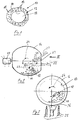
- the product according to FIG. 1 is a dry product which is characterized by a high durability and which does not allow any enzymatic, biological or bacterial reactions. These are prevented by the coating 12.
- the coating 12 has a capillary structure so that solution medium can penetrate and dissolve the coating very quickly.
- this is set to a residual moisture of not more than about 2 to 8%, in particular about 3 to 5%.
- FIG. 1 A possibility for producing a semi-finished food or feed product according to FIG. 1 is described in more detail with reference to FIGS. 2 and 3:
- Rotary-powered coating drum 16 pieces of carrier materials 11 filled in the un-cooked - for semi-finished products - or consumable, in particular cooked - for end products - and inside the coating drum with pulverulent fines in a likewise un-cooked or cooked state.
- the rotary drive for the coating drum 16 is identified in FIG. 2 by the reference number 17. As a rule, a regulated electric motor is used for this.
- the rotary movement of the coating drum carries the carrier material 11 in the direction of rotation, as shown in FIG. 3. Approximately halfway up the rotary drum, the carrier material carried back falls back according to the arrows 18 in FIGS. 2 and 3. Because of this entrainment and reversing movement according to arrow 18, the carrier material 11 is in constant circulation. In this state, the carrier material is first moistened on all sides, in particular with water or milk or the like liquid. For this purpose, a liquid spray nozzle 20 projects through the front access opening 19 of the coating drum 16. The spray cone is identified by the reference number 21 in FIG. 2. Due to the above-mentioned circulation of the carrier material 11, this is moistened approximately uniformly over the entire surface.
- the carrier material moistened on the surface is provided with a first layer of fine material.
- powdery fine material is introduced into the rotating coating drum 16.
- the corresponding fine material feed line is identified in FIG. 2 by the reference number 22.
- the fine substance discharge above the circulating carrier material is provided with the reference number 23.
- the applied fine material Due to the constant circulation of the carrier material thanks to the rotation of the coating drum 16 in the direction of arrow 24, the applied fine material is stabilized or compacted on the surface of the carrier material.
- the degree of compaction depends on the one hand on the intensity of the Moistening of the carrier material and on the other hand on the fine material itself and the circulation time.
- the speed of rotation of the coating drum 16 also plays a not inconsiderable role in the intensity of the compression of the layer of fine material which has been exposed in the manner described. If necessary, this process can be repeated any number of times until there is a sufficiently thick layer of fine material.
- the rising of fine material onto the carrier material thus takes place in layers, the consistency and / or composition of the individual layers being different.
- the rising can also be influenced by increasing or decreasing the temperature inside the coating drum.
- the corresponding measures for this are shown in FIG. 3 with the Bunsen burners 25 arranged below the coating drum 16 on the one hand and the nozzle 26 for the exit of a cooling medium, for. B. liquid nitrogen or liquid CO 2 indicated on the other hand.
- a cooling medium for. B. liquid nitrogen or liquid CO 2 indicated on the other hand.
- other measures are taken in a large production plant, e.g. B. the use of electric heating rods instead of the Bunsen burner mentioned or the introduction of a cooling medium directly into the coating drum 16.
- the illustration in FIG. 3 should only be understood as an indication of the temperature measures described.
- the process temperature depends on the fine materials used on the one hand and the carrier material on the other.
- the coated carrier material can be placed on heating plates within the vacuum chamber. After reaching a predetermined pressure of z. B. 3.5 mbar, the heating plates are switched on. This will cause dehydration within the vacuum chamber accelerated considerably.
- the flopping starts at a vacuum of around 4.0 to 0.01 mbar.
- the fine material layer that has been applied to the carrier material is relatively tough, the toughness depending on the water content and / or composition of the fine material layer and the thickness and degree of compaction thereof.
- This tough fine substance layer delays the described dehydration or sublimation. Due to the negative pressure, the tough layer of fine material is radially stretched, initially with little dehydration. In the further course, ie with increasing negative pressure or increasing evacuation, a largely open-pore structure is formed. The fine material layer "pops up". As already mentioned, viscous fines layers can be achieved through a higher protein or sugar content of the fines and additionally through intensive mechanical compaction (longer coating process).
- the semi-finished food or feed should be manufactured with the lowest possible TA, namely a TA of a maximum of about 104 to 112.
- the semi-finished products should be immediately dried or deep-frozen to ensure the function of the pasted ingredients for not to affect their later processing.
- the instant products mentioned are semifinished products within the scope of the described invention.
- the end product is obtained by dissolving the semifinished product or instant product in water, milk or the like.
- the products described can also be used as baking and cooking aids or ingredients.
- the "popped" coating of the carrier material is extremely abrasion-resistant.
- the abrasion resistance can be increased further by at least strongly compressing the last layer of fine material before “popping up”, so that it is relatively compact even in the "popped up” state.
Landscapes
- Chemical & Material Sciences (AREA)
- Life Sciences & Earth Sciences (AREA)
- Polymers & Plastics (AREA)
- Engineering & Computer Science (AREA)
- Food Science & Technology (AREA)
- Oil, Petroleum & Natural Gas (AREA)
- Zoology (AREA)
- Fodder In General (AREA)
- General Preparation And Processing Of Foods (AREA)
- Medicinal Preparation (AREA)
Applications Claiming Priority (2)
| Application Number | Priority Date | Filing Date | Title |
|---|---|---|---|
| DE19522701 | 1995-06-22 | ||
| DE19522701 | 1995-06-22 |
Publications (3)
| Publication Number | Publication Date |
|---|---|
| EP0749698A2 true EP0749698A2 (fr) | 1996-12-27 |
| EP0749698A3 EP0749698A3 (fr) | 1998-07-01 |
| EP0749698B1 EP0749698B1 (fr) | 2003-03-05 |
Family
ID=7765001
Family Applications (1)
| Application Number | Title | Priority Date | Filing Date |
|---|---|---|---|
| EP96110095A Expired - Lifetime EP0749698B1 (fr) | 1995-06-22 | 1996-06-21 | Produit enrobé, fini ou semi-fini, destiné à l'alimentation animale ou humaine |
Country Status (3)
| Country | Link |
|---|---|
| EP (1) | EP0749698B1 (fr) |
| AT (1) | ATE233493T1 (fr) |
| DE (1) | DE59610186D1 (fr) |
Cited By (4)
| Publication number | Priority date | Publication date | Assignee | Title |
|---|---|---|---|---|
| EP1053690A3 (fr) * | 1999-05-17 | 2003-07-02 | VK Mühlen Food Service GmbH | Produit enrobé de pâte et frit et son procédé de fabrication |
| DE102014107054A1 (de) * | 2014-05-19 | 2015-11-19 | Hans-Jürgen Deuerer | Verfahren zur Herstellung eines fleischbasierten Futtermittelkonzentrats, fleischbasiertes Futtermittelkonzentrat sowie fleischbasierter Futterdrink |
| US9980910B2 (en) | 2010-11-16 | 2018-05-29 | Provimi North America, Inc. | Enteric-coated sodium metabisulfite livestock feed additive for vomitoxin detoxification |
| US10743565B2 (en) | 2013-10-02 | 2020-08-18 | Can Technologies, Inc. | Feed pellets and related systems and methods |
Family Cites Families (11)
| Publication number | Priority date | Publication date | Assignee | Title |
|---|---|---|---|---|
| FI40675B (fr) * | 1964-11-13 | 1968-12-31 | American Potato Co | |
| US3615676A (en) * | 1967-12-18 | 1971-10-26 | Gen Mills Inc | Process for sugar coating ready-to-eat cereal |
| US3833747A (en) * | 1970-08-21 | 1974-09-03 | J Cording | Process for reducing the hygroscopicity of dehydrated fruits |
| US3989853A (en) * | 1973-09-17 | 1976-11-02 | Forkner John H | Method for expanding confections in a package |
| JPS5851845A (ja) * | 1981-08-26 | 1983-03-26 | Meiji Seika Kaisha Ltd | 膨化中空菓子の製造方法 |
| JPS61209556A (ja) * | 1985-03-14 | 1986-09-17 | Toyo Suisan Kk | 長期保存可能な天ぷらの製造方法 |
| ATE77211T1 (de) * | 1987-11-04 | 1992-07-15 | Schaaf Heinz Ohg | Verfahren zur herstellung von snacks oder dergleichen produkte. |
| JPH0367554A (ja) * | 1989-08-04 | 1991-03-22 | Bieichiyou Nogyo Kyodo Kumiai | 食品の製造方法 |
| US5208055A (en) * | 1992-01-15 | 1993-05-04 | Naturestar Foods, Inc. | Freeze dried cheese and popcorn product |
| ATE150619T1 (de) * | 1993-06-01 | 1997-04-15 | Peter Enzensperger | Backwaren-zutatenverbund, verfahren zur herstellung sowie verwendung desselben |
| JPH07147888A (ja) * | 1993-09-30 | 1995-06-13 | Sankai:Kk | 衣つき即席乾燥肉食品及びその製造方法 |
-
1996
- 1996-06-21 EP EP96110095A patent/EP0749698B1/fr not_active Expired - Lifetime
- 1996-06-21 AT AT96110095T patent/ATE233493T1/de not_active IP Right Cessation
- 1996-06-21 DE DE59610186T patent/DE59610186D1/de not_active Expired - Fee Related
Cited By (4)
| Publication number | Priority date | Publication date | Assignee | Title |
|---|---|---|---|---|
| EP1053690A3 (fr) * | 1999-05-17 | 2003-07-02 | VK Mühlen Food Service GmbH | Produit enrobé de pâte et frit et son procédé de fabrication |
| US9980910B2 (en) | 2010-11-16 | 2018-05-29 | Provimi North America, Inc. | Enteric-coated sodium metabisulfite livestock feed additive for vomitoxin detoxification |
| US10743565B2 (en) | 2013-10-02 | 2020-08-18 | Can Technologies, Inc. | Feed pellets and related systems and methods |
| DE102014107054A1 (de) * | 2014-05-19 | 2015-11-19 | Hans-Jürgen Deuerer | Verfahren zur Herstellung eines fleischbasierten Futtermittelkonzentrats, fleischbasiertes Futtermittelkonzentrat sowie fleischbasierter Futterdrink |
Also Published As
| Publication number | Publication date |
|---|---|
| DE59610186D1 (de) | 2003-04-10 |
| ATE233493T1 (de) | 2003-03-15 |
| EP0749698B1 (fr) | 2003-03-05 |
| EP0749698A3 (fr) | 1998-07-01 |
Similar Documents
| Publication | Publication Date | Title |
|---|---|---|
| EP0973408B1 (fr) | Glace alimentaire contenant des additifs a consistance moelleuse | |
| DE69424913T2 (de) | Koextrudiertes Produkt und Verfahren seiner Herstellung | |
| DE2549391A1 (de) | Entwaesserte nahrungsmittelprodukte und verfahren zur herstellung derselben | |
| DE2647856A1 (de) | Zuckergussmasse | |
| DE69501745T2 (de) | Imbiss-Snack | |
| DE2146255A1 (de) | Expandierte fleischhaltige Nahrungsund Futtermittel | |
| EP0512274B1 (fr) | Mélange de fruits à cuire surgelé, prêt à l'emploi | |
| EP0009219B1 (fr) | Tranches sèches de produits alimentaires ou de délicatesses en forme de chips et procédé pour leur fabrication | |
| WO2012093139A1 (fr) | Procédé de production de produits de confiserie, ainsi que produits de confiserie | |
| DE4022058C2 (de) | Honigpulver und Verfahren zu seiner Herstellung | |
| DE60215020T2 (de) | Keks für eiskonfekt | |
| DE19535582C2 (de) | Würzmischung für die TK-Industrie | |
| EP0749698B1 (fr) | Produit enrobé, fini ou semi-fini, destiné à l'alimentation animale ou humaine | |
| DE3404442C2 (de) | Gefülltes Nahrungsmittel-Verbundprodukt auf Getreidebasis und Verfahren zu seiner Herstellung | |
| DE4141448A1 (de) | Verfahren zu herstellung von tiefgefrorenen verzehrfertigen fertiggerichten und anwendungen dieses verfahrens | |
| EP1257179B1 (fr) | Melange pour assaisonnement a haute teneur en sel | |
| DE1303052C2 (de) | Verfahren zur herstellung von pulverfoermigen haltbaren nahrungsmitteln | |
| DE2350638C3 (de) | Verfahren zur Herstellung von Snack-Produkten | |
| DE69331094T2 (de) | Verfahren zur Herstellung von essfertigen Getreideflocken | |
| DE2135842A1 (de) | Verfahren zur herstellung von zuckerund fetthaltigen mandel-/nussgebaecken (knuspergebaeck) oder ueberzuegen und damit versehenen erzeugnissen sowie ein produkt zur durchfuehrung des verfahrens | |
| DE1767537C3 (de) | Verfahren zur Herstellung einer Eisspeise | |
| DE2158295C3 (de) | Verfahren zur Herstellung eßbarer expandierter Körner auf Zuckerbasis | |
| DE3118705A1 (de) | Stubentierfutter mit mittlerem feuchtigkeitsgehalt und verfahren zu seiner herstellung | |
| DE10033733A1 (de) | Verfahren zur Herstellung strukturierter und haltbarer Trockenback-Formteile und -Stücke | |
| EP0701402B1 (fr) | Melange pret a utiliser pour patisserie, son procede de production et son utilisation |
Legal Events
| Date | Code | Title | Description |
|---|---|---|---|
| PUAI | Public reference made under article 153(3) epc to a published international application that has entered the european phase |
Free format text: ORIGINAL CODE: 0009012 |
|
| AK | Designated contracting states |
Kind code of ref document: A2 Designated state(s): AT BE CH DE DK ES FR GB GR IT LI NL |
|
| PUAL | Search report despatched |
Free format text: ORIGINAL CODE: 0009013 |
|
| AK | Designated contracting states |
Kind code of ref document: A3 Designated state(s): AT BE CH DE DK ES FR GB GR IT LI NL |
|
| 17P | Request for examination filed |
Effective date: 19981209 |
|
| GRAG | Despatch of communication of intention to grant |
Free format text: ORIGINAL CODE: EPIDOS AGRA |
|
| 17Q | First examination report despatched |
Effective date: 20010903 |
|
| GRAG | Despatch of communication of intention to grant |
Free format text: ORIGINAL CODE: EPIDOS AGRA |
|
| GRAH | Despatch of communication of intention to grant a patent |
Free format text: ORIGINAL CODE: EPIDOS IGRA |
|
| GRAH | Despatch of communication of intention to grant a patent |
Free format text: ORIGINAL CODE: EPIDOS IGRA |
|
| GRAA | (expected) grant |
Free format text: ORIGINAL CODE: 0009210 |
|
| AK | Designated contracting states |
Designated state(s): AT BE CH DE DK ES FR GB GR IT LI NL |
|
| PG25 | Lapsed in a contracting state [announced via postgrant information from national office to epo] |
Ref country code: NL Free format text: LAPSE BECAUSE OF FAILURE TO SUBMIT A TRANSLATION OF THE DESCRIPTION OR TO PAY THE FEE WITHIN THE PRESCRIBED TIME-LIMIT Effective date: 20030305 Ref country code: IT Free format text: LAPSE BECAUSE OF FAILURE TO SUBMIT A TRANSLATION OF THE DESCRIPTION OR TO PAY THE FEE WITHIN THE PRE;WARNING: LAPSES OF ITALIAN PATENTS WITH EFFECTIVE DATE BEFORE 2007 MAY HAVE OCCURRED AT ANY TIME BEFORE 2007. THE CORRECT EFFECTIVE DATE MAY BE DIFFERENT FROM THE ONE RECORDED.SCRIBED TIME-LIMIT Effective date: 20030305 Ref country code: GR Free format text: LAPSE BECAUSE OF FAILURE TO SUBMIT A TRANSLATION OF THE DESCRIPTION OR TO PAY THE FEE WITHIN THE PRESCRIBED TIME-LIMIT Effective date: 20030305 Ref country code: GB Free format text: LAPSE BECAUSE OF FAILURE TO SUBMIT A TRANSLATION OF THE DESCRIPTION OR TO PAY THE FEE WITHIN THE PRESCRIBED TIME-LIMIT Effective date: 20030305 Ref country code: FR Free format text: LAPSE BECAUSE OF NON-PAYMENT OF DUE FEES Effective date: 20030305 |
|
| REG | Reference to a national code |
Ref country code: GB Ref legal event code: FG4D Free format text: NOT ENGLISH |
|
| REG | Reference to a national code |
Ref country code: CH Ref legal event code: NV Representative=s name: TROESCH SCHEIDEGGER WERNER AG Ref country code: CH Ref legal event code: EP |
|
| REF | Corresponds to: |
Ref document number: 59610186 Country of ref document: DE Date of ref document: 20030410 Kind code of ref document: P |
|
| PG25 | Lapsed in a contracting state [announced via postgrant information from national office to epo] |
Ref country code: DK Free format text: LAPSE BECAUSE OF FAILURE TO SUBMIT A TRANSLATION OF THE DESCRIPTION OR TO PAY THE FEE WITHIN THE PRESCRIBED TIME-LIMIT Effective date: 20030605 |
|
| PG25 | Lapsed in a contracting state [announced via postgrant information from national office to epo] |
Ref country code: AT Free format text: LAPSE BECAUSE OF NON-PAYMENT OF DUE FEES Effective date: 20030621 |
|
| PG25 | Lapsed in a contracting state [announced via postgrant information from national office to epo] |
Ref country code: LI Free format text: LAPSE BECAUSE OF NON-PAYMENT OF DUE FEES Effective date: 20030630 Ref country code: CH Free format text: LAPSE BECAUSE OF NON-PAYMENT OF DUE FEES Effective date: 20030630 Ref country code: BE Free format text: LAPSE BECAUSE OF NON-PAYMENT OF DUE FEES Effective date: 20030630 |
|
| NLV1 | Nl: lapsed or annulled due to failure to fulfill the requirements of art. 29p and 29m of the patents act | ||
| GBV | Gb: ep patent (uk) treated as always having been void in accordance with gb section 77(7)/1977 [no translation filed] |
Effective date: 20030305 |
|
| PG25 | Lapsed in a contracting state [announced via postgrant information from national office to epo] |
Ref country code: ES Free format text: LAPSE BECAUSE OF FAILURE TO SUBMIT A TRANSLATION OF THE DESCRIPTION OR TO PAY THE FEE WITHIN THE PRESCRIBED TIME-LIMIT Effective date: 20030930 |
|
| BERE | Be: lapsed |
Owner name: *ENZENSPERGER PETER Effective date: 20030630 |
|
| PG25 | Lapsed in a contracting state [announced via postgrant information from national office to epo] |
Ref country code: DE Free format text: LAPSE BECAUSE OF NON-PAYMENT OF DUE FEES Effective date: 20040101 |
|
| PLBE | No opposition filed within time limit |
Free format text: ORIGINAL CODE: 0009261 |
|
| STAA | Information on the status of an ep patent application or granted ep patent |
Free format text: STATUS: NO OPPOSITION FILED WITHIN TIME LIMIT |
|
| EN | Fr: translation not filed | ||
| REG | Reference to a national code |
Ref country code: CH Ref legal event code: PL |
|
| 26N | No opposition filed |
Effective date: 20031208 |