EP0750880A2 - Personenidentifizierungssystem - Google Patents
Personenidentifizierungssystem Download PDFInfo
- Publication number
- EP0750880A2 EP0750880A2 EP96110172A EP96110172A EP0750880A2 EP 0750880 A2 EP0750880 A2 EP 0750880A2 EP 96110172 A EP96110172 A EP 96110172A EP 96110172 A EP96110172 A EP 96110172A EP 0750880 A2 EP0750880 A2 EP 0750880A2
- Authority
- EP
- European Patent Office
- Prior art keywords
- personal identification
- label
- identification data
- data
- data read
- Prior art date
- Legal status (The legal status is an assumption and is not a legal conclusion. Google has not performed a legal analysis and makes no representation as to the accuracy of the status listed.)
- Granted
Links
Images


Classifications
-
- A—HUMAN NECESSITIES
- A61—MEDICAL OR VETERINARY SCIENCE; HYGIENE
- A61B—DIAGNOSIS; SURGERY; IDENTIFICATION
- A61B5/00—Measuring for diagnostic purposes; Identification of persons
- A61B5/117—Identification of persons
- A61B5/1171—Identification of persons based on the shapes or appearances of their bodies or parts thereof
- A61B5/1172—Identification of persons based on the shapes or appearances of their bodies or parts thereof using fingerprinting
-
- A—HUMAN NECESSITIES
- A61—MEDICAL OR VETERINARY SCIENCE; HYGIENE
- A61M—DEVICES FOR INTRODUCING MEDIA INTO, OR ONTO, THE BODY; DEVICES FOR TRANSDUCING BODY MEDIA OR FOR TAKING MEDIA FROM THE BODY; DEVICES FOR PRODUCING OR ENDING SLEEP OR STUPOR
- A61M2205/00—General characteristics of the apparatus
- A61M2205/60—General characteristics of the apparatus with identification means
- A61M2205/6009—General characteristics of the apparatus with identification means for matching patient with his treatment, e.g. to improve transfusion security
Definitions
- the present invention relates to a personal identification system for comparing an article to which personal identification should be applied with a person using the article and confirming them, that is, a system used to collate previously collected and preserved blood with the blood of a patient (donor), and confirm whether the stored blood is his own when the patient undergos a surgical operation and using the store blood for transfusion.
- a bar code for processing the data for personal identification is widely used for supermarkets, retailers, OA, FA, medical treatment, libraries, and home delivery service, in which a numerical or alphabetical character is expressed in accordance with combination of widths of a white portion (space) and a black portion (bar).
- the bar code has a low information density. Therefore, it is not realistic to bar-code personal identification data such as a fingerprint, palm shape, finger shape, or ear shape because it requires a large amount of data.
- the personal identification data is obtained by reading the image of a fingerprint, palm shape, finger shape, or ear shape and digitizing the data and the label printing means outputs the personal identification data as two-dimensional data codes.
- the label data read means serves as a two-dimensional data code reader.
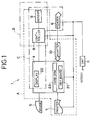
- FIG. 1 is a block diagram showing the structure of a personal identification system of the present invention, as main units, which is provided with a computer 4, personal identification data readers 8 and 9 (personal identification data read means) having a sensor section 9 and a controller section 8, a label data reader 6 (label data read means), and a label printer 7 (printing means).
- a computer 4 personal identification data readers 8 and 9 (personal identification data read means) having a sensor section 9 and a controller section 8, a label data reader 6 (label data read means), and a label printer 7 (printing means).
- personal identification data entry means A includes the computer 4, personal identification data readers 8 and 9, and label printer 7.
- personal identification data read means B includes the personal identification data readers 8 and 9.
- Personal identification data collation means C personal identification data collation means having label data read means for reading personal identification data of the label attached to the article and collating the personal identification data of the label read by the label data read means with the personal identification data read by the personal identification data read means to decide acceptance or rejection of the collation result
- the means A, B, and C are united.
- the computer 4 has a voice generating function and has a keyboard 21 (personal identification input means) for inputting personal identification such as the patient's code number, address, name, age, date of birth, body weight, type of blood (ABO.Rh way), biochemical inspection items, presence or absence of and type of infectious disease, and name of disease.
- the computer 4 has also a hard disk 23 (data storage and preservation means) for recording and preserving the operation history, collation confirmation history, and transfusion history of the personal identification system, personal identification data, and personal information, a data display 22 (data display means) for displaying a collation result of personal information and personal identification data on a display such as a CRT or LCD, and a mouse 5 for executing program of the computer 4.
- the identification data reader sensor section 9 reads the image (picture) of a characteristic portion of a human body capable of identifying a person, such as, for example, a fingerprint, palm shape, finger shape, or ear shape, and which may be an image reader such as a CCD or scanner.
- the identification data reader controller section 8 has a function for digitizing an image signal read by the sensor section 9 (an electronic picture is digitized and converted to a mathematical characterization). The digitization and conversion of the image signal read by the sensor section 9 may be executed by the computer 4. In this case, the controller 8 is unnecessary.
- the label data reader 6 is a unit for reading personal identification data printed on a label attached to a blood bag, which uses a two-dimensional data code reader in the case of the present invention.
- the reader 6 it is preferable to use a video camera (industrial video camera, machine vision camera, CCD policing camera, portable video camera, still video camera, or portable wand), which easily interlocks with an electronic locking device.
- a read signal of the label data reader 6 is input to the computer 4 through an adapter 10.
- a two-dimensional data code (matrix data code) is not a mere symbol but a computer language consisting of white and black cells, which is a two-dimensional matrix code dynamically variable correspondingly to actually coded information and whose size can be selected in a range between 14" and 0.001" squares. That is, the information density is high and the misreading rate is as low as 1/65,000,000
- the label printer 7 is used to print the data for personal identification (including other personal information) on a label.
- the data is obtained by combining the personal identification data digitized by the controller section 8 or the computer 4, with the personal identification recorded and preserved in the computer 4.
- the combined data are converted to two-dimensional data codes by the computer 4. It is better to print other personal information in the form of normal characters so as to raise the visibility of an operator.
- Printed data codes can optionally be combined in color as long as there is a contrast of approx. 20%.
- a printer for the printed data codes it is preferable to use a dot printer, ink jet printer, or laser printer.
- a personal identification system 1a for using exclusively personal identification data entry is placed in the control room 40
- a personal identification system 1b for using exclusively personal identification data read is placed in the blood collection room 41
- a personal identification system 1c for using exclusively personal identification data collation is placed in the surgical operation room 42.
- the computer 4 of the personal identification system 1a in the control room 40 works as a host computer.
- the computers 31 and 32 placed in the blood collection room 41 and surgical operation room 42 work as terminal computers.
- the host computer 4 connects with the terminal computers 31 and 32 through modems (data transmission/reception means) 33, 34, and 35.
- various pieces of information such as personal identification data, personal information, and operation histories are centrally controlled by the hard disk 23 of the computer 4 in the control room 40. That is, the recorded and preserved data used for execution in the blood collection room 41 and surgical operation room 42 is received from the hard disk 23. And also the data input through the keyboards 21 and 21 in the blood collection room 41 and surgical operation room 42, and the label data records read by the label data readers 6 and 6 are transmitted to the hard disk 23 of the personal identification system 1a through the modems 33, 34, and 35.
- the label printed by the label printer 7 in the room 41, is attached to the blood bag, and blood from the patient is collected in the blood bag, and the bag is brought into surgical operation room 42, and there, the data on the label is read by the label data reader 6, and is collated with the patient himself.
- FIGS 5 to 7 are showing flow charts of operating process when using a personal identification system 1 of the present invention for self-blood translation.
- a fingerprint is used as a personal identification data.
- Figures 5 is flow chart when entering the ID of a patient as a preliminary step of a medical treatment, in which a clinical chart of the patient is prepared and then ID entry is started (step 50).
- the ID entry is performed by inputting pieces of personal information such as the patient's name, age, sex, type of blood, entry finger, and ID number to the computer 4 (step 51) and then making the patient put his finger on the personal identification data reader sensor section 9 to read his fingerprint data (step 52). Then, it is selected whether to print ID data on a label for the clinical chart (step 53). In this case, if an error is found in the notation of the name, operations are retried from step 51.
- the ID data is output by the label printer 7 to print the clinical-chart label (step 54).
- fingerprint data is combined with the name, ID number, entry finger, issue date, and others inputted through the keyboard, the label is printed with two-dimensional data codes, and pieces of personal information such as the name and entry finger are also printed by normal characters to secure the visibility of the operator.
- the operation history of a series of the above operations is recorded and preserved in the hard disk 23 (step 55) and the printed clinical-chart label is attached to the patient's clinical chart to preserve it (step 56).
- the ID entry is ended (step 57).
- the ID data is read out of the clinical chart label by the label data reader 6 (the fingerprint data is read by the two-dimensional data code reader as the label data reader 6)(step 61).
- the fingerprint data on the clinical chart label is collated with the patient's fingerprint read by the personal identification data reader sensor section 9, and the result of acceptance or rejection to the display 22 and/or voices is output (step 62). If the data and the fingerprint do not coincide each other, they are reconfirmed and operations are retried from step 61 because the patient or the clinical chart may have been confused.
- ID data to be recorded on a label for a blood bag is input through the keyboard (step 63) to select whether to print the data (name, fingerprint data, quantity of blood to be collected and others) on the blood-bag label (step 64).
- the data is imperfect, operations are retried from step 61.
- the ID data is printed in the form of two-dimensional data codes.
- the printed label is attached to the surface of an empty blood bag (step 65) and covered with a laminate to protect the surface (step 66). Thereafter, blood is collected in the blood bag from a patient (donor)(step 67).
- a confirmation-collation button of the controller 8 is pressed (step 68).
- the fingerprint data printed on the clinical-chart label is read by the label data reader 6 (step 69) and collated with the fingerprint data of the patient (donor) read by the personal identification data reader sensor section 9 in the computer 4. Acceptance or rejection of the collation result is output to the display 22 and/or voices (step 70). If the both fingerprint data do not coincide each other as the result of collation, the clinical-chart is reconfirmed and operations are retried form step 68 because the patient or clinical-chart may be confused.
- step 75 the patient signs the signature space of the blood bag (step 75), and then, the above-mentioned series of operation histories and collation histories are recorded and preserved in the hard disk 23 (step 77). Finally, the above-mentioned confirmation inspection certificate and signature space are confirmed and the blood bag filled with blood is stored in a predetermined place (step 77), and the blood collection is ended (step 78).
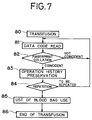
- FIG. 7 is a flow chart showing the operation procedure for transfusing the blood in the blood bag into a patient.
- the blood bag filled with blood through the above blood collection is prepared (step 80).
- the fingerprint data printed on the label of the blood bag is read by the label data reader 6 (step 81), and also, in the computer 4, the finger print data is collated with the fingerprint of a patient (donor)read by the section 9. Acceptance or rejection of the collation result is output to the display 22 and/or voices (step 82).
- the fingerprint data do not coincide with the patient's fingerprint, operations are retried from step 81. When they coincide each other, the data, such as, operation history, collation confirmation history, transfusion history are recorded and preserved in the hard disk 23 (step 83).
- steps 84 When blood is collected in a plurality of blood bags, operations from step 81 to step 83 are repeated for each blood bag (step 84). Thereafter, the blood in the blood bag is transfused to the patient (step 85) and transfusion is ended (step
- the ID entry shown in Fig. 5 is exclusively executed by the personal identification systems 1a and 1d in the control room 40
- blood collection in Fig. 6 is exclusively executed by the personal identification systems 1b and 1e in the blood collection room 41.
- the transfusion in Fig. 7 is exclusively executed by the personal identification systems 1c and 1f in the surgical operation room 42.
- the present invention can effectively be used for the following cases.
Landscapes
- Life Sciences & Earth Sciences (AREA)
- Health & Medical Sciences (AREA)
- Medical Informatics (AREA)
- Biophysics (AREA)
- Pathology (AREA)
- Engineering & Computer Science (AREA)
- Biomedical Technology (AREA)
- Heart & Thoracic Surgery (AREA)
- Physics & Mathematics (AREA)
- Molecular Biology (AREA)
- Surgery (AREA)
- Animal Behavior & Ethology (AREA)
- General Health & Medical Sciences (AREA)
- Public Health (AREA)
- Veterinary Medicine (AREA)
- Measurement Of The Respiration, Hearing Ability, Form, And Blood Characteristics Of Living Organisms (AREA)
- Collating Specific Patterns (AREA)
Applications Claiming Priority (6)
| Application Number | Priority Date | Filing Date | Title |
|---|---|---|---|
| JP18206795 | 1995-06-26 | ||
| JP182067/95 | 1995-06-26 | ||
| JP18206795 | 1995-06-26 | ||
| JP97573/96 | 1996-03-27 | ||
| JP09757396A JP3281255B2 (ja) | 1995-06-26 | 1996-03-27 | 個人識別装置 |
| JP9757396 | 1996-03-27 |
Publications (3)
| Publication Number | Publication Date |
|---|---|
| EP0750880A2 true EP0750880A2 (de) | 1997-01-02 |
| EP0750880A3 EP0750880A3 (de) | 1999-03-31 |
| EP0750880B1 EP0750880B1 (de) | 2003-04-23 |
Family
ID=26438737
Family Applications (1)
| Application Number | Title | Priority Date | Filing Date |
|---|---|---|---|
| EP96110172A Expired - Lifetime EP0750880B1 (de) | 1995-06-26 | 1996-06-24 | Personenidentifizierungssystem |
Country Status (4)
| Country | Link |
|---|---|
| US (1) | US6005962A (de) |
| EP (1) | EP0750880B1 (de) |
| JP (1) | JP3281255B2 (de) |
| DE (1) | DE69627579T2 (de) |
Cited By (4)
| Publication number | Priority date | Publication date | Assignee | Title |
|---|---|---|---|---|
| DE19630951A1 (de) * | 1996-07-31 | 1998-02-05 | Siemens Ag | Röntgendiagnostikgerät mit Schaltmitteln zum Auslösen von Fuktionen |
| FR2796182A1 (fr) * | 1999-07-05 | 2001-01-12 | Lab Med Blutbank Technologie G | Dispositif de transmission de donnees entre une puce informatique associee a une poche de sang et le dispositif informatique d'un dispositif de pesage |
| WO2001091641A1 (es) * | 2000-05-30 | 2001-12-06 | Identificacion Y Custodia Neonatal, S.A. | Memoria descriptiva sistema y equipo electronico de identificacion de neonatos |
| GB2420893A (en) * | 2004-12-02 | 2006-06-07 | Newcastle Upon Tyne Hospitals | Blood transfusion checking system |
Families Citing this family (17)
| Publication number | Priority date | Publication date | Assignee | Title |
|---|---|---|---|---|
| JPH1185858A (ja) * | 1997-09-05 | 1999-03-30 | Hitachi Ltd | 物品管理システム |
| US20050040226A1 (en) * | 1997-10-01 | 2005-02-24 | Zaher Al-Sheikh | User authorization system containing a user image |
| US7509280B1 (en) * | 1997-11-24 | 2009-03-24 | Clinlcomp International, Inc. | Enterprise healthcare management system and method of using same |
| US6870946B1 (en) | 1998-08-06 | 2005-03-22 | Secugen Corporation | Compact optical fingerprint capturing and recognition system |
| US6381347B1 (en) | 1998-11-12 | 2002-04-30 | Secugen | High contrast, low distortion optical acquistion system for image capturing |
| US6211790B1 (en) * | 1999-05-19 | 2001-04-03 | Elpas North America, Inc. | Infant and parent matching and security system and method of matching infant and parent |
| JP2002065642A (ja) * | 2000-08-29 | 2002-03-05 | Olympus Optical Co Ltd | 医療用検査システム |
| JP4538140B2 (ja) * | 2000-08-30 | 2010-09-08 | 株式会社テクノメデイカ | 処置確認システム用携帯型照合装置 |
| DE10052201B8 (de) * | 2000-10-20 | 2005-06-30 | Carl Zeiss Meditec Ag | Verfahren und Vorrichtung zur Identifizierung eines Patienten und eines Operationsgebietes |
| WO2002089018A1 (en) * | 2001-05-02 | 2002-11-07 | Secugen Corporation | Authenticating user on computer network for biometric information |
| JP5015390B2 (ja) * | 2001-07-04 | 2012-08-29 | 川澄化学工業株式会社 | 個人識別装置及び個人識別情報の照合方法 |
| JP4812984B2 (ja) * | 2001-08-17 | 2011-11-09 | 川澄化学工業株式会社 | 個人識別装置 |
| KR100432490B1 (ko) | 2001-09-17 | 2004-05-22 | (주)니트 젠 | 광학식 지문취득 장치 |
| JP4009612B2 (ja) * | 2004-04-08 | 2007-11-21 | オリンパス株式会社 | 受信装置 |
| US20080281635A1 (en) * | 2004-10-06 | 2008-11-13 | Martis Dinesh J | Method of administering a beneficiary medical procedure |
| US8511551B1 (en) | 2008-01-11 | 2013-08-20 | Terry B. Foster | Information card and method of accessing the same |
| CN111643125A (zh) * | 2020-06-23 | 2020-09-11 | 桂林医学院 | 一种自主采集核酸样品的系统及其采集方法 |
Family Cites Families (11)
| Publication number | Priority date | Publication date | Assignee | Title |
|---|---|---|---|---|
| US4415802A (en) * | 1981-08-03 | 1983-11-15 | E. I. Du Pont De Nemours And Company | Cross identification system and lock |
| US4857713A (en) * | 1986-02-14 | 1989-08-15 | Brown Jack D | Hospital error avoidance system |
| US5071168A (en) * | 1989-01-25 | 1991-12-10 | Shamos Morris H | Patient identification system |
| US5193855A (en) * | 1989-01-25 | 1993-03-16 | Shamos Morris H | Patient and healthcare provider identification system |
| US5401944A (en) * | 1990-11-20 | 1995-03-28 | Symbol Technologies, Inc. | Traveler security and luggage control system |
| US5164575A (en) * | 1991-04-23 | 1992-11-17 | Neeley William E | Blood sampling procedure and apparatus |
| JP3315763B2 (ja) * | 1993-06-07 | 2002-08-19 | テルモ株式会社 | 血液バッグ管理方法 |
| US5505494B1 (en) * | 1993-09-17 | 1998-09-29 | Bell Data Software Corp | System for producing a personal id card |
| US5537313A (en) * | 1993-11-22 | 1996-07-16 | Enterprise Systems, Inc. | Point of supply use distribution process and apparatus |
| US5623552A (en) * | 1994-01-21 | 1997-04-22 | Cardguard International, Inc. | Self-authenticating identification card with fingerprint identification |
| US5592561A (en) * | 1994-04-14 | 1997-01-07 | Moore; Lewis J. | Anti-counterfeiting system |
-
1996
- 1996-03-27 JP JP09757396A patent/JP3281255B2/ja not_active Expired - Fee Related
- 1996-06-24 DE DE69627579T patent/DE69627579T2/de not_active Expired - Fee Related
- 1996-06-24 EP EP96110172A patent/EP0750880B1/de not_active Expired - Lifetime
- 1996-06-24 US US08/668,924 patent/US6005962A/en not_active Expired - Fee Related
Cited By (6)
| Publication number | Priority date | Publication date | Assignee | Title |
|---|---|---|---|---|
| DE19630951A1 (de) * | 1996-07-31 | 1998-02-05 | Siemens Ag | Röntgendiagnostikgerät mit Schaltmitteln zum Auslösen von Fuktionen |
| US6094589A (en) * | 1996-07-31 | 2000-07-25 | Siemens Aktiengesellschaft | Medical diagnostic apparatus with a control limited to use only by an authorized person |
| FR2796182A1 (fr) * | 1999-07-05 | 2001-01-12 | Lab Med Blutbank Technologie G | Dispositif de transmission de donnees entre une puce informatique associee a une poche de sang et le dispositif informatique d'un dispositif de pesage |
| WO2001091641A1 (es) * | 2000-05-30 | 2001-12-06 | Identificacion Y Custodia Neonatal, S.A. | Memoria descriptiva sistema y equipo electronico de identificacion de neonatos |
| ES2180377A1 (es) * | 2000-05-30 | 2003-02-01 | Identificacion Y Custodia Neon | Sistema y equipo electronico de identificacion de neonatos. |
| GB2420893A (en) * | 2004-12-02 | 2006-06-07 | Newcastle Upon Tyne Hospitals | Blood transfusion checking system |
Also Published As
| Publication number | Publication date |
|---|---|
| JPH0970398A (ja) | 1997-03-18 |
| US6005962A (en) | 1999-12-21 |
| EP0750880B1 (de) | 2003-04-23 |
| DE69627579D1 (de) | 2003-05-28 |
| DE69627579T2 (de) | 2004-01-29 |
| EP0750880A3 (de) | 1999-03-31 |
| JP3281255B2 (ja) | 2002-05-13 |
Similar Documents
| Publication | Publication Date | Title |
|---|---|---|
| EP0750880B1 (de) | Personenidentifizierungssystem | |
| US5071168A (en) | Patient identification system | |
| US7044379B2 (en) | Information management system, information processing apparatus and method, recording medium, and program | |
| JPH03198835A (ja) | 患者識別方法と装置 | |
| US6997381B2 (en) | Dual-sided smart card reader | |
| US7490767B2 (en) | Method and apparatus for monitoring transfusion of blood | |
| CA2043544C (en) | Patient and healthcare provider identification system | |
| US20050149350A1 (en) | Patient information management system and method | |
| US20040236606A1 (en) | Medical tool management and support system | |
| WO2000013588A1 (en) | Verification of human medical data | |
| CN116490931A (zh) | 用于捕获计算机可读代码的方法、读取装置和读取系统 | |
| JP2001134700A (ja) | 医療用情報管理システム | |
| JPH09171528A (ja) | 医療情報入力システムおよび医療情報入力方法 | |
| EP3933844B1 (de) | Verfahren zur verwaltung chirurgischer gegenstände und system zur verwaltung chirurgischer gegenstände für einen intelligenten operationssaal | |
| JP2002366650A (ja) | 病院総合管理システムおよび方法 | |
| JP2005245828A (ja) | 携帯医療端末及び携帯医療端末を用いた医療支援システム | |
| EP0696006A2 (de) | Automatisches Patientenaufnahmesystem für Krankenhäuser | |
| EP1410760B1 (de) | System und elektronisches gerät zur identifikation von neugeborenen | |
| JP3394335B2 (ja) | 自己血輸血用個人識別装置 | |
| JP2003079600A (ja) | 個人識別装置及び個人識別情報の照合方法 | |
| JP2001338061A (ja) | 画像送信装置および画像送信方法 | |
| JPH08101869A (ja) | 診察自動受付装置 | |
| JP2005087252A (ja) | 画像入力装置 | |
| JP2001175776A (ja) | 携帯型自動患者確認装置及びリストバンド式自動患者確認システム | |
| US20060060648A1 (en) | Method and apparatus for storing and reading medical records from a magnetic card |
Legal Events
| Date | Code | Title | Description |
|---|---|---|---|
| PUAI | Public reference made under article 153(3) epc to a published international application that has entered the european phase |
Free format text: ORIGINAL CODE: 0009012 |
|
| AK | Designated contracting states |
Kind code of ref document: A2 Designated state(s): DE FR IT NL SE |
|
| PUAL | Search report despatched |
Free format text: ORIGINAL CODE: 0009013 |
|
| AK | Designated contracting states |
Kind code of ref document: A3 Designated state(s): DE FR IT NL SE |
|
| 17P | Request for examination filed |
Effective date: 19990324 |
|
| 17Q | First examination report despatched |
Effective date: 20020218 |
|
| GRAH | Despatch of communication of intention to grant a patent |
Free format text: ORIGINAL CODE: EPIDOS IGRA |
|
| GRAH | Despatch of communication of intention to grant a patent |
Free format text: ORIGINAL CODE: EPIDOS IGRA |
|
| GRAA | (expected) grant |
Free format text: ORIGINAL CODE: 0009210 |
|
| AK | Designated contracting states |
Designated state(s): DE FR IT NL SE |
|
| PG25 | Lapsed in a contracting state [announced via postgrant information from national office to epo] |
Ref country code: IT Free format text: LAPSE BECAUSE OF FAILURE TO SUBMIT A TRANSLATION OF THE DESCRIPTION OR TO PAY THE FEE WITHIN THE PRE;WARNING: LAPSES OF ITALIAN PATENTS WITH EFFECTIVE DATE BEFORE 2007 MAY HAVE OCCURRED AT ANY TIME BEFORE 2007. THE CORRECT EFFECTIVE DATE MAY BE DIFFERENT FROM THE ONE RECORDED.SCRIBED TIME-LIMIT Effective date: 20030423 |
|
| REF | Corresponds to: |
Ref document number: 69627579 Country of ref document: DE Date of ref document: 20030528 Kind code of ref document: P |
|
| REG | Reference to a national code |
Ref country code: SE Ref legal event code: TRGR |
|
| ET | Fr: translation filed | ||
| PLBE | No opposition filed within time limit |
Free format text: ORIGINAL CODE: 0009261 |
|
| STAA | Information on the status of an ep patent application or granted ep patent |
Free format text: STATUS: NO OPPOSITION FILED WITHIN TIME LIMIT |
|
| 26N | No opposition filed |
Effective date: 20040126 |
|
| PGFP | Annual fee paid to national office [announced via postgrant information from national office to epo] |
Ref country code: NL Payment date: 20090615 Year of fee payment: 14 |
|
| PGFP | Annual fee paid to national office [announced via postgrant information from national office to epo] |
Ref country code: SE Payment date: 20090605 Year of fee payment: 14 |
|
| PGFP | Annual fee paid to national office [announced via postgrant information from national office to epo] |
Ref country code: DE Payment date: 20090619 Year of fee payment: 14 |
|
| REG | Reference to a national code |
Ref country code: NL Ref legal event code: V1 Effective date: 20110101 |
|
| EUG | Se: european patent has lapsed | ||
| REG | Reference to a national code |
Ref country code: FR Ref legal event code: ST Effective date: 20110228 |
|
| PG25 | Lapsed in a contracting state [announced via postgrant information from national office to epo] |
Ref country code: DE Free format text: LAPSE BECAUSE OF NON-PAYMENT OF DUE FEES Effective date: 20110101 |
|
| PG25 | Lapsed in a contracting state [announced via postgrant information from national office to epo] |
Ref country code: FR Free format text: LAPSE BECAUSE OF NON-PAYMENT OF DUE FEES Effective date: 20100630 Ref country code: NL Free format text: LAPSE BECAUSE OF NON-PAYMENT OF DUE FEES Effective date: 20110101 |
|
| PG25 | Lapsed in a contracting state [announced via postgrant information from national office to epo] |
Ref country code: SE Free format text: LAPSE BECAUSE OF NON-PAYMENT OF DUE FEES Effective date: 20100625 |
|
| PGFP | Annual fee paid to national office [announced via postgrant information from national office to epo] |
Ref country code: FR Payment date: 20090611 Year of fee payment: 14 |