EP0750976A2 - Dispositif hydraulique de fermeture de moule pour une machine à mouler par injection - Google Patents
Dispositif hydraulique de fermeture de moule pour une machine à mouler par injection Download PDFInfo
- Publication number
- EP0750976A2 EP0750976A2 EP96110188A EP96110188A EP0750976A2 EP 0750976 A2 EP0750976 A2 EP 0750976A2 EP 96110188 A EP96110188 A EP 96110188A EP 96110188 A EP96110188 A EP 96110188A EP 0750976 A2 EP0750976 A2 EP 0750976A2
- Authority
- EP
- European Patent Office
- Prior art keywords
- pressure
- piston
- cylinder
- low
- closing
- Prior art date
- Legal status (The legal status is an assumption and is not a legal conclusion. Google has not performed a legal analysis and makes no representation as to the accuracy of the status listed.)
- Withdrawn
Links
- 238000001746 injection moulding Methods 0.000 title claims abstract description 5
- 238000007789 sealing Methods 0.000 claims description 3
- 238000012545 processing Methods 0.000 claims description 2
- 238000007654 immersion Methods 0.000 claims 1
- 239000012530 fluid Substances 0.000 description 9
- 238000000034 method Methods 0.000 description 5
- 238000005507 spraying Methods 0.000 description 5
- 238000011161 development Methods 0.000 description 2
- 238000010276 construction Methods 0.000 description 1
- 238000013461 design Methods 0.000 description 1
- 230000000694 effects Effects 0.000 description 1
- 230000002349 favourable effect Effects 0.000 description 1
- 238000012986 modification Methods 0.000 description 1
- 230000004048 modification Effects 0.000 description 1
- 239000007921 spray Substances 0.000 description 1
Images





Classifications
-
- B—PERFORMING OPERATIONS; TRANSPORTING
- B29—WORKING OF PLASTICS; WORKING OF SUBSTANCES IN A PLASTIC STATE IN GENERAL
- B29C—SHAPING OR JOINING OF PLASTICS; SHAPING OF MATERIAL IN A PLASTIC STATE, NOT OTHERWISE PROVIDED FOR; AFTER-TREATMENT OF THE SHAPED PRODUCTS, e.g. REPAIRING
- B29C45/00—Injection moulding, i.e. forcing the required volume of moulding material through a nozzle into a closed mould; Apparatus therefor
- B29C45/17—Component parts, details or accessories; Auxiliary operations
- B29C45/64—Mould opening, closing or clamping devices
- B29C45/67—Mould opening, closing or clamping devices hydraulic
- B29C45/6764—Mould opening, closing or clamping devices hydraulic using hydraulically connectable chambers of the clamping cylinder during the mould opening and closing movement
-
- B—PERFORMING OPERATIONS; TRANSPORTING
- B29—WORKING OF PLASTICS; WORKING OF SUBSTANCES IN A PLASTIC STATE IN GENERAL
- B29C—SHAPING OR JOINING OF PLASTICS; SHAPING OF MATERIAL IN A PLASTIC STATE, NOT OTHERWISE PROVIDED FOR; AFTER-TREATMENT OF THE SHAPED PRODUCTS, e.g. REPAIRING
- B29C45/00—Injection moulding, i.e. forcing the required volume of moulding material through a nozzle into a closed mould; Apparatus therefor
- B29C45/17—Component parts, details or accessories; Auxiliary operations
- B29C45/64—Mould opening, closing or clamping devices
- B29C45/67—Mould opening, closing or clamping devices hydraulic
Definitions
- Such a device is known from DE 2834895 C2.
- the closing piston closes, the space behind the closing piston fills with hydraulic fluid.
- the hydraulic fluid flows through the channel that connects the pressure side of the closing piston to the hydraulic tank.
- the pressure intensifier is actuated by pressurizing the low-pressure piston.
- the high-pressure piston migrates into the high-pressure cylinder, which is formed by the channel leading from the hydraulic tank to the pressure side of the closing piston.
- the high pressure piston of the pressure intensifier closes this channel and builds up the actual closing pressure behind the locking cylinder.
- the pressure intensifier is actuated again, in the opposite direction Direction.
- the channel leading to the hydraulic tank is thus opened again, whereupon the closing piston can push the hydraulic fluid into the hydraulic tank during its retraction movement.
- the known drive is characterized by very favorable fluidic conditions between the hydraulic tank and the pressure side of the closing piston, with a simple design and control. However, the control speed of the known drive appears to be in need of improvement.
- the invention is accordingly based on the object to provide a hydraulic mold closing device of the type mentioned, which works with reduced control times.
- This construction has the essential advantage that the piston element of the pressure intensifier can be moved at high speed from its rest position into the position in which the build-up of the closing pressure begins, that is to say in which the high-pressure piston sealingly enters the high-pressure cylinder.
- the low-pressure piston also enters the low-pressure cylinder. Up to this At this point, the low-pressure piston can be flowed around to its pressure side, so that the space with the enlarged diameter automatically fills up.
- the high-pressure piston enters the high-pressure cylinder, the lateral openings of the travel piston on the pressure side of the low-pressure piston become free, so that the build-up of the closing pressure can begin.
- the piston element of the pressure intensifier is in a position in which the high-pressure cylinder is open, neither of the two pistons lies against its cylinder wall.
- the guidance of the piston element is taken over by the driving piston which plunges into its driving cylinder.
- the high-pressure piston of the pressure booster carries an axial pin that slides in a housing guide. In this way, the piston element of the pressure intensifier is guided securely at both ends.
- the housing guide for the axial pin is designed as a cylinder and can be connected to the hydraulic tank and the hydraulic pump. After the end of a spraying process, this cylinder is connected to the system pressure, whereby the piston element of the pressure intensifier reaches its open position.
- This embodiment is advantageous if the pressure intensifier works in a system in which the hydraulic fluid is sucked into the pressure chamber behind the latter when the closing piston closes. After the end of a spraying process, this space and thus also the pressure side of the high pressure piston of the pressure booster suddenly becomes depressurized as soon as the high pressure piston has migrated slightly out of the high pressure cylinder. Automatic resetting of the piston element of the pressure intensifier would therefore only take place to a small extent without the cylinder for the axial pin. Cylinder and axial pin ensure that the high pressure cylinder of the Pressure intensifier is fully opened and so that the next intake stroke can take place under optimal flow conditions.
- the pressure intensifier can also be used in differential circulation systems, for which it is proposed in a development of the invention that the channel leading to the pressure side of the closing piston is connected to a channel when the high pressure cylinder of the pressure intensifier is open, which leads to the side of the closing piston opposite the pressure side. This channel is placed under the system pressure to achieve the required closing piston movements. If the tubular piston of the pressure transducer is connected to the hydraulic tank, a differential pressure acts on the piston element, which causes the piston element to move into the fully open position.
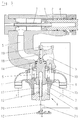
- the hydraulic mold closing device is part of a plastic injection molding machine and is used to move the movable mold half back and forth between its open position, wherein in the closed position the Closing pressure is built up. It has a locking cylinder housing 1, in which a locking piston 2 works. 1 is in the open position and in FIGS. 2 and 3 in the closed position. The movement from the open position to the closed position is effected by a travel piston 3, while an annular space 4 is acted upon by the system pressure for the opposite movement.
- Fig. 2 shows the arrangement after completion of the closing movement.
- the closing pressure is now built up, specifically by actuating a pressure booster 6.
- the pressure intensifier 6 has a housing 7 in which a piston element 8 works.
- the latter forms a low-pressure piston 9 and a high-pressure piston 10.
- the piston element 8 is provided with a travel cylinder 11 into which a tubular travel piston 12 is immersed.
- a valve 13 is switched from the position shown in FIG. 1, in which the pressure intensifier 6 is depressurized, to the position shown in FIG. 2.
- the travel piston 12 is therefore connected to a hydraulic pump P, which is only indicated symbolically.
- the piston element 8 moves from the position according to FIG. 2 into the position according to FIG. 3.
- the high-pressure piston 10 of the piston element enters a high-pressure cylinder 14 which is formed by the channel 5.
- the high-pressure piston 10 closes the high-pressure cylinder 14 and thus the channel 5. As it moves further, it builds up the closing pressure.
- the travel piston 12 of the pressure booster 6 has lateral openings 17 which are exposed as soon as the low-pressure piston 9 enters the low-pressure cylinder 15. In this way, the low-pressure piston 9 is connected on the pressure side to the system pressure, so that the pressure intensifier 6 can fulfill its function.
- the arrangement is simple in structure and control. Their main advantage is that very short control times can be used, since the piston element 8 of the pressure intensifier 6 quickly reaches its active position. This is essential because the travel path of the piston element 8 must not be chosen too small in order to keep the flow conditions in the channel 5 as low as possible.
- the housing guide 19 is designed as a cylinder, the pin 18 working as a piston and causing the piston element 8 to return.
- FIG. 3 shows the state immediately after the end of the spraying process, the valve 13 having been switched to the position which causes the pressure booster 6 to be deactivated.
- the hydraulic pump P is connected to the housing guide 19 so that the pin 18 of the piston element 8 under the System pressure is there.
- the system pressure is applied to the check valve 20 via a control line 21 and opens the latter.
- the space 16 on the pressure side of the low-pressure piston 9 is connected to the hydraulic tank T and is accordingly depressurized.
- the pin 18 thus pushes the piston element 8 into the rest position, whereby the channel 5 is opened.
- the hydraulic fluid located on the pressure side can flow freely into the tank.
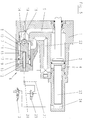
- FIGS. 4 to 7 works with a differential circulation system.
- the closing piston pulls the movable mold half against the fixed mold half, while according to FIGS. 1 to 3 the movable mold half is pressed against the fixed mold half.
- FIGS. 4 to 7 only refers to the differences.
- the channel 5 is connected via the pressure booster 6 to a channel 22 which allows the hydraulic fluid to overflow from one side of the closing piston 2 to the other and can also be connected to the hydraulic tank T and to the hydraulic pump P. Furthermore, an extension 23 of the closing piston 2 projects into a cylinder space 24. In addition to the valve 13, a further valve 25 is provided in order to be able to carry out the necessary switching steps for the control.
- Fig. 4 shows the closing piston 2 with the mold open.
- the pressure intensifier 6 assumes its open position and the valves 13 and 25 keep the system depressurized.
- valve 25 By switching the valve 25 into the position shown in FIG. 6, the build-up of the closing pressure is initiated, i.e. the travel piston 12 of the pressure booster 6 is acted upon by the system pressure.
- Fig. 7 shows the arrangement after completion of the spraying process.
- the valves 13 and 25 are switched so that the return movement of both the piston element 8 of the pressure booster 6 and the closing piston 2 can begin.
- the system pressure is applied to both the channel 22 and the cylinder space 24.
- the check valve 20 has opened so that the space 16 behind the low-pressure piston 9 of the pressure booster 6 is depressurized.
- the return movement of the piston element 8 of the pressure booster 6 takes place due to the pressure acting on the low-pressure piston 9 via the channel 22.
- the pin 18 of the piston element 8 fulfills a pure guiding function.
- the pin 18 of the piston element 8 can be dispensed with if the guidance by the driving piston 12 is sufficient to securely position the piston element 8 during its free travel.
- the other details shown in the exemplary embodiments are also variable.
- the valves 13 and 25 can be integrated into one unit.
Landscapes
- Engineering & Computer Science (AREA)
- Manufacturing & Machinery (AREA)
- Mechanical Engineering (AREA)
- Injection Moulding Of Plastics Or The Like (AREA)
- Fluid-Pressure Circuits (AREA)
- Moulds For Moulding Plastics Or The Like (AREA)
Applications Claiming Priority (3)
| Application Number | Priority Date | Filing Date | Title |
|---|---|---|---|
| DE19523420 | 1995-06-28 | ||
| DE19523420A DE19523420C1 (de) | 1995-06-28 | 1995-06-28 | Hydraulische Formschließvorrichtung für eine Spritzgießmaschine |
| US08/667,397 US5750163A (en) | 1995-06-28 | 1996-06-21 | Hydraulic mould closure device for an injection moulding machine |
Publications (2)
| Publication Number | Publication Date |
|---|---|
| EP0750976A2 true EP0750976A2 (fr) | 1997-01-02 |
| EP0750976A3 EP0750976A3 (fr) | 1998-05-06 |
Family
ID=26016343
Family Applications (1)
| Application Number | Title | Priority Date | Filing Date |
|---|---|---|---|
| EP96110188A Withdrawn EP0750976A3 (fr) | 1995-06-28 | 1996-06-24 | Dispositif hydraulique de fermeture de moule pour une machine à mouler par injection |
Country Status (4)
| Country | Link |
|---|---|
| US (1) | US5750163A (fr) |
| EP (1) | EP0750976A3 (fr) |
| JP (1) | JPH0999461A (fr) |
| DE (1) | DE19523420C1 (fr) |
Families Citing this family (2)
| Publication number | Priority date | Publication date | Assignee | Title |
|---|---|---|---|---|
| DE10220406B4 (de) * | 2001-07-02 | 2011-02-03 | Bosch Rexroth Aktiengesellschaft | Antriebsvorrichtung für ein bewegliches Teil, insbesondere Formschließvorrichtung für eine Spritzgießmaschine, und Verfahren zum Betrieb einer solchen Antriebsvorrichtung |
| DE102006012381B4 (de) * | 2006-03-17 | 2009-10-08 | Dr. Boy Gmbh & Co. Kg | Formschließvorrichtung für Spritzgießmaschinen |
Family Cites Families (15)
| Publication number | Priority date | Publication date | Assignee | Title |
|---|---|---|---|---|
| US2878648A (en) * | 1957-08-26 | 1959-03-24 | Nat Automatic Tool Company Inc | Molding machine ram and valve construction |
| US3084512A (en) * | 1958-03-10 | 1963-04-09 | Koehring Co | Hydraulic molding machines |
| FR1439211A (fr) * | 1965-04-08 | 1966-05-20 | Nouveau vérin hydraulique pour mécanisme de fermeture des presses à injecter les matières plastiques et similaires | |
| DE2834895C2 (de) * | 1978-08-09 | 1983-10-20 | Dr. Boy GmbH, 5466 Neustadt | Hydraulische Formschließvorrichtung mit einem Druckübersetzer |
| DE2845448C2 (de) * | 1978-10-19 | 1982-09-16 | Karl 7298 Loßburg Hehl | Hydraulischer Arbeitszylinder für die Formschließvorrichtung einer Kunststoff-Spritzgießmaschine |
| DE2852516C2 (de) * | 1978-12-05 | 1987-01-02 | Krauss-Maffei AG, 8000 München | Formschließvorrichtung für eine Spritzgießmaschine |
| DE3044137C2 (de) * | 1980-11-24 | 1985-01-31 | Karl 7298 Loßburg Hehl | Formschließeinheit zum Aufnehmen einer Kunststoffspritzgießform |
| DE3107004C2 (de) * | 1981-02-25 | 1985-11-28 | Krauss-Maffei AG, 8000 München | Formschließvorrichtung |
| FR2572018B1 (fr) * | 1984-10-19 | 1994-09-16 | Comdec | Installation de compactage de dechets equipee de deux presses jumelees |
| DE3644181C1 (de) * | 1986-12-23 | 1988-04-28 | Karl Hehl | Hydraulikeinrichtung fuer die Formschliesseinheit einer Kunststoff-Spritzgiessmaschine |
| JPH068021B2 (ja) * | 1987-02-27 | 1994-02-02 | 青木 茂人 | 射出成形機の型締機構 |
| JPH02211965A (ja) * | 1988-10-31 | 1990-08-23 | Toshiba Mach Co Ltd | 型締シリンダ装置 |
| DE4100539A1 (de) * | 1991-01-10 | 1992-07-16 | Boy Gmbh Dr | Hydraulischer antrieb fuer eine formschliesseinheit einer spritzgiessmaschine |
| DE4209392C2 (de) * | 1992-03-23 | 1995-10-12 | Krauss Maffei Ag | Formschließvorrichtung für eine Spritzgießmaschine |
| JPH06330225A (ja) * | 1993-05-25 | 1994-11-29 | Mitsubishi Materials Corp | 耐摩耗性のすぐれたコンプレッサ用Fe基焼結合金製摺動部材 |
-
1995
- 1995-06-28 DE DE19523420A patent/DE19523420C1/de not_active Expired - Lifetime
-
1996
- 1996-06-21 US US08/667,397 patent/US5750163A/en not_active Expired - Lifetime
- 1996-06-24 EP EP96110188A patent/EP0750976A3/fr not_active Withdrawn
- 1996-06-28 JP JP8188915A patent/JPH0999461A/ja active Pending
Also Published As
| Publication number | Publication date |
|---|---|
| DE19523420C1 (de) | 1996-09-12 |
| US5750163A (en) | 1998-05-12 |
| EP0750976A3 (fr) | 1998-05-06 |
| JPH0999461A (ja) | 1997-04-15 |
Similar Documents
| Publication | Publication Date | Title |
|---|---|---|
| DE2603891C3 (de) | Antrieb zum Bewegen eines Einspritzkolbens einer Druckgießmaschine | |
| EP1476652B1 (fr) | Soupape d'injection de carburant pour moteurs a combustion interne | |
| DE19742073A1 (de) | Kraftstoffeinspritzvorrichtung für Brennkraftmaschinen | |
| DE1576088B2 (de) | Schnellentlastungsventil fuer hydraulische kraftzylinder | |
| EP0577955A1 (fr) | Muliplicateur de pression pneumo-hydraulique | |
| EP0066274A1 (fr) | Arrangement de vannes pour augmenter la vitesse de sortie d'un vérin | |
| DE1778952C3 (de) | Hydraulische Formschließvorrichtung für eine Kunststoff-Spritzgießmaschine | |
| DE3934124A1 (de) | Druckluftgetriebene pumpenanordnung | |
| DE3013381C2 (de) | Arbeitskolben-Zylinder-Einheit | |
| DE2102591A1 (de) | Hydraulik Pumpe | |
| EP1029173B1 (fr) | Unite de commande pour soupape d'injection de carburant | |
| DE2834895C2 (de) | Hydraulische Formschließvorrichtung mit einem Druckübersetzer | |
| DE102005035633A1 (de) | Servomotor | |
| WO2014096162A1 (fr) | Pompe enfichable | |
| DE1286403B (de) | Verfahren und Vorrichtung zum Ablassen von Luft aus mit pulsierendem Druck arbeitenden Pumpen | |
| DE19523420C1 (de) | Hydraulische Formschließvorrichtung für eine Spritzgießmaschine | |
| DE3427326C2 (fr) | ||
| DE19757157C2 (de) | Hydraulischer Linearantrieb | |
| DE19909288A1 (de) | Verfahren zur spanlosen Herstellung eines Ventilgehäuses | |
| DE3508170A1 (de) | Hydraulische vorrichtung | |
| EP1446276B1 (fr) | Dispositif d'entrainement, utilise en particulier pour l'unite de fermeture, l'unite d'injection ou les ejecteurs d'une machine de moulage de plastique par injection | |
| DE19940289B4 (de) | Kraftstoffeinspritzventil | |
| DE1576088C (de) | Schnellentlastungsventil für hydraulische Kraftzylinder | |
| DE19927070B4 (de) | Hydraulische Presse | |
| DE2450209A1 (de) | Hydraulische pump- und stellvorrichtung |
Legal Events
| Date | Code | Title | Description |
|---|---|---|---|
| PUAI | Public reference made under article 153(3) epc to a published international application that has entered the european phase |
Free format text: ORIGINAL CODE: 0009012 |
|
| AK | Designated contracting states |
Kind code of ref document: A2 Designated state(s): AT CH DE ES FR GB IT LI NL |
|
| PUAL | Search report despatched |
Free format text: ORIGINAL CODE: 0009013 |
|
| AK | Designated contracting states |
Kind code of ref document: A3 Designated state(s): AT CH DE ES FR GB IT LI NL |
|
| 17P | Request for examination filed |
Effective date: 19981009 |
|
| GRAG | Despatch of communication of intention to grant |
Free format text: ORIGINAL CODE: EPIDOS AGRA |
|
| GRAG | Despatch of communication of intention to grant |
Free format text: ORIGINAL CODE: EPIDOS AGRA |
|
| GRAH | Despatch of communication of intention to grant a patent |
Free format text: ORIGINAL CODE: EPIDOS IGRA |
|
| 17Q | First examination report despatched |
Effective date: 20000530 |
|
| STAA | Information on the status of an ep patent application or granted ep patent |
Free format text: STATUS: THE APPLICATION IS DEEMED TO BE WITHDRAWN |
|
| 18D | Application deemed to be withdrawn |
Effective date: 20001005 |