EP0751189B2 - Compositions de pigments sous forme de poudre - Google Patents
Compositions de pigments sous forme de poudre Download PDFInfo
- Publication number
- EP0751189B2 EP0751189B2 EP96109681A EP96109681A EP0751189B2 EP 0751189 B2 EP0751189 B2 EP 0751189B2 EP 96109681 A EP96109681 A EP 96109681A EP 96109681 A EP96109681 A EP 96109681A EP 0751189 B2 EP0751189 B2 EP 0751189B2
- Authority
- EP
- European Patent Office
- Prior art keywords
- radical
- formula
- acid
- castor oil
- pigment
- Prior art date
- Legal status (The legal status is an assumption and is not a legal conclusion. Google has not performed a legal analysis and makes no representation as to the accuracy of the status listed.)
- Expired - Lifetime
Links
Classifications
-
- C—CHEMISTRY; METALLURGY
- C09—DYES; PAINTS; POLISHES; NATURAL RESINS; ADHESIVES; COMPOSITIONS NOT OTHERWISE PROVIDED FOR; APPLICATIONS OF MATERIALS NOT OTHERWISE PROVIDED FOR
- C09C—TREATMENT OF INORGANIC MATERIALS, OTHER THAN FIBROUS FILLERS, TO ENHANCE THEIR PIGMENTING OR FILLING PROPERTIES ; PREPARATION OF CARBON BLACK ; PREPARATION OF INORGANIC MATERIALS WHICH ARE NO SINGLE CHEMICAL COMPOUNDS AND WHICH ARE MAINLY USED AS PIGMENTS OR FILLERS
- C09C3/00—Treatment in general of inorganic materials, other than fibrous fillers, to enhance their pigmenting or filling properties
- C09C3/006—Combinations of treatments provided for in groups C09C3/04 - C09C3/12
-
- C—CHEMISTRY; METALLURGY
- C08—ORGANIC MACROMOLECULAR COMPOUNDS; THEIR PREPARATION OR CHEMICAL WORKING-UP; COMPOSITIONS BASED THEREON
- C08K—Use of inorganic or non-macromolecular organic substances as compounding ingredients
- C08K5/00—Use of organic ingredients
- C08K5/04—Oxygen-containing compounds
- C08K5/10—Esters; Ether-esters
- C08K5/101—Esters; Ether-esters of monocarboxylic acids
- C08K5/103—Esters; Ether-esters of monocarboxylic acids with polyalcohols
-
- C—CHEMISTRY; METALLURGY
- C09—DYES; PAINTS; POLISHES; NATURAL RESINS; ADHESIVES; COMPOSITIONS NOT OTHERWISE PROVIDED FOR; APPLICATIONS OF MATERIALS NOT OTHERWISE PROVIDED FOR
- C09B—ORGANIC DYES OR CLOSELY-RELATED COMPOUNDS FOR PRODUCING DYES, e.g. PIGMENTS; MORDANTS; LAKES
- C09B67/00—Influencing the physical, e.g. the dyeing or printing properties of dyestuffs without chemical reactions, e.g. by treating with solvents grinding or grinding assistants, coating of pigments or dyes; Process features in the making of dyestuff preparations; Dyestuff preparations of a special physical nature, e.g. tablets, films
- C09B67/006—Preparation of organic pigments
- C09B67/0063—Preparation of organic pigments of organic pigments with only macromolecular substances
-
- C—CHEMISTRY; METALLURGY
- C09—DYES; PAINTS; POLISHES; NATURAL RESINS; ADHESIVES; COMPOSITIONS NOT OTHERWISE PROVIDED FOR; APPLICATIONS OF MATERIALS NOT OTHERWISE PROVIDED FOR
- C09C—TREATMENT OF INORGANIC MATERIALS, OTHER THAN FIBROUS FILLERS, TO ENHANCE THEIR PIGMENTING OR FILLING PROPERTIES ; PREPARATION OF CARBON BLACK ; PREPARATION OF INORGANIC MATERIALS WHICH ARE NO SINGLE CHEMICAL COMPOUNDS AND WHICH ARE MAINLY USED AS PIGMENTS OR FILLERS
- C09C3/00—Treatment in general of inorganic materials, other than fibrous fillers, to enhance their pigmenting or filling properties
- C09C3/04—Physical treatment, e.g. grinding or treatment with ultrasonic vibrations
-
- C—CHEMISTRY; METALLURGY
- C09—DYES; PAINTS; POLISHES; NATURAL RESINS; ADHESIVES; COMPOSITIONS NOT OTHERWISE PROVIDED FOR; APPLICATIONS OF MATERIALS NOT OTHERWISE PROVIDED FOR
- C09C—TREATMENT OF INORGANIC MATERIALS, OTHER THAN FIBROUS FILLERS, TO ENHANCE THEIR PIGMENTING OR FILLING PROPERTIES ; PREPARATION OF CARBON BLACK ; PREPARATION OF INORGANIC MATERIALS WHICH ARE NO SINGLE CHEMICAL COMPOUNDS AND WHICH ARE MAINLY USED AS PIGMENTS OR FILLERS
- C09C3/00—Treatment in general of inorganic materials, other than fibrous fillers, to enhance their pigmenting or filling properties
- C09C3/04—Physical treatment, e.g. grinding or treatment with ultrasonic vibrations
- C09C3/041—Grinding
-
- C—CHEMISTRY; METALLURGY
- C09—DYES; PAINTS; POLISHES; NATURAL RESINS; ADHESIVES; COMPOSITIONS NOT OTHERWISE PROVIDED FOR; APPLICATIONS OF MATERIALS NOT OTHERWISE PROVIDED FOR
- C09C—TREATMENT OF INORGANIC MATERIALS, OTHER THAN FIBROUS FILLERS, TO ENHANCE THEIR PIGMENTING OR FILLING PROPERTIES ; PREPARATION OF CARBON BLACK ; PREPARATION OF INORGANIC MATERIALS WHICH ARE NO SINGLE CHEMICAL COMPOUNDS AND WHICH ARE MAINLY USED AS PIGMENTS OR FILLERS
- C09C3/00—Treatment in general of inorganic materials, other than fibrous fillers, to enhance their pigmenting or filling properties
- C09C3/08—Treatment with low-molecular-weight non-polymer organic compounds
-
- C—CHEMISTRY; METALLURGY
- C09—DYES; PAINTS; POLISHES; NATURAL RESINS; ADHESIVES; COMPOSITIONS NOT OTHERWISE PROVIDED FOR; APPLICATIONS OF MATERIALS NOT OTHERWISE PROVIDED FOR
- C09C—TREATMENT OF INORGANIC MATERIALS, OTHER THAN FIBROUS FILLERS, TO ENHANCE THEIR PIGMENTING OR FILLING PROPERTIES ; PREPARATION OF CARBON BLACK ; PREPARATION OF INORGANIC MATERIALS WHICH ARE NO SINGLE CHEMICAL COMPOUNDS AND WHICH ARE MAINLY USED AS PIGMENTS OR FILLERS
- C09C3/00—Treatment in general of inorganic materials, other than fibrous fillers, to enhance their pigmenting or filling properties
- C09C3/10—Treatment with macromolecular organic compounds
-
- C—CHEMISTRY; METALLURGY
- C01—INORGANIC CHEMISTRY
- C01P—INDEXING SCHEME RELATING TO STRUCTURAL AND PHYSICAL ASPECTS OF SOLID INORGANIC COMPOUNDS
- C01P2004/00—Particle morphology
- C01P2004/60—Particles characterised by their size
- C01P2004/61—Micrometer sized, i.e. from 1-100 micrometer
Definitions
- the invention relates to easily dispersible powdered pigment preparations for pigmenting plasters and architectural paint dispersions based on synthetic resin.
- aqueous pigment dispersions which are stirred into the white dispersion for coloring and mixed.
- pigments e.g. azo, lacquered azo, naphthol, isoindolinone, isoindoline, phthalocyanine, quinacridone, quinophthalone, diketopyrrolopyrrole pigments, but also inorganic, especially oxide pigments, as aqueous or aqueous-organic preparations be used.
- the usual anionic, cationic or nonionic dispersants used alone or in combination, for example alkyl sulfates, Alkyl sulfonates, alkyl phosphates, alkyl benzene sulfonates, octadecyl phosphates, dodecyl benzene sulfonates and sulfosuccinic acid esters, Condensation products from fatty acid and taurine or hydroxyethanesulfonic acid as well as reaction products from ethoxylated alkylphenols and fatty alcohols with chlorosulfonic acid and phosphorus oxychlorides (Winnacker, kuchler, "Chemical Technology", Vol.
- quaternary ammonium salts such as Hexadecyltrimethylammonium chloride for use.
- dispersing units such as dissolvers. Rotor-stator mill, Attrition mills. Turbulent high-speed mixers, kneaders or roller mills.
- aqueous preparations contain organic solvents such as e.g. Glycols, propylene glycol, that is added to prevent drying out or to increase the resistance to freezing, causes odor problems and cannot be used in non-VOC (volatile organic compound) preparations.
- organic solvents such as e.g. Glycols, propylene glycol
- the object of the present invention was. to find low-dust powdered pigment preparations. Which can be easily stirred into synthetic resin dispersions and plasters and flocculent, speck-free and streak-free Paintings result.
- oxide pigments e.g. Iron oxide, nickel titanium oxide, chrome titanium oxide, chrome oxide green or cobalt blue.
- Monoazo, disazo and lacquered in particular come as organic pigments Azo, benzimidazolone, naphthol, isoindolinone, isoindoline, phthalocyanine, quinacridone, perylene, perinone, thioindigo, Quinophthalone, dioxazine and diketopyrrolopyrrole pigments.
- Novolaks for the present invention are preferably those in EP-A-0 065 751 and DE-A-2 901 462 described oxalkylated aldehyde-alkylphenol condensates of interest, in particular alkylphenol novolak polyglycol ethers, a 7-core novolak with 105 ethylene oxide units (EO), then to the partial benzoic acid ester and sulfosuccinic acid Na salt implemented (Example 3.5.3 in EP-A-0 065 751) and a 7-core novolak with 105 EO as in Example 2 of DE-A-2 901 462.
- alkylphenol novolak polyglycol ethers a 7-core novolak with 105 ethylene oxide units (EO)
- EO ethylene oxide units
- Bisphenol polyglycol ethers are described, for example, in DE-A-3 026 127 (US Pat. No. 4,960,935), Example 1, and in DE-A-2 913 176 (CA-A-1 158 384), example 1.
- C 12 -C 18 fatty alcohols containing 2 to 50 ethylene oxide and / or propylene oxide units are preferably used as the alkoxylated fatty alcohols.
- C 8 -C 22 fatty amines with 2 to 30 ethylene oxide and / or propylene oxide units are preferably used as oxakylated fatty amines.
- Castor oil fat body is natural or modified castor oil or natural or modified ricinoleic acid Roger that.
- Modified castor oil is a single or multiple hydrogenated or a simple or multiply arylated castor oil understood.
- Modified ricinoleic acid is a hydrogenated or arylated ricinoleic acid Roger that.
- Arylated in this context means that a phenol carboxylic acid, preferably one Hydroxynaphthoic acid or a derivative thereof, is added to an olefinic double bond of the castor oil fatty body.
- the castor oil fatty substance on which Group A is based is, for example, commercially available castor oil essentially from a glyceride of ricinoleic acid, oleic acid, linoleic acid and stearic acid, or is simple or multiply hydrogenated castor oil, hydrogenated castorolic acid or with hydroxynaphthoic acids or derivatives of hydroxynaphthoic acids single or multiple arylated castor oil or single arylated castor oil.
- Natural castor oil contains free hydroxyl groups and olefinic double bonds.
- a natural or modified ricinoleic acid is used as the starting product, it is expedient to the free carboxyl group of ricinoleic acid by a 2- to 6-valent alcohol on which the radical D is based or to esterify an alkylolamine. Said esterification is carried out before the oxyalkylation step b), as in EP-A-0 582 928.
- Glycerin diglycerin, polyglycerols, 1,2,4-butanetriol, butanediol- (1,4), glycol, polyglycols, 1,1,1-trimethylolethane, 1,1,1-trimethylolpropane, pentaerythritol, 2,4-dihydroxy-3-methylolpentane, hexanetriol, sorbitol, anhydrosorbitol, Hexitol or mannitol as well as mono-, di- and triethanolamine and also alkylolamines, such as N- (2-hydroxyethyl) -1,2-diaminoethane, N- (2-hydroxyethyl) diethylene triamine, N- (2-hydroxyethyl) triethylene tetramine and 2-aminoethanol.
- alkylolamines such as N- (2-hydroxyethyl) -1,2-diaminoethane, N- (2-hydroxyeth
- the aromatic carboxylic acids on which the acyl group Z 2 is based are, for example, benzoic acid, 1-naphthoic acid or 2-naphthoic acid and hydroxynaphthoic acids, preferably 1-hydroxy-4-naphthoic acid, 2-hydroxy-1-naphthoic acid, 3-hydroxy-1-naphthoic acid, 5-hydroxy -1-naphthoic acid, 6-hydroxy-1-naphthoic acid, 7-hydroxy-1-naphthoic acid, 8-hydroxy-1-naphthoic acid, 1-hydroxy-2-naphthoic acid, 3-hydroxy-2-naphthoic acid, 5-hydroxy-2 -naphthoic acid, 6-hydroxy-2-naphthoic acid, 7-hydroxy-2-naphthoic acid and 1-hydroxy-3-naphthoic acid.
- the resin acids on which the acyl group Z 3 is based are natural or modified resin acids, for example abietic acid, dehydroabietic acid, dihydroabietic acid, tetrahydroabietic acid, laevopimaric acid, dextropimaric acid and isodextropimaric acid, as are present in commercially available types of rosin, and disproportionated, disproportionated, acid-modified resin.
- the fatty acids on which the acyl radical Z 4 is based are dimerized or trimerized fatty acids having 28 to 72, in particular 36 to 54, carbon atoms, and also saturated or unsaturated C 8 -C 22 fatty acids, for example octanoic acid, pelargonic acid, capric acid, undecanoic acid, lauric acid, tridecanoic acid, myristic acid , Pentadecanoic acid, palmitic acid, heptadecanoic acid, stearic acid, nonadecanoic acid, arachic acid, behenic acid, 10-undecenoic acid, lauroleic acid, myristoleic acid, palmitoleic acid, 6c- and 6t-octadecenoic acid, elaidic acid, oleic acid, linoleic acid and linolenic fatty acid, in particular hydroxyl-fatty acid, in particular 8-even fatty acid, in particular even 8-fatty
- the the acyl radical Z 5 underlying acids or anhydrides are, for example, maleic acid, maleic anhydride, fumaric acid, phthalic acid, phthalic anhydride, isophthalic acid, terephthalic acid, oxalic acid, malonic acid, succinic acid, succinic anhydride, glutaric acid, glutaric anhydride, adipic acid, pimelic acid, suberic acid, azelaic acid, sebacic acid and sulfosuccinic acid, preferably Succinic acid, phthalic acid, terephthalic acid, maleic acid and fumaric acid, especially sulfosuccinic acid.
- reaction products of castor oil or castorolic acid with a resin acid on which the Z 3 radical is based preferably a rosin, and ethylene oxide and / or propylene oxide and, if appropriate, with a dicarboxylic acid on which the Z 5 radical is based.
- reaction products are castor oil colophonium ester oxethylate di-sulfosuccinic acid half-ester, di-colophonium castor oil oxethylate sulfosuccinate, castor oil oil-coiophonium ester oxaikyiat-dimalelic acid half-ester and its triethylene tetramine acid-oxyzolinate ester-oxychlorosolate ester-oxyzolonate oil-oxychlorosolonate-ethoxylate-ricinoleolate-oxychlorate The production of these products is described in EP-A-0 582 928.
- the water-soluble mixture of polyvinyl alcohol and vinyl alcohol is preferably a partially hydrolyzed one Polyvinyl alcohol with a degree of hydrolysis of 70 to 92 mol%, preferably 85 to 90 mol%, and an outlet viscosity (as a 4% by weight aqueous solution) from 2 to 20 mPas.
- the water-soluble mixture of vinyl alcohol copolymers is preferably a mixture of partially or fully hydrolyzed copolymers of alkyl vinyl ester and vinyl acetate with alkyl vinyl ester fractions of 5 to 20 mol% (outlet viscosities of 2 to 20 mPas), in particular copolymers from alkyl vinyl acetate and vinyl acetate. Examples of such products can be found under CAS no. 9002-89-5 and the CAS no. 25213-24-5.
- additives are, for example, wetting agents, dedusting agents, anti-foaming agents and anti-caking agents.
- the pigment preparations according to the invention are prepared in such a way that the pigment, which is expediently a finished or unfinished, usually commercially available pigment powder, in an aqueous or organic-aqueous medium at a temperature of 20 to 60 ° C. and a pH of 4 to 10 converted into a finely divided state by continuous or discontinuous grinding or kneading, the components mentioned under b), c) and d) being added before, during or after the fine distribution process, and the finely divided pigment dispersion thus obtained by a suitable process Achieving a fine, free-flowing powder transferred to dryness, for example by spray drying, belt drying or fluidized-bed drying.
- the fine distribution of the pigment is expediently carried out by grinding and / or kneading the aqueous or aqueous-organic, preferably aqueous or aqueous-alcoholic, suspension in a suitable kneader or a wet grinding apparatus, for example a dispersion kneader or an agitator ball mill.
- Component b) is preferably added before the fine distribution, component c) preferably during or / and after the fine distribution and component d) preferably during or / and after the fine distribution and / or after drying.
- the total solids concentration in the suspension is advantageously 15 to 45, preferably 20 to 30,% by weight.
- the milling or kneading time is usually 1 ⁇ 2 to 4 hours. Fine distribution is achieved in the normal case, when no more than 3% of the particles larger than 1 .mu.m and no shares greater than 3 ⁇ m.
- the suspensions thus produced are obtained by continuous drying, preferably by spray drying in a suitable spray drying system, dried.
- the suspension is usually combined with hot air in one Two-substance spray dryer atomized into fine droplets by using spray nozzles or atomizing disks.
- the optimum gas inlet temperature must be determined for each pigment suspension through preliminary tests. 140 are common up to 230 ° C.
- the particle size of the spray-dried products depends on the particle size of the pigment suspension used and is expediently free-flowing and easy to dose through the choice of the combination of auxiliaries set.
- Spray drying takes place without thread formation and wall deposits. The result is powdery, good free-flowing, non-caking, highly concentrated pigment preparations.
- the powdered pigment preparations according to the invention meet all the application-related requirements placed on such preparations.
- the mostly higher pigment contents of the powders compared to the liquid settings are related to the color strength that can be achieved in relation to the pigment contents.
- a lower color yield through retention of the aids does not occur.
- the incorporation and redispersion of the free-flowing and easy-to-dose pigment preparations in the various white emulsion paints commonly found in practice, usually containing TiO 2 or BaSO 4 , the basis of which can be modified polyvinyl acetates, acrylates or styrene-acrylates, for example, can be easily stirred in. Speck-free, streak-free and stain-free coatings result when spreading or spreading.
- the powder preparations have considerable properties economic and ecological advantages. There is no need for the disposal of plastic containers, since the inventive ones Powder preparations can be packed in paper. There are also significant savings in storage, since the powder preparations can often be set twice as high in pigment content like the corresponding liquid settings. Powders are ecological without using them for a long period of time Preservatives that are not entirely harmless can be stored without loss of quality. Lack of frost stability, what often leads to malfunctions in liquid formulations also occurs with powder preparations over long periods of time not on. Since powders can be removed from the corresponding containers without leaving any residue, cleaning is essential and refilling these containers is no problem.
- C.I. Pigment Orange 5 (C.I. No. 12075) are mixed with 100 parts demineralized water, 16 parts a 50% strength by weight aqueous setting of castor oil-rosin ester oxethylate-disulfosuccinic acid half-ester, as described in EP-A-0 582 928, preparation example 2, and 70 parts of a 20% strength by weight aqueous solution of a Partially hydrolyzed polyvinyl alcohol with a degree of hydrolysis of approx.
- CI Pigment Red 112 (CI No. 12370) are demineralized with 70 parts of water, 15 parts of a 50% strength by weight aqueous setting of the reaction product from castor oil and rosin, then oxethylated with about 80 ethylene oxide units per mole, as in EP -A-0 582 928, preparation example 1, 90 parts of a 20% by weight aqueous solution of a partially hydrolyzed polyvinyl alcohol with a degree of hydrolysis of about 88 mol% (the viscosity of the 4% by weight aqueous solution at 20 ° C is 4 mPas) and 2 parts of a water-soluble ammonium salt of a low molecular weight polyacrylic acid pasted with a dissolver and then ground in a stirred ball mill with 1 mm silica quartz beads until finely divided as in Example 1.
- the approximately 20% by weight dispersion is dried in a two-component nozzle spray drying tower.
- the gas inlet temperature is 150 to 155 ° C. Spray drying runs smoothly. The result is a dust-free, free-flowing powder.
- this pigment powder 3 parts are in 5 minutes by hand in 100 parts of different commercially available White dispersions stirred in and result in a strong, speck-free coat of paint, which can be achieved by 2 minutes Stirring with a high-speed stirrer can only be gradually improved in color strength.
- CI Pigment Red 5 (CI No. 12490) are mixed with 110 parts of demineralized water, 20 parts of a 50% strength by weight aqueous setting of the reaction product from castor oil and rosin, then ethoxylated with about 80 ethylene oxide units per mole, such as in EP-A-0 582 928, Preparation Example 1, 100 parts of a 20% by weight aqueous solution of a partially hydrolyzed polyvinyl alcohol with a degree of hydrolysis of about 88 mol%, as described in Example 1, and 5 parts of a 30% by weight .-% aqueous solution of an ammonium salt of a low molecular weight polyacrylic acid pasted with a dissolver and then ground with 1 mm-silica quartz beads in a stirred ball mill until fine distribution (particle size of 1 micron maximum).
- the dispersion is dried over a spray drying tower (gas inlet temperature 180 to 185 ° C.).
- the spray drying is trouble-free and results in a dust-free, free-flowing powder, which is stirred into various commercially available white dispersions and results in a flocculation-stable, strong, speck-free coating.
- Example 1 If, instead of the pigment indicated in Example 1, the ones indicated in the table below are used Pigments and otherwise operates as described above, so you also get low-dust, free-flowing, highly concentrated, easily dispersible powder preparations with similar good properties as in Example 1.
- the grinding time The suspension to the fine distribution is determined by the pigment and is between 30 and 90 minutes.
Landscapes
- Chemical & Material Sciences (AREA)
- Organic Chemistry (AREA)
- Chemical Kinetics & Catalysis (AREA)
- Health & Medical Sciences (AREA)
- Medicinal Chemistry (AREA)
- Polymers & Plastics (AREA)
- Paints Or Removers (AREA)
- Pigments, Carbon Blacks, Or Wood Stains (AREA)
- Processes Of Treating Macromolecular Substances (AREA)
- Compositions Of Macromolecular Compounds (AREA)
- Medicinal Preparation (AREA)
Claims (11)
- Préparation pigmentaire pulvérulente contenantla somme des composants donnant 100 %.a) un pigment organique ou inorganique,b) un composé pris dans le groupe des novolaques, des éthers de bisphénol et de polyglycol, des alcools gras alkoxylés, des amines grasses alkoxylées, ou des produits d'estérification et/ou d'arylation préparés à partir d'un corps gras à base d'huile de ricin naturelle ou modifiée, qui sont alkoxylés et éventuellement reliés par estérification à des acides dicarboxyliques pour donner des unités récurrentes,c) un mélange hydrosoluble de poly(alcool vinylique) et d'alcool vinylique ou de copolymères d'alcool vinylique etd) éventuellement d'autres matières d'addition usuelles,
- Préparation pigmentaire pulvérulente selon la revendication 1, constituéede 25 à 80 % en masse, de préférence de 35 à 70 % en masse, du composant a),de 3 à 40 % en masse, de préférence de 10 à 30 % en masse, du composant b),de 2 à 40 % en masse, de préférence de 10 à 30 % en masse, du composant c) etde 0 à 7 % en masse, de préférence de 2 à 5 % en masse, du composant d).
- Préparation pigmentaire pulvérulente selon la revendication 1 ou 2, caractérisée en ce que le pigment est un pigment du type oxyde inorganique, un pigment monoazoïque, disazoïque, azoïque sous forme de laque insoluble, de benzimidazolone, de naphtol, d'isoindolinone, d'isoindoline, de phtalocyanine, de quinacridone, de pérylène, de périnone, de thioindigo, de quinophtalone, de dioxazine ou un pigment de dicétopyrrolopyrrole.
- Préparation pigmentaire pulvérulente selon la revendication 1 ou 3, caractérisée en ce que le composant b) est un éther d'alkylphénolnovolaque et de polyglycol, un éther de bisphénol et de polyglycol ou un corps gras estérifié et alkoxylé à base d'huile de ricin constitué
de 1 à 10 unités de formule (Ia)de 1 à 72 restes monovalents de formule (Ib)
de 1 à 9 groupes bivalents de formule (Ic)- A
- le reste d'une huile de ricin naturelle ou modifiée ou le reste d'un acide ricinoléique naturel ou modifié ;
- D
- une liaison directe ou un reste bivalent d'un
alcool linéaire ou ramifié à fonctionnalité 2 à 6
présentant 2 à 8 atomes de carbone ou un reste
bivalent d'une alkylolamine
HO-(CH2)v-[NH-(CH2)u]a-NH2,
a représente un entier de 0 à 4,
u et v sont identiques ou différents et représentent un entier de 2 à 14,
et tous ou une partie des groupes OH, NH ou NH2 étant alkoxylés ;- E
- représente un reste aliphatique à chaíne droite,
ramifiée ou cyclique présentant de 0 à 20 atomes
de carbone ;
un reste aromatique présentant de 6 à 10 atomes de carbone ;
un reste alcényle à base d'un acide gras en C28-C72 insaturé, dimérisé ;
ou un groupe de formules -CH=CH-, -CH2CH(SO3M)- ou -CH(SO3M)CH2-, où M représente un cation ; - X
- représente un groupe de formules -CH2-CH2-, -CH(CH3)CH2- ou -CH2CH(CH3)- ou une combinaison de ces groupes ;
- Z
- représente des restes Z1 à Z6 identiques ou différents, où
- Z1
- représente un atome d'hydrogène,
- Z2
- représente un reste acyle de formule R1-CO-, dans laquelle R1 représente un reste phényle, naphtyle ou hydroxynaphtyle,
- Z3
- représente un reste acyle d'un acide résinique naturel non modifié ou modifié,
- Z4
- représente un reste acyle d'un acide di- ou tricarboxylique à base d'un acide gras en C28-C72 di- ou trimérisé ou un reste acyle d'un acide gras en C8-C22 saturé ou insaturé,
- Z5
- représente des restes identiques ou différents de formules -CO-(CH2)q-COOM, -CO-CH=CH-COOM, -CO-CH2-CH(SO3M)-COOM, -CO-CH(SO3M)-CH2-COOM et -OC-C6H4-COOM, où q est un entier de 0 à 10,
ou un groupe de formule (II)où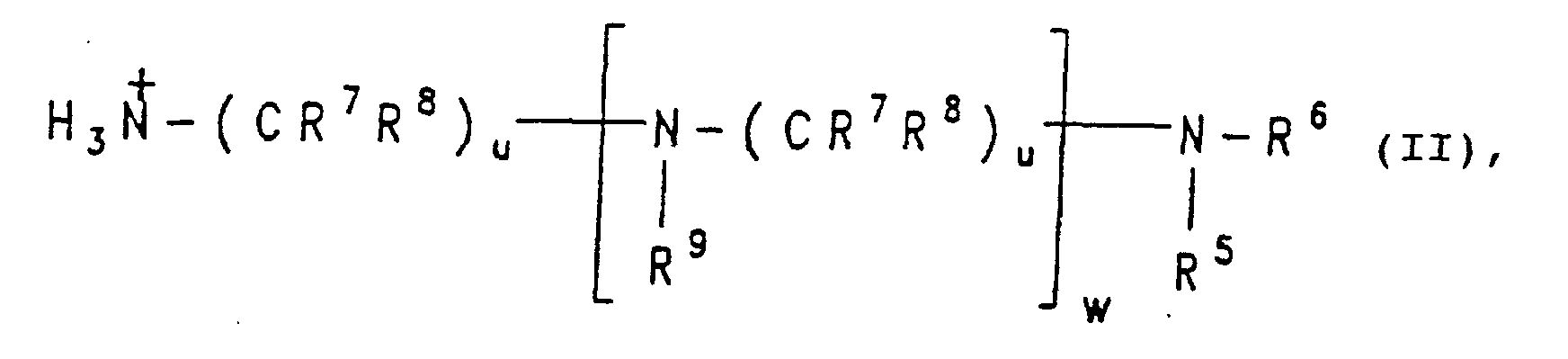
- R9, R5 et R6
- sont identiques ou différents et représentent un atome d'hydrogène ou un groupe hydroxyalkyle présentant 1 à 6 atomes de carbone et
- R7 et R8
- sont identiques ou différents et représentent un atome d'hydrogène ou un groupe méthyle,
- u
- sont chaque fois identiques ou différents et sont un entier de 2 à 14 et
- w
- est un entier de zéro à 25 ;
où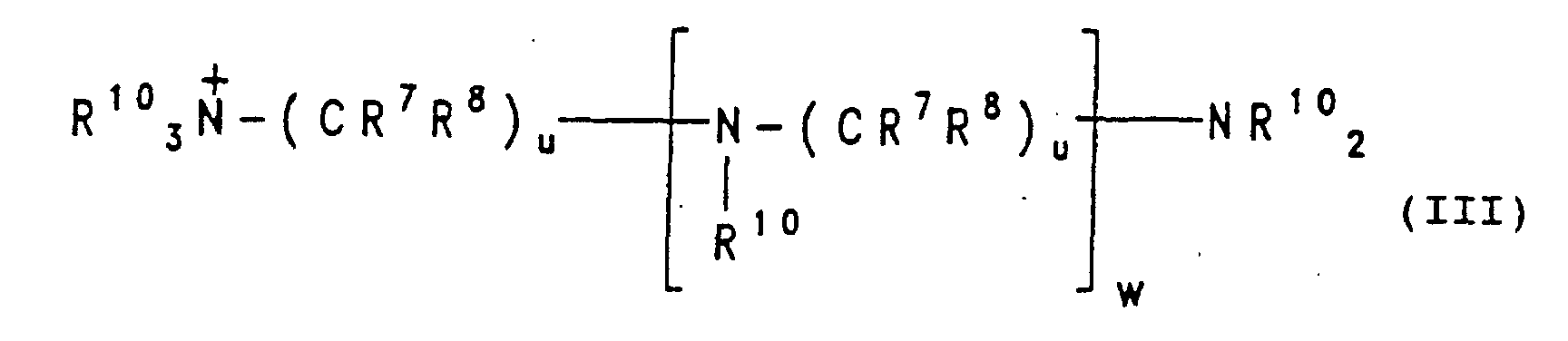
- R10
- représente le groupe H(-O-X-)y, où X possède la signification précitée et y est un entier de 1 à 100,
- m
- dans le cas où A représente un reste acide ricinoléique, vaut 1, et dans le cas où A représente un reste huile de ricin, vaut 1 ou 2,
- n
- est un entier de 1 à 250,
- p
- dans le cas où A est une huile de ricin, vaut 0, et dans le cas où A est un reste acide ricinoléique, vaut 1 et
- r
- va de 1 à 6,
- Préparation pulvérulente selon la revendication 4, caractérisée en ce que le corps gras estérifié et alkoxylé à base d'huile de ricin contient de 1 à 5 unités de formule (Ia), où
- A
- représente le reste d'une huile de ricin naturelle ou modifiée et par conséquent, p vaut zéro,
- X
- représente un groupe -CH2CH2- et
- n
- est un entier de 5 à 125, de préférence de 10 à 80.
- Préparation pigmentaire pulvérulente selon la revendication 4, caractérisée en ce que le corps gras estérifié et alkoxylé à base d'huile de ricin contient 1 à 5 unités de formule (I), où
- A
- représente le reste d'une huile de ricin naturelle ou modifiée et p vaut 1,
- D
- représente un reste bivalent d'un alcool à chaíne droite ou ramifiée 2 à 6 fonctionnel présentant 2 à 6 atomes de carbone ou d'une (alkylol en C2-C3)-amine, d'une (alkylol en C2-C3)-(alkylène en C2-C3)-diamine, d'une (alkylol en C2-C3)-di-(alkylène en C2-C3)triamine ou d'une (alkylol en C2-C3)-tri(alkylène en C2-C3)tétramine,
- X
- représente un groupe -CH2CH2- et
- n
- est un entier de 5 à 125, de préférence de 10 à 80.
- Préparation pigmentaire pulvérulente selon au moins l'une des revendications 1 à 6, caractérisée en ce que le composant b) est un ester d'huile de ricin-colophane-éthoxylate-hémi-ester de l'acide di-sulfosuccinique, un éthoxylate-sulfosuccinate de di-colophane-huile de ricin, un ester d'huile de ricin-colophane-alkoxylate-hémi-ester de l'acide di-maléique ou son sel de triéthylènetétramine, ester de l'acide succinique-huile de ricin-éthoxylate-ester de colophane-éthoxylate-sulfosuccinate ou un ester mixte d'huile de ricin-colophane-glycérine.
- Préparation pigmentaire pulvérulente selon au moins l'une des revendications 1 à 7, caractérisée en ce que le composant c) est un poly(alcool vinylique) partiellement hydrolysé ayant un degré d'hydrolyse de 70 à 92 % molaires ou un copolymère partiellement ou entièrement saponifié d'ester alkylvinylique et d'acétate de vinyle présentant des taux en ester alkylvinylique de 5 à 20 % molaires.
- Procédé pour la préparation d'une préparation pigmentaire pulvérulente selon au moins l'une des revendications 1 à 8, caractérisé en ce qu'on transforme le pigment en un état de division fine par broyage ou malaxage en continu ou en discontinu dans un milieu aqueux ou aqueux-organique, les composants indiqués aux points b), c) et d) étant ajoutés avant, au cours ou après l'opération de division fine, et on transforme la dispersion de pigment finement divisé ainsi obtenue au moyen d'un procédé approprié en obtenant une poudre fine, coulable, par séchage jusqu'à siccité totale.
- Procédé selon la revendication 9, caractérisé en ce qu'on transforme la dispersion de pigment finement divisée par séchage par pulvérisation, séchage sur bande ou séchage en lit fluidisé jusqu'à siccité totale.
- Utilisation d'une préparation pigmentaire pulvérulente selon au moins l'une des revendications 1 à 8 pour la pigmentation d'une peinture-dispersion aqueuse ou d'un enduit.
Applications Claiming Priority (2)
| Application Number | Priority Date | Filing Date | Title |
|---|---|---|---|
| DE19523204A DE19523204A1 (de) | 1995-06-27 | 1995-06-27 | Pulverförmige Pigmentzubereitung |
| DE19523204 | 1995-06-27 |
Publications (4)
| Publication Number | Publication Date |
|---|---|
| EP0751189A2 EP0751189A2 (fr) | 1997-01-02 |
| EP0751189A3 EP0751189A3 (fr) | 1998-01-07 |
| EP0751189B1 EP0751189B1 (fr) | 2001-09-26 |
| EP0751189B2 true EP0751189B2 (fr) | 2004-12-01 |
Family
ID=7765282
Family Applications (1)
| Application Number | Title | Priority Date | Filing Date |
|---|---|---|---|
| EP96109681A Expired - Lifetime EP0751189B2 (fr) | 1995-06-27 | 1996-06-17 | Compositions de pigments sous forme de poudre |
Country Status (9)
| Country | Link |
|---|---|
| US (1) | US5681876A (fr) |
| EP (1) | EP0751189B2 (fr) |
| JP (1) | JPH0925359A (fr) |
| KR (1) | KR970001479A (fr) |
| AT (1) | ATE206151T1 (fr) |
| CA (1) | CA2179956A1 (fr) |
| DE (2) | DE19523204A1 (fr) |
| ES (1) | ES2164806T5 (fr) |
| TW (1) | TW367354B (fr) |
Families Citing this family (17)
| Publication number | Priority date | Publication date | Assignee | Title |
|---|---|---|---|---|
| DE19905269A1 (de) | 1999-02-09 | 2000-08-10 | Bayer Ag | Feste Pigmentpräparationen |
| DE19954401C2 (de) | 1999-11-12 | 2002-08-29 | Bayer Ag | Feste Pigmentpräparationen zur Saatgut-/beizeneinfärbung |
| EP1255566A2 (fr) * | 2000-02-04 | 2002-11-13 | Seo Hong Yoo | Preparation de formes posologiques a base de solutions aqueuse claires a partir d'acides biliaires |
| DE10102019A1 (de) | 2001-01-18 | 2002-07-25 | Clariant Gmbh | Pulverförmige Pigmentpräparationen zur Einfärbung von Folien |
| DE10204304A1 (de) * | 2002-02-01 | 2003-08-14 | Basf Ag | Pigmentgranulate |
| DE10244683A1 (de) * | 2002-09-24 | 2004-04-01 | Basf Ag | Feste Pigmentzubereitungen, enthaltend oberflächenaktive Additive auf Basis von alkoxylierten Bisphenolen |
| GB2395715A (en) * | 2002-11-27 | 2004-06-02 | Clive Richard Peacock | Coloured surfacing plaster |
| AU2003294031A1 (en) * | 2002-12-04 | 2004-06-23 | Ciba Specialty Chemicals Holding Inc. | Dust-free pigment compositions obtainable by spray-drying |
| DE10344660A1 (de) | 2003-09-25 | 2005-04-28 | Merck Patent Gmbh | Verkapselte Pigmente |
| AU2006202780A1 (en) * | 2005-07-27 | 2007-02-15 | Lanxess Deutschland Gmbh | Pigment/auxiliary combination having improved colour properties |
| US20070266901A1 (en) * | 2006-04-06 | 2007-11-22 | Rance Derek G | Encapsulated colorants for waterborne coating compositions system and kit and method |
| US7931745B2 (en) * | 2006-04-10 | 2011-04-26 | Lanxess Deutschland Gmbh | Black pigment/auxiliary combination having improved colour strength |
| FR2911147B1 (fr) | 2007-01-09 | 2009-02-13 | Coatex S A S Soc Par Actions S | Procede de fabrication d'une poudre d'oxyde et d'hydroxyde metallique autodispersable dans l'eau, poudre et dispersion aqueuse obtenues, leurs utilisations. |
| WO2010011230A1 (fr) | 2008-07-25 | 2010-01-28 | Hewlett-Packard Development Company, L.P. | Revêtement composite et substrat utilisés dans l’impression électrophotographique liquide et procédé associé |
| JP2016000778A (ja) * | 2014-06-11 | 2016-01-07 | 花王株式会社 | 洗浄剤用色素顆粒の製造方法 |
| EP3894519A1 (fr) * | 2018-12-11 | 2021-10-20 | Nouryon Chemicals International B.V. | Désémulsionnant polyester |
| CN116836567B (zh) * | 2023-09-01 | 2023-11-10 | 蓬莱新光颜料化工有限公司 | 一种无粉尘颜料的制备方法 |
Citations (1)
| Publication number | Priority date | Publication date | Assignee | Title |
|---|---|---|---|---|
| DE2608993A1 (de) † | 1975-04-28 | 1976-11-11 | Hercules Inc | Trockene, wasserdispergierbare pigmentmassen und verfahren zu ihrer herstellung |
Family Cites Families (9)
| Publication number | Priority date | Publication date | Assignee | Title |
|---|---|---|---|---|
| GB1077422A (en) * | 1964-02-25 | 1967-07-26 | Nippon Paint Co Ltd | An improved pigment dispersion for water thinnable paints |
| BE793704A (fr) * | 1972-01-05 | 1973-07-05 | Hoechst Ag | Procede de preparation de compositions renfermant de l'alcool polyvinylique et un pigment |
| DE2901462A1 (de) * | 1979-01-16 | 1980-07-31 | Hoechst Ag | Pigmentdispersionen und ihre verwendung |
| DE2913176A1 (de) * | 1979-04-02 | 1980-10-23 | Hoechst Ag | Dispergiermittel, verfahren zu deren herstellung und deren verwendung |
| DE3026127A1 (de) * | 1980-07-10 | 1982-02-18 | Hoechst Ag, 6000 Frankfurt | Bisphenolderivate, verfahren zu ihrer herstellung und ihre verwendung als tenside |
| DE3120697A1 (de) * | 1981-05-23 | 1982-12-09 | Hoechst Ag, 6000 Frankfurt | Anionische verbindungen auf basis modifizierter novolack-oxalkylate, ihre herstellung und ihre verwendung als schaumfreie grenzflaechenaktive mittel |
| DE3803450A1 (de) * | 1988-02-05 | 1989-08-17 | Hoechst Ag | Emissionsarme dispersionsfarben, anstrichmittel und kunststoffdispersionsputze sowie verfahren zu ihrer herstellung |
| DE3839865C2 (de) * | 1988-11-25 | 1994-07-07 | Wacker Chemie Gmbh | Verfahren zur Herstellung kaltwasserlöslicher auf Pigmente aufgezogener Polyvinylalkohole |
| EP0582928B1 (fr) * | 1992-08-11 | 1999-05-12 | Clariant GmbH | Composés tensioactifs à base de corps gras d'huile de ricin modifiés |
-
1995
- 1995-06-27 DE DE19523204A patent/DE19523204A1/de not_active Withdrawn
-
1996
- 1996-06-17 DE DE59607754T patent/DE59607754D1/de not_active Expired - Lifetime
- 1996-06-17 EP EP96109681A patent/EP0751189B2/fr not_active Expired - Lifetime
- 1996-06-17 AT AT96109681T patent/ATE206151T1/de not_active IP Right Cessation
- 1996-06-17 ES ES96109681T patent/ES2164806T5/es not_active Expired - Lifetime
- 1996-06-26 KR KR1019960024036A patent/KR970001479A/ko not_active Withdrawn
- 1996-06-26 CA CA002179956A patent/CA2179956A1/fr not_active Abandoned
- 1996-06-26 JP JP8166306A patent/JPH0925359A/ja active Pending
- 1996-06-27 US US08/670,524 patent/US5681876A/en not_active Expired - Lifetime
- 1996-07-05 TW TW085108140A patent/TW367354B/zh active
Patent Citations (1)
| Publication number | Priority date | Publication date | Assignee | Title |
|---|---|---|---|---|
| DE2608993A1 (de) † | 1975-04-28 | 1976-11-11 | Hercules Inc | Trockene, wasserdispergierbare pigmentmassen und verfahren zu ihrer herstellung |
Also Published As
| Publication number | Publication date |
|---|---|
| KR970001479A (ko) | 1997-01-24 |
| CA2179956A1 (fr) | 1996-12-28 |
| ES2164806T5 (es) | 2005-05-01 |
| EP0751189A2 (fr) | 1997-01-02 |
| ATE206151T1 (de) | 2001-10-15 |
| JPH0925359A (ja) | 1997-01-28 |
| DE59607754D1 (de) | 2001-10-31 |
| ES2164806T3 (es) | 2002-03-01 |
| EP0751189A3 (fr) | 1998-01-07 |
| US5681876A (en) | 1997-10-28 |
| TW367354B (en) | 1999-08-21 |
| EP0751189B1 (fr) | 2001-09-26 |
| DE19523204A1 (de) | 1997-01-02 |
Similar Documents
| Publication | Publication Date | Title |
|---|---|---|
| EP0751189B2 (fr) | Compositions de pigments sous forme de poudre | |
| EP1474485B1 (fr) | Preparations pigmentaires | |
| EP1103173B1 (fr) | Utilisation de préparations solides de pigments pour colorer des semences et semences traitées par des liquide | |
| KR101503951B1 (ko) | 알릴 에터 및 비닐 에터에 기초한 음이온성 첨가제를 포함하는 수성 안료 제제 | |
| EP0582928B1 (fr) | Composés tensioactifs à base de corps gras d'huile de ricin modifiés | |
| DE68914368T2 (de) | Dispergiermittel für nichtwässerige Systeme. | |
| EP2367887B1 (fr) | Préparations pigmentaires contenant des additifs tensio-actifs non ioniques | |
| EP1687379A1 (fr) | Preparations de pigments a base d'eau | |
| EP3233260B1 (fr) | Dispersant universel | |
| WO2004046251A2 (fr) | Preparations de pigment solides, contenant des additifs tensioactifs anioniques hydrosolubles renfermant des groupes carboxylate | |
| EP2406335B1 (fr) | Préparations pigmentaires solides renfermant des esters d'acide phosphorique ou d'acide phosphonique en tant qu'additifs tensioactifs | |
| US20060112852A1 (en) | Solid pigment preparations containing pigment derivatives and surface-active additives | |
| KR101579337B1 (ko) | 비-이온성 첨가제를 포함하는 건성 안료 제제 | |
| US4369270A (en) | Pigment dispersions and use thereof | |
| EP0102923A1 (fr) | Détergent approprié pour le post-lavage de teintures réactives et procédé de lavage correspondant | |
| EP0014503B1 (fr) | Procédé de préparation de compositions solides dispersables en milieu aqueux de substances actives étant peu solubles à insolubles dans l'eau, fortement concentrées, finement dispersées, contenant peu ou pas d'agent dispersant | |
| WO2004094540A1 (fr) | Pigments facilement solubles a fort pouvoir colorant | |
| EP0118394A1 (fr) | Préparations de colorants de dispersion | |
| DE60014477T2 (de) | Überführung im wässrigen Medium von einem Kupferphthalocyaninblau-Rohpigment von einem roten in einen grünen Farbton | |
| DE2459895C3 (de) | Zerstäubungsgetrocknete niedrigschmelzende basische Farbstoffe und Verfahren zu ihrer Herstellung | |
| DE102005029309A1 (de) | Dispersion von desagglomeriertem Bariumsulfat in halogenierten Lösungsmitteln, Ethern oder Estern | |
| DE10228199A1 (de) | Pigmentzubereitungen | |
| CH526619A (de) | Verfahren zur Herstellung von Pigmentpräparationen | |
| DE1277478B (de) | Leicht dispergierbares Titandioxid-Pigment |
Legal Events
| Date | Code | Title | Description |
|---|---|---|---|
| PUAI | Public reference made under article 153(3) epc to a published international application that has entered the european phase |
Free format text: ORIGINAL CODE: 0009012 |
|
| AK | Designated contracting states |
Kind code of ref document: A2 Designated state(s): AT CH DE ES FI FR GB IT LI |
|
| PUAL | Search report despatched |
Free format text: ORIGINAL CODE: 0009013 |
|
| RAP1 | Party data changed (applicant data changed or rights of an application transferred) |
Owner name: CLARIANT GMBH |
|
| AK | Designated contracting states |
Kind code of ref document: A3 Designated state(s): AT CH DE ES FI FR GB IT LI |
|
| 17P | Request for examination filed |
Effective date: 19980707 |
|
| GRAG | Despatch of communication of intention to grant |
Free format text: ORIGINAL CODE: EPIDOS AGRA |
|
| GRAH | Despatch of communication of intention to grant a patent |
Free format text: ORIGINAL CODE: EPIDOS IGRA |
|
| 17Q | First examination report despatched |
Effective date: 20010213 |
|
| GRAH | Despatch of communication of intention to grant a patent |
Free format text: ORIGINAL CODE: EPIDOS IGRA |
|
| GRAA | (expected) grant |
Free format text: ORIGINAL CODE: 0009210 |
|
| AK | Designated contracting states |
Kind code of ref document: B1 Designated state(s): AT CH DE ES FI FR GB IT LI |
|
| REF | Corresponds to: |
Ref document number: 206151 Country of ref document: AT Date of ref document: 20011015 Kind code of ref document: T |
|
| REG | Reference to a national code |
Ref country code: CH Ref legal event code: EP |
|
| REF | Corresponds to: |
Ref document number: 59607754 Country of ref document: DE Date of ref document: 20011031 |
|
| REG | Reference to a national code |
Ref country code: GB Ref legal event code: IF02 |
|
| GBT | Gb: translation of ep patent filed (gb section 77(6)(a)/1977) |
Effective date: 20011201 |
|
| ET | Fr: translation filed | ||
| REG | Reference to a national code |
Ref country code: ES Ref legal event code: FG2A Ref document number: 2164806 Country of ref document: ES Kind code of ref document: T3 |
|
| PLBQ | Unpublished change to opponent data |
Free format text: ORIGINAL CODE: EPIDOS OPPO |
|
| PLBI | Opposition filed |
Free format text: ORIGINAL CODE: 0009260 |
|
| PLBF | Reply of patent proprietor to notice(s) of opposition |
Free format text: ORIGINAL CODE: EPIDOS OBSO |
|
| 26 | Opposition filed |
Opponent name: BAYER AG Effective date: 20020626 |
|
| PLBF | Reply of patent proprietor to notice(s) of opposition |
Free format text: ORIGINAL CODE: EPIDOS OBSO |
|
| PLAT | Information related to reply to examination report in opposition deleted |
Free format text: ORIGINAL CODE: EPIDOSDORE3 |
|
| PLAY | Examination report in opposition despatched + time limit |
Free format text: ORIGINAL CODE: EPIDOSNORE2 |
|
| PLBC | Reply to examination report in opposition received |
Free format text: ORIGINAL CODE: EPIDOSNORE3 |
|
| PLAB | Opposition data, opponent's data or that of the opponent's representative modified |
Free format text: ORIGINAL CODE: 0009299OPPO |
|
| R26 | Opposition filed (corrected) |
Opponent name: BAYER CHEMICALS AG Effective date: 20020626 |
|
| PUAH | Patent maintained in amended form |
Free format text: ORIGINAL CODE: 0009272 |
|
| STAA | Information on the status of an ep patent application or granted ep patent |
Free format text: STATUS: PATENT MAINTAINED AS AMENDED |
|
| 27A | Patent maintained in amended form |
Effective date: 20041201 |
|
| AK | Designated contracting states |
Kind code of ref document: B2 Designated state(s): AT CH DE ES FI FR GB IT LI |
|
| REG | Reference to a national code |
Ref country code: CH Ref legal event code: AEN Free format text: AUFRECHTERHALTUNG DES PATENTES IN GEAENDERTER FORM |
|
| GBTA | Gb: translation of amended ep patent filed (gb section 77(6)(b)/1977) | ||
| REG | Reference to a national code |
Ref country code: ES Ref legal event code: DC2A Date of ref document: 20041229 Kind code of ref document: T5 |
|
| ET3 | Fr: translation filed ** decision concerning opposition | ||
| REG | Reference to a national code |
Ref country code: CH Ref legal event code: PFA Owner name: CLARIANT PRODUKTE (DEUTSCHLAND) GMBH Free format text: CLARIANT GMBH#BRUENINGSTRASSE 50#65929 FRANKFURT AM MAIN (DE) -TRANSFER TO- CLARIANT PRODUKTE (DEUTSCHLAND) GMBH#BRUENINGSTRASSE 50#65929 FRANKFURT AM MAIN (DE) |
|
| REG | Reference to a national code |
Ref country code: FR Ref legal event code: CD |
|
| PLAB | Opposition data, opponent's data or that of the opponent's representative modified |
Free format text: ORIGINAL CODE: 0009299OPPO |
|
| PGFP | Annual fee paid to national office [announced via postgrant information from national office to epo] |
Ref country code: FR Payment date: 20100506 Year of fee payment: 15 Ref country code: FI Payment date: 20100621 Year of fee payment: 15 Ref country code: ES Payment date: 20100430 Year of fee payment: 15 |
|
| PGFP | Annual fee paid to national office [announced via postgrant information from national office to epo] |
Ref country code: IT Payment date: 20100427 Year of fee payment: 15 Ref country code: AT Payment date: 20100419 Year of fee payment: 15 |
|
| PGFP | Annual fee paid to national office [announced via postgrant information from national office to epo] |
Ref country code: CH Payment date: 20100506 Year of fee payment: 15 |
|
| PGFP | Annual fee paid to national office [announced via postgrant information from national office to epo] |
Ref country code: GB Payment date: 20100524 Year of fee payment: 15 Ref country code: DE Payment date: 20100417 Year of fee payment: 15 |
|
| PG25 | Lapsed in a contracting state [announced via postgrant information from national office to epo] |
Ref country code: FI Free format text: LAPSE BECAUSE OF NON-PAYMENT OF DUE FEES Effective date: 20110617 |
|
| REG | Reference to a national code |
Ref country code: CH Ref legal event code: PL |
|
| GBPC | Gb: european patent ceased through non-payment of renewal fee |
Effective date: 20110617 |
|
| PG25 | Lapsed in a contracting state [announced via postgrant information from national office to epo] |
Ref country code: AT Free format text: LAPSE BECAUSE OF NON-PAYMENT OF DUE FEES Effective date: 20110617 Ref country code: IT Free format text: LAPSE BECAUSE OF NON-PAYMENT OF DUE FEES Effective date: 20110617 |
|
| REG | Reference to a national code |
Ref country code: AT Ref legal event code: MM01 Ref document number: 206151 Country of ref document: AT Kind code of ref document: T Effective date: 20110617 |
|
| REG | Reference to a national code |
Ref country code: FR Ref legal event code: ST Effective date: 20120229 |
|
| REG | Reference to a national code |
Ref country code: DE Ref legal event code: R119 Ref document number: 59607754 Country of ref document: DE Effective date: 20120103 |
|
| PG25 | Lapsed in a contracting state [announced via postgrant information from national office to epo] |
Ref country code: DE Free format text: LAPSE BECAUSE OF NON-PAYMENT OF DUE FEES Effective date: 20120103 Ref country code: FR Free format text: LAPSE BECAUSE OF NON-PAYMENT OF DUE FEES Effective date: 20110630 Ref country code: CH Free format text: LAPSE BECAUSE OF NON-PAYMENT OF DUE FEES Effective date: 20110630 Ref country code: LI Free format text: LAPSE BECAUSE OF NON-PAYMENT OF DUE FEES Effective date: 20110630 |
|
| PG25 | Lapsed in a contracting state [announced via postgrant information from national office to epo] |
Ref country code: GB Free format text: LAPSE BECAUSE OF NON-PAYMENT OF DUE FEES Effective date: 20110617 |
|
| REG | Reference to a national code |
Ref country code: ES Ref legal event code: FD2A Effective date: 20120717 |
|
| PG25 | Lapsed in a contracting state [announced via postgrant information from national office to epo] |
Ref country code: ES Free format text: LAPSE BECAUSE OF NON-PAYMENT OF DUE FEES Effective date: 20110618 |