EP0751632A1 - Procede de communication multi-station pour systemes de satellite sur orbite a basse altitude et son dispositif de mise en oeuvre - Google Patents
Procede de communication multi-station pour systemes de satellite sur orbite a basse altitude et son dispositif de mise en oeuvre Download PDFInfo
- Publication number
- EP0751632A1 EP0751632A1 EP95913948A EP95913948A EP0751632A1 EP 0751632 A1 EP0751632 A1 EP 0751632A1 EP 95913948 A EP95913948 A EP 95913948A EP 95913948 A EP95913948 A EP 95913948A EP 0751632 A1 EP0751632 A1 EP 0751632A1
- Authority
- EP
- European Patent Office
- Prior art keywords
- satellite
- signal
- frequency
- delay
- information
- Prior art date
- Legal status (The legal status is an assumption and is not a legal conclusion. Google has not performed a legal analysis and makes no representation as to the accuracy of the status listed.)
- Withdrawn
Links
- 238000004891 communication Methods 0.000 title claims abstract description 153
- 238000000034 method Methods 0.000 title claims abstract description 74
- 230000010354 integration Effects 0.000 claims abstract description 5
- 238000000411 transmission spectrum Methods 0.000 claims abstract description 4
- 238000001228 spectrum Methods 0.000 claims description 47
- 230000001934 delay Effects 0.000 claims description 43
- 238000000926 separation method Methods 0.000 claims description 24
- 230000001360 synchronised effect Effects 0.000 claims description 24
- 230000005540 biological transmission Effects 0.000 claims description 21
- 238000007493 shaping process Methods 0.000 claims description 11
- 230000033001 locomotion Effects 0.000 claims description 10
- 238000012545 processing Methods 0.000 claims description 10
- 238000012937 correction Methods 0.000 claims description 7
- 230000006835 compression Effects 0.000 claims description 6
- 238000007906 compression Methods 0.000 claims description 6
- 230000010363 phase shift Effects 0.000 claims description 6
- 230000002441 reversible effect Effects 0.000 claims description 6
- 230000002349 favourable effect Effects 0.000 claims description 3
- 230000006837 decompression Effects 0.000 claims description 2
- 230000004069 differentiation Effects 0.000 claims description 2
- 238000004364 calculation method Methods 0.000 abstract description 4
- 210000004027 cell Anatomy 0.000 description 32
- 230000036039 immunity Effects 0.000 description 24
- 238000011156 evaluation Methods 0.000 description 15
- 238000010586 diagram Methods 0.000 description 7
- 238000013461 design Methods 0.000 description 5
- 230000006870 function Effects 0.000 description 5
- 239000000243 solution Substances 0.000 description 5
- 239000002131 composite material Substances 0.000 description 4
- 238000013459 approach Methods 0.000 description 3
- 230000008901 benefit Effects 0.000 description 3
- 230000006872 improvement Effects 0.000 description 3
- 230000008569 process Effects 0.000 description 3
- 230000004044 response Effects 0.000 description 3
- 238000012546 transfer Methods 0.000 description 3
- 238000012935 Averaging Methods 0.000 description 2
- 230000003321 amplification Effects 0.000 description 2
- 230000001413 cellular effect Effects 0.000 description 2
- 238000011161 development Methods 0.000 description 2
- 230000000694 effects Effects 0.000 description 2
- 229910052741 iridium Inorganic materials 0.000 description 2
- GKOZUEZYRPOHIO-UHFFFAOYSA-N iridium atom Chemical compound [Ir] GKOZUEZYRPOHIO-UHFFFAOYSA-N 0.000 description 2
- 238000003199 nucleic acid amplification method Methods 0.000 description 2
- 230000008520 organization Effects 0.000 description 2
- 239000000047 product Substances 0.000 description 2
- 230000009467 reduction Effects 0.000 description 2
- 210000003850 cellular structure Anatomy 0.000 description 1
- 230000008859 change Effects 0.000 description 1
- 230000003247 decreasing effect Effects 0.000 description 1
- 230000001419 dependent effect Effects 0.000 description 1
- 238000002347 injection Methods 0.000 description 1
- 239000007924 injection Substances 0.000 description 1
- 230000000670 limiting effect Effects 0.000 description 1
- 238000005259 measurement Methods 0.000 description 1
- 238000010295 mobile communication Methods 0.000 description 1
- 230000036961 partial effect Effects 0.000 description 1
- 238000013139 quantization Methods 0.000 description 1
- 230000002829 reductive effect Effects 0.000 description 1
- 239000013589 supplement Substances 0.000 description 1
Images


Classifications
-
- H—ELECTRICITY
- H04—ELECTRIC COMMUNICATION TECHNIQUE
- H04B—TRANSMISSION
- H04B7/00—Radio transmission systems, i.e. using radiation field
- H04B7/14—Relay systems
- H04B7/15—Active relay systems
- H04B7/204—Multiple access
- H04B7/212—Time-division multiple access [TDMA]
- H04B7/2125—Synchronisation
Definitions
- the present invention relates to the field of communication via satellite transponders, and more specificatlly, to a method of constructing a multi-station communications system with free access of subscribers through low-orbit satellites, to a method of multiple-station communication With integration of low-orbit and high-orbit satellite systems, and also to a method of signal search and initial channel synchronization in the satellite communications system, and to apparatus for implementing these methods.
- satellite communications systems with direct signal re-relaying by satellite transponders.
- a class of satellite communications systems is known in which a partial (or complete) processing of signals from the user stations is performed at the satellite transponders.
- the disadvantages of the prior-art method is the presence of regional stations providing for control of the communications system and switching of signal flows at satellite transponders, which, though simplifying the transponder design, results, however, in narrowing the area and time of service (communication is ensured only under the condition of transponder visibility at an angle of elevation greater than the limiting one from three points simultaneously, namely, two points of location of the user stations and the point of location of the regional station), and also in increasing signals delay along their propagation route.
- the disadvantages of the prior-art method is also the limitedness of the area of servicing the users and impossibility of effecting global communication.
- EMC electromagnetic compatibility
- a differential method of self-location is known, which is one of the ways for further development of the existing navigation satellite systems of "Glonass” and "GPS" type.
- the method resides in that the receiver of one of the said navigation systems is disposed in a reference point with exactly known coordinates.
- Such a receiver by receiving signals from a constellation of navigation satellites, solves the problem of assessing the coordinates of the reference point. After comparing the obtained coordinates with the exact coordinates, corrections are calculated, which are transmitted to the navigation information consumers (mainly, to mobile consumers) who are in the vicinity of the reference point at distances within hundreds kilometers.
- the consumers of the navigation satellite systems are capable of improving the accuracy of self-location by one or two orders of magnitude as compared with assessing the coordinates by the navigation satellites only.
- Implementation of this method is only possible with a developed mobile communications system and with the possibility of ensuring broardcast transmission. Therefore, the subject of the present invention is intended to improve the accuracy of navigation aids for the mobile users of the low-orbit communications system, which widens the potentialities and service properties of the low-orbit satellite communications systems.
- the communication of two users of the low-orbit system is implemented through the following chain: a user station, a low-orbit transponder, a regional station, a stationary satellite transponder, another regional station, a low-orbit satellite transponder, a user station.
- another stationary satellite may be needed, which is connected via an intersatellite link with the first stationary satellite.
- the transmitters of the user stations are synchronized due to the autotuning of the transmitters by the carrier frequency and signal delay (code delay).
- transponders There are known two basic types of transponders: those which perform direct relaying of user station signals and those which process the signals on board the satellite transponders. When processing signals at the satellite transponders, a higher noise immunity of the system is provided.
- correlation tracking systems which include systems of phase (or frequency) autotuning of frequency and circuits for tracking the delay. It is required to provide the search and initial synchronization of the correlation receiver and transmitter at the user station.
- the systems of search and initial synchronization of the correlation receivers are described in sufficient detail, for example, in the publication "Interference immunity of radio systems with composite signals", G.I.Tuzov, V.A.Sivov, V.I.Prytkov et al, edited by G.I.Tuzov, M., Radio i svyaz publishers, 1985, pp 115-157.
- Some of said forms of signal search can be used for search and initial synchronization of the transmitters and communications channel as a whole with the search apparatus disposed at a satellite transponder.
- the receiver of the satellite transponder becomes seriously complicated and, as a result, the advantage is lost connected with simiplification of the satellite transponder equipment performing autotuning of all the user stations transmitters.
- An object of the invention is to provide a method and apparatus for multiple-station communication, which will ensure:
- a method of multiple-station communication for low-orbit satellite systems comprising the steps of transmitting by user stations synchronization signals and information-modulated signals, reswitching the information-modulated signals aboard a transponder, emitting thereof at different frequencies by beams spaced apart with the use of phase-shift keying, emitting by the transponder its own synchronization signal, receiving the synchronization signal from the satellite transponder by the user stations and the information-modulated signals meant therefor, the method further comprising, according to the invention, generating and emitting, at the satellite transponder, a wideband pseudorandom synchronization signal with phase-shift keying over the entire width of the transmission spectrum from the satellite transponder and over the entire service area divided into cells with the power density gradually increasing from the area center to the edges thereof, modulating said synchronization signal with service information intended for control of the communication system, performing rejection of said synchronization signal spectrum sections coincident,at the time of emission, with the spectrum of signals emitted by the satellite transpond
- the code allotted to the user station for calling the satellite transponder with the delay established individually for each user station is additionally modulated by a short message including information on the number of the called party,with subsequent demodulation and separation of said message at the satellite transponder.
- an intersatellite communication is established with neighbour satellite transponders similar to the communication established between the satellite transponder and one of the user stations, each of the satellite transponders performing, in this case, by the principle of constructing the network, both the part of a user station synchronized from the neighbour satellite tranponder and a satellite transponder from which are synchronized other satellite transponders, and the time of exit from the common service area of each of the user stations and from the spatial cell is determined at the satellite transponders, each of the user stations being informed about this, with simultaneous presenting thereto recommendation on switchover to communication with the most favourable satellite transponder at a new frequency and time interval of another spatial beam, whereupon at the user station, simultaneously with maintaining the communication, a synchronization signal is received from the recommended satellite, with establishing a new frequency and time interval and the autotune transmitter is synchronized from said satellite transponder by frequency and delay, information is transmitted
- information is transmitted, from the users disposed in reference points with precisely known coordinates, about the coordinates of said reference points and the navigation corrections obtained as a result of comparison of the precisely known coordinates with those obtained as a result of estimations from navigation satellites, said information is demodulated at the satellite transponder with subsequent modulation by said information of the synchronization signal emitted from the satellite transponder and demodulation of said information by interested user stations.
- navigation information is switched which is obtained from the user stations disposed in reference points with precisely known coordinates, and it is transmitted by each of the spaced apart beams within the predetermined time intervals and the allocated internal codes with subsequent separation of said information by interested user stations.
- a method of multiple-station communication with integration of high-orbit and low-orbit satellite systems which comprise satellite transponders in stationary and low orbits comprises the steps of emitting synchronization signals and information-modulated signals generated on the basis of wideband pseudorandom signals with phase-shift keying, and also receiving information-modulated signals from low-orbit satellite transponders by means of small-size user stations and synchronization signals, which also comprises, according to the present invention, generating, at high-orbit satellite transponders, a wideband pseudorandom synchronization signal with phase manipulation over the entire spectrum width allotted for information transmission from the satellite transponder with code differentiation of signals generated by different satellite transponders, emitting said signal over the entire common spatial service area divided into cells and including visible orbits of all low-orbit satellite transponders, with the power density gradually increasing from the area center to the edges thereof, modulating said signal with service information, performing rejection of said signal spectrum sections coincident at the emission instants with the spectrum of the e
- the above-mentioned and other objects are accomplished also in a method of search and initial synchronization of channels in a satellite communications system with direct relaying of signals, in which wideband pseudorandom signals are used for synchronization, and synchronization of the user station transmitters are carried out by a synchronization signal from the satellite transponder, said method providing emission by each user station, in addition to an information-modulated signal, of its own synchronization signal, reception from the satellite transponder of information-modulated signals and its own synchronization signal, the method further comprises, according to the invention, performing at the user stations, after receiving the synchronization signal of the satellite transponder, unidirectional discrete scanning of the delay of the emitted synchronization signal with preliminary compensation of the Doppler increment by the carrier and clock frequencies, which increment is separated from the received synchronization signal of the satellite transponder, noting the instant of coincidence of the own relayed synchronization signal delay with the delay of the reference signal of the same waveform phased from the synchronization signal of the satellite transponder
- a delay is introduced into the emitted signal at the user station with a reverse sign relative to the received synchronization signal, said delay being proportional to [ - ( ⁇ /2) ap ⁇ ], where ( ⁇ /2) ap is the a priori known delay, ⁇ is the maximum value of the a priori error in the knowledge of the delay, and scanning is commenced in the direction ⁇ , the instant of coincidence of the delays is noted of the own relayed signal received by the receiver and of the reference signal of the same waveform phased from the satellite transponder synchronization signal received by the receiver, the discrete delay 2[( ⁇ /2) ap ⁇ ] is introduced into the emitted signal and scanning is performed in the direction ⁇ , a new instant of coincidence of the signal delays is noted, the resultant is estimated taking into account the scanning of the delay between the
- the instants of coincidence of the delays of the synchronization signal emitted by the user station and the reference signal of the same waveform are noted, which reference signal is Phased from a generator of the synchronization signal codes disposed at the satellite transponder, and the instants of coincidence of the delays are subsequently relayed by modulating the signal from the satellite transponder, the signal is received and demodulated by the appropriate user stations.
- an apparatus for implementing the method of multiple-station communication for low-orbit satellite systems which comprises, at a satellite transponder, a transceiving phased antenna array with a modulator and a high-frequency portion, a receiver of signals of communication and service information, a unit for generating a synchronization signal and a service information signal, a frequency spectrum synthesizer, an antenna for transmitting a signal of synchronization with a high-frequency portion, a unit for packet generating with a buffer memory, a user station including a transceiving antenna with a high-frequency portion of a transmitter, a signal receiver with a high-frequency portion and channels for separating information, a synchronization signal receiver comprising a circuit for phase autotuning of frequency, a delay tracking circuit, interconnected by a cross link, and a channel for service information separation; a transmitter with frequency end code delay autotuning, including a frequency autotune circuit and a delay tracking circuit
- an apparatus for signal search and initial channel synchronization in a satellite communications system comprising, at a user station, a circuit of phase autotune of frequency, including a series combination of a signal receiver with a high-frequency portion, injection filters, a subtractive mixer, a code demodulator with an intermediate frequency amplifier, a phase detector with a lowpass filter, a controlled generator coupled to a reference input of the subtractive mixer, a frequency spectrum synthesizer, a delay tracking circuit, including a series combination of a discriminator with a lowpass filter, a controlled generator, a synchronization code generator connected to a reference input of the discriminator, and generators of transmitter codes (user and internal); a circuit of phase (frequency) autotuning of the transmitter frequency, including a phase (frequency) discriminator with a lowpass filter, a controlled generator, a modulator and an amplifier of high frequency; a circuit for tracking a transmitter delay code, including a delay discriminator with a
- a satellite transponder is provided with a transceiving phased antenna array (PAA), and the service area, in which the satellite is visible at an angle of location not less than the preset one, is divided into 6 (or a greater number) cells in which emission (reception) of signals takes place at various frequencies with time-division operation at each of the frequencies, which reduces mutual interferences.
- PAA phased antenna array
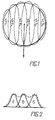
- Fig. 1 shows a satellite coverage area divided into 6 cells, information by the satellite transponder being relayed sequentially at the frequencies f 1 , f 2 , f 3 with spaced apart beams with time division.
- Fig. 2 shows the spectra of signals with a widened spectrum at the transmission frequencies f 1 , f 2 , f 3 .
- the method of the present invention resides in that from user stations are transmitted synchronization signals and infromation-modulated signals, the information-modulated signals are reswitched on board the transponder, and they are emitted at various frequencies by spaced apart beams (Fig. 1) with the use time-division multiplex and phase manipulation. From the satellite transponder, its own synchronizarion signal is emitted, which is received by user stations together with the information-modulated signals meant for them.
- the synchronization signal generated on board the transponder is a wideband pseudorandom signal with phase manipulation occupying the entire band of the information-modulated signal transmitted from the transponder (Fig. 2).
- the directional pattern of the antenna emitting a synchronization signal must be such as to provide a uniform power density irrespective of the distance from the satellite to the user station, and the boundaries of the service area are determined by a tilt angle at which the satellite transponder is visible by the user stations and the communication can still be maintained.
- the increased signal bandwidth-duration product is conducive in improving the noise immunity, electromagnetic compatibility and synchronization precision required for implementing time-division multiplex, and at the same time the communications sytem does without auxiliary widening of the frequency band allocated to the entire system.
- the synchronization signal is modulated with service information transmitted to the users and intended for controlling the operation of the entire system.
- Such measures are the following: selection of different codes for synchronization signals and information transfer signals, rejection at the satellite transponder of those synchronization signal spectrum portions which coincide at the instant of emission with the spectrum of the information-modulated signals, with the emitted power of the synchronization signal being constant.
- all the user stations perform synchronization signal reception and separation of service information with simultaneous rejection of the spectrum portions of the synchronization signal, which coincide with the spectrum of the signals carrying information at the time of their reception by the user stations which are in different spatial cells.
- a check on locations of all the users is mode at the satellite transponder relative to the spatial cells formed by the beams of the phased antenna array of the transponder.
- the users must constantly estimate their coordinates to an accuracy of hundreds kilometers with the use of a subscriber station (or other navigation methods, including those claimed in the invention), and transmit them regularly to the satellite transponder.
- the coarse coordinates of the location of the users, and also approximate characteristics of the vector of their motion must be stored in the memory of satellite transponder.
- Reception is also performed, at the satellite transponder, of packets from the user stations and storage of their information portions, and from the preamble of the packets evaluation is made of the mismatches by the carrier frequency and code delay against standards at the satellite transponders, with their subsequent storage.
- All the user stations perform compensation in the autotune transmitters of the Doppler shift by the carrier and clock frequencies using a synchronization signal received from the satellite transponder, effect autotuning of their own transmitters by the carrier frequency and code delay using the values of the corresponding mismatches separated from the preamble.
- a query is sent to the satellite transponder by emitting with the aid of the autotune transmitter several cycles of the pseudorandom radio signal with a code assigned for the call of the satellite transponder with a delay preset individually for each of the user stations.
- the number of the calling user station and the spatial cell in which it is located are identified from the call signal received and its delay, and the time interval allocated to the calling user station and the internal code for two-way (with the transponder) communication are reported by means of the calling station code.
- the calling user reports in the time interval allocated to this user, to the satellite transponder the number of the calling user station by modulating the internal code identified at the satellite transponder with its coordinates and the spatial location cell.
- a call arrives from the satellite transponder, which simultaneously sets the time interval and internal code for two-way communication with the satellite transponder.
- the called subscriber on receiving the call from the satellite transponder, performs the initial synchronization of the autotune transmitter and in the allocated time interval using said transmitter reports to the transponder on the readiness for communication by modulating the separated internal code.
- the time intervals and numbers of the internal codes are established at the satellite transponder and reported to the two user stations to establish two-way communication, the time intervals being separated on the condition of convenience of routing the packets taking into account the cells of the users' location.
- each user establishes the internal codes in the transmitter end receiver, ensures information generation in a digital form and its time compression, performs its multibase coding by the separated internal code and signal emission in allocated time interval with a preamble including several cycles of the internal code with a fixed delay ( or several cycles of the code allocated to a group of subscribers).
- An increased interference immunity, privacy of talks and improved EMC, less intricate equipment are provided in the method of the invention due to realizing multiple-station access with time division multiplex (MATM) in combination with multiple-station access with code division multiplex (MACM), and also frequency and space division.
- MATM time division multiplex
- MCM code division multiplex
- the high accuracy of synchronization, necessary for MATM, is provided due to the use of synchronization signals with a higher band and band-width-duration product than in the prior-art method.
- relatively short quasiorthogonal internal codes are introduced, which are allocated individually to each subscriber with the recommended number M of the code elements in the range from 64 to 8192. These codes ensure block multibase information coding.
- the internal codes for transmission and reception are allocated by the user from the satellite transponder for one (or several) communication session. All the above-mentioned measures increase interference immunity with interferences created by the equipment of other subscribers both with incorrect use of the equipment and with mulfunctions therein, and also in the case of interferences created intentionally, and therefore excludes interceptions without useing special means. Additional employment of special means for cryptosecurity of information is conducive to improving the privacy of talks. Additional use of convolutional codes is neither excluded.
- the maximum interference immunity of reception will be ensured when the power of the multiplexed signals is equalized, which is attained as a result of measurement of the levels of the multiplexed signals within each time interval, separation of the signals with the maximum and minimum levels with respect to the average value and transmission of recommendations in the preamble of the packets on decreasing or increasing the power of the transmitters of the corresponding users. Having received the preamble, the users regulate the power of the transmitters.
- a special procedure of calling the transponder by the subscribers in which after emitting to the satellite transponder a special phased code sequence common for groups of subscribers, the user station ready to establish communication with the satellite transponder or other subscriber is identified at the satellite transponder from the delay of this sequence individual for each user station.
- One of the specific features of the invention is the possibility afforded to the subscribers to transmit to the satellite transponder, together with a call from the satellite transponder, short messages including information on the number of the called user station, which simplifies and accelerates the procedure of establishing communication between the subscribers.
- the call code with a delay individual for each user is additionally modulated by this message.
- One of the aspects favouring the solution of the stated problem is the process of synchronizing the autotune transmitter, and also generating an information message to the subscribers.
- Analog information which is to be transferred to the subscribers, after quantization digitization, time compression, multibase coding is emitted within the allocated time interval with a preamble which includes one-two cycles of the user's own internal code (it is possible to have the own code for a group of users).
- a preamble processing at the satellite transponder evaluation of the code delay and signal frequency against the onboard standards (onboard synchronization signal)which place in the preamble in a digital form the signals transmitted to the corresponding user stations.
- the user stations receive said mismatch evaluations and use them in the autotune transmitter.
- An important specific feature of the invention is giving up regional terrestrial stations and developing intersatellite communications. This allows an abrupt enlargement of the terrestrial service area, increase of the time of stable communication of the users and interference immunity, improvement of EMC, reduction of the number of relayings, decrease of the time delay of a signal during its propagation along the route.
- a single disadvantage of such a solution is associated with a more intricate transponder design. Therefore, the invention suggests new technical solutions which make it possible to make the transponder design more simple.
- each of the satellites transponders in the communication network can perform either the function of a driven satellite (as if the function of a user station) synchronized from a neighbouring satellite, or a drive satellite from which other satellites are synchronized.
- a criterion for example, can be created according to which the satellites flying in front of and on the right (as viewed in the direction of motion) perform the part of the drive satellites, and those in the rear and on the left are driven.
- the functions of the satellites can be determined on the Earth from the communications system control center.
- the intersatellite communication can be efficient and sufficiently easily practicable with a small number of relayings (not more than three). However, even with such restrictions, the service area is drastically increased.
- a next specific feature is associated with ensuring continuity of communication when change-over to the operation with another satellite is made.
- the satellite transponders it is necessary to estimate the operating conditions of the user station, in particular, to estimate the time of exit of the user stations from the visibility zone of the particular satellite.
- the subscriber must be noticed about it over the service communication and he must be given recommendation to change-over to the operation with another most favourable satellite to continue the communication. Realization of such a procedure at the user stations is not excluded.
- duplex communication is continued to be maintained at the user station, and at the same time reception of a synchronization signal from another satellite is made using the other equipment halfset, the autotune transmitter is synchronized from this satellite, and then transmission is performed to the two satellites simultaneously.
- Matching in time of information flows passing through the two satellites is ensured at the same time at the said satellite transponders via an intersatellite communication line, and synchronous automatic transfer of a subscriber (subscribers) to the operation with another satellite.
- a fourth specific feature is connected with ensuring a multiple-station global personal communication for the subscribers using small-size user stations with the minimum number of re-relayings, signal reswitching and the least signal delays on the route of their transmission.
- intersatellite communications lines are organized between stationary satellite transponder and satellites transponders of the low-orbit system, which are within the visibility zone of the stationary satellites.
- Communication organization in this case is the same as in the low-orbit communications system, namely, the stationary satellite is the drive satellite transponder emitting its own synchronization signal as does the satellite of the low-orbit system, the common service area of the stationary satellite transponder includes all low-orbit satellite transponders visible thereto, the major axes of the spatial cells formed by the phased antenna array are parallel to the directions of motion of the satellite transponders of the low-orbit system, which as if perform the functions of the user stations in the low-orbit system.
- the synchronization signals of different stationary satellites differ in the code shape.
- a further specific feature is connected with an increase in the traffic-handling capacity of the system and provision of interference immunity with signal compression. This is attained by placing within each time interval several signals having different internal codes but equal power at the transponder input. In order to ensure interference immunity on board the satellite transponder, evaluation of the power levels of the signals in each time interval is performed, signals are determined with lower and higher power and in the preamble of the packet recommendations are transmitted to the subscribers on power level correction performed by said subscribers.
- One more specific feature is associated with realizing the differential navigation method for which communication is required, which is capable of transmitting navigational information from a stationary reference point by several mobile objects simultaneously.
- the user station located in the vicinity of the reference point transmits navigational information within the interval allocated thereto with the use of the internal code, which is received on board the transponder and must be circularly transmitted to mobile subscribers.
- Two versions of implementing the conference communication are possible:
- one more specific feature is connected with signal search and initial synchronization of channels in the low-orbit communications system.
- signal search narrowing of uncertainty is achieved in evaluating the delay and frequency of pseudorandom signals to a value which ensure signal coverage by correlation tracking filters including systems of phase and frequency autotuning of frequency and circuits for tracking the delay of a highband pseudorandom signal. It is necessary to ensure at the user station search and initial synchronization of both the correlation receivers and the correlation transmitters.
- the receiver of the satellite transponder becomes drastically complicated, and, as a result, an advantage is lost, which is associated with simplification of the satellite transponder equipment with autotuning of the transmitters of all user stations, and the time of signal search is increased.
- duplex communication will be required between the satellite transponder and each user station, by means of which it is necessary to transmit, from the satellite transponder to the user stations, information on instantaneous evaluations of the code delay and signal frequency and to receive a response of each user station, which is not always feasible.
- the interference immunity of the communications system in the mode of search and initial channel synchronization will be low. Therefore, the proposed solutions imply simplification of the satellite transponder by excluding the equipment of search and initial synchronization of channels, decrease of the time of the initial synchronization of the transmitters of the user stations and the communication channel as a whole, increase of the interference immunity of the communications system in the mode of search and initial synchronization.
- Two forms of the communications system are considered, namely, where a transponder is used on the satellite transponder with direct re-relaying of the user station signals for search and initial synchronization, and also a transponder with signal processing on board the satellite transponder, which covers completely the possible forms.
- the method resides in that in the system of satellite communication use is made of wideband pseudorandom signals, and synchronization of the user station receivers is performed by a synchronization signal from board the satellite transponder.
- each user station emits, beside an information-modulated signal, its own synchronization signal.
- information-modulated signals and its own synchronization signal used for synchronizing the transmitter are received from the satellite transponder.
- unidirectional discrete scanning of the delay of the emitted synchronization signal is effected with preliminary compensation of the Doppler increment by the carrier and clock frequencies, which is separated from the received synchronization signal of the satellite tranponder.
- the instant of coincidence of the delay of the own relayed synchronization signal with the delay of the reference signal of the same waveform phased from the synchronization signal of the satellite transponder received by the receiver is fixed.
- the discrete delay 2[- ( ⁇ /2) a pr ⁇ ] is again introduced in the emitted signal and scanning is performed in the direction ⁇ up to a new instant of coincidence of the delays of said signals.
- the use of the a priori value of the signal delay along the route of propagation permits of reducing the region of search and, thus, reducing the time of search and channel synchronization.
- evaluation of the resultant delay is performed (with regard for the discretely introduced and obtained delay as a result of scanning), and a delay is introduced, equal to half said resultant delay, into the emitted signal in the initial direction of scanning.
- the instants of coincidence of the delays are transmitted to the corresponding user stations and are separated by them.
- the instants of the delay coincidence use can be made of the already available delay discriminators, located on the transponders, and for transmitting information on coincidence of the delays the same transmission channel is used as that for transmitting mismatches intracking the delay.
- Figure 3 shows the block-diagram of the apparatus comprising the equipment units of a satellite transponder (1 to 13) and the equipment units of a user station (14 to 20):
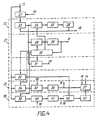
- FIG. 4 presents more detailed functional circuits of the two units, that is, unit 16 and unit 17.
- the unit 16 comprises:
- the unit 17 comprises:
- the antenna (1) for transmitting the synchronization signal with a high-frequency portion must provide a uniform power of the signal on the Earth's surface over the entire service area defined by a preset tilt angle of the satellite visibility irrespective of the distance from the transponder.
- the shape of the directional diagram of the antenna is such that it ensures minimum amplification in the central region of the diagram and maximum amplification towards its edges.
- the antenna is coupled to the frequency spectrum synthesizer (2) and rejection filters (4).
- the rejection filters (4) are connected through inputs with the control system (12) with ODC, and also with the unit (5) for generating a synchronization signal and service information.
- the rejection filters (4) perform rejection of the spectrum portions of the synchronization signal, which coincide with information-carrying signals emitted at a given instant of time, and are connected through a control input to the control system with ODC, (12).
- the transceiving phased antenna array(PAA) (3) with a modulator and a high-frequency portion is connected to the receiver (7) of the communication and service information signals and also to the unit (6) for packet shaping with a buffer memory, which unit through a control unit is connected to the control system (12) with ODC.
- the packet shaping unit with a buffer memory stores and generates information packets emitted in different spatial cells.
- Each packet has a preamble containing estimations of the errors by delay and frequency, which are formed by the frequency and delay disciminators (8) with a buffer memory and a preamble generator, after which the evaluations are also written in the buffer memory of the unit (6).
- Control and synchronization of the operation of the units (6), (7), (8) take place from the control system (12) with ODC.
- the receiver (7) of communication and service information signals is also connected to the input of the receiver (9) of a call of the satellite transponder, which is a matched filter tuned to the call code.
- the call codes shaped by the unit (17) of the user station equipment differ from each other in delay.
- the board call receiver (3) is connected to the control system (12) with ODC, which receiver ensures evaluation of the delay of the code received by the code receiver (9), and thereby the number of the user station calling the satellite transponder is identified.
- ODC optical coherence tomography
- the calling user station is assigned and reported, by means of the units (5, 11, 12) its own internal code in which information is received on the called user station, and then a call is formed to the user station (if it is not engaged) by means of the generator (13) of the call to subscribers, which is connected to the unit (5).
- the code generator (11) (synchronization, internal end user codes), the control system (12 ) with a ODC, the generator (13) of the call to a user station are strictly synchronized from a single clock generator (10), and, moreover, the generators of synchronization codes, internal codes and user codes are phased with each other.
- control system (20) which includes a control digital computer.
- the mode of operation in time of the transceiving antenna (14) with a high-frequency portion of the transmitter for reception and transmission is also defined by the control system (20).
- the signals from the transponder arrive at the signal receiver (15) with a high-frequency portion and information separation channels.
- the information separation channels are essentially a set of correlators the number of which is equal to the base of the received code, and are connected through an output to a decision-making circuit.
- the internal codes arrive to the reference inputs of said correlators from the unit (30) (Fig.4).
- the input of the synchronization signal receiver is connected to the input of the antenna (14) through the rejection filters (21). These filters controlled from the control system (20) reject a portion of the synchronization signal spectrum at the instants of time when signals arrive at the receiver input, which carry information from the cell where the particular subscriber is located.
- the synchronization signal receiver is a tracking filter including two circuits, namely, a circuit (22) of phase (frequency) autotuning of frequency and a circuit (27) of tracking a signal delay which are interconnected by cross links.
- Various forms of the tracking receivers are described in the publication "Interference immunity of radio signals" (edited by G.I.Tuzov - M., Radio i svyaz publishers, 1985, pp 115-141).
- the circuit (22) for phase autotuning of frequency comprises a series combination of the subtractive mixer (23), the demodulator (24) of code with an intermediate frequency amplifier (IPA), a phase detector (25) with a lowpass filter and a reference generator, a controlled generator (26) connected to the reference input of said subtractive mixer (23).
- the delay tracking circuit (DTC) connected to the output of the mixer (23) comprises the delay discriminator (28) with a lowpass filter having its reference inputs connected to the outputs of the code generator (30), the controlled clock generator (29) connected to the code generator (30), and the code generator (30) includes a synchronization code generator, a user code generator and an internal code generator which are phased with each other.
- the synchronization code generator (30) is connected to the service information separation channel (31).
- the conventional frequency and code delay autotune transmitter (17) is described in the publication "Interference immunity of radio systems with composite signals", editted by G.I.Tuzov - M., Radio i svyaz publishers, 1985, pp 130-132.
- the autotune transmitter includes a circuit (33) of phase (or frequency) autotuning of frequency (PAT or FAT), and also the circuit (38) for code delay tracking (DCT).
- the circuit (33) includes the phase (or frequency) discriminator with a lowpass filter, which is connected via a reference input, to the internal code generator (30), and, via the output, to a chain including the voltage adder (35), the controlled generator (36) and also the modulator (37) which is coupled to the transceiving antenna (14).
- the circuit DTC comprises the delay discriminator with a lowpass filter, which discriminator is connected, via reference inputs, to the generator (30) of the receiver internal codes, and, via an output, to the chain: the voltage adder (40), the clock frequency controlled generator (41), the scanning circuit (42), the code generator (43) comprising a generator of call codes of the transponder and a generator of internal codes.
- the Doppler shift compensation circuit (18) ensures compensation of the Doppler shifts, respectively, by the carrier and clock frequencies in the autotune transmitter (respectively, in the circuits (33) of PAT (or FAT) and DCT (38)), separating the Doppler increments by the carrier and clock frequencies from the synchronization signal received by the receiver (16). If we introduce these increments with an opposite sign, respectively, into the controlled generators (37, 41) by the carrier and clock frequencies of the autotune transmitter to the voltage adders (35) and (40), then at the input of the transponder these frequencies will be close to their nominal values.
- the operation of the apparatus is effected in the following manner.
- Generation and emission of a wide-band pseudorandom synchronization signal are perfomed at the satellite transponder over the entire spectrum of transmission from board and over the entire region of visibility by the users of the satellite, the visibility increasing gradually from the region center towards its edges.
- the users ensure the synchronization signal search by frequency and delay, and then perform synchronous tracking the synchronization signal by means of a two-circuit tracking filter (the frequency tracking circuit (22) and the delay tracking circuit (27)). Reception of service information is also possible by means of the unit (31).
- the operation of the transmitting PAA (3) is controlled from the control system (12).
- the synchronization signal On board the transponder the synchronization signal is modulated with information and, by a command from the control system (12), the portions of the synchronization signal spectrum which coincide at the instants of emission with the spectrum of the signals emitted by the transponder are rejected, the latter signals carrying information at a constant emitted power of the synchronization signal.
- a simplex onboard user is in fact ensured, and the user is ready to take a call of another user.
- the calling party performs compensation of the Doppler shift by the carrier and clock frequencies by means of the compensation circuit (18), carries out initial synchronization of the own autotune transmitter (17) using the circuit (32) for search and initial synchronization of the transmitter, and then changes over to the mode of synchronous tracking the signal parameters by the transmitter. Evaluation of mismatches is then performed at the satellite transponder in the frequency and delay discriminators (8), the mismatches are transmitted by means of the units (6) and (4) to the calling party, are separated at the user station by the units (34) and (39), after which the mismatches are operated upon in the autotune transmitter (17).
- a call is made to the satellite transponder on the necessity of communication with other subscribers by effecting emission by means of the autotune transmitter of several cycles of a preudorandom radio signal with the code assigned for calling the satellite transponder and with the delay assumed beforehand individually for the particular subscriber.
- the number of the calling party is determined by means of the units (4), (7), (9), (12) from the received call signal and its delay, and the code of the particular subscriber is used to report to the subscriber the time interval and internal code allocated for him for a two-way (with the transponder) communication.
- the calling party reports to the transponder, within the time interval allocated to him, by modulating the internal code of the transmitter in the unit (37), the number of the called party identified at the transponder with the coordinates and the spatial cell of the location thereof, and a call is made from the transponder (with the calling party being disengaged) in the particular user code, and the time interval and internal code are reported to him for the two-way communication in the transponder.
- the invention also provides the possibility of modulating with a short message the code of calling the transponder by each subscriber. This short message may also contain information on the number of the called party. In this case, no necessity arises to allocate the code and time interval for the user-transponder communication, which somewhat simplifies the procedure of establishing communication between two users.
- the called party having received the call, performs the initial synchronization of the own autotune transmitter (17) by preliminarily conducting compensation of the Doppler shift in the transmitter by means of the unit (18) and within the assigned time interval reports to the transponder on the readiness of communication by modulating the assigned internal code. Having received this message, time intervals and internal code numbers are determined at the transponder by means of the units (7), (8) to organize a duplex, these time intervals being assigned on the condition of convenience of routing the information messages in forming packets for definite spatial cells in which the users are located.
- each user sets the assigned internal code in the transmitter and receiver, ensures time compression of the transmitted information by means of the unit (19), performs its multibase encoding by the internal code, and also shaping and emitting a signal within the assigned time interval with a preamble in which one or two cycles of the internal code with a fixed delay (or several cycles of the code specially allocated for synchronizing a group of users) are transmitted.
- evaluations of the mismatches are effected by the code delay and frequency against the onboard standards by means of the unit (8), these evaluations are transmitted into the unit (6) which shapes information packets with new preambles intended for the corresponding users, which are emitted by the satellite transponder and separated by the user stations.
- Figure 5 shows a block diagram of the user station apparatus implementing the method of searching the initial synchronization of channels, according to the invention.
- Fig.5 explains and supplements Fig.4. Additionally introduced into the circuit of Fig. 5 are the following units:
- the apparatus for signal search and initial channel synchronization comprises, at the user station, a frequency tracking circuit (22) including a high-frequency path, a subtractive mixer (23), a code demodulator (24) with an intermediate frequency amplifier, a phase detector (25) with a lowpass filter and a reference generator, a controlled generator (26), and also a frequency spectrum synthesizer (50).
- a frequency tracking circuit including the discriminator (28) with a lowpass filter, a controlled clock generator (29), code (synchronization, user, internal) generators (30), which are phased with each other.
- the apparatus comprises a circuit (33) of phase (or frequency) autotuning of the transmitter frequency, including a phase (frequency) discriminator (34) with a lowpass filter, a controlled generator (36), and also a modulator (37); a code delay tracking circuit (38) of the transmitter, including a delay discriminator (39) with a lowpass filter, a controlled clock frequency generator (41), code generator (43) of the transmitter (transponder-calling and internal codes).
- a circuit (33) of phase (or frequency) autotuning of the transmitter frequency including a phase (frequency) discriminator (34) with a lowpass filter, a controlled generator (36), and also a modulator (37);
- a code delay tracking circuit (38) of the transmitter including a delay discriminator (39) with a lowpass filter, a controlled clock frequency generator (41), code generator (43) of the transmitter (transponder-calling and internal codes).
- a search correlator (51) connected, via the reference input, to code (user, internal) generators (47) which are phased with a synchronization code generator (46).
- the search correlator (51) is connected to a search mode control unit (52) which is coupled to and phased with the controlled clock generator (29) and to the code (user, internal) generator (47), and, via the control output, is connected to two switches K included into the circuit (33) of phase (or frequency) autotuning of frequency and the circuit (38) for tracking the transmitter code delay, and also to a scanning circuit (42) cut in between the output-input of the clock frequency generator (41) and the code generators (43) of the transmitter (transponder-calling and internal codes).
- the apparatus also comprises two circuits (18) of the Doppler shift compensation by the carrier and clock frequencies, each of which includes subtractive mixers (44) and (48) having their inputs connected, respectively, to the outputs of the frequency spectrum synthesizer (50) and the outputs of the controlled generator (26) and the controlled clock generator (29), said mixers having their outputs connected, through the phase detectors (45, 49) with lowpass filters, to introduced voltage adders (35) and (40), the first of which is connected, through said switch (K), to the output of the phase (frequency) discriminator (34) with a lowpass filter, and the second of which is connected, also through the switch (K), to the output of the discriminator (39) with a lowpass filter, the output of one voltage adder (35) being connected, via the controlled generator (36), to the input of said phase detector (45) with a lowpass filter, and the output of the second voltage adder is connected, via the controlled clock frequency generator (41) to the input of the second phase detector (49) with a lowpass filter.
- the apparatus operates in the following manner. First, the units (22), (27) of the user transmitter are synchronized by the received synchronization signal of the satellite transponder, then the Doppler increments are compensated by the carrier and clock frequencies. Considered hereinbelow is only compensation by clock frequency because compensation by carrier frequency is performed in a similar manner.
- the reference frequency equal to 2f nc is fed to a second input of the subtractive mixer (48) from the frequency spectrum synthesizer (50). Then, at the output of the subtractive mixer (48) we shall have (f nc ⁇ f Di ). This frequency is introduced into the controlled clock frequency generator (41) by the phase autotune circuit.
- the method and apparatus for multiple-station communication can find application in communications systems of any type, and also in the control systems for space vehicles.
Landscapes
- Engineering & Computer Science (AREA)
- Computer Networks & Wireless Communication (AREA)
- Signal Processing (AREA)
- Radio Relay Systems (AREA)
- Mobile Radio Communication Systems (AREA)
- Variable-Direction Aerials And Aerial Arrays (AREA)
Applications Claiming Priority (7)
| Application Number | Priority Date | Filing Date | Title |
|---|---|---|---|
| RU94009148 | 1994-03-17 | ||
| RU94009037 | 1994-03-17 | ||
| RU94009037/09A RU2075264C1 (ru) | 1994-03-17 | 1994-03-17 | Способ многостанционной связи с интеграцией высокоорбитальной и низкоорбитальной спутниковых систем и устройство для его осуществления |
| RU94009502 | 1994-03-17 | ||
| RU94009502A RU2065253C1 (ru) | 1994-03-17 | 1994-03-17 | Способ поиска сигнала и начальной синхронизации каналов в системе спутниковой связи и устройство для его осуществления |
| RU94009148/09A RU2075265C1 (ru) | 1994-03-17 | 1994-03-17 | Способ многостанционной связи для низкоорбитальных спутниковых систем и устройство для его осуществления |
| PCT/RU1995/000044 WO1995025388A1 (fr) | 1994-03-17 | 1995-03-16 | Procede de communication multi-station pour systemes de satellite sur orbite a basse altitude et son dispositif de mise en oeuvre |
Publications (2)
| Publication Number | Publication Date |
|---|---|
| EP0751632A1 true EP0751632A1 (fr) | 1997-01-02 |
| EP0751632A4 EP0751632A4 (fr) | 1999-06-30 |
Family
ID=27354142
Family Applications (1)
| Application Number | Title | Priority Date | Filing Date |
|---|---|---|---|
| EP95913948A Withdrawn EP0751632A4 (fr) | 1994-03-17 | 1995-03-16 | Procede de communication multi-station pour systemes de satellite sur orbite a basse altitude et son dispositif de mise en oeuvre |
Country Status (3)
| Country | Link |
|---|---|
| US (1) | US5898902A (fr) |
| EP (1) | EP0751632A4 (fr) |
| WO (1) | WO1995025388A1 (fr) |
Cited By (2)
| Publication number | Priority date | Publication date | Assignee | Title |
|---|---|---|---|---|
| GB2354910A (en) * | 1999-10-01 | 2001-04-04 | Motorola Ltd | Re-clocking repeater facilitating transmission of overhead signalling in specific timeslots |
| US6633745B1 (en) | 2000-03-29 | 2003-10-14 | Societe Europeenne Des Satellites S.A. | Satellite cluster comprising a plurality of modular satellites |
Families Citing this family (47)
| Publication number | Priority date | Publication date | Assignee | Title |
|---|---|---|---|---|
| US5841768A (en) * | 1996-06-27 | 1998-11-24 | Interdigital Technology Corporation | Method of controlling initial power ramp-up in CDMA systems by using short codes |
| DE19649926A1 (de) * | 1996-12-02 | 1998-06-04 | Wegmann & Co Gmbh | Kommunikationseinrichtung in einem Kampffahrzeug |
| US6529485B1 (en) * | 1997-10-20 | 2003-03-04 | Viasat, Inc. | Method for generation of accurate doppler-free local clock in satellite/wireless networks |
| US6128469A (en) * | 1998-03-21 | 2000-10-03 | Aeroastro, Inc. | Satellite communication system with a sweeping high-gain antenna |
| US6337980B1 (en) * | 1999-03-18 | 2002-01-08 | Hughes Electronics Corporation | Multiple satellite mobile communications method and apparatus for hand-held terminals |
| US7215954B1 (en) * | 1999-03-18 | 2007-05-08 | The Directv Group, Inc. | Resource allocation method for multi-platform communication system |
| RU2234191C2 (ru) * | 2001-07-24 | 2004-08-10 | Косякин Сергей Иванович | Способ передачи информации в системах с кодовым разделением каналов и устройство для его осуществления |
| US20030023978A1 (en) * | 2001-07-25 | 2003-01-30 | Bajgrowicz Brian David | Satellite television system |
| US20050215194A1 (en) * | 2004-03-09 | 2005-09-29 | Boling Brian M | Combination service request and satellite radio system |
| US7646755B2 (en) * | 2005-06-30 | 2010-01-12 | Microsoft Corporation | Seamless integration of portable computing devices and desktop computers |
| US7929908B2 (en) * | 2006-05-24 | 2011-04-19 | The Boeing Company | Method and system for controlling a network for power beam transmission |
| US8625572B2 (en) * | 2008-12-19 | 2014-01-07 | Nokia Corporation | Synchronization indication in networks |
| KR101924830B1 (ko) * | 2012-06-19 | 2019-02-27 | 삼성전자주식회사 | 무선 통신 네트워크에서 단말의 동기화 방법 및 장치 |
| US9756138B2 (en) * | 2013-04-08 | 2017-09-05 | Here Global B.V. | Desktop application synchronization to process data captured on a mobile device |
| US10757668B2 (en) * | 2018-02-27 | 2020-08-25 | Qualcomm Incorporated | Determining a reference timing for a discovery procedure |
| US10951305B2 (en) | 2018-04-26 | 2021-03-16 | Lynk Global, Inc. | Orbital base station filtering of interference from terrestrial-terrestrial communications of devices that use protocols in common with orbital-terrestrial communications |
| US12153150B2 (en) | 2019-11-27 | 2024-11-26 | Rockwell Collins, Inc. | Doppler nulling scanning (DNS) security (spatial awareness) |
| US12111406B2 (en) | 2019-11-27 | 2024-10-08 | Rockwell Collins, Inc. | Adaptive doppler-nulling digitization for high-resolution |
| US12366625B2 (en) | 2019-11-27 | 2025-07-22 | Rockwell Collins, Inc. | System and method using passive spatial awareness for GEO network routing |
| US12326506B2 (en) | 2019-11-27 | 2025-06-10 | Rockwell Collins, Inc. | DNS spatial discoveries with on-going traffic |
| US12407393B2 (en) | 2019-11-27 | 2025-09-02 | Rockwell Collins, Inc. | System and method for spatial awareness overlay onto mobile ad hoc network (MANET) frequent message preambles |
| US12498442B2 (en) | 2019-11-27 | 2025-12-16 | Rockwell Collins, Inc. | Robust addressing schema for spatial awareness via doppler null scanning (DNS) |
| US12474431B2 (en) | 2019-11-27 | 2025-11-18 | Rockwell Collins, Inc. | Doppler-nulling and two-way timing and ranging (spatial awareness) |
| US11737121B2 (en) | 2021-08-20 | 2023-08-22 | Rockwell Collins, Inc. | System and method to compile and distribute spatial awareness information for network |
| US12477583B2 (en) | 2022-06-22 | 2025-11-18 | Rockwell Collins, Inc. | Aliasing for cell-based manet |
| US12571868B2 (en) | 2019-11-27 | 2026-03-10 | Rockwell Collins, Inc. | Doppler null scanning for coordination including expendable platforms (spatial awareness) |
| US11665658B1 (en) | 2021-04-16 | 2023-05-30 | Rockwell Collins, Inc. | System and method for application of doppler corrections for time synchronized transmitter and receiver |
| US12531596B2 (en) | 2019-11-27 | 2026-01-20 | Rockwell Collins, Inc. | Doppler-nulling for directional networks (spatial awareness) |
| US12546845B2 (en) | 2021-11-23 | 2026-02-10 | Rockwell Collins, Inc. | Search and rescue system with doppler-nulling spatial awareness |
| US11726162B2 (en) | 2021-04-16 | 2023-08-15 | Rockwell Collins, Inc. | System and method for neighbor direction and relative velocity determination via doppler nulling techniques |
| US12504496B2 (en) | 2019-11-27 | 2025-12-23 | Rockwell Collins, Inc. | Station keeping using doppler null scanning |
| US12316403B2 (en) | 2022-05-20 | 2025-05-27 | Rockwell Collins, Inc. | Situational awareness (SA) in radio silence (spatial awareness) |
| US11977173B2 (en) | 2019-11-27 | 2024-05-07 | Rockwell Collins, Inc. | Spoofing and denial of service detection and protection with doppler nulling (spatial awareness) |
| US12335138B2 (en) | 2019-11-27 | 2025-06-17 | Rockwell Collins, Inc. | Spatial awareness navigation techniques on unmanned aerial vehicles (spatial awareness) |
| US12553978B2 (en) | 2019-11-27 | 2026-02-17 | Rockwell Collins, Inc. | Proactive link acquisition (spatial awareness) |
| US12584986B2 (en) | 2019-11-27 | 2026-03-24 | Rockwell Collins, Inc. | Reliable efficient flooding with Doppler nulling (spatial awareness) |
| US12523733B2 (en) | 2019-11-27 | 2026-01-13 | Rockwell Collins, Inc | Directional enhancements for mobile ad hoc networks (MANET) via doppler null scanning (DNS) |
| US12540997B2 (en) | 2019-11-27 | 2026-02-03 | Rockwell Collins, Inc. | System and method for application of doppler null scanning (DNS) to position navigation timing (PNT) |
| US12050279B2 (en) | 2019-11-27 | 2024-07-30 | Rockwell Collins, Inc. | Doppler nulling spatial awareness (DNSA) solutions for non-terrestrial networks |
| US12137048B2 (en) | 2019-11-27 | 2024-11-05 | Rockwell Collins, Inc. | System and method for spatial awareness network routing |
| CN112019254B (zh) * | 2020-08-10 | 2022-04-15 | 航天科工空间工程发展有限公司 | 一种低轨卫星网络主动式低时延路由方法 |
| US11233562B1 (en) | 2020-12-29 | 2022-01-25 | Hughes Network Systems, Llc | Mobile satellite modem for combined geostationary, medium and low earth orbit satellite operation |
| CN113433575B (zh) * | 2021-07-16 | 2024-05-31 | 广东省南方航天港科技有限公司 | 一种辐射源的定位方法、装置、设备、系统及存储介质 |
| EP4250592A1 (fr) | 2022-03-24 | 2023-09-27 | Rohde & Schwarz GmbH & Co. KG | Procédé et système de réception d'un signal de liaison descendante de satellite |
| CN116015346B (zh) * | 2022-12-27 | 2023-08-08 | 中国人民解放军军事科学院系统工程研究院 | 一种基于级联抑制的非平衡混叠扩频信号盲分离方法 |
| CN116094630B (zh) * | 2023-04-07 | 2023-08-08 | 湖南国天电子科技有限公司 | 一种高精度信号延迟计算方法 |
| CN116567829A (zh) * | 2023-05-18 | 2023-08-08 | 西安交通大学 | 一种低轨卫星物联网场景下的上行资源分配方法及设备 |
Family Cites Families (5)
| Publication number | Priority date | Publication date | Assignee | Title |
|---|---|---|---|---|
| US4375697A (en) * | 1980-09-04 | 1983-03-01 | Hughes Aircraft Company | Satellite arrangement providing effective use of the geostationary orbit |
| GB2134755A (en) * | 1983-01-21 | 1984-08-15 | Univ Birmingham | Satellite transmission systems |
| US4532635A (en) * | 1983-08-19 | 1985-07-30 | Rca Corporation | System and method employing two hop spread spectrum signal transmissions between small earth stations via a satellite and a large earth station and structure and method for synchronizing such transmissions |
| DE3437317A1 (de) * | 1984-10-11 | 1986-04-24 | Deutsche Bundespost, vertreten durch den Präsidenten des Fernmeldetechnischen Zentralamtes, 6100 Darmstadt | Funkuebertragungsverfahren ueber erdsatelliten |
| FR2695774B1 (fr) * | 1992-09-15 | 1994-10-28 | France Telecom | Réseau de télécommunications. |
-
1995
- 1995-03-16 US US08/714,122 patent/US5898902A/en not_active Expired - Fee Related
- 1995-03-16 EP EP95913948A patent/EP0751632A4/fr not_active Withdrawn
- 1995-03-16 WO PCT/RU1995/000044 patent/WO1995025388A1/fr not_active Ceased
Non-Patent Citations (2)
| Title |
|---|
| No further relevant documents disclosed * |
| See also references of WO9525388A1 * |
Cited By (2)
| Publication number | Priority date | Publication date | Assignee | Title |
|---|---|---|---|---|
| GB2354910A (en) * | 1999-10-01 | 2001-04-04 | Motorola Ltd | Re-clocking repeater facilitating transmission of overhead signalling in specific timeslots |
| US6633745B1 (en) | 2000-03-29 | 2003-10-14 | Societe Europeenne Des Satellites S.A. | Satellite cluster comprising a plurality of modular satellites |
Also Published As
| Publication number | Publication date |
|---|---|
| WO1995025388A1 (fr) | 1995-09-21 |
| EP0751632A4 (fr) | 1999-06-30 |
| US5898902A (en) | 1999-04-27 |
Similar Documents
| Publication | Publication Date | Title |
|---|---|---|
| US5898902A (en) | Method and apparatus for multiple-station communication for low-orbit satelllite systems | |
| US6020847A (en) | Geolocation method and apparatus for satellite based telecommunications system | |
| US5844521A (en) | Geolocation method and apparatus for satellite based telecommunications system | |
| EP0467651B1 (fr) | Système satellite cellulaire avec unité d'abonné assisté par position. | |
| US5875402A (en) | Time-synchronous communication system | |
| US5878034A (en) | Spacecraft TDMA communications system with synchronization by spread spectrum overlay channel | |
| US6127967A (en) | Low-earth orbit satellite acquisition and synchronization system using a beacon signal | |
| EP0934633B1 (fr) | Determination de decalages de frequence dans des systemes de communication | |
| US5619209A (en) | User paging for mobile satellite communications | |
| JP4457117B2 (ja) | ダイバーシチ送信を伴う加入者位置測定のための無線電話システム | |
| US5612703A (en) | position determination in an integrated cellular communications system | |
| US5739784A (en) | Method and beam stepping apparatus for a satellite cellular communication system | |
| EP1050978A2 (fr) | Système de communication par satellite avec méthode de traitement de transfert de communication | |
| US6920309B1 (en) | User positioning technique for multi-platform communication system | |
| GB2265795A (en) | Telecommunication system with increased channels by use of orbiting communication satellites | |
| US6332069B1 (en) | Apparatus and method for grouping carriers to minimize the occurrence of call blocking in a satellite-based communications network | |
| KR20020005651A (ko) | 페이징 장치 및 방법 | |
| US5862479A (en) | Space-based communication system and method with continuous channel reuse maintenance | |
| EP1110335B1 (fr) | Systeme et procede de mesure et de correction d'une erreur d'horloge dans un terminal utilisateur | |
| US6298238B1 (en) | Fast user terminal position determination in a satellite communications system | |
| EP1950894B1 (fr) | Procédé de téléappel à forte pénétration | |
| JP2001501419A (ja) | 通信システムのタイミングおよび周波数を前補正する方法および装置 | |
| RU2133555C1 (ru) | Способ и устройство высокоскоростной и низкоскоростной связи через спутники на низких и средних орбитах | |
| US5949794A (en) | Time symmetrical control signal, and a receiver and transmission system employing the same | |
| GB2290009A (en) | Collision avoidance in satellite communication system |
Legal Events
| Date | Code | Title | Description |
|---|---|---|---|
| PUAI | Public reference made under article 153(3) epc to a published international application that has entered the european phase |
Free format text: ORIGINAL CODE: 0009012 |
|
| 17P | Request for examination filed |
Effective date: 19961014 |
|
| AK | Designated contracting states |
Kind code of ref document: A1 Designated state(s): DE FR GB IT |
|
| A4 | Supplementary search report drawn up and despatched |
Effective date: 19990514 |
|
| AK | Designated contracting states |
Kind code of ref document: A4 Designated state(s): DE FR GB IT |
|
| RIC1 | Information provided on ipc code assigned before grant |
Free format text: 6H 04B 7/185 A, 6H 04B 7/19 B, 6H 04B 7/204 B, 6H 04B 7/212 B |
|
| STAA | Information on the status of an ep patent application or granted ep patent |
Free format text: STATUS: THE APPLICATION IS DEEMED TO BE WITHDRAWN |
|
| 18D | Application deemed to be withdrawn |
Effective date: 20021001 |