EP0752665A1 - Méthode et dispositif de coordination de transfert de données entre le matériel et le logiciel - Google Patents
Méthode et dispositif de coordination de transfert de données entre le matériel et le logiciel Download PDFInfo
- Publication number
- EP0752665A1 EP0752665A1 EP96110613A EP96110613A EP0752665A1 EP 0752665 A1 EP0752665 A1 EP 0752665A1 EP 96110613 A EP96110613 A EP 96110613A EP 96110613 A EP96110613 A EP 96110613A EP 0752665 A1 EP0752665 A1 EP 0752665A1
- Authority
- EP
- European Patent Office
- Prior art keywords
- data
- storage field
- storage
- circuit
- entry number
- Prior art date
- Legal status (The legal status is an assumption and is not a legal conclusion. Google has not performed a legal analysis and makes no representation as to the accuracy of the status listed.)
- Granted
Links
Images



Classifications
-
- G—PHYSICS
- G06—COMPUTING OR CALCULATING; COUNTING
- G06F—ELECTRIC DIGITAL DATA PROCESSING
- G06F13/00—Interconnection of, or transfer of information or other signals between, memories, input/output devices or central processing units
- G06F13/38—Information transfer, e.g. on bus
- G06F13/382—Information transfer, e.g. on bus using universal interface adapter
- G06F13/385—Information transfer, e.g. on bus using universal interface adapter for adaptation of a particular data processing system to different peripheral devices
Definitions
- the present invention relates generally to the field of computer systems and, in particular, to a method and apparatus for coordinating data transfer between hardware and software in computer systems.
- Properly functioning computer systems generally provide a mechanism which guarantees an orderly access to shared memory and other shared resources. This is necessary to protect data from being changed simultaneously by two or more processors.
- a binary variable called a semaphore is often used to denote ownership and to indicate the processor which owns the shared resource for writing.
- a semaphore is a software-controlled flag that is stored in a memory location that is typically used between two processors.
- the semaphore when the semaphore is equal to 0, it means that a particular processor owns the shared resource for writing to, so that the shared memory is not available for other processors to write to.
- the semaphore When the semaphore is equal to 1, the ownership of the shared memory is relinquished to any requesting processor.
- the processors sharing the same memory segment do not need a semaphore handshake to indicate ownership when they are reading from the shared memory segment. Instead, a semaphore handshake is only needed if the processors intend to write to the shared memory segment.
- Once a processor acquires ownership of a shared memory segment it does its processing and updates the shared memory segment, after which, it relinquishes its ownership by toggling the semaphore bit (from 0 to 1 or 1 to 0).
- a descriptor ring is a data structure having a plurality of entries (for example, 1 to N) which are arranged in a circular fashion. The content of each entry in the descriptor ring is known as a descriptor.
- a typical descriptor contains a base address field which provides the base of the page table address in a segmented-page organization or the block base address in a segment register organization.
- Each descriptor includes a bit which is set to a '1' if the entry is owned by hardware or a '0' if the entry is owned by software. This bit is known as an "OWN" bit.
- the owner of the descriptor is responsible for releasing ownership when it updates the descriptor. Thus, when software has completed the posting of transmission packets, it sets the OWN bit to a 1 and when hardware has completed transmission of a packet, it clears the OWN bit.
- OWN bit semaphore mechanism imposes significant overhead on each transaction, as the hardware must write back to the descriptor to clear the OWN bit each time it completes a transaction. In a typical transmission system utilizing only one channel, one such descriptor ring is used for the channel. However, in systems which utilize the Asynchronous Transfer Mode (ATM) protocol, such overhead is multiplied because multiple channels are used and typical solutions to the problems posed by transactional overhead are not easily scalable.
- ATM Asynchronous Transfer Mode
- the hardware in these conventional systems has to periodically inquire if software has posted packets for transmission. This is conventionally accomplished by polling memory to determine the status of the OWN bit. These visits to memory may however, be futile because the software may not have posted any entries thereby leaving the OWN bit unset. As a result, the hardware has to continue polling memory until the software posts packets for transmission and signifies the completion of this task by setting the OWN bit. The requirement for polling decreases the bandwidth for the Input/Output system that can otherwise be used by other devices sharing the same system.
- a method and apparatus of coordinating data transfer between hardware and software in a computer system through the use of a semaphore mechanism is disclosed.
- software provides the descriptor entry number to a first storage field in a predetermined storage location which is accessible by hardware.
- Hardware accounts for the transactions it has completed by writing the descriptor entry number to a second storage field in the storage location.
- To determine if there is additional data to process hardware compares the contents of the first storage field and the contents of the second storage field. If the contents of both storage fields are equal, the corresponding ring or channel has run out of data and no additional data is to be processed.
- the corresponding channel goes to sleep until it is waken by a command indicating that software has provided another descriptor entry number to the first storage field in the storage location. If the contents of both storage fields are not equal, hardware continues to process the data represented by the descriptors provided.
- the present invention eliminates the need for polling memory to determine if data is to be processed. It also eliminates the need to clear OWN bits, thereby reducing transactional overhead and processing time.
- Figure 1 illustrates an exemplary computer system network incorporating an asynchronous transfer mode network interface circuit which utilizes the method and apparatus of data transfer coordination of the present invention.
- Figure 2 is an overall system diagram illustrating the architecture of the asynchronous transfer mode network interface circuit which utilizes the method and apparatus of data transfer coordination in accordance with a preferred embodiment of the present invention.
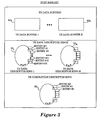
- Figure 3 illustrates a simplified block diagram of a preferred data structure of the host memory used for data transmission in a system utilizing the apparatus and method of the present invention.
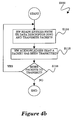
- Figures 4a and 4b are flowcharts illustrating the process of data transfer coordination in accordance with a preferred embodiment of the present invention.
- FIG. 1 illustrates an exemplary computer system network incorporating the ATM network interface circuit which utilizes the method and apparatus of data transfer coordination of the present invention.
- the computer system network 10 includes host computer systems (not shown) which incorporate one or more of the ATM network interface circuits (NIC) 12.
- the NICs 12 are coupled through a local ATM switch 14 to a public ATM switch 16 to enable asynchronous transfer of data between host computer systems coupled to the network 10.
- the NICs 12 can be coupled directly to the public ATM switch 16.
- the computer system network 10 may also include computer systems which incorporate the use of a Local Area Network (“LAN”) emulation 15 which serves as a gateway for connecting other networks such as Ethernet or token ring networks 17 which utilize the ATM network as a supporting framework.
- LAN Local Area Network
- FIG. 2 is a simplified system diagram illustrating the architecture of the ATM NIC 12 which utilizes the method and apparatus of data transfer coordination in accordance with a preferred embodiment of the present invention.
- the ATM NIC 12 interfaces a host computer system 48 coupled through system bus 38 to the network media 40 operating in accordance with the ATM protocol.
- the ATM NIC 12 shown includes a System Bus interface 20, a Generic Input/Output ("GIO") interface 24, a System and ATM Layer Core 22, a Local Slave interface 26, a transmit (TX) FIFO 28, a receive (RX) FIFO 30, a Media interface 32, an External Buffer Memory Interface 34 and a clock synthesis circuit 36.
- GIO Generic Input/Output
- TX transmit
- RX receive
- the elements 20-36 of NIC 12 cooperate to transfer data between the host computer 48 and the other computers in the network through multiple, dynamically allocated channels in multiple bandwidth groups.
- the elements of the network interface circuit 12 function as a multi-channel intelligent direct memory access (DMA) controller coupled to the System Bus 38 of the host computer system 48.
- DMA direct memory access
- multiple transmit and receive channels are serviced as virtual connections utilizing a full duplex 155/622 Mbps physical link.
- Multiple packets of data, subscribed to different channels over the System Bus 38 to the external buffer memory 42, via the External Buffer Memory Interface 34, are segmented by the System and ATM Layer Core 22 into transmit cells for transmission to the Media 40 through Media interface 32.
- the Core 22 also comprises reassembly logic to facilitate reassembly of the received cells to packets.
- the Core 22 further includes a storage block 44 which includes a plurality of storage locations 50a-50m, each of which correspond to the number of channels supported by the ATM NIC 12.
- the storage locations 50a-50m each include a first storage field 52 and a second storage field 54.
- a comparing circuit 56 is coupled to each storage location 50a-50m, and is used to compare the contents of the first storage field 52 and the contents of the second storage field 54.
- An example of the comparing circuit 56 is an exclusive-OR gate.
- storage location 50a includes a first storage field 52a and a second storage field 54a
- storage location 50m includes a first storage field 52m and a second storage field 54m.
- the storage location 50a is coupled to comparing circuit 56a, which is used to compare the contents of the first storage field 52a and the contents of the second storage field 54a.
- the storage location 50m is coupled to comparing circuit 56m, which is used to compare the contents of the first storage field 52m and the contents of the second storage field 54m.
- the storage locations 50a-50m, the first storage fields 52a-52m, the second storage fields 54a-54m and the comparing circuits 56a-56m will be referred in general as the storage location 50, the first storage field 52, the second storage field 54 and the comparing circuit 56.
- the storage locations 50 and the comparing circuits 56 are used to coordinate data transfer in accordance with the teachings of the present invention, as discussed in detail in the following sections.
- the TX and RX FIFOS 28, 30, coupled between the Core 22 and the Media Interface 32, are used to stage the transmit and receive cell payloads of the transmit and receive packets respectively.
- the Media Interface 32 transmits and receives cells to the Media 40 of the network, driven by clock signals provided by Clock Synthesis Circuit 36.
- the Media and therefore the Media interface 32, conforms to the Universal Test and Operations Physical Interface for ATM ("UTOPIA") standard, as described by the ATM Forum Ad Hoc specification.
- UTOPIA Universal Test and Operations Physical Interface for ATM
- the clock synthesis circuit 36 provides either a clock signal of 20 MHz or 40 MHz to enable the Media interface 32 to support a byte stream at 20 MHz for 155 Mbps or a 16 bit stream at 40 MHz for a 622 Mbps data stream.
- the Media Interface 32 receives 52-byte data cells each having a 4-byte cell header and a 48-byte payload from the TX FIFO 28.
- the Media Interface 32 inserts a checksum as a fifth byte to the cell header into each cell prior to providing the 53-byte data cell to the Media 40.
- the Media Interface 32 examines the checksum in the fifth byte of each cell to determine if the checksum is correct. If so, the byte representing the checksum is stripped from the cell and the cell is forwarded to the RX FIFO 30. Otherwise, the entire cell is dropped.
- the System Bus Interface 20 and GIO interface 24 insulate the host computer system 48 from the specifics of the transfer to the Media 40. Furthermore, the Core 22 is insulated from the specifics of the system bus 38 and host specifics.
- the System Bus is an S-Bus, as specified in the Institute of Electronics and Electrical Engineers ("IEEE") standard 1496 specification.
- the System Bus Interface 20 is configured to communicate in accordance with the specifications of the system bus, in the present illustration, the S-Bus. It is contemplated that the System Bus Interface 20 can be configured to conform to different host computer system busses.
- the System Bus Interface 20 is also configured to transfer and receive data in accordance with the protocols specified by the GIO interface 24.
- the GIO interface 24 provides a singular interface through which the Core 22 communicates with the host computer. Thus, the Core 22 does not change for different embodiments of the NIC 12 which interface to different host computer systems and busses.
- Three memory sub-systems are associated with the operation of the NIC 12. These include the host memory 49 located in the host computer system 48, the local buffer memory 42 external to the System and ATM Layer Core 22 and control storage block 44 located in the Core 22.
- the NIC 12 manages two memory areas: the buffer memory 42 and the storage block 44.
- the buffer memory 42 contains packet data for all transmit and receive channels supported by the NIC 12.
- the storage block 44 contains DMA state information for transmit and receive channels and pointers to data structures in host memory 49 for which DMA transfers are performed.
- the storage block 44 also contains the data structure specifics to manage multiple transmit and receive buffers for packets in transition between the host 48 and the Media 40.
- the host computer system 48 includes host memory 49 which contains data packets and pointers to the packets being transmitted and received. As noted previously, the NIC 12 also shields the cell delineation details of asynchronous transfer from the applications running on the host computer system. For present purposes, it is assumed that software running on the host computer system 48 manage transmit and receive data using wrap around transmit and receive rings with packet interfaces as is well known in the art.
- FIG. 3 illustrates a simplified block diagram illustrating a preferred data structure of the host memory 49 used for data transmission in a system incorporating the present invention.
- the host memory includes transmission (TX) data buffers 60a-60k, transmission (TX) data descriptor rings 70a-70m and a transmission (TX) completion descriptor ring 80.
- the TX data descriptor rings 70a-70m are data structures having a plurality of ring entries, for example, entries 71, 72, 73. Each of the TX data rings 70a-70m corresponds to one of m channels supported by the NIC 12.
- Each of these ring entries 71, 72, 73, accessed by software sequentially and in a circular fashion, is of a sufficient size (e.g., 64 bytes) to contain a descriptor having transmission-related information (e.g., the size of data packet, etc.) and pointers to a desired data packet located in a TX data buffer 60a-60k.
- the descriptors on each ring are numbered from 1 to N, where N is the number of descriptors on each ring 70a-70m.
- N 1024 and each ring is associated with a pre-programmed bandwidth group.
- each descriptor ring may have one or more packets queued for transmission.
- the number of TX data buffers, k is less than or equal to (mxN), since the TX data buffers 60a-60k should be sufficient in number to hold data from N entries and m channels.
- each "kick" command is written to a first storage field 52 in storage location 50, providing the TX data ring number (0-126) and the corresponding descriptor number of the last descriptor posted. Since there are 127 channels in the present embodiment, 127 storage locations 50a-50m each having a first storage field 52a-52m are available for the posting of such "kick" commands. Hardware (or circuitry) on the Core 22 assigned to the processing of the packets on the NIC 12 also keeps track of the last descriptor, per ring, it is processing. This descriptor number is maintained in a second storage field 54 in storage location 50.
- the hardware on the Core 22 checks the contents of the first storage field 52 and the second storage field 54 when it has completed transferring a packet and is ready to transfer another packet, or when it receives a "kick" command. This is done through the use of comparing circuit 56, which compares the contents of the first storage field 52 and the contents of the second storage field 54.
- comparing circuit 56 is an exclusive-OR gate.
- the TX completion descriptor ring 80 is a data structure having a plurality of ring entries 80a-80j.
- the TX completion descriptor ring 80 serves as a place holder for the hardware to provide the status of a packet that was transferred to the buffer memory 42.
- the number of ring entries on the TX completion descriptor ring 80 is j, where j ⁇ mxN, since the ring 80 must have sufficient entries for posting N descriptors from m channels.
- the hardware uses a descriptor in the TX completion descriptor ring 80 to provide the corresponding TX data ring number and descriptor number corresponding to the packet that was transferred.
- the TX completion ring 80 is used to report to hardware the descriptors which are available for use by the hardware to post updates of completed transactions.
- the TX completion descriptor ring 80 is accessible by both hardware and software.
- the TX completion descriptor ring 80 preferably occupies 64 KBytes of host memory through 1,024 ring entries, since it has to be large enough to contain the multiple packet completion updates from m descriptor rings each having N descriptors.
- FIG. 4a is a flowchart illustrating the process S100 of data transfer coordination performed by the software running on the computer host system 48 in accordance with a preferred embodiment of the present invention.
- the process S100 then advances to process block S108, where software writes the number of the last entry in the TX data descriptor ring to the first storage field 52 in storage location 50.
- This process step S108 constitutes the issuance of the "kick" command.
- the process S100 inquires if software has more packets to post for transmission, as shown in decision block S110. If so, the process S100 returns to decision block S104. If not, the process S100 queries if the process of posting packets should pause or cease, as shown in decision block S112. If so, the process S100 proceeds to pause or to terminate the process of posting packets. If not, the process S100 proceeds to decision block S110, to continue inquiring if more packets are to be posted for transmission.
- FIG. 4b is a flowchart illustrating the process S200 of data transfer coordination performed by the hardware in core 22 in accordance with a preferred embodiment of the present invention.
- process S200 proceeds to process block S114, where hardware (“HW") reads the entries from the appropriate TX data descriptor ring 70a-70m and transmits the packets.
- HW hardware
- process S100 (which includes process steps S102-S112) operates asynchronously vis-a-vis process S200 (which include process steps S114-S118).
- the process S200 continues to process block S116, where hardware acknowledges that a packet has been transferred.
- the acknowledgment is issued through the use of TX completion ring 80 and by posting the corresponding TX data ring number and descriptor number of the packet that was transferred in a third storage field (not shown) in a second storage location (not shown) in accordance a preferred method of reporting the completion of a transfer and generating an interrupt which has an individual mask bit for ease of toggling in software.
- This technique of acknowledging the completion of a transfer is described in detail in concurrently filed and co-pending U.S. Patent Application entitled "Method and Apparatus of Reporting Data Transfer between Hardware and Software", which is assigned to the assignee of the present invention and incorporated herein.
- the process S200 then proceeds to decision block S118 to determine if more packets have to be transmitted. This is accomplished through a comparison of contents of the first storage field 52 and the contents of the second storage field 54 for a particular storage location 50a-50m.
- a comparing circuit 56 may be used to compare the contents of the first storage field 52 and the second storage field 54 for a particular storage location 50a-50m.
- the comparing circuit 56 may set a flag in a status register (not shown) if the contents of the storage fields 52 and 54 are equal. If the contents of the first storage field 52 and the contents of the second storage field 54 are not equal, i.e., when both hardware and software descriptor pointers do not match, the corresponding ring or channel has more data for transmission.
- the process S200 thus returns to process block S114 to continue reading entries from the appropriate TX data descriptor ring 70a-70m. If the contents of the first storage field 52 and the contents of the second storage field 54 are equal, i.e., when both hardware and software descriptor pointers match, the corresponding descriptor ring or channel has ran out of data for transmission. Under this condition, the corresponding channel goes to sleep until it is waken by another software "kick" command. The process S200 terminates and is resumed upon receiving a "kick" command issued by software indicating that an entry has been posted to a TX data descriptor ring 70a-70m.
- the present invention may be implemented in any computer system requiring the coordination of data transfer between software and hardware and is not restricted to data transfer or data transmission utilizing the ATM protocol.
- the storage field 52 need not be located in the same storage location 50 as the second storage field 54.
Landscapes
- Engineering & Computer Science (AREA)
- Theoretical Computer Science (AREA)
- Physics & Mathematics (AREA)
- General Engineering & Computer Science (AREA)
- General Physics & Mathematics (AREA)
- Multi Processors (AREA)
- Information Transfer Systems (AREA)
- Computer And Data Communications (AREA)
- Data Exchanges In Wide-Area Networks (AREA)
Applications Claiming Priority (2)
| Application Number | Priority Date | Filing Date | Title |
|---|---|---|---|
| US08/499,317 US5675829A (en) | 1995-07-07 | 1995-07-07 | Method and apparatus for coordinating data transfer between hardware and software by comparing entry number of data to be transferred data to entry number of transferred data |
| US499317 | 1995-07-07 |
Publications (2)
| Publication Number | Publication Date |
|---|---|
| EP0752665A1 true EP0752665A1 (fr) | 1997-01-08 |
| EP0752665B1 EP0752665B1 (fr) | 2001-12-05 |
Family
ID=23984790
Family Applications (1)
| Application Number | Title | Priority Date | Filing Date |
|---|---|---|---|
| EP96110613A Expired - Lifetime EP0752665B1 (fr) | 1995-07-07 | 1996-07-01 | Méthode et dispositif de coordination de transfert de données entre le matériel et le logiciel |
Country Status (4)
| Country | Link |
|---|---|
| US (1) | US5675829A (fr) |
| EP (1) | EP0752665B1 (fr) |
| JP (1) | JPH09167127A (fr) |
| DE (1) | DE69617547T2 (fr) |
Families Citing this family (21)
| Publication number | Priority date | Publication date | Assignee | Title |
|---|---|---|---|---|
| US5870628A (en) * | 1996-06-11 | 1999-02-09 | International Business Machines Corporation | Adaptor for receiving and processing asynchronous transfer mode cells within a computer network |
| US5812760A (en) * | 1996-06-25 | 1998-09-22 | Lsi Logic Corporation | Programmable byte wise MPEG systems layer parser |
| US7324546B1 (en) * | 1996-08-07 | 2008-01-29 | Cisco Technology, Inc. | Network router integrated onto a silicon chip |
| US5822612A (en) * | 1996-09-12 | 1998-10-13 | Thomas; Robert E. | Apparatus and method for managing schedule table pointers |
| US6070219A (en) * | 1996-10-09 | 2000-05-30 | Intel Corporation | Hierarchical interrupt structure for event notification on multi-virtual circuit network interface controller |
| US6021446A (en) * | 1997-07-11 | 2000-02-01 | Sun Microsystems, Inc. | Network device driver performing initial packet processing within high priority hardware interrupt service routine and then finishing processing within low priority software interrupt service routine |
| FR2770665B1 (fr) * | 1997-11-06 | 2002-12-20 | Alsthom Cge Alkatel | Dispositif d'echange entre unites de traitement d'informations a processeurs interconnectes par un bus commun |
| US6098100A (en) * | 1998-06-08 | 2000-08-01 | Silicon Integrated Systems Corp. | Method and apparatus for detecting a wake packet issued by a network device to a sleeping node |
| US6353845B1 (en) * | 1998-06-25 | 2002-03-05 | International Business Machines Corporation | Computer system, program product and method for tracking asynchronous I/O with timeout support |
| US6327615B1 (en) * | 1998-09-30 | 2001-12-04 | Stmicroelectronics, Inc. | Method and system of controlling transfer of data by updating descriptors in descriptor rings |
| US7389374B1 (en) | 2000-05-17 | 2008-06-17 | Marvell International Ltd. | High latency interface between hardware components |
| US6871251B1 (en) * | 2000-05-17 | 2005-03-22 | Marvell International Ltd. | High latency interface between hardware components |
| US7281065B1 (en) | 2000-08-17 | 2007-10-09 | Marvell International Ltd. | Long latency interface protocol |
| US6647438B1 (en) * | 2000-09-19 | 2003-11-11 | Intel Corporation | Direct memory access transfer reduction method and apparatus to overlay data on to scatter gather descriptors for bus-mastering I/O controllers |
| US7454753B2 (en) * | 2001-06-27 | 2008-11-18 | International Business Machines Corporation | Semaphore management subsystem for use with multi-thread processor systems |
| US7089555B2 (en) * | 2001-06-27 | 2006-08-08 | International Business Machines Corporation | Ordered semaphore management subsystem |
| US7143414B2 (en) * | 2001-09-26 | 2006-11-28 | International Business Machines Corporation | Method and apparatus for locking multiple semaphores |
| US7406690B2 (en) * | 2001-09-26 | 2008-07-29 | International Business Machines Corporation | Flow lookahead in an ordered semaphore management subsystem |
| US8660137B2 (en) * | 2005-09-29 | 2014-02-25 | Broadcom Israel Research, Ltd. | Method and system for quality of service and congestion management for converged network interface devices |
| US7970963B2 (en) * | 2009-06-29 | 2011-06-28 | Oracle America, Inc. | Efficient buffer management in a multi-threaded network interface |
| US11314566B1 (en) * | 2019-09-06 | 2022-04-26 | Facebook Technologies, Llc. | Inter-process communication for microkernel operating system |
Citations (2)
| Publication number | Priority date | Publication date | Assignee | Title |
|---|---|---|---|---|
| EP0459752A2 (fr) * | 1990-05-29 | 1991-12-04 | Advanced Micro Devices, Inc. | Adapteur de réseau utilisant des mémoires tampons et plusieurs anneaux de descripteurs |
| US5299313A (en) * | 1992-07-28 | 1994-03-29 | 3Com Corporation | Network interface with host independent buffer management |
Family Cites Families (13)
| Publication number | Priority date | Publication date | Assignee | Title |
|---|---|---|---|---|
| US4285038A (en) * | 1976-10-15 | 1981-08-18 | Tokyo Shibaura Electric Co., Ltd. | Information transfer control system |
| US4458316A (en) * | 1981-03-06 | 1984-07-03 | International Business Machines Corporation | Queuing commands in a peripheral data storage system |
| US4462074A (en) * | 1981-11-19 | 1984-07-24 | Codex Corporation | Do loop circuit |
| US5097442A (en) * | 1985-06-20 | 1992-03-17 | Texas Instruments Incorporated | Programmable depth first-in, first-out memory |
| US4888691A (en) * | 1988-03-09 | 1989-12-19 | Prime Computer, Inc. | Method for disk I/O transfer |
| US5265228A (en) * | 1989-12-05 | 1993-11-23 | Texas Instruments Incorporated | Apparatus for transfer of data units between buses |
| KR950008837B1 (ko) * | 1990-03-09 | 1995-08-08 | 후지쓰 가부시끼가이샤 | 멀티 프로세서 시스템용 제어시스템 |
| US5249271A (en) * | 1990-06-04 | 1993-09-28 | Emulex Corporation | Buffer memory data flow controller |
| JP2836283B2 (ja) * | 1991-04-11 | 1998-12-14 | 日本電気株式会社 | バッファ管理方式 |
| GB9209840D0 (en) * | 1992-05-07 | 1992-06-24 | Int Computers Ltd | Data buffering mechanism |
| DE69428186T2 (de) * | 1994-04-28 | 2002-03-28 | Hewlett-Packard Co.(A Delaware Corporation), Palo Alto | Mehrfachsendeeinrichtung |
| US5592684A (en) * | 1994-07-22 | 1997-01-07 | Dell Usa, L.P. | Store queue including a byte order tracking mechanism for maintaining data coherency |
| US5548587A (en) * | 1994-09-12 | 1996-08-20 | Efficient Networks, Inc. | Asynchronous transfer mode adapter for desktop applications |
-
1995
- 1995-07-07 US US08/499,317 patent/US5675829A/en not_active Expired - Lifetime
-
1996
- 1996-07-01 DE DE69617547T patent/DE69617547T2/de not_active Expired - Fee Related
- 1996-07-01 EP EP96110613A patent/EP0752665B1/fr not_active Expired - Lifetime
- 1996-07-08 JP JP8195276A patent/JPH09167127A/ja active Pending
Patent Citations (2)
| Publication number | Priority date | Publication date | Assignee | Title |
|---|---|---|---|---|
| EP0459752A2 (fr) * | 1990-05-29 | 1991-12-04 | Advanced Micro Devices, Inc. | Adapteur de réseau utilisant des mémoires tampons et plusieurs anneaux de descripteurs |
| US5299313A (en) * | 1992-07-28 | 1994-03-29 | 3Com Corporation | Network interface with host independent buffer management |
Also Published As
| Publication number | Publication date |
|---|---|
| DE69617547T2 (de) | 2002-07-25 |
| DE69617547D1 (de) | 2002-01-17 |
| JPH09167127A (ja) | 1997-06-24 |
| EP0752665B1 (fr) | 2001-12-05 |
| US5675829A (en) | 1997-10-07 |
Similar Documents
| Publication | Publication Date | Title |
|---|---|---|
| US5745790A (en) | Method and apparatus for reporting the status of asynchronous data transfer | |
| US5675829A (en) | Method and apparatus for coordinating data transfer between hardware and software by comparing entry number of data to be transferred data to entry number of transferred data | |
| US5745684A (en) | Apparatus and method for providing a generic interface between a host system and an asynchronous transfer mode core functional block | |
| US5633870A (en) | Method and apparatus for controlling data flow through an ATM interface | |
| US5689509A (en) | Apparatus and method for packetizing and segmenting MPEG packets | |
| US5875352A (en) | Method and apparatus for multiple channel direct memory access control | |
| EP0772130B1 (fr) | Méthode et appareil pour transfert et traitement de commandes virtuelles | |
| EP0891116A2 (fr) | Méchanisme pour reduire le temps système des interruptions dans des modules de commande périphériques | |
| US5371736A (en) | Universal protocol programmable communications interface | |
| US6219736B1 (en) | Universal serial bus (USB) RAM architecture for use with microcomputers via an interface optimized for integrated services device network (ISDN) | |
| US5793953A (en) | Method and apparatus for allowing packet data to be separated over multiple bus targets | |
| EP0772369B1 (fr) | Partitionnement de bloc d'interface de cellules pour un outil de segmentation et de réassemblage | |
| US20020009075A1 (en) | System for reducing bus overhead for communication with a network interface | |
| JPH09266485A (ja) | Atmパケット・ヘッダおよびデータをホスト・コンピュータ・システムにバースト転送するための方法および装置 | |
| EP0752651A2 (fr) | Référence valeur index pour structures de données partagées | |
| JPH09128313A (ja) | コンピュータ通信システム・インターフェースにおける送信データのバッファリング | |
| US5555374A (en) | System and method for coupling a plurality of peripheral devices to a host computer through a host computer parallel port | |
| US5680401A (en) | Method and apparatus for asynchronously segmenting packets of multiple channels into ATM cells | |
| JP2005504392A (ja) | バス・システムおよびバス・インターフェース | |
| US6052387A (en) | Enhanced interface for an asynchronous transfer mode segmentation controller | |
| JP2005504393A (ja) | バス・システムおよびバス・インターフェース | |
| KR970007257B1 (ko) | 패킷 전송 시스템과, 데이타 버스 및 전용 제어라인 모두를 활용하는 방법 | |
| US6178462B1 (en) | Protocol for using a PCI interface for connecting networks | |
| JPS6298444A (ja) | デ−タ通信方式 |
Legal Events
| Date | Code | Title | Description |
|---|---|---|---|
| PUAI | Public reference made under article 153(3) epc to a published international application that has entered the european phase |
Free format text: ORIGINAL CODE: 0009012 |
|
| AK | Designated contracting states |
Kind code of ref document: A1 Designated state(s): DE FR GB IT NL SE |
|
| 17P | Request for examination filed |
Effective date: 19970702 |
|
| 17Q | First examination report despatched |
Effective date: 20000802 |
|
| GRAG | Despatch of communication of intention to grant |
Free format text: ORIGINAL CODE: EPIDOS AGRA |
|
| GRAG | Despatch of communication of intention to grant |
Free format text: ORIGINAL CODE: EPIDOS AGRA |
|
| GRAH | Despatch of communication of intention to grant a patent |
Free format text: ORIGINAL CODE: EPIDOS IGRA |
|
| GRAH | Despatch of communication of intention to grant a patent |
Free format text: ORIGINAL CODE: EPIDOS IGRA |
|
| GRAA | (expected) grant |
Free format text: ORIGINAL CODE: 0009210 |
|
| AK | Designated contracting states |
Kind code of ref document: B1 Designated state(s): DE FR GB IT NL SE |
|
| REG | Reference to a national code |
Ref country code: GB Ref legal event code: IF02 |
|
| REF | Corresponds to: |
Ref document number: 69617547 Country of ref document: DE Date of ref document: 20020117 |
|
| ET | Fr: translation filed | ||
| PGFP | Annual fee paid to national office [announced via postgrant information from national office to epo] |
Ref country code: SE Payment date: 20020731 Year of fee payment: 7 Ref country code: NL Payment date: 20020731 Year of fee payment: 7 |
|
| PLBE | No opposition filed within time limit |
Free format text: ORIGINAL CODE: 0009261 |
|
| STAA | Information on the status of an ep patent application or granted ep patent |
Free format text: STATUS: NO OPPOSITION FILED WITHIN TIME LIMIT |
|
| 26N | No opposition filed | ||
| PG25 | Lapsed in a contracting state [announced via postgrant information from national office to epo] |
Ref country code: SE Free format text: LAPSE BECAUSE OF NON-PAYMENT OF DUE FEES Effective date: 20030702 |
|
| PG25 | Lapsed in a contracting state [announced via postgrant information from national office to epo] |
Ref country code: NL Free format text: LAPSE BECAUSE OF NON-PAYMENT OF DUE FEES Effective date: 20040201 |
|
| EUG | Se: european patent has lapsed | ||
| NLV4 | Nl: lapsed or anulled due to non-payment of the annual fee |
Effective date: 20040201 |
|
| PGFP | Annual fee paid to national office [announced via postgrant information from national office to epo] |
Ref country code: FR Payment date: 20040708 Year of fee payment: 9 |
|
| PGFP | Annual fee paid to national office [announced via postgrant information from national office to epo] |
Ref country code: DE Payment date: 20050623 Year of fee payment: 10 |
|
| PG25 | Lapsed in a contracting state [announced via postgrant information from national office to epo] |
Ref country code: IT Free format text: LAPSE BECAUSE OF NON-PAYMENT OF DUE FEES Effective date: 20050701 |
|
| PG25 | Lapsed in a contracting state [announced via postgrant information from national office to epo] |
Ref country code: FR Free format text: LAPSE BECAUSE OF NON-PAYMENT OF DUE FEES Effective date: 20060331 |
|
| REG | Reference to a national code |
Ref country code: FR Ref legal event code: ST Effective date: 20060331 |
|
| PG25 | Lapsed in a contracting state [announced via postgrant information from national office to epo] |
Ref country code: DE Free format text: LAPSE BECAUSE OF NON-PAYMENT OF DUE FEES Effective date: 20070201 |
|
| PGFP | Annual fee paid to national office [announced via postgrant information from national office to epo] |
Ref country code: GB Payment date: 20150701 Year of fee payment: 20 |
|
| REG | Reference to a national code |
Ref country code: GB Ref legal event code: PE20 Expiry date: 20160630 |
|
| PG25 | Lapsed in a contracting state [announced via postgrant information from national office to epo] |
Ref country code: GB Free format text: LAPSE BECAUSE OF EXPIRATION OF PROTECTION Effective date: 20160630 |