EP0753479A2 - Fahrzeug, insbesondere Kampffahrzeug mit einer Hubplattform - Google Patents
Fahrzeug, insbesondere Kampffahrzeug mit einer Hubplattform Download PDFInfo
- Publication number
- EP0753479A2 EP0753479A2 EP96109459A EP96109459A EP0753479A2 EP 0753479 A2 EP0753479 A2 EP 0753479A2 EP 96109459 A EP96109459 A EP 96109459A EP 96109459 A EP96109459 A EP 96109459A EP 0753479 A2 EP0753479 A2 EP 0753479A2
- Authority
- EP
- European Patent Office
- Prior art keywords
- vehicle
- lifting platform
- lifting
- lifting device
- vehicle according
- Prior art date
- Legal status (The legal status is an assumption and is not a legal conclusion. Google has not performed a legal analysis and makes no representation as to the accuracy of the status listed.)
- Granted
Links
Images


Classifications
-
- B—PERFORMING OPERATIONS; TRANSPORTING
- B66—HOISTING; LIFTING; HAULING
- B66F—HOISTING, LIFTING, HAULING OR PUSHING, NOT OTHERWISE PROVIDED FOR, e.g. DEVICES WHICH APPLY A LIFTING OR PUSHING FORCE DIRECTLY TO THE SURFACE OF A LOAD
- B66F11/00—Lifting devices specially adapted for particular uses not otherwise provided for
- B66F11/04—Lifting devices specially adapted for particular uses not otherwise provided for for movable platforms or cabins, e.g. on vehicles, permitting workmen to place themselves in any desired position for carrying out required operations
- B66F11/042—Lifting devices specially adapted for particular uses not otherwise provided for for movable platforms or cabins, e.g. on vehicles, permitting workmen to place themselves in any desired position for carrying out required operations actuated by lazy-tongs mechanisms or articulated levers
-
- F—MECHANICAL ENGINEERING; LIGHTING; HEATING; WEAPONS; BLASTING
- F16—ENGINEERING ELEMENTS AND UNITS; GENERAL MEASURES FOR PRODUCING AND MAINTAINING EFFECTIVE FUNCTIONING OF MACHINES OR INSTALLATIONS; THERMAL INSULATION IN GENERAL
- F16M—FRAMES, CASINGS OR BEDS OF ENGINES, MACHINES OR APPARATUS, NOT SPECIFIC TO ENGINES, MACHINES OR APPARATUS PROVIDED FOR ELSEWHERE; STANDS; SUPPORTS
- F16M11/00—Stands or trestles as supports for apparatus or articles placed thereon ; Stands for scientific apparatus such as gravitational force meters
- F16M11/02—Heads
- F16M11/04—Means for attachment of apparatus; Means allowing adjustment of the apparatus relatively to the stand
- F16M11/043—Allowing translations
- F16M11/046—Allowing translations adapted to upward-downward translation movement
-
- F—MECHANICAL ENGINEERING; LIGHTING; HEATING; WEAPONS; BLASTING
- F16—ENGINEERING ELEMENTS AND UNITS; GENERAL MEASURES FOR PRODUCING AND MAINTAINING EFFECTIVE FUNCTIONING OF MACHINES OR INSTALLATIONS; THERMAL INSULATION IN GENERAL
- F16M—FRAMES, CASINGS OR BEDS OF ENGINES, MACHINES OR APPARATUS, NOT SPECIFIC TO ENGINES, MACHINES OR APPARATUS PROVIDED FOR ELSEWHERE; STANDS; SUPPORTS
- F16M11/00—Stands or trestles as supports for apparatus or articles placed thereon ; Stands for scientific apparatus such as gravitational force meters
- F16M11/20—Undercarriages with or without wheels
- F16M11/24—Undercarriages with or without wheels changeable in height or length of legs, also for transport only, e.g. by means of tubes screwed into each other
- F16M11/26—Undercarriages with or without wheels changeable in height or length of legs, also for transport only, e.g. by means of tubes screwed into each other by telescoping, with or without folding
- F16M11/28—Undercarriages for supports with one single telescoping pillar
-
- F—MECHANICAL ENGINEERING; LIGHTING; HEATING; WEAPONS; BLASTING
- F16—ENGINEERING ELEMENTS AND UNITS; GENERAL MEASURES FOR PRODUCING AND MAINTAINING EFFECTIVE FUNCTIONING OF MACHINES OR INSTALLATIONS; THERMAL INSULATION IN GENERAL
- F16M—FRAMES, CASINGS OR BEDS OF ENGINES, MACHINES OR APPARATUS, NOT SPECIFIC TO ENGINES, MACHINES OR APPARATUS PROVIDED FOR ELSEWHERE; STANDS; SUPPORTS
- F16M11/00—Stands or trestles as supports for apparatus or articles placed thereon ; Stands for scientific apparatus such as gravitational force meters
- F16M11/42—Stands or trestles as supports for apparatus or articles placed thereon ; Stands for scientific apparatus such as gravitational force meters with arrangement for propelling the support stands on wheels
-
- F—MECHANICAL ENGINEERING; LIGHTING; HEATING; WEAPONS; BLASTING
- F16—ENGINEERING ELEMENTS AND UNITS; GENERAL MEASURES FOR PRODUCING AND MAINTAINING EFFECTIVE FUNCTIONING OF MACHINES OR INSTALLATIONS; THERMAL INSULATION IN GENERAL
- F16M—FRAMES, CASINGS OR BEDS OF ENGINES, MACHINES OR APPARATUS, NOT SPECIFIC TO ENGINES, MACHINES OR APPARATUS PROVIDED FOR ELSEWHERE; STANDS; SUPPORTS
- F16M13/00—Other supports for positioning apparatus or articles; Means for steadying hand-held apparatus or articles
- F16M13/005—Other supports for positioning apparatus or articles; Means for steadying hand-held apparatus or articles integral with the apparatus or articles to be supported
-
- F—MECHANICAL ENGINEERING; LIGHTING; HEATING; WEAPONS; BLASTING
- F41—WEAPONS
- F41H—ARMOUR; ARMOURED TURRETS; ARMOURED OR ARMED VEHICLES; MEANS OF ATTACK OR DEFENCE, e.g. CAMOUFLAGE, IN GENERAL
- F41H5/00—Armour; Armour plates
- F41H5/26—Peepholes; Windows; Loopholes
-
- F—MECHANICAL ENGINEERING; LIGHTING; HEATING; WEAPONS; BLASTING
- F41—WEAPONS
- F41H—ARMOUR; ARMOURED TURRETS; ARMOURED OR ARMED VEHICLES; MEANS OF ATTACK OR DEFENCE, e.g. CAMOUFLAGE, IN GENERAL
- F41H7/00—Armoured or armed vehicles
- F41H7/02—Land vehicles with enclosing armour, e.g. tanks
-
- F—MECHANICAL ENGINEERING; LIGHTING; HEATING; WEAPONS; BLASTING
- F41—WEAPONS
- F41H—ARMOUR; ARMOURED TURRETS; ARMOURED OR ARMED VEHICLES; MEANS OF ATTACK OR DEFENCE, e.g. CAMOUFLAGE, IN GENERAL
- F41H7/00—Armoured or armed vehicles
- F41H7/02—Land vehicles with enclosing armour, e.g. tanks
- F41H7/04—Armour construction
- F41H7/048—Vehicles having separate armoured compartments, e.g. modular armoured vehicles
Definitions
- the invention relates to a vehicle, in particular a combat vehicle with a lifting platform which is connected to the upper side of the vehicle via a lifting device, the lifting device having two telescopic arms which are arranged in a scissor-like manner but without coupling, the lower end of which is each articulated to the upper side of the vehicle and the upper end of which is articulated is connected to the lifting platform, and each telescopic arm has a drive device for the extension movement and on one of the telescopic arms is arranged a lifting device pivoting the telescopic arm out of a substantially horizontal rest position and with a control device for controlling the drive devices and the lifting device.
- DE 40 30 167C2 describes a mobile lifting platform which in principle has the features specified above. It is a work platform that can be assumed to have a fairly horizontal base when in use. With this known device, it is not possible to compensate for any inclination of the chassis during the upward movement of the platform.
- the invention has for its object to design a vehicle, in particular a combat vehicle with a lifting platform, which is connected to the top of the vehicle in accordance with the features specified above and listed in the preamble of claim 1, so that it is ensured with very simple design features that the lifting platform can be raised so that a slope is compensated for. Furthermore, it should be possible to accommodate the lifting platform and lifting device on the vehicle in such a way that they are integrated into the vehicle contour in the retracted state and unimpeded driving operation and especially in the case of a military vehicle important all-round view of the angle mirror and the hatch are guaranteed.
- the basic idea of the invention is to use the lifting platform known from a mobile working platform with a lifting device on a vehicle, in particular a combat vehicle, in such a way that movements of the two telescopic arms can be controlled independently of one another, in such a way that the first of the two telescopic arms during erection - And extending movement is leading, while the second telescopic arm is readjusted such that the lifting platform is leveled in one axis due to the signals emitted by the inclination sensor arranged on the lifting platform.
- the telescopic arms it is possible, for example, to compensate for a slope in the transverse direction of the vehicle. Compensation in the longitudinal direction of the vehicle can then be carried out using simple means on the lifting platform itself.
- This torque can either be applied by a spring mechanism, for example a torsion bar spring, or also by a single-stage cylinder or an electric linear drive.
- the overall construction of the lifting device makes it possible to accommodate both the lifting platform and the telescopic arms in a recess on the top of the vehicle when retracted. Furthermore, it is an advantage of the device according to the invention that the lifting platform-lifting device unit can be installed as a module in existing vehicles, or can be attached to it, or can also be used as a whole in future vehicle concepts.
- Both hydraulic cylinders and electric spindle drives can be used as drive devices for the extending movement of the telescopic arms and also as a lifting device.
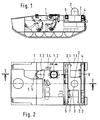
- FIG. 1 and 2 show a combat vehicle 1 with a chain drive of a known type, on the upper side of which a trough-like depression 1.1 is arranged which extends in the transverse direction to the longitudinal axis of the vehicle and is explained in more detail below. Furthermore, the vehicle has entry / exit hatches 1.2 and 1.3, around which angle mirrors 1.4 and 1.5 are arranged for all-round visibility. Further, known features of the combat vehicle as such, which can partly be seen in the drawings, are not explained in more detail below.
- the combat vehicle shown in the drawings is equipped with a lifting platform 2 on which for example, an indicated viewing device 3 can be arranged.
- the lifting platform 2 can be extended upwards from a rest position, in which it is arranged within the trough-like depression 1.1 at the rear of the combat vehicle, into a position such as is shown, for example, in FIGS. 3 and 4.
- a lifting device is provided between the combat vehicle and the lifting platform, which has two extendable, scissor-like arranged telescopic arms 4 and 5, the lower ends 4.1, 5.1 of the telescopic arms each being articulated with the top of the vehicle and the upper ends 4.2, 5.2 of the telescopic arms each are articulated to support arms 2.1 and 2.2 of the lifting platform 2.
- the drive devices for the extension movement of the telescopic arms 4 and 5 consist of five-stage hydraulic cylinders, but other drive devices, for example electrical spindle telescopes, can also be used here.
- the drive devices for the extension movement of the telescopic arms 4 and 5 consist of five-stage hydraulic cylinders, but other drive devices, for example electrical spindle telescopes, can also be used here.
- the telescopic arms 4 and 5 are designed as single-stage hydraulic cylinders lifting devices 6 and 7, by means of which the telescopic arms 4 and 5 can be pivoted up from the essentially horizontal rest position.
- electric linear drives can be used instead of the hydraulic cylinders.
- a lifting device in the form of a hydraulic cylinder or linear drive is provided, while on the other telescopic arm only a spring mechanism biased in the lifting direction, for example a torsion bar spring, is arranged, which facilitates the pivoting up of this telescopic arm from the rest position in the lower extension area.
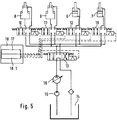
- the drive and lifting devices are shown in a highly schematic manner in FIG. 5.
- a control device 18 is present which contains a microprocessor 18.1.
- an inclination sensor 17 is arranged on the lifting platform 2 in a manner not specifically shown, which is connected to the control device 18 and indicates the respective inclination of the lifting platform 2 against the horizon and supplies a corresponding control signal to the control device 18.
- the hydraulic circuit contains a five-stage telescopic cylinder 8, for example for the extension movement of the telescopic arm 4, a five-stage telescopic cylinder 9, for example for the extension movement of the telescopic arm 5, and a support cylinder 6 for pivoting the telescopic arm 4 and a second support cylinder 7 for pivoting the telescopic arm 5.
- the hydraulic fluid is supplied and discharged from a storage vessel 14 by means of a pump 15, a pressure gauge 16 and the valves 10, 11, 12, 19 and 13 which can be controlled by the control device 18.
- All of the hydraulic lifting devices 8, 9 and 6, 7 can be actuated independently of one another, and the extension of the lifting platform 2 is controlled by the control device 18 and the inclination sensor 17 in such a way that, for example, the first telescopic arm 4 by means of the telescopic cylinder 8 and the supporting cylinder 6 executes an upward and outward movement, while the second telescopic arm 5 is only adjusted to support the lifting platform 2 and is thereby ensured by corresponding control signals coming from the inclination sensor 17 that during the uprighting and extending movement the upper articulation point of the telescopic cylinder 4 is vertical on a line extends to the vehicle and the lifting platform 2 always remains above the vehicle.
- the lifting platform 2 is further horizontally aligned in an axis parallel to the longitudinal direction of the combat vehicle, so that a slope in the vehicle transverse direction can be compensated for.
- the end position of the lifting platform 2 in the extended state is shown in different perspectives in FIGS. 3 and 4.
- the retraction movement takes place in the opposite direction, so that in the retracted state the lifting platform moves back into the trough-like recess 1.1 and telescopic arms and platform are integrated into the vehicle contour, so that only the viewing device 3 installed on the lifting platform 2 protrudes beyond the vehicle contour and also can be used when retracted.
- driving operation which is unimpeded by the telescopic arms 4 and 5 and the lifting platform 2 is achieved and the all-round view of the angle mirrors 1.4 is not disturbed.
Landscapes
- Engineering & Computer Science (AREA)
- General Engineering & Computer Science (AREA)
- Mechanical Engineering (AREA)
- Structural Engineering (AREA)
- Life Sciences & Earth Sciences (AREA)
- Geology (AREA)
- Forklifts And Lifting Vehicles (AREA)
- Vehicle Cleaning, Maintenance, Repair, Refitting, And Outriggers (AREA)
Abstract
Description
- Die Erfindung betrifft ein Fahrzeug, insbesondere ein Kampffahrzeug mit einer Hubplattform die über eine Hubeinrichtung mit der Fahrzeugoberseite verbunden ist, wobei die Hubeinrichtung zwei ausfahrbare scherenartig aber ohne Koppelung miteinander angeordnete Teleskoparme aufweist, deren unteres Ende jeweils gelenkig mit der Fahrzeugoberseite und deren oberes Ende jeweils gelenkig mit der Hubplattform verbunden ist, und jeder Teleskoparm eine Antriebsvorrichtung für die Ausfahrbewegung besitzt und an einem der Teleskoparme eine den Teleskoparm aus einer im wesentlichen horizontalen Ruhestellung hochschwenkende Hubvorrichtung angeordnet ist und mit einer Steuereinrichtung zur Steuerung der Antriebsvorrichtungen und der Hubvorrichtung.
- In der DE 40 30 167C2 ist eine fahrbare Hubbühne beschrieben, die prinzipiell die oben angegebenen Merkmale besitzt. Es handelt sich hier um eine Arbeitsbühne, bei der davon ausgegangen werden kann, daß im Gebrauch das Fahrzeuguntergestell einigermaßen waagerecht ausgerichtet ist. Es ist bei dieser bekannten Einrichtung nicht möglich, eine eventuelle Schrägstellung des Fahrgestells bei der Aufwärtsbewegung der Plattform auszugleichen.
- Es ist weiterhin bekannt (siehe z.B. DE 31 20 338C2), an einem Fahrzeug, insbesondere einem Kampffahrzeug, eine Hubplattform über einen Knickhebelausleger anzuordnen, wobei der Knickhebelausleger aus zwei aneinander anschließenden und gegeneinander verschwenkbaren Hebelarmen besteht. Derartige Konstruktionen sind technisch relativ aufwendig.
- Der Erfindung liegt die Aufgabe zugrunde, ein Fahrzeug, insbesondere ein Kampffahrzeug mit einer Hubplattform, die gemäß den oben angegebenen und im Oberbegriff des Patentanspruchs 1 aufgeführten Merkmalen mit der Fahrzeugoberseite verbunden ist, so auszugestalten, daß mit sehr einfachen Konstruktionsmerkmalen sichergestellt ist, daß die Hubplattform so angehoben werden kann, daß eine Geländeneigung ausgeglichen wird. Weiterhin sollte es möglich sein, Hubplattform und Hubeinreichtung so auf dem Fahrzeug unterzubringen, daß sie im eingefahrenen Zustand in die Fahrzeugkontur integriert sind und ein unbehinderter Fahrbetrieb und die bei einem Militärfahrzeug besonders wichtige Rundumsicht über Winkelspiegel und über die Luke gewährleistet sind.
- Die Lösung dieser Aufgabe geschieht erfindungsgemäß mit den Merkmalen aus dem kennzeichnenden Teil des Patentanspruchs 1. Vorteilhafte Weiterbildungen der Erfindung sind in den Unteransprüchen beschrieben.
- Der Grundgedanke der Erfindung besteht darin, die von einer fahrbaren Arbeitsbühne bekannte Hubplattform mit Hubeinrichtung an einem Fahrzeug, insbesondere einem Kampffahrzeug in der Weise einzusetzen, daß Bewegungen der beiden Teleskoparme unabhängig voneinander steuerbar sind und zwar so, daß der erste der beiden Teleskoparme bei der Aufricht- und Ausfahrbewegung führend ist, während der zweite Teleskoparm so nachgesteuert wird, daß aufgrund der von dem an der Hubplattform angeordneten Neigungssensor abgegebenen Signale die Hubplattform in einer Achse horizontiert wird. So ist es bei entsprechender Anordnung der Teleskoparme möglich, beispielsweise eine Geländeneigung in Fahrzeugquerrichtung auszugleichen. Ein Ausgleichen in Fahrzeuglängsrichtung kann dann mit einfachen Mitteln an der Hubplattform selbst durchgeführt werden.
- Da im eingefahrenen Zustand die Teleskoparme im wesentlichen horizontal ausgerichtet sind, hat es sich, um das Ausfahren des zweiten Teleskoparmes aus dieser Position zu erleichtern, als vorteilhaft erwiesen, wenn dieser Teleskoparm mindestens im unteren Ausfahrbereich mit einem Drehmoment um seine Aufrichtachse beaufschlagt wird. Dieses Drehmoment kann entweder durch einen Federmechanismus, beispielsweise eine Drehstabfeder, oder auch durch einen einstufigen Zylinder oder einen elektrischen Linearantrieb aufgebracht werden.
- Die Gesamtkonstruktion der Hubeinrichtung macht es möglich, sowohl die Hubplattform als auch die Teleskoparme im eingefahrenen Zustand in eine Vertiefung an der Fahrzeugoberseite aufzunehmen. Weiterhin ist es ein Vorteil der erfindungsgemäßen Einrichtung, daß die Einheit Hubplattform-Hubeinrichtung als Modul in bestehende Fahrzeuge eingebaut, bzw. an sie angebaut oder auch bei zukünftigen Fahrzeugkonzepten als Ganzes eingesetzt werden kann.
- Als Antriebsvorrichtungen für die Ausfahrbewegung der Teleskoparme und auch als Hubvorrichtung können sowohl Hydraulikzylinder als auch elektrische Spindelantriebe eingesetzt werden.
- Im folgenden wird anhand der beigefügten Zeichnungen ein Ausführungsbeispiel für ein Fahrzeug mit einer Hubplattform nach der Erfindung näher erläutert.
- In den Zeichnungen zeigen:
- Fig. 1 in einer teilweise nach der Linie I-I in Fig. 2 geschnittenen Seitenansicht ein Kampffahrzeug mit einer Hubplattform im eingefahrenen Zustand der Hubeinrichtung;
- Fig. 2 das Kampffahrzeug nach Fig. 1 in einer Aufsicht;
- Fig. 3 in einer perspektivischen Darstellung das Kampffahrzeug nach Fig. 1 und 2 mit ausgefahrener Hubplattform;
- Fig. 4 in einer anderen Perspektive das Kampffahrzeug nach Fig. 1 und 2 mit ausgefahrener Hubplattform;
- Fig. 5 in einem Prinzipschaltbild die Antriebsvorrichtungen und die Hubvorrichtung der Hubeinrichtung in einer Ausführung mit Hydraulikzylindern.
- Die Fig. 1 und 2 zeigen ein Kampffahrzeug 1 mit Kettenantrieb bekannter Bauart, an dessen Oberseite eine in Querrichtung zur Fahrzeuglängsachse verlaufende wannenartige Vertiefung 1.1 angeordnet ist, die weiter unten näher erläutert wird. Weiterhin besitzt das Fahrzeug Ein/Ausstiegsluken 1.2 und 1.3, um die herum für die Rundumsicht Winkelspiegel 1.4 bzw. 1.5 angeordnet sind. Weitere, an sich bekannte Merkmale des Kampffahrzeugs als solches, die teilweise den Zeichnungen zu entnehmen sind, werden im folgenden nicht näher erläutert.
- Das in den Zeichnungen dargestellte Kampffahrzeug ist mit einer Hubplattform 2 ausgerüstet, auf der beispielsweise ein angedeutetes Sichtgerät 3 angeordnet sein kann. Die Hubplattform 2 kann aus einer Ruhestellung, in der sie innerhalb der wannenartigen Vertiefung 1.1 am Heck des Kampffahrzeugs angeordnet ist, nach oben ausgefahren werden in eine Stellung, wie sie beispielsweise in den Fig. 3 und 4 dargestellt ist. Zu diesem Zweck ist zwischen dem Kampffahrzeug und der Hubplattform eine Hubeinrichtung vorgesehen, die zwei ausfahrbare, scherenartig angeordnete Teleskoparme 4 und 5 aufweist, wobei die unteren Enden 4.1, 5.1 der Teleskoparme jeweils gelenkig mit der Fahrzeugoberseite und die oberen Enden 4.2, 5.2 der Teleskoparme jeweils gelenkig mit Tragarmen 2.1 und 2.2 der Hubplattform 2 verbunden sind. Im Bereich zwischen diesen Koppelungspunkten an den Enden der Teleskoparme sind diese nicht miteinander gekoppelt. In dem dargestellten Ausführungsbeispiel bestehen die Antriebsvorrichtungen für die Ausfahrbewegung der Teleskoparme 4 und 5 aus fünfstufigen Hydraulikzylindern, es können hier aber auch andere Antriebsvorrichtungen, beispielsweise elektrische Spindelteleskope eingesetzt werden. Im unteren Bereich der Teleskoparme 4 und 5 sind als einstufige Hydraulikzylinder ausgebildete Hubvorrichtungen 6 und 7 angeordnet, mittels derer die Teleskoparme 4 und 5 aus der im wesentlichen horizontalen Ruhestellung hochgeschwenkt werden können. Auch an dieser Stelle können an Stelle der Hydraulikzylinder beispielsweise elektrische Linearantriebe eingesetzt werden. Wie weiter unten näher erläutert, ist es auch ausreichend, wenn nur einer der beiden Teleskoparme mit einer Hubvorrichtung in Form eines Hydraulikzylinder oder Linearantriebes versehen ist, während am anderen Teleskoparm lediglich ein in Anheberichtung vorgespannter Federmechanismus, beispielsweise eine Drehstabfeder, angeordnet ist, die das Hochschwenken dieses Teleskoparms aus der Ruhestellung im unteren Ausfahrbereich erleichtert.
- Die Antriebs- und Hubeinrichtungen sind in Fig. 5 stark schematisiert dargestellt. Es ist eine Steuereinrichtung 18 vorhanden, die einen Mikroprozessor 18.1 enthält. Weiterhin ist an der Hubplattform 2 in nicht eigens dargestellter Weise ein Neigungssensor 17 angeordnet, der mit der Steuereinrichtung 18 verbunden ist und die jeweilige Neigung der Hubplattform 2 gegen den Horizont angibt und ein entsprechendes Steuersignal der Steuereinrichtung 18 zuführt. Der Hydraulikkreis enthält einen insgesamt fünfstufigen Teleskopzylinder 8, beispielsweise für die Ausfahrbewegung des Teleskoparms 4, einen fünfstufigen Teleskopzylinder 9, beispielsweise für die Ausfahrbewegung des Teleskoparms 5, sowie einen Stützzylinder 6 zum Hochschwenken des Teleskoparms 4 und einen zweiten Stützzylinder 7 zum Hochschwenken des Teleskoparms 5.
- Die Zuführung und Abführung der Hydraulikflüssigkeit aus einem Vorratsgefäß 14 erfolgt mittels einer Pumpe 15 über einen Druckmesser 16 und die von der Steuereinrichtung 18 her ansteuerbaren Ventile 10, 11, 12, 19 und 13.
- Sämtliche der hydraulischen Hubvorrichtungen 8, 9 und 6, 7 sind unabhängig voneinander betätigbar, und das Ausfahren der Hubplattform 2 erfolgt gesteuert von der Steuereinrichtung 18 und dem Neigungssensor 17 in der Weise, daß beispielsweise der erste Teleskoparm 4 mittels des Teleskopzylinders 8 und des Stützzylinders 6 eine Aufrecht- und Ausfahrbewegung ausführt, während der zweite Teleskoparm 5 lediglich zur Abstützung der Hubplattform 2 nachgeführt wird und dabei durch entsprechende vom Neigungssensor 17 ausgehende Steuersignale dafür gesorgt wird, daß während der Aufricht- und Ausfahrbewegung der obere Anlenkpunkt des Teleskopzylinders 4 auf einer Linie senkrecht zum Fahrzeug ausfährt und die Hubplattform 2 immer über dem Fahrzeug bleibt. Hierbei wird weiterhin die Hubplattform 2 in einer Achse parallel zur Längsrichtung des Kampffahrzeugs horizontiert, so daß eine Geländeneigung in Fahrzeugquerrichtung ausgeglichen werden kann. Die Endstellung der Hubplattform 2 im ausgefahrenen Zustand ist in unterschiedlichen Perspektiven in den Fig. 3 und 4 dargestellt. Die Einfahrbewegung geschieht in umgekehrter Richtung, so daß im wieder eingefahrenen Zustand die Hubplattform wieder in die wannenartige Vertiefung 1.1 einfährt und Teleskoparme und Plattform in die Fahrzeugkontur integriert sind, so daß nur noch das auf der Hubplattform 2 installierte Sichtgerät 3 über die Fahrzeugkontur herausragt und auch im eingefahrenen Zustand eingesetzt werden kann. Durch diese Anordnung wird ein von den Teleskoparmen 4 und 5 sowie der Hubplattform 2 unbehinderter Fahrbetrieb erreicht und die Rundumsicht über die Winkelspiegel 1.4 nicht gestört.
Claims (12)
- Fahrzeug, insbesondere Kampffahrzeug, mit einer Hubplattform, die über eine Hubeinrichtung mit der Fahrzeugoberseite verbunden ist, wobei die Hubeinrichtung zwei ausfahrbare, scherenartig aber ohne Koppelung miteinander angeordnete Teleskoparme aufweist, deren unteres Ende jeweils gelenkig mit der Fahrzeugoberseite und deren oberes Ende jeweils gelenkig mit der Hubplattform verbunden ist, und jeder Teleskoparm eine Antriebsvorrichtung für die Ausfahrbewegung besitzt und an einem der Teleskoparme eine den Teleskoparm aus einer im wesentlichen horizontalen Ruhestellung hochschwenkende Hubvorrichtung angeordnet ist und mit einer Steuereinrichtung zur Steuerung der Antriebsvorrichtungen und der Hubvorrichtung, dadurch gekennzeichnet, daß die beiden Antriebsvorrichtungen (8, 9) und die Hubvorrichtung (6, 7) von der einen Mikroprozessor (18.1) enthaltenden Steuereinrichtung (18) aus unabhängig voneinander ansteuerbar sind derart, daß der erste mit der Hubvorrichtung (6) versehene Teleskoparm (4) eine Aufricht- und Ausfahrbewegung ausführt, während der zweite Teleskoparm (5) lediglich zur Abstützung der Hubplattform (2) nachgeführt wird, wobei gesteuert von einem an der Hubplattform (2) angeordneten, mit der Steuereinrichtung (18) verbundenen Neigungssensor (17) die Hubplattform (2) während der Aufricht- und Ausfahrbewegung in einer Achse im wesentlichen senkrecht zur Schwenkebene der Teleskoparme (4, 5) horizontiert wird.
- Fahrzeug nach Anspruch 1, dadurch gekennzeichnet, daß die Aufricht- und Ausfahrbewegung des ersten Teleskoparms (4) so gesteuert ist, daß sich der obere Anlenkpunkt (4.2) dieses Teleskoparms auf einer Bahn im wesentlichen senkrecht zur Fahrzeugmittelebene bewegt.
- Fahrzeug nach Anspruch 1 oder 2, dadurch gekennzeichnet, daß als Antriebsvorrichtungen für die Ausfahrbewegung der Teleskoparme (4, 5) mehrstufige Hydraulikzylinder (8, 9) dienen.
- Fahrzeug nach Anspruch 1 oder 2, dadurch gekennzeichnet, daß als Antriebsvorrichtungen für die Ausfahrbewegung der Teleskoparme elektrische Spindelantriebe dienen.
- Fahrzeug nach Anspruch 3 oder 4, dadurch gekennzeichnet, daß die Hubvorrichtung als einstufiger Hydraulikzylinder (6) ausgebildet ist.
- Fahrzeug nach Anspruch 3 oder 4, dadurch gekennzeichnet, daß die Hubvorrichtung als elektrischer Linearantrieb ausgebildet ist.
- Fahrzeug nach einem der Ansprüche 1 bis 6, dadurch gekennzeichnet, daß am zweiten Teleskoparm (5) eine die Anhebbewegung aus der im wesentlichen horizontalen Ruhestellung unterstützende Hilfs-Hubvorrichtung (7) angeordnet ist.
- Fahrzeug nach Anspruch 7, dadurch gekennzeichnet, daß die Hilfs-Hubvorrichtung als in Anhebrichtung vorgespannte Drehstabfeder ausgebildet ist.
- Fahrzeug nach Anspruch 7, dadurch gekennzeichnet, daß die Hilfs-Hubvorrichtung als zusätzlicher, von der Steuereinrichtung (18) her ansteuerbarer einstufiger Hydraulikzylinder (7) ausgebildet ist.
- Fahrzeug nach Anspruch 7, dadurch gekennzeichnet, daß die Hilfs-Hubvorrichtung als elektrischer Linearantrieb ausgebildet ist.
- Fahrzeug nach einem der Ansprüche 1 bis 10, dadurch gekennzeichnet, daß die Schwenkebenen der Teleskoparme (4, 5) im wesentlichen senkrecht zur Fahrzeuglängsachse stehen.
- Fahrzeug nach Anspruch 11, dadurch gekennzeichnet, daß an der Fahrzeugoberseite eine wannenartige Vertiefung (1.1) angeordnet ist, in welche die Hubplattform (2) sowie die Teleskoparme (4, 5) im eingefahrenen Zustand aufgenommen werden.
Applications Claiming Priority (2)
| Application Number | Priority Date | Filing Date | Title |
|---|---|---|---|
| DE19525695A DE19525695A1 (de) | 1995-07-14 | 1995-07-14 | Fahrzeug, insbesondere Kampffahrzeug mit einer Hubplattform |
| DE19525695 | 1995-07-14 |
Publications (3)
| Publication Number | Publication Date |
|---|---|
| EP0753479A2 true EP0753479A2 (de) | 1997-01-15 |
| EP0753479A3 EP0753479A3 (de) | 1998-06-17 |
| EP0753479B1 EP0753479B1 (de) | 2003-07-30 |
Family
ID=7766827
Family Applications (1)
| Application Number | Title | Priority Date | Filing Date |
|---|---|---|---|
| EP96109459A Expired - Lifetime EP0753479B1 (de) | 1995-07-14 | 1996-06-13 | Fahrzeug, insbesondere Kampffahrzeug mit einer Hubplattform |
Country Status (2)
| Country | Link |
|---|---|
| EP (1) | EP0753479B1 (de) |
| DE (2) | DE19525695A1 (de) |
Cited By (5)
| Publication number | Priority date | Publication date | Assignee | Title |
|---|---|---|---|---|
| EP1191303A2 (de) | 2000-09-20 | 2002-03-27 | Krauss-Maffei Wegmann GmbH & Co. KG | Gepanzertes Fahrzeug, insbesondere Kampffahrzeug |
| EP2020558A1 (de) * | 2007-07-21 | 2009-02-04 | Otto-Friedrich-Universität Bamberg | Vorrichtung zum Fotografieren und/oder Scannen und/oder Vermessen eines Objekts |
| NL2006268C2 (en) * | 2011-02-21 | 2012-08-22 | Reedijk Hydrauliek B V | Mobile crane and method of operating a mobile crane. |
| EP3431916A1 (de) * | 2017-07-19 | 2019-01-23 | NEXTER Systems | Militärfahrzeug |
| CN110605697A (zh) * | 2019-08-26 | 2019-12-24 | 国网天津市电力公司电力科学研究院 | 一种适用于非平整地面作业的多功能工具箱 |
Families Citing this family (4)
| Publication number | Priority date | Publication date | Assignee | Title |
|---|---|---|---|---|
| DE19946411A1 (de) * | 1999-09-28 | 2001-04-26 | Metz Aerials Gmbh & Co Kg | Verfahren und Vorrichtung zur Bewegung eines Auslegers eines Arbeits- oder Rettungsgeräts |
| DE10032423B4 (de) * | 2000-07-04 | 2007-10-18 | Palfinger Europe Gmbh | Fahrbare Hubarbeitsbühne |
| DE10254680B4 (de) * | 2002-05-15 | 2004-04-08 | Noell Crane Systems Gmbh | Portalhubwagen |
| DE102006037107A1 (de) * | 2006-08-07 | 2008-02-14 | Claas Fertigungstechnik Gmbh | Arbeitsbühne |
Family Cites Families (11)
| Publication number | Priority date | Publication date | Assignee | Title |
|---|---|---|---|---|
| US4282794A (en) * | 1979-04-30 | 1981-08-11 | Miller Avy L | Self-propelled off-road vehicle |
| FR2504701A1 (fr) * | 1981-04-22 | 1982-10-29 | Camiva | Dispositif de commande de correction automatique de devers pour echelle orientable deployable ou bras elevateur analogue sur vehicule |
| JPS60197600A (ja) * | 1984-03-15 | 1985-10-07 | 株式会社ジャパニック | 伸縮ブ−ム機構 |
| DE3738835A1 (de) * | 1987-11-16 | 1989-05-24 | Srt Steuerungs Regelungstech | Kampfwagen mit elevierbarer waffenplattform |
| DE3807966A1 (de) * | 1988-03-10 | 1989-09-21 | Ruthmann Anton Gmbh & Co | Hubarbeitsbuehne mit prozessorsteuerung |
| DE3900570A1 (de) * | 1989-01-11 | 1990-07-12 | Goeppner Kaiserslautern Eisen | Kampffahrzeug mit kampfplattformen und hubanlage |
| AU631478B2 (en) * | 1990-01-22 | 1992-11-26 | Nikken Corporation | Lifting apparatus |
| DE9017696U1 (de) * | 1990-07-04 | 1991-11-07 | Michaelis, Karl-Heinz, 2801 Grasberg | Fahrbare Hubbühne |
| DE4030167A1 (de) * | 1990-09-24 | 1992-03-26 | Michaelis Karl Heinz | Fahrbare hubbuehne |
| JPH06298495A (ja) * | 1993-04-09 | 1994-10-25 | Japanic:Kk | 高所作業車 |
| JPH0812296A (ja) * | 1994-07-01 | 1996-01-16 | Kyushu Electric Power Co Inc | 高所作業車の作動制御装置 |
-
1995
- 1995-07-14 DE DE19525695A patent/DE19525695A1/de not_active Withdrawn
-
1996
- 1996-06-13 EP EP96109459A patent/EP0753479B1/de not_active Expired - Lifetime
- 1996-06-13 DE DE59610624T patent/DE59610624D1/de not_active Expired - Lifetime
Cited By (6)
| Publication number | Priority date | Publication date | Assignee | Title |
|---|---|---|---|---|
| EP1191303A2 (de) | 2000-09-20 | 2002-03-27 | Krauss-Maffei Wegmann GmbH & Co. KG | Gepanzertes Fahrzeug, insbesondere Kampffahrzeug |
| EP2020558A1 (de) * | 2007-07-21 | 2009-02-04 | Otto-Friedrich-Universität Bamberg | Vorrichtung zum Fotografieren und/oder Scannen und/oder Vermessen eines Objekts |
| NL2006268C2 (en) * | 2011-02-21 | 2012-08-22 | Reedijk Hydrauliek B V | Mobile crane and method of operating a mobile crane. |
| EP3431916A1 (de) * | 2017-07-19 | 2019-01-23 | NEXTER Systems | Militärfahrzeug |
| FR3069313A1 (fr) * | 2017-07-19 | 2019-01-25 | Nexter Systems | Vehicule militaire |
| CN110605697A (zh) * | 2019-08-26 | 2019-12-24 | 国网天津市电力公司电力科学研究院 | 一种适用于非平整地面作业的多功能工具箱 |
Also Published As
| Publication number | Publication date |
|---|---|
| EP0753479B1 (de) | 2003-07-30 |
| DE59610624D1 (de) | 2003-09-04 |
| EP0753479A3 (de) | 1998-06-17 |
| DE19525695A1 (de) | 1997-01-16 |
Similar Documents
| Publication | Publication Date | Title |
|---|---|---|
| EP0594997B1 (de) | Überkopf-Gepäckablage mit absenkbarer Schale, insbesondere zur Anwendung in Passagierflugzeugen | |
| EP1246771B1 (de) | Fahrbare betonpumpe mit teleskopierbaren stützauslegern | |
| DE3711232C2 (de) | ||
| EP0753479B1 (de) | Fahrzeug, insbesondere Kampffahrzeug mit einer Hubplattform | |
| DE4203820C5 (de) | Fahrbare Betonpumpe | |
| EP1191303B1 (de) | Gepanzertes Fahrzeug, insbesondere Kampffahrzeug | |
| DE102016009038B4 (de) | Klappspitzen-Anlenkstück und Verfahren zum Montieren einer Klappspitze | |
| DE102007008776A1 (de) | Umschlaggerät | |
| DE102009033917A1 (de) | Fahrzeug mit ausschwenkbarem Mastarmaufbau | |
| DE8711818U1 (de) | Lastkraftwagen mit Unterfahrschutz | |
| EP1674619A2 (de) | Umschlaggerät | |
| WO2003043882A1 (de) | Ruder mit gleitschwenkkolbenanlenkung | |
| DE3425428A1 (de) | Fahrzeug fuer den garagentransport | |
| EP2598698B1 (de) | Fahrzeug und abstützvorrichtung | |
| EP0870873B1 (de) | Vorrichtung zum Verlegen einer Brücke | |
| EP1743611B1 (de) | Ausfahrbare Einstiegsrampe für Fahrzeuge des öffentlichen Personenverkehrs | |
| DE2938614A1 (de) | Hubvorrichtung | |
| DE1190154B (de) | Fahrbare und hoehenverstellbare Arbeitsplattform mit Gelenkmast | |
| EP4244428B1 (de) | Brückenverlegefahrzeug | |
| DE3329564C1 (de) | Hydraulisch hochfahrbare, mobile Plattform | |
| DE10032423B4 (de) | Fahrbare Hubarbeitsbühne | |
| DE2536384A1 (de) | Lenkungssteuermechanismus | |
| DE1756767C3 (de) | Druckmittelbetätigte Kippvorrichtung für einen an einem Fahrzeugrahmen kippbar angelenkten Behälter | |
| DE202017101211U1 (de) | Ladekran zur Montage auf einem Fahrzeug | |
| DE8904010U1 (de) | Kran, insbesondere Fahrzeugkran |
Legal Events
| Date | Code | Title | Description |
|---|---|---|---|
| PUAI | Public reference made under article 153(3) epc to a published international application that has entered the european phase |
Free format text: ORIGINAL CODE: 0009012 |
|
| AK | Designated contracting states |
Kind code of ref document: A2 Designated state(s): DE FR GB IT NL SE |
|
| PUAL | Search report despatched |
Free format text: ORIGINAL CODE: 0009013 |
|
| AK | Designated contracting states |
Kind code of ref document: A3 Designated state(s): DE FR GB IT NL SE |
|
| 17P | Request for examination filed |
Effective date: 19980602 |
|
| GRAH | Despatch of communication of intention to grant a patent |
Free format text: ORIGINAL CODE: EPIDOS IGRA |
|
| RAP1 | Party data changed (applicant data changed or rights of an application transferred) |
Owner name: KRAUSS-MAFFEI WEGMANN GMBH & CO. KG |
|
| GRAH | Despatch of communication of intention to grant a patent |
Free format text: ORIGINAL CODE: EPIDOS IGRA |
|
| GRAA | (expected) grant |
Free format text: ORIGINAL CODE: 0009210 |
|
| AK | Designated contracting states |
Designated state(s): DE FR GB IT NL SE |
|
| REG | Reference to a national code |
Ref country code: GB Ref legal event code: FG4D Free format text: NOT ENGLISH |
|
| REF | Corresponds to: |
Ref document number: 59610624 Country of ref document: DE Date of ref document: 20030904 Kind code of ref document: P |
|
| REG | Reference to a national code |
Ref country code: SE Ref legal event code: TRGR |
|
| GBT | Gb: translation of ep patent filed (gb section 77(6)(a)/1977) |
Effective date: 20031027 |
|
| ET | Fr: translation filed | ||
| PLBE | No opposition filed within time limit |
Free format text: ORIGINAL CODE: 0009261 |
|
| STAA | Information on the status of an ep patent application or granted ep patent |
Free format text: STATUS: NO OPPOSITION FILED WITHIN TIME LIMIT |
|
| 26N | No opposition filed |
Effective date: 20040504 |
|
| PGFP | Annual fee paid to national office [announced via postgrant information from national office to epo] |
Ref country code: NL Payment date: 20120628 Year of fee payment: 17 |
|
| PGFP | Annual fee paid to national office [announced via postgrant information from national office to epo] |
Ref country code: GB Payment date: 20120621 Year of fee payment: 17 Ref country code: FR Payment date: 20120705 Year of fee payment: 17 Ref country code: SE Payment date: 20120625 Year of fee payment: 17 |
|
| PGFP | Annual fee paid to national office [announced via postgrant information from national office to epo] |
Ref country code: IT Payment date: 20120623 Year of fee payment: 17 |
|
| REG | Reference to a national code |
Ref country code: NL Ref legal event code: V1 Effective date: 20140101 |
|
| PG25 | Lapsed in a contracting state [announced via postgrant information from national office to epo] |
Ref country code: SE Free format text: LAPSE BECAUSE OF NON-PAYMENT OF DUE FEES Effective date: 20130614 |
|
| REG | Reference to a national code |
Ref country code: SE Ref legal event code: EUG |
|
| GBPC | Gb: european patent ceased through non-payment of renewal fee |
Effective date: 20130613 |
|
| REG | Reference to a national code |
Ref country code: FR Ref legal event code: ST Effective date: 20140228 |
|
| PG25 | Lapsed in a contracting state [announced via postgrant information from national office to epo] |
Ref country code: GB Free format text: LAPSE BECAUSE OF NON-PAYMENT OF DUE FEES Effective date: 20130613 Ref country code: NL Free format text: LAPSE BECAUSE OF NON-PAYMENT OF DUE FEES Effective date: 20140101 |
|
| PG25 | Lapsed in a contracting state [announced via postgrant information from national office to epo] |
Ref country code: IT Free format text: LAPSE BECAUSE OF NON-PAYMENT OF DUE FEES Effective date: 20130613 Ref country code: FR Free format text: LAPSE BECAUSE OF NON-PAYMENT OF DUE FEES Effective date: 20130701 |
|
| PGFP | Annual fee paid to national office [announced via postgrant information from national office to epo] |
Ref country code: DE Payment date: 20140630 Year of fee payment: 19 |
|
| REG | Reference to a national code |
Ref country code: DE Ref legal event code: R119 Ref document number: 59610624 Country of ref document: DE |
|
| PG25 | Lapsed in a contracting state [announced via postgrant information from national office to epo] |
Ref country code: DE Free format text: LAPSE BECAUSE OF NON-PAYMENT OF DUE FEES Effective date: 20160101 |