EP0754652B1 - Steinwolle mit hohem Widerstand und Verfahren zu seiner Herstellung - Google Patents
Steinwolle mit hohem Widerstand und Verfahren zu seiner Herstellung Download PDFInfo
- Publication number
- EP0754652B1 EP0754652B1 EP96305051A EP96305051A EP0754652B1 EP 0754652 B1 EP0754652 B1 EP 0754652B1 EP 96305051 A EP96305051 A EP 96305051A EP 96305051 A EP96305051 A EP 96305051A EP 0754652 B1 EP0754652 B1 EP 0754652B1
- Authority
- EP
- European Patent Office
- Prior art keywords
- rock wool
- high strength
- producing
- melt
- starting material
- Prior art date
- Legal status (The legal status is an assumption and is not a legal conclusion. Google has not performed a legal analysis and makes no representation as to the accuracy of the status listed.)
- Expired - Lifetime
Links
Images
Classifications
-
- C—CHEMISTRY; METALLURGY
- C03—GLASS; MINERAL OR SLAG WOOL
- C03B—MANUFACTURE, SHAPING, OR SUPPLEMENTARY PROCESSES
- C03B5/00—Melting in furnaces; Furnaces so far as specially adapted for glass manufacture
- C03B5/16—Special features of the melting process; Auxiliary means specially adapted for glass-melting furnaces
- C03B5/167—Means for preventing damage to equipment, e.g. by molten glass, hot gases, batches
- C03B5/1672—Use of materials therefor
-
- C—CHEMISTRY; METALLURGY
- C03—GLASS; MINERAL OR SLAG WOOL
- C03B—MANUFACTURE, SHAPING, OR SUPPLEMENTARY PROCESSES
- C03B37/00—Manufacture or treatment of flakes, fibres, or filaments from softened glass, minerals, or slags
- C03B37/01—Manufacture of glass fibres or filaments
- C03B37/04—Manufacture of glass fibres or filaments by using centrifugal force, e.g. spinning through radial orifices; Construction of the spinner cups therefor
- C03B37/05—Manufacture of glass fibres or filaments by using centrifugal force, e.g. spinning through radial orifices; Construction of the spinner cups therefor by projecting molten glass on a rotating body having no radial orifices
-
- C—CHEMISTRY; METALLURGY
- C03—GLASS; MINERAL OR SLAG WOOL
- C03B—MANUFACTURE, SHAPING, OR SUPPLEMENTARY PROCESSES
- C03B1/00—Preparing the batches
- C03B1/02—Compacting the glass batches, e.g. pelletising
-
- C—CHEMISTRY; METALLURGY
- C03—GLASS; MINERAL OR SLAG WOOL
- C03B—MANUFACTURE, SHAPING, OR SUPPLEMENTARY PROCESSES
- C03B3/00—Charging the melting furnaces
- C03B3/02—Charging the melting furnaces combined with preheating, premelting or pretreating the glass-making ingredients, pellets or cullet
-
- C—CHEMISTRY; METALLURGY
- C03—GLASS; MINERAL OR SLAG WOOL
- C03B—MANUFACTURE, SHAPING, OR SUPPLEMENTARY PROCESSES
- C03B3/00—Charging the melting furnaces
- C03B3/02—Charging the melting furnaces combined with preheating, premelting or pretreating the glass-making ingredients, pellets or cullet
- C03B3/023—Preheating
-
- C—CHEMISTRY; METALLURGY
- C03—GLASS; MINERAL OR SLAG WOOL
- C03B—MANUFACTURE, SHAPING, OR SUPPLEMENTARY PROCESSES
- C03B37/00—Manufacture or treatment of flakes, fibres, or filaments from softened glass, minerals, or slags
- C03B37/01—Manufacture of glass fibres or filaments
- C03B37/04—Manufacture of glass fibres or filaments by using centrifugal force, e.g. spinning through radial orifices; Construction of the spinner cups therefor
- C03B37/05—Manufacture of glass fibres or filaments by using centrifugal force, e.g. spinning through radial orifices; Construction of the spinner cups therefor by projecting molten glass on a rotating body having no radial orifices
- C03B37/055—Manufacture of glass fibres or filaments by using centrifugal force, e.g. spinning through radial orifices; Construction of the spinner cups therefor by projecting molten glass on a rotating body having no radial orifices by projecting onto and spinning off the outer surface of the rotating body
-
- C—CHEMISTRY; METALLURGY
- C03—GLASS; MINERAL OR SLAG WOOL
- C03B—MANUFACTURE, SHAPING, OR SUPPLEMENTARY PROCESSES
- C03B37/00—Manufacture or treatment of flakes, fibres, or filaments from softened glass, minerals, or slags
- C03B37/08—Bushings, e.g. construction, bushing reinforcement means; Spinnerettes; Nozzles; Nozzle plates
-
- C—CHEMISTRY; METALLURGY
- C03—GLASS; MINERAL OR SLAG WOOL
- C03B—MANUFACTURE, SHAPING, OR SUPPLEMENTARY PROCESSES
- C03B5/00—Melting in furnaces; Furnaces so far as specially adapted for glass manufacture
- C03B5/16—Special features of the melting process; Auxiliary means specially adapted for glass-melting furnaces
- C03B5/167—Means for preventing damage to equipment, e.g. by molten glass, hot gases, batches
-
- C—CHEMISTRY; METALLURGY
- C03—GLASS; MINERAL OR SLAG WOOL
- C03C—CHEMICAL COMPOSITION OF GLASSES, GLAZES OR VITREOUS ENAMELS; SURFACE TREATMENT OF GLASS; SURFACE TREATMENT OF FIBRES OR FILAMENTS MADE FROM GLASS, MINERALS OR SLAGS; JOINING GLASS TO GLASS OR OTHER MATERIALS
- C03C1/00—Ingredients generally applicable to manufacture of glasses, glazes, or vitreous enamels
- C03C1/02—Pretreated ingredients
-
- Y—GENERAL TAGGING OF NEW TECHNOLOGICAL DEVELOPMENTS; GENERAL TAGGING OF CROSS-SECTIONAL TECHNOLOGIES SPANNING OVER SEVERAL SECTIONS OF THE IPC; TECHNICAL SUBJECTS COVERED BY FORMER USPC CROSS-REFERENCE ART COLLECTIONS [XRACs] AND DIGESTS
- Y02—TECHNOLOGIES OR APPLICATIONS FOR MITIGATION OR ADAPTATION AGAINST CLIMATE CHANGE
- Y02P—CLIMATE CHANGE MITIGATION TECHNOLOGIES IN THE PRODUCTION OR PROCESSING OF GOODS
- Y02P40/00—Technologies relating to the processing of minerals
- Y02P40/50—Glass production, e.g. reusing waste heat during processing or shaping
-
- Y—GENERAL TAGGING OF NEW TECHNOLOGICAL DEVELOPMENTS; GENERAL TAGGING OF CROSS-SECTIONAL TECHNOLOGIES SPANNING OVER SEVERAL SECTIONS OF THE IPC; TECHNICAL SUBJECTS COVERED BY FORMER USPC CROSS-REFERENCE ART COLLECTIONS [XRACs] AND DIGESTS
- Y10—TECHNICAL SUBJECTS COVERED BY FORMER USPC
- Y10T—TECHNICAL SUBJECTS COVERED BY FORMER US CLASSIFICATION
- Y10T428/00—Stock material or miscellaneous articles
- Y10T428/29—Coated or structually defined flake, particle, cell, strand, strand portion, rod, filament, macroscopic fiber or mass thereof
- Y10T428/2904—Staple length fiber
-
- Y—GENERAL TAGGING OF NEW TECHNOLOGICAL DEVELOPMENTS; GENERAL TAGGING OF CROSS-SECTIONAL TECHNOLOGIES SPANNING OVER SEVERAL SECTIONS OF THE IPC; TECHNICAL SUBJECTS COVERED BY FORMER USPC CROSS-REFERENCE ART COLLECTIONS [XRACs] AND DIGESTS
- Y10—TECHNICAL SUBJECTS COVERED BY FORMER USPC
- Y10T—TECHNICAL SUBJECTS COVERED BY FORMER US CLASSIFICATION
- Y10T428/00—Stock material or miscellaneous articles
- Y10T428/29—Coated or structually defined flake, particle, cell, strand, strand portion, rod, filament, macroscopic fiber or mass thereof
- Y10T428/2913—Rod, strand, filament or fiber
-
- Y—GENERAL TAGGING OF NEW TECHNOLOGICAL DEVELOPMENTS; GENERAL TAGGING OF CROSS-SECTIONAL TECHNOLOGIES SPANNING OVER SEVERAL SECTIONS OF THE IPC; TECHNICAL SUBJECTS COVERED BY FORMER USPC CROSS-REFERENCE ART COLLECTIONS [XRACs] AND DIGESTS
- Y10—TECHNICAL SUBJECTS COVERED BY FORMER USPC
- Y10T—TECHNICAL SUBJECTS COVERED BY FORMER US CLASSIFICATION
- Y10T428/00—Stock material or miscellaneous articles
- Y10T428/29—Coated or structually defined flake, particle, cell, strand, strand portion, rod, filament, macroscopic fiber or mass thereof
- Y10T428/2913—Rod, strand, filament or fiber
- Y10T428/2933—Coated or with bond, impregnation or core
-
- Y—GENERAL TAGGING OF NEW TECHNOLOGICAL DEVELOPMENTS; GENERAL TAGGING OF CROSS-SECTIONAL TECHNOLOGIES SPANNING OVER SEVERAL SECTIONS OF THE IPC; TECHNICAL SUBJECTS COVERED BY FORMER USPC CROSS-REFERENCE ART COLLECTIONS [XRACs] AND DIGESTS
- Y10—TECHNICAL SUBJECTS COVERED BY FORMER USPC
- Y10T—TECHNICAL SUBJECTS COVERED BY FORMER US CLASSIFICATION
- Y10T428/00—Stock material or miscellaneous articles
- Y10T428/29—Coated or structually defined flake, particle, cell, strand, strand portion, rod, filament, macroscopic fiber or mass thereof
- Y10T428/2913—Rod, strand, filament or fiber
- Y10T428/2933—Coated or with bond, impregnation or core
- Y10T428/294—Coated or with bond, impregnation or core including metal or compound thereof [excluding glass, ceramic and asbestos]
-
- Y—GENERAL TAGGING OF NEW TECHNOLOGICAL DEVELOPMENTS; GENERAL TAGGING OF CROSS-SECTIONAL TECHNOLOGIES SPANNING OVER SEVERAL SECTIONS OF THE IPC; TECHNICAL SUBJECTS COVERED BY FORMER USPC CROSS-REFERENCE ART COLLECTIONS [XRACs] AND DIGESTS
- Y10—TECHNICAL SUBJECTS COVERED BY FORMER USPC
- Y10T—TECHNICAL SUBJECTS COVERED BY FORMER US CLASSIFICATION
- Y10T442/00—Fabric [woven, knitted, or nonwoven textile or cloth, etc.]
- Y10T442/10—Scrim [e.g., open net or mesh, gauze, loose or open weave or knit, etc.]
- Y10T442/102—Woven scrim
- Y10T442/133—Inorganic fiber-containing scrim
- Y10T442/138—Including a metal layer
Definitions
- This invention relates to a high strength rock wool which is useful in a thermal insulation material, a sound absorbing material and various reinforcing fibers, has a small impurity content and as excellent flexibility and tensile strength, and to a process for producing the same.
- the molten slag passes through the unstable interior of the cupola by gravity in a time as short as 15 to 20 minutes and hence the melting is insufficient, the quality of the melt is very bad, and the strength of the rock wool in the form of a fiber is very low.
- the rock wool produced by the direct process is not greatly different from that obtained in the cupola as far as the final products are compared.
- the present inventors have found that the fine impurities of the non-oxide type present in the conventionally used rock wool make the rock wool brittle, and in the conventional cupola using coke or in the conventional electric furnace in which carbon electrodes are used and a carbonaceous refractory material is used as a furnace-lining refractory, the furnace contents are melted in a strongly reducing atmosphere, so that the non-oxide type impurities are contained in the unoxidized state in the rock wool, and hence have considered that in order to permit the rock wool to have a high strength, it is necessary to quickly oxidize these non-oxide type impurities to dissolve them in the melt or disperse them away as a gas.
- the non-oxide type impurities include particularly metallic iron, iron phosphide, iron sulfide, sulfur and carbon, and it has been found that the conventional rock wool fiber produced from the cupola contains 0.05 to 0.20% by weight of metallic iron (including iron phosphide and iron sulfide) and has a total sulfur content of 0.20 to 0.50% by weight and a total carbon content of about 0.08 to 0.20% by weight. Therefore, the present inventors have extensively tried various experiments and thorough investigation to complete this invention.
- This invention further provides the high strength rock wool so obtained, and a thermal insulating or sound absorbing material containing it.
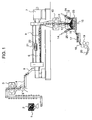
- Fig. 1, 1 refers to the starting material, 2 to blocks (the starting material), 3 to a pulverizer, 4 to particles (the starting material), 5 to a magnetic separator, 6 to a rotary kiln, 7 to a fuel oil burner, 8 to a feed opening, 9 to a block-shaped calcined product, 10 to a pair of water-cooled milling rolls, 11 to a particle-shaped calcined product, 12 to an electric furnace, 13 to a mountain form, 14 to a molybdenum electrode, 15 to a melt, 16 to a tap hole, 17 to a secondary furnace, 18 to the tapping, 19 to spinner wheels, 20 to a rock wool, 21 to a ring-shaped deposit, 22 to a water-cooled scraper equipped with rotor blades, 23 to a furnace structure, 24 to a furnace lid and 25 to a water-cooled holder.
- Fig. 1 is an explanatory view showing the flow of steps of introducing the starting material including shot and the like into a rotary kiln after adjusting the particle size thereof, calcining the starting material, crushing and pulverizing the block-shaped calcined product by means of a pair of water-cooled milling rolls to particles, allowing the particles to fall into an electric furnace to melt the same, and fiberizing the melt by means of spinner wheels.
- the block-shaped calcined product is crushed and pulverized by means of a pair of water-cooled milling rolls 10 to be formed into particle-shaped calcined product 11.
- the particle-shaped calcined product 11 is accumulated in the mountain form 13 on the surface of the melt in the electric furnace 12, and electric current is allowed to flow between the molybdenum electrodes 14 which have been inserted from the upper part of the furnace wall with their degree of inclination being adjustable and mounted there to heat and melt the particle-shaped calcined product in the mountain form, to form the melt 15.
- the melt 15 is withdrawn through the tap hole 16 into the secondary furnace 17 in which the temperature and flow are adjusted to become the tapping 18.
- This tapping 18 is fiberized by means of spinner wheels 19, thereby obtaining a rock wool 20.
- the ring-shaped deposit 21 formed on the internal wall of the rotary kiln is continuously removed by means of a water-cooled scraper 22 equipped with rotor blades alone or in combination with a water-cooled scraper equipped with fixed blades.
- the electric furnace 12 is composed of a furnace lid 24 made of a refractory material and a furnace structure 23 made of a refractory material and having a water-cooled structure outside of the refractory material.
- the three molybdenum electrodes 14 are equipped with the water-cooled holder 25 to prevent the electrodes 14 from being oxidized and consumed.
- the calcination temperature may vary depending upon the kind of starting material used and is preferably 1,000°C to 1,250°C. When shot is used, the calcination temperature region is more preferably from 1,100 to 1,250°C. When blast furnace slag is used, the calcination temperature region is more preferably from 1,000 to 1,250°C.
- the retention time of the starting material in the calcination region of from 1,000 to 1,250°C in the rotary kiln is preferably at least 1 minute but within 60 minutes and this is sufficient. A retention time of more than 60 minutes is uneconomic in respect of the equipment cost and the energy cost.
- the falling distance is about 3 m, and hence there is a fear that the falling block may collide with the electrodes and the water-cooled holder to break or damage the apparatus and that the collision of the block falling against a pile of the starting material on the liquid level in the electric furnace may disturb the stable operation of the furnace.
- the pair of water-cooled milling rolls are composed of two hollow rolls made of heat resisting steel, the interiors of the hollow rolls are cooled with water and the surfaces of the rolls have helical protrusions for better capture of the blocks, whereby it is made possible to easily convert the blocks having various sizes to particles having a desired dimension of 40 mm or less by adjusting the gap between the rolls so as to be able to crush and pulverize the blocks.
- the melt having carbon dissolved therein is reducible, so that the ability of the melt to oxidize the impurities contained in the starting material of the rock wool (metallic iron, iron phosphide, iron sulfide, sulfur and carbon) is much inferior to that in the oxidizing atmosphere, and accordingly it cannot be expected that the impurities are oxidized to substantially result in an increase of the strength of rock wool.
- an oxide type refractory material for example a magnesia-chromium type or magnesia type refractory material which is excellent in resistance to corrosion with the melt, is used in combination with water-cooling means.
- the process is such an energy-saving type production system that the blocks calcined in a rotary kiln are directly crushed and pulverized, the resulting particles are placed as they are in the high temperature state in an electric furnace and melted therein and the resulting melt is formed into a fiber.
- Shot was used as the starting material and this was crushed to particles having diameters of 10 mm or less and, after removal of iron, introduced into a rotary kiln.
- the highest temperature of the rotary kiln was set at 1,200°C and the inclination and number of revolutions of the rotary kiln were set so that the starting material passed through the calcination temperature region of from 1,000 to 1,200°C of the rotary kiln in about 10 minutes (retention time).
- the oxygen concentration of the gas discharged from the rotary kiln was 2% and the carbon dioxide concentration of the gas was 12%.
- the calcined blocks comprised mainly those having a size of 30 to 250 mm and the central portions of large blocks having a size of 200 to 250 mm were colored slightly pale black.
- the blocks were immediately crushed and pulverized by a pair of water-cooled milling rollers to particles having a size of 40 mm, and the particles obtained were sent to an electric furnace, allowed to stay therein for a residence time of 15 minutes, 30 minutes or 60 minutes while the temperature of the melt was kept at 1,450°C or higher, after which the melt was discharged through the tap hole and then formed into a fiber by spinner wheels, thereby obtaining a high strength rock wool (this invention) having an average fiber diameter of 4 ⁇ m.
- a ring-shaped deposit was formed on the inner wall near the center of the rotary kiln having a total length of 6 m; however, this was scraped by revolving a water-cooled scraper equipped with rotor blades as shown in Fig. 1 at 10 to 50 rpm.
- the electric furnace had three molybdenum electrodes inserted obliquely from the upper structure of the furnace and electric current was allowed to flow between the electrodes to heat the melt.
- the upper atmosphere of the electric furnace was kept at about 1,200°C by supplemental gas heating and the molybdenum was protected by a water-cooled holder for preventing the molybdenum from being oxidized and consumed.
- Example 2 The same procedure as in Example 1 was repeated, except that 90 parts by weight of blast furnace slag and 10 parts by weight of silica sand were used as the starting material, to obtain a high strength rock wool (this invention) having an average fiber diameter of 4 ⁇ m.
- Example 2 The same procedure as in Example 1 was repeated, except that the preliminary calcination conditions were changed to the highest calcination temperature of 850°C and the retention time of 30 minutes for the calcination, to obtain rock wool for comparison.
Landscapes
- Chemical & Material Sciences (AREA)
- Engineering & Computer Science (AREA)
- Materials Engineering (AREA)
- Organic Chemistry (AREA)
- Life Sciences & Earth Sciences (AREA)
- Geochemistry & Mineralogy (AREA)
- General Life Sciences & Earth Sciences (AREA)
- Manufacturing & Machinery (AREA)
- Chemical Kinetics & Catalysis (AREA)
- General Chemical & Material Sciences (AREA)
- Glass Compositions (AREA)
- Manufacture, Treatment Of Glass Fibers (AREA)
- Inorganic Fibers (AREA)
- Processing Of Solid Wastes (AREA)
- Nonwoven Fabrics (AREA)
- Treatments For Attaching Organic Compounds To Fibrous Goods (AREA)
Claims (10)
- Verfahren zur Herstellung von Steinwolle hoher Festigkeit, wobei man vorab ein Ausgangsmaterial kalziniert, das industrielle Abfallprodukte umfasst, die im Laufe der Produktion einer Steinwolle in einem Kalzinierungstemperaturbereich von 1000 bis 1250°C über einen Zeitraum von mindestens 1 min, aber innerhalb 60 min, in einer oxidierenden Atmosphäre erzeugt werden, man das sich ergebende blockförmige kalzinierte Produkt zerkleinert und pulverisiert, das sich ergebende partikelförmige kalzinierte Produkt in einen Elektroofen gibt, um dasselbe zu schmelzen, und man die sich ergebende Schmelze mit Spinnrädern zu Fasern verarbeitet.
- Verfahren zur Herstellung einer Steinwolle hoher Festigkeit gemäß Anspruch 1, wobei man die vorgeschaltete Kalzinierung des Ausgangsmaterials in einem oxidierenden Gas mit einer Sauerstoff-Konzentration von 2 bis 10% durchführt.
- Verfahren zur Herstellung einer Steinwolle hoher Festigkeit gemäß Anspruch 1, worin das Ausgangsmaterial als Verunreinigungen metallisches Eisen, Eisenphosphid, Eisensulfid, Schwefel und Kohlenstoff enthält, und wobei die vorgeschaltete Kalzinierung in einem Drehrohrofen durchgeführt wird, um die genannten Verunreinigungen zu oxidieren.
- Verfahren zur Herstellung von Steinwolle hoher Festigkeit gemäß Anspruch 1, wobei die Zerkleinerung und Pulverisierung mit einem Paar Wasser-gekühlter Mahlwalzen durchgeführt werden.
- Verfahren zur Herstellung von Steinwolle hoher Festigkeit gemäß Anspruch 1, wobei das Zerkleinern und Pulverisieren so durchgeführt werden, dass das partikelförmige kalzinierte Produkt Abmessungen von 40 mm oder weniger aufweist.
- Verfahren zur Herstellung von Steinwolle hoher Festigkeit gemäß Anspruch 1, worin der Elektroofen Molybdän-Elektroden aufweist und mit einer Auskleidung aus einem korrosionsbeständigen oxidischen Feuerfestmaterial, das frei von einem Feuerfestmaterial vom Kohlenstoff-Typ ist, und mit einer Wasserkühlung ausgestaltet ist.
- Verfahren zur Herstellung von Steinwolle hoher Festigkeit gemäß Anspruch 1 oder 3, worin das Ausgangsmaterial Schotter, Steinwollreste oder -abfall, Reste oder Abfälle eines aus Steinwolle verarbeiteten Produkts oder Hochofen-Schlacke umfasst.
- Steinwolle hoher Festigkeit, erhalten mit einem Verfahren gemäß einem der Ansprüche 1 bis 7.
- Steinwolle hoher Festigkeit gemäß Anspruch 8, worin die Steinwollfaser eine solche Zusammensetzung, dass der Gehalt an metallischem Eisen 0,05 Gew.% oder weniger, der gesamte Schwefelgehalt 0,10 Gew.% oder weniger und der gesamte Kohlenstoffgehalt 0,10 Gew.% betragen, und eine Durchschnittszugfestigkeit des Monofilaments von 100 kg/mm2 oder mehr aufweist.
- Thermisches Isolationsmaterial oder Schallabsorbierendes Material, umfassend die hochfeste Steinwolle gemäß Anspruch 8 oder 9.
Applications Claiming Priority (3)
| Application Number | Priority Date | Filing Date | Title |
|---|---|---|---|
| JP197959/95 | 1995-07-12 | ||
| JP19795995A JP3173336B2 (ja) | 1995-07-12 | 1995-07-12 | 高強度ロックウール及びその製造方法 |
| JP19795995 | 1995-07-12 |
Publications (2)
| Publication Number | Publication Date |
|---|---|
| EP0754652A1 EP0754652A1 (de) | 1997-01-22 |
| EP0754652B1 true EP0754652B1 (de) | 2001-12-12 |
Family
ID=16383169
Family Applications (1)
| Application Number | Title | Priority Date | Filing Date |
|---|---|---|---|
| EP96305051A Expired - Lifetime EP0754652B1 (de) | 1995-07-12 | 1996-07-09 | Steinwolle mit hohem Widerstand und Verfahren zu seiner Herstellung |
Country Status (8)
| Country | Link |
|---|---|
| US (1) | US5750255A (de) |
| EP (1) | EP0754652B1 (de) |
| JP (1) | JP3173336B2 (de) |
| KR (1) | KR0184163B1 (de) |
| AT (1) | ATE210613T1 (de) |
| AU (1) | AU687315B2 (de) |
| DE (1) | DE69617820T2 (de) |
| DK (1) | DK0754652T3 (de) |
Families Citing this family (18)
| Publication number | Priority date | Publication date | Assignee | Title |
|---|---|---|---|---|
| GB2353996B (en) * | 1999-09-27 | 2001-07-25 | Morgan Crucible Co | Methods of making inorganic fibres |
| JP5019157B2 (ja) * | 2006-10-02 | 2012-09-05 | Jfeスチール株式会社 | ロックウール |
| FI123191B (sv) * | 2007-03-28 | 2012-12-14 | Paroc Oy Ab | Anordning och förfarande för smältpåmatning, anordningens användning |
| US20110247534A1 (en) * | 2010-04-08 | 2011-10-13 | E-Sunscience Co., Ltd. | Waste recycling apparatus |
| CN101913795B (zh) * | 2010-07-09 | 2012-08-29 | 南京恒翔保温材料制造有限公司 | 一种岩棉纤维节能保温材料的制备方法 |
| US20130087085A1 (en) * | 2011-10-11 | 2013-04-11 | Peter Rugg | System and Method for Cleaning Coal and Biomass in Efficient Integration with Fuel Delivery to a Boiler |
| CN102873738A (zh) * | 2012-07-09 | 2013-01-16 | 江苏富星新材料科技有限公司 | 粉煤灰保温板的生产方法 |
| JP5990494B2 (ja) * | 2013-06-20 | 2016-09-14 | Jfeロックファイバ−株式会社 | ロックウールの製造方法と製造設備 |
| CN107522406A (zh) * | 2016-06-20 | 2017-12-29 | 张家港市华舰五金工具有限公司 | 棉渣纤维及其制备方法 |
| US9796635B1 (en) * | 2016-06-22 | 2017-10-24 | Usg Interiors, Llc | Large diameter slag wool, composition and method of making same |
| KR101937807B1 (ko) * | 2016-10-04 | 2019-01-14 | 재단법인 포항산업과학연구원 | 제철 공정의 부산물을 이용한 무기 섬유 및 이의 제조 방법 |
| WO2018066803A1 (ko) * | 2016-10-04 | 2018-04-12 | 재단법인 포항산업과학연구원 | 제철 공정의 부산물을 이용한 무기 섬유 및 이의 제조 방법 |
| US10208477B2 (en) | 2016-10-20 | 2019-02-19 | Usg Interiors, Llc | Veil finishing process |
| US10094614B2 (en) | 2016-12-14 | 2018-10-09 | Usg Interiors, Llc | Method for dewatering acoustical panels |
| US11753550B2 (en) | 2018-06-14 | 2023-09-12 | Usg Interiors, Llc | Borate and silicate coating for improved acoustical panel performance and methods of making same |
| AT524875B1 (de) * | 2021-08-16 | 2022-10-15 | Ibe Anlagentechnik Gmbh | Verfahren zur abfallfreien Herstellung von Dämmstoffprodukten aus Mineralwolle |
| CN113772943B (zh) * | 2021-10-20 | 2023-07-25 | 昌邑市恒瑞热力有限公司 | 玄武岩纤维电生产系统 |
| CN115140943B (zh) * | 2022-06-30 | 2023-09-19 | 北京中环鑫汇科技有限公司 | 一种利用钢铁厂固废生产岩棉的方法 |
Family Cites Families (15)
| Publication number | Priority date | Publication date | Assignee | Title |
|---|---|---|---|---|
| US2636723A (en) * | 1946-07-19 | 1953-04-28 | Babcock & Wilcox Co | High-temperature melting apparatus |
| US4353725A (en) * | 1981-03-23 | 1982-10-12 | Owens-Corning Fiberglas Corporation | Process and apparatus for recycling scrap glass |
| NZ208658A (en) * | 1983-07-25 | 1987-03-31 | Ppg Industries Inc | Two-stage batch liquefaction process and apparatus therefor |
| JPS61146743A (ja) * | 1984-12-20 | 1986-07-04 | 西脇 仁一 | セメントクリンカ取出し装置 |
| US4634461A (en) * | 1985-06-25 | 1987-01-06 | Ppg Industries, Inc. | Method of melting raw materials for glass or the like with staged combustion and preheating |
| US4920080A (en) * | 1988-08-19 | 1990-04-24 | Ppg Industries, Inc. | Method of making glass with preliminary reaction of batch materials |
| JPH0312342A (ja) * | 1989-06-12 | 1991-01-21 | Sumitomo Metal Ind Ltd | ロックウールおよびロックウールマット断熱材の製造方法 |
| FI85687C (sv) * | 1990-03-28 | 1992-05-25 | Partek Ab | Förfarande och anläggning för framställning av en mineralfiberbana |
| JPH0543265A (ja) * | 1991-05-24 | 1993-02-23 | Sumitomo Metal Ind Ltd | ロツクウールの製造方法 |
| JP2981504B2 (ja) * | 1992-06-22 | 1999-11-22 | 宣治 金子 | 軽量吸音板の製造方法 |
| JPH0674154A (ja) * | 1992-08-26 | 1994-03-15 | Matsushita Refrig Co Ltd | 密閉型圧縮機 |
| JP3122916B2 (ja) * | 1992-12-02 | 2001-01-09 | 新日鐵化学株式会社 | ロックウール製造原料とその製造方法及びロックウールの製造方法 |
| JPH06217637A (ja) * | 1993-01-28 | 1994-08-09 | Nippon Steel Chem Co Ltd | 植物育成用材料及びその製造方法 |
| JPH0725564A (ja) * | 1993-07-13 | 1995-01-27 | Takenaka Komuten Co Ltd | エレベータ装置 |
| US5529594A (en) * | 1994-04-28 | 1996-06-25 | Stir-Melter, Inc. | Method for producing mineral fibers having gaseous occlusions |
-
1995
- 1995-07-12 JP JP19795995A patent/JP3173336B2/ja not_active Expired - Fee Related
-
1996
- 1996-07-09 DE DE69617820T patent/DE69617820T2/de not_active Expired - Lifetime
- 1996-07-09 AT AT96305051T patent/ATE210613T1/de active
- 1996-07-09 US US08/677,396 patent/US5750255A/en not_active Expired - Lifetime
- 1996-07-09 EP EP96305051A patent/EP0754652B1/de not_active Expired - Lifetime
- 1996-07-09 DK DK96305051T patent/DK0754652T3/da active
- 1996-07-11 KR KR1019960027950A patent/KR0184163B1/ko not_active Expired - Fee Related
- 1996-07-11 AU AU59464/96A patent/AU687315B2/en not_active Ceased
Also Published As
| Publication number | Publication date |
|---|---|
| AU687315B2 (en) | 1998-02-19 |
| ATE210613T1 (de) | 2001-12-15 |
| DE69617820T2 (de) | 2002-06-13 |
| DK0754652T3 (da) | 2002-03-18 |
| AU5946496A (en) | 1997-01-23 |
| US5750255A (en) | 1998-05-12 |
| JP3173336B2 (ja) | 2001-06-04 |
| DE69617820D1 (de) | 2002-01-24 |
| JPH0925137A (ja) | 1997-01-28 |
| KR970006216A (ko) | 1997-02-19 |
| EP0754652A1 (de) | 1997-01-22 |
| KR0184163B1 (ko) | 1999-04-15 |
Similar Documents
| Publication | Publication Date | Title |
|---|---|---|
| EP0754652B1 (de) | Steinwolle mit hohem Widerstand und Verfahren zu seiner Herstellung | |
| RU2143410C1 (ru) | Способ производства стеклокерамической плитки из использованной футеровки тиглей для выплавки алюминия (варианты) и стеклокерамическая плитка | |
| US8038973B2 (en) | High purity silicon production system and production method | |
| EP1037861B1 (de) | Briketten für mineralfaserherstellungsverfahren | |
| US8025824B2 (en) | Process for producing refractory particles | |
| EP1036044B2 (de) | Herstellung von synthetischen glasfasern | |
| US4396422A (en) | Process for producing iron and refractory material | |
| CA2063419A1 (en) | Process for producing mineral fibers incorporating an alumina-containing residue from a metal melting operation and fibers so produced | |
| CN115298144A (zh) | 人造玻璃质纤维的制造方法 | |
| CN114229891B (zh) | 一种通过热解和磁选制备晶体的装置及使用该装置制备氧化锆的方法 | |
| JPH10273332A (ja) | 都市ゴミ焼却灰溶融スラグを主原料とした高強度ロッ クウールおよびその製造方法 | |
| JP3173323B2 (ja) | 高強度ロックウール及びその製造方法 | |
| WO1999028249A1 (en) | Apparatus and method for the production of man-made vitreous fibres | |
| US3403213A (en) | Electric furnace having refractory brick of specific composition in the critical wear areas | |
| US8033140B1 (en) | Method for the production of mineral wool and iron from serpentine ore | |
| JP3173322B2 (ja) | 高強度ロックウールの製造方法 | |
| CN1059704A (zh) | 脱硅锆制造技术 | |
| EP1036040B1 (de) | Verfahren und vorrichtung zum herstellen von glasartigen synthetischen fasern | |
| Akerkar et al. | Calcium silicide-methods of production and their technological consideration | |
| EA045803B1 (ru) | Способ изготовления искусственных стекловидных волокон | |
| JPH0524871B2 (de) | ||
| EA045831B1 (ru) | Способ изготовления минеральных волокон | |
| Pickles et al. | Batch and continuous production of fused silica in a plasma furnace | |
| EP0353265A1 (de) | Verfahren zur reduktion von geschmolzenem eisensilikat zur herstellung von feuerfesten und chemisch widerstandsfähigen fasern sowie von grundmetall | |
| JPH042541B2 (de) |
Legal Events
| Date | Code | Title | Description |
|---|---|---|---|
| PUAI | Public reference made under article 153(3) epc to a published international application that has entered the european phase |
Free format text: ORIGINAL CODE: 0009012 |
|
| AK | Designated contracting states |
Kind code of ref document: A1 Designated state(s): AT DE DK FR GB SE |
|
| 17P | Request for examination filed |
Effective date: 19970319 |
|
| 17Q | First examination report despatched |
Effective date: 19990622 |
|
| GRAG | Despatch of communication of intention to grant |
Free format text: ORIGINAL CODE: EPIDOS AGRA |
|
| GRAG | Despatch of communication of intention to grant |
Free format text: ORIGINAL CODE: EPIDOS AGRA |
|
| GRAH | Despatch of communication of intention to grant a patent |
Free format text: ORIGINAL CODE: EPIDOS IGRA |
|
| GRAH | Despatch of communication of intention to grant a patent |
Free format text: ORIGINAL CODE: EPIDOS IGRA |
|
| GRAA | (expected) grant |
Free format text: ORIGINAL CODE: 0009210 |
|
| AK | Designated contracting states |
Kind code of ref document: B1 Designated state(s): AT DE DK FR GB SE |
|
| REF | Corresponds to: |
Ref document number: 210613 Country of ref document: AT Date of ref document: 20011215 Kind code of ref document: T |
|
| REG | Reference to a national code |
Ref country code: GB Ref legal event code: IF02 |
|
| REF | Corresponds to: |
Ref document number: 69617820 Country of ref document: DE Date of ref document: 20020124 |
|
| REG | Reference to a national code |
Ref country code: DK Ref legal event code: T3 |
|
| ET | Fr: translation filed | ||
| PLBE | No opposition filed within time limit |
Free format text: ORIGINAL CODE: 0009261 |
|
| STAA | Information on the status of an ep patent application or granted ep patent |
Free format text: STATUS: NO OPPOSITION FILED WITHIN TIME LIMIT |
|
| 26N | No opposition filed | ||
| PGFP | Annual fee paid to national office [announced via postgrant information from national office to epo] |
Ref country code: DE Payment date: 20130703 Year of fee payment: 18 Ref country code: AT Payment date: 20130626 Year of fee payment: 18 Ref country code: SE Payment date: 20130711 Year of fee payment: 18 Ref country code: DK Payment date: 20130711 Year of fee payment: 18 |
|
| PGFP | Annual fee paid to national office [announced via postgrant information from national office to epo] |
Ref country code: GB Payment date: 20130703 Year of fee payment: 18 Ref country code: FR Payment date: 20130724 Year of fee payment: 18 |
|
| REG | Reference to a national code |
Ref country code: DE Ref legal event code: R119 Ref document number: 69617820 Country of ref document: DE |
|
| REG | Reference to a national code |
Ref country code: DK Ref legal event code: EBP Effective date: 20140731 |
|
| REG | Reference to a national code |
Ref country code: SE Ref legal event code: EUG |
|
| REG | Reference to a national code |
Ref country code: AT Ref legal event code: MM01 Ref document number: 210613 Country of ref document: AT Kind code of ref document: T Effective date: 20140709 |
|
| GBPC | Gb: european patent ceased through non-payment of renewal fee |
Effective date: 20140709 |
|
| REG | Reference to a national code |
Ref country code: FR Ref legal event code: ST Effective date: 20150331 |
|
| PG25 | Lapsed in a contracting state [announced via postgrant information from national office to epo] |
Ref country code: DE Free format text: LAPSE BECAUSE OF NON-PAYMENT OF DUE FEES Effective date: 20150203 |
|
| REG | Reference to a national code |
Ref country code: DE Ref legal event code: R119 Ref document number: 69617820 Country of ref document: DE Effective date: 20150203 |
|
| PG25 | Lapsed in a contracting state [announced via postgrant information from national office to epo] |
Ref country code: SE Free format text: LAPSE BECAUSE OF NON-PAYMENT OF DUE FEES Effective date: 20140710 Ref country code: AT Free format text: LAPSE BECAUSE OF NON-PAYMENT OF DUE FEES Effective date: 20140709 Ref country code: GB Free format text: LAPSE BECAUSE OF NON-PAYMENT OF DUE FEES Effective date: 20140709 Ref country code: FR Free format text: LAPSE BECAUSE OF NON-PAYMENT OF DUE FEES Effective date: 20140731 |
|
| PG25 | Lapsed in a contracting state [announced via postgrant information from national office to epo] |
Ref country code: DK Free format text: LAPSE BECAUSE OF NON-PAYMENT OF DUE FEES Effective date: 20140731 |