EP0754738A1 - Composition hydrofuge, composition de revêtement polymère fluorocarboné et film de revêtement - Google Patents
Composition hydrofuge, composition de revêtement polymère fluorocarboné et film de revêtement Download PDFInfo
- Publication number
- EP0754738A1 EP0754738A1 EP96305262A EP96305262A EP0754738A1 EP 0754738 A1 EP0754738 A1 EP 0754738A1 EP 96305262 A EP96305262 A EP 96305262A EP 96305262 A EP96305262 A EP 96305262A EP 0754738 A1 EP0754738 A1 EP 0754738A1
- Authority
- EP
- European Patent Office
- Prior art keywords
- fluorocarbon polymer
- powder
- binder
- coating film
- additive
- Prior art date
- Legal status (The legal status is an assumption and is not a legal conclusion. Google has not performed a legal analysis and makes no representation as to the accuracy of the status listed.)
- Granted
Links
- GTLACDSXYULKMZ-UHFFFAOYSA-N FC(C(F)(F)F)F Chemical compound FC(C(F)(F)F)F GTLACDSXYULKMZ-UHFFFAOYSA-N 0.000 description 1
- YEDDVXZFXSHDIB-UHFFFAOYSA-N OC(C(C(F)F)(F)F)(F)F Chemical compound OC(C(C(F)F)(F)F)(F)F YEDDVXZFXSHDIB-UHFFFAOYSA-N 0.000 description 1
Images






Classifications
-
- C—CHEMISTRY; METALLURGY
- C09—DYES; PAINTS; POLISHES; NATURAL RESINS; ADHESIVES; COMPOSITIONS NOT OTHERWISE PROVIDED FOR; APPLICATIONS OF MATERIALS NOT OTHERWISE PROVIDED FOR
- C09K—MATERIALS FOR MISCELLANEOUS APPLICATIONS, NOT PROVIDED FOR ELSEWHERE
- C09K3/00—Materials not provided for elsewhere
- C09K3/18—Materials not provided for elsewhere for application to surfaces to minimize adherence of ice, mist or water thereto; Thawing or antifreeze materials for application to surfaces
-
- C—CHEMISTRY; METALLURGY
- C09—DYES; PAINTS; POLISHES; NATURAL RESINS; ADHESIVES; COMPOSITIONS NOT OTHERWISE PROVIDED FOR; APPLICATIONS OF MATERIALS NOT OTHERWISE PROVIDED FOR
- C09D—COATING COMPOSITIONS, e.g. PAINTS, VARNISHES OR LACQUERS; FILLING PASTES; CHEMICAL PAINT OR INK REMOVERS; INKS; CORRECTING FLUIDS; WOODSTAINS; PASTES OR SOLIDS FOR COLOURING OR PRINTING; USE OF MATERIALS THEREFOR
- C09D127/00—Coating compositions based on homopolymers or copolymers of compounds having one or more unsaturated aliphatic radicals, each having only one carbon-to-carbon double bond, and at least one being terminated by a halogen; Coating compositions based on derivatives of such polymers
- C09D127/02—Coating compositions based on homopolymers or copolymers of compounds having one or more unsaturated aliphatic radicals, each having only one carbon-to-carbon double bond, and at least one being terminated by a halogen; Coating compositions based on derivatives of such polymers not modified by chemical after-treatment
- C09D127/12—Coating compositions based on homopolymers or copolymers of compounds having one or more unsaturated aliphatic radicals, each having only one carbon-to-carbon double bond, and at least one being terminated by a halogen; Coating compositions based on derivatives of such polymers not modified by chemical after-treatment containing fluorine atoms
- C09D127/18—Homopolymers or copolymers of tetrafluoroethene
-
- C—CHEMISTRY; METALLURGY
- C08—ORGANIC MACROMOLECULAR COMPOUNDS; THEIR PREPARATION OR CHEMICAL WORKING-UP; COMPOSITIONS BASED THEREON
- C08L—COMPOSITIONS OF MACROMOLECULAR COMPOUNDS
- C08L23/00—Compositions of homopolymers or copolymers of unsaturated aliphatic hydrocarbons having only one carbon-to-carbon double bond; Compositions of derivatives of such polymers
- C08L23/02—Compositions of homopolymers or copolymers of unsaturated aliphatic hydrocarbons having only one carbon-to-carbon double bond; Compositions of derivatives of such polymers not modified by chemical after-treatment
-
- C—CHEMISTRY; METALLURGY
- C08—ORGANIC MACROMOLECULAR COMPOUNDS; THEIR PREPARATION OR CHEMICAL WORKING-UP; COMPOSITIONS BASED THEREON
- C08L—COMPOSITIONS OF MACROMOLECULAR COMPOUNDS
- C08L25/00—Compositions of, homopolymers or copolymers of compounds having one or more unsaturated aliphatic radicals, each having only one carbon-to-carbon double bond, and at least one being terminated by an aromatic carbocyclic ring; Compositions of derivatives of such polymers
- C08L25/02—Homopolymers or copolymers of hydrocarbons
-
- C—CHEMISTRY; METALLURGY
- C08—ORGANIC MACROMOLECULAR COMPOUNDS; THEIR PREPARATION OR CHEMICAL WORKING-UP; COMPOSITIONS BASED THEREON
- C08L—COMPOSITIONS OF MACROMOLECULAR COMPOUNDS
- C08L27/00—Compositions of homopolymers or copolymers of compounds having one or more unsaturated aliphatic radicals, each having only one carbon-to-carbon double bond, and at least one being terminated by a halogen; Compositions of derivatives of such polymers
- C08L27/02—Compositions of homopolymers or copolymers of compounds having one or more unsaturated aliphatic radicals, each having only one carbon-to-carbon double bond, and at least one being terminated by a halogen; Compositions of derivatives of such polymers not modified by chemical after-treatment
- C08L27/12—Compositions of homopolymers or copolymers of compounds having one or more unsaturated aliphatic radicals, each having only one carbon-to-carbon double bond, and at least one being terminated by a halogen; Compositions of derivatives of such polymers not modified by chemical after-treatment containing fluorine atoms
-
- C—CHEMISTRY; METALLURGY
- C08—ORGANIC MACROMOLECULAR COMPOUNDS; THEIR PREPARATION OR CHEMICAL WORKING-UP; COMPOSITIONS BASED THEREON
- C08L—COMPOSITIONS OF MACROMOLECULAR COMPOUNDS
- C08L33/00—Compositions of homopolymers or copolymers of compounds having one or more unsaturated aliphatic radicals, each having only one carbon-to-carbon double bond, and only one being terminated by only one carboxyl radical, or of salts, anhydrides, esters, amides, imides or nitriles thereof; Compositions of derivatives of such polymers
- C08L33/04—Homopolymers or copolymers of esters
- C08L33/06—Homopolymers or copolymers of esters of esters containing only carbon, hydrogen and oxygen, which oxygen atoms are present only as part of the carboxyl radical
-
- C—CHEMISTRY; METALLURGY
- C08—ORGANIC MACROMOLECULAR COMPOUNDS; THEIR PREPARATION OR CHEMICAL WORKING-UP; COMPOSITIONS BASED THEREON
- C08L—COMPOSITIONS OF MACROMOLECULAR COMPOUNDS
- C08L43/00—Compositions of homopolymers or copolymers of compounds having one or more unsaturated aliphatic radicals, each having only one carbon-to-carbon double bond, and containing boron, silicon, phosphorus, selenium, tellurium or a metal; Compositions of derivatives of such polymers
- C08L43/04—Homopolymers or copolymers of monomers containing silicon
-
- C—CHEMISTRY; METALLURGY
- C08—ORGANIC MACROMOLECULAR COMPOUNDS; THEIR PREPARATION OR CHEMICAL WORKING-UP; COMPOSITIONS BASED THEREON
- C08L—COMPOSITIONS OF MACROMOLECULAR COMPOUNDS
- C08L67/00—Compositions of polyesters obtained by reactions forming a carboxylic ester link in the main chain; Compositions of derivatives of such polymers
- C08L67/02—Polyesters derived from dicarboxylic acids and dihydroxy compounds
Definitions
- the present invention relates to a composition containing fluorocarbon polymer powder, to a coating composition containing fluorocarbon polymer powder and a binder dispersing the powder, and to a coating film made therefrom.
- Films made from the fluorocarbon polymer composition or coating composition of the present invention have water repellent properties, water proofing properties, anti snow adhesion, lubricating properties so that the composition of the present invention can be used as coated on various articles which need to have water repellent properties.
- Articles that require water repellent properties include, for example, rain goods such as umbrellas, exteriors of buildings, outdoor constructions, automobiles, and the like.
- Articles or products which must have antisnow-sticking properties and antiice-sticking properties are, for example, roofs of houses or buildings located in heavy snow falling regions, antennae for radio communication, cables, steel towers, railway vehicles, ships, automobiles, jigs for civil engineering machines, and the like.
- the fluorocarbon polymer composition and coating composition of the present invention can be used in a wide variety of applications including protective films for protecting metal articles.
- Conventional fluorocarbon polymer coating compositions and films are used in various fields including construction or architecture, automobiles, and the like. These coating compositions and coating films comprise single component system consisting of a copolymer of a fluoroolefin with one or more of various other hydrocarbons. There have been used two-component coating compositions and coating films which contain polytetrafluoroethylene or polyvinylidene fluoride as a main component mixed with a specific acrylic resin. However, these conventional coating compositions and coating films do not have sufficiently high water repellent properties and the resulting films have a water contact angle of about 80°.
- the present inventors have investigated water repellent properties of fluorocarbon polymer-based coating compositions and coating films therefrom and realized two-component coating compositions which contain a fluorocarbon polymer powder dispersed in a binder and have high water repellent properties as expressed in terms of water contact angle of about 140°.
- the coating compositions and coating films have been put into practical use.
- the two-component coating compositions and coating films made therefrom associated with a problem that instead of their excellent initial water repellent properties, the coating compositions and coating films made therefrom suffer deterioration of water repellent properties when immersed in water for a prolonged period of time.
- an object of the present invention is to obviate the above problems associated with the conventional coating compositions and coating films and provide a fluorocarbon polymer coating composition.
- Another object of the present invention is to provide a fluorocarbon polymer coating film.
- Still another object of the present invention is to provide a fluorocarbon polymer composition or material.
- the present invention provides a fluorocarbon polymer coating composition characterized by comprising:
- the additive may be one substance selected from a fluoro oil, a surfactant, and mixtures thereof.
- the fluoro oil may be at least one of perfluorinated polyether, perfluorinated alkyl polyether, and polytrifluoroethylene.
- the surfactant may be a fluorocarbon surfactant.
- the fluorocarbon polymer powder may be at least one of polytetrafluoroethylene powder, tetrafluoroethylene/hexafluoropropylene copolymer powder, polyvinylidene fluoride powder, and mixtures thereof.
- the fluorocarbon polymer powder may comprise fluorocarbon polymer having partially or completely fluorinated terminal groups.
- the binder may be at least one of polyvinylidene fluoride, polytetrafluoroethylene, acrylic silicone resin, polyester resin, ethylene/carbon monoxide copolymer, ethylene/vinylketone copolymer, propylene/vinylketone copolymer, styrene/vinylketone and copolymer.
- the binder may be at least one of polyvinylidene fluoride, polytetrafluoroethylene, acrylic silicone and polyester resin.
- the additive may preferably have a surface free energy larger than that of the perfluorinated polymer powder.
- the fluorocarbon polymer powder may preferably comprise fluorocarbon polymer having an average molecular weight of 500 to 20,000.
- the present invention provides a fluorocarbon polymer coating film comprising:
- the additive may be one substance selected from a fluoro oil, a surfactant, and mixtures thereof.
- the fluoro oil may be at least one of perfluorinated polyether, perfluorinated alkyl polyether, and polytrifluoroethylene.
- the surfactant may be a fluorocarbon surfactant.
- the fluorocarbon polymer powder may be at least one of polytetrafluoroethylene powder, tetrafluoroethylene/hexafluoropropylene copolymer powder, polyvinylidene fluoride powder, and mixtures thereof.
- the fluorocarbon polymer powder may comprise fluorocarbon polymer having partially or completely fluorinated terminal groups.
- the binder may be at least one of polyvinylidene fluoride, polytetrafluoroethylene, acrylic silicone resin, polyester resin, ethylene/carbon monoxide copolymer, ethylene/vinylketone copolymer, propylene/vinylketone copolymer, styrene/vinylketone and copolymer.
- the binder may be at least one of polyvinylidene fluoride, polytetrafluoroethylene, acrylic silicone and polyester resin.
- the additive may have a surface free energy larger than that of the perfluorinated polymer powder.
- the fluorocarbon polymer powder may comprise fluorocarbon polymer having an average molecular weight of 500 to 20,000.
- the fluorocarbon polymer powder may exist in agglomerate units comprised by a mixture of the fluorocarbon polymer powder with the binder or the additive, the agglomerate unit constituting the coating film.
- Gaps between particles of the fluorocarbon polymer powder may be filled with at least one of the binder and the additive.
- the present invention provides a water repellent composition
- a water repellent composition comprising:
- the fluorocarbon polymer powder may be at least one selected from the group consisting of polyvinylidene fluoride, polytetrafluoroethylene, acrylic silicone resin, polyester resin, epoxy resin, and mixtures thereof.
- the additive may be at least one substance selected from a fluoro oil, surfactant and mixtures thereof.
- the fluoro oil may be at least one of perfluorinated polyether, perfluorinated alkyl polyether, and polytrifluoroethylene.
- the surfactant may be a fluorocarbon surfactant.
- the fluorocarbon polymer powder may be at least one of polytetrafluoroethylene powder, tetrafluoroethylene/hexafluoropropylene copolymer powder, polyvinylidene fluoride powder, and mixtures thereof.
- the fluorocarbon polymer powder may comprise fluorocarbon polymer having partially or completely fluorinated terminal groups.
- the additive may have a surface free energy larger than that of the perfluorinated polymer powder.
- the composition or film contains in addition to the fluorocarbon polymer powder and the binder, an additive which is a substance having a surface free energy smaller than that of the binder.
- This additive fills space between the fluorocarbon polymer particles and the binder resin to prevent penetration of water into the coating film. This results in high water repellent properties which last for a prolonged period of time.
- a decrease in water repellency will not occur for long time even when used outdoors or with occasional or frequent exposure to water.
- the coating composition and coating film of the present invention have decreased snow shearing force and, hence, are excellent in antisnow-sticking properties.
- the conventional two-component fluorocarbon polymer coating composition forms films which have surfaces in which the fluorocarbon polymer particles and the binder do not wet with each other due to a large difference in surface free energy between the two components.
- the films have a structure in which part or whole of the respective fluorocarbon polymer particles emerge from the surface of the binder. With the films having such a structure, a decrease in water repellent properties due to a prolonged immersion in water is observed. This is caused by the presence of gaps formed between the fluorocarbon polymer particles and the binder. It is considered that water penetrates into the gaps gradually and trapped therein, thus causing a decrease in water repellent properties of the film. Denaturation or change in structure of the binder exposed on the surface of the film is considered to be a possible cause of a decrease in water repellent properties.
- the present inventors have found that the deterioration with time of water repellent properties observed with the conventional two-component fluorocarbon polymer coating compositions and films is caused by existence of gaps formed between the fluorocarbon polymer particles and the binder due to poor wettability of the two components with each other since they have surface free energies differing considerably from each other and that removal or reduction of the gaps realizes improved water repellent properties.
- the present invention is completed based on this discovery.
- the present invention is directed to water repellent composition, coating composition and coating film which contains fluorocarbon polymer powder and a binder and an additive which is a substance having a surface free energy smaller than that of the binder.
- Existence of the additive improves wettability of the fluorocarbon polymer particles with the binder so that the occurrence of gaps between the fluorocarbon polymer particles and the binder can be prevented effectively.
- the fluorocarbon polymer particles mix well with the additive or binder to reduce the gaps or spaces between the respective fluorocarbon polymer particles. Since the additive has a surface free energy smaller than that of the binder, the additive covers therewith the binder on the surface of the resulting coating film.
- the fluorocarbon polymer powder has a surface free energy, as fluorocarbon polymer powder which is smaller than those of the additive and binder, respectively, so that the particles of fluorocarbon polymer powder near the surface of the additive or binder emerge partly from the surface of the film and exposed to the environmental atmosphere.
- the structure of the coating film of the present invention is considered to comprise a mixture of the additive or binder with the fluorocarbon polymer particles with gaps between the respective fluorocarbon polymer powder being minimized or completely filled with the additive or binder.
- the binder on the surface of the coating film is covered with the additive and is not or rarely exposed to the ambient atmosphere. This is contrary to the case where a conventional two-component coating composition is used where the binder is uncovered on the surface of the resulting coating film.
- the coating film of the present invention is prevented from the occurrence of deterioration with time of water repellent properties so that a decrease in water repellent properties can be prevented even after a prolonged immersion in water.
- existence of the additive that has a surface free energy smaller than that of the binder on the surface of the coating film as exposed to the ambient atmosphere decreases ice adhesion or sticking on the surface of the coating film.
- the fluorocarbon polymer particles which can be used in the coating composition and coating film of the present invention includes, for example, polytetrafluoroethylene powder, tetrafluoroethylene/hexafluoropropylene copolymer powder, polyvinylidene fluoride powder. These fluorocarbon polymer particles can be used singly or in combination.
- the fluorocarbon polymer particles comprise polymers which have terminal groups that are partially fluorinated or completely fluorinated (perfluorinated).
- the fluorocarbon polymer powder has a particle size of 1 to 100 ⁇ m.
- the fluorocarbon polymer for example, polytetrafluoroethylene
- the fluorocarbon polymer has a molecular weight of preferably 500 to 20,000. This is because when the molecular weight of the fluorocarbon polymer is below 500, the bondings connected to carbon atoms cannot be fluorinated completely and nonfluorinated carbons tend to form carbonyl groups or the like in the skeleton that are capable of forming hydrogen bonds with molecules of water, thus deteriorating water repellent properties and water-proofing properties of the coating film.
- the fluorocarbon polymer powder can be prepared by a conventional method. In this case, it is preferred that the fluorocarbon polymer powder be prepared under controlled such that high degree of fluorination can be attained and the concentration of oxygen in the ambient atmosphere is maintained at a level not higher than 0.1%.
- binder there can be used polyvinylidene fluorides, polytetrafluoroethylenes, acrylic silicone resins, polyesters, ethylene/carbon monoxide copolymers, ethylene/vinylketone copolymers, propylene/vinylketone copolymers, and styrene/vinylketone copolymers. These binder resins can be used singly or in combination.
- the ethylene/carbon monoxide copolymers, ethylene/vinylketone copolymers, propylene/vinylketone copolymers, styrene/vinylketone copolymers and the like are photodegrading resins which photochemically decompose upon exposure to sunlight to have decreased molecular weights and tend to become brittle so that they will readily be broken down when exposed to the weather.
- these binder resins can also be used in the present invention.
- a self-regenerating type water repellent coating composition can be obtained in which always new water repellent surfaces appear due to the above-described breaking down of the photodegrading resin.
- the preferred content of the fluorocarbon polymer powder of 5 to 90% by volume is selected for the following reasons. With below 5% by volume of the fluorocarbon polymer powder, no sufficient water repellent effect can be obtained while with above 90% by volume of the fluorocarbon polymer powder, the sunlight is shielded by the fluorocarbon polymer particles so that breaking down of the above-described binder resins is sometimes deterred, resulting in a delayed self-regeneration of water repelling effect.
- the additive which can be used in the present invention is not limited particularly as far as it has a surface free energy smaller than that of the binder.
- Suitable binders include fluoro oils and surfactants. These can be used singly or in combination.
- fluoro oils examples include perfluorinated polyethers, perfluorinated alkyl polyethers, polytrifluoroethylene, and mixtures thereof.
- Preferred surfactant is, for example, a fluorocarbon surfactant.
- the surface free energy of the additive must be larger than that of the fluorocarbon polymer powder.
- fluoro oil and fluorocarbon surfactants particularly preferred are those listed in Table 1 below.
- the coating composition of the present invention can be coated on a substrate or an article to be coated directly. Alternatively, there may be applied to the substrate or article to be coated at least one of or mixtures of resins selected from acrylic silicone resin, polyester resin, epoxy resin, acrylic resin, urethane resin, phthalic acid resin, fluorocarbon resin, vinyl resin before the coating composition of the present invention can be coated thereon.
- resins selected from acrylic silicone resin, polyester resin, epoxy resin, acrylic resin, urethane resin, phthalic acid resin, fluorocarbon resin, vinyl resin before the coating composition of the present invention can be coated thereon.
- the water repellent coating composition of the present invention may be applied to a substrate or article after it is coated with a water repellent coating composition comprising at least one of acrylic silicone resin, polyester resin, epoxy resin, acrylic resin, urethane resin, phthalic acid resin, fluorocarbon resin, or vinyl resin and fluorocarbon polymer powder having a molecular weight of 500 to 20,000 and containing fluorinated terminal groups in amounts of 5 to 90% by volume and the volatile components therein is evaporated.
- fluorocarbon polymer coating compositions were sprayed on respective fiber reinforced plastics (FRP) plates mainly comprised by an epoxy resin to prepare samples for evaluating the effect of the present invention.
- FRP fiber reinforced plastics
- four coating composition formulations were prepared in the same way as above except that four kinds of fluorocarbon surfactants having surface free energies of 17.4, 26.4, 34.0, and 44.6 mN/m, respectively, in an amount of 0.5% by volume were used instead of the above-described fluoro oil.
- the resulting coating compositions were sprayed onto FRP plates mainly comprised by an epoxy resin containing glass fiber to prepare samples for evaluating the effect of the present invention.
- a coating composition of Comparative Embodiment 1 was prepared by mixing 80% by volume of the same polytetrafluoroethylene powder as used in Embodiment 1 and 20% by volume of polyvinylidene fluoride as a binder using a ball mill. The coating composition thus obtained was sprayed onto an FRP plate comprised mainly by an epoxy resin to prepare a comparative sample.
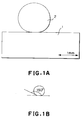
- FIG. 1 is a schematic diagram illustrating a water droplet on the coating film of Embodiment 1.
- a water droplet 2 is on a coating film 1.
- Fig. 1B is a schematic diagram illustrating measurement of water contact angle.
- Fig. 2 shows water contact angles measured when various additives having different surface free energy were added to the coating compositions. More particularly, Fig. 2 illustrates relationship between the surface free energy, (mN/m) of additive and the water contact angle (°).
- filled circles indicate a surfactant-based additive
- blank squares indicate a fluoro oil-base additive.
- Fig. 2 also illustrates respective average surface free energies of fluorocarbon polymer powder and polyvinylidene fluoride as a binder by dot lines (cf. Yoshiaki Kitasaki, Hata, Toshio, Nippon Secchaku Kyokai Shi, Vol. 8, page 131 (1972), E.G. Shafrin and W.A. Zisman, Journal of Physical Chemistry, Vol. 64, page 519 (1972)).
- Comparative Embodiment 1 had a water contact angle of 140°. From these data, it follows that addition of an additive having a surface free energy smaller than that of the binder gives a coating film having water repellent properties equivalent to those of the two-component fluorocarbon polymer coating composition.
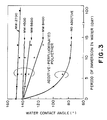
- FIG. 3 is a graph which illustrates relationship between period (numbers of day) of immersion in water and water repellent properties of films made from fluorocarbon polymer coating compositions containing as the additive described above four types of perfluorinated polyethers with different molecular weights, respectively, according to Embodiment 1 of the present invention.
- Fig. 3 also shows water repellent properties of the sample of Comparative Embodiment 1. More particularly, Fig.
- 3 is a graph illustrating time dependent change in water repellent properties of fluoro oil-containing sample films when immersed in water, with the horizontal axis (axis of abscissa) indicating period of immersion in water (day) and the vertical axis (axis of ordinate) indicating water contact angle (°).
- Symbols filled circle, blank circle, filled square and blank square designate the cases where the perfluorinated polyethers used had molecular weights of 2,700, 4,500, 5,600, and 8,400, respectively. Filled triangle designates the case where no additive was used.
- the coating film samples prepared from the coating compositions according to Embodiment 1 of the present invention were immersed in deionized water and taken out after respective predetermined days, followed by measuring water contact angles by the above-described method. This operation was repeated and evaluation was made of effects of a long-term immersion in water.
- the samples obtained by coating the fluorocarbon polymer coating composition of the present invention showed less deterioration with time of water repellent properties as compared with the sample of Comparative Embodiment 1 and are superior in a long-term water resistance.
- the sample containing the fluoro oil having a molecular weight of 2,700 retained a high initial water repellent property even after immersion in water for 100 days.
- the perfluorinated polyether used as the additive in the present invention more preferred are those which have a molecular weight of not larger than 5,600 in view of resistance to long-term water immersion. Further, it is preferred that the fluorocarbon polymer powder is contained in an amount of not smaller than 30% by volume based on the total volume of the coating composition or film. Further, it is more preferred that the coating composition or coating film of the present invention contain the fluorocarbon polymer powder in amounts of not less than 30% by volume.
- the amount of the additive is preferably not more than 10% by volume since the fluorocarbon polymer powder can be dispersed uniformly in the binder when the additive exists in amounts not more than 10% by volume.
- the sample of Comparative Embodiment 1 was evaluated for the surface of the coating composition in the same manner as described above. As a result water contact angle of 140° was observed. Although no remarkable difference in initial water repellent properties just after formation of coating films was observed among the samples containing the fluorocarbon polymer powder having molecular weights other than 2,700, the fluorocarbon polymer coating composition and coating film of the present invention were confirmed to be superior to the conventional fluorocarbon polymer coating composition and film in resistance to long-term water immersion.
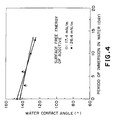
- Fig. 4 is a graph illustrating relationship between period of immersion in water and water repellent properties of coating film samples made from the fluorocarbon polymer coating composition according to Embodiment 1 of the present invention containing 0.5% by volume of a fluorocarbon surfactant as the additive. More particularly, Fig. 4 is a graph illustrating time dependent change in water repellent properties of fluorocarbon surfactant-containing sample films when immersed in water, with the horizontal axis (axis of abscissa) indicating period of immersion in water (day) and the vertical axis (axis of ordinate) indicating water contact angle (°). As for symbols, blank square and filled triangle designate the cases where the perfluorinated polyethers used had surface free energies of 17.4 mN/m and 26.4 mN/m, respectively.
- ice was allowed to adhere on coating films and snow sticking shearing force was measured using a snow sticking force tester.
- the tester is a device with which cylindrical ice piece of 32 mm in diameter deposited on the surface of a coating film sample is pulled at a constant speed in the direction parallel to the surface of the coating film and a change in load until the ice is released by means of a load cell.
- the maximum load is defined as the snow sticking shearing force of the film sample tested.
- Shearing stresses were measured of a sample obtained by spraying a coating composition containing 0.5% by volume of perfluorinated polyether (molecular weight: 2,700) as an additive and the sample of Comparative Embodiment 1. The measurement was repeated 5 times each and average values were calculated.
- the coating film of Embodiment 1 had a snow sticking shearing stress of 23 g/cm 2 while the sample of Comparative Embodiment 1 had a snow sticking shearing stress of 55 g/cm 2 .
- the coating composition of the present invention had a snow sticking shearing stress smaller than the two-component coating composition of Comparative Embodiment 1 and snow deposited on the coating film made from the coating composition of the present invention released readily. Therefore, the present invention is superior in improvement of water repellent properties of coating composition and film over the prior art.
- Embodiments 2 to 31 and Comparative Embodiments 2 to 31 below were examined deterioration with time of water repellent properties of coating films containing various kinds of fluorocarbon polymer powders, binders and additives.
- Polytetrafluoroethylene (molecular weight: 8,500, average particle diameter: 1 ⁇ m) as a fluorocarbon polymer powder, polyvinylidene fluoride as a binder, and perfluorinated polyether (molecular weight: 2,700) as an additive were mixed in the proportions shown in Table 2-1 in a ball mill to prepare fluorocarbon polymer coating compositions containing various amounts of the additive. These fluorocarbon polymer coating compositions were sprayed on respective FRP plates comprised mainly by an epoxy resin to prepare coating film samples for evaluation of the effect of the present invention.
- Table 2-1 shows the compositions of samples A to C of Embodiment 2 in which the content (volume percentage) of the polyvinylidene fluoride and perfluorinated polyether were varied.
- Fluorocarbon polymer coating compositions were prepared in the same manner as in Embodiment 2 except that polytetrafluoroethylene was used as the binder. Coating films were prepared from these coating compositions in the same manner as in Embodiment 2. Table 2-1 shows the compositions of sample films D, E, and F with varied amounts of polytetrafluoroethylene as the binder and perfluorinated polyether as the additive.
- Fluorocarbon polymer coating compositions were prepared in the same manner as in Embodiment 2 except that acrylic silicone resin was used as the binder. Coating films were prepared from these coating compositions in the same manner as in Embodiment 2. Table 2-1 shows the compositions of sample films G, H and I with varied amounts of acrylic silicone resin as the binder and perfluorinated polyether as the additive.
- Fluorocarbon polymer coating compositions were prepared in the same manner as in Embodiment 2 except that polyester resin was used as the binder. Coating films were prepared from these coating compositions in the same manner as in Embodiment 2. Table 2-1 shows the compositions of sample films J, K and L with varied amounts of polyester resin as the binder and perfluorinated polyether as the additive.
- Fluorocarbon polymer coating compositions were prepared in the same manner as in Embodiment 2 except that epoxy resin was used as the binder. Coating films were prepared from these coating compositions in the same manner as in Embodiment 2. Table 2-1 shows the compositions of sample films M, N and O with varied amounts of epoxy resin as the binder and perfluorinated polyether as the additive.
- Fluorocarbon polymer coating compositions were prepared in the same manner as in Embodiment 2 except that perfluorinated alkyl polyether was used as the additive. Coating films were prepared from these coating compositions in the same manner as in Embodiment 2. Table 2-2 shows the compositions of sample films A-1, B-1 and C-1 with varied amounts of polyvinylidene fluoride as the binder and perfluorinated alkyl polyether as the additive.
- Fluorocarbon polymer coating compositions were prepared in the same manner as in Embodiment 3 except that perfluorinated alkyl polyether as used in Embodiment 7 was used as the additive. Coating films were prepared from these coating compositions in the same manner as in Embodiment 2. Table 2-2 shows the compositions of sample films D-1, E-1 and F-1 with varied amounts of polytetrafluoroethylene as the binder and perfluorinated alkyl polyether as the additive.
- Fluorocarbon polymer coating compositions were prepared in the same manner as in Embodiment 4 except that perfluorinated alkyl polyether as used in Embodiment 7 was used as the additive. Coating films were prepared from these coating compositions in the same manner as in Embodiment 2. Table 2-2 shows the compositions of sample films G-1, H-1 and I-1 with varied amounts of acrylic silicone resin as the binder and perfluorinated alkyl polyether as the additive.
- Fluorocarbon polymer coating compositions were prepared in the same manner as in Embodiment 5 except that perfluorinated alkyl polyether as used in Embodiment 7 was used as the additive. Coating films were prepared from these coating compositions in the same manner as in Embodiment 2. Table 2-2 shows the compositions of sample films J-1, K-1 and L-1 with varied amounts of polyester resin as the binder and perfluorinated alkyl polyether as the additive.
- Fluorocarbon polymer coating compositions were prepared in the same manner as in Embodiment 6 except that perfluorinated alkyl polyether as used in Embodiment 7 was used as the additive. Coating films were prepared from these coating compositions in the same manner as in Embodiment 2. Table 2-2 shows the compositions of sample films M-1, N-1 and O-1 with varied amounts of epoxy resin as the binder and perfluorinated alkyl polyether as the additive.
- Fluorocarbon polymer coating compositions were prepared in the same manner as in Embodiment 2 except that polytrifluoroethylene was used as the additive. Coating films were prepared from these coating compositions in the same manner as in Embodiment 2. Table 2-3 shows the compositions of sample films A-2, B-2 and C-2 with varied amounts of polyvinylidene fluoride as the binder and polytrifluoroethylene as the additive.
- Fluorocarbon polymer coating compositions were prepared in the same manner as in Embodiment 3 except that polytrifluoroethylene as used in Embodiment 12 was used as the additive. Coating films were prepared from these coating compositions in the same manner as in Embodiment 2. Table 2-3 shows the compositions of sample films D-2, E-2 and F-2 with varied amounts of polytetrafluoroethylene as the binder and polytrifluoroethylene as the additive.
- Fluorocarbon polymer coating compositions were prepared in the same manner as in Embodiment 4 except that polytrifluoroethylene as used in Embodiment 12 was used as the additive. Coating films were prepared from these coating compositions in the same manner as in Embodiment 2. Table 2-3 shows the compositions of sample films G-2, H-2 and I-2 with varied amounts of acrylic silicone resin as the binder and polytrifluoroethylene as the additive.
- Fluorocarbon polymer coating compositions were prepared in the same manner as in Embodiment 5 except that polytrifluoroethylene as used in Embodiment 12 was used as the additive. Coating films were prepared from these coating compositions in the same manner as in Embodiment 2. Table 2-3 shows the compositions of sample films J-2, K-2 and L-2 with varied amounts of polyester resin as the binder and polytrifluoroethylene as the additive.
- Fluorocarbon polymer coating compositions were prepared in the same manner as in Embodiment 6 except that polytrifluoroethylene as used in Embodiment 12 was used as the additive. Coating films were prepared from these coating compositions in the same manner as in Embodiment 2. Table 2-3 shows the compositions of sample films M-2, N-2 and O-2 with varied amounts of epoxy resin as the binder and polytrifluoroethylene as the additive.
- Fluorocarbon polymer coating compositions were prepared in the same manner as in Embodiment 2 except that tetrafluoroethylene/hexafluoropropylene copolymer powder was used as the fluorocarbon polymer powder. Coating films were prepared from these coating compositions in the same manner as in Embodiment 2. Table 2-4 shows the compositions of sample films A-3, B-3 and C-3 with varied amounts of polyvinylidene fluoride as the binder and perfluorinated polyether as the additive.
- Fluorocarbon polymer coating compositions were prepared in the same manner as in Embodiment 3 except that tetrafluoroethylene/hexafluoropropylene copolymer powder as used in Embodiment 17 was used as the fluorocarbon polymer powder. Coating films were prepared from these coating compositions in the same manner as in Embodiment 2. Table 2-4 shows the compositions of sample films D-3, E-3, and F-3 with varied amounts of polytetrafluoroethylene as the binder and perfluorinated polyether as the additive.
- Fluorocarbon polymer coating compositions were prepared in the same manner as in Embodiment 4 except that tetrafluoroethylene/hexafluoropropylene copolymer powder as used in Embodiment 17 was used as the fluorocarbon polymer powder. Coating films were prepared from these coating compositions in the same manner as in Embodiment 2. Table 2-4 shows the compositions of sample films G-3, H-3 and I-3 with varied amounts of acrylic silicone resin as the binder and perfluorinated polyether as the additive.
- Fluorocarbon polymer coating compositions were prepared in the same manner as in Embodiment 5 except that tetrafluoroethylene/hexafluoropropylene copolymer powder as used in Embodiment 17 was used as the fluorocarbon polymer powder. Coating films were prepared from these coating compositions in the same manner as in Embodiment 2. Table 2-4 shows the compositions of sample films J-3, K-3 and L-3 with varied amounts of polyester resin as the binder and perfluorinated polyether as the additive.
- Fluorocarbon polymer coating compositions were prepared in the same manner as in Embodiment 6 except that tetrafluoroethylene/hexafluoropropylene copolymer powder as used in Embodiment 17 was used as the fluorocarbon polymer powder. Coating films were prepared from these coating compositions in the same manner as in Embodiment 2. Table 2-4 shows the compositions of sample films M, N and O with varied amounts of epoxy resin as the binder and perfluorinated polyether as the additive.
- Fluorocarbon polymer coating compositions were prepared in the same manner as in Embodiment 7 except that tetrafluoroethylene/hexafluoropropylene copolymer powder as used in Embodiment 17 was used as the fluorocarbon polymer powder. Coating films were prepared from these coating compositions in the same manner as in Embodiment 2. Table 2-5 shows the compositions of sample films A-4, B-4 and C-4 with varied amounts of polyvinylidene fluoride as the binder and perfluorinated alkyl polyether as the additive.
- Fluorocarbon polymer coating compositions were prepared in the same manner as in Embodiment 8 except that tetrafluoroethylene/hexafluoropropylene copolymer powder as used in Embodiment 17 was used as the fluorocarbon polymer powder. Coating films were prepared from these coating compositions in the same manner as in Embodiment 2. Table 2-5 shows the compositions of sample films D-4, E-4 and F-4 with varied amounts of polytetrafluoroethylene as the binder and perfluorinated alkyl polyether as the additive.
- Fluorocarbon polymer coating compositions were prepared in the same manner as in Embodiment 9 except that tetrafluoroethylene/hexafluoropropylene copolymer powder as used in Embodiment 17 was used as the fluorocarbon polymer powder. Coating films were prepared from these coating compositions in the same manner as in Embodiment 2. Table 2-5 shows the compositions of sample films G-4, H-4 and I-4 with varied amounts of acrylic silicone resin as the binder and perfluorinated alkyl polyether as the additive.
- Fluorocarbon polymer coating compositions were prepared in the same manner as in Embodiment 10 except that tetrafluoroethylene/hexafluoropropylene copolymer powder as used in Embodiment 17 was used as the polymer powder. Coating films were prepared from these coating compositions in the same manner as in Embodiment 2. Table 2-5 shows the compositions of sample films J-4, K-4 and L-4 with varied amounts of polyester resin as the binder and perfluorinated alkyl polyether as the additive.
- Fluorocarbon polymer coating compositions were prepared in the same manner as in Embodiment 11 except that tetrafluoroethylene/hexafluoropropylene copolymer powder as used in Embodiment 17 was used as the fluorocarbon polymer powder. Coating films were prepared from these coating compositions in the same manner as in Embodiment 2. Table 2-5 shows the compositions of sample films M-4, N-4 and O-4 with varied amounts of epoxy resin as the binder and perfluorinated alkyl polyether as the additive.
- Fluorocarbon polymer coating compositions were prepared in the same manner as in Embodiment 2 except that tetrafluoroethylene/hexafluoropropylene copolymer powder as used in Embodiment 17 was used as the fluorocarbon polymer powder. Coating films were prepared from these coating compositions. in the same manner as in Embodiment 2. Table 2-6 shows the compositions of sample films A-5, B-5 and C-5 with varied amounts of polyvinylidene fluoride as the binder and polytrifluoroethylene as the additive.
- Fluorocarbon polymer coating compositions were prepared in the same manner as in Embodiment 13 except that tetrafluoroethylene/hexafluoropropylene copolymer powder as used in Embodiment 17 was used as the fluorocarbon polymer powder. Coating films were prepared from these coating compositions in the same manner as in Embodiment 2. Table 2-6 shows the compositions of sample films D-5, E-5 and F-5 with varied amounts of polytetrafluoroethylene as the binder and polytrifluoroethylene as the additive.
- Fluorocarbon polymer coating compositions were prepared in the same manner as in Embodiment 14 except that tetrafluoroethylene/hexafluoropropylene copolymer powder as used in Embodiment 17 was used as the fluorocarbon polymer powder. Coating films were prepared from these coating compositions in the same manner as in Embodiment 2. Table 2-6 shows the compositions of sample films G-5, H-5 and I-5 with varied amounts of acrylic silicone resin as the binder and polytrifluoroethylene as the additive.
- Fluorocarbon polymer coating compositions were prepared in the same manner as in Embodiment 15 except that tetrafluoroethylene/hexafluoropropylene copolymer powder as used in Embodiment 17 was used as the fluorocarbon polymer powder. Coating films were prepared from these coating compositions in the same manner as in Embodiment 2. Table 2-6 shows the compositions of sample films J-5, K-5 and L-5 with varied amounts of polyester resin as the binder and polytrifluoroethylene as the additive.
- Fluorocarbon polymer coating compositions were prepared in the same manner as in Embodiment 16 except that tetrafluoroethylene/hexafluoropropylene copolymer powder as used in Embodiment 17 was used as the fluorocarbon polymer powder. Coating films were prepared from these coating compositions in the same manner as in Embodiment 2. Table 2-6 shows the compositions of sample films M-5, N-5 and 0-5 with varied amounts of epoxy resin as the binder and polytrifluoroethylene as the additive.
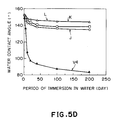
- the coating films samples A to O of Embodiments 2 to 6 and comparative film samples V1 to V5 of Comparative Embodiments 2 to 6 were immersed in deionized water and taken out of the water after predetermined period (days) , followed by measuring water contact angles in the same manner as described in above. This operation was repeated and influences of long-term water immersion were evaluated.
- Figs. 5A, 5B, 5C, 5D and 5E show the results obtained.
- blank circle, blank square, blank triangle indicate samples containing the additive in amounts of 0.5% by volume, 2.0% by volume, and 5.0% by volume, respectively.
- Filled triangle indicates the sample which contain 0% by volume of the additive.
- the fluorocarbon polymer coating films of Embodiments 2 to 6 show a less decrease in water repellent properties with time than the coating films of Comparative Embodiments 2 to 6.
- the coating films of Embodiments 2 to 6 showed a water contact angle of 150° just after formation of the films. Therefore, comparing initial water repellent properties, there was observed no substantial difference between the samples of the present invention and those of comparative embodiments.
- the fluorocarbon polymer coating composition is superior to the conventional fluorocarbon polymer coating composition.
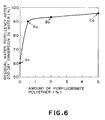
- Fig. 6 illustrates influence of the amount of the perfluorinated polyether on residual water repellent properties after 200 day water immersion, as an index of long-term durability to water.
- symbols A 0 , B 0 and C 0 indicate the film sample groups containing 0.5% by volume, 2.0% by volume and 5.0%, respectively, by volume of perfluorinated polyether as the additive.
- V0 indicates the film sample group containing no additive.
- Residual Water Repellency Water Contact Angle After 200 Day Water Immersion Initial Water Contact Angle and calculated from Figs. 5A, 5B, 5C, 5D and 5E.
- Fig. 6 shows that when 0.5% by volume of perfluorinated polyether is present in the coating film (cf. sample group A 0 ), the residual water repellent property after 200 day water immersion is at least 90%, which means long-term durability to water.
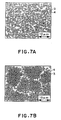
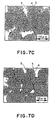
- Figs. 7A, 7B, 7C and 7D are schematic diagrams illustrating the conditions of the surfaces of the coating films observed on SEM (scanning electron microscope) at a magnification of X3,000.
- 3 is a fluorocarbon polymer particle
- 4 is a binder
- 5 is an agglomerate. As shown in Figs.
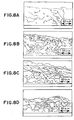
- FIGs. 8A, 8B, 8C and 8D are schematic diagrams illustrating the profile of the film samples A to C of Embodiment 2 and sample V1 of Comparative Embodiment 2 observed on SEM at a magnification of X1,000.
- the FRP plate was notched and applied shearing force to cut.
- the resulting cross section was used as a sample for observing the profile of the coating film.
- no agglomeration of the fluorocarbon polymer powder was observed from the surface to the inside of the coating film.
- the coating films of the present invention that contains an additive in addition to the fluorocarbon polymer powder and the binder has a specific structure that the fluorocarbon polymer particles agglomerate to form agglomerated units to fill the gaps between the fluorocarbon polymer particles so that a decrease in water repellency after prolonged immersion in water can be prevented effectively.
- Polytetrafluoroethylene powder (M.W.: 8,500, average particle diameter: 1 ⁇ m) was prepared under atmosphere of not higher than 0.1% oxygen with an increased degree of fluorination.
- the fluorocarbon polymer powder (H), polyvinylidene fluoride as a binder and perfluorinated polyether (M.W.: 2,700) as an additive were mixed in a ball mill to prepare coating compositions. These coating compositions were sprayed onto respective FRP plates comprised mainly by an epoxy resin to form coating films for evaluation of the effect of the present invention.
- Table 4 shows the compositions of samples A-6 to C-6 in which the content (volume percentage) of the polyvinylidene fluoride as a binder and perfluorinated polyether as an additive were varied.
- a coating film sample was prepared in the same manner as in Embodiment 32 except that no additive was used.
- Table 4 shows the composition of the comparative coating film sample V31 and V32.
Landscapes
- Chemical & Material Sciences (AREA)
- Engineering & Computer Science (AREA)
- Materials Engineering (AREA)
- Organic Chemistry (AREA)
- Life Sciences & Earth Sciences (AREA)
- Wood Science & Technology (AREA)
- Combustion & Propulsion (AREA)
- Paints Or Removers (AREA)
Applications Claiming Priority (3)
| Application Number | Priority Date | Filing Date | Title |
|---|---|---|---|
| JP204073/95 | 1995-07-19 | ||
| JP20407395 | 1995-07-19 | ||
| JP20407395 | 1995-07-19 |
Publications (2)
| Publication Number | Publication Date |
|---|---|
| EP0754738A1 true EP0754738A1 (fr) | 1997-01-22 |
| EP0754738B1 EP0754738B1 (fr) | 2003-03-12 |
Family
ID=16484328
Family Applications (1)
| Application Number | Title | Priority Date | Filing Date |
|---|---|---|---|
| EP96305262A Expired - Lifetime EP0754738B1 (fr) | 1995-07-19 | 1996-07-17 | Composition hydrofuge, composition de revêtement polymère fluorocarboné et film de revêtement |
Country Status (4)
| Country | Link |
|---|---|
| US (1) | US6124388A (fr) |
| EP (1) | EP0754738B1 (fr) |
| CA (1) | CA2181521C (fr) |
| DE (1) | DE69626579T2 (fr) |
Cited By (11)
| Publication number | Priority date | Publication date | Assignee | Title |
|---|---|---|---|---|
| EP0939105A4 (fr) * | 1996-11-18 | 2000-03-01 | Daikin Ind Ltd | Hydrofuge tenace et articles ainsi revetus |
| WO2000039240A1 (fr) * | 1998-12-24 | 2000-07-06 | Sunyx Surface Nanotechnologies Gmbh | Surface ultraphobe |
| EP1153987A3 (fr) * | 2000-05-08 | 2002-07-10 | Basf Aktiengesellschaft | Compositions pour préparer des surfaces difficilement mouillables |
| WO2004024803A1 (fr) * | 2002-09-13 | 2004-03-25 | 3M Innovative Properties Company | Feuille resistante a l'eau recouverte d'un film protecteur, feuille empechant l'adhesion de neige et procede de production d'une planche resistante a l'eau |
| EP1163317A4 (fr) * | 1999-02-25 | 2004-12-29 | Platinum Res Organization Llc | Compositions, a base de catalyseurs, de revetement de surface et procedes associes |
| EP1586613A1 (fr) * | 2004-04-14 | 2005-10-19 | Fuji Jukogyo Kabushiki Kaisha | Matériau de revêtement mélangé et sa méthode de préparation |
| CN103709854A (zh) * | 2013-12-31 | 2014-04-09 | 上海交通大学 | 一种水分散型氟碳面漆涂料及其制备方法 |
| US8771798B2 (en) | 2001-03-21 | 2014-07-08 | Akzo Nobel N.V. | Anti-fouling compositions with a fluorinated alkyl- or alkoxy- containing polymer or oligomer |
| WO2015119943A1 (fr) * | 2014-02-07 | 2015-08-13 | E. I. Du Pont De Nemours And Company | Compositions glaciophobes |
| WO2015195406A1 (fr) * | 2014-06-17 | 2015-12-23 | The Chemours Company Fc, Llc | Particules comprenant du polytétrafluoroéthylène et du perfluoropolyéther |
| EP3115299A1 (fr) * | 2015-06-15 | 2017-01-11 | Fuji Jukogyo Kabushiki Kaisha | Matériau de revêtement mixte, aile et système antigivrage |
Families Citing this family (39)
| Publication number | Priority date | Publication date | Assignee | Title |
|---|---|---|---|---|
| WO2002092660A2 (fr) | 2001-05-14 | 2002-11-21 | Omnova Soltions Inc | Surfactants polymeres derives de monomeres cycliques possedant des groupes lateraux de carbone fluore |
| US6660828B2 (en) | 2001-05-14 | 2003-12-09 | Omnova Solutions Inc. | Fluorinated short carbon atom side chain and polar group containing polymer, and flow, or leveling, or wetting agents thereof |
| US20060078893A1 (en) | 2004-10-12 | 2006-04-13 | Medical Research Council | Compartmentalised combinatorial chemistry by microfluidic control |
| GB0307428D0 (en) | 2003-03-31 | 2003-05-07 | Medical Res Council | Compartmentalised combinatorial chemistry |
| GB0307403D0 (en) | 2003-03-31 | 2003-05-07 | Medical Res Council | Selection by compartmentalised screening |
| US20040245395A1 (en) * | 2003-05-09 | 2004-12-09 | Wallace Randall W. | Aircraft ice protection system |
| US20050221339A1 (en) | 2004-03-31 | 2005-10-06 | Medical Research Council Harvard University | Compartmentalised screening by microfluidic control |
| US7968287B2 (en) | 2004-10-08 | 2011-06-28 | Medical Research Council Harvard University | In vitro evolution in microfluidic systems |
| US20060281861A1 (en) * | 2005-06-13 | 2006-12-14 | Putnam John W | Erosion resistant anti-icing coatings |
| WO2007081385A2 (fr) | 2006-01-11 | 2007-07-19 | Raindance Technologies, Inc. | Dispositifs microfluidiques et leurs procédés d'utilisation dans la formation et le contrôle de nanoréacteurs |
| EP2530167A1 (fr) | 2006-05-11 | 2012-12-05 | Raindance Technologies, Inc. | Dispositifs microfluidiques |
| US9562837B2 (en) | 2006-05-11 | 2017-02-07 | Raindance Technologies, Inc. | Systems for handling microfludic droplets |
| EP2077912B1 (fr) | 2006-08-07 | 2019-03-27 | The President and Fellows of Harvard College | Tensioactifs fluorocarbonés stabilisateurs d'émulsions |
| WO2008097559A2 (fr) | 2007-02-06 | 2008-08-14 | Brandeis University | Manipulation de fluides et de réactions dans des systèmes microfluidiques |
| US8592221B2 (en) | 2007-04-19 | 2013-11-26 | Brandeis University | Manipulation of fluids, fluid components and reactions in microfluidic systems |
| EP4047367A1 (fr) | 2008-07-18 | 2022-08-24 | Bio-Rad Laboratories, Inc. | Procedé de détection d'analytes cibles au moyens des bibliothèques de gouttelettes |
| US12038438B2 (en) | 2008-07-18 | 2024-07-16 | Bio-Rad Laboratories, Inc. | Enzyme quantification |
| WO2010111231A1 (fr) | 2009-03-23 | 2010-09-30 | Raindance Technologies, Inc. | Manipulation de gouttelettes microfluidiques |
| US10520500B2 (en) | 2009-10-09 | 2019-12-31 | Abdeslam El Harrak | Labelled silica-based nanomaterial with enhanced properties and uses thereof |
| US10837883B2 (en) | 2009-12-23 | 2020-11-17 | Bio-Rad Laboratories, Inc. | Microfluidic systems and methods for reducing the exchange of molecules between droplets |
| US9366632B2 (en) | 2010-02-12 | 2016-06-14 | Raindance Technologies, Inc. | Digital analyte analysis |
| EP4484577A3 (fr) | 2010-02-12 | 2025-03-26 | Bio-Rad Laboratories, Inc. | Analyse numérique d'analyte |
| US10351905B2 (en) | 2010-02-12 | 2019-07-16 | Bio-Rad Laboratories, Inc. | Digital analyte analysis |
| US9399797B2 (en) | 2010-02-12 | 2016-07-26 | Raindance Technologies, Inc. | Digital analyte analysis |
| US9562897B2 (en) | 2010-09-30 | 2017-02-07 | Raindance Technologies, Inc. | Sandwich assays in droplets |
| EP3412778A1 (fr) | 2011-02-11 | 2018-12-12 | Raindance Technologies, Inc. | Procédés permettant de former des gouttelettes mélangées |
| WO2012112804A1 (fr) | 2011-02-18 | 2012-08-23 | Raindance Technoligies, Inc. | Compositions et méthodes de marquage moléculaire |
| DE102012208653B4 (de) * | 2011-05-27 | 2019-04-25 | Technische Universität Bergakademie Freiberg | Verfahren zur Herstellung einer Oberflächenbeschichtung mit eisabweisenden Eigenschaften, Oberflächenbeschichtung und deren Verwendung |
| US8841071B2 (en) | 2011-06-02 | 2014-09-23 | Raindance Technologies, Inc. | Sample multiplexing |
| EP3216872B1 (fr) | 2011-06-02 | 2020-04-01 | Bio-Rad Laboratories, Inc. | Quantification d'enzyme |
| US8658430B2 (en) | 2011-07-20 | 2014-02-25 | Raindance Technologies, Inc. | Manipulating droplet size |
| US11901041B2 (en) | 2013-10-04 | 2024-02-13 | Bio-Rad Laboratories, Inc. | Digital analysis of nucleic acid modification |
| US9944977B2 (en) | 2013-12-12 | 2018-04-17 | Raindance Technologies, Inc. | Distinguishing rare variations in a nucleic acid sequence from a sample |
| WO2015103367A1 (fr) | 2013-12-31 | 2015-07-09 | Raindance Technologies, Inc. | Système et procédé de détection d'une espèce d'arn |
| US10647981B1 (en) | 2015-09-08 | 2020-05-12 | Bio-Rad Laboratories, Inc. | Nucleic acid library generation methods and compositions |
| CN105713574B (zh) * | 2016-02-29 | 2017-10-17 | 中国铁道科学研究院金属及化学研究所 | 一种铁路机车车辆防冰液 |
| CN110350196B (zh) * | 2019-06-27 | 2022-07-05 | 东华大学 | 一种复合粘结剂、硅基负极片及其制备方法 |
| KR102224071B1 (ko) | 2019-10-25 | 2021-03-05 | 한국화학연구원 | 불소계 고분자 복합막 및 이의 제조방법 |
| CN116675959B (zh) * | 2023-06-14 | 2025-09-12 | 湖南中能新材料技术有限公司 | 一种防水保护膜及其制备方法与应用 |
Citations (5)
| Publication number | Priority date | Publication date | Assignee | Title |
|---|---|---|---|---|
| EP0132716A1 (fr) * | 1983-07-15 | 1985-02-13 | Laboratoire Suisse de Recherches Horlogères | Composition de peinture lubrifiante |
| EP0503872A1 (fr) * | 1991-03-12 | 1992-09-16 | Nobuatsu Watanabe | Matériau composité contenant un composé du fluor et procédé de fabrication |
| JPH06122841A (ja) * | 1992-10-13 | 1994-05-06 | Nippon Telegr & Teleph Corp <Ntt> | はっ水性粉体塗料及びその塗装方法 |
| JPH06248110A (ja) * | 1993-02-26 | 1994-09-06 | Nippon Telegr & Teleph Corp <Ntt> | はっ水性、耐食性、耐着雪性、耐候性及び潤滑性に優れた材料及びその製造方法 |
| WO1994021729A1 (fr) * | 1993-03-17 | 1994-09-29 | Daikin Industries, Ltd. | Composition de revetement en caoutchouc fluore et methode de modification de surface de base |
Family Cites Families (3)
| Publication number | Priority date | Publication date | Assignee | Title |
|---|---|---|---|---|
| US3975352A (en) * | 1974-08-13 | 1976-08-17 | Eastman Kodak Company | Repellent compositions and elements containing the same |
| JPH03184208A (ja) * | 1989-12-13 | 1991-08-12 | Fujikura Ltd | 絶縁電線 |
| JP2614825B2 (ja) * | 1994-06-07 | 1997-05-28 | 北海道 | 着雪氷防止塗料組成物 |
-
1996
- 1996-07-17 DE DE69626579T patent/DE69626579T2/de not_active Expired - Fee Related
- 1996-07-17 US US08/682,353 patent/US6124388A/en not_active Expired - Fee Related
- 1996-07-17 EP EP96305262A patent/EP0754738B1/fr not_active Expired - Lifetime
- 1996-07-18 CA CA002181521A patent/CA2181521C/fr not_active Expired - Fee Related
Patent Citations (6)
| Publication number | Priority date | Publication date | Assignee | Title |
|---|---|---|---|---|
| EP0132716A1 (fr) * | 1983-07-15 | 1985-02-13 | Laboratoire Suisse de Recherches Horlogères | Composition de peinture lubrifiante |
| EP0503872A1 (fr) * | 1991-03-12 | 1992-09-16 | Nobuatsu Watanabe | Matériau composité contenant un composé du fluor et procédé de fabrication |
| JPH06122841A (ja) * | 1992-10-13 | 1994-05-06 | Nippon Telegr & Teleph Corp <Ntt> | はっ水性粉体塗料及びその塗装方法 |
| JPH06248110A (ja) * | 1993-02-26 | 1994-09-06 | Nippon Telegr & Teleph Corp <Ntt> | はっ水性、耐食性、耐着雪性、耐候性及び潤滑性に優れた材料及びその製造方法 |
| WO1994021729A1 (fr) * | 1993-03-17 | 1994-09-29 | Daikin Industries, Ltd. | Composition de revetement en caoutchouc fluore et methode de modification de surface de base |
| EP0690096A1 (fr) * | 1993-03-17 | 1996-01-03 | Daikin Industries, Ltd. | Composition de revetement en caoutchouc fluore et methode de modification de surface de base |
Non-Patent Citations (2)
| Title |
|---|
| DATABASE WPI Week 9423, Derwent World Patents Index; AN 94-186504, XP002017793 * |
| DATABASE WPI Week 9440, Derwent World Patents Index; AN 94-322286, XP002017792 * |
Cited By (19)
| Publication number | Priority date | Publication date | Assignee | Title |
|---|---|---|---|---|
| EP0939105A4 (fr) * | 1996-11-18 | 2000-03-01 | Daikin Ind Ltd | Hydrofuge tenace et articles ainsi revetus |
| US7285331B1 (en) | 1998-12-24 | 2007-10-23 | Qiagen Gmbh | Ultraphobic surface |
| WO2000039240A1 (fr) * | 1998-12-24 | 2000-07-06 | Sunyx Surface Nanotechnologies Gmbh | Surface ultraphobe |
| CZ301248B6 (cs) * | 1998-12-24 | 2009-12-23 | Qiagen Gmbh | Strukturovaný ultrafobní povrch, zpusob jeho prípravy a jeho použití |
| EP1163317A4 (fr) * | 1999-02-25 | 2004-12-29 | Platinum Res Organization Llc | Compositions, a base de catalyseurs, de revetement de surface et procedes associes |
| EP1153987A3 (fr) * | 2000-05-08 | 2002-07-10 | Basf Aktiengesellschaft | Compositions pour préparer des surfaces difficilement mouillables |
| US6683126B2 (en) | 2000-05-08 | 2004-01-27 | Basf Aktiengesellschaft | Compositions for producing difficult-to-wet surface |
| US8771798B2 (en) | 2001-03-21 | 2014-07-08 | Akzo Nobel N.V. | Anti-fouling compositions with a fluorinated alkyl- or alkoxy- containing polymer or oligomer |
| WO2004024803A1 (fr) * | 2002-09-13 | 2004-03-25 | 3M Innovative Properties Company | Feuille resistante a l'eau recouverte d'un film protecteur, feuille empechant l'adhesion de neige et procede de production d'une planche resistante a l'eau |
| US6949278B2 (en) | 2002-09-13 | 2005-09-27 | 3M Innovative Properties Company | Water-repellent sheet with protective film, sheet for preventing snow adhesion and method for producing water-repellent board |
| EP1586613A1 (fr) * | 2004-04-14 | 2005-10-19 | Fuji Jukogyo Kabushiki Kaisha | Matériau de revêtement mélangé et sa méthode de préparation |
| CN103709854A (zh) * | 2013-12-31 | 2014-04-09 | 上海交通大学 | 一种水分散型氟碳面漆涂料及其制备方法 |
| WO2015119943A1 (fr) * | 2014-02-07 | 2015-08-13 | E. I. Du Pont De Nemours And Company | Compositions glaciophobes |
| WO2015195406A1 (fr) * | 2014-06-17 | 2015-12-23 | The Chemours Company Fc, Llc | Particules comprenant du polytétrafluoroéthylène et du perfluoropolyéther |
| CN106661236A (zh) * | 2014-06-17 | 2017-05-10 | 科慕埃弗西有限公司 | 包含聚四氟乙烯和全氟聚醚的颗粒 |
| US10087290B2 (en) | 2014-06-17 | 2018-10-02 | The Chemours Company Fc, Llc | Particles comprising polytetrafluoroethylene and perfluoropolyether |
| CN106661236B (zh) * | 2014-06-17 | 2020-08-04 | 科慕埃弗西有限公司 | 包含聚四氟乙烯和全氟聚醚的颗粒 |
| EP3115299A1 (fr) * | 2015-06-15 | 2017-01-11 | Fuji Jukogyo Kabushiki Kaisha | Matériau de revêtement mixte, aile et système antigivrage |
| US10351247B2 (en) | 2015-06-15 | 2019-07-16 | Subaru Corporation | Wing and anti-icing system |
Also Published As
| Publication number | Publication date |
|---|---|
| DE69626579D1 (de) | 2003-04-17 |
| EP0754738B1 (fr) | 2003-03-12 |
| CA2181521A1 (fr) | 1997-01-20 |
| CA2181521C (fr) | 2000-02-29 |
| DE69626579T2 (de) | 2003-11-20 |
| US6124388A (en) | 2000-09-26 |
Similar Documents
| Publication | Publication Date | Title |
|---|---|---|
| US6124388A (en) | Water repellent composition, fluorocarbon polymer coating composition and coating film therefrom | |
| CA2202834C (fr) | Composition de revetement hydrofuge et pellicule de revetement et articles revetus de ce produit | |
| US10465091B2 (en) | Durable icephobic surfaces | |
| US10590038B1 (en) | Producing cementitious materials with improved hydrophobicity and strength using reclaimed waste substances | |
| Bongiovanni et al. | Perfluoropolyether structures as surface modifying agents of UV‐curable systems | |
| US11136464B2 (en) | Articles subject to ice formation comprising a repellent surface | |
| EP0825241A1 (fr) | Revêtement hydrophobe, procédé pour sa préparation, revêtements et articles revêtus | |
| DE19741225A1 (de) | Wischerblatt und Verfahren zu seiner Herstellung | |
| US6579620B2 (en) | Water-repellent coating and coating film | |
| KR940001713B1 (ko) | 경화성 수지 조성물 | |
| Toselli et al. | Poly (ϵ-caprolactone)-poly (fluoroalkylene oxide)-poly (ϵ-caprolactone) block copolymers. 2. Thermal and surface properties | |
| US3893962A (en) | Telephone cable filling composition (II) | |
| US20190382590A1 (en) | Articles subject to ice formation comprising a repellent surface comprising a fluorochemical material | |
| US5050959A (en) | Fiber optic compositions and method for making thereof | |
| EP0173071A2 (fr) | Composition de revêtement aqueuse à base de résines de fluorocarbures | |
| CA2027685C (fr) | Feuillard d'acier enduit d'une couche organique composite a resistance a la corrosion et a sondabilite ameliorees | |
| JPH0987574A (ja) | フッ素樹脂組成物、フッ素樹脂塗料およびその塗膜 | |
| EP0562660A1 (fr) | Composition pour protéger les miroirs à revêtement métallique contre la corrosion et leur procédé de préparation | |
| Atteya et al. | Optimization of nano and micro filler concentration in epoxy matrix for better mechanical and anticorrosion properties | |
| KR0128134B1 (ko) | 방청성 및 윤활특성이 우수한 강판 피복용 수지용액 | |
| Hirano et al. | Accelerated weatherability of shed materials for composite insulators | |
| CN116333595B (zh) | 风机叶片防冰涂层以及风机叶片 | |
| Yang et al. | Preparation and study of graphite nanoplatelets/waterborne acrylate composite anticorrosive coating | |
| JP3485295B2 (ja) | はっ水性塗料 | |
| EP1360249B1 (fr) | Revetement sous-marin a base d'epoxy |
Legal Events
| Date | Code | Title | Description |
|---|---|---|---|
| PUAI | Public reference made under article 153(3) epc to a published international application that has entered the european phase |
Free format text: ORIGINAL CODE: 0009012 |
|
| AK | Designated contracting states |
Kind code of ref document: A1 Designated state(s): DE FR GB |
|
| 17P | Request for examination filed |
Effective date: 19970312 |
|
| 17Q | First examination report despatched |
Effective date: 19970807 |
|
| GRAG | Despatch of communication of intention to grant |
Free format text: ORIGINAL CODE: EPIDOS AGRA |
|
| GRAG | Despatch of communication of intention to grant |
Free format text: ORIGINAL CODE: EPIDOS AGRA |
|
| GRAH | Despatch of communication of intention to grant a patent |
Free format text: ORIGINAL CODE: EPIDOS IGRA |
|
| GRAH | Despatch of communication of intention to grant a patent |
Free format text: ORIGINAL CODE: EPIDOS IGRA |
|
| GRAA | (expected) grant |
Free format text: ORIGINAL CODE: 0009210 |
|
| AK | Designated contracting states |
Designated state(s): DE FR GB |
|
| REG | Reference to a national code |
Ref country code: GB Ref legal event code: FG4D |
|
| REF | Corresponds to: |
Ref document number: 69626579 Country of ref document: DE Date of ref document: 20030417 Kind code of ref document: P |
|
| ET | Fr: translation filed | ||
| PLBE | No opposition filed within time limit |
Free format text: ORIGINAL CODE: 0009261 |
|
| STAA | Information on the status of an ep patent application or granted ep patent |
Free format text: STATUS: NO OPPOSITION FILED WITHIN TIME LIMIT |
|
| 26N | No opposition filed |
Effective date: 20031215 |
|
| PGFP | Annual fee paid to national office [announced via postgrant information from national office to epo] |
Ref country code: FR Payment date: 20060623 Year of fee payment: 11 |
|
| PGFP | Annual fee paid to national office [announced via postgrant information from national office to epo] |
Ref country code: GB Payment date: 20060717 Year of fee payment: 11 |
|
| PGFP | Annual fee paid to national office [announced via postgrant information from national office to epo] |
Ref country code: DE Payment date: 20060828 Year of fee payment: 11 |
|
| GBPC | Gb: european patent ceased through non-payment of renewal fee |
Effective date: 20070717 |
|
| PG25 | Lapsed in a contracting state [announced via postgrant information from national office to epo] |
Ref country code: DE Free format text: LAPSE BECAUSE OF NON-PAYMENT OF DUE FEES Effective date: 20080201 |
|
| PG25 | Lapsed in a contracting state [announced via postgrant information from national office to epo] |
Ref country code: GB Free format text: LAPSE BECAUSE OF NON-PAYMENT OF DUE FEES Effective date: 20070717 |
|
| REG | Reference to a national code |
Ref country code: FR Ref legal event code: ST Effective date: 20080331 |
|
| PG25 | Lapsed in a contracting state [announced via postgrant information from national office to epo] |
Ref country code: FR Free format text: LAPSE BECAUSE OF NON-PAYMENT OF DUE FEES Effective date: 20070731 |