EP0755122A2 - Verfahren und Anordnung zur Bestimmung eines adaptiven Abbruchkriteriums beim iterativen Decodieren multidimensional codierter Information - Google Patents
Verfahren und Anordnung zur Bestimmung eines adaptiven Abbruchkriteriums beim iterativen Decodieren multidimensional codierter Information Download PDFInfo
- Publication number
- EP0755122A2 EP0755122A2 EP96111310A EP96111310A EP0755122A2 EP 0755122 A2 EP0755122 A2 EP 0755122A2 EP 96111310 A EP96111310 A EP 96111310A EP 96111310 A EP96111310 A EP 96111310A EP 0755122 A2 EP0755122 A2 EP 0755122A2
- Authority
- EP
- European Patent Office
- Prior art keywords
- decoding
- weighted
- iterative decoding
- relative entropy
- information
- Prior art date
- Legal status (The legal status is an assumption and is not a legal conclusion. Google has not performed a legal analysis and makes no representation as to the accuracy of the status listed.)
- Granted
Links
- 230000003044 adaptive effect Effects 0.000 title claims abstract description 10
- 238000000034 method Methods 0.000 title claims description 40
- 230000005540 biological transmission Effects 0.000 claims description 2
- 102100026190 Class E basic helix-loop-helix protein 41 Human genes 0.000 description 10
- 101000765033 Homo sapiens Class E basic helix-loop-helix protein 41 Proteins 0.000 description 10
- 102100026191 Class E basic helix-loop-helix protein 40 Human genes 0.000 description 8
- 101710130550 Class E basic helix-loop-helix protein 40 Proteins 0.000 description 8
- 238000009826 distribution Methods 0.000 description 5
- 238000004364 calculation method Methods 0.000 description 4
- 230000009897 systematic effect Effects 0.000 description 3
- 238000011161 development Methods 0.000 description 2
- 230000018109 developmental process Effects 0.000 description 2
- 238000010586 diagram Methods 0.000 description 2
- 230000007935 neutral effect Effects 0.000 description 2
- 238000009825 accumulation Methods 0.000 description 1
- 238000012937 correction Methods 0.000 description 1
- 230000003111 delayed effect Effects 0.000 description 1
- 238000009795 derivation Methods 0.000 description 1
- 230000000694 effects Effects 0.000 description 1
- 239000011159 matrix material Substances 0.000 description 1
- 238000005457 optimization Methods 0.000 description 1
- 238000012545 processing Methods 0.000 description 1
Images

Classifications
-
- H—ELECTRICITY
- H04—ELECTRIC COMMUNICATION TECHNIQUE
- H04L—TRANSMISSION OF DIGITAL INFORMATION, e.g. TELEGRAPHIC COMMUNICATION
- H04L1/00—Arrangements for detecting or preventing errors in the information received
- H04L1/004—Arrangements for detecting or preventing errors in the information received by using forward error control
- H04L1/0045—Arrangements at the receiver end
- H04L1/0047—Decoding adapted to other signal detection operation
- H04L1/005—Iterative decoding, including iteration between signal detection and decoding operation
- H04L1/0051—Stopping criteria
-
- H—ELECTRICITY
- H03—ELECTRONIC CIRCUITRY
- H03M—CODING; DECODING; CODE CONVERSION IN GENERAL
- H03M13/00—Coding, decoding or code conversion, for error detection or error correction; Coding theory basic assumptions; Coding bounds; Error probability evaluation methods; Channel models; Simulation or testing of codes
- H03M13/29—Coding, decoding or code conversion, for error detection or error correction; Coding theory basic assumptions; Coding bounds; Error probability evaluation methods; Channel models; Simulation or testing of codes combining two or more codes or code structures, e.g. product codes, generalised product codes, concatenated codes, inner and outer codes
- H03M13/2957—Turbo codes and decoding
- H03M13/2975—Judging correct decoding, e.g. iteration stopping criteria
-
- H—ELECTRICITY
- H04—ELECTRIC COMMUNICATION TECHNIQUE
- H04L—TRANSMISSION OF DIGITAL INFORMATION, e.g. TELEGRAPHIC COMMUNICATION
- H04L1/00—Arrangements for detecting or preventing errors in the information received
- H04L1/004—Arrangements for detecting or preventing errors in the information received by using forward error control
- H04L1/0056—Systems characterized by the type of code used
- H04L1/0064—Concatenated codes
- H04L1/0066—Parallel concatenated codes
Definitions
- the coding device at the transmitter derives control characters from the characters representing the information by appropriate coding. With the help of these control characters, it is possible for the recipient to detect changed information characters and, if necessary, to correct them.
- Various coding methods are available for channel coding. One of these methods is multidimensional coding.
- the code group used here includes the "Near Shannon limit error-correcting and decoding: Turbo-Codes (1)" by C. Berrou, Proc. ICC '93, May 1993 and C. Berrou, A. Glambibo-Codes: General principles and applications” R. de Gaudenzi and M. Luise (Ed.), Audio and Video Digital Radio Broadcasting Systems and Techniques, Proc. of the 6th Tirrenia Int. Workshop on Digital Communications, pp. 215-226, 1993, described concatenated systematic recursive codes - "Turbo Codes”.
- Multidimensional codes are decoded iteratively at the receiving end.
- C. Berrou presents an iterative decoding method for the case of two systematic recursive codes in European patent application EP 92 460 011.7, but without going into adaptive termination criteria.
- An adaptive termination criterion allows the number of, deviating from a predetermined fixed number of iterations Adapt iterations flexibly to the course of the decoding.
- Statistical studies show that the decoded control characters can often be determined with a high degree of certainty after only a few iterations. Further iterations contribute little to the efficiency of the coding process.
- P. Robertson "Illuminating the structure of code and decoder for parallel concatenated recursive systematic (Turbo) codes", submitted GLOBECOM '94, describes an adaptive termination criterion based on a comparison of the noise variance of the channel transmitting the information with a signal given by a given signal -Noise ratio and thus a channel designated error rate. If the noise variance determined after an iteration step yields a value smaller than the predetermined value corresponding to a signal-to-noise ratio, the iterative decoding process is terminated.
- the invention is therefore based on the object of specifying a method and an arrangement for determining an adaptive termination criterion in the iterative decoding of multidimensionally coded information which avoids the disadvantages mentioned above.
- the particular inventive aspect lies in the use of the information (extrinsic information) additionally obtained during the iterative decoding process for determining the termination of the decoding method.
- the weighted decision soft output
- each of the information characters to be decoded in particular information bits for digital characters
- the determination of the approximation of the relative entropy from the weighted decisions of two partial iterations, on which the proposed termination criterion is based, can thus be initiated both after a partial iteration step and after a complete iteration.
- L ( û k ) the a priori information and the extrinsic information from the decoding of the jth component code that is current at the time i.
- L ( i ) P ( û k ) characterize the binary distribution P ( i ) k .
- the distribution Q ( i ) k is then replaced by the L value L ( i ) Q ( û k ), which differs from L ( i ) P ( û k ) differs in that at least one summand comes from the sum of the n extrinsic information from a previous partial iteration ⁇ ( ⁇ ⁇ i ).
- D ⁇ ( P ( i ) ⁇ Q ( i ) ) ( k ) D ⁇ ( P ( i ) k ⁇ Q ( i ) k ) the cross entropy D (P ⁇ Q) of the ith partial iteration, which, since P ( i ) from the L values of the ith part iteration and Q ( i ) in addition to the L values of the ith part iteration, also from the L values depends on at least one partial iteration ⁇ ( ⁇ ⁇ i ), which is a measure of the change in the decisions of second partial iterations i and ⁇ .
- the termination criterion can be formulated as follows using D ⁇ ( P ( i ) ⁇ Q ( i ) ) :
- the iterative decoding can be terminated after the partial iteration i, if D ⁇ ( P ( i ) ⁇ Q ( i ) ) ⁇ S .
- both the quality and the complexity of the decoding can be influenced.
- the particular advantage of this procedure lies in the fact that the additionally obtained information (extrinsic information) is already generated by the known method, so that additional calculation processes are not required.
- the comparison of the weighted decisions about the information bits is made after completion of a complete iteration step, including the extrinsic information obtained from the decoding of all component codes of the multi-dimensional code.
- the contribution of an iteration step is fully evaluated and integrated into the termination criterion.
- the calculation of the approximation of the relative entropy can be carried out by processing the extrinsic information and the result can be compared with a threshold value. In the event that the relative entropy is less than the threshold value, the iterative decoding can be terminated - claim 3.
- the proposed adaptive termination criterion includes all the methods that are in the termination condition (4) Instead of D ⁇ ( P ( i ) ⁇ Q ( i ) ) use other approximations of cross entropy, the cross entropy itself or other quantities that are similar in properties to cross entropy.
- the last group includes, in particular, the quantities which evaluate the difference in the results of the decoding of two or more different partial iterations mainly by forming the difference between the soft output values or by forming parts of the soft output values.
- the determination of a threshold value, with which the relative entropy is compared, represents a characteristic value for the decoding quality, which can be selected according to the type of service to which the transmitted information belongs. If the information is transmitted within predetermined frames, the threshold value for each frame can be defined separately in the sense of the flexibility of the method according to the invention.
- the termination criterion determined in the context of the method according to the invention can be combined with further additional termination criteria.
- This additional termination criterion can e.g. be a specified number of iterations that mark a maximum tolerable decoding delay.
- the decoding module in FIG. 1 effects an iteration step in the sense of an iterative decoding of the received information.
- an extrinsic information Z p feedback method
- the module has three inputs, for the characters X p representing the information, the control characters corresponding to the channel coding Y p and the extrinsic information Z p generated in the last iteration substep.
- the decoding module has five outputs, the characters X p representing the information being delayed by the shift register SR1 and the control characters Y p by the shift register SR2 and also being present at the outputs of the decoding module.
- the extrinsic information Z p + 1 obtained by the current iteration step of iterative decoding forms an output of the decoding module and is returned to the input via a first register R1, output a provides the termination decision and output S p + 1 delivers one after the last iteration weighted decision about the information sent.
- a first input of a first decoder DEC1 is connected to the input of the decoding module which carries the character X p .
- An output of the first register R1 feeds the first decoder DEC1 to a second input the extrinsic information Z p obtained during the last iteration substep.
- This information Z p is set to a neutral value before the first iteration via a reset input Reset of the first register R1.
- a third input of the first decoder DEC1 is connected to the first contact of a two-stage switch US.
- the switch US is also connected to the input of the decoding module carrying the control characters Y p .
- An output of the first decoder DEC1 supplies first intermediate information x1, which contains both the extrinsic information Z p of the decoding and the characters X p representing the information, to an input of an interleaver I.
- first intermediate information x1 is scrambled into second intermediate information x2.
- An output of the interleaver I is connected to a first input of a second decoder DEC2, so that the second intermediate information x2 is present at the second decoder DEC2.
- a second input of the second decoder DEC2 is connected to a second contact of the switch US.
- the switch US switches two serially existing sequences of control characters Y p to the two decoders DEC1, DEC2 and inserts neutral characters if necessary. Parallel lines can also be selected for the control characters Y p without the changeover switch US.
- the second decoder DEC2 is connected on the one hand to an input of a first deinterleaver DE1 and on the other hand to an input of a second deinterleaver DE2.
- the first deinterleaver DE1 provides a signal S p + 1 , the soft output of the iteration, at the output.
- the output of the second deinterleaver DE2 provides fourth intermediate information x4 which represents the extrinsic information obtained by the current iteration step and is supplied to an input of the first register R1.
- the soft output S p + 1 at the output of the first deinterleaver DE1 is applied both to an input of a second register R2 and to an input of a device INT.
- a second input of the device INT is connected to the output of the second register R2.
- a signal a representing the termination decision is present at an output of the device INT determining the termination of the iterative decoding method.
- the shift registers SR1 and SR2 delay the characters X p representing the information and the control characters Y p until the decisions made by the iteration step are available at the outputs of the decoding module.
- the decoding module processes binary characters, for example, the characters X p , Y p and Z p being available as bit sequences of n bits.
- the first decoder DEC1 corresponds to the first encoder of the coding device.
- the decoding result of the first decoder DEC1, the first intermediate information x1 is fed to the interleaver I, which scrambles the bits within the character sequence in accordance with an interleaver matrix.
- This scrambled character sequence is the second intermediate information x2, which is decoded in the second decoder DEC2 together with the corresponding part of the control character sequence Y p .
- the second decoder DEC2 corresponds to the second encoder of the coding device, which generates the associated part of the control character sequence Y p .
- the second decoder DEC2 generates the third intermediate information x3, which corresponds to the soft output S p + 1 of the iteration after the first deinterleaver DE1.
- the first decoder DEC1 and the second decoder DEC2 do not necessarily have to use the same decoding methods. They only have to correspond to the associated coders of the coding device.
- the fourth intermediate information x4 also generated by the second decoder DEC2 is, after deinterleaving in the second deinterleaver DE2, extrinsic information Z p + 1 of the current iteration step in the first register R1 written so that it is available as extrinsic information Z p for the next iteration step.
- the soft output S p + 1 provided at the output of the second deinterleaver DE1 is written into the second register R2.
- the second register R2 is constructed and clocked in such a way that the soft output S p and S p + 1 of two successive iteration steps is present at the device for deciding on the termination INT.
- An abort signal a is generated by this device INT.
- a subtracting element SUB is connected with its subtracting input to the soft output S p generated in the previous iteration step and via its adding input to the soft output S p + 1 generated in the current iteration step.
- An output of the subtractor SUB with the signal S p + 1 -S p has a connection to a squarer Q, which generates the signal (S p + 1 -S p ) squared.
- the signal (S p + 1 -S p ) 2 is fed to a multiplier MUL.
- a multiplier is multiplied in this multiplier MUL, which was generated by forming the amount of the soft output S p + 1 generated in the previous iteration step in a means for forming the amount B and by calculating an expotential function in an means for forming the expotential EX.
- the squarer Q and the means for forming the expotential function EX can be realized by means of corresponding computing routines or by tables with non-linearly quantized input and output values. Accordingly, the multiplier MUL can also be simplified.
- the multiplication result is added up in an accumulator AKK connected to the output of the multiplier MUL.
- the relative entropy D of the current iteration is thus approximately present at the output of the accumulator AKK.
- a threshold switch S1 following the accumulator AKK the summed relative entropy D is compared with an adjustable threshold value S.
- the accumulator AKK is reset, so that when deciding whether to terminate the iterative decoding, the relative entropy D of the last iteration step is compared with the threshold value S. If the relative entropy D is less than the threshold value S, an abort signal a is generated at an output of the threshold value switch S1.
- This termination signal a is evaluated by the decoding module and, after termination of the decoding, the soft output S p + 1 is made available to subsequent modules after the last iteration - not shown.
- the calculation of the relative entropy D can be terminated.
- other calculation methods of the termination signal a can also be used using variables similar to the relative entropy D.
Landscapes
- Engineering & Computer Science (AREA)
- Computer Networks & Wireless Communication (AREA)
- Signal Processing (AREA)
- Physics & Mathematics (AREA)
- Probability & Statistics with Applications (AREA)
- Theoretical Computer Science (AREA)
- Error Detection And Correction (AREA)
- Compression, Expansion, Code Conversion, And Decoders (AREA)
- Measuring Fluid Pressure (AREA)
Abstract
Description
- Bei der Übertragung von Information von einem Sender zu einem Empfänger auf gestörten Nachrichtenkanälen treten Fehler auf, die es empfängerseitig zu erkennen und zu korrigieren gilt. Dazu werden bei der Kanalcodierung zusätzlich zu den die Information repräsentierenden Zeichen weitere redundante Kontrollzeichen übertragen.
- Die Codiereinrichtung beim Sender leitet bei der Kanalcodierung Kontrollzeichen aus den die Information repräsentierenden Zeichen durch eine entsprechende Codierung ab. Mit Hilfe dieser Kontrollzeichen ist es empfängerseitig möglich, geänderte Informationszeichen zu detektieren und gegebenenfalls zu korrigieren. Für die Kanalcodierung stehen verschiedenartige Codierungsverfahren zur Verfügung. Eines dieser Verfahren ist die multidimensionale Codierung. Zu der dabei verwendeten Codegruppe zählen die von C. Berrou "Near Shannon limit error-correcting and decoding: Turbo-Codes (1)", Proc. ICC '93, May 1993 und C. Berrou, A. Glavieux, "Turbo-Codes: General principles and applications" R. de Gaudenzi and M. Luise (Ed.), Audio and Video Digital Radio Broadcasting Systems and Techniques, Proc. of the 6th Tirrenia Int. Workshop on Digital Communications, pp. 215-226, 1993, beschriebenen parallel verketteten systematischen rekursiven Codes - "Turbo-Codes".
- Multidimensionale Codes werden empfangsseitig iterativ decodiert. C. Berrou stellt hierfür für den Fall von zwei systematischen rekursiven Codes in der europäischen Patentanmeldung EP 92 460 011.7 ein iteratives Decodierverfahren vor, ohne jedoch auf adaptive Abbruchkriterien einzugehen. Ein adaptives Abbruchkriterium gestattet es, abweichend von einer vorgegebenen festen Anzahl von Iterationen, die Anzahl der Iterationen flexibel an den Verlauf der Decodierung anzupassen. Statistische Untersuchungen zeigen, daß oft schon nach wenigen Iterationen die decodierten Kontrollzeichen mit hoher Sicherheit bestimmt werden können. Weitere Iterationen tragen nur noch wenig zur Leistungsfähigkeit des Codierverfahrens bei.
- Aus M. Moher,
 Decoding via Cross-entropy Minimization
 , Proceedings of GLOBECOM
 93, IEEE Global Telecommunications Conference, Vol. 2, Houston, TX, USA, 19.11.-2.12.1993, S. 809-813, ist ein Decodierverfahren zur Decodierung von Produktcodes bekannt, das auf einer Abschätzung der Entropie beruht. Dabei werden die empfangenen Kanalinformationen mit den aus den Paritätsgleichungen (Paritätsbits und Nutzbits) bestimmten Codewörtern verglichen. Je ähnlicher das Decodierergebnis (die bestimmten Codewörter) den Kanalinformationen ist - dabei ist die relative Entropie minimal - umso besser ist die Decodierung. Hierbei dient die relative Entropie als Optimierungskriterium für die Decodierung.
 - Aus P. Robertson, "Illuminating the structure of code and decoder for parallel concatenated recursive systematic (Turbo) codes", submitted GLOBECOM '94, ist ein adaptives Abbruchkriterium basierend auf einen Vergleich der Rauschvarianz des die Information übermittelnden Kanals mit einem durch ein vorgegebenes Signal-Rausch-Verhältnis und damit einer Fehlerrate bezeichneten Kanal. Ergibt die nach einem Iterationsschritt bestimmte Rauschvarianz einen Wert kleiner als der vorbestimmte, mit einem Signal-Rausch-Verhältnis korrespondierende Wert, so wird der iterative Decodierungsvorgang abgebrochen. Es liegt damit ein Abbruchkriterium vor, das auf einer Schätzung der Qualität der Decodierung beruht und lediglich auf der empirischen Feststellung aufbaut, daß bei stark fehlerbehafteten Zeichensequenzen die Rauschvarianz bis zur die vollständige Fehlerbehebung ermöglichenden Iterationsschritt sehr hoch ist. Im übrigen ist der Rechenaufwand zur Bestimmung dieses Abbruchkriteriums sehr hoch.
- Der Erfindung liegt somit die Aufgabe zugrunde, ein Verfahren und eine Anordnung zur Bestimmung eines adaptiven Abbruchkriteriums beim iterativen Decodieren multidimensional codierter Information anzugeben, das die oben genannten Nachteile vermeidet.
- Diese Aufgabe wird durch das Verfahren nach den Merkmalen des Anspruchs 1 gelöst. In einem unabhängigen Anspruch wird eine Anordnung zur Durchführung des erfindungsgemäßen Verfahrens angegeben.
- Der besondere erfinderische Aspekt liegt in der Nutzung der während des Prozesses der iterativen Decodierung zusätzlich gewonnenen Information (Extrinsic Information) zur Bestimmung des Abbruchs des Decodierungsverfahrens. Nach einer jeden Decodierung eines der Komponentencodes des multidimensionalen Codes kann die gewichtete Entscheidung (Soft Output) über jedes der zu decodierenden Informationszeichen (insbesondere Informationsbits bei digitalen Zeichen) als Summe der Extrinsic Information aus der jeweils letzten Decodierung eines jeden Komponentencodes der Kanalinformation sowie der eventuell vorhandenen a priori Information über das betreffende Informationsbit gebildet werden. Die Bestimmung der Näherung der relativen Entropie aus den gewichteten Entscheidungen zweier Teiliterationen, die dem vorgeschlagenen Abbruchkriterium zugrunde liegt, kann damit sowohl nach einem Teiliterationsschritt als auch nach einer vollständigen Iteration eingeleitet werden.
- Das Verfahren zur Bestimmung eines adaptiven Abbruchkriteriums soll im folgenden kurz anhand informationstheoretischer Herleitungen erläutert werden. Es basiert im wesentlichen auf einer Näherung der relativen Entropie (Cross Entropy, Relative Entropy) D(P∥Q) zweier Verteilungen P und Q, die ein Maß für den Unterschied der Verteilungen P und Q ist.
- Sei L


- Dabei bezeichnetdie Kanalinformation, L(û k ) die a priori Information und
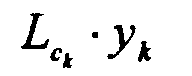 die zum Zeitpunkt i aktuelle Extrinsic Information aus der Decodierung des j-ten Komponentencodes. L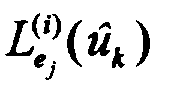


- Unter den Voraussetzungen, daß sign(L


- Setzt man weiter die statistische Unabhängigkeit der einzelnen Entscheidungen voraus, approximiert

- Da der Abbruch der iterativen Decodierung nach einer Teiliteration i idealerweise genau dann erfolgen soll, wenn auch weitere Teiliterationen keine Änderung der Ergebnisses der Decodierung bewirken, kann das Abbruchkriterium mit Hilfe von D̃(P (i)∥Q (i)) wie folgt formuliert werden:
- Die iterative Decodierung kann nach der Teiliteration i abgebrochen werden, falls

- Durch die Wahl des Schwellwertes S kann sowohl auf die Qualität, als auch auf die Komplexität der Decodierung Einfluß genommen werden.
- Der besondere Vorteil dieser Vorgehensweise liegt darin, daß die zusätzlich gewonnene Information (Extrinsic Information) durch das bekannte Verfahren bereits erzeugt wird, also zusätzliche Berechnungsvorgänge entfallen.
- Nach einer vorteilhaften Weiterbildung des erfindungsgemäßen Verfahrens wird der Vergleich der gewichteten Entscheidungen über die Informationsbits nach Vollendung eines kompletten Iterationsschritts unter Einbeziehung der aus der Decodierung aller Komponentencodes des mulitdimensionalen Codes gewonnen Extrinsic Information gebildet. Dadurch wird der Beitrag eines Iterationsschrittes vollständig ausgewertet und in das Abbruchkriterium integriert.
- Die Berechnung der Näherung der relativen Entropie kann durch Verarbeitung der Extrinsic Information vorgenommen und das Ergebnis mit einem Schwellwert verglichen werden. Für den Fall, daß die relative Entropie kleiner als der Schwellwert ist, kann die iterative Decodierung abgebrochen werden - Anspruch 3. Das vorgeschlagene adaptive Abbruchkriterium schließt alle die Verfahren ein, die in der Abbruchbedingung (4) statt D̃(P (i)∥Q (i)) andere Näherungen der Cross Entropy, die Cross Entropy selbst oder andere Größen, die in ihren Eigenschaften der Cross Entropy ähnlich sind, verwenden. Zu der letzten Gruppe sind insbesondere die Größen zu zählen, die den Unterschied in den Ergebnissen der Decodierung zweier oder mehrerer verschiedener Teiliterationen hauptsächlich durch Differenzbildung der Soft Output-Werte oder durch Differenzbildung von Teilen der Soft Output-Werte evaluieren.
- Die Festlegung eines Schwellwertes, mit dem die relative Entropie verglichen wird, stellt einen Kennwert für die Decodierungsqualität dar, der nach Art des Dienstes, dem die übertragene Information angehört, wählbar ist. Werden die Information innerhalb vorbestimmter Rahmen übertragen, kann im Sinne der Flexibilität des erfindungsgemäßen Verfahrens der Schwellwert für jeden Rahmen getrennt festgelegt werden.
- Das im Rahmen des erfindungsgemäßen Verfahrens bestimmte Abbruchkriterium kann mit weiteren zusätzlichen Abbruchkriterien kombiniert werden. Dieses zusätzliche Abbruchkriterium kann z.B. eine festgelegte Anzahl von Iterationen sein, die eine maximal tolerierbare Decodierverzögerung markieren.
- Ein unabhängiger Anspruch beschreibt einen Decodiermodul im Sinne des erfindungsgemäßen Verfahrens. Weitere vorteilhafte Weiterbildungen des erfindungsmäßen Verfahrens und des erfindungsgemäßen Decodiermoduls sind in den übrigen Unteransprüchen angegeben.
- Das erfindungsgemäße Verfahren soll anhand eines Ausführungsbeispiels näher beschrieben werden.
- Es zeigen
- FIG 1
- das Blockschaltbild eines Decodiermoduls im Sinne des erfindungsgemäßen Verfahrens, und
- FIG 2
- ein Blockschaltbild der Einrichtung innerhalb des Decoders, die einen Abbruch der iterativen Decodierung bewirkt.
- Der Decodiermodul in FIG 1 bewirkt einen Iterationsschritt im Sinne einer iterativen Decodierung der empfangenen Information. Im gewählten Beispiel erfolgt eine Rückkopplung einer bei der Decodierung erzeugten Extrinsic Information Zp (feedback-Verfahren). Es ist jedoch auch möglich, mehrere solcher Decodiermodule aneinanderzureihen (pipeline-Verfahren.
- Der Modul besitzt drei Eingänge, für die die Information repräsentierenden Zeichen Xp, die Kontrollzeichen entsprechend der Kanalcodierung Yp und die im letzten Iterationsteilschritt erzeugte Extrinsic Information Zp. Der Decodiermodul besitzt fünf Ausgänge, wobei die die Information repräsentierenden Zeichen Xp über das Schieberegister SR1 und die Kontrollzeichen Yp über das Schieberegister SR2 verzögert werden und auch an den Ausgängen des Decodiermoduls anliegen. Die durch den aktuellen Iterationsschritt der iterative Decodierung gewonnene Extrinsic Information Zp+1 bildet einen Ausgang des Decodiermoduls und wird über ein erstes Register R1 zum Eingang zurückgeführt, der Ausgang a liefert die Abbruchentscheidung und der Ausgang Sp+1 liefert nach der letzten Iteration eine gewichtete Entscheidung über die gesendete Information.
- Ein erster Eingang eines ersten Decoders DEC1 ist mit dem die Information repräsentierenden Zeichen Xp führenden Eingang des Decodiermoduls verbunden. Ein Ausgang des ersten Registers R1 führt dem ersten Decodierer DEC1 auf einen zweiten Eingang die während des letzten Iterationsteilschrittes gewonnene Extrinsic Information Zp zu. Diese Information Zp wird vor der ersten Iteration über einen Rücksetzeingang Reset des ersten Registers R1 auf einen neutralen Wert gesetzt.
- Ein dritter Eingang des ersten Decodierers DEC1 ist mit dem ersten Kontakt eines zweistufigen Umschalters US verbunden. Der Umschalter US ist weiterhin mit dem die Kontrollzeichen Yp führenden Eingang des Decodiermoduls verbunden.
- Ein Ausgang des ersten Decodierers DEC1 führt eine erste Zwischeninformation x1, die sowohl die Extrinsic Information Zp der Decodierung als auch die die Informationen repräsentierenden Zeichen Xp enthält, einem Eingang eines Interleavers I zu. Im Interleaver I wird die erste Zwischeninformation x1 zu einer zweiten Zwischeninformation x2 verwürfelt.
- Ein Ausgang des Interleavers I ist mit einem ersten Eingang eines zweiten Decodierers DEC2 verbunden, so daß die zweite Zwischeninformation x2 am zweiten Decodierer DEC2 vorliegt. Ein zweiter Eingang des zweiten Decodierers DEC2 ist mit einem zweiten Kontakt des Umschalters US verbunden. Der Umschalter US schaltet im gewählten Beispiel zwei seriell vorliegende Sequenzen von Kontrollzeichen Yp zeitrichtig auf die zwei Decodierer DEC1, DEC2 und fügt gegebenenfalls neutrale Zeichen ein. Es können sehr wohl auch parallele Leitungen unter Verzicht auf den Umschalter US für die Kontrollzeichen Yp gewählt werden.
- Der zweite Decodierer DEC2 ist zum einen mit einem Eingang eines ersten Deinterleavers DE1 und zum anderen mit einem Eingang eines zweiten Deinterleavers DE2 verbunden. Der erste Deinterleaver DE1 stellt am Ausgang ein Signal Sp+1 , der Soft Output der Iteration, zur Verfügung. Der Ausgang des zweiten Deinterleavers DE2 stellt eine die durch den aktuellen Iterationsschritt gewonnene Extrinsic Information repräsentierende vierte Zwischeninformation x4 bereit, die einem Eingang des ersten Registers R1 zugeführt wird.
- Der Soft Output Sp+1 am Ausgang des ersten Deinterleavers DE1 wird sowohl an einen Eingang eines zweiten Registers R2 als auch an einen Eingang einer Einrichtung INT angelegt. Ein zweiter Eingang der Einrichtung INT ist mit dem Ausgang des zweiten Registers R2 verbunden. An einem Ausgang der den Abbruch des iterativen Decodierungsverfahrens bestimmenden Einrichtung INT liegt ein die Abbruchentscheidung repräsentierendes Signal a an.
- Die Schieberegister SR1 und SR2 verzögern die die Information repräsentierenden Zeichen Xp und die Kontrollzeichen Yp, bis die durch den Iterationsschritt getroffenen Entscheidungen an den Ausgängen des Decodiermoduls vorliegen. Der Decodiermodul verarbeitet beispielsweise binäre Zeichen, wobei die Zeichen Xp, Yp und Zp als Bitsequenzen von n Bits zur Verfügung stehen.
- Der erste Decodierer DEC1 korrespondiert mit dem ersten Codierer der Codiereinrichtung. Das Decodierungsergebnis des ersten Decodierers DEC1, die erste Zwischeninformation x1, wird dem Interleaver I zugeführt, der entsprechend einer Interleaver-Matrix die Bits innerhalb der Zeichensequenz verwürfelt. Diese verwürfelte Zeichensequenz ist die zweite Zwischeninformation x2, die im zweiten Decoder DEC2 zusammen mit dem entsprechenden Teil der Kontrollzeichensequenz Yp decodiert wird. Der zweite Decodierers DEC2 korrespondiert mit dem zweiten Codierers der Codiereinrichtung, der den zugehörigen Teil der Kontrollzeichensequenz Yp generiert. Der zweite Decoder DEC2 erzeugt die dritte Zwischeninformation x3, die nach dem ersten Deinterleaver DE1 dem Soft Output Sp+1 der Iteration entspricht. Der erste Decodierer DEC1 und der zweite Decodierer DEC2 müssen nicht zwangsläufig die gleichen Decodierungsverfahren verwenden. Sie müssen lediglich den zugehörigen Codierern der Codiereinrichtung entsprechen.
- Die ebenfalls durch den zweiten Decodierer DEC2 erzeugte vierte Zwischeninformation x4 wird nach einem Deinterleaving im zweiten Deinterleaver DE2 als Extrinsic Information Zp+1 des aktuellen Iterationsschrittes in das erste Register R1 geschrieben, so daß sie als Extrinsic Information Zp für den nächsten Iterationsschritt zur Verfügung steht. Der am Ausgang-des zweiten Deinterleavers DE1 zur Verfügung gestellte Soft Output Sp+1 wird in das zweite Register R2 geschrieben. Das zweite Register R2 ist so aufgebaut und getaktet, daß an der Einrichtung zur Entscheidung über den Abbruch INT der Soft Output Sp und Sp+1 zweier aufeinanderfolgender Iterationsschritte anliegt. Durch diese Einrichtung INT wird ein Abbruchsignal a erzeugt.
- In FIG 2 wird im folgenden diese Einrichtung zur Bestimmung des Abbruchs INT detaillierter beschrieben. Ein Subtrahierglied SUB ist mit seinem subtrahierenden Eingang mit dem im vorhergehenden Iterationsschritt erzeugten Soft Output Sp und über seinen addierenden Eingang mit dem im aktuellen Iterationsschritt erzeugten Soft Output Sp+1 verbunden. Ein Ausgang des Subtrahiergliedes SUB mit dem Signal Sp+1-Sp hat eine Verbindung mit einem Quadrierer Q, der das Signal (Sp+1-Sp) zum Quadrat erzeugt. Das Signal (Sp+1-Sp)2 wird auf ein Multiplizierglied MUL geführt. In diesem Multiplizierglied MUL wird dazu ein Signal multipliziert, das durch eine Betragsbildung des im vorhergehenden Iterationsschritt erzeugten Soft Outputs Sp+1 in einem Mittel zur Betragsbildung B und durch Berechnung einer Expotentialfunktion in einem Mittel zur Expotentialbildung EX erzeugt wurde. Der Quadrierer Q und das Mittel zur Expotentialfunktionsbildung EX können durch entsprechende Rechenroutinen oder durch Tabellen mit nichtlinear quantisierten Eingangs- und Ausgangswerten realisiert werden. Dementsprechend kann auch das Multipllizierglied MUL vereinfacht werden.
- In einem mit dem Ausgang des Multiplizierglieds MUL verbundenen Akkumulator AKK wird das Multiplikationsergebnis aufsummiert. Am Ausgang des Akkumulators AKK liegt somit die relative Entropie D der aktuellen Iteration näherungsweise vor. Die relative Entropie D wird damit einsprechend der Gleichung:

- In einem auf den Akkumulator AKK folgenden Schwellwertschalter S1 wird die aufsummierte relative Entropie D mit einem einstellbaren Schwellwert S verglichen. Nach jedem Iterationsschritt wird der Akkumulator AKK zurückgesetzt, so daß bei der Entscheidung über den Abbruch der iterativen Decodierung die relative Entropie D des letzten Iterationsschrittes mit dem Schwellwert S verglichen wird. Falls die relative Entropie D kleiner dem Schwellwert S ist, wird ein Abbruchsignal a an einem Ausgang des Schwellwertschalters S1 erzeugt. Dieses Abbruchsignal a wird durch den Decodiermodul ausgewertet und nach Abbruch der Decodierung der Soft Output Sp+1 nach der letzten Iteration nachfolgenden Modulen zur Verfügung gestellt - nicht dargestellt.
- Vorteilhafterweie kann nach jedem Akkumulationsschritt bereits geprüft werden, ob der Schwellwert S überschritten wird. Ist dies der Fall, kann die Berechnung der relativen Entropie D abgebrochen werden. Zur Realisierung der Einrichtung über die Bestimmung des Abbruchs der iterativen Decodierung INT können auch andere Berechnungsverfahren des Abbruchsignals a unter Verwendung von der relativen Entropie D ähnlichen Größen eingesetzt werden.
Claims (14)
- Verfahren zur Bestimmung eines adaptiven Abbruchkriteriums beim iterativen Decodieren multidimensional codierter Information,
bei dem nach einem Iterationsteilschritt eine erste gewichtete Entscheidung (Sp+1), der Soft Output, über die zu decodierende Information mit einer zweiten gewichteten Entscheidung (Sp), die aus einer zur ersten gewichteteten Entscheidung (Sp+1) unterschiedlichen Kombination von Teilergebnissen vorangegangener Iterationsteilschritte gewonnen wird, verglichen wird und
in Abhängigkeit vom Vergleichsergebnis die iterative Decodierung abgebrochen wird. - Verfahren nach Anspruch 1,
dadurch gekennzeichnet,
daß die dem Vergleich zugrundeliegenden gewichteten Entscheidungen (Sp+1, Sp) nach Vollendung eines kompletten Iterationsschrittes aus den der Dimension des Codes entsprechenden Komponenten des Codes gebildet werden. - Verfahren nach einem der Ansprüche 1 oder 2,
dadurch gekennzeichnet,
daß die dem Vergleich zugrundeliegenden gewichteten Entscheidungen (Sp+1, Sp) zur Berechnung einer relativen Entropie (D) verwendet werden,
daß die relative Entropie (D) mit einem Schwellwert (S) verglichen wird und
daß für den Fall, daß die relative Entropie (D) kleiner als der Schwellwert (S) ist, die iterative Decodierung abgebrochen wird. - Verfahren nach Anspruch 3,
dadurch gekennzeichnet,
daß die Decodierung abgebrochen wird, falls die relative Entropie (D) kleiner als der Schwellwert (S) ist oder die Anzahl der bereits vollzogenen Iterationen einer vorbestimmten Zahl entspricht. - Verfahren nach Anspruch 3 oder 4,
dadurch gekennzeichnet,
daß der Schwellwert (S) in Abhängigkeit von der gewünschten Übertragungsqualität und der mittleren Decodierverzögerung einstellbar ist. - Verfahren nach einem der Ansprüche 3 bis 5,
dadurch gekennzeichnet,
daß die zu decodierende Information innerhalb mehrerer Rahmen übertragen wird und der Schwellwert (S) für jeden Rahmen getrennt festgelegt wird. - Verfahren nach Anspruch 3 bis 6,
dadurch gekennzeichnet,
daß anstelle der relativen Entropie (D) Näherungen derselben verwendet werden. - Verfahren nach Anspruch 3 bis 6,
dadurch gekennzeichnet,
daß zum Vergleich der gewichteten Entscheidungen (Sp+1, Sp) anstelle der relativen Entropie (D) andere Größen, die in ihren Eigenschaften ähnlich sind oder durch Differenzbildung der gewichteten Entscheidungen (Sp+1, Sp) oder Teilen davon gewonnen werden, verwendet werden. - Verfahren nach Anspruch 3 bis 6,
dadurch gekennzeichnet,
daß zur Bestimmung der relativen Entropie (D) oder Näherungen davon Tabellen mit nichtlinear quantisierten Eingangs- und Ausgangswerten eingesetzt werden. - Verfahren nach einem der vorhergehenden Ansprüche,
dadurch gekennzeichnet,
daß zusätzliche Abbruchkriterien in die Entscheidung über den Abbruch der iterativen Decodierung einbezogen werden. - Decodiermodul mit Bestimmung eines adaptiven Abbruchkriteriums beim iterativen Decodieren multidimensional codierter Information,
mit Mitteln zur Ermittelung und Speicherung von gewichteten Entscheidungen (Sp+1, Sp) nach einem Iterationsteilschritt, mit Mitteln zum Vergleichen der gewichteten Entscheidungen (Sp+1, Sp) und
mit Mitteln zur Veranlassung eines Abbruchs der iterativen Decodierung in Abhängigkeit vom Vergleichsergebnis. - Decodiermodul nach Anspruch 11,
dadurch gekennzeichnet,
daß die Mittel zur Ermittlung und Speicherung der gewichteten Entscheidungen (Sp+1, Sp) derart ausgestaltet sind,- daß die erste gewichtete Entscheidung (Sp+1) aus dem aktuellen Iterationsschritt gewonnen wird,- daß die zweite gewichtete Entscheidung (Sp) aus einer zur ersten gewichteten Entscheidung (Sp+1) unterschiedlichen Kombination von Teilergebnissen vorangegangener Iterationsteilschritte gewonnen wird,daß die Mittel zum Vergleich der gewichteten Entscheidungen (Sp+1, Sp) so ausgestaltet sind,- daß die relative Entropie (D) aus den gewichteten Entscheidungen (Sp+1, Sp) bestimmt wird, die relative Entropie (D) mit einem Schwellwert (S) verglichen wird undfür den Fall, daß die relative Entropie (D) kleiner als der Schwellwert (S) ist, die iterative Decodierung durch die Mittel zur Veranlassung eines Abbruchs der iterativen Decodierung abgebrochen wird. - Decodiermodul nach Anspruch 12,
dadurch gekennzeichnet,
daß Mittel zum Einstellen des Schwellwertes (S) vorgesehen sind, so daß für in Rahmen übertragene Information der Schwellwert (S) für jeden Rahmen getrennt eingestellt werden kann. - Decodiermodul nach Anspruch 12 oder 13,
dadurch gekennzeichnet,
daß die Mittel zur Veranlassung des Abbruchs der iterativen Decodierung in Abhängigkeit vom Vergleichsergebnis ebenfalls nach einer durch Einstellmittel festgelegten Maximalanzahl von Iterationen den Abbruch der iterativen Decodierung bewirken.
Applications Claiming Priority (2)
| Application Number | Priority Date | Filing Date | Title |
|---|---|---|---|
| DE19526416A DE19526416A1 (de) | 1995-07-19 | 1995-07-19 | Verfahren und Anordnung zur Bestimmung eines adaptiven Abbruchkriteriums beim iterativen Decodieren multidimensional codierter Infomation |
| DE19526416 | 1995-07-19 |
Publications (3)
| Publication Number | Publication Date |
|---|---|
| EP0755122A2 true EP0755122A2 (de) | 1997-01-22 |
| EP0755122A3 EP0755122A3 (de) | 2001-05-09 |
| EP0755122B1 EP0755122B1 (de) | 2003-04-02 |
Family
ID=7767277
Family Applications (1)
| Application Number | Title | Priority Date | Filing Date |
|---|---|---|---|
| EP96111310A Expired - Lifetime EP0755122B1 (de) | 1995-07-19 | 1996-07-12 | Verfahren und Anordnung zur Bestimmung eines adaptiven Abbruchkriteriums beim iterativen Decodieren multidimensional codierter Information |
Country Status (4)
| Country | Link |
|---|---|
| US (1) | US5761248A (de) |
| EP (1) | EP0755122B1 (de) |
| DE (2) | DE19526416A1 (de) |
| ES (1) | ES2196106T3 (de) |
Cited By (11)
| Publication number | Priority date | Publication date | Assignee | Title |
|---|---|---|---|---|
| WO1999009696A1 (en) * | 1997-08-14 | 1999-02-25 | Ericsson Inc. | Communications systems and methods employing selective recursive decoding |
| WO1999009697A1 (en) * | 1997-08-14 | 1999-02-25 | Ericsson Inc. | Communications systems and methods employing parallel coding without interleaving |
| WO1999011009A1 (de) * | 1997-08-22 | 1999-03-04 | Siemens Aktiengesellschaft | Verfahren zur datenübertragung auf übertragungskanälen in einem digitalen übertragungssystem |
| EP0917294A1 (de) * | 1997-11-18 | 1999-05-19 | Koninklijke Philips Electronics N.V. | Digitales Übertragungssystem, Dekoder und Dekodierungsverfahren |
| EP0959580A1 (de) * | 1998-05-19 | 1999-11-24 | Lucent Technologies Inc. | Iterativer Entzerrer/Dekodierer |
| AU721048B2 (en) * | 1998-04-03 | 2000-06-22 | Lucent Technologies Inc. | Iterative demapping |
| WO2002052733A1 (en) * | 2000-12-22 | 2002-07-04 | Nec Corporation | Number-of-repetitions updating device and method |
| EP1101369A4 (de) * | 1999-05-28 | 2004-05-12 | Samsung Electronics Co Ltd | Vorrichtung und verfahren zur adaptiven map-kanaldekodierung in einem funktelekommunikationssystem |
| US6915474B2 (en) | 2001-05-15 | 2005-07-05 | Matsushita Electric Industrial Co., Ltd. | Turbo decoding apparatus and decoding iteration count controlling method in turbo decoding |
| CN100350750C (zh) * | 2000-09-29 | 2007-11-21 | 高通股份有限公司 | 通信系统中用于减少解码器的功耗的方法和装置 |
| CN1602589B (zh) * | 2001-09-25 | 2011-04-20 | 高通股份有限公司 | 用于无线通信的turbo解码方法、装置和处理器 |
Families Citing this family (57)
| Publication number | Priority date | Publication date | Assignee | Title |
|---|---|---|---|---|
| KR100429506B1 (ko) * | 1998-04-18 | 2004-11-20 | 삼성전자주식회사 | 통신시스템의 채널부호/복호장치 및 방법 |
| ATE270795T1 (de) | 1998-09-28 | 2004-07-15 | Comtech Telecomm Corp | Turbo produktkode decodierer |
| US6292918B1 (en) * | 1998-11-05 | 2001-09-18 | Qualcomm Incorporated | Efficient iterative decoding |
| US6397205B1 (en) | 1998-11-24 | 2002-05-28 | Duquesne University Of The Holy Ghost | Document categorization and evaluation via cross-entrophy |
| US6298084B1 (en) * | 1998-11-24 | 2001-10-02 | Motorola, Inc. | Bad frame detector and turbo decoder |
| US6233709B1 (en) | 1998-12-07 | 2001-05-15 | Nokia Mobile Phones Ltd. | Dynamic iterative decoding for balancing quality of service parameters |
| DE69943198D1 (de) * | 1998-12-30 | 2011-03-31 | Canon Kk | Kodierungsvorrichtung und Verfahren, Dekodierungsvorrichtung und Verfahren und dazugehörige Systeme |
| US6665357B1 (en) * | 1999-01-22 | 2003-12-16 | Sharp Laboratories Of America, Inc. | Soft-output turbo code decoder and optimized decoding method |
| US6304995B1 (en) * | 1999-01-26 | 2001-10-16 | Trw Inc. | Pipelined architecture to decode parallel and serial concatenated codes |
| WO2000052832A1 (en) * | 1999-03-01 | 2000-09-08 | Fujitsu Limited | Turbo-decoding device |
| DE19934646C2 (de) * | 1999-07-16 | 2001-09-13 | Univ Dresden Tech | Verfahren und Vorrichtung zur iterativen Decodierung von verketteten Codes |
| US6570919B1 (en) * | 1999-07-30 | 2003-05-27 | Agere Systems Inc. | Iterative decoding of data packets employing decision feedback equalization |
| US6848069B1 (en) * | 1999-08-10 | 2005-01-25 | Intel Corporation | Iterative decoding process |
| EP1234420A2 (de) * | 1999-12-03 | 2002-08-28 | Broadcom Corporation | Viterbi-slicer für turbokoden |
| EP1254544B1 (de) * | 1999-12-03 | 2015-04-29 | Broadcom Corporation | Eingebettete trainingssequenzen für frequenzerfassung und -verfolgung |
| US6898254B2 (en) * | 2000-01-31 | 2005-05-24 | Texas Instruments Incorporated | Turbo decoder stopping criterion improvement |
| US6879648B2 (en) * | 2000-01-31 | 2005-04-12 | Texas Instruments Incorporated | Turbo decoder stopping based on mean and variance of extrinsics |
| FR2805106A1 (fr) * | 2000-02-14 | 2001-08-17 | Mitsubishi Electric Inf Tech | Procede de transmission numerique de type a codage correcteur d'erreurs |
| US7356752B2 (en) * | 2000-03-14 | 2008-04-08 | Comtech Telecommunications Corp. | Enhanced turbo product codes |
| AU2001289296A1 (en) * | 2000-04-04 | 2001-10-15 | Advanced Hardware Architectures, Inc. | Enhanced turbo product code decoder system |
| US6675342B1 (en) * | 2000-04-11 | 2004-01-06 | Texas Instruments Incorporated | Direct comparison adaptive halting decoder and method of use |
| US6591390B1 (en) * | 2000-04-11 | 2003-07-08 | Texas Instruments Incorporated | CRC-based adaptive halting turbo decoder and method of use |
| US20010052104A1 (en) * | 2000-04-20 | 2001-12-13 | Motorola, Inc. | Iteration terminating using quality index criteria of turbo codes |
| WO2001086821A2 (en) * | 2000-05-05 | 2001-11-15 | Icoding Technology, Inc. | Improved error floor turbo codes |
| FR2809248B1 (fr) | 2000-05-19 | 2003-08-08 | Canon Kk | Compression de donnees numeriques et codage des donnees compressees pour les proteger contre les erreurs de transmission |
| US6944803B2 (en) * | 2000-07-06 | 2005-09-13 | Her Majesty The Queen In Right Of Canada, As Represented By The Minister Of Industry Through The Communications Research Centre Canada | Code structure, encoder, encoding method, and associated decoder and decoding method and iteratively decodable code structure, encoder, encoding method, and associated iterative decoder and iterative decoding method |
| FR2811832B1 (fr) * | 2000-07-13 | 2003-09-26 | Canon Kk | Procedes, dispositifs et appareils d'optimisation adaptative pour la transmission de signaux codes |
| EP1178613A1 (de) * | 2000-08-01 | 2002-02-06 | Motorola, Inc. | Vorrichtung und Verfahren zur Bestimmung eines Abbruchkriteriums in einem iterativen Detektionsprozess |
| EP1364479B1 (de) * | 2000-09-01 | 2010-04-28 | Broadcom Corporation | Satellitenempfänger und entsprechendes verfahren |
| AU2001287101A1 (en) * | 2000-09-05 | 2002-03-22 | Broadcom Corporation | Quasi error free (qef) communication using turbo codes |
| US7242726B2 (en) * | 2000-09-12 | 2007-07-10 | Broadcom Corporation | Parallel concatenated code with soft-in soft-out interactive turbo decoder |
| US6604220B1 (en) * | 2000-09-28 | 2003-08-05 | Western Digital Technologies, Inc. | Disk drive comprising a multiple-input sequence detector selectively biased by bits of a decoded ECC codedword |
| US6775405B1 (en) * | 2000-09-29 | 2004-08-10 | Koninklijke Philips Electronics, N.V. | Image registration system and method using cross-entropy optimization |
| US6518892B2 (en) | 2000-11-06 | 2003-02-11 | Broadcom Corporation | Stopping criteria for iterative decoding |
| US6745352B2 (en) | 2000-12-13 | 2004-06-01 | Ericsson Inc. | Methods of estimating error rates for communications received using iterative processing and related receivers |
| US7230978B2 (en) | 2000-12-29 | 2007-06-12 | Infineon Technologies Ag | Channel CODEC processor configurable for multiple wireless communications standards |
| FR2819672B1 (fr) * | 2001-01-18 | 2003-04-04 | Canon Kk | Procede et dispositif d'emission et de reception d'images numeriques utilisant un marqueur d'image pour le decodage |
| EP1364462A1 (de) * | 2001-02-23 | 2003-11-26 | Koninklijke Philips Electronics N.V. | Turbo dekodersystem mit parallel dekodieren |
| US6950977B2 (en) * | 2001-03-15 | 2005-09-27 | 3G.Com, Inc. | Mechanism for turbo decoding when CRC for partial blocks is provided |
| FR2822315B1 (fr) * | 2001-03-19 | 2003-06-06 | Mitsubishi Electric Inf Tech | Procede et dispositif d'optimisation, sous contrainte de performances, de la taille de blocs de donnees codees |
| US6738948B2 (en) * | 2001-04-09 | 2004-05-18 | Motorola, Inc. | Iteration terminating using quality index criteria of turbo codes |
| EP1407555A1 (de) * | 2001-05-09 | 2004-04-14 | Comtech Telecommunications Corp. | Wenig dichte paritätsprüfcodes und wenig dichte turboproduktcodes |
| JP2002359846A (ja) * | 2001-05-31 | 2002-12-13 | Sanyo Electric Co Ltd | 画像復号方法および装置 |
| WO2002099976A2 (en) | 2001-06-06 | 2002-12-12 | Seagate Technology Llc | A method and coding apparatus using low density parity check codes for data storage or data transmission |
| AUPR679101A0 (en) * | 2001-08-03 | 2001-08-30 | Lucent Technologies Inc. | Termination of iterative decoding |
| US7331012B2 (en) * | 2002-09-30 | 2008-02-12 | Seagate Technology Llc | System and method for iterative decoding of Reed-Muller codes |
| US7346833B2 (en) * | 2002-11-05 | 2008-03-18 | Analog Devices, Inc. | Reduced complexity turbo decoding scheme |
| US7100101B1 (en) * | 2002-11-08 | 2006-08-29 | Xilinx, Inc. | Method and apparatus for concatenated and interleaved turbo product code encoding and decoding |
| FR2850810B1 (fr) * | 2003-02-03 | 2005-05-13 | Nortel Networks Ltd | Procede de controle du nombre d'iterations d'un processus de decodage iteratif et dispositif pour la mise en oeuvre du procede |
| US20050022101A1 (en) * | 2003-07-21 | 2005-01-27 | Peter Malm | Fast iteration termination of Turbo decoding |
| US20050193320A1 (en) * | 2004-02-09 | 2005-09-01 | President And Fellows Of Harvard College | Methods and apparatus for improving performance of information coding schemes |
| US8341506B2 (en) * | 2007-03-30 | 2012-12-25 | HGST Netherlands B.V. | Techniques for correcting errors using iterative decoding |
| EP2218186B1 (de) * | 2007-12-12 | 2018-03-14 | Telefonaktiebolaget LM Ericsson (publ) | Verfahren und anordnung für verbesserte turbodecodierung |
| CA2660073A1 (en) * | 2008-03-25 | 2009-09-25 | Kenneth Gracie | Event cleanup processing for improving the performance of sequence based decoders |
| US8930791B2 (en) * | 2009-12-23 | 2015-01-06 | Intel Corporation | Early stop method and apparatus for turbo decoding |
| US8983008B2 (en) | 2009-12-23 | 2015-03-17 | Intel Corporation | Methods and apparatus for tail termination of turbo decoding |
| US8621321B2 (en) * | 2010-07-01 | 2013-12-31 | Densbits Technologies Ltd. | System and method for multi-dimensional encoding and decoding |
Family Cites Families (4)
| Publication number | Priority date | Publication date | Assignee | Title |
|---|---|---|---|---|
| FR2261666B1 (de) * | 1974-02-19 | 1979-09-28 | Thomson Csf | |
| US3976863A (en) * | 1974-07-01 | 1976-08-24 | Alfred Engel | Optimal decoder for non-stationary signals |
| FR2675968B1 (fr) * | 1991-04-23 | 1994-02-04 | France Telecom | Procede de decodage d'un code convolutif a maximum de vraisemblance et ponderation des decisions, et decodeur correspondant. |
| FR2675971B1 (fr) * | 1991-04-23 | 1993-08-06 | France Telecom | Procede de codage correcteur d'erreurs a au moins deux codages convolutifs systematiques en parallele, procede de decodage iteratif, module de decodage et decodeur correspondants. |
-
1995
- 1995-07-19 DE DE19526416A patent/DE19526416A1/de not_active Withdrawn
-
1996
- 1996-07-12 EP EP96111310A patent/EP0755122B1/de not_active Expired - Lifetime
- 1996-07-12 ES ES96111310T patent/ES2196106T3/es not_active Expired - Lifetime
- 1996-07-12 DE DE59610289T patent/DE59610289D1/de not_active Expired - Fee Related
- 1996-07-19 US US08/684,155 patent/US5761248A/en not_active Expired - Fee Related
Non-Patent Citations (4)
| Title |
|---|
| "GLOBECOM '94", 1994, article P. ROBERTSON: "Illuminating the structure of code and decoder for parallel concatenated recursive systematic (Turbo) codes" |
| "Proc. ICC '93", May 1993, article C. BERROU: "Near Shannon limit error-correcting and decoding: Turbo-Codes (1)" |
| "Proceedings of GLOBECOM '93, IEEE Global Telecommunications Conference, Houston, 19.11-2.12.1993", vol. 2, 1993, article M. MOHER: "Decoding via Cross-entropy Minimization", pages: 809 - 813, XP010109771, DOI: doi:10.1109/GLOCOM.1993.318192 |
| R. DE GAUDENZI, M. LUISE: "Audio and Video Digital Radio Broadcasting Systems and Techniques, Proc. of the 6th Tirrenia Int. Workshop on Digital Communications", 1993, article C. BERROU, A. GLAVIEUX: "Turbo-Codes: General principles and applications", pages: 215 - 226 |
Cited By (15)
| Publication number | Priority date | Publication date | Assignee | Title |
|---|---|---|---|---|
| WO1999009697A1 (en) * | 1997-08-14 | 1999-02-25 | Ericsson Inc. | Communications systems and methods employing parallel coding without interleaving |
| US5983385A (en) * | 1997-08-14 | 1999-11-09 | Ericsson Inc. | Communications systems and methods employing parallel coding without interleaving |
| WO1999009696A1 (en) * | 1997-08-14 | 1999-02-25 | Ericsson Inc. | Communications systems and methods employing selective recursive decoding |
| US6272183B1 (en) | 1997-08-22 | 2001-08-07 | Siemens Aktiengesellschaft | Method for data transmission on transmission channels in a digital transmission system |
| WO1999011009A1 (de) * | 1997-08-22 | 1999-03-04 | Siemens Aktiengesellschaft | Verfahren zur datenübertragung auf übertragungskanälen in einem digitalen übertragungssystem |
| EP0917294A1 (de) * | 1997-11-18 | 1999-05-19 | Koninklijke Philips Electronics N.V. | Digitales Übertragungssystem, Dekoder und Dekodierungsverfahren |
| FR2771228A1 (fr) * | 1997-11-18 | 1999-05-21 | Philips Electronics Nv | Systeme de transmission numerique, decodeur, et procede de decodage |
| US6353911B1 (en) | 1998-04-03 | 2002-03-05 | Agere Systems Guardian Corp. | Iterative demapping |
| AU721048B2 (en) * | 1998-04-03 | 2000-06-22 | Lucent Technologies Inc. | Iterative demapping |
| EP0959580A1 (de) * | 1998-05-19 | 1999-11-24 | Lucent Technologies Inc. | Iterativer Entzerrer/Dekodierer |
| EP1101369A4 (de) * | 1999-05-28 | 2004-05-12 | Samsung Electronics Co Ltd | Vorrichtung und verfahren zur adaptiven map-kanaldekodierung in einem funktelekommunikationssystem |
| CN100350750C (zh) * | 2000-09-29 | 2007-11-21 | 高通股份有限公司 | 通信系统中用于减少解码器的功耗的方法和装置 |
| WO2002052733A1 (en) * | 2000-12-22 | 2002-07-04 | Nec Corporation | Number-of-repetitions updating device and method |
| US6915474B2 (en) | 2001-05-15 | 2005-07-05 | Matsushita Electric Industrial Co., Ltd. | Turbo decoding apparatus and decoding iteration count controlling method in turbo decoding |
| CN1602589B (zh) * | 2001-09-25 | 2011-04-20 | 高通股份有限公司 | 用于无线通信的turbo解码方法、装置和处理器 |
Also Published As
| Publication number | Publication date |
|---|---|
| DE59610289D1 (de) | 2003-05-08 |
| EP0755122A3 (de) | 2001-05-09 |
| EP0755122B1 (de) | 2003-04-02 |
| DE19526416A1 (de) | 1997-01-23 |
| ES2196106T3 (es) | 2003-12-16 |
| US5761248A (en) | 1998-06-02 |
Similar Documents
| Publication | Publication Date | Title |
|---|---|---|
| EP0755122B1 (de) | Verfahren und Anordnung zur Bestimmung eines adaptiven Abbruchkriteriums beim iterativen Decodieren multidimensional codierter Information | |
| DE69810485T2 (de) | Kommunikationssysteme und verfahren mit paralleler verschachtelungsloser kodierung | |
| DE3910739C3 (de) | Verfahren zum Verallgemeinern des Viterbi-Algorithmus und Einrichtungen zur Durchführung des Verfahrens | |
| EP0749211B1 (de) | Verfahren und Codiereinrichtung zur gesicherten Übertragung von Daten mittels Mehrkomponenten-Codierung | |
| DE60113053T2 (de) | Vor-Dekoder für Turbodekoder, zur Rückgewinnung von punktierten Paritätssymbolen, sowie ein Verfahren zur Rückgewinnung eines Turbokodes | |
| DE60001988T2 (de) | Turbo Dekodierung mit variabler Anzahl von Iterationen | |
| DE69718395T2 (de) | Informationsbits-Übertragungsverfahren mit Fehlerkorrektur-Kodierung, Kodier- und Dekodiervorrichtung dafür | |
| DE69722331T2 (de) | Informationsbits-Übertragungsverfahren mit Fehlerkorrektur-Kodierung, Kodier- und Dekodiervorrichtung dafür | |
| DE69936908T2 (de) | Iterative dekodierung von produktkoden | |
| DE69804810T2 (de) | Kommunikationssysteme bzw. verfahren, bei denen eine selektive und rekursive dekodierung verwendet wird | |
| DE60120723T2 (de) | Iterationsabbruch für Turbodecodierer | |
| DE69722571T2 (de) | System und Verfahren zur digitalen Übertragung mit einem Produktkode kombiniert mit multidimensionaler Modulation | |
| DE69621228T2 (de) | Verfahren, modul und vorrichtung zum empfang digitaler signale mit iterativer arbeitsweise | |
| DE60211413T2 (de) | Verfahren und Vorrichtung zur Optimierung der Größe von codierten Datenblöcken | |
| DE102005010006B4 (de) | Verfahren und Vorrichtung zum Terminieren einer iterativen Turbo-Dekodierung | |
| WO2001043290A1 (de) | Turbo-code-decoder und turbo-code-decodierverfahren mit iterativer kanalparameterschätzung | |
| DE19902100C2 (de) | Verfahren und Vorrichtung zur Decodierung von Faltungscodes | |
| DE69908629T2 (de) | Hybrid verschachteler für turbo-kodierer | |
| EP1151571A1 (de) | Verfahren und einrichtung zur entzerrung und dekodierung eines datensignals | |
| DE60319557T2 (de) | Verfahren zur Verminderung der Anzahl der Bits pro Softbit | |
| DE19521327A1 (de) | Verfahren und Codiereinrichtung zur gesicherten Übertragung von Information mittels Mehrkomponenten-Codierung | |
| EP1198890B1 (de) | Verfahren zum erzeugen von zuverlässigkeitsinformationen für die kanaldecodierung in einem funkempfänger sowie entsprechender funkempfänger | |
| DE602004013186T2 (de) | Linear-approximation der max*-operation für log-map-decodierung | |
| EP1249074B1 (de) | Verfahren zur decodierung eines datensignals | |
| EP0876022B1 (de) | Verfahren und Vorrichtung zur Fehlerverdeckung in digitalen Übertragungssystemen |
Legal Events
| Date | Code | Title | Description |
|---|---|---|---|
| PUAI | Public reference made under article 153(3) epc to a published international application that has entered the european phase |
Free format text: ORIGINAL CODE: 0009012 |
|
| AK | Designated contracting states |
Kind code of ref document: A2 Designated state(s): DE ES FR GB IT |
|
| PUAL | Search report despatched |
Free format text: ORIGINAL CODE: 0009013 |
|
| AK | Designated contracting states |
Kind code of ref document: A3 Designated state(s): DE ES FR GB IT |
|
| RIC1 | Information provided on ipc code assigned before grant |
Free format text: 7H 03M 13/00 A, 7H 03M 13/29 B, 7H 03M 13/35 B, 7H 03M 13/39 B, 7H 04L 1/00 B |
|
| 17P | Request for examination filed |
Effective date: 20011105 |
|
| GRAH | Despatch of communication of intention to grant a patent |
Free format text: ORIGINAL CODE: EPIDOS IGRA |
|
| GRAH | Despatch of communication of intention to grant a patent |
Free format text: ORIGINAL CODE: EPIDOS IGRA |
|
| GRAA | (expected) grant |
Free format text: ORIGINAL CODE: 0009210 |
|
| AK | Designated contracting states |
Designated state(s): DE ES FR GB IT |
|
| REG | Reference to a national code |
Ref country code: GB Ref legal event code: FG4D Free format text: NOT ENGLISH |
|
| REF | Corresponds to: |
Ref document number: 59610289 Country of ref document: DE Date of ref document: 20030508 Kind code of ref document: P |
|
| GBT | Gb: translation of ep patent filed (gb section 77(6)(a)/1977) | ||
| REG | Reference to a national code |
Ref country code: ES Ref legal event code: FG2A Ref document number: 2196106 Country of ref document: ES Kind code of ref document: T3 |
|
| ET | Fr: translation filed | ||
| PLBE | No opposition filed within time limit |
Free format text: ORIGINAL CODE: 0009261 |
|
| STAA | Information on the status of an ep patent application or granted ep patent |
Free format text: STATUS: NO OPPOSITION FILED WITHIN TIME LIMIT |
|
| 26N | No opposition filed |
Effective date: 20040105 |
|
| PGFP | Annual fee paid to national office [announced via postgrant information from national office to epo] |
Ref country code: ES Payment date: 20070727 Year of fee payment: 12 |
|
| PGFP | Annual fee paid to national office [announced via postgrant information from national office to epo] |
Ref country code: DE Payment date: 20070731 Year of fee payment: 12 |
|
| PGFP | Annual fee paid to national office [announced via postgrant information from national office to epo] |
Ref country code: GB Payment date: 20070720 Year of fee payment: 12 |
|
| PGFP | Annual fee paid to national office [announced via postgrant information from national office to epo] |
Ref country code: IT Payment date: 20070723 Year of fee payment: 12 |
|
| PGFP | Annual fee paid to national office [announced via postgrant information from national office to epo] |
Ref country code: FR Payment date: 20070710 Year of fee payment: 12 |
|
| REG | Reference to a national code |
Ref country code: FR Ref legal event code: TP |
|
| REG | Reference to a national code |
Ref country code: GB Ref legal event code: 732E Free format text: REGISTERED BETWEEN 20090129 AND 20090204 |
|
| GBPC | Gb: european patent ceased through non-payment of renewal fee |
Effective date: 20080712 |
|
| PG25 | Lapsed in a contracting state [announced via postgrant information from national office to epo] |
Ref country code: DE Free format text: LAPSE BECAUSE OF NON-PAYMENT OF DUE FEES Effective date: 20090203 |
|
| REG | Reference to a national code |
Ref country code: FR Ref legal event code: ST Effective date: 20090331 |
|
| PG25 | Lapsed in a contracting state [announced via postgrant information from national office to epo] |
Ref country code: GB Free format text: LAPSE BECAUSE OF NON-PAYMENT OF DUE FEES Effective date: 20080712 |
|
| PG25 | Lapsed in a contracting state [announced via postgrant information from national office to epo] |
Ref country code: IT Free format text: LAPSE BECAUSE OF NON-PAYMENT OF DUE FEES Effective date: 20080712 Ref country code: FR Free format text: LAPSE BECAUSE OF NON-PAYMENT OF DUE FEES Effective date: 20080731 |
|
| REG | Reference to a national code |
Ref country code: ES Ref legal event code: FD2A Effective date: 20080714 |
|
| PG25 | Lapsed in a contracting state [announced via postgrant information from national office to epo] |
Ref country code: ES Free format text: LAPSE BECAUSE OF NON-PAYMENT OF DUE FEES Effective date: 20080714 |