EP0757151A2 - Profil zur Dichtung einer Tür - Google Patents
Profil zur Dichtung einer Tür Download PDFInfo
- Publication number
- EP0757151A2 EP0757151A2 EP96110119A EP96110119A EP0757151A2 EP 0757151 A2 EP0757151 A2 EP 0757151A2 EP 96110119 A EP96110119 A EP 96110119A EP 96110119 A EP96110119 A EP 96110119A EP 0757151 A2 EP0757151 A2 EP 0757151A2
- Authority
- EP
- European Patent Office
- Prior art keywords
- profile
- foot
- sealing
- leg
- constriction
- Prior art date
- Legal status (The legal status is an assumption and is not a legal conclusion. Google has not performed a legal analysis and makes no representation as to the accuracy of the status listed.)
- Withdrawn
Links
Images
Classifications
-
- E—FIXED CONSTRUCTIONS
- E06—DOORS, WINDOWS, SHUTTERS, OR ROLLER BLINDS IN GENERAL; LADDERS
- E06B—FIXED OR MOVABLE CLOSURES FOR OPENINGS IN BUILDINGS, VEHICLES, FENCES OR LIKE ENCLOSURES IN GENERAL, e.g. DOORS, WINDOWS, BLINDS, GATES
- E06B7/00—Special arrangements or measures in connection with doors or windows
- E06B7/16—Sealing arrangements on wings or parts co-operating with the wings
- E06B7/22—Sealing arrangements on wings or parts co-operating with the wings by means of elastic edgings, e.g. elastic rubber tubes; by means of resilient edgings, e.g. felt or plush strips, resilient metal strips
- E06B7/23—Plastic, sponge rubber, or like strips or tubes
- E06B7/2301—Plastic, sponge rubber, or like strips or tubes without an integrally formed part for fixing the edging
- E06B7/2303—Plastic, sponge rubber, or like strips or tubes without an integrally formed part for fixing the edging hollow
-
- F—MECHANICAL ENGINEERING; LIGHTING; HEATING; WEAPONS; BLASTING
- F25—REFRIGERATION OR COOLING; COMBINED HEATING AND REFRIGERATION SYSTEMS; HEAT PUMP SYSTEMS; MANUFACTURE OR STORAGE OF ICE; LIQUEFACTION SOLIDIFICATION OF GASES
- F25D—REFRIGERATORS; COLD ROOMS; ICE-BOXES; COOLING OR FREEZING APPARATUS NOT OTHERWISE PROVIDED FOR
- F25D23/00—General constructional features
- F25D23/08—Parts formed wholly or mainly of plastics materials
- F25D23/082—Strips
- F25D23/087—Sealing strips
Definitions
- the invention relates to a profile for sealing a door or flap against a body part, in particular between a refrigerator door and a refrigerator body, consisting of a profile foot with a profile leg, which is integrally connected to a bellows-shaped or tubular sealing part.
- the known sealing profiles of this type consist of a C-shaped profile part made of harder plastic with a groove open towards the body part, the C-shaped profile part being provided with at least one leg for attachment between an inner and an outer shell of the door, and wherein the leg which delimits the groove at the top is connected to bellows and / or tubular profile parts made of softer plastic.
- a profile is known from EP 0 146 994 B1.
- Such a sealing profile is known from DE-U 94 10 579.0, in which the leg delimiting the groove at the bottom consists of an angled profile part, the lower web of which runs at a distance approximately parallel to the base of the C-shaped profile part.
- the C-shaped profile part made of harder plastic and the leg made of softer plastic consisting of an angled profile part cause a compressive stress on this flange when inserting the flange of the inner shell. Since this compressive stress is generated all around in the separating area between the inner shell and the outer shell, a hermetic seal against the foam pressure is produced when the door body is being foamed, whereby foam parts from these connection areas are absolutely prevented from escaping.
- the profile according to the prior art can also be used as the basis for a spare part seal.
- the C-shaped profile part which is open at the top into the bellows cavity, serves for this purpose.
- sealing bellows of the sealing profile is damaged during use, so that it can no longer fully develop its sealing effect.
- the sealing bellows is cut off above the free ends of the C-shaped profile part and the latching foot of the spare part seal is pressed into the receiving space of the C-shaped profile part.
- the sealing profile then fully fulfills its sealing effect.
- the profile foot leg carries a latching foot projecting into the clear interior of the sealing part.
- this solution has the advantage that the C-shaped profile part can be dispensed with as a design element. The elongated base of this element had to lie firmly against the flange of the inner shell in order to prevent foam parts from escaping at this connection point when foaming.
- the solution according to the invention allows the profile leg, with which the bellows-shaped sealing part is connected, to extend in a straight line, which lies over the entire length of the free leg of the inner shell when producing the connection between the seal and the inner shell. This does not interfere with a downward into the receiving space for the free leg of the inner shell profile part, so that additional offsets of the free leg of the inner shell can be omitted.
- the latching foot protruding from the profile leg into the clear interior of the sealing part does not interfere with the sealing function of the seal, because this latching foot is designed so that the breathing path of the sealing bellows is not obstructed.
- the outer side leg of the profile foot has a constriction-reducing constriction.
- the profile foot leg itself has a further constriction-reducing constriction at its free end, which lies above the outer side leg, in the area of the connection to the sealing part or in the area of the sealing part connected to the profile foot leg.
- These constriction-reducing constrictions serve as tear-off or cut-off edges, by means of which the injured sealing bellows can easily be separated running around the door.
- the snap-in groove of a spare part seal can be snapped onto the then exposed snap-in foot as an exchange profile all around the door. The seal then fulfills its sealing purpose again.
- the latching foot 3 protrudes, which can be shaped as a mushroom-shaped, spherical or in another embodiment designed notch.
- the sealing bellows 4 carries in its upper region a receiving pocket 42 into which a magnetic tape can be inserted if necessary.
- a sealing flap 43 can be integrally formed on the upper edge, which, in the installed state, leans sealingly all around on body parts of the door.
- a constriction-reducing constriction 25 is formed above the articulation of the upper profile foot leg 23 and serves as a tear-off edge for the sealing bellows in the event of its injury.
- a constriction-reducing constriction 26 is also provided in the area of the connection of the sealing bellows 4 to the free end of the upper profile leg 23, which also serves as a tear-off edge in the event of an injury.
- the sealing bellows 4 is torn off over the tear-off edges 25, 26 from the base 22 of the profile foot 2 and the free end 231 of the upper profile foot leg 23, the latching foot 3 is still freely available at the top for carrying out a latching connection.
- the exchange profile 5 shown in Fig. 2 is used as a spare part seal.
- Exchanging profile 5 is almost identical to sealing profile 1 except for the foot area.
- the exchange profile 5 has a C-shaped profile part 52 designed with the groove 51 open at the bottom.
- the C-shaped profile part 52 has the side legs 521, 522, which are connected in one piece by the base 523.
- On the side leg 521 is in the area from its connection to the base 523 on the outside the connecting section 53 of the replacement sealing bellows is integrally formed.
- the connecting section 53 runs upwards directly into the replacement sealing bellows 54 and downwards into a sealing lug 55.
- the end of the sealing bellows 54 is integrally formed on the outside of the profile leg 522 in the upper region.
- the C-shaped profile part 52 has on the free edges of the side legs 521, 522 inward toward the receiving groove 51 short profile legs 5211, 5221, which protrude into the receiving groove 51 and narrow their clear cross section. In the event of locking, these short profile legs 5211, 5221 engage behind the locking areas of the locking foot 3 on the upper profile foot leg 23 of the profile foot 3 after the sealing bellows have been separated there on the constriction-reducing constrictions 25, 26, again creating a fully functional sealing profile.
Landscapes
- Engineering & Computer Science (AREA)
- Civil Engineering (AREA)
- Structural Engineering (AREA)
- Chemical & Material Sciences (AREA)
- Combustion & Propulsion (AREA)
- Physics & Mathematics (AREA)
- Mechanical Engineering (AREA)
- Thermal Sciences (AREA)
- General Engineering & Computer Science (AREA)
- Specific Sealing Or Ventilating Devices For Doors And Windows (AREA)
- Seal Device For Vehicle (AREA)
- Refrigerator Housings (AREA)
Abstract
Die Erfindung betrifft ein Profil zur Dichtung einer Tür oder Klappe zwischen einer Kühlmöbeltür und einem Kühlmöbelkorpus. Das Profil besteht aus einem Profilfuß (2) mit einem oberen (23) und einem unteren (21) Profilfußschenkel, wobei der obere Profilfußschenkel (23) mit einem balg- oder schlauchförmigen Dichtungsteil (4) einstückig verbunden ist. Der obere Profilfußschenkel (23) trägt einen in den lichten Innenraum (41) des Dichtungsbalges (4) aufragenden Rastfuß (3).
Description
- Die Erfindung betrifft ein Profil zur Dichtung einer Tür oder Klappe gegenüber einem Korpusteil, insbesondere zwischen einer Kühlmöbeltür und einem Kühlmöbelkorpus, bestehend aus einem Profilfuß mit einem Profilfußschenkel, der mit einem balg- oder schlauchförmigen Dichtungsteil einstückig verbunden ist.
- Die bekannten Dichtprofile dieser Art bestehen aus einem C-förmigen Profilteil aus härterem Kunststoff mit in Richtung auf das Korpusteil offener Nut, wobei das C-förmige Profilteil mit mindestens einem Schenkel zur Befestigung zwischen einer Innen- und einer Außenschale der Tür versehen ist, und wobei der die Nut nach oben begrenzende Schenkel mit balg- und/oder schlauchförmigen Profilteilen aus weicherem Kunststoff verbunden ist. Ein derartiges Profil ist aus der EP 0 146 994 B1 bekannt.
- Aus dem DE-U 94 10 579.0 ist ein derartiges Dichtprofil bekannt, bei dem der die Nut nach unten begrenzende Schenkel aus einem abgewinkelten Profilteil besteht, dessen unterer Steg im Abstand etwa parallel zur Basis des C-förmigen Profilteils verläuft. Das C-förmige Profilteil aus härterem Kunststoff und der aus einem abgewinkelten Profilteil bestehende Schenkel aus weicherem Kunststoff bewirken beim Einsetzen des Flansches der Innenschale eine Preßspannung auf diesen Flansch. Da diese Preßspannung umlaufend im Trennbereich zwischen der Innenschale und Außenschale erzeugt wird, erfolgt damit eine hermetische Abdichtung gegen den Schäumdruck beim Auschäumen des Türkorpusses, wobei ein Austreten von Schaumteilen aus diesen Verbindungsbereichen absolut verhindert wird.
- Neben diesem Vorteil kann das Profil nach dem Stand der Technik noch als Basis für eine Ersatzteildichtung eingesetzt werden. Dazu dient das nach oben in den Balghohlraum offene C-förmige Profilteil, in dessen Lumen nach Abtrennung der balgförmigen Profilteile der Rastfuß einer Ersatzteildichtung eingerastet werden kann.
- Ein solches Vorgehen kann notwendig werden, wenn der Dichtungsbalg des Dichtprofils im Gebrauch verletzt wird, so daß er seine dichtende Wirkung nicht mehr voll entfalten kann. In diesem Fall wird der Dichtungsbalg oberhalb der freien Enden des C-förmigen Profilteils abgeschnitten und der Rastfuß der Ersatzteildichtung in den Aufnahmeraum des C-förmigen Profilteils eingedrückt. Das Dichtprofil erfüllt danach wieder voll seine abdichtende Wirkung.
- Der Nachteil dieser bekannten Profilform liegt im aufwendigen Montagevorgang des Dichtprofils auf dem Flansch der Innenschale, der in einer speziellen Form abgekröpft sein muß, um hinter die verbreiterte Spitze des als abgewinkeltes Profilteil ausgebildeten unteren Schenkels der Aufnahmenut mit Klemmwirkung einzugreifen.
- Hier setzt die Erfindung ein, die es sich zur Aufgabe gestellt hat, diesen Nachteil ZU vermeiden und eine Dichtung anzugeben, die neben einer erleichterten Montage die Möglichkeit des Einbringens einer Ersatzteildichtung bei Verletzung des ursprünglichen Dichtbalges in einfachster Weise zuläßt. Erfindungsgemäß wird dazu vorgeschlagen, daß der Profilfußschenkel einen in den lichten Innenraum des Dichtungsteils aufragenden Rastfuß trägt. Gegenüber dem geschilderten Stand der Technik bringt diese Lösung den Vorteil, daß auf das C-förmige Profilteil als Gestaltungselement verzichtet werden kann. Die gestreckte Basis dieses Elementes mußte am Flansch der Innenschale fest anliegen, um den Austritt von Schaumteilen beim Ausschäumen an dieser Verbindungsstelle zu verhindern. Die erfindungsgemäße Lösung dagegen läßt den Profilfußschenkel, mit dem das balgförmige Dichtungsteil verbunden ist, in gerader Erstreckung verlaufen, die sich in ganzer Länge auf den freien Schenkel der Innenschale bei der Herstellung der Verbindung zwischen Dichtung und Innenschale anlegt. Hierbei stört kein nach unten in den Aufnahmeraum für den freien Schenkel der Innenschale eingreifender Profilteil, so daß zusätzliche Abkröpfungen des freien Schenkels der Innenschale entfallen können.
- Der vom Profilfußschenkel in den lichten Innenraum des Dichtungsteils aufragende Rastfuß stört auch die Dichtfunktion der Dichtung nicht, denn dieser Rastfuß ist so gestaltet, daß der Atmungsweg des Dichtbalges nicht behindert wird.
- Für die erleichterte Abtrennung des Dichtbalges im Verletzungsfall ist es vorteilhaft, daß der äußere Seitenschenkel des Profilfußes eine querschnittsverringernde Einschnürung aufweist. Dem gleichen Vorteil dient das Merkmal, daß der Profilfußschenkel an seinem dem äußeren Seitenschenkel gagenüberliegenden freien Ende im Bereich der Anbindung an den Dichtungsteil oder im Bereich des an den Profilfußschenkel angebundenen Dichtungsteils selbst eine weitere querschnittsverringernde Einschnürung aufweist. Diese querschnittsverringernden Einschnürungen dienen als Abreiß- oder Abschneidkanten, über die der verletzte Dichtungsbalg leicht rund um die Tür verlaufend abgetrennt werden kann. Auf den dann freiliegenden Rastfuß kann die Rastnut einer Ersatzteildichtung als Austauschprofil türumlaufend aufgerastet werden. Die Dichtung erfüllt danach wieder ihren abdichtenden Zweck.
- In der Zeichnung ist ein Ausführungsbeispiel des erfindungsgemäßen Dichtprofils schematisch dargestellt; es zeigt:
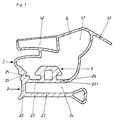
- Fig. 1 das Dichtprofil mit Profilfuß, Rastfuß und Dichtungsbalg
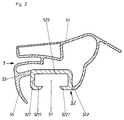
- Fig. 2 die Ersatzteildichtung als Austauschprofil
- Von der Außenseite des oberen Profilfußschenkels 23 in den lichten Innenraum 41 des Dichtungsbalges 4 ragt der Rastfuß 3 auf, der als pilzkopfartige, kugelförmige oder in sonstiger Ausführungsform gestaltete Raste geformt sein kann.
- Der Dichtungsbalg 4 trägt in seinem oberen Bereich eine Aufnahmetasche 42, in welche im Bedarfsfall ein Magnetband eingeschoben werden kann. Zusätzlich kann am oberen Rand eine Dichtlasche 43 angeformt sein, welche sich im Einbauzustand rundumlaufend an Korpusteilen der Tür dichtend anlehnt.
- In die Basis 22 des Profilfußes ist oberhalb der Anlenkung des oberen Profilfußschenkels 23 eine querschnittsverringernde Einschnürung 25 eingeformt, die als Abreißkante für den Dichtbalg im Falle von dessen Verletzung dient. Eine solche querschnittsverringernde Einschnürung 26 ist auch im Bereich der Anbindung des Dichtungsbalges 4 an das freie Ende des oberen Profilfußschenkels 23 vorgesehen, die ebenfalls als Abreißkante im Verletzungsfall dient.
- Wird der Dichtungsbalg 4 über die Abreißkanten 25, 26 von der Basis 22 des Profilfußes 2 und dem freien Ende 231 des oberen Profilfußschenkels 23 abgerissen, steht der Rastfuß 3 noch oben hin frei zur Durchführung einer Rastverbindung zur Verfügung.
- In diesem Fall wird das in Fig. 2 dargestellte Austauschprofil 5 als Ersatzteildichtung eingesetzt. Das Austauschprofil 5 ist bis auf den Fußbereich nahezu identisch mit dem Dichtprofil 1 gestaltet. Anstelle des Profilfußes 2 besitzt das Austauschprofil 5 ein mit nach unten offener Nut 51 gestaltetes C-förmiges Profilteil 52. Das C-förmige Profilteil 52 besitzt die Seitenschenkel 521, 522, die durch die Basis 523 einstückig verbunden sind. An den Seitenschenkel 521 ist im Bereich von dessen Verbindung mit der Basis 523 außenseitig der Verbindungsabschnitt 53 des Ersatzdichtungsbalges einstückig angeformt. Der Verbindungsabschnitt 53 verläuft nach oben direkt in den Ersatzdichtungsbalg 54 und nach unten in eine Dichtfahne 55. Die Dichtfahne 55 liegt bei der Verrasterung des C-förmigen Rastprofils 52 der Ersatzteildichtung 5 an Korpusbereichen der Innenschale umlaufend abdichtend an.
- An den Profilschenkel 522 ist außenseitig im oberen Bereich das Ende des Dichtungsbalges 54 einstückig angeformt.
- Das C-förmige Profilteil 52 besitzt an den freien Rändern der Seitenschenkel 521, 522 nach innen zur Aufnahmenut 51 hin gerichtete kurze Profilschenkel 5211, 5221, weiche in die Aufnahmenut 51 hineinragen und deren lichten Querschnitt verengen. Diese kurzen Profilschenkel 5211, 5221 hintergreifen im Verrasterungsfall die Rastbereiche des Rastfßes 3 am oberen Profilfußschenkel 23 des Profilfußes 3 nach der dort erfolgten Abtrennung des Dichtbalges an den querschnittsverringernden Einschnürungen 25, 26, wodurch wieder ein voll funktionsfähiges Dichtprofil geschaffen wird.
Claims (4)
- Profil zur Dichtung einer Tür oder Klappe gegenüber einem Korpusteil, insbesondere zwischen einer Kühlmöbeltür und einem Kühlmöbelkorpus, bestehend aus einem Profilfuß mit einem oberen und einem unteren Profilfußschenkel, wobei der obere Profilfußschenkel mit einem balg- oder schlauchförmigen Dichtungsteil einstückig verbunden ist, dadurch gekennzeichnet, daß der obere Profilfußschenkel (23) einen in den lichten Innenraum (41) des Dichtungsbalges (4) aufragenden Rastfuß (3) trägt.
- Profil nach Anspruch 1, dadurch gekennzeichnet, daß in die Basis (22) des Profilfußes (2) oberhalb der Anbindung des oberen Profilfußschenkels (23) eine querschnittsverringernde Einschnürung (25) eingebracht ist.
- Profil nach Anspruch 1, dadurch gekennzeichnet, daß der obere Profilfußschenkel (23) an seinem der Basis (22) gegenüberliegenden freien Ende (231) im Bereich der Anbindung an den Dichtungsbalg eine querschnittsverringernde Einschnürung (26) aufweist.
- Profil nach Ansprüchen 1-3, dadurch gekennzeichnet, daß nach der Abtrennung des Dichtungsbalges (4) über die querschnittsverringernden Einschnürungen (25, 26) das Austauschprofil (5) über die Aufnahmenut (51) mit dem Rastfuß (3) des oberen Profilschenkels (23) verrastbar ist.
Applications Claiming Priority (2)
| Application Number | Priority Date | Filing Date | Title |
|---|---|---|---|
| DE29512529U | 1995-08-03 | ||
| DE29512529U DE29512529U1 (de) | 1995-08-03 | 1995-08-03 | Profil zur Dichtung einer Tür |
Publications (2)
| Publication Number | Publication Date |
|---|---|
| EP0757151A2 true EP0757151A2 (de) | 1997-02-05 |
| EP0757151A3 EP0757151A3 (de) | 1998-04-15 |
Family
ID=8011359
Family Applications (1)
| Application Number | Title | Priority Date | Filing Date |
|---|---|---|---|
| EP96110119A Withdrawn EP0757151A3 (de) | 1995-08-03 | 1996-06-22 | Profil zur Dichtung einer Tür |
Country Status (3)
| Country | Link |
|---|---|
| EP (1) | EP0757151A3 (de) |
| DE (1) | DE29512529U1 (de) |
| ZA (1) | ZA966112B (de) |
Cited By (2)
| Publication number | Priority date | Publication date | Assignee | Title |
|---|---|---|---|---|
| EP0959312A3 (de) * | 1998-05-18 | 2000-02-02 | Liebherr-Hausgeräte Gmbh | Profil zur Dichtung einer Tür oder Klappe gegenüber einem Korpusteil |
| EP0974795A3 (de) * | 1998-07-24 | 2000-02-02 | BSH Fabricacion, S.A. | Abdichtungsvorrichtung für Kühlschranktür |
Families Citing this family (6)
| Publication number | Priority date | Publication date | Assignee | Title |
|---|---|---|---|---|
| DE29512529U1 (de) * | 1995-08-03 | 1996-02-22 | Rehau Ag + Co, 95111 Rehau | Profil zur Dichtung einer Tür |
| DE102007028616A1 (de) * | 2007-06-19 | 2008-12-24 | Rehau Ag + Co. | Profil zur Dichtung einer Tür |
| DE202007012848U1 (de) * | 2007-09-13 | 2009-02-12 | Rehau Ag + Co | Dichtung für Türen |
| DE202021104279U1 (de) | 2021-08-10 | 2023-03-28 | REHAU Industries SE & Co. KG | Abdeckvorrichtung zum Abdecken einer Verbindungsstelle von medienführenden Rohrendabschnitten |
| DE202021104281U1 (de) | 2021-08-10 | 2023-03-28 | REHAU Industries SE & Co. KG | Abdeckvorrichtung zum Abdecken einer Verbindungsstelle von medienführenden Rohrendabschnitten |
| DE202021104278U1 (de) | 2021-08-10 | 2022-12-12 | REHAU Industries SE & Co. KG | Abdeckvorrichtung zum Abdecken einer Verbindungsstelle von medienführenden Rohrendabschnitten |
Family Cites Families (8)
| Publication number | Priority date | Publication date | Assignee | Title |
|---|---|---|---|---|
| US3117352A (en) * | 1961-02-21 | 1964-01-14 | H O Canfield Company Inc | Non-slip door gasket |
| DE3022381A1 (de) * | 1980-06-14 | 1981-12-24 | Licentia Patent-Verwaltungs-Gmbh, 6000 Frankfurt | Profildichtung |
| DE3323540A1 (de) * | 1983-06-30 | 1985-01-03 | Licentia Patent-Verwaltungs-Gmbh, 6000 Frankfurt | Tuerdichtung fuer ein kuehlgeraet |
| DE3476443D1 (en) * | 1983-12-23 | 1989-03-02 | Ilpea Spa | Profile of plastic material for refrigerator cabinets |
| IT1175317B (it) * | 1984-02-08 | 1987-07-01 | Ilpea Spa | Guarnizione di chiusura tra porta e relativa battuta su un mobile, in particolare un frigorifero |
| DE8801873U1 (de) * | 1988-02-13 | 1988-03-31 | REHAU AG + Co, 8673 Rehau | Rahmenförmige Dichtung |
| DE9410579U1 (de) * | 1994-06-30 | 1994-09-01 | Rehau Ag + Co, 95111 Rehau | Profil zur Dichtung einer Tür |
| DE29512529U1 (de) * | 1995-08-03 | 1996-02-22 | Rehau Ag + Co, 95111 Rehau | Profil zur Dichtung einer Tür |
-
1995
- 1995-08-03 DE DE29512529U patent/DE29512529U1/de not_active Expired - Lifetime
-
1996
- 1996-06-22 EP EP96110119A patent/EP0757151A3/de not_active Withdrawn
- 1996-07-18 ZA ZA9606112A patent/ZA966112B/xx unknown
Cited By (2)
| Publication number | Priority date | Publication date | Assignee | Title |
|---|---|---|---|---|
| EP0959312A3 (de) * | 1998-05-18 | 2000-02-02 | Liebherr-Hausgeräte Gmbh | Profil zur Dichtung einer Tür oder Klappe gegenüber einem Korpusteil |
| EP0974795A3 (de) * | 1998-07-24 | 2000-02-02 | BSH Fabricacion, S.A. | Abdichtungsvorrichtung für Kühlschranktür |
Also Published As
| Publication number | Publication date |
|---|---|
| DE29512529U1 (de) | 1996-02-22 |
| EP0757151A3 (de) | 1998-04-15 |
| ZA966112B (en) | 1997-02-03 |
Similar Documents
| Publication | Publication Date | Title |
|---|---|---|
| EP2162321B1 (de) | Flaches wischblatt | |
| EP0749378B1 (de) | Wischblatt | |
| EP1056628A1 (de) | Vorrichtung zum gelenkigen verbinden eines wischblatts für scheiben von kraftfahrzeugen mit einem wischerarm und verfahren zum herstellen dieser verbindung | |
| DE4415081A1 (de) | Wischarm, insbesondere für Kraftfahrzeuge | |
| DE3430121A1 (de) | Instrumententafel fuer kraftfahrzeuge | |
| DE3222864A1 (de) | Wischblatt fuer scheibenwischanlagen von fahrzeugen, insbesondere kraftfahrzeugen und verfahren zu seiner herstellung | |
| EP2842713A1 (de) | Gelenk | |
| EP1060931A2 (de) | Stegkappe aus gummielastischem Material | |
| EP1367931B1 (de) | Kippgelenkausbildung eines staubsauger-saugkanals | |
| DE29512529U1 (de) | Profil zur Dichtung einer Tür | |
| EP1291255B1 (de) | Vorrichtung zur Aufnahme einer Fahrzeughubeinrichtung | |
| DE19961873C2 (de) | Eckenausbildung am Fensterrahmen einer Fahrzeugtür | |
| EP0690197A2 (de) | Profil zur Dichtung einer Tür | |
| EP2441998B1 (de) | Flexibles Teilstück für einen Gasströmungskanal | |
| DE9306553U1 (de) | Schaltleiste | |
| DE102019124844B3 (de) | Fahrzeugdach und Dachanordnung | |
| EP0097219A2 (de) | Haltegriff od. dgl. für Fahrzeuge | |
| EP0894655A2 (de) | Sonnenblende für Fahrzeuge | |
| DE2604325C3 (de) | Wischvorrichtung für Scheiben von Kraftfahrzeugen | |
| EP0611347A1 (de) | Wischarm, insbesondere zur reinigung einer scheibe eines kraftfahrzeugs. | |
| DE29619300U1 (de) | Profil zur Dichtung einer Tür | |
| DE3208235C2 (de) | ||
| DE2550544C3 (de) | Lager, insbesondere Schwenklager für Fahrzeugsonnenblenden | |
| DE4423914A1 (de) | Schnappscharnier für eine Tankklappe | |
| EP0908659A2 (de) | Fluid-Steckverbindung und Fluid-Rohrleitungselement |
Legal Events
| Date | Code | Title | Description |
|---|---|---|---|
| PUAI | Public reference made under article 153(3) epc to a published international application that has entered the european phase |
Free format text: ORIGINAL CODE: 0009012 |
|
| AK | Designated contracting states |
Kind code of ref document: A2 Designated state(s): AT DE DK ES FR GB IT SE |
|
| PUAL | Search report despatched |
Free format text: ORIGINAL CODE: 0009013 |
|
| AK | Designated contracting states |
Kind code of ref document: A3 Designated state(s): AT DE DK ES FR GB IT SE |
|
| 17P | Request for examination filed |
Effective date: 19980430 |
|
| STAA | Information on the status of an ep patent application or granted ep patent |
Free format text: STATUS: THE APPLICATION HAS BEEN WITHDRAWN |
|
| 18W | Application withdrawn |
Withdrawal date: 20000529 |