EP0759426A2 - Verfahren zur Herstellung von optisch aktiven 1-Aryl-alkylaminen - Google Patents
Verfahren zur Herstellung von optisch aktiven 1-Aryl-alkylaminen Download PDFInfo
- Publication number
- EP0759426A2 EP0759426A2 EP96112609A EP96112609A EP0759426A2 EP 0759426 A2 EP0759426 A2 EP 0759426A2 EP 96112609 A EP96112609 A EP 96112609A EP 96112609 A EP96112609 A EP 96112609A EP 0759426 A2 EP0759426 A2 EP 0759426A2
- Authority
- EP
- European Patent Office
- Prior art keywords
- butyl
- formula
- carbon atoms
- hydrogen
- fluorine
- Prior art date
- Legal status (The legal status is an assumption and is not a legal conclusion. Google has not performed a legal analysis and makes no representation as to the accuracy of the status listed.)
- Granted
Links
- 0 *CC(C(N)=O)[Al] Chemical compound *CC(C(N)=O)[Al] 0.000 description 2
- PINPOEWMCLFRRB-UHFFFAOYSA-N CC(c(cc1)ccc1Cl)N Chemical compound CC(c(cc1)ccc1Cl)N PINPOEWMCLFRRB-UHFFFAOYSA-N 0.000 description 1
Classifications
-
- C—CHEMISTRY; METALLURGY
- C07—ORGANIC CHEMISTRY
- C07C—ACYCLIC OR CARBOCYCLIC COMPOUNDS
- C07C211/00—Compounds containing amino groups bound to a carbon skeleton
- C07C211/01—Compounds containing amino groups bound to a carbon skeleton having amino groups bound to acyclic carbon atoms
- C07C211/02—Compounds containing amino groups bound to a carbon skeleton having amino groups bound to acyclic carbon atoms of an acyclic saturated carbon skeleton
- C07C211/03—Monoamines
-
- C—CHEMISTRY; METALLURGY
- C12—BIOCHEMISTRY; BEER; SPIRITS; WINE; VINEGAR; MICROBIOLOGY; ENZYMOLOGY; MUTATION OR GENETIC ENGINEERING
- C12P—FERMENTATION OR ENZYME-USING PROCESSES TO SYNTHESISE A DESIRED CHEMICAL COMPOUND OR COMPOSITION OR TO SEPARATE OPTICAL ISOMERS FROM A RACEMIC MIXTURE
- C12P41/00—Processes using enzymes or microorganisms to separate optical isomers from a racemic mixture
- C12P41/006—Processes using enzymes or microorganisms to separate optical isomers from a racemic mixture by reactions involving C-N bonds, e.g. nitriles, amides, hydantoins, carbamates, lactames, transamination reactions, or keto group formation from racemic mixtures
-
- C—CHEMISTRY; METALLURGY
- C07—ORGANIC CHEMISTRY
- C07C—ACYCLIC OR CARBOCYCLIC COMPOUNDS
- C07C209/00—Preparation of compounds containing amino groups bound to a carbon skeleton
- C07C209/54—Preparation of compounds containing amino groups bound to a carbon skeleton by rearrangement reactions
- C07C209/58—Preparation of compounds containing amino groups bound to a carbon skeleton by rearrangement reactions from or via amides
-
- C—CHEMISTRY; METALLURGY
- C12—BIOCHEMISTRY; BEER; SPIRITS; WINE; VINEGAR; MICROBIOLOGY; ENZYMOLOGY; MUTATION OR GENETIC ENGINEERING
- C12P—FERMENTATION OR ENZYME-USING PROCESSES TO SYNTHESISE A DESIRED CHEMICAL COMPOUND OR COMPOSITION OR TO SEPARATE OPTICAL ISOMERS FROM A RACEMIC MIXTURE
- C12P13/00—Preparation of nitrogen-containing organic compounds
- C12P13/02—Amides, e.g. chloramphenicol or polyamides; Imides or polyimides; Urethanes, i.e. compounds comprising N-C=O structural element or polyurethanes
Definitions
- the present invention relates to a new process for the preparation of (R) -1-aryl-alkylamines which can be used as intermediates for the synthesis of active compounds with fungicidal properties.
- optically active amines can be prepared by reacting racemates of amines with 2- (4-hydroxyphenoxy) propionic acid, separating the desired product from the resulting mixture of diastereomers, and treating the optically active amine therefrom by treatment with base releases (see JP-A 95-010 813).
- a disadvantage of this process is that the yields of the desired substances are not always satisfactory and, above all, the optical purity of the reaction products leaves something to be desired.
- optically active primary and secondary amines can be prepared by first enantioselectively acylating racemic amine with certain esters in the presence of a hydrolase, then the mixture of optically active amine and optically active acylated amine separates and thereby obtains an enantiomer of the amine and optionally obtains the other enantiomer from the optically active, acylated amine by amide cleavage.
- the (S) amines are formed.
- this process has the disadvantage that the optical yields are relatively low in some cases.
- (R) -1-aryl-alkylamines are to be understood as those optically active compounds of the formula (I) which have the (R) configuration on the asymmetrically substituted carbon atom.
- the asymmetrically substituted carbon atom is identified by (*).
- the chirality centers are also marked in other formulas.
- the method according to the invention has a number of advantages. It enables the production of a large number of (R) -1-aryl-alkylamines in high yield and very good optical purity. It is also favorable that both the starting materials and the reaction components are easily accessible and are also available in larger quantities. Finally, it is particularly advantageous that the (S) -2-arylalkanoic acid ester which has not been reacted in each case can also be racemized in a simple manner and used again for the resolution of racemate.
- racemic 2-arylalkanoic acid ethyl esters or methyl esters of the formula (II) are known or can be prepared by known methods.
- Suitable biocatalysts for carrying out the first stage of the process according to the invention are all those lipases which are selectively suitable for cleaving the (R) -enantiomers of ethyl 2-arylalkanoate of the formula (II) and for catalysing the formation of amides.
- lipases from Candida antarctica, Newlase F, lipase from Pseudomonas sp. and called Lipase M. These lipases that can be used as biocatalysts are known.
- the lipases can be used either natively or in modified form, for example microencapsulated, or bound to inorganic or organic carrier materials.
- Celite, zeolites, polysaccharides, polyamides and polystyrene resins are suitable as carrier materials.
- Ammonia is used for aminolysis when the first stage of the process according to the invention is carried out. This is preferably used dried either in gaseous form or in liquid form.
- Suitable diluents for carrying out the first stage of the process according to the invention are preferably tertiary alcohols, such as tert-butanol and 3-methyl-3-pentanol, and furthermore ethers, such as dioxane, furan, dimethyl ether, methyl tert-butyl ether and tert .-Amyl methyl ether, as well as acetonitrile and isopropanol.
- Tert-butanol is particularly preferably used.
- the temperatures can be varied within a certain range when carrying out the first stage of the process according to the invention. In general, temperatures between -10 ° C and 80 ° C, preferably between 0 ° C and 70 ° C.
- the process is carried out either under atmospheric pressure or, if liquid ammonia is used in a pressure vessel, under the autogenous pressure which arises. But it is also possible to work under additional pressure.
- 1 g of racemic ethyl or methyl 2-arylalkanoate of the formula (II) is generally 0.01 g to 0.5 g, preferably 0.01 g to 0 , 3 g of lipase.
- the amount of ammonia can be varied within a wide range. In general, 0.5 mol to 30 mol, preferably 0.5 mol to 10 mol, of ammonia are used per 1 mol of racemic 2-arylalkanoic acid ethyl ester or methyl ester of the formula (II).
- the procedure When working with gaseous ammonia, the procedure is such that ammonia is first added to the reaction mixture until saturated and then ammonia is passed through the reaction vessel until the reaction has ended.
- the procedure When working with liquid ammonia, the procedure is such that liquid ammonia is condensed at low temperature in a pressure vessel filled with the reaction mixture, then the pressure vessel is closed and heated to the desired temperature.
- the processing takes place according to usual Methods. In general, the procedure is such that the biocatalyst is separated off, the filtrate is concentrated and the residue which remains is taken up in a suitable solvent mixture, so that the desired amide precipitates in solid form and can be filtered off.
- the (S) -2-arylalkanoic acid ethyl ester or methyl ester can be obtained from the filtrate by concentration under reduced pressure. This can be racemized, for example, by treatment with sodium ethylate in ethanol and used again for the resolution.
- Sodium hypochlorite and sodium hypobromite can be considered as hypohalites when carrying out the second stage of the process according to the invention.
- the procedure is such that these substances are freshly prepared by reacting chlorine or bromine with aqueous sodium hydroxide solution and immediately following the further reaction.
- reaction temperatures can be varied within a certain range when carrying out the second stage of the process according to the invention. In general, temperatures between 0 ° C and 120 ° C, preferably between 20 ° C and 100 ° C.
- the second stage of the process according to the invention is generally carried out under atmospheric pressure. But it is also possible to work under increased pressure.
- the (R) -1-arylalkylamines of the formula (I) which can be prepared by the process according to the invention are valuable intermediates for the production of pharmaceuticals or of active compounds with insecticidal, fungicidal or herbicidal properties (cf. EP-A 0 519 211, EP-A 0 453 137, EP-A 0 283 879, EP-A 0 264 217 and EP-A 0 341 475).
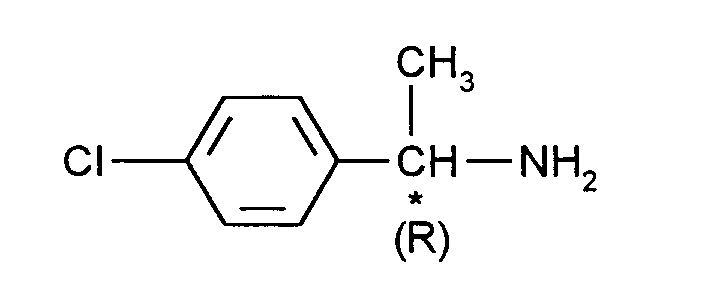
- the fungicidally active compound of the formula is obtained by using the (R) -1- (4-chlorophenyl) ethylamine of the formula with 2,2-dichloro-1-ethyl-3-methyl-1-cyclopropanecarboxylic acid chloride of the formula in the presence of an acid binder and in the presence of an inert organic diluent.
- a mixture of 5 g of racemic ethyl 2- (4-chlorophenyl) propionate and 50 ml of tert-butanol is stirred at 50 ° C. with 1 g of Candida antarctica lipase (Novozym 435, activity 7000 PLU / g). transferred.
- Ammonia is then passed into the reaction mixture with stirring at 50 ° C. until saturation.
- the mixture is stirred for a further 28 hours at 50 ° C. and a slow ammonia stream is continuously passed through the apparatus.
Landscapes
- Chemical & Material Sciences (AREA)
- Organic Chemistry (AREA)
- Engineering & Computer Science (AREA)
- Zoology (AREA)
- Life Sciences & Earth Sciences (AREA)
- Wood Science & Technology (AREA)
- Chemical Kinetics & Catalysis (AREA)
- Microbiology (AREA)
- General Chemical & Material Sciences (AREA)
- Biotechnology (AREA)
- Health & Medical Sciences (AREA)
- Biochemistry (AREA)
- Bioinformatics & Cheminformatics (AREA)
- General Engineering & Computer Science (AREA)
- General Health & Medical Sciences (AREA)
- Genetics & Genomics (AREA)
- Analytical Chemistry (AREA)
- Preparation Of Compounds By Using Micro-Organisms (AREA)
- Organic Low-Molecular-Weight Compounds And Preparation Thereof (AREA)
Abstract

- R1 und Ar
- die in der Beschreibung angegebenen Bedeutungen haben,
- a) Racemate von 2-Aryl-alkansäure-ethylestern bzw. -methylestern der Formel

- b) aus dem Reaktionsgemisch die entstandenen (R)-2-Aryl-alkansäure-amide der Formel
Description
- Die vorliegende Erfindung betrifft ein neues Verfahren zur Herstellung von (R)-1-Aryl-alkylaminen, die als Zwischenprodukte zur Synthese von Wirkstoffen mit fungiziden Eigenschaften verwendet werden können.
- Es ist bereits bekannt, daß sich optisch aktive Amine herstellen lassen, indem man Racemate von Aminen mit 2-(4-Hydroxyphenoxy)-propionsäure umsetzt, aus dem entstehenden Diastereomeren-Gemisch das gewünschte Produkt abtrennt und daraus durch Behandlung mit Base das optisch aktive Amin freisetzt (vgl. JP-A 95-010 813). Ungünstig an diesem Verfahren ist, daß die Ausbeuten an den gewünschten Substanzen nicht immer befriedigend sind und vor allem die optische Reinheit der Reaktionsprodukte zu wünschen übrig läßt.
- Weiterhin ist schon bekannt, daß man (R)-1-(4-Chlor-phenyl)-ethylamin erhält, wenn man racemisches 1-(4-Chlor-phenyl)-ethylamin in Gegenwart von Ethanol mit (S)-(-)-N-Phenylcarbamat-milchsäure umsetzt, den dabei entstehenden Kristallbrei absaugt und mit wäßriger Natronlauge in Gegenwart von Methylenchlorid behandelt (vgl. EP-A 0 341 475). Die Wirtschaftlichkeit dieses Verfahrens wird aber dadurch beeinträchtigt, daß ein beachtlicher Anteil an (S)-(-)-N-Phenylcarbamat-milchsäure in der nach dem Absaugen des Kristallbreis anfallenden Mutterlauge vorhanden ist und daraus nur in aufwendiger Weise isoliert werden kann.
- Wie ferner in der DE-A 4 332 738 offenbart wird, lassen sich optisch aktive primäre und sekundäre Amine herstellen, indem man zunächst racemisches Amin mit bestimmten Estern in Gegenwart einer Hydrolase enantioselektiv acyliert, dann das Gemisch aus optisch aktivem Amin und optisch aktivem acyliertem Amin trennt und dadurch ein Enantiomer des Amins erhält und gegebenenfalls aus dem optisch aktiven, acylierten Amin durch Amidspaltung das andere Enantiomer erhält. Beim Arbeiten nach diesem Verfahren entstehen aber jeweils nur die (S)-Amine. Um auch die entsprechenden (R)-Amine zu gewinnen, ist eine aufwendige Abtrennung der acylierten Komponente und deren Spaltung erforderlich.
- Aus. J. Chem. Soc. Chem. Commun. 1993, 1831-1832 ist zu entnehmen, daß sich Racemate des 2-(4-Isobutyl-phenyl)-propionsäure-(2-chlorethyl)-esters mit Hilfe von Ammoniak in Gegenwart bestimmter Enzyme, wie Candida antarctica Lipase SP 435, enantioselektiv in das (R)-2-(4-Isobutyl-phenyl)-propionsäure-amid überführen lassen. Dieses Verfahren ist aber mit dem Nachteil behaftet, daß neben dem gewünschten (R)-Amid auch ein erheblicher Anteil an freier (R)-Säure entsteht.
- Darüber hinaus ist bekannt, daß optisch aktive Amine durch enantioselektive Hydrierung von C = N-Bindungen in Gegenwart von chiralen Übergangsmetall-Komplexen zugänglich sind (vgl. Angew. Chem. 105, 245 (1993)). Neben einer aufwendigen Herstellung und Rückführung des Katalysators weist dieses Verfahren den Nachteil auf, daß die optischen Ausbeuten in manchen Fällen relativ niedrig sind.
- Schließlich geht aus der Literatur hervor, daß optisch aktive Amine bei der asymmetrischen Reduktion von Oximen mit Lithium-aluminium-hydrid, chiralen Lithium-aluminium-hydrid-Komplexen oder chiralen Boran-Komplexen in guten optischen Ausbeuten anfallen (vgl. Chem. Lett. (1986), 1133 und J. Chem. Perkin Trans. I (1985), 2039). Für eine Durchführung im technischen Maßstab ist diese Methode aber aus Sicherheitsgründen nur bedingt geeignet.
- Es wurde nun gefunden, daß man (R)-1-Aryl-alkylamine der Formel

- R1
- für Wasserstoff oder Alkyl steht und
- Ar
- für gegebenenfalls substituiertes Phenyl der Formel

- R2 und R6
- für Wasserstoff oder Fluor stehen und
- R3, R4 und R5
- unabhängig voneinander für Wasserstoff, Halogen, Alkyl, Halogenalkyl, Alkoxy, Halogenalkoxy, Cyano, Dialkylamino, Nitro, Phenyl, Phenoxy oder Benzyl stehen,
- Ar
- für gegebenenfalls einfach bis dreifach, gleichartig oder verschieden durch Halogen, Alkyl, Halogenalkyl, Alkoxy und/oder Halogenalkoxy substituiertes Naphthyl steht,
- a) Racemate von 2-Aryl-alkansäure-ethylestern bzw. -methylestern der Formel

- R1 und Ar
- die oben angegebenen Bedeutungen haben,
- b) aus dem Reaktionsgemisch die entstandenen (R)-2-Aryl-alkansäure-amide der Formel

- R1 und Ar
- die oben angegebenen Bedeutungen haben,
NaOHal (IV),
in welcher- Hal
- für Chlor oder Brom steht,
- Unter (R)-1-Aryl-alkylaminen sind diejenigen optisch aktiven Verbindungen der Formel (I) zu verstehen, die am asymmetrisch substituierten Kohlenstoffatom die (R)-Konfiguration aufweisen. In der Formel (I) ist das asymmetrisch substituierte Kohlenstoffatom durch (*) gekennzeichnet. In gleicher Weise sind die Chiralitätszentren auch in anderen Formeln markiert.
- Es ist als äußerst überraschend zu bezeichnen, daß sich (R)-1-Aryl-alkylamine nach dem erfindungsgemäßen Verfahren in hoher Ausbeute und sehr guter optischer Reinheit herstellen lassen. Aufgrund des bekannten Standes der Technik konnte nämlich nicht damit gerechnet werden, daß die im Vergleich zu den 2-Chlorethylestern weniger reaktiven Ethylester und Methylester sich als Ausgangsstoffe eignen würden. Unerwartet ist auch, daß eine Hydrolyse der eingesetzten Ester nur in sehr geringem Maße stattfindet.
- Das erfindungsgemäße Verfahren weist eine Reihe von Vorteilen auf. So ermöglicht es die Herstellung einer Vielzahl von (R)-1-Aryl-alkylaminen in hoher Ausbeute und sehr guter optischer Reinheit. Günstig ist auch, daß sowohl die Ausgangsstoffe als auch die Reaktionskomponenten in einfacher Weise zugänglich sind und auch in größeren Mengen zur Verfügung stehen. Von besonderem Vorteil ist schließlich, daß sich auch der jeweils nicht umgesetzte (S)-2-Aryl-alkansäure-ester in einfacher Weise racemisieren und erneut zur Racematspaltung verwenden läßt.
- Setzt man racemischen 2-(4-Chlorphenyl)-propionsäure-ethylester mit Lipase aus Candida antarctica in Gegenwart von Ammoniak um und behandelt man das daraus entstandene Amid nach vorheriger Abtrennung mit Natriumhypobromit, so kann der Verlauf des erfindungsgemäßen Verfahrens durch das folgende Formelschema veranschaulicht werden.

- Die bei der Durchführung des erfindungsgemäßen Verfahrens als Ausgangsstoffe benötigten racemischen 2-Aryl-alkansäure-ethylester bzw. -methylester sind durch die Formel (II) allgemein definiert. In dieser Formel steht
- R1
- vorzugsweise für Wasserstoff oder geradkettiges oder verzweigtes Alkyl mit 1 bis 4 Kohlenstoffatomen, und
- Ar
- steht für gegebenenfalls substituiertes Phenyl der Formel

- R2 und R6
- vorzugsweise für Wasserstoff oder Fluor stehen, wobei zumindest einer dieser beiden Substituenten für Wassersstoff steht, und
- R3, R4 und R5
- unabhängig voneinander vorzugsweise für Wasserstoff, Fluor, Chlor, Brom, geradkettiges oder verzweigtes Alkyl mit 1 bis 4 Kohlenstoffatomen, geradkettiges oder verzweigtes Alkoxy mit 1 bis 4 Kohlenstoffatomen, Halogenalkyl mit 1 bis 4 Kohlenstoffatomen und 1 bis 5 gleichen oder verschiedenen Halogenatomen, Halogenalkoxy mit 1 bis 4 Kohlenstoffatomen und 1 bis 5 gleichen oder verschiedenen Halogenatomen, Cyano, Dialkylamino mit 1 bis 4 Kohlenstoffatomen in jeder Alkylgruppe, Nitro, Phenyl, Phenoxy oder Benzyl stehen,
oder - Ar
- steht vorzugsweise für gegebenenfalls einfach bis dreifach, gleichartig oder verschieden durch Fluor, Chlor, Brom, geradkettiges oder verzweigtes Alkyl mit 1 bis 4 Kohlenstoffatomen, Halogenalkyl mit 1 bis 4 Kohlenstoffatomen und 1 bis 5 gleichen oder verschiedenen Halogenatomen, Alkoxy mit 1 bis 4 Kohlenstoffatomen und/oder Halogenalkoxy mit 1 bis 4 Kohlenstoffatomen und 1 bis 5 gleichen oder verschiedenen Halogenatomen substituiertes Naphthyl, wobei jedoch die ortho-Positionen zu dem Kohlenstoffatom, über das der Naphthyl-Rest gebunden ist, nicht substituiert sind.
- R1
- für Wasserstoff, Methyl, Ethyl, n-Propyl, Isopropyl, n-Butyl, iso-Butyl oder sek.-Butyl steht und
- Ar
- für gegebenenfalls substituiertes Phenyl der Formel

- R2 und R6
- für Wasserstoff oder Fluor stehen, wobei zumindest einer dieser beiden Substituenten für Wassersstoff steht, und
- R3, R4 und R5
- unabhängig voneinander vorzugsweise für Wasserstoff, Fluor, Chlor, Brom, Methyl, Ethyl, n-Propyl, Isopropyl, n-Butyl, iso-Butyl, sek.-Butyl, tert.-Butyl, Methoxy, Ethoxy, Trichlormethyl, Trifluormethyl, Difluormethyl, Trifluormethoxy, Difluorchlormethoxy, Difluormethoxy, Cyano, Dimethylamino, Diethylamino, Nitro, Phenyl, Phenoxy oder Benzyl stehen, oder
- Ar
- für gegebenenfalls einfach bis dreifach, gleichartig oder verschieden durch Fluor, Chlor, Brom, Methyl, Ethyl, n-Propyl, Isopropyl, n-Butyl, iso-Butyl, sek.-Butyl, tert.-Butyl, Methoxy, Ethoxy, Trichlormethyl, Trifluormethyl, Difluormethyl, Trifluormethoxy und/oder Difluormethoxy substituiertes Naphthyl steht, wobei jedoch die ortho-Positionen zu dem Kohlenstoffatom, über das der Naphthyl-Rest gebunden ist, nicht substituiert sind.
- Die racemischen 2-Aryl-alkansäure-ethylester bzw. -methylester der Formel (II) sind bekannt oder lassen sich nach bekannten Methoden herstellen.
- Als Biokatalysatoren kommen bei der Durchführung der ersten Stufe des erfindungsgemäßen Verfahrens alle diejenigen Lipasen in Betracht, die selektiv zur Spaltung der (R)-Enantiomeren von 2-Aryl-alkansäure-ethylestern der Formel (II) und zur Katalyse der Amidbildung geeignet sind. Als Beispiele seien Lipase aus Candida antarctica, Newlase F, Lipase aus Pseudomonas sp. und Lipase M genannt. Diese als Biokatalysatoren einsetzbaren Lipasen sind bekannt.
- Die Lipasen können bei der Durchführung der ersten Stufe des erfindungsgemäßen Verfahrens entweder nativ oder in modifizierter Form, z.B. mikroverkapselt oder an anorganische oder organische Trägermaterialien gebunden eingesetzt werden.
- Als Trägermaterialien kommen dabei zum Beispiel Celite, Zeolithe, Polysaccharide, Polyamide und Polystyrolharze in Frage.
- Zur Aminolyse dient bei der Durchführung der ersten Stufe des erfindungsgemäßen Verfahrens Ammoniak. Dieser wird vorzugsweise getrocknet entweder gasförmig oder in flüssiger Form eingesetzt.
- Als Verdünnungsmittel kommen bei der Durchführung der ersten Stufe des erfindungsgemäßen Verfahrens vorzugsweise tertiäre Alkohole, wie tert.-Butanol und 3-Methyl-3-pentanol, ferner Ether, wie Dioxan, Furan, Dimethylether, Methyl-tert.-butyl-ether und tert.-Amyl-methyl-ether, sowie auch Acetonitril und Isopropanol in Betracht. Besonders bevorzugt verwendbar ist tert.-Butanol.
- Die Temperaturen können bei der Durchführung der ersten Stufe des erfindungsgemäßen Verfahrens innerhalb eines bestimmten Bereiches variiert werden. Im allgemeinen arbeitet man bei Temperaturen zwischen -10°C und 80°C, vorzugsweise zwischen 0°C und 70°C.
- Bei der Durchführung der ersten Stufe des erfindungsgemäßen Verfahrens arbeitet man entweder unter Atmosphärendruck oder, sofern flüssiger Ammoniak in einem Druckgefäß eingesetzt wird, unter dem sich dabei einstellenden Eigendruck. Es ist aber auch möglich, unter zusätzlich erhöhtem Druck zu arbeiten.
- Bei der Durchführung der ersten Stufe des erfindungsgemäßen Verfahrens setzt man auf 1 g an racemischem 2-Aryl-alkansäure-ethylester oder -methylester der Formel (II) im allgemeinen 0,01 g bis 0,5 g, vorzugsweise 0,01 g bis 0,3 g an Lipase ein. Die Menge an Ammoniak kann innerhalb eines größeren Bereiches variiert werden. Auf 1 Mol an racemischem 2-Aryl-alkansäure-ethylester bzw. - methylester der Formel (II) setzt man im allgemeinen 0,5 Mol bis 30 Mol, vorzugsweise 0,5 Mol bis 10 Mol an Ammoniak ein. Beim Arbeiten mit gasförmigem Ammoniak geht man im einzelnen so vor, daß man das Reaktionsgemisch zunächst bis zur Sättigung mit Ammoniak versetzt und dann bis zur Beendigung der Umsetzung Ammoniak durch das Reaktionsgefäß leitet. Beim Arbeiten mit flüssigem Ammoniak verfährt man in der Weise, daß man flüssigen Ammoniak bei niedriger Temperatur in einem mit dem Reaktionsgemisch gefüllten Druckgefäß kondensiert, dann das Druckgefäß verschließt und auf die jeweils gewünschte Temperatur erwärmt. Die Aufarbeitung erfolgt nach üblichen Methoden. Im allgemeinen geht man so vor, daß man den Biokatalysator abtrennt, das Filtrat einengt und den verbleibenden Rückstand in einem geeigneten Lösungsmittel-Gemisch aufnimmt, so daß das gewünschte Amid in fester Form ausfällt und abfiltriert werden kann. Aus dem Filtrat kann durch Einengen unter vermindertem Druck der (S)-2-Aryl-alkansäure-ethylester bzw. -methylester gewonnen werden. Dieser läßt sich z.B. durch Behandeln mit Natriumethylat in Ethanol racemisieren und erneut für die Racematspaltung verwenden.
- Als Hypohalogenite kommen bei der Durchführung der zweiten Stufe des erfindungsgemäßen Verfahrens Natriumhypochlorit und Natriumhypobromit in Betracht. Im allgemeinen geht man so vor, daß man diese Stoffe frisch herstellt, indem man Chlor oder Brom mit wäßriger Natronlauge umsetzt und die weitere Reaktion unmittelbar anschließt.
- Die Reaktionstemperaturen können bei der Durchführung der zweiten Stufe des erfindungsgemäßen Verfahrens innerhalb eines bestimmten Bereiches variiert werden. Im allgemeinen arbeitet man bei Temperaturen zwischen 0°C und 120°C, vorzugsweise zwischen 20°C und 100°C.
- Bei der Durchführung der zweiten Stufe des erfindungsgemäßen Verfahrens arbeitet man im allgemeinen unter Atmosphärendruck. Es ist aber auch möglich, unter erhöhtem Druck zu arbeiten.
- Bei der Durchführung der zweiten Stufe des erfindungsgemäßen Verfahrens setzt man auf 1 Mol an (R)-2-Aryl-alkansäureamid der Formel (III) im allgemeinen 1,1 bis 10 Mol, vorzugsweise 1,1 bis 5 Mol an Natriumhypohalogenit ein. Die Aufarbeitung erfolgt nach üblichen Methoden. Im allgemeinen verfährt man in der Weise, daß man das Reaktionsgemisch mit einem mit Wasser wenig mischbaren, organischen Lösungsmittel extrahiert, die vereinigten organischen Phasen trocknet und unter vermindertem Druck einengt. Gegebenenfalls kann eine weitere Reinigung der anfallenden Produkte, z.B. durch Chromatographie oder Destillation, vorgenommen werden.
- Die nach dem erfindungsgemäßen Verfahren herstellbaren (R)-1-Aryl-alkylamine der Formel (I) sind wertvolle Zwischenprodukte zur Herstellung von Pharmazeutika oder von Wirkstoffen mit insektiziden, fungiziden oder herbiziden Eigenschaften (vgl. EP-A 0 519 211, EP-A 0 453 137, EP-A 0 283 879, EP-A 0 264 217 und EP-A 0 341 475). So erhält man z.B. die fungizid wirksame Verbindung der Formel


- Die Durchführung des erfindungsgemäßen Verfahrens wird durch die folgenden Beispiele veranschaulicht.
-
-

- Ein Gemisch aus 5 g racemischem 2-(4-Chlor-phenyl)-propionsäure-ethylester und 50 ml tert.-Butanol wird bei 50°C unter Rühren mit 1 g Lipase aus Candida antarctica (Novozym 435, Aktivität 7000 PLU/g) versetzt. Danach wird unter Rühren bei 50°C bis zur Sättigung Ammoniak in das Reaktionsgemisch geleitet. Man rührt weitere 28 Stunden bei 50 °C und leitet dabei ständig einen langsamen Ammoniakstrom durch die Apparatur. Anschließend wird aufgearbeitet, indem man den Biokatalysator abfiltriert, mit tert.-Butanol und Ethanol nachwäscht, das Filtrat unter vermindertem Druck einengt und den verbleibenden Rückstand mit einem Gemisch aus Petrolether:Di-isopropyl-ether = 9:1 verrührt. Das dabei kristallin anfallende Produkt wird abfiltriert, mit Petrolether nachgewaschen und getrocknet. Man erhält auf diese Weise 1,78 g (42,8 % der Theorie, Umsatz 44-Flächenprozent GC) an (R)-2-(4-Chlor-phenyl)-propionsäure-amid mit einem ee-Wert 96,1 %
- Ein Gemisch aus 5 g racemischem 2-(4-Chlor-phenyl)-propionsäure-ethylester und 50 ml tert.-Butanol wird bei Raumtemperatur in einen Autoklaven gegeben und mit 1 g Lipase aus Candida antarctica (Novozym 435, Aktivität 7000 PLU/g) versetzt. Danach kühlt man auf -50 °C und kondensiert 0,5 g Ammoniak in das Reaktionsgemisch. Man verschließt das Druckgefäß, erwärmt auf 50°C und läßt 24 Stunden unter Rühren reagieren. Anschließend wird in der oben beschriebenen Weise aufgearbeitet. Man erhält dabei 1,78 g (42,8 % der Theorie) an (R)-2-(4-Chlor-phenyl)-propionsäureamid mit einem ee-Wert 99,1 %
-

- In eine Lösung von 5,5 g (0,137 Mol) Natriumhydroxid in 45 ml Wasser werden bei 0°C unter Rühren 4,4 g (0,0275 Mol) Brom eingetropft. Das entstehende Gemisch wird auf -5°C gekühlt und unter Rühren mit .4,2 g (0,0229 Mol) (R)-2-(4-Chlor-phenyl)-propionsäureamid (ee-Wert 98 %) versetzt. Anschließend wird 5 Stunden auf 50°C erhitzt. Nach dem Abkühlen auf Raumtemperatur extrahiert man das Reaktionsgemisch dreimal mit Methylenchlorid, trocknet die vereinigten organischen Phasen über Natriumsulfat und engt unter vermindertem Druck ein. Auf diese Weise erhält man ein Produkt, das gemäß Gaschromatogramm zu 87 % aus (R)-1-(4-Chlor-phenyl)-ethylamin (ee-Wert >98 %) besteht. Danach errechnet sich eine Ausbeute von 78,5 % der Theorie.
-

-

- Ein Gemisch aus 1,6 g racemischem 2-Phenyl-propionsäure-ethylester und 18 ml tert.-Butanol wird bei 50°C unter Rühren mit 0,35 g Lipase aus Candida antarctica (Novozym 435, Aktivität 7000 PLU/g) versetzt. Danach wird unter Rühren bei 50 bis 53°C bis zur Sättigung Ammoniak in das Reaktionsgemisch eingeleitet. Man rührt weitere 8 Stunden bei 50 bis 53°C und leitet dabei ständig einen langsamen Ammoniakstrom durch die Apparatur. Anschließend wird in der im Beispiel 1 angegebenen Weise aufgearbeitet. Man erhält dabei 0,6 g (90 % der Theorie, Umsatz 46 Flächenprozent GC) an (R)-2-Phenyl-propionsäure-amid mit einem ee-Wert >98 %
-

- Ein Gemisch aus 6 g (0,04 Mol) (R)-2-Phenyl-propionsäureamid, 4 g (0,1 Mol) Natriumhydroxid und 30 ml Wasser wird bei Raumtemperatur unter Rühren mit 48 g (0,084 Mol) Chlorlauge (Gehalt an aktivem Chlor: 12,5 %) versetzt. Anschließend wird 4 Stunden lang auf 80°C erhitzt. Nach dem Abkühlen auf Raumtemperatur extrahiert man das Reaktionsgemisch dreimal mit je 75 ml Methylenchlorid, trocknet die vereinigten organischen Phasen über Natriumsulfat und engt unter vermindertem Druck ein. Auf diese Weise erhält man 4,7 g eines Produktes, das gemäß Gaschromatogramm zu 85 % aus (R)-1-Phenyl-ethylamin (ee-Wert >98 %) besteht. Danach errechnet sich eine Ausbeute von 82,5 % der Theorie.
Claims (7)
- Verfahren zur Herstellung von (R)-1-Aryl-alkylaminen der Formel
 R1 für Wasserstoff oder Alkyl steht undAr für gegebenenfalls substituiertes Phenyl der Formel
 R2 und R6 für Wasserstoff oder Fluor stehen undR3, R4 und R5 unabhängig voneinander für Wasserstoff, Halogen, Alkyl, Halogenalkyl, Alkoxy, Halogenalkoxy, Cyano, Dialkylamino, Nitro, Phenyl, Phenoxy oder Benzyl stehen,oderAr für gegebenenfalls einfach bis dreifach, gleichartig oder verschieden durch Halogen, Alkyl, Halogenalkyl, Alkoxy und/oder Halogenalkoxy substituiertes Naphthyl steht,dadurch gekennzeichnet, daß mana) Racemate von 2-Aryl-alkansäure-ethylestern bzw. - methylestern der Formel
 R1 und Ar die oben angegebenen Bedeutungen haben,mit Ammoniak in Gegenwart von Lipasen, die zur Spaltung von Estern geeignet sind, in Gegenwart eines Verdünnungsmittels umsetzt,b) aus dem Reaktionsgemisch die entstandenen (R)-2-Aryl-alkansäure-amide der Formel
 R1 und Ar die oben angegebenen Bedeutungen haben,abtrennt und dann mit Natrium-hypohalogeniten der Formel
NaOHal (IV),
in welcherHal für Chlor oder Brom steht,in Gegenwart von Wasser umsetzt. - Verfahren gemäß Anspruch 1, dadurch gekennzeichnet, daß man als Ausgangsstoffe Racemate von 2-Aryl-alkansäure-ethylestern bzw. -methylestern der Formel (II) einsetzt, in denenR1 für Wasserstoff oder geradkettiges oder verzweigtes Alkyl mit 1 bis 4 Kohlenstoffatomen steht, undAr für gegebenenfalls substituiertes Phenyl der Formel
 R2 und R6 für Wasserstoff oder Fluor stehen, wobei zumindest einer dieser beiden Substituenten für Wassersstoff steht, undR3, R4 und R5 unabhängig voneinander für Wasserstoff, Fluor, Chlor, Brom, geradkettiges oder verzweigtes Alkyl mit 1 bis 4 Kohlenstoffatomen, geradkettiges oder verzweigtes Alkoxy mit 1 bis 4 Kohlenstoffatomen, Halogenalkyl mit 1 bis 4 Kohlenstoffatomen und 1 bis 5 gleichen oder verschiedenen Halogenatomen, Halogenalkoxy mit 1 bis 4 Kohlenstoffatomen und 1 bis 5 gleichen oder verschiedenen Halogenatomen, Cyano, Dialkylamino mit 1 bis 4 Kohlenstoffatomen in jeder Alkylgruppe, Nitro, Phenyl, Phenoxy oder Benzyl stehen,
oderAr für gegebenenfalls einfach bis dreifach, gleichartig oder verschieden durch Fluor, Chlor, Brom, geradkettiges oder verzweigtes Alkyl mit 1 bis 4 Kohlenstoffatomen, Halogenalkyl mit 1 bis 4 Kohlenstoffatomen und 1 bis 5 gleichen oder verschiedenen Halogenatomen, Alkoxy mit 1 bis 4 Kohlenstoffatomen und/oder Halogenalkoxy mit 1 bis 4 Kohlenstoffatomen und 1 bis 5 gleichen oder verschiedenen Halogenatomen substituiertes Naphthyl steht, wobei jedoch die ortho-Positionen zu dem Kohlenstoffatom, über das der Naphthyl-Rest gebunden ist, nicht substituiert sind. - Verfahren gemäß Anspruch 1, dadurch gekennzeichnet, daß man als Ausgangsstoffe Racemate von 2-Aryl-alkansäure-ethylestern bzw. -methylestern der Formel (II) einsetzt, in denenR1 für Wasserstoff, Methyl, Ethyl, n-Propyl, Isopropyl, n-Butyl, iso-Butyl oder sek.-Butyl steht undAr für gegebenenfalls substituiertes Phenyl der Formel
 R2 und R6 für Wasserstoff oder Fluor stehen, wobei zumindest einer dieser beiden Substituenten für Wassersstoff steht, undR3, R4 und R5 unabhängig voneinander für Wasserstoff, Fluor, Chlor, Brom, Methyl, Ethyl, n-Propyl, Isopropyl, n-Butyl, iso-Butyl, sek.-Butyl, tert.-Butyl, Methoxy, Ethoxy, Trichlormethyl, Trifluormethyl, Difluormethyl, Trifluormethoxy, Difluorchlormethoxy, Difluormethoxy, Cyano, Dimethylamino, Diethylamino, Nitro, Phenyl, Phenoxy oder Benzyl stehen, oderAr für gegebenenfalls einfach bis dreifach, gleichartig oder verschieden durch Fluor, Chlor, Brom, Methyl, Ethyl, n-Propyl, Isopropyl, n-Butyl, iso-Butyl, sek.-Butyl, tert.-Butyl, Methoxy, Ethoxy, Trichlormethyl, Trifluormethyl, Difluormethyl, Trifluormethoxy und/oder Difluormethoxy substituiertes Naphthyl steht, wobei jedoch die ortho-Positionen zu dem Kohlenstoffatom, über das der Naphthyl-Rest gebunden ist, nicht substituiert sind.
 - Verfahren gemäß Anspruch 1, dadurch gekennzeichnet, daß man Lipase aus Candida antarctica als Biokatalysator einsetzt.
- Verfahren gemäß Anspruch 1, dadurch gekennzeichnet, daß man tertiäre Alkohole, Ether, Acetonitril oder Isopropanol als Verdünnungsmittel bei der Durchführung der ersten Stufe einsetzt.
- Verfahren gemäß Anspruch 1, dadurch gekennzeichnet, daß man bei der Durchführung der ersten Stufe bei Temperaturen zwischen -10°C und 80°C arbeitet.
- Verfahren gemäß Anspruch 1, dadurch gekennzeichnet, daß man bei der Durchführung der zweiten Stufe bei Temperaturen zwischen 0°C und 120°C arbeitet.
Applications Claiming Priority (2)
| Application Number | Priority Date | Filing Date | Title |
|---|---|---|---|
| DE19530204A DE19530204A1 (de) | 1995-08-17 | 1995-08-17 | Verfahren zur Herstellung von optisch aktiven l-Aryl-alkylaminen |
| DE19530204 | 1995-08-17 |
Publications (3)
| Publication Number | Publication Date |
|---|---|
| EP0759426A2 true EP0759426A2 (de) | 1997-02-26 |
| EP0759426A3 EP0759426A3 (de) | 1999-06-30 |
| EP0759426B1 EP0759426B1 (de) | 2001-11-28 |
Family
ID=7769676
Family Applications (1)
| Application Number | Title | Priority Date | Filing Date |
|---|---|---|---|
| EP96112609A Expired - Lifetime EP0759426B1 (de) | 1995-08-17 | 1996-08-05 | Verfahren zur Herstellung von optisch aktiven 1-Aryl-alkylaminen |
Country Status (5)
| Country | Link |
|---|---|
| US (1) | US5773656A (de) |
| EP (1) | EP0759426B1 (de) |
| JP (1) | JPH0951798A (de) |
| KR (1) | KR970010733A (de) |
| DE (2) | DE19530204A1 (de) |
Families Citing this family (3)
| Publication number | Priority date | Publication date | Assignee | Title |
|---|---|---|---|---|
| RU2527177C2 (ru) | 2007-12-20 | 2014-08-27 | Энвиво Фармасьютикалз, Инк. | Четырехзамещенные бензолы |
| KR102571426B1 (ko) * | 2016-06-27 | 2023-08-29 | 오씨아이 주식회사 | 삼불화질소 흡착제의 제조방법 |
| KR102682735B1 (ko) * | 2021-12-20 | 2024-07-05 | 재단법인 한국탄소산업진흥원 | 피치의 저온 산화안정화 방법 및 이를 통해 제조된 활성탄소 |
Family Cites Families (6)
| Publication number | Priority date | Publication date | Assignee | Title |
|---|---|---|---|---|
| DE2357749A1 (de) * | 1973-11-20 | 1975-05-28 | Basf Ag | Verfahren zur herstellung von aminen |
| DE3815728A1 (de) * | 1988-05-07 | 1989-11-16 | Bayer Ag | Stereoisomere von n-(r)-(1-aryl-ethyl)-1-alkyl-2,2-dichlor- cyclopropancarbonsaeureamiden |
| JPH0710813A (ja) * | 1993-06-28 | 1995-01-13 | Nissan Chem Ind Ltd | α−フェネチルアミン化合物の光学分割法 |
| NL9301574A (nl) * | 1993-09-10 | 1995-04-03 | Univ Delft Tech | Werkwijze voor het uitvoeren van enzymatisch gekatalyseerde omzettingen van organische verbindingen. |
| DE4332738A1 (de) * | 1993-09-25 | 1995-03-30 | Basf Ag | Racematspaltung primärer und sekundärer Amine durch Enzym-katalysierte Acylierung |
| JPH07303496A (ja) * | 1994-03-16 | 1995-11-21 | Asahi Chem Ind Co Ltd | 光学活性(s)−2−フェニル−3−メチルブチルアミンの製造方法 |
-
1995
- 1995-08-17 DE DE19530204A patent/DE19530204A1/de not_active Withdrawn
-
1996
- 1996-08-05 DE DE59608300T patent/DE59608300D1/de not_active Expired - Fee Related
- 1996-08-05 EP EP96112609A patent/EP0759426B1/de not_active Expired - Lifetime
- 1996-08-09 US US08/694,893 patent/US5773656A/en not_active Expired - Fee Related
- 1996-08-13 JP JP8229461A patent/JPH0951798A/ja active Pending
- 1996-08-14 KR KR1019960033736A patent/KR970010733A/ko not_active Withdrawn
Also Published As
| Publication number | Publication date |
|---|---|
| DE59608300D1 (de) | 2002-01-10 |
| DE19530204A1 (de) | 1997-02-20 |
| KR970010733A (ko) | 1997-03-27 |
| EP0759426A3 (de) | 1999-06-30 |
| EP0759426B1 (de) | 2001-11-28 |
| JPH0951798A (ja) | 1997-02-25 |
| US5773656A (en) | 1998-06-30 |
Similar Documents
| Publication | Publication Date | Title |
|---|---|---|
| EP0720655B1 (de) | Racematspaltung primärer und sekundärer amine durch enzym-katalysierte acylierung | |
| EP0539767B1 (de) | Enzymatisches Verfahren zur enantioselektiven Herstellung optisch aktiver Cyanhydrine | |
| EP0759426B1 (de) | Verfahren zur Herstellung von optisch aktiven 1-Aryl-alkylaminen | |
| EP0865500B1 (de) | Verfahren zur herstellung von optisch aktiven aminen | |
| EP0910660B1 (de) | Verfahren zur herstellung von optisch aktiven aminen | |
| DE60032139T2 (de) | Verfahren zur herstellung von r-(-)-carnitin aus s-(-)-chlorbernsteinsäure oder aus einem ihrer derivate | |
| EP1252327A1 (de) | Verfahren zur enzymatischen racematspaltung von aminomethyl-aryl-cyclohexanol-derivaten | |
| DE69109258T2 (de) | Verfahren zur stereoselektiven Umwandlung eines Diols in einen Alkohol. | |
| EP0632130A1 (de) | Enzymatisches Verfahren zur Herstellung aliphatischer S-Cyanhydrine | |
| EP0812363A1 (de) | Verfahren zur herstellung von optisch aktiven aminen | |
| DE3779785T2 (de) | Verfahren zur enzymatischen auftrennung von racemischen 2-amino-1-alkanolen. | |
| EP0759425A2 (de) | Verfahren zur Herstellung von optisch aktiven 1-Aryl-alkylaminen | |
| EP0461541B1 (de) | Verfahren zur Racematspaltung von 2,2-Dimethylcyclopropancarbonsäure | |
| EP0877815A1 (de) | Verfahren zur herstellung von optisch aktiven aminen | |
| EP1323830B1 (de) | Verfahren zur Herstellung von heterocyclischen (R)-und (S)-Cyanhydrinen | |
| DE69905218T2 (de) | Verfahren zur Herstellung von L-Allysin Acetal | |
| EP0303947A2 (de) | Verfahren zur enzymatischen Herstellung optisch aktiver phosphorhaltiger funktioneller Essigsäurederivate | |
| EP0474200B1 (de) | Verfahren zur Racematspaltung von 2,2-Dimethylcyclopropancarbonsäure | |
| DE69928123T2 (de) | Ester von 3-(3,4-dihalogenophenyl)-2,6-dioxopiperidine-3-propionsäure als zwischenprodukte | |
| EP1969129B1 (de) | Verfahren zur herstellung von (r)- und (s)-4-(1-aminomethyl)benzoesäuremethylester-sulfat aus racemischem 4-(1-amin0ethyl)benzoesäuremethylester | |
| DE19637336A1 (de) | Verfahren zur Herstellung von optisch aktiven Aminen | |
| AT500910B1 (de) | Verfahren zur herstellung von beta-hydroxynitroverbindungen | |
| DE4322064A1 (de) | Enzymatisches Verfahren zur Herstellung aliphatischer S-Cyanhydrine | |
| EP0906267B1 (de) | Verfahren zur herstellung von optisch aktiven 1-phenyl-ethylaminen | |
| DE4139083A1 (de) | Enzymatisches verfahren zur enantioselektiven herstellung optisch aktiver cyanhydrine |
Legal Events
| Date | Code | Title | Description |
|---|---|---|---|
| PUAI | Public reference made under article 153(3) epc to a published international application that has entered the european phase |
Free format text: ORIGINAL CODE: 0009012 |
|
| AK | Designated contracting states |
Kind code of ref document: A2 Designated state(s): BE CH DE FR GB IT LI NL |
|
| PUAL | Search report despatched |
Free format text: ORIGINAL CODE: 0009013 |
|
| AK | Designated contracting states |
Kind code of ref document: A3 Designated state(s): BE CH DE FR GB IT LI NL |
|
| 17P | Request for examination filed |
Effective date: 19991230 |
|
| GRAG | Despatch of communication of intention to grant |
Free format text: ORIGINAL CODE: EPIDOS AGRA |
|
| 17Q | First examination report despatched |
Effective date: 20000331 |
|
| GRAG | Despatch of communication of intention to grant |
Free format text: ORIGINAL CODE: EPIDOS AGRA |
|
| GRAH | Despatch of communication of intention to grant a patent |
Free format text: ORIGINAL CODE: EPIDOS IGRA |
|
| GRAH | Despatch of communication of intention to grant a patent |
Free format text: ORIGINAL CODE: EPIDOS IGRA |
|
| GRAA | (expected) grant |
Free format text: ORIGINAL CODE: 0009210 |
|
| AK | Designated contracting states |
Kind code of ref document: B1 Designated state(s): BE CH DE FR GB IT LI NL |
|
| PG25 | Lapsed in a contracting state [announced via postgrant information from national office to epo] |
Ref country code: NL Free format text: LAPSE BECAUSE OF FAILURE TO SUBMIT A TRANSLATION OF THE DESCRIPTION OR TO PAY THE FEE WITHIN THE PRESCRIBED TIME-LIMIT Effective date: 20011128 Ref country code: IT Free format text: LAPSE BECAUSE OF FAILURE TO SUBMIT A TRANSLATION OF THE DESCRIPTION OR TO PAY THE FEE WITHIN THE PRE;WARNING: LAPSES OF ITALIAN PATENTS WITH EFFECTIVE DATE BEFORE 2007 MAY HAVE OCCURRED AT ANY TIME BEFORE 2007. THE CORRECT EFFECTIVE DATE MAY BE DIFFERENT FROM THE ONE RECORDED.SCRIBED TIME-LIMIT Effective date: 20011128 Ref country code: GB Free format text: LAPSE BECAUSE OF FAILURE TO SUBMIT A TRANSLATION OF THE DESCRIPTION OR TO PAY THE FEE WITHIN THE PRESCRIBED TIME-LIMIT Effective date: 20011128 Ref country code: FR Free format text: LAPSE BECAUSE OF FAILURE TO SUBMIT A TRANSLATION OF THE DESCRIPTION OR TO PAY THE FEE WITHIN THE PRESCRIBED TIME-LIMIT Effective date: 20011128 |
|
| REG | Reference to a national code |
Ref country code: CH Ref legal event code: EP |
|
| REG | Reference to a national code |
Ref country code: GB Ref legal event code: IF02 |
|
| REF | Corresponds to: |
Ref document number: 59608300 Country of ref document: DE Date of ref document: 20020110 |
|
| NLV1 | Nl: lapsed or annulled due to failure to fulfill the requirements of art. 29p and 29m of the patents act | ||
| GBV | Gb: ep patent (uk) treated as always having been void in accordance with gb section 77(7)/1977 [no translation filed] |
Effective date: 20011128 |
|
| PG25 | Lapsed in a contracting state [announced via postgrant information from national office to epo] |
Ref country code: LI Free format text: LAPSE BECAUSE OF NON-PAYMENT OF DUE FEES Effective date: 20020831 Ref country code: CH Free format text: LAPSE BECAUSE OF NON-PAYMENT OF DUE FEES Effective date: 20020831 |
|
| EN | Fr: translation not filed | ||
| PLBE | No opposition filed within time limit |
Free format text: ORIGINAL CODE: 0009261 |
|
| STAA | Information on the status of an ep patent application or granted ep patent |
Free format text: STATUS: NO OPPOSITION FILED WITHIN TIME LIMIT |
|
| 26N | No opposition filed | ||
| PGFP | Annual fee paid to national office [announced via postgrant information from national office to epo] |
Ref country code: BE Payment date: 20030124 Year of fee payment: 7 |
|
| PG25 | Lapsed in a contracting state [announced via postgrant information from national office to epo] |
Ref country code: DE Free format text: LAPSE BECAUSE OF NON-PAYMENT OF DUE FEES Effective date: 20030301 |
|
| REG | Reference to a national code |
Ref country code: CH Ref legal event code: PL |
|
| PG25 | Lapsed in a contracting state [announced via postgrant information from national office to epo] |
Ref country code: BE Free format text: LAPSE BECAUSE OF NON-PAYMENT OF DUE FEES Effective date: 20030831 |
|
| BERE | Be: lapsed |
Owner name: *BAYER A.G. Effective date: 20030831 |