EP0760252A1 - Membran und Verfahren zum Trennen von aromatischen Kohlenwasserstoffen aus einem Gemisch von verschiedenen aromatischen Kohlenwasserstoffen oder aus einem Gemisch von derartigen aromatischen Kohlenwasserstoffen und nicht-aromatischen Kohlenwasserstoffen - Google Patents
Membran und Verfahren zum Trennen von aromatischen Kohlenwasserstoffen aus einem Gemisch von verschiedenen aromatischen Kohlenwasserstoffen oder aus einem Gemisch von derartigen aromatischen Kohlenwasserstoffen und nicht-aromatischen Kohlenwasserstoffen Download PDFInfo
- Publication number
- EP0760252A1 EP0760252A1 EP96202342A EP96202342A EP0760252A1 EP 0760252 A1 EP0760252 A1 EP 0760252A1 EP 96202342 A EP96202342 A EP 96202342A EP 96202342 A EP96202342 A EP 96202342A EP 0760252 A1 EP0760252 A1 EP 0760252A1
- Authority
- EP
- European Patent Office
- Prior art keywords
- membrane
- aromatic hydrocarbons
- aromatic
- mixture
- separation
- Prior art date
- Legal status (The legal status is an assumption and is not a legal conclusion. Google has not performed a legal analysis and makes no representation as to the accuracy of the status listed.)
- Withdrawn
Links
- 239000012528 membrane Substances 0.000 title claims abstract description 104
- 239000000203 mixture Substances 0.000 title claims abstract description 48
- 150000004945 aromatic hydrocarbons Chemical class 0.000 title claims abstract description 43
- 238000000926 separation method Methods 0.000 title claims abstract description 35
- 238000000034 method Methods 0.000 title claims abstract description 19
- 125000003118 aryl group Chemical group 0.000 claims abstract description 25
- 229920000642 polymer Polymers 0.000 claims abstract description 18
- 229920001643 poly(ether ketone) Polymers 0.000 claims abstract description 7
- 238000006243 chemical reaction Methods 0.000 claims abstract description 3
- 230000005855 radiation Effects 0.000 claims abstract description 3
- 238000007669 thermal treatment Methods 0.000 claims abstract description 3
- YXFVVABEGXRONW-UHFFFAOYSA-N Toluene Chemical compound CC1=CC=CC=C1 YXFVVABEGXRONW-UHFFFAOYSA-N 0.000 claims description 45
- 238000005373 pervaporation Methods 0.000 claims description 25
- UHOVQNZJYSORNB-UHFFFAOYSA-N Benzene Chemical compound C1=CC=CC=C1 UHOVQNZJYSORNB-UHFFFAOYSA-N 0.000 claims description 15
- -1 PEKEK Polymers 0.000 claims description 10
- 239000000463 material Substances 0.000 claims description 8
- 229920002530 polyetherether ketone Polymers 0.000 claims description 6
- FDDDEECHVMSUSB-UHFFFAOYSA-N sulfanilamide Chemical compound NC1=CC=C(S(N)(=O)=O)C=C1 FDDDEECHVMSUSB-UHFFFAOYSA-N 0.000 claims description 6
- 229940124530 sulfonamide Drugs 0.000 claims description 6
- 239000004642 Polyimide Substances 0.000 claims description 5
- 125000000217 alkyl group Chemical group 0.000 claims description 5
- 229920001721 polyimide Polymers 0.000 claims description 5
- 125000001797 benzyl group Chemical group [H]C1=C([H])C([H])=C(C([H])=C1[H])C([H])([H])* 0.000 claims description 4
- 239000002131 composite material Substances 0.000 claims description 4
- 229910005948 SO2Cl Inorganic materials 0.000 claims description 3
- 125000004400 (C1-C12) alkyl group Chemical group 0.000 claims description 2
- 239000004696 Poly ether ether ketone Substances 0.000 claims description 2
- 229920002614 Polyether block amide Polymers 0.000 claims description 2
- 229920000265 Polyparaphenylene Polymers 0.000 claims description 2
- 229910006069 SO3H Inorganic materials 0.000 claims description 2
- UCKMPCXJQFINFW-UHFFFAOYSA-N Sulphide Chemical compound [S-2] UCKMPCXJQFINFW-UHFFFAOYSA-N 0.000 claims description 2
- 229910052783 alkali metal Inorganic materials 0.000 claims description 2
- 239000004760 aramid Substances 0.000 claims description 2
- 229920003235 aromatic polyamide Polymers 0.000 claims description 2
- JUPQTSLXMOCDHR-UHFFFAOYSA-N benzene-1,4-diol;bis(4-fluorophenyl)methanone Chemical compound OC1=CC=C(O)C=C1.C1=CC(F)=CC=C1C(=O)C1=CC=C(F)C=C1 JUPQTSLXMOCDHR-UHFFFAOYSA-N 0.000 claims description 2
- 229920001657 poly(etheretherketoneketone) Polymers 0.000 claims description 2
- 229920001652 poly(etherketoneketone) Polymers 0.000 claims description 2
- 125000000020 sulfo group Chemical group O=S(=O)([*])O[H] 0.000 claims description 2
- 230000015572 biosynthetic process Effects 0.000 claims 1
- 230000004907 flux Effects 0.000 description 18
- 239000010408 film Substances 0.000 description 13
- 238000005266 casting Methods 0.000 description 12
- NHTMVDHEPJAVLT-UHFFFAOYSA-N Isooctane Chemical compound CC(C)CC(C)(C)C NHTMVDHEPJAVLT-UHFFFAOYSA-N 0.000 description 11
- 239000011521 glass Substances 0.000 description 11
- 239000012466 permeate Substances 0.000 description 10
- 239000002904 solvent Substances 0.000 description 6
- 238000002474 experimental method Methods 0.000 description 5
- XLYOFNOQVPJJNP-UHFFFAOYSA-N water Substances O XLYOFNOQVPJJNP-UHFFFAOYSA-N 0.000 description 5
- LFQSCWFLJHTTHZ-UHFFFAOYSA-N Ethanol Chemical compound CCO LFQSCWFLJHTTHZ-UHFFFAOYSA-N 0.000 description 4
- 229940081735 acetylcellulose Drugs 0.000 description 4
- 239000000956 alloy Substances 0.000 description 4
- 229910045601 alloy Inorganic materials 0.000 description 4
- 229920002301 cellulose acetate Polymers 0.000 description 4
- JVSWJIKNEAIKJW-UHFFFAOYSA-N dimethyl-hexane Natural products CCCCCC(C)C JVSWJIKNEAIKJW-UHFFFAOYSA-N 0.000 description 4
- USIUVYZYUHIAEV-UHFFFAOYSA-N diphenyl ether Chemical compound C=1C=CC=CC=1OC1=CC=CC=C1 USIUVYZYUHIAEV-UHFFFAOYSA-N 0.000 description 4
- 229920006254 polymer film Polymers 0.000 description 4
- 230000008569 process Effects 0.000 description 4
- 238000006467 substitution reaction Methods 0.000 description 4
- XDTMQSROBMDMFD-UHFFFAOYSA-N Cyclohexane Chemical compound C1CCCCC1 XDTMQSROBMDMFD-UHFFFAOYSA-N 0.000 description 3
- YMWUJEATGCHHMB-UHFFFAOYSA-N Dichloromethane Chemical compound ClCCl YMWUJEATGCHHMB-UHFFFAOYSA-N 0.000 description 3
- 239000004743 Polypropylene Substances 0.000 description 3
- 125000001931 aliphatic group Chemical group 0.000 description 3
- 150000001491 aromatic compounds Chemical class 0.000 description 3
- 239000007788 liquid Substances 0.000 description 3
- 229920002635 polyurethane Polymers 0.000 description 3
- 239000004814 polyurethane Substances 0.000 description 3
- 238000011160 research Methods 0.000 description 3
- 239000000126 substance Substances 0.000 description 3
- IJGRMHOSHXDMSA-UHFFFAOYSA-N Atomic nitrogen Chemical compound N#N IJGRMHOSHXDMSA-UHFFFAOYSA-N 0.000 description 2
- HEDRZPFGACZZDS-UHFFFAOYSA-N Chloroform Chemical compound ClC(Cl)Cl HEDRZPFGACZZDS-UHFFFAOYSA-N 0.000 description 2
- 239000002202 Polyethylene glycol Substances 0.000 description 2
- 239000004793 Polystyrene Substances 0.000 description 2
- PPBRXRYQALVLMV-UHFFFAOYSA-N Styrene Chemical compound C=CC1=CC=CC=C1 PPBRXRYQALVLMV-UHFFFAOYSA-N 0.000 description 2
- 150000001338 aliphatic hydrocarbons Chemical class 0.000 description 2
- 229920003232 aliphatic polyester Polymers 0.000 description 2
- 230000008901 benefit Effects 0.000 description 2
- WIRUZQNBHNAMAB-UHFFFAOYSA-N benzene;cyclohexane Chemical compound C1CCCCC1.C1=CC=CC=C1 WIRUZQNBHNAMAB-UHFFFAOYSA-N 0.000 description 2
- 238000009835 boiling Methods 0.000 description 2
- 229920002678 cellulose Polymers 0.000 description 2
- 238000012512 characterization method Methods 0.000 description 2
- 230000001143 conditioned effect Effects 0.000 description 2
- 238000001816 cooling Methods 0.000 description 2
- HGCIXCUEYOPUTN-UHFFFAOYSA-N cyclohexene Chemical compound C1CCC=CC1 HGCIXCUEYOPUTN-UHFFFAOYSA-N 0.000 description 2
- 230000008021 deposition Effects 0.000 description 2
- 150000004985 diamines Chemical class 0.000 description 2
- LAWOZCWGWDVVSG-UHFFFAOYSA-N dioctylamine Chemical compound CCCCCCCCNCCCCCCCC LAWOZCWGWDVVSG-UHFFFAOYSA-N 0.000 description 2
- 239000000428 dust Substances 0.000 description 2
- 238000007654 immersion Methods 0.000 description 2
- 239000000178 monomer Substances 0.000 description 2
- GKTNLYAAZKKMTQ-UHFFFAOYSA-N n-[bis(dimethylamino)phosphinimyl]-n-methylmethanamine Chemical compound CN(C)P(=N)(N(C)C)N(C)C GKTNLYAAZKKMTQ-UHFFFAOYSA-N 0.000 description 2
- 239000003960 organic solvent Substances 0.000 description 2
- 230000010287 polarization Effects 0.000 description 2
- 229920002492 poly(sulfone) Polymers 0.000 description 2
- 229920001223 polyethylene glycol Polymers 0.000 description 2
- 229920005597 polymer membrane Polymers 0.000 description 2
- 229920001155 polypropylene Polymers 0.000 description 2
- 229920002223 polystyrene Polymers 0.000 description 2
- 238000011045 prefiltration Methods 0.000 description 2
- 238000003756 stirring Methods 0.000 description 2
- 230000008961 swelling Effects 0.000 description 2
- 238000012360 testing method Methods 0.000 description 2
- 239000010409 thin film Substances 0.000 description 2
- 229920000930 2, 6-dimethyl-1, 4-phenylene oxide Polymers 0.000 description 1
- WDGCBNTXZHJTHJ-UHFFFAOYSA-N 2h-1,3-oxazol-2-id-4-one Chemical compound O=C1CO[C-]=N1 WDGCBNTXZHJTHJ-UHFFFAOYSA-N 0.000 description 1
- GVLZQVREHWQBJN-UHFFFAOYSA-N 3,5-dimethyl-7-oxabicyclo[2.2.1]hepta-1,3,5-triene Chemical group CC1=C(O2)C(C)=CC2=C1 GVLZQVREHWQBJN-UHFFFAOYSA-N 0.000 description 1
- BWLUMTFWVZZZND-UHFFFAOYSA-N Dibenzylamine Chemical compound C=1C=CC=CC=1CNCC1=CC=CC=C1 BWLUMTFWVZZZND-UHFFFAOYSA-N 0.000 description 1
- 239000004593 Epoxy Substances 0.000 description 1
- 229920000459 Nitrile rubber Polymers 0.000 description 1
- 229940123973 Oxygen scavenger Drugs 0.000 description 1
- 239000004721 Polyphenylene oxide Substances 0.000 description 1
- XSQUKJJJFZCRTK-UHFFFAOYSA-N Urea Chemical compound NC(N)=O XSQUKJJJFZCRTK-UHFFFAOYSA-N 0.000 description 1
- SMEGJBVQLJJKKX-HOTMZDKISA-N [(2R,3S,4S,5R,6R)-5-acetyloxy-3,4,6-trihydroxyoxan-2-yl]methyl acetate Chemical compound CC(=O)OC[C@@H]1[C@H]([C@@H]([C@H]([C@@H](O1)O)OC(=O)C)O)O SMEGJBVQLJJKKX-HOTMZDKISA-N 0.000 description 1
- YRKCREAYFQTBPV-UHFFFAOYSA-N acetylacetone Chemical compound CC(=O)CC(C)=O YRKCREAYFQTBPV-UHFFFAOYSA-N 0.000 description 1
- 230000002378 acidificating effect Effects 0.000 description 1
- 238000013019 agitation Methods 0.000 description 1
- 150000001408 amides Chemical class 0.000 description 1
- 238000004458 analytical method Methods 0.000 description 1
- 239000003849 aromatic solvent Substances 0.000 description 1
- QVGXLLKOCUKJST-UHFFFAOYSA-N atomic oxygen Chemical compound [O] QVGXLLKOCUKJST-UHFFFAOYSA-N 0.000 description 1
- 239000002585 base Substances 0.000 description 1
- 239000004202 carbamide Substances 0.000 description 1
- 150000004649 carbonic acid derivatives Chemical class 0.000 description 1
- 125000003178 carboxy group Chemical group [H]OC(*)=O 0.000 description 1
- 239000000969 carrier Substances 0.000 description 1
- 238000004517 catalytic hydrocracking Methods 0.000 description 1
- 239000001913 cellulose Substances 0.000 description 1
- 230000000052 comparative effect Effects 0.000 description 1
- 230000003750 conditioning effect Effects 0.000 description 1
- 238000004132 cross linking Methods 0.000 description 1
- 230000007423 decrease Effects 0.000 description 1
- 239000003599 detergent Substances 0.000 description 1
- 238000011161 development Methods 0.000 description 1
- HPNMFZURTQLUMO-UHFFFAOYSA-N diethylamine Chemical compound CCNCC HPNMFZURTQLUMO-UHFFFAOYSA-N 0.000 description 1
- 238000004821 distillation Methods 0.000 description 1
- 230000000694 effects Effects 0.000 description 1
- 229920001971 elastomer Polymers 0.000 description 1
- 239000000806 elastomer Substances 0.000 description 1
- 238000010894 electron beam technology Methods 0.000 description 1
- 238000000605 extraction Methods 0.000 description 1
- 230000002349 favourable effect Effects 0.000 description 1
- 239000000835 fiber Substances 0.000 description 1
- 230000009477 glass transition Effects 0.000 description 1
- 238000010438 heat treatment Methods 0.000 description 1
- 150000003949 imides Chemical class 0.000 description 1
- 239000012535 impurity Substances 0.000 description 1
- 238000005461 lubrication Methods 0.000 description 1
- 238000004519 manufacturing process Methods 0.000 description 1
- 239000011159 matrix material Substances 0.000 description 1
- 238000005259 measurement Methods 0.000 description 1
- 238000002156 mixing Methods 0.000 description 1
- 238000012986 modification Methods 0.000 description 1
- 230000004048 modification Effects 0.000 description 1
- 229910052757 nitrogen Inorganic materials 0.000 description 1
- 239000001301 oxygen Substances 0.000 description 1
- 229910052760 oxygen Inorganic materials 0.000 description 1
- 150000002989 phenols Chemical class 0.000 description 1
- 125000001997 phenyl group Chemical group [H]C1=C([H])C([H])=C(*)C([H])=C1[H] 0.000 description 1
- UEZVMMHDMIWARA-UHFFFAOYSA-M phosphonate Chemical compound [O-]P(=O)=O UEZVMMHDMIWARA-UHFFFAOYSA-M 0.000 description 1
- 229920002852 poly(2,6-dimethyl-1,4-phenylene oxide) polymer Polymers 0.000 description 1
- 229920001230 polyarylate Polymers 0.000 description 1
- 229920000515 polycarbonate Polymers 0.000 description 1
- 239000004417 polycarbonate Substances 0.000 description 1
- 229920006289 polycarbonate film Polymers 0.000 description 1
- 229920000728 polyester Polymers 0.000 description 1
- 229920002959 polymer blend Polymers 0.000 description 1
- 229920006380 polyphenylene oxide Polymers 0.000 description 1
- 229920003225 polyurethane elastomer Polymers 0.000 description 1
- 238000010992 reflux Methods 0.000 description 1
- 229920006395 saturated elastomer Polymers 0.000 description 1
- 229930195734 saturated hydrocarbon Natural products 0.000 description 1
- 125000001424 substituent group Chemical group 0.000 description 1
- 239000000758 substrate Substances 0.000 description 1
- 239000000725 suspension Substances 0.000 description 1
- 230000009897 systematic effect Effects 0.000 description 1
- 229920006305 unsaturated polyester Polymers 0.000 description 1
- 238000005303 weighing Methods 0.000 description 1
Images

Classifications
-
- B—PERFORMING OPERATIONS; TRANSPORTING
- B01—PHYSICAL OR CHEMICAL PROCESSES OR APPARATUS IN GENERAL
- B01D—SEPARATION
- B01D61/00—Processes of separation using semi-permeable membranes, e.g. dialysis, osmosis or ultrafiltration; Apparatus, accessories or auxiliary operations specially adapted therefor
- B01D61/36—Pervaporation; Membrane distillation; Liquid permeation
- B01D61/362—Pervaporation
-
- B—PERFORMING OPERATIONS; TRANSPORTING
- B01—PHYSICAL OR CHEMICAL PROCESSES OR APPARATUS IN GENERAL
- B01D—SEPARATION
- B01D71/00—Semi-permeable membranes for separation processes or apparatus characterised by the material; Manufacturing processes specially adapted therefor
- B01D71/06—Organic material
- B01D71/52—Polyethers
- B01D71/522—Aromatic polyethers
- B01D71/5222—Polyetherketone, polyetheretherketone, or polyaryletherketone
-
- B—PERFORMING OPERATIONS; TRANSPORTING
- B01—PHYSICAL OR CHEMICAL PROCESSES OR APPARATUS IN GENERAL
- B01D—SEPARATION
- B01D71/00—Semi-permeable membranes for separation processes or apparatus characterised by the material; Manufacturing processes specially adapted therefor
- B01D71/06—Organic material
- B01D71/66—Polymers having sulfur in the main chain, with or without nitrogen, oxygen or carbon only
- B01D71/68—Polysulfones; Polyethersulfones
-
- B—PERFORMING OPERATIONS; TRANSPORTING
- B01—PHYSICAL OR CHEMICAL PROCESSES OR APPARATUS IN GENERAL
- B01D—SEPARATION
- B01D71/00—Semi-permeable membranes for separation processes or apparatus characterised by the material; Manufacturing processes specially adapted therefor
- B01D71/06—Organic material
- B01D71/76—Macromolecular material not specifically provided for in a single one of groups B01D71/08 - B01D71/74
- B01D71/82—Macromolecular material not specifically provided for in a single one of groups B01D71/08 - B01D71/74 characterised by the presence of specified groups, e.g. introduced by chemical after-treatment
-
- C—CHEMISTRY; METALLURGY
- C10—PETROLEUM, GAS OR COKE INDUSTRIES; TECHNICAL GASES CONTAINING CARBON MONOXIDE; FUELS; LUBRICANTS; PEAT
- C10G—CRACKING HYDROCARBON OILS; PRODUCTION OF LIQUID HYDROCARBON MIXTURES, e.g. BY DESTRUCTIVE HYDROGENATION, OLIGOMERISATION, POLYMERISATION; RECOVERY OF HYDROCARBON OILS FROM OIL-SHALE, OIL-SAND, OR GASES; REFINING MIXTURES MAINLY CONSISTING OF HYDROCARBONS; REFORMING OF NAPHTHA; MINERAL WAXES
- C10G31/00—Refining of hydrocarbon oils, in the absence of hydrogen, by methods not otherwise provided for
- C10G31/11—Refining of hydrocarbon oils, in the absence of hydrogen, by methods not otherwise provided for by dialysis
Definitions
- the invention relates to a membrane for the separation of aromatic hydrocarbons from a mixture of various aromatic hydrocarbons or from a mixture of such aromatic hydrocarbons and non-aromatic hydrocarbons, as well as to a method for the separation of aromatic hydrocarbons from a mixture of various aromatic hydrocarbons or from a mixture of such aromatic hydrocarbons and non-aromatic hydrocarbons.
- aromatic hydrocarbons are generally separated from a mixture of aromatic hydrocarbons and aliphatic hydrocarbons by means of distillation and/or extraction. With respect to saving energy, these methods are inefficient in comparison with pervaporation. In particular if the aliphatic/aromatic components have similar vapour pressures so that they form azeotropes as, for instance the benzenecyclohexane system, pervaporation is especially useful for the separation of mixtures which contain the aromatic component to be removed in low a concentration, namely at least lower than 50% by weight.
- a thin active selective layer ( ⁇ 1 ⁇ m) is applied to a micro-porous carrier substrate by suspension deposition or by deposition from solution, allowing the solvent to evaporate and/or allowing it to pass through the thick permeable carrier layer.
- the membrane's properties are comparable to those described above.
- an important disadvantage is that in particular the selectivity is too low to eliminate small quantities of aromatic volatile components from aliphatic mixtures.
- Polyimide/aliphatic polyester copolymers having various hard and soft segments (US 4,990,275, US 4,994,880), as well as polyimide/aliphatic polyesters copolymers without carboxyl groups (US 5,241,039) have been evaluated as membrane material.
- the advantage of all these materials is, for instance, that they have a higher aromatic/saturated selectivity than polyurethanes It is noted that only polymer films have been evaluated.
- membrane materials very recently patented by Exxon comprise polyesters (US 4,976,868), polyarylates (US 5,012,036), sulphonated polysulphons (US 5,055,631), polycarbonates (US 5,019,666) and polyphthalate carbonates (US 5,012,035), thermically cross-linked nitrile-rubber membranes (US 4,885,096) and multi-block polymers (PCT/US 91/08494, US, 5,039,417, US 5,039,418, US 5,039,422, US 5,049,281) having a first prepolymer - an imide or amide acidic prepolymer (US 5,039,417), an oxazolidon prepolymer (US 5,039,418), a urea prepolymer (US 5,039,422) or a prepolymer produced by combining epoxy with diamine ((US 5,049,281) - which was extended with a compatible second prepolymer.
- the membrane is a plasma polymer film, formed from plasma which is able to polymerize the 2,4-pentane-dion monomer.
- pervaporation experiments of toluene/i-octane (50/50% by w/w) at 100°C show, separation factors ( ⁇ ) of 35 and a flux of 1.2 kg ⁇ m ⁇ m -2 ⁇ h -1 at a feed pressure of 1 bar.
- Vofsi A study of permeation of organic solvents through polymeric membranes based on polymeric alloys of polyphosphonates and acetyl cellulose. II. Separation of benzene, cyclohexene, and cyclohexane, J. Appl. Polym. Sci., 18, 2137 (1974); I. Cabasso, J. Jagur-Grodzinski, D. Vofsi, Polymeric alloys of phosphonated polystyrene or polyphenylene oxide with cellulose ester, polystyrene, or unsaturated polyester, US 4,073,754) having a separation factor of 12. The permeation fluxes of pure benzene and pure cyclohexane were 7.0 and 0.46 kg ⁇ m ⁇ m -2 ⁇ h -1 respectively.
- the pervaporation method was also successfully applied for the separation of alkyl aromatics from aromatic solvents and for the separation of alkyl aromatic isomers by using preferably asymmetrical, dense polyimide membranes (EP 0 160 140).
- the invention provides membranes for the separation of aromatic compounds from a mixture of aromatic compounds and/or non-aromatic compounds, characterized in that the membrane is formed from a polymer whose backbone comprises aromatic groups and the aromatic centre comprises polar groups.
- the membrane is preferably prepared from a polymer whose backbone is an aromatic polyether ketone.
- polyether ketone is PEK, PEKK, PEEK, PEKEK, PEEKK, etc.
- the backbone of the polymer is 2,6-di-C 1 -C 12 alkyl-1,4-phenylene oxide or 2,6-diphenyl-1,4-phenyl oxide.
- the backbone is polysulphon, polysulphonate or polyphenylene sulphide.
- the polar groups present in the aromatic centre are SO 2 Cl or groups derived therefrom, such as SO 3 H or alkali metal salts derived therefrom, SO 2 OR, in which R is a C 1 -C 12 alkyl, benzyl or phenyl, SO 2 NR 1 R 2 , in which R 1 and R 2 may or may not be identical, and C 1 -C 12 represents alkyl, benzyl or aryl.
- membrane properties may be modified by chemical reaction, radiation with electrons, heating, or a combination of these.
- an SO 2 Cl group may be cross-linked with a diamine.
- a particularly useful membrane is a membrane formed from N,N-dioctylpolyether etherketone sulphonamide subjected to a subsequent electron treatment.
- membrane properties in particular of sulphonated or chlorosulphonated polysulphon or poly(2,6-dimethyl-1,4-phenylene oxide), by chemically treating the membrane, or by subjecting the membrane to a subsequent thermal treatment.
- the membrane according to the invention is especially suitable for utilization as composite membrane, where the membrane is applied to a carrier which, with regard to the mixture to be separated, is an inert carrier.
- the inert carrier is usually an aromatic polyamide, polyimide or polyether amide material.
- the carrier is preferably applied to an inert non-woven, such as PET, PP and preferably PPS.
- the invention comprises further a method for the separation of aromatic hydrocarbons from a mixture of various aromatic hydrocarbons or from a mixture of such aromatic hydrocarbons characterized in that the membrane is formed from a polymer, whose backbone comprises aromatic centres and one or more of the aromatic centres comprise polar groups.
- mixtures containing at least 1% by weight of aromatic hydrocarbons were used in the separation.
- the aromatic hydrocarbons separated in accordance with the invention are benzene, alkyl aromatics, such as toluene, etc.
- the membrane according to the invention is prepared according to a method of the prior art.
- the membrane may occur in a variety of configurations and may be applied in a variety of shapes.
- the membrane may be flat or tubular.
- Flat membranes may be used rolled up into a spiral or as flat plates.
- Tubular and hollow fibre membranes may be used in a bundled configuration.
- a pervaporation test device was used having four membrane cells, which device was designed and constructed such that characterization of the membranes could be carried out on laboratory scale, with controllable concentration polarization and at a temperature up to 120°C.
- the permeate was collected for analysis in a container, cooled with liquid nitrogen. Only a little of the permeate is extracted in order to minimize the effects of concentration polarization and temperature loss for the benefit of the pervaporation process.
- the downward permeate pressure is kept constant within 2 mbar with the aid of a vacuum pump and a valve provided between the condensers and the pump.
- the basic properties of the membrane were determined by measuring the permselectivity with toluene/i-octane mixtures composed at ratios of 15/85 to 5/95% by w/w. Measurements commenced after allowing the membrane film to acclimatize in the test cell for 1 hour at 90°C. The actual duration of the determination was usually 1 to 5 hours, depending on the permeate flux.
- the membrane was conditioned by allowing the film first to swell in a toluene-i-octane mixture of 5/95% w/w during 24 hours at 90°C, unless stated otherwise. This swelling time is presumed to suffice for the film to reach optimal swelling.
- composition of the mixture and of the permeate samples was determined by refractometry.
- the permeate fluxes were determined by weighing the permeate samples in the cold trap.
- the required capacity of a membrane for the pervaporation of a toluene/i-octane mixture is expressed by a separation factor ⁇ .
- the specific permeate fluxes are used to compare various polymer film materials, assuming the flux of the permeate to be inversely proportional to the membrane thickness.
- membranes according to the invention are cast according to a method of the prior art, which is as follows.
- a suitable casting solution (usually 8-15% by weight) was cast over a glass plate with the aid of a doctors knife to form a series of homogenous symmetrical films (about 15-50 ⁇ m).
- an amount of casting polymer was dissolved under agitation at raised temperature.
- the casting solution was filtered through a pressure filter at 4 bar.
- the polymer solution was then left overnight in order to let air bubbles escape.
- the cast films (casting thickness: 150-250) were dried for about 1 hour in an oven without air circulation at a suitable temperature and finally for 16 hours at a higher temperature in order to remove the remaining solvent rests.
- the films were easy to remove from the glass plate with the aid of the capillary force of water (or other non-solvent for the polymer).
- the glass plate was first cleaned with a detergent and water and subsequently with reversed osmosis water. The glass plate was then sprayed with ethanol and left to dry at room temperature with the casting side facing down in order to avoid dust impurities.
- the casting side was cleaned with a soft paper tissue moistened with ethanol.
- the plates should be cleaned from the top downward, catching the dust at the base.
- the plate was then wiped dry with a fresh paper tissue by the same wiping movement.
- the glass plate was then placed into a casting box onto four carriers, with the casting side facing upward and after about 15 minutes it was used for casting.
- the casting box should be as clean as possible and should be sealed.
- the bottle containing the filtered polymer solution and the doctors knife were also put into the casting box.
- a polyether etherketon sulphonamide was prepared by reacting chlorosulphonated poly(phenylether etherketon) with a stoichiometric amount of diethylamine.
- the degree of substitution of the resulting polymer (PEEK-SO 2 N(ethyl) 2 ) was 0.8.
- 6.7 g were dissolved in 62 g methylene chloride under stirring, by boiling under reflux. After cooling the solution was filtered under a pressure of 4 bars over a prefilter (GF92, Schleicher & Schuell) and a 10 ⁇ m polypropylene filter (Gelman) respectively. The solution was left to stand for one night and then spread with doctors knife onto a glass plate.
- the film was cast, it was placed into an oven without air circulation for 1 hour at 65°C, then into an oven with air circulation for 4 hours at 90°C, and finally under vacuum for 16 hours at 100°C.
- the membrane was removed from the glass plate by immersion in water. Subsequently the membrane was dried in the open air.
- the pervaporation properties of the 35 ⁇ m thick membrane were determined at 90°C for a mixture of 5% by weight of toluene and 95% by weight of iso-octane, resulting in a separation factor of 30 and a normalized flux of 0.5 kg. ⁇ m.m -2 .hour -1 .
- a polyether etherketon sulphonamide was prepared by reacting chlorosulphonated poly(phenylether etherketon) with a stoichiometric amount of di-n-octylamine.
- the degree of substitution of the resulting polymer (PEEK-SO 2 N(n-octyl) 2 ) was 0.8.
- 7.5 g were dissolved under stirring in 49.9 g chloroform by boiling for 3 hours at 70°C. After cooling the solution was filtered under a pressure of 4 bars over a prefilter (GF-92, Schleicher & Schuell) and a 2.7 ⁇ m polypropylene filter (GF/D, Whatman) respectively.
- the solution was left to stand for one night and then spread with a doctors knife onto a glass plate. After the film was cast, it was placed into an oven without air circulation for 1 hour at 65°C, then into an oven with air circulation for 4 hours at 90°C and finally under vacuum for 16 hours at 100°C.
- the membrane was removed from the glass plate by immersion in water. The membrane was subsequently dried in the open air. After that the membrane was modified by use of a 175 kV Electrocurtain Electron Beam system (ESI, Model CB 150/15/180L).
- EI Electrocurtain Electron Beam system
- the sample was irradiated in discrete steps with doses up to 120 Mrad. As the maximum irradiation dose in one run was 30 Mrad, several successive runs were necessary.
- Example II The procedure of Example II was repeated except that the membranes were not modified by electron irradiation. The membrane disintegrated under the pervaporation conditions as described in Example II.
- Examples II and IIa show the favourable effect of membrane modification by electron irradiation on the separation factor.
- a 16 ⁇ m thick membrane film was modified by irradiation with 60 Mrad electrons in the manner described in Example II.
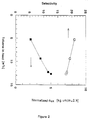
- Example III shows that as the toluene content in the feed flow increases, the normalized flux increases, while the separation factor decreases.
- a polyether etherketon sulphonamide was prepared by reacting chlorosulphonated poly(phenylether etherketon) with 50 moles% di-n-octylamine calculated with regard to the degree of substitution of 0.8 of the chlorosulphonated polymer (PEEK-SO 2 Cl).
- a 17 ⁇ m thick membrane film was prepared in the manner described in Example II.
- Example II Under the pervaporation conditions of Example II this membrane exhibited no solvent flux at 90°C for a mixture of 5.6% by weight of toluene and 94.4% by weight of iso-octane.
- a polyether etherketon sulphonamide was prepared by reacting chlorosulphonated poly(phenylether etherketon) with a stoichiometric amount of dibenzylamine. The degree of substitution of the resulting polymer (PEEK-SO 2 N(benzyl) 2 )) was 0.8. A 15 ⁇ m thick membrane film was prepared in the manner described in Example II.
Landscapes
- Chemical & Material Sciences (AREA)
- Chemical Kinetics & Catalysis (AREA)
- Engineering & Computer Science (AREA)
- Water Supply & Treatment (AREA)
- Oil, Petroleum & Natural Gas (AREA)
- General Chemical & Material Sciences (AREA)
- Organic Chemistry (AREA)
- Separation Using Semi-Permeable Membranes (AREA)
Applications Claiming Priority (2)
| Application Number | Priority Date | Filing Date | Title |
|---|---|---|---|
| NL1001062 | 1995-08-25 | ||
| NL1001062A NL1001062C2 (nl) | 1995-08-25 | 1995-08-25 | Membraan en werkwijze voor het scheiden van aromatische koolwaterstoffen uit een mengsel van diverse aromatische koolwaterstoffen of uit een mengsel van dergelijke aromatische koolwaterstoffen en niet-aromatische koolwaterstoffen. |
Publications (1)
| Publication Number | Publication Date |
|---|---|
| EP0760252A1 true EP0760252A1 (de) | 1997-03-05 |
Family
ID=19761495
Family Applications (1)
| Application Number | Title | Priority Date | Filing Date |
|---|---|---|---|
| EP96202342A Withdrawn EP0760252A1 (de) | 1995-08-25 | 1996-08-23 | Membran und Verfahren zum Trennen von aromatischen Kohlenwasserstoffen aus einem Gemisch von verschiedenen aromatischen Kohlenwasserstoffen oder aus einem Gemisch von derartigen aromatischen Kohlenwasserstoffen und nicht-aromatischen Kohlenwasserstoffen |
Country Status (4)
| Country | Link |
|---|---|
| EP (1) | EP0760252A1 (de) |
| JP (1) | JPH09262447A (de) |
| CA (1) | CA2183850A1 (de) |
| NL (1) | NL1001062C2 (de) |
Cited By (3)
| Publication number | Priority date | Publication date | Assignee | Title |
|---|---|---|---|---|
| US10478778B2 (en) | 2015-07-01 | 2019-11-19 | 3M Innovative Properties Company | Composite membranes with improved performance and/or durability and methods of use |
| US10618008B2 (en) | 2015-07-01 | 2020-04-14 | 3M Innovative Properties Company | Polymeric ionomer separation membranes and methods of use |
| US10737220B2 (en) | 2015-07-01 | 2020-08-11 | 3M Innovative Properties Company | PVP- and/or PVL-containing composite membranes and methods of use |
Citations (42)
| Publication number | Priority date | Publication date | Assignee | Title |
|---|---|---|---|---|
| US4073754A (en) | 1972-05-12 | 1978-02-14 | Israel Cabasso | Polymer alloys of phosphonylated polystyrene or polyphenylene oxide with cellulose ester, polystyrene, or unsaturated polyester |
| US4115465A (en) | 1976-06-19 | 1978-09-19 | Bayer Aktiengesellschaft | Separation of aromatic hydrocarbons from mixtures, using polyurethane membranes |
| EP0160140A2 (de) | 1984-04-27 | 1985-11-06 | Exxon Research And Engineering Company | Verfahren zur Trennung von Alkylaromaten von aromatischen Lösungsmitteln und die Trennung von Alkylaromaten mit Membranen |
| US4596860A (en) * | 1984-10-03 | 1986-06-24 | The Standard Oil Company | Process for the modification of aromatic polymers via Friedel-Crafts reactions to produce novel polymers and the use thereof |
| EP0202841A2 (de) * | 1985-05-21 | 1986-11-26 | Imperial Chemical Industries Plc | Gastrennung |
| CA1234764A (en) * | 1984-07-18 | 1988-04-05 | Robert Y.M. Huang | Treatment of oil recovery process waste water |
| US4802987A (en) | 1984-02-24 | 1989-02-07 | Exxon Research And Engineering Company | Selective permeation of aromatic hydrocarbons through polyethylene glycol impregnated regenerated cellulose or cellulose acetate membranes |
| EP0312379A2 (de) | 1987-10-14 | 1989-04-19 | Exxon Research And Engineering Company | Hocharomatische anisotrope Membranen aus Polyharnstoff/Urethan und ihre Verwendung zur Trennung aromatischer und nicht-aromatischer Kohlenwasserstoffe |
| EP0312374A2 (de) | 1987-10-14 | 1989-04-19 | Exxon Research And Engineering Company | Hocharomatische Membranen aus Polyharnstoff/Urethan und ihre Verwendung zur Trennung aromatischer und nicht-aromatischer Kohlenwasserstoffe |
| EP0312378A2 (de) | 1987-10-14 | 1989-04-19 | Exxon Research And Engineering Company | Verfahren zur Herstellung einer Dünnschicht-Verbundmembran durch Absetzen aus einer Lösung und Verwendung der Membran |
| EP0312377A2 (de) | 1987-10-14 | 1989-04-19 | Exxon Research And Engineering Company | Verfahren zur Herstellung einer Dünnschicht-Verbundmembran durch Absetzen aus einer Suspension und Verwendung solcher Membranen |
| EP0312376A2 (de) | 1987-10-14 | 1989-04-19 | Exxon Research And Engineering Company | Membran aus Polyharnstoff und ihre Verwendung zur Trennung aromatischer und nicht-aromatischer Kohlenwasserstoffe |
| EP0312375A2 (de) | 1987-10-14 | 1989-04-19 | Exxon Research And Engineering Company | Hocharomatischer Polymermembran aus Polyharnstoff und Polyurethan und ihre Verwendung zur Trennung aromatischer und nicht-aromatischer Kohlenwasserstoffe |
| EP0331298A2 (de) * | 1988-02-08 | 1989-09-06 | North West Water Group Plc | Substituierte aromatische Polymere |
| EP0336241A2 (de) | 1988-04-07 | 1989-10-11 | Bayer Ag | Verbundmembranen, Verfahren zu ihrer Herstellung und ihre Verwendung |
| US4885096A (en) | 1988-06-13 | 1989-12-05 | Exxon Research And Engineering Company | Aromatics - non-armoatics separation by permeation through thermally crosslinked nitrile rubber membranes |
| US4929357A (en) | 1989-08-09 | 1990-05-29 | Exxon Research And Engineering Company | Isocyanurate crosslinked polyurethane membranes and their use for the separation of aromatics from non-aromatics |
| US4929358A (en) | 1989-08-09 | 1990-05-29 | Exxon Research And Engineering Company | Polyurethane-imide membranes and their use for the separation of aromatics from non-aromatics |
| US4962271A (en) | 1989-12-19 | 1990-10-09 | Exxon Research And Engineering Company | Selective separation of multi-ring aromatic hydrocarbons from distillates by perstraction |
| EP0398093A2 (de) | 1989-05-18 | 1990-11-22 | Bayer Ag | Verbundmembranen, Verfahren zu ihrer Herstellung und ihre Verwendung |
| US4976868A (en) | 1989-10-16 | 1990-12-11 | Exxon Research And Engineering Company | Polyester membranes for aromatics/saturates separation |
| EP0404416A1 (de) * | 1989-06-21 | 1990-12-27 | Exxon Chemical Patents Inc. | Mit einem Übergangsmetall ausgetauschte Ionomermembran für die Trennung von Kohlenwasserstoffverbindungen |
| US4983338A (en) | 1989-08-09 | 1991-01-08 | Exxon Research And Engineering Company | Isocyanurate crosslinked polyurethane membranes and their use for the separation of aromatics from non-aromatics |
| US4990275A (en) | 1989-10-16 | 1991-02-05 | Exxon Research And Engineering Company | Polyimide aliphatic polyester copolymers (C-2356) |
| US4994880A (en) | 1986-10-31 | 1991-02-19 | Nippondenso Co., Ltd. | Semiconductor device constituting bipolar transistor |
| DE3927787A1 (de) | 1989-08-23 | 1991-02-28 | Bayer Ag | Verbundmembran, ihre herstellung und verfahren zur pervaporation und gastrennung durch einsatz dieser verbundmembran |
| US5012035A (en) | 1990-07-11 | 1991-04-30 | Exxon Research And Engineering Company | Polyphthalatecarbonate membranes for aromatics/saturates separation |
| US5012036A (en) | 1990-07-11 | 1991-04-30 | Exxon Research And Engineering Company | Polyarylate membranes or aromatics/saturates separation (C-2415) |
| US5019666A (en) | 1988-08-04 | 1991-05-28 | Exxon Research And Engineering Company | Non-porous polycarbonate membranes for separation of aromatics from saturates |
| US5030355A (en) | 1987-10-14 | 1991-07-09 | Exxon Research & Engineering Company | Thin film composite membrane prepared by suspension deposition |
| US5039417A (en) | 1990-12-06 | 1991-08-13 | Exxon Research And Engineering Company | Membrane made from a multi-block polymer comprising an imide or amide-acid prepolymer chain extended with a compatible second prepolymer and its use in separations |
| US5039418A (en) | 1990-12-06 | 1991-08-13 | Exxon Research And Engineering Company | Membrane made from a multi-block polymer comprising an oxazolidone prepolymer chain extended with a compatible second prepolymer and its use in separations |
| US5039422A (en) | 1990-12-06 | 1991-08-13 | Exxon Research And Engineering Company | Multi-block polymer comprising a urea prepolymer chain extended with a compatible second prepolymer, the membrane made therefrom and its use in separations |
| US5049281A (en) | 1990-12-06 | 1991-09-17 | Exxon Research And Engineering Company | Multi-block polymer comprising a first prepolymer, made by combining epoxy with diamine, chain extended with a compatible second prepolymer, the membrane made therefrom and its use in separations |
| US5055631A (en) | 1990-07-11 | 1991-10-08 | Exxon Research & Engineering Company | Sulfonated polysulfone membranes for aromatics/saturates separation |
| US5063186A (en) | 1987-10-14 | 1991-11-05 | Exxon Research & Engineering Company | Highly aromatic polyurea/urethane membranes and their use of the separation of aromatics from non-aromatics |
| US5095171A (en) | 1991-04-08 | 1992-03-10 | Exxon Research And Engineering Company | Control of oxygen level in feed for improved aromatics/non-aromatics pervaporation (OP-3602) |
| US5207909A (en) | 1992-03-25 | 1993-05-04 | Exxon Research And Engineering Company | Plasma polymer membrane (C-2564) |
| US5241039A (en) | 1992-08-14 | 1993-08-31 | Exxon Research & Engineering Company | Polyimide/aliphatic polyester copolymers without pendent carboxylic acid groups (C-2662) |
| GB2268186A (en) | 1992-06-29 | 1994-01-05 | Exxon Research Engineering Co | Membrane/hydrocracking process for improved feedstock utilization in the production of reduced emissions gasoline |
| US5348569A (en) * | 1993-06-30 | 1994-09-20 | Praxair Technology, Inc. | Modified poly(phenylene oxide) based membranes for enhanced fluid separation |
| US9108494B2 (en) | 2013-12-04 | 2015-08-18 | Webasto-Edscha Cabrio GmbH | Convertible top with link arrangements for adjusting a convertible top element |
-
1995
- 1995-08-25 NL NL1001062A patent/NL1001062C2/nl not_active IP Right Cessation
-
1996
- 1996-08-21 CA CA002183850A patent/CA2183850A1/en not_active Abandoned
- 1996-08-23 JP JP8260078A patent/JPH09262447A/ja active Pending
- 1996-08-23 EP EP96202342A patent/EP0760252A1/de not_active Withdrawn
Patent Citations (42)
| Publication number | Priority date | Publication date | Assignee | Title |
|---|---|---|---|---|
| US4073754A (en) | 1972-05-12 | 1978-02-14 | Israel Cabasso | Polymer alloys of phosphonylated polystyrene or polyphenylene oxide with cellulose ester, polystyrene, or unsaturated polyester |
| US4115465A (en) | 1976-06-19 | 1978-09-19 | Bayer Aktiengesellschaft | Separation of aromatic hydrocarbons from mixtures, using polyurethane membranes |
| US4802987A (en) | 1984-02-24 | 1989-02-07 | Exxon Research And Engineering Company | Selective permeation of aromatic hydrocarbons through polyethylene glycol impregnated regenerated cellulose or cellulose acetate membranes |
| EP0160140A2 (de) | 1984-04-27 | 1985-11-06 | Exxon Research And Engineering Company | Verfahren zur Trennung von Alkylaromaten von aromatischen Lösungsmitteln und die Trennung von Alkylaromaten mit Membranen |
| CA1234764A (en) * | 1984-07-18 | 1988-04-05 | Robert Y.M. Huang | Treatment of oil recovery process waste water |
| US4596860A (en) * | 1984-10-03 | 1986-06-24 | The Standard Oil Company | Process for the modification of aromatic polymers via Friedel-Crafts reactions to produce novel polymers and the use thereof |
| EP0202841A2 (de) * | 1985-05-21 | 1986-11-26 | Imperial Chemical Industries Plc | Gastrennung |
| US4994880A (en) | 1986-10-31 | 1991-02-19 | Nippondenso Co., Ltd. | Semiconductor device constituting bipolar transistor |
| EP0312375A2 (de) | 1987-10-14 | 1989-04-19 | Exxon Research And Engineering Company | Hocharomatischer Polymermembran aus Polyharnstoff und Polyurethan und ihre Verwendung zur Trennung aromatischer und nicht-aromatischer Kohlenwasserstoffe |
| EP0312378A2 (de) | 1987-10-14 | 1989-04-19 | Exxon Research And Engineering Company | Verfahren zur Herstellung einer Dünnschicht-Verbundmembran durch Absetzen aus einer Lösung und Verwendung der Membran |
| EP0312377A2 (de) | 1987-10-14 | 1989-04-19 | Exxon Research And Engineering Company | Verfahren zur Herstellung einer Dünnschicht-Verbundmembran durch Absetzen aus einer Suspension und Verwendung solcher Membranen |
| EP0312376A2 (de) | 1987-10-14 | 1989-04-19 | Exxon Research And Engineering Company | Membran aus Polyharnstoff und ihre Verwendung zur Trennung aromatischer und nicht-aromatischer Kohlenwasserstoffe |
| EP0312379A2 (de) | 1987-10-14 | 1989-04-19 | Exxon Research And Engineering Company | Hocharomatische anisotrope Membranen aus Polyharnstoff/Urethan und ihre Verwendung zur Trennung aromatischer und nicht-aromatischer Kohlenwasserstoffe |
| US5030355A (en) | 1987-10-14 | 1991-07-09 | Exxon Research & Engineering Company | Thin film composite membrane prepared by suspension deposition |
| US5063186A (en) | 1987-10-14 | 1991-11-05 | Exxon Research & Engineering Company | Highly aromatic polyurea/urethane membranes and their use of the separation of aromatics from non-aromatics |
| EP0312374A2 (de) | 1987-10-14 | 1989-04-19 | Exxon Research And Engineering Company | Hocharomatische Membranen aus Polyharnstoff/Urethan und ihre Verwendung zur Trennung aromatischer und nicht-aromatischer Kohlenwasserstoffe |
| EP0331298A2 (de) * | 1988-02-08 | 1989-09-06 | North West Water Group Plc | Substituierte aromatische Polymere |
| EP0336241A2 (de) | 1988-04-07 | 1989-10-11 | Bayer Ag | Verbundmembranen, Verfahren zu ihrer Herstellung und ihre Verwendung |
| US4885096A (en) | 1988-06-13 | 1989-12-05 | Exxon Research And Engineering Company | Aromatics - non-armoatics separation by permeation through thermally crosslinked nitrile rubber membranes |
| US5019666A (en) | 1988-08-04 | 1991-05-28 | Exxon Research And Engineering Company | Non-porous polycarbonate membranes for separation of aromatics from saturates |
| EP0398093A2 (de) | 1989-05-18 | 1990-11-22 | Bayer Ag | Verbundmembranen, Verfahren zu ihrer Herstellung und ihre Verwendung |
| EP0404416A1 (de) * | 1989-06-21 | 1990-12-27 | Exxon Chemical Patents Inc. | Mit einem Übergangsmetall ausgetauschte Ionomermembran für die Trennung von Kohlenwasserstoffverbindungen |
| US4983338A (en) | 1989-08-09 | 1991-01-08 | Exxon Research And Engineering Company | Isocyanurate crosslinked polyurethane membranes and their use for the separation of aromatics from non-aromatics |
| US4929358A (en) | 1989-08-09 | 1990-05-29 | Exxon Research And Engineering Company | Polyurethane-imide membranes and their use for the separation of aromatics from non-aromatics |
| US4929357A (en) | 1989-08-09 | 1990-05-29 | Exxon Research And Engineering Company | Isocyanurate crosslinked polyurethane membranes and their use for the separation of aromatics from non-aromatics |
| DE3927787A1 (de) | 1989-08-23 | 1991-02-28 | Bayer Ag | Verbundmembran, ihre herstellung und verfahren zur pervaporation und gastrennung durch einsatz dieser verbundmembran |
| US4976868A (en) | 1989-10-16 | 1990-12-11 | Exxon Research And Engineering Company | Polyester membranes for aromatics/saturates separation |
| US4990275A (en) | 1989-10-16 | 1991-02-05 | Exxon Research And Engineering Company | Polyimide aliphatic polyester copolymers (C-2356) |
| US4962271A (en) | 1989-12-19 | 1990-10-09 | Exxon Research And Engineering Company | Selective separation of multi-ring aromatic hydrocarbons from distillates by perstraction |
| US5012036A (en) | 1990-07-11 | 1991-04-30 | Exxon Research And Engineering Company | Polyarylate membranes or aromatics/saturates separation (C-2415) |
| US5012035A (en) | 1990-07-11 | 1991-04-30 | Exxon Research And Engineering Company | Polyphthalatecarbonate membranes for aromatics/saturates separation |
| US5055631A (en) | 1990-07-11 | 1991-10-08 | Exxon Research & Engineering Company | Sulfonated polysulfone membranes for aromatics/saturates separation |
| US5049281A (en) | 1990-12-06 | 1991-09-17 | Exxon Research And Engineering Company | Multi-block polymer comprising a first prepolymer, made by combining epoxy with diamine, chain extended with a compatible second prepolymer, the membrane made therefrom and its use in separations |
| US5039422A (en) | 1990-12-06 | 1991-08-13 | Exxon Research And Engineering Company | Multi-block polymer comprising a urea prepolymer chain extended with a compatible second prepolymer, the membrane made therefrom and its use in separations |
| US5039418A (en) | 1990-12-06 | 1991-08-13 | Exxon Research And Engineering Company | Membrane made from a multi-block polymer comprising an oxazolidone prepolymer chain extended with a compatible second prepolymer and its use in separations |
| US5039417A (en) | 1990-12-06 | 1991-08-13 | Exxon Research And Engineering Company | Membrane made from a multi-block polymer comprising an imide or amide-acid prepolymer chain extended with a compatible second prepolymer and its use in separations |
| US5095171A (en) | 1991-04-08 | 1992-03-10 | Exxon Research And Engineering Company | Control of oxygen level in feed for improved aromatics/non-aromatics pervaporation (OP-3602) |
| US5207909A (en) | 1992-03-25 | 1993-05-04 | Exxon Research And Engineering Company | Plasma polymer membrane (C-2564) |
| GB2268186A (en) | 1992-06-29 | 1994-01-05 | Exxon Research Engineering Co | Membrane/hydrocracking process for improved feedstock utilization in the production of reduced emissions gasoline |
| US5241039A (en) | 1992-08-14 | 1993-08-31 | Exxon Research & Engineering Company | Polyimide/aliphatic polyester copolymers without pendent carboxylic acid groups (C-2662) |
| US5348569A (en) * | 1993-06-30 | 1994-09-20 | Praxair Technology, Inc. | Modified poly(phenylene oxide) based membranes for enhanced fluid separation |
| US9108494B2 (en) | 2013-12-04 | 2015-08-18 | Webasto-Edscha Cabrio GmbH | Convertible top with link arrangements for adjusting a convertible top element |
Non-Patent Citations (5)
Cited By (3)
| Publication number | Priority date | Publication date | Assignee | Title |
|---|---|---|---|---|
| US10478778B2 (en) | 2015-07-01 | 2019-11-19 | 3M Innovative Properties Company | Composite membranes with improved performance and/or durability and methods of use |
| US10618008B2 (en) | 2015-07-01 | 2020-04-14 | 3M Innovative Properties Company | Polymeric ionomer separation membranes and methods of use |
| US10737220B2 (en) | 2015-07-01 | 2020-08-11 | 3M Innovative Properties Company | PVP- and/or PVL-containing composite membranes and methods of use |
Also Published As
| Publication number | Publication date |
|---|---|
| NL1001062C2 (nl) | 1997-02-27 |
| CA2183850A1 (en) | 1997-02-26 |
| JPH09262447A (ja) | 1997-10-07 |
Similar Documents
| Publication | Publication Date | Title |
|---|---|---|
| EP0424040B1 (de) | Membranen hergestellt aus vernetzten Kopolymeren aus aliphatischen Polyesterdiolen und Dianhydriden. | |
| KR100612707B1 (ko) | 윤활유로 상태조절된 막을 사용한 방향족 탄화수소의 회수 방법 | |
| US4115465A (en) | Separation of aromatic hydrocarbons from mixtures, using polyurethane membranes | |
| US4929358A (en) | Polyurethane-imide membranes and their use for the separation of aromatics from non-aromatics | |
| US5039418A (en) | Membrane made from a multi-block polymer comprising an oxazolidone prepolymer chain extended with a compatible second prepolymer and its use in separations | |
| Hao et al. | The pervaporation properties of sulfonyl-containing polyimide membranes to aromatic/aliphatic hydrocarbon mixtures | |
| US5012035A (en) | Polyphthalatecarbonate membranes for aromatics/saturates separation | |
| US5019666A (en) | Non-porous polycarbonate membranes for separation of aromatics from saturates | |
| EP0312374A2 (de) | Hocharomatische Membranen aus Polyharnstoff/Urethan und ihre Verwendung zur Trennung aromatischer und nicht-aromatischer Kohlenwasserstoffe | |
| US4997906A (en) | Crosslinked copolymers of aliphatic polyester diols and dianhydrides | |
| EP0416752A2 (de) | Polyurethan-Membranen und ihre Verwendung zur Trennung aromatischer und nicht aromatischer Kohlenwasserstoffe | |
| EP0424039A1 (de) | Verfahren zur Trennung von aromatischen und gesättigten Kohlenwasserstoffen | |
| US4879044A (en) | Highly aromatic anisotropic polyurea/urethane membranes and their use for the separation of aromatics from non aromatics | |
| JPH06505522A (ja) | 改良された芳香族成分/非芳香族成分透過蒸発用の供給原料における酸素の制御 | |
| EP0760251A1 (de) | Membran und Verfahren zum Trennen von aromatischen Kohlenwasserstoffen aus einem Gemisch von verschiedenen aromatischen Kohlenwasserstoffen oder aus einem Gemisch derartigen aromatischen Kohlenwasserstoffen mit nicht-aromatischen Kohlenwasserstoffen | |
| US5055631A (en) | Sulfonated polysulfone membranes for aromatics/saturates separation | |
| EP0312378B1 (de) | Verfahren zur Herstellung einer Dünnschicht-Verbundmembran durch Absetzen aus einer Lösung und Verwendung der Membran | |
| US4828773A (en) | Highly aromatic anisotropic polyurea/urethane membranes and their use for the separation of aromatics from non-aromatics | |
| CA2183850A1 (en) | Membrane and method for the separation of aromatic hydrocarbons from a mixture of various aromatic hydrocarbons or from a mixture of such aromatic hydrocarbons and non-aromatic hydrocarbons | |
| EP0536994A2 (de) | Ungesättigte Polyester und Membrane zur Trennung von aromaten/gesättigten Verbindungen | |
| EP0760250A1 (de) | Membran und Verfahren zum Trennen von aromatischen Kohlenwasserstoffen aus einem Gemisch von verschiedenen aromatischen Kohlenwasserstoffen oder aus einem Gemisch von derartigen aromatischen Kohlenwasserstoffen und nicht-aromatischen Kohlenwasserstoffen | |
| US5093003A (en) | Halogenated polyurethanes | |
| JP2563072B2 (ja) | 分離方法に用いる新規固体多価両親媒性ポリマー | |
| US5028685A (en) | Halogenated polyurethanes | |
| US5039422A (en) | Multi-block polymer comprising a urea prepolymer chain extended with a compatible second prepolymer, the membrane made therefrom and its use in separations |
Legal Events
| Date | Code | Title | Description |
|---|---|---|---|
| PUAI | Public reference made under article 153(3) epc to a published international application that has entered the european phase |
Free format text: ORIGINAL CODE: 0009012 |
|
| 17P | Request for examination filed |
Effective date: 19961113 |
|
| AK | Designated contracting states |
Kind code of ref document: A1 Designated state(s): AT BE CH DE DK ES FI FR GB GR IE IT LI NL PT SE |
|
| 17Q | First examination report despatched |
Effective date: 20000125 |
|
| STAA | Information on the status of an ep patent application or granted ep patent |
Free format text: STATUS: THE APPLICATION IS DEEMED TO BE WITHDRAWN |
|
| 18D | Application deemed to be withdrawn |
Effective date: 20000606 |