EP0760281B1 - Struktur-Wandbelag und Verfahren zum Herstellen desselben - Google Patents
Struktur-Wandbelag und Verfahren zum Herstellen desselben Download PDFInfo
- Publication number
- EP0760281B1 EP0760281B1 EP96113521A EP96113521A EP0760281B1 EP 0760281 B1 EP0760281 B1 EP 0760281B1 EP 96113521 A EP96113521 A EP 96113521A EP 96113521 A EP96113521 A EP 96113521A EP 0760281 B1 EP0760281 B1 EP 0760281B1
- Authority
- EP
- European Patent Office
- Prior art keywords
- web
- foam
- wall covering
- composite
- structural wall
- Prior art date
- Legal status (The legal status is an assumption and is not a legal conclusion. Google has not performed a legal analysis and makes no representation as to the accuracy of the status listed.)
- Expired - Lifetime
Links
- 238000004519 manufacturing process Methods 0.000 title claims description 22
- 239000006260 foam Substances 0.000 claims abstract description 110
- 239000002313 adhesive film Substances 0.000 claims abstract description 30
- -1 polyethylene Polymers 0.000 claims abstract description 28
- 229920001169 thermoplastic Polymers 0.000 claims abstract description 28
- XLYOFNOQVPJJNP-UHFFFAOYSA-N water Substances O XLYOFNOQVPJJNP-UHFFFAOYSA-N 0.000 claims abstract description 28
- 239000004416 thermosoftening plastic Substances 0.000 claims abstract description 25
- 238000004049 embossing Methods 0.000 claims abstract description 24
- 238000000034 method Methods 0.000 claims abstract description 24
- 239000004698 Polyethylene Substances 0.000 claims abstract description 15
- 229920000573 polyethylene Polymers 0.000 claims abstract description 15
- 238000010521 absorption reaction Methods 0.000 claims abstract description 14
- 229920000098 polyolefin Polymers 0.000 claims abstract description 13
- 239000004743 Polypropylene Substances 0.000 claims abstract description 11
- 229920001155 polypropylene Polymers 0.000 claims abstract description 11
- 230000008569 process Effects 0.000 claims abstract description 10
- 229920000728 polyester Polymers 0.000 claims abstract description 5
- 239000011148 porous material Substances 0.000 claims abstract description 4
- 239000002131 composite material Substances 0.000 claims description 57
- 239000012209 synthetic fiber Substances 0.000 claims description 26
- 229920002994 synthetic fiber Polymers 0.000 claims description 26
- 229920002678 cellulose Polymers 0.000 claims description 20
- 239000001913 cellulose Substances 0.000 claims description 20
- 229920003023 plastic Polymers 0.000 claims description 10
- 239000004033 plastic Substances 0.000 claims description 9
- 239000013039 cover film Substances 0.000 claims description 8
- 238000007373 indentation Methods 0.000 claims description 7
- 229920002635 polyurethane Polymers 0.000 claims description 6
- 239000004814 polyurethane Substances 0.000 claims description 6
- 229920003043 Cellulose fiber Polymers 0.000 claims description 4
- 239000011248 coating agent Substances 0.000 claims description 4
- 238000000576 coating method Methods 0.000 claims description 4
- 230000008859 change Effects 0.000 claims description 3
- 239000006185 dispersion Substances 0.000 claims description 3
- 239000004831 Hot glue Substances 0.000 claims description 2
- 239000007822 coupling agent Substances 0.000 claims 2
- 238000004132 cross linking Methods 0.000 claims 2
- 230000003292 diminished effect Effects 0.000 claims 1
- 239000011527 polyurethane coating Substances 0.000 claims 1
- 210000004027 cell Anatomy 0.000 abstract description 17
- 239000010410 layer Substances 0.000 abstract description 8
- 239000012790 adhesive layer Substances 0.000 abstract description 7
- 150000001875 compounds Chemical class 0.000 abstract description 4
- 239000000463 material Substances 0.000 abstract description 4
- 210000002421 cell wall Anatomy 0.000 abstract description 3
- 229920006248 expandable polystyrene Polymers 0.000 abstract 1
- 239000010408 film Substances 0.000 description 7
- 238000012545 processing Methods 0.000 description 6
- 239000002318 adhesion promoter Substances 0.000 description 5
- 239000002184 metal Substances 0.000 description 5
- 239000004745 nonwoven fabric Substances 0.000 description 5
- 239000004616 structural foam Substances 0.000 description 5
- 241000283690 Bos taurus Species 0.000 description 4
- 239000000080 wetting agent Substances 0.000 description 4
- 239000000853 adhesive Substances 0.000 description 3
- 230000001070 adhesive effect Effects 0.000 description 3
- 230000015572 biosynthetic process Effects 0.000 description 3
- 229920001971 elastomer Polymers 0.000 description 3
- 238000003860 storage Methods 0.000 description 3
- 239000004793 Polystyrene Substances 0.000 description 2
- 239000013543 active substance Substances 0.000 description 2
- 125000000129 anionic group Chemical group 0.000 description 2
- 230000006835 compression Effects 0.000 description 2
- 238000007906 compression Methods 0.000 description 2
- 238000011161 development Methods 0.000 description 2
- 238000001035 drying Methods 0.000 description 2
- 238000007765 extrusion coating Methods 0.000 description 2
- 239000011888 foil Substances 0.000 description 2
- 239000003292 glue Substances 0.000 description 2
- 239000000203 mixture Substances 0.000 description 2
- 238000013008 moisture curing Methods 0.000 description 2
- 230000003287 optical effect Effects 0.000 description 2
- 229920002223 polystyrene Polymers 0.000 description 2
- 239000004094 surface-active agent Substances 0.000 description 2
- 238000012549 training Methods 0.000 description 2
- UNILWMWFPHPYOR-KXEYIPSPSA-M 1-[6-[2-[3-[3-[3-[2-[2-[3-[[2-[2-[[(2r)-1-[[2-[[(2r)-1-[3-[2-[2-[3-[[2-(2-amino-2-oxoethoxy)acetyl]amino]propoxy]ethoxy]ethoxy]propylamino]-3-hydroxy-1-oxopropan-2-yl]amino]-2-oxoethyl]amino]-3-[(2r)-2,3-di(hexadecanoyloxy)propyl]sulfanyl-1-oxopropan-2-yl Chemical compound O=C1C(SCCC(=O)NCCCOCCOCCOCCCNC(=O)COCC(=O)N[C@@H](CSC[C@@H](COC(=O)CCCCCCCCCCCCCCC)OC(=O)CCCCCCCCCCCCCCC)C(=O)NCC(=O)N[C@H](CO)C(=O)NCCCOCCOCCOCCCNC(=O)COCC(N)=O)CC(=O)N1CCNC(=O)CCCCCN\1C2=CC=C(S([O-])(=O)=O)C=C2CC/1=C/C=C/C=C/C1=[N+](CC)C2=CC=C(S([O-])(=O)=O)C=C2C1 UNILWMWFPHPYOR-KXEYIPSPSA-M 0.000 description 1
- 229910019142 PO4 Inorganic materials 0.000 description 1
- 239000002250 absorbent Substances 0.000 description 1
- 239000003945 anionic surfactant Substances 0.000 description 1
- 230000009286 beneficial effect Effects 0.000 description 1
- 230000015556 catabolic process Effects 0.000 description 1
- 239000003093 cationic surfactant Substances 0.000 description 1
- 239000007795 chemical reaction product Substances 0.000 description 1
- 238000004040 coloring Methods 0.000 description 1
- 238000006731 degradation reaction Methods 0.000 description 1
- 239000012153 distilled water Substances 0.000 description 1
- 238000001125 extrusion Methods 0.000 description 1
- 239000004744 fabric Substances 0.000 description 1
- 150000002191 fatty alcohols Chemical class 0.000 description 1
- 210000000497 foam cell Anatomy 0.000 description 1
- 239000007789 gas Substances 0.000 description 1
- 238000010438 heat treatment Methods 0.000 description 1
- 238000007654 immersion Methods 0.000 description 1
- 238000009413 insulation Methods 0.000 description 1
- 238000003475 lamination Methods 0.000 description 1
- 238000005259 measurement Methods 0.000 description 1
- 238000012986 modification Methods 0.000 description 1
- 230000004048 modification Effects 0.000 description 1
- 239000002736 nonionic surfactant Substances 0.000 description 1
- 230000000149 penetrating effect Effects 0.000 description 1
- 230000035699 permeability Effects 0.000 description 1
- 235000021317 phosphate Nutrition 0.000 description 1
- 229920001522 polyglycol ester Polymers 0.000 description 1
- 238000002360 preparation method Methods 0.000 description 1
- 230000002035 prolonged effect Effects 0.000 description 1
- 239000011241 protective layer Substances 0.000 description 1
- 230000009467 reduction Effects 0.000 description 1
- 230000002787 reinforcement Effects 0.000 description 1
- 230000000284 resting effect Effects 0.000 description 1
- 230000000717 retained effect Effects 0.000 description 1
- 238000005096 rolling process Methods 0.000 description 1
- 238000005507 spraying Methods 0.000 description 1
- 230000008961 swelling Effects 0.000 description 1
- 238000005303 weighing Methods 0.000 description 1
Images

Classifications
-
- B—PERFORMING OPERATIONS; TRANSPORTING
- B32—LAYERED PRODUCTS
- B32B—LAYERED PRODUCTS, i.e. PRODUCTS BUILT-UP OF STRATA OF FLAT OR NON-FLAT, e.g. CELLULAR OR HONEYCOMB, FORM
- B32B5/00—Layered products characterised by the non- homogeneity or physical structure, i.e. comprising a fibrous, filamentary, particulate or foam layer; Layered products characterised by having a layer differing constitutionally or physically in different parts
- B32B5/18—Layered products characterised by the non- homogeneity or physical structure, i.e. comprising a fibrous, filamentary, particulate or foam layer; Layered products characterised by having a layer differing constitutionally or physically in different parts characterised by features of a layer of foamed material
-
- B—PERFORMING OPERATIONS; TRANSPORTING
- B29—WORKING OF PLASTICS; WORKING OF SUBSTANCES IN A PLASTIC STATE IN GENERAL
- B29C—SHAPING OR JOINING OF PLASTICS; SHAPING OF MATERIAL IN A PLASTIC STATE, NOT OTHERWISE PROVIDED FOR; AFTER-TREATMENT OF THE SHAPED PRODUCTS, e.g. REPAIRING
- B29C44/00—Shaping by internal pressure generated in the material, e.g. swelling or foaming ; Producing porous or cellular expanded plastics articles
- B29C44/34—Auxiliary operations
- B29C44/56—After-treatment of articles, e.g. for altering the shape
- B29C44/569—Shaping and joining components with different densities or hardness
-
- B—PERFORMING OPERATIONS; TRANSPORTING
- B32—LAYERED PRODUCTS
- B32B—LAYERED PRODUCTS, i.e. PRODUCTS BUILT-UP OF STRATA OF FLAT OR NON-FLAT, e.g. CELLULAR OR HONEYCOMB, FORM
- B32B29/00—Layered products comprising a layer of paper or cardboard
- B32B29/002—Layered products comprising a layer of paper or cardboard as the main or only constituent of a layer, which is next to another layer of the same or of a different material
- B32B29/007—Layered products comprising a layer of paper or cardboard as the main or only constituent of a layer, which is next to another layer of the same or of a different material next to a foam layer
-
- B—PERFORMING OPERATIONS; TRANSPORTING
- B32—LAYERED PRODUCTS
- B32B—LAYERED PRODUCTS, i.e. PRODUCTS BUILT-UP OF STRATA OF FLAT OR NON-FLAT, e.g. CELLULAR OR HONEYCOMB, FORM
- B32B38/00—Ancillary operations in connection with laminating processes
- B32B38/04—Punching, slitting or perforating
-
- B—PERFORMING OPERATIONS; TRANSPORTING
- B32—LAYERED PRODUCTS
- B32B—LAYERED PRODUCTS, i.e. PRODUCTS BUILT-UP OF STRATA OF FLAT OR NON-FLAT, e.g. CELLULAR OR HONEYCOMB, FORM
- B32B5/00—Layered products characterised by the non- homogeneity or physical structure, i.e. comprising a fibrous, filamentary, particulate or foam layer; Layered products characterised by having a layer differing constitutionally or physically in different parts
- B32B5/14—Layered products characterised by the non- homogeneity or physical structure, i.e. comprising a fibrous, filamentary, particulate or foam layer; Layered products characterised by having a layer differing constitutionally or physically in different parts characterised by a layer differing constitutionally or physically in different parts, e.g. denser near its faces
- B32B5/145—Variation across the thickness of the layer
-
- B—PERFORMING OPERATIONS; TRANSPORTING
- B32—LAYERED PRODUCTS
- B32B—LAYERED PRODUCTS, i.e. PRODUCTS BUILT-UP OF STRATA OF FLAT OR NON-FLAT, e.g. CELLULAR OR HONEYCOMB, FORM
- B32B7/00—Layered products characterised by the relation between layers; Layered products characterised by the relative orientation of features between layers, or by the relative values of a measurable parameter between layers, i.e. products comprising layers having different physical, chemical or physicochemical properties; Layered products characterised by the interconnection of layers
- B32B7/04—Interconnection of layers
- B32B7/12—Interconnection of layers using interposed adhesives or interposed materials with bonding properties
-
- D—TEXTILES; PAPER
- D06—TREATMENT OF TEXTILES OR THE LIKE; LAUNDERING; FLEXIBLE MATERIALS NOT OTHERWISE PROVIDED FOR
- D06N—WALL, FLOOR, OR LIKE COVERING MATERIALS, e.g. LINOLEUM, OILCLOTH, ARTIFICIAL LEATHER, ROOFING FELT, CONSISTING OF A FIBROUS WEB COATED WITH A LAYER OF MACROMOLECULAR MATERIAL; FLEXIBLE SHEET MATERIAL NOT OTHERWISE PROVIDED FOR
- D06N7/00—Flexible sheet materials not otherwise provided for, e.g. textile threads, filaments, yarns or tow, glued on macromolecular material
- D06N7/0002—Wallpaper or wall covering on textile basis
-
- B—PERFORMING OPERATIONS; TRANSPORTING
- B29—WORKING OF PLASTICS; WORKING OF SUBSTANCES IN A PLASTIC STATE IN GENERAL
- B29C—SHAPING OR JOINING OF PLASTICS; SHAPING OF MATERIAL IN A PLASTIC STATE, NOT OTHERWISE PROVIDED FOR; AFTER-TREATMENT OF THE SHAPED PRODUCTS, e.g. REPAIRING
- B29C59/00—Surface shaping of articles, e.g. embossing; Apparatus therefor
- B29C59/02—Surface shaping of articles, e.g. embossing; Apparatus therefor by mechanical means, e.g. pressing
- B29C59/04—Surface shaping of articles, e.g. embossing; Apparatus therefor by mechanical means, e.g. pressing using rollers or endless belts
-
- B—PERFORMING OPERATIONS; TRANSPORTING
- B29—WORKING OF PLASTICS; WORKING OF SUBSTANCES IN A PLASTIC STATE IN GENERAL
- B29K—INDEXING SCHEME ASSOCIATED WITH SUBCLASSES B29B, B29C OR B29D, RELATING TO MOULDING MATERIALS OR TO MATERIALS FOR MOULDS, REINFORCEMENTS, FILLERS OR PREFORMED PARTS, e.g. INSERTS
- B29K2105/00—Condition, form or state of moulded material or of the material to be shaped
- B29K2105/04—Condition, form or state of moulded material or of the material to be shaped cellular or porous
-
- B—PERFORMING OPERATIONS; TRANSPORTING
- B32—LAYERED PRODUCTS
- B32B—LAYERED PRODUCTS, i.e. PRODUCTS BUILT-UP OF STRATA OF FLAT OR NON-FLAT, e.g. CELLULAR OR HONEYCOMB, FORM
- B32B2266/00—Composition of foam
- B32B2266/06—Open cell foam
-
- B—PERFORMING OPERATIONS; TRANSPORTING
- B32—LAYERED PRODUCTS
- B32B—LAYERED PRODUCTS, i.e. PRODUCTS BUILT-UP OF STRATA OF FLAT OR NON-FLAT, e.g. CELLULAR OR HONEYCOMB, FORM
- B32B2305/00—Condition, form or state of the layers or laminate
- B32B2305/02—Cellular or porous
- B32B2305/022—Foam
-
- B—PERFORMING OPERATIONS; TRANSPORTING
- B32—LAYERED PRODUCTS
- B32B—LAYERED PRODUCTS, i.e. PRODUCTS BUILT-UP OF STRATA OF FLAT OR NON-FLAT, e.g. CELLULAR OR HONEYCOMB, FORM
- B32B2307/00—Properties of the layers or laminate
- B32B2307/70—Other properties
- B32B2307/726—Permeability to liquids, absorption
-
- B—PERFORMING OPERATIONS; TRANSPORTING
- B32—LAYERED PRODUCTS
- B32B—LAYERED PRODUCTS, i.e. PRODUCTS BUILT-UP OF STRATA OF FLAT OR NON-FLAT, e.g. CELLULAR OR HONEYCOMB, FORM
- B32B2310/00—Treatment by energy or chemical effects
- B32B2310/08—Treatment by energy or chemical effects by wave energy or particle radiation
- B32B2310/0806—Treatment by energy or chemical effects by wave energy or particle radiation using electromagnetic radiation
- B32B2310/0825—Treatment by energy or chemical effects by wave energy or particle radiation using electromagnetic radiation using IR radiation
-
- B—PERFORMING OPERATIONS; TRANSPORTING
- B32—LAYERED PRODUCTS
- B32B—LAYERED PRODUCTS, i.e. PRODUCTS BUILT-UP OF STRATA OF FLAT OR NON-FLAT, e.g. CELLULAR OR HONEYCOMB, FORM
- B32B2317/00—Animal or vegetable based
- B32B2317/12—Paper, e.g. cardboard
-
- B—PERFORMING OPERATIONS; TRANSPORTING
- B32—LAYERED PRODUCTS
- B32B—LAYERED PRODUCTS, i.e. PRODUCTS BUILT-UP OF STRATA OF FLAT OR NON-FLAT, e.g. CELLULAR OR HONEYCOMB, FORM
- B32B2607/00—Walls, panels
- B32B2607/02—Wall papers, wall coverings
Definitions
- the invention relates to a structural wall covering from a provided with a surface structure by means of embossing Compound of a sheet-like foam of predominantly closed-cell foam structure based on polyolefins, such as polyethylene or polypropylene, an adhesive film based a thermoplastic and a carrier web Basis of a cellulose-containing web, such as a paper web or a cellulose fiber fleece, or a synthetic fiber fleece.
- polyolefins such as polyethylene or polypropylene
- an adhesive film based a thermoplastic and a carrier web Basis of a cellulose-containing web such as a paper web or a cellulose fiber fleece, or a synthetic fiber fleece.
- the invention is concerned with a method for Manufacture of a structural wall covering of the aforementioned type, a fresh on the carrier web as an adhesive film extruded thermoplastic applied and hereby the prefabricated foam sheet from closed-cell foam structure when performing a nip is connected under pressure and subsequently when passing through an embossing gap, the surface of the Foam sheet of the composite is shaped.
- Structural wall coverings in the form of have long been known Structural foam wallpaper based on PVC foam. This have the disadvantage, however, that they are aggressive in the event of a fire Gases develop as a result of attack on building reinforcement lead to damage to the masonry and Endanger people, which is often more serious than the damage caused by the fire alone.
- Such structural wall coverings are used both to increase the Thermal insulation in residential and business premises as well optical beautification of these rooms, so to improve quality of living. In particular, allow a Printing and structuring of the foam surface Production of different designs. An essential one These structural wall coverings are a prerequisite and easy processability.
- a generic structural wall covering in the shape of a Structural foam wallpaper and a process for producing it the same is known for example from DE 41 20 306 A1 become.
- DE GM 94 02 973 is a wallpaper made of a foamed Plastic and a paper web known in which one made foamed plastic existing film the top one Wallpaper-receiving layer is, and the paper web forms the lower layer to be glued to the wall, whereby the two layers are adhered to each other by lamination are connected, optionally using an adhesive.
- Structural foam wallpapers are from the aforementioned publications based on polystyrene or polyethylene foam known. In the event of a fire, they behave as usual used paper wallpaper.
- the invention has for its object a structural wall covering of the generic type and a Manufacturing process to create this using prefabricated halogen-free foam sheets into one End product that is easy to print and process, i.e. lies as flat as possible during processing and if possible shows no tendency to curl or bulge. It is therefore the job of Invention, a well printable structure wall covering under Use of prefabricated foam sheets to create the has low internal tension or its internal tension are saved during processing.
- this object is achieved through further training Generic structural wall covering to improve the Processability solved in that the embossed Foam sheet of the composite a different thickness of 0.02 to 3 mm and in the area of the surface of the Foam sheet a compacted rind under which the Cells are greatly enlarged, then after the Middle to a loosened up compared to the not embossed Foam sheet coarsened cell structure and in the on the thermoplastic adhesive film adjacent area in the essentially the evenly fine-celled cell structure of the still has non-embossed foam sheet, and the structural wall covering Has channels through the carrier web, the Adhesive film and the embossed foam sheet of the composite pass through and through the embossing an alternating Cross-section change of the foam sheet at approximate Flatness of the carrier web is present, the aforementioned Measures for a good flatness of the structural wall covering to lead.
- the composite has up to 50 channels per cm 2 of area.
- the channels preferably have a diameter of 0.01 to 0.5 mm, they can also taper slightly towards the foam side. The finer the channels, the more channels can be formed on a given area. Through this formation of channels that lead through the composite, the moisture permeability of the structural wall covering according to the invention is facilitated and substantially improved.
- the channels accelerate after the structural wall covering has been glued the delivery of the in the carrier web and the Foam sheet absorbed water to the environment.
- the channels cause by the frequent interruption a high degree of flexibility of the composite structure Structural wall covering according to the invention, which is used to break down the contributes to internal tensions and easy processability ensures.
- thermoplastic in particular polyolefins, such as polyethylene or polypropylene or mixtures of these thermoplastics, optionally with others compatible materials can be used.
- adhesive film preferably selected such a film based on the same thermoplastic from which the Foam sheet consists, is made or from one thermoplastic hot melt adhesive.
- the adhesive film is in in any case, preferably extruded immediately and still plastic applied to the carrier web and then easily with the then applied foam sheet and the carrier sheet to bond to a strong bond.
- this deeply embossed structure of the structural wall covering with alternating cross-section changes this one increased flexibility due to existing internal tensions of the structural wall covering can be further dismantled.
- This cover sheet can, for example as protection for the structured and possibly with a Print provided surface of the foam sheet of the Compound may be provided and is preferred in this case made of a transparent plastic. It is also possible to cover the cover film itself in the desired manner printing and / or embossing for advantageous optical effects to achieve.
- the foam sheet of the composite proposes the invention moreover before, on the surface of the foam sheet of the A coating based on a composite moisture-curing polyurethane system with a thickness smaller than 50 ⁇ m.
- This coating by means of Polyurethane system then serves as an adhesion promoter and allows a slight printing on the surface of the Foam sheet, for example by means of an aqueous Ink dispersion.
- the structural wall covering according to the invention can be used with both water-absorbing cellulose-containing carrier web as well a carrier web based on a synthetic fiber fleece, the absorbs almost no water.
- the water absorption of the is advantageous structure-wall covering composite according to the invention with a cellulose-containing carrier web at least 0.15 ml / g in 10 Minutes.
- Structural wall covering also supports from one Synthetic fiber fleece based on thermoplastic Plastics are used that are only a minor to have almost no water absorption.
- thermoplastic Plastics for these synthetic fiber nonwovens are part of the Invention in particular thermoplastic polyester as well polyolefins; with these in particular on the basis of Polypropylene.
- Structure wall coverings with a Carrier web made of a synthetic fiber fleece are suitable for their little to almost no water absorption especially for the Use on large walls of buildings.
- the dry does not absorb water inclined carrier web of the structural wall covering to none Swelling or similar changes so that the edge hits of the structural wall covering applied in strips change more, like it does with a cellulose-containing one Carrier web would be the case.
- Synthetic fiber nonwovens with a basis weight of 50 to 200 g / m 2 are preferably used, which are easy to process with sufficient stability.
- polypropylene for the Synthetic fiber fleece used for the carrier web As a polyolefin, for example, polypropylene for the Synthetic fiber fleece used for the carrier web, it is above possible, a pure and therefore light produce recyclable composite of a wall covering by also the adhesive layer and the foam sheet from this Polyolefin are made.
- thermoplastic such as a polyolefin
- a wetting agent preferably anionic and / or nonionic surface-active substances on the fleece or by incorporating such Wetting agent in the thermoplastic plastic its processing into a synthetic fiber fleece.
- a wetting agent preferably anionic and / or nonionic surface-active substances
- Such provided with surface-active substances Plastics, also for the production of synthetic fiber nonwovens are suitable, for example, in US Pat. No. 4,578,414 described.
- Suitable wetting agents by spraying or by means of Immersion bath can be applied to the synthetic fiber fleece, are, for example, nonionic surfactants based on Fatty alcohol ethoxylates or anionic surfactants based on Polyglycol esters and / or fatty alcohol phosphates.
- the surfactants are in amounts of about 0.3 to 3 wt .-% based on the Weight of the synthetic fiber fleece used. It is also possible to use mixtures of surfactants, it is also possible to use cationic surfactants.
- the invention further relates to a method for Manufacture of a structural wall covering from an embossing with a surface structure provided composite sheet-like foam of closed-cell Foam structure based on polyolefins, such as polyethylene or polypropylene, an adhesive film based on a thermoplastic and a carrier web based a cellulosic web, such as a paper web or one Cellulose fiber fleece, or a synthetic fiber fleece one of claims 1 to 15, in which on the carrier web as Adhesive film is a freshly extruded thermoplastic applied and hereby the prefabricated foam sheet from closed-cell foam structure when performing a nip is connected under pressure and subsequently when passing through an embossing gap, the surface of the Foam sheet of the composite is shaped.
- polyolefins such as polyethylene or polypropylene
- an adhesive film based on a thermoplastic and a carrier web based a cellulosic web such as a paper web or one Cellulose fiber fleece, or
- the procedure for Manufacture of a structural wall covering with improved Processability is characterized in that immediately the foam sheet before connecting to the carrier sheet approximately room temperature is elongated by a maximum of 1% and the extruded thermoplastic adhesive film first on the Carrier web applied and immediately afterwards this Preliminary composite of carrier web and adhesive film to the roll gap fed and connected here with the elongated foam sheet and in the subsequent embossing the surface of the Composite is structured, the thickness of the Foam sheet is reduced by 5 to 95% and the composite mechanically before or after passing through the embossing gap is provided through channels leading through the composite.
- the method according to the invention for producing a structural wall covering is preferably carried out so that the composite before or is needled after embossing.
- This needling can for example, that the bond by a Gap between a needle roller and a counter roller becomes.
- the bond along its length is advantageous Carrier web passed the needle roller so that the complete formation of the channels in this carrier track always is reliably guaranteed.
- the needling of the structural wall covering leads to the formation of Channels in the structure wall covering through which the delivery of the especially and predominantly absorbed by the carrier web Water to the environment is accelerated.
- the method according to the invention enables production a structural wall covering with improved workability and reduced internal tensions.
- the foam structure of the Foam sheet rebuilt and one in the area of the surface compacted rind with enlarged cells and possibly torn open cell walls formed to one in the middle loosened cell structure reached and in the area of the thermoplastic adhesive film towards a uniformly fine Preserve cell structure.
- This also means that the structure wall covering existing roll tensions reduced.
- the one in the Connected channels also cause degradation internal tensions through increased flexibility of the Composite structure. They completely become a tendency to roll or buckle leading internal tensions due to water absorption in particular the cellulose-containing carrier sheet of the structural wall covering turned off, resulting in a complete. Lying flat.
- This moistening of the composite essentially only takes the cellulose-containing carrier web Water, with at least the natural residual moisture content of paper is reached again. However, a is preferred higher residual moisture content of the carrier web up to a maximum of 15% sought.
- This rewetting of the composite or in Composite cellulose-containing carrier web can also because of having a fast and high Water absorption capacity equipped and used Carrier web can be carried out efficiently.
- the structural wall covering sectionally wound on rolls and airtight packed e.g. welded in foil.
- the carrier web introduced increased residual moisture during the Transport and storage of the rollers are preserved and therefore also after prolonged storage the beneficial properties of structure wall covering according to the invention remain.
- a protective layer for the foam sheet and / or decorative, e.g. colored surface for the To obtain structural wall covering according to the invention suggested that on the foam sheet before running in in the nip on their facing away from the adhesive film Surface of a cover film made of the same type of plastic is applied, which has a thickness of 10 to 100 microns.
- the cover film can advantageously be applied in the coextrusion process the foam sheet are applied.
- Adhesion promoter can be applied using a thin coat and the surface provided with the adhesion promoter by means of can be printed with an aqueous ink dispersion.
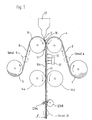
- Fig. 1 the manufacturing process is schematic shown. From a driven supply roll 1 is one essentially closed-cell foam sheet 2 for example polyethylene with a thickness of 3, see FIG. 2, of, for example, 1.2 mm, after an extrusion process was produced, the driven cooled metal roller 4 fed to an extrusion coating system and thereby Mechanically applying a tension in the foam web 0.15% elongated.
- a driven supply roll 1 is one essentially closed-cell foam sheet 2 for example polyethylene with a thickness of 3, see FIG. 2, of, for example, 1.2 mm, after an extrusion process was produced, the driven cooled metal roller 4 fed to an extrusion coating system and thereby Mechanically applying a tension in the foam web 0.15% elongated.
- the extrusion coating system is furthermore, from a supply roll 5, a weakly sized paper web as carrier web 6 with a basis weight of 60 g / m 2 , which has 40 volume% open pores 7, see FIG. 3, in relation to the total volume of the paper web , fed.
- the carrier web 6 is fed to the roll gap 11 via the cooled rubber roll 8, which forms the roll gap 11 together with the driven, cooled metal roll 4.
- an adhesive layer 9 made of a polyethylene film, extruded from an extruder 23 and emerging from a heated slot die 23, is applied directly to the carrier web 6, still resting on the rubber roller 8.
- the polyethylene film as the adhesive layer 9 has, for example, a weight per unit area of 30 g / m 2 .
- the still hot plasticized adhesive layer 9 made of a polyethylene film adheres directly to the carrier web 6.
- the paper web-polyethylene film composite 10 thus formed meets directly in the subsequently arranged nip 11 with the mechanically elongated foam web 2 and bonds under the pressure as it passes through the nip with it to a composite 13. Almost simultaneously, the composite 13 is cooled by the cooled metal roller 4, so that sticking of the foam web 2 to the metal roller 4 is avoided.
- the nip 11 between the rubber roller 8 and the metal roller 4th leaving composite 13 of paper web as carrier web, Polyethylene film as an adhesive film and foam sheet is then an embossing station, namely the embossing roller pair 14a, 14b fed.
- the surface 12 of the Foam sheet 2 of the composite 13 for example by means of an IR radiator 22 heated in the thermoplastic state range, so that during the subsequent passage of the embossing rollers, from those in contact with the surface 12a of the carrier web 6 coming embossing roller 14a is cooled, for example to 25 ° C, the desired surface structuring of the foam sheet of the network 13 takes place and a structured Foam sheet 15 is now present.
- the sheet-shaped foam layer 15 of the Structure wall covering 25 When embossing the thickness of the foam sheet 15, see 4, through the embossed structure by 5 to 95% reduced, the sheet-shaped foam layer 15 of the Structure wall covering 25 then still has a thickness in the area between, for example, 0.02 to 1.5 mm. At the same time changed the cell structure of the foam sheet 15, the originally uniformly fine cell structure of the cells 19 of the not yet embossed and joined foam sheet 2, see Fig.
- the structural wall covering 25 is also with the composite 13 penetrating channels 26 formed.
- channels 26 in the network 13 of Structural wall covering 25 is needled. 1 is the needling of the structural wall covering 25, for example by the carrier web side by means of a spiked roller 27a and a counter roll 27b.
- the manufactured with it Channels 26 lead through the carrier web 6 and the adhesive film 9 and the foam sheet 15 therethrough.
- the channels 26 have a diameter of 0.01 to 0.5 mm.
- a Structure wall covering can be made using the as a carrier sheet a synthetic fiber fleece, for example based on polyester or polypropylene, optionally hydrophilic by means of an im Dip applied anionic and / or nonionic Equipped with a wetting agent in an amount of 0.8% by weight, is used and by means of a used as an adhesive film hereby compatible thermoplastic with a Foam sheet is connected as described above.
- a purely structured wall covering is preferred for example based on polypropylene or polyethylene manufactured.
- the embossing with prior heating and the Manufacturing the channels loses the cellulose-containing carrier web 6 a significant part of their usually included Residual moisture, which is normally about 5% for a paper web is. Due to this drying out of the carrier web Residual moisture content below the normal values becomes a rollund The curvature of the structure wall covering is promoted. to Eliminating this tendency to curl and bulge becomes the structural wall covering re-humidified during its manufacture what in 1 is indicated by arrows F.
- the carrier web 6 takes this during the short-term Moisturize so much moisture that it is a residual moisture from 5 to 15% after moistening and a roll and This eliminates the tendency to warp.
- the predominantly closed-cell foam sheet on the other hand, only takes insignificant moisture.
- the textured wall covering sectionally wound into rolls and airtight, e.g. packed in foil so that the residual moisture can no longer escape and the structure wall covering without Roll tendency is particularly easy to process.
- the structural wall covering 25 thus produced is before Process on the carrier web side with a water-containing Spread adhesive / paste.
- the structure wall covering takes here in the time while it is being processed, mainly (up to 99%) via the carrier web 6 for example, 0.21 ml / g water in 10 minutes.
- the cellulosic carrier sheet contains, like a so-called heavy wallpaper.
- Such structural wall coverings are usually on the back, i.e. on the Spread the carrier web side with paste and then onto one dry wall applied.
- the carrier web (6) deviates from that just described Example is formed from a synthetic fiber fleece is Humidification described above for the purpose of raising the Residual moisture content of the carrier web is not necessary because in the Contrary to a cellulose-containing carrier web by low Residual amounts of moisture, which may still be during processing become smaller, no curl and curl becomes. Rather, a synthetic fiber fleece has such a high one Flexibility and elasticity that are always good Flatness of the structured wall covering thus formed.
- the embossed structure of the structure wall covering on its top 12 can be in accordance with the desired designs provided differently and to different extents his.
- Printing on the surface of the structural wall covering can be done the manufacture of the composite or after that takes place but preferably towards the end of production.
- pretreatment e.g. using an adhesion promoter based on a polyurethane system, is a big one Variety of prints possible.
- Colored foam sheets can also be used be by embossing and / or printing simultaneous compression of the foam surface different shades due to different Lead reflection of the incident light.
Landscapes
- Engineering & Computer Science (AREA)
- Textile Engineering (AREA)
- Laminated Bodies (AREA)
- Fencing (AREA)
- Filling Or Discharging Of Gas Storage Vessels (AREA)
- Extrusion Of Metal (AREA)
Description
- Fig. 1
- eine schematische Darstellung der Herstellung des Struktur-Wandbelags
- Fig. 2
- den vergrößerten Querschnitt der Schaumstoffbahn gemäß Detail A von Fig. 1
- Fig. 3
- den vergrößerten Querschnitt der Papierbahn gemäß Detail B nach Fig. 1
- Fig. 4
- den vergrößerten Querschnitt des Struktur-Wandbelags gemäß Detail D nach Fig. 1.
Claims (22)
- Struktur-Wandbelag aus einem mittels Prägen mit einer Oberflächenstruktur versehenen Verbund eines bahnenförmigen Schaumstoffes von überwiegend geschlossenzelliger Schaumstruktur auf Basis von Polyolefinen, wie Polyethylen oder Polypropylen, eines Klebefilmes auf Basis eines thermoplastischen Kunststoffes und einer Trägerbahn auf Basis einer cellulosehaltigen Bahn, wie einer Papierbahn oder eines Cellulosefaservlieses, oder eines Synthesefaservlieses,
dadurch gekennzeichnet, daß die geprägte Schaumstoffbahn (15) des Verbundes eine unterschiedliche Dicke von 0,02 bis 3 mm aufweist und im Bereich der Oberfläche (12) der Schaumstoffbahn eine verdichtete Schwarte (16), unter der die Zellen (17) stark vergrößert sind, hieran anschließend nach der Mitte zu eine aufgelockerte gegenüber der nicht geprägten Schaumstoffbahn (2) vergröberte Zellstruktur (18) und in dem an den thermoplastischen Klebefilm (9) angrenzenden Bereich im wesentlichen die gleichmäßig feinzellige Zellstruktur (19) der noch nicht geprägten Schaumstoffbahn (2) aufweist, und der Struktur-Wandbelag Kanäle (26) aufweist, die durch die Trägerbahn (6), den Klebefilm (9) und die geprägte Schaumstoffbahn des Verbundes hindurchführen und durch das Prägen ein alternierender Querschnittswechsel der Schaumstoff bahn bei annähernder Planlage der Trägerbahn (6) vorhanden ist. - Struktur-Wandbelag nach Anspruch 1,
dadurch gekennzeichnet, daß der Verbund bis zu 50 Kanäle pro cm2 aufweist. - Struktur-Wandbelag nach einem der Ansprüche 1 oder 2,
dadurch gekennzeichnet, daß der Klebefilm (9) auf Basis des gleichen thermoplastischen Kunststoffes, aus dem der Schaumstoff besteht oder aus einem thermoplastischen Schmelzkleber hergestellt ist. - Struktur-Wandbelag nach einem der Ansprüche 1 bis 3,
dadurch gekennzeichnet, daß beide Oberflächen (12, 12a) des Struktur-Wandbelags so strukturiert sind, daß in Bereichen tiefgeprägter Struktur mit Einbuchtungen (20) auf der Oberfläche (12) der Schaumstoffbahn leicht konkave, d.h. etwas eingezogene Bereiche (21) auf der anderen Oberfläche (12a) der Trägerbahn des Verbundes einander gegenüberliegend ausgebildet sind. - Struktur-Wandbelag nach einem der Ansprüche 1 bis 4,
dadurch gekennzeichnet, daß die durch den Verbund hindurchführenden Kanäle (26) einen Durchmesser von 0,01 bis 0,5 mm aufweisen. - Struktur-Wandbelag nach einem der Ansprüche 1 bis 5,
dadurch gekennzeichnet, daß die Schaumstoffbahn auf ihrer dem Klebefilm (9) abgewandten Seite eine fest aufgebrachte Deckfolie einer Dicke von 10 bis 100 um aus artgleichem Kunststoff wie die Schaumstoffbahn aufweist. - Struktur-Wandbelag nach einem der Ansprüche 1 bis 5,
dadurch gekennzeichnet, daß auf die Oberfläche (12) der Schaumstoffbahn des Verbundes eine Beschichtung auf Basis eines feuchtigkeitsvernetzenden Polyurethan-Systems mit einer Dicke kleiner als 50 µm aufgebracht ist. - Struktur-Wandbelag nach einem der Ansprüche 1 bis 7,
dadurch gekennzeichnet, daß die Schaumstoffbahn des Verbundes eingefärbt und/oder auf ihrer Oberfläche (12) bzw. der auf die Schaumstoffbahn aufgebrachten Deckfolie oder Polyurethan-Beschichtung bedruckt ist. - Struktur-Wandbelag nach einem der Ansprüche 1 bis 8,
dadurch gekennzeichnet, die Wasseraufnahme des den Struktur-Wandbelag bildenden Verbundes mit einer cellulosehaltigen Trägerbahn (6) mindestens 0,15 ml/g in 10 Minuten beträgt. - Struktur-Wandbelag nach einem der Ansprüche 1 bis 9,
dadurch gekennzeichnet, daß die Trägerbahn (6) aus einer Papierbahn gebildet ist, die mindestens 30 Volumen-% offene Poren in bezug auf das Gesamtvolumen der Papierbahn und ein Flächengewicht von 20 bis 150 g/m2 aufweist. - Struktur-Wandbelag nach einem der Ansprüche 1 bis 10,
dadurch gekennzeichnet, daß die aus einer cellulosehaltigen Bahn gebildete Trägerbahn (6) an der Wasseraufnahme einen Anteil von 99,5 bis 95 % und die geprägte Schaumstoffbahn des Verbundes einen Anteil von 0,5 bis 5 % aufweist - Struktur-Wandbelag nach einem der Ansprüche 1 bis 11,
dadurch gekennzeichnet, daß die Trägerbahn eine Restfeuchte von 5 bis 15 % aufweist. - Struktur-Wandbelag nach einem der Ansprüche I bis 8,
dadurch gekennzeichnet, daß Trägerbahnen aus einem Synthesefaservlies auf Basis von thermoplastischen Polyestern oder Polyolefinen, wie Polypropylen eingesetzt sind. - Struktur-Wandbelag nach Anspruch 13,
dadurch gekennzeichnet, daß Synthesefaservliese mit einem Flächengewicht von 50 bis 200 g/m2 eingesetzt sind. - Struktur-Wandbelag nach einem der Ansprüche 13 oder 14,
dadurch gekennzeichnet, daß hydrophil ausgerüstete Synthesefaservliese eingesetzt sind. - Verfahren zum Herstellen eines Struktur-Wandbelags aus einem mittels Prägen mit einer Oberflächenstruktur versehenen Verbund eines bahnenförmigen Schaumstoffes von geschlossenzelliger Schaumstruktur auf Basis von Polyolefinen, wie Polyethylen oder Polypropylen, eines Klebfilmes auf Basis eines thermoplastischen Kunststoffes und einer Trägerbahn auf Basis einer cellulosehaltigen Bahn, wie einer Papierbahn oder eines Cellulosefaservlieses oder eines Synthesefaservlieses nach einem der Ansprüche 1 bis 15, bei dem auf die Trägerbahn als Klebefilm ein frisch extrudierter noch plastifizierter thermoplastischer Kunststoff aufgebracht und hiermit die vorgefertigte Schaumstoffbahn von geschlossenzelliger Schaumstruktur beim Durchführen durch einen Walzenspalt unter Druck verbunden wird und nachfolgend beim Durchlaufen eines Prägespaltes die Oberfläche der Schaumstoffbahn des Verbundes geprägt wird, dadurch gekennzeichnet, daß unmittelbar vor dem Verbinden mit der Trägerbahn (6) die Schaumstoff bahn (2) bei annähernd Raumtemperatur um maximal 1 % gelängt wird und der extrudierte thermoplastische Klebefilm (9) zunächst auf die Trägerbahn (6) aufgebracht und unmittelbar danach dieser Vorverbund von Trägerbahn (6) und Klebefilm (9) dem Walzenspalt (11) zugeführt und hier mit der gelängten Schaumstoffbahn (2) verbunden wird und bei dem nachfolgenden Prägen die Oberfläche des Verbundes strukturiert wird, wobei die Dicke der Schaumstoffbahn um 5 bis 95 % vermindert wird und der Verbund vor oder nach dem Durchlaufen des Prägespaltes maschinell mit durch den Verbund hindurchführenden Kanälen versehen wird.
- Verfahren nach Anspruch 16,
dadurch gekennzeichnet, daß die durch den Verbund führenden Kanäle durch Durchführen des Verbundes durch einen Spalt zwischen einer Nadelwalze und einer Gegenwalze hergestellt werden. - Verfahren nach einem der Ansprüche 16 oder 17
dadurch gekennzeichnet, daß auf die Schaumstoffbahn (2) vor dem Einlaufen in den Walzenspalt auf ihrer dem Klebefilm (9) abgewandten Oberfläche eine Deckfolie aus artgleichem Kunststoff aufgebracht wird, die eine Dicke von 10 bis 100 µm aufweist. - Verfahren nach Anspruch 18,
dadurch gekennzeichnet, daß die Deckfolie im Coextrusionsverfahren auf die Schaumstoffbahn (2) aufgebracht wird. - Verfahren nach einem der Ansprüche 16 oder 17,
dadurch gekennzeichnet, daß auf die dem Klebefilm (9) abgewandte Oberfläche der Schaumstoffbahn (2) vor oder nach dem Herstellen des Verbundes mit der Trägerbahn (6) ein feuchtigkeitsvernetzendes Polyurethan-System als Haftvermittler mittels eines Dünnstrichs aufgebracht wird und die mit dem Haftvermittler versehene Oberfläche mittels einer wäßrigen Druckfarbendispersion bedruckt wird. - Verfahren nach einem der Ansprüche 16 bis 20,
dadurch gekennzeichnet, das der Struktur-Wandbelag nach seiner Fertigstellung abschnittsweise auf Rollen aufgewickelt und luftdicht verpackt wird. - Verfahren nach Anspruch 16,
dadurch gekennzeichnet, daß der geprägte, genadelte und gegebenenfalls bedruckte, eine cellulosehaltige Trägerbahn enthaltende Verbund befeuchtet wird, so daß die durch die vorangegangenen Verfahrensschritte verlorengegangene Feuchte der Trägerbahn mindestens wieder ausgeglichen wird und die Restfeuchte der cellulosehaltigen Trägerbahn durch das Befeuchten auf 5 bis 15 % angehoben wird.
Applications Claiming Priority (2)
| Application Number | Priority Date | Filing Date | Title |
|---|---|---|---|
| DE19531142A DE19531142C2 (de) | 1995-08-24 | 1995-08-24 | Strukturschaumstoff-Tapete |
| DE19531142 | 1995-08-24 |
Publications (3)
| Publication Number | Publication Date |
|---|---|
| EP0760281A2 EP0760281A2 (de) | 1997-03-05 |
| EP0760281A3 EP0760281A3 (de) | 1999-08-18 |
| EP0760281B1 true EP0760281B1 (de) | 2002-12-04 |
Family
ID=7770273
Family Applications (1)
| Application Number | Title | Priority Date | Filing Date |
|---|---|---|---|
| EP96113521A Expired - Lifetime EP0760281B1 (de) | 1995-08-24 | 1996-08-23 | Struktur-Wandbelag und Verfahren zum Herstellen desselben |
Country Status (4)
| Country | Link |
|---|---|
| EP (1) | EP0760281B1 (de) |
| AT (1) | ATE228929T1 (de) |
| DE (2) | DE19531142C2 (de) |
| DK (1) | DK0760281T3 (de) |
Cited By (3)
| Publication number | Priority date | Publication date | Assignee | Title |
|---|---|---|---|---|
| WO2014158347A1 (en) * | 2013-03-14 | 2014-10-02 | Hewlett-Packard Development Company, L.P. | Wall covering |
| WO2024130143A1 (en) * | 2022-12-16 | 2024-06-20 | W. L. Gore & Associates, Inc. | Selective densification of expanded polyethylene |
| WO2024130149A1 (en) * | 2022-12-16 | 2024-06-20 | W. L. Gore & Associates, Inc. | Improved bend radius and stored length in polyethylene constructs |
Families Citing this family (3)
| Publication number | Priority date | Publication date | Assignee | Title |
|---|---|---|---|---|
| ES2153719B1 (es) * | 1997-07-11 | 2001-10-16 | Autotex S A | Procedimiento de laminacion de espumas de polietileno. |
| DE102012007910A1 (de) | 2012-04-20 | 2013-10-24 | Hänsel & Co. GmbH | Tapete sowie Verfahren zu ihrer Herstellung |
| DE102015007886B4 (de) * | 2015-06-20 | 2019-01-17 | Daimler Ag | Verbundbauteil für ein Fahrzeug, insbesondere einen Kraftwagen |
Family Cites Families (5)
| Publication number | Priority date | Publication date | Assignee | Title |
|---|---|---|---|---|
| ES495398A0 (es) * | 1979-09-28 | 1981-11-16 | Armstrong Cork Co | Procedimiento para facilitar el escape de gas o vapor del interior de un material que tiene una porcion porosa. |
| DD153615A1 (de) * | 1980-10-10 | 1982-01-20 | Werner Lauterberg | Gepraegte,abwaschbare tapete |
| GB2137138B (en) * | 1983-03-15 | 1987-04-01 | Atomic Energy Authority Uk | Thermal insulation layer |
| DE4120306A1 (de) * | 1991-06-20 | 1992-12-24 | Hager Wolfgang | Verfahren und vorrichtung zur herstellung einer strukturschaumstofftapete |
| DE9402973U1 (de) * | 1994-02-23 | 1994-07-21 | Haas, Hermann, 35708 Haiger | Tapete |
-
1995
- 1995-08-24 DE DE19531142A patent/DE19531142C2/de not_active Expired - Fee Related
-
1996
- 1996-08-23 EP EP96113521A patent/EP0760281B1/de not_active Expired - Lifetime
- 1996-08-23 DK DK96113521T patent/DK0760281T3/da active
- 1996-08-23 DE DE59609942T patent/DE59609942D1/de not_active Expired - Fee Related
- 1996-08-23 AT AT96113521T patent/ATE228929T1/de not_active IP Right Cessation
Cited By (3)
| Publication number | Priority date | Publication date | Assignee | Title |
|---|---|---|---|---|
| WO2014158347A1 (en) * | 2013-03-14 | 2014-10-02 | Hewlett-Packard Development Company, L.P. | Wall covering |
| WO2024130143A1 (en) * | 2022-12-16 | 2024-06-20 | W. L. Gore & Associates, Inc. | Selective densification of expanded polyethylene |
| WO2024130149A1 (en) * | 2022-12-16 | 2024-06-20 | W. L. Gore & Associates, Inc. | Improved bend radius and stored length in polyethylene constructs |
Also Published As
| Publication number | Publication date |
|---|---|
| EP0760281A2 (de) | 1997-03-05 |
| ATE228929T1 (de) | 2002-12-15 |
| DE59609942D1 (de) | 2003-01-16 |
| DK0760281T3 (da) | 2003-03-17 |
| DE19531142A1 (de) | 1997-02-27 |
| DE19531142C2 (de) | 1997-09-25 |
| EP0760281A3 (de) | 1999-08-18 |
Similar Documents
| Publication | Publication Date | Title |
|---|---|---|
| DE69634088T2 (de) | Eingekapselte isolationsvorrichtung | |
| DE2451651C2 (de) | Verfahren und Vorrichtung zum Herstellen von Wellpappe | |
| DE69023503T2 (de) | Wärmeklebbares papierblatt. | |
| DE69316358T2 (de) | Verfahren zum herstellen eines als oberste lage eines absorbierenden einmalartikels geeigneten materials sowie entsprechendes material | |
| DE3224430A1 (de) | Geschichtetes, gekrepptes papiertuch und verfahren zu seiner herstellung | |
| DE69824468T2 (de) | Verfahren zum Laminieren einer porösen Bahn mit einem Verstärkungsmaterial mit grossen Maschen | |
| DE60314992T2 (de) | Verfahren und vorrichtung zur herstellung einer mehrlagigen bahn aus flexiblem material, wie zum beispiel papier und vliesstoff, und durch das verfahren hergestelltes mehrlagiges material und produkt | |
| DE2455895A1 (de) | Mehrschichtiges saugfaehiges papierwischtuch und verfahren zu seiner herstellung | |
| EP0855479A2 (de) | Diffusionsoffene Dachunterspannbahn und Verfahren zur Herstellung derselben | |
| DE3407817A1 (de) | Weiches, feuchtigkeitsbestaendiges tucherzeugnis | |
| DE2555840A1 (de) | Boden- oder wandbelag und verfahren zu seiner herstellung | |
| DE2445070A1 (de) | Verfahren zur herstellung von materialien mit plueschoberflaeche | |
| DE60302877T2 (de) | Verfahren und vorrichtung zur herstellung einer mehrlagigen bahn aus flexiblem material, wie zum beispiel papier und vliesstoff, und durch das verfahren hergestelltes mehrlagiges material | |
| DE2049978A1 (de) | ||
| DE10057149A1 (de) | Diffusionsoffene Dachunterspannbahn | |
| DE10359957A1 (de) | Verfahren zum Herstellen einer Unterdeckbahn für Dächer | |
| EP0760281B1 (de) | Struktur-Wandbelag und Verfahren zum Herstellen desselben | |
| EP0700779A2 (de) | Diffusionsoffene Baufolien und Verfahren zu ihrer Herstellung | |
| EP1073796A1 (de) | Mehrlagige papier-prägetapete mit glatter rückseite, sowie verfahren zu deren herstellung | |
| DE112008000633T5 (de) | Verfahren zum Herstellen eines Verbundgewebes | |
| DE2725201C2 (de) | Verstaerkte wellpappe und verfahren zu ihrer herstellung | |
| DE60304166T2 (de) | Verfahren zur herstellung einer mehrlagigen bahn aus flexiblem material wie papier oder vliesstoff und durch das verfahren hergestelltes mehrlagiges material | |
| AT394971B (de) | Verbundmaterial und verfahren zu dessen herstellung | |
| DE4241516C1 (en) | Artificial leather - comprises laminate of fibrous fleece, poly urethane foam and covering layer with fibres needled through foam to other side | |
| DE69702753T2 (de) | Platte, paneel oder ähnliche artikel aus thermoformbarem mehrsichtigem material und verfahren zur herstellung derselben |
Legal Events
| Date | Code | Title | Description |
|---|---|---|---|
| PUAI | Public reference made under article 153(3) epc to a published international application that has entered the european phase |
Free format text: ORIGINAL CODE: 0009012 |
|
| AK | Designated contracting states |
Kind code of ref document: A2 Designated state(s): AT BE CH DE DK FR GB LI LU NL SE |
|
| PUAL | Search report despatched |
Free format text: ORIGINAL CODE: 0009013 |
|
| AK | Designated contracting states |
Kind code of ref document: A3 Designated state(s): AT BE CH DE DK FR GB LI LU NL SE |
|
| RIC1 | Information provided on ipc code assigned before grant |
Free format text: 6B 32B 5/18 A, 6B 32B 3/24 B, 6B 32B 3/30 B, 6D 06N 7/00 B |
|
| 17P | Request for examination filed |
Effective date: 19991112 |
|
| GRAH | Despatch of communication of intention to grant a patent |
Free format text: ORIGINAL CODE: EPIDOS IGRA |
|
| GRAH | Despatch of communication of intention to grant a patent |
Free format text: ORIGINAL CODE: EPIDOS IGRA |
|
| GRAA | (expected) grant |
Free format text: ORIGINAL CODE: 0009210 |
|
| RAP1 | Party data changed (applicant data changed or rights of an application transferred) |
Owner name: POLYMER-TEC GMBH |
|
| AK | Designated contracting states |
Kind code of ref document: B1 Designated state(s): AT BE CH DE DK FR GB LI LU NL SE |
|
| REF | Corresponds to: |
Ref document number: 228929 Country of ref document: AT Date of ref document: 20021215 Kind code of ref document: T |
|
| REG | Reference to a national code |
Ref country code: GB Ref legal event code: FG4D Free format text: NOT ENGLISH |
|
| REG | Reference to a national code |
Ref country code: CH Ref legal event code: EP |
|
| REF | Corresponds to: |
Ref document number: 59609942 Country of ref document: DE Date of ref document: 20030116 |
|
| REG | Reference to a national code |
Ref country code: DK Ref legal event code: T3 |
|
| GBT | Gb: translation of ep patent filed (gb section 77(6)(a)/1977) |
Effective date: 20030315 |
|
| ET | Fr: translation filed | ||
| PG25 | Lapsed in a contracting state [announced via postgrant information from national office to epo] |
Ref country code: LU Free format text: LAPSE BECAUSE OF NON-PAYMENT OF DUE FEES Effective date: 20030823 |
|
| PLBE | No opposition filed within time limit |
Free format text: ORIGINAL CODE: 0009261 |
|
| STAA | Information on the status of an ep patent application or granted ep patent |
Free format text: STATUS: NO OPPOSITION FILED WITHIN TIME LIMIT |
|
| 26N | No opposition filed |
Effective date: 20030905 |
|
| PGFP | Annual fee paid to national office [announced via postgrant information from national office to epo] |
Ref country code: FR Payment date: 20050819 Year of fee payment: 10 |
|
| PGFP | Annual fee paid to national office [announced via postgrant information from national office to epo] |
Ref country code: NL Payment date: 20060821 Year of fee payment: 11 |
|
| PGFP | Annual fee paid to national office [announced via postgrant information from national office to epo] |
Ref country code: BE Payment date: 20060828 Year of fee payment: 11 Ref country code: AT Payment date: 20060828 Year of fee payment: 11 |
|
| PGFP | Annual fee paid to national office [announced via postgrant information from national office to epo] |
Ref country code: CH Payment date: 20060829 Year of fee payment: 11 |
|
| PGFP | Annual fee paid to national office [announced via postgrant information from national office to epo] |
Ref country code: GB Payment date: 20060830 Year of fee payment: 11 Ref country code: DK Payment date: 20060830 Year of fee payment: 11 |
|
| REG | Reference to a national code |
Ref country code: CH Ref legal event code: PUE Owner name: POLYMER-TEC HALBZEUGE GMBH Free format text: POLYMER-TEC GMBH#HAYSTRASSE 7-13#55566 BAD SOBERNHEIM (DE) -TRANSFER TO- POLYMER-TEC HALBZEUGE GMBH#HAYSTRASSE 7-13#55566 BAD SOBERNHEIM (DE) |
|
| REG | Reference to a national code |
Ref country code: GB Ref legal event code: 732E |
|
| REG | Reference to a national code |
Ref country code: FR Ref legal event code: TP |
|
| NLS | Nl: assignments of ep-patents |
Owner name: POLYMER-TEC HALBZEUGE GMBH Effective date: 20060908 |
|
| PGFP | Annual fee paid to national office [announced via postgrant information from national office to epo] |
Ref country code: SE Payment date: 20060829 Year of fee payment: 11 |
|
| BERE | Be: lapsed |
Owner name: *POLYMER-TEC HALBZEUGE G.M.B.H. Effective date: 20070831 |
|
| EUG | Se: european patent has lapsed | ||
| REG | Reference to a national code |
Ref country code: CH Ref legal event code: PL |
|
| REG | Reference to a national code |
Ref country code: DK Ref legal event code: EBP |
|
| GBPC | Gb: european patent ceased through non-payment of renewal fee |
Effective date: 20070823 |
|
| PG25 | Lapsed in a contracting state [announced via postgrant information from national office to epo] |
Ref country code: SE Free format text: LAPSE BECAUSE OF NON-PAYMENT OF DUE FEES Effective date: 20070824 Ref country code: NL Free format text: LAPSE BECAUSE OF NON-PAYMENT OF DUE FEES Effective date: 20080301 Ref country code: LI Free format text: LAPSE BECAUSE OF NON-PAYMENT OF DUE FEES Effective date: 20070831 Ref country code: CH Free format text: LAPSE BECAUSE OF NON-PAYMENT OF DUE FEES Effective date: 20070831 |
|
| NLV4 | Nl: lapsed or anulled due to non-payment of the annual fee |
Effective date: 20080301 |
|
| PG25 | Lapsed in a contracting state [announced via postgrant information from national office to epo] |
Ref country code: AT Free format text: LAPSE BECAUSE OF NON-PAYMENT OF DUE FEES Effective date: 20070823 |
|
| REG | Reference to a national code |
Ref country code: FR Ref legal event code: ST Effective date: 20080430 |
|
| PG25 | Lapsed in a contracting state [announced via postgrant information from national office to epo] |
Ref country code: DK Free format text: LAPSE BECAUSE OF NON-PAYMENT OF DUE FEES Effective date: 20070831 |
|
| PG25 | Lapsed in a contracting state [announced via postgrant information from national office to epo] |
Ref country code: BE Free format text: LAPSE BECAUSE OF NON-PAYMENT OF DUE FEES Effective date: 20070831 |
|
| PG25 | Lapsed in a contracting state [announced via postgrant information from national office to epo] |
Ref country code: FR Free format text: LAPSE BECAUSE OF NON-PAYMENT OF DUE FEES Effective date: 20070831 |
|
| PG25 | Lapsed in a contracting state [announced via postgrant information from national office to epo] |
Ref country code: GB Free format text: LAPSE BECAUSE OF NON-PAYMENT OF DUE FEES Effective date: 20070823 |
|
| PGFP | Annual fee paid to national office [announced via postgrant information from national office to epo] |
Ref country code: DE Payment date: 20081025 Year of fee payment: 13 |
|
| PG25 | Lapsed in a contracting state [announced via postgrant information from national office to epo] |
Ref country code: FR Free format text: LAPSE BECAUSE OF NON-PAYMENT OF DUE FEES Effective date: 20060831 |
|
| PG25 | Lapsed in a contracting state [announced via postgrant information from national office to epo] |
Ref country code: DE Free format text: LAPSE BECAUSE OF NON-PAYMENT OF DUE FEES Effective date: 20100302 |