EP0760563A1 - Structure multitrame et protocole de communication pour un réseau de transmission - Google Patents
Structure multitrame et protocole de communication pour un réseau de transmission Download PDFInfo
- Publication number
- EP0760563A1 EP0760563A1 EP95202332A EP95202332A EP0760563A1 EP 0760563 A1 EP0760563 A1 EP 0760563A1 EP 95202332 A EP95202332 A EP 95202332A EP 95202332 A EP95202332 A EP 95202332A EP 0760563 A1 EP0760563 A1 EP 0760563A1
- Authority
- EP
- European Patent Office
- Prior art keywords
- signalling
- telephony
- time slots
- bursts
- carrying
- Prior art date
- Legal status (The legal status is an assumption and is not a legal conclusion. Google has not performed a legal analysis and makes no representation as to the accuracy of the status listed.)
- Withdrawn
Links
- 230000011664 signaling Effects 0.000 claims abstract description 155
- 108091006146 Channels Proteins 0.000 claims abstract description 94
- 230000000737 periodic effect Effects 0.000 claims abstract description 5
- 238000004891 communication Methods 0.000 claims description 10
- 230000005540 biological transmission Effects 0.000 abstract description 17
- 238000000034 method Methods 0.000 abstract description 5
- 230000003287 optical effect Effects 0.000 description 12
- 101000685663 Homo sapiens Sodium/nucleoside cotransporter 1 Proteins 0.000 description 6
- 102100023116 Sodium/nucleoside cotransporter 1 Human genes 0.000 description 6
- 238000011144 upstream manufacturing Methods 0.000 description 4
- 101100272852 Clostridium botulinum (strain Langeland / NCTC 10281 / Type F) F gene Proteins 0.000 description 2
- 101000821827 Homo sapiens Sodium/nucleoside cotransporter 2 Proteins 0.000 description 2
- 101100376154 Saccharomyces cerevisiae (strain ATCC 204508 / S288c) TY2B-F gene Proteins 0.000 description 2
- 102100021541 Sodium/nucleoside cotransporter 2 Human genes 0.000 description 2
- 230000008878 coupling Effects 0.000 description 2
- 238000010168 coupling process Methods 0.000 description 2
- 238000005859 coupling reaction Methods 0.000 description 2
- 230000001419 dependent effect Effects 0.000 description 2
- 238000013461 design Methods 0.000 description 2
- 238000012360 testing method Methods 0.000 description 2
- 238000013459 approach Methods 0.000 description 1
- 230000000903 blocking effect Effects 0.000 description 1
- 238000006243 chemical reaction Methods 0.000 description 1
- 230000008094 contradictory effect Effects 0.000 description 1
- 239000000835 fiber Substances 0.000 description 1
- 238000013507 mapping Methods 0.000 description 1
- 239000000203 mixture Substances 0.000 description 1
- 239000013307 optical fiber Substances 0.000 description 1
- 238000005070 sampling Methods 0.000 description 1
- 238000001228 spectrum Methods 0.000 description 1
- 230000001360 synchronised effect Effects 0.000 description 1
Images

Classifications
-
- H—ELECTRICITY
- H04—ELECTRIC COMMUNICATION TECHNIQUE
- H04N—PICTORIAL COMMUNICATION, e.g. TELEVISION
- H04N7/00—Television systems
- H04N7/16—Analogue secrecy systems; Analogue subscription systems
- H04N7/173—Analogue secrecy systems; Analogue subscription systems with two-way working, e.g. subscriber sending a programme selection signal
-
- H—ELECTRICITY
- H04—ELECTRIC COMMUNICATION TECHNIQUE
- H04H—BROADCAST COMMUNICATION
- H04H20/00—Arrangements for broadcast or for distribution combined with broadcast
- H04H20/44—Arrangements characterised by circuits or components specially adapted for broadcast
- H04H20/46—Arrangements characterised by circuits or components specially adapted for broadcast specially adapted for broadcast systems covered by groups H04H20/53-H04H20/95
-
- H—ELECTRICITY
- H04—ELECTRIC COMMUNICATION TECHNIQUE
- H04H—BROADCAST COMMUNICATION
- H04H20/00—Arrangements for broadcast or for distribution combined with broadcast
- H04H20/65—Arrangements characterised by transmission systems for broadcast
- H04H20/76—Wired systems
- H04H20/77—Wired systems using carrier waves
- H04H20/78—CATV [Community Antenna Television] systems
- H04H20/79—CATV [Community Antenna Television] systems using downlink of the CATV systems, e.g. audio broadcast via CATV network
-
- H—ELECTRICITY
- H04—ELECTRIC COMMUNICATION TECHNIQUE
- H04H—BROADCAST COMMUNICATION
- H04H20/00—Arrangements for broadcast or for distribution combined with broadcast
- H04H20/65—Arrangements characterised by transmission systems for broadcast
- H04H20/76—Wired systems
- H04H20/77—Wired systems using carrier waves
- H04H20/81—Wired systems using carrier waves combined with telephone network over which the broadcast is continuously available
-
- H—ELECTRICITY
- H04—ELECTRIC COMMUNICATION TECHNIQUE
- H04H—BROADCAST COMMUNICATION
- H04H60/00—Arrangements for broadcast applications with a direct linking to broadcast information or broadcast space-time; Broadcast-related systems
- H04H60/76—Arrangements characterised by transmission systems other than for broadcast, e.g. the Internet
- H04H60/81—Arrangements characterised by transmission systems other than for broadcast, e.g. the Internet characterised by the transmission system itself
- H04H60/93—Wired transmission systems
- H04H60/96—CATV systems
- H04H60/97—CATV systems using uplink of the CATV systems
-
- H—ELECTRICITY
- H04—ELECTRIC COMMUNICATION TECHNIQUE
- H04J—MULTIPLEX COMMUNICATION
- H04J3/00—Time-division multiplex systems
- H04J3/02—Details
- H04J3/12—Arrangements providing for calling or supervisory signals
-
- H—ELECTRICITY
- H04—ELECTRIC COMMUNICATION TECHNIQUE
- H04J—MULTIPLEX COMMUNICATION
- H04J3/00—Time-division multiplex systems
- H04J3/16—Time-division multiplex systems in which the time allocation to individual channels within a transmission cycle is variable, e.g. to accommodate varying complexity of signals, to vary number of channels transmitted
- H04J3/1605—Fixed allocated frame structures
-
- H—ELECTRICITY
- H04—ELECTRIC COMMUNICATION TECHNIQUE
- H04L—TRANSMISSION OF DIGITAL INFORMATION, e.g. TELEGRAPHIC COMMUNICATION
- H04L12/00—Data switching networks
- H04L12/28—Data switching networks characterised by path configuration, e.g. LAN [Local Area Networks] or WAN [Wide Area Networks]
- H04L12/2801—Broadband local area networks
-
- H—ELECTRICITY
- H04—ELECTRIC COMMUNICATION TECHNIQUE
- H04N—PICTORIAL COMMUNICATION, e.g. TELEVISION
- H04N7/00—Television systems
- H04N7/10—Adaptations for transmission by electrical cable
-
- H—ELECTRICITY
- H04—ELECTRIC COMMUNICATION TECHNIQUE
- H04H—BROADCAST COMMUNICATION
- H04H20/00—Arrangements for broadcast or for distribution combined with broadcast
- H04H20/28—Arrangements for simultaneous broadcast of plural pieces of information
- H04H20/33—Arrangements for simultaneous broadcast of plural pieces of information by plural channels
-
- H—ELECTRICITY
- H04—ELECTRIC COMMUNICATION TECHNIQUE
- H04H—BROADCAST COMMUNICATION
- H04H2201/00—Aspects of broadcast communication
- H04H2201/70—Aspects of broadcast communication characterised in that receivers can be addressed
-
- H—ELECTRICITY
- H04—ELECTRIC COMMUNICATION TECHNIQUE
- H04H—BROADCAST COMMUNICATION
- H04H60/00—Arrangements for broadcast applications with a direct linking to broadcast information or broadcast space-time; Broadcast-related systems
- H04H60/09—Arrangements for device control with a direct linkage to broadcast information or to broadcast space-time; Arrangements for control of broadcast-related services
- H04H60/14—Arrangements for conditional access to broadcast information or to broadcast-related services
- H04H60/15—Arrangements for conditional access to broadcast information or to broadcast-related services on receiving information
Definitions
- the present invention relates to a multiframe structure for transmitting narrowband telephony signals according to channel associated signalling protocols or common channel signalling protocols over a broadband cable link onto which broadband signals are transmitted.
- CAble TeleVision (CATV) networks originally designed to transport broadband signals such as analog video or television signals over broadband cable links can be merged with telephony access networks in order to provide for an alternate solution to access subscriber stations with both the video and the telephony signals.
- the cable links of the networks may be optical-fiber or coaxial cables coupling a video broadcasting head-end as well as a telephony access node to several subscriber stations, generally via a central hub, each subscriber station being provided with a telephone and/or a television set.
- bursts are roughly equivalent to the contents of a well-known time slot or "channel" of a Time Division Multiplex (TDM) frame.
- TDM Time Division Multiplex
- Such a time slot is adapted to carry any type of classical narrowband telephony data, but a burst additionally comprises extra bits for synchronization, error control, TDMA signalling and guard bits to avoid burst overlaps.
- This overhead may add significant bandwidth requirement because of the thereby increased length of the time slot.
- the known video transmission networks are thus a priory not adapted for transmitting telephony signals according to the Time Division Multiple Access (TDMA) technique over a bus connection topology with geographically distant access points.
- TDMA Time Division Multiple Access
- Another constraint is that, to allow an efficient layered implementation, all the time slots should have a same length. The telephony receiver can then easier extract the bursts of data from these time slots without having knowledge of their meaning.
- CAS Channel Associated Signaling
- CCS Common Channel Signalling
- the signaling information is carried along with the traffic data, i.e. the user telephony data.
- traffic data i.e. the user telephony data.
- These older signalling schemes generally use a combination of in-band tones and line states to code signalling messages such as on and off hook, dial number, ringing, busy, ...
- Signalling messages are carried by a particular time slot, called “signalling channel”, of the frame and are always associated to user data carried by two other time slots, called “traffic channels", of the same frame.
- An implementation suited for CAS may not carry CCS because, in the latter, there is no direct relationship between signalling channels and traffic channels. Indeed, forcing to do so will result in a very inefficient spectrum usage of the telephony transmission frequency band because of the great number of unused bits.
- a frame structure adapted to CCS is inadequate to carry CAS since signalling channels should then be allocated independently to the traffic channels.
- a first object of the present invention is to provide a multiframe structure that allows to support, on an existing broadband cable link, at least the channel associated signalling (CAS) and the common channel signalling (CCS) protocols while avoiding significant efficiency loss in any of these signalling modes.
- CAS channel associated signalling
- CCS common channel signalling
- said multiframe structure includes a plurality of time division multiple access frames, each frame comprising a plurality of time slots each adapted to carry a burst of data, a first plurality of said time slots carrying signalling bursts of telephony signalling information and a second plurality of said time slots carrying traffic bursts of telephony traffic data, that for the common channel signalling protocols the time slots carrying said signalling bursts are grouped within each of said frames, and that for the channel associated signalling protocols time slots carrying said signalling bursts are separated by several time slots carrying said traffic bursts and are distributed over the frames of said multiframe structure on a periodic basis.
- each of said frames includes at least one time slot carrying a control burst of cable link operation signalling for exchange between a telephony access node and subscriber stations which are all coupled to said broadband cable link onto which said broadband signals are frequency multiplexed with said narrowband telephony signals.
- some of the telephony signals are used to control, from the subscriber station, the transmission of the video signals thereto. These signals are then transmitted to the video broadcasting head-end either directly or via the telephony access network.
- Still another characteristic feature of the present multiframe structure is that for said channel associated signalling the time slots of said multiframe structure are distributed in said multiframe structure at a rate of one time slot carrying a signalling burst for four time slot carrying traffic bursts.
- said payload consists of four bytes of said telephony signals and said multiframe structure includes at least four frames.
- a second object of the present invention is to define a multiframe handling protocol for handling a multiframe structure used for transmitting narrowband telephony signals over a broadband cable link onto which said narrowband telephony signals are frequency multiplexed with broadband video signals.
- an asymmetric handling protocol has to be defined for the telephony signals with contention management on the uplink path over the broadband cable link, i.e. from subscriber stations to a telephony access node.
- This multiframe handling protocol has to manage transparently different signalling schemes as for instance the channel associated signaling (CAS) and the common channel signalling (CCS).
- CAS channel associated signaling
- CCS common channel signalling
- control bursts may be used to allocate and de-allocate traffic channels, i.e. time slots, to the telephony signals transmitted between the telephony access node and the subscriber stations, whilst the so-called “polling delay” is tuneable by allocating, per frame, one or more time slots carrying control bursts of cable link operation signalling.
- the bandwidth used by the present multiframe handling protocol may thus, if required, be reduced to a minimum.
- this multiframe structure may transparently carry most any type of signalling schemes, including the above CAS and CCS protocols.
- the same predetermined time slot is further always used for the exchange of any data between the latter. It is thus possible, through the time slot carrying a control burst, to initiate and manage remote functions such as tests, configuration settings, status and alarm reporting, resets, etc...
- the number of telephony communications simultaneously possible over the broadband video cable link is dependent of the number of time slots, per frame, able to carry bursts of telephony data, whilst the number of links between the telephony access node and subscriber stations is dependent of the number of time slots carrying control bursts per multiframe.
- the present multiframe structure it is thus possible to have more permanent links than simultaneous communication between the subscriber stations and the telephony access node.
- the present invention is further also characterized by a telephone access node including line termination means adapted to operate the above multiframe structure and multiframe handling protocol and by a subscriber station including network termination means also adapted to operate these multiframe structure and multiframe handling protocol.
- the video signals of the video broadcasting head-end HE are first transmitted, via a first optical broadband down-stream link, to a video amplifier VA forming part of the central hub HUB. From the video amplifier VA the video signals are further transferred, via a second optical broadband down-stream link, to an optical/electrical converter OEC located in a broadband optical network termination BONT interfacing the central hub HUB and the subscriber stations HOME.
- OEC optical/electrical converter
- the video signals are frequency multiplexed with the telephony signals and these merged signals are transmitted on the bi-directional coaxial broadband cable link BCL.
- the broadband cable link BCL has a bus topology to which the subscriber stations HOME are connected via respective coaxial network terminations CNT1, CNT2, ... CNTn.
- a coaxial network termination which will hereafter generally be referred to as CNT, forms part of the subscriber station HOME and is located in or near to the user premise.
- CNT is an interface between the coaxial broadband cable link BCL and the television set TV and/or the telephone set of the user.
- a CNT is thus adapted to separate the video signals and the telephony signals transmitted on the cable link BCL and to transmit them to the television set TV and to the telephone set of the user respectively, and vice versa.
- the HUC has another separate connection to a telephony access node TAN located in or near to the central hub HUB.
- the control signals are transmitted to the video broadcasting head-end HE via the fourth optical link, whilst the telephony signals are transmitted, in a bi-directional way, to the telephony access node TAN and so further to the local telephone exchange LTE to which TAN is connected.
- first and fourth optical links have a length of less than 20 km
- second and third optical link have a length of less than 10 km
- coaxial broadband cable link BCL has a length of approximately 250 m.
- either the telephony access node TAN or the local telephone exchange LTE may be connected to the video broadcasting head-end HE.
- the fourth optical link between the HUC and HE is then no longer necessary since the control signals may be transferred via TAN or LTE.
- the control signals should be sent as narrowband telephony signals or the TAN and/or the LTE should be adapted to transmit the broadband control signals.
- the telephony access node TAN includes a radio frequency line termination RFLT which, as the coaxial network termination CNT located in each subscriber station HOME, is adapted to convert telephony signals transmitted according to standard telephony transmission protocols such as the Channel Associated Signalling (CAS) schemes or the Common Channel Signalling (CCS) schemes into signals able to be carried in bursts of the TDMA multiframe structure, and vice versa.
- standard telephony transmission protocols such as the Channel Associated Signalling (CAS) schemes or the Common Channel Signalling (CCS) schemes
- CAS Channel Associated Signalling
- CCS Common Channel Signalling
- a first half byte of the signalling information carried by the so-called "signalling channel” is associated to a first traffic channel, whilst the second half byte of the same signalling channel is associated to another traffic channel of the frame.
- the signalling information relates for instance to the on/off hook status. Dialling, ringing and busy information of the telephone set are carried as audible tones through the associated traffic channel.
- the 15 frames of the multiframe allocation scheme are thus necessary to carry the signalling information associated to all of the 30 user data time slots or traffic channels of these frames.
- the common channel signalling (CCS) scheme also uses frames of 32 time slots of which one time slot is adapted to carry signalling information but this signalling information is here transported independently of the user data or traffic channel associated thereto.
- the radio frequency line termination RFLT and the coaxial network terminations CNT map either the CAS or the CCS protocols into the time division multiple access (TDMA) multiframe structure used for the telephony transmission on the broadband cable link BCL.
- TDMA time division multiple access
- Each multiframe of this structure, transmitted at a radio frequency, is constituted by at least four frames which each comprises 40 time slots carrying bursts of data.
- a burst of data comprises a synchronization part and a payload wherein telephony data is loaded.
- the synchronization part consists of extra bits used for synchronization, error control, signalling and some guard bits to avoid burst overlaps.
- the radio receiver line termination RFLT Since the radio receiver line termination RFLT has only to synchronise once per burst, i.e. per time slot, the longer the burst, the better the channel usage and thus the transmission efficiency. On the other hand, the longer the burst, the larger the transmission delay due to the packetisation of the data therein. However, the telephony loop delay may not exceed a predetermined value. A compromise has thus to be found as will be described below.
- the payload of a TDMA burst must have a throughput of 64 Kbit/sec and must be composed of a multiple n of 8 bits, one byte being the length of a PCM time slot.
- a burst has been chosen with a length of four bytes for its payload, i.e. with a value of four for the parameter n. Because each time slot only carries a burst of four telecommunication bytes, the polling delay is limited within international requirements and expensive echo cancellers are avoided. These four payload bytes of the burst are preceded by 6 extra synchronization bits in the synchronization part thereof.
- each time slot of the multiframe carries either signalling information or user data but never a mixture of both, and a time slot carrying a signalling burst, i.e. a burst of signalling information, can only be associated to at most one time slot carrying a traffic burst, i.e. a burst of telephony user data.
- a carrier in order to carry the above CAS and CCS schemes, a carrier must be able to carry simultaneously up to 30 "Public Office Telephone Service” (POTS) communications corresponding to the above 30 traffic channels.
- POTS Public Office Telephone Service
- the number N of time slots per frame must be greater than or equal to 32 taking into account signalling transmission bandwidth.
- signalling information has a throughput of 16 Kbit/sec.
- the time slots are therefore grouped in blocks of five including four time slots carrying traffic bursts and one time slot carrying a signalling burst.
- a frame must have a number N of time slots which is a multiple of 5.
- each frame comprises 40 time slots and four frames are necessary to carry the signalling information associated to the 30 traffic bursts per frame.
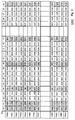
- Fig. 2 shows several TDMA multiframes each constituted of four frames FN00-FN03, FN04-FN07, ..., FN60-FN63 subdivided into 40 time slots TS00 to TS39.
- This multiframe structure is adapted to carry channel associated signalling (CAS) protocols.
- CAS channel associated signalling
- time slots TS02, TS03, TS05 to TS08, TS10 to TS13, ... and TS35 to TS38 are adapted to carry traffic bursts, D01 to D30 respectively, of which the payload is constituted by four bytes of telephony user data, whilst 8 time slots TS04, TS09, TS14, ... and TS39 are adapted to carry signalling bursts of which the payload is constituted by 32 bits of telephony signalling information.
- the remaining two time slots TS00 and TS01 carry control bursts of cable link operation signalling as will be explained later.
- the above blocks of five time slots are distributed over the multiframe and are constituted by the time slots TS00 to TS04, TS05 to TS09, TS10 to TS14, ...,TS35 to TS39.
- the first four time slots carry traffic bursts of user data D03 to D06, D07 to D10, ... and D27 to D30, whilst the last time slot carries a signalling burst. Since the signalling bursts are each only associated to one single traffic burst, the signalling information S03 to S30 respectively associated to the user data D03 to D30 forms part of the signalling bursts distributed over the four frames of the multiframe.
- the first block of time slots TS00 to TS04 is slightly different in that its first two time slots TS00 and TS01 carry control bursts of cable link operation signalling and that the following two time slots TS02 and TS03 carry traffic bursts of the user data D01 and D02.
- the fifth time slot TS04 of the first block TS00 to TS04 is not used (nu) in the first two frames FN00 and FN01 of a multiframe, say FN00 to FN03 as an example, and carries signalling bursts S01 and S02 of signalling information associated to the traffic bursts D01 and D02 in the last two frames FN02 and FN03 of this multiframe FN00 to FN03.
- the 30 traffic channels and 30 signalling channels associated thereto of the channel associated signalling (CAS) protocols are thus mapped and transported in the multiframe structure of four frames, e.g. FN00 to FN03.
- the control bursts of cable link operation signalling mentioned above are carried by the time slots TS00 and TS01 of each frame.
- Cable link operation signalling may for instance be synchronisation information or a "User Associated Channel” (UAC) number.
- UAC User Associated Channel
- Synchronisation information, used to synchronise the multiframe is loaded in the first time slot TS00 of the first frame FN00 of the multiframe structure and this time slot TS00 is called "Broadcast Synchronization Channel” (BSC).
- BSC Broadcast Synchronization Channel
- the user associated channel (UAC), loaded in the second time slot TS01 of the first frame FN00 of the multiframe structure as well as in the first two time slots TS00 and TS01 of all the other frames, is used to exchange information between the radio frequency line termination RFLT located in the telephony access node TAN and the coaxial network terminations CNT1, CNT2, ... to CNTn. This exchange of information forms part of a multiframe handling protocol which will be explained below.
- Each subscriber station HOME, and more particularly the coaxial network termination CNT thereof, has a unique address known by the radio frequency line termination RFLT.
- the line termination RFLT loads the address of the corresponding destination subscriber station, say U01, as a user associated channel (UAC) number in one of the above time slots carrying control bursts, i.e. in the time slot TS01 of the first frame FN00 or in any of the first two time slots TS00 or TS01 of the following frames.
- UAC user associated channel
- Each coaxial network termination CNT is adapted to recognise its own unique address within these time slots. When the address U01 of the coaxial network termination CNT1 is recognised by the latter, e.g.
- this time slot is memorised by CNT1 as dedicated thereto and will further always be used by the latter to exchange information with the radio frequency line termination RFLT and so further with the telephony access node TAN and the local telephone exchange LTE.
- the information exchanged through this dedicated time slot is for instance used for the allocation or de-allocation of time slots carrying traffic bursts D01, ..., D30 with there associated signalling bursts S01, ..., S30 via which the user associated to CNT1 may, owing to his telephone set, transmit and receive data to and from the local telephone exchange LTE or the video broadcasting head-end HE as mentioned above.
- This dedicated time slot may also be used by the telephony access node TAN to initiate and manage remote functions such as tests, configuration settings and resets, as well as by the coaxial network termination CNT to report status, alarms, etc...
- the number of simultaneous telephone communications is limited to a maximum of 30 because of the 30 time slots carrying traffic bursts in a frame
- the number of semi-permanent links established between the radio frequency line termination RFLT and the coaxial network terminations CNT via the broadband cable link BCL may be much higher when the multiframes are arranged in a super-multiframe structure. If, for instance as shown in Fig. 2, a super-multiframe structure including 18 multiframes or 64 frames FN00 to FN63 is build, it is possible, with only two time slots TS00 and TS01 per frame carrying control bursts, to access up to 127 subscriber stations HOME.
- the first time slot TS00 of the first frame FN00 is then reserved for carrying a control burst of super-multiframe synchronization, i.e. is a BSC channel, and all the other time slots carry control bursts which are used to exchange information with the 127 subscriber stations of which the coaxial network terminations CNT have addresses U01 to U127 as indicated.
- a control burst of super-multiframe synchronization i.e. is a BSC channel
- all the other time slots carry control bursts which are used to exchange information with the 127 subscriber stations of which the coaxial network terminations CNT have addresses U01 to U127 as indicated.
- the number of connected subscriber stations HOME is high, whilst the polling delay of the telephone communications remains very low owing to the only two time slots carrying control bursts in each frame.
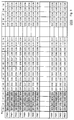
- Fig. 3 shows a multiframe structure similar to the one of Fig. 2 but adapted to carry common channel signaling CCS protocols.
- the user data carried by the 30 time slots or traffic channels as well as the data carried by the single signalling channel all have a sampling rate of 64 kbit/second. Since the signalling data is transmitted independently of the user data, an implementation has been designed to allow the transmission of up to 36 POTS communications or 32 ISDN channels.
- the first four time slots TS00 to TS03 of each frame are used to carry control bursts of cable link operating signalling and the following 36 time slots TS04 to TS39 carry traffic bursts C01 to C36 of telephony user data.
- each TDMA multiframe structure includes four frames FN00 to FN03, as for the CAS scheme.
- the time slots TS00 to TS03 carry signalling bursts, S01 to S04 respectively, including cable link operating signalling that is merged with other frame signalling and synchronization information of the CCS protocols.
- These four consecutive signalling bursts form a group which can be seen as one large burst including the signalling messages from S01 to S04.
- a wideband common control channel TS00 to TS03 is so obtained.
- the multiframes are also arranged in a super-multiframe structure including 64 frames FN00 to FN63.
- the addresses of the coaxial network terminations CNT are embedded in the common control channel TS00 to TS03 of all the frames FN00 to FN63.
Landscapes
- Engineering & Computer Science (AREA)
- Signal Processing (AREA)
- Computer Networks & Wireless Communication (AREA)
- Multimedia (AREA)
- Time-Division Multiplex Systems (AREA)
Priority Applications (4)
| Application Number | Priority Date | Filing Date | Title |
|---|---|---|---|
| EP95202332A EP0760563A1 (fr) | 1995-08-29 | 1995-08-29 | Structure multitrame et protocole de communication pour un réseau de transmission |
| AU62177/96A AU703777B2 (en) | 1995-08-29 | 1996-08-20 | Multiframe structure for telecommunications network |
| CA002184401A CA2184401A1 (fr) | 1995-08-29 | 1996-08-28 | Structure multitrame et protocole de prise en charge pour reseau de telecommunication |
| US08/697,737 US5848070A (en) | 1995-08-29 | 1996-08-29 | Multiframe structure and handling protocol for a telecommunication network |
Applications Claiming Priority (1)
| Application Number | Priority Date | Filing Date | Title |
|---|---|---|---|
| EP95202332A EP0760563A1 (fr) | 1995-08-29 | 1995-08-29 | Structure multitrame et protocole de communication pour un réseau de transmission |
Publications (1)
| Publication Number | Publication Date |
|---|---|
| EP0760563A1 true EP0760563A1 (fr) | 1997-03-05 |
Family
ID=8220592
Family Applications (1)
| Application Number | Title | Priority Date | Filing Date |
|---|---|---|---|
| EP95202332A Withdrawn EP0760563A1 (fr) | 1995-08-29 | 1995-08-29 | Structure multitrame et protocole de communication pour un réseau de transmission |
Country Status (4)
| Country | Link |
|---|---|
| US (1) | US5848070A (fr) |
| EP (1) | EP0760563A1 (fr) |
| AU (1) | AU703777B2 (fr) |
| CA (1) | CA2184401A1 (fr) |
Cited By (6)
| Publication number | Priority date | Publication date | Assignee | Title |
|---|---|---|---|---|
| FR2769393A1 (fr) * | 1997-10-02 | 1999-04-09 | Matra Communication | Procede de multiplexage de signaux numeriques |
| EP0975115A1 (fr) * | 1998-07-21 | 2000-01-26 | Lucent Technologies Inc. | Procédé et système de signalisation |
| EP0821499A3 (fr) * | 1996-07-25 | 2001-08-29 | Lucent Technologies Inc. | Transmission des canaux D dans des systèmes de télécommunication |
| WO2008070107A1 (fr) * | 2006-12-04 | 2008-06-12 | Adc Dsl Systems, Inc. | Communications de données de point à multipoint, avec signalisation de canal associée (cas) |
| US7856036B2 (en) | 2007-02-28 | 2010-12-21 | Adc Dsl Systems, Inc. | Point to multipoint crosslink |
| US8340118B2 (en) | 2008-05-22 | 2012-12-25 | Adc Dsl Systems, Inc. | System and method for multiplexing fractional TDM frames |
Families Citing this family (26)
| Publication number | Priority date | Publication date | Assignee | Title |
|---|---|---|---|---|
| FI103371B (fi) | 1996-06-13 | 1999-06-15 | Nokia Telecommunications Oy | Menetelmä ja järjestelmä hätäliikenteen varmistamiseksi |
| FI103372B1 (fi) * | 1996-06-20 | 1999-06-15 | Nokia Telecommunications Oy | Menetelmä ja järjestelmä hätäliikenteen varmistamiseksi |
| US6167120A (en) * | 1996-11-06 | 2000-12-26 | Lextron Systems, Inc. | Apparatus and methods for home networking |
| US6160817A (en) * | 1997-04-30 | 2000-12-12 | Siemens Aktiengesellschaft | Method for using narrowband performance features provided in broadband communications terminals, in broadband networks |
| US6151390A (en) * | 1997-07-31 | 2000-11-21 | Cisco Technology, Inc. | Protocol conversion using channel associated signaling |
| US6650632B1 (en) | 1998-06-30 | 2003-11-18 | Cisco Technology, Inc. | Feature transparency in a telecommunications network |
| GB9817411D0 (en) * | 1998-08-10 | 1998-10-07 | Northern Telecom Ltd | Telecommunications system |
| US7212522B1 (en) | 1998-09-30 | 2007-05-01 | Cisco Technology, Inc. | Communicating voice over a packet-switching network |
| US6658022B1 (en) | 1998-09-30 | 2003-12-02 | Cisco Technology, Inc. | Signaling protocol for controlling voice calls in a packet switching network |
| US6570869B1 (en) | 1998-09-30 | 2003-05-27 | Cisco Technology, Inc. | Communicating voice over a packet-switching network |
| US6460182B1 (en) * | 1999-05-11 | 2002-10-01 | Marconi Communications, Inc. | Optical communication system for transmitting RF signals downstream and bidirectional telephony signals which also include RF control signals upstream |
| US6680952B1 (en) | 1999-06-01 | 2004-01-20 | Cisco Technology, Inc. | Method and apparatus for backhaul of telecommunications signaling protocols over packet-switching networks |
| US6498667B1 (en) | 1999-09-10 | 2002-12-24 | Quantum Bridge Communications, Inc. | Method and system for packet transmission over passive optical network |
| US6122335A (en) | 1999-10-01 | 2000-09-19 | Quantum Bridge Communications, Inc. | Method and apparatus for fast burst mode data recovery |
| US6592272B1 (en) | 1999-10-22 | 2003-07-15 | Quantum Bridge Communications, Inc. | Burst mode transmission over multiple optical wavelengths |
| US6990123B1 (en) | 2000-01-24 | 2006-01-24 | Quantum Bridge Communications Inc. | Method and apparatus for redundant transmission over TDMA optical networks |
| DE10043477B4 (de) * | 2000-09-04 | 2004-10-07 | Siemens Ag | Verfahren zur Verteilung von Signalisierungsdaten auf Übertragungskanälen in einem Mobilfunksystem |
| EP1356680B1 (fr) | 2001-02-02 | 2013-05-22 | Opentv, Inc. | Procede et systeme de reformatage d'un contenu destine a etre affiche sur une television interactive |
| US7017175B2 (en) * | 2001-02-02 | 2006-03-21 | Opentv, Inc. | Digital television application protocol for interactive television |
| US7305697B2 (en) | 2001-02-02 | 2007-12-04 | Opentv, Inc. | Service gateway for interactive television |
| US7233587B2 (en) * | 2002-02-01 | 2007-06-19 | Harris Corporation | Method and system for encapsulating time division multiplex data into individual packets of a packet based network |
| US20040243910A1 (en) * | 2003-05-29 | 2004-12-02 | Mcleod Gordon R. | Packet data recovery system |
| US8713300B2 (en) | 2011-01-21 | 2014-04-29 | Symantec Corporation | System and method for netbackup data decryption in a high latency low bandwidth environment |
| US8495178B1 (en) | 2011-04-01 | 2013-07-23 | Symantec Corporation | Dynamic bandwidth discovery and allocation to improve performance for backing up data |
| US10044835B1 (en) | 2013-12-11 | 2018-08-07 | Symantec Corporation | Reducing redundant transmissions by polling clients |
| US9992118B2 (en) | 2014-10-27 | 2018-06-05 | Veritas Technologies Llc | System and method for optimizing transportation over networks |
Citations (5)
| Publication number | Priority date | Publication date | Assignee | Title |
|---|---|---|---|---|
| EP0440059A1 (fr) * | 1990-01-22 | 1991-08-07 | Alcatel Business Systems | Procédé de transmission d'octets mettant en oeuvre une trame synchrone associant des cellules asynchrones à des canaux isochrones |
| EP0462650A2 (fr) * | 1990-06-18 | 1991-12-27 | Philips Patentverwaltung GmbH | Système de transmission à multiplexage temporel |
| US5189673A (en) * | 1991-07-30 | 1993-02-23 | Alcatel Network Systems, Inc. | Method and apparatus for controlling switched video in an optical fiber telecommunications system |
| EP0547527A1 (fr) * | 1991-12-16 | 1993-06-23 | Mitsubishi Denki Kabushiki Kaisha | Dispositif pour la transmission d'information de commande pour un système de communication multiplex par répartition dans le temps |
| WO1995008228A1 (fr) * | 1993-09-17 | 1995-03-23 | Scientific-Atlanta, Inc. | Systeme de communication a large bande |
Family Cites Families (3)
| Publication number | Priority date | Publication date | Assignee | Title |
|---|---|---|---|---|
| JPH0654973B2 (ja) * | 1983-11-09 | 1994-07-20 | ソニー株式会社 | Catvラインを使用したデジタル信号の伝送装置 |
| US5247347A (en) * | 1991-09-27 | 1993-09-21 | Bell Atlantic Network Services, Inc. | Pstn architecture for video-on-demand services |
| US5594726A (en) * | 1993-09-17 | 1997-01-14 | Scientific-Atlanta, Inc. | Frequency agile broadband communications system |
-
1995
- 1995-08-29 EP EP95202332A patent/EP0760563A1/fr not_active Withdrawn
-
1996
- 1996-08-20 AU AU62177/96A patent/AU703777B2/en not_active Ceased
- 1996-08-28 CA CA002184401A patent/CA2184401A1/fr not_active Abandoned
- 1996-08-29 US US08/697,737 patent/US5848070A/en not_active Expired - Fee Related
Patent Citations (5)
| Publication number | Priority date | Publication date | Assignee | Title |
|---|---|---|---|---|
| EP0440059A1 (fr) * | 1990-01-22 | 1991-08-07 | Alcatel Business Systems | Procédé de transmission d'octets mettant en oeuvre une trame synchrone associant des cellules asynchrones à des canaux isochrones |
| EP0462650A2 (fr) * | 1990-06-18 | 1991-12-27 | Philips Patentverwaltung GmbH | Système de transmission à multiplexage temporel |
| US5189673A (en) * | 1991-07-30 | 1993-02-23 | Alcatel Network Systems, Inc. | Method and apparatus for controlling switched video in an optical fiber telecommunications system |
| EP0547527A1 (fr) * | 1991-12-16 | 1993-06-23 | Mitsubishi Denki Kabushiki Kaisha | Dispositif pour la transmission d'information de commande pour un système de communication multiplex par répartition dans le temps |
| WO1995008228A1 (fr) * | 1993-09-17 | 1995-03-23 | Scientific-Atlanta, Inc. | Systeme de communication a large bande |
Non-Patent Citations (1)
| Title |
|---|
| MITROU N M ET AL: "VOICE AND DATA INTEGRATION IN THE AIR-INTERFACE OF A MICROCELLULAR MOBILE COMMUNICATION SYSTEM", IEEE TRANSACTIONS ON VEHICULAR TECHNOLOGY, vol. 42, no. 1, 1 February 1993 (1993-02-01), pages 1 - 13, XP000363394 * |
Cited By (11)
| Publication number | Priority date | Publication date | Assignee | Title |
|---|---|---|---|---|
| EP0821499A3 (fr) * | 1996-07-25 | 2001-08-29 | Lucent Technologies Inc. | Transmission des canaux D dans des systèmes de télécommunication |
| FR2769393A1 (fr) * | 1997-10-02 | 1999-04-09 | Matra Communication | Procede de multiplexage de signaux numeriques |
| EP0975115A1 (fr) * | 1998-07-21 | 2000-01-26 | Lucent Technologies Inc. | Procédé et système de signalisation |
| US7516473B1 (en) | 1998-07-21 | 2009-04-07 | Agere Systems Inc. | Method and system for signaling |
| WO2008070107A1 (fr) * | 2006-12-04 | 2008-06-12 | Adc Dsl Systems, Inc. | Communications de données de point à multipoint, avec signalisation de canal associée (cas) |
| US8208496B2 (en) | 2006-12-04 | 2012-06-26 | Adc Dsl Systems, Inc. | Point-to-multipoint data communication with channel associated signaling |
| US8396084B2 (en) | 2006-12-04 | 2013-03-12 | Adc Dsl Systems, Inc. | Point-to-multipoint data communications with channel associated signaling |
| US7856036B2 (en) | 2007-02-28 | 2010-12-21 | Adc Dsl Systems, Inc. | Point to multipoint crosslink |
| US8547994B2 (en) | 2007-02-28 | 2013-10-01 | Adc Dsl Systems, Inc. | Point to multipoint crosslink |
| US8340118B2 (en) | 2008-05-22 | 2012-12-25 | Adc Dsl Systems, Inc. | System and method for multiplexing fractional TDM frames |
| US8982913B2 (en) | 2008-05-22 | 2015-03-17 | Adc Telecommunications, Inc. | Multiple E-carrier transport over DSL |
Also Published As
| Publication number | Publication date |
|---|---|
| CA2184401A1 (fr) | 1997-03-01 |
| US5848070A (en) | 1998-12-08 |
| AU6217796A (en) | 1997-03-06 |
| AU703777B2 (en) | 1999-04-01 |
Similar Documents
| Publication | Publication Date | Title |
|---|---|---|
| AU703777B2 (en) | Multiframe structure for telecommunications network | |
| US5642351A (en) | Wide area fiber and TV cable fast packet cell network | |
| US5457560A (en) | Fiber optic telecommunication system employing continuous downlink, burst uplink transmission format with preset uplink guard band | |
| US5499241A (en) | Broadband communications system | |
| AU686368B2 (en) | Frequency agile broadband communications system | |
| US5543951A (en) | Method for receive-side clock supply for video signals digitally transmitted with ATM in fiber/coaxial subscriber line networks | |
| US5756280A (en) | Multimedia distribution network including video switch | |
| US5719872A (en) | Reverse path allocation and contention resolution scheme for a broadband communications system | |
| US5642155A (en) | Method and apparatus for supporting two-way telecommunications on CATV networks | |
| US3980831A (en) | Data switching system | |
| KR19990028524A (ko) | 광대역 통신 시스템용의 변조기 | |
| US7086082B1 (en) | Implementation of delay-critical services in a cable television system | |
| CA2237644A1 (fr) | Systeme et procede pour une ligne d'abonne multihote | |
| EP0257901B1 (fr) | Techniques de commutation pour systèmes de communication multiplex à division de fréquence | |
| EP0125744A2 (fr) | Système de télécommunication à boucle fermée | |
| CA1190675A (fr) | Systeme de communication a large bande | |
| JPH0728441B2 (ja) | 移動通信交換システム | |
| US6320856B1 (en) | System and method for a multi-host subscriber loop | |
| KR0140174B1 (ko) | 프레임 맵핑/디팹핑 장치 | |
| AU702701B2 (en) | Apparatus and method for supporting two-way communications on CATV networks | |
| JPS63237698A (ja) | 情報通信ネツトワ−ク | |
| EP0821499A2 (fr) | Transmission des canaux D dans des systèmes de télécommunication | |
| Yamagata et al. | Studies on realization of information retrieval service function by fiber optic broadband distribution system |
Legal Events
| Date | Code | Title | Description |
|---|---|---|---|
| PUAI | Public reference made under article 153(3) epc to a published international application that has entered the european phase |
Free format text: ORIGINAL CODE: 0009012 |
|
| AK | Designated contracting states |
Kind code of ref document: A1 Designated state(s): BE CH DE ES FR GB IT LI NL SE |
|
| 17P | Request for examination filed |
Effective date: 19970905 |
|
| 17Q | First examination report despatched |
Effective date: 20000307 |
|
| GRAG | Despatch of communication of intention to grant |
Free format text: ORIGINAL CODE: EPIDOS AGRA |
|
| GRAG | Despatch of communication of intention to grant |
Free format text: ORIGINAL CODE: EPIDOS AGRA |
|
| GRAH | Despatch of communication of intention to grant a patent |
Free format text: ORIGINAL CODE: EPIDOS IGRA |
|
| GRAH | Despatch of communication of intention to grant a patent |
Free format text: ORIGINAL CODE: EPIDOS IGRA |
|
| RAP1 | Party data changed (applicant data changed or rights of an application transferred) |
Owner name: ALCATEL |
|
| STAA | Information on the status of an ep patent application or granted ep patent |
Free format text: STATUS: THE APPLICATION HAS BEEN WITHDRAWN |
|
| 18W | Application withdrawn |
Withdrawal date: 20020402 |