EP0760591A2 - Verfahren und Gerät zur Schnittstellenbilding zwischen Zugriffsverbindungen niedriger Geschwindigkeit und einem Hochgeschwindigkeitsvermittlungsschalter mit Zeitmultiplexbetrieb - Google Patents
Verfahren und Gerät zur Schnittstellenbilding zwischen Zugriffsverbindungen niedriger Geschwindigkeit und einem Hochgeschwindigkeitsvermittlungsschalter mit Zeitmultiplexbetrieb Download PDFInfo
- Publication number
- EP0760591A2 EP0760591A2 EP96306104A EP96306104A EP0760591A2 EP 0760591 A2 EP0760591 A2 EP 0760591A2 EP 96306104 A EP96306104 A EP 96306104A EP 96306104 A EP96306104 A EP 96306104A EP 0760591 A2 EP0760591 A2 EP 0760591A2
- Authority
- EP
- European Patent Office
- Prior art keywords
- high speed
- links
- access links
- switch fabric
- content
- Prior art date
- Legal status (The legal status is an assumption and is not a legal conclusion. Google has not performed a legal analysis and makes no representation as to the accuracy of the status listed.)
- Withdrawn
Links
- 239000004744 fabric Substances 0.000 title claims abstract description 154
- 238000000034 method Methods 0.000 title claims description 7
- 230000000903 blocking effect Effects 0.000 claims abstract description 11
- 230000015654 memory Effects 0.000 claims description 23
- 238000012546 transfer Methods 0.000 claims description 7
- 230000004044 response Effects 0.000 claims description 5
- 238000004891 communication Methods 0.000 description 11
- 230000001360 synchronised effect Effects 0.000 description 7
- 238000010586 diagram Methods 0.000 description 4
- 230000003287 optical effect Effects 0.000 description 3
- 230000011664 signaling Effects 0.000 description 3
- 230000009977 dual effect Effects 0.000 description 2
- 230000006870 function Effects 0.000 description 2
- 101710179738 6,7-dimethyl-8-ribityllumazine synthase 1 Proteins 0.000 description 1
- 101710186608 Lipoyl synthase 1 Proteins 0.000 description 1
- 101710137584 Lipoyl synthase 1, chloroplastic Proteins 0.000 description 1
- 101710090391 Lipoyl synthase 1, mitochondrial Proteins 0.000 description 1
- 230000005540 biological transmission Effects 0.000 description 1
- 229920006235 chlorinated polyethylene elastomer Polymers 0.000 description 1
- 238000000136 cloud-point extraction Methods 0.000 description 1
- 230000001934 delay Effects 0.000 description 1
- 238000012423 maintenance Methods 0.000 description 1
- 230000002093 peripheral effect Effects 0.000 description 1
- 238000012545 processing Methods 0.000 description 1
Images




Classifications
-
- H—ELECTRICITY
- H04—ELECTRIC COMMUNICATION TECHNIQUE
- H04Q—SELECTING
- H04Q11/00—Selecting arrangements for multiplex systems
- H04Q11/04—Selecting arrangements for multiplex systems for time-division multiplexing
-
- H—ELECTRICITY
- H04—ELECTRIC COMMUNICATION TECHNIQUE
- H04Q—SELECTING
- H04Q11/00—Selecting arrangements for multiplex systems
- H04Q11/04—Selecting arrangements for multiplex systems for time-division multiplexing
- H04Q11/06—Time-space-time switching
Definitions
- the invention relates, generally, to a method and apparatus for interfacing low speed access links to a high speed time multiplexed switch fabric and, more particularly, to the implementation of a high speed switch fabric in existing telecommunications networks switching systems having low speed access links through the use of the method and apparatus of the invention.
- a typical telecommunications network include a plurality of switching systems connected to one another over trunks and connected to customer premise equipment (CPE), such as station sets, multimedia equipment or the like, over voice and data lines.
- CPE customer premise equipment
- the switching systems route calls through the network to provide connectivity between CPEs as will be understood.
- a call control signaling network such as an SS7 network, overlays the voice and data network and provides signaling for controlling the routing of the voice and data signals.
- the call control signals are also routed through the switching systems.
- the switching systems must be capable of handling a large volume of signal traffic with minimum delays, errors or blocked calls.
- Switched switch fabric for internally routing the signals through the switch. It is to be understood that the switch fabric is that portion of the switching system where connections are selectively made between an input and an output to create a path for routing a call.
- the switch fabric has a switch fabric with a reconfiguration rate of 256 times per 125 microseconds where the reconfiguration rate is the number of separate connections the switch fabric can make per unit time per physical link pair. Signals are delivered to and received from the fabric via time multiplexed access links where each link carries 256 time slots per 125 microseconds. The speed of the access links is the same as the reconfiguration rate of the switch fabric such that the switch fabric can process the incoming signals at the rate the signals are received from the access links.
- switch fabric In order to accommodate the current volume of traffic in the switching system and achieve satisfactory blocking performance a relatively large (i.e. 192 x 192) switch fabric is used. While such switch fabrics are adequate for routing existing telephone service, they are relatively slow when compared to the latest high speed switch fabrics.
- the newest switch fabrics offer a much higher reconfiguration rate.
- existing high speed switch fabrics such as SpectraNet, developed by AT&T and described in "SpectraNet, A High Speed, Synchronous Switch For Broadband STM Communication", XIV International Switching Symposium, Yokohama, Japan, Oct. 1992, sponsored by the Institute of Electronics, Information and Communication Engineers, have reconfiguration rates on the order of 30 to 40 times faster than the switch fabrics currently being used by existing switching systems. Because of the extremely fast reconfiguration rates of these fabrics, much smaller high speed TMS fabrics can be used in place of the switch fabrics currently being used to achieve the same non-blocking performance. It will be appreciated that the use of smaller, faster switch fabrics would be more efficient and less expensive than the fabrics currently being used in the switching systems.
- existing telecommunications networks typically include low speed access links for delivering signals to the relatively slow speed switch fabric where the speed of the access links equals the reconfiguration rate of the slow speed switch fabrics as previously described. Because the high speed switch fabrics have a much higher reconfiguration rate, it is not technically possible to simply replace the low speed switch fabrics with the high speed switch fabrics and deliver signals to the high speed switch fabric over the existing low speed access links. It will be understood that it is also not economically or commercially feasible to replace all existing low speed access links with high speed links where the speed of the links is the same as the reconfiguration rate of the high speed switching fabric.
- the connectivity through the fabric must be at least as good as the existing connectivity achieved where the low speed access links are connected directly to low speed switching fabrics.
- the method and apparatus of the invention solves the above-noted problem by providing a high speed time multiplexed switch (TMS) fabric unit for use in a telecommunications system having relatively low speed TMS access links.
- TMS time multiplexed switch
- the TMS fabric unit of the invention consists of a plurality of programmable multiplexers where each programmable multiplexer is connected to a predetermined number, J, of the access links.
- Each access link carries M time slots where M is a relatively large number, e.g. 100.
- the programmable multiplexers put the content of the access links onto two high speed links.
- the speed of the high speed links is at least J times the speed of the access links such that for each time slot on the access links there is a fixed group of at least J time slots on each high speed link.
- the two high speed links deliver the signals to at least one high speed TMS fabric where the speed of the high speed links is matched to the reconfiguration rate of the high speed TMS fabric.
- the above-described arrangement is used in reverse.
- Two high speed links connect the high speed TMS fabric to programmable demultiplexers and the programmable demultiplexers deliver the content of the fixed group of J time slots on the high speed links to J access links.
- the TMS fabric is a non-blocking space division switch between the high speed links connecting the programmable multiplexers and the programmable demultiplexers, and the programmable multiplexers and demultiplexers provide the interface between the high speed links and the existing low speed access links.
- Such a switching system can consist of one of the 5ESS® family of switches, described in AT&T Technical Journal , Vol. 64, No. 6, part 2, pp. 1305-1564, July/August 1985, and manufactured by AT&T.
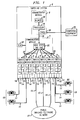
- the architecture of such a switching system includes a communications module 4 forming a hub and having a plurality of switch modules 6, and an administrative module 8 emanating therefrom.
- Each switch module 6 is controlled by processor 7 and a local data base 9; each switch module 6 provides call processing, time division switching and signaling for the lines and trunks to which it is connected.
- Line units 10 provide interface to customer lines 11 that connect to customer premise equipment 13, and trunk units 12 provide interface to trunks 15 that connect to other elements of the network 17 such as switches.
- Circuit units 14 provide tones, announcements, recorded messages, tone decoding and the like.
- the administrative module 8 provides functions that can be centralized such as maintenance control, craft interface, text and data base management, call routing and time slot allocation.
- the administrative module 8 consists of a control unit such as the AT&T 3B21D duplex processor 16 and main memory store 18. In some systems the administrative module is assisted by a separate processor (not shown) that performs some of the administrative functions.
- the administrative module 8 also can include an input/output processor 20 providing communication between switching system 2 and peripheral devices 22 such as terminals, printers or the like.
- Communications module 4 is the hub of the switching system and communicates with the administrative module 8 over data link 19 and the switch modules 6 over low speed access links 32.
- Communications module 4 consists of a message switch that provides the administrative module-to-switch module and switch module-to-switch module message communications and a time multiplexed switch providing the switch module-to-switch module and switch module-to-administrative module time slot connection for voice and data communication and the clock distribution.
- the message switch of communications module 4 includes the high speed TMS fabric unit 25 of the invention. It will be appreciated that while the previously described switch architecture relates specifically to the AT&T 5ESS® switch, the switch fabric unit of the invention can be used in any switch and the specific switch architecture may vary.
- the TMS fabric unit 25 of the invention includes a high speed switch fabric 24 that is a non-blocking space division switch that configures its cross-connects for each high speed link time slot period based on the content of control memory 27 as will hereinafter be described.
- the high speed switch fabric 24 can consist of the SpectraNet fabric, discussed above, or any similar high speed fabric. It will be appreciated that the TMS fabric unit 25 of the invention is intended to operate in any system where a high speed switch fabric is used with relatively low speed access links.
- the switch fabric 24 includes a control unit consisting of a dual port memory 27 and a processor 29.
- the dual port memory 27 receives input from TMS fabric unit processor 37 dictating configuration of the switch fabric.
- the input received by memory 27 is used by processor 29 to control the configuration of switch fabric 24.
- the operation of the processor 29 and memory 27 for controlling the switch fabric configuration is described in detail in U.S. Patent No. 5,329,524 issued to Paker on July 12, 1994.
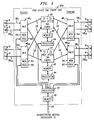
- the receive side of TMS fabric unit 25 includes a plurality of programmable multiplexers 26 1 , through 26 N , each communicating with TMS fabric 24 over high speed links 28a and 28b.
- the transmit side of communications module 4 includes a plurality of programmable demultiplexers 301 through 30 N , each also communicating with TMS fabric 24 over high speed links 35a and 35b.
- the speed of links 28a, 28b and 35a, 35b is matched to the reconfiguration rate of switch fabric 24.
- Each of the multiplexers 26 1 through 26 N and demultiplexers 30 1 through 30 N receive signals over a plurality of relatively low speed access links 32 1 through 32 J .
- Access links 32 1 through 32 J connect TMS fabric unit 25 to switch modules 6 for receiving and transmitting intraswitch signals between the switch modules as described with reference to FIG. 1. It will be appreciated that while the flow of signals is unidirectional, each switch module receives as well as transmits signals such that the illustrated configuration is duplicated for each switch module such that signals can be received from and transmitted to every switch module.
- the programmable multiplexers and demultiplexers each include a control unit consisting of a memory 31 and a processor 33 for controlling the configuration of the devices such that the connections through the multiplexer and demultiplexer can be made in any desired sequence to connect time slots on access links 32 1 through 32 J to time slots on high speed links 28a, 28b and 35a, 35b as desired.
- each multiplexer and demultiplexer is provided with its own memory and processor, a single processor and memory could be shared by multiple multiplexers and demultiplexers.
- each of the multiplexers 261 through 26 N and demultiplexers 30 1 through 30 N could be replaced by a combined multiplexer/demultiplexer to allow some connections to be made through the multiplexer/demultiplexer without transmitting the signals through the switch fabric, if desired.
- Each access link 32 1 through 32 J carries M time slots where M is a relatively large number, for example, 100.
- the speed (bit rate) of each high speed link 28a, 28b and 35a, 35b is at least J times the speed (bit rate) of each access link 32 1 through 32 J where J is the number of access links on each of the multiplexers 26 1 through 26 N and demultiplexers 30 1 through 30 N .
- J is the number of access links on each of the multiplexers 26 1 through 26 N and demultiplexers 30 1 through 30 N .
- time slots HS 1 through HS J on each high speed link are a fixed group corresponding to time slot LS 1 on the access links
- time slots HS J+1 through HS 2J are the fixed group on the high speed links corresponding to time slot LS 2 on the access links and so on.
- Each high speed link 28a, 28b and 35a, 35b carries M fixed groups of time slots, where M is the number of access link time slots as previously defined.
- the programmable multiplexer hosting that access link fills the corresponding fixed group on each high speed link connected to the multiplexer. For example, during time slot period LS 1 of the access links hosted by multiplexer 26 1 , the multiplexer 26 1 places the content from the LS 1 time period for each of access links 32 1 through 32 J on the corresponding high speed time slots HS 1 through HS J of the high speed links 28a and 28b connected to multiplexer 26 1 . For each fixed group time slot on each of the high speed links, the programmed multiplexer either takes the content of the corresponding time slot from one of the access links or uses a default pattern if the time slot is idle.
- the programmed demultiplexers 30 1 through 30 N have available one fixed group of time slots from the two high speed links 35a and 35b at any one time. During one access link time slot period, the programmed demultiplexer 30 either takes the content of a fixed group time slot from one of the high speed links 35a or 35b or it uses a default pattern for an idle time slot.
- the content of one time slot for all of the access links 32 1 through 32 J must be available at the programmed multiplexers 261 though 26 N before the transfer of the contents of the access links to the fixed group of time slots on the high speed links begins.
- the programmed demultiplexers 30 1 through 30 N all of the contents for a fixed group of time slots of the high speed links must be available before the contents are transferred to the corresponding time slots on access links 32 1 through 32 J .
- both the programmed multiplexers and demultiplexers have memory to hold the time slot content for one access link time slot period. Because the number, M, of access link time slots is large, the delay of one time slot period is a small fraction of the frame period and is, therefore, insignificant.
- the multiplexer connected to access link 32 1 and the multiplexer connected to access link 32 2 can each have at most J-1 high speed link fixed group time slots in use for time slot LS 3 such that together at most 2(J-1) time slots are used. Therefore, there at least two time slots in the fixed group of time slots on the high speed links that are idle for time slot LS 3 for both access links. For each of the two access links, the same fixed group time slot and the same high speed link are used at both the demultiplexer and multiplexer for the connection.
- the switch fabric unit 25 includes a processor 37 and a memory 39 in communication with the control units of each of the multiplexers 26 1 through 26 N , demultiplexers 30 1 through 30 N and switch fabric 24.
- the processor 37 upon receipt of a path hunt request from administrative module processor 16, performs a path hunt for determining a path through the TMS fabric unit 25 for connecting a calling CPE to a called CPE. Specifically, a path is determined for connecting an inlet time slot on the access link connected to the switch module hosting a calling CPE and an outlet time slot on the access link connected to the switch module hosting the called CPE.
- the inlet time slot and outlet are identified to the TMS fabric unit processor 37 by administrative module processor 16 after administrative module processor 16 performs a path hunt on the access links connecting the calling CPE to the called CPE as is generally known.
- processor 37 determines a path (i.e., identifies idle time slots on the high speed links that are able to connect the idle inlet and outlet time slots on the access links previously identified by processor 16)
- the time slots identified by processor 37 are sent to the memories 31 of the multiplexer and demultiplexer that serves the identified time slots and to the memory 27 of the switch fabric 24.
- the processors 33 and 29 configure the multiplexer, demultiplexer and switch fabric in response to the time slots sent by processor 37 to connect the appropriate switch modules and complete the call.
- TMS switch fabric unit 25a is configured as illustrated in FIG. 4 and consists of a pair of high speed 32 x 32 TMS fabrics 40 and 41 such as the SpectraNet fabric developed by AT&T.
- This TMS fabric has a maximum reconfiguration rate of 9,720 times per 125 microseconds and is a non-blocking space division switch that configures its cross-connects for each high speed link time slot period based on the content of control memory 42. While a specific high speed TMS fabric is described, it will be appreciated that the system of the invention is intended to operate with any high speed switch fabric used in conjunction with relatively low speed access links.
- the TMS fabric unit 25a is described as being composed of two 32 x 32 TMS fabrics, it is to be understood that the size of the fabric is related to the speed of the high speed links and the desired signal capacity of the switching system.
- the two 32 x 32 TMS fabrics can be replaced by a single 64 x 64 TMS fabric although the use of the two smaller fabrics is more efficient.
- Each of the switch fabrics includes a control unit consisting of a memory 42 and a processor 44 for controlling the configuration of the switch fabric in response to path information provided by the TMS fabric unit processor 37.
- the receive side of TMS fabric unit 25a includes a plurality of programmable multiplexers 46 1 through 46 32 , each communicating with TMS fabric 40 over high speed links 50 and with TMS fabric 41 over high speed links 52.
- the transmit side of TMS fabric unit 25a includes a plurality of programmable demultiplexers 48 1 through 48 32 each communicating with TMS fabric 40 over high speed links 54 and with TMS fabric 41 over high speed links 56.
- the high speed links 50, 52, 54 and 56 consist of a SONET OC-12 optical carrier which carries twelve standard OC-1 interfaces, each standard OC-1 interface having 672 payload time slots and each time slot using 8 bits.
- the basic rate of the SONET OC-12 is 622.08 mb/s.
- the connections within multiplexers 46 1 through 46 32 are controlled by dedicated control units consisting of a processor 62 and memory 64 although, as previously described, a single control unit could be used to control multiple multiplexers and demultiplexers.
- Each of the programmed multiplexers 46 1 through 46 32 consists of twelve inputs connected one each to access links 58 1 through 58 12 .
- the outputs of multiplexers 46 1 through 46 32 are connected to high speed links 50 and 52.
- each of the programmed demultiplexers 48 1 through 48 32 consists of twelve outputs connected one each to access links 58 1 through 58 12 and two inputs connected to high speed links 54 and 56.
- the connection of the inputs to the outputs is controlled by processors 62 based on the input in memories 64.
- the access links 58 1 through 58 12 connect the programmed multiplexers and demultiplexers to switch modules 6.
- the access links are typically connected to the switch modules 6 by appropriate interface circuits as will be understood.
- Each of the access links preferably consists of a TMS link which carries 256 time slots that are 16 bits wide. For purposes of this invention, each TMS link can be treated as having 512 time slots that are 8 bits wide.
- the OC-12 high speed links must be divided into 512 fixed groups as previously described with reference to FIG. 3.
- each of the twelve OC-1s that comprises the OC-12 has one time slot designated for each fixed group where each OC-1 has 672 payload time slots. Because an OC-12 is more than 12 times faster than a TMS link, only 512 of 672 time slots in the OC-1 fixed group are actually used. Because the above-described embodiment does not use the entire OC-12 payload, more than 12 TMS links can be handled if more complex programmed multiplexers and demultiplexers are used.
- the TMS fabric unit 25b includes processor 37 and memory 39 for performing the path hunt through TMS fabric unit 25b in response to the path hunt request from administrative module processor 16 as previously described with reference to FIG. 2.
- Processor 37 communicates with each of memories 64 and 42 to identify the time slots identified from the path hunt such that the TMS fabrics 40 and 41, multiplexers 46 and demultiplexers 48 can be configured to connect the identified time slots.
- the programmed multiplexers 46 1 through 46 32 and demultiplexers 48 1 through 48 32 are connected to the switch modules 6 via low speed access links 58 1 through 58 12 and to the high speed TMS switch fabrics via high speed links 50 and 52 as described with reference to FIG. 4.
- the high speed switch fabrics 40 and 41 are also connected to time slot interchangers 70 over the high speed links 72 and 74, respectively.
- the time slot interchangers 70 are connected to SONET terminals 76 over high speed links 78 such as OC-12 links and the SONET terminals 76 are connected to ATM switch 80.
- the switch fabric unit operates as described above.
- the fabric unit operates as set forth in U.S. Patent No. 5,329,524 issued to Paker on July 12, 1994.
- the fabric unit illustrated in FIG. 5 allows a switching system to handle both broadband and narrow band services through a single switch fabric unit.
- SONET facilities can carry both synchronous transfer mode (STM) and asynchronous transfer mode (ATM) payloads.
- the switch fabric unit can be used to separate these payloads and deliver the ATM portion to an ATM switch 80 such as a Globeview-2000 manufactured and sold by AT&T.
- Operation begins when a request for a connection is made by a calling CPE (block 601) identifying a called party by the dialed directory number.
- a path hunt is performed by the switching system processor 16 located in administrative module 8 as is known in the art to identify an idle time slot on an access link for the inlet signals from the calling CPE and a corresponding idle time slot on an access link for the outlet signals to the called CPE (block 602).
- the switching system processor 16 transmits the identified inlet and outlet time slots to the TMS fabric unit processor 37 with a request that a path hunt be performed to identify a path through the TMS fabric unit connecting the inlet and outlet time slots (block 603).
- the TMS fabric unit processor 37 performs a path hunt and identifies idle time slots on the high speed links 28a, 28b and 35a, 35b connected to the programmed multiplexer and demultiplexer, respectively, that connect the access link time slots identified by the switching system microprocessor 16 (block 604). It is to be understood that for any time slot selected on an access link, the time slot selected on the high speed links will be one of the time slots in the fixed group of time slots associated with the selected access link time slot.
- the access link path hunt is performed external to the fabric unit 25 by processor 16 and the high speed link path hunt is performed internal of the TMS fabric unit by processor 37, it will be appreciated that a single processor could perform the entire path hunt through the entire switching system.
- the use of a single or separate processors will be dictated by the desired capacity of the switch and the capabilities of the processors as will be appreciated by one skilled in the art.
- the TMS fabric unit processor 37 then provides the determined path information (both the time slots on the access links originally identified by processor 16 and the time slots on the high speed links identified by processor 37) to the control units of the programmable multiplexer and the programmable demultiplexer serving the identified time slots (block 605).
- the programmable multiplexer and demultiplexer translate this information to specific memory addresses and data values (block 606) and the processors 33 configure the multiplexer and demultiplexer to create the path connecting the identified time slots (block 607).
- the path information is provided to the switch fabric control unit memory 27 (block 608).
- the switch fabric control unit translates this information to specific memory addresses and data values (block 609) and the switch fabric processor 29 configures the switch fabric based on these values to complete the path through the switch (block 610). This path is maintained until the call is terminated by one of the parties at which time, the time slots are designated idle.
Landscapes
- Engineering & Computer Science (AREA)
- Computer Networks & Wireless Communication (AREA)
- Time-Division Multiplex Systems (AREA)
- Data Exchanges In Wide-Area Networks (AREA)
- Use Of Switch Circuits For Exchanges And Methods Of Control Of Multiplex Exchanges (AREA)
Applications Claiming Priority (2)
| Application Number | Priority Date | Filing Date | Title |
|---|---|---|---|
| US08/522,216 US5696761A (en) | 1995-08-31 | 1995-08-31 | Method and apparatus for interfacing low speed access links to a high speed time multiplexed switch fabric |
| US522216 | 1995-08-31 |
Publications (2)
| Publication Number | Publication Date |
|---|---|
| EP0760591A2 true EP0760591A2 (de) | 1997-03-05 |
| EP0760591A3 EP0760591A3 (de) | 2000-05-17 |
Family
ID=24079956
Family Applications (1)
| Application Number | Title | Priority Date | Filing Date |
|---|---|---|---|
| EP96306104A Withdrawn EP0760591A3 (de) | 1995-08-31 | 1996-08-21 | Verfahren und Gerät zur Schnittstellenbilding zwischen Zugriffsverbindungen niedriger Geschwindigkeit und einem Hochgeschwindigkeitsvermittlungsschalter mit Zeitmultiplexbetrieb |
Country Status (5)
| Country | Link |
|---|---|
| US (1) | US5696761A (de) |
| EP (1) | EP0760591A3 (de) |
| JP (1) | JPH09139746A (de) |
| KR (1) | KR970014450A (de) |
| CA (1) | CA2175853C (de) |
Cited By (1)
| Publication number | Priority date | Publication date | Assignee | Title |
|---|---|---|---|---|
| EP0874487A3 (de) * | 1997-04-24 | 2002-10-23 | Nortel Networks Limited | Transparente Übertragung in einem Nachrichtenübertragungssystem |
Families Citing this family (18)
| Publication number | Priority date | Publication date | Assignee | Title |
|---|---|---|---|---|
| SE9603908L (sv) * | 1996-10-25 | 1998-04-26 | Ericsson Telefon Ab L M | Omkonfigurering av multiplexor |
| US6151315A (en) * | 1997-06-02 | 2000-11-21 | At&T Corp | Method and apparatus for achieving fabric independent routing technique |
| US6049542A (en) * | 1997-12-31 | 2000-04-11 | Samsung Electronics Co., Ltd. | Scalable multistage interconnection network architecture and method for performing in-service upgrade thereof |
| US6526021B1 (en) * | 1998-04-03 | 2003-02-25 | Alcatel Network Systems, Inc. | Clear channel 1:N SONET transport system and method |
| US6546022B1 (en) * | 1998-04-03 | 2003-04-08 | Sprint Communications Company, L.P. | Method, system and apparatus for processing information in a telecommunications system |
| JP3738378B2 (ja) * | 1998-05-08 | 2006-01-25 | 富士通株式会社 | システム構成設定方法及び伝送装置 |
| FR2782430B1 (fr) * | 1998-08-13 | 2004-05-28 | Bull Sa | Procede et interface d'interconnection mettant en oeuvre des liaisons serie haut-debit |
| AU5910399A (en) | 1998-09-11 | 2000-04-03 | Sharewave, Inc. | Method and apparatus for accessing a computer network communication channel |
| US6765919B1 (en) * | 1998-10-23 | 2004-07-20 | Brocade Communications Systems, Inc. | Method and system for creating and implementing zones within a fibre channel system |
| EP1032165A1 (de) * | 1999-02-26 | 2000-08-30 | International Business Machines Corporation | Verfahren zur Zusammenfügung zerteilter Rahmen von Daten, die über eine Fermebene übertragen werden |
| US6980544B2 (en) * | 1999-07-14 | 2005-12-27 | Telefonaktiebolaget Lm Ericsson (Publ) | Combining narrowband applications with broadband transport |
| US7082127B1 (en) * | 2000-07-28 | 2006-07-25 | Marconi Intellectual Property (Ringfence), Inc. | Synchronous dynamic register updating across a distributed system |
| US7327748B2 (en) * | 2002-01-28 | 2008-02-05 | Alcatel Lucent | Enterprise switching device and method |
| US20040105388A1 (en) * | 2002-12-02 | 2004-06-03 | David Wilkins | Router node with control fabric and resource isolation therein |
| JP3795508B2 (ja) * | 2003-04-17 | 2006-07-12 | 富士通株式会社 | 伝送ネットワークシステム |
| US7873056B2 (en) * | 2004-11-18 | 2011-01-18 | Nec Corporation | Switch device, switching method and switch control program |
| EP2437442B1 (de) * | 2010-09-30 | 2013-02-13 | Alcatel Lucent | Vorrichtung und Verfahren zum Umschalten von Datenverkehr in einem digitalen Übertragungsnetzwerk |
| DE102020212187A1 (de) * | 2020-09-28 | 2022-03-31 | Siemens Healthcare Gmbh | Medizinisches Datenverwaltungssystem |
Family Cites Families (8)
| Publication number | Priority date | Publication date | Assignee | Title |
|---|---|---|---|---|
| US4817083A (en) * | 1987-03-06 | 1989-03-28 | American Telephone And Telegraph Company At&T Bell Laboratories | Rearrangeable multiconnection switching networks employing both space division and time division switching |
| US4979164A (en) * | 1989-05-24 | 1990-12-18 | At&T Bell Laboratories | Switching system reliability |
| JP2675147B2 (ja) * | 1989-07-14 | 1997-11-12 | 株式会社日立製作所 | 通信方法 |
| US5005171A (en) * | 1990-01-09 | 1991-04-02 | At&T Bell Laboratories | Telecommunication transmission format suited for network-independent timing environments |
| US5329524A (en) * | 1992-10-20 | 1994-07-12 | At&T Bell Laboratories | TDM circuit-switching arrangement that handles frames of different sizes |
| US5351236A (en) * | 1992-10-20 | 1994-09-27 | At&T Bell Laboratories | Multirate, sonet-ready, switching arrangement |
| US5323390A (en) * | 1992-10-20 | 1994-06-21 | At&T Bell Laboratories | Multirate, sonet-ready, switching arrangement |
| JPH07123067A (ja) * | 1993-10-20 | 1995-05-12 | Hitachi Ltd | 多重化装置 |
-
1995
- 1995-08-31 US US08/522,216 patent/US5696761A/en not_active Expired - Fee Related
-
1996
- 1996-05-06 CA CA002175853A patent/CA2175853C/en not_active Expired - Fee Related
- 1996-08-21 EP EP96306104A patent/EP0760591A3/de not_active Withdrawn
- 1996-08-28 KR KR1019960035924A patent/KR970014450A/ko not_active Ceased
- 1996-08-29 JP JP22802496A patent/JPH09139746A/ja active Pending
Cited By (1)
| Publication number | Priority date | Publication date | Assignee | Title |
|---|---|---|---|---|
| EP0874487A3 (de) * | 1997-04-24 | 2002-10-23 | Nortel Networks Limited | Transparente Übertragung in einem Nachrichtenübertragungssystem |
Also Published As
| Publication number | Publication date |
|---|---|
| CA2175853C (en) | 1999-09-28 |
| EP0760591A3 (de) | 2000-05-17 |
| US5696761A (en) | 1997-12-09 |
| CA2175853A1 (en) | 1997-03-01 |
| KR970014450A (ko) | 1997-03-29 |
| JPH09139746A (ja) | 1997-05-27 |
Similar Documents
| Publication | Publication Date | Title |
|---|---|---|
| US5696761A (en) | Method and apparatus for interfacing low speed access links to a high speed time multiplexed switch fabric | |
| AU661102B2 (en) | Synchronous optical network overhead server | |
| US4970721A (en) | Resource-decoupled architecture for a telecommunications switching system | |
| CA2195490C (en) | Merging the functions of switching and cross connect in telecommunications networks | |
| US4797589A (en) | Dynamically reconfigurable time-space-time digital switch and network | |
| EP0425146B1 (de) | Anordnung für die Steuerung eines digitalen Verzweigerschalters von einem Vermittlungssystem aus | |
| US5115425A (en) | Switching system reliability | |
| US5119366A (en) | Call processing method for distributed switching | |
| EP0451400A2 (de) | Verfahren und Vorrichtung zur Rekonfiguration von Verbindungen zwischen Funktionseinheiten eines Vermittlungssystems | |
| US6151325A (en) | Method and apparatus for high-capacity circuit switching with an ATM second stage switch | |
| WO1998028901A2 (en) | Distributed voice processing system | |
| US6128301A (en) | Architecture for distribution of voice over ATM networks | |
| US6389014B1 (en) | ATM switching device and method capable of providing voice call service | |
| US6289018B1 (en) | ATM switching system supporting N-ISDN traffic and method for controlling the same | |
| US6804229B2 (en) | Multiple node network architecture | |
| GB2223378A (en) | Automatic telecommunications systems | |
| US6931022B1 (en) | Background test system for time division multiplexing switching systems | |
| US5590129A (en) | Single stage telecommunications switch with partitioned processors | |
| CA2290304C (en) | Direct end-office atm trunking | |
| US6778538B2 (en) | Virtual junctors | |
| JPH05316149A (ja) | ディジタル電子構内交換機 | |
| WO1987006784A1 (en) | Apparatus and method for tdm data switching | |
| US7366198B2 (en) | Method and system for packet and circuit telephony in a distributed telecommunications switching system | |
| Walters et al. | Evolution of fiber access systems to ATM broadband networking | |
| Boulter | Digital signalling in the access network |
Legal Events
| Date | Code | Title | Description |
|---|---|---|---|
| PUAI | Public reference made under article 153(3) epc to a published international application that has entered the european phase |
Free format text: ORIGINAL CODE: 0009012 |
|
| AK | Designated contracting states |
Kind code of ref document: A2 Designated state(s): DE ES FR GB IT |
|
| PUAL | Search report despatched |
Free format text: ORIGINAL CODE: 0009013 |
|
| AK | Designated contracting states |
Kind code of ref document: A3 Designated state(s): DE ES FR GB IT |
|
| RIC1 | Information provided on ipc code assigned before grant |
Free format text: 7H 04Q 11/06 A, 7H 04Q 11/04 B |
|
| 17P | Request for examination filed |
Effective date: 20001106 |
|
| 17Q | First examination report despatched |
Effective date: 20010521 |
|
| STAA | Information on the status of an ep patent application or granted ep patent |
Free format text: STATUS: THE APPLICATION IS DEEMED TO BE WITHDRAWN |
|
| 18D | Application deemed to be withdrawn |
Effective date: 20040730 |