EP0760719B1 - Procede et dispositif d'extinction d'incendies - Google Patents
Procede et dispositif d'extinction d'incendies Download PDFInfo
- Publication number
- EP0760719B1 EP0760719B1 EP95927731A EP95927731A EP0760719B1 EP 0760719 B1 EP0760719 B1 EP 0760719B1 EP 95927731 A EP95927731 A EP 95927731A EP 95927731 A EP95927731 A EP 95927731A EP 0760719 B1 EP0760719 B1 EP 0760719B1
- Authority
- EP
- European Patent Office
- Prior art keywords
- hose
- explosive
- extinguishing
- fire
- extinguishing agent
- Prior art date
- Legal status (The legal status is an assumption and is not a legal conclusion. Google has not performed a legal analysis and makes no representation as to the accuracy of the status listed.)
- Expired - Lifetime
Links
- 238000000034 method Methods 0.000 title claims abstract description 12
- 239000003795 chemical substances by application Substances 0.000 claims abstract description 56
- 239000002360 explosive Substances 0.000 claims abstract description 42
- 239000003595 mist Substances 0.000 claims abstract description 13
- 238000005422 blasting Methods 0.000 claims abstract description 7
- 238000005474 detonation Methods 0.000 claims abstract description 7
- 239000000428 dust Substances 0.000 claims abstract description 6
- 239000000463 material Substances 0.000 claims description 9
- XLYOFNOQVPJJNP-UHFFFAOYSA-N water Substances O XLYOFNOQVPJJNP-UHFFFAOYSA-N 0.000 claims description 7
- 238000009434 installation Methods 0.000 claims 1
- 239000011253 protective coating Substances 0.000 claims 1
- 230000000694 effects Effects 0.000 description 17
- 239000000446 fuel Substances 0.000 description 4
- 239000007884 disintegrant Substances 0.000 description 3
- 239000004033 plastic Substances 0.000 description 3
- 230000003449 preventive effect Effects 0.000 description 3
- 238000003860 storage Methods 0.000 description 3
- 238000000889 atomisation Methods 0.000 description 2
- 238000004880 explosion Methods 0.000 description 2
- 239000006260 foam Substances 0.000 description 2
- 238000005187 foaming Methods 0.000 description 2
- 238000004519 manufacturing process Methods 0.000 description 2
- 239000002245 particle Substances 0.000 description 2
- 238000004781 supercooling Methods 0.000 description 2
- 230000006978 adaptation Effects 0.000 description 1
- 239000000654 additive Substances 0.000 description 1
- 230000000996 additive effect Effects 0.000 description 1
- 238000004026 adhesive bonding Methods 0.000 description 1
- XAGFODPZIPBFFR-UHFFFAOYSA-N aluminium Chemical compound [Al] XAGFODPZIPBFFR-UHFFFAOYSA-N 0.000 description 1
- 229910052782 aluminium Inorganic materials 0.000 description 1
- 230000015572 biosynthetic process Effects 0.000 description 1
- 238000007664 blowing Methods 0.000 description 1
- 239000011248 coating agent Substances 0.000 description 1
- 238000000576 coating method Methods 0.000 description 1
- 238000011161 development Methods 0.000 description 1
- 230000018109 developmental process Effects 0.000 description 1
- 238000009826 distribution Methods 0.000 description 1
- 238000005553 drilling Methods 0.000 description 1
- 239000010419 fine particle Substances 0.000 description 1
- 239000011521 glass Substances 0.000 description 1
- 230000001771 impaired effect Effects 0.000 description 1
- 230000001788 irregular Effects 0.000 description 1
- 239000000843 powder Substances 0.000 description 1
- 230000001681 protective effect Effects 0.000 description 1
- 230000005855 radiation Effects 0.000 description 1
- 238000001228 spectrum Methods 0.000 description 1
- 239000000126 substance Substances 0.000 description 1
Images



Classifications
-
- A—HUMAN NECESSITIES
- A62—LIFE-SAVING; FIRE-FIGHTING
- A62C—FIRE-FIGHTING
- A62C3/00—Fire prevention, containment or extinguishing specially adapted for particular objects or places
- A62C3/02—Fire prevention, containment or extinguishing specially adapted for particular objects or places for area conflagrations, e.g. forest fires, subterranean fires
- A62C3/0228—Fire prevention, containment or extinguishing specially adapted for particular objects or places for area conflagrations, e.g. forest fires, subterranean fires with delivery of fire extinguishing material by air or aircraft
- A62C3/025—Fire extinguishing bombs; Projectiles and launchers therefor
-
- A—HUMAN NECESSITIES
- A62—LIFE-SAVING; FIRE-FIGHTING
- A62C—FIRE-FIGHTING
- A62C35/00—Permanently-installed equipment
- A62C35/02—Permanently-installed equipment with containers for delivering the extinguishing substance
- A62C35/08—Containers destroyed or opened by bursting charge
Definitions
- the present invention relates to a device for extinguishing fires, with a container for holding an extinguishing agent, and with an explosive in or on this container, by the ignition of which the extinguishing agent is atomized into a mist and set on fire.
- the invention further relates to a method for extinguishing forest or wildfires using the described device.
- a high-explosive charge is understood to mean one that generates a detonation wave with a propagation speed of over 5000 m / sec.
- the extinguishing agent mist Due to the small size of the individual droplet droplets, the extinguishing agent mist has a very large total surface in relation to the amount of extinguishing agent used, with which the extinguishing agent mist lies on the fire in the vicinity of the blasted container and extinguishes it by the known supercooling effect.
- the extinguishing effect when blasting an extinguishing agent is based in a known manner on the blow-out effect of the detonation wave.
- fire extinguishers intended for stationary use which take advantage of the above-described effect of detonating an extinguishing agent.
- These known fire extinguishing devices have a cylindrical container for containing an extinguishing agent and a concentrically arranged elongated inner container which extends longitudinally in the extinguishing agent container and is filled with an explosive charge.
- Such a fire extinguisher is known from EP 488 536, in which the explosive charge, in contrast to the two fire extinguishers described above, is attached to the outside of the extinguishing agent container.
- US 3,980,139 and FR 1,473,621 each disclose a "fire-fighting bomb" consisting of a cylindrical glass or plastic container for holding an extinguishing agent, and a cylindrical, concentrically arranged inner container which in turn contains the explosive.
- the difference between these fire-fighting bombs and the fire-extinguishers described above is only the ignition of the explosive, which takes place in the bombs either by a radio signal or by the action of heat when the fire-fighting bomb is thrown into a fire.
- the present invention has for its object to provide a more adaptable and effective device for extinguishing fires.
- Both the device according to the invention and the method have a whole series of advantages which considerably increase the effectiveness in fire fighting.
- “mobile” fire fighting means the extinguishing of fires by task forces. Such fires are, for example, forest or wildfires or even fires in industrial plants or normal buildings.
- “Stationary” fire fighting is to be understood to mean the extinguishing of fires by means of an extinguishing device according to the invention that is permanently installed and ready for use at the hazard location.
- the systems or buildings to be protected thereby have a wide spectrum; This includes, for example, oil or gas tanks, refineries, oil drilling or production facilities, runways or refueling areas at airports and the like.
- the extinguishing device is distinguished in mobile use in that it can be adapted to the course of the flame front and thus to the threat over almost unlimited lengths.
- the hose which is initially not filled with extinguishing agent, is unrolled and laid out, for example from drums, like a conventional fire hose. An almost unlimited spatial range of use is thereby achieved.
- the arrangement of several hose lines spaced parallel to one another enables several fire-fighting lines and thus an almost unlimited depth of use to be generated.
- the flexible hose can be manufactured by the meter and is easily transportable when rolled up.
- the extinguishing device according to the invention is also characterized by its great flexibility in design. Since even the smallest cantilever radii are possible, the extinguishing device can, for example, be guided around furnishings such as rules or the like or around structural obstacles such as columns or the like when installed in a warehouse. It is also conceivable to hang the flexible hose over high racks. Thus, a maximum adaptation of the stationary extinguishing device to potential sources of danger is also possible here.
- the advantage of the device according to the invention is that the extinguishing agent mist can be generated quickly, flexibly and inexpensively at the scene.
- the basic materials required for this namely water and possibly an extinguishing agent additive ("RETARDER") and the disintegrant, can be stored in a confined space for a long time without any problems and can also be easily transported.
- RETARDER extinguishing agent additive
- the device according to the invention for stationary fire protection can be permanently installed or - for mobile fire fighting - can be used variably on site, even where conventional extinguishing methods fail, for example because of water shortages.
- fires of different fire classes can be extinguished safely by the device according to the invention.
- the explosive can be designed as a flexible detonating cord that extends in the longitudinal direction of the hose
- discrete linear explosive charges can also be provided, which are also shown in FIG Longitudinal direction in uniform Distances are arranged in or on the hose.
- the flexible hose preferably consists of a thin-walled but relatively resistant material.
- the choice of hose material will be made so that it is as tough as necessary and as flexible as possible.
- the resistance in mobile use is only intended to ensure that no holes are caused by branches or sharp stones when the hose is laid out and then filled with extinguishing agent.
- the flexibility will be based on the criteria that the hose should be able to be rolled up and that the smallest extension radii are possible.
- the hose should have the lowest possible weight.
- Thin-walled plastic hoses are preferably used, which could be described as "burstable" within the scope of the above requirements.
- the selection of the hose material described also avoids endangering people by throwing away hard materials, such as are used, for example, in the known fire-fighting bombs or the like. Even hard PVC could endanger people from a distance.
- the hose has protection against heat radiation, for example by being made of white material or having an aluminum coating.
- the hose will usually have a circular cross-section, it is also conceivable for special applications that the hose has a triangular cross-section when filled.
- This cross-section enables a stable position of the hose and thus the possibility to color-code a certain side of the triangle, for example, which should face the source of the fire.
- the detonating cord is at the angle of the triangular hose, which is opposite the triangle side facing the source of the fire.
- a directed explosive effect can thereby be achieved in a particularly effective manner. This can be supported by the fact that the side of the triangular hose facing the source of the fire is weaker than the other two sides.
- a goal when blowing up the hose filled with extinguishing agent is to remove as much pressure as possible from the surface on which the hose rests in order to bring as much extinguishing agent into the air.
- the disintegrant for example one or more detonating cords
- the disintegrant is arranged at a distance of approximately one third of the hose diameter from the floor or from a holder where the hose rests.
- Such a positioning can be realized most simply by gluing two hoses in parallel and picking up the detonating cord between the two hoses in contact. By lifting the detonating cord from the surface, an excellent distribution and alignment of the extinguishing agent mist can be achieved.
- the hose with the disintegrant is arranged on an elongate carrier, for example a bowl-shaped or angular cross-section.
- an elongate carrier for example a bowl-shaped or angular cross-section.
- the advantage of stable, stationary storage of the ready-to-use extinguishing hose can be seen from the fact that the hose on the carrier can preferably be constantly filled with the extinguishing agent.
- the extinguishing device according to the invention is also suitable for binding dust during blasting work, for example when buildings are blown up, in that the hose is at least partially laid out around the object to be blasted, filled with water and when the dust front arises by ignition of the explosive is blown up. If necessary, several protective walls can be laid out around the object to be blown up, which are then fired sequentially. This makes it possible to effectively combat the great dust nuisance that has previously occurred when buildings are blown up.
- the extinguishing device according to the invention can be used as a preventive fire protection device on or on an airport runway or an aircraft parking position.
- a preventive measure in the event of a hip emergency landing of an aircraft it is known from the prior art to apply an approximately 1000 m long and 60 m wide foam carpet to the runway. However, this takes 45 to 60 minutes, and the cost of the equipment required for this is very high. Runway foaming has not been carried out for some time because, in addition to the enormous expenditure of time and money, the meaning of such foaming has been questioned. Because of the foam carpet, the aircraft can become uncontrollable during the emergency landing and move out of the side of the runway, so that the rescue work are more likely to be hindered.
- the critical moment and thus also the critical position in the emergency landing of an aircraft is only reached when the aircraft comes to a standstill and fuel that leaks is ignited.
- the finest extinguishing agent particles generated by the blasting rain down on the activated critical area and form a surface film that leads to a closed surface within a very short time and thus prevents the fuel from igniting.
- extinguishing device in preventive fire protection in an aircraft parking position, where the aircraft are generally also refueled.
- a hose front between the aircraft and the terminal building which can be constantly filled with extinguishing agent and, in an emergency, can lay a finest film of extinguishing agent over the protected area.
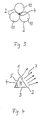
- arrows 7 each show the main direction of propagation of the blown-up extinguishing agent and the pressure wave.
- FIG. 1 shows a flexible hose 2 of any length, which is circular in cross section and made of a thin-walled plastic material, which is filled with an extinguishing agent 10.
- a linear flexible detonating cord 4 made of highly explosive explosive runs within the hose at a distance of about a third of the hose diameter from the bottom of the hose, which is water-resistant, hardly flammable and can be stored almost indefinitely is. With these properties, the explosive can be used both in a mobile and in a stationary application of the extinguishing device.
- the extinguishing agent is atomized into the finest droplet of extinguishing agent by the excess pressure in a fraction of a second and distributed almost uniformly radially in all directions in the direction of the arrows 7. This creates an approximately semicircular cross-section of the extinguishing agent mist on the environment.
- the detonating cord 4 is arranged outside the filled hose 2, an essentially directed detonating and extinguishing effect can be achieved.
- the detonating cord 4 is positioned on the side of the hose 2 facing away from the source of the fire on the floor (not shown). This also helps to fight the fire very effectively, in which far more than 50% of the extinguishing agent can have a direct extinguishing effect.
- detonating cord 4 is arranged in the center of the tube bundle.
- other positions up to the use of several detonating cords at different locations are also conceivable.
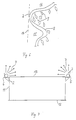
- FIG. 4 shows a shape deviating from the circular cross-sectional shape of the tube 2.
- the tube 2 shown there has a triangular cross-sectional shape, and the detonating cord 4 is arranged at the angle of the triangular tube 2, that of the triangular side or tube wall 1 which faces the source of the fire is opposite.
- an essentially directed explosive and extinguishing effect in the direction of arrows 7 can also be achieved.
- This directional effect could be supported, for example, in that the side 1 of the hose 2 facing the source of the fire is made materially weaker than the two other triangle sides 3, 5.
- side 1 can be marked in color in order to ensure proper positioning of the detonating cord in the hose in relation to the source of the fire or the direction of the threat when the extinguishing device is laid out.
- FIG. 5 shows a schematically illustrated forest fire.
- the fire front 8 moves from right to left in the illustration.
- a hose 2 according to FIG. 1 was laid along the entire fire front 8 with the detonating cord 4 contained therein and filled with extinguishing agent. If the detonating cord 4 is detonated, the extinguishing agent atomized into a mist spreads to both sides of the hose 2 over a width of 50 m each.
- the flames 9 are extinguished in the manner described above both by the supercooling effect and by the detonation wave associated with the explosion.
- the area of the forest that was not covered by the fire front 8 is moistened by the extinguishing agent mist.
- FIG. 6 shows a schematically illustrated, irregularly extending fire front 8.
- one advantage of the extinguishing device according to the invention can be shown particularly clearly: if the fire were combated with known, non-flexible extinguishing devices, for example by stringing together rigid extinguishing agent containers along the line 14 shown in broken lines, the extinguishing agent contained in the containers would only have an effect in the most advanced area 17 of the fire front 8 when it was detonated, while in areas 15, 16 no extinguishing effect would be achieved.
- the flexible extinguishing agent hose 2 enables the control line to be adapted to the shape of the flame front 8 and thus a very effective use of the extinguishing agent.
- the extinguishing device can be used in the shortest possible time, since the hose 2 in front of the fire front 8 can be designed like a normal C hose, filled with the extinguishing agent 10 and blasted by igniting the explosive.
- the use of the method according to the invention is also ecologically harmless. The use of extinguishing agent leaves hardly any traces and the loss of biological substance can be reduced to a minimum due to the high efficiency of the process.
- FIG. 7 shows an example of a stationary application of the extinguishing device in object protection. Shown is a schematic cross section of an oil tank 12, which has a circumferential bracket-like support 6 with an angular cross section at the level of its upper edge 13.
- the hose 2 filled with extinguishing agent rests on the carrier 6.
- the position of the detonating cord 4, which is not shown here, is of secondary importance here.
- the alignment of the explosive and extinguishing effect in the direction of the arrows 7 is achieved in this embodiment by the shielding of the hose on the back by the carrier 6.
- the extinguishing device is automatically detonated by sensors when the fuel contained in the tank 12 ignites.
- the extinguishing agent mist covers the burning fuel like a lid and extinguishes the fire in the manner described above.
- the stationary use of the extinguishing device described in this way can of course also be transferred to the protection of high racks in storage rooms or the like.
- FIG. 8 shows a schematic plan view of an airport runway 18 with an aircraft 19 located thereon.
- the area on a runway 18 in which an emergency landing aircraft 19 comes to a standstill is referred to as a critical area 20, which is indicated here by a dash-dotted line.
- This critical area is approximately 600 to 1,000 meters long and its location can generally be predicted for any type of aircraft.
- Left and right of the runway 18, for example, 5 lengths of tubes 21 are arranged in a total of 10 segments 22 to 31. Depending on where the aircraft 19 comes to a stop during an emergency landing, the corresponding segments 22 to 31 are activated.
- hoses 21 can also be arranged parallel to one another, a second row of hoses (not shown here) could also be used as a so-called “second alarm wave", which is activated when the extinguishing agent supply of the fire-fighting vehicles has been used up.
Landscapes
- Health & Medical Sciences (AREA)
- Emergency Management (AREA)
- Business, Economics & Management (AREA)
- Public Health (AREA)
- Forests & Forestry (AREA)
- Life Sciences & Earth Sciences (AREA)
- Ecology (AREA)
- Biodiversity & Conservation Biology (AREA)
- Fire-Extinguishing By Fire Departments, And Fire-Extinguishing Equipment And Control Thereof (AREA)
- Fire-Extinguishing Compositions (AREA)
- Chemical And Physical Treatments For Wood And The Like (AREA)
- Measurement And Recording Of Electrical Phenomena And Electrical Characteristics Of The Living Body (AREA)
- Respiratory Apparatuses And Protective Means (AREA)
Claims (11)
- Dispositif pour éteindre des incendies, comportant un récipient pour recevoir un agent d'extinction (10), et un explosif retenu dans ou sur ce récipient, par amorçage duquel l'agent d'extinction (10) est pulvérisé en brouillard et est amené dans l'incendie, caractérisé en ce que le récipient est un tuyau flexible (2) refermable des deux extrémités.
- Dispositif selon la revendication 1,
caractérisé en ce que l'explosif est réalisé sous la forme d'un cordon détonant flexible (4), qui s'étend en direction longitudinale du tuyau (2). - Dispositif selon la revendication 1,
caractérisé en ce que l'explosif est réalisé sous la forme d'une charge explosive discrète linéaire et en ce qu'il est agencé en répartition à des distances régulières. - Dispositif selon l'une quelconque des revendications 1 à 3,
caractérisé en ce que le tuyau (2) est constitué en un matériau à paroi mince mais résistant. - Dispositif selon l'une quelconque des revendications 1 à 4,
caractérisé en ce que le tuyau (2) est constitué en un matériau qui reflète la chaleur rayonnante, ou en ce qu'il présente un revêtement protecteur à cet effet. - Dispositif selon lune quelconque des revendications 1 à 5,
caractérisé en ce que l'explosif est agencé à une distance d'environ un tiers du diamètre du tuyau, par rapport au fond ou à une monture sur laquelle repose le tuyau (2). - Dispositif selon lune quelconque des revendications 1 à 6,
caractérisé en ce que le tuyau (2) comportant l'explosif est agencé sur un support (6) allongé présentant en section transversale par exemple la forme d'une coque ou d'une équerre. - Utilisation du dispositif selon l'une ou plusieurs des revendications 1 à 7, en tant que dispositif de protection anti-incendie d'objets pour des installations ou systèmes stationnaires.
- Utilisation du dispositif selon l'une ou plusieurs des revendications 1 à 7 pour retenir la poussière lors de travaux explosifs,
caractérisé en ce que le tuyau est posé au moins partiellement autour de l'objet à faire exploser, en ce qu'il est rempli d'eau et en ce qu'on le fait exploser lors de l'apparition du front de poussière, par amorçage de l'explosif. - Utilisation du dispositif selon l'une ou plusieurs des revendications 1 à 7 en tant que dispositif de protection anti-incendie préventif au niveau de ou sur une piste d'atterrissage d'un aéroport ou sur un emplacement de stationnement d'avions,
caractérisé en ce que le tuyau (2) est posé au moins partiellement le long de la piste d'atterrissage ou autour de l'emplacement de stationnement à protéger, en ce qu'il est rempli de l'agent d'extinction (10), et en ce qu'on le fait exploser lors de l'apparition d'un danger d'incendie, par amorçage de l'explosif. - Procédé pour éteindre des incendies de forêt ou de surface au moyen d'un dispositif selon l'une ou plusieurs des revendications 1 à 7,
caractérisé en ce que le tuyau (2) est posé devant le front du feu (8), en ce qu'il est rempli de l'agent d'extinction (10), et en ce qu'on le fait exploser par amorçage de l'explosif.
Applications Claiming Priority (5)
| Application Number | Priority Date | Filing Date | Title |
|---|---|---|---|
| DE4427889 | 1994-08-08 | ||
| DE4427889 | 1994-08-08 | ||
| DE19500477 | 1995-01-10 | ||
| DE19500477A DE19500477C1 (de) | 1994-08-08 | 1995-01-10 | Verfahren und Vorrichtung zum Löschen von Bränden |
| PCT/EP1995/002964 WO1996004960A1 (fr) | 1994-08-08 | 1995-07-26 | Procede et dispositif d'extinction d'incendies |
Publications (2)
| Publication Number | Publication Date |
|---|---|
| EP0760719A1 EP0760719A1 (fr) | 1997-03-12 |
| EP0760719B1 true EP0760719B1 (fr) | 1997-08-20 |
Family
ID=25939001
Family Applications (1)
| Application Number | Title | Priority Date | Filing Date |
|---|---|---|---|
| EP95927731A Expired - Lifetime EP0760719B1 (fr) | 1994-08-08 | 1995-07-26 | Procede et dispositif d'extinction d'incendies |
Country Status (22)
| Country | Link |
|---|---|
| US (1) | US5894891A (fr) |
| EP (1) | EP0760719B1 (fr) |
| JP (1) | JP3078016B2 (fr) |
| KR (1) | KR100419035B1 (fr) |
| AT (1) | ATE157031T1 (fr) |
| AU (1) | AU684663B2 (fr) |
| BR (1) | BR9508986A (fr) |
| CA (1) | CA2177969C (fr) |
| DE (2) | DE19500477C1 (fr) |
| DK (1) | DK0760719T3 (fr) |
| ES (1) | ES2108584T3 (fr) |
| GR (1) | GR3025329T3 (fr) |
| HR (1) | HRP950434B1 (fr) |
| IL (1) | IL114788A (fr) |
| MA (1) | MA23642A1 (fr) |
| NO (1) | NO307034B1 (fr) |
| NZ (1) | NZ290821A (fr) |
| SG (1) | SG63523A1 (fr) |
| TR (1) | TR199500980A2 (fr) |
| TW (1) | TW303301B (fr) |
| WO (1) | WO1996004960A1 (fr) |
| YU (1) | YU48696B (fr) |
Families Citing this family (40)
| Publication number | Priority date | Publication date | Assignee | Title |
|---|---|---|---|---|
| DE19539210A1 (de) * | 1995-10-21 | 1997-04-24 | Dynamit Nobel Ag | Löschkette zum Bekämpfen von Bränden |
| DE19643929C2 (de) * | 1996-10-30 | 1998-08-06 | Wagner Alarm Sicherung | Vorrichtung und Verfahren zum Sprenglöschen von Bränden |
| RU2129892C1 (ru) * | 1998-08-06 | 1999-05-10 | Таланов Борис Петрович | Способ подавления пожара |
| RU2129893C1 (ru) * | 1998-08-06 | 1999-05-10 | Таланов Борис Петрович | Способ подавления пожара |
| DE19915840A1 (de) * | 1999-04-08 | 2000-10-12 | Anton Neumeir | Verfahren und Gerät zum Löschen von Waldbränden aus der Luft |
| RU2171125C1 (ru) * | 1999-11-17 | 2001-07-27 | Гриншпан Яков Рувимович | Взрывное устройство для борьбы с лесным пожаром |
| DE10014543A1 (de) * | 2000-03-23 | 2001-09-27 | Klaus Spies | Druckgenerierungseinrichtung, vorzugsweise für Löschsysteme |
| US6318473B1 (en) | 2000-08-18 | 2001-11-20 | Talmadge O. Bartley | Expansive fire extinguishing system |
| US6796382B2 (en) | 2001-07-02 | 2004-09-28 | Siam Safety Premier Co., Ltd. | Fire extinguishing ball |
| DE60217154T2 (de) * | 2001-09-19 | 2007-10-18 | Adiga, Kayyani C. | Feuerlöschung unter verwendung von wassernebel mit tröpfchen ultrafeiner grösse |
| DE10206815B4 (de) * | 2002-02-19 | 2004-02-12 | Pinnig, Jörg | Vorrichtung und Verfahren zum Sprenglöschen von Bränden |
| WO2004014489A1 (fr) * | 2002-08-09 | 2004-02-19 | Jutabha, Sally | Boule d'extinction d'incendie |
| RU2230689C1 (ru) * | 2003-01-20 | 2004-06-20 | Гриншпан Яков Рувимович | Десантно-взрывное устройство для сброса с транспортного самолета |
| DE10346163A1 (de) | 2003-10-04 | 2005-05-04 | Diehl Bgt Defence Gmbh & Co Kg | Flugkörper zur Brandbekämpfung |
| AU2005227863A1 (en) * | 2004-02-06 | 2005-10-13 | Jeffrey P. Reistroffer | Linear incendiary strand and method for prescribed fire ignition |
| RU2275222C2 (ru) * | 2004-04-12 | 2006-04-27 | ГОУ ВПО Тюменская государственная архитектурно-строительная академия | Способ предотвращения распространения пожара |
| KR200372978Y1 (ko) * | 2004-07-21 | 2005-01-14 | 심화준 | 화약식 무인 자동소화 및 비상분사 장치 |
| FR2876920B1 (fr) * | 2004-10-26 | 2007-07-06 | Claude Piveau | Tuyau pour stopper un feu |
| US20080087444A1 (en) * | 2006-10-12 | 2008-04-17 | Held Jerry M | New technique for fire fighting-large scale open fires |
| US20080289831A1 (en) * | 2007-05-25 | 2008-11-27 | Kaimart Phanawatnan Woradech | Fire extinguishing device |
| CZ307311B6 (cs) * | 2010-01-13 | 2018-05-30 | Univerzita Tomáše Bati ve Zlíně | Způsob hašení přízemních lokálních požárů pomocí trhací techniky |
| RU2458716C1 (ru) * | 2011-03-21 | 2012-08-20 | Государственное образовательное учреждение высшего профессионального образования Томский государственный университет (ТГУ) | Комбинированный способ локализации и тушения низовых лесных и степных пожаров |
| US10054410B2 (en) | 2011-08-04 | 2018-08-21 | James Y. Menefee, III | Cartridge for handheld payload launcher system |
| EP2739930B1 (fr) | 2011-08-04 | 2016-10-12 | Polywad, Inc. | Système de lanceur de charges utiles à recul atténué |
| US9383161B2 (en) | 2011-08-04 | 2016-07-05 | James Y. Menefee, III | Handheld payload launcher system |
| RU2496539C1 (ru) * | 2012-05-05 | 2013-10-27 | Федеральное государственное бюджетное образовательное учреждение высшего профессионального образования "Национальный исследовательский Томский государственный университет" (ТГУ) | Накладной шнуровой заряд для локализации низовых лесных и степных пожаров |
| CN103432700B (zh) * | 2013-09-16 | 2015-03-18 | 国家电网公司 | 一种快速扑灭输电线路沿线山火的方法 |
| US9808660B2 (en) | 2015-03-31 | 2017-11-07 | Robert Shane Kilburn | Fire fighting apparatus and method |
| US20170323240A1 (en) | 2016-05-06 | 2017-11-09 | General Electric Company | Computing system to control the use of physical state attainment with inspection |
| US20240157180A1 (en) | 2021-02-04 | 2024-05-16 | Mighty Fire Breaker Llc | Method of and kit for installing and operating a wildfire defense spraying system on a property parcel for proactively spraying environmentally-clean liquid fire inhibitor thereover to inhibit fire ignition and flame spread caused by wind-driven wildfire embers |
| US12594448B2 (en) | 2019-06-22 | 2026-04-07 | Mighty Fire Breaker Llc | Environmentally-clean aqueous-based fire extinguishing biochemical liquid concentrates for mixing with proportioned quantities of water to produce fire extinguishing water streams |
| US11865390B2 (en) | 2017-12-03 | 2024-01-09 | Mighty Fire Breaker Llc | Environmentally-clean water-based fire inhibiting biochemical compositions, and methods of and apparatus for applying the same to protect property against wildfire |
| US11865394B2 (en) | 2017-12-03 | 2024-01-09 | Mighty Fire Breaker Llc | Environmentally-clean biodegradable water-based concentrates for producing fire inhibiting and fire extinguishing liquids for fighting class A and class B fires |
| US10653904B2 (en) | 2017-12-02 | 2020-05-19 | M-Fire Holdings, Llc | Methods of suppressing wild fires raging across regions of land in the direction of prevailing winds by forming anti-fire (AF) chemical fire-breaking systems using environmentally clean anti-fire (AF) liquid spray applied using GPS-tracking techniques |
| US11826592B2 (en) | 2018-01-09 | 2023-11-28 | Mighty Fire Breaker Llc | Process of forming strategic chemical-type wildfire breaks on ground surfaces to proactively prevent fire ignition and flame spread, and reduce the production of smoke in the presence of a wild fire |
| US20240252866A1 (en) | 2020-03-01 | 2024-08-01 | Mighty Fire Breaker Llc | Liquid hydrocarbon sorbing article of manufacture for inhibiting fire ignition involving flammable liquid hydrocarbons, while absorbing the flammable liquid hydrocarbons when spilled on a body of water and/or land |
| US11911643B2 (en) | 2021-02-04 | 2024-02-27 | Mighty Fire Breaker Llc | Environmentally-clean fire inhibiting and extinguishing compositions and products for sorbing flammable liquids while inhibiting ignition and extinguishing fire |
| DE102021004284A1 (de) | 2021-08-21 | 2023-02-23 | Kastriot Merlaku | Feuerwehr-Lösch-Düse oder Feuerwehr-Mehrzweckstrahlrohr |
| WO2023076684A1 (fr) * | 2021-11-01 | 2023-05-04 | Pax Products, LLC | Appareil d'extinction d'incendie |
| KR102913876B1 (ko) * | 2023-12-06 | 2026-01-15 | 황태성 | 소화선 장치 |
Family Cites Families (11)
| Publication number | Priority date | Publication date | Assignee | Title |
|---|---|---|---|---|
| US1080068A (en) * | 1913-01-03 | 1913-12-02 | Alphonse La Breche | Automatic fire-extinguisher. |
| US1119799A (en) * | 1913-09-15 | 1914-12-08 | Charles M Bowman | Fire-extinguisher. |
| FR1473621A (fr) * | 1966-03-30 | 1967-03-17 | Bombe extinctrice | |
| US3482637A (en) | 1967-10-20 | 1969-12-09 | Us Interior | Process and method for quenching incipient gas-air explosions |
| LU66154A1 (fr) * | 1972-09-25 | 1974-04-02 | ||
| US3980139A (en) * | 1975-09-15 | 1976-09-14 | Norman Kirk | Fire extinguishing bomb for putting out fires |
| US4938293A (en) * | 1987-04-29 | 1990-07-03 | Systron Donner Corp. | Linear fire extinguisher |
| FR2620033A1 (fr) * | 1987-09-07 | 1989-03-10 | Collard Catherine | Dispositif pour creer rapidement une zone d'humidite continue apte a affronter et eteindre les incendies de foret avec vent fort et pendant la nuit |
| EP0390384A1 (fr) * | 1989-03-31 | 1990-10-03 | Kidde-Graviner Limited | Extincteurs d'incendie |
| US5050683A (en) | 1990-05-14 | 1991-09-24 | The United States Of America As Represented By The Secretary Of The Army | Extinguishing rocket/missile solid propellants |
| US5088560A (en) * | 1990-11-01 | 1992-02-18 | Systron Donner Corporation | Zero force fire extinguisher |
-
1995
- 1995-01-10 DE DE19500477A patent/DE19500477C1/de not_active Expired - Fee Related
- 1995-07-26 NZ NZ290821A patent/NZ290821A/en unknown
- 1995-07-26 EP EP95927731A patent/EP0760719B1/fr not_active Expired - Lifetime
- 1995-07-26 AU AU31664/95A patent/AU684663B2/en not_active Ceased
- 1995-07-26 ES ES95927731T patent/ES2108584T3/es not_active Expired - Lifetime
- 1995-07-26 WO PCT/EP1995/002964 patent/WO1996004960A1/fr not_active Ceased
- 1995-07-26 BR BR9508986A patent/BR9508986A/pt not_active IP Right Cessation
- 1995-07-26 US US08/649,640 patent/US5894891A/en not_active Expired - Lifetime
- 1995-07-26 KR KR1019970700849A patent/KR100419035B1/ko not_active Expired - Fee Related
- 1995-07-26 DK DK95927731.0T patent/DK0760719T3/da active
- 1995-07-26 DE DE59500541T patent/DE59500541D1/de not_active Expired - Lifetime
- 1995-07-26 AT AT95927731T patent/ATE157031T1/de active
- 1995-07-26 JP JP08506951A patent/JP3078016B2/ja not_active Expired - Fee Related
- 1995-07-26 CA CA002177969A patent/CA2177969C/fr not_active Expired - Fee Related
- 1995-07-31 IL IL11478895A patent/IL114788A/xx not_active IP Right Cessation
- 1995-08-02 SG SG1995001030A patent/SG63523A1/en unknown
- 1995-08-02 HR HR950434A patent/HRP950434B1/xx not_active IP Right Cessation
- 1995-08-05 TW TW084108174A patent/TW303301B/zh not_active IP Right Cessation
- 1995-08-07 YU YU53495A patent/YU48696B/sh unknown
- 1995-08-08 MA MA23983A patent/MA23642A1/fr unknown
- 1995-08-08 TR TR95/00980A patent/TR199500980A2/xx unknown
-
1996
- 1996-07-17 NO NO962992A patent/NO307034B1/no unknown
-
1997
- 1997-11-11 GR GR970402971T patent/GR3025329T3/el unknown
Also Published As
| Publication number | Publication date |
|---|---|
| IL114788A0 (en) | 1995-11-27 |
| IL114788A (en) | 1999-07-14 |
| NO962992L (no) | 1996-07-17 |
| TW303301B (fr) | 1997-04-21 |
| WO1996004960A1 (fr) | 1996-02-22 |
| MX9700972A (es) | 1998-07-31 |
| AU684663B2 (en) | 1997-12-18 |
| CA2177969C (fr) | 1999-12-28 |
| KR100419035B1 (ko) | 2004-07-27 |
| JP3078016B2 (ja) | 2000-08-21 |
| CA2177969A1 (fr) | 1996-02-22 |
| BR9508986A (pt) | 1997-11-11 |
| ES2108584T3 (es) | 1997-12-16 |
| YU53495A (sh) | 1997-12-05 |
| EP0760719A1 (fr) | 1997-03-12 |
| DK0760719T3 (da) | 1998-04-06 |
| US5894891A (en) | 1999-04-20 |
| TR199500980A2 (tr) | 1996-06-21 |
| HRP950434A2 (en) | 1997-06-30 |
| NZ290821A (en) | 1997-05-26 |
| NO962992D0 (no) | 1996-07-17 |
| NO307034B1 (no) | 2000-01-31 |
| YU48696B (sh) | 1999-07-28 |
| DE19500477C1 (de) | 1995-11-23 |
| GR3025329T3 (en) | 1998-02-27 |
| HRP950434B1 (en) | 2000-08-31 |
| DE59500541D1 (de) | 1997-09-25 |
| SG63523A1 (en) | 1999-03-30 |
| JPH10508214A (ja) | 1998-08-18 |
| ATE157031T1 (de) | 1997-09-15 |
| AU3166495A (en) | 1996-03-07 |
| MA23642A1 (fr) | 1996-04-01 |
Similar Documents
| Publication | Publication Date | Title |
|---|---|---|
| EP0760719B1 (fr) | Procede et dispositif d'extinction d'incendies | |
| US7261165B1 (en) | Appartus for fighting forest fires | |
| US7210537B1 (en) | Method of controlling fires | |
| EP0785809A1 (fr) | Procede et dispositif de lutte aerienne contre des incendies | |
| EP1520604A2 (fr) | Missile de lutte contre l'incendie | |
| DE69014111T2 (de) | Anordnung eines rauchentwickelnden tarnungssystems. | |
| DE3876335T2 (de) | Verfahren zur feuerbekaempfung und anwendung dieses verfahrens. | |
| EP1716890A1 (fr) | Procede et dispositif de localisation et/ou d'extinction d'incendie | |
| DE102007036902A1 (de) | Löschvorrichtung, Löschsystem und Verfahren zur lokalen Brandbekämpfung | |
| EP1007159B1 (fr) | Dispositif et procede pyrotechnique d'extinction d'incendie | |
| WO1998039064A1 (fr) | Dispositif explosif d'extinction d'incendie | |
| DE4427326B4 (de) | Stationäre Feuerlöschanlage | |
| DE977984C (fr) | ||
| DE2459633A1 (de) | Einrichtung zum schutz gegen geschosse | |
| EP0696463A2 (fr) | Méthode et dispositif pour transférer des charges utiles à un lieu éloigné | |
| DE10033395A1 (de) | Verfahren zum Bekämpfen eines Brandes und Brandbekämpfungseinrichtung | |
| EP0775886B1 (fr) | Dispositif de protection pour des objets en mouvement rapide | |
| EP0010734B1 (fr) | Robinetterie protégée contre l'explosion et la détonation | |
| DE3022460A1 (de) | Verfahren und vorrichtung zum ausbringen von in luft schwebenden tarnmitteln mittels traegerprojektilen | |
| RU2083245C1 (ru) | Противопожарное защитное заграждение | |
| DE102007061108B4 (de) | Verfahren und Vorrichtung zur Brandbekämpfung | |
| EP0848967B1 (fr) | Dispositif d'extinction d'incendies | |
| DE19717530C2 (de) | Vorrichtung zur Bekämpfung von Gebäude-, insbesondere Bunkeranlagen | |
| DE102006058446A1 (de) | Vorrichtung und ein Verfahren zum Löschen von Bränden, insbesondere von Waldbränden | |
| DE202022002151U1 (de) | Vorrichtung zur Kühlung und/oder zur Brandbekämpfung |
Legal Events
| Date | Code | Title | Description |
|---|---|---|---|
| PUAI | Public reference made under article 153(3) epc to a published international application that has entered the european phase |
Free format text: ORIGINAL CODE: 0009012 |
|
| GRAG | Despatch of communication of intention to grant |
Free format text: ORIGINAL CODE: EPIDOS AGRA |
|
| 17P | Request for examination filed |
Effective date: 19960524 |
|
| AK | Designated contracting states |
Kind code of ref document: A1 Designated state(s): AT BE CH DE DK ES FR GB GR IE IT LI NL PT SE |
|
| 17Q | First examination report despatched |
Effective date: 19970313 |
|
| GRAH | Despatch of communication of intention to grant a patent |
Free format text: ORIGINAL CODE: EPIDOS IGRA |
|
| GRAH | Despatch of communication of intention to grant a patent |
Free format text: ORIGINAL CODE: EPIDOS IGRA |
|
| GRAA | (expected) grant |
Free format text: ORIGINAL CODE: 0009210 |
|
| AK | Designated contracting states |
Kind code of ref document: B1 Designated state(s): AT BE CH DE DK ES FR GB GR IE IT LI NL PT SE |
|
| REF | Corresponds to: |
Ref document number: 157031 Country of ref document: AT Date of ref document: 19970915 Kind code of ref document: T |
|
| REG | Reference to a national code |
Ref country code: CH Ref legal event code: EP |
|
| GBT | Gb: translation of ep patent filed (gb section 77(6)(a)/1977) |
Effective date: 19970820 |
|
| REF | Corresponds to: |
Ref document number: 59500541 Country of ref document: DE Date of ref document: 19970925 |
|
| ET | Fr: translation filed | ||
| REG | Reference to a national code |
Ref country code: CH Ref legal event code: NV Representative=s name: ANDRE BRAUN PATENTANWALT VSP |
|
| ITF | It: translation for a ep patent filed | ||
| REG | Reference to a national code |
Ref country code: ES Ref legal event code: FG2A Ref document number: 2108584 Country of ref document: ES Kind code of ref document: T3 |
|
| REG | Reference to a national code |
Ref country code: GR Ref legal event code: FG4A Free format text: 3025329 |
|
| REG | Reference to a national code |
Ref country code: PT Ref legal event code: SC4A Free format text: AVAILABILITY OF NATIONAL TRANSLATION Effective date: 19971119 |
|
| REG | Reference to a national code |
Ref country code: DK Ref legal event code: T3 |
|
| PLBE | No opposition filed within time limit |
Free format text: ORIGINAL CODE: 0009261 |
|
| STAA | Information on the status of an ep patent application or granted ep patent |
Free format text: STATUS: NO OPPOSITION FILED WITHIN TIME LIMIT |
|
| 26N | No opposition filed | ||
| REG | Reference to a national code |
Ref country code: GB Ref legal event code: IF02 |
|
| PGFP | Annual fee paid to national office [announced via postgrant information from national office to epo] |
Ref country code: DK Payment date: 20070713 Year of fee payment: 13 |
|
| PGFP | Annual fee paid to national office [announced via postgrant information from national office to epo] |
Ref country code: IE Payment date: 20070720 Year of fee payment: 13 |
|
| REG | Reference to a national code |
Ref country code: CH Ref legal event code: NV Representative=s name: BRAUNPAT BRAUN EDER AG |
|
| PGFP | Annual fee paid to national office [announced via postgrant information from national office to epo] |
Ref country code: SE Payment date: 20070712 Year of fee payment: 13 Ref country code: NL Payment date: 20070716 Year of fee payment: 13 Ref country code: BE Payment date: 20070802 Year of fee payment: 13 |
|
| REG | Reference to a national code |
Ref country code: DK Ref legal event code: EBP |
|
| EUG | Se: european patent has lapsed | ||
| NLV4 | Nl: lapsed or anulled due to non-payment of the annual fee |
Effective date: 20090201 |
|
| REG | Reference to a national code |
Ref country code: IE Ref legal event code: MM4A |
|
| PG25 | Lapsed in a contracting state [announced via postgrant information from national office to epo] |
Ref country code: NL Free format text: LAPSE BECAUSE OF NON-PAYMENT OF DUE FEES Effective date: 20090201 |
|
| PG25 | Lapsed in a contracting state [announced via postgrant information from national office to epo] |
Ref country code: IE Free format text: LAPSE BECAUSE OF NON-PAYMENT OF DUE FEES Effective date: 20080728 Ref country code: DK Free format text: LAPSE BECAUSE OF NON-PAYMENT OF DUE FEES Effective date: 20080731 |
|
| PG25 | Lapsed in a contracting state [announced via postgrant information from national office to epo] |
Ref country code: SE Free format text: LAPSE BECAUSE OF NON-PAYMENT OF DUE FEES Effective date: 20080727 Ref country code: BE Free format text: LAPSE BECAUSE OF NON-PAYMENT OF DUE FEES Effective date: 20080731 |
|
| PGFP | Annual fee paid to national office [announced via postgrant information from national office to epo] |
Ref country code: PT Payment date: 20110630 Year of fee payment: 17 |
|
| PGFP | Annual fee paid to national office [announced via postgrant information from national office to epo] |
Ref country code: CH Payment date: 20110725 Year of fee payment: 17 Ref country code: FR Payment date: 20110729 Year of fee payment: 17 |
|
| PGFP | Annual fee paid to national office [announced via postgrant information from national office to epo] |
Ref country code: AT Payment date: 20110714 Year of fee payment: 17 Ref country code: GR Payment date: 20110727 Year of fee payment: 17 Ref country code: GB Payment date: 20110721 Year of fee payment: 17 Ref country code: ES Payment date: 20110726 Year of fee payment: 17 Ref country code: DE Payment date: 20110722 Year of fee payment: 17 |
|
| PGFP | Annual fee paid to national office [announced via postgrant information from national office to epo] |
Ref country code: IT Payment date: 20110726 Year of fee payment: 17 |
|
| REG | Reference to a national code |
Ref country code: PT Ref legal event code: MM4A Free format text: LAPSE DUE TO NON-PAYMENT OF FEES Effective date: 20130128 |
|
| REG | Reference to a national code |
Ref country code: CH Ref legal event code: PL |
|
| REG | Reference to a national code |
Ref country code: GR Ref legal event code: ML Ref document number: 970402971 Country of ref document: GR Effective date: 20130104 |
|
| REG | Reference to a national code |
Ref country code: AT Ref legal event code: MM01 Ref document number: 157031 Country of ref document: AT Kind code of ref document: T Effective date: 20120726 |
|
| GBPC | Gb: european patent ceased through non-payment of renewal fee |
Effective date: 20120726 |
|
| REG | Reference to a national code |
Ref country code: FR Ref legal event code: ST Effective date: 20130329 |
|
| PG25 | Lapsed in a contracting state [announced via postgrant information from national office to epo] |
Ref country code: FR Free format text: LAPSE BECAUSE OF NON-PAYMENT OF DUE FEES Effective date: 20120731 Ref country code: CH Free format text: LAPSE BECAUSE OF NON-PAYMENT OF DUE FEES Effective date: 20120731 Ref country code: GB Free format text: LAPSE BECAUSE OF NON-PAYMENT OF DUE FEES Effective date: 20120726 Ref country code: LI Free format text: LAPSE BECAUSE OF NON-PAYMENT OF DUE FEES Effective date: 20120731 Ref country code: DE Free format text: LAPSE BECAUSE OF NON-PAYMENT OF DUE FEES Effective date: 20130201 |
|
| PG25 | Lapsed in a contracting state [announced via postgrant information from national office to epo] |
Ref country code: GR Free format text: LAPSE BECAUSE OF NON-PAYMENT OF DUE FEES Effective date: 20130204 Ref country code: IT Free format text: LAPSE BECAUSE OF NON-PAYMENT OF DUE FEES Effective date: 20120726 Ref country code: PT Free format text: LAPSE BECAUSE OF NON-PAYMENT OF DUE FEES Effective date: 20130128 |
|
| PG25 | Lapsed in a contracting state [announced via postgrant information from national office to epo] |
Ref country code: AT Free format text: LAPSE BECAUSE OF NON-PAYMENT OF DUE FEES Effective date: 20120726 |
|
| REG | Reference to a national code |
Ref country code: DE Ref legal event code: R119 Ref document number: 59500541 Country of ref document: DE Effective date: 20130201 |
|
| REG | Reference to a national code |
Ref country code: ES Ref legal event code: FD2A Effective date: 20131018 |
|
| PG25 | Lapsed in a contracting state [announced via postgrant information from national office to epo] |
Ref country code: ES Free format text: LAPSE BECAUSE OF NON-PAYMENT OF DUE FEES Effective date: 20120727 |