EP0761127A2 - Ensemble d'assemblage et unité en porte à faux pour la fixation d'objets à un mur - Google Patents
Ensemble d'assemblage et unité en porte à faux pour la fixation d'objets à un mur Download PDFInfo
- Publication number
- EP0761127A2 EP0761127A2 EP96810530A EP96810530A EP0761127A2 EP 0761127 A2 EP0761127 A2 EP 0761127A2 EP 96810530 A EP96810530 A EP 96810530A EP 96810530 A EP96810530 A EP 96810530A EP 0761127 A2 EP0761127 A2 EP 0761127A2
- Authority
- EP
- European Patent Office
- Prior art keywords
- wall
- cantilever unit
- opening
- building wall
- screw
- Prior art date
- Legal status (The legal status is an assumption and is not a legal conclusion. Google has not performed a legal analysis and makes no representation as to the accuracy of the status listed.)
- Granted
Links
Images

Classifications
-
- A—HUMAN NECESSITIES
- A47—FURNITURE; DOMESTIC ARTICLES OR APPLIANCES; COFFEE MILLS; SPICE MILLS; SUCTION CLEANERS IN GENERAL
- A47B—TABLES; DESKS; OFFICE FURNITURE; CABINETS; DRAWERS; GENERAL DETAILS OF FURNITURE
- A47B95/00—Fittings for furniture
- A47B95/008—Suspension fittings for cabinets to be hung on walls
Definitions
- the invention relates to a method according to the preamble of patent claim 1, a mounting kit according to the preamble of patent claim 2 and a cantilever unit according to the preamble of patent claim 3.
- cantilever units attached to the side walls of the objects, preferably only in cupboards. These block-like (prismatic) cantilever units were screwed into the rear side wall area immediately in front of the rear wall. There was an opening for a retaining screw in the middle parallel to the contact level to be placed on the side wall. The axis of the breakthrough was parallel to the article side wall surface and perpendicular to the article back wall.
- the rear wall was first drilled according to the opening position of the cantilever units to be installed in the interior of the cabinet. Then the respective cantilever units were screwed in precisely to match the hole and opening and the cabinet was held to the building wall at the installation site. The locations for the building wall holes to be dowelled were marked. At the marked locations, holes were then drilled for the wall dowels holding the fastening screws and the dowels inserted. The cabinet was then attached to the wall holes with screws inserted through the openings in the cantilever units.
- the object of the invention is to provide a method, a mounting kit and a cantilever unit which, compared to the prior art, permits a simpler and faster mounting of objects on a wall, in particular on a building wall.
- the invention solves the stated problem in that no more cantilever units with a perpendicular to the object rear wall or building wall, ie to the object side wall parallel breakthrough are used, but a breakthrough whose axis is inclined to the side wall surface, i.e. at an angle ⁇ between 5 ° and 60 °, preferably between 8 ° and 20 °, the breakthrough exit being closer to the side wall carrying the cantilever unit than that Breakthrough entry.
- the cantilever units are each screwed onto the object side walls. They have a contact surface (contact level) with which they preferably abut the inside of the relevant object side wall.
- the openings of the cantilever units according to the invention thus run at the abovementioned angle to this contact surface.
- the cantilever unit according to the invention can namely be screwed directly onto the side walls in the vicinity of the rear wall without first drilling a hole in the rear wall. After the cabinet has been placed on the building wall, a drill is drilled into the opening through the rear wall into the building wall. The hole is preferably drilled to suit the corresponding dowel. The dowel is inserted through the opening into the wall drill hole. Then the fastening screw is inserted through the opening in the cantilever unit and screwed into the wall hole.
- the opening is not only arranged fixedly at a predetermined angle in the unit, but an insert which can be pivoted in the unit is used, this Breakthrough, the angular position of the breakthrough can be selected individually according to the space required (operating space) for the use of a tool for screwing the fastener into the building wall.
- This operating space depends on whether just a simple screwdriver or z. B. a drill is used.
- the desired cabinet spacing can be set by rotating it.
- the insert then has a threaded hole matching the fastening screw, which can also only be cut with the thread of the fastening screw. If the fastener is first screwed into the insert and then the insert is rotated together when screwing into the building wall, the fastening screw (fastening element) can be screwed into the insert in such a way that the screw head has a desired position, for. B. does not protrude. The distance between the back wall of the object and the surface of the building wall is then achieved by screwing the fastening screw into the building wall.
- the fastening screw can also be screwed into the building wall with a view to an optimal degree of screwing in and the distance can be achieved by turning the insert on the screw thread of the fastening screw.
- the screw head can protrude above or enter the cantilever unit; a slip sleeve to be put over would then have to be formed with a correspondingly large interior.
- the insert in the base housing of the cantilever unit is held axially, but can be rotated around the opening axis.
- the cantilever unit will preferably be designed with a releasable locking device against rotation of the insert.
- the lock would be inserted if the fastening screw is to be screwed into the insert.
- the cantilever units are preferably made standardized from one and the same material (plastic or metal casting), preferably in a universal size.
- a suitably colored and patterned sleeve can be attached to the cantilever units like a hood.
- the sleeve and the cantilever unit will be equipped with snap-in elements, so that the sleeve cannot fall off later.
- the cantilever unit is designed as a mirror image with a mirror plane perpendicular to the contact surface on the side wall. This allows one and the same cantilever unit to be used on the right or left side walls. If the mirror-image configuration is omitted, the bores in the cantilever unit for the retaining screws to be screwed into the side walls would have to be provided symmetrically with two countersinks for the screw head. Furthermore, the cantilever unit would then have two mutually opposite contact surfaces for the relevant left or right side wall.
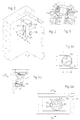
- FIG. 1 shows a cupboard 2 as an object, which is held on a building wall 3 using a cantilever unit 1 . Only the rear wall 5 and one of its side walls 7 are shown in FIG. 1 of the cabinet.
- the cantilever unit 1 is arranged in an inner cabinet edge 9 between the side and rear walls 7 and 5 and is screwed to the side wall 7 with two screws 8 , only one of which is shown in broken lines in FIG .
- the cantilever unit 1 has an opening 10, the axis 11 of which extends obliquely to the contact plane 13 , with which the cantilever unit 1 lies against the surface 14 of the cabinet side wall 7 .
- the angle ⁇ between the axis 11 and the surface 14 is between 5 ° and 60 °, preferably between 8 ° and 20 °, the breakthrough inlet opening 15 being at a greater distance from the contact plane 13 with respect to the outlet opening 17 .
- This bevel results in a fastening screw 19 tool acting as a fastening element, a larger operating clearance.
- a screwdriver not shown
- a drill (not shown) for drilling through the rear wall 5 and for drilling in the building wall 3
- the drill chuck can no longer damage the inside surface of the cabinet.
- the through-hole 15 having top surface of the cantilever unit 1 proceeds in the direction perpendicular to the abutment plane 15 side surfaces via rounded edges.
- a threaded sleeve 20 with an internal thread 20a is firmly clamped in the opening 10 as the step-shaped extension narrowing the opening.
- the length of the threaded sleeve 20 is slightly less than the length of the opening 10 .
- a screw-in element 21 that is axially non-displaceable (locked) but (radially) rotatable on the fastening screw 19 sits in the threaded sleeve 20 in a form-fitting manner.
- the fastening screw 19 is already shown screwed into the wall 3 in a dowel 18 . According to the Einschraubgrad of the screw-in element 21 in the building wall 3, the distance d of the cabinet back wall 5 be set from the building wall.
- the screw-in element 21 is axially fixed axially by the screw shaft 31 surrounds the bead 32 and a flaring 33 on the upper end of the screw, but kept free to rotate about the screw axis.
- the screw 19 has a “wood thread” 35 .
- the screw end has a hexagon pocket hole 37 (indicated by dashed lines) for attaching a corresponding hexagon key (not shown).
- the screw-in element 21 has a four-pointed crown 39 at its upper end for the attachment of a corresponding crown key (not shown). Crown and hex keys can be combined in one
- the tool can be united with one another, in which case the cone wrench can be moved axially.
- the threaded sleeve 20 has at its upper end a tool attachment 22, in particular in the form of a crown, for a crown wrench (not shown).
- the threaded sleeve 20 is held axially and can be rotated radially to the sleeve axis 11 with this crown wrench.
- a commercially available "wood screw” can now be used, the thread of which is preferably formed up to the shoulder of the screw head.
- the fastening screw is now almost completely screwed into the threaded sleeve 20 .
- the fastening screw is screwed into the building wall 3 , it also being possible here to set the wall distance d via the degree of screwing into the building wall 3 .
- the wall distance d can also be changed by turning the threaded sleeve 20 when the fastening screw is fixed. In this case, however, the screw head protrudes more or less from the cantilever unit.
- the free space above the threaded sleeve 20 is selected so large that the head of a commercially available screw (round head, countersunk head, pan head screw, etc.), which is not shown, and which has no screw-in element 21 , can also be accommodated.
- a commercially available screw round head, countersunk head, pan head screw, etc.
- the cantilever unit 1 alone shows a perspective illustration in FIG .
- the two through holes 23a and 23b for screws 8 for fastening to the side wall 7 and the opening 10 can be seen here.
- the cantilever unit 1 has a clamping cover 43 which can be pressed against a base part 42 by means of two screws 41a and 41b . With the clamping cover 43 , the threaded sleeve 20 can be held against rotation between the clamping cover 43 and the base part 42 .
- the clamp cover 43 is completely removable. The threaded sleeve 20 can then be removed.
- the cantilever unit 1 does not have to be constructed in two parts; a one-piece can also be used. However, the two-part design facilitates the assembly of the threaded sleeve 20 or the ball sleeve 27 described below.
- FIG. 2 also shows the mirror-image structure of the cantilever unit 1 .
- the plane of symmetry is perpendicular to the contact surface 13 and includes the breakthrough axis 11 , as shown in Figure 1 .
- the cantilever unit 1 can have an attachable sleeve 46 .
- the slip sleeves 46 are available in several color and pattern versions to achieve an adaptation to the type of wood in question of the interior wall of the cabinet. It is preferred to provide noses 47 on the inside of the sleeve as locking elements, which preferably engage in a gap 45 between the clamping cover 43 and the base part 42 .
- the threaded sleeve 20 it is also possible, as shown in FIG. 3 , to use a freely rotatable ball sleeve 27 with a threaded bore 44 lying in a ball socket 28 .
- the ball sleeve 27 has in its upper region a tool attachment 48 designed as a crown, analogous to that of the threaded sleeve 20 .
- the ball sleeve 27 with a tool in the non-clamped state analogous to the threaded sleeve 20 to its breakdown axis 27 are rotated to the distance adjustment on the thread of the fastening screw.
- the opening can also have only a fixed, step-shaped projection, not shown. This paragraph can also be unthreaded if you use a thread-cutting screw element or a screw with a thread-cutting thread.
- the ball sleeve 27 allows a large angular selection range for the axis of the fastening screw 19 .
- the disadvantage of this embodiment is the different position of the screw head of the fastening screw from the top of the cantilever unit.
- the screw head can now lie in the cantilever unit or protrude above its surface.
- This variant also results in a higher sleeve which has to accommodate the screw head.
- the screw can also be screwed into the cantilever unit with a precise fit, as stated above, the wall distance d then being achieved by the degree of screwing into the wall.
- FIGS. 4a to 4c a cantilever unit 51 which is configured analogously to this and is shown in FIGS. 4a to 4c .
- This cantilever unit 51 has an insert 55 which can be rotated, but which can be locked with a locking element 53 against rotation.
- the stake 55 has an internal area 56 with an internal thread for the form-fitting engagement of the fixing screw, this internal thread 56 also being able to be cut by the fixing screw when it is screwed in.
- the insert 55 can now be designed analogously to the threaded or ball sleeve 20 or 27 already described above.
- the insert can also initially be fixed non-rotatably to the base part of the cantilever unit via a connection provided with a predetermined breaking point and can then be rotated about its breakthrough axis after the predetermined breaking point has been broken open.
- the strength of the predetermined breaking point is selected such that the predetermined breaking point holds the fastening screw in place during the screwing-in process. If the screw has been screwed in until the screw head approximately closes with the top of the cantilever unit 51 , the predetermined breaking point is preferably separated by a hammer blow on the screw head, as a result of which the insert can now be rotated about its longitudinal axis.
- the sleeve-like insert 55 is preferably provided with two mutually opposite longitudinal slots 61a and 61b and a radial circumferential groove 63 .
- a coaxial web 65 engages in this groove 63 with a clearance fit in the opening 66 of the base part 59 of the cantilever unit 51 . Due to the clearance fit, the insert 55 is rotatable about its longitudinal axis in the base part 59 .
- the web 65 has a coaxial inlet ramp 67 for the insertion of the insert 55 .
- the outer contour of the two-part projection 69a / b lying between the groove 63 and the end 68 of the insert 55 is not circular, but rather approximately elliptical with the diameters f and g perpendicular to one another.
- the diameter f is selected such that it is smaller by a play tolerance than the inside diameter of the opening 66 at the location of the web 65 .
- the diameter f corresponds to the diameter of the opening 66 on the web-free parts minus a clearance tolerance.
- the width of the longitudinal slots, in particular in the area of the shoulders 66a and 66b and adjacent, is larger by a tolerance than twice the height of the web 63 . These dimensions allow the insert 55 to be pushed into the opening 66 and pushed over the web 65 with subsequent snapping into the groove 63 .
- the remaining outer diameter of the insert 55 is smaller by a tolerance than the remaining diameter of the opening 66 , the tolerance being chosen such that a sliding twisting is possible, but the insert 55 does not "wobble".
- the web on the insert and the groove can also be arranged in an opening.
- the cantilever unit 1 or 51 is preferably used whenever it needs to be attached to a side wall approximately perpendicular to the building wall or in an object corner.
- Objects and devices can also be fastened within a housing using the cantilever unit described above. If, for example, the housing is a sheet metal housing, sheet metal screws will be used for the fastening screws; screws with a metric thread, so-called “metal screws", can also be used.
- the cantilever unit can also be mounted on side walls which have an angle which deviates from the vertical in relation to the rear wall or the building wall. Use e.g. B. on horizontally lying side walls, which, however, are approximately perpendicular to the building or rear wall of the cabinet, is also possible.
- the cantilever unit with the ball sleeve 27 can, however, preferably also be used on inclined side walls, since, due to the adjustable “screw-in angle”, the optimum operating space for the drilling or screwing tool can be selected.
- cantilever units on any inclined side walls.
- the new slope of the opening in the cantilever unit for the fastening screw must then be superimposed on the 5 ° to 60 °, preferably 8 ° to 20 °, starting from the wall inclination, in order to obtain the operating space necessary for a screw-in tool.
- the contact plane 13 must also be designed to be inclined accordingly.
- the cantilever unit can be arranged not only on the inside of the object side wall, but also on the outside thereof, in particular using the cover sleeve which is colored with a corresponding pattern.
- the rotatability of the screw-in element 21 on the fastening screw 19 and the rotatability of the inserts 20, 27 and 55 about their longitudinal axis can be dispensed with.
- the through holes 23a and 23b of the cantilever unit 1 shown in FIG. 2 can also be designed as elongated holes, which then extend parallel to the rear wall 5 . These elongated holes (not shown) then enable the height of the object held on a wall by the cantilever unit to be adjusted. Of course, the hole originally drilled into the rear wall through the opening 10 in the rear wall 5 would have to be enlarged by re-drilling or filing. In order to prevent the cantilever unit, which is then screwed onto the side wall at the correct height, from slipping, the upper edges of the elongated holes should preferably be provided with corrugation or rastering, in which the screw head is then held in a form-fitting manner.
- the opening 10 can also be designed as an elongated hole, the elongated hole extension of which would likewise run parallel to the rear wall 5 .
- the corrugation or rastering mentioned above can be provided on the top of the longitudinal slot.
- both the through holes 23a and 23b and the opening 10 can be formed as elongated holes.
- FIG . 5 shows an embodiment variant, in particular for the cantilever unit 51 shown in FIGS. 4a to 4c .
- Analogous to the web 65 holding the cantilever unit 51 there is a robust flange 75 which is inclined according to the inclination of the opening 73 and has an insert part 79 held in a bore 77 .
- the insert part 79 has a clamping ring 80 with a lateral inlet slope 81 , which facilitates its pushing through the bore 77 .
- the clamping ring 80 can also have slots (not shown) running approximately parallel to the opening axis 83 or also inclined, which can extend beyond the clamping ring 80 . This makes it easier to bend the clamping ring 80 inward.
- the end of the opening 73 opposite the clamping ring 80 has a retaining ring 84 which prevents the insertion part 79 from being pushed through the bore 77 .
- Holding and clamping ring 84 respectively. 80 are spaced apart from each other in accordance with the flange thickness and the diameter of the area between the holding and clamping ring 84 and 80 to the diameter of the bore 77 is designed with a clearance fit such that the insertion part 79 can be rotated in the bore 77 .
- the flange 75 merges into a wall support part 85 .
- the wall support part 85 is screwed to a side wall of the object, in particular a cabinet side wall 88 , with two screws 87 , one of which is visible in FIG. 5 .
- the openings 89 for the screws 87 can now be designed as bores or as elongated holes according to the above statements.
- a wedge not shown, similar to the wedge 53 , the insert 79 can be locked when the fastening screw, not shown here, is screwed through. The wedge can then be removed for wall clearance adjustment.
- This cantilever unit 91 can also be covered with a slip sleeve, not shown.
- Flange 75 and wall support part 85 together form a single component 92 , in the opening 73 of which the insert part 79 is then pressed.
- Both parts 79 and 92 are preferably injection molded from plastic.
- the wedge (not shown) lying in a (not shown) slot of the opening 73 for locking the insert 79 can the insert part 79 is also molded and provided with a predetermined breaking point.
- an attack for a tool will be attached to the top of the retaining ring 84 , with which the predetermined breaking point can be broken open after the fastening screw has been screwed in and screwed into the building wall to adjust the distance.
- the attack for the tool can be training as a hexagon head for a wrench.
- Slots can also be provided for the use of a screwdriver. Of course, both forms can also be used together.
- a ball sleeve analogous to the ball sleeve 27 can also be used with a corresponding configuration of the bore 77 , which would then be bulbous.
- the cantilever unit 91 shown in FIG. 5 can be modified as shown in FIG. 6 into a cantilever unit 95 which can be inserted into the rear wall 94 of the object.
- the angle leg receiving the screw 87 is omitted and the flange 75 is designed as a flange 97 with an annular recess 99 .
- This recess 99 is bounded at the top and bottom by a retaining ring and a stop ring 100a or 100b .
- the two rings 100a and 100b are spaced apart from one another in accordance with the thickness of the rear wall 94 .
- an insert part 103 which is designed analogously to the insert part 79 is likewise inserted in the cantilever unit 95 .
- the insert part 103 can be designed as a spherical sleeve.
- the retaining flange 100a has in its free the insert 103 portion 104 a plurality of longitudinal cuts 105, which provide the retaining ring 100a a Einsetzelastiztician so that it is easier to use in a drilled hole in the rear wall 94 107th
- the cantilever unit 95 is located in the side wall, ie preferably in the rear wall.
- the insert 79 and 103 can be inserted into the rear wall alone. In this case, however, the fastening screw can then no longer be inserted at an angle, but rather approximately perpendicular to the surface of the object rear wall in question.
Landscapes
- Furniture Connections (AREA)
- Supports Or Holders For Household Use (AREA)
- Connection Of Plates (AREA)
- Conveying And Assembling Of Building Elements In Situ (AREA)
Applications Claiming Priority (9)
| Application Number | Priority Date | Filing Date | Title |
|---|---|---|---|
| CH236495 | 1995-08-18 | ||
| CH2364/95 | 1995-09-08 | ||
| CH236495 | 1995-09-08 | ||
| CH3017/95 | 1995-10-26 | ||
| CH301795 | 1995-10-26 | ||
| CH301795 | 1995-10-26 | ||
| CH34196 | 1996-02-09 | ||
| CH34196 | 1996-02-09 | ||
| CH341/96 | 1996-02-09 |
Publications (3)
| Publication Number | Publication Date |
|---|---|
| EP0761127A2 true EP0761127A2 (fr) | 1997-03-12 |
| EP0761127A3 EP0761127A3 (fr) | 1999-02-24 |
| EP0761127B1 EP0761127B1 (fr) | 2003-01-15 |
Family
ID=27172007
Family Applications (1)
| Application Number | Title | Priority Date | Filing Date |
|---|---|---|---|
| EP96810530A Expired - Lifetime EP0761127B1 (fr) | 1995-08-18 | 1996-08-12 | Ensemble d'assemblage et unité en porte à faux pour la fixation d'objets à un mur |
Country Status (3)
| Country | Link |
|---|---|
| EP (1) | EP0761127B1 (fr) |
| AT (1) | ATE230949T1 (fr) |
| DE (1) | DE59610053D1 (fr) |
Family Cites Families (2)
| Publication number | Priority date | Publication date | Assignee | Title |
|---|---|---|---|---|
| DE1282894C2 (de) * | 1963-10-12 | 1976-02-12 | Robert Krause KG, 7315 Weilheim | Beschlag zum justierbaren aufhaengen von moebeln, wie haengeschraenke, regale o.dgl., an einer wand |
| DE1291872B (de) * | 1964-04-03 | 1969-04-03 | Krause Kg Robert | Beschlag zum justierbaren Aufhaengen von Moebeln, Schraenken, Regalen od. dgl. an einer Wand |
-
1996
- 1996-08-12 AT AT96810530T patent/ATE230949T1/de not_active IP Right Cessation
- 1996-08-12 EP EP96810530A patent/EP0761127B1/fr not_active Expired - Lifetime
- 1996-08-12 DE DE59610053T patent/DE59610053D1/de not_active Expired - Fee Related
Also Published As
| Publication number | Publication date |
|---|---|
| DE59610053D1 (de) | 2003-02-20 |
| EP0761127A3 (fr) | 1999-02-24 |
| ATE230949T1 (de) | 2003-02-15 |
| EP0761127B1 (fr) | 2003-01-15 |
Similar Documents
| Publication | Publication Date | Title |
|---|---|---|
| EP0761130B1 (fr) | Ferrure de fixation pour panneaux frontaux de tiroir | |
| EP0019782A2 (fr) | Cheville métallique creuse | |
| EP3404153A1 (fr) | Ensemble de fixation destiné à la fixation d'un plateau de manutention pour objets sanitaires et utilisation d'un tel ensemble de fixation | |
| DE4210488A1 (de) | Verbindungseinrichtung für ein insbesondere rohrförmiges Bauteil | |
| EP4130495A1 (fr) | Système de fixation destiné à la fixation d'une pièce rapportée et procédé de fixation et d'ajustement de la pièce rapportée | |
| DE20312075U1 (de) | Vorrichtung mit zwei durch eine Verbindungsschraube zusammengehaltenen Hohlprofilen sowie Werkzeug dazu | |
| DE20100623U1 (de) | Büchse für die Befestigung eines Beschlagteils an einem Hohlprofil | |
| EP1712717A2 (fr) | Ferrure pour la connection d'une porte | |
| EP0761127B1 (fr) | Ensemble d'assemblage et unité en porte à faux pour la fixation d'objets à un mur | |
| EP1134170B1 (fr) | Structure à assemblage modulaire pour des rayons de stockage | |
| DE3042258A1 (de) | Verstellbares tuer- oder fensterband | |
| DE19516159A1 (de) | Verstellbares Türband | |
| DE3725719C2 (de) | Verfahren und Vorrichtung zur Befestigung eines Griffes, oder dergleichen | |
| EP0196485A1 (fr) | Dispositif de fixation d'un élément de construction sur un mur ou une autre partie de bâtiment | |
| DE4010999A1 (de) | Befestigungselement | |
| DE19625708C1 (de) | Profilelement zum Aufbau von Rahmen und Fassadenkonstruktionen | |
| DE69002342T2 (de) | Befestigungsvorrichtung durch Zusammenschrauben auf einem Profil, insbesondere auf einem Elektrizitätsschrank. | |
| DE29508741U1 (de) | Befestigungsanker sowie System aus Befestigungsanker und Bauelement | |
| DE3301478A1 (de) | Befestigungsvorrichtung zum befestigen eines rohr- oder stangenfoermigen bauteils an einer montageflaeche | |
| EP1388628A2 (fr) | Charnière avec un dispositif de levage et d'abaissement réglable en hauteur et en angle pour portes et fenêtres | |
| DE10210627C1 (de) | Vorrichtung zum Verbinden wenigstens zweier Bauteile | |
| EP4151866A1 (fr) | Dispositif de fixation | |
| DE20011197U1 (de) | T-Verbindung zwischen einem Pfosten- und einem Riegelprofil einer Fassade oder eines Lichtdaches | |
| DE3722292A1 (de) | Befestigungselement mit einer duebelartigen buchse | |
| EP1188869B1 (fr) | Dispositif de fixation pour une barre de douche |
Legal Events
| Date | Code | Title | Description |
|---|---|---|---|
| PUAI | Public reference made under article 153(3) epc to a published international application that has entered the european phase |
Free format text: ORIGINAL CODE: 0009012 |
|
| AK | Designated contracting states |
Kind code of ref document: A2 Designated state(s): AT BE CH DE DK FR IT LI NL SE |
|
| AX | Request for extension of the european patent |
Free format text: SI PAYMENT 960816 |
|
| PUAL | Search report despatched |
Free format text: ORIGINAL CODE: 0009013 |
|
| AK | Designated contracting states |
Kind code of ref document: A3 Designated state(s): AT BE CH DE DK FR IT LI NL SE |
|
| AX | Request for extension of the european patent |
Free format text: SI PAYMENT 960816 |
|
| 17P | Request for examination filed |
Effective date: 19990820 |
|
| 17Q | First examination report despatched |
Effective date: 20001020 |
|
| GRAG | Despatch of communication of intention to grant |
Free format text: ORIGINAL CODE: EPIDOS AGRA |
|
| GRAG | Despatch of communication of intention to grant |
Free format text: ORIGINAL CODE: EPIDOS AGRA |
|
| GRAH | Despatch of communication of intention to grant a patent |
Free format text: ORIGINAL CODE: EPIDOS IGRA |
|
| GRAG | Despatch of communication of intention to grant |
Free format text: ORIGINAL CODE: EPIDOS AGRA |
|
| GRAH | Despatch of communication of intention to grant a patent |
Free format text: ORIGINAL CODE: EPIDOS IGRA |
|
| GRAH | Despatch of communication of intention to grant a patent |
Free format text: ORIGINAL CODE: EPIDOS IGRA |
|
| GRAA | (expected) grant |
Free format text: ORIGINAL CODE: 0009210 |
|
| AK | Designated contracting states |
Kind code of ref document: B1 Designated state(s): AT BE CH DE DK FR IT LI NL SE |
|
| AX | Request for extension of the european patent |
Free format text: SI PAYMENT 19960816 |
|
| PG25 | Lapsed in a contracting state [announced via postgrant information from national office to epo] |
Ref country code: NL Free format text: LAPSE BECAUSE OF FAILURE TO SUBMIT A TRANSLATION OF THE DESCRIPTION OR TO PAY THE FEE WITHIN THE PRESCRIBED TIME-LIMIT Effective date: 20030115 Ref country code: IT Free format text: LAPSE BECAUSE OF FAILURE TO SUBMIT A TRANSLATION OF THE DESCRIPTION OR TO PAY THE FEE WITHIN THE PRE;WARNING: LAPSES OF ITALIAN PATENTS WITH EFFECTIVE DATE BEFORE 2007 MAY HAVE OCCURRED AT ANY TIME BEFORE 2007. THE CORRECT EFFECTIVE DATE MAY BE DIFFERENT FROM THE ONE RECORDED.SCRIBED TIME-LIMIT Effective date: 20030115 Ref country code: FR Free format text: LAPSE BECAUSE OF NON-PAYMENT OF DUE FEES Effective date: 20030115 |
|
| REG | Reference to a national code |
Ref country code: CH Ref legal event code: EP |
|
| REF | Corresponds to: |
Ref document number: 59610053 Country of ref document: DE Date of ref document: 20030220 Kind code of ref document: P |
|
| PG25 | Lapsed in a contracting state [announced via postgrant information from national office to epo] |
Ref country code: SE Free format text: LAPSE BECAUSE OF FAILURE TO SUBMIT A TRANSLATION OF THE DESCRIPTION OR TO PAY THE FEE WITHIN THE PRESCRIBED TIME-LIMIT Effective date: 20030415 Ref country code: DK Free format text: LAPSE BECAUSE OF FAILURE TO SUBMIT A TRANSLATION OF THE DESCRIPTION OR TO PAY THE FEE WITHIN THE PRESCRIBED TIME-LIMIT Effective date: 20030415 |
|
| REG | Reference to a national code |
Ref country code: CH Ref legal event code: NV Representative=s name: KELLER & PARTNER PATENTANWAELTE AG |
|
| NLV1 | Nl: lapsed or annulled due to failure to fulfill the requirements of art. 29p and 29m of the patents act | ||
| PG25 | Lapsed in a contracting state [announced via postgrant information from national office to epo] |
Ref country code: BE Free format text: LAPSE BECAUSE OF NON-PAYMENT OF DUE FEES Effective date: 20030831 |
|
| PLBE | No opposition filed within time limit |
Free format text: ORIGINAL CODE: 0009261 |
|
| STAA | Information on the status of an ep patent application or granted ep patent |
Free format text: STATUS: NO OPPOSITION FILED WITHIN TIME LIMIT |
|
| EN | Fr: translation not filed | ||
| 26N | No opposition filed |
Effective date: 20031016 |
|
| BERE | Be: lapsed |
Owner name: *RIPPSTEIN MARTIN Effective date: 20030831 |
|
| PGFP | Annual fee paid to national office [announced via postgrant information from national office to epo] |
Ref country code: DE Payment date: 20040825 Year of fee payment: 9 Ref country code: AT Payment date: 20040825 Year of fee payment: 9 |
|
| PG25 | Lapsed in a contracting state [announced via postgrant information from national office to epo] |
Ref country code: AT Free format text: LAPSE BECAUSE OF NON-PAYMENT OF DUE FEES Effective date: 20050812 |
|
| PG25 | Lapsed in a contracting state [announced via postgrant information from national office to epo] |
Ref country code: DE Free format text: LAPSE BECAUSE OF NON-PAYMENT OF DUE FEES Effective date: 20060301 |
|
| REG | Reference to a national code |
Ref country code: CH Ref legal event code: PCAR Free format text: NEW ADDRESS: EIGERSTRASSE 2 POSTFACH, 3000 BERN 14 (CH) |
|
| PGFP | Annual fee paid to national office [announced via postgrant information from national office to epo] |
Ref country code: CH Payment date: 20150826 Year of fee payment: 20 |
|
| REG | Reference to a national code |
Ref country code: CH Ref legal event code: PL |