EP0761184A2 - Verbesserte Bänder für orthopädische und orthetische Anwendungen - Google Patents
Verbesserte Bänder für orthopädische und orthetische Anwendungen Download PDFInfo
- Publication number
- EP0761184A2 EP0761184A2 EP96305782A EP96305782A EP0761184A2 EP 0761184 A2 EP0761184 A2 EP 0761184A2 EP 96305782 A EP96305782 A EP 96305782A EP 96305782 A EP96305782 A EP 96305782A EP 0761184 A2 EP0761184 A2 EP 0761184A2
- Authority
- EP
- European Patent Office
- Prior art keywords
- strap
- main portion
- tab
- elements
- appliance
- Prior art date
- Legal status (The legal status is an assumption and is not a legal conclusion. Google has not performed a legal analysis and makes no representation as to the accuracy of the status listed.)
- Withdrawn
Links
Images
Classifications
-
- A—HUMAN NECESSITIES
- A61—MEDICAL OR VETERINARY SCIENCE; HYGIENE
- A61F—FILTERS IMPLANTABLE INTO BLOOD VESSELS; PROSTHESES; DEVICES PROVIDING PATENCY TO, OR PREVENTING COLLAPSING OF, TUBULAR STRUCTURES OF THE BODY, e.g. STENTS; ORTHOPAEDIC, NURSING OR CONTRACEPTIVE DEVICES; FOMENTATION; TREATMENT OR PROTECTION OF EYES OR EARS; BANDAGES, DRESSINGS OR ABSORBENT PADS; FIRST-AID KITS
- A61F5/00—Orthopaedic methods or devices for non-surgical treatment of bones or joints; Nursing devices ; Anti-rape devices
- A61F5/01—Orthopaedic devices, e.g. long-term immobilising or pressure directing devices for treating broken or deformed bones such as splints, casts or braces
Definitions
- An improved strap for use with orthopaedic and orthotic appliances worn about the trunk and limbs is made from strips of hook and loop pile fabrics.
- the instant strap has a releasably reattachable end tab by means of which shortening and general adjustment of the strap is easier than with prior art straps and general versatility and security is enhanced.
- This invention relates to straps which are the means used for attaching and securing most orthoses and orthotic devices to the human body.
- the invention relates to novel means for allowing straps made from strips of hook and loop pile fabrics to be shortened, adjusted and re-positioned.
- Narrow fabrics is a term used by those skilled in the art of textile manufacture to describe strip or ribbon materials such as those used to make textile straps.
- Hook pile and loop pile narrow fabrics often referred to simply as 'hook and loop' have been used for strapping and closure purposes for many years and examples may be found in many industrial and domestic applications. These vary from the re-sealable edges of aircraft seat covers to simple tab closure patches on outdoor and infant clothing. Other examples include applications in the automotive industry such as securing trim panels and roof headlinings for the interiors of vehicles. In this disclosure I shall generally refer to lengths of such fabrics as strips, sections or portions.
- straps of this type Another problem with straps of this type is maintaining security and reliability of the first attachment to the appliance during a protracted period of use.
- Many manufacturers stitch the first end of the main portion of the strap, which is almost always made of loop, directly to the appliance. Alternatively they employ some form of runner or guide, itself securely attached to the appliance and secure the first end of the strap to this.
- a variety of methods is employed in direct stitching which can vary from, at its simplest, a single line of stitching across the strap to a sewn pattern such as a rectangle and diagonals scheme. where the strap material and appliance material are suitable, high frequency or heat welding is sometimes employed, however, these process tend to degrade the materials and the weld strength is often unacceptably poor.
- a short hook section is attached to or over the first end of the main portion of the strap, by sewing or welding, in such a manner that the hook facing may be doubled around the runner and then apposed to the loop surface.
- the main portion of the strap is made of hook pile fabric, the converse approach with a short section of loop is employed.
- the second end of the main portion of a strap made of loop material usually has a section of hook material attached to or over it.
- This portion is often referred to by those skilled in the arts of orthotics and orthopaedics as the tab end or end tab.
- the end tab is secured to the main portion by sewing or welding and the same range of variations encountered in securing the first end is also seen here.
- end tab In addition, unless the end tab is fully oversewn onto the main portion of the strap, it requires an additional length allowance for overlapping attachment to the main portion. In sewn straps this is typically 1'' (25mm) to 11 ⁇ 2'' (38mm) and in welded straps it is generally closer to 1 ⁇ 2'' (12.5mm).
- the welding method of attachment is used less and less frequently in straps over 1" (25mm) in width for orthopaedic and orthotic use because it is now widely recognised that the tractive loads likely to be imposed on such straps may well exceed the weld strength or the material strength in the weld zone.
- a further problem with straps of this type relates to adjustment in their length, particularly in regard to shortening. It is unusual and rarely cost effective to make orthopaedic and orthotic appliances which are entirely customised and this is especially true in relation to straps. In most countries there is a general trend to employ ready made or off-the-shelf appliances made by commercial manufacturers. The manufacturer is confronted by the problem of having to decide upon a standardised range of sizes which will inevitably fit many patients less than perfectly. Making straps adjustable in length is an important way of achieving the best possible fit when patients have body measurements which do not correspond well with standard appliance sizes.
- the present invention provides improvements to straps for orthopaedic and orthotic appliances used on the human body.
- the main portions of straps are made from strips of hook or loop pile fabrics in such a manner that at least part of these portions have two functional surfaces.
- a novel arrangement between the main portions of the straps and end tabs which are made from strips of co-functional hook or loop pile fabrics, provides quicker, easier and more economical adjustment and better patient comfort than prior art straps.
- a first structural element and main portion is made from a strip of loop pile or hook pile fabrics, attached releasably or non-releasably at a first end, directly or indirectly, to a first point on the appliance and which, at least in that part of the main portion likely to be required for adjustment, has first and second, parallel, outwards facing, iso-functional surfaces.
- the second end of the main portion of the strap passes through guide means, which also constitute restraining means, attached to a second point on the appliance and is doubled back on itself, such tractive load being applied to the strap against the restraining guide means as is appropriate for the purpose.
- guide means which also constitute restraining means, attached to a second point on the appliance and is doubled back on itself, such tractive load being applied to the strap against the restraining guide means as is appropriate for the purpose.
- a second structural element of the strap is an end tab, releasably and re-attachably secured to both functional surfaces of the second end of the main portion of the strap.
- the end tab comprises a first, shorter, portion and second, longer, portion, both made from strips of hook pile or both made from loop pile fabrics, co-functional with the material selected for the main portion.
- the two portions of the end tab are secured together, non-releasably, preferably by secure sewing across their respective widths, with functional surfaces opposed (facing inwards) and aligned along their respective long axes.
- the parallel and outwards facing functional surfaces of the second end of the main strap portion are inserted between the opposed inwards facing co-functional surfaces of the end tab which are then pressed together.
- the second end of the main portion of the strap is then passed through guide and counterforce means and doubled back on itself.
- a tractive load is applied to the strap and a functional surface of the stem of the end tab is then pressed against the corresponding surface of the main portion of the strap to secure it in place..
- the end tab may be removed quickly and easily, the main portion may be trimmed to length and the end tab re-attached. Alternatively, the end tab may be kept separate until a brief trial of the main portion strap length under tension is accomplished and any trimming deemed necessary is completed.
- This approach avoids the need for the fitter to have to remove the end tab during the fitting process and saves time for both parties. In a knee brace, for instance, there may be as many as six or even more straps, thus such savings can be very worthwhile.
- the strap of the instant invention allows adjustment, particularly shortening, to be carried out in all situations without removing the appliance from the patient.
- the main portions of straps according to the invention may be restricted to an economical length which makes handling easier and contains costs.
- the lengths of each of them need not be substantially longer than the overlapped and sewn length of a conventional non-releasable end tab. This feature allows straps according to the present invention to be used in restricted areas, such as on small circumference limbs, including the forearms of small adults and the limbs of young children. Furthermore, the lengths of each of the opposed functional surfaces of the end tabs do not need to be equal so that if, for some particular purpose, a degree of extra security is required, the length of one may be increased as required.
- Straps according to the present invention overcome the problem, encountered in prior art straps, in which a releasable and re-attachable securing arrangement employed at the first end of the main portion, has to be moved in order to achieve shortening. Under those circumstances, adjacent areas of strap with large differences in strap thickness either impinge upon the limb or interfere with many ordinary daily living activities. It will be clear that it is possible, though not essential, for straps according to the present invention to be non-releasably secured at the first end of the main portion. This can often be achieved by sewing very close to the securing means at the first anchor point. Such a docking arrangement can virtually eliminate impingement of the secured portion of the strap on the limb in many orthopaedic and orthotic appliances.
- straps according to the present invention are provided with a releasably reattachable first end and the appliance has a plurality of suitable anchor points, such straps may be transferred between anchor points and may be used left or right handed. In addition they may be turned inside out with no loss of utility.
- an object of this invention to provide straps, for use with orthopaedic and orthotic appliances, which have releasable and re-attachable end tabs.
- End tabs having two portions, both portions being mutually and nonreleasably attached across their respective widths and aligned along their long axes in such a manner that two iso-functional surfaces, co-functional with the two surfaces of the main portion, are generally opposed facing inwards, with an included angle between them and by means of which the end tabs may be kept short, rendering the straps suitable for use in restricted areas,
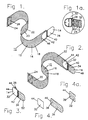
- a strap according to the present invention has the general designation 10 and is intended for use with orthopaedic and orthotic appliances.
- Strap 10 may be seen to comprise the principal elements of a main portion 12 and a releasably re-attachable end tab 14.
- Main portion 12 is made from a strip of loop pile fabric with a first side 16 having a first loop pile surface 18 and a second side 20 having a second loop pile surface 22, both loop pile surfaces extending throughout its entire length.
- Strap 10 has a first end 24 pile surfaces extending throughout its entire length.
- Strap 10 has a first end 24 adapted by the provision of a piece of hook pile fabric 26 attached to first surface 16. by any standard method including sewing, high frequency welding or even by selecting it to have hook pile on both sides.
- hook pile fabric 26 indicated in hidden detail is used to secure first end 24 of main strap portion 12 to itself around suitable anchor means such as a plastic anchor plate with guide means, represented at 28 and mounted on an appliance 30.
- End tab 14 comprises a first portion 32 and a second portion 34 which is longer. Both portions 32 and 34 are made of strips of hook pile fabrics and in this embodiment each has a single hook pile surface 36 and 38, respectively. It will be readily appreciated by those skilled in the art that main portion 12 of strap 10 could equally be made from hook pile fabrics in which case portions 32 and 34 of end tab 14 would be made from loop pile fabric. I prefer to use loop pile fabric for main portion 12 because hook pile is uncomfortable against the skin and strap/skin contact can often occur in orthopaedic and orthotic applications. Portions 32 and 34 of end tab 14 are mutually attached, preferably by strong oversewing, indicated at 40, with hook pile surfaces 36 and 38 opposed facing inwards.
- Sewing is strongly preferred since high frequency welding can weaken the base material leading to failure under robust traction. This problem is accentuated when functional surfaces rather than flat backings of hook or loop pile narrow fabrics are welded opposed. The attendant loss of performance is not acceptable in orthopaedic and orthotic use.
- 32 and 34 are mutually attached such that their respective ends 44 and 46 are substantially co-linear.
- Opposed hook pile surfaces 36 and 38 of end tab 14 are separated and then manually pressed against loop pile surfaces 18 and 22 of main strap portion 12 at its second end 42.
- the functional lengths of opposed hook pile surfaces 36 of portion 32 and corresponding portion 38 of portion 34 need not exceed the width of the material of end tab 14 in general orthopaedic and orthotic applications and may re-attachable end tab of the present invention may be enjoyed without penalty since it is quite usual to use an overlapped sewn area between the main portion of a strap and a non-releasable end tab of a conventional appliance strap.
- the length of such an oversewn area will generally equal or exceed the width of material used.
- the advantage of the instant end tab 14 may be enhanced by making it from strips of fabric somewhat less in width than main portion 12 of strap 10.
- end tab 14 may be made of 11 ⁇ 2'' (38mm) material and in many cases the functional lengths of 36 and 38 may be as little as 1.2" (30mm) whilst still providing excellent attachment characteristics.
- Such a strategy also improves cosmetic appearance of strap 10. It addition it ensures that in the event of re-attachment of end tab 14 in less than perfect alignment at some point, its edges are less likely to overrun the edges of main portion 12 and this assists smoother running of straps according to the present invention through guide means.
- Tabbing end 48 of end tab 14 has a length which need not normally exceed one and a half times the width for 2" (50mm) and 11 ⁇ 2'' end tabs according to the present invention but for narrower end tabs a minimum of 2'' (50mm) is preferable. This is not so much for security as for case of handling during tabbing and untabbing.
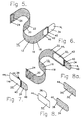
- a strap 10 1 has a main portion 12, substantially similar to that employed in the first embodiment and an end tab 14 1 which is similar in most respects to end tab 14 of the first embodiment.
- End tab 14 1 has a section 32 1 wherein the length of functional surface 36 1 is at least twice that of 36 of portion 32 in the first embodiment to which it corresponds.
- the edges 44 1 and 46 of 32 1 and 34, respectively are not co-linear, however they are substantially parallel. This embodiment would normally be reserved for situations where extra security of attachment beyond normal robust use is required. This might be the case where an appliance is to be fitted on and used by a disturbed or confused patient who might try to interfere with the releasable end tab.
- End tab 14 1 of the second embodiment is always used wath functional surface 36 1 of 32 1 attached to the second loop pile surface 22 of main portion 12 of strap 10 1 . Furthermore, 36 1 is placed on the side of strap 10 1 towards the patient so that it is effectively hidden and inaccessible when strap 10 1 is secured in use.
- the instant straps of both embodiments are intended to be used either circumferentially or hemi-circumferentially about the limbs or trunk.
- forces generated between a strap and the limb will be directed radially.
- Compressive and inwardly directed radial forces from the strap will be opposed by equal, outwardly directed forces generated in the tissues.
- this effect also serves to maintain a mutually compressive relationship between hook surface 36 of end tab 14 and hook surface 36 1 of end tab 14 1 against second loop pile surface 22 of main strap portion 12 in strap set ups as shown in Figs 1, 2, 5 and 6, providing excellent security.
- the second preferred embodiment takes particular advantage of this effect.
- tensional forces in the instant straps of both embodiments will be circumferential and will therefore be effectively directed along the hook to loop attachment surfaces between main portion 12 and end tabs 14 and 14 1 which is generally accepted as the optimum arrangement to prevent unwanted separation of such attachments in these materials.
- straps according to the present invention may be shortened quickly and easily without recourse to removal of the appliance from the patient and without unlocking the first end of the strap from the appliance. This is accomplished simply by peeling back the tab end to access the rest of the end tab, peeling this off the main strap portion, which is trimmed as required, then re-attaching the end tab and re-tensioning and tabbing down the strap to itself.
- straps of the present invention may be moved from one suitable anchor point on an appliance to another, for instance to change from left to right handed use.
- a strap may also be docked at the anchor point with the first end 24 either on view, facing outwards, or obscured, facing inwards, according to choice and circumstances. If a change is made from one choice to the other it is only necessary to remove the end tab turn it over and re-attach it.
- this invention provides an improved strap for orthopaedic and orthotic appliances having a reieasable and re-attachable end tab of sewn construction which provides for easier shortening and adjustment and enhanced general versatility.
- this invention has been described in respect of two preferred embodiments, modifications and adapations may readily be made by those skilled in the art of orthopaedics and orthotics and it is intended that the claims cover any such modifications and adapations which fall within the spirit and scope of the invention.
- the invention comprises
Landscapes
- Health & Medical Sciences (AREA)
- Nursing (AREA)
- Orthopedic Medicine & Surgery (AREA)
- Engineering & Computer Science (AREA)
- Biomedical Technology (AREA)
- Heart & Thoracic Surgery (AREA)
- Vascular Medicine (AREA)
- Life Sciences & Earth Sciences (AREA)
- Animal Behavior & Ethology (AREA)
- General Health & Medical Sciences (AREA)
- Public Health (AREA)
- Veterinary Medicine (AREA)
- Footwear And Its Accessory, Manufacturing Method And Apparatuses (AREA)
- Orthopedics, Nursing, And Contraception (AREA)
Applications Claiming Priority (2)
| Application Number | Priority Date | Filing Date | Title |
|---|---|---|---|
| GBGB9516243.4A GB9516243D0 (en) | 1995-08-08 | 1995-08-08 | Improved straps for orthopaedic and orthotic appliances |
| GB9516243 | 1995-08-08 |
Publications (2)
| Publication Number | Publication Date |
|---|---|
| EP0761184A2 true EP0761184A2 (de) | 1997-03-12 |
| EP0761184A3 EP0761184A3 (de) | 2000-02-09 |
Family
ID=10778944
Family Applications (1)
| Application Number | Title | Priority Date | Filing Date |
|---|---|---|---|
| EP96305782A Withdrawn EP0761184A3 (de) | 1995-08-08 | 1996-08-06 | Verbesserte Bänder für orthopädische und orthetische Anwendungen |
Country Status (2)
| Country | Link |
|---|---|
| EP (1) | EP0761184A3 (de) |
| GB (1) | GB9516243D0 (de) |
Cited By (5)
| Publication number | Priority date | Publication date | Assignee | Title |
|---|---|---|---|---|
| FR2881947A1 (fr) * | 2005-02-15 | 2006-08-18 | Richard Freres Sa Sa | Orthese reversible |
| EP1792589A1 (de) | 2005-12-02 | 2007-06-06 | Ebi, L.P. | Befestigungsadapter |
| WO2014060367A3 (en) * | 2012-10-15 | 2015-02-19 | Velcro Industries B.V. | Double-sided fasteners |
| KR20150066567A (ko) * | 2012-10-09 | 2015-06-16 | 쓰리엠 이노베이티브 프로퍼티즈 컴파니 | 체결구 부재 |
| KR20180026925A (ko) * | 2016-09-05 | 2018-03-14 | 신해원 | 찜질 밴드 모듈 |
Family Cites Families (4)
| Publication number | Priority date | Publication date | Assignee | Title |
|---|---|---|---|---|
| KR880002481A (ko) * | 1986-08-05 | 1988-05-09 | 로랜드 유. 로제오 | 전단 트랩 터치 패스너 시스템 |
| US5136759A (en) * | 1990-01-12 | 1992-08-11 | Armour Ii Thomas W | Multi-purpose fastening device |
| US5217431A (en) * | 1992-02-20 | 1993-06-08 | Smith & Nephew Donjoy, Inc. | Orthopedic ankle brace |
| EP0605013A1 (de) * | 1992-12-30 | 1994-07-06 | Kimberly-Clark Corporation | Verstellbares Kleidungsstück |
-
1995
- 1995-08-08 GB GBGB9516243.4A patent/GB9516243D0/en active Pending
-
1996
- 1996-08-06 EP EP96305782A patent/EP0761184A3/de not_active Withdrawn
Cited By (13)
| Publication number | Priority date | Publication date | Assignee | Title |
|---|---|---|---|---|
| FR2881947A1 (fr) * | 2005-02-15 | 2006-08-18 | Richard Freres Sa Sa | Orthese reversible |
| EP1716826A1 (de) * | 2005-02-15 | 2006-11-02 | Richard Freres S.A. | Beidseitig tragbare Orthese |
| EP1792589A1 (de) | 2005-12-02 | 2007-06-06 | Ebi, L.P. | Befestigungsadapter |
| US7451531B2 (en) | 2005-12-02 | 2008-11-18 | Ebi, Llc | Fastener adapter |
| US7661178B2 (en) | 2005-12-02 | 2010-02-16 | Ebi, Llc | Fastener adapter |
| KR20150066567A (ko) * | 2012-10-09 | 2015-06-16 | 쓰리엠 이노베이티브 프로퍼티즈 컴파니 | 체결구 부재 |
| WO2014060367A3 (en) * | 2012-10-15 | 2015-02-19 | Velcro Industries B.V. | Double-sided fasteners |
| CN105025747A (zh) * | 2012-10-15 | 2015-11-04 | 维尔克工业有限公司 | 双面紧固件 |
| US9339085B2 (en) | 2012-10-15 | 2016-05-17 | Velcro BVBA | Double-sided fasteners |
| US10117481B2 (en) | 2012-10-15 | 2018-11-06 | Velcro BVBA | Double-sided fasteners |
| CN108741448A (zh) * | 2012-10-15 | 2018-11-06 | 维尔克有限公司 | 双面紧固件 |
| US11246381B2 (en) | 2012-10-15 | 2022-02-15 | Velcro Ip Holdings Llc | Double-sided fasteners |
| KR20180026925A (ko) * | 2016-09-05 | 2018-03-14 | 신해원 | 찜질 밴드 모듈 |
Also Published As
| Publication number | Publication date |
|---|---|
| EP0761184A3 (de) | 2000-02-09 |
| GB9516243D0 (en) | 1995-10-11 |
Similar Documents
| Publication | Publication Date | Title |
|---|---|---|
| US4013070A (en) | Body part immobilizer | |
| CA2121342C (en) | Adjustable knee support | |
| US5076288A (en) | Double-lock friction fastener system | |
| US6099490A (en) | Support brace | |
| US5152741A (en) | Surgical chest dressing | |
| US4396013A (en) | Support and guide strap | |
| US5758366A (en) | Garment belt | |
| US4905713A (en) | Shoulder movement restriction device | |
| PL175427B1 (pl) | Pas mocujący do artykułu konfekcyjnego | |
| US4355635A (en) | Adjustable arm sling with pouch | |
| JPH09135856A (ja) | 医療用コルセット | |
| WO1999034757A1 (en) | Adjustable ankle brace system | |
| CN106794075A (zh) | 压缩系统 | |
| EP0761184A2 (de) | Verbesserte Bänder für orthopädische und orthetische Anwendungen | |
| US3932897A (en) | Hockey garter belt | |
| US3547117A (en) | Athletic supporter | |
| US20040134501A1 (en) | Universal leg brace | |
| US6406469B1 (en) | Re-useable holders for diapers and disposable liners | |
| JP3043552U (ja) | 腰痛用ベルト | |
| US20070220659A1 (en) | Underpants | |
| US20260108085A1 (en) | Cover for cushion | |
| JPH0718725Y2 (ja) | 病人用下着 | |
| JP2004024437A (ja) | 骨盤矯正ベルト | |
| JPH10127674A (ja) | 膝用サポータ | |
| JP2595012Y2 (ja) | 病人用ズボン |
Legal Events
| Date | Code | Title | Description |
|---|---|---|---|
| PUAI | Public reference made under article 153(3) epc to a published international application that has entered the european phase |
Free format text: ORIGINAL CODE: 0009012 |
|
| AK | Designated contracting states |
Kind code of ref document: A2 Designated state(s): DE ES FR GB IT SE |
|
| PUAL | Search report despatched |
Free format text: ORIGINAL CODE: 0009013 |
|
| AK | Designated contracting states |
Kind code of ref document: A3 Designated state(s): DE ES FR GB IT SE |
|
| RIC1 | Information provided on ipc code assigned before grant |
Free format text: 7A 61F 5/00 A, 7A 61F 13/62 B, 7A 44B 18/00 B |
|
| STAA | Information on the status of an ep patent application or granted ep patent |
Free format text: STATUS: THE APPLICATION IS DEEMED TO BE WITHDRAWN |
|
| 18D | Application deemed to be withdrawn |
Effective date: 20000810 |