EP0761609B1 - Terpolymère agent inhibiteur d'incrustations et méthode de traitement des eaux - Google Patents
Terpolymère agent inhibiteur d'incrustations et méthode de traitement des eaux Download PDFInfo
- Publication number
- EP0761609B1 EP0761609B1 EP96113182A EP96113182A EP0761609B1 EP 0761609 B1 EP0761609 B1 EP 0761609B1 EP 96113182 A EP96113182 A EP 96113182A EP 96113182 A EP96113182 A EP 96113182A EP 0761609 B1 EP0761609 B1 EP 0761609B1
- Authority
- EP
- European Patent Office
- Prior art keywords
- water
- acid
- agent
- meth
- liter
- Prior art date
- Legal status (The legal status is an assumption and is not a legal conclusion. Google has not performed a legal analysis and makes no representation as to the accuracy of the status listed.)
- Expired - Lifetime
Links
Images

Classifications
-
- C—CHEMISTRY; METALLURGY
- C02—TREATMENT OF WATER, WASTE WATER, SEWAGE, OR SLUDGE
- C02F—TREATMENT OF WATER, WASTE WATER, SEWAGE, OR SLUDGE
- C02F5/00—Softening water; Preventing scale; Adding scale preventatives or scale removers to water, e.g. adding sequestering agents
- C02F5/08—Treatment of water with complexing chemicals or other solubilising agents for softening, scale prevention or scale removal, e.g. adding sequestering agents
- C02F5/10—Treatment of water with complexing chemicals or other solubilising agents for softening, scale prevention or scale removal, e.g. adding sequestering agents using organic substances
- C02F5/12—Treatment of water with complexing chemicals or other solubilising agents for softening, scale prevention or scale removal, e.g. adding sequestering agents using organic substances containing nitrogen
- C02F5/125—Treatment of water with complexing chemicals or other solubilising agents for softening, scale prevention or scale removal, e.g. adding sequestering agents using organic substances containing nitrogen combined with inorganic substances
-
- C—CHEMISTRY; METALLURGY
- C02—TREATMENT OF WATER, WASTE WATER, SEWAGE, OR SLUDGE
- C02F—TREATMENT OF WATER, WASTE WATER, SEWAGE, OR SLUDGE
- C02F5/00—Softening water; Preventing scale; Adding scale preventatives or scale removers to water, e.g. adding sequestering agents
-
- C—CHEMISTRY; METALLURGY
- C02—TREATMENT OF WATER, WASTE WATER, SEWAGE, OR SLUDGE
- C02F—TREATMENT OF WATER, WASTE WATER, SEWAGE, OR SLUDGE
- C02F5/00—Softening water; Preventing scale; Adding scale preventatives or scale removers to water, e.g. adding sequestering agents
- C02F5/08—Treatment of water with complexing chemicals or other solubilising agents for softening, scale prevention or scale removal, e.g. adding sequestering agents
- C02F5/10—Treatment of water with complexing chemicals or other solubilising agents for softening, scale prevention or scale removal, e.g. adding sequestering agents using organic substances
-
- C—CHEMISTRY; METALLURGY
- C02—TREATMENT OF WATER, WASTE WATER, SEWAGE, OR SLUDGE
- C02F—TREATMENT OF WATER, WASTE WATER, SEWAGE, OR SLUDGE
- C02F5/00—Softening water; Preventing scale; Adding scale preventatives or scale removers to water, e.g. adding sequestering agents
- C02F5/08—Treatment of water with complexing chemicals or other solubilising agents for softening, scale prevention or scale removal, e.g. adding sequestering agents
- C02F5/10—Treatment of water with complexing chemicals or other solubilising agents for softening, scale prevention or scale removal, e.g. adding sequestering agents using organic substances
- C02F5/105—Treatment of water with complexing chemicals or other solubilising agents for softening, scale prevention or scale removal, e.g. adding sequestering agents using organic substances combined with inorganic substances
-
- C—CHEMISTRY; METALLURGY
- C02—TREATMENT OF WATER, WASTE WATER, SEWAGE, OR SLUDGE
- C02F—TREATMENT OF WATER, WASTE WATER, SEWAGE, OR SLUDGE
- C02F5/00—Softening water; Preventing scale; Adding scale preventatives or scale removers to water, e.g. adding sequestering agents
- C02F5/08—Treatment of water with complexing chemicals or other solubilising agents for softening, scale prevention or scale removal, e.g. adding sequestering agents
- C02F5/10—Treatment of water with complexing chemicals or other solubilising agents for softening, scale prevention or scale removal, e.g. adding sequestering agents using organic substances
- C02F5/12—Treatment of water with complexing chemicals or other solubilising agents for softening, scale prevention or scale removal, e.g. adding sequestering agents using organic substances containing nitrogen
-
- C—CHEMISTRY; METALLURGY
- C23—COATING METALLIC MATERIAL; COATING MATERIAL WITH METALLIC MATERIAL; CHEMICAL SURFACE TREATMENT; DIFFUSION TREATMENT OF METALLIC MATERIAL; COATING BY VACUUM EVAPORATION, BY SPUTTERING, BY ION IMPLANTATION OR BY CHEMICAL VAPOUR DEPOSITION, IN GENERAL; INHIBITING CORROSION OF METALLIC MATERIAL OR INCRUSTATION IN GENERAL
- C23F—NON-MECHANICAL REMOVAL OF METALLIC MATERIAL FROM SURFACE; INHIBITING CORROSION OF METALLIC MATERIAL OR INCRUSTATION IN GENERAL; MULTI-STEP PROCESSES FOR SURFACE TREATMENT OF METALLIC MATERIAL INVOLVING AT LEAST ONE PROCESS PROVIDED FOR IN CLASS C23 AND AT LEAST ONE PROCESS COVERED BY SUBCLASS C21D OR C22F OR CLASS C25
- C23F11/00—Inhibiting corrosion of metallic material by applying inhibitors to the surface in danger of corrosion or adding them to the corrosive agent
- C23F11/08—Inhibiting corrosion of metallic material by applying inhibitors to the surface in danger of corrosion or adding them to the corrosive agent in other liquids
- C23F11/10—Inhibiting corrosion of metallic material by applying inhibitors to the surface in danger of corrosion or adding them to the corrosive agent in other liquids using organic inhibitors
-
- C—CHEMISTRY; METALLURGY
- C23—COATING METALLIC MATERIAL; COATING MATERIAL WITH METALLIC MATERIAL; CHEMICAL SURFACE TREATMENT; DIFFUSION TREATMENT OF METALLIC MATERIAL; COATING BY VACUUM EVAPORATION, BY SPUTTERING, BY ION IMPLANTATION OR BY CHEMICAL VAPOUR DEPOSITION, IN GENERAL; INHIBITING CORROSION OF METALLIC MATERIAL OR INCRUSTATION IN GENERAL
- C23F—NON-MECHANICAL REMOVAL OF METALLIC MATERIAL FROM SURFACE; INHIBITING CORROSION OF METALLIC MATERIAL OR INCRUSTATION IN GENERAL; MULTI-STEP PROCESSES FOR SURFACE TREATMENT OF METALLIC MATERIAL INVOLVING AT LEAST ONE PROCESS PROVIDED FOR IN CLASS C23 AND AT LEAST ONE PROCESS COVERED BY SUBCLASS C21D OR C22F OR CLASS C25
- C23F11/00—Inhibiting corrosion of metallic material by applying inhibitors to the surface in danger of corrosion or adding them to the corrosive agent
- C23F11/08—Inhibiting corrosion of metallic material by applying inhibitors to the surface in danger of corrosion or adding them to the corrosive agent in other liquids
- C23F11/10—Inhibiting corrosion of metallic material by applying inhibitors to the surface in danger of corrosion or adding them to the corrosive agent in other liquids using organic inhibitors
- C23F11/173—Macromolecular compounds
-
- C—CHEMISTRY; METALLURGY
- C23—COATING METALLIC MATERIAL; COATING MATERIAL WITH METALLIC MATERIAL; CHEMICAL SURFACE TREATMENT; DIFFUSION TREATMENT OF METALLIC MATERIAL; COATING BY VACUUM EVAPORATION, BY SPUTTERING, BY ION IMPLANTATION OR BY CHEMICAL VAPOUR DEPOSITION, IN GENERAL; INHIBITING CORROSION OF METALLIC MATERIAL OR INCRUSTATION IN GENERAL
- C23F—NON-MECHANICAL REMOVAL OF METALLIC MATERIAL FROM SURFACE; INHIBITING CORROSION OF METALLIC MATERIAL OR INCRUSTATION IN GENERAL; MULTI-STEP PROCESSES FOR SURFACE TREATMENT OF METALLIC MATERIAL INVOLVING AT LEAST ONE PROCESS PROVIDED FOR IN CLASS C23 AND AT LEAST ONE PROCESS COVERED BY SUBCLASS C21D OR C22F OR CLASS C25
- C23F14/00—Inhibiting incrustation in apparatus for heating liquids for physical or chemical purposes
- C23F14/02—Inhibiting incrustation in apparatus for heating liquids for physical or chemical purposes by chemical means
Definitions
- the present invention relates to a novel water treating agent and a method for treating water therewith.
- the present invention relates to a novel water treating agent which is used in boilers, cooling water systems, hot water systems and dust collecting water plants for preventing them from being disordered by heat transfer failure, flow rate depression and local corrosion to be caused by adhesion or deposition of scale, sludge and slime onto heating pipes, heat exchangers, condensers, reactors for polymerization and various pipe lines in them also relates to a method of using the agent for treating water in them.
- poly phosphates and carboxylic acid polymers have been used in a scale inhibiting and fouling preventing agent to be used in boilers, cooling water systems, dust collecting water plants and water supply piping systems for the purpose of preventing the adhesion of scale onto the surfaces of the metal parts to be kept in contact with water, preventing the deposition of sludge onto them and preventing the local corrosion to occur in the area under the fouled parts.
- poly phosphates are defective in that they are easily hydrolyzed to give orthophosphates, which precipitate as calcium phosphate in water systems having high pH and high calcium hardness at high temperatures to often accelerate scale troubles in them.
- orthophosphates which precipitate as calcium phosphate in water systems having high pH and high calcium hardness at high temperatures to often accelerate scale troubles in them.
- waste waters containing phosphorus are problematic as causing eutrophication in closed water areas such as lakes, marshes and island seas, the use of phosphorus containing chemicals must be limited.
- carboxylic acid polymers form insoluble salts in water containing high concentrations of poly valent metal ions and the salts precipitate therein, with the result that the polymers are not effective in such water.
- the polymers are applied to water having a high calcium ion concentration, the water becomes cloudy due to the calcium salts formed and precipitated therein.
- a phosphorus free water treating agent for scale inhibition which comprises a copolymer of a conjugated dienesulfonic acid and (meth)acrylic acid and which is said to be effective even in systems having high metal ion concentrations without being precipitated therein. Comparing this with sodium polyacrylate which has heretofore been used in conventional water treating agents, the former is superior to the latter but is not satisfactorily good. Therefore, it is desired to obtain a water treating agent having much improved scale retarding and fouling preventing effects.
- CHEMICAL ABSTRACTS vol. 166, no. 26, 29 June 1992, abstract no. 256737p, page 49, column 2 - page 50, column 1 and JP-A-04 028 708 disclose a copolymer which can be produced by copolymerising a conjugated dienesulfonate, a carboxyl-containing compound and a hydroxyl-containing compound.
- the sulfogroup containing copolymer may be used for the treatment of water.
- EP-A-0 337 738 discloses a sulfonation product of conjugated diene.
- the particular sulfonation product may be used as a water-treating agent.
- the object of the present invention is to provide a phosphorus free water treating agent which does not react with poly valent ions to form insoluble salts and which has an excellent and long lasting, scale inhibiting and fouling preventing effect, and also a method for treating water therewith.
- the object of the present invention is to provide a water treating agent having an excellent metal corrosion preventing effect, and also a method for treating water therewith.
- the first aspect of the present invention is to provide a water treating agent comprising a ternary copolymer which is synthesized from a conjugated dienesulfonic acid and/or its salt of the following general formula [1]: wherein R 1 , R 2 , R 3 , R 4 , R 5 and R 6 each represent a hydrogen atom, a methyl group or -SO 3 X 1 , provided that one or more of R 1 to R 6 are methyl groups, one or more of the remaining R 1 to R 6 are groups of -SO 3 X 1 , and X 1 represents a hydrogen atom, a monovalent metal, or an ammonium group unsubstituted or mono substituted by an organic group: and a (meth)acrylic acid and/or its salts of the following general formula [2]: wherein R 7 represents a hydrogen atom or a methyl group; and X 2 represents a hydrogen atom, a monovalent metal, or an ammonium group unsubstituted or mono
- the ternary copolymer to be in the water treating agent comprises from 5 to 50 mol% of the unit derived from the conjugated dienesulfonic acid and/or its salt, from 40 to 90 mol% of the unit derived from the (meth)acrylic acid and/or its salt, and from 1 to 20 mol% of the unit derived from the (meth)acrylamido-2-methylalkanesulfonic acid and/or its salt.
- the ternary copolymer to be in the water treating agent has a weight average molecular weight of from 500 to 300,000.
- the water treating agent further comprises a metal corrosion inhibitor.
- the metal corrosion inhibitor to be optionally in the water treating agent comprises at least one selected from the group consisting of polyvalent metal salts, phosphonates, azoles, phosphates, phosphocarboxylates, amines and phosphoric esters.
- the second aspect of the present invention is to provide a method for treating water, comprising adding to water systems a water treating agent that comprises a ternary copolymer as synthesized from a conjugated dienesulfonic acid and/or its salt of the following general formula [1]: wherein R 1 , R 2 , R 3 , R 4 , R 5 and R 6 each represent a hydrogen atom, a methyl group or -SO 3 X 1 , provided that one or more of R 1 to R 6 are methyl groups, one or more of the remaining R 1 to R 6 are groups of -SO 3 X 1 , and X 1 represents a hydrogen atom, a monovalent metal, or an ammonium group unsubstituted or mono substituted by an organic group; and a (meth)acrylic acid and/or its salts of the following general formula [2]: wherein R 7 represents a hydrogen atom or a methyl group; and X 2 represents a hydrogen atom, a monovalent metal, or an ammoni
- the ternary copolymer to be in the water treating agent comprises from 5 to 50 mol% of the unit derived from the conjugated dienesulfonic acid and/or its salt, from 40 to 90 mol% of the unit derived from the (meth)acrylic acid and/or its salt, and from 1 to 20 mol% of the unit derived from the (meth)acrylamido-2-methylalkanesulfonic acid and/or its salt.
- the ternary copolymer to be in the water treating agent has a weight-average molecular weight of from 500 to 300,000.
- the water treating agent further comprises a metal corrosion inhibitor in addition to the ternary copolymer.
- the metal corrosion inhibitor to be optionally in the water treating agent comprises at least one selected from the group consisting of polyvalent metal salts, phosphonates, azoles, phosphates, phosphocarboxylates, amines and phosphoric esters.
- Fig. 1 is a flow diagram of the pilot plant of a water-cooling system as used here in Examples 19 to 21 and Comparative Examples 41 to 42.
- the water treating agent of the present invention comprises a copolymer which is synthesized from a conjugated dienesulfonic acid and/or its salts of the following general formula [1], a (meth)acrylic acid and/or its salts of the following general formula [2], and a (meth)acrylamido-2-methylalkanesulfonic acid and/or its salt of the following general formula [4]:
- R 1 , R 2 , R 3 , R 4 , R 5 and R 6 each represent a hydrogen atom, a methyl group or -SO 3 X 1 , provided that one or more of R 1 to R 6 are methyl groups, one or more of the remaining R 1 to R 6 are groups of -SO 3 X 1 , and X 1 represents a hydrogen atom, a monovalent metal, or an ammonium group unsubstituted or mono substituted by an organic group.
- R 7 represents a hydrogen atom or a methyl group
- X 2 represents a hydrogen atom, a monovalent metal, or an ammonium group unsubstituted or mono substituted by an organic group.
- R 9 and R 10 each represent a hydrogen atom or a methyl group
- X 3 represents a hydrogen atom, a monovalent metal, or an ammonium group unsubstituted or mono-substituted by an organic group.
- the ammonium group as mono substituted by an organic group is an ammonium group to be formed through the reaction of -SO 3 H or -COOH with a primary amine.
- the primary amine that can give such an ammonium group as mono substituted by an organic group includes, for example, methylamine, ethylamine, propylamine, isopropylamine, butylamine, isobutylamine, sec butylamine, tert butylamine, pentylamine, hexylamine, cyclohexylamine, benzylamine, and monoethanolamine.
- X 1 and X 2 each are preferably an alkali metal, more preferably sodium.
- the conjugated dienesulfonic acid of formula [1] includes, for example, 2-methyl-1,3-butadiene-1-sulfonic acid, 2-methyl-1,3-butadiene-3-sulfonic acid, 2-methyl-1,3-butadiene-4-sulfonic acid, 1,3-pentadiene-1-sulfonic acid, 1,3-pentadiene-2-sulfonic acid, 1,3-pentadiene-3-sulfonic acid, 1,3-pentadiene-4-sulfonic acid, 2,3-dimethylbutadiene-1-sulfonic acid, 2-methyl-1,3-pentadiene-4-sulfonic acid, 3-methyl-1,3-pentadiene-1-sulfonic acid, 2-methyl-1,3-butadiene-1,3-disulfonic acid, and 2-methyl-1,3-butadiene-1,4-disulfonic acid.
- the (meth)acrylic acid of formula [2] includes acrylic acid and methacrylic acid.
- Acrylic acid is preferably used in the water treating agent of the present invention.
- the method of copolymerizing the conjugated dienesulfonic acid and/or its salt of formula [1], the (meth)acrylic acid and/or its salt of formula [2], and the (meth)acrylamido-2-methylalkanesulfonic acid and/or its salt of formula [4] to obtain the ternary copolymer for use in the present invention is not specifically defined but may be any conventional one.
- the monomer of formula [1], the monomer of formula [2] and the monomer of formula [4] are all soluble in water, and the ternary copolymer to be obtained through copolymerization of these monomers is also soluble in water. Therefore, solution polymerization using water as the medium is preferably employed to copolymerize these monomers.
- solution polymerization using water as the medium is such that the pre-determined monomers are dissolved in water, then the atmosphere around the resulting system is substituted with nitrogen, a water soluble, radical polymerization initiator is added thereto, and the system is heated.
- the radical polymerization initiator includes, for example, hydrogen peroxide, sodium persulfate, potassium persulfate, ammonium persulfate, 2,2'-azobis(2-amidinopropane) dihydrochloride, and t butyl hydroperoxide.
- the polymerization initiator can be added successively or all at a time.
- the amount of the polymerization initiator to be added may be generally from 0.01 to 5 parts by weight, preferably from 0.1 to 3 parts by weight, relative to 100 parts by weight of the monomers in total. If it is less than 0.01 parts by weight, the polymerization of the monomers could not be conducted efficiently, but if it is more than 5 parts by weight, the cost of the catalyst uneconomically increases too much.
- a reducing agent such as sodium pyrobisulfite, ferrous sulfate, copper sulfate, triethanolamine, glucose, formaldehyde sodium sulfoxylate, L-ascorbic acid or its salt or sodium hydrogensulfite, and also a chelating agent, such as glycine, alanine or sodium ethylenediaminetetraacetate, can be added to the polymerization system.
- a reducing agent such as sodium pyrobisulfite, ferrous sulfate, copper sulfate, triethanolamine, glucose, formaldehyde sodium sulfoxylate, L-ascorbic acid or its salt or sodium hydrogensulfite
- a chelating agent such as glycine, alanine or sodium ethylenediaminetetraacetate
- a chain transfer agent can be used as the agent for controlling the molecular weight of the copolymer to be produced.
- the chain transfer agent includes, for example, mercaptans such as t dodecylmercaptan, n tetradecylmercaptan, octylmercaptan, t hexylmercaptan and n hexylmercaptan, halides such as ethylene bromide, hydrocarbons such as 9,10-dihydroanthracene, 1,4-cyclohexadiene and 1,4-dihydroanthracene, heterocyclic compounds such as 2,5-dihydrofuran, as well as ⁇ -methylstyrene dimers, and xanthogen disulfides.
- the chain transfer agent can be added in an amount of less than 10 parts by weight relative to 100 parts by weight of the monomers in total.
- the polymerization temperature may be from -50 to +200°C, preferably from +50 to +150°C.
- the polymerization time may be from 0.1 to 30 hours, within which the radical polymerization shall be conducted.
- the time for the addition of the monomers shall be from 0.5 to 5 hours, preferably from 1 to 3 hours.
- the copolymer to be in the water treating agent of the present invention which has the ability to inhibit scaling and to prevent fouling in water plants comprises from 5 to 50 mol% of the unit derived from the conjugated dienesulfonic acid and/or its salt, from 40 to 90 mol% of the unit derived from the (meth)acrylic acid and/or its salt, and from 1 to 20 mol% of the unit derived from the (meth)acrylamido-2-methylalkanesulfonic acid and/or its salt.
- the copolymer comprises from 10 to 30 mol% of the unit derived from the conjugated dienesulfonic acid and/or its salt, from 60 to 90 mol% of the unit derived from the (meth)acrylic acid and/or its salt, and from 2 to 15 mol% of the unit derived from the (meth)acrylamido-2-methylalkanesulfonic acid and/or its salt.
- the content of the unit derived from the conjugated dienesulfonic acid and/or its salt in the copolymer, which is in the water treating agent of the present invention having the ability to inhibit scaling and to prevent fouling in water systems is less than 5 mol% or more than 50 mol%, the scale inhibiting and fouling preventing effect of the water treating agent will be lowered. If the content of the unit derived from the (meth)acrylic acid and/or its salt in the copolymer is less than 40 mol% or more than 90 mol%, the scale inhibiting and fouling preventing effect of the water treating agent will be also lowered.
- the scale inhibiting and fouling preventing effect of the water treating agent will be also lowered.
- the copolymer to be in the water treating agent of the present invention which has the ability to inhibit scaling and to prevent fouling in water system may comprise any other monomer units, in addition to the unit derived from the conjugated dienesulfonic acid and/or its salt of formula [1], the unit derived from the (meth)acrylic acid and/or its salt of formula [2], and the unit derived from the (meth)acrylamido-2-methylalkanesulfonic acid and/or its salt of formula [4].
- the copolymer of this type comprising such additional monomer units can be obtained by copolymerizing the monomer of formula [1], the monomer of formula [2], the monomer of formula [4], and a monomer copolymerizable with these monomers, according to any known methods.
- the monomer copolymerizable with the monomer of formula [1], the monomer of formula [2] and the monomer of formula [4] includes, for example, 3-allyloxy-2 -hydroxypropanesulfonic acid, vinylsulfonic acid, acid phosphoxyethyl methacrylate, acid phosphoxyethyl acrylate, acid phosphoxy polyoxyethylene glycol monomethacrylate, (meth)acrylamide, (meth)acrylonitrile, methyl (meth)acrylate, glycidyl (meth)acrylate, N methylol(meth)acrylamide, maleic acid, maleic anhydride, styrene, ⁇ -methylstyrene, vinyltoluene, p-methylstyrene, and vinyl acetate.
- the copolymer to be in the water treating agent of the present invention having the ability to inhibit scaling and to prevent fouling in water systems has a weight average molecular weight of from 500 to 300,000, more preferably from 5,000 to 50,000. If the copolymer in the water treating agent has a weight average molecular weight of less than 500, the scale inhibiting and fouling preventing effect of the agent will be lowered. If the copolymer has a weight average molecular weight of more than 300,000. the viscosity of the water treating agent comprising it will be too high so that the agent will be not easy to handle.
- the amount to be added to water systems shall be suitably selected, depending on the quality of water to be treated therewith, which includes its pH, hardness and alkalinity, the temperature of water and also the heat-transferring conditions in the system.
- the amount of the water treating agent to be added shall be from 0.1 to 1,000 mg/liter, in terms of the solid content of the copolymer in the agent. In most cases, the amount may be from 1 to 100 mg/liter, in terms of the solid content of the copolymer in the agent, in order to make the agent exhibit a satisfactory scale inhibiting and fouling preventing effect.
- the water treating agent of the present invention is used in boiler systems, cooling water systems, industrial water supply plants, dust collecting water plants, drainage systems and slug cooling systems in the iron industry, and ash cooling systems in garbage incinerators, for preventing them from being disordered by heat transfer failure and flow rate depression to be caused by adhesion or deposition of scale, sludge and slime onto the surfaces of metal parts in them and by local corrosion to occur in the area under the fouled parts.
- the method of adding to such water systems the water treating agent of the present invention having the ability to inhibit scaling and to prevent fouling in them is not specifically defined.
- the agent can be added thereto all at a time or either intermittently or continuously.
- the water treating agent can be used singly by itself but is preferably used along with a metal corrosion inhibitor to synergistically exhibit the metal corrosion inhibiting effect.
- the metal corrosion inhibitor includes polyvalent metal salts such as zinc salts, nickel salts, molybdates and tungstates; phosphonates; azoles such as triazoles; phosphates such as orthophosphates and polyphosphates; phosphonocarboxylates; amines and phosphoric esters.
- the metal corrosion inhibitor if used, can be added to the copolymer having the ability to inhibit scaling and to inhibit fouling in water systems, in an amount of from 0.1 to 10 parts by weight relative to one part of the copolymer.
- predetermined amounts of these can be previously mixed to give one formulation which shall be added to water systems, or alternatively, the two can be separately added to water systems in such a manner that predetermined amounts of the two shall exist therein.
- the water treating agent of the present invention may further contain any other known water treating agents.
- Known water treating agents include known scale inhibiting and fouling preventing chemicals, microbicides (slime retarding agents), acids and alkalis.
- the known scale inhibiting chemicals include, for example, polyacrylates, polyacrylamides and their partial hydrolysis products, maleic acid polymers, itaconic acid polymers, and binary acrylic copolymers comprising 2-hydroxyethyl methacrylate and hydroxyallyloxypropanesulfonic acid.
- microbicides include, for example, chlorine compounds such as chlorine gas, sodium and potassium hypochlorite, and sodium chloroisocyanurate; inorganic and organic, bromine containing agents; organic nitrogen sulfur compounds; and quaternary ammonium salts.
- isoprenesulfonic acid commercially-available product with an acid content of 40 % by weight
- 200.3 g of acrylic acid commercially available product with an acid content of 80 % by weight
- 31.4 g of acrylamido-2-methylpropanesulfonic acid commercially available product with an acid content of 98 % by weight
- the molar ratio of isoprenesulfonic acid/acrylic acid/acrylamido-2-methylpropanesulfonic acid in the aqueous solution was 20/75/5.
- Demineralized water a pH buffering solution comprising boric acid and sodium borate, a solution of sodium salt of isoprenesulfonic acid/acrylic acid/acrylamido-2-methylpropanesulfonic acid (20/75/5, by mol%) copolymer having a weight average molecular weight of 15,000 (this is a scale inhibiting and foulig-preventing agent), and a solution of calcium chloride were put into a 500-ml conical beaker in that order, to prepare 500 ml of a test liquid having a pH of 8.5, a solid content of the scale inhibiting and fouling preventing agent of 100 mg/liter, and a calcium hardness, in terms of CaCO 3 content, of 50 mg/liter.
- test liquids comprising (A1) and having a calcium concentration, in terms of CaCO 3 , of 900 mg/liter or less did not become turbid, while those comprising (A1) and having a calcium concentration, in terms of CaCO 3 , of 1000 mg/liter or more became turbid.
- the minimum calcium hardness (calcium concentration) that shall make the test liquid cloudy (turbid) was defined to be the anti gelling concentration for the copolymer tested. According to this definition, the anti gelling concentration for the copolymer of the scale inhibiting and fouling preventing agent (A1) tested herein was 1000 mg of CaCO 3 /liter.
- test liquids comprising (B1) and having a calcium concentration, in terms of CaCO 3 , of 500 mg/liter or less did not become turbid, while those comprising (B1) and having a calcium concentration, in terms of CaCO 3 , of 600 mg/liter or more became turbid.
- Example 2 The same experiment as in Example 1 was repeated, except that a solution of sodium salt of isoprenesulfonic acid/acrylic acid/acrylamido-2-methylpropanesulfonic acid (20/75/5, by mol%) copolymer having a weight average molecular weight of 22.000 was used as the scale retarding and soil preventing agent.
- the anti gelling concentration for the scale inhibiting and fouling preventing agent tested herein was 600 mg of CaCO 3 /liter.
- Example 2 The same experiment as in Example 1 was repeated, except that a solution of sodium salt of isoprenesulfonic acid/acrylic acid (25/75, by mol%) copolymer having a weight average molecular weight of 10,000 was used as the scale inhibiting and fouling preventing agent.
- the anti gelling concentration for the scale inhibiting and fouling preventing agent tested herein was 400 mg of CaCO 3 /liter.
- Example 2 The same experiment as in Example 1 was repeated, except that a solution of sodium salt of isoprenesulfonic acid/acrylic acid (25/75, by mol%) copolymer having a weight average molecular weight of 15,000 was used as the scale inhibiting and fouling preventing agent.
- the anti gelling concentration for the scale inhibiting and fouling preventing agent tested herein was 400 mg of CaCO 3 /liter.
- Example 2 The same experiment as in Example 1 was repeated, except that a solution of sodium polyacrylate having a weight average molecular weight of 5,000 was used as the scale inhibiting and fouling preventing agent.
- the anti gelling concentration for the scale inhibiting and fouling preventing agent tested herein was 100 mg of CaCO 3 /liter.
- the scale inhibiting and fouling preventing agent for which the anti gelling concentration is higher, can be dissolved more stably in water having a high calcium hardness while exhibiting a more stable scale inhibiting and fouling preventing effect. It is known from the results of the above mentioned examples and comparative examples that the scale inhibiting and fouling preventing agents of the present invention, each comprising an isoprenesulfonic acid/acrylic acid/acrylamido-2-methylpropanesulfonic acid copolymer, exhibit a higher anti gelling ability and therefore can be dissolved more stably in water having a high calcium hardness than the comparative agent comprising a sodium polyacrylate and even than the other comparative agents each comprising an isoprenesulfonic acid/acrylic acid copolymer, the comparative agents being referred to herein as samples of prior art products.
- Demineralized water a pH buffering solution comprising boric acid and sodium borate, a solution of calcium chloride, a solution of sodium salt of isoprenesulfonic acid/acrylic acid/acrylamido-2-methylpropanesulfonic acid (20/75/5, by mol%) copolymer having a weight average molecular weight of 15,000 (this is a scale inhibiting and fouling preventing agent), and a solution of sodium phosphate were put into a 500-ml conical beaker in that order, to prepare 500 ml of a test liquid having a pH of 8.6, a solid content of the scale inhibiting and fouling-preventing agent of 8 mg/liter, a calcium hardness, in terms of CaCO 3 content, of 100 mg/liter, and a phosphate ion concentration, in terms of PO 4 3- , of 10 mg/liter.
- a pH buffering solution comprising boric acid and sodium borate, a solution of calcium chloride, a solution of sodium salt of isoprenesulfonic
- the conical beaker was sealed with a polyethylene film, and left in a water bath filled with water having a controlled temperature of 60°C. After 40 hours, the test liquid was taken out and filtered through a filter paper having a pore diameter of 0.1 ⁇ m, and the phosphate ion concentration remained in the resulting filtrate was measured to be 9.4 mg PO 4 3- /liter.
- Example 3 The same experiment as in Example 3 was repeated, using the same scale inhibiting and fouling preventing agent as that used in Example 3, except that the concentration of the agent was varied to 6 mg, in terms of the solid content, per liter. The phosphate ion concentration remained in the filtrate was 2.4 mg PO 4 3- /liter.
- Example 3 The same experiment as in Example 3 was repeated, except that a solution of sodium salt of isoprenesulfonic acid/acrylic acid/acrylamido-2-methylpropanesulfonic acid (20/75/5, by mol%) copolymer having a weight average molecular weight of 22,000 was used as the scale inhibiting and fouling preventing agent and that the concentration of the agent was 8 mg, in terms of the solid content, per liter. The phosphate ion concentration remained in the filtrate was 9.2 mg PO 4 3- /liter.
- Example 3 The same experiment as in Example 3 was repeated, except that the same scale inhibiting and fouling preventing agent as that used in Example 5 was used and that the concentration of the agent was varied to 6 mg, in terms of the solid content, per liter.
- the phosphate ion concentration remained in the filtrate was 1.6 mg PO 4 3- /liter.
- Example 3 The same experiment as in Example 3 was repeated, except that a solution of sodium salt of isoprenesulfonic acid/acrylic acid (25/75, by mol%) copolymer having a weight average molecular weight of 15,000 was used as the scale inhibiting and the fouling preventing agent and that the concentration of the agent was 12 mg, in terms of the solid content, per liter.
- the phosphate ion concentration remained in the filtrate was 9.2 mg PO 4 3- /liter.
- Example 3 The same experiment as in Example 3 was repeated, except that the same scale inhibiting and fouling preventing agent as that used in Comparative Example 4 was used and that the concentration of the agent was varied to 10 mg, in terms of the solid content, per liter.
- the phosphate ion concentration remained in the filtrate was 6.3 mg PO 4 3- /liter.
- Example 3 The same experiment as in Example 3 was repeated, except that the same scale inhibiting and fouling preventing agent as that used in Comparative Example 4 was used and that the concentration of the agent was varied to 8 mg, in terms of the solid content, per liter.
- the phosphate ion concentration remained in the filtrate was 3.2 mg PO 4 3- /liter.
- Example 3 The same experiment as in Example 3 was repeated, except that a solution of sodium polyacrylate having a weight-average molecular weight of 5,000 was used as the scale inhibiting and fouling preventing agent and that the concentration of the agent was 12 mg, in terms of the solid content, per liter.
- the phosphate ion concentration remained in the filtrate was 2.5 mg PO 4 3- /liter.
- Example 3 The same experiment as in Example 3 was repeated, except that the same scale inhibiting and fouling preventing agent as that used in Comparative Example 7 was used and that the concentration of the agent was varied to 8 mg, in terms of the solid content, per liter.
- the phosphate ion concentration remained in the filtrate was 1.0 mg PO 4 3- /liter.
- Example 3 The same experiment as in Example 3 was repeated, except that no scale inhibiting and fouling preventing agent was added.
- the phosphate ion concentration remained in the filtrate was 0.3 mg PO 4 3- /liter.
- the test liquid to which the agent was added shall produce a smaller amount of the precipitate of calcium phosphate therein and therefore the phosphate ion content of the filtrate from the test liquid containing the agent shall be near to the original phosphate ion content of the test liquid which is 10 mg PO 4 3- /liter.
- the test liquid to which the agent was added shall produce a larger amount of the precipitate of calcium phosphate therein. Since the precipitate is removed through the filtration of the test liquid containing the agent, the filtrate shall have a smaller phosphate ion content.
- the phosphate ion concentration in the filtrate was only 3.2 mg PO 4 3- /liter.
- the scale inhibiting and fouling preventing agent of the present invention Only when the comparative agent was added in an amount of 12 mg, in terms of the solid content of the agent, per liter of the test liquid, the phosphate ion concentration in the filtrate was larger than 9 mg PO 4 3- /liter.
- the phosphate ion concentration in the filtrate was only 2.5 mg PO 4 3- /liter.
- Demineralized water a solution of calcium chloride, a solution of sodium salt of isoprenesulfonic acid/acrylic acid/acrylamido-2-methylpropanesulfonic acid (20/75/5, by mol%) copolymer having a weight average molecular weight of 22,000 (this is a scale inhibiting and fouling preventing agent), a solution of zinc chloride and a solution of sodium hydrogencarbonate were put into a 500-ml conical beaker in that order. Last, an aqueous solution of 1 wt.%-sodium hydroxide was added thereto to adjust the pH of the resulting mixture.
- the conical beaker was sealed with a polyethylene film, and left in a water bath filled with water having a controlled temperature of 60°C. After 40 hours, the test liquid was taken out and filtered through a filter paper having a pore diameter of 0.1 ⁇ m, and the phosphate ion concentration and the zinc ion concentration remained in the resulting filtrate were measured to be 9.0 mg/liter in total of the two.
- Example 7 The same experiment as in Example 7 was repeated except that a solution of sodium salt of isoprenesulfonic acid/acrylic acid (25/75, by mol%) copolymer having a weight-average molecular weight of 22,000 was used as the scale inhibiting and fouling preventing agent and that the concentration of the agent was 4 mg, in terms of the solid content, per liter. The sum of the phosphate ion concentration and the zinc ion concentration remained in the filtrate was 9.0 mg/liter.
- Example 7 The same experiment as in Example 7 was repeated except that a solution of sodium polyacrylate having a weight average molecular weight of 5,000 was used as the scale inhibiting and fouling preventing agent and that the concentration of the agent was 10 mg, in terms of the solid content, per liter.
- an aqueous solution of 1 wt.%-sodium hydroxide was used for the adjustment of the pH of the mixture in the last step.
- the sum of the phosphate ion concentration and the zinc ion concentration remained in the filtrate was 3.5 mg/liter.
- Example 7 The same experiment as in Example 7 was repeated except that no scale inhibiting and fouling preventing agent was added. In this, an aqueous solution of 1 wt.%-sodium hydroxide was used for the adjustment of the pH of the mixture in the last step. The sum of the phosphate ion concentration and the zinc ion concentration remained in the filtrate was 0.2 mg/liter.
- Example 7 The results of Example 7 and Comparative Examples 10 to 12 are shown in Table 3.
- the test liquid to which the agent was added shall produce a smaller amount of the precipitate of zinc phosphate therein and therefore the sum of the phosphate ion content and the zinc ion content of the filtrate from the test liquid containing the agent shall be near to the sum of the phosphate ion content and the zinc ion content of the original test liquid which is 9.5 mg/liter.
- the test liquid to which the agent was added shall produce a larger amount of the precipitate of zinc phosphate therein. Since the precipitate is removed through the filtration of the test liquid containing the agent, the filtrate shall have a smaller phosphate ion content and a smaller zinc ion content.
- the effect of the scale inhibiting and fouling preventing agent of the present invention comprising an isoprenesulfonic acid/acrylic acid/acrylamido-2-methylpropanesulfonic acid against the precipitation of calcium phosphate is higher than that of the comparative agent comprising an isoprenesulfonic acid/acrylic acid against the same. From these, therefore, it is understood that the scale inhibiting and fouling preventing agent of the present invention is preferable to the comparative agent, as being more effectively applicable to various objects than the latter
- Demineralized water a solution of sodium salt of isoprenesulfonic acid/acrylic acid/acrylamido-2-methylpropanesulfonic acid (20/75/5, by mol%) copolymer having a weight average molecular weight of 15,000 (this is a scale inhibiting and fouling preventing agent), a solution of sodium hydrogencarbonate, a solution of sodium silicate No. 3, a solution of calcium chloride, a solution of magnesium sulfate and a solution of ferric chloride were put into a 500-ml conical beaker in that order. Last, an aqueous solution of 1 wt.% sulfuric acid was added thereto to adjust the pH of the resulting mixture.
- the conical beaker was sealed with a polyethylene film, and left in a water bath filled with water having a controlled temperature of 30°C, for 20 hours. After this, the beaker was taken out, and the dissolved iron content of the supernatant thus separated in the beaker was measured to be 10.0 mg Fe/liter.
- Example 8 The same experiment as in Example 8 was repeated, except that a solution of sodium salt of isoprenesulfonic acid/acrylic acid/acrylamido-2-methylpropanesulfonic acid (20/75/5, by mol%) copolymer having a weight average molecular weight of 22,000 was used as the scale inhibiting and fouling preventing agent and that the concentration of the agent was 5.0 mg, in terms of the solid content, per liter. The dissolved iron content of the supernatant was 10.0 mg Fe/liter.
- Example 8 The same experiment as in Example 8 was repeated, except that a solution of sodium salt of isoprenesulfonic acid/acrylic acid (25/75, by mol%) copolymer having a weight average molecular weight of 16,000 was used as the scale inhibiting and the fouling preventing agent and that the concentration of the agent was 7.5 mg, in terms of the solid content, per liter.
- an aqueous solution of 1 wt.%-sulfuric acid was used for the adjustment of the pH of the mixture in the last step.
- the dissolved iron content of the supernatant was 10.0 mg Fe/liter.
- Example 8 The same experiment as in Example 8 was repeated, except that the same scale inhibiting and fouling preventing agent as that used in Comparative Example 13 was used and that the concentration of the agent was varied to 5.0 mg, in terms of the solid content, per liter.
- an aqueous solution of 1 wt.%-sulfuric acid was used for the adjustment of the pH of the mixture in the last step.
- the dissolved iron content of the supernatant was 7.8 mg Fe/liter.
- Example 8 The same experiment as in Example 8 was repeated, except that a solution of sodium salt of isoprenesulfonic acid/acrylic acid (25/75, by mol%) copolymer having a weight average molecular weight of 22,000 was used as the scale inhibiting and the fouling preventing agent and that the concentration of the agent was 7.5 mg, in terms of the solid content, per liter.
- an aqueous solution of 1 wt.%-sulfuric acid was used for the adjustment of the pH of the mixture in the last step.
- the dissolved iron content of the supernatant was 10.0 mg Fe/liter.
- Example 8 The same experiment as in Example 8 was repeated, except that the same scale inhibiting and fouling preventing agent as that used in Comparative Example 15 was used and that the concentration of the agent was varied to 5.0 mg, in terms of the solid content, per liter.
- an aqueous solution of 1 wt.%-sulfuric acid was used for the adjustment of the pH of the mixture in the last step.
- the dissolved iron content of the supernatant was 8.0 mg Fe/liter.
- Example 9 The same experiment as in Example 9 was repeated, except that a solution of sodium hexametaphosphate was used as the scale inhibiting and fouling preventing agent and that the concentration of the agent was 10.0 mg, in terms of the solid content, per liter.
- an aqueous solution of 1 wt.%-sulfuric acid was used for the adjustment of the pH of the mixture in the last step.
- the dissolved iron content of the supernatant was 3.3 mg Fe/liter.
- Example 8 The same experiment as in Example 8 was repeated, except that a solution of sodium hexametaphosphate was used as the scale inhibiting and fouling preventing agent and that the concentration of the agent was 7.5 mg, in terms of the solid content, per liter.
- an aqueous solution of 1 wt.%-sulfuric acid was used for the adjustment of the pH of the mixture in the last step.
- the dissolved iron content of the supernatant was 2.4 mg Fe/liter.
- Example 8 The same experiment as in Example 8 was repeated, except that a solution of sodium polyacrylate having a weight average molecular weight of 5,000 was used as the scale inhibiting and fouling preventing agent and that the concentration of the agent was 10.0 mg, in terms of the solid content, per liter.
- an aqueous solution of 1 wt.%-sulfuric acid was used for the adjustment of the pH of the mixture in the last step.
- the dissolved iron content of the supernatant was 6.0 mg Fe/liter.
- Example 8 The same experiment as in Example 8 was repeated, except that no scale inhibiting and fouling preventing agent was added. In this, an aqueous solution of 1 wt.%-sulfuric acid was used for the adjustment of the pH of the mixture in the last step. The dissolved iron content of the supernatant was 0.4 mg Fe/liter.
- the iron component as existing in the test liquid shall be precipitated in the form of iron oxide hydrate or iron hydroxide. Therefore, the effect of the scale inhibiting and fouling preventing agent as added to the test liquid for dispersing the iron oxide or iron hydroxide precipitate formed in the test liquid can be evaluated from the data of the dissolved iron content of the supernatant separated from the test liquid to which the agent was added.
- the scale inhibiting and fouling preventing agent of the present invention comprising an isoprenesulfonic acid/acrylic acid/acrylamido-2-methylpropanesulfonic acid copolymer, when added to the test liquid in an amount of 5 mg, in terms of the solid content thereof, per liter, inhibited the precipitation of iron of 10 mg/liter, while acting to completely disperse and keep it in water in the test liquid.
- the comparative agent comprising an isoprenesulfonic acid/acrylic acid copolymer was added to the same test liquid in an amount of 5 mg, in terms of the solid content thereof, per liter, it could not inhibit the precipitation of iron of 10 mg/liter.
- the scale inhibiting and fouling preventing agent of the present invention has a much more excellent effect for dispersing iron oxide and iron hydroxide in water than the comparative agents comprising sodium hexametaphosphate or sodium polyacrylate.
- the water-treating agent of the present invention was tested with respect to its preventing effect against scaling and corrosion therein.
- the test period was 23 days.
- the water balance in the cooling system is shown in Table 5.
- the quality of make up water as supplied to the system and that of the cooling water as circulating therein are shown in Table 6.
- the operational conditions for the heat exchangers used herein are shown in Table 7.
- the chemicals used herein and their concentrations are shown in Table 8.
- the corrosion rate of the test electrodes as installed at the inlet of the heat exchanger No. 1 (H/E 1) and at the outlet of the heat exchanger No. 4 (H/E 4) was measured, using a corrosion monitor (Corrosion Monitor 500C Model, produced by Toho Giken KK) in accordance with a linear polarization method. The results obtained are shown in Table 9. The scaling rate on the heat transfer tube of each heat exchanger was measured and shown in Table 10. Results of Corrosion Test Installation of Electrode Material of Electrode Rate of Corrosion (mg/dm 2.
- Example 10 Comparative Example 21 Inlet of H/E 1 (temperature of water: 40°C) Carbon Steel 5.5 6.4 Copper 0.5 0.8 Outlet of H/E 4 (temperature of water: 47°C) Carbon Steel 7.4 10.1 Copper 0.8 1.2 Results of Scaling Test Heat Exchanger Scaling Rate (mg/cm 2 month)
- Example 10 Comparative Example 21 H/E 1 (temperature of water at inlet: 40°C) 0.9 3.4 H/E 2 0.9 3.5 H/E 3 2.0 8.9 H/E 4 (temperature of water at outlet: 47°C) 2.6 12.7
- compositions of the present invention of Example 10 are superior to the comparative composition of Comparative Example 21 as being more effective against the corrosion of carbon steel and copper and against the scaling of heat transfer tubes in the heat exchangers than the latter.
- the scale formed in this experiment consisted essentially of magnesium silicate of 65 % of all the components constituting it in Comparative Example 21, while the magnesium silicate content of the scale formed in Example 10 was 35 %. It is obvious from these that the effect of the compositions of the present invention against the formation of silica scale is higher than that of the comparative composition.
- the scale inhibiting and fouling preventing agent of the present invention which is obtained by introducing a third component of acrylamido-2-methylpropanesulfonic acid into an isoprenesulfonic acid-acrylic acid copolymer, exhibits a higher effect against corrosion and scaling in water systems, when combined with a corrosion inhibitor, than an isoprenesulfonic acid acrylic acid copolymer.
- the water treating agent of the present invention comprising a conjugated dienesulfonic acid/(meth)acrylic acid/(meth)acrylamido-2-methylalkanesulfonic acid copolymer exhibits an excellent anti scaling and anti fouling effect in water systems and can therefore prevent water systems from being disordered by thermal efficiency depression and water flow rate depression to be caused by adhesion or deposition of scale, sludge and slime onto heat exchangers, heat transfer heating pipes and pipe lines that constitute water systems.
Landscapes
- Chemical & Material Sciences (AREA)
- Engineering & Computer Science (AREA)
- Organic Chemistry (AREA)
- General Chemical & Material Sciences (AREA)
- Chemical Kinetics & Catalysis (AREA)
- Water Supply & Treatment (AREA)
- Life Sciences & Earth Sciences (AREA)
- Environmental & Geological Engineering (AREA)
- Hydrology & Water Resources (AREA)
- Materials Engineering (AREA)
- Mechanical Engineering (AREA)
- Metallurgy (AREA)
- Inorganic Chemistry (AREA)
- Preventing Corrosion Or Incrustation Of Metals (AREA)
- Addition Polymer Or Copolymer, Post-Treatments, Or Chemical Modifications (AREA)
- Pharmaceuticals Containing Other Organic And Inorganic Compounds (AREA)
- Saccharide Compounds (AREA)
- Acyclic And Carbocyclic Compounds In Medicinal Compositions (AREA)
- Removal Of Specific Substances (AREA)
Claims (10)
- Agent de traitement de l'eau comprenant un copolymère ternaire qui est synthétisé à partir d'un acide diène-sulfonique conjugué et/ou de son sel de formule générale [1] :dans laquelle R1, R2, R3, R4, R5 et R6 représentent chacun un atome d'hydrogène, un groupement méthyle ou -SO3X1, à la condition qu'un ou plusieurs de R1 à R6 soient des groupements méthyle, un ou plusieurs des R1 à R6 restants soient des groupements -SO3X1, et X1 représente un atome d'hydrogène, un métal monovalent ou un groupement ammonium non substitué ou monosubstitué par un groupement organique,

d'un acide (méth)acrylique et/ou de ses sels de formule générale [2] suivante :dans laquelle R7 représente un atome d'hydrogène ou un groupement méthyle, et X2 représente un atome d'hydrogène, un métal monovalent, ou un groupement ammonium non substitué ou monosubstitué par un groupement organique,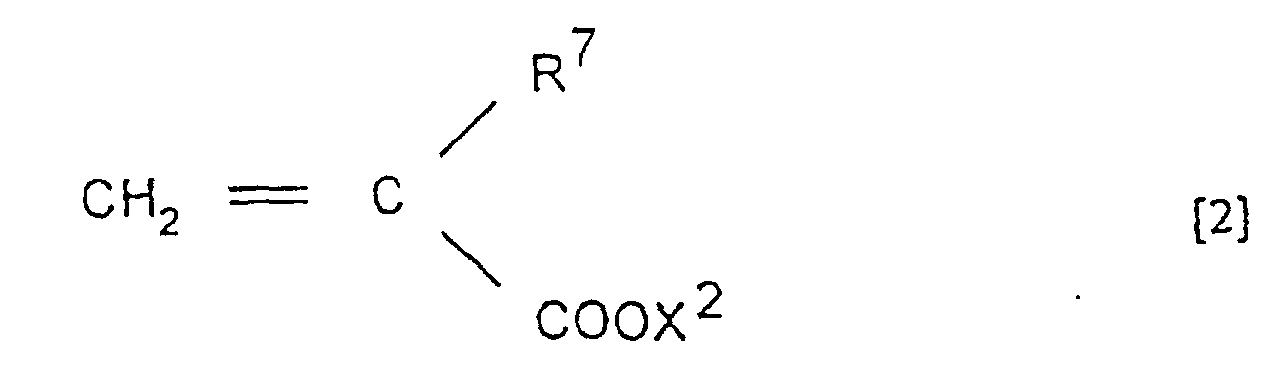
et d'un acide (méth)acrylamido-2-méthylalcane-sulfonique et/ou de son sel de formule générale [4] suivante :dans laquelle R9 et R10 représentent chacun un atome d'hydrogène ou un groupement méthyle, et X3 présente un atome d'hydrogène, un métal monovalent ou un groupement ammonium non substitué ou monosubstitué par un groupement organique.
- Agent de traitement de l'eau selon la revendication 1, dans lequel le copolymère ternaire comprend de 5 à 50 % en mol de l'unité dérivée de l'acide diène-sulfonique conjugué et/ou de son sel, de 40 à 90 % en mol de l'unité dérivée de l'acide (méth)acrylique et/ou de son sel, et de 1 à 20 % en mol de l'unité dérivée de l'acide (méth)acrylamido-2-méthylalcanesulfonique et/ou de son sel.
- Agent de traitement de l'eau selon la revendication 1 ou 2, dans lequel le copolymère ternaire présente une masse moléculaire moyenne en poids de 500 à 300 000.
- Agent de traitement de l'eau selon la revendication 1, qui comprend en outre un inhibiteur de corrosion du métal.
- Agent de traitement de l'eau selon la revendication 4, dans lequel l'inhibiteur de corrosion du métal comprend au moins un composant choisi parmi le groupe constitué de sels de métaux plurivalents, de phosphonates, d'azoles, de phosphates, de polyphosphates, de phosphonocarboxylates, d'amines et d'esters phosphoriques.
- Procédé de traitement de l'eau, comprenant l'addition à des systèmes d'eaux d'un agent de traitement de l'eau qui comprend un copolymère ternaire qui est synthétisé à partir d'un acide diène-sulfonique conjugué et/ou de son sel de formule générale [1] suivante :dans laquelle R1, R2, R3, R4, R5 et R6 représentent chacun un atome d'hydrogène, un groupement méthyle ou -SO3X1, à la condition qu'un ou plusieurs de R1 à R6 soient des groupements méthyle, un ou plusieurs des R1 à R6 restants soient des groupements -SO3X1, et X1 représente un atome d'hydrogène, un métal monovalent, ou un groupement ammonium non substitué ou monosubstitué par un groupement organique,

d'un acide (méth)acrylique et/ou de ses sels de formule générale [2] suivante :dans laquelle R7 représente un atome d'hydrogène ou un groupement méthyle, et X2 représente un atome d'hydrogène, un métal monovalent, ou un groupement ammonium non substitué ou monosubstitué par un groupement organique,
et d'un acide (méth)acrylamido-2-méthylalcane-sulfonique et/ou de son sel de formule générale [4] suivante :dans laquelle R9 et R10 représentent chacun un atome d'hydrogène ou un groupement méthyle, et X3 présente un atome d'hydrogène, un métal monovalent ou un groupement ammonium non substitué ou monosubstitué par un groupement organique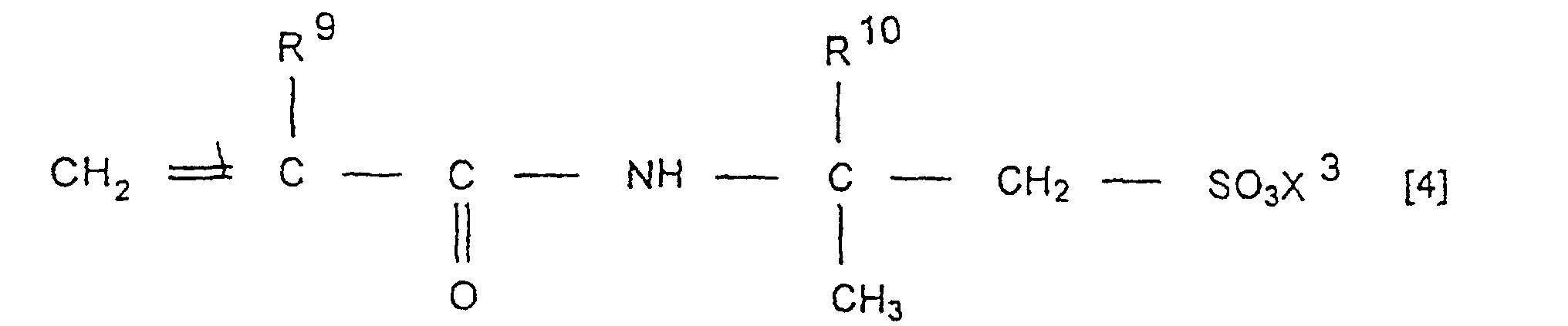
dans une proportion de 0,1 à 1 000 mg/litre. - Procédé de traitement de l'eau selon la revendication 6, dans lequel le copolymère ternaire devant se trouver dans l'agent de traitement de l'eau comprend de 5 à 50 % en mol de l'unité dérivée de l'acide diène-sulfonique conjugué et/ou de son sel, de 40 à 90 % en mol de l'unité dérivée de l'acide (méth)acrylique et/ou de son sel, et de 1 à 20 % en mol de l'unité dérivée de l'acide (méth)acrylamido-2-méthylalcanesulfonique et/ou de son sel.
- Procédé de traitement des eaux selon la revendication 6 ou 7, dans lequel le copolymère ternaire devant se trouver dans l'agent de traitement de l'eau présente une masse moléculaire moyenne en poids de 500 à 300 000.
- Procédé de traitement de l'eau selon la revendication 6, dans lequel l'agent de traitement comprend en outre un inhibiteur de corrosion du métal en plus du copolymère ternaire.
- Procédé de traitement de l'eau selon la revendication 9, dans lequel l'inhibiteur de corrosion du métal comprend au moins un composant choisi parmi le groupe constitué de sels de métaux plurivalents, de phosphonates, d'azoles, de phosphates, de polyphosphates, de phosphonocarboxylates, d'amines et d'esters phosphoriques.
Applications Claiming Priority (6)
| Application Number | Priority Date | Filing Date | Title |
|---|---|---|---|
| JP234785/95 | 1995-08-21 | ||
| JP23478595 | 1995-08-21 | ||
| JP23478595 | 1995-08-21 | ||
| JP2174696 | 1996-01-12 | ||
| JP21746/96 | 1996-01-12 | ||
| JP2174696 | 1996-01-12 |
Publications (2)
| Publication Number | Publication Date |
|---|---|
| EP0761609A1 EP0761609A1 (fr) | 1997-03-12 |
| EP0761609B1 true EP0761609B1 (fr) | 2001-11-21 |
Family
ID=26358834
Family Applications (1)
| Application Number | Title | Priority Date | Filing Date |
|---|---|---|---|
| EP96113182A Expired - Lifetime EP0761609B1 (fr) | 1995-08-21 | 1996-08-16 | Terpolymère agent inhibiteur d'incrustations et méthode de traitement des eaux |
Country Status (10)
| Country | Link |
|---|---|
| US (1) | US5716529A (fr) |
| EP (1) | EP0761609B1 (fr) |
| KR (1) | KR100203201B1 (fr) |
| CN (1) | CN1098816C (fr) |
| AT (1) | ATE209165T1 (fr) |
| BR (1) | BR9603494A (fr) |
| DE (1) | DE69617140T2 (fr) |
| ES (1) | ES2168420T3 (fr) |
| MY (1) | MY113513A (fr) |
| SG (1) | SG55226A1 (fr) |
Families Citing this family (22)
| Publication number | Priority date | Publication date | Assignee | Title |
|---|---|---|---|---|
| US6001264A (en) * | 1995-08-21 | 1999-12-14 | Kurita Water Industries Ltd. | Water-treating agent and method for treating water |
| US6183649B1 (en) * | 1998-10-07 | 2001-02-06 | Michael W. Fontana | Method for treating water circulating systems |
| JP2002273478A (ja) * | 2001-03-21 | 2002-09-24 | Jsr Corp | スケール防止方法 |
| CN101560022B (zh) * | 2009-05-26 | 2011-05-11 | 西安协力动力科技有限公司 | 复合缓蚀阻垢剂 |
| DE102010032417A1 (de) * | 2010-07-27 | 2012-02-02 | Buck- Chemie Gmbh | Haftendes saures Sanitärreinigungs- und Beduftungsmittel |
| CN102863088B (zh) * | 2011-07-07 | 2014-03-05 | 爱环吴世(苏州)环保有限公司 | 一种防腐阻垢剂及其加工工艺 |
| CN102583790A (zh) * | 2012-03-12 | 2012-07-18 | 华阳新兴科技(天津)集团有限公司 | 一种用于中水循环冷却水的复合缓蚀阻垢剂及其制备方法 |
| CN104628154A (zh) * | 2013-11-09 | 2015-05-20 | 西安润达化工科技有限公司 | 一种锅炉水处理剂 |
| US20150376799A1 (en) * | 2014-06-30 | 2015-12-31 | Baker Hughes Incorporated | Non-phosphorous containing corrosion inhibitors for aqueous systems |
| CN104525897A (zh) * | 2015-01-08 | 2015-04-22 | 浙江万丰奥威汽轮股份有限公司 | 一种低压铸造模具的新型冷却介质 |
| US9487423B1 (en) * | 2015-08-04 | 2016-11-08 | Itaconix Corporation | Partially decarboxylated polycarboxylic acid polymers |
| CN106087466A (zh) * | 2016-08-29 | 2016-11-09 | 盛虹集团有限公司 | 生物基ptt面料免蒸洗印花工艺用分散染料组合物 |
| CN108085665B (zh) * | 2017-12-30 | 2020-02-07 | 仙桃市信达化工有限责任公司 | 一种新型工业循环冷水系统预膜剂及其制备方法 |
| CN108219051A (zh) * | 2018-02-11 | 2018-06-29 | 李剑峰 | 一种三元共聚物阻垢剂及其制备方法 |
| CN108358327A (zh) * | 2018-03-23 | 2018-08-03 | 山东天庆科技发展有限公司 | 一种复合高效低磷阻垢缓蚀剂及其制备方法 |
| US10738139B2 (en) | 2018-12-18 | 2020-08-11 | Itaconix Corporation | Decarboxylation and amidation of polyitaconic acid polymers |
| CN110204094A (zh) * | 2019-06-05 | 2019-09-06 | 南京化工园博瑞德水务有限公司 | 一种高钙水处理系统 |
| CN110563168A (zh) * | 2019-09-11 | 2019-12-13 | 宁夏神耀科技有限责任公司 | 一种阻垢分散剂及其制备方法 |
| CN111762900B (zh) * | 2020-07-09 | 2022-06-07 | 河北省科学院能源研究所 | 一种无磷复合水处理药剂及其应用 |
| CN113023909B (zh) * | 2021-03-23 | 2022-10-18 | 中海油(天津)油田化工有限公司 | 一种油田无磷防垢剂及其制备方法 |
| CN116282599B (zh) * | 2023-03-24 | 2025-01-28 | 廊坊高科广大科技有限公司 | 有机缓蚀阻垢水处理剂 |
| CN119143303B (zh) * | 2024-11-20 | 2025-01-21 | 甘肃泰升化工科技有限公司 | 一种含二溴氰基乙酰胺的循环水处理剂及其制备方法 |
Family Cites Families (5)
| Publication number | Priority date | Publication date | Assignee | Title |
|---|---|---|---|---|
| US4115437A (en) * | 1976-10-28 | 1978-09-19 | Sumitomo Chemical Company, Limited | Sulfonated product of butadiene or isoprene oligomer and the production therefor |
| US5182343A (en) * | 1988-04-15 | 1993-01-26 | Japan Synthetic Rubber Co., Ltd. | Homopolymers of sulfonated isoprene and 1,3-butadiene and agents containing the same |
| JP2590790B2 (ja) * | 1988-04-15 | 1997-03-12 | 日本合成ゴム株式会社 | 共役ジエンスルホン化物重合体の製造方法 |
| JP3018421B2 (ja) * | 1990-04-25 | 2000-03-13 | ジェイエスアール株式会社 | スケール防止用水処理剤 |
| JPH0663590A (ja) * | 1992-06-29 | 1994-03-08 | Japan Synthetic Rubber Co Ltd | スケール除去剤及びそれを用いたスケール除去方法 |
-
1996
- 1996-08-13 KR KR1019960033495A patent/KR100203201B1/ko not_active Expired - Lifetime
- 1996-08-16 AT AT96113182T patent/ATE209165T1/de not_active IP Right Cessation
- 1996-08-16 ES ES96113182T patent/ES2168420T3/es not_active Expired - Lifetime
- 1996-08-16 EP EP96113182A patent/EP0761609B1/fr not_active Expired - Lifetime
- 1996-08-16 DE DE69617140T patent/DE69617140T2/de not_active Expired - Fee Related
- 1996-08-19 US US08/699,652 patent/US5716529A/en not_active Expired - Fee Related
- 1996-08-20 SG SG1996010500A patent/SG55226A1/en unknown
- 1996-08-20 MY MYPI96003407A patent/MY113513A/en unknown
- 1996-08-20 CN CN96109621A patent/CN1098816C/zh not_active Expired - Fee Related
- 1996-08-21 BR BR9603494-7A patent/BR9603494A/pt not_active IP Right Cessation
Also Published As
| Publication number | Publication date |
|---|---|
| DE69617140D1 (de) | 2002-01-03 |
| KR100203201B1 (ko) | 1999-06-15 |
| SG55226A1 (en) | 1998-12-21 |
| US5716529A (en) | 1998-02-10 |
| MY113513A (en) | 2002-03-30 |
| EP0761609A1 (fr) | 1997-03-12 |
| ES2168420T3 (es) | 2002-06-16 |
| CN1098816C (zh) | 2003-01-15 |
| CN1152554A (zh) | 1997-06-25 |
| DE69617140T2 (de) | 2002-04-18 |
| KR970010679A (ko) | 1997-03-27 |
| MX9603503A (es) | 1998-05-31 |
| ATE209165T1 (de) | 2001-12-15 |
| BR9603494A (pt) | 1999-10-13 |
Similar Documents
| Publication | Publication Date | Title |
|---|---|---|
| EP0761609B1 (fr) | Terpolymère agent inhibiteur d'incrustations et méthode de traitement des eaux | |
| US4374733A (en) | Method for treating aqueous mediums | |
| US4913822A (en) | Method for control of scale and inhibition of corrosion in cooling water systems | |
| AU690755B2 (en) | Prevention of scale formation in aqueous systems | |
| US4659480A (en) | Water treatment polymers and methods of use thereof | |
| US4209398A (en) | Water treating process | |
| US4469615A (en) | Water treating compositions | |
| EP0071323B1 (fr) | Procédé et composition pour le traitement de milieux aqueux | |
| US5282976A (en) | Terpolymer useful as a scale inhibitor | |
| BR0208127B1 (pt) | método para controle de formação de incrustação e deposição em sistemas aquosos. | |
| US6001264A (en) | Water-treating agent and method for treating water | |
| EP0353817B1 (fr) | Procédé pour inhiber la formation de tartre à l'aide de polymères allylsulfonate-anhydride maléique | |
| CA1187765A (fr) | Repression de l'encrassement des systemes aqueux par le fer | |
| US4326980A (en) | Acrylic copolymer composition inhibits scale formation and disperses oil in aqueous systems | |
| US4708815A (en) | Water treatment polymers and methods of use thereof | |
| JPS6148590B2 (fr) | ||
| US4673508A (en) | Inhibition of calcium phosphate scale formation with a maleate polymer | |
| US4253968A (en) | Process of inhibiting precipitation of calcium salts utilizing a copolymer of allyl monomers and maleic anhydride | |
| US4446045A (en) | Composition for treating aqueous mediums | |
| US5601754A (en) | Water treatment polymer containing poly[oxy-[(hydroxymethyl)-1,2-ethanediyl]] macromonomers and methods of use thereof | |
| US4324664A (en) | Method and composition for treating aqueous mediums | |
| CA2051678A1 (fr) | Utilisation de copolymeres hydrosolubles d'acides carboxyliques monoethyleniques et de vinylimidazoles ou de leurs derives, pour le traitement de l'eau | |
| EP0511850A1 (fr) | Terpolymères de l'acide itaconique pour l'inhibition de tartre à pH élevé | |
| JP4019331B2 (ja) | 水処理剤 | |
| US4427568A (en) | Composition for treating aqueous mediums |
Legal Events
| Date | Code | Title | Description |
|---|---|---|---|
| PUAI | Public reference made under article 153(3) epc to a published international application that has entered the european phase |
Free format text: ORIGINAL CODE: 0009012 |
|
| AK | Designated contracting states |
Kind code of ref document: A1 Designated state(s): AT BE DE ES FR GB IT NL |
|
| 17P | Request for examination filed |
Effective date: 19970813 |
|
| 17Q | First examination report despatched |
Effective date: 19981203 |
|
| GRAG | Despatch of communication of intention to grant |
Free format text: ORIGINAL CODE: EPIDOS AGRA |
|
| GRAG | Despatch of communication of intention to grant |
Free format text: ORIGINAL CODE: EPIDOS AGRA |
|
| GRAH | Despatch of communication of intention to grant a patent |
Free format text: ORIGINAL CODE: EPIDOS IGRA |
|
| GRAH | Despatch of communication of intention to grant a patent |
Free format text: ORIGINAL CODE: EPIDOS IGRA |
|
| GRAA | (expected) grant |
Free format text: ORIGINAL CODE: 0009210 |
|
| AK | Designated contracting states |
Kind code of ref document: B1 Designated state(s): AT BE DE ES FR GB IT NL |
|
| REF | Corresponds to: |
Ref document number: 209165 Country of ref document: AT Date of ref document: 20011215 Kind code of ref document: T |
|
| REG | Reference to a national code |
Ref country code: GB Ref legal event code: IF02 |
|
| REF | Corresponds to: |
Ref document number: 69617140 Country of ref document: DE Date of ref document: 20020103 |
|
| ET | Fr: translation filed | ||
| REG | Reference to a national code |
Ref country code: ES Ref legal event code: FG2A Ref document number: 2168420 Country of ref document: ES Kind code of ref document: T3 |
|
| PLBE | No opposition filed within time limit |
Free format text: ORIGINAL CODE: 0009261 |
|
| STAA | Information on the status of an ep patent application or granted ep patent |
Free format text: STATUS: NO OPPOSITION FILED WITHIN TIME LIMIT |
|
| 26N | No opposition filed | ||
| PGFP | Annual fee paid to national office [announced via postgrant information from national office to epo] |
Ref country code: DE Payment date: 20070809 Year of fee payment: 12 |
|
| PGFP | Annual fee paid to national office [announced via postgrant information from national office to epo] |
Ref country code: ES Payment date: 20070926 Year of fee payment: 12 |
|
| PGFP | Annual fee paid to national office [announced via postgrant information from national office to epo] |
Ref country code: AT Payment date: 20070813 Year of fee payment: 12 |
|
| PGFP | Annual fee paid to national office [announced via postgrant information from national office to epo] |
Ref country code: GB Payment date: 20070815 Year of fee payment: 12 |
|
| PGFP | Annual fee paid to national office [announced via postgrant information from national office to epo] |
Ref country code: NL Payment date: 20070805 Year of fee payment: 12 Ref country code: IT Payment date: 20070828 Year of fee payment: 12 |
|
| PGFP | Annual fee paid to national office [announced via postgrant information from national office to epo] |
Ref country code: BE Payment date: 20071018 Year of fee payment: 12 |
|
| PGFP | Annual fee paid to national office [announced via postgrant information from national office to epo] |
Ref country code: FR Payment date: 20070808 Year of fee payment: 12 |
|
| GBPC | Gb: european patent ceased through non-payment of renewal fee |
Effective date: 20080816 |
|
| PG25 | Lapsed in a contracting state [announced via postgrant information from national office to epo] |
Ref country code: AT Free format text: LAPSE BECAUSE OF NON-PAYMENT OF DUE FEES Effective date: 20080816 |
|
| NLV4 | Nl: lapsed or anulled due to non-payment of the annual fee |
Effective date: 20090301 |
|
| PG25 | Lapsed in a contracting state [announced via postgrant information from national office to epo] |
Ref country code: NL Free format text: LAPSE BECAUSE OF NON-PAYMENT OF DUE FEES Effective date: 20090301 |
|
| REG | Reference to a national code |
Ref country code: FR Ref legal event code: ST Effective date: 20090430 |
|
| PG25 | Lapsed in a contracting state [announced via postgrant information from national office to epo] |
Ref country code: BE Free format text: LAPSE BECAUSE OF NON-PAYMENT OF DUE FEES Effective date: 20080831 |
|
| PG25 | Lapsed in a contracting state [announced via postgrant information from national office to epo] |
Ref country code: IT Free format text: LAPSE BECAUSE OF NON-PAYMENT OF DUE FEES Effective date: 20080816 Ref country code: FR Free format text: LAPSE BECAUSE OF NON-PAYMENT OF DUE FEES Effective date: 20080901 Ref country code: DE Free format text: LAPSE BECAUSE OF NON-PAYMENT OF DUE FEES Effective date: 20090303 |
|
| REG | Reference to a national code |
Ref country code: ES Ref legal event code: FD2A Effective date: 20080818 |
|
| PG25 | Lapsed in a contracting state [announced via postgrant information from national office to epo] |
Ref country code: GB Free format text: LAPSE BECAUSE OF NON-PAYMENT OF DUE FEES Effective date: 20080816 |
|
| PG25 | Lapsed in a contracting state [announced via postgrant information from national office to epo] |
Ref country code: ES Free format text: LAPSE BECAUSE OF NON-PAYMENT OF DUE FEES Effective date: 20080818 |