EP0761681A2 - Verfahren zur Herstellung substituierter N-Ethyl-Glycinderivate - Google Patents
Verfahren zur Herstellung substituierter N-Ethyl-Glycinderivate Download PDFInfo
- Publication number
- EP0761681A2 EP0761681A2 EP96113530A EP96113530A EP0761681A2 EP 0761681 A2 EP0761681 A2 EP 0761681A2 EP 96113530 A EP96113530 A EP 96113530A EP 96113530 A EP96113530 A EP 96113530A EP 0761681 A2 EP0761681 A2 EP 0761681A2
- Authority
- EP
- European Patent Office
- Prior art keywords
- formula
- compound
- acid
- labile
- tert
- Prior art date
- Legal status (The legal status is an assumption and is not a legal conclusion. Google has not performed a legal analysis and makes no representation as to the accuracy of the status listed.)
- Granted
Links
- 0 *CC(N(CC*)CC(O)=O)=O Chemical compound *CC(N(CC*)CC(O)=O)=O 0.000 description 1
Classifications
-
- C—CHEMISTRY; METALLURGY
- C07—ORGANIC CHEMISTRY
- C07K—PEPTIDES
- C07K5/00—Peptides containing up to four amino acids in a fully defined sequence; Derivatives thereof
- C07K5/04—Peptides containing up to four amino acids in a fully defined sequence; Derivatives thereof containing only normal peptide links
- C07K5/06—Dipeptides
- C07K5/06139—Dipeptides with the first amino acid being heterocyclic
-
- C—CHEMISTRY; METALLURGY
- C07—ORGANIC CHEMISTRY
- C07K—PEPTIDES
- C07K14/00—Peptides having more than 20 amino acids; Gastrins; Somatostatins; Melanotropins; Derivatives thereof
- C07K14/001—Peptides having more than 20 amino acids; Gastrins; Somatostatins; Melanotropins; Derivatives thereof by chemical synthesis
- C07K14/003—Peptide-nucleic acids (PNAs)
-
- Y—GENERAL TAGGING OF NEW TECHNOLOGICAL DEVELOPMENTS; GENERAL TAGGING OF CROSS-SECTIONAL TECHNOLOGIES SPANNING OVER SEVERAL SECTIONS OF THE IPC; TECHNICAL SUBJECTS COVERED BY FORMER USPC CROSS-REFERENCE ART COLLECTIONS [XRACs] AND DIGESTS
- Y02—TECHNOLOGIES OR APPLICATIONS FOR MITIGATION OR ADAPTATION AGAINST CLIMATE CHANGE
- Y02P—CLIMATE CHANGE MITIGATION TECHNOLOGIES IN THE PRODUCTION OR PROCESSING OF GOODS
- Y02P20/00—Technologies relating to chemical industry
- Y02P20/50—Improvements relating to the production of bulk chemicals
- Y02P20/55—Design of synthesis routes, e.g. reducing the use of auxiliary or protecting groups
Definitions
- the present invention relates to a new, improved process for the preparation of substituted N-ethyl-glycine derivatives for the synthesis of PNA and PNA / DNA hybrids, which are described in EP-A 672 661. These substituted N-ethyl-glycine derivatives are used to produce PNA and PNA / DNA hybrids as described in EP-A 672 677. Their application relates to the use as inhibitors of gene expression (antisense oligonucleotides, ribozymes, sense oligonucleotides and triplex forming oligonucleotides), as probes for the detection of nucleic acids and as aids in molecular biology.
- the aim of the invention is to find a simple, inexpensive process for the preparation of these substituted N-ethyl-glycine derivatives.
- Activation methods customary in peptide synthesis are e.g. B. in Houben-Weyl, Methods of Organic Chemistry, Volume 15/2 or other reagents, such as. B. BOP (B. Castro, JR Dormoy, G. Evin and C. Selve, Tetrahedron Lett. 1975, 1219-1222), PyBOP (J. Coste, D. Le-Nguyen and B. Castro, Tetrahedron Lett. 1990, 205-208), BroP (J. Coste, M.-N. Dufour, A. Pantaloni and B. Castro, Tetrahedron Lett. 1990, 669-672), PyBroP (J. Coste, E. Frerot, P. Jouin and Castro, Tetrahedron Lett.
- BOP B. Castro, JR Dormoy, G. Evin and C. Selve, Tetrahedron Lett. 1975, 1219-1222
- PyBOP J. Coste, D. Le-Nguyen and B. Castro, Te
- B. HBTU V. Dourtoglou, B. Gross, V. Lambropoulou, C. Zioudrou, Synthesis 1984, 572-574
- TBTU TPTU
- TSTU TNTU
- TOTU EP-A-0 460 446
- HATU LA Carpino, J. Am. Chem. Soc. 1993, 115, 4397-4398
- HAPyU TAPipU
- carbodiimides e.g. B. dicyclohexylcarbodiimide or diisopropylcarbodiimide.
- Phosphonium reagents such as. B. PyBOP or PyBroP
- uronium reagents such as. B. HBTU, TBTU, TPTU, TSTU, TNTU, TOTU or HATU, BOI or acid chlorides or acid fluorides and propanephosphonic anhydride (PPA).
- PPA propanephosphonic anhydride
- B. trifluoroacetic acid the protective groups for the primary amino function and the carboxyl group of aminoethylglycine are simultaneously split off.
- the protective group PG the compound of the formula I is then formed directly.
- the advantage is that the protection of the carboxyl group improves the solubility of the hydroxyethylglycine derivative in organic solvents and also others will find it easier to connect with Formula III liaisons.
- the synthesis of the compounds of formula II takes place, for. B. by the reaction of commercially available 1,2-diaminoethane or aminoethanol with the corresponding haloacetic acid esters such as. B. commercially available chloroacetic acid tert-butyl ester, bromoacetic acid tert-butyl ester.
- the aminoethylglycine ester is reacted with a suitable protective group reagent such as, for. B. Ddz (phenyl) carbonate, Trt-Cl, di-tert-butyl dicarbonate, Boc-ONSu, tert-butylphenyl carbonate.
- Another method is the implementation of mono-protected 1,2-diaminoethane, such as. B. Mono-Boc-diaminoethane with haloacetic acid esters, such as. B. chloroacetic acid tert-butyl ester or bromoacetic acid tert-butyl ester.
- Boc-Glycinal with glycine tert-butyl ester with hydrogen on palladium on carbon or with sodium cyanoborohydride or sodium triacetoxy-borohydride as reducing agent.
- the necessary Boc-Glycinal z. B. as described by A. Evidente, G. Picalli, A. Sisto, M. Ohba, K. Honda, T. Fujii, Chem. Pharm. Bull. 1992, 1937-1939, glycine tert-butyl ester is commercial available.
- the nucleobase-acetic acid derivatives of the formula III can be obtained by alkylating the corresponding nucleobases or the nucleobases protected in the exocyclic hydroxy or amino function with chloroacetic acid, bromoacetic acid, iodoacetic acid or their esters. If necessary, temporary protective groups are additionally introduced on the nucleobase for selective alkylation. As a protective group for the nucleobases, all can be compatible with the protective group PG, which is labile against weak acids Protection groups can be used.
- Protective groups such as the benzoyl, isobutanoyl, acetyl, phenoxyacetyl, 4- (t-butyl) benzoyl, 4- (t-butyl) phenoxyacetyl, 4- (methoxy) are preferred for the exocyclic amino function.
- Benzoyl-, isobutanoyl-, 4- (t-butyl) -benzoyl-, 2- (4-nitrophenyl) ethyl-oxycarbonyl-, 2- (2,4-dinitrophenyl) ethyl-oxycarbonyl-, 9-fluorenylmethoxycarbonyl are particularly preferred -, 4- (Methoxy) benzoyl or para- (t-butyl) -phenoxyacetyl, para-nitrophenyl-2-ethyl-oxycarbonyl group.
Landscapes
- Chemical & Material Sciences (AREA)
- Organic Chemistry (AREA)
- Health & Medical Sciences (AREA)
- Biochemistry (AREA)
- Life Sciences & Earth Sciences (AREA)
- Proteomics, Peptides & Aminoacids (AREA)
- Biophysics (AREA)
- General Health & Medical Sciences (AREA)
- Genetics & Genomics (AREA)
- Medicinal Chemistry (AREA)
- Molecular Biology (AREA)
- Gastroenterology & Hepatology (AREA)
- General Chemical & Material Sciences (AREA)
- Chemical Kinetics & Catalysis (AREA)
- Organic Low-Molecular-Weight Compounds And Preparation Thereof (AREA)
- Peptides Or Proteins (AREA)
- Pharmaceuticals Containing Other Organic And Inorganic Compounds (AREA)
Abstract

mit einer Verbindung der Formel


Description
- Die vorliegende Erfindung betrifft ein neues, verbessertes Verfahren zur Herstellung von substituierten N-Ethyl-Glycinderivaten zur Synthese von PNA und PNA-/DNA-Hybriden, die in EP-A 672 661 beschrieben sind. Diese substituierten N-Ethyl-Glycinderivate dienen zur Herstellung von PNA und PNA-/DNA-Hybriden wie sie in EP-A 672 677 beschrieben sind. Deren Anwendung bezieht sich auf die Verwendung als Inhibitoren der Genexpression (Antisense Oligonucleotide, Ribozyme, Sense Oligonucleotide und Triplex Forming Oligonucleotide), als Sonden zum Nachweis von Nucleinsäuren und als Hilfsmittel in der Molekularbiologie.
- Ziel der Erfindung ist es, ein einfaches, preiswertes Verfahren zur Herstellung dieser substituierten N-Ethyl-Glycinderivate zu finden.
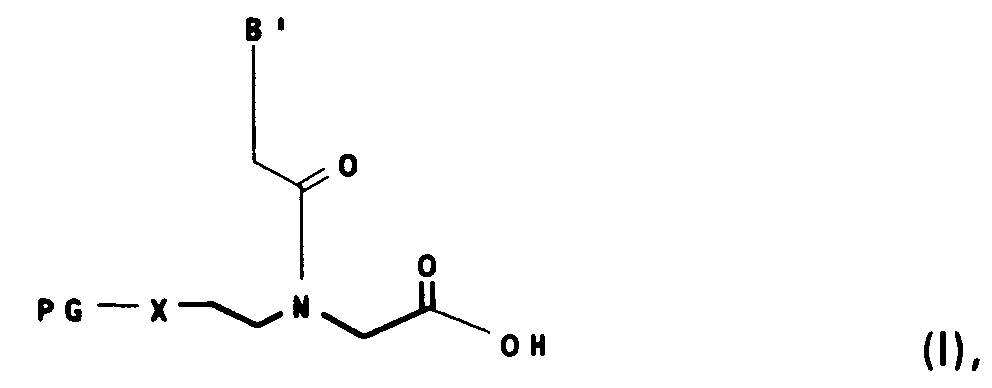
- Das neuartige Verfahren zur Herstellung der substituierten N-Ethyl-Glycinderivate der Formel I

- PG
- für eine gegen schwache Säuren labile Aminoschutzgruppe vom Urethantyp, wie z. B. 1-(1-Adamantyl)1-methylethoxycarbonyl (Adpoc), 1-(3,5-di-tert.-butylphenyl)1-methylethoxycarbonyl (t-Bumeoc) und 1-(3,5-di-tert.-butylphenyl)1-methylethoxycarbonyl (t-Bumeoc) und 1-Methyl-1-(4-biphenyl)ethyloxycarbonyl (Bpoc), 3,5-Dimethoxyphenyl-2-propyl-2-oxycarbonyl (Ddz) oder vom Trityl-Typ, wie Triphenylmethyl (Trt), (4-Methoxyphenyl)diphenylmethyl (Mmt), (4-Methylphenyl)diphenylmethyl (Mtt), Di-(4-methoxyphenyl)phenylmethyl (Dmt) und 9-(9-Phenyl)xanthenyl (Pixyl),
- X
- für NH oder O, und
- B'
- für in der Nucleotidchemie übliche Basen, beispielsweise für natürliche Basen wie Adenin, Cytosin, Guanin, Thymin und Uracil oder unnatürliche Basen, wie Purin, 2.6-Diaminopurin, 7-Deazaadenin oder 7-Deazaguanin, die beide gegebenenfalls in der 7-Position durch einen Substituenten aus der Reihe Halogen, (C1-C10)-Alkyl, (C2-C10)-Alkenyl oder (C3-C10)-Alkinyl, bevorzugt Chlor, Brom oder Jod, (C3-C6)-Alkyl, (C3-C6)-Alkenyl oder (C3-C6)-Alkinyl, substituiert sind, N4N4-Ethanocytosin, N6N6-Ethano-2.6-diaminopurin, 5-Methylcytosin,5-(C3-C6)-Alkinyl-uracil, 5-(C3-C6)-Alkinylcytosin, 5-Fluor-uracil oder Pseudoisocytosin, deren exocyclische Amino bzw. Hydroxygruppen durch geeignete bekannte Schutzgruppen, wie die Benzoyl-, Isobutanoyl-, Acetyl-, Phenoxyacetyl-, 4-(t-Butyl)-benzoyl-, 4-(t-Butyl)-Phenoxyacetyl-, 4-(Methoxy)-benzoyl-, 2-(4-Nitrophenyl)ethyloxycarbonyl-, 2-(2,4-Dinitrophenyl)ethyl-oxycarbonyl-, 9-Fluorenylmethoxycarbonyl- Diphenylcarbamoyl oder Formamidin-Gruppe, bevorzugt die Benzoyl-, Isobutanoyl-, Acetyl-, Phenoxyacetyl-, 4-(t-Butyl)-benzoyl-, 4-(Methoxy)-benzoyl-Gruppe, und für Guanin auch durch eine Kombination von 2-N-Acetyl mit 6-O-Diphenylcarbamoyl geschützt sind, stehen
sowie deren Salze, bevorzugt deren Salze mit tert. organischen Basen, wie z. B. Triethylamin oder Pyridin, - a) eine Verbindung der Formel II

- R
- Wasserstoff, oder wenn X = NH ist, eine säurelabile Schutzgruppe, wie z. B. Boc, Ddz, Trt, bevorzugt Boc, und
- R1
- eine gegen Säuren labile und gegen Amine stabile Schutzgruppe, wie z. B. tert. Butyl und (2-Chlorphenyl)diphenylmethyl, bevorzugt tert.-Butyl, bedeuten, und
- X
- wie oben definiert ist,

- B'
- wie oben definiert ist,
zu einer Verbindung der Formel IV
- R, X, B' und R1
- wie oben definiert sind,
- b) anschließend die Verbindung der Formel IV durch Abspaltung der säurelabilen Esterschutzgruppe R1 bzw. für X = NH durch gleichzeitige Abspaltung der säurelabilen Schutzgruppe R unter geeigneten sauren Bedingungen mit z. B. Trifluoressigsäure in einem geeigneten Lösungsmittel wie z. B. Dichlormethan, Ethylacetat, Dioxan etc. gegebenenfalls unter Zusatz von Kationenfängern wie z. B. Anisol, Thiophenol, Triethylsilan etc.,
in eine Verbindung der Formel V überführt, wobei bei Verbindungen der Formel IV mit X = O im Laufe dieser Abspaltung in gewissem Maße auch das Lacton der Formel Va entstehen kann, das aber durch Behandlung mit Basen, wie z. B. NaOH oder Triethylamin, in wäßrigem Medium einfach in das offenkettige Derivat der Formel V überführt werden kann,
- X und B'
- wie oben definiert sind,
- c) die Verbindung der Formel V mit einem geeigneten Reagenz, wie z. B. t-Bumeoc-fluorid, Adpoc-azid, Bpoc-azid, Ddz-(phenyl)carbonat, Trt-Cl, Mtt-Cl, Mmt-Cl, Dmt-Cl oder Pixyl-Cl, in einem geeigneten Lösungsmittel, wie z. B. DMF, NMP, Acetonitril, Dichlormethan oder Mischungen dieser Lösungsmittel unter Verwendung einer Hilfsbase z. B. NEM, DIPEA, Pyridin, Triethylamin in die Verbindung der Formel I und anschließend gegebenenfalls in deren Salze überführt.
- In der Peptidsynthese übliche Aktivierungsmethoden sind z. B. in Houben-Weyl, Methoden der organischen Chemie, Band 15/2 oder weitere Reagenzien, wie z. B. BOP (B. Castro, J. R. Dormoy, G. Evin and C. Selve, Tetrahedron Lett. 1975, 1219-1222), PyBOP (J. Coste, D. Le-Nguyen und B. Castro, Tetrahedron Lett. 1990, 205-208), BroP (J. Coste, M.-N. Dufour, A. Pantaloni und B. Castro, Tetrahedron Lett. 1990, 669-672), PyBroP (J. Coste, E. Frerot, P. Jouin und B. Castro, Tetrahedron Lett. 1991, 1967-1970) und Uronium-Reagenzien, wie z. B. HBTU (V. Dourtoglou, B. Gross, V. Lambropoulou, C. Zioudrou, Synthesis 1984, 572-574), TBTU, TPTU, TSTU, TNTU, (R. Knorr, A. Trzeciak, W. Bannwarth and D. Gillessen, Tetrahedron Letters 1989, 1927-1930), TOTU (EP-A-0 460 446), HATU (L. A. Carpino, J. Am. Chem. Soc. 1993, 115, 4397-4398), HAPyU, TAPipU (A. Ehrlich, S. Rothemund, M. Brudel, M. Beyermann, L. A. Carpino und M. Bienert, Tetrahedron Lett. 1993, 4781-4784), BOI (K. Akaji, N. Kuriyama, T. Kimura, Y. Fujiwara und Y. Kiso, Tetrahedron Lett. 1992, 3177-3180), Propanphosphonsäureanhydrid (PPA) (H. Wissmann, H. J. Kleiner, Angew. Chem. 92, 129-130, 1990) oder Säurechloride bzw. Säurefluoride (L. A. Carpino, H. G. Chao, M. Beyermann and M. Bienert, J. Org. Chem., 56(1991), 2635; J.-N. Bertho, A. Loffet, C. Pinel, F. Reuther and G. Sennyey in E. Giralt and D. Andreu (Eds.) Peptides 1990, Escom Science Publishers B. V. 1991, pp. 53-54; J. Green und K. Bradley, Tetrahedron 1993, 4141-4146), 2,4,6-Mesitylensulfonyl-3-nitro-1,2,4-triazolid (MSNT) (B. Blankemeyer-Menge, M. Nimitz und R. Frank, Tetrahedron Lett. 1990, 1701-1704), 2,5-Diphenyl-2,3-dihydro-3-oxo-4-hydroxythiophendioxid (TDO) (R. Kirstgen, R. C. Sheppard, W. Steglich, J. Chem. Soc. Chem. Commun. 1987, 1870-1871) oder aktivierte Ester (D. Hudson, Peptide Res. 1990, 51 - 55) in den jeweiligen Literaturstellen beschrieben.
- Bevorzugt ist die Verwendung von Carbodiimiden, z. B. Dicyclohexylcarbodiimid oder Diisopropylcarbodiimid. Bevorzugt verwendet werden ebenfalls Phosphonium-Reagenzien, wie z. B. PyBOP oder PyBroP, Uronium-Reagenzien, wie z. B. HBTU, TBTU, TPTU, TSTU, TNTU, TOTU oder HATU, BOI oder Säurechloride bzw. Säurefluoride sowie Propanphosphonsäureanhydrid (PPA).
- Der Vorteil des neuen Verfahrens für die Herstellung der Verbindungen der Formel I mit X = NH liegt darin, daß aus der Zwischenstufe der Formel IV durch Einwirkung eines einzigen Reagenzes z. B. Trifluoressigsäure gleichzeitig die Schutzgruppen für die primäre Aminofunktion und die Carboxylgruppe des Aminoethylglycins abgespalten werden. Durch Einführung der Schutzgruppe PG entsteht dann direkt die Verbindung der Formel I. Für die Herstellung der Titelverbindungen der Formel I mit X = O liegt der Vorteil darin, daß durch den Schutz der Carboxylgruppe sich zum einen die Löslichkeit des Hydroxyethylglycinderivates in organischen Lösungsmittels verbessert und zum anderen die Verknüpfung mit Verbindurgen der Formel III erleichtert.
- Die Synthese der Verbindungen der Formel II erfolgt z. B. durch die Umsetzung von kommerziell erhältlichem 1,2-Diaminoethan oder Aminoethanol mit den entsprechenden Halogenessigsäureester wie z. B. kommerziell verfügbarem Chloressigsäure tert.-butylester, Brümessigsäure tert.-butylester. Für X = NH und R = säurelabile Schutzgruppe folgt eine Umsetzung des Aminoethylglycinesters mit einem geeigneten Schutzgruppenreagenz wie z. B. Ddz-(phenyl)carbonat, Trt-Cl, Di-tert.butyldicarbonat, Boc-ONSu, tert.-Butylphenylcarbonat. Ein weiteres Verfahren besteht in der Umsetzung von Mono-geschütztem 1,2-Diaminoethan, wie z. B. Mono-Boc-diaminoethan mit Halogenessigsäureestern, wie z. B. Chloressigsäure tert.-butylester oder Bromessigsäure tert.-butylester.
- Ein weiteres Verfahren zur Herstellung der Verbindungen der Formel II mit R = Boc und R1 = tert.-Butyl besteht in der reduktiven Aminierung von Glyoxylsäure-tert.-butylester mit Ethylendiamin, Mono-Boc-Ethylendiamin (für X = NH) bzw. Aminoethanol (für X = O) mit Wasserstoff an Palladium auf Kohle oder mit Natriumcyanoborhydrid oder Natrium-triacetoxy-borhydrid als Reduktionsmittel. Der für diese Reaktion notwendige Glyoxylsäure-tert.-butylester kann wie z. B. in J. E. Bishop, J. F. O'Connell, H. Rapoport, J. Org. Chem. 1991, 5079-5091 beschrieben erhalten werden. Die Synthese von Mono-Boc-Ethylendiamin ist z. B. in Kapcho, A. P.; Kuell, C. S.; Synth Commun. (1990), 2559-2564 beschrieben.
- Ebenfalls geeignet für die Herstellung von Verbindungen der Formel II mit X = NH ist die reduktive Aminierung von Boc-Glycinal mit Glycin-tert.-butylester mit Wasserstoff an Palladium auf Kohle oder mit Natriumcyanoborhydrid oder Natrium-triacetoxy-borhydrid als Reduktionsmittel. Das dazu notwendige Boc-Glycinal wird z. B. wie bei A. Evidente, G. Picalli, A. Sisto, M. Ohba, K. Honda, T. Fujii, Chem. Pharm. Bull. 1992, 1937-1939 beschrieben hergestellt, Glycin-tert.-butylester ist kommerziell erhältlich.
- Die Nucleobasen-Essigsäurederivate der Formel III können durch Alkylierung der ensprechenden Nucleobasen oder der in der exocyclischen Hydroxy- oder Aminofunktion geschützten Nucleobasen mit Chloressigsäure, Bromessigsäure, Jodessigsäure oder deren Estern erhalten werden. Gegebenenfalls werden dabei zur selektiven Alkylierung zusätzlich temporäre Schutzgruppen an der Nucleobase eingeführt. Als Schutzgruppe für die Nucleobasen können alle mit der gegen schwache Säuren labilen Schutzgruppe PG kompatible Schutzgruppen verwendet werden. Für die exocyclische Aminofunktion werden bevorzugt Schutzgruppen, wie die Benzoyl-, Isobutanoyl-, Acetyl-, Phenoxyacetyl-, 4-(t-Butyl)-benzoyl-, 4-(t-Butyl)-Phenoxyacetyl-, 4-(Methoxy)-benzoyl-, 2-(4-Nitrophenyl)ethyl-oxycarbonyl-, 2-(2,4-Dinitrophenyl)ethyl-oxycarbonyl-, 9-Fluorenylmethoxycarbonyl- oder Formamidin-Gruppe verwendet. Insbesondere bevorzugt sind die Benzoyl-, Isobutanoyl-, 4-(t-Butyl)-benzoyl-, 2-(4-Nitrophenyl)ethyl-oxycarbonyl-, 2-(2,4-Dinitrophenyl)ethyl-oxycarbonyl-, 9-Fluorenylmethoxycarbonyl-, 4-(Methoxy)-benzoyl- oder para-(t-Butyl)-Phenoxyacetyl-, para-Nitrophenyl-2-ethyl-oxycarbonyl-Gruppe.
- Gegenstand der Erfindung sind ferner die wertvollen Zwischenprodukte der Formel IV, worin R, X, B' und R1 wie oben definiert sind, worin bevorzugt jedoch R Wasserstoff oder wenn X = NH ist, Boc und R1 tert. Butyl bedeutet.
- 30.2 ml (0.5 Mol) Aminoethanol werden in 200 ml DMF gelöst, 17 ml (0.1 Mol) Diisopropylethylamin zugegeben und 14.8 ml (0.1 Mol) Bromessigsäure-tert.-butylester zugetropft. Die Mischung wird 24 h bei Raumtemperatur gerührt und dann das Lösungsmittel am Rotationsverdampfer im Vakuum abgedampft. Der Rückstand wird in 100 ml Wasser aufgenommen, mit Natriumchlorid gesättigt und mit dreimal 100 ml Ethylacetat extrahiert. Die organische Phase wird mit wenig gesättigter NaCl-Lösung gewaschen, über Natriumsulfat getrocknet und dann zur Trocknene eingeengt. Man erhält 11.96 g des Produkts als farbloses Öl.
- MS(ES+): 176.2 (M + H)+
- Rf = 0.51 (2-Butanon:Wasser:Pyridin:Essigsäure/70:15:15:2)
- 3 ml (0.05 Mol) Aminoethanol werden in 20 ml DMF gelöst 1.7 ml (0.01 Mol) Diisopropylethylamin zugegeben und 1.4 ml (0.01 Mol) Chloressigsäure-tert.-butylester zugetropft. Die Mischung wird 24 h bei Raumtemperatur gerührt und dann das Lösungsmittel am Rotationsverdampfer im Vakuum abgedampft. Der Rückstand wird in 20 ml Wasser aufgenommen, mit Natriumchlorid gesättigt und mit dreimal 20 ml Ethylacetat extrahiert. Die organische Phase wird mit wenig gesättigter NaCl-Lösung gewaschen, über Natriumsulfat getrocknet und dann zur Trocknene eingeengt. Man erhält 1.9 g des Produkts als farbloses Öl.
- MS(ES+): 176.2 (M + H)+
- Rf = 0.51 (2-Butanon:Wasser:Pyridin:Essigsäure/70:15:15:2)
- 8.9 g (53 mMol) H-Oeg-OtBu werden in 100 ml DMF gelöst, dann nacheinander 8.8 g (48 mMol) Thyminylessigsäure, 19.4 ml (106 mMol) Triethylamin und 17.4 g (53 mMol) TOTU hinzugegeben. Es wird noch 3h bei Raumtemperatur gerührt, dann das Lösungsmittel am Rotationsverdampfer im Vakuum abgedampft. Der Rückstand wird mit wenig Ethylacetat verrührt, wobei das Produkt auszufallen beginnt. Man läßt noch über Nacht bei 4°C stehen, saugt das ausgefallene Produkt ab, wäscht mit wenig Ethylacetat nach und trocknet im Vakuum. Ausbeute: 11.8 g farblose Substanz.
- MS(ES+): 342.2 (M + H)+
- Rf = 0.75 (2-Butanon:Wasser:Pyridin:Essigsäure/70:15:15:2)
- 9.47 g (28 mMol) H-Oeg(T)-OtBu werden in 150 ml Dichlormethan suspendiert und mit 100 ml 95% Trifluoressigsäure (5% Wasser) versetzt. Es ensteht ein klare Lösung, die 3h bei Raumtemperatur gerührt wird. Das Reaktinsgemisch wird dann in 1l kalten (0°C) gut gerührten Methyl-tert.butylether eingetropft, wobei das Produkt ausfällt. Das ausgefallene Rohprodukt (enthält auch etwas entstandenes Lacton) wird in einer Mischung aus 170 ml Dioxan, 170 ml Wasser und 6.4 ml Triethylamin gelöst und 2h bei Raumtemperatur gerührt, wobei das Lacton geöffnet wird und das Triethylammonium-Salz entsteht. Dann wird das Gemisch zur Trockene eingedampft und der Rückstand im Vakuum getrocknet.
- Ausbeute: 10.51 g amorpher Feststoff
- MS(ES+): 286.2 (M + H)+
- Rf = 0.12 (Dichlormethan:Methanol:Ethylacetat/10:2:1 und 1% Triethylamin)
- 1.0 g (2.6 mMol) H-Oeg(T)-OH · NEt3 werden in 10 ml DMF gelöst und 1.4 ml (10 mMol) Triethylamin zugegeben. Dann werden 1.8 g (5.2 mMol) Dmt-Cl in 10 ml Dichlormethan zugetropft und die Mischung 16 h bei Raumtemperatur gerührt. Dann wird das Lösungsmittel am Rotationsverdampfer im Vakuum abgedampft, der Rückstand in Dichlormethan aufgenommen, mit Wasser gewaschen, die organische Phase über Natriumsulfat getrocknet und dann eingedampft. Das erhalten Rohprodukt wird mittels Säulenchromatographie an Kieselgel mit Dichlormethan/Methanol/Ethylacetat 15:1:1 mit 1 % Triethylamin als Elutionsmittel gereinigt. Die das Produkt enthaltenden Fraktionen werden vereinigt und eingeengt. Man erhält 960 mg des Produktes als Schaum.
- MS(FAB, MeOH/NBA): 587.3 (M)+
- Rf = 0.29 (Dichlormethan:Methanol:Ethylacetat/10:2:1 und 1% Triethylamin)
- 1.8 g (11 mMol) H-Oeg-OtBu werden in 100 ml DMF gelöst, dann nacheinander 3.0 g (10 mMol) N4-(4-Methoxybenzoyl)-N1-carboxymethyl-cytosin, 3 ml Triethylamin und 3.6 g (11 mMol) TOTU hinzugegeben. Es wird noch 4h bei Raumtemperatur gerührt, dann das Lösungsmittel am Rotationsverdampfer im Vakuum abgedampft. Der Rückstand wird in Ethylacetat aufgenommen und zweimal mit Natriumhydrogencarbonat-Lösung gewaschen. Dabei fällt das Produkt in der Ethylacetatphase aus. Man saugt das ausgefallene Produkt ab, wäscht mit wenig Ethylacetat nach und trocknet im Vakuum. Ausbeute: 3.06 g farblose Substanz.
- MS(FAB, MeOH/NBA): 461.3 (M + H)+
- Rf = 0.81 (2-Butanon:Wasser:Pyridin:Essigsäure/70:15:15:2)
- 1.5 g (3.4 mMol) H-Oeg(CMeOBz)-OtBu werden in einer Mischung aus 30 ml Dichlormethan und 20 ml 95% Trifluoressigsäure (5% Wasser) die 2.5 ml Anisol enthält, gelöst. Die klare Lösung wird 5h bei Raumtemperatur gerührt und dann in 500 ml kalten (0°C) gut gerührten Methyl-tert.butylether eingetropft, wobei das Produkt ausfällt. Das ausgefallene Rohprodukt (enthält auch etwas entstandenes Lacton) wird in einer Mischung aus 25 ml Dioxan, 25 ml Wasser und 0.44 ml Triethylamin gelöst und 3h bei Raumtemperatur gerührt, wobei das Lacton geöffnet wird und das Triethylammonium-Salz entsteht. Dann wird das Gemisch zur Trockene eingedampft und der Rückstand mittels Säulenchromatographie an Kieselgel mit Dichlormethan/Methanol/Ethylacetat 10:3:2 mit 1% Triethylamin als Elutionsmittel gereinigt. Ausbeute: 920 mg amorpher Feststoff
- MS(ES+): 405.2 (M + H)+
- Rf = 0.16 (Dichlormethan:Methanol:Ethylacetat/10:3:2 und 1% Triethylamin)
- 920 mg (1.8 mMol) H-Oeg(CMeBz)-OH · NEt3 werden in 10 ml DMF gelöst und 1 ml (7.2 mMol) Triethylamin zugegeben. Dann werden 1.2 g (3.6 mMol) Dmt-Cl in 10 ml Dichlormethan zugetropft und die Mischung 16 h bei Raumtemperatur gerührt. Dann wird das Lösungsmittel am Rotationsverdampfer im Vakuum abgedampft, der Rückstand in Dichlormethan aufgenommen, mit Wasser gewaschen, die organische Phase über Natriumsulfat getrocknet und dann eingedampft. Das erhaltene Rohprodukt wird mittels Säulenchromatographie an Kieselgel mit Dichlormethan/Methanol/Ethylacetat 15:1:1 mit 1% Triethylamin als Elutionsmittel gereinigt. Die das Produkt enthaltenden Fraktionen werden vereinigt und eingeengt. Man erhält 900 mg des Produktes als Schaum.
- MS(FAB, MeOH/NBA): 707.3 (M + H)+
- Rf = 0.24 (Dichlormethan:Methanol:Ethylacetat/10:3:2 und 1% Triethylamin)
- 534 mg (3.3 mMol) H-Oeg-OtBu worden in 10 ml DMF gelöst, dann nacheinander, 1.0g (3.1 mMol) N6-(4-Methoxybenzoyl)-N9-carboxymethyladenin, 0.77 ml (4.5 mMol) N-Ethylmorpholin und 1.0 g (3.1 mMol) TOTU hinzugegeben. Es wird über Nacht bei Raumtemperatur gerührt, dann das Lösungsmittel im Vakuum am Rotationsverdampfer abgedampft. Der Rückstand wird in Ethylacetat aufgenommen und zweimal mit Natriumhydrogencarbonat-Lösung und Wasser gewaschen. Die organische Phase wird über Natriumsulfat getrocknet und dann eingedampft. Man erhält 1.33 g des Produktes.
- MS(FAB, MeOH/NBA): 485.3 (M + H)+
- Rf = 0.63 (n-Butanol:Wasser:Essigsäure/3:1:1)
- 1.3 g (2.7 mMol) H-Oeg(AMeOBz)-OtBu werden in 15 ml 95% Trifluoressigsäure (5% Wasser) gelöst. Die klare Lösung wird 1h bei Raumtemperatur gerührt und dann in 250 ml kalten (0°C) gut gerührten Diethylether eingetropft, wobei das Produkt ausfällt. Das ausgefallene Rohprodukt (enthält auch etwas entstandenes Lacton) wird in einer Mischung aus 15 ml Dioxan, 15 ml Wasser und 0. 4 ml Triethylamin gelöst und 2 h bei Raumtemperatur gerührt, wobei das Lacton geöffnet wird und das Triethylammonium-Salz entsteht. Dann wird das Gemisch zur Trockene eingedampft und 3mal mit Pyridin abgeraucht. Der Rückstand wird direkt in die nächste Reaktion eingesezt.
- MS(FAB, NBA/MeOH/LiCl): 435.2 (M + Li)+
- Rf = 0.37 (n-Butanol:Wasser:Essigsäure/3:1:1)
- Das in der vorherigen Reaktion erhaltene H-Oeg(AMeOBz)-OH · NEt3 wird in 10ml Pyridin gelöst. Dann werden 1.7 g ( 5 mMol) Dmt-Cl zugegeben und die Mischung 16 h bei Raumtemperatur gerührt. Dann wird das Lösungsmittel am Rotationsverdampfer im Vakuum abgedampft, der Rückstand in Dichlormethan aufgenommen. Man wäscht mit 5%ige wässriger Zitronensäure und ges. wässriger NaCl Lösung, trocknet die organische Phase über Natriumsulfat und engt dann zur Trockene ein. Das erhaltene Rohprodukt wird mittels Säulenchromatographie an Kieselgel mit Dichlormethan mit einem Gradienten von 1-10% Methanol 1% Triethylamin als Elutionsmittel gereinigt. Die das Produkt enthaltenden Fraktionen werden vereinigt und eingeengt. Der Rückstand wird in 5ml Dichlormethan gelöst und dann in 100 ml gut gerührten Diethylether eingetropft, wobei das Produkt ausfällt. Man erhält 580 mg des Produktes als Pulver.
- MS(FAB, MeOH/NBA): 731.3 (M + H)+
- Rf = 0.70 (n-Butanol:Wasser:Essigsäure/3:1:1)
- In einen Dreihalskolben mit Rührer, Rückflußkühler und Tropftrichter werden 120 ml (1.8 Mol) 1,2-Diaminoethan in 300 ml Dichlormethan gegeben. Zur gut gerührten Lösung werden innerhalb von ca. 2.5h 42.7 ml (0.3 Mol) Chloressigsäure-tert.-butylester in 100 ml Dichlormethan zugetropft. Die Reaktion ist leicht exotherm. Nach ca. 15 min tritt eine Trübung ein und das gebildete Diaminhydrochlorid setzt sich als ölige Phase ab. Zur Vervollständigung der Reaktion wird noch ca. 2h bei Raumtemperatur nachgerührt (DC Kontrolle in Ethylmethylketon/Pyridin/Wasser/Eissessig 70:15:15:2) und dann das Reaktionsgemisch mit 200 ml Wasser versetzt. Die organische Phase wird abgetrennt und die Wasserphase noch zweimal mit je 100 ml Dichlormethan extrahiert. Die vereinigten organischen Phasen werden dann noch einmal mit 100 ml Wasser rückextrahiert und über Natriumsulfat getrocknet. Nach Abfiltrieren des Trockenmittels wird die organische Phase auf 800 ml aufgefüllt und zur Bestimmung der Rohausbeute 40 ml zur Trockene eingeengt. Rückstand 2.28 g, entspricht Gesamtmenge von 45.6 g (86%). Diese Dichlormethan-Lösung des Rohproduktes wird dann wie nachfolgend beschrieben direkt weiter umgesetzt zum Boc-Aeg-OtBu.
- MS(ES+): 189.1 (M + H)+
- Rf = 0.36 (2-Butanon:Wasser:Pyridin:Essigsäure/70:15:15:2)
- 0.26 Mol H-Aeg-OtBu (Lösung in 800 ml Dichlormethan) werden mit 38 ml (0.27 Mol) Triethylamin versetzt und dann unter gutem Rühren langsam innerhalb von 45 min eine Lösung von 54.5 g (0.25 Mol) Di-tert.-butyldicarbonat in 100 ml Dichlormethan zugetropft. Dabei wird die Reaktionlösung durch entstehendes Carbamat (aus CO2) dickflüssiger und daher mit 100 ml Dichlormethan verdünnt. Nach beendeter Reaktion ist die Lösung dünnflüssig und nur schwach getrübt. Es werden 100 ml Wasser zugegeben, die organische Phase wird abgetrennt und die wäßrige Phase nochmals mit 100 ml Dichlormethan extrahiert. Die organische Phase wird über Natriumsulfat getrocknet und dann im Vakuum eingeengt. Rohprodukt: 77.6 g eines farblosen Öls. Dieses Rohprodukt wird durch Säulenchromatographie an Kieselgel mit Ethylacetat als Elutionsmittel gereinigt. Ausbeute: 48.1 g
- MS(ES+): 275.2 (M + H)+
- Rf = 0.46 (Ethylacetat)
- 1.375 g (5 mMol) Boc-Aeg-OtBu werden in 20 ml DMF gelöst und dann nacheinander 921 mg (5mMol) Thyminylessigsäure, 1.64 g(5mMol) TOTU und 1.7 ml (10mMol) Diisopropylethylamin zugegeben. Die Mischung wird über Nacht bei Raumtemperatur gerührt und dann im Vakuum eingedampft. Der ölige Rückstand wird in 70 ml Ethylacetat aufgenommen und jeweils 5mal mit je 5 ml Natriumhydrogencarbonat-Lösung bzw. Kaliumhydrogensulfat-Lösung extrahiert. Dann wird noch dreimal mit je 5 ml Wasser gewaschen. Die organische Phase wird über Natriumsulfat getrocknet und dann zur Trockene eingeengt. Der verbliebene feste Rückstand wird mit Diethylether verrieben, abgesaugt und getrocknet. Ausbeute: 1.82 g
- MS(ES+): 441.3 (M + H)+
- Rf = 0.55 (Dichlormethan:Methanol:Triethylamin/100:10:1)
- 6.875 g (25 mMol) Boc-Aeg-OtBu werden in 100 ml DMF gelöst und dann nacheinander 4.6 g (25mMol) Thyminylessigsäure, 8.2 g(25mMol) TOTU und 8.5 ml (100mMol) Diisopropylethylamin zugegeben. Die Mischung wird 4h bei Raumtemperatur gerührt und dann im Vakuum eingedampft. Der ölige Rückstand wird in 350 ml Ethylacetat aufgenommen und jeweils 5mal mit je 5 ml Natriumhydrogencarbonat-Lösung bzw. Kaliumhydrogensulfat-Lösung extrahiert. Dann wird noch dreimal mit je 5 ml Wasser gewaschen. Hierbei fällt schon Substanz in der organischen Phase aus, die abgesaugt wird. Die organische Phase des Filtrats wird abgetrennt, über Natriumsulfat getrocknet und dann zur Trockene eingeengt. Der verbliebene feste Rückstand wird mit Diethylether verrieben, abgesaugt und getrocknet. Die vereinigten Rohprodukte werden aus Ethylacetat umkristallisiert.
- Ausbeute: 9.71 g
- MS(ES+): 441.3 (M + H)+
- Rf = 0.55 (Dichlormethan:Methanol:Triethylamin/100:10:1)
- 1.375 g (5 mMol) Boc-Aeg-OtBu werden in 20 ml DMF gelöst und dann nacheinander 1.515 g (5mMol) N4-(4-methoxybenzoyl)-N1-carboxymethylcytosin, 1.64 g(5mMol) TOTU und 1.7 ml (10mMol) Diisopropylethylamin zugegeben. Die Mischung wird über Nacht bei Raumtemperatur gerührt und dann im Vakuum eingedampft. Der halbfeste Rückstand wird in Dichlormethan aufgenommen, filtriert und das Filtrat eingeengt. Der Rückstand wird mit Ethylacetat verrieben, wobei das Produkt als Festsubstanz ausfällt. Es wird aus wenig Ethylacetat umkristallisiert, abgesaugt, mit Ethylacetat gewaschen und im Vakuum getrocknet.
- Ausbeute: 1.89 g
- MS(ES+): 560.3 (M + H)+
- Rf = 0.53 (Dichlormethan:Methanol:Triethylamin/100:10:1)
- 549 mg (2 mMol) Boc-Aeg-OtBu werden in 10 ml DMF gelöst und dann nacheinander 655 mg (2mMol) N6-(4-Methoxybenzoyl)-N9-carboxymethyladenin, 656 mg (2mMol) TOTU und 0.68 ml (4mMol) Diisopropylethylamin zugegeben. Die Mischung wird über Nacht bei Raumtemperatur gerührt und dann im Vakuum eingedampft. Der Rückstand wird in 30 ml Ethylacetat aufgenommen und jeweils 2mal mit je 5 ml Natriumhydrogencarbonat-Lösung bzw. Wasser gewaschen. Die organische Phase wird über Natriumsulfat getrocknet und dann zur Trockene eingeengt. Der verbliebene feste Rückstand wird mit Diethylether verrieben, abgesaugt und getrocknet. Ausbeute: 730 mg
- MS(FAB, MeOH/NBA): 584.2 (M + H)+
- Rf = 0.74 (Dichlormethan:Methanol /10:1 und 1% Triethylamin)
- 11.0 g (25 mMol) Boc-Aeg(T)-OtBu werden mit 110 ml 95% Trifluoressigsäure (5% Wasser) versetzt. Es ensteht ein klare Lösung, die 2h bei Raumtemperatur gerührt wird. Das Reaktionsgemisch wird dann eingeengt und mit Diethylether verrieben. Das ausgefallene Rohprodukt wird direkt in den nächsten Syntheseschritt eingesetzt.
- Ausbeute: 7.1 g amorpher Feststoff
- MS(ES+): 285.2 (M + H)+
- Rf = 0.14 (2-Butanon:Wasser:Pyridin:Essigsäure/70:15:15:2)
- 7.1 g H-Aeg(T)-OH aus der voherigen Reaktion werden in 300 ml DMF gelöst, dann werden 13.9 ml (100 mMol) Triethylamin zugegeben gefolgt von 8.9 g (29.2 mMol) Mmt-Cl in 5 Portionen. Die Mischung wird über Nacht gerührt, dann von Ungelöstem (unumgesetztes H-Aeg(T)-OH, 2.78 g) abfiltriert und das Filtrat im Vakuum eingedampft. Der Rückstand wird in 300 ml Dichlormethan aufgenommen dreimal mit 30 ml Wasser gewaschen. Die organische Phase wird über Natriumsulfat getrocknet und dann zur Trockene eingeengt. Der verbliebene feste Rückstand wird in wenig Ethylacetat gelöst, mit ein wenig Triethylamin versetzt und in 200 ml Diethylether eingerührt. Das ausgefallene Produkt wird abgesaugt, mit wenig Ether gewaschen und im Vakuum getrocknet.
- Ausbeute: 7.3 g
- MS(FAB, MeOH/NBA/LiCl): 569.5 (M + Li)+
- Rf = 0.25 (Dichlormethan:Methanol:Triethylamin/100:10:1)
- 1.6 g (2.9 mMol) Boc-Aeg(CMeBz)-OtBu werden mit einer Mischung aus 30 ml Dichlormethan und 16 ml 95% Trifluoressigsäure (5% Wasser) versetzt. Es entsteht eine klare Lösung, die 3h bei Raumtemperatur gerührt wird. Das Reaktionsgemisch wird dann eingeengt und mit Diethylether verrieben. Das ausgefallene Rohprodukt wird direkt in den nächsten Syntheseschritt eingesetzt.
- Ausbeute: 1.86 g amorphe Festsubstanz
- Rf = 0.34 (2-Butanon:Wasser:Pyridin:Essigsäure/70:15:15:2)
- 1.26 g H-Aeg(CMeBz)-OH aus der voherigen Reaktion werden in 50 ml DMF gelöst, dann werden 2.1 ml (15 mMol) Triethylamin zugegeben gefolgt von 1.06 g (3.5 mMol) Mmt-Cl in 3 Portionen. Die Mischung wird über Nacht gerührt, dann von wenig Ungelöstem abfiltriert und das Filtrat im Vakuum eingedampft. Der Rückstand wird in 50 ml Dichlormethan aufgenommen dreimal mit 10 ml Wasser gewaschen. Die organische Phase wird über Natriumsulfat getrocknet, dann auf ca. 10 ml eingeengt und in 80 ml Diethylether eingerührt. Das ausgefallene Produkt wird abgesaugt, mit wenig Ether gewaschen und im Vakuum getrocknet.
- Ausbeute: 1.35 g
- MS(FAB, MeOH/NBA): 676.4 (M + H)+
- Rf = 0.62 (2-Butanon:Wasser:Pyridin:Essigsäure/70:15:15:2)
- 725 mg (1.2mMol) Boc-Aeg(AMeBz)-OtBu werden mit 10 ml 95% Trifluoressigsäure (5% Wasser) versetzt. Es entsteht ein klare Lösung, die 3h bei Raumtemperatur gerührt wird. Das Reaktionsgemisch wird dann eingeengt und mit Diethylether verrieben. Das ausgefallene Rohprodukt wird direkt in den nächsten Syntheseschritt eingesetzt.
- Ausbeute: 830 mg amorphe Festsubstanz
- 690 mg H-Aeg(AMeBz)-OH aus der voherigen Reaktion werden in 25 ml DMF gelöst, dann werden 0.88 ml (6.5 mMol) Triethylamin zugegeben gefolgt von 494 mg (1.6 mMol) Mmt-Cl in 3 Portionen. Die Mischung wird über Nacht gerührt, dann von wenig Ungelöstem abfiltriert und das Filtrat im Vakuum eingedampft. Der Rückstand wird in 20 ml Dichlormethan aufgenommen dreimal mit 5 ml Wasser gewaschen. Die organische Phase wird über Natriumsulfat getrocknet, dann eingeengt und der Rückstand mit Diethylether verrieben. Das ausgefallene Produkt wird abgesaugt, mit wenig Ether gewaschen und im Vakuum getrocknet.
- Ausbeute: 440 mg
- MS(ES+): 700.3 (M + H)+
- Rf = 0.59 (2-Butanon:Wasser:Pyridin:Essigsäure/70:15:15:2)
- 1.375 g (5mMol) Boc-Aeg-OtBu werden in 30 ml DMF gelöst und dann nacheinander 2.23 g (5mMol) N2-Acetyl-O4-diphenylcarbamoyl-9-carboxymethyl-guanin, 1.64 g(5mMol) TOTU und 1.7 ml (10mMol) Diisopropylethylamin zugegeben. Die Mischung wird über Nacht bei Raumtemperatur gerührt und dann im Vakuum eingedampft. Der Rückstand wird in 50 ml Ethylacetat aufgenommen, je 4mal mit 3 ml Natriumhydrogencarbonat-Lösung, 3 ml Kaliumhydrogensulfat-Lösung und 3 ml Wasser extrahiert. Die organische Phase wird über Natriumsulfat getrocknet, das Trockenmittel abfiltriert und das Filtrat eingeengt. Der Rückstand wird mit Ether verrieben, wobei das Produkt als harzige Festsubstanz zurückbleibt. Dieses Produkt wird ohne weitere Reinigung in die nachfolgende Reaktion eingesetzt
- Ausbeute:3.14 g
- MS(FAB, NBA/MeOH): 703.3 (M + H)+
- Rf = 0.80(Dichlormethan:Methanol:Triethylamin/100:10:1)
- 2.08 g (2.96 mMol) Boc-Aeg(G2-Ac,4-Dpc)-OtBu werden mit 20 ml 95% Trifluoressigsäure (5% Wasser) versetzt. Es ensteht ein klare Lösung, die 30min bei Raumtemperatur gerührt wird. Das Reaktionsgemisch wird dann eingeengt und mit Diethylether verrieben. Das ausgefallene Rohprodukt wird direkt in den nächsten Syntheseschritt eingesetzt.
- Ausbeute: 1.46 g amorphe Festsubstanz
- Rf = 0.15(2-Butanon:Wasser:Pyridin:Essigsäure/70:15:15:2)
- 1.46g H-Ae(G2-Ac)-OH aus der voherigen Reaktion werden in 30 ml DMF gelöst, dann werden 2.1 ml (15mMol) Triethylamin zugegeben gefolgt von 939 mg (3.04mMol) Mmt-Cl in 3 Portionen. Die Mischung wird über Nacht gerührt, dann von wenig Ungelöstem abfiltriert und das Filtrat im Vakuum eingedampft. Der Rückstand wird in 30 ml Ethylacetat aufgenommen, je 3mal mit 3 ml Natriumhydrogencarbonat-Lösung und 3 ml Wasser extrahiert. Die organische Phase wird über Natriumsulfat getrocknet, das Trockenmittel abfiltriert und das Filtrat eingeengt. Der Rückstand wird mit Ether verrieben. Das ausgefallene Produkt wird abgesaugt, mit wenig Ether gewaschen und im Vakuum getrocknet.
- Ausbeute: 1.10 g
- MS(ES+): 624.3 (M + H)+
- Rf = 0.14(Dichlormethan:Methanol:Triethylamin/100:10:1)
- 114.6 g (0.418 Mol) Boc-Aeg-OtBu und 127 g(0.418 Mol) N4-(4-methoxybenzoyl)-N1-carboxymethylcytosin werden mit 1.5 l Ethylacetat versetzt und zur gerührten Suspension 115 ml (0.836 Mol) Triethylamin hinzugegeben. Dann werden werden 400 ml (ca. 0.628 Mol) einer 50%igen Propanphosphonsäureanhydrid-Lösung in Ethylacetat innerhalb von 2 min zugegeben. Hierbei steigt die Temperatur leicht an. Die Mischung wird durch Zugabe von weiteren 65 ml (0.469 Mol) Triethylamin auf pH 8 gestellt und noch 2.5 h nachgerührt. Der Niederschlag wird abgesaugt, zuerst mit 500 ml Ethylacetat und dann mit 1 l Wasser gewaschen. Aus der Mutterlauge fällt noch weiteres Produkt aus. Beide Niederschläge werden erneut mit 500 ml Wasser verrührt, abgesaugt, mit 500 ml Wasser gewaschenund im Vakuum getrocknet.
- Ausbeute: 196.6 g
- 300.0 g (1.094 Mol) Boc-Aeg-OtBu werden in 2.8 l DMF gelöst und dann nacheinander 358.2 g ( 1.094 Mol) N6-(4-Methoxybenzoyl)-N9-carboxymethyladenin, 360.5 g (2mMol) TOTU und 373.9 ml (2.184 Mol) Diisopropylethylamin zugegeben. Die Mischung wird noch 2h bei Raumtemperatur gerührt und dann in eine gerührte eisgekühlte Lösung von 214.29 g Natriumhydrogencarbonat in 2.2 l Wasser getropft, wobei das Produkt ausfällt. Anschließend werden noch 2 l Methyl-tert.butylether zugegeben. Diese Mischung wird über Nacht stehengelassen. Dann wird der Nieder schlag abgesaugt und nacheinander mit je zweimal 2l Wasser und 2l Methyl-tert.butylether verrührt, erneut abfiltriert und der Niederschlag im Vakuum getrocknet. Ausbeute: 437.7 g
- 535 ml (8 Mol) 1,2-Diaminoethan werden in 2 l Dichlormethan gelöst. Unter Rühren und Kühlung wird eine Lösung von 218.5 g (1 Mol) Di-tert.-butyldicarbonat in 500 ml Dichlormethan innerhalb von 1.5 h zugetropft. Die Mischung wird noch 20 h nachgerührt, dann mit 1l Wasser versetzt und kräftig durchgerührt. Die Phasen werden getrennt und die Wasserphase noch zweimal mit je 500 ml Dichlormethan extrahiert. Die vereinigten organischen Phasen werden mit halbgesättigter Natriumchloridlösung gewaschen und über Natriumsulfat getrocknet. Die organische Phase wird auf 1 l Volumen eingeengt
- Zu der oben erhaltenen Lösung gibt man 138 ml (0.97 Mol) Triethylamin und eine Spatelspitze Kaliumjodid. Dann wird unter Rühren eine Lösung von 149.5 ml Chloressigsäure-tert.-butylester zugetropft und diese Mischung 50 h bei 40°C gerührt. Dann werden 500 ml Wasser zugegeben, die Mischung kräftig durchgerührt und die organische Phase abgetrennt, über Natriumsulfat getrocknet und eingeengt. Das erhaltene Rohprodukt wird an Kieselgel mit Ethylacetat Methanol 95:5 als Eluent chromatographisch gereinigt. Man erhält 78 g des gewünschten Produktes.
- 4.8 l (72 Mol) 1,2-Diaminoethan werden in 18 l Dichlormethan gelöst. Unter Rühren und Kühlung wird eine Lösung von 1.97 kg (9.03 Mol) Di-tert.-butyl-dicarbonat in 4.5 l Dichlormethan innerhalb von 2 h zugetropft. Die Mischung wird noch 20 h nachgerührt, dann mit 9l Wasser versetzt und kräftig durchgerührt. Die Phasen werden getrennt und die Wasserphase noch zweimal mit je 4.5 l Dichlormethan extrahiert. Die vereinigten organischen Phasen werden mit halbgesättigter Natriumchloridlösung gewaschen und über Natriumsulfat getrocknet. Die organische Phase wird auf 9 l Volumen eingeengt
- Zu der oben erhaltenen Lösung gibt man 1.24 l Triethylamin und 5g Kaliumjodid. Dann wird unter Rühren eine Lösung von 1.245 l Chloressigsäure-tert.-butylester in 4.5 l Dichlormethan zugetropft und diese Mischung 50 h bei 40°C gerührt. Dann werden 5 l Wasser zugegeben, die Mischung kräftig durchgerührt und die organische Phase abgetrennt, über Natriumsulfat getrocknet und eingeengt. Das erhaltene Rohprodukt wird an Kieselgel mit Ethylacetat Methanol 95:5 als Eluent chromatographisch gereinigt. Man erhält 1.03 kg des gewünschten Produktes.
- Weitere verwendete Abkürzungen sind nachfolgend aufgelistet.
- Aeg
- N-(2-Aminoethyl)glycyl, -NH-CH2-CH2-NH-CH2-CO-
- Aeg(AMeOBz)
- N-(2-Aminoethyl)-N-((9-(N6-4-methoxybenzoyl)-adenosyl)acetyl)-glycyl
- Aeg(CBz)
- N-(2-Aminoethyl)-N-((1-(N4-benzoyl)-cytosyl)acetyl)-glycyl
- Aeg(CMeOBz)
- N-(2-Aminoethyl)-N-((1-(N4-4-methoxybenzoyl)-cytosyl)acetyl)-glycyl
- Aeg(CtBuBz)
- N-(2-Aminoethyl)-N-((1-(N4-4-tert.butylbenzoyl)-cytosyl)acetyl)-glycyl
- Aeg(GiBu)
- N-(2-Aminoethyl)-N-((9-(N2-isobutanoyl)-guanosyl)acetyl)-glycyl
- Aeg(G2-Ac,4-Dpc)
- N-(2-Aminoethyl)-N-((9-(N2-acetyl-O4-diphenylcarbamoyl)guanosyl)acetyl)-glycyl
- Aeg(G2-Ac)
- N-(2-Aminoethyl)-N-((9-(N2-acetyl)-guanosyl)acetyl)-glycyl
- Aeg(T)
- N-(2-Aminoethyl)-N-((1-thyminyl)acetyl)-glycyl
- Bnpeoc
- 2,2-[Bis(4-nitrophenyl)]-ethoxycarbonyl)
- Boc
- tert.-Butyloxycarbonyl
- BOI
- 2-(Benzotriazol-1-yl)oxy-1,3-dimethyl-imidazolidinium-hexafluorphosphat
- BOP
- Benzotriazolyl-1-oxy-tris(dimethylamino)-phosphonium-hexafluorphosphat
- BroP
- Brom-tris(dimethylamino)-phosphonium-hexafluorphosphat
- BSA
- N,O-Bis-(trimethylsilyl)-acetamid
- But
- tert.-Butyl
- Bz
- Benzoyl
- Bzl
- Benzyl
- Cl-Z
- 4-Chlor-benzyloxycarbonyl
- CPG
- Controlled Pore Glas
- DBU
- 1,8-Diazabicyclo[5.4.0]undec-7-en
- DCM
- Dichlormethan
- Ddz
- 3.5-Dimethoxyphenyl-2-propyl-2-oxycarbonyl
- DMF
- Dimethylformamid
- Dmt
- Di-(4-methoxyphenyl)phenylmethyl,
- Dnpeoc
- 2-(2,4-Dinitrophenyl)-ethoxycarbonyl
- Dpc
- Diphenylcarbamoyl
- FAM
- Fluorescein-Rest
- Fm
- 9-Fluorenylmethyl
- Fmoc
- 9-Fluorenylmethyloxycarbonyl
- H-Aeg-OH
- N-(2-Aminoethyl)glycin
- HAPyU
- O-(7-Azabenzotriazol-1-yl)-1,1,3,3-bis(tetramethylen)uronium-hexafluorphosphat
- HATU
- O-(7-Azabenzotriazol-1-yl)-1,1,3,3-tetramethyluronium-hexafluorphosphat
- HBTU
- O-(Benzotriazol-1-yl)-1,1,3,3-tetramethyluronium-hexafluorphosphat
- HOBt
- 1-Hydroxybenzotriazol
- HONSu
- N-Hydroxysuccinimid
- HOObt
- 3-Hydroxy-4-oxo-3,4- dihydrobenzotriazin
- iBu
- Isobutanoyl
- MeOBz
- 4-Methoxybenzoyl
- Mmt
- 4-Methoxytriphenylmethyl
- Moz
- 4-Methoxybenzyloxycarbonyl
- MSNT
- 2,4,6-Mesitylensulfonyl-3-nitro-1,2,4-triazolid
- Mtt
- 4-Methylphenyldiphenylmethyl
- NMP
- N-Methylpyrrolidin
- Oeg
- N-(2-Oxyethyl)glycyl, -O-CH2-CH2-NH-CH2-CO-
- Pixyl
- 9-(9-Phenyl)xanthenyl
- PyBOP
- Benzotriazolyl-1-oxy-tripyrrolidinophosphonium-hexafluorphosphat
- PyBroP
- Brom-tripyrrolidinophosphonium-hexafluorphosphat
- TAPipU
- O-(7-Azabenzotriazol-1-yl)-1,1,3,3-bis(pentamethylen)uronium-tetrafluoroborat
- TBTU
- O-(Benzotriazol-1-yl)-1,1,3,3-tetramethyluronium-tetrafluoroborat
- tBu
- tert.-Butyl
- tBuBz
- 4-tert.Butylbenzoyl
- TDBTU
- O-(3,4-Dihydro-4-oxo-1,2,3-benzotriazin-3-yl)-1,1,3,3-tetramethyluronium-tetrafluoroborat
- TDO
- 2,5-Diphenyl-2,3-dihydro-3-oxo-4-hydroxythiophendioxid
- TFA
- Trifluoressigsäure
- THF
- Tetrahydrofuran
- TNTU
- O-[(5-Norbonen-2,3-dicarboximido]-1,1,3,3-tetramethyluronium-tetrafluoroborat
- TOTU
- O-[(Cyano(ethoxycarbonyl)methylen)amino]-1,1,3,3-tetramethyluronium-tetrafluoroborat
- TPTU
- O-(1,2-Dihydro-2-oxo-1-pyridyl)-1,1,3,3'-tetramethyluronium-tetrafluoroborat
- Trt
- Trityl
- TSTU
- O-(N-Succinimidyl)-1,1,3,3-tetramethyluronium-tetrafluoroborat
- Z
- Benzyloxycarbonyl
- MS(ES+)
- Elektrospray Massenspektrum (Positiv Ion)
- MS(ES-)
- Elektrospray Massenspektrum (Negativ Ion)
- MS(DCI)
- Direkt-Ionisations-Massenspektrum
- MS(FAB)
- East-Atom-Bombardement-Massenspektrum
- NBA
- Nitrobenzylalkohol
Claims (4)
- Verfahren zur Herstellung substituierter N-Ethyl-Glycinderivate der Formel I
 PG für eine gegen schwache Säuren labile Aminoschutzgruppe vom Urethantyp oder vom Trityl-Typ,X für NH oder O, undB' für in der Nucleotidchemie übliche Basen, deren exocyclische Amino bzw. Hydroxygruppen durch geeignete bekannte Schutzgruppen geschützt sind, stehen,sowie deren Salze,
dadurch gekennzeichnet, daß mana) eine Verbindung der Formel II R Wasserstoff, oder wenn X = NH ist, eine säurelabile Schutzgruppe undR1 eine gegen Säuren labile und gegen Amine stabile Schutzgruppe bedeuten, undX wie oben definiert ist,mit einer Verbindung der Formel III
 B' wie oben definiert ist,bei 0 - 45°C in einem geeigneten Lösungsmittel unter Verwendung eines in der Peptidchemie üblichen Kupplungsreagenzes
zu einer Verbindung der Formel IV R, X, B' und R1 wie oben definiert sind,umsetzt,b) anschließend die Verbindung der Formel IV durch Abspaltung der säurelabilen Esterschutzgruppe R1 bzw. für X = NH durch gleichzeitige Abspaltung der säurelabilen Schutzgruppe R unter geeigneten sauren Bedingungen in einem geeigneten Lösungsmittel gegebenenfalls unter Zusatz von Kationenfängern in eine Verbindung der Formel V überführt, wobei Verbindungen der Formel IV mit X = O gegebenenfalls zusätzlich mit Basen in wäßrigem Medium behandelt werden,
 X und B' wie oben definiert sind,c) die Verbindung der Formel V mit einem geeigneten Reagenz in einem geeigneten Lösungsmittel unter Verwendung einer Hilfsbase in die Verbindung der Formel I und anschließend gegebenenfalls in deren Salze überführt.
 - Verfahren zur Herstellung substituierter N-Ethyl-Glycinderivate der Formel I gemäß Anspruch 1, dadurch gekennzeichnet, daß mana) eine Verbindung der Formel II,
worinR Wasserstoff, oder wenn X = NH ist, Boc, Ddz oder Trt undR1 tert. Butyl oder (2-Chlorphenyl)diphenylmethyl bedeuten, undX wie oben definiert ist,mit einer Verbindung der Formel III,
worinB' wie oben definiert ist,bei Raumtemperatur, in DMF, Acetonitril, Dichlormethan oder Mischungen dieser Lösungsmittel unter Verwendung von Carbodiimiden, Phosphonium-Reagenzien, Uronium-Reagenzien, Säurehalogeniden oder aktivierten Estern,
zu einer Verbindung der Formel IV
worinR, X, B' und R1 wie oben definiert sind,umsetzt,b) anschließend die Verbindung der Formel IV durch Abspaltung der säurelabilen Esterschutzgruppe R1 bzw. für X = NH durch gleichzeitige Abspaltung der säurelabilen Schutzgruppe R mit Trifluoressigsäure in Dichlormethan, Ethylacetat oder Dioxan gegebenenfalls unter Zusatz von Anisol, Thiophenol oder Triethylsilan
in eine Verbindung der Formel V überführt,
worinX und B' wie oben definiert sind, undwobei die Verbindungen der Formel IV mit X = O gegebenenfalls zusätzlich mit NaOH oder Triethylamin in wäßrigem Medium behandelt werden,c) die Verbindung der Formel V mit t-Bumeoc-fluorid, Adpoc-azid, Bpoc-azid, Ddz-(phenyl)carbonat, Trt-Cl, Mtt-Cl, Mmt-Cl, Dmt-Cl oder Pixyl-Cl in DMF, NMP, Acetonitril, Dichlormethan oder Mischungen dieser Lösungsmittel unter Verwendung von NEM, DIPEA, Pyridin, Triethylamin in die Verbindung der Formel I und anschließend gegebenenfalls in deren Salze überführt. - Verfahren zur Herstellung substituierter N-Ethyl-Glycinderivate der Formel I gemäß Anspruch 2, dadurch gekennzeichnet, daß in der Verbindung der Formel II R Wasserstoff oder wenn X = NH ist, Boc und R1 tert. Butyl sind.
- Zwischenprodukt der Formel IV,
 X für NH oder O,B' für in der Nucleotidchemie übliche Basen, deren exocyclische Amino bzw. Hydroxygruppen durch geeignete bekannte Schutzgruppen geschützt sind, stehen,R Wasserstoff, oder wenn X = NH ist, eine säurelabile Schutzgruppe undR1 eine gegen Säuren labile und gegen Amine stabile Schutzgruppe bedeuten.
Applications Claiming Priority (2)
| Application Number | Priority Date | Filing Date | Title |
|---|---|---|---|
| DE19532553 | 1995-09-04 | ||
| DE19532553A DE19532553A1 (de) | 1995-09-04 | 1995-09-04 | Verfahren zur Herstellung substituierter N-Ethyl-Glycinderivate |
Publications (3)
| Publication Number | Publication Date |
|---|---|
| EP0761681A2 true EP0761681A2 (de) | 1997-03-12 |
| EP0761681A3 EP0761681A3 (de) | 1997-07-09 |
| EP0761681B1 EP0761681B1 (de) | 2002-03-13 |
Family
ID=7771182
Family Applications (1)
| Application Number | Title | Priority Date | Filing Date |
|---|---|---|---|
| EP96113530A Expired - Lifetime EP0761681B1 (de) | 1995-09-04 | 1996-08-22 | Verfahren zur Herstellung substituierter N-Ethyl-Glycinderivate |
Country Status (11)
| Country | Link |
|---|---|
| US (1) | US5817811A (de) |
| EP (1) | EP0761681B1 (de) |
| JP (1) | JP3934708B2 (de) |
| AT (1) | ATE214398T1 (de) |
| AU (1) | AU708034B2 (de) |
| CA (1) | CA2184681C (de) |
| DE (2) | DE19532553A1 (de) |
| DK (1) | DK0761681T3 (de) |
| ES (1) | ES2173230T3 (de) |
| NO (1) | NO313833B1 (de) |
| PT (1) | PT761681E (de) |
Cited By (4)
| Publication number | Priority date | Publication date | Assignee | Title |
|---|---|---|---|---|
| EP1171435A2 (de) * | 1999-04-13 | 2002-01-16 | Basf Aktiengesellschaft | Pyrimidin-2-on derivate als integrinrezeptorliganden |
| EP0960121A4 (de) * | 1996-07-24 | 2003-05-28 | Buchardt Dorte | Peptidnukleinsäuren mit erhöhter bindungsaffinität, sequenzspezifität und löslichkeit |
| US6710164B1 (en) | 1993-11-22 | 2004-03-23 | Peter E. Nielsen | Peptide nucleic acids having enhanced binding affinity, sequence specificity and solubility |
| CN100347161C (zh) * | 2002-04-26 | 2007-11-07 | 帕那金股份有限公司 | Pna单体和前体 |
Families Citing this family (14)
| Publication number | Priority date | Publication date | Assignee | Title |
|---|---|---|---|---|
| US5855911A (en) * | 1995-08-29 | 1999-01-05 | Board Of Regents, The University Of Texas System | Liposomal phosphodiester, phosphorothioate, and P-ethoxy oligonucleotides |
| US6043353A (en) * | 1995-12-22 | 2000-03-28 | University Technologies International, Inc. | Reusable solid support for oligonucleotide synthesis, process for production thereof and process for use thereof |
| WO1997023497A1 (en) * | 1995-12-22 | 1997-07-03 | University Technologies International Inc. | Linker arm for solid support oligonucleotide synthesis and process for production thereof |
| US6977244B2 (en) | 1996-10-04 | 2005-12-20 | Board Of Regents, The University Of Texas Systems | Inhibition of Bcl-2 protein expression by liposomal antisense oligodeoxynucleotides |
| DE19640974A1 (de) * | 1996-10-04 | 1998-04-16 | Bayer Ag | Bausteine für DNA/PNA-Cooligomere |
| HU226867B1 (en) * | 1997-05-14 | 2009-12-28 | Morphochem Ag | Method for producing polymers having nucleo-bases as side-groups |
| US7704962B1 (en) | 1997-10-03 | 2010-04-27 | Board Of Regents, The University Of Texas System | Small oligonucleotides with anti-tumor activity |
| US7285288B1 (en) | 1997-10-03 | 2007-10-23 | Board Of Regents, The University Of Texas System | Inhibition of Bcl-2 protein expression by liposomal antisense oligodeoxynucleotides |
| US7135564B1 (en) * | 1998-07-02 | 2006-11-14 | University Technologies International Inc. | Reusable solid support for oligonucleotide synthesis |
| AU4965499A (en) * | 1998-07-09 | 2000-02-01 | Biocept, Inc. | Method of using an improved peptide nucleic acid universal library to optimize dna sequence hybridation |
| US7256275B2 (en) * | 2001-03-09 | 2007-08-14 | Boston Probes, Inc. | Methods, kits and compositions pertaining to combination oligomers and libraries for their preparation |
| US6541626B2 (en) * | 2001-04-17 | 2003-04-01 | Isis Pharmaceuticals, Inc. | Process for selective N-acylation of purine nucleosides |
| WO2004048594A2 (en) | 2002-11-21 | 2004-06-10 | Epicentre Technologies | Preparation and use of single-stranded transcription substrates for synthesis of transcription products corresponding to target sequences |
| KR101354692B1 (ko) * | 2010-11-26 | 2014-02-06 | 서울대학교산학협력단 | 올리고머 및 그 제조 방법 |
Family Cites Families (4)
| Publication number | Priority date | Publication date | Assignee | Title |
|---|---|---|---|---|
| DE4408528A1 (de) * | 1994-03-14 | 1995-09-28 | Hoechst Ag | Peptid-Oligonucleotid-Derivate, deren Herstellung und Verwendung |
| DE4408534A1 (de) * | 1994-03-14 | 1995-09-28 | Hoechst Ag | Substituierte N-Ethyl-Glycinderivate zur Herstellung von PNA und PNA-/DNA-Hybriden |
| DE4421536A1 (de) * | 1994-06-20 | 1995-12-21 | Hoechst Ag | Perfluoralkylgruppen tragende phenylsubstituierte Alkenylcarbonsäure-guanidine, Verfahren zu ihrer Herstellung, ihre Verwendung als Medikament oder Diagnostikum sowie sie enthaltendes Medikament |
| DE69632324T2 (de) * | 1995-06-07 | 2005-06-16 | PerSeptive Biosystems, Inc., Framingham | Pna-dna-chimäre und pna-synthone zu deren herstellung |
-
1995
- 1995-09-04 DE DE19532553A patent/DE19532553A1/de not_active Withdrawn
-
1996
- 1996-08-22 DK DK96113530T patent/DK0761681T3/da active
- 1996-08-22 AT AT96113530T patent/ATE214398T1/de active
- 1996-08-22 ES ES96113530T patent/ES2173230T3/es not_active Expired - Lifetime
- 1996-08-22 EP EP96113530A patent/EP0761681B1/de not_active Expired - Lifetime
- 1996-08-22 PT PT96113530T patent/PT761681E/pt unknown
- 1996-08-22 DE DE59608867T patent/DE59608867D1/de not_active Expired - Lifetime
- 1996-09-02 AU AU64408/96A patent/AU708034B2/en not_active Ceased
- 1996-09-03 US US08/707,149 patent/US5817811A/en not_active Expired - Lifetime
- 1996-09-03 NO NO19963677A patent/NO313833B1/no not_active IP Right Cessation
- 1996-09-03 CA CA002184681A patent/CA2184681C/en not_active Expired - Fee Related
- 1996-09-03 JP JP23269296A patent/JP3934708B2/ja not_active Expired - Fee Related
Cited By (4)
| Publication number | Priority date | Publication date | Assignee | Title |
|---|---|---|---|---|
| US6710164B1 (en) | 1993-11-22 | 2004-03-23 | Peter E. Nielsen | Peptide nucleic acids having enhanced binding affinity, sequence specificity and solubility |
| EP0960121A4 (de) * | 1996-07-24 | 2003-05-28 | Buchardt Dorte | Peptidnukleinsäuren mit erhöhter bindungsaffinität, sequenzspezifität und löslichkeit |
| EP1171435A2 (de) * | 1999-04-13 | 2002-01-16 | Basf Aktiengesellschaft | Pyrimidin-2-on derivate als integrinrezeptorliganden |
| CN100347161C (zh) * | 2002-04-26 | 2007-11-07 | 帕那金股份有限公司 | Pna单体和前体 |
Also Published As
| Publication number | Publication date |
|---|---|
| AU708034B2 (en) | 1999-07-29 |
| NO963677D0 (no) | 1996-09-03 |
| EP0761681A3 (de) | 1997-07-09 |
| CA2184681A1 (en) | 1997-03-05 |
| AU6440896A (en) | 1997-03-06 |
| DE19532553A1 (de) | 1997-03-06 |
| ES2173230T3 (es) | 2002-10-16 |
| ATE214398T1 (de) | 2002-03-15 |
| NO313833B1 (no) | 2002-12-09 |
| NO963677L (no) | 1997-03-05 |
| PT761681E (pt) | 2002-08-30 |
| JP3934708B2 (ja) | 2007-06-20 |
| US5817811A (en) | 1998-10-06 |
| DK0761681T3 (da) | 2002-07-08 |
| JPH09124572A (ja) | 1997-05-13 |
| CA2184681C (en) | 2010-01-05 |
| EP0761681B1 (de) | 2002-03-13 |
| DE59608867D1 (de) | 2002-04-18 |
Similar Documents
| Publication | Publication Date | Title |
|---|---|---|
| EP0761681B1 (de) | Verfahren zur Herstellung substituierter N-Ethyl-Glycinderivate | |
| EP0672700B1 (de) | PNA-Synthese unter Verwendung einer gegen schwache Säuren labilen Amino-Schutzgruppe | |
| DE69516847T2 (de) | Chlorpyrimidine als zwischenprodukte | |
| Lowe et al. | Amino acids bearing nucleobases for the synthesis of novel peptidenucleic acids | |
| DE69737636T2 (de) | Verfahren zur herstellung von purinderivaten | |
| EP0739898A2 (de) | Phosphonomonoesternnukleinsäuren, Verfahren zu ihrer Herstellung und ihre Verwendung | |
| US20040039040A1 (en) | Urea derivative and adhesive-molecule inhibitor containing the same as active ingredient | |
| EP0672661A1 (de) | Substituierte N-Ethyl-Glycinderivate zur Herstellung von PNA und PNA-/DNA-Hybriden | |
| US6355726B1 (en) | Method for producing polymers having nucleo-bases as side-groups | |
| EP0672701A1 (de) | PNA-Synthese unter Verwendung einer basenlabilen Amino-Schutzgruppe | |
| DE69706828T2 (de) | Verfahren zur herstellung von purinderivaten | |
| Mitchell et al. | Synthesis of C‐nucleoside isosteres of 9‐(2‐hydroxyethoxymethyl) guanine (acyclovir) | |
| WO1998042735A1 (de) | Neue monomerbausteine zur markierung von peptidischen nukleinsäuren | |
| US5049551A (en) | 5-fluorouracil, 2'-deoxy-5-fluorouridine and 1-carbomoyl-5-fluorouracil compounds | |
| US3029239A (en) | Basic substituted 1-and 7-alkylxanthines or salts thereof | |
| Chaltin et al. | Selection of New Sequence‐Selective Unnatural Peptides Binding to Double‐Stranded Deoxyribonucleic Acids (dsDNA) by Means of a Gel‐Retardation Experiment for Library Analysis | |
| EP0839828A1 (de) | Bausteine für DNA/PNA-Cooligomere | |
| DE60008988T2 (de) | Synthese von Peptid-Nucleinsäuren | |
| DE19508923A1 (de) | Phosphonomonoesternukleinsäuren, Verfahren zu ihrer Herstellung und ihre Verwendung | |
| DE19720165A1 (de) | Verfahren zur Herstellung von Polymeren, die Nucleobasen als Seitengruppen aufweisen | |
| KR20230109301A (ko) | 신규한 pna 단량체 및 이를 포함하는 pna 올리고머 | |
| DE10139730A1 (de) | Verfahren zur Herstellung CNA | |
| DE19543865A1 (de) | Phosphonomonoesternukleinsäuren, Verfahren zu ihrer Herstellung und ihre Verwendung |
Legal Events
| Date | Code | Title | Description |
|---|---|---|---|
| PUAI | Public reference made under article 153(3) epc to a published international application that has entered the european phase |
Free format text: ORIGINAL CODE: 0009012 |
|
| AK | Designated contracting states |
Kind code of ref document: A2 Designated state(s): AT BE CH DE DK ES FI FR GB GR IE IT LI LU NL PT SE |
|
| PUAL | Search report despatched |
Free format text: ORIGINAL CODE: 0009013 |
|
| AK | Designated contracting states |
Kind code of ref document: A3 Designated state(s): AT BE CH DE DK ES FI FR GB GR IE IT LI LU NL PT SE |
|
| 17P | Request for examination filed |
Effective date: 19980109 |
|
| 17Q | First examination report despatched |
Effective date: 20000724 |
|
| GRAG | Despatch of communication of intention to grant |
Free format text: ORIGINAL CODE: EPIDOS AGRA |
|
| GRAG | Despatch of communication of intention to grant |
Free format text: ORIGINAL CODE: EPIDOS AGRA |
|
| GRAH | Despatch of communication of intention to grant a patent |
Free format text: ORIGINAL CODE: EPIDOS IGRA |
|
| GRAH | Despatch of communication of intention to grant a patent |
Free format text: ORIGINAL CODE: EPIDOS IGRA |
|
| REG | Reference to a national code |
Ref country code: GB Ref legal event code: IF02 |
|
| GRAA | (expected) grant |
Free format text: ORIGINAL CODE: 0009210 |
|
| AK | Designated contracting states |
Kind code of ref document: B1 Designated state(s): AT BE CH DE DK ES FI FR GB GR IE IT LI LU NL PT SE |
|
| REF | Corresponds to: |
Ref document number: 214398 Country of ref document: AT Date of ref document: 20020315 Kind code of ref document: T |
|
| REG | Reference to a national code |
Ref country code: CH Ref legal event code: EP |
|
| REF | Corresponds to: |
Ref document number: 59608867 Country of ref document: DE Date of ref document: 20020418 |
|
| GBT | Gb: translation of ep patent filed (gb section 77(6)(a)/1977) |
Effective date: 20020522 |
|
| REG | Reference to a national code |
Ref country code: DK Ref legal event code: T3 |
|
| ET | Fr: translation filed | ||
| REG | Reference to a national code |
Ref country code: PT Ref legal event code: SC4A Free format text: AVAILABILITY OF NATIONAL TRANSLATION Effective date: 20020514 |
|
| REG | Reference to a national code |
Ref country code: GR Ref legal event code: EP Ref document number: 20020401795 Country of ref document: GR |
|
| REG | Reference to a national code |
Ref country code: ES Ref legal event code: FG2A Ref document number: 2173230 Country of ref document: ES Kind code of ref document: T3 |
|
| PLBE | No opposition filed within time limit |
Free format text: ORIGINAL CODE: 0009261 |
|
| STAA | Information on the status of an ep patent application or granted ep patent |
Free format text: STATUS: NO OPPOSITION FILED WITHIN TIME LIMIT |
|
| 26N | No opposition filed |
Effective date: 20021216 |
|
| PGFP | Annual fee paid to national office [announced via postgrant information from national office to epo] |
Ref country code: GR Payment date: 20130723 Year of fee payment: 18 Ref country code: CH Payment date: 20130813 Year of fee payment: 18 Ref country code: AT Payment date: 20130726 Year of fee payment: 18 Ref country code: LU Payment date: 20130902 Year of fee payment: 18 Ref country code: DE Payment date: 20130814 Year of fee payment: 18 Ref country code: ES Payment date: 20130711 Year of fee payment: 18 Ref country code: DK Payment date: 20130812 Year of fee payment: 18 Ref country code: NL Payment date: 20130810 Year of fee payment: 18 Ref country code: SE Payment date: 20130813 Year of fee payment: 18 Ref country code: PT Payment date: 20130225 Year of fee payment: 18 Ref country code: FI Payment date: 20130812 Year of fee payment: 18 Ref country code: IE Payment date: 20130812 Year of fee payment: 18 |
|
| PGFP | Annual fee paid to national office [announced via postgrant information from national office to epo] |
Ref country code: GB Payment date: 20130821 Year of fee payment: 18 Ref country code: FR Payment date: 20130808 Year of fee payment: 18 |
|
| PGFP | Annual fee paid to national office [announced via postgrant information from national office to epo] |
Ref country code: IT Payment date: 20130809 Year of fee payment: 18 |
|
| PGFP | Annual fee paid to national office [announced via postgrant information from national office to epo] |
Ref country code: BE Payment date: 20130819 Year of fee payment: 18 |
|
| REG | Reference to a national code |
Ref country code: PT Ref legal event code: MM4A Free format text: LAPSE DUE TO NON-PAYMENT OF FEES Effective date: 20150223 |
|
| REG | Reference to a national code |
Ref country code: DE Ref legal event code: R119 Ref document number: 59608867 Country of ref document: DE |
|
| REG | Reference to a national code |
Ref country code: NL Ref legal event code: V1 Effective date: 20150301 |
|
| REG | Reference to a national code |
Ref country code: DK Ref legal event code: EBP Effective date: 20140831 |
|
| PG25 | Lapsed in a contracting state [announced via postgrant information from national office to epo] |
Ref country code: LU Free format text: LAPSE BECAUSE OF NON-PAYMENT OF DUE FEES Effective date: 20140822 |
|
| REG | Reference to a national code |
Ref country code: CH Ref legal event code: PL Ref country code: SE Ref legal event code: EUG |
|
| REG | Reference to a national code |
Ref country code: AT Ref legal event code: MM01 Ref document number: 214398 Country of ref document: AT Kind code of ref document: T Effective date: 20140822 |
|
| REG | Reference to a national code |
Ref country code: GR Ref legal event code: ML Ref document number: 20020401795 Country of ref document: GR Effective date: 20150304 |
|
| GBPC | Gb: european patent ceased through non-payment of renewal fee |
Effective date: 20140822 |
|
| PG25 | Lapsed in a contracting state [announced via postgrant information from national office to epo] |
Ref country code: LI Free format text: LAPSE BECAUSE OF NON-PAYMENT OF DUE FEES Effective date: 20140831 Ref country code: IT Free format text: LAPSE BECAUSE OF NON-PAYMENT OF DUE FEES Effective date: 20140822 Ref country code: BE Free format text: LAPSE BECAUSE OF NON-PAYMENT OF DUE FEES Effective date: 20140831 Ref country code: FI Free format text: LAPSE BECAUSE OF NON-PAYMENT OF DUE FEES Effective date: 20140822 Ref country code: NL Free format text: LAPSE BECAUSE OF NON-PAYMENT OF DUE FEES Effective date: 20150301 Ref country code: CH Free format text: LAPSE BECAUSE OF NON-PAYMENT OF DUE FEES Effective date: 20140831 Ref country code: PT Free format text: LAPSE BECAUSE OF NON-PAYMENT OF DUE FEES Effective date: 20150223 |
|
| REG | Reference to a national code |
Ref country code: IE Ref legal event code: MM4A |
|
| REG | Reference to a national code |
Ref country code: DE Ref legal event code: R119 Ref document number: 59608867 Country of ref document: DE Effective date: 20150303 |
|
| PG25 | Lapsed in a contracting state [announced via postgrant information from national office to epo] |
Ref country code: SE Free format text: LAPSE BECAUSE OF NON-PAYMENT OF DUE FEES Effective date: 20140823 Ref country code: GR Free format text: LAPSE BECAUSE OF NON-PAYMENT OF DUE FEES Effective date: 20150304 Ref country code: AT Free format text: LAPSE BECAUSE OF NON-PAYMENT OF DUE FEES Effective date: 20140822 |
|
| REG | Reference to a national code |
Ref country code: FR Ref legal event code: ST Effective date: 20150430 |
|
| PG25 | Lapsed in a contracting state [announced via postgrant information from national office to epo] |
Ref country code: DE Free format text: LAPSE BECAUSE OF NON-PAYMENT OF DUE FEES Effective date: 20150303 Ref country code: DK Free format text: LAPSE BECAUSE OF NON-PAYMENT OF DUE FEES Effective date: 20140831 Ref country code: GB Free format text: LAPSE BECAUSE OF NON-PAYMENT OF DUE FEES Effective date: 20140822 |
|
| PG25 | Lapsed in a contracting state [announced via postgrant information from national office to epo] |
Ref country code: FR Free format text: LAPSE BECAUSE OF NON-PAYMENT OF DUE FEES Effective date: 20140901 Ref country code: IE Free format text: LAPSE BECAUSE OF NON-PAYMENT OF DUE FEES Effective date: 20140822 |
|
| REG | Reference to a national code |
Ref country code: ES Ref legal event code: FD2A Effective date: 20150925 |
|
| PG25 | Lapsed in a contracting state [announced via postgrant information from national office to epo] |
Ref country code: ES Free format text: LAPSE BECAUSE OF NON-PAYMENT OF DUE FEES Effective date: 20140823 |