EP0761764A1 - Wasserunlösliche Azofarbmittel auf Basis von Aminochinazolindionen - Google Patents
Wasserunlösliche Azofarbmittel auf Basis von Aminochinazolindionen Download PDFInfo
- Publication number
- EP0761764A1 EP0761764A1 EP96112208A EP96112208A EP0761764A1 EP 0761764 A1 EP0761764 A1 EP 0761764A1 EP 96112208 A EP96112208 A EP 96112208A EP 96112208 A EP96112208 A EP 96112208A EP 0761764 A1 EP0761764 A1 EP 0761764A1
- Authority
- EP
- European Patent Office
- Prior art keywords
- alkyl
- group
- conh
- phenyl
- atom
- Prior art date
- Legal status (The legal status is an assumption and is not a legal conclusion. Google has not performed a legal analysis and makes no representation as to the accuracy of the status listed.)
- Granted
Links
- NDFCFTOWEKYFMV-UHFFFAOYSA-N 5-amino-1h-quinazoline-2,4-dione Chemical class N1C(=O)NC(=O)C2=C1C=CC=C2N NDFCFTOWEKYFMV-UHFFFAOYSA-N 0.000 title 1
- 239000004150 EU approved colour Substances 0.000 title 1
- 229940006093 opthalmologic coloring agent diagnostic Drugs 0.000 title 1
- 125000001997 phenyl group Chemical group [H]C1=C([H])C([H])=C(*)C([H])=C1[H] 0.000 claims abstract description 27
- 125000006297 carbonyl amino group Chemical group [H]N([*:2])C([*:1])=O 0.000 claims abstract description 21
- 238000000034 method Methods 0.000 claims abstract description 10
- 229910052736 halogen Inorganic materials 0.000 claims abstract description 9
- 150000002367 halogens Chemical class 0.000 claims abstract description 9
- 125000002023 trifluoromethyl group Chemical group FC(F)(F)* 0.000 claims abstract description 7
- 125000001841 imino group Chemical group [H]N=* 0.000 claims abstract description 6
- 229910052760 oxygen Inorganic materials 0.000 claims abstract description 4
- 150000001875 compounds Chemical class 0.000 claims description 23
- -1 Cyano, hydroxy Chemical group 0.000 claims description 21
- 125000004178 (C1-C4) alkyl group Chemical group 0.000 claims description 19
- 125000004435 hydrogen atom Chemical group [H]* 0.000 claims description 15
- 238000000576 coating method Methods 0.000 claims description 11
- 239000000843 powder Substances 0.000 claims description 11
- 125000004430 oxygen atom Chemical group O* 0.000 claims description 10
- 125000001495 ethyl group Chemical group [H]C([H])([H])C([H])([H])* 0.000 claims description 9
- 125000002496 methyl group Chemical group [H]C([H])([H])* 0.000 claims description 9
- 125000000449 nitro group Chemical group [O-][N+](*)=O 0.000 claims description 9
- 239000003973 paint Substances 0.000 claims description 8
- 238000002360 preparation method Methods 0.000 claims description 7
- 239000004698 Polyethylene Substances 0.000 claims description 6
- 239000000976 ink Substances 0.000 claims description 6
- 239000011368 organic material Substances 0.000 claims description 6
- 229920000573 polyethylene Polymers 0.000 claims description 6
- 125000004434 sulfur atom Chemical group 0.000 claims description 6
- 238000007639 printing Methods 0.000 claims description 5
- 125000001424 substituent group Chemical group 0.000 claims description 5
- 239000004743 Polypropylene Substances 0.000 claims description 4
- 150000001412 amines Chemical class 0.000 claims description 4
- 229920000098 polyolefin Polymers 0.000 claims description 4
- 229920001155 polypropylene Polymers 0.000 claims description 4
- 229910052801 chlorine Inorganic materials 0.000 claims description 3
- 125000004093 cyano group Chemical group *C#N 0.000 claims description 3
- 125000005843 halogen group Chemical group 0.000 claims description 3
- 229910052739 hydrogen Inorganic materials 0.000 claims description 3
- 239000001257 hydrogen Substances 0.000 claims description 3
- 239000004922 lacquer Substances 0.000 claims description 3
- 150000003254 radicals Chemical class 0.000 claims description 3
- UFHFLCQGNIYNRP-UHFFFAOYSA-N Hydrogen Chemical compound [H][H] UFHFLCQGNIYNRP-UHFFFAOYSA-N 0.000 claims description 2
- 125000001309 chloro group Chemical group Cl* 0.000 claims description 2
- 230000000485 pigmenting effect Effects 0.000 claims description 2
- 125000002294 quinazolinyl group Chemical group N1=C(N=CC2=CC=CC=C12)* 0.000 claims description 2
- 125000000217 alkyl group Chemical group 0.000 abstract description 7
- 125000003917 carbamoyl group Chemical group [H]N([H])C(*)=O 0.000 abstract description 3
- 125000003545 alkoxy group Chemical group 0.000 abstract 2
- 125000000753 cycloalkyl group Chemical group 0.000 abstract 2
- JCXJVPUVTGWSNB-UHFFFAOYSA-N Nitrogen dioxide Chemical compound O=[N]=O JCXJVPUVTGWSNB-UHFFFAOYSA-N 0.000 abstract 1
- 239000000049 pigment Substances 0.000 description 21
- 239000000243 solution Substances 0.000 description 21
- 238000005859 coupling reaction Methods 0.000 description 16
- 238000010168 coupling process Methods 0.000 description 14
- 230000008878 coupling Effects 0.000 description 13
- SDUUYVWJDAEWSE-UHFFFAOYSA-N 6-amino-1h-quinazoline-2,4-dione Chemical class N1C(=O)NC(=O)C2=CC(N)=CC=C21 SDUUYVWJDAEWSE-UHFFFAOYSA-N 0.000 description 8
- QTBSBXVTEAMEQO-UHFFFAOYSA-N Acetic acid Chemical compound CC(O)=O QTBSBXVTEAMEQO-UHFFFAOYSA-N 0.000 description 8
- 229920005989 resin Polymers 0.000 description 8
- 239000011347 resin Substances 0.000 description 8
- 239000011248 coating agent Substances 0.000 description 7
- 239000012954 diazonium Substances 0.000 description 7
- 150000001989 diazonium salts Chemical class 0.000 description 7
- 239000006185 dispersion Substances 0.000 description 7
- 239000000725 suspension Substances 0.000 description 7
- 239000000203 mixture Substances 0.000 description 5
- 229960000583 acetic acid Drugs 0.000 description 4
- 229920000180 alkyd Chemical class 0.000 description 4
- 239000003086 colorant Substances 0.000 description 4
- 239000012362 glacial acetic acid Substances 0.000 description 4
- 229920003023 plastic Polymers 0.000 description 4
- 239000004033 plastic Substances 0.000 description 4
- XLYOFNOQVPJJNP-UHFFFAOYSA-N water Substances O XLYOFNOQVPJJNP-UHFFFAOYSA-N 0.000 description 4
- 125000000229 (C1-C4)alkoxy group Chemical group 0.000 description 3
- MECMQZBUZCGXQW-UHFFFAOYSA-N 1-phenyl-1,3-diazinane-2,4,6-trione Chemical compound O=C1NC(=O)CC(=O)N1C1=CC=CC=C1 MECMQZBUZCGXQW-UHFFFAOYSA-N 0.000 description 3
- 229920000877 Melamine resin Chemical class 0.000 description 3
- ZMXDDKWLCZADIW-UHFFFAOYSA-N N,N-Dimethylformamide Chemical compound CN(C)C=O ZMXDDKWLCZADIW-UHFFFAOYSA-N 0.000 description 3
- HEMHJVSKTPXQMS-UHFFFAOYSA-M Sodium hydroxide Chemical compound [OH-].[Na+] HEMHJVSKTPXQMS-UHFFFAOYSA-M 0.000 description 3
- 239000012736 aqueous medium Substances 0.000 description 3
- 239000003822 epoxy resin Substances 0.000 description 3
- 230000002349 favourable effect Effects 0.000 description 3
- 239000003960 organic solvent Substances 0.000 description 3
- 229920000647 polyepoxide Polymers 0.000 description 3
- 229920001225 polyester resin Polymers 0.000 description 3
- 239000004645 polyester resin Substances 0.000 description 3
- 238000006116 polymerization reaction Methods 0.000 description 3
- 239000004814 polyurethane Substances 0.000 description 3
- 239000004800 polyvinyl chloride Substances 0.000 description 3
- 238000012360 testing method Methods 0.000 description 3
- CSCPPACGZOOCGX-UHFFFAOYSA-N Acetone Chemical compound CC(C)=O CSCPPACGZOOCGX-UHFFFAOYSA-N 0.000 description 2
- 229920000178 Acrylic resin Chemical class 0.000 description 2
- 239000004925 Acrylic resin Chemical class 0.000 description 2
- RTZKZFJDLAIYFH-UHFFFAOYSA-N Diethyl ether Chemical compound CCOCC RTZKZFJDLAIYFH-UHFFFAOYSA-N 0.000 description 2
- IAZDPXIOMUYVGZ-UHFFFAOYSA-N Dimethylsulphoxide Chemical compound CS(C)=O IAZDPXIOMUYVGZ-UHFFFAOYSA-N 0.000 description 2
- VEXZGXHMUGYJMC-UHFFFAOYSA-N Hydrochloric acid Chemical compound Cl VEXZGXHMUGYJMC-UHFFFAOYSA-N 0.000 description 2
- SECXISVLQFMRJM-UHFFFAOYSA-N N-Methylpyrrolidone Chemical compound CN1CCCC1=O SECXISVLQFMRJM-UHFFFAOYSA-N 0.000 description 2
- JUJWROOIHBZHMG-UHFFFAOYSA-N Pyridine Chemical compound C1=CC=NC=C1 JUJWROOIHBZHMG-UHFFFAOYSA-N 0.000 description 2
- SMWDFEZZVXVKRB-UHFFFAOYSA-N Quinoline Chemical compound N1=CC=CC2=CC=CC=C21 SMWDFEZZVXVKRB-UHFFFAOYSA-N 0.000 description 2
- PPBRXRYQALVLMV-UHFFFAOYSA-N Styrene Chemical compound C=CC1=CC=CC=C1 PPBRXRYQALVLMV-UHFFFAOYSA-N 0.000 description 2
- 239000011230 binding agent Substances 0.000 description 2
- 238000001816 cooling Methods 0.000 description 2
- 239000013078 crystal Substances 0.000 description 2
- 229920001971 elastomer Polymers 0.000 description 2
- 150000002148 esters Chemical class 0.000 description 2
- LNEPOXFFQSENCJ-UHFFFAOYSA-N haloperidol Chemical compound C1CC(O)(C=2C=CC(Cl)=CC=2)CCN1CCCC(=O)C1=CC=C(F)C=C1 LNEPOXFFQSENCJ-UHFFFAOYSA-N 0.000 description 2
- 125000005597 hydrazone group Chemical group 0.000 description 2
- 125000002887 hydroxy group Chemical group [H]O* 0.000 description 2
- 239000000025 natural resin Substances 0.000 description 2
- 238000007645 offset printing Methods 0.000 description 2
- 229920001568 phenolic resin Chemical class 0.000 description 2
- 229920000728 polyester Polymers 0.000 description 2
- 239000004848 polyfunctional curative Substances 0.000 description 2
- 229920002635 polyurethane Polymers 0.000 description 2
- 229920000915 polyvinyl chloride Polymers 0.000 description 2
- 239000005060 rubber Substances 0.000 description 2
- 229920002050 silicone resin Polymers 0.000 description 2
- LPXPTNMVRIOKMN-UHFFFAOYSA-M sodium nitrite Chemical compound [Na+].[O-]N=O LPXPTNMVRIOKMN-UHFFFAOYSA-M 0.000 description 2
- 229920003002 synthetic resin Polymers 0.000 description 2
- 239000000057 synthetic resin Substances 0.000 description 2
- NJVOHKFLBKQLIZ-UHFFFAOYSA-N (2-ethenylphenyl) prop-2-enoate Chemical compound C=CC(=O)OC1=CC=CC=C1C=C NJVOHKFLBKQLIZ-UHFFFAOYSA-N 0.000 description 1
- SHBTUGJAKBRBBJ-UHFFFAOYSA-N 1,3-diethyl-2-sulfanylidene-1,3-diazinane-4,6-dione Chemical compound CCN1C(=O)CC(=O)N(CC)C1=S SHBTUGJAKBRBBJ-UHFFFAOYSA-N 0.000 description 1
- VVSASNKOFCZVES-UHFFFAOYSA-N 1,3-dimethyl-1,3-diazinane-2,4,6-trione Chemical compound CN1C(=O)CC(=O)N(C)C1=O VVSASNKOFCZVES-UHFFFAOYSA-N 0.000 description 1
- DCGGMHIZEAHUJL-UHFFFAOYSA-N 1-methyl-1,3-diazinane-2,4,6-trione Chemical compound CN1C(=O)CC(=O)NC1=O DCGGMHIZEAHUJL-UHFFFAOYSA-N 0.000 description 1
- ZVEHALIGKXOZRY-UHFFFAOYSA-N 6-amino-1,3-dimethylquinazoline-2,4-dione Chemical compound C1=C(N)C=C2C(=O)N(C)C(=O)N(C)C2=C1 ZVEHALIGKXOZRY-UHFFFAOYSA-N 0.000 description 1
- SDLUDKLQMNZEDQ-UHFFFAOYSA-N 6-amino-1-methylquinazoline-2,4-dione Chemical compound C1=C(N)C=C2C(=O)NC(=O)N(C)C2=C1 SDLUDKLQMNZEDQ-UHFFFAOYSA-N 0.000 description 1
- DOORLJBUFLIDAT-UHFFFAOYSA-N 6-amino-1-phenylquinazoline-2,4-dione Chemical compound O=C1NC(=O)C2=CC(N)=CC=C2N1C1=CC=CC=C1 DOORLJBUFLIDAT-UHFFFAOYSA-N 0.000 description 1
- RLZOJYBUTBCYMC-UHFFFAOYSA-N 6-amino-7-(trifluoromethyl)-1h-quinazoline-2,4-dione Chemical compound N1C(=O)NC(=O)C2=C1C=C(C(F)(F)F)C(N)=C2 RLZOJYBUTBCYMC-UHFFFAOYSA-N 0.000 description 1
- NIXOWILDQLNWCW-UHFFFAOYSA-M Acrylate Chemical compound [O-]C(=O)C=C NIXOWILDQLNWCW-UHFFFAOYSA-M 0.000 description 1
- 0 CC(CC(N)=*)(C(*C(N1C)=O)=CC*)C1=O Chemical compound CC(CC(N)=*)(C(*C(N1C)=O)=CC*)C1=O 0.000 description 1
- ZAMOUSCENKQFHK-UHFFFAOYSA-N Chlorine atom Chemical compound [Cl] ZAMOUSCENKQFHK-UHFFFAOYSA-N 0.000 description 1
- LFQSCWFLJHTTHZ-UHFFFAOYSA-N Ethanol Chemical compound CCO LFQSCWFLJHTTHZ-UHFFFAOYSA-N 0.000 description 1
- 239000001856 Ethyl cellulose Substances 0.000 description 1
- ZZSNKZQZMQGXPY-UHFFFAOYSA-N Ethyl cellulose Chemical compound CCOCC1OC(OC)C(OCC)C(OCC)C1OC1C(O)C(O)C(OC)C(CO)O1 ZZSNKZQZMQGXPY-UHFFFAOYSA-N 0.000 description 1
- IAYPIBMASNFSPL-UHFFFAOYSA-N Ethylene oxide Chemical compound C1CO1 IAYPIBMASNFSPL-UHFFFAOYSA-N 0.000 description 1
- 239000004640 Melamine resin Substances 0.000 description 1
- IOVCWXUNBOPUCH-UHFFFAOYSA-M Nitrite anion Chemical compound [O-]N=O IOVCWXUNBOPUCH-UHFFFAOYSA-M 0.000 description 1
- 239000000020 Nitrocellulose Substances 0.000 description 1
- 239000004952 Polyamide Substances 0.000 description 1
- 239000004793 Polystyrene Chemical class 0.000 description 1
- 229920001756 Polyvinyl chloride acetate Polymers 0.000 description 1
- VMHLLURERBWHNL-UHFFFAOYSA-M Sodium acetate Chemical compound [Na+].CC([O-])=O VMHLLURERBWHNL-UHFFFAOYSA-M 0.000 description 1
- 229920002125 Sokalan® Polymers 0.000 description 1
- 239000002174 Styrene-butadiene Substances 0.000 description 1
- XSQUKJJJFZCRTK-UHFFFAOYSA-N Urea Chemical class NC(N)=O XSQUKJJJFZCRTK-UHFFFAOYSA-N 0.000 description 1
- 229920001807 Urea-formaldehyde Polymers 0.000 description 1
- 150000008065 acid anhydrides Chemical class 0.000 description 1
- 239000000654 additive Substances 0.000 description 1
- 150000001298 alcohols Chemical class 0.000 description 1
- 229920003180 amino resin Polymers 0.000 description 1
- 125000000129 anionic group Chemical group 0.000 description 1
- 239000007864 aqueous solution Substances 0.000 description 1
- 150000004945 aromatic hydrocarbons Chemical class 0.000 description 1
- 125000003118 aryl group Chemical group 0.000 description 1
- 150000007656 barbituric acids Chemical class 0.000 description 1
- 238000009835 boiling Methods 0.000 description 1
- 239000007853 buffer solution Substances 0.000 description 1
- MTAZNLWOLGHBHU-UHFFFAOYSA-N butadiene-styrene rubber Chemical compound C=CC=C.C=CC1=CC=CC=C1 MTAZNLWOLGHBHU-UHFFFAOYSA-N 0.000 description 1
- QHIWVLPBUQWDMQ-UHFFFAOYSA-N butyl prop-2-enoate;methyl 2-methylprop-2-enoate;prop-2-enoic acid Chemical compound OC(=O)C=C.COC(=O)C(C)=C.CCCCOC(=O)C=C QHIWVLPBUQWDMQ-UHFFFAOYSA-N 0.000 description 1
- 239000004202 carbamide Substances 0.000 description 1
- 239000005018 casein Substances 0.000 description 1
- BECPQYXYKAMYBN-UHFFFAOYSA-N casein, tech. Chemical compound NCCCCC(C(O)=O)N=C(O)C(CC(O)=O)N=C(O)C(CCC(O)=N)N=C(O)C(CC(C)C)N=C(O)C(CCC(O)=O)N=C(O)C(CC(O)=O)N=C(O)C(CCC(O)=O)N=C(O)C(C(C)O)N=C(O)C(CCC(O)=N)N=C(O)C(CCC(O)=N)N=C(O)C(CCC(O)=N)N=C(O)C(CCC(O)=O)N=C(O)C(CCC(O)=O)N=C(O)C(COP(O)(O)=O)N=C(O)C(CCC(O)=N)N=C(O)C(N)CC1=CC=CC=C1 BECPQYXYKAMYBN-UHFFFAOYSA-N 0.000 description 1
- 235000021240 caseins Nutrition 0.000 description 1
- 125000002091 cationic group Chemical group 0.000 description 1
- 229920002678 cellulose Polymers 0.000 description 1
- 229920002301 cellulose acetate Polymers 0.000 description 1
- 229920001727 cellulose butyrate Polymers 0.000 description 1
- 229920003086 cellulose ether Polymers 0.000 description 1
- 239000000919 ceramic Substances 0.000 description 1
- 238000006243 chemical reaction Methods 0.000 description 1
- 239000003795 chemical substances by application Substances 0.000 description 1
- 239000000460 chlorine Substances 0.000 description 1
- 150000008422 chlorobenzenes Chemical class 0.000 description 1
- 125000000068 chlorophenyl group Chemical group 0.000 description 1
- 239000004567 concrete Substances 0.000 description 1
- 238000009833 condensation Methods 0.000 description 1
- 230000005494 condensation Effects 0.000 description 1
- 230000008021 deposition Effects 0.000 description 1
- 150000001991 dicarboxylic acids Chemical class 0.000 description 1
- QGBSISYHAICWAH-UHFFFAOYSA-N dicyandiamide Chemical compound NC(N)=NC#N QGBSISYHAICWAH-UHFFFAOYSA-N 0.000 description 1
- 239000002270 dispersing agent Substances 0.000 description 1
- 238000001035 drying Methods 0.000 description 1
- 229920001249 ethyl cellulose Polymers 0.000 description 1
- 235000019325 ethyl cellulose Nutrition 0.000 description 1
- 150000002191 fatty alcohols Chemical class 0.000 description 1
- 238000001914 filtration Methods 0.000 description 1
- 239000011521 glass Substances 0.000 description 1
- 150000002334 glycols Chemical class 0.000 description 1
- 238000000227 grinding Methods 0.000 description 1
- 238000010438 heat treatment Methods 0.000 description 1
- 239000012943 hotmelt Substances 0.000 description 1
- 150000002460 imidazoles Chemical class 0.000 description 1
- 238000002329 infrared spectrum Methods 0.000 description 1
- 239000004615 ingredient Substances 0.000 description 1
- 239000012948 isocyanate Substances 0.000 description 1
- 150000002513 isocyanates Chemical class 0.000 description 1
- 239000007788 liquid Substances 0.000 description 1
- 238000004519 manufacturing process Methods 0.000 description 1
- 239000000463 material Substances 0.000 description 1
- 239000002609 medium Substances 0.000 description 1
- 239000000155 melt Substances 0.000 description 1
- 239000002184 metal Substances 0.000 description 1
- 229910052751 metal Inorganic materials 0.000 description 1
- 125000000956 methoxy group Chemical group [H]C([H])([H])O* 0.000 description 1
- 238000002156 mixing Methods 0.000 description 1
- LNOPIUAQISRISI-UHFFFAOYSA-N n'-hydroxy-2-propan-2-ylsulfonylethanimidamide Chemical compound CC(C)S(=O)(=O)CC(N)=NO LNOPIUAQISRISI-UHFFFAOYSA-N 0.000 description 1
- 150000005181 nitrobenzenes Chemical class 0.000 description 1
- 229920001220 nitrocellulos Polymers 0.000 description 1
- 239000003921 oil Substances 0.000 description 1
- 150000002894 organic compounds Chemical class 0.000 description 1
- 150000002918 oxazolines Chemical class 0.000 description 1
- 239000000123 paper Substances 0.000 description 1
- ISWSIDIOOBJBQZ-UHFFFAOYSA-N phenol group Chemical group C1(=CC=CC=C1)O ISWSIDIOOBJBQZ-UHFFFAOYSA-N 0.000 description 1
- 239000004597 plastic additive Substances 0.000 description 1
- 229920002492 poly(sulfone) Polymers 0.000 description 1
- 239000004584 polyacrylic acid Substances 0.000 description 1
- 229920002239 polyacrylonitrile Polymers 0.000 description 1
- 229920002647 polyamide Polymers 0.000 description 1
- 229920000515 polycarbonate Chemical class 0.000 description 1
- 239000004417 polycarbonate Chemical class 0.000 description 1
- 238000006068 polycondensation reaction Methods 0.000 description 1
- 229920000151 polyglycol Polymers 0.000 description 1
- 239000010695 polyglycol Substances 0.000 description 1
- 229920002223 polystyrene Chemical class 0.000 description 1
- 229920005749 polyurethane resin Polymers 0.000 description 1
- 229920002689 polyvinyl acetate Polymers 0.000 description 1
- 239000011118 polyvinyl acetate Substances 0.000 description 1
- UMJSCPRVCHMLSP-UHFFFAOYSA-N pyridine Natural products COC1=CC=CN=C1 UMJSCPRVCHMLSP-UHFFFAOYSA-N 0.000 description 1
- XFGPXURFKAUHQR-UHFFFAOYSA-N quinazolin-6-amine Chemical compound N1=CN=CC2=CC(N)=CC=C21 XFGPXURFKAUHQR-UHFFFAOYSA-N 0.000 description 1
- 239000001632 sodium acetate Substances 0.000 description 1
- 235000017281 sodium acetate Nutrition 0.000 description 1
- 235000010288 sodium nitrite Nutrition 0.000 description 1
- 238000009987 spinning Methods 0.000 description 1
- 239000011115 styrene butadiene Substances 0.000 description 1
- 229920003048 styrene butadiene rubber Polymers 0.000 description 1
- 239000000126 substance Substances 0.000 description 1
- 238000006467 substitution reaction Methods 0.000 description 1
- 239000004094 surface-active agent Substances 0.000 description 1
- 239000004753 textile Substances 0.000 description 1
- 125000003944 tolyl group Chemical group 0.000 description 1
- 150000003673 urethanes Chemical class 0.000 description 1
- 229920002554 vinyl polymer Chemical class 0.000 description 1
- 239000001993 wax Substances 0.000 description 1
- 239000002023 wood Substances 0.000 description 1
- 239000001052 yellow pigment Substances 0.000 description 1
Classifications
-
- C—CHEMISTRY; METALLURGY
- C09—DYES; PAINTS; POLISHES; NATURAL RESINS; ADHESIVES; COMPOSITIONS NOT OTHERWISE PROVIDED FOR; APPLICATIONS OF MATERIALS NOT OTHERWISE PROVIDED FOR
- C09D—COATING COMPOSITIONS, e.g. PAINTS, VARNISHES OR LACQUERS; FILLING PASTES; CHEMICAL PAINT OR INK REMOVERS; INKS; CORRECTING FLUIDS; WOODSTAINS; PASTES OR SOLIDS FOR COLOURING OR PRINTING; USE OF MATERIALS THEREFOR
- C09D11/00—Inks
- C09D11/02—Printing inks
- C09D11/03—Printing inks characterised by features other than the chemical nature of the binder
- C09D11/037—Printing inks characterised by features other than the chemical nature of the binder characterised by the pigment
-
- C—CHEMISTRY; METALLURGY
- C09—DYES; PAINTS; POLISHES; NATURAL RESINS; ADHESIVES; COMPOSITIONS NOT OTHERWISE PROVIDED FOR; APPLICATIONS OF MATERIALS NOT OTHERWISE PROVIDED FOR
- C09B—ORGANIC DYES OR CLOSELY-RELATED COMPOUNDS FOR PRODUCING DYES, e.g. PIGMENTS; MORDANTS; LAKES
- C09B29/00—Monoazo dyes prepared by diazotising and coupling
- C09B29/0025—Monoazo dyes prepared by diazotising and coupling from diazotized amino heterocyclic compounds
- C09B29/0029—Monoazo dyes prepared by diazotising and coupling from diazotized amino heterocyclic compounds the heterocyclic ring containing only nitrogen as heteroatom
- C09B29/0051—Monoazo dyes prepared by diazotising and coupling from diazotized amino heterocyclic compounds the heterocyclic ring containing only nitrogen as heteroatom containing a six-membered heterocyclic ring with two nitrogen atoms
-
- C—CHEMISTRY; METALLURGY
- C09—DYES; PAINTS; POLISHES; NATURAL RESINS; ADHESIVES; COMPOSITIONS NOT OTHERWISE PROVIDED FOR; APPLICATIONS OF MATERIALS NOT OTHERWISE PROVIDED FOR
- C09B—ORGANIC DYES OR CLOSELY-RELATED COMPOUNDS FOR PRODUCING DYES, e.g. PIGMENTS; MORDANTS; LAKES
- C09B29/00—Monoazo dyes prepared by diazotising and coupling
- C09B29/34—Monoazo dyes prepared by diazotising and coupling from other coupling components
- C09B29/36—Monoazo dyes prepared by diazotising and coupling from other coupling components from heterocyclic compounds
- C09B29/3604—Monoazo dyes prepared by diazotising and coupling from other coupling components from heterocyclic compounds containing only a nitrogen as heteroatom
- C09B29/3665—Monoazo dyes prepared by diazotising and coupling from other coupling components from heterocyclic compounds containing only a nitrogen as heteroatom containing a six-membered heterocyclic ring with two nitrogen atoms
- C09B29/3669—Monoazo dyes prepared by diazotising and coupling from other coupling components from heterocyclic compounds containing only a nitrogen as heteroatom containing a six-membered heterocyclic ring with two nitrogen atoms from a pyrimidine ring
- C09B29/3673—Barbituric acid and derivatives thereof
-
- C—CHEMISTRY; METALLURGY
- C09—DYES; PAINTS; POLISHES; NATURAL RESINS; ADHESIVES; COMPOSITIONS NOT OTHERWISE PROVIDED FOR; APPLICATIONS OF MATERIALS NOT OTHERWISE PROVIDED FOR
- C09D—COATING COMPOSITIONS, e.g. PAINTS, VARNISHES OR LACQUERS; FILLING PASTES; CHEMICAL PAINT OR INK REMOVERS; INKS; CORRECTING FLUIDS; WOODSTAINS; PASTES OR SOLIDS FOR COLOURING OR PRINTING; USE OF MATERIALS THEREFOR
- C09D5/00—Coating compositions, e.g. paints, varnishes or lacquers, characterised by their physical nature or the effects produced; Filling pastes
- C09D5/03—Powdery paints
- C09D5/033—Powdery paints characterised by the additives
- C09D5/035—Coloring agents, e.g. pigments
-
- C—CHEMISTRY; METALLURGY
- C09—DYES; PAINTS; POLISHES; NATURAL RESINS; ADHESIVES; COMPOSITIONS NOT OTHERWISE PROVIDED FOR; APPLICATIONS OF MATERIALS NOT OTHERWISE PROVIDED FOR
- C09D—COATING COMPOSITIONS, e.g. PAINTS, VARNISHES OR LACQUERS; FILLING PASTES; CHEMICAL PAINT OR INK REMOVERS; INKS; CORRECTING FLUIDS; WOODSTAINS; PASTES OR SOLIDS FOR COLOURING OR PRINTING; USE OF MATERIALS THEREFOR
- C09D7/00—Features of coating compositions, not provided for in group C09D5/00; Processes for incorporating ingredients in coating compositions
- C09D7/40—Additives
- C09D7/41—Organic pigments; Organic dyes
-
- G—PHYSICS
- G03—PHOTOGRAPHY; CINEMATOGRAPHY; ANALOGOUS TECHNIQUES USING WAVES OTHER THAN OPTICAL WAVES; ELECTROGRAPHY; HOLOGRAPHY
- G03G—ELECTROGRAPHY; ELECTROPHOTOGRAPHY; MAGNETOGRAPHY
- G03G9/00—Developers
- G03G9/08—Developers with toner particles
- G03G9/09—Colouring agents for toner particles
- G03G9/0906—Organic dyes
- G03G9/091—Azo dyes
Definitions
- the invention relates to azo pigments based on 6-aminoquinazoline-2,4-diones and N-substituted barbituric acids.
- DE-A-1 544 394 and DE-A-23 51 294 disclose azo pigments based on 6-aminoquinazolinedione and unsubstituted barbituric acid which, however, no longer meet today's requirements with regard to temperature stability, color strength and dispersibility in high molecular weight organic materials.
- the object of the present invention was to provide new azo pigments with a yellow hue, high temperature stability and high color strength which meet today's pigment requirements.
- the general formula (I) is to be understood as an idealized formula and also includes the corresponding tautomeric compounds and the possible configuration isomers of any tautomeric form.
- the compounds of general formula (I) are normally in the hydrazone form.
- the general formula (I) therefore primarily includes the hydrazone form.
- the present invention also relates to a process for the preparation of the compounds of the general formula (I) according to the invention, characterized in that one or more amines of the general formula (II) wherein R 3 , R 4 , R 5 have the meanings defined in formula (I), diazotized and in a molar ratio of 1: 0.9 to 1.1, preferably 1: 0.95 to 1.05, with one or more Compounds of the formula (III), wherein X, Y, R 1 and R 2 have the meanings defined in formula (I), couples under suitable conditions.
- Suitable amines of the formula (II) are, for example, 6-amino-1H, 3H-quinazoline-2,4-dione and substituted 6-amino-1H, 3H-quinazoline-2,4-diones which are located on the 5-, 7- or 8-position of the quinazoline system, in particular at the 7-position, a substituent from the group halogen, in particular chlorine; Trifluoromethyl; C 1 -C 4 alkyl, especially methyl or ethyl; C 1 -C 4 alkoxy, especially methoxy; Have nitro or cyano.
- 6-amino-quinazoline-2,4-diones which are independent of a substitution at the 5-, 7- or 8-position at the 1-position and / or at the 3-position C 1 -C 4 - Wear alkyl, preferably methyl or ethyl, phenyl, chlorophenyl, methylphenyl or methoxyphenyl.
- 6-Amino-1H, 3H-quinazoline-2,4-dione, 7-trifluoromethyl-6-amino-1H, 3H-quinazoline-2,4-dione, 7-chloro-6-amino-1H, 3H are preferably used -quinazoline-2,4-dione, 1-methyl-6-amino-3H-quinazoline-2,4-dione, 1-phenyl-6-amino-3H-quinazoline-2,4-dione and 1,3-dimethyl -6-amino-quinazoline-2,4-dione.
- Suitable coupling components of the formula (III) are, for example, 1-methylbarbituric acid, 1,3-dimethylbarbituric acid, 1-phenylbarbituric acid and 1,3-diethyl-2-thiobarbituric acid.
- the preparation of such compounds is described in the literature, for example in Beilstein 5-24-09-00094 ff and in the references cited there to previous supplementary works.
- the compounds of the formula (I) according to the invention are prepared by processes known per se by coupling the diazotized amines with the coupling components mentioned in an aqueous medium, if appropriate in the presence of nonionic, anionic or cationic surface-active agents Substances that may have a cloud point in an aqueous medium. If appropriate, other auxiliaries, such as natural or synthetic resins or resin derivatives, or customary paint, printing ink or plastic additives can also be used.
- the coupling can also take place in whole or in part in organic solvents.
- Method c is particularly advantageous in the method according to the invention.
- the compounds of formula (I) according to the invention are valuable water-insoluble colorants and can be isolated in a conventional manner after the coupling reaction. It is often expedient to subject the azo pigments obtained after the coupling reaction to a post-treatment (finish) in order to achieve the full color strength and a particularly favorable crystal structure.
- the moist or dried pigments can be used in organic solvents such as, for this purpose Heat pyridine, N-methyl-2-pyrrolidone, dimethylformamide, dimethyl sulfoxide, alcohols, chlorobenzenes, glacial acetic acid, quinoline, glycols, nitrobenzenes or aromatic hydrocarbons for some time, if necessary under increased pressure.
- the conversion into a favorable crystal structure or the full color strength can also be achieved by heating with water, if appropriate under pressure and, if appropriate, with the addition of dispersing agents or organic solvents, for example the above type.
- the compounds of formula (I) according to the invention are particularly suitable for pigmenting high molecular weight organic materials.
- High molecular weight organic materials are, for example, cellulose ethers and esters such as ethyl cellulose, nitrocellulose, cellulose acetate, cellulose butyrate, natural resins or synthetic resins such as polymerization resins or condensation resins, e.g.
- Aminoplasts especially urea and melamine formaldehyde resins, alkyd resins, acrylic resins, phenoplasts, polycarbonates, polystyrene, polyvinyl compounds, especially polyvinyl chloride or polyvinyl acetate, polyolefins, especially polyethylene and polypropylene, polyacrylic compounds, especially polyacrylonitrile and polyacrylic acid esters, polyamides, polyurethanes or polyesters, rubber, casein , Silicone and silicone resins, individually or in mixtures. Polyolefins such as polyethylene and polypropylene are particularly preferred as the medium.
- the pigment preparations obtained according to the invention are used in an amount of preferably 0.1 to 10% by weight.
- the compounds of the formula (I) according to the invention are notable for particularly high temperature stability, good dispersibility in the high molecular weight organic materials and high color strength.
- the water-insoluble compounds of formula (I) prepared according to the invention are suitable as colorants in electrophotographic toners and developers, such as e.g. One- or two-component powder toners (also called one- or two-component developers), magnetic toners, liquid toners, polymerization toners and special toners (Lit .: L.B. Schein, "Electrophotography and Development Physics”; Springer Series in Electrophysics 14, Springer Verlag, 2nd edition, 1992).
- electrophotographic toners and developers such as e.g. One- or two-component powder toners (also called one- or two-component developers), magnetic toners, liquid toners, polymerization toners and special toners (Lit .: L.B. Schein, "Electrophotography and Development Physics”; Springer Series in Electrophysics 14, Springer Verlag, 2nd edition, 1992).
- Typical bond binders are polymerization, polyaddition and polycondensation resins, such as styrene, styrene-acrylate, styrene-butadiene, acrylate, polyester, phenol-epoxy resins, polysulfones, polyurethanes, individually or in combination, and polyethylene and polypropylene, which also contain other ingredients, such as charge control agents, waxes or flow aids, or can be modified with these additives afterwards.
- resins such as styrene, styrene-acrylate, styrene-butadiene, acrylate, polyester, phenol-epoxy resins, polysulfones, polyurethanes, individually or in combination, and polyethylene and polypropylene, which also contain other ingredients, such as charge control agents, waxes or flow aids, or can be modified with these additives afterwards.
- water-insoluble compounds of the formula (I) prepared according to the invention are suitable as colorants in powders and powder coatings, in particular in triboelectrically or electrokinetically sprayable powder coatings, which are used for the surface coating of objects made of, for example, metal, wood, plastic, glass, ceramic, concrete, textile material, paper or rubber can be used (JF Hughes, "Electrostatics Powder Coating” Research Studies, John Wiley & Sons, 1984).
- Epoxy resins, carboxyl- and hydroxyl-containing polyester resins, polyurethane and acrylic resins are typically combined as powder coating resins used with usual hardeners. Combinations of resins are also used. For example, epoxy resins are often used in combination with carboxyl- and hydroxyl-containing polyester resins.
- Typical hardener components are, for example, acid anhydrides, imidazoles and dicyandiamide and their derivatives, blocked isocyanates, bisacyl urethanes, phenolic and melamine resins, triglycidyl isocyanurates, oxazolines and dicarboxylic acids.
- water-insoluble compounds of the formula (I) prepared according to the invention are suitable as colorants in ink-jet inks on an aqueous and non-aqueous basis and in those inks which work according to the hot-melt process.
- an aromatic-containing alkyd melamine resin paint (AM) based on a medium-oil, non-drying alkyd resin was selected from the large number of known paints.
- soft polyvinyl chloride and polyethylene were selected from the large number of known plastics.
- an alkyd resin-based offset printing system was selected from the large number of known printing systems.
- a toner system based on polyester resin was selected from the large number of known toner systems.
- a resin system was selected from the large number of known powder coating systems for pigments in the powder coating sector.
- N-phenylbarbituric acid 40.8 parts are dissolved in 600 parts by volume of water by adding 24 parts by volume of 33% sodium hydroxide solution.
- the diazonium salt solution 200 parts of ice and 78.2 parts of a 10% strength aqueous solution of a fatty alcohol polyglycol ether based on a C 16 -C 18 alcohol, reacted with about 25 parts of ethylene oxide, are reacted in a dome. submitted.
- the pH is adjusted to 4.3 to 4.4 with 900 parts by volume of 4 normal sodium acetate solution.
- This mixture is mixed with the solution of the coupling component within 50 to 60 minutes.
- the pigment suspension is heated to 98 ° C. by passing in steam and this temperature is maintained for 90 minutes.
- the mixture is allowed to cool to 80 ° C., the pigment is filtered off and washed with water.
- the pigment from Example 1 provides an opaque and strong-colored coating in the AM lacquer, which has a high lightfastness. Glossy and colorful prints are obtained in offset printing. Good dispersibility, high color strengths and pure shades are obtained in soft polyvinyl chloride.
- the test in polyethylene shows high temperature stability and high color strength. Testing in the toner system shows compatibility and homogeneous dispersibility in the binder, high color strength and favorable transparency. The constant electrostatic influence on the toner system with triboelectric charging is particularly advantageous.
- the test in the powder coating system proves the sprayability of the paint and its deposition on the workpiece.
- the pigments from Examples 2 to 6 deliver strong-colored coatings with pure shades in the AM lacquer.
Landscapes
- Chemical & Material Sciences (AREA)
- Organic Chemistry (AREA)
- Materials Engineering (AREA)
- Wood Science & Technology (AREA)
- Life Sciences & Earth Sciences (AREA)
- Engineering & Computer Science (AREA)
- Chemical Kinetics & Catalysis (AREA)
- General Physics & Mathematics (AREA)
- Physics & Mathematics (AREA)
- General Chemical & Material Sciences (AREA)
- Paints Or Removers (AREA)
- Developing Agents For Electrophotography (AREA)
- Inks, Pencil-Leads, Or Crayons (AREA)
- Compositions Of Macromolecular Compounds (AREA)
- Paper (AREA)
- Color Printing (AREA)
- Pharmaceuticals Containing Other Organic And Inorganic Compounds (AREA)
- Plural Heterocyclic Compounds (AREA)
Abstract

- X
- ein O- oder S-Atom oder eine Imino-Gruppe,
- Y
- ein O-Atom oder eine Iminogruppe,
- R1 und R2
- ein Wasserstoffatom, C1-C4-Alkyl, eine unsubstituierte Phenylgruppe oder eine substituierte Phenylgruppe mit 1 bis 5 Substituenten aus der Gruppe C1-C4-Alkyl, C1-C4-Alkoxy, Halogen, Nitro, Cyano, Hydroxy, CF3, CONH2, CONH(C5-C6-cycloalkyl),CON(C1-C4-alkyl)2, CONH(C1-C4)-alkyl, COO(C1-C4)alkyl, COO(C5-C6-cycloalkyl) und CONH(phenyl), mit der Maßgabe, daß mindestens einer der Reste R1 oder R2 eine der genannten von Wasserstoff verschiedenen Bedeutungen hat,
- R3
- ein Wasserstoffatom, eine Trifluormethylgruppe, ein Halogenatom, eine C1-C4-Alkyl-, eine C1-C4-Alkoxy-, eine Nitro- oder eine Cyanogruppe,
- R4 und R5
- unabhängig voneinander ein Wasserstoffatom, C1-C4-Alkyl, Phenyl oder eine substituierte Phenyl-Gruppe mit 1 bis 5 Substituenten aus der Gruppe C1-C4-Alkyl, C1-C4-Alkoxy, Halogen, Nitro, Cyano, Hydroxy, CF3, CONH2, CONH(C5-C6-cycloalkyl), CON(C1-C4-alkyl)2, CONH(C1-C4)-alkyl, COO(C1-C4)alkyl, COO(C5-C6-cycloalkyl) und CONH(phenyl),
Description
- Die Erfindung betrifft Azopigmente auf Basis von 6-Aminochinazolin-2,4-dionen und N-substituierter Barbitursäuren.
- Die DE-A-1 544 394 und DE-A-23 51 294 offenbaren Azopigmente auf Basis von 6-Aminochinazolindion und unsubstituierter Barbitursäure, die jedoch hinsichtlich der Temperaturstabilität, Farbstärke und Dispergierbarkeit in hochmolekularen organischen Materialien nicht mehr den heutigen Anforderungen genügen.
- Der vorliegenden Erfindung lag die Aufgabe zugrunde, neue Azopigmente mit gelbem Farbton, hoher Temperaturstabilität und hoher Farbstärke zur Verfügung zu stellen, die heutigen Anforderungen an Pigmente gerecht werden.
- Es wurde gefunden, daß Azopigmente auf Basis von 6-Aminochinazolindionen und N-substituierter Barbitursäuren überraschenderweise die vorliegende Aufgabe lösen.
- Gegenstand der vorliegenden Erfindung sind Azopigmente der allgemeinen Formel (I)

- X
- ein O- oder S-Atom oder eine Imino-Gruppe,
- Y
- ein O-Atom oder eine Iminogruppe,
- R1 und R2
- ein Wasserstoffatom, C1-C4-Alkyl, eine unsubstituierte Phenylgruppe oder eine substituierte Phenylgruppe mit 1 bis 5, vorzugsweise 1 bis 3, Substituenten aus der Gruppe C1-C4-Alkyl, C1-C4-Alkoxy, Halogen, Nitro, Cyano, Hydroxy, CF3, CONH2, CONH(C5-C6-cycloalkyl), CON(C1-C4-alkyl)2, CONH(C1-C4)-alkyl, COO(C1-C4)alkyl, COO(C5-C6-cycloalkyl) und CONH(phenyl), mit der Maßgabe, daß mindestens einer der Reste R1 oder R2 eine der genannten von Wasserstoff verschiedenen Bedeutungen hat,
- R3
- ein Wasserstoffatom, eine Trifluormethylgruppe, ein Halogenatom, eine C1-C4-Alkyl-, eine C1-C4-Alkoxy-, eine Nitro- oder eine Cyanogruppe,
- R4 und R5
- unabhängig voneinander ein Wasserstoffatom, C1-C4-Alkyl, Phenyl oder eine substituierte Phenyl-Gruppe mit 1 bis 5, vorzugsweise 1 bis 3, Substituenten aus der Gruppe C1-C4-Alkyl, C1-C4-Alkoxy, Halogen, Nitro, Cyano, Hydroxy, CF3, CONH2, CONH(C5-C6-cycloalkyl), CON(C1-C4-alkyl)2, CONH(C1-C4)-alkyl, COO(C1-C4)alkyl, COO(C5-C6-cycloalkyl) und CONH(phenyl),
- Von besonderem Interesse sind Verbindungen der allgemeinen Formel (I),
worin - X
- ein O- oder ein S-Atom,
- Y
- ein O-Atom,
- R1
- ein Wasserstoffatom oder eine C1-C4-Alkylgruppe, vorzugsweise Methyl oder Ethyl, oder eine Phenylgruppe,
- R2
- ein C1-C4-Alkyl, wie Methyl oder Ethyl, oder eine Phenylgruppe,
- R3
- ein Wasserstoffatom, eine Trifluormethyl-Gruppe oder ein Chlor-Atom, und
- R4 und R5
- unabhängig voneinander ein Wasserstoffatom, Phenyl oder C1-C4-Alkyl, wie Methyl oder Ethyl,
- Die allgemeine Formel (I) ist als idealisierte Formel zu verstehen und umfaßt auch die entsprechenden tautomeren Verbindungen sowie die möglichen Konfiguationsisomeren jeder tautomeren Form. Die Verbindungen der allgemeinen Formel (I) liegen normalerweise in der Hydrazonform vor. Die allgemeine Formel (I) umfaßt deshalb vor allem auch die Hydrazonform.
- Gegenstand der vorliegenden Erfindung ist auch ein Verfahren zur Herstellung der erfindungsgemäßen Verbindungen der allgemeinen Formel (I), dadurch gekennzeichnet, daß man ein oder mehrere Amine der allgemeinen Formel (II)


- Die allgemeinen Formeln (II) und (III) sind als idealisierte Formeln zu verstehen, die auch die entsprechenden tautomeren Verbindungen sowie die möglichen Konfigurationsisomere jeder tautomeren Form umfassen.
- Geeignete Amine der Formel (II) sind beispielsweise 6-Amino-1H,3H-chinazolin-2,4-dion sowie substituierte 6-Amino-1H,3H-chinazolin-2,4-dione, die an der 5-, 7- oder 8-Position des Chinazolin-Systems, insbesondere an der 7-Position, einen Substituenten aus der Gruppe Halogen, insbesondere Chlor; Trifluormethyl; C1-C4-Alkyl, insbesondere Methyl oder Ethyl; C1-C4-Alkoxy, insbesondere Methoxy; Nitro oder Cyano aufweisen. Geeignet sind weiterhin 6-Amino-chinazolin-2,4-dione, die unabhängig von einer Substitution an der 5-, 7- oder 8-Position an der 1-Position und/oder an der 3-Position C1-C4-Alkyl, vorzugsweise Methyl oder Ethyl, Phenyl, Chlorphenyl, Methylphenyl oder Methoxyphenyl tragen.
- Die Herstellung derartiger Verbindungen ist in der Literatur beschrieben, beispielsweise in Beilstein 5-24-07-00456 ff, 5-24-07-00523 ff, 4-25-00-04191 ff und in den dort zitierten Verweisen auf frühere Ergänzungwerke. Vorzugweise verwendet man 6-Amino-1H,3H-chinazolin-2,4-dion, 7-Trifluormethyl-6-amino-1H,3H-chinazolin-2,4-dion, 7-Chlor-6-amino-1H,3H-chinazolin-2,4-dion, 1-Methyl-6-amino-3H-chinazolin-2,4-dion, 1-Phenyl-6-amino-3H-chinazolin-2,4-dion und 1,3-Dimethyl-6-amino-chinazolin-2,4-dion.
- Geeignete Kupplungskomponenten der Formel (III) sind beispielsweise 1-Methylbarbitursäure, 1,3-Dimethylbarbitursäure, 1-Phenylbarbitursäure und 1,3-Diethyl-2-thiobarbitursäure. Die Herstellung derartiger Verbindungen ist in der Literatur beschrieben, beispielsweise in Beilstein 5-24-09-00094 ff und in den dort zitierten Verweisen auf frühere Ergänzungswerke.
- Die Herstellung der erfindungsgemäßen Verbindungen der Formel (I) erfolgt nach an sich bekannten Verfahren durch Kupplung der diazotierten Amine mit den genannten Kupplungskomponenten im wässrigen Medium, gegebenenfalls in Gegenwart nichtionogener, anionischer oder kationischer oberflächenaktiver Substanzen, die einen Trübungspunkt in wässrigem Medium haben können. Gegebenenfalls können auch weitere Hilfsmittel, wie natürliche oder synthetische Harze oder Harzderivate, oder übliche Lackfarben-, Druckfarben- oder Kunststoff-Additive verwendet werden. Die Kupplung kann auch ganz oder teilweise in organischen Lösungsmitteln erfolgen.
- Die Kupplungsreaktion wird nach einer der üblichen Methoden im wäßrigen Medium durchgeführt, indem man
- a) eine Lösung des Diazoniumsalzes zu einer Suspension oder Dispersion der Kupplungskomponente zugibt, oder
- b) eine Lösung des Diazoniumsalzes und eine Lösung, Suspension oder Dispersion der Kupplungskomponente zu einer Pufferlösung oder in eine Mischdüse gleichzeitig zudosiert, oder
- c) eine Lösung der Kupplungskomponente zu einer Lösung des Diazoniumsalzes zugibt, oder
- d) eine Suspension oder Dispersion der Kupplungskomponente zu einer Lösung des Diazoniumsalzes zugibt.
- Die Verfahrensparameter Zeit, Temperatur und pH-Wert unterscheiden sich nur wenig von denen in herkömmlichen Kupplungsverfahren und sind somit dem Fachmann bekannt.
- Im erfindungsgemäßen Verfahren besonders vorteilhaft ist die Methode c.
- Die erfindungsgemäßen Verbindungen der Formel (I) stellen wertvolle wasserunlösliche Farbmittel dar und können nach der Kupplungsreaktion in üblicher Weise isoliert werden. Häufig ist es zweckmäßig, die nach der Kupplungsreaktion erhaltenen Azopigmente zur Erzielung der vollen Farbstärke und einer besonders günstigen Kristallstruktur einer Nachbehandlung (Finish) zu unterwerfen. Beispielsweise kann man zu diesem Zweck die feuchten oder getrockneten Pigmente in organischen Lösungsmitteln, wie beispielsweise Pyridin, N-Methyl-2-pyrrolidon, Dimethylformamid, Dimethylsulfoxid, Alkoholen, Chiorbenzolen, Eisessig, Chinolin, Glykolen, Nitrobenzolen oder aromatischen Kohlenwasserstoffen einige Zeit, gegebenenfalls unter erhöhtem Druck, erhitzen. In einigen Fällen gelingt die Überführung in eine günstige Kristallstruktur oder die Erzielung der vollen Farbstärke auch schon durch Erhitzen mit Wasser, gegebenenfalls unter Druck und gegebenenfalls unter Zusatz von Dispergiermitteln oder organischen Lösungsmitteln, beispielsweise der vorstehenden Art.
- Die erfindungsgemäßen Verbindungen der Formel (I) eignen sich besonders zum Pigmentieren von hochmolekularen organischen Materialien. Hochmolekulare organische Materialien sind beispielsweise Celluloseether und -ester, wie Ethylcellulose, Nitrocellulose, Celluloseacetat, Cellulosebutyrat, natürliche Harze oder Kunstharze, wie Polymerisationsharze oder Kondensationsharze, z.B. Aminoplaste, insbesondere Harnstoff- und Melamin-Formaldehydharze, Alkydharze, Acrylharze, Phenoplaste, Polycarbonate, Polystyrol, Polyvinylverbindungen, insbesondere Polyvinylchlorid oder Polyvinylacetat, Polyolefine, insbesondere Polyethylen und Polypropylen, Polyacrylverbindungen, insbesondere Polyacrylnitril und Polyacrylsäureester, Polyamide, Polyurethane oder Polyester, Gummi, Casein, Silikon und Silikonharze, einzeln oder in Mischungen. Als Medium besonders bevorzugt sind Polyolefine, wie Polyethylen und Polypropylen.
- Es spielt dabei keine Rolle, ob die erwähnten hochmolekularen organischen Verbindungen als plastische Massen, Schmelzen oder in Form von Spinnlösungen vorliegen oder in Lacken, Anstrichstoffen oder Druckfarben enthalten sind. Je nach Verwendungszweck erweist es sich als vorteilhaft, die erfindungsgemäß erhaltenen Pigmentzubereitungen als Verschnitte oder in Form von Präparationen oder Dispersionen zu benutzen. Bezogen auf das zu pigmentierende hochmolekulare organische Material, setzt man die erfindungsgemäßen Pigmente in einer Menge von vorzugsweise 0,1 bis 10 Gew.-% ein.
- Die erfindungsgemäßen Verbindungen der Formel (I) zeichnen sich durch besonders hohe Temperaturstabilität, gute Dispergierbarkeit in den hochmolekularen organischen Materialien und hohe Farbstärke aus.
- Die erfindungsgemäß hergestellten wasserunlöslichen Verbindungen der Formel (I) sind geeignet als Farbmittel in elektrophotographischen Tonern und Entwicklern, wie z.B. Ein- oder Zweikomponentenpulvertonern (auch Ein- oder Zweikomponenten-Entwickler genannt), Magnettoner, Flüssigtoner, Polymerisationstoner sowie Spezialtoner (Lit: L.B. Schein, "Electrophotography and Development Physics"; Springer Series in Electrophysics 14, Springer Verlag, 2nd edition, 1992).
- Typische Tonderbindemittel sind Polymerisations-, Polyadditions- und Polykondensationsharze, wie Styrol-, Styrolacrylat-, Styrolbutadien-, Acrylat-, Polyester-, Phenol-Epoxidharze, Polysulfone, Polyurethane, einzeln oder in Kombination, sowie Polyethylen und Polypropylen, die noch weitere Inhaltsstoffe, wie Ladungssteuermittel, Wachse oder Fließhilfsmittel, enthalten können oder im Nachhinein mit diesen Zusätzen modifiziert werden.
- Desweiteren sind die erfindungsgemäß hergestellten wasserunlöslichen Verbindungen der Formel (I) geeignet als Farbmittel in Pulver und Pulverlacken, insbesondere in triboelektrisch oder elektrokinetisch versprühbaren Pulverlacken, die zur Oberflächenbeschichtung von Gegenständen aus beispielsweise Metall, Holz, Kunststoff, Glas, Keramik, Beton, Textilmaterial, Papier oder Kautschuk zur Anwendung kommen (J.F. Hughes, "Electrostatics Powder Coating" Research Studies, John Wiley & Sons, 1984).
- Als Pulverlackharze werden typischerweise Epoxidharze, carboxyl- und hydroxylgruppenhaltige Polyesterharze, Polyurethan- und Acrylharze zusammen mit üblichen Härtern eingesetzt. Auch Kombinationen von Harzen finden Verwendung. So werden beispielsweise häufig Epoxidharze in Kombination mit carboxyl- und hydroxylgruppenhaltigen Polyesterharzen eingesetzt. Typische Härterkomponenten (in Abhängigkeit vom Harzsystem) sind beispielsweise Säureanhydride, Imidazole sowie Dicyandiamid und deren Abkömmlinge, verkappte Isocyanate, Bisacylurethane, Phenol- und Melaminharze, Triglycidylisocyanurate, Oxazoline und Dicarbonsäuren.
- Außerdem sind die erfindungsgemäß hergestellten wasserunlöslichen Verbindungen der Formel (I) als Farbmittel in Ink-Jet Tinten auf wäßriger und nichtwäßriger Basis sowie in solchen Tinten, die nach dem hot-melt-Verfahren arbeiten, geeignet.
- Zur Beurteilung der Eigenschaften der nach der Erfindung hergestellten Pigmente auf dem Lacksektor wurde aus der Vielzahl der bekannten Lacke ein aromatenhaltiger Alkydmelaminharzlack (AM) auf Basis eines mittelöligen, nichtrocknenden Alkydharzes ausgewählt.
- Zur Beurteilung der Eigenschaften der nach der Erfindung hergestellten Pigmente auf dem Kunststoffsektor wurden aus der Vielzahl der bekannten Kunststoffe Weichpolyvinylchlorid und Polyethylen ausgewählt.
- Zur Beurteilung der Eigenschaften der nach der Erfindung hergestellten Pigmente auf dem Drucksektor wurde aus der Vielzahl der bekannten Drucksysteme ein Offsetdrucksystem auf Alkydharzbasis ausgewählt.
- Zur Beurteilung der Eigenschaften der nach der Erfindung hergestellten Pigmente auf dem Tonersektor wurde aus der Vielzahl der bekannten Tonersysteme ein Tonersystem auf Polyesterharzbasis ausgewählt.
- Zur Beurteilung der Eigenschaften der nach der Erfindung hergestellten Pigmente auf dem Pulverlacksektor wurde aus der Vielzahl der bekannten Pulverlacksysteme ein Harzsystem ausgewählt.
- In den folgenden Beispielen bedeuten Teile Gewichtsteile und Prozente Gewichtsprozente.
- 35,4 Teile 6-Amino-1H,3H-chinazolin-2,4-dion werden in 400 Volumenteilen Eisessig zum Sieden erhitzt und 60 Volumenteile 31 %ige Salzsäure zugetropft. Nach Abkühlen auf 20°C werden 40 Volumenteile 5-normaler Natriumnitritlösung innerhalb 5 Minuten zugetropft. Es wird 1 Stunde bei Raumtemperatur nachgerührt und anschließend mit 660 Volumenteilen Wasser verdünnt. Das Diazoniumsalz löst sich, die Lösung klärt man durch Filtration und zerstört den Nitritüberschuß durch Amidosulfonsäure.
- 40,8 Teile N-Phenylbarbitursäure werden in 600 Volumenteilen Wasser durch Zugabe von 24 Volumenteilen 33 %iger Natronlauge gelöst.
- In einem Kuppelgefäß werden die Diazoniumsalzlösung, 200 Teile Eis und 78,2 Teile einer 10 %igen wäßrigen Lösung eines Fettalkoholpolyglykolethers auf Basis eines C16-C18-Alkohols, umgesetzt mit ca. 25 Teilen Ethylenoxid, vorgelegt. Mit 900 Volumenteilen 4 normaler Natriumacetatlösung wird der pH-Wert auf 4,3 bis 4,4 eingestellt. Diese Mischung wird innerhalb 50 bis 60 Minuten mit der Lösung der Kupplungskomponente versetzt. Nach beendeter Kupplung erhitzt man die Pigmentsuspension durch Einleiten von Dampf auf 98°C und hält diese Temperatur 90 Minuten. Man läßt auf 80°C abkühlen, filtriert das Pigment ab und wäscht es mit Wasser.
- Der feuchte Presskuchen wird in 1500 Volumenteilen Eisessig unter Rühren zum Kochen erhitzt und 10 Minuten bei dieser Temperatur gehalten. Nach Abkühlen auf 100°C wird das Pigment abgesaugt, mit Eisessig und dann mit Aceton gewaschen und bei 65°C getrocknet. Nach dem Mahlen erhält man 63,6 Teile eines gelben Pigments.
- IR-Spektrum:
- 3440 cm-1, 3178 cm-1, 3065-1, 2843 cm-1, 1711 cm-1, 1642 cm-1, 1521 cm-1, 1420 cm-1, 1278 cm-1, 1212 cm-1, 720 cm-1.
- Verfährt man in Analogie zu dem Herstellungsbeispiel und setzt anstelle von 6-Amino-1H,3H-chinazolin-2,4-dion als Base bzw. N-Phenylbarbitursäure als Kupplungskomponente andere Basen und Kupplungskomponenten entsprechend nachfolgender Tabelle 1 ein, so gelangt man ebenfalls zu wertvollen Pigmenten:


- Das Pigment aus dem Beispiel 1 liefert im AM-Lack eine deckende und farbstarke Lackierung, die eine hohe Lichtechtheit aufweist. Im Offsetdruck werden glänzende und farbstarke Drucke erhalten. In Weichpolyvinylchlorid werden gute Dispergierbarkeiten, hohe Farbstärken und reine Farbtöne erhalten. Die Prüfung in Polyethylen zeigt hohe Temperaturstabilitäten und hohe Farbstärken. Die Prüfung im Tonersystem zeigt Kompatibilität und homogene Dispergierbarkeit im Bindemittel, hohe Farbstärke und günstige Transparenz. Vorteilhaft ist insbesondere der konstante elektrostatische Einfluß auf das Tonersystem bei triboelektrischer Aufladung. Die Prüfung im Pulverlacksystem belegt die Versprühbarkeit des Lackes und dessen Abscheidung auf dem Werkstück.
- Die Pigmente aus den Beispielen 2 bis 6 liefern im AM-Lack farbstarke Lackierungen mit reinen Farbtönen.
Claims (9)
- Verbindung der allgemeinen Formel (I)
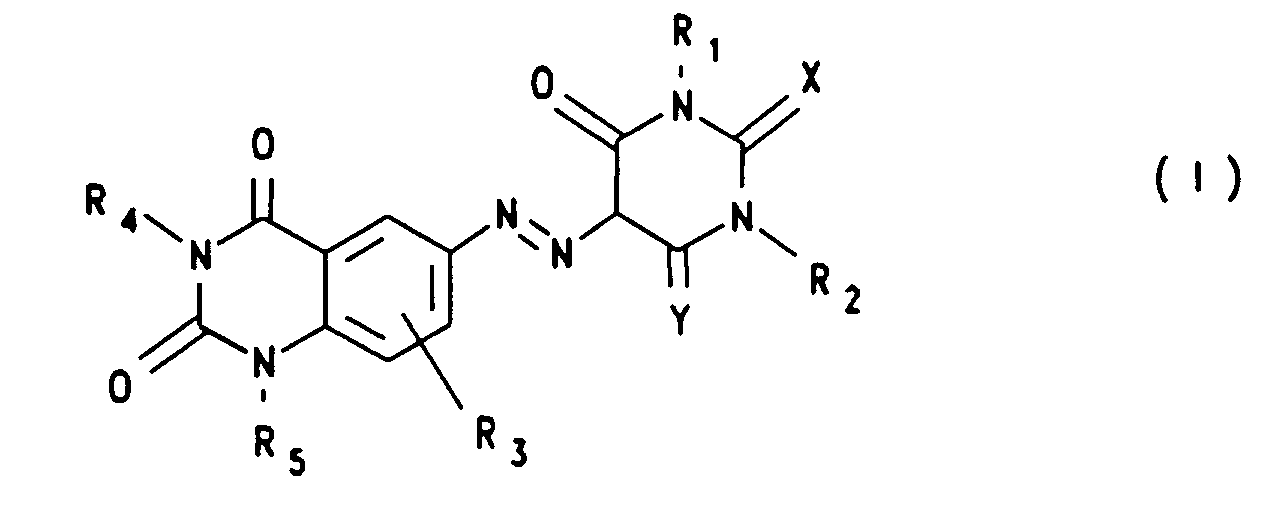 X ein O- oder S-Atom oder eine Imino-Gruppe,Y ein O-Atom oder eine Iminogruppe,R1 und R2 ein Wasserstoffatom, C1-C4-Alkyl, eine unsubstituierte Phenylgruppe oder eine substituierte Phenylgruppe mit 1 bis 5 Substituenten aus der Gruppe C1-C4-Alkyl, C1-C4-Alkoxy, Halogen, Nitro, Cyano, Hydroxy, CF3, CONH2, CONH(C5-C6-cycloalkyl),CON(C1-C4-alkyl)2, CONH(C1-C4)-alkyl, COO(C1-C4)alkyl, COO(C5-C6-cycloalkyl) und CONH(phenyl), mit der Maßgabe, daß mindestens einer der Reste R1 oder R2 eine der genannten von Wasserstoff verschiedenen Bedeutungen hat,R3 ein Wasserstoffatom, eine Trifluormethylgruppe, ein Halogenatom, eine C1-C4-Alkyl-, eine C1-C4-Alkoxy-, eine Nitro- oder eine Cyanogruppe,R4 und R5 unabhängig voneinander ein Wasserstoffatom, C1-C4-Alkyl, Phenyl oder eine substituierte Phenyl-Gruppe mit 1 bis 5 Substituenten aus der Gruppe C1-C4-Alkyl, C1-C4-Alkoxy, Halogen, Nitro, Cyano, Hydroxy, CF3, CONH2, CONH(C5-C6-cycloalkyl), CON(C1-C4-alkyl)2, CONH(C1-C4)-alkyl, COO(C1-C4)alkyl, COO(C5-C6-cycloalkyl) und CONH(phenyl),bedeuten.
 - Verbindung nach Anspruch 1, dadurch gekennzeichnet, daßX ein O- oder S-Atom,Y ein O-Atom,R1 ein Wasserstoffatom, eine C1-C4-Alkylgruppe oder eine Phenylgruppe,R2 eine C1-C4-Alkylgruppe oder eine Phenylgruppe,R3 ein Wasserstoffatom, ein Chloratom oder eine CF3-Gruppe,R4 ein Wasserstoffatom, Phenyl oder C1-C4-Alkyl undR5 ein Wasserstoffatom, Phenyl oder C1-C4-Alkyl sind.
- Verbindung nach Anspruch 1 oder 2, dadurch gekennzeichnet, daß die C1-C4-Alkylgruppen jeweils Methyl oder Ethyl sind.
- Verbindung nach mindestens einem der Ansprüche 1 bis 3, dadurch gekennzeichnet, daß der Rest R3 an 7-Position des Chinazolin-Systems steht.
- Verbindung nach mindestens einem der Ansprüche 1 bis 4, dadurch gekennzeichnet, daßR1 Phenyl,R2, R3, R4 und R5 jeweils Wasserstoff undX und Y jeweils ein O-Atom sind.
- Verfahren zur Herstellung einer Verbindung nach mindestens einem der Ansprüche 1 bis 5, dadurch gekennzeichnet, daß man ein oder mehrere Amine der allgemeinen Formel (II),


- Verwendung einer Verbindung der allgemeinen Formel (I) gemäß einem oder mehreren der Ansprüche 1 bis 5 zum Pigmentieren von hochmolekularen organischen Materialien, Lacken, Anstrichstoffen, Druckfarben, elektrophotographischen Tonern und Entwicklern, triboelektrisch oder elektrokinetisch versprühbaren Pulvern und Pulverlacken, und Tinten.
- Verwendung nach Anspruch 7, dadurch gekennzeichnet, daß das hochmolekulare organische Medium ein Polyolefin ist.
- Verwendung nach Anspruch 8, dadurch gekennzeichnet, daß das Polyolefin Polyethylen oder Polypropylen ist.
Applications Claiming Priority (2)
| Application Number | Priority Date | Filing Date | Title |
|---|---|---|---|
| DE19529262 | 1995-08-09 | ||
| DE19529262A DE19529262A1 (de) | 1995-08-09 | 1995-08-09 | Wasserunlösliche Azofarbmittel auf Basis von Aminochinazolindionen |
Publications (2)
| Publication Number | Publication Date |
|---|---|
| EP0761764A1 true EP0761764A1 (de) | 1997-03-12 |
| EP0761764B1 EP0761764B1 (de) | 1999-12-29 |
Family
ID=7769069
Family Applications (1)
| Application Number | Title | Priority Date | Filing Date |
|---|---|---|---|
| EP96112208A Expired - Lifetime EP0761764B1 (de) | 1995-08-09 | 1996-07-29 | Wasserunlösliche Azofarbmittel auf Basis von Aminochinazolindionen |
Country Status (11)
| Country | Link |
|---|---|
| US (1) | US5747566A (de) |
| EP (1) | EP0761764B1 (de) |
| JP (1) | JPH09137073A (de) |
| KR (1) | KR100416015B1 (de) |
| CN (1) | CN1066174C (de) |
| BR (1) | BR9603347A (de) |
| CZ (1) | CZ290587B6 (de) |
| DE (2) | DE19529262A1 (de) |
| DK (1) | DK0761764T3 (de) |
| ES (1) | ES2143114T3 (de) |
| TW (1) | TW419506B (de) |
Families Citing this family (5)
| Publication number | Priority date | Publication date | Assignee | Title |
|---|---|---|---|---|
| DE19747395A1 (de) * | 1997-10-27 | 1999-04-29 | Clariant Int Ltd | Heterocyclische Verbindungen als polymerlösliche Farbstoffe |
| US6245839B1 (en) * | 1998-11-25 | 2001-06-12 | The Lubrizol Corporation | Powder-coating compositions containing transfer efficiency-enhancing additives |
| US6392147B1 (en) | 1999-02-02 | 2002-05-21 | Lear Corporation | Protector that snaps over routed parts |
| CN1330645C (zh) | 1999-03-10 | 2007-08-08 | 西巴特殊化学品控股有限公司 | 作为有机材料着色剂的苯并呋喃-2-酮类化合物 |
| DE10032683A1 (de) * | 2000-07-05 | 2002-01-17 | Clariant Gmbh | Farbmittelmischung |
Citations (5)
| Publication number | Priority date | Publication date | Assignee | Title |
|---|---|---|---|---|
| FR1510398A (fr) * | 1966-02-03 | 1968-01-19 | Basf Ag | Colorants azoïques et procédé pour leur préparation |
| DE2420941A1 (de) * | 1973-05-03 | 1974-11-21 | Ciba Geigy Ag | Neue monoazopigmente, verfahren zu deren herstellung und verwendung |
| DE2351294A1 (de) * | 1973-10-12 | 1975-04-24 | Bayer Ag | Azopigmente |
| DE2535140A1 (de) * | 1974-08-09 | 1976-02-19 | Ciba Geigy Ag | Neue monoazopigmente, verfahren zu deren herstellung und verwendung |
| US4171301A (en) * | 1972-07-13 | 1979-10-16 | Ciba-Geigy Corporation | Monoazo pigments containing barbituric acid derivatives |
Family Cites Families (3)
| Publication number | Priority date | Publication date | Assignee | Title |
|---|---|---|---|---|
| DD96076A5 (de) * | 1970-12-28 | 1973-03-05 | ||
| US4028322A (en) * | 1972-07-13 | 1977-06-07 | Ciba-Geigy Corporation | 6-Methylbenzimidazolonylazobarbituric acid pigment |
| DE3215875A1 (de) * | 1981-09-02 | 1983-03-17 | Bayer Ag, 5090 Leverkusen | Azobarbitursaeure-derivate, ihre festen loesungen, einschlussverbindungen und interkalationsverbindungen |
-
1995
- 1995-08-09 DE DE19529262A patent/DE19529262A1/de not_active Withdrawn
-
1996
- 1996-07-29 DE DE59604022T patent/DE59604022D1/de not_active Expired - Fee Related
- 1996-07-29 DK DK96112208T patent/DK0761764T3/da active
- 1996-07-29 ES ES96112208T patent/ES2143114T3/es not_active Expired - Lifetime
- 1996-07-29 EP EP96112208A patent/EP0761764B1/de not_active Expired - Lifetime
- 1996-08-06 JP JP20729796A patent/JPH09137073A/ja active Pending
- 1996-08-07 TW TW085109578A patent/TW419506B/zh active
- 1996-08-08 US US08/694,162 patent/US5747566A/en not_active Expired - Fee Related
- 1996-08-08 KR KR1019960032965A patent/KR100416015B1/ko not_active Expired - Fee Related
- 1996-08-08 CZ CZ19962349A patent/CZ290587B6/cs not_active IP Right Cessation
- 1996-08-08 BR BR9603347A patent/BR9603347A/pt not_active Application Discontinuation
- 1996-08-08 CN CN96109396A patent/CN1066174C/zh not_active Expired - Fee Related
Patent Citations (7)
| Publication number | Priority date | Publication date | Assignee | Title |
|---|---|---|---|---|
| FR1510398A (fr) * | 1966-02-03 | 1968-01-19 | Basf Ag | Colorants azoïques et procédé pour leur préparation |
| DE1544394A1 (de) * | 1966-02-03 | 1971-03-04 | Basf Ag | Wasserunloesliche Azofarbstoffe |
| US4171301A (en) * | 1972-07-13 | 1979-10-16 | Ciba-Geigy Corporation | Monoazo pigments containing barbituric acid derivatives |
| DE2420941A1 (de) * | 1973-05-03 | 1974-11-21 | Ciba Geigy Ag | Neue monoazopigmente, verfahren zu deren herstellung und verwendung |
| DE2351294A1 (de) * | 1973-10-12 | 1975-04-24 | Bayer Ag | Azopigmente |
| FR2247511A1 (de) * | 1973-10-12 | 1975-05-09 | Bayer Ag | |
| DE2535140A1 (de) * | 1974-08-09 | 1976-02-19 | Ciba Geigy Ag | Neue monoazopigmente, verfahren zu deren herstellung und verwendung |
Also Published As
| Publication number | Publication date |
|---|---|
| TW419506B (en) | 2001-01-21 |
| KR100416015B1 (ko) | 2005-08-05 |
| JPH09137073A (ja) | 1997-05-27 |
| DE19529262A1 (de) | 1997-02-13 |
| ES2143114T3 (es) | 2000-05-01 |
| DE59604022D1 (de) | 2000-02-03 |
| CZ234996A3 (en) | 1997-02-12 |
| BR9603347A (pt) | 1998-05-05 |
| DK0761764T3 (da) | 2000-04-25 |
| KR970010897A (ko) | 1997-03-27 |
| CN1149604A (zh) | 1997-05-14 |
| US5747566A (en) | 1998-05-05 |
| CN1066174C (zh) | 2001-05-23 |
| MX9603282A (es) | 1997-07-31 |
| EP0761764B1 (de) | 1999-12-29 |
| CZ290587B6 (cs) | 2002-08-14 |
Similar Documents
| Publication | Publication Date | Title |
|---|---|---|
| EP0894831B1 (de) | Chinoxalin-monoazo-acetarylid-Pigment | |
| EP0889046A1 (de) | Triphendioxazine und ihre Verwendung als Pigmente | |
| EP0742217B1 (de) | Isoindolinpigmente auf Basis von Aminochinoxalindionen | |
| EP0686673B1 (de) | Isoindolinpigmente | |
| EP1658336A1 (de) | Mischkristalle mit derivaten von c.i. pigment red 170 | |
| DE69833135T2 (de) | Triphendioxazinverbindungen | |
| EP0761764B1 (de) | Wasserunlösliche Azofarbmittel auf Basis von Aminochinazolindionen | |
| EP0816439B1 (de) | Wasserunlösliche Azofarbmittel auf Basis von N-Acetoacetyldehydrothiotoluidin | |
| DE60007911T2 (de) | Verfahren zur Herstellung von Thiazin-Indigoverbindungen und von neuen Zwischenprodukten dafür | |
| DE3338622A1 (de) | Rotes azinpigment | |
| EP1521755B1 (de) | Neue diketopyrrolopyrrolpigmente | |
| EP1417264B1 (de) | Neue azopigmente | |
| WO2004085542A1 (de) | Heterocyclische farbmittel auf basis von benzodipyrrolen | |
| EP1706459B1 (de) | Triphendioxazinpigmente | |
| EP0022076B1 (de) | Iminoisoindolinonfarbstoffe, Verfahren zu deren Herstellung und deren Verwendung | |
| EP1639047B1 (de) | Heterocyclische farbmittel auf basis von diazabenzoisoindolen | |
| EP1713802B1 (de) | Mesoionische pigmente auf basis von 2,4-dioxopyrimidinen | |
| EP0170987A1 (de) | Benzimidazol-2-carbonsäure-Derivate | |
| WO2005005550A1 (de) | Azofarbmittel auf der basis von 2-phenyl-6-amino-7-methoxycarbonyl(3,4h)-chinazolin-4-on | |
| MXPA96003282A (en) | Aminekinazoline-diones-based water-insoluble azo dyes |
Legal Events
| Date | Code | Title | Description |
|---|---|---|---|
| PUAI | Public reference made under article 153(3) epc to a published international application that has entered the european phase |
Free format text: ORIGINAL CODE: 0009012 |
|
| AK | Designated contracting states |
Kind code of ref document: A1 Designated state(s): BE CH DE DK ES FR GB LI |
|
| 17P | Request for examination filed |
Effective date: 19970912 |
|
| RAP1 | Party data changed (applicant data changed or rights of an application transferred) |
Owner name: CLARIANT GMBH |
|
| 17Q | First examination report despatched |
Effective date: 19971117 |
|
| GRAG | Despatch of communication of intention to grant |
Free format text: ORIGINAL CODE: EPIDOS AGRA |
|
| GRAG | Despatch of communication of intention to grant |
Free format text: ORIGINAL CODE: EPIDOS AGRA |
|
| GRAH | Despatch of communication of intention to grant a patent |
Free format text: ORIGINAL CODE: EPIDOS IGRA |
|
| GRAH | Despatch of communication of intention to grant a patent |
Free format text: ORIGINAL CODE: EPIDOS IGRA |
|
| GRAA | (expected) grant |
Free format text: ORIGINAL CODE: 0009210 |
|
| AK | Designated contracting states |
Kind code of ref document: B1 Designated state(s): BE CH DE DK ES FR GB LI |
|
| REG | Reference to a national code |
Ref country code: CH Ref legal event code: EP |
|
| REF | Corresponds to: |
Ref document number: 59604022 Country of ref document: DE Date of ref document: 20000203 |
|
| GBT | Gb: translation of ep patent filed (gb section 77(6)(a)/1977) |
Effective date: 20000306 |
|
| ET | Fr: translation filed | ||
| REG | Reference to a national code |
Ref country code: DK Ref legal event code: T3 |
|
| REG | Reference to a national code |
Ref country code: ES Ref legal event code: FG2A Ref document number: 2143114 Country of ref document: ES Kind code of ref document: T3 |
|
| PGFP | Annual fee paid to national office [announced via postgrant information from national office to epo] |
Ref country code: DK Payment date: 20000622 Year of fee payment: 5 |
|
| PLBE | No opposition filed within time limit |
Free format text: ORIGINAL CODE: 0009261 |
|
| STAA | Information on the status of an ep patent application or granted ep patent |
Free format text: STATUS: NO OPPOSITION FILED WITHIN TIME LIMIT |
|
| 26N | No opposition filed | ||
| PGFP | Annual fee paid to national office [announced via postgrant information from national office to epo] |
Ref country code: ES Payment date: 20010628 Year of fee payment: 6 |
|
| PG25 | Lapsed in a contracting state [announced via postgrant information from national office to epo] |
Ref country code: DK Free format text: LAPSE BECAUSE OF NON-PAYMENT OF DUE FEES Effective date: 20010729 |
|
| REG | Reference to a national code |
Ref country code: FR Ref legal event code: ST |
|
| REG | Reference to a national code |
Ref country code: GB Ref legal event code: IF02 |
|
| REG | Reference to a national code |
Ref country code: FR Ref legal event code: RN |
|
| REG | Reference to a national code |
Ref country code: FR Ref legal event code: FC |
|
| REG | Reference to a national code |
Ref country code: FR Ref legal event code: FC |
|
| REG | Reference to a national code |
Ref country code: DK Ref legal event code: EBP |
|
| PG25 | Lapsed in a contracting state [announced via postgrant information from national office to epo] |
Ref country code: ES Free format text: LAPSE BECAUSE OF NON-PAYMENT OF DUE FEES Effective date: 20020730 |
|
| REG | Reference to a national code |
Ref country code: ES Ref legal event code: FD2A Effective date: 20030811 |
|
| REG | Reference to a national code |
Ref country code: CH Ref legal event code: PFA Owner name: CLARIANT PRODUKTE (DEUTSCHLAND) GMBH Free format text: CLARIANT GMBH#BRUENINGSTRASSE 50#65929 FRANKFURT AM MAIN (DE) -TRANSFER TO- CLARIANT PRODUKTE (DEUTSCHLAND) GMBH#BRUENINGSTRASSE 50#65929 FRANKFURT AM MAIN (DE) |
|
| REG | Reference to a national code |
Ref country code: FR Ref legal event code: CD |
|
| PGFP | Annual fee paid to national office [announced via postgrant information from national office to epo] |
Ref country code: CH Payment date: 20070622 Year of fee payment: 12 |
|
| PGFP | Annual fee paid to national office [announced via postgrant information from national office to epo] |
Ref country code: BE Payment date: 20070814 Year of fee payment: 12 |
|
| PGFP | Annual fee paid to national office [announced via postgrant information from national office to epo] |
Ref country code: DE Payment date: 20080620 Year of fee payment: 13 |
|
| PGFP | Annual fee paid to national office [announced via postgrant information from national office to epo] |
Ref country code: FR Payment date: 20080612 Year of fee payment: 13 |
|
| PGFP | Annual fee paid to national office [announced via postgrant information from national office to epo] |
Ref country code: GB Payment date: 20080630 Year of fee payment: 13 |
|
| REG | Reference to a national code |
Ref country code: CH Ref legal event code: PL |
|
| REG | Reference to a national code |
Ref country code: FR Ref legal event code: ST Effective date: 20090331 |
|
| PG25 | Lapsed in a contracting state [announced via postgrant information from national office to epo] |
Ref country code: LI Free format text: LAPSE BECAUSE OF NON-PAYMENT OF DUE FEES Effective date: 20080731 Ref country code: CH Free format text: LAPSE BECAUSE OF NON-PAYMENT OF DUE FEES Effective date: 20080731 |
|
| PG25 | Lapsed in a contracting state [announced via postgrant information from national office to epo] |
Ref country code: FR Free format text: LAPSE BECAUSE OF NON-PAYMENT OF DUE FEES Effective date: 20080731 |
|
| GBPC | Gb: european patent ceased through non-payment of renewal fee |
Effective date: 20090729 |
|
| PG25 | Lapsed in a contracting state [announced via postgrant information from national office to epo] |
Ref country code: GB Free format text: LAPSE BECAUSE OF NON-PAYMENT OF DUE FEES Effective date: 20090729 |
|
| PG25 | Lapsed in a contracting state [announced via postgrant information from national office to epo] |
Ref country code: DE Free format text: LAPSE BECAUSE OF NON-PAYMENT OF DUE FEES Effective date: 20100202 |
|
| PG25 | Lapsed in a contracting state [announced via postgrant information from national office to epo] |
Ref country code: BE Free format text: LAPSE BECAUSE OF NON-PAYMENT OF DUE FEES Effective date: 20080731 |
|
| PG25 | Lapsed in a contracting state [announced via postgrant information from national office to epo] |
Ref country code: FR Free format text: LAPSE BECAUSE OF NON-PAYMENT OF DUE FEES Effective date: 20090731 |